The right rifle for a black bear hunt depends on the type of hunting you’ll be doing.
The three primary ways to hunt black bears are spot-and-stalk, hunting with hounds, and baiting. The last two aren’t legal everywhere, and spotting and stalking is only practical where terrain and vegetation offer vistas for glassing. I hate sitting still, so baiting is my least favorite. However, baiting is highly productive because the black bear’s greatest weakness is its appetite. Although it’s not my favorite, I’ve done a lot of bear hunting over bait, especially the last few years.

My recent Kansas whitetail hunting has helped. I’m getting better at stand-hunting, able to sit longer with less fidgeting. It’s worth the wait when a bear appears—it’s almost as exciting as when a leopard comes onto bait. The difference is, baboons and birds telegraph a leopard’s approach. The black bear usually appears silently, materializing out of the shadowed woods, most often at last light.
Now comes the hardest part: Judging size. Black bears are among the most difficult animals to judge. Spot-and-stalk hunting is the worst, when the bear is just a dark blob on a hillside. Hound hunting is the best, because you’re very close when the bear trees or bays, and you’ve probably seen the track.
There is an advantage to baiting because the bait provides a size reference. Most commonly, a barrel is used, and that’s your yardstick. Be aware that barrels aren’t created equal. Wally Mack in Alberta uses 55-gallon drums. I’m in Andre Morin’s bear camp in Maine right now; he’s using 35-gallon barrels.
Black bears also aren’t created equal. Any area that has black bears can produce an outsize monster, but some areas are known for extra-big bears. It’s good to know what the expectations are, but even then you’ll make mistakes. Fortunately that doesn’t matter too much because black bear meat is good (cook it thoroughly!), and there’s a special thrill about bear hunting.
I don’t consider the black bear dangerous, but I’ve had two outfitter friends who were badly mauled by small black bears. Going into darkening woods after a shot isn’t pleasant. And bears are tough, regardless of size. I like to know I’ve hit them well, with something certain to have done the job.

This doesn’t require a cannon. Most black bears taken are similar in weight to buck whitetails, but heavier in bone structure and muscle. However, you never know when you might get lucky and encounter a monster. The heaviest black bear known was taken in North Carolina in 1998, weighing an astonishing 1,100 pounds. That’s a different animal from the average 150-pound black bear, so it’s not a bad idea to be overgunned.
With black bears, the hunting methodology determines the shot. In spot-and-stalk hunting, depending on terrain and vegetation, you want to be prepared to shoot at least 200 yards. You don’t need anything special, just a versatile well-scoped hunting rifle. I’ve used various cartridges between .270 and .375. The .308 and .30-06 are hard to beat, but I’ve also used 7mms and magnum .30s. Since I believe in bullet diameter, and always hope for extra-large, I like the mediums, so long as they’re fast enough to reach out.
One of my best black bears came from North Carolina, in the fall season. We were hunting from tall deer stands, ambushing bears coming out of corn fields. I used my heavy 8mm Rem Mag. A fast .33 might have been even better. I love the .35s, but in spot-and-stalk hunting, the milder .35s—.350 Legend, .35 Rem, .360 Buckhammer—may not have the energy to reach 200 yards on bears. A bright scope is essential because most stalks will be done in fading light.

While any versatile scoped rifle can be used for all three methods, ideal arms for hound-hunting and baiting are different. Over hounds, the shot will be very close. The houndsman’s first concern is for his dogs. He wants the bear hit hard and killed cleanly. Larger bears often bay on the ground, and it becomes a wild melee. This is one of few situations in the hunting world where scopes are a hindrance, because of their tunnel-vision effect, increasing danger to dogs.
Getting to the dogs can be a hard scramble, so your firearm should also be light and unencumbering. A big handgun in a shoulder holster, from 10mm or .41 Magnum on up, is ideal, if that’s your cup of tea. Houndsmen often carry good old lever-action carbines.
Just last night, in Maine, I was talking guns with outfitter Andre Morin. He hunts bears with hounds and over bait, and he immediately said, “I don’t like the .30-30.”
That was interesting, because I told him that both guys I knew who were mauled by black bears were attacked by bears wounded with .30-30s. Oregon outfitter Jess Caswell spent a long time in the hospital after his incident. When he healed up, he bought a Model 600 Remington in .350 Rem Mag. It’s short, light, and has ferocious recoil, but it’s a real bear-buster. For hound hunting, Andre carries a Traditions break-open single shot. He has two, one in .35 Whelen, another in .450 Bushmaster. Bear-busters.
With baiting, the game changes. This is probably the best method for bowhunters. There will be a clear shot, at a known distance determined when the blind or stand is set. It’s no secret I’m mostly a rifle hunter, so on baited bear hunts I’ve often sat 75 yards from the bait. That allows for more fidgeting, but that’s too far for bowhunting, also too far for iron sights when the light starts to go.
A few years ago, I went to Wally Mack’s camp (W&L Guide Service) in northern Alberta for the first time. He sets all his bait sites the same way, with the stand at a maximum of 25 yards. Every stand is set up for any method of take, hunter’s choice. Last year, son-in-law Brad Jannenga, a serious bowhunter, took the biggest bear of the week with his bow. A couple days later, on the same stand, daughter Brittany shot two big bears two hours apart. She used a .300 Win Mag with open sights.
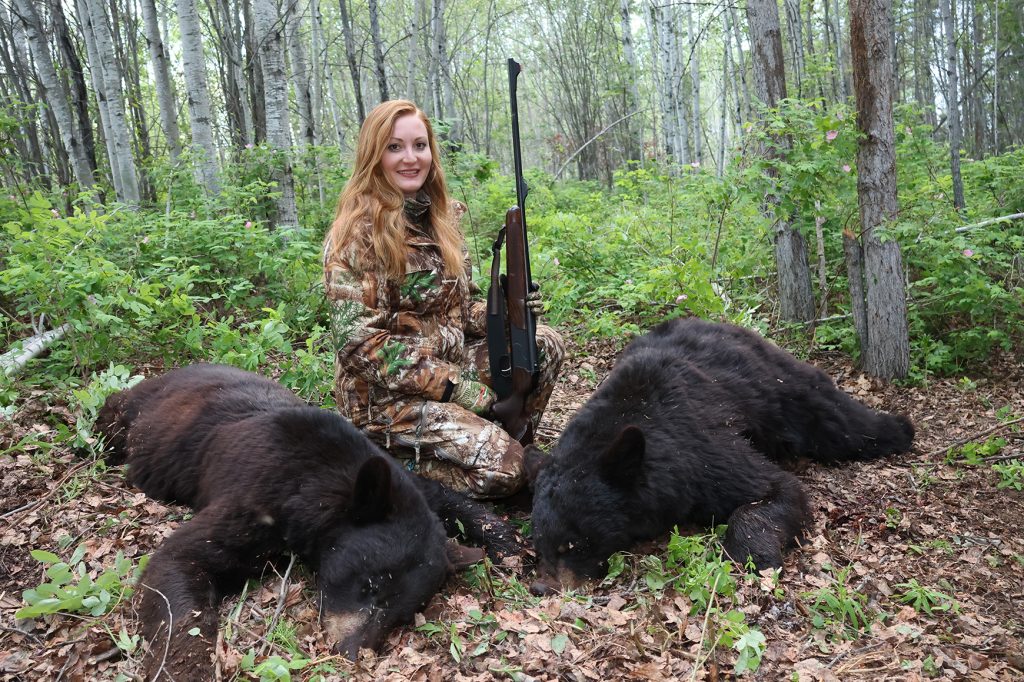
Just now, I was delighted to see that Andre Morin (Katahdin’s Shadow Outfitters) in Maine, sets his bait sites the same way: Close shots only. Method of take is hunter’s choice. When we got to camp, his “scoreboard” from the 2024 season noted 20 bears taken with archery gear, handguns, shotguns with slugs, and an eclectic array of centerfire rifles.
Although I’ve dabbled in all methods of take, I’m mostly a rifle guy. So, what are the best rifles for hunting bears over bait? Since the distance is known, it depends on what gives you the most pleasure. First time at W&L, I had scoped rifles in .350 Legend and .450 Bushmaster. I shot a nice bear with each, but I felt a little silly shooting bears at 20 yards with scopes. Last time I was there I used my .303 double and a Big Horn Armoy M1889 in .500 S&W, both with iron sights, and took two nice bears.

I went to Maine because it was on my bucket list to take a black bear in the Northeast. I wasn’t sure what to bring. I’d never shot a black bear with a .45-70, so I brought my Ruger/Marlin 1895 with an older Swarovski 1-6X scope. I knew Andre sets his stands close to his baits. Although I considered removing the scope and using the ghost-ring aperture, I left the scope on.
My bear materialized just before sunset, the bait already in deep shadow. My night vision isn’t what it once was; I’d have struggled with the aperture. It wasn’t a big bear, just an average, acceptable Maine bear. My 300-grain Hornady flat-point broke the on-shoulder, wrecked the chest cavity, kept going. He traveled 30 yards, leaving a massive blood trail. The old .45-70 still works!
So do the .35s. I love them, all of them. Old friend Mike Deasey from Pennsylvania was my hunting partner on this Maine hunt. Mike brought a Marlin in .35 Rem, still a great deep-woods cartridge. Next night, he shot a bear with a 200-grain Sierra round-nose. His bullet exited and his bear also went about 30 yards. Two lefties, two lever-actions, two bears.
Okay, so what do I think is best? I admire the .35 Rem, love the .348 Win. All Marlins can be easily scoped, but the top-eject Winchester M71 .348 can’t be. Except for hunting with hounds, a serious black bear gun needs a light-gathering optic because too many shots come at last light. Forty years ago, I had a Savage 99 in .358 Win that was stolen. I always wanted another, but few 99s were made in .358. I just bought one from GunBroker–can’t wait to receive it. Flat-shooting enough for stalking, and hard-hitting under any conditions, that’s the rifle I’ll take on my next black bear hunt.