The UK and Ireland are among the best places in the world to be a deer hunter.
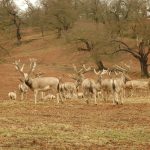
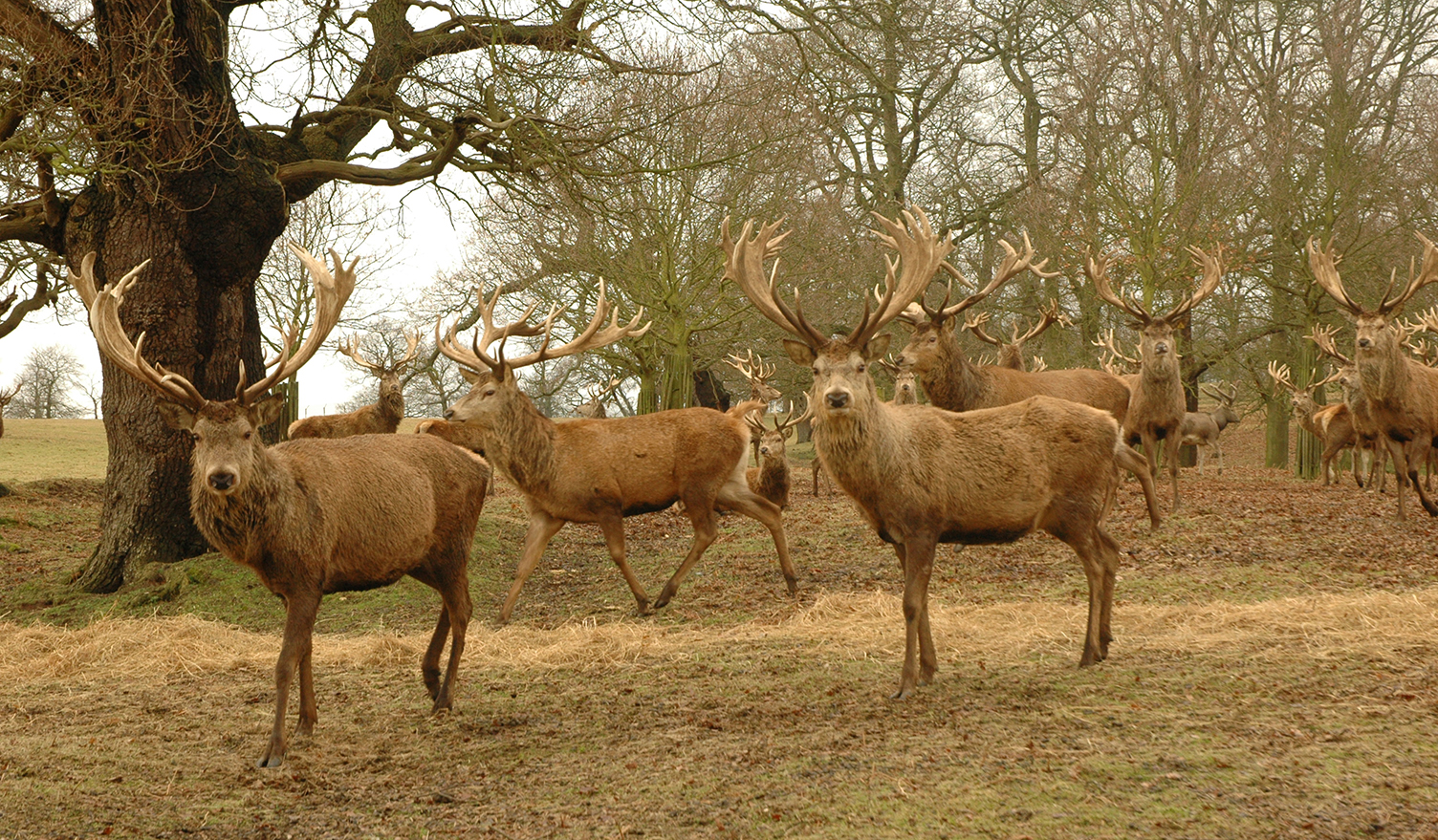
Image above: Most of the large red deer in England are in deer parks and on estates, like the ones above. However, there are a few pockets of free-range red deer in England, and there are plenty in Scotland.
If you’re a deer freak, you need to spend some time in the British Isles. I doubt there’s a similar-size region in the world that offers such variety of antlered game. A half-dozen free-range deer species, plus more in parks and on estates.
Throughout the UK and Ireland, bird hunting is the most common field sport. Deer hunters (stalkers in the local lexicon) are a small minority. This creates both problems and opportunities. Without enough hunters to keep them in chec, deer numbers continue to grow, creating agricultural issues in many areas, and escalating road hazards
If I believed in reincarnation, I’d want to come back as a deer stalker in the British Isles. Unlimited opportunity through a long season. Mind you, there is no “free” public land hunting. Some landowners don’t allow hunting, while others accept that overpopulation isn’t good for anyone, including the deer. Typically, arrangements are made with local deer stalkers to manage the herds. Game meat is sold, with ready markets to restaurants. Thus, deer stalking is a harvest, proceeds defraying crop damage and lease costs. The stalkers I know harvest a lot of deer.
The primary entities of the British Isles are the United Kingdom (England, Scotland, Wales, and Northern Ireland), and the Republic of Ireland. Seasons, species, and situations differ, but there is deer stalking in all, and visiting hunters are welcome. From our smug American viewpoint, we think of gun laws over there as draconian and repressive. Yes, to a degree. No handguns or semiauto rifles. However, temporary permits for hunting are surprisingly simple. I’ve taken rifles into England, Scotland, and Ireland with no problems. Considering the amount of shooting deer stalkers do, if you choose to borrow or rent a rifle, you’ll be handed one well-suited to the country and game.
Let’s look at deer stalking in the primary entities of the British Isles.
SCOTLAND: Scotland joins England to the north and is more sparsely populated, especially her wild and remote northern highlands. Also, quite far north, there is terrain reminiscent of southern Alaska. Scotland is most famous for red deer stalking, primarily in the north. European roe deer are also endemic, although they thin out to the north. Free-range fallow deer are widespread, but more localized than in England and Ireland. Just before Covid, Donna and I did a marvelous roebuck hunt in Scotland with Michael Gross’s International Adventures. It took place in June in central Scotland, and we hunted several properties, including the late Queen’s Balmoral estate. Gorgeous country, lots of roebucks.

In Scotland, the emphasis is on the stalk, and it’s a harvest. On red deer, this can be frustrating, especially for we antler-conscious Americans. Because of both northern climate and genetics, Scottish stags aren’t huge, but you must go in understanding that visitors are rarely allowed to take the best stags. Instead, you’ll take stags with mismatched points or poor antlers. If you’re looking for a giant red deer, Scotland isn’t for you. However, you’ll have a wonderful experience, with lodging ranging from old castles to picturesque local inns.
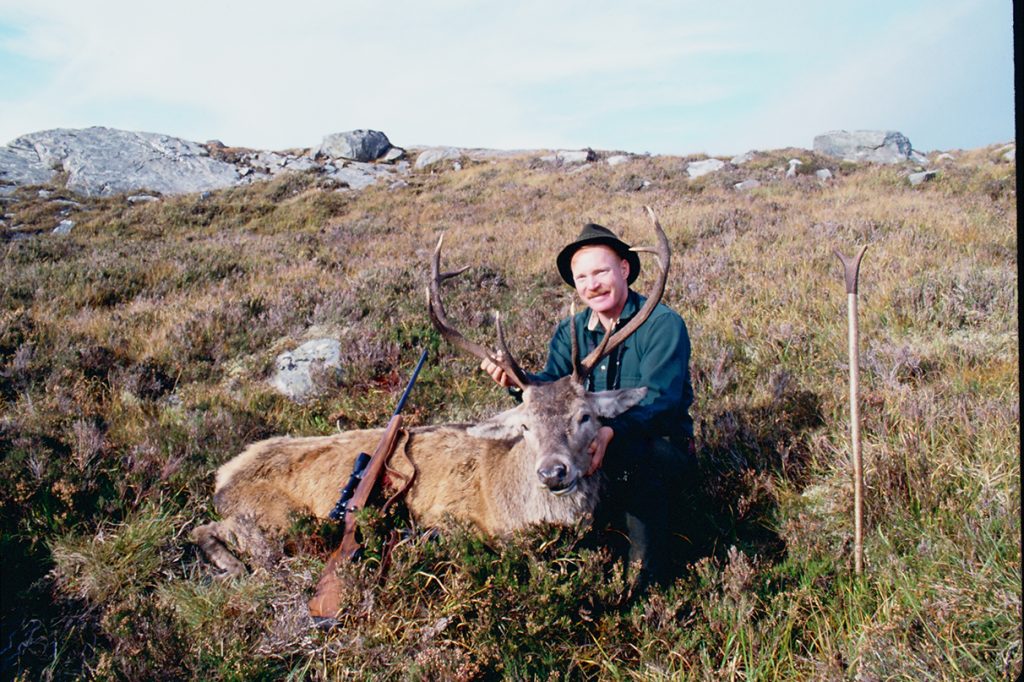
Roebucks are hunted in spring and summer, while red deer hunting focuses on the roar in September and October. Non-native sika deer are widespread in Scotland, free-ranging east to west, primarily in the north. I took a nice sika deer as an adjunct to a red deer hunt thirty years ago. Today, sikas have expanded their range and are a threat to forestry in many areas.
IRELAND: Ireland was once home to reindeer and the huge Irish elk, both gone for about 10,000 years. Ireland is a separate island and roe deer are not native. They were introduced in the mid-19th century, increased for fifty years, then vanished a century ago. Thus, the red deer is Ireland’s only native deer, joined today by widespread sika and fallow deer. Free-range populations of both species exceed 50,000 animals, though both are spotty. Recently, the Reeve’s muntjac was introduced from England and seems to be taking hold, so may eventually add a fourth Irish deer.

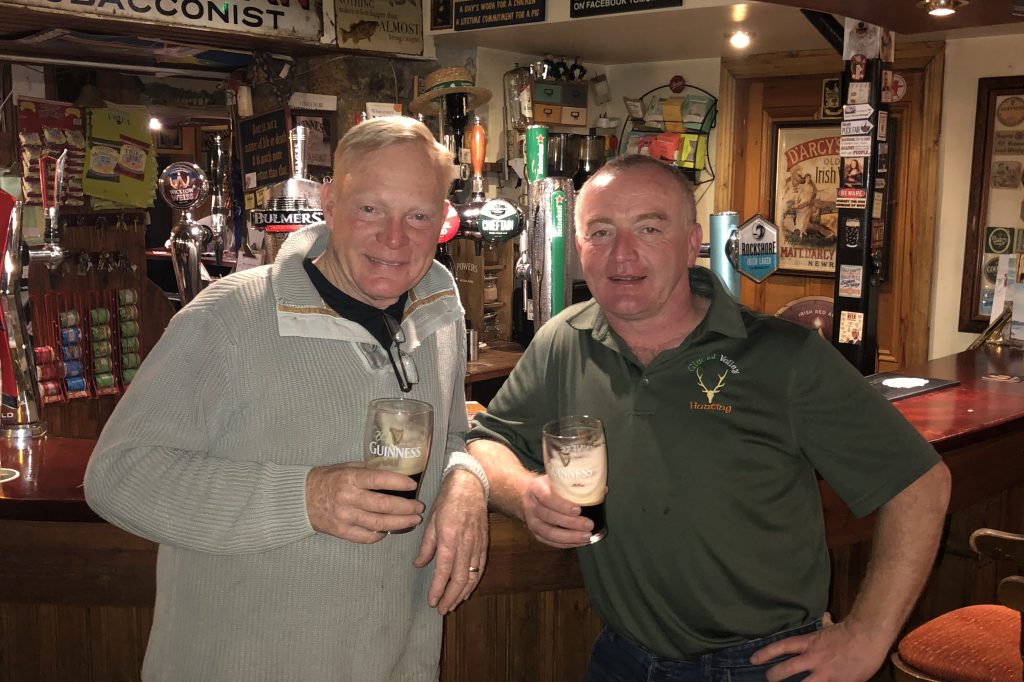
Red, sika, and fallow deer are found in both Ireland and Northern Ireland. I haven’t hunted in Northern Ireland, but that northeast corner is said to produce Ireland’s best red deer. Country-wide, there is an issue with interbreeding of reds and sikas, so you could say a hybrid red/sika is yet another Irish deer. We hunted in the low, rugged Wicklow Mountains south of Dublin with the Nolan family’s Glacial Valley Hunting in October, prime time for sika deer to be in the rut.
It was a magic hunt, lodging in a historic country pub nestled between ridges. Sika deer are secretive and sneaky, but there are plenty of them. Naturally, Donna shot a much better sika than I did. While we were there, our friend Megan Fonte took a red/sika hybrid, so I got a chance to examine this “other” Irish deer. Hers was an ancient cull stag with wicked spikes for antlers, hybridization obvious.
ENGLAND AND WALES: Wales is a block of 22 counties in the west of England. By road or train, travel between England, Scotland, and Wales is transparent. It’s worth noting that game regulations are set by county. Seasons are not necessarily the same, and some counties set a legal minimum of 6mm for deer, while in others a .22 centerfire is legal.
Red deer and European roe deer are the only native deer. The little roe deer are widespread throughout, easily the most numerous deer, overpopulated in numerous counties. Over the years, I’ve done several spring/summer trips for roebuck. With long daylight, typically you have “outings” in the early mornings and late afternoons, with a long break in between. Not all outings are successful, but I’ve shot several roebucks on each trip. Again, it’s a harvest; you shoot what the guide or stalker tells you. Most I’ve taken aren’t large, but England’s rich farmland produces good antlers; there are always one or two good bucks in the mix.
English red deer (Robin Hood’s deer) are potentially bigger than in the rest of the Isles. However, most red deer are on estates and deer parks, with just a few pockets of free-ranging reds. When I was in the run-up for the Weatherby award, I tried desperately to get one. First, down in the southwest corner. Could have shot a spike, but that wasn’t what I had in mind. Then, we went up to New Forest in south-central England. Probably the largest contiguous tract of oak forest in the country, but it’s a patchwork of small holdings. We saw a giant stag on the next property, bigger than any red stag I’ve taken anywhere. We saw him daily, but he never came onto the land we could hunt.
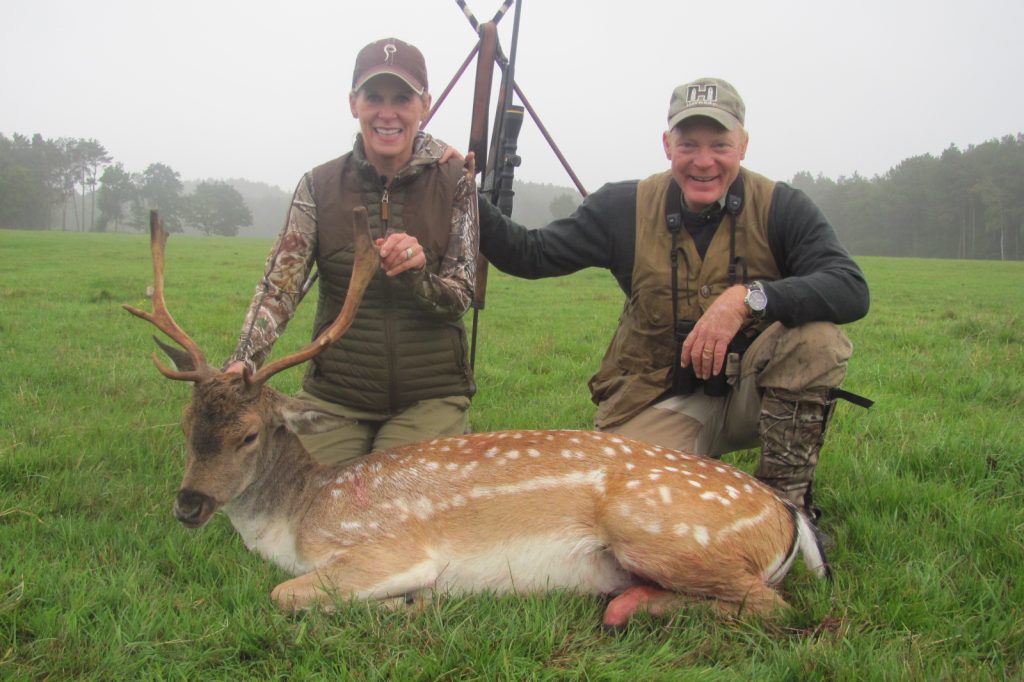
While there, Donna shot a free-range New Forest fallow deer in New Forest. Fallow deer were likely introduced during the Roman occupation, and are the most numerous of several non-natives, widely free-ranging and overpopulated to almost pest numbers in much of central England. Dating back to the Norman conquest, it seems it was in vogue for large landowners of the nobility to have deer parks on their estates.
Most famous is the Duke of Bedford’s deer park at Woburn Abbey, southwest of London, with records from the 5th Duke of Bedford in 1661. In the late 19th Century, Herbrand Russell, 11th Duke of Bedford, had a keen interest in zoology. He added some 42 different species, including sika deer, Chinese water deer, and Reeve’s muntjac. As the story goes, a huge tree fell during a storm and breached the brick wall surrounding the deer park. This is the likely source of both muntjac and water deer. Free-range muntjacs are now widespread throughout central and southwest England, water deer more localized in farmland near Woburn Abbey.
Sika deer are free-ranging in localized pockets, not nearly as widespread as in Ireland and Scotland. I’ve never seen a sika deer in England, but I haven’t looked for one. In May 2025, I was stalking roebucks in central England with friend Simon Barr and guide Alex Nielson. Lots of roebucks. We saw several muntjacs, but spring/summer is wrong for that little deer. Few bucks are in hard antler, and they’re hard to see in tall cover. Years ago, I did a wonderful February hunt for free-range muntjac and water deer. Late winter is the best time, cover as low as it gets. Hampered by cold rain, my muntjac wasn’t very big; I’d like to do that hunt again.
All free-range sika in the British Isles are considered the small Japanese race, but their origin is unclear and some get awfully big. There are also Manchurian sikas, hog deer, Pere David’s deer, all the rest—and who-knows-what-else—on estates, but that wraps up the free-range picture.
Regardless of species, big animals on estates are costly, though often less than under similar situations in New Zealand and Texas. Because the harvest is essential,and the venison pre-sold, free-range stalking throughout the British Isles is inexpensive and productive. Timing depends on the species and antler cycle, but there is some stalking throughout the year and it’s all wonderful fun.