Africa’s various reedbucks are interesting antelopes that make for challenging quarry.
Photo above: This is a very old common reedbuck ram, with ribs and hip bones showing. He’s no giant, but his horns have good shape and decent length.
The first reedbuck I ever saw was in the Matopo Hills of old Rhodesia (now Zimbabwe). We were traveling at speed along a good ranch road through a grassy plain when one of Barrie Duckworth’s trackers made an amazing spot. Not the whole animal, just the upper third of one black horn sticking up among tall grass stems, more than a hundred yards out.
It took me forever to see it, but when I finally did we made a quick approach. When we got close (really close) the buck jumped from its bed and sped away. I missed it more than once as it bounded through the grass, and finally got it down at a couple hundred yards just before it vanished into cover.
The reedbucks, genus Redunca, are a widespread family of antelopes found, in one variety or another, throughout sub-Saharan Africa—but very discontinuously. Reedbucks have short, thick ringed horns that curve forward and taper to needle points. Uniquely, reedbucks have soft, bulbous bases of incipient horn growth, which boil away during skull preparation. They come in small, medium, and large: mountain, bohor, and common reedbucks. They are almost always found in grass or reeds, usually near water. All have fluffy coats of soft, fine hair, ranging from almost yellow to gray, with lighter (sometimes white) underparts, and a longish fluffy tail. All have meat that is tender and tasty, good camp fare. Also, perhaps the reedbuck’s most distinctive feature: All have prominent black glandular spots beneath the ear.
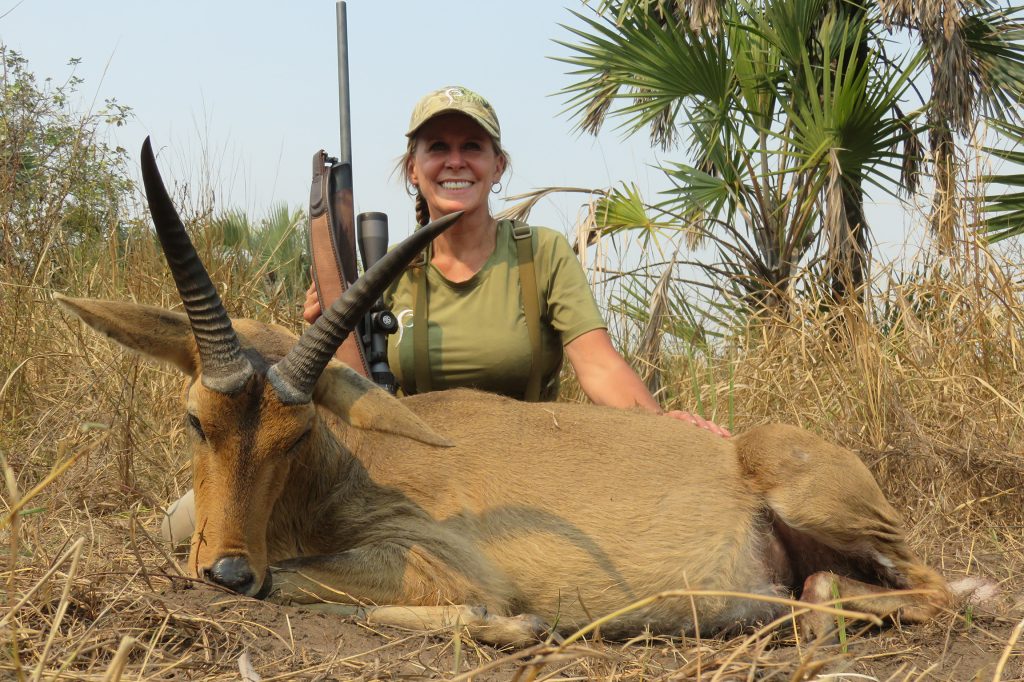
The largest by far, with the longest horns, is the common or Southern reedbuck, R. redundinum. Common reedbuck can weigh up to 170 pounds, so they are almost into the medium-antelope class. The Rowland Ward record is over 19 inches, a giant, but any common reedbuck with horns in the teens is a fine trophy.
They are found in grassy plains from East Africa southwestward but, again, very discontinuously. They were on license when I hunted in Kenya, but I never saw one. I can’t recall ever seeing one in Tanzania, either, though they surely occur. They are found in all the countries of southern Africa, but only in their specific grassy habitat. I’ve seen them in Namibia’s Caprivi and in northern Botswana, just about the only regions in each of these arid countries that offer ideal habitat. In coastal Mozambique, which also offers perfect habitat, they replace the impala as the most plentiful medium-sized antelope, roaming the floodplains of the Zambezi Delta in the thousands.
Despite their numbers, they seem to rarely grow large horns there. In fact, like many common antelopes, big ones aren’t common anywhere. The best place I ever saw to take an extra-large common reedbuck was in hilly, grassy farmland in Natal. However, big reedbucks are rare. It’s an animal that will almost never be on a hunter’s primary wish list, but if you see a big one, better take it if you can. It might be a long time before you seen another like it. The curve of the horn is typically back and up, then curving into forward-facing tips, usually with a wider V than the others.
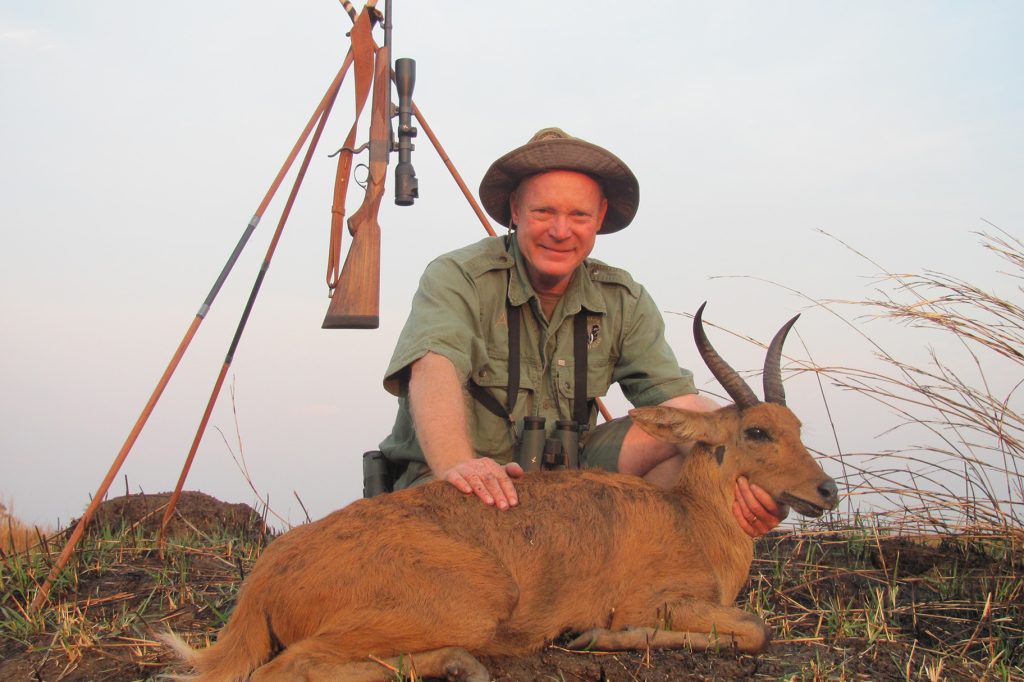
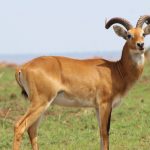
The bohor reedbucks are the medium-size variety, much smaller at maybe 100 to 110 pounds, with narrower forward-slanting horns that almost never exceed 12 inches. The bohor reedbuck, R. redunca, is thus the type specimen, I assume because they were identified to science first. They are also yellowish to bronze in body color, but with more muted underparts than the common reedbuck. They range from East Africa westward across the savanna and sahel, north of the forest and south of the Sahara.
We divide the types of bohor reedbucks into regional groupings for record-keeping, but visual differences are subtle and minimal. I shot an East African bohor reedbuck in western Tanzania, and this race seems plentiful and widespread in Uganda. Typically, all the reedbucks are hunted by spotting and stalking, but along the reedbeds of Uganda’s Kafu River north of Kampala, we often see them while sitting in machans for sitatunga.

Steve Hornady took the best bohor reedbuck I’ve ever seen in this fashion. While we weren’t seeing any sitatungas that morning, we had this giant reedbuck feeding in front of us along the edge of a sitatunga haunt. It took some doing to talk him into taking it, but he’s glad he did.
Off to the west, the Nigerian bohor reedbuck is frequently encountered along riverines in northern Cameroon and Central African Republic (CAR). Again, it’s an unlikely animal to be high on any wish list but it is frequently taken as part of the bag on Derby eland safaris.
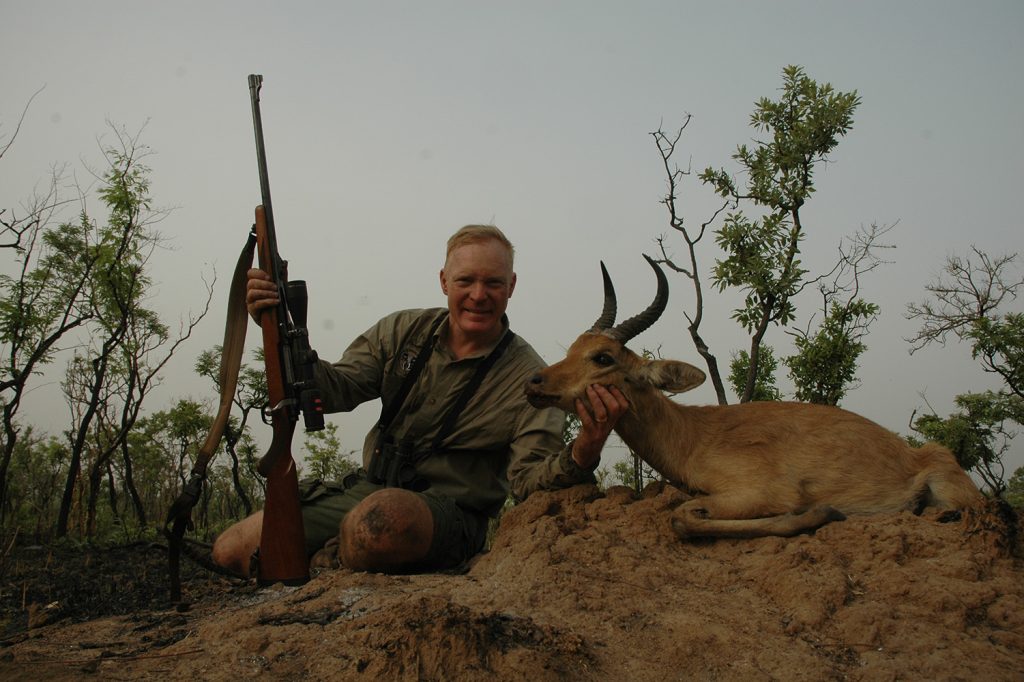
Westernmost is the Nagor reedbuck, found above the forest zone west of Nigeria all the way to Senegal. Benin and Burkina Faso, neither currently hunted due to political unrest, were the most likely places to take this variety. When I hunted in Burkina Faso I was really collecting countries more than animals, but the Nagor reedbuck was an animal found there I hadn’t taken elsewhere, so we put in the time and I got a really big one.
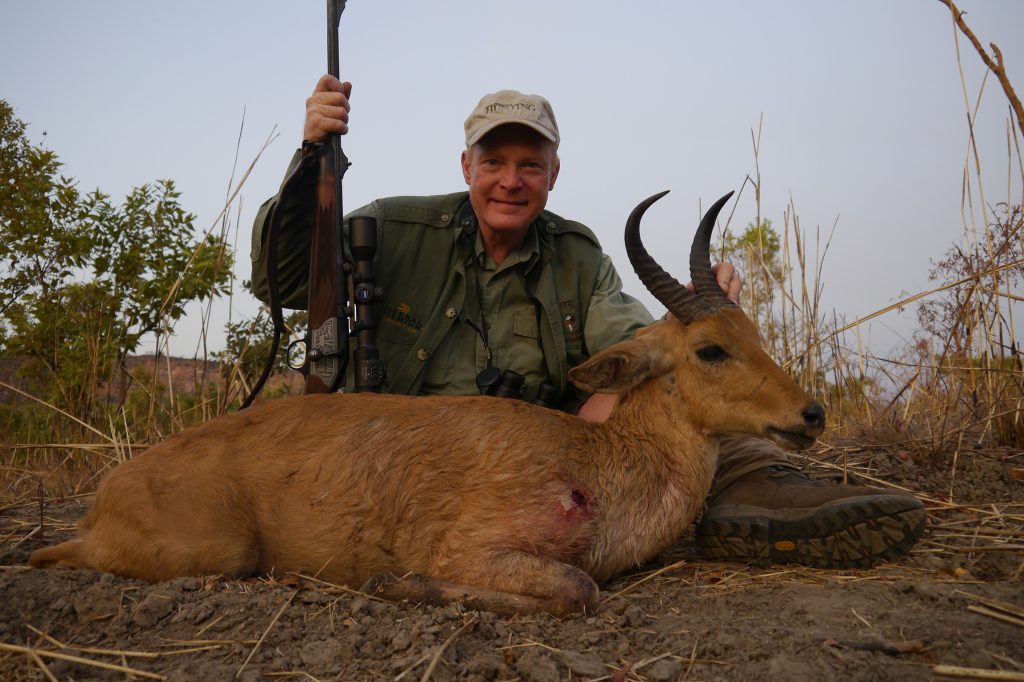
There are two more bohors: Abyssinian and Sudan. The Sudan bohor reedbuck, likely with the longest horns, is plentiful in Sudan’s East Equatoria province east of the Nile. With constant civil war, South Sudan hasn’t been huntable since 1983. Strife continues, so there is not much chance of hunting that one.
The Abyssinian bohor reedbuck is a bit of an anomaly. It is visually similar to the other bohor reedbucks and is definitely not of the mountain reedbuck species, but it’s found up in the Ethiopian high country along with, and at equal elevation to, the mountain nyala. I saw some on my first mountain nyala hunt in 1993, but I didn’t have a license, and I hunted them when I went back in 2000. I assume they must be found in suitable habitat in Ethiopia’s low country, but I have no experience. The Danakil Depression is too dry, and I never made it to the Omo Valley.
The mountain reedbuck, R. fulvorufula, is among Africa’s few genuine mountain species. You don’t really find them up in the rocks like klipspringers. Instead, look for them on grassy knolls and in higher basins, and listen for their sharp, trilling alarm whistle. They are much smaller and very gray in color, again with white or pale underparts. A big male weighs about 55 pounds, with horns shorter and straighter than the bohors. About eight inches is a dandy, above nine inches highly unlikely.
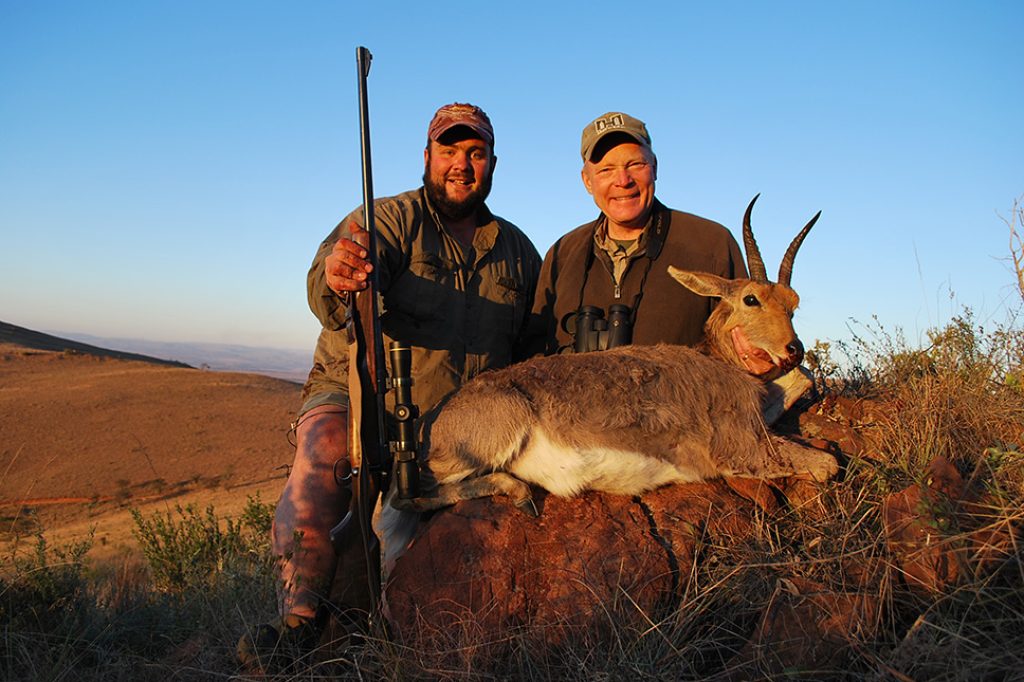
We divide them into three regional races—Southern, Chanler’s, and Western. The Southern mountain reedbuck is primarily a South African specialty, found in most mountains and taller hills, with a few spilling over into suitable habitat in surrounding country. Chanler’s mountain reedbuck of East Africa is smaller yet, occurring in scattered mountain ranges in Kenya, Tanzania, Uganda, and probably into southern Ethiopia and Sudan.
I’ve only had one chance at a Chanler’s mountain reedbuck. Michel Mantheakis and I were hunting on the Tarangire Plain in Masailand. That region has a lot of isolated mountains; Kilimanjaro is the largest. We passed by a small but significant promontory and Michel knew there were some reedbucks up there. We climbed up, heard them whistling, and I got a quick shot on a nice buck.
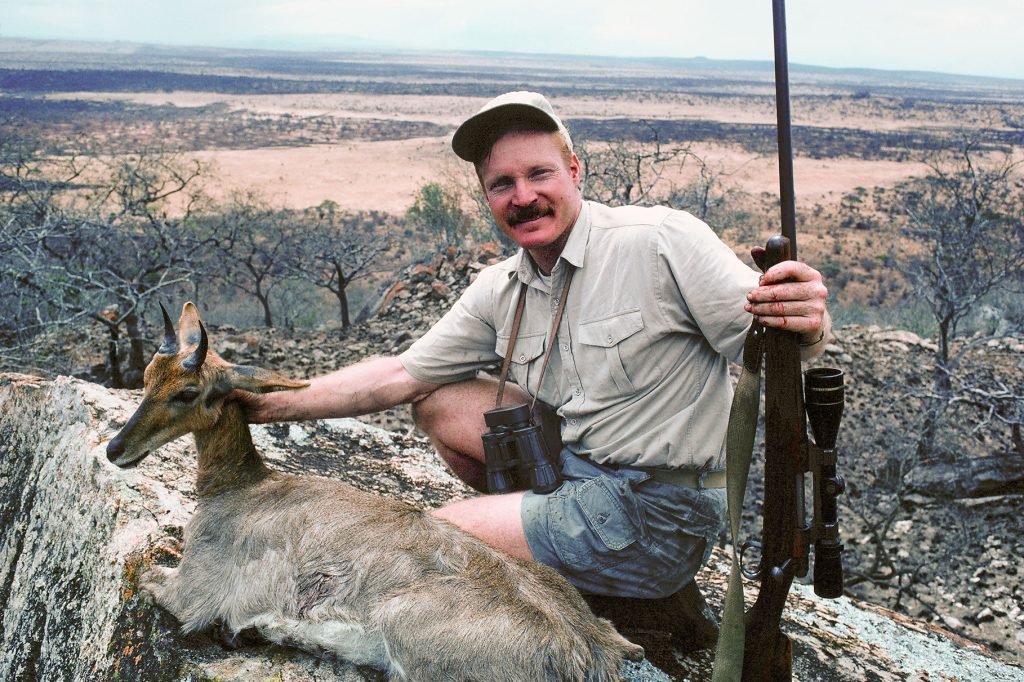
I doubt if the exact range of the Western mountain reedbuck is even known, but there are significant hills—if not mountains—in the Central African Republic and northern Cameroon. We were driving to camp along a big ridge and saw a family group. They are not on license; the only person I knew who got one was Dick Cabela, on a rare museum permit. Very little is known about this reedbuck.
My best mountain reedbuck was taken with Charl van Rooyen in northern South Africa, where Mpumalanga and Limpopo provinces come together. We spotted him bedded above a little face, stalked up from the bottom, and shot him at about 60 yards. We weren’t hunting for a reedbuck. It didn’t matter. Charl knew he was unusually big and insisted we drop whatever we were doing. With reedbucks, when you see a giant, you go after him.