Jack O’Connor’s favorite cartridge is still a great choice for hunting a wide variety of big game.
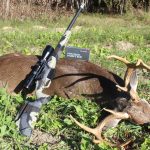
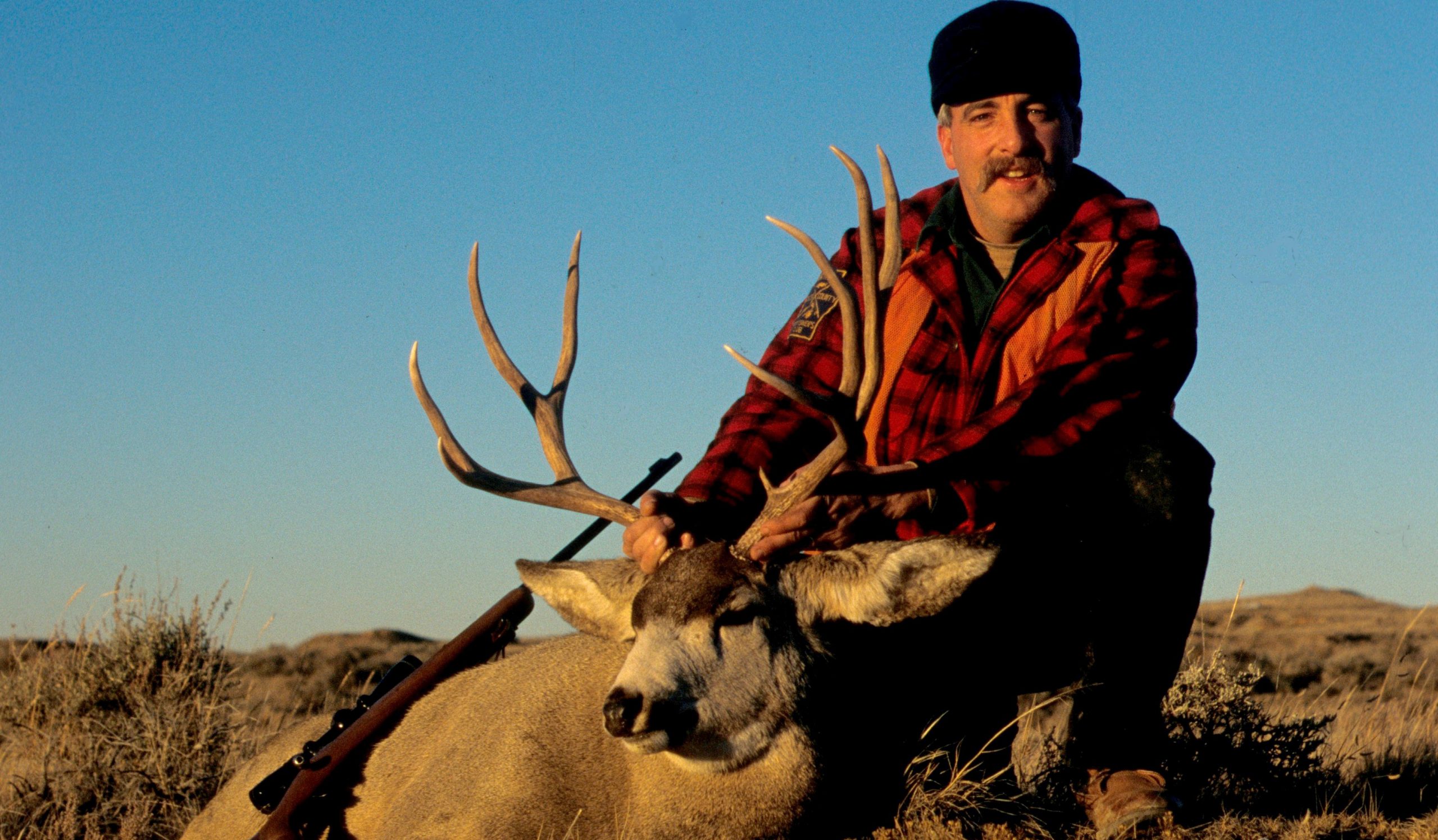
Photo above: The .270 is considered one of the best rounds for mule deer bucks. Barsness guided his friend Jay Rightnour to this public-land buck in Montana’s Missouri Breaks.
There’s been controversy involving the .270 Winchester ever since it was officially introduced by Winchester in 1925. There still is a century later, although the cartridge is still very popular, even after the introduction of so many new—and supposedly better—big-game rounds.
Many hunters looked at the ballistic statistics for the original factory load, a 130-grain bullet supposedly started at over 3,100 feet per second, and decided the .270 was probably a good round for deer-size game, but not anything bigger. Others decided to try it on larger game, including the guy who eventually became known as the godfather of the .270, Jack O’Connor.
At first O’Connor used it on deer, not only in Arizona where he taught college English for a living, but also south of the border in the Mexican state of Sonora. The deer he hunted were both the small subspecies of whitetail called Coues and larger desert mule deer, and he found the .270’s flat trajectory worked very well for the typical open-country shooting.
By then, O’Connor had already started selling magazine articles to supplement his small salary. By the mid-1930s he was able to quit his college job and start hunting more widely, thanks in part due to magazines helping pay for hunts. He eventually went on a guided packstring hunt in Alberta for bighorn sheep, mule deer, moose and grizzly, planning to use the .270 on the bighorn and mule deer, and the .30-06 on moose and grizzly.
He and his guide hunted moose by glassing from a mountainside into a creek bottom. But whenever they spotted a bull out feeding, before they could get down the mountain, it would disappear in the thick, shady vegetation along the creek. So early one morning, O’Connor decided to still-hunt alone along the creek. He took his .270, probably because it was considerably lighter than his .30-06, and easier to carry.
O’Connor eventually jumped a big bull and took a quartering-away shot. The moose didn’t drop, so he followed its tracks in the soft ground—finding where it had fallen to its knees, then stood up again. Soon O’Connor got another angling lung shot, and the bull fell dead.
He was using the original 130-grain factory ammo. The Winchester bullet had a very heavy jacket along the shank to help hold the bullet together during expansion so it would penetrate deeper. As he noted in one of his stories about the hunt, “It dawned on me that if a bullet gives adequate penetration it does not have to be particularly heavy in order to penetrate well.”
Eventually he killed a dozen moose with the .270, often using handloads with bullets designed for even deeper penetration. But handloading didn’t become popular until after World War II, partly because ammunition companies saw it as a threat to their sales, so they didn’t market bullets separately.
In fact Philip B. Sharpe’s classic book, Complete Guide to Handloading, published in 1937, states: “For handloading purposes, the major objection to the .270 Winchester is the lack of variety in the bullets available in other than the cast variety. Metal-cased bullets of other calibers do not fit properly.”
This changed during and soon after World War II, as “metal-cased” (jacketed) .270 bullets became more available. Eventually several new companies manufactured bullets for handloaders, including Hornady, Nosler, Sierra, and Speer—all of which started up between 1943 and 1949.
Especially helpful to .270 users was Nosler’s Partition, which many of today’s hunters consider the first controlled-expansion bullet. It featured a soft front core which expanded violently, separated from a harder rear core of by a partition of jacket material, which resulted in consistently deeper penetration.
Despite this, and other controlled-expansion bullets developed since then, some hunters still class the .270 as just a deer cartridge. One I know, a widely experienced hunter who’s also developed several custom hunting bullets, thinks the .270 isn’t even enough for caribou. This puzzles me, since I’ve taken a dozen bull caribou from Alaska to northern Quebec, and while mature bulls are about the same size as cow elk, they’re not hard to kill.
Here I should probably describe my experience with the .270 Winchester, since some of you may strongly agree with my friend, so might not want to waste your time by reading further. My first .270, a Remington 700 ADL, was purchased in 1974 at a hardware store in Wolf Point, Montana. With a little tweaking, it turned out to be one of the most accurate factory big-game rifles I’ve ever owned. Its best handload turned out to be the 150-grain Hornady Spire Point, with Jack O’Connor’s recommended load of Hodgdon H4831. (This was the original U.S. military surplus powder, not today’s version.)
I chose the 150 Hornady because I thought I couldn’t afford Nosler Partitions–and Hornady Spire Points had the reputation of being deeper-penetrating than the other brands of “non-premium” big-game bullets. This was a few years before Hornady introduced their Interlock bullet, with a thicker ring of jacket brass inside the rear of the jacket, but I did later discover that the pre-Interlock Hornadys featured a harder lead core than most other bullets.
This handload consistently grouped three shots into around half an inch at 100 yards, and on the one occasion I shot it at 300, it put four shots in 1¼ inches. It penetrated well on elk-size game, usually exiting on broadside shots, and often at even steeper angles.
Among the animals taken with it was my first really big mule deer, a mountain buck as big as an average cow elk. He was about twenty-five yards above me on a steep slope, and the bullet entered the front of his chest. After traveling through the lungs, it broke the spine at the rear of the ribcage and exited.
The next .270 I handloaded for, however, was the one that really convinced me of the round’s suitability on much larger game. It was a Browning A-Bolt, the first rifle a manufacturer ever sent me for article-testing during my early gunwriting career. It grouped almost as well as the Remington, and was also one of the lightest mass-produced .270s available at the time.
Eileen had started hunting a couple years earlier with an old Remington 722 .257 Roberts, the rifle my paternal grandmother used for her big game hunting before she passed away. After that the .257 had wandered around the family, at least four other people taking deer with it, but hadn’t been hunting in several years.
Eileen used it to take several pronghorns and deer, but she wanted to hunt elk too, and everybody said the .257 wasn’t enough. She’d also decided the 722 was heavier than she liked, so we sent Browning a check for the A-Bolt .270.
I developed two handloads, one with the 130-grain Hornady Spire Point, and another with the 150-grain Nosler Partition (which by then we could afford). Both bullets landed in the same group at 100 yards, common in .270s, so she could use the more affordable 130s for sighting-in, practice, pronghorn, and deer, and use the 150 Partitions for larger game.
On the last day of that fall’s big-game season she took her first elk at around 150 yards. The young bull wobbled for a few seconds after the shot, then dropped dead.
The next year Eileen decided she wanted to hunt even bigger game, so she applied for a bull moose tag in the annual Montana lottery. I’d been applying for more than a decade and hadn’t drawn one, but she kept telling friends she was going moose hunting that fall. They’d ask if she was going to Alaska or Canada, and she’d say no, she was hunting in Montana—and they’d laugh. When her tag showed up in the mail, she waved it in front of more than one person, including me.
She’d applied for an area south of Bozeman where I grew up hunting deer and elk—and had seen quite a few moose. We scouted for a couple days before the season opened on September 15th, but daytime temps were in the 80s and we didn’t see any moose.
Dawn of opening day, however, was nice and cool, and before the sun rose over the mountains we found the eating-size bull she wanted, standing quartering away in a willow draw below us, in easy range.
She sat down and aimed for the far shoulder, as she’d learned to do when hunting deer. At the shot the bull took a step, then dropped dead in the middle of second step. The bullet had entered the middle of the left ribs, and ended up under the hide of the right shoulder. It wasn’t a trophy bull, but was mature, with a 4×5 rack not quite three feet in width. Its body was as big as any bull elk I’ve seen on the ground.
A dozen years later Eileen planned to hunt elk on a ranch fifty miles west of where we live. This was the year Barnes Bullets introduced their Triple-Shock X-Bullet (TSX), which has a grooved shank that reduces copper-fouling.
Coni Brooks heard about Eileen’s elk plan, and asked if she’d be willing to field test the 140-grain .270 bullet. She said sure, and I handloaded some to right around 3,000 fps, which grouped well under an inch.
Eileen not only used the 140 on a young bull at 200 yards (which exited), but during the pack-out, a coyote also received one at 250 yards. Some hunters had expressed concern about how well TSXs would expand on lighter game, so Eileen was able to inform Coni it also expanded fine. In fact the only problem with TSXs on elk we’ve seen is that these days Montana elk are so abundant they’re often found in big herds, so you need to be aware of other elk possibly standing behind the one you shoot.
Seventeen years after Eileen got her moose, we were both invited by custom gunsmith Charlie Sisk to an event on a Texas ranch. He’d arranged for her to take a cow bison, and would provide one of his rifles and some appropriate ammo. The rifle turned out to be a .270, and the ammo Federal Premiums with 130-grain Barnes TSXs. The hunt was a real hunt, not one of the too-common shootings of a buffalo in a pasture.
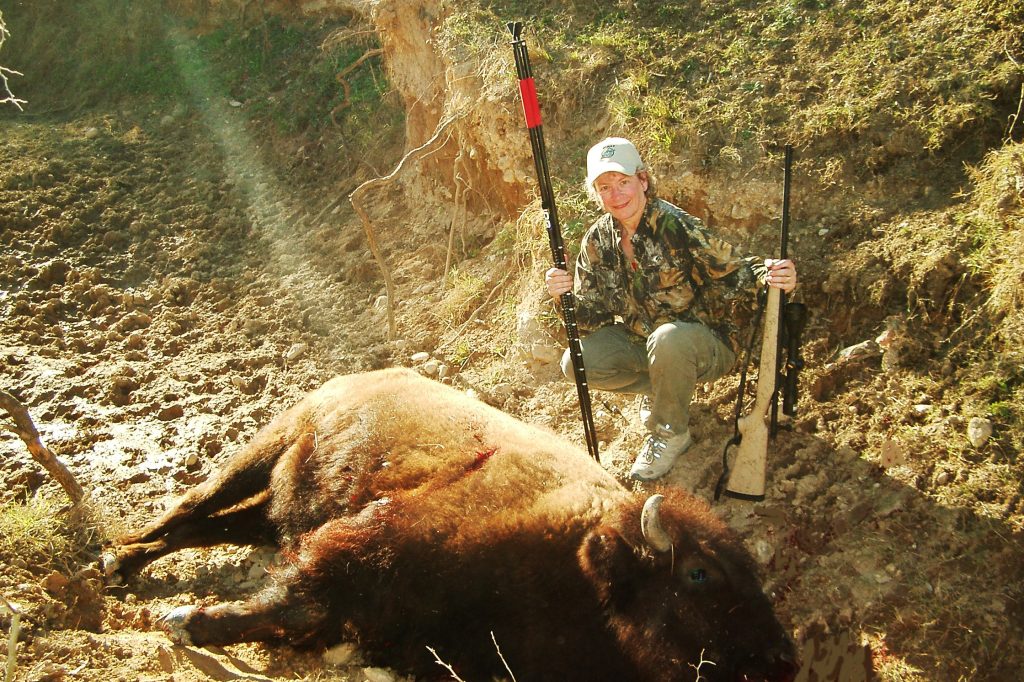
There had originally been three cows hanging together, but one had been taken by another hunter a few days before. We had to track the other pair for two hours through thick, thorny brush and trees before finally getting within 150 yards.
Eileen was shooting off standing sticks, due to all the ground cover, and waited until one of the cows turned broadside before putting the bullet a third of the way up the chest. The cow staggered and went forty yards, leaving a copious blood trail, before falling. Its body dimensions were just about exactly the same–though shaped somewhat differently—as her moose. The meat was also great.
Another hunter who thinks the .270 works well on game larger than deer is our old friend Phil Shoemaker, the Alaska Master Guide who’s been guiding brown bear hunters on the Peninsula for over half a century.
Phil is willing to guide brown bear hunters who use .270 Winchesters, as long as they use appropriate bullets. One of his clients was a rancher from Colorado whose only big-game rifle was a .270, which he’d used on a bunch of elk. Phil told him to buy a couple boxes of Federal’s Premium ammo loaded with 150-grain Nosler Partitions.
The guy did, and they found a big boar fresh out of its den, with a perfect, unrubbed hide. At the first shot through the lungs, the bear locked up, and dropped to a follow-up shot. The hide squared right around 10 feet, and the skull qualified for the Boone and Crockett Club’s records.
Many rifle enthusiasts are aware that Winchester introduced the .270 in a then new bolt-action rifle they named the Model 54. I even owned a 54 for a while. It came with a Lyman receiver sight. The 54 appeared long before factory rifles came drilled and tapped for scope mounts, and I did not add a scope—partly because the rifle regularly grouped three shots of typical factory ammo and handloads into about 1½ inches at 100 yards. Eventually a friend who’s one of the biggest Winchester loonies I’ve ever known talked me into selling it to him.
One of the advantages of the .270 for the traveling hunter is that factory ammunition is available just about anywhere. One of my habits when traveling to hunt is to visit sporting-goods stores to see what’s available. I can’t remember visiting any shop where .270 ammunition wasn’t available, usually in good quantities. I even found it in the tiny, one-room general store in Sleetmute, Alaska. The .270 is a very popular hunting round in places as diverse as the Western Cape Province of South Africa to Arviat, Nunavut, on the western shore of Hudson Bay. This hundred-year-old stalwart is still right at home in any hunting camp.
John Barsness’s books are available from riflesandrecipes.com.