Fall is here, and it’s the best time of year.
Best of all he loved the fall, wrote Ernest Hemingway in an epitaph for a friend. Don’t we all? For hunters throughout the Northern Hemisphere, this is our season. Summer heat is abating, leaves are starting to turn, and animals are feeling good.
Like Robert Ruark’s hunter’s horn, autumn sounds earlier for some, later for others. I’m at the farm in southeast Kansas in early October. Fall isn’t here yet, but I’m seeing the first signs: morning temps in the 50s for the first time in months.
We don’t see our deer much through the summer. Sure, they go to agriculture at night, but our country is mostly climax oak forest. There are plenty of good groceries in the woods, especially in this year of heavy rains after four dry years. Just yesterday, we were out checking stands and clearing shooting lanes. We saw a lot of deer, so they’re feeling the fall, too.
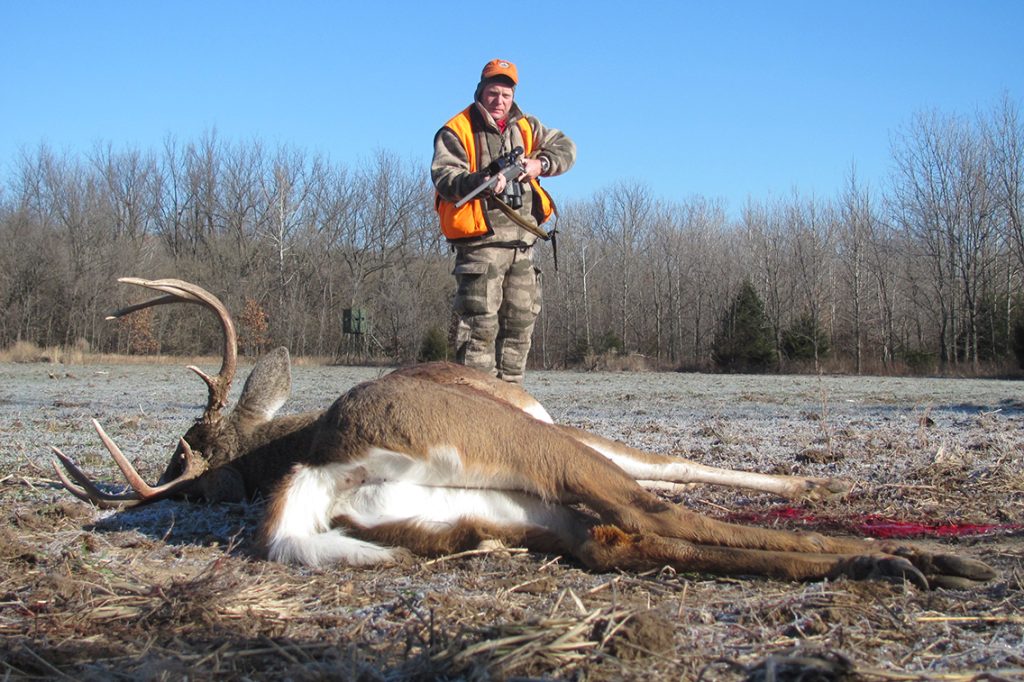
There are rubs in the woods, but we probably won’t see scrapes for a couple of weeks. With all the rain, it’s still so thick and green that trails aren’t yet well-defined. Every year is a bit different, and it always depends on where you are. Far to the north and west, aspens and tamaracks are turning golden and elk are bugling. I’ll be spending the next couple of weeks in elk country, hoping they’re still bugling.
We North Americans don’t have a patent on that wonderful mountain music. A few years ago, I looked out across a valley at a sea of gold, heard bugles drifting up from the trees. Closed my eyes, I thought I was in Montana. Then I realized I was in Mongolia. The trees weren’t tamaracks, but almost: Siberian larch instead of western larch, the bugles coming from Asian wapiti, not the American version I’ll be hunting next week.
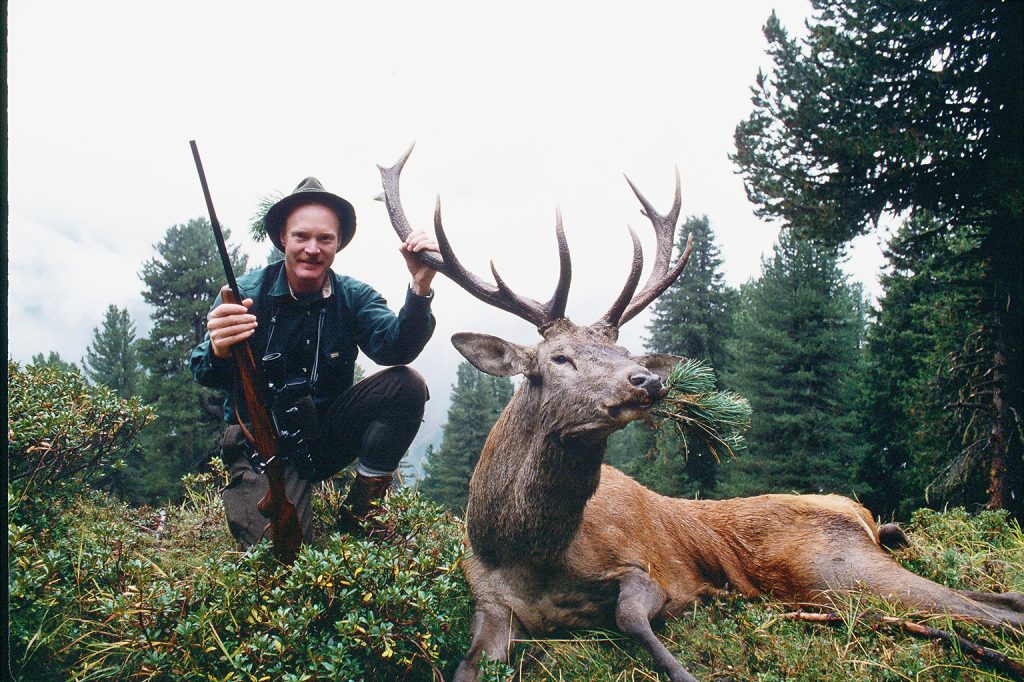
Farther west across the great land mass of Eurasia, there won’t be bugling. Instead, from the British Isles and Spain eastward to the Caucasus, the red stags are roaring. Though they are kissing cousins to our elk, their challenge is an altogether different sound, a deep guttural bellow.
The wapiti adapted to Asian steppes and American plains while the red deer were (and are) creatures of forest. I’m told that the elk’s bugle carries better in open country, while the red deer’s roar resonates in thicker cover. Either way, the sounds are amazing. Around the Northern Hemisphere, this is our season, and hunters are working out their strategies.
Depending on latitude, autumn comes at different times, and may be short or long. Much farther north, tundras are bright crimson. I won’t be up there this fall, but at this time of year I remember many fine autumns. I heard from Alaskan buddy Dave Leonard a couple days ago, as he was finishing a fine caribou season down at the tip of the Alaska Peninsula. We caught it perfectly a few years ago, tundras in full color. In 2024, I went up for the October bear season. Still autumn, but late, days getting shorter, best colors faded.
Instead, there was a different harbinger. We camped in a valley that was flooded with ptarmigan, the greatest concentration of any upland gamebird I have ever seen. Glassed at distance or when a flock took flight, it looked like a sea of bright white. Up close, they were still turning to winter colors, russet heads and necks, brown backs, lower bodies and wings Tide-washed to the whitest white. With near-constant wind and rain, we didn’t get a bear that trip. I didn’t pack in a shotgun, but I got a huge kick out of watching the ptarmigan. Now and then a big flock would swoop over our tent, wingbeats loud like breaking surf.
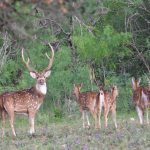
For most American hunters, autumn means deer season. For the majority, that means whitetails. Out West, mule deer. As autumn comes at different times, our various deer aren’t on the same schedules, nor are our seasons. With our southeast Kansas whitetails, we’ll have good pre-rut activity in October, with the peak of the rut usually just before Thanksgiving. If the weather is right they’ll still be chasing when rifle season rolls around a week later.
The rut varies from north to south, usually earlier to later, and sometimes varies within larger states. In the Southwest, Coues deer rut much later than northern whitetails, in January and well into February. Mule deer also usually rut later than whitetails, December into January. There’s a reason why a notorious mule deer poacher was called “Mr. January.”
Here in the States, our hunting seasons aren’t necessarily set for the best time to hunt our various species. Many seasons are pre-rut. Throughout the West, most mule deer seasons come and go before the rut gets serious. Some, like our Kansas rifle deer season and all later elk seasons, are purposefully post-rut. Thanks to our awesome North American Model of wildlife management, game managers walk a tightrope, maximizing opportunity while avoiding excessive harvest. Thus, relatively few of us have the luxury of seasons that coincide with the “best” times to hunt, when our game is most vulnerable.

It doesn’t matter. We all know when our seasons are coming up and we know the challenges their timing brings. Right now, in October, some of you are in the middle of your hunting season. Others, like me, are still looking ahead. Some of us are blessed with long seasons. We can study the lunar calendar and plan on hitting it hard when the moon is dark. Many American seasons are short and we don’t have that luxury. Our Kansas rifle deer season is just twelve days, the timing set in stone for decades. I don’t even look at the moon phase anymore, since there’s nothing I can do about it.
We can’t do anything about the weather, either. We can look up the norms and averages, but we can’t predict what the weather gods will bring. When a hunting season rolls around, it’s often the weather that will make us or break us, perhaps more than any other factor. Now, in early fall, we can look ahead to hunts and seasons still to come and imagine that the weather will be perfect, realizing it probably won’t be. Of course, we’ll play the hand we’re dealt, and hunt as hard as we can.
Nothing wrong with being optimistic, hoping for the best. Too warm makes things tough, and that’s common with these late falls we’ve been having. Hard rain is also bad–just hope that it stops. When it does, it doesn’t matter what time of day; the game is going to move. Strong, gusty wind is probably the worst of all. Animals can’t hear and can’t smell, and will usually hunker down.
Perfect for me is crisp and cool, with a light, steady breeze that I can feel and manage. A good tracking snow would be nice. I remember a couple of mule deer hunts when overnight snow changed the game and got deer moving. Naturally, there can be too much of a good thing. On a mule deer hunt in Alberta we were caught in a terrible blizzard, where the roads drifted shut. We were hunting a great ranch that held monsters, but I doubt we could access 10 percent of the country we had available.

Northern hunters—and the animals they hunt—are used to extreme cold. I don’t like it, can deal with it if I must, but cold can also be too much of a good thing. On another Canadian whitetail hunt in early November the temp dropped way below zero. I thought it would be wonderful. The deer thought otherwise. It was the first major cold snap, and it shut them down; we hardly saw any tracks until it warmed up a bit.
My southeast Kansas whitetails are fair-weather creatures. For the early December season, still a long way out, I want calm, frosty mornings, warming as the sun comes up. Naturally, I’ll take what we get, and it could be anything. A few seasons back it was perfect the day before opening day. Overnight, a weird warm front came through and it was 75 degrees F at dawn. We couldn’t buy a deer for three days, then it cooled down and we filled our tags. And I’ve seen the opposite: First time it drops into the teens, our deer shut down.
With a foot of crunchy oak leaf litter on the ground, stand hunting is the only option we have. My fantasy is to wake up opening morning to a foot of fresh, fluffy snow. Then, at least in my mind’s eye, I could sneak into his bedroom and give Bucky a surprise. It’s never happened. In the twenty years we’ve had that farm, we’ve never had more than a light skiff of snow during rifle season. Maybe this will be the year. I hope this is also the fall your hunting dreams come true.