Aoudad hunts are fantastic mountain-hunting experiences.
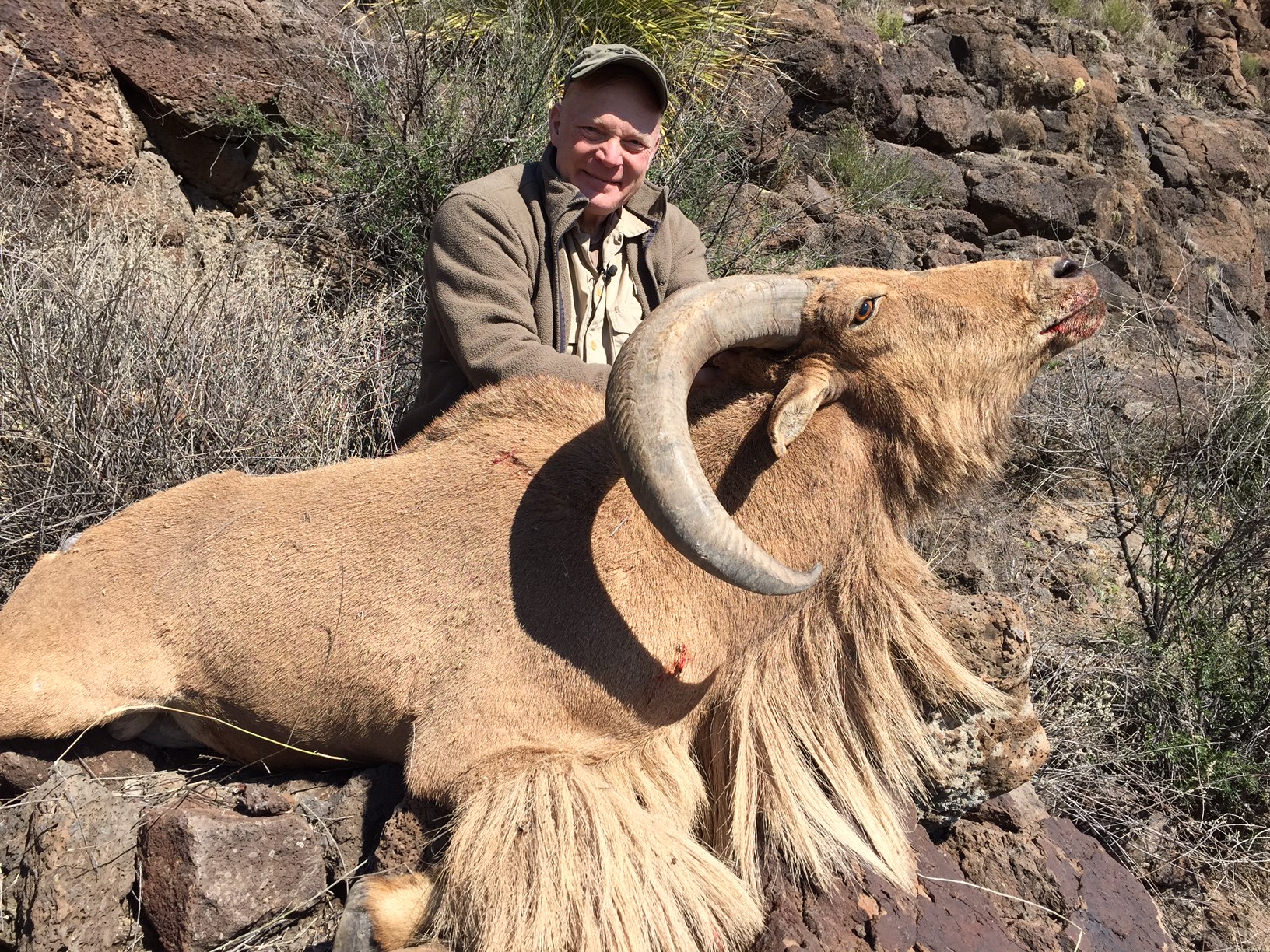
Photo above: A fine aoudad from the Davis Mountains of Far West Texas. This ram has excellent horns, but this photo also shows the sheer size of a big aoudad ram, and it shows off the mane and chaps on the front legs.
Want to experience a hunt for a great mountain animal without breaking the bank? Think about aoudad. Properly, the aoudad or Barbary sheep is neither a sheep nor a goat. One genus, one species, Ammotragus lervia is sort of a natural bridge between the two families, with some attributes of both. Personally, I think they’re closer to goats, but the aoudad is a strikingly attractive animal with thick, curving horns, long, luxurious neck mane, and those unique chaps down the front legs. It’s also sharp-eyed, wary, and difficult to hunt.
I may never draw another sheep permit, and there are many mountain hunts I can’t afford. But I can hunt aoudad, and I think they’re awesome. So, every few years I find myself hunting them. The world’s largest population is found in the rugged mountains of Far West Texas. One estimate suggests 25,000, although that could be low. I love to hunt them there, scenery right out a John Ford Western. It’s a real sheep hunt, in many ways like hunting desert bighorns. With two differences: First, you’ll probably see a lot more animals. Second, although the cost of aoudad hunts have increased (like everything else), they’re a fraction the cost of a desert bighorn hunt, and readily available.

Far West Texas is hardly the only option. They’re also found farther east, widely distributed in the Texas Hill Country and Edwards Plateau, both on fenced game ranches and free ranging. There are also populations in New Mexico and Mexico. There’s even a herd on California’s Central Coast, introduced by William Randolph Hearst.
In 2001, I hunted native range aoudad in Chad’s Ennedi Mountains, and they are now hunted in Morocco’s Atlas Mountains of Morocco, where some fine rams have been taken recently. I’ve hunted them free range in southern Spain and in arid mountains in South Africa’s Eastern Cape.
Although I don’t hunt them frequently, I’m enough of an aoudad nut that I don’t pass opportunities. In the last year I had two entirely different aoudad experiences. Last year, Jim Craig and I hunted them in Far West Texas with Jim Breck Bean’s High West Outfitters. Craig, from Indiana, has taken more North American wild sheep than anyone I know, but never an aoudad. He won this hunt in a Wild Sheep Foundation raffle so we rallied in Marfa, Texas on a hot September midday.
Most of my Texas aoudad hunting has been in late winter, January into March. Not because the weather was cool, or because that was the best time. Pure convenience, after the fall hunting seasons. Texas outfitters consistently tell me that early fall is best for big rams, when the males gather in bachelor herds. In October 2020 buddy John Stucker and I hunted the Davis Mountains and caught it right. The rams were yarded up in groups up to the dozens. First morning, John shot the longest-horned aoudad I’ve ever seen, an astonishing 37 inches on both horns. Usually, among a forest of horns, it’s difficult to pick out the biggest one. This ram stood out.

So last September, Jim Craig and I hunted a ranch southwest of Marfa. I’d been there before, on a February mule deer hunt. It’s tall, bluffy country, ideal for aoudad. We saw quite a few and one of our party took a fine ram, so I was excited to be there at the right time.
At first it seemed we were a bit early, still too hot, even at 7,000 feet elevation. We glassed high and low for a day, saw few, then aoudads started to show. There was no indication the rams were gathering, but most of the herds had rams with them. Now comes the hard part. Males and females have similar horns in relation to body size. It takes experience to sort the girls from the boys, and to identify mature rams. Fortunately, our young guide, Creed Cade, grew up in the area and knew his stuff.
On a blazing afternoon we spotted a big herd feeding above a tall cliff, big, dark ram among them. It was Craig’s stalk, so I stayed in the truck with Jim’s wife, LeeAnne. Just as well. The only way up was on the north end of the cliff, tough climb. I’m no spring chicken, and Jim Craig has ten years on me. In the steepest stuff, he was hands and knees both up and down. We heard his shot just before sunset. We couldn’t recover his ram until next morning, which worked out perfectly for me. At dawn, there was another group on the same cliff, mature ram among them. Jim’s ram was a real giant, the second-best aoudad I’ve seen. Mine wasn’t as big, but it was a solid, heavy-horned old ram, exactly what I’d hoped for.

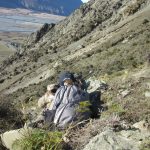
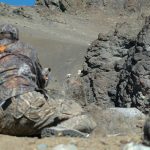
I love the Far West Texas mountains. Because of numbers, aoudad hunts are highly successful, but not easy. It’s a real mountain hunt; footing is murderous in crumbling rock, spiny cacti everywhere. Farther east, on Hill Country ranches, it’s a whole different experience.
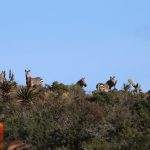
Hunting aoudad on lower, brushier ranches is in some ways more difficult because there’s rarely enough relief for glassing. But it’s physically easier, often done from stands. It’s not necessarily more successful because aoudads are unpredictable and don’t require surface water. The driest, harshest piece of Texas probably looked like paradise to the first aoudads introduced. Where I hunted them in Chad, it may rain once in a decade.
Over the years, I’ve had Texas ranchers tell me, “I introduced aoudad years ago. Probably some around, but we never see them.” Son-in-law Brad Jannenga had a different problem on his Aspire Wildlife ranch near Hondo. There were no aoudad present until a group appeared in his northwest pasture. Crossed in from a neighbor, for sure. However they got there, they’re not wanted, but they’ve been there for two years. One good ram was shot, and then they learned how to vanish. I’ve hunted them on foot, sat for them, never saw more than a quick flash, no chance for a shot.
By this summer the herd had increased to maybe sixteen unwelcome guests demanding room and board, with at least one good ram among them, others up-and-coming. In June, ignoring the heat and taking advantage of the axis rut, gunwriter friend Lane Pearce brought his godson Kevin Roe and young son Lawson to the ranch to take an axis buck. Lawson got a fine buck the first evening, so with time on our hands we spread out in stands in the northwest pasture, hoping to whittle down the trespassing aoudads.
Good grief, these things had become like ghosts. That pasture holds other species, all seen. Nobody laid an eye on an aoudad. Then, on the last evening, Lane and I sat together, our box blind a sauna in 90-degree weather. Fun evening anyway. A herd of addax fed in front of us, and as sunset approached, whitetails in their red summer coats started to come out.
Lane was on my right, with a long, narrow clearing out his side window. Just after sunset I glanced past him and saw a big tan form at the end of his clearing. Not just an aoudad–a pretty good ram. I had the rifle, and I managed to climb over Lane and get to the window. The ram had good mass and reasonable horn length. But it was standing behind a stout tree, shoulder covered, no shot. Although 150 yards away in failing light, the ram must have seen my movement. In that instant he started to trot. Maybe he would have stopped, but it looked like he was headed out. I was shooting Lane’s Weatherby 307 in 7mm Backcountry. I swung with him, caught up, got to his shoulder when the rifle went off. In recoil, I neither saw nor heard impact, then he was gone into thick stuff.
I’d shot the rifle at the ranch range, knew it was on. I was certain I’d hit him, also sure the height was right. However, I also knew I’d hit him a bit too far back. Aoudad rams are stoutly built and extremely tough. This wasn’t good. I could only hope the 170-grain Terminal Ascent had done its job and exited.
It was full dark by the time ranch manager Ethan Cook collected us, so we went to camp and gathered lights and thermals. There was not much blood, but young Lawson Roe found it easily. We found the ram almost as easily, down and dead just sixty yards into the brush. As I’d expected, my hit was a few inches too far back, about at the diaphragm, and the bullet had exited. I can’t say it was an aoudad hunt to match the mountains the mountains of Far West Texas, but I was pleased. I’d spent a lot of time hunting that ram.