You can have your trophy and eat it, too.
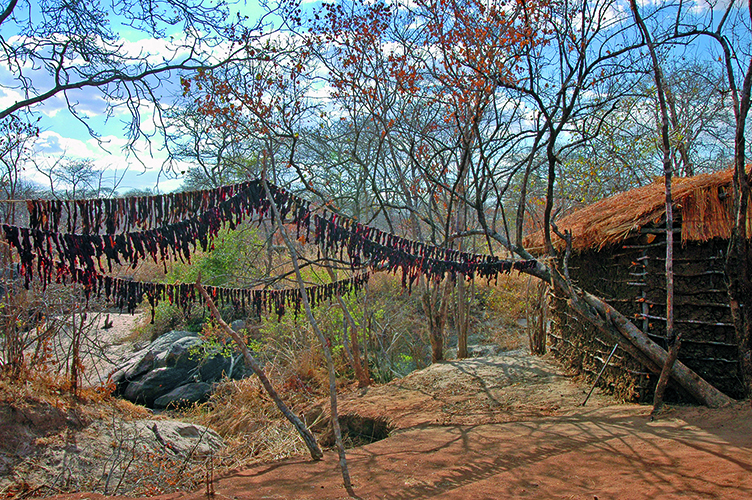
Photo above: Strips of Cape buffalo meat drying for biltong at a hunting camp in rural Tanzania.
Those who oppose big-game hunting in Africa seem to labor under the impression that when an animal hits the ground, its head and horns are taken as a “trophy” and the rest of the carcass is left to rot. I find this ironic since some of the most lasting memories I have of my hunt for a big Cape buffalo involve eating it.
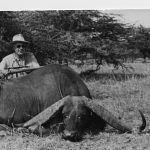
The biggest bull I shot in Tanzania was definitely a trophy. Forty inches is considered the gold standard when it comes to buff, and the broad horns of my bull stretched the tape to 45. The hunt itself was a thrilling adventure I’ll never forget, involving hours of tracking through a dusty miombo forest as our party dodged grumpy elephants and biting tsetse flies. At the moment of truth, I shot the big bull through the heart with my .375 H&H and he plowed into the ground with a final, defiant bellow.
After we had taken photos and paid our respects to the bull, the trackers and other members of the safari crew began breaking down the buffalo as our PH unloaded a table and chairs and made us lunch. Once the butchering was finished, the trackers, thrilled with the edible bonanza that had fallen into their laps, made a small fire some distance away and peeled some green sticks, spearing chunks of something on them. As we ate our sandwiches, my husband, Scott, and I wondered what they were doing. It wasn’t long before we found out.
One of the trackers came over and offered us some of the fresh tripe–buffalo intestine–he had roasted on a stick. He carved off slices of it with his pocketknife while our PH explained to us that, from their point of view, this was one of the most prized and delectable parts of the buffalo. We realized we were being honored with the offer to share. Each of us ate a couple of slices, finding it a little rubbery, but surprisingly good.
Scott and I ended up taking two buffalo each on that memorable safari, and almost every meal we ate in our remote tented camp involved buffalo. Our cook, Tumaini, was a wizard with the tasty but not very tender meat, marinating and grilling buffalo steaks to perfection. He served us appetizers of fresh buffalo heart and even buffalo bone marrow spread on crackers. We enjoyed buffalo goulash and buffalo meat pies. On the evening after I killed the big bull, we had the African equivalent of Rocky Mountain oysters, the camp staff chuckling at me as I sampled them. (After gamely eating one, I passed on seconds.) My favorite dish, though, was buffalo-tail soup. Tumaini’s version of the classic oxtail soup featured a savory broth simmered slowly with meat and vegetables over an open fire.
I don’t think we well-fed Westerners can possibly appreciate how much the acquisition of all that meat meant to the staff and their families living in the area of that wilderness hunting camp. Within hours after we shot our first buffalo, there were ropes strung all over their camp like clotheslines, each one draped with strips of buffalo meat drying in the sun for biltong. Our PH told us our four buffalo would feed the local families for weeks. Was this a trophy hunt? Sure. Was it also a meat hunt? Without a doubt.
While we hunters seek out hunts in far-flung places for the adventures they provide, the true impact of these hunts is even more meaningful. Hunts for both dangerous game and plains game in Africa provide not only an incredible experience for the hunters, but also much-needed protein and economic benefits for the local people. That’s an outcome that hunters and non-hunters alike should find exceptionally palatable.