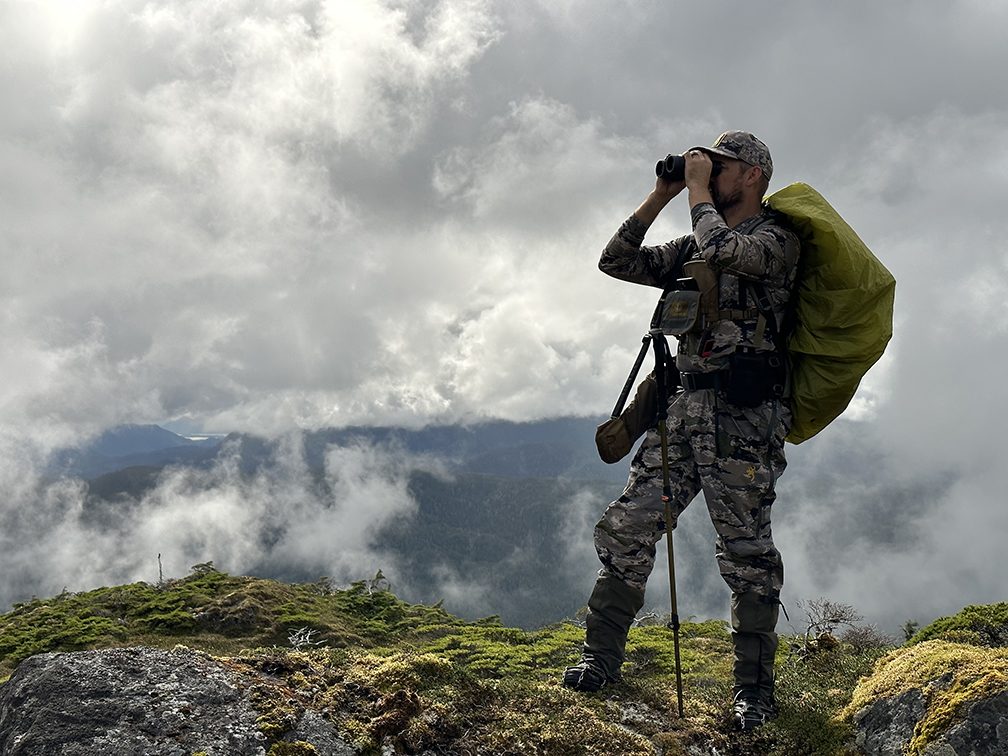
For better or worse, communicating from remote places is easier than ever.
A quarter-century ago I pulled my truck up to a sun-faded phone booth in a little town at the base of the mountains. Dirty, bloodstained, and tired, I limped into the booth and inserted a few quarters. Glancing through the dirty window, I made sure my horses were OK in their trailer as I waited for the phone to ring. Two weeks had passed since I had spoken with my young bride and I wanted to let her know I’d killed a bull elk, made it out of the wilderness alive, and was headed home.
In those days there were no satellite communication phones or devices. Cell phones came in a bag the size of a small suitcase, and service was very limited. Back then we headed into the backcountry for days or weeks at a time with the knowledge that communication would be nonexistent until we emerged. If we got hurt, we would be on our own. If things got really bad, well, at least we died doing what we loved. And our families might never really know what happened, even if search parties were able to locate our camp or remains.
That’s all changed nowadays, even in rugged territory where cell coverage is nonexistent. With the help of a compact electronic device we can communicate with our loved ones, check the weather forecast, share our location and, if need be, summon the cavalry to pull us out of a jam. We’ve lost some of that feeling of solitude and separation from everyday life, but we’ve gained a significant margin of safety and convenience. I do occasionally miss the old days, but as a husband and father I’m grateful for the ability to keep in touch with my loved ones and for the ability to request help should I need it.
These devices can up our hunting game too, as long as it’s legal and kept within the bounds of fair chase. We can communicate with hunting buddies during a stalk, share waypoints and travel routes, and send our location to friends willing to help us pack our hard-earned meat out of the boonies. These abilities are awesome and can make a real difference in our adventures. But they also need to be used with caution. The line that divides what’s fair chase and what’s not can be thin sometimes. Make sure you abide by all regulations, and think carefully about any electronically assisted hunting methods to be sure you feel good about using them.
Electronic Tools
I’m going to keep this discussion simple, reviewing the capabilities and the downsides of different devices that I’ve used and liked. I’ll list them in order of preference, beginning with my favorite.
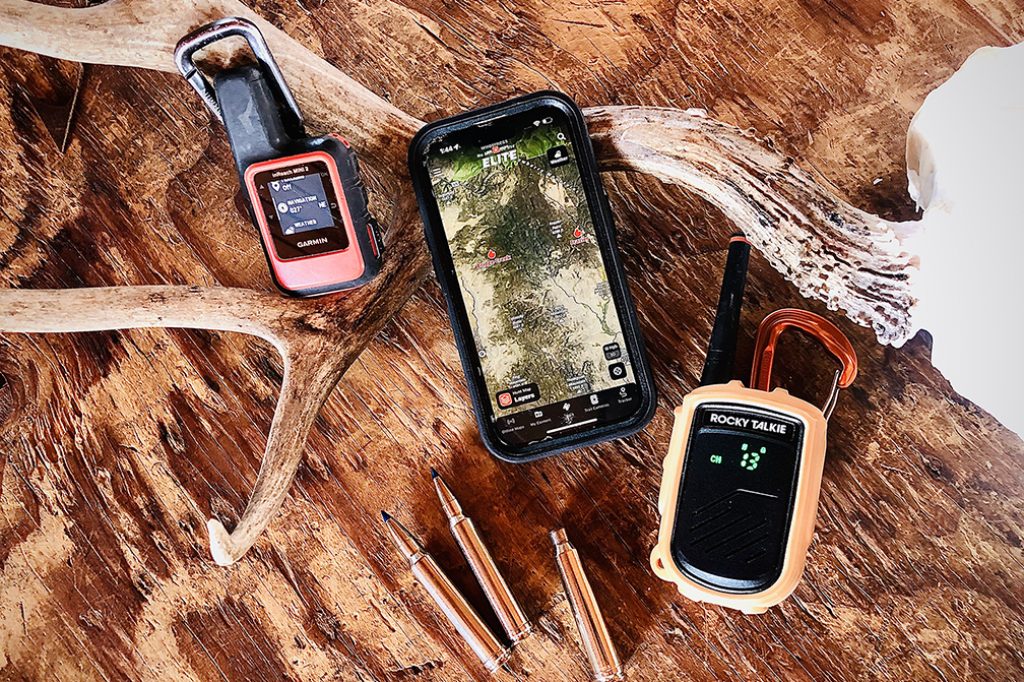
Satellite-capable cell phones: Recent models of smartphones in both Apple and Android versions sport the ability to send and receive texts via satellite–no cell service needed. They can also share your location and signal for help via an SOS message.
My iPhone has become my go-to device for backcountry use because it’s so versatile. I can map, research, navigate, and save waypoints via my OnX Hunt app, take magazine-quality photos, communicate via satellite, summon the cavalry, and–when I find a spot with cell service–send photos and call my family. It’s a remarkably capable tool that can make your wilderness adventure safer and more productive. Just don’t waste time scrolling on it– that will defeat the entire purpose of your time afield.
The big downside to smartphones is their ravenous appetite for electricity. I carry a compact battery bank and a lightweight folding solar panel in my hunting pack. With these, I can keep my phone, my headlamp, and my inReach device charged.
Garmin inReach Mini 2: This satellite communicator is remarkably capable, compact, and lightweight. With it you can send and receive messages, navigate, save waypoints, enable folks back home to watch your “track,” send an SOS message, and check the weather forecast. Battery life is excellent. Before my phone became satellite-capable, the Mini 2 was my lifeline to the outside world. I still carry mine as a redundant safety unit, and to check the weather. I love that feature. You can also share your location as well as waypoints you’ve saved with fellow hunters.
Its downsides are few. The display screen is very small, and typing a message is laborious (unless you pair the Mini 2 with your smartphone), and a subscription is required. In light of what the Garmin can do, those drawbacks are irrelevant.
Satellite phone: This was the first of these new wonder tools, and to this day I can’t imagine how it can send my voice into outer space and then back down to my wife’s phone, and vice-versa. It’s remarkable. Sat phones also offer messaging and SOS capability. I’ve carried a sat phone into the backcountry, but it usually stayed at camp, not in my pack. Nowadays I don’t use one much, simply because there are better options for what I do.
Satellite phones are heavy and bulky, two negative words in the world of wilderness hunting. They require a subscription. Even though hearing your loved one’s voice on the line is an awesome perk, given the option I’ll choose a satellite-capable smart phone or an inReach, or both, for my backcountry communication tool.
Handheld radios: I’ve used handheld radios for years, both while hunting and while cowboying in rugged country where cell service is nonexistent and communication is important. (These are for communicating with your group, not with the outside world.) Using a walkie-talkie comes with ethical considerations, which I’ll address here in a minute, but for now let’s discuss what they’re good for: close-range communication, obviously, and keeping abreast of what each hunter or member of your party is doing. They’re also great for calling a tag-holding hunter to your location when you’ve spotted the quarry, or for directing the movement of a hunter trying to stalk close to game. Herein lies the ethical conundrum; some folks consider these techniques unsporting. And in some states – Idaho, for example – the use of handheld radios for hunting is illegal. Abide by local regulations and your own ethics.
The Boone and Crockett Club and the Pope and Young Club do not consider the use of walkie-talkies in harvesting game to be fair chase. Using one will render your trophy invalid for inclusion in the record books, should you be fortunate enough to harvest an animal big enough to qualify.
Over the past three decades I’ve used a plethora of different handheld radios. A couple of the early models, simple and charged by three AA batteries, worked great. Most of the interim models I’ve tried were ridiculously complicated, lost their charge way too fast, and failed with dismaying reliability. A year ago I’d had enough and embarked on a quest to find a great radio. I discovered the Rocky-Talkie, a simple, robust handheld that holds its charge for days, has great range, and is readily operable by tech-challenged folks like me.
Rocky-Talkie radios aren’t cheap, which is their one downside. But if you want a handheld that really works, they are worth the money.
Primitive Communication
Back in the Stone Age (I grew up in the waning years of that era) hunters were still able to communicate, albeit with less precision than we now do. Let’s talk a little about methods that still work, even when the batteries run out and the screens go dark.
Gunshots: Three shots fired in steady succession has long been known as a signal of distress–kind of an abbreviated SOS signal. Make sure that the members of your group understand this signal. In the event that you fire three shots in a row while shooting at game, establish a protocol (perhaps a fourth shot) that will notify your hunting buddies that you’re not in trouble. (A quick note on firing shots to summon help: Using your bow to fire three arrows is reported to be ineffective.)
Flashlights and mirrors: Mirrors work great for signaling whenever the sun is situated at a suitable angle. Simply catch the reflection and cast it downrange. You can flash Morse code if you know it, or establish other simple signals. The same can be done at night by flicking a flashlight on and off, or with a candle or lantern simply by covering and uncovering the light. Back before electricity was invented, ships at sea used this method to communicate during nighttime hours. It’s very effective.
Flags or white objects: Hand signals can be used by an observer to communicate with hunters making a stalk, especially in areas where radios are not allowed. They are hard to see at a distance, though. Colorful flags work well, or a white sheet of card-stock paper. Every hunting camp will establish their own signals and methods; the one constant is that these signals must be visible to work. They can provide valuable help during a challenging hunt.
Electronic communicators can add a real modicum of safety and convenience to our wilderness adventures, but they can also rob us of solitude and the respite from modern life that are so important to the backcountry experience. Use them wisely to keep in touch with loved ones and to prevent disaster. Don’t use them as a crutch for good woodsmanship, and don’t waste precious wilderness time on social media or entertainment.
In the end, we sally forth into the last unspoiled places on earth in search of much more than game. On a hunt done right, the wilderness hunter reconnects with wildlife and wild places. In a word, he finds his inner caveman. And in this crazy, connected world, that’s a good thing.