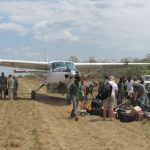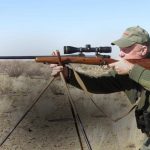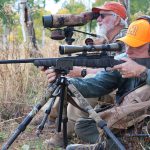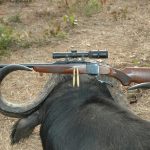
When it comes to calibers for most African hunting, bigger is not usually better.
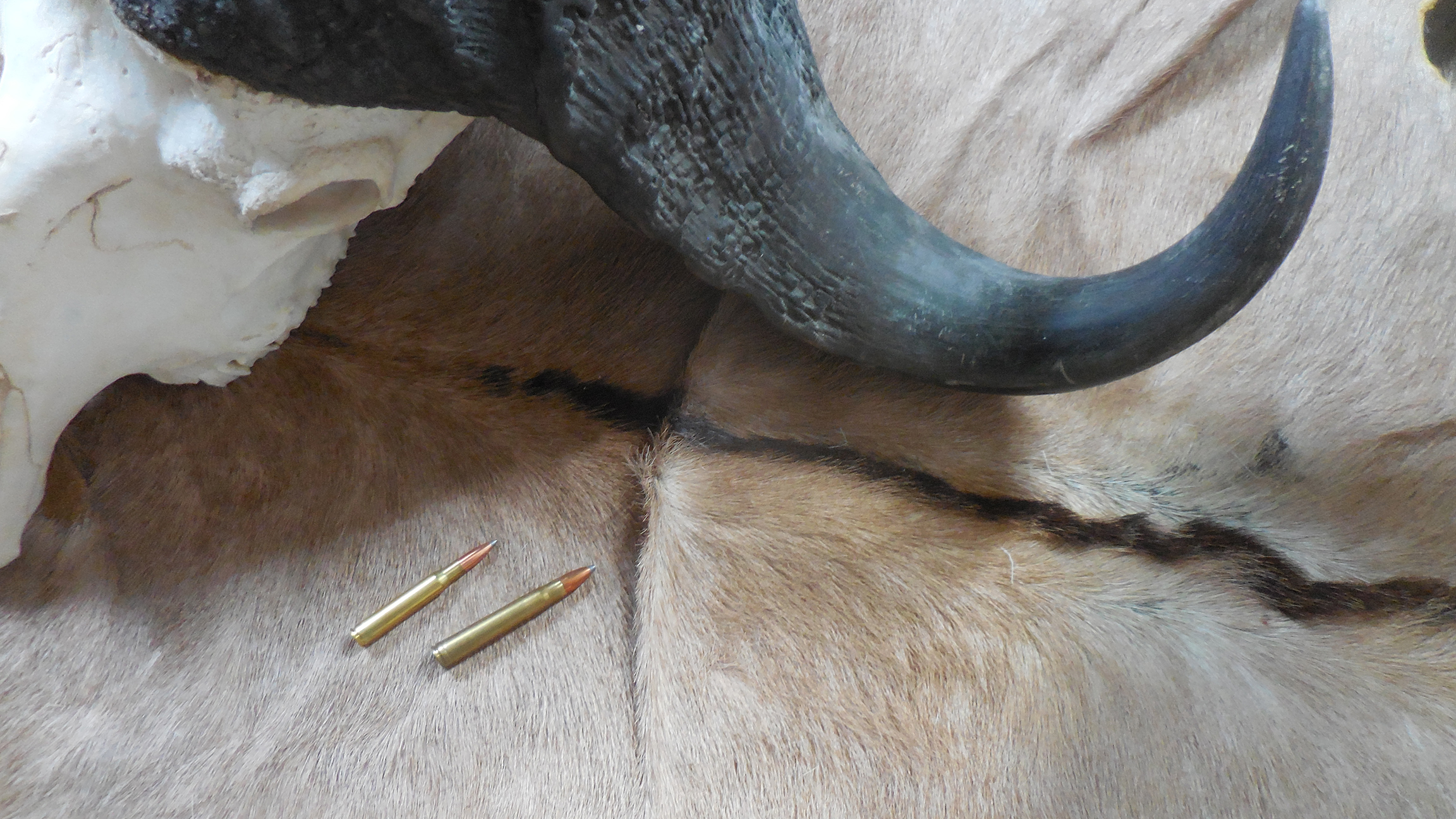
Photo above: While both the .30-06 and .375 H&H are over a century old, they still work very well for most African hunting.
One persistent belief among many American big-game hunters is that African game is harder to kill than similar-size North American game. This is why many Americans choose larger cartridges for their first safari than they would normally hunt with at home, even if they’re only hunting plains game.
This assumption is not particularly helpful for most American hunters, a conclusion I’ve come to after observing quite a few of them in action. This became particularly obvious on a month-long “cull” safari in South Africa on a huge ranch, where two groups of a dozen Americans each spent two weeks. (I spent the entire month.)
We were there primarily to cull animals that were overabundant or had some fault such as deformed or broken horns. But we could also take trophy animals by paying the ranch’s standard fee. In total, the group took 184 animals.
Most of the hunters brought two rifles. One was chambered for a “deer” cartridge and was intended to be used on smaller animals, mostly springbok. These rounds included cartridges such as the .270 Winchester, 7mm-08 Remington, and .30-06.
Their other rifle was for “elk-size” African animals such as kudu and wildebeest, ranging from 400 to 800 pounds. Those rounds included various .300 magnums as well as medium-bores such as the .338 Winchester, 9.3×62, and .375 H&H.
My rifles were chambered in 7×57 and 9.3×62. I’d already used the 7×57 considerably in North America for game from pronghorns to a bull moose, and since the 7×57 had a long and splendid reputation in Africa, I decided it just might work. My 9.3s had worked well on several larger American animals, including moose and an Alaska grizzly, and I wanted to use one on African game partly because the 9.3×62 was originally designed as an affordable all-round cartridge for European settlers who farmed and ranched in Africa.
But many first-timers to Africa don’t really grasp is how much shooting can be involved on a single safari. Multi-animal hunts in North America usually involve only two species, such as pronghorn and mule deer, or caribou and moose. But most safari hunters plan on hunting half a dozen or more animals.
Many of today’s safaris also involve plenty of driving on primitive dirt roads, or sometimes off-road, in Toyota Land Cruisers with stiff suspension. This can result in problems developing with scope mounts and occasionally scopes. This is why it’s not uncommon to test-shoot safari rifles occasionally to make sure the scope’s still zeroed. Doing all this shooting with a rifle that recoils more than they’re used to causes some hunters develop a flinch, which doesn’t help shot placement.
A few of the first-time African hunters on the cull safari realized this quickly, and switched to using only their deer rifle after a few days. One example was a guy who’d brought a 7mm-08 Remington and a .300 Winchester Magnum.
After two days he switched to the 7mm-08, and I was beside him when he used it on a blue wildebeest–often considered the toughest of the elk-size plains game. The range was around 150 yards, with the bull angling slightly away, and the 140-grain bonded bullet landed a third of the way up the bull’s chest, just behind the shoulder. The bull ran sixty yards and fell dead.
Another guy who soon admitted his “big rifle” was a little too much brought the same combination as I did, a 7×57 and 9.3×62. He’d never hunted with the 9.3×62 before, and he soon started shooting the 7×57 almost exclusively, using the 9.3×62 only on a couple larger animals.
A few guys brought only one rifle. One chose a lightweight .300 WSM, and by his second week he had developed a flinch and was not shooting well. He finally got a chance at a bull kudu (the animal he wanted most) on the last day of the hunt at 150 yards—and broke its jaw. The kudu ran off over stony ground, leaving only a few drops of blood where it was hit, and couldn’t be tracked. (It was found dead several days later, and the skull and horns were shipped to the hunter.)
On the other hand, the caliber is not as important as the hunter’s familiarity with the rifle. Another guy who also brought only one rifle brought a .338 Winchester Magnum—which he shot very well. In fact, it was his first-ever big-game hunt, which he’d been talked into by his hunting partner. He’d practiced sufficiently before the hunt, shooting his rifle extensively and from various positions.
I’ve long suspected that one reason African game acquired its super-tough reputation was because of the original jacketed bullets used in smokeless cartridges early in the twentieth century. The most frequent solution to a lack of penetration was to use heavier bullets, partly due to their reduced impact velocity. And some hunters used full-metal-jacket (“solid”) bullets even on plains game in an effort to achieve sufficient penetration.
One famous example was W.D.M. “Karamojo” Bell, primarily known for his use of solids in the 6.5×54 Mannlicher-Schoenauer and 7×57 Mauser when hunting elephants. But Bell also used the same bullets on lesser African game, sometimes claiming his rifles’ bores had never been “polluted” with soft-nose bullets. Obviously, some of the animals he shot ran a long way when shot with solids in the heart/lung cavity–but Bell never traveled without skilled native trackers.
By the mid-twentieth century far better “controlled expansion” bullets started appearing, and they performed much better. Two new ones had recently appeared prior to my South Africa safari, the Barnes Triple-Shock X-Bullet and the Nosler AccuBond. Since many of the participants handloaded, both bullets got tested considerably, and they worked very well. In fact, the 140-grain 7mm bullet that downed the blue wildebeest was an AccuBond.
Several years earlier, one first-time safari hunter who heard the claim that African game was exceptionally tough was my wife, Eileen. She’d decided we needed to go on a plains-game safari in 1999, but even though she’d been successfully slaying North American game (including bull elk and moose) with the .270 Winchester since she’d started hunting fifteen years earlier, she decided to take a bigger rifle, one of my .30-06s.
I worked up a handload with 165-grain Combined Technology Fail Safe bullets, which worked very similarly to Barnes X-bullets and grouped very well. We both used Fail Safes a lot in the 1990s, before Barnes solved the copper-fouling problems with the original X-Bullet by developing the groove-sided TSX.
Eileen used 140-grain Fail Safes in her .270, so she was happy with my choice. They worked so well in the .30-06 that on her first morning in Namibia she took both a trophy gemsbok and kudu, and a few days later, a big blue wildebeest. The only animal she shot more than once was the kudu, which she dropped running, the Fail Safe angling through both lungs. But once down it wiggled some, so she shot it again.
Her PH, Fritz, declared her the “champion hunter” that evening around the dinner table. (All I’d done that day, while hunting with Fritz’s son Jochen, was take a big eland bull.)
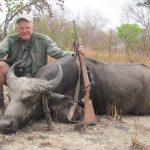
When it comes to buffalo, much of the same thinking applies. Some American hunters doubt the ability of the .375 H&H on Cape buffalo, despite having no experience with buffalo. Often this comes from reading old safari stories, which of course involved early bullets.
The PH I’ve hunted with most is the now-retired Kevin Thomas, born and raised in what was then Southern Rhodesia and is now Zimbabwe. He killed his first buffalo at age seventeen, and a few years later worked as a buffalo culler on a big cattle ranch before Zim’s safari business started.
His buffalo-culling rifle was a .30-06 using handloaded 180-grain Nosler Partitions. Herds were hazed toward him by ranch workers, and eventually Kevin shot more than 500, including at least 100 mature bulls with no problems, primarily using chest shots.
When I met Kevin, he was backing up his buffalo-hunting safari clients with a custom .375 H&H. Despite often being seriously outgunned by clients shooting .416s and .458s, he had to follow and finish off quite a few wounded bulls with his “little” rifle.
The reason many buffalo hunters bring rifles chambered for cartridges larger than the .375 is “in case of a charge.” But as Kevin points out, shot placement is everything, and buffalo shot correctly with a .375 rarely charge. Even if they do, his .375 has always stopped them.