Sports A Field

Hunting the Blackbuck

The blackbuck is a beautiful exotic antelope that is wary and challenging to pursue.

I shot my first blackbuck antelope some 40 years ago. It was a foggy morning in the Texas Hill Country, and the animal was just barely visible at the edge of the fog line, probably 150 yards. Maybe the fog helped, because the animal stayed uncharacteristically motionless while I duck-walked to a handy boulder to take a quick rest. It was an excellent ram, with a coal-black upper body and long, corkscrewing horns.

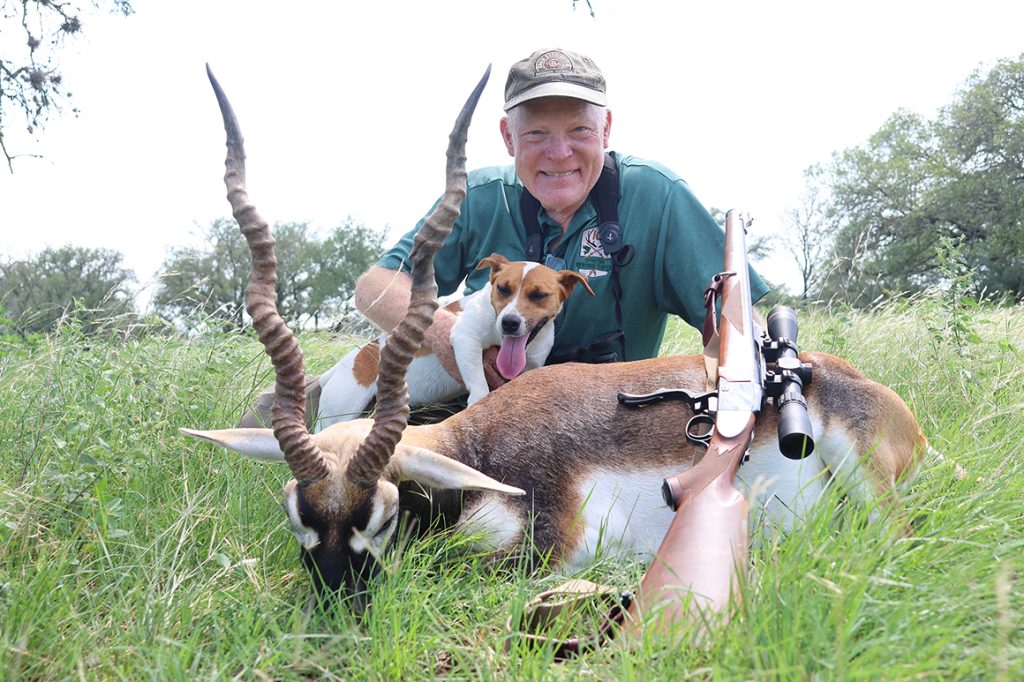
My most recent blackbuck was taken in June 2025 on my son-in-law’s Texas ranch. Much closer range, quick shot. The horns weren’t as long but he was a nice, mature ram with a good, dark coat.

The author’s most recent blackbuck was taken in Texas in June 2025, using a Ruger No. 1 in .22 Hornet. This was an exceptionally big-bodied ram, weight close to 100 pounds, approaching the upper limit of the little Hornet’s capability.

In between those two I shot two others in Texas, several in Argentina, and one along the Indus River in southern Pakistan. All my Texas blackbucks were estate animals, on game-fenced ranches. In Argentina, all my blackbucks were free range. My Pakistan ram was both free range and on native range. That said, provided favorable habitat and adequate acreage, I don’t think presence or absence of fencing makes much difference with blackbucks.

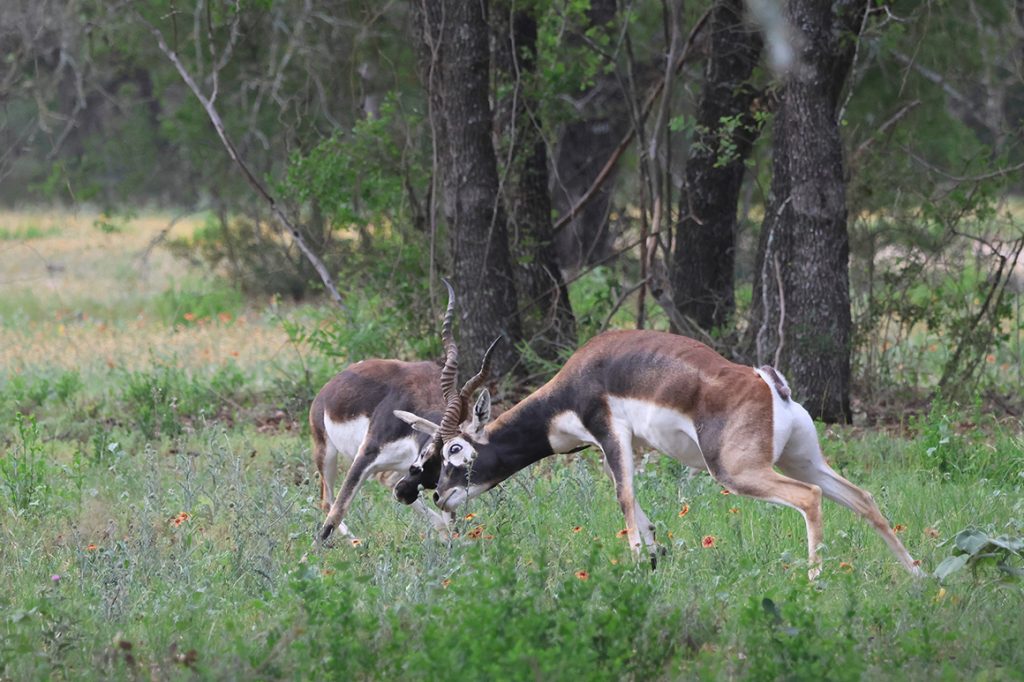
They are small, nervous, fleet-footed antelopes, using keen vision as a first line of defense, quick to take flight at the first hint of danger. They are also feisty. Males mark their territories with both urine and feces and are quick to take aggressive action when another male intrudes. Which, from my observation, happens frequently. So, also from my observation, they usually don’t stand in one spot for very long.

Blackbuck males are highly territorial and aggressive with intruders. Serious fights are common, although losses from injuries seem infrequent.

That first blackbuck I shot so long ago was taken with a .338 Winchester Magnum. Obviously, I was ridiculously overgunned. I’m not sure why I had a .338 in Texas. Built for me by the late Chet Brown, I think it was a brand-new rifle that I was itching to use. My most recent blackbuck was taken with a Ruger No. 1 in the mild little .22 Hornet. That time, if you suggested I was a bit undergunned I wouldn’t argue. I’d just bought the rifle, worked up some accurate handloads with the Hornet’s original 45-grain bullets. Based on experience with the Hornet on smaller African antelopes, I was pretty sure I could get away with it, provided I waited for a close shot and was careful. I got a quartering-away shot and the little bullet exited the off-shoulder. At the shot the animal took off into thick oaks. As is common with small calibers, we never found blood. Certain of the shot, we took the buck’s line and quickly found him piled up.

The blackbuck, Antilope cervicapra, is a close relative to the gazelles and is very small. References suggest that males weigh from 44 to 126 pounds, averaging 84 pounds. I’ll buy the average, but I’m certain I’ve never seen a blackbuck that exceeded 100 pounds. They offer a small, frequently shifting target. Ideal cartridges probably lie somewhere between my two extremes. More important than raw power: The rifle must be accurate, and it should be handy enough so that you can get it into action quickly. With a blackbuck, when you get a clean, standing shot at comfortable range, better take it.

The blackbuck antelope is native to plains and scrub forests in India, Nepal, and southern Pakistan (which, until Partition in 1948, was part of India). As part of their culture, Hindus don’t molest blackbucks, so there are still some in India and a few in Nepal. Their greatest threat has been habitat loss, from human sprawl and deforestation. They were gone from Pakistan by the turn of the millennium, then reintroduced in the valley of the Indus. With good management, they came back successfully and are again huntable. Southern Pakistan is the only place where blackbucks are hunted in their original habitat.

Pursuing them free range and native range was fun, and an adventure. Hunting celebrity and great guy J. Alain Smith was my partner on that hunt. We crossed the broad Indus River on a wooden boat, powered by an ancient diesel engine, our ship resembling the S.S. Minnow in its best days. Across the river, we walked across cultivated fields and, as promised, we found blackbucks.

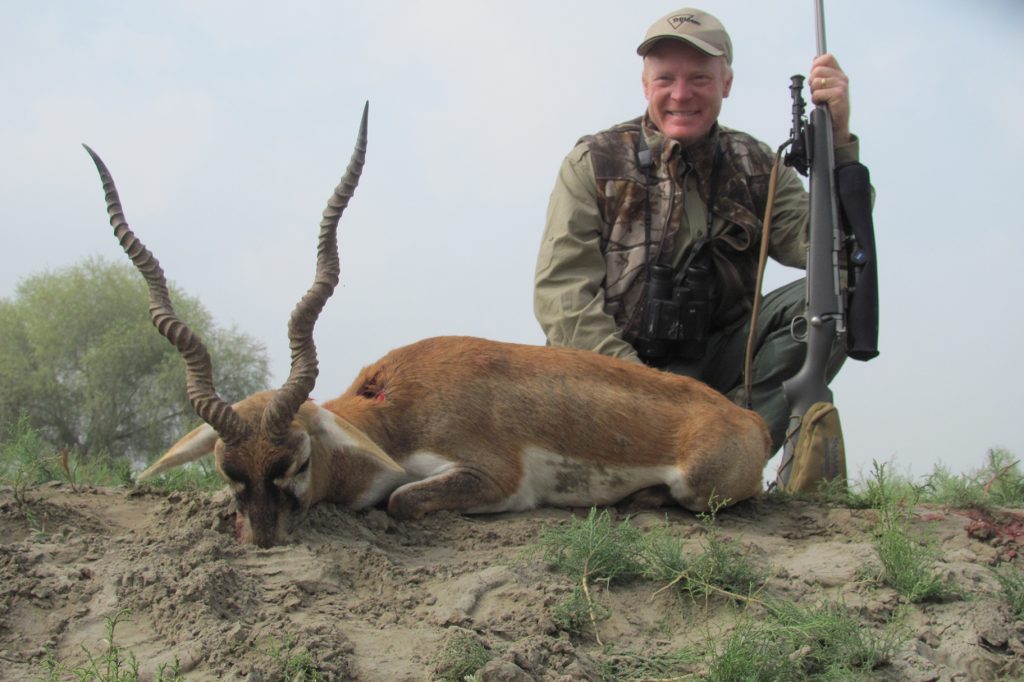
This blackbuck was taken in southern Pakistan in 2011. Not a young ram, the horns are excellent, but the tan body color is a mystery.

Mine, an excellent ram, was with some ewes on the far side of a big, plowed field, an elevated levee behind. I went prone on a bipod, then held off while some farm workers walked across the levee behind the herd. J. Alain’s ram was a more typical blackbuck encounter, in brushy country to the north. Animals glassed, quick stalk, put up sticks, take the shot. Which he did, with instant effect.

A difference between J. Alain’s blackbuck and mine: The upper torso on his was dark, mine was tan. With blackbuck antelope, females and young males are always tan on upper surfaces with white bellies. Only mature males have the black upper body, neck and face, with stark white underbellies, and distinctive white rings around the eyes. The horns on my ram were excellent, one of the largest blackbucks taken in decades. Yet it was lacking the glossy black coat that “makes” a blackbuck. J. Alain’s was darker, but still not glossy black like introduced blackbucks I’ve hunted in Argentina and Texas. I can’t explain this; I just haven’t seen enough blackbucks on their native range to have an opinion.

The good news: It’s not necessary to go all the way to Pakistan to hunt blackbuck. From zoo stock, they were first introduced into Texas ranches in 1932. Good move. Today, there are far more blackbucks in Texas than remain on their native range, with the Texas herd estimated to exceed 20,000. Blackbucks are a fixture on Texas game ranches, mostly on estates, also free-ranging on “low fence” properties across the Edwards Plateau and elsewhere. After axis deer (chital), the blackbuck is Texas’s second-most common and popular non-native animal.

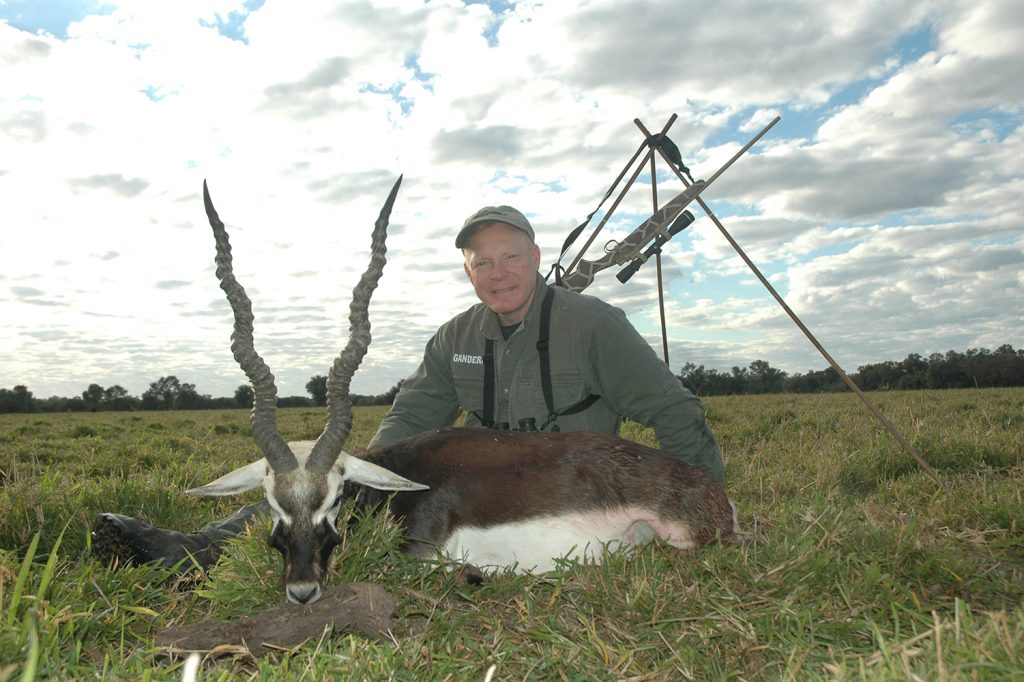
Blackbucks were introduced into Argentina a decade earlier, into ideal plains habitat with few predators. Although blackbucks are a fixture on most Argentinean game ranches, they are also found free-range in various areas, sometimes in large numbers, with Argentina’s blackbucks thought to number nearly 10,000. I think my best-ever blackbuck was taken in Chaco, northern Argentina. Later, I hunted them free-range on cattle ranches in La Pampa province. And in southern Buenos Aires province, open-range cattle country, with big herds of blackbucks moving like drifting smoke on the horizon. There have also been introductions into Australia, not with as much success—there are huntable populations in just a couple of spots. With native-range hunting so limited, it doesn’t matter much where you hunt them. Anywhere, the blackbuck antelope is a unique and attractive animal.

This is probably the author’s best blackbuck antelope, taken in Chaco Province in northern Argentina.

Small, nervous, and fast, blackbucks aren’t usually easy to hunt. You get one attempt at a stalk, and then the odds drop dramatically. At least on that day. The fact that they’re strongly territorial is a weakness and an opportunity. Any given part of their habitat looks much the same to you and me, but apparently not to them. Males establish and defend relatively small territories. A good buck seen in a specific area will almost certainly return to that area, so that’s where you start looking. Most of my blackbuck hunts started by going to a place where an extra-large buck had been seen. Interestingly, our pronghorn antelope, only a distant relative, is much the same: Strongly territorial, despite the seemingly unbroken sameness of their habitat.

Among the myriad and diverse ring-horned antelopes of both Africa and Asia, only the addax, native to the Sahara Desert, and the blackbuck grow horns that are both ringed from bases upward, and grow in a spiral. Despite this shared characteristic, addax and blackbuck are not close cousins, their home range thousands of miles apart. With addax, which are much larger, males and females grow similar horns. With blackbuck, only the males grow horns. Females are noticeably smaller and remain a drab tan with white underparts throughout their lives.

Despite their corkscrew horns, blackbucks are not of the spiral-horned tribe of antelopes, so horn length is usually measured on the straight, base to tip, not by following around the spiral. Horn length, in inches, in the upper teens is good, into the lower twenties truly exceptional. Hunting essentially closed in India in 1973. However, throughout the centuries of the British Raj, the Indian subcontinent was a popular hunting destination, and blackbucks were plentiful. There are old records of blackbucks from India approaching 30 inches. I can’t even imagine what a ram like that might look like! Measured on the straight, no known Texas blackbuck has ever grown two feet of horns.

Leave a Comment

Ducks and Salt Water

Hunting sea ducks calls for tough retrievers and shotguns with plenty of punch.

Low, gray skies descended almost to the waterline.  A feeble sun lay just above the mountain horizon to the south, invisible above the scud. The wind was modest by local standards—15 gusting to 20—but it still made our decoys tack back and forth crazily against the incoming tide. It was just another day of winter duck hunting on Kodiak Island.

Lori and I had been married for just a few months. I’d optimistically billed this trip as a honeymoon. Although she had grown up in a Montana ranch family, she had never done any wingshooting. I knew this would be a challenging way to introduce a beginner to shotguns. However, winter visits to Bob, one of my guiding partners, had become a regular, highly anticipated event. I wasn’t going to miss it, and my bride wasn’t going to be left behind.

Although she was well grounded in firearm safety and had done some target shooting, I suggested that she leave her 20-gauge behind. Sea duck hunting requires more punch. Crouched behind a beach log twenty yards from the waterline, I knew the shooting would be difficult even for a veteran, and I didn’t want her to start off frustrated.

Then Ernie, another member of our team, shouted, “Birds coming from my side!” Stretched out in a line and flying low against the water, they were still a long way out, but I could tell they were surf scoters. The flock veered sharply in our direction. As I heard Ernie fire, I identified a drake by its distinctive facial markings, swung my barrel as fast as I’d ever made it move, and watched the bird cartwheel across the waves. The flock was moving so fast I didn’t even think about a second shot.

“Got one down?” I asked Ernie.

“Yeah, but its head’s up and it’s swimming hard.”

“The dog will get it.” Bob’s Chessie had followed us all the way from camp, and I welcomed his company despite his faults. I’d hunted with Yaeger for years, and while I respected his talent and determination, I also knew that he treated commands as suggestions at best. He had broken at the sound of Ernie’s shot and was already closing on the wounded duck.

“We don’t have to worry about getting my bird,” I said, and we didn’t. The dog had evidently marked that one down too, and as soon as he dropped the cripple at Ernie’s feet he plunged back into the sea, churning off in that direction.

“That looked like a long shot,” Lori said as Yaeger began the return leg of his retrieve.

“It was,” I agreed.  “Don’t worry. They’ll be closer soon and you can take my gun and start shooting.”

“How do you know that?”

“Because the tide is coming in.” Although modest by Alaska standards, Kodiak tides are still greater than any in the Lower 48. “In another hour the waterline will be right in front of us. We’ll have to move the decoys, but you should have some closer shots.”

She did. After some predictable missing, she dropped a drake harlequin and immediately demanded that we take it to our taxidermist. Since harlequins may be the most gorgeous waterfowl on the continent, I didn’t argue. Although I felt sure the bears would already be in their dens, I dropped a couple of slugs in my shotgun before we began the hike back through the woods to Bob’s cabin. 

Now, thirty years later, Lori shoots at least as well as I do. I love looking at that mounted harlequin and remembering how it all began–on a sea duck hunt.

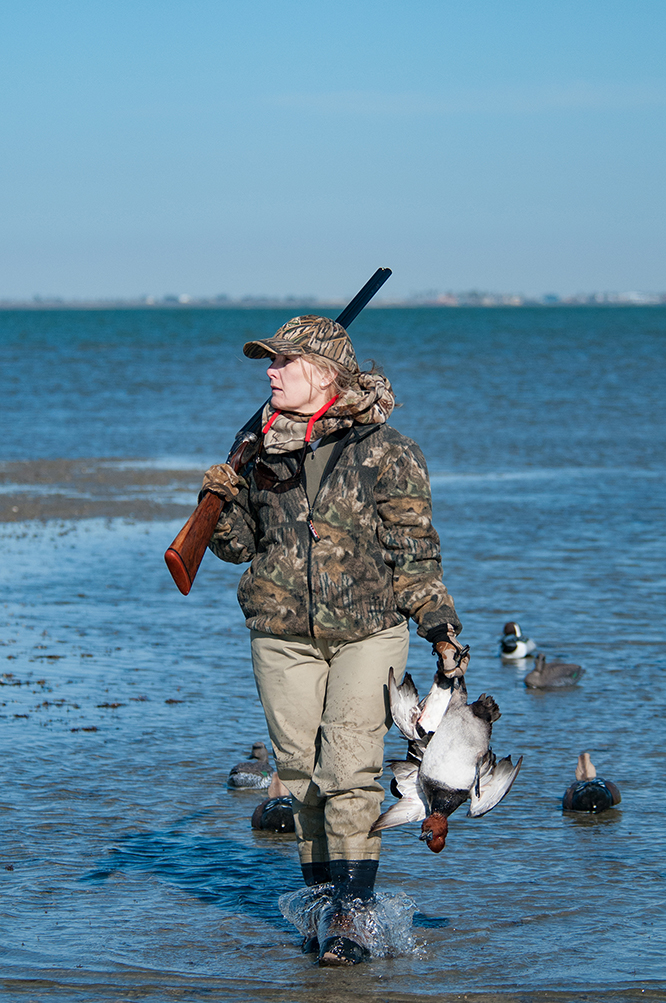
Sea duck hunting doesn’t have to mean cold, wet, and windy weather, but it often does.

How does hunting over salt water differ from inland duck hunting? Let me count the ways.

I’ve done some saltwater duck hunting along the Texas Gulf Coast and enjoyed it, but most of my experience has come in the North Pacific. Sea duck hunting doesn’t have to mean cold, wet, and windy weather, and I’ve hunted the Texas coast in shirtsleeves.  Weather in the North Pacific is another story. Plan on dressing in your best foul-weather gear. 

Air temperature isn’t the only challenge. When I lived in Alaska, the Coast Guard estimated that after twenty minutes of immersion in the North Pacific a healthy young recruit would be “unable to participate in his own rescue.” Remember that grim warning when hunting or traveling in a skiff. Paying attention to the tides is crucial along the shoreline. An outgoing tide can leave the skiff you arrived in high and dry, while rising water can cut you off from dry ground.

Sea duck hunting requires more thought than usual in the selection of guns and loads. Inland, I’m a bit of an outlier. When I’m shooting decoying ducks over the little springs and creeks I hunt in the Central Flyway I’m happy with a 20-gauge. It’s easier to handle a light gun when swinging quickly in tight cover, and my banged-up right shoulder no longer enjoys recoil from a heavy load. Most shot opportunities are close, and if they aren’t I don’t take them. 

That reasoning doesn’t apply in salt water, where the shots are longer and the birds are tougher. I find sea ducks harder to bring down than the usual mallards and pintails, perhaps because their leaner outline gives pellets less to hit and they have thicker protective layers of plumage and fat. Whatever the case, sea ducks call for more firepower than my usual light duck guns can provide.

It’s best to plan as if you were hunting geese, with three-inch 12-gauge shells, tight chokes, and heavy shot. In contrast to puddle ducks, I don’t hunt geese with anything lighter than No. 2s or chokes less than full. Those are good guidelines for sea ducks, too.

One other important consideration affects my choice of firearms on sea duck hunts. The marine environment can be devastating to shotguns. While I don’t own any shotguns that I could call fancy, most of mine are nice enough to deserve good care. I hate to expose them to salt water. When I lived in Alaska I hunted sea ducks with our standard camp bear gun, a 12-gauge pump that had been handled roughly for years. Even so, I cleaned it religiously after every trip to the coast, as I admit I don’t always do with my other guns after a day of upland hunting .

I’ve always believed in some wisdom from Nash Buckingham: “The best long-distance load for waterfowl is a good retriever.” Since I spend more time fussing with my dogs than with my firearms, I almost have one at my side when I’m wingshooting, no matter what the quarry. The sea presents a lot of challenges to a dog, no matter how tough it has proven elsewhere. I never take a dog to the salt until it has demonstrated endurance, strong swimming, and determination in fresh water.

The choice of dogs is always personal. Anyone familiar with the Chesapeake Bay retriever’s origin story will understand why they are so popular among sea duck hunters. I’ve watched some heroic saltwater retrieves by friends’ Chessies. However, the Lab’s ancestors worked offshore in the Newfoundland cod fishery centuries ago, a background that persists in their genetics. I’ve always been a Lab guy and, with a couple of exceptions, mine have always taken readily to the sea.

Sea duck hunting isn’t all about raging seas and miserable conditions. Back (way back) when I was growing up in Washington, friends and I would rise early, take the ferry across Puget Sound, drive across the Hood Canal Bridge on the east side of the Olympic Peninsula, (years before its 1979 collapse) and fish a couple of under-appreciated little steelhead streams. Then, unless the fishing was fantastic, we would drive north, launch our canoe, and paddle out to the spit at head of the bay. If the tide was right, we’d spend a couple of hours pass shooting a mixed bag of dabblers and sea ducks with an occasional brant mixed in. Oysters grew on the spit, which we would shuck and eat with tabasco sauce and squeezed lemon while we waited for ducks to fly. We never went through a lot of shells, but it’s hard to remember better duck hunting trips.

The tideline is one of our most biologically diverse and fascinating ecosystems. I can enjoy it whether I’m carrying a shotgun, a fly rod, or just poking around in the mud. When I moved back to Montana from Alaska, the thing I missed most wasn’t the moose, sheep, or salmon, but the sea. Hunting the waterfowl that live there is one of my favorite excuses for returning.

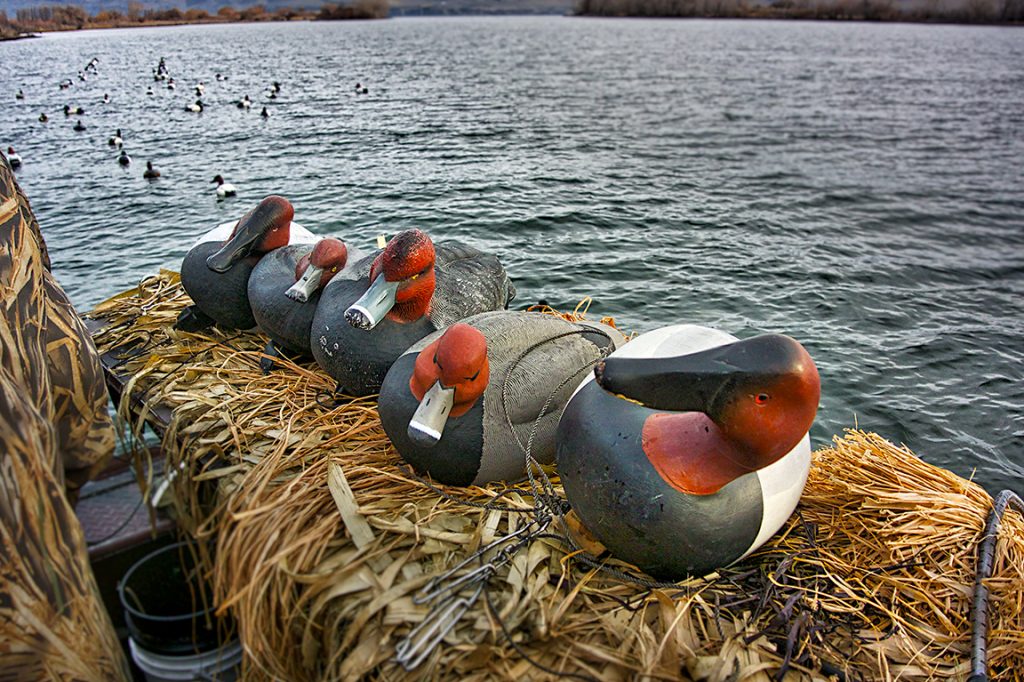
Decoying ducks on the tideline is a wonderful way to spend a fall day.

Leave a Comment

Looking Sharp

The right knife is a crucial tool for breaking down an animal in the backcountry.

Photo above, from top: Two editions of Benchmade’s TaggedOut folder; Montana Knife Company Stonewall Skinner; and BenchMade MeatCrafter. The colored blades are an option on some knife models.

Eighteen inches of fresh snow blanketed the landscape, wrapping everything in impossible white. A rhythmic swish, swish, sounded from the horses’ legs as they pushed through the snow, following the vivid path of a hundred migrating elk. My friend Jeff and I each had an antlerless elk tag burning holes in our respective pockets and we pressed steadily forward, knowing that at the end of these elk tracks there would be elk. 

And so there were, some bedded and others feeding in a mountainside scrub oak swale. We crawled through the snow, rested our rifles on our packs, and dropped two of them. Dusting the glistening snow kernels from our clothing, we slogged down the hill to begin the joyful task of converting our elk into meat. Jeff’s elk was down the hill from mine a hundred and fifty yards, and by and by he hiked up to my position. 

“I lost my knife in the snow,” he said.

Fortunately, I had a good spare knife in my pack. Handing it over with a grin I cautioned him against losing that one as well. A couple hours later, we were headed for the truck, this time breaking trail through the snow for our heavily laden horses. Had I not possessed a spare knife we would have been there twice as long, reduced to processing two elk with one knife. It would have been a long, cold hike out in the evening darkness. The moral of the story, of course, is to always carry a spare blade when hunting.

I’ve been blessed to wield knives and process meat from Alaska to Arizona and from California to Africa. I’ve skinned and caped out critters ranging from rattlesnakes to moose, including several hundred each of deer and elk. As a result, I’ve formed some opinions on what makes a great knife. So let’s take a detailed look at knife design and construction. I’ll break this discussion down into three basic categories: hunting, processing, and caping. Each category offers its own set of challenges, requiring separate tools to do the job right. That said, one knife can perform all tasks, and if I were to choose just one for all-around use it would be the hunting model.

As backcountry hunters, we must hold our knives to a higher standard. The primary difference of course, is weight–we can’t afford to pack around a big old Bowie. We must choose cutlery that is light in the hand and on the scale, graceful to use, and possessed of fine steel that will maintain a sharp edge long enough to skin and quarter an elk or moose. Ideally your knife will feel comfortable in your hand–it’s no fun using a knife uncomfortable enough to raise a blister while skinning an elk.

A good hunting knife should be non-slippery when it becomes covered with blood and fat, and I like a small guard or swell at the front of the handle to help prevent my hand from sliding forward onto the blade. Some of the nastiest cuts I’ve seen occur while butchering game happened just that way.

The shape of your blade is important too, since you’ll need to perform myriad tasks with it. A sharp point will make piercing stubborn hide easy. My preference for point design is a drop point, or a very shallow clip point. Avoid aggressive clip points, as they are hard to keep from perforating things you just don’t want to puncture while making your rip cuts.

After piercing the hide, the next thing you’ll need to do is make rip cuts around the lower legs, up to center, and from stem to stern. To make a good rip cut your blade should have a couple inches or more of a straight, very sharp edge running from just behind the curve of the point back toward the haft. (As a note, rip cuts should be made from underneath the hide. Cutting hair rapidly dulls a fine edge, so insert that sharp point mentioned earlier till your blade is buried under the hide. Now lift and push your blade forward, unzipping the hide in a smooth, long cut.)

A successful wilderness hunter doing good work with his backcountry blade.

Your next task while breaking down a big-game animal is to peel back the skin. Here’s where the curve of your blade comes into play. If you examine a dedicated skinning knife you’ll notice that the blade forms a huge curve. We don’t want that, but we do need a well-curved section of blade running from the point back an inch and a half or so. That curve will enable you to handily skin your critter without accidentally slicing the point of your knife through the hide.

A blade shaped as I’ve described will also serve well to remove quarters and backstraps, and trim meat and tenderloins from your game. While doing so, keep in mind that contact with bone will rapidly turn the edge on your knife. Speaking of holding an edge, I’ve used every kind of steel from stainless to Damascus, and in my opinion the new MagnaCut steel makes the best hunting blade for our purposes. It’s tough, corrosion-resistant, and holds a razor-sharp edge very well indeed.

Now that I’ve described the attributes I look for in a wilderness hunting knife, I’ll share details on my favorite models. I have a couple–one for superlight backpacking hunts and the other for hunts when I am on horseback and don’t need to worry about weight quite as much. My favorite superlight knife is the TaggedOut Carbon Fiber folder by Benchmade. It’s a pricey little thing, but it features carbon-fiber scales, CPM MagnaCut steel, a 3.5-inch clip point blade, and weighs only 2.44 ounces. Benchmade also offers the TaggedOut at a significantly lower price point featuring their Grivory (engineered plastic) scales, CPM-154 stainless steel, and an even lighter weight of 2.1 ounces. These knives are my go-to models for every backcountry hunt I make.

For hunts where weight is not so much of an issue (horseback or float hunts) I use Montana Knife Company’s MagnaCut Stonewall Skinner. It’s a fixed-blade 9.25-inch model featuring G-10 handle material, a 4.5-inch blade, and weighing 5.53 ounces. This knife is super tough, gets scary sharp, and feels incredible in your hand. It’s great for breaking down big, thick-skinned game, as well as performing camp chores and tasks.

Note: A hunter’s knives are very personal tools. As you’ve probably noticed, I’m not a fan of replaceable-blade models. I don’t like how they feel and their lack of balance. They are dangerous–I personally know a man who watched a young fellow lose his eye to a flying splinter off a disposable blade. And I just don’t agree with the modern disposable mindset. A good knife will last most of a lifetime. Why leave scattered razor-sharp trash in your wake? Instead, learn how to get your blades shaving sharp–it’s a skill every true outdoorsman and hunter should have.

Processing

The conclusion of every productive hunt should be the enjoyable task of cutting, trimming, and wrapping meat for the freezer. At home, or when on horsepack trips, I use a dedicated processing knife from Benchmade called the MeatCrafter. Sporting a 6-inch upswept trailing-point blade thin enough to be slightly flexible, it’s akin to a filet knife and incredibly handy at trimming, portioning, and shaping meat. I usually avoid boning with this knife because I don’t want to compromise the edge. I keep my hunting knife handy and use that for the boning part of the job. 

Often, I will perform this work before departing my wilderness camp, sans the wrapping part. (I bag all the finished cuts in heavy-duty gallon freezer bags, and later remove and double wrap the meat in good freezer paper before stowing it in my chest freezer at home.) This saves significant pack-out weight in the form of undesirable bone, fat, and tissue.

Meat quality is largely dependent upon how well you care for it. It’s of paramount importance to keep the meat clean and free of hair, grime, dirt, and such. It’s also important to get the meat cool as soon as possible after the kill. Take the necessary time to get quality photos, but then skin, quarter, and hang the meat to cool as efficiently as possible. Use every precaution to keep the meat clean.

Caping

Not every hunter will want to cape their animal, especially when they must carry the cape in their backpack for miles to get it out of the backcountry. However, if you’ve harvested a great animal and love shoulder mounts, it’ll be worth the effort. You’ll want to be equipped with a proper caping knife and the skill to do the job right. That skill is one that I don’t have room here to describe; however, I can recommend the proper tools for the job. 

To start, use your regular hunting knife to skin the hide up to the base of the ears and skull. and then switch to your caping blade to skin the face. The best blade for this job is long and slender, with a razor-sharp edge and point. The blade need only be two or three inches long, but it’s nice to have a longer handle to provide grip and dexterity. The Mini SpeedGoat from Montana Knife Company provides good configuration for caping, and it’s still substantial enough to use for skinning and quartering in a pinch. Weighing at just 1.2 ounces, this would make an ideal backup knife.

Blades of Note

As a kid I was kicking dirt down the two-track leading to my family’s farm when I spotted a shiny Buck knife in the sand. A fixed blade “fishing knife” model, it sported a thin-ish blade with the tip broken off. I stuck it atop a nearby fencepost and left it for the owner to claim. He never showed, so eventually I took the knife home, ground a point back onto the blade, and used it for many years as my primary hunting knife. It’s tired and worn, and the blade is longer than ideal, but I’ve sure dismantled a lot of game with that old knife.

Another of my favorite experiences with a blade came while following legendary Alaskan guide Phil Shoemaker on a Peninsula brown bear hunt. His client killed a great boar, and as we began to skin it, I pulled a large stone blade from my pack. My close friend and world-class flint knapper Greg Nunn had made it for me, and I’d carried it for several weeks hoping for the opportunity to use it on a bear. I’d been told that a stone blade was ideal for skinning a bear, leaving the hide and hair follicles more intact than a conventional steel blade. This seemed to be true, and we had a great time trying out my stone knife while skinning that bear.

Leave a Comment

Stripes

The zebra is one of Africa’s iconic animals, and one of the most challenging to hunt.

To me, the zebra is the most classic and iconic African animal. In three species and numerous races, zebras are confined strictly to eastern and southern Africa. I love to see them, love to watch them. And, on occasion, I love to hunt them.

Antihunters and too many non-hunters would quickly ask, “How could you possibly hunt a zebra?” The proper answer is that, like all animal populations, they need to be managed. The zebra is a large grazer that requires a lot of grass. Like all African animals, all meat is utilized. And, with zebras, the magnificent skin is always preserved. A quicker answer to that question, though, is, “Only with great difficulty.”

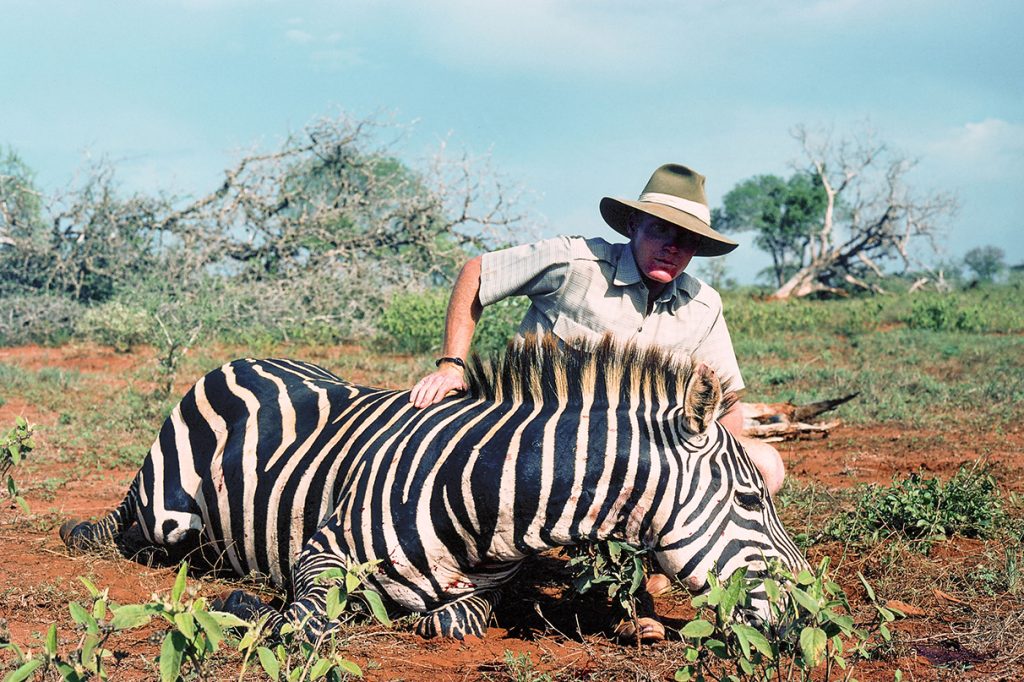
The author’s first zebra was a Grant’s zebra, taken in Kenya in 1977. He used a Ruger M77 in .30-06 with 180-grain Nosler Partition, which put the animal down on the spot.

All senses are keen, and zebras are constantly switched on, alert, wary, and difficult to approach. In the open, the black-on-white stripes show up like a beacon, jumping into your binoculars  at great distance. Seems like Nature played them a cruel prank. In the dappled shade of thornbush or scrub forest, the story is reversed. In cover, the striped pattern gives them excellent camouflage. I can’t speak to other predators, but it seems to baffle the human eye.

Eventually, often when they start to move, you’ll pick them out. From a hunting standpoint, that’s just the first part of the challenge. You aren’t just trying to shoot a zebra; it must be the right zebra. Most of the time, you’re looking for a stallion. However, it depends on the situation. We used to think that if the herd stallion is taken, he will be quickly replaced. This is true but there is evidence that removing the dominant male can cause turmoil in the herd. So, sometimes you’re purposefully looking for a mature mare without foal.

Either way, zebra hunts are always sex-specific. Since they have no horns or antlers, this is tough. The stallion’s genitals are well back, mostly hidden by the back legs and obscured by medium-high brush. Mature stallions are usually larger and built heavier, with thicker neck and shoulders. These are unreliable, and if you wait until they’re going away to see the testicles, it’s often too late to get a shot.

Most of the time, the decision is made on a combination of these indicators, then verified by behavior. When they run, it’s easier. The stallion will almost always come last, lagging until his mares stop. In cover, it’s difficult.  I’ve spent hours with good PHs trying to be certain which was the stallion. Sooner or later, if a stallion is present, he’ll probably tip his hand with aggressive behavior.

When daughter Brittany was preparing for her first safari we discussed what animal(s) interested her. She immediately said her first choice was a zehra. Knowing how crazy she was about horses, I was surprised and asked why. “Well, my mom says they’re spooky and hard to hunt. Besides, I want a rug for my room.” Both good reasons.

However you feel about it, the zebra is an equine, but neither a horse nor an ass. Unlike the latter two groups, only rarely has the zebra been successfully domesticated. Perhaps because they developed as favorite prey of lions, they are generally too temperamental and dangerous. The zebra is a wild animal, large and exceptionally tough.

There are three extant species: Plains, mountain, and Grevy’s. Current taxonomic thinking places the plains zebra as Equus quagga, the mountain zebra as E. zebra, and Grevy’s zebra as E. grevyi. The extinct quagga was confined to South Africa’s Cape, placing it squarely in the path of settlers advancing into the interior. Extinct since 1883, only twenty-three skins survive. We think the quagga was striped on neck and shoulder, with darker flanks and rump. For years it was considered a separate species; today it is mostly considered a subspecies of plains zebra. 

Stripe patterns vary among both races and subspecies, but the Grevy’s zebra of northern Kenya and Ethiopia is the most distinct: Larger body, heavier build, bigger ears. Like the mountain zebra, the stripes stop short of the belly, and the stripes are narrower, a beautiful pin-striped zebra found in semi-desert. Joe Bishop and I saw quite a lot of them in Ethiopia’s arid Danakil in 1993, but by then they were off-license. Despite no legal hunting for decades, the population continues to decline, now below 2,000 in the wild.

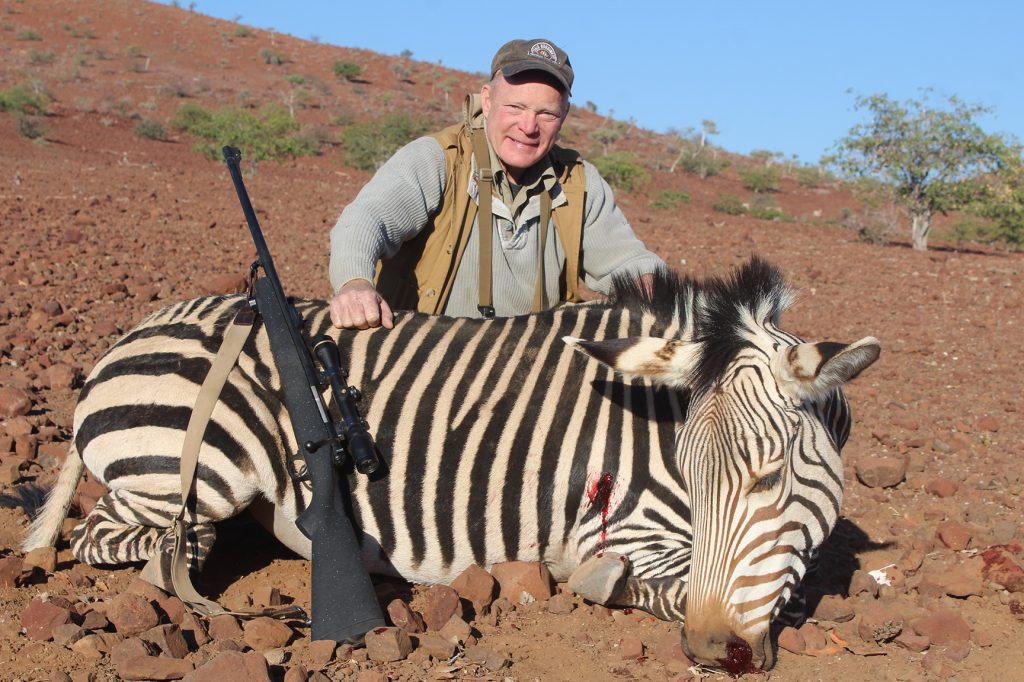
This Hartmann’s mountain zebra was dropped with a shoulder shot from a Montana Rifles bolt-action in 9.3x62mm.

Two thousand miles to the southwest there are two subspecies of mountain zebra, Hartmann’s mountain zebra in Namibia and Angola; and the Cape mountain zebra in South Africa. Visually they are almost indistinguishable. On both, the stripes end on the lower flanks, with white belly, and both prefer mountain habitat. Cape mountain zebras tend to have broader black stripes and I think they tend to be starker black and white; many Hartmann’s zebras tend to have stripes with a slightly brownish tinge. The biggest difference is that the Cape mountain zebra is smaller, up to 600 pounds, while a big Hartmann’s zebra can top 900.

When I first hunted then-South West Africa in the late 1970s, Hartmann’s mountain zebras were scarce and mostly confined to the Erongo Mountains. Today they are plentiful, spread throughout mountain habitat and present on most game ranches. Cape mountain zebras are a different story, almost extirpated and making a slow comeback. Currently, Cape mountain zebras aren’t importable into the United States. This is problematic for the few game ranchers trying to breed them up because this reduces their value.

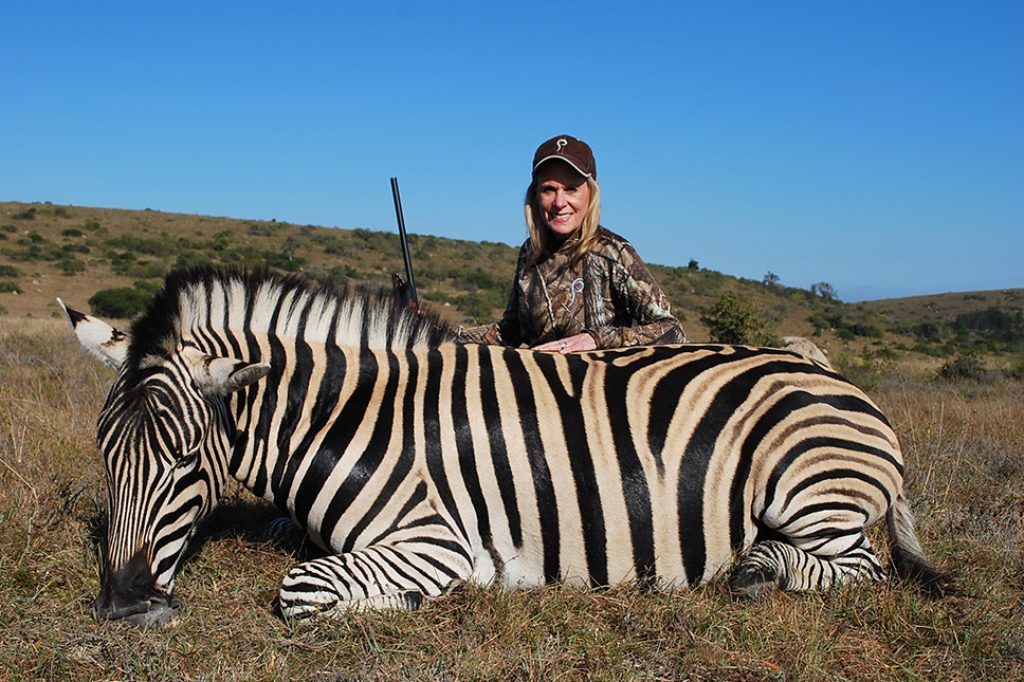
In between Grevy’s and mountain zebras, across the huge swath of East and Southern Africa is the widespread and plentiful plains or “common” zebra, with vertical flank stripes all the way to the belly. Numerous subspecies were proposed based on differences in striping and size, not all validated. Most widespread is Burchell’s zebra, a large-bodied zebra, typically with distinct gray “shadow stripes” between the black bands. Burchell’s zebra is the zebra of Zimbabwe, Botswana, most of South Africa, and most of Namibia.

Donna Boddington dropped this Burchell’s zebra in its tracks with a 130-grain Interlock from her .270. She used a shoulder shot (on the opposite side). This stallion shows the classic gray “shadow” striping of the Burchell’s zebra on its rump.

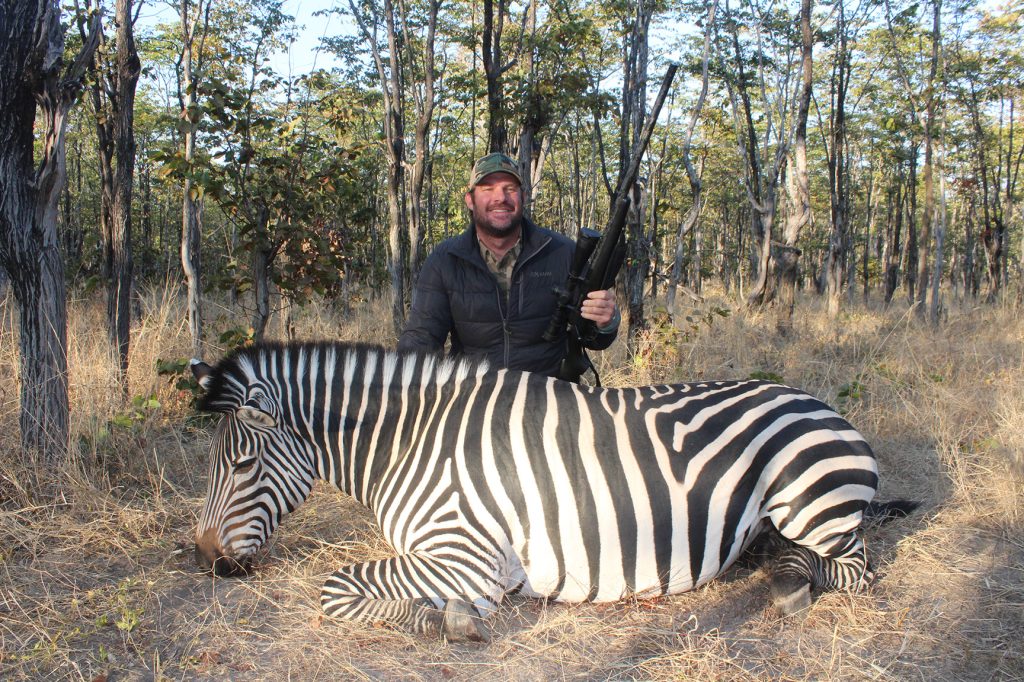
To the northeast is Grant’s, also called Boehm’s zebra, a slightly smaller zebra, attractive black and white stripes with little or no shadow striping. This is the plains zebra of East Africa south into northern Mozambique. Crawshay’s zebra, with narrower black and white body stripes and leg stripes to the hoof is found in southeastern Tanzania, eastern Zambia, Malawi, and west-central Mozambique. To the west is Chapman’s zebra, western Zambia across to Caprivi, also with less shadow striping than Burchell’s, and sometimes a brownish tint.

There are two more subspecies of plains zebra, both more isolated than the rest, both with stark black and white stripes. The Sudan maneless zebra is found in southeast Sudan and into Uganda. This zebra has not been hunted since Sudan closed in 1983. The Selous zebra, smaller than other plains zebras, ranged across southeastern Mozambique. After Mozambique’s long civil war, only a few dozen remained at the Zambeze delta. They have recovered nicely and are hunted on a small quota in the Coutadas surrounding Marromeu Reserve.

The author’s son-in-law, Brad Jannenga, took this Crawshay’s zebra in northeastern Zambia. This race of plains zebra has stark black-and-white stripes, no shadow striping.

It is said that zebra stripes are like fingerprints, no two patterns exactly alike, with much variance among individuals. I can’t say that I’ve ever picked a zebra for exceptional pattern. However, zebras, especially males, fight viciously and many bear nasty scars. So, if a zebra rug is the goal, when possible, it’s a good idea to look them over carefully.

Most important is to place the shot with care. A big zebra of most races will weigh 800 pounds or more. Except for eland, the zebra is the largest of the non-dangerous African animals we lump together as “plains game.” And they are strong and tenacious.

It isn’t necessary to use a cannon. Both my daughters have used their 7mm-08s to cleanly take zebras and Donna usually uses a .270. I’ve taken a number with .375s because that’s what I was carrying. There’s nothing wrong with thumping a zebra hard but, for larger plains game, I’m mostly a .30-caliber guy. Whether from a .308, .30-06, or a magnum .30, seems to me a 180-grain .30-caliber is just about perfect for Mr. Stripes.

That’s provided you hit him right. If you don’t, you’re in for a long day. Hit poorly, the zebra seems to be an animal that just keeps going, as long and as far as it can. Because of size and toughness, on zebras I prefer the central shoulder shot. It’s worth waiting for a broadside presentation and the zebra makes it easy. All zebras, all races have a bold chevron-like marking on the center of the shoulder, where the horizontal leg stripes and vertical neck body stripes meet. It makes a wonderful target, up the center of the on-foreleg, one-third up from the brisket-belly line. A zebra hit in this spot won’t go far.

Leave a Comment

Bulls of the Bering Sea

An unusual hunt for huge reindeer in the Aleutian Islands.

“I made you some cinnamon rolls.” 

You know you’ve been stranded at the airport for a long time when the woman who works for the airline brings you homemade cinnamon rolls. We were, in fact, on day four of sitting in this small Alaskan airport waiting for a break in the weather. Every day, even if the weather was clear on our end, it was fogged in at the other. But that’s how it is with travel in the Far North: sometimes, just getting to your destination is even more of an adventure than the adventure itself.

Our intended destination was in the Aleutian Islands. My son Logan and I were on our way to hunt reindeer with the natives on one of the islands. Members of the species Rangifer tarandus are typically referred to as caribou in North America and reindeer in Europe and Asia. Why, then, are there “reindeer” in Alaska? The answer is a matter of their origins. 

Neither reindeer nor caribou are native to most of Alaska’s offshore islands. They were first introduced to the region in the late nineteenth and early twentieth centuries, part of a federal effort to provide a steady meat supply and economic opportunity for Alaska’s native communities. Between 1891 and the 1930s, government and missionary programs relocated reindeer from Siberia and caribou from herds on the Alaskan mainland to various coastal and island locations across western Alaska, including the Aleutians and other islands in the Bering Sea. 

On these islands, reindeer usually thrived due to the abundant forage, cool maritime climate, fewer insects, and a lack of large predators such as wolves or bears. Over the decades, their numbers swelled into the thousands. The animals we would be hunting originally came from just across the Bering Strait in Chukotka, eastern Russia. These reindeer have thrived over the past century, so much so that they eventually became too abundant. In the early 1980s, they numbered in the thousands and overgrazed the tundra lichens, causing the population to plummet to a few dozen by 1986. Then, something unprecedented occurred. The remaining reindeer adapted to eating grasses instead, a phenomenon that had not been observed anywhere else in the world. Since then, the locals claim these reindeer have grown larger, stronger, and more resilient. They play an important role as both a subsistence resource and, in recent years, as an opportunity for visiting hunters seeking a remote and unusual adventure.

A testament to the genetics and trophy quality of these animals happened just a week prior to our trip. Stetson Wheat, who arranged our hunt, had a fantastic hunt himself. He stalked a herd containing several big bulls. He settled on a beautiful bull, only to have his rifle misfire not once, but twice. After scanning the herd again, he spotted another huge bull. He quickly got settled and squeezed off the shot. This time his rifle fired, and his “second-choice” reindeer was down. Fearing ground shrinkage, he approached his bull, only to find quite the opposite. His bull will likely be the new SCI world-record free-range reindeer, green-scoring an incredible 647 1/8.

Logan and I spent two nights in Anchorage “camping” in the airport. While there, we met Steve Loncosky, the other hunter who would be with us on our hunt. It didn’t take long to realize Steve has the same sense of humor and “roll with it” attitude as we do, and we hit it off immediately. On the morning of day three in Anchorage the weather cleared, which gave us a window to fly to Dutch Harbor. Now we were at least closer to our destination. The afternoon flight to our hunting grounds was canceled because of weather but, determined to make the best of it, Steve and Logan bought fishing licenses and gear and spent the afternoon catching salmon with nearly every cast. 

By our third day of being stuck in Dutch Harbor, we began to feel like locals. Our dejected looks must have tugged on the heartstrings of the woman at the small airport, prompting her to make us the pan of cinnamon rolls. 

Finally, on the afternoon of our fourth day in Dutch Harbor, we got the call that we were flying. We scrambled to get our gear and bounded to the plane. Arriving on the island, we were met by our native guide, Richard, who was also the reindeer herd manager. Richard drove us to a community-owned house we rented for the hunt and we cached our gear. Since it was still early in the afternoon, Richard suggested we go out and glass for reindeer.

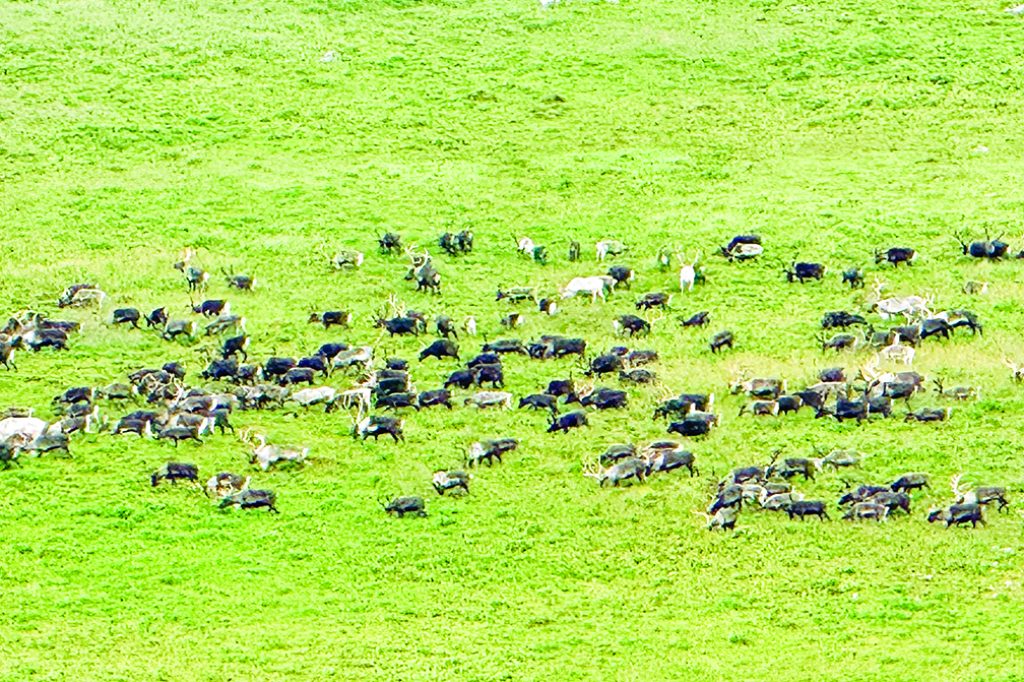
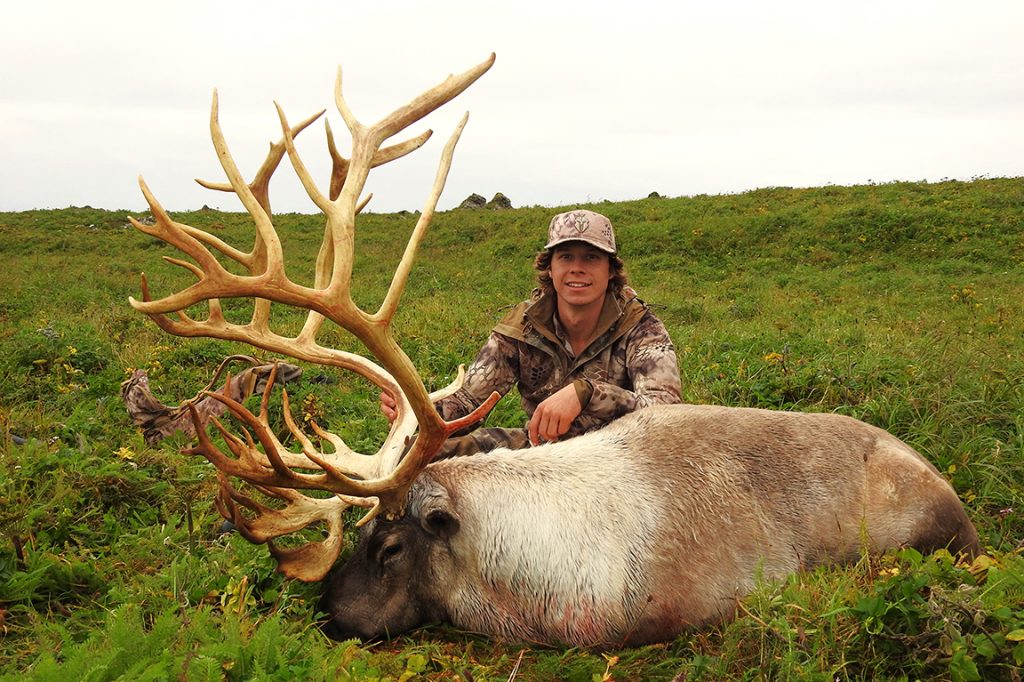
The number of huge bulls in the herd was astounding. 

He gave us a tour of the village as we made our way out of town. It was interesting seeing the native culture and listening to Richard talk about the reindeer and how the village benefits from them, both for sustenance and now because they are managing the herds for mature trophy bulls to attract visiting hunters. They estimate there are roughly 1,500 head of reindeer on the island, of which roughly one-third are bulls.

Logan was the first to spot a herd of reindeer in the distance. After getting the spotting scope on them, we could see it was a herd of approximately 200 animals, mostly bulls. We headed back to town to grab our gear, then headed back out to find the herd. 

The reindeer had bedded not far from where we had last seen them, just below the crest of a hill. We sat and watched them for a bit, trying to make a plan for a stalk. After a while, one of the bigger bulls in the herd began making his way toward a depression in the ground where Richard said there was a small lake. One by one the other bulls also began making their way toward the water. There was a large outcropping overlooking the lake, so we thought if we could get to those rocks we might have a shot at the bulls. The outcropping was over a mile away, so we donned our packs and used the rolling terrain to hide our approach. 

The terrain consisted of hills of volcanic rock covered in moss and grass. Walking was rough and you had to be constantly on the lookout for hidden holes. We made it to the small rock mountain undetected and began creeping to a point where we could see the herd. Upon reaching a flat spot, we could see the bulls about 500 yards to our right. There were so many it looked like a forest of intertwined antlers. There were antlers of all size and shapes. Some grew straight upward, some out wide. Some even grew backward.  It was truly a sight to behold and drool over.

Logan had his eyes on a bull with numerous long tines. “That’s the one I want to try for!” he said. There were so many mature bulls it was hard to choose one. I could see several I would be happy with. 

Logan began easing forward to set up his spotting scope for a closer look and only made it about a yard before he quickly dropped back down, eyes wide. “There’s a big lone bull bedded right here!” he whispered. 

Peeking over the ledge, we spotted the bull, which had heavy, wide-framed antlers. We looked him over and Steve said, “I’ll take that one if you guys don’t care.” We told him that was completely fine. 

We devised a plan. Logan and I would drop down into the lake depression and work our way below the herd, which was now bedded just over the crest of the hill from the lake, then crawl over the edge to look for a shot opportunity. We told Steve to watch his chosen bull and to wait until Logan and I got in place. If we got a shot, his bull should stand, offering him a shot. If his bull happened to stand first, we told him to go ahead and shoot. 

Logan and I dropped behind the rocks and down into the lakebed. We circled the lake, staying out of sight of the bedded bulls. The wind was perfect as we slowly crawled over the crest of the ridge, staying as low as we could. When we could see antler tips, we moved up a hair more and began glassing for Logan’s chosen bull. Deciphering the tangle of antlers was a challenge but soon Logan spotted his bull bedded on the far side of the herd. We dropped back down into the lakebed and worked our way to that end of the herd. 

There was one small rock sticking up out of the tundra a couple hundred yards off. We figured it would offer the only cover to be had, so we began crawling. Reaching the rock undetected, we sat up and began glassing the still-bedded bulls. The big one Logan wanted was still obscured by other bulls. Suddenly we heard a rifle shot and knew Steve’s bull must have stood and offered him a shot. The herd rose to their feet, alert but not spooked. Logan rested his rifle on top of the rock, but still no shot. Slowly the herd began feeding into the wind, back toward the rock outcropping where Steve shot his bull from. Knowing an elevated position would give us a better look down into the herd, and hopefully a better shot opportunity, we crawled back into the lake bed and began hurriedly paralleling the bulls. 

Once we reached the rock outcropping Logan and I moved higher, to a position with a big rock that made a perfect rest. We began scanning the herd. The reindeer were about 200 yards away and we had perfect wind. They were feeding and moving slowly down the valley. Logan spotted his bull directly in the middle of the herd. One of the beautiful bulls I had put on my list was in the back and in the clear, but I didn’t want to screw up Logan’s opportunity. Richard had told us, however, that at the sound of a shot, instead of lining out and running, these reindeer tend to bunch together and begin circling. You can then often catch a good bull out on the edge. 

Waiting for a clear shot was excruciating. Logan would be on the gun for long periods of time, then as his chosen bull seemed almost in the clear, another bull would step in front. Safety back on, take a deep breath, and watch. This cycle repeated itself numerous times and all we could do was laugh at the absurdity of the situation. Too many bulls! 

Finally Logan decided to move higher to try to see his bull. I stayed at the lower position and kept watching for a clear shot opportunity. Eventually, a bull that was on my mental hit list stepped out in front of the herd. I ranged him at 200 yards, settled my cross hairs, and the bull dropped at the shot. When I grabbed my binocular to look at him, I could see Steve’s bull lying in the same bino frame as my bull, just a few hundred yards apart.

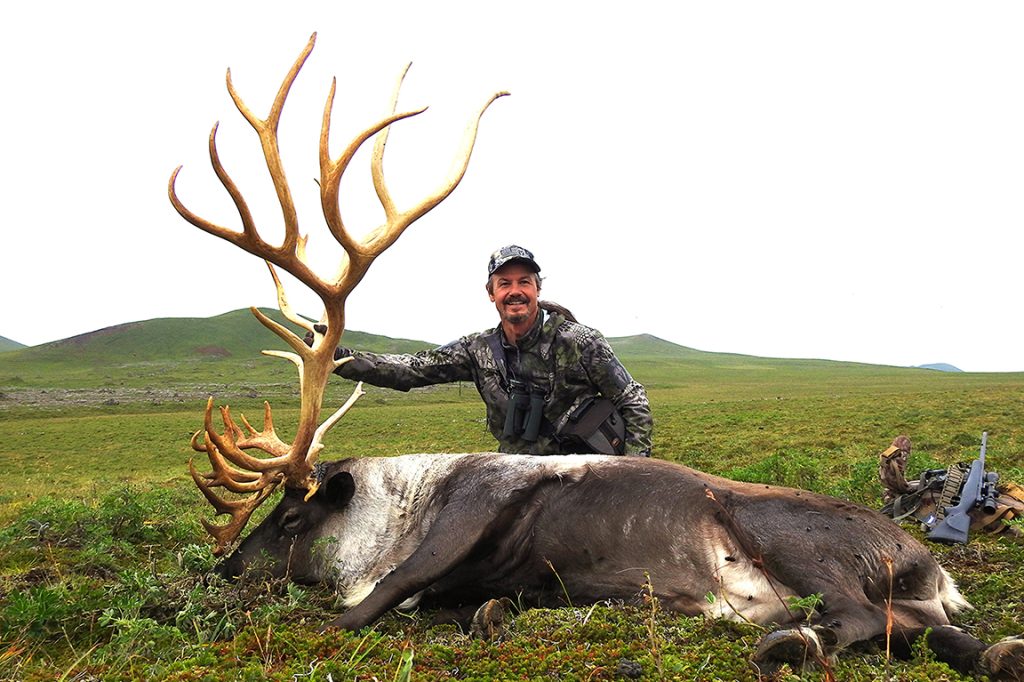
James Reed with an impressive reindeer from the Aleutian Islands.

The herd began circling, still slowly working down the valley. I glanced to my left and saw Logan crawling down a ridge a few hundred yards off in an effort to intercept the bulls. It was fun to watch the drama unfold as he moved closer, closing the distance. I worked my way back up to Steve and Richard, who were all smiles. I told them I was going to crawl out to Logan. They were going to wait for the herd to move off, then start field-dressing Steve’s bull. 

I crouch-walked behind the ridge to the intersecting ridge Logan was on and began crawling up to his position. He only had a small rock for cover so I positioned myself directly behind him and inched my way up to him. He had found his bull again but it was facing straight away. Finally, after nearly two hours of playing cat-and-mouse with this bull, he stepped clear and turned broadside. Logan squeezed off the shot and the bull reared up and went down. We shared a sigh of relief, and then a laugh at the absurdity of the situation. Even though the hunt had happened relatively quickly–three big bulls in just a few hours–we had packed a lot of stalking and crawling and many highs and lows into that short time. It felt like a week of hunting in one afternoon.

Logan Reed had his heart set on this bull, and spent several hours stalking the herd until it offered a shot.

We made our way up to my bull and I was absolutely amazed by its size, both body and antlers. It was much larger than any caribou I have ever shot. We took pictures, then made our way to Logan’s bull. His was magnificent as well. Its antlers were more compact in frame, but had far more points. Steve’s bull was a really old bull with a wide, heavy frame and huge body. He had an injured leg, which was likely why he was separated from the rest of the herd.

We got the bulls dressed and quartered and began packing them down the valley. The pack out was pretty treacherous with all the hidden rocks and holes. I stepped in one hole and fell forward, scraping both of my shins and knees on rocks. Logan followed suit not long after, but luckily we sustained no serious injuries. We got the bulls packed out and got back to our rental house about 12:30 in the morning–exhausted, hungry, but ecstatic over the day’s events. After eating a bite, we hit the sack. 

I lay in bed and thought about what a rollercoaster this adventure had been. Several days of stress and boredom to get here. Despair with each canceled flight. Then the whirlwind hunt we had just experienced in one afternoon, and the three amazing bulls. As I drifted off to sleep in this native village on a remote island in the Bering Sea, I had a smile on my face and another great memory to put in my mental vault—another adventure I was fortunate to share with my son.

Logan had only a small rock for cover, but he was able to belly-crawl within shooting distance of his bull.

About the Hunt

This hunt was booked through BookYourHunt.com and operated by Stetson Wheat of Great Beyond Outdoors. Stetson works with the Aleut natives to manage the reindeer on St. Paul Island in the Bering Sea. DIY hunts are not allowed, and a limited number of tags are available for trophy reindeer to maintain a healthy population of mature animals and excellent trophy quality. The hunt is conducted and guided by the native reindeer herd manager. Travel to the Aleutians can be challenging due to severe weather and fog, so booking backup flights is recommended. Learn more at bookyourhunt.com and greatbeyondoutdoors.com/adventure1

Leave a Comment

Keep in Touch

For better or worse, communicating from remote places is easier than ever.

A quarter-century ago I pulled my truck up to a sun-faded phone booth in a little town at the base of the mountains. Dirty, bloodstained, and tired, I limped into the booth and inserted a few quarters. Glancing through the dirty window, I made sure my horses were OK in their trailer as I waited for the phone to ring. Two weeks had passed since I had spoken with my young bride and I wanted to let her know I’d killed a bull elk, made it out of the wilderness alive, and was headed home.

In those days there were no satellite communication phones or devices. Cell phones came in a bag the size of a small suitcase, and service was very limited. Back then we headed into the backcountry for days or weeks at a time with the knowledge that communication would be nonexistent until we emerged. If we got hurt, we would be on our own. If things got really bad, well, at least we died doing what we loved. And our families might never really know what happened, even if search parties were able to locate our camp or remains.

That’s all changed nowadays, even in rugged territory where cell coverage is nonexistent. With the help of a compact electronic device we can communicate with our loved ones, check the weather forecast, share our location and, if need be, summon the cavalry to pull us out of a jam. We’ve lost some of that feeling of solitude and separation from everyday life, but we’ve gained a significant margin of safety and convenience. I do occasionally miss the old days, but as a husband and father I’m grateful for the ability to keep in touch with my loved ones and for the ability to request help should I need it.

These devices can up our hunting game too, as long as it’s legal and kept within the bounds of fair chase. We can communicate with hunting buddies during a stalk, share waypoints and travel routes, and send our location to friends willing to help us pack our hard-earned meat out of the boonies. These abilities are awesome and can make a real difference in our adventures. But they also need to be used with caution. The line that divides what’s fair chase and what’s not can be thin sometimes. Make sure you abide by all regulations, and think carefully about any electronically assisted hunting methods to be sure you feel good about using them.

Electronic Tools

I’m going to keep this discussion simple, reviewing the capabilities and the downsides of different devices that I’ve used and liked. I’ll list them in order of preference, beginning with my favorite.

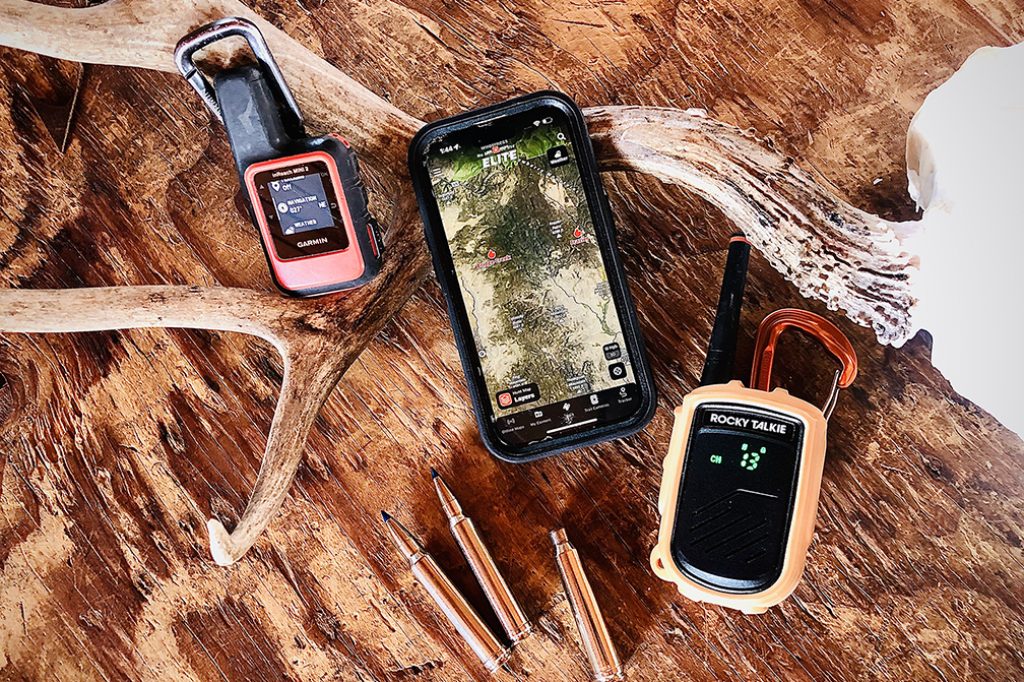
Satellite-capable cell phones: Recent models of smartphones in both Apple and Android versions sport the ability to send and receive texts via satellite–no cell service needed. They can also share your location and signal for help via an SOS message.

My iPhone has become my go-to device for backcountry use because it’s so versatile. I can map, research, navigate, and save waypoints via my OnX Hunt app, take magazine-quality photos, communicate via satellite, summon the cavalry, and–when I find a spot with cell service–send photos and call my family. It’s a remarkably capable tool that can make your wilderness adventure safer and more productive. Just don’t waste time scrolling on it– that will defeat the entire purpose of your time afield.

The big downside to smartphones is their ravenous appetite for electricity. I carry a compact battery bank and a lightweight folding solar panel in my hunting pack. With these, I can keep my phone, my headlamp, and my inReach device charged.

Garmin inReach Mini 2: This satellite communicator is remarkably capable, compact, and lightweight. With it you can send and receive messages, navigate, save waypoints, enable folks back home to watch your “track,” send an SOS message, and check the weather forecast. Battery life is excellent. Before my phone became satellite-capable, the Mini 2 was my lifeline to the outside world. I still carry mine as a redundant safety unit, and to check the weather. I love that feature. You can also share your location as well as waypoints you’ve saved with fellow hunters.

Its downsides are few. The display screen is very small, and typing a message is laborious (unless you pair the Mini 2 with your smartphone), and a subscription is required. In light of what the Garmin can do, those drawbacks are irrelevant.

Satellite phone: This was the first of these new wonder tools, and to this day I can’t imagine how it can send my voice into outer space and then back down to my wife’s phone, and vice-versa. It’s remarkable. Sat phones also offer messaging and SOS capability. I’ve carried a sat phone into the backcountry, but it usually stayed at camp, not in my pack. Nowadays I don’t use one much, simply because there are better options for what I do.

Satellite phones are heavy and bulky, two negative words in the world of wilderness hunting. They require a subscription. Even though hearing your loved one’s voice on the line is an awesome perk, given the option I’ll choose a satellite-capable smart phone or an inReach, or both, for my backcountry communication tool.

Handheld radios: I’ve used handheld radios for years, both while hunting and while cowboying in rugged country where cell service is nonexistent and communication is important. (These are for communicating with your group, not with the outside world.) Using a walkie-talkie comes with ethical considerations, which I’ll address here in a minute, but for now let’s discuss what they’re good for: close-range communication, obviously, and keeping abreast of what each hunter or member of your party is doing. They’re also great for calling a tag-holding hunter to your location when you’ve spotted the quarry, or for directing the movement of a hunter trying to stalk close to game. Herein lies the ethical conundrum; some folks consider these techniques unsporting. And in some states – Idaho, for example – the use of handheld radios for hunting is illegal. Abide by local regulations and your own ethics.

The Boone and Crockett Club and the Pope and Young Club do not consider the use of walkie-talkies in harvesting game to be fair chase. Using one will render your trophy invalid for inclusion in the record books, should you be fortunate enough to harvest an animal big enough to qualify.

Over the past three decades I’ve used a plethora of different handheld radios. A couple of the early models, simple and charged by three AA batteries, worked great. Most of the interim models I’ve tried were ridiculously complicated, lost their charge way too fast, and failed with dismaying reliability. A year ago I’d had enough and embarked on a quest to find a great radio. I discovered the Rocky-Talkie, a simple, robust handheld that holds its charge for days, has great range, and is readily operable by tech-challenged folks like me.

Rocky-Talkie radios aren’t cheap, which is their one downside. But if you want a handheld that really works, they are worth the money.

Three of the author’s favorite electronic communication devices: Garmin inReach Mini 2, satellite-capable iPhone, and a Rocky-Talkie radio.

Primitive Communication

Back in the Stone Age (I grew up in the waning years of that era) hunters were still able to communicate, albeit with less precision than we now do. Let’s talk a little about methods that still work, even when the batteries run out and the screens go dark.

Gunshots: Three shots fired in steady succession has long been known as a signal of distress–kind of an abbreviated SOS signal. Make sure that the members of your group understand this signal. In the event that you fire three shots in a row while shooting at game, establish a protocol (perhaps a fourth shot) that will notify your hunting buddies that you’re not in trouble. (A quick note on firing shots to summon help: Using your bow to fire three arrows is reported to be ineffective.)

Flashlights and mirrors: Mirrors work great for signaling whenever the sun is situated at a suitable angle. Simply catch the reflection and cast it downrange. You can flash Morse code if you know it, or establish other simple signals. The same can be done at night by flicking a flashlight on and off, or with a candle or lantern simply by covering and uncovering the light. Back before electricity was invented, ships at sea used this method to communicate during nighttime hours. It’s very effective.

Flags or white objects: Hand signals can be used by an observer to communicate with hunters making a stalk, especially in areas where radios are not allowed. They are hard to see at a distance, though. Colorful flags work well, or a white sheet of card-stock paper. Every hunting camp will establish their own signals and methods; the one constant is that these signals must be visible to work. They can provide valuable help during a challenging hunt.

Electronic communicators can add a real modicum of safety and convenience to our wilderness adventures, but they can also rob us of solitude and the respite from modern life that are so important to the backcountry experience. Use them wisely to keep in touch with loved ones and to prevent disaster. Don’t use them as a crutch for good woodsmanship, and don’t waste precious wilderness time on social media or entertainment.

In the end, we sally forth into the last unspoiled places on earth in search of much more than game. On a hunt done right, the wilderness hunter reconnects with wildlife and wild places. In a word, he finds his inner caveman. And in this crazy, connected world, that’s a good thing.

Leave a Comment

Buffalo-tail Soup

You can have your trophy and eat it, too.

Photo above: Strips of Cape buffalo meat drying for biltong at a hunting camp in rural Tanzania.

Those who oppose big-game hunting in Africa seem to labor under the impression that when an animal hits the ground, its head and horns are taken as a “trophy” and the rest of the carcass is left to rot. I find this ironic since some of the most lasting memories I have of my hunt for a big Cape buffalo involve eating it.

The biggest bull I shot in Tanzania was definitely a trophy. Forty inches is considered the gold standard when it comes to buff, and the board horns of my bull stretched the tape to 45. The hunt itself was a thrilling adventure I’ll never forget, involving hours of tracking through a dusty mambo forest as our party dodged grumpy elephants and biting tsetse flies. At the moment of truth, I shot the big bull through the heart with my .375 H&H and he plowed into the ground with a final, defiant bellow.

After we had taken photos and paid our respects to the bull, the trackers and other members of the safari crew began breaking down the buffalo as our PH unloaded a table and chairs and made us lunch. Once the butchering was finished, the trackers, thrilled with the edible bonanza that had fallen into their laps, made a small fire some distance away and peeled some green sticks, spearing chunks of something on them. As we ate our sandwiches, my husband, Scott, and I wondered what they were doing. It wasn’t long before we found out.

One of the trackers came over and offered us some of the fresh tripe–buffalo intestine–he had roasted on a stick. He carved off slices of it with his pocketknife while our PH explained to us that, from their point of view, this was one of the most prized and delectable parts of the buffalo. We realized we were being honored with the offer to share. Each of us ate a couple of slices, finding it a little rubbery, but surprisingly good.

Scott and I ended up taking two buffalo each on that memorable safari, and almost every meal we ate in our remote tented camp involved buffalo. Our cook, Tumaini, was a wizard with the tasty but not very tender meat, marinating and grilling buffalo steaks to perfection. He served us appetizers of fresh buffalo heart and even buffalo bone marrow spread on crackers. We enjoyed buffalo goulash and buffalo meat pies. On the evening after I killed the big bull, we had the African equivalent of Rocky Mountain oysters, the camp staff chuckling at me as I sampled them. (After gamely eating one, I passed on seconds.) My favorite dish, though, was buffalo-tail soup. Tumaini’s version of the classic oxtail soup featured a savory broth simmered slowly with meat and vegetables over an open fire.

I don’t think we well-fed Westerners can possibly appreciate how much the acquisition of all that meat meant to the staff and their families living in the area of that wilderness hunting camp. Within hours after we shot our first buffalo, there were ropes strung all over their camp like clotheslines, each one draped with strips of buffalo meat drying in the sun for biltong. Our PH told us our four buffalo would feed the local families for weeks. Was this a trophy hunt? Sure. Was it also a meat hunt? Without a doubt.

While we hunters seek out hunts in far-flung places for the adventures they provide, the true impact of these hunts is even more meaningful. Hunts for both dangerous game and plains game in Africa provide not only an incredible experience for the hunters, but also much-needed protein and economic benefits for the local people. That’s an outcome that hunters and non-hunters alike should find exceptionally palatable.

Leave a Comment

Use JUST Enough Gun

When it comes to calibers for most African hunting, bigger is not usually better.

Photo above: While both the .30-06 and .375 H&H are over a century old, they still work very well for most African hunting.

One persistent belief among many American big-game hunters is that African game is harder to kill than similar-size North American game. This is why many Americans choose larger cartridges for their first safari than they would normally hunt with at home, even if they’re only hunting plains game.

This assumption is not particularly helpful for most American hunters, a conclusion I’ve come to after observing quite a few of them in action. This became particularly obvious on a month-long “cull” safari in South Africa on a huge ranch, where two groups of a dozen Americans each spent two weeks. (I spent the entire month.)

We were there primarily to cull animals that were overabundant or had some fault such as deformed or broken horns. But we could also take trophy animals by paying the ranch’s standard fee. In total, the group took 184 animals. 

Most of the hunters brought two rifles. One was chambered for a “deer” cartridge and was intended to be used on smaller animals, mostly springbok. These rounds included cartridges such as the .270 Winchester, 7mm-08 Remington, and .30-06. 

Their other rifle was for “elk-size” African animals such as kudu and wildebeest, ranging from 400 to 800 pounds. Those rounds included various .300 magnums as well as medium-bores such as the .338 Winchester, 9.3×62, and .375 H&H.

My rifles were chambered in 7×57 and 9.3×62. I’d already used the 7×57 considerably in North America for game from pronghorns to a bull moose, and since the 7×57 had a long and splendid reputation in Africa, I decided it just might work. My 9.3s had worked well on several larger American animals, including moose and an Alaska grizzly, and I wanted to use one on African game partly because the 9.3×62 was originally designed as an affordable all-round cartridge for European settlers who farmed and ranched in Africa.

But many first-timers to Africa don’t really grasp is how much shooting can be involved on a single safari. Multi-animal hunts in North America usually involve only two species, such as pronghorn and mule deer, or caribou and moose. But most safari hunters plan on hunting half a dozen or more animals.

Many of today’s safaris also involve plenty of driving on primitive dirt roads, or sometimes off-road, in Toyota Land Cruisers with stiff suspension. This can result in problems developing with scope mounts and occasionally scopes. This is why it’s not uncommon to test-shoot safari rifles occasionally to make sure the scope’s still zeroed. Doing all this shooting with a rifle that recoils more than they’re used to causes some hunters develop a flinch, which doesn’t help shot placement.

A few of the first-time African hunters on the cull safari realized this quickly, and switched to using only their deer rifle after a few days. One example was a guy who’d brought a 7mm-08 Remington and a .300 Winchester Magnum. 

After two days he switched to the 7mm-08, and I was beside him when he used it on a blue wildebeest–often considered the toughest of the elk-size plains game. The range was around 150 yards, with the bull angling slightly away, and the 140-grain bonded bullet landed a third of the way up the bull’s chest, just behind the shoulder. The bull ran sixty yards and fell dead. 

Another guy who soon admitted his “big rifle” was a little too much brought the same combination as I did, a 7×57 and 9.3×62. He’d never hunted with the 9.3×62 before, and he soon started shooting the 7×57 almost exclusively, using the 9.3×62 only on a couple larger animals. 

A few guys brought only one rifle. One chose a lightweight .300 WSM, and by his second week he had developed a flinch and was not shooting well. He finally got a chance at a bull kudu (the animal he wanted most) on the last day of the hunt at 150 yards—and broke its jaw. The kudu ran off over stony ground, leaving only a few drops of blood where it was hit, and couldn’t be tracked. (It was found dead several days later, and the skull and horns were shipped to the hunter.)

On the other hand, the caliber is not as important as the hunter’s familiarity with the rifle.  Another guy who also brought only one rifle brought a .338 Winchester Magnum—which he shot very well. In fact, it was his first-ever big-game hunt, which he’d been talked into by his hunting partner. He’d practiced sufficiently before the hunt, shooting his rifle extensively and from various positions.

I’ve long suspected that one reason African game acquired its super-tough reputation was because of the original jacketed bullets used in smokeless cartridges early in the twentieth century. The most frequent solution to a lack of penetration was to use heavier bullets, partly due to their reduced impact velocity. And some hunters used full-metal-jacket (“solid”) bullets even on plains game in an effort to achieve sufficient penetration. 

One famous example was W.D.M. “Karamojo” Bell, primarily known for his use of solids in the 6.5×54 Mannlicher-Schoenauer and 7×57 Mauser when hunting elephants. But Bell also used the same bullets on lesser African game, sometimes claiming his rifles’ bores had never been “polluted” with soft-nose bullets. Obviously, some of the animals he shot ran a long way when shot with solids in the heart/lung cavity–but Bell never traveled without skilled native trackers.

By the mid-twentieth century far better “controlled expansion” bullets started appearing, and they performed much better. Two new ones had recently appeared prior to my South Africa safari, the Barnes Triple-Shock X-Bullet and the Nosler AccuBond. Since many of the participants handloaded, both bullets got tested considerably, and they worked very well. In fact, the 140-grain 7mm bullet that downed the blue wildebeest was an AccuBond. 

Several years earlier, one first-time safari hunter who heard the claim that African game was exceptionally tough was my wife, Eileen. She’d decided we needed to go on a plains-game safari in 1999, but even though she’d been successfully slaying North American game (including bull elk and moose) with the .270 Winchester since she’d started hunting fifteen years earlier, she decided to take a bigger rifle, one of my .30-06s. 

I worked up a handload with 165-grain Combined Technology Fail Safe bullets, which worked very similarly to Barnes X-bullets and grouped very well. We both used Fail Safes a lot in the 1990s, before Barnes solved the copper-fouling problems with the original X-Bullet by developing the groove-sided TSX.

Eileen used 140-grain Fail Safes in her .270, so she was happy with my choice. They worked so well in the .30-06 that on her first morning in Namibia she took both a trophy gemsbok and kudu, and a few days later, a big blue wildebeest. The only animal she shot more than once was the kudu, which she dropped running, the Fail Safe angling through both lungs. But once down it wiggled some, so she shot it again.  

Her PH, Fritz, declared her the “champion hunter” that evening around the dinner table. (All I’d done that day, while hunting with Fritz’s son Jochen, was take a big eland bull.)

When it comes to buffalo, much of the same thinking applies. Some American hunters doubt the ability of the .375 H&H on Cape buffalo, despite having no experience with buffalo. Often this comes from reading old safari stories, which of course involved early bullets. 

The PH I’ve hunted with most is the now-retired Kevin Thomas, born and raised in what was then Southern Rhodesia and is now Zimbabwe. He killed his first buffalo at age seventeen, and a few years later worked as a buffalo culler on a big cattle ranch before Zim’s safari business started. 

His buffalo-culling rifle was a .30-06 using handloaded 180-grain Nosler Partitions. Herds were hazed toward him by ranch workers, and eventually Kevin shot more than 500, including at least 100 mature bulls with no problems, primarily using chest shots.

When I met Kevin, he was backing up his buffalo-hunting safari clients with a custom .375 H&H. Despite often being seriously outgunned by clients shooting .416s and .458s, he had to follow and finish off quite a few wounded bulls with his “little” rifle.

The reason many buffalo hunters bring rifles chambered for cartridges larger than the .375 is “in case of a charge.” But as Kevin points out, shot placement is everything, and buffalo shot correctly with a .375 rarely charge. Even if they do, his .375 has always stopped them.

Leave a Comment

I Missed!

It happens to all of us eventually. The important thing is to learn from it.

Photo above: A place of shame. From this spot in Arizona, the author missed the best elk he’s ever seen. Although far, he misjudged the uphill angle, held high and shot over. “Hold on hair, never on air.”

Missing is not an easy subject to address. As a young writer, I was advised that stories about unsuccessful hunts—and errors—were to be avoided. Mostly because people don’t want to read about that stuff. As one reader put it, “I can mess up perfectly well on my own; I don’t want to read about you people messing up.”

I get that, but over time we have created unrealistic expectations. Failure, in terms of unfilled tags, is part of the deal, but we don’t talk about that. Two years ago, I was on an elk hunt in Colorado. Tit was third season, too warm, no snow, and the elk were up high. There were six hunters in camp, and no shots fired. Nothing wrong with the hunt; the elk just weren’t there. Not much of a story, so I didn’t write about it. I wasn’t mad about it, there just wasn’t much to tell.

Missed shots, too, are part of the deal. Yeah, I know, our editor will be deluged with letters from hunters who maintain they have never missed. I used to think there were two explanations: He or she has an exceptionally selective memory, or he or she hasn’t hunted very much. Stick around, and it’s bound to happen.

Now that I’m older, I realize there’s a third option. Most American hunters pursue whitetails, and many hunt from the same stands season after season. They know the likely approaches, they know the distances. Provided they take their time, there’s no excuse for a bad shot. Even then, however, misses can happen. In part, I’ve learned this from my Kansas whitetail hunting. On our property, shots aren’t long and all our stands offer a steady rest. And yet, now and again, we have misses. There is lots of airspace around game animals, and lots of excitement when a long-dreamed-of buck appears.

The author’s Kansas treestands offer a steady rifle rest and distances are usually short. It’s not difficult shooting, but excitement and airspace around the animal cause problems. Any shot at game can be missed.

Most hunting is different from stand-hunting for whitetails. Unfamiliar distances and terrain, unexpected field positions. Maybe add some huffing and puffing from altitude or exertion. Suddenly, there is much more airspace around that animal.

Neither unfilled tags nor misses are the worst that can happen. Almost-misses are worse–poorly placed shots that result in a wounded animal. This is stuff we write about even more rarely. Sadly, it happens, also part of the deal, because no one shoots perfectly every time.  Never happened to you? Bless you. Stick around. And remember the Bible teaches us “Pride goeth before a fall.”

I have had many unsuccessful hunts. If there was a story, I wrote about it. In a group, provided some hunters get lucky, there’s usually a story. The good news: Completely skunked camps are about as rare as camps where every hunter fills his or her tag.

I have made errant shots and I have wounded animals. In sixty years of hunting, fortunately, just a few. I have written about them. The hurt, shame, and embarrassment never goes away. Such massive errors still haunt me, as do a handful of spectacular misses, which I have also written about.

Some writers admit their errors, others don’t. No moral judgment implied. A story is a story. We need to be truthful, but within that truth we don’t have to tell everything. Do we?

I was not blessed with a selective memory. Late at night, when sleep won’t come, I relive some of my worst errors. One of these was my first buffalo in Kenya. I could have shot again, but I failed to, making the classic American error of admiring my first shot while a wounded buffalo dove into the bamboo forest, never to be seen again.

Fifty-five years ago, Dad and I drew tags in Colorado’s Maroon Bell Wilderness. Far down a steep slope, I got a shot at a wonderful buck. There were no rangefinders back then and I didn’t understand the uphill/downhill thing. I held too high and shot right over him. Years later, I made the same mistake on a huge Arizona elk. Today, we have angle-adjusting rangefinders, reticles, and turrets that could have helped. Maybe. But both times I broke a cardinal rule: “When in doubt, hold on hair, never on air.”

Even with modern rangefinders that compensate for angle, steep uphill or downhill shots are tough, awkward positions and the angle reduces target size. The author made this one, on a Pyrenean chamois in Spain.

I’ve often written about these and other foibles. Right now, I’m on the horns of a dilemma. Recently, I did a red deer hunt in Europe, and took a fine stag at the tail end. The story I wrote omits the fact that three days earlier, I missed a stag. My excuse, if one is needed: I couldn’t figure out how to include that incident within the allowed word count. The omission bothers me enough that, as penance, I’ll tell it now.

That afternoon we fought blizzard conditions in thick timber. At dusk, we spilled out at the bottom of a steep cutline. Two benches up stood a cluster of hinds, with the antlers of a nice stag on the skyline. It wasn’t that far, but no rangefinder can give a reading in a snowstorm. My guide set up shooting sticks and we cleared the ocular lens of snow while the stag remained standing. I got on him, got the shot off, and he ran into the trees.

Dark was gathering by the time we got up there, but tracks were clear in the snow. There was no blood. I felt good about the shot, so I assumed we’d find him in the morning. However, we had cell phone video of the shot, taken over my shoulder, which is very useful under such circumstances. The video gave no indication of a hit. Next morning a search was made, and we found no sign, so the hunt continued to eventual success.

That’s a good story because it was a clean miss. But it’s disturbing because I cannot explain it. Europeans don’t observe shooting hours, so it was getting dim. Blowing snow didn’t help, but the animal was dark against fresh snow, its antlers clean against darkening sky. The scope was bright enough, and I felt steady on the excellent Danish Viper-Flex fore-and-aft shooting sticks. The fact that I missed doesn’t bother me. Not knowing why I missed will bother me for a long time. Rushed, in terrible weather, I wish I hadn’t taken the shot at all.

The fore-and-aft sticks, offering support to both buttstock and fore-end, are amazingly steady. The author is about to drop the hammer on a European roebuck using the Viper-Flex sticks, made in Denmark.

Fortunately, I don’t miss often, but it happens. When it does, that’s my usual reaction: Why did I take that shot at all?

If you’re among the fortunate few who have never missed or near-missed (or can’t remember when it last happened), then the reality is mentally devastating. Yes, it really can happen to you, and eventually will if you hunt enough, especially under varying conditions. There are two things you can do. First, get back on the horse and ride again as quickly as possible. Try to put it past you, accept that it’s part of the game.

Second, and more important, try to understand why you missed. Thirty years ago, in an early book (Shots at Big Game), I devoted an entire chapter to “mystery misses,” the ones that haunt you because you aren’t sure what you did wrong. That red stag is now added to my short list of unexplained errors. First, if you don’t know what you did wrong, check the rifle! Mechanical failures are rare but real; it’s essential to rule them out before continuing. You bet we did that before continuing my stag hunt!   

Usually, if we are experienced hunters and shooters, we know exactly what went wrong. Then the cure is simple: Vow to never do that again. Or spend more time on the range working on whatever position failed you.

Last spring, I spent some time in Europe roebuck hunting. Assisting in a managed harvest, we shot, well, a bunch of deer. I’d just had cataract surgery and lens replacement, and I could see the difference. I felt twenty years younger, was shooting like a champ.

I practice from a lot of positions, and I shoot well off sticks. One common technique I’ve never mastered, however, is shooting off a tall bipod. I suck, cannot avoid a wobble. In Latvia, my guide used a tall bipod. My heart sinks when I see one, and I know I’d better be close. Roebucks are small and a good buck wasn’t close. I struggled to get steady enough and tried to time the wobble to the trigger break and failed. I kicked myself as I wondered why I took that shot.

Rob Gearing of Spartan Precision demonstrates good position with his Javelin tall bipod, body low and weight into the sticks. Despite much practice, the standing bipod is the author’s nemesis; he has never learned to control a serious wobble. From this position, he needs to be close.

The real secret to avoiding misses is to not take any shot you aren’t certain of. What that means varies widely depending on your skill level, equipment, distance, light, weather, wind, shot presentation, and so much more. Unfortunately, we’re all human, and all our equipment is made and used by humans. Sooner or later, most of us get excited, rush shots, misread wind, an animal takes a step, we have a mechanical or optics failure, or all that airspace gets us.  Being sure is the essence of ethical hunting, but (hopefully) rare misses are still part of the game. If you know what happened, it’s good to let them haunt you. Maybe you won’t make that mistake again.

A fine red stag, taken in Bulgaria in January 2026. The author doesn’t like to admit that he missed a nice stag three days earlier.

Leave a Comment

Double Delight

Feast your eyes on two lovely shotguns made by one of Italy’s most respected gunmakers.

Bellissimo! What else can you say when you look at a pair of Italian-made shotguns as eye-catching as the ones above?

These two beauties—Fausti’s Dea Upland SLX side-by-side and Class Upland SLX over/under–are standouts in the Fausti Arms Boutique line. All of the shotguns in this line are characterized by refined finishes, intricate engravings, and stocks made with selected woods—classy touches that add high-end elegance to the solid quality and reliability that underlie every Fausti shotgun. One hundred percent made in Italy, these guns are the embodiment of precision workmanship and the latest gunmaking technology.

First, a little background on the maker of these lovely doubles. Fausti Arms is headquartered in Italy’s Val Trompia Valley, a region that has been known for centuries as the “Valley of the Gun.” Largely because of the rich iron deposits in this part of the southern Alps, it was here that some of the world’s first modern firearms were built. After World War II, a young gunmaker named Stefano Fausti began designing and building custom firearms in his small shop in the valley. His handmade firearms were among the best of the many gunmakers in the region, and by 1948 he started his own company, which is not only still going strong after more than three-quarters of a century, but is also still owned and run by the Fausti family. 

Company president Giovanna Fausti cites three major aspects that set Fausti shotguns apart from the competition. First, its over/under shotguns are built on a proprietary “Four Locks” action system. Second, every gun Fausti makes incorporates an action and frame that is scaled to the specific gauge. Third, all components on every Fausti shotgun are machined from a solid block of steel, which gives these guns exceptional strength and absolute reliability.

Fausti has a broad product line—more than thirty models– at a variety of price points. Although every gun is built to the same exacting standards of quality and reliability, the higher-end guns in the company’s Boutique line are luxury-level guns with superior stocks and engraving, such as the two doubles featured here. There are two prongs to the Boutique line: some Boutique guns can be purchased off the shelf from a dealer and are usually available the same day; or, for shooters who want a more customized shotgun, Boutique guns can be ordered with customized stocks, finishes, and engraving. 

Fortunately for those of us on this side of the pond, Fausti also has a robust presence in America. The Fausti USA headquarters in Fredericksburg, Virginia, provides a base that allows the company to serve its US dealer network and provide after-sales assistance to US customers.

The Over/Under

The Class Upland SLX is built on Fausti’s exclusive Four Locks system. Pushing the tang lever and hinging the barrels down activates the selective ejectors. The barrel selector for the single trigger is in the tang safety.

The Class Upland SLX over/under embodies all the distinctive elements of Fausti’s Boutique line of over/unders. Available in 12, 16, and 20 gauge, each built on its own dedicated action frame, as well as in 28-gauge and .410-bore, which share the same proportions, all of these guns are perfectly balanced for easy carrying in the field. The long sideplates feature hand-engraved artwork, and there are two finishes to choose from: coin finish or color-case-hardened.

The barrels are offered in a range of lengths from 26.5 to 30 inches, either with fixed or interchangeable chokes. Chromed internally and finished with a deep, uniform black burnishing, the barrels are strong and true. The automatic extractors ensure optimal expulsion of the spent cases and gently lift the cartridges contained in the chamber if it is necessary to unload the shotgun without having fired them.

The Class Upland SLX over/under shown with a silver finish.

The seal between the barrels and the action is entrusted to the exclusive Four Locks locking system, which guarantees reliability and durability over time even when subjected to intense and prolonged use. This system ties the barrel and receiver together via a Purdey-style underbolt that engages both bottom barrel hinges. In addition, twin action projections engage the barrel breech, one on each side. Machined from a solid bar of steel, this system creates an incredibly strong action.

The stock of the Class Upland SLX is made of select oil-finished walnut. The grip can be customized with a choice of English, pistol, or Prince of Wales style. The fore-end is splinter-style with an auget release. It features fine-pitch hand-checkering that offers a secure and comfortable grip. Average weight of these guns ranges from 6.2 pounds for the .410 to 7.3 pounds for the 12-gauge version.

The Side-by-Side

The Dea Upland SLX boasts AAA+ walnut, oil-finished to a satin luster, and extensive scroll engraving.

Dea is the Italian word for “goddess,” and it is an apt name for this superbly built side-by-side. The elegant long sideplates that characterize the Dea Upland SLX are offered in a choice of two finishes, silver (also called French grayed) or color-case-hardened, and these are hand-engraved with a gamebird in flight surrounded by a light ornamentation. The Fausti logo, restyled in silver and placed on the trigger guard and on the opening key, is a distinctive stylistic element specific to this side-by-side.

Like other Fausti side-by-sides, this model features a modified Anson & Deeley-style boxlock mechanism. These actions are beautifully proportioned with scaled receivers, available in 12-, 16-, 20-, 28-gauge, and .410. The 12-, 16-, and 20-gauge guns feature a splinter forearm, while the 28-gauge and .410 are built with a semi-beavertail forearm that ensures a more secure grip with the thinner barrels of the sub-gauge guns.

The single, non-selectable trigger is protected by a long trigger guard that curves rearward to the English-style straight stock. The stock is select high-grade oil-finished walnut, ending with a full rubber butt plate. Barrel lengths from 26.5 to 30 inches are available, and these guns range in weight from an easy-carrying 4.95 pounds in the 28-gauge to 6.8 pounds in the 12-gauge.

Quality Italian double guns–those built to exacting standards on modern machines with exquisite styling represent the pinnacle of the gunmaker’s art. After nearly eight decades of building guns, Fausti knows its business. These two shotguns are proof that precision workmanship based on the latest technology, high-end materials, attention to detail, and skilled craftsmanship can give life to shotguns that are solid and reliable as well as beautiful. They represent a synthesis of passion and ingenuity and make for ideal hunting companions that won’t let you down.

The Dea Upland SLX and the Class Upland SLX, like all of Fausti’s Boutique guns, can be purchased off-the-shelf at Fausti dealers, but if you want a little something extra, you can order them with upgrades like personalized engraving and custom stock fit. Naturally this comes at additional cost and takes a little extra time, but this is a great option for a shotgun made just for you. Either way, you’ll have a shotgun that is reliable, durable, and truly bellissimo. Find your nearest Fausti DIAMOND Dealer at faustiusa.com/official-dealers.php.

The DEA Upland SLX is also available in a striking silver finish.

Leave a Comment

tablet

Never Miss An Issue!Subscribe Now: 6 Issues for $34.97

More Details
WordPress Video Lightbox Plugin