An unusual hunt for huge reindeer in the Aleutian Islands.
“I made you some cinnamon rolls.”
You know you’ve been stranded at the airport for a long time when the woman who works for the airline brings you homemade cinnamon rolls. We were, in fact, on day four of sitting in this small Alaskan airport waiting for a break in the weather. Every day, even if the weather was clear on our end, it was fogged in at the other. But that’s how it is with travel in the Far North: sometimes, just getting to your destination is even more of an adventure than the adventure itself.
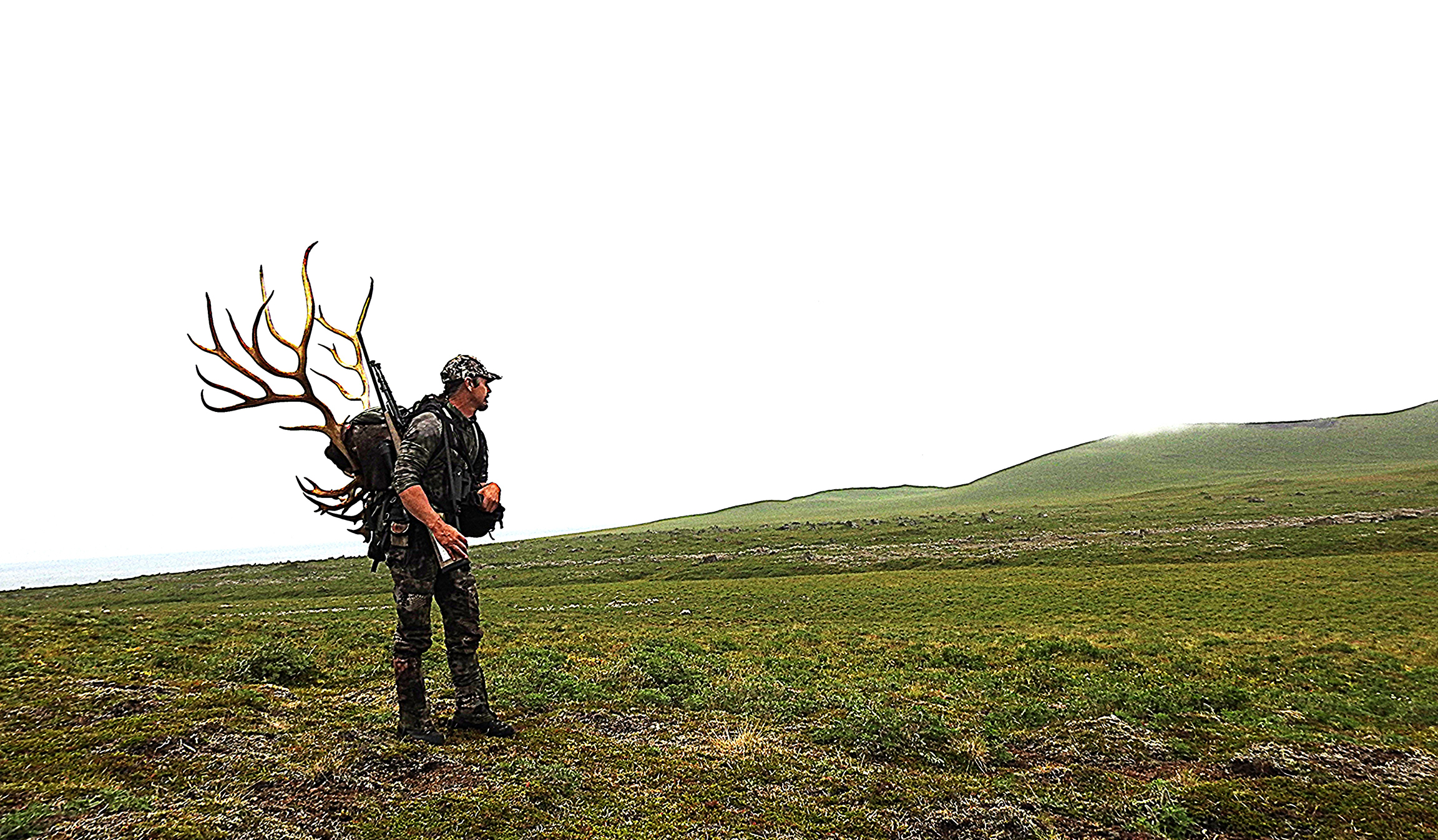
Our intended destination was in the Aleutian Islands. My son Logan and I were on our way to hunt reindeer with the natives on one of the islands. Members of the species Rangifer tarandus are typically referred to as caribou in North America and reindeer in Europe and Asia. Why, then, are there “reindeer” in Alaska? The answer is a matter of their origins.
Neither reindeer nor caribou are native to most of Alaska’s offshore islands. They were first introduced to the region in the late nineteenth and early twentieth centuries, part of a federal effort to provide a steady meat supply and economic opportunity for Alaska’s native communities. Between 1891 and the 1930s, government and missionary programs relocated reindeer from Siberia and caribou from herds on the Alaskan mainland to various coastal and island locations across western Alaska, including the Aleutians and other islands in the Bering Sea.
On these islands, reindeer usually thrived due to the abundant forage, cool maritime climate, fewer insects, and a lack of large predators such as wolves or bears. Over the decades, their numbers swelled into the thousands. The animals we would be hunting originally came from just across the Bering Strait in Chukotka, eastern Russia. These reindeer have thrived over the past century, so much so that they eventually became too abundant. In the early 1980s, they numbered in the thousands and overgrazed the tundra lichens, causing the population to plummet to a few dozen by 1986. Then, something unprecedented occurred. The remaining reindeer adapted to eating grasses instead, a phenomenon that had not been observed anywhere else in the world. Since then, the locals claim these reindeer have grown larger, stronger, and more resilient. They play an important role as both a subsistence resource and, in recent years, as an opportunity for visiting hunters seeking a remote and unusual adventure.
A testament to the genetics and trophy quality of these animals happened just a week prior to our trip. Stetson Wheat, who arranged our hunt, had a fantastic hunt himself. He stalked a herd containing several big bulls. He settled on a beautiful bull, only to have his rifle misfire not once, but twice. After scanning the herd again, he spotted another huge bull. He quickly got settled and squeezed off the shot. This time his rifle fired, and his “second-choice” reindeer was down. Fearing ground shrinkage, he approached his bull, only to find quite the opposite. His bull will likely be the new SCI world-record free-range reindeer, green-scoring an incredible 647 1/8.
Logan and I spent two nights in Anchorage “camping” in the airport. While there, we met Steve Loncosky, the other hunter who would be with us on our hunt. It didn’t take long to realize Steve has the same sense of humor and “roll with it” attitude as we do, and we hit it off immediately. On the morning of day three in Anchorage the weather cleared, which gave us a window to fly to Dutch Harbor. Now we were at least closer to our destination. The afternoon flight to our hunting grounds was canceled because of weather but, determined to make the best of it, Steve and Logan bought fishing licenses and gear and spent the afternoon catching salmon with nearly every cast.
By our third day of being stuck in Dutch Harbor, we began to feel like locals. Our dejected looks must have tugged on the heartstrings of the woman at the small airport, prompting her to make us the pan of cinnamon rolls.
Finally, on the afternoon of our fourth day in Dutch Harbor, we got the call that we were flying. We scrambled to get our gear and bounded to the plane. Arriving on the island, we were met by our native guide, Richard, who was also the reindeer herd manager. Richard drove us to a community-owned house we rented for the hunt and we cached our gear. Since it was still early in the afternoon, Richard suggested we go out and glass for reindeer.
He gave us a tour of the village as we made our way out of town. It was interesting seeing the native culture and listening to Richard talk about the reindeer and how the village benefits from them, both for sustenance and now because they are managing the herds for mature trophy bulls to attract visiting hunters. They estimate there are roughly 1,500 head of reindeer on the island, of which roughly one-third are bulls.
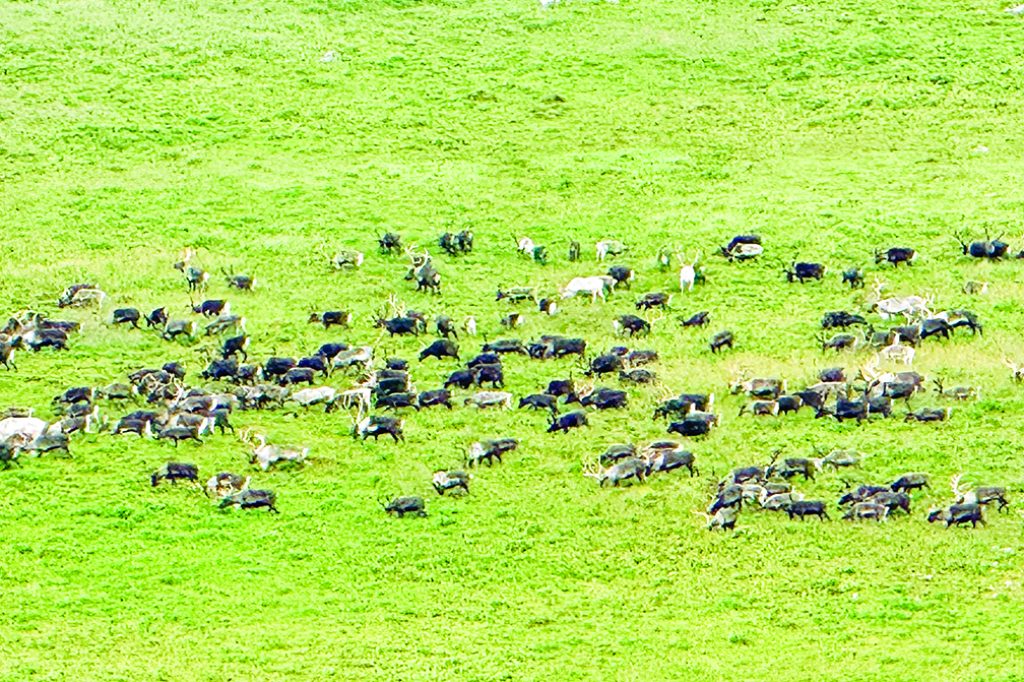
Logan was the first to spot a herd of reindeer in the distance. After getting the spotting scope on them, we could see it was a herd of approximately 200 animals, mostly bulls. We headed back to town to grab our gear, then headed back out to find the herd.
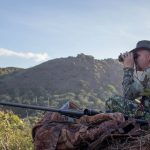
The reindeer had bedded not far from where we had last seen them, just below the crest of a hill. We sat and watched them for a bit, trying to make a plan for a stalk. After a while, one of the bigger bulls in the herd began making his way toward a depression in the ground where Richard said there was a small lake. One by one the other bulls also began making their way toward the water. There was a large outcropping overlooking the lake, so we thought if we could get to those rocks we might have a shot at the bulls. The outcropping was over a mile away, so we donned our packs and used the rolling terrain to hide our approach.
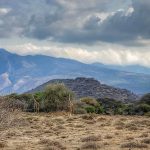
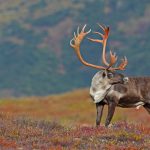
The terrain consisted of hills of volcanic rock covered in moss and grass. Walking was rough and you had to be constantly on the lookout for hidden holes. We made it to the small rock mountain undetected and began creeping to a point where we could see the herd. Upon reaching a flat spot, we could see the bulls about 500 yards to our right. There were so many it looked like a forest of intertwined antlers. There were antlers of all size and shapes. Some grew straight upward, some out wide. Some even grew backward. It was truly a sight to behold and drool over.
Logan had his eyes on a bull with numerous long tines. “That’s the one I want to try for!” he said. There were so many mature bulls it was hard to choose one. I could see several I would be happy with.
Logan began easing forward to set up his spotting scope for a closer look and only made it about a yard before he quickly dropped back down, eyes wide. “There’s a big lone bull bedded right here!” he whispered.
Peeking over the ledge, we spotted the bull, which had heavy, wide-framed antlers. We looked him over and Steve said, “I’ll take that one if you guys don’t care.” We told him that was completely fine.
We devised a plan. Logan and I would drop down into the lake depression and work our way below the herd, which was now bedded just over the crest of the hill from the lake, then crawl over the edge to look for a shot opportunity. We told Steve to watch his chosen bull and to wait until Logan and I got in place. If we got a shot, his bull should stand, offering him a shot. If his bull happened to stand first, we told him to go ahead and shoot.
Logan and I dropped behind the rocks and down into the lakebed. We circled the lake, staying out of sight of the bedded bulls. The wind was perfect as we slowly crawled over the crest of the ridge, staying as low as we could. When we could see antler tips, we moved up a hair more and began glassing for Logan’s chosen bull. Deciphering the tangle of antlers was a challenge but soon Logan spotted his bull bedded on the far side of the herd. We dropped back down into the lakebed and worked our way to that end of the herd.
There was one small rock sticking up out of the tundra a couple hundred yards off. We figured it would offer the only cover to be had, so we began crawling. Reaching the rock undetected, we sat up and began glassing the still-bedded bulls. The big one Logan wanted was still obscured by other bulls. Suddenly we heard a rifle shot and knew Steve’s bull must have stood and offered him a shot. The herd rose to their feet, alert but not spooked. Logan rested his rifle on top of the rock, but still no shot. Slowly the herd began feeding into the wind, back toward the rock outcropping where Steve shot his bull from. Knowing an elevated position would give us a better look down into the herd, and hopefully a better shot opportunity, we crawled back into the lake bed and began hurriedly paralleling the bulls.
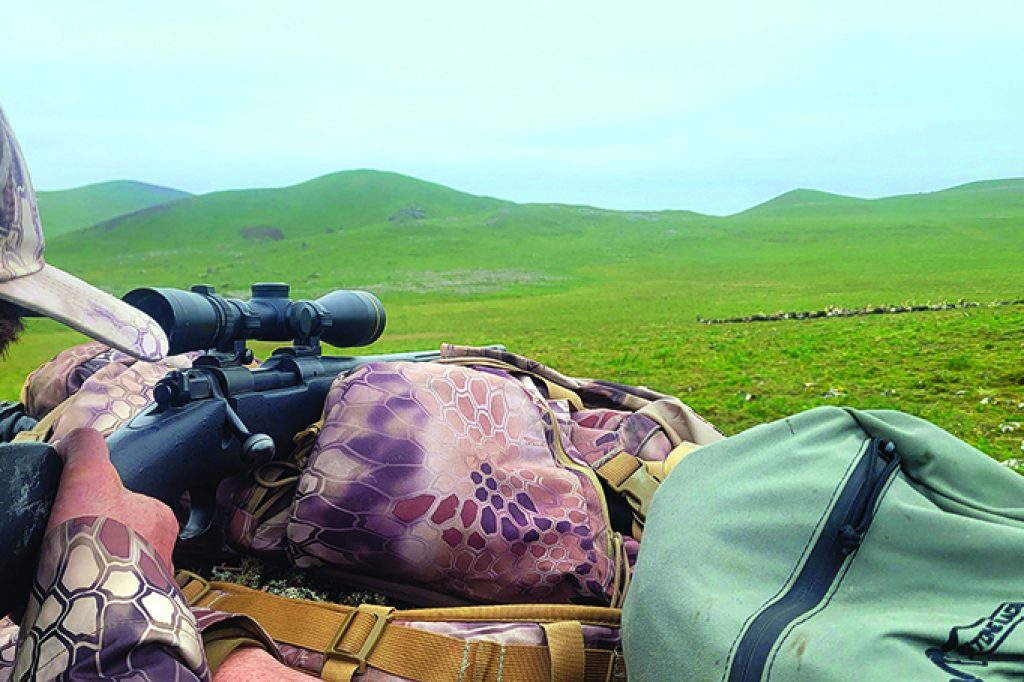
Once we reached the rock outcropping Logan and I moved higher, to a position with a big rock that made a perfect rest. We began scanning the herd. The reindeer were about 200 yards away and we had perfect wind. They were feeding and moving slowly down the valley. Logan spotted his bull directly in the middle of the herd. One of the beautiful bulls I had put on my list was in the back and in the clear, but I didn’t want to screw up Logan’s opportunity. Richard had told us, however, that at the sound of a shot, instead of lining out and running, these reindeer tend to bunch together and begin circling. You can then often catch a good bull out on the edge.
Waiting for a clear shot was excruciating. Logan would be on the gun for long periods of time, then as his chosen bull seemed almost in the clear, another bull would step in front. Safety back on, take a deep breath, and watch. This cycle repeated itself numerous times and all we could do was laugh at the absurdity of the situation. Too many bulls!
Finally Logan decided to move higher to try to see his bull. I stayed at the lower position and kept watching for a clear shot opportunity. Eventually, a bull that was on my mental hit list stepped out in front of the herd. I ranged him at 200 yards, settled my cross hairs, and the bull dropped at the shot. When I grabbed my binocular to look at him, I could see Steve’s bull lying in the same bino frame as my bull, just a few hundred yards apart.
The herd began circling, still slowly working down the valley. I glanced to my left and saw Logan crawling down a ridge a few hundred yards off in an effort to intercept the bulls. It was fun to watch the drama unfold as he moved closer, closing the distance. I worked my way back up to Steve and Richard, who were all smiles. I told them I was going to crawl out to Logan. They were going to wait for the herd to move off, then start field-dressing Steve’s bull.
I crouch-walked behind the ridge to the intersecting ridge Logan was on and began crawling up to his position. He only had a small rock for cover so I positioned myself directly behind him and inched my way up to him. He had found his bull again but it was facing straight away. Finally, after nearly two hours of playing cat-and-mouse with this bull, he stepped clear and turned broadside. Logan squeezed off the shot and the bull reared up and went down. We shared a sigh of relief, and then a laugh at the absurdity of the situation. Even though the hunt had happened relatively quickly–three big bulls in just a few hours–we had packed a lot of stalking and crawling and many highs and lows into that short time. It felt like a week of hunting in one afternoon.
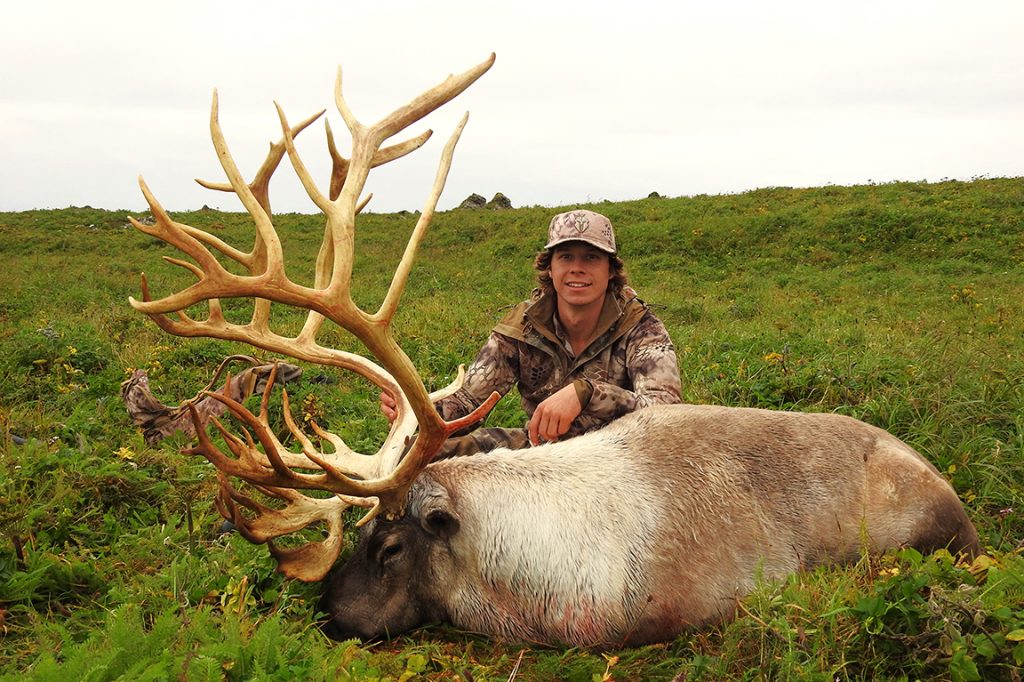
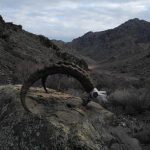
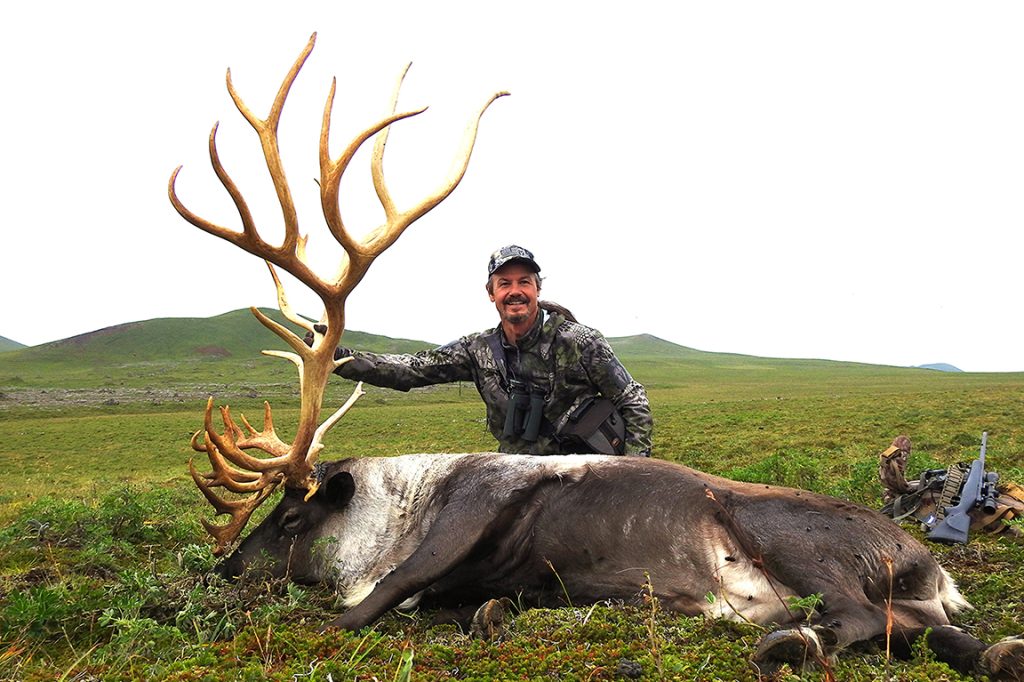
We made our way up to my bull and I was absolutely amazed by its size, both body and antlers. It was much larger than any caribou I have ever shot. We took pictures, then made our way to Logan’s bull. His was magnificent as well. Its antlers were more compact in frame, but had far more points. Steve’s bull was a really old bull with a wide, heavy frame and huge body. He had an injured leg, which was likely why he was separated from the rest of the herd.
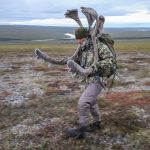
We got the bulls dressed and quartered and began packing them down the valley. The pack out was pretty treacherous with all the hidden rocks and holes. I stepped in one hole and fell forward, scraping both of my shins and knees on rocks. Logan followed suit not long after, but luckily we sustained no serious injuries. We got the bulls packed out and got back to our rental house about 12:30 in the morning–exhausted, hungry, but ecstatic over the day’s events. After eating a bite, we hit the sack.
I lay in bed and thought about what a rollercoaster this adventure had been. Several days of stress and boredom to get here. Despair with each canceled flight. Then the whirlwind hunt we had just experienced in one afternoon, and the three amazing bulls. As I drifted off to sleep in this native village on a remote island in the Bering Sea, I had a smile on my face and another great memory to put in my mental vault—another adventure I was fortunate to share with my son.
About the Hunt
This hunt was booked through BookYourHunt.com and operated by Stetson Wheat of Great Beyond Outdoors. Stetson works with the Aleut natives to manage the reindeer on St. Paul Island in the Bering Sea. DIY hunts are not allowed, and a limited number of tags are available for trophy reindeer to maintain a healthy population of mature animals and excellent trophy quality. The hunt is conducted and guided by the native reindeer herd manager. Travel to the Aleutians can be challenging due to severe weather and fog, so booking backup flights is recommended. Learn more at bookyourhunt.com and greatbeyondoutdoors.com/adventure1