The right knife is a crucial tool for breaking down an animal in the backcountry.
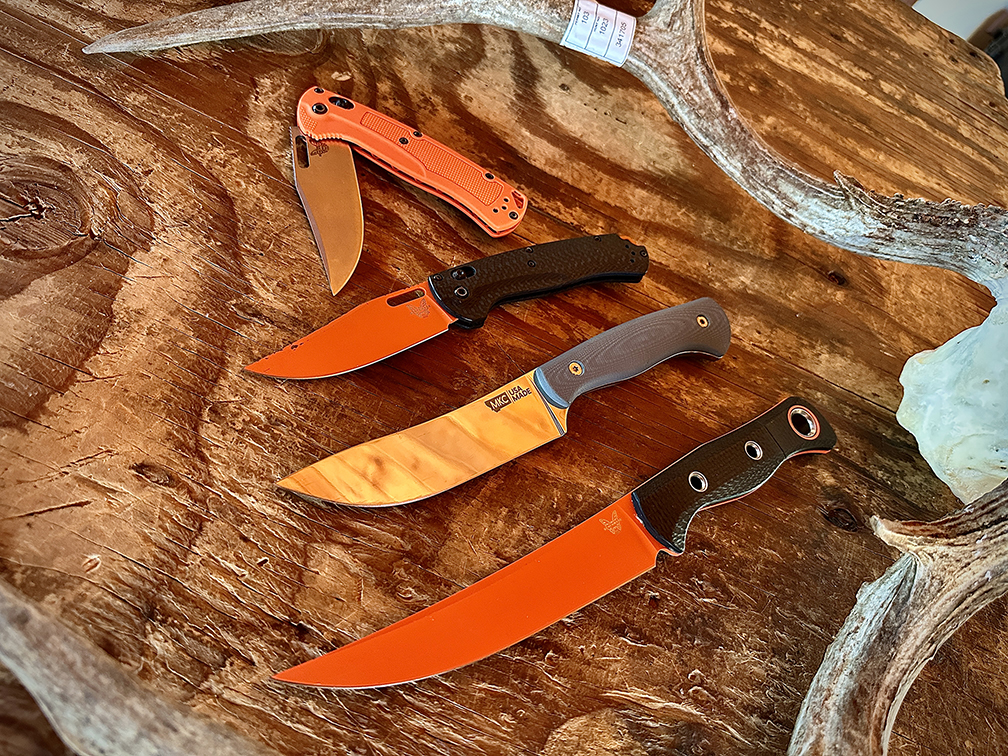
Photo above, from top: Two editions of Benchmade’s TaggedOut folder; Montana Knife Company Stonewall Skinner; and BenchMade MeatCrafter. The colored blades are an option on some knife models.
Eighteen inches of fresh snow blanketed the landscape, wrapping everything in impossible white. A rhythmic swish, swish, sounded from the horses’ legs as they pushed through the snow, following the vivid path of a hundred migrating elk. My friend Jeff and I each had an antlerless elk tag burning holes in our respective pockets and we pressed steadily forward, knowing that at the end of these elk tracks there would be elk.
And so there were, some bedded and others feeding in a mountainside scrub oak swale. We crawled through the snow, rested our rifles on our packs, and dropped two of them. Dusting the glistening snow kernels from our clothing, we slogged down the hill to begin the joyful task of converting our elk into meat. Jeff’s elk was down the hill from mine a hundred and fifty yards, and by and by he hiked up to my position.
“I lost my knife in the snow,” he said.
Fortunately, I had a good spare knife in my pack. Handing it over with a grin I cautioned him against losing that one as well. A couple hours later, we were headed for the truck, this time breaking trail through the snow for our heavily laden horses. Had I not possessed a spare knife we would have been there twice as long, reduced to processing two elk with one knife. It would have been a long, cold hike out in the evening darkness. The moral of the story, of course, is to always carry a spare blade when hunting.
I’ve been blessed to wield knives and process meat from Alaska to Arizona and from California to Africa. I’ve skinned and caped out critters ranging from rattlesnakes to moose, including several hundred each of deer and elk. As a result, I’ve formed some opinions on what makes a great knife. So let’s take a detailed look at knife design and construction. I’ll break this discussion down into three basic categories: hunting, processing, and caping. Each category offers its own set of challenges, requiring separate tools to do the job right. That said, one knife can perform all tasks, and if I were to choose just one for all-around use it would be the hunting model.
As backcountry hunters, we must hold our knives to a higher standard. The primary difference of course, is weight–we can’t afford to pack around a big old Bowie. We must choose cutlery that is light in the hand and on the scale, graceful to use, and possessed of fine steel that will maintain a sharp edge long enough to skin and quarter an elk or moose. Ideally your knife will feel comfortable in your hand–it’s no fun using a knife uncomfortable enough to raise a blister while skinning an elk.
A good hunting knife should be non-slippery when it becomes covered with blood and fat, and I like a small guard or swell at the front of the handle to help prevent my hand from sliding forward onto the blade. Some of the nastiest cuts I’ve seen occur while butchering game happened just that way.
The shape of your blade is important too, since you’ll need to perform myriad tasks with it. A sharp point will make piercing stubborn hide easy. My preference for point design is a drop point, or a very shallow clip point. Avoid aggressive clip points, as they are hard to keep from perforating things you just don’t want to puncture while making your rip cuts.
After piercing the hide, the next thing you’ll need to do is make rip cuts around the lower legs, up to center, and from stem to stern. To make a good rip cut your blade should have a couple inches or more of a straight, very sharp edge running from just behind the curve of the point back toward the haft. (As a note, rip cuts should be made from underneath the hide. Cutting hair rapidly dulls a fine edge, so insert that sharp point mentioned earlier till your blade is buried under the hide. Now lift and push your blade forward, unzipping the hide in a smooth, long cut.)
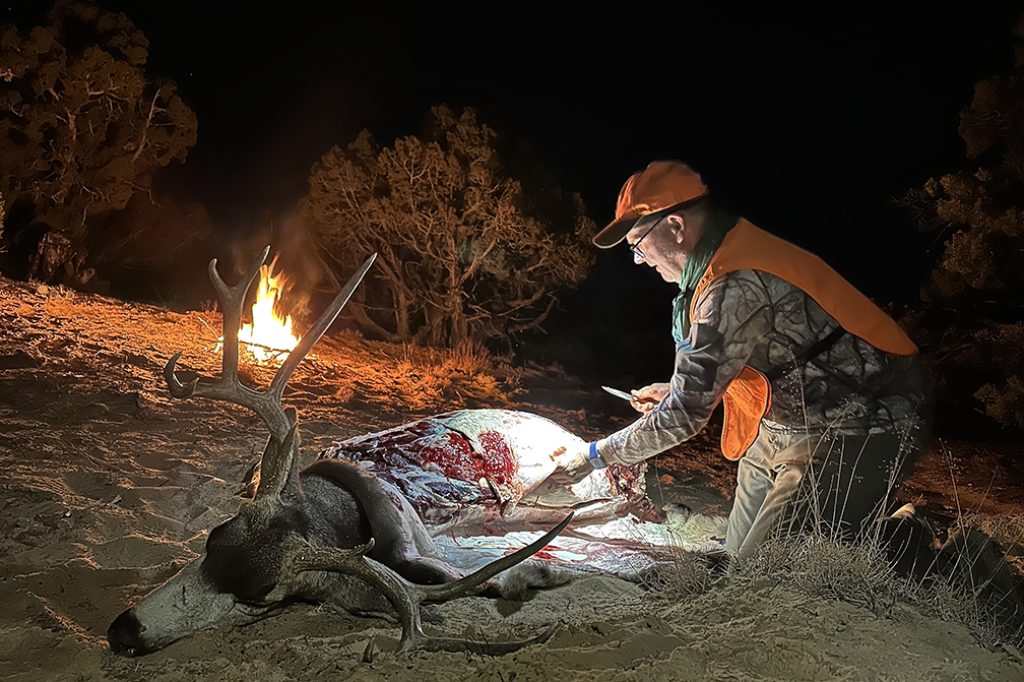
Your next task while breaking down a big-game animal is to peel back the skin. Here’s where the curve of your blade comes into play. If you examine a dedicated skinning knife you’ll notice that the blade forms a huge curve. We don’t want that, but we do need a well-curved section of blade running from the point back an inch and a half or so. That curve will enable you to handily skin your critter without accidentally slicing the point of your knife through the hide.
A blade shaped as I’ve described will also serve well to remove quarters and backstraps, and trim meat and tenderloins from your game. While doing so, keep in mind that contact with bone will rapidly turn the edge on your knife. Speaking of holding an edge, I’ve used every kind of steel from stainless to Damascus, and in my opinion the new MagnaCut steel makes the best hunting blade for our purposes. It’s tough, corrosion-resistant, and holds a razor-sharp edge very well indeed.
Now that I’ve described the attributes I look for in a wilderness hunting knife, I’ll share details on my favorite models. I have a couple–one for superlight backpacking hunts and the other for hunts when I am on horseback and don’t need to worry about weight quite as much. My favorite superlight knife is the TaggedOut Carbon Fiber folder by Benchmade. It’s a pricey little thing, but it features carbon-fiber scales, CPM MagnaCut steel, a 3.5-inch clip point blade, and weighs only 2.44 ounces. Benchmade also offers the TaggedOut at a significantly lower price point featuring their Grivory (engineered plastic) scales, CPM-154 stainless steel, and an even lighter weight of 2.1 ounces. These knives are my go-to models for every backcountry hunt I make.
For hunts where weight is not so much of an issue (horseback or float hunts) I use Montana Knife Company’s MagnaCut Stonewall Skinner. It’s a fixed-blade 9.25-inch model featuring G-10 handle material, a 4.5-inch blade, and weighing 5.53 ounces. This knife is super tough, gets scary sharp, and feels incredible in your hand. It’s great for breaking down big, thick-skinned game, as well as performing camp chores and tasks.
Note: A hunter’s knives are very personal tools. As you’ve probably noticed, I’m not a fan of replaceable-blade models. I don’t like how they feel and their lack of balance. They are dangerous–I personally know a man who watched a young fellow lose his eye to a flying splinter off a disposable blade. And I just don’t agree with the modern disposable mindset. A good knife will last most of a lifetime. Why leave scattered razor-sharp trash in your wake? Instead, learn how to get your blades shaving sharp–it’s a skill every true outdoorsman and hunter should have.
Processing
The conclusion of every productive hunt should be the enjoyable task of cutting, trimming, and wrapping meat for the freezer. At home, or when on horsepack trips, I use a dedicated processing knife from Benchmade called the MeatCrafter. Sporting a 6-inch upswept trailing-point blade thin enough to be slightly flexible, it’s akin to a filet knife and incredibly handy at trimming, portioning, and shaping meat. I usually avoid boning with this knife because I don’t want to compromise the edge. I keep my hunting knife handy and use that for the boning part of the job.
Often, I will perform this work before departing my wilderness camp, sans the wrapping part. (I bag all the finished cuts in heavy-duty gallon freezer bags, and later remove and double wrap the meat in good freezer paper before stowing it in my chest freezer at home.) This saves significant pack-out weight in the form of undesirable bone, fat, and tissue.
Meat quality is largely dependent upon how well you care for it. It’s of paramount importance to keep the meat clean and free of hair, grime, dirt, and such. It’s also important to get the meat cool as soon as possible after the kill. Take the necessary time to get quality photos, but then skin, quarter, and hang the meat to cool as efficiently as possible. Use every precaution to keep the meat clean.
Caping
Not every hunter will want to cape their animal, especially when they must carry the cape in their backpack for miles to get it out of the backcountry. However, if you’ve harvested a great animal and love shoulder mounts, it’ll be worth the effort. You’ll want to be equipped with a proper caping knife and the skill to do the job right. That skill is one that I don’t have room here to describe; however, I can recommend the proper tools for the job.
To start, use your regular hunting knife to skin the hide up to the base of the ears and skull. and then switch to your caping blade to skin the face. The best blade for this job is long and slender, with a razor-sharp edge and point. The blade need only be two or three inches long, but it’s nice to have a longer handle to provide grip and dexterity. The Mini SpeedGoat from Montana Knife Company provides good configuration for caping, and it’s still substantial enough to use for skinning and quartering in a pinch. Weighing at just 1.2 ounces, this would make an ideal backup knife.
Blades of Note
As a kid I was kicking dirt down the two-track leading to my family’s farm when I spotted a shiny Buck knife in the sand. A fixed blade “fishing knife” model, it sported a thin-ish blade with the tip broken off. I stuck it atop a nearby fencepost and left it for the owner to claim. He never showed, so eventually I took the knife home, ground a point back onto the blade, and used it for many years as my primary hunting knife. It’s tired and worn, and the blade is longer than ideal, but I’ve sure dismantled a lot of game with that old knife.
Another of my favorite experiences with a blade came while following legendary Alaskan guide Phil Shoemaker on a Peninsula brown bear hunt. His client killed a great boar, and as we began to skin it, I pulled a large stone blade from my pack. My close friend and world-class flint knapper Greg Nunn had made it for me, and I’d carried it for several weeks hoping for the opportunity to use it on a bear. I’d been told that a stone blade was ideal for skinning a bear, leaving the hide and hair follicles more intact than a conventional steel blade. This seemed to be true, and we had a great time trying out my stone knife while skinning that bear.