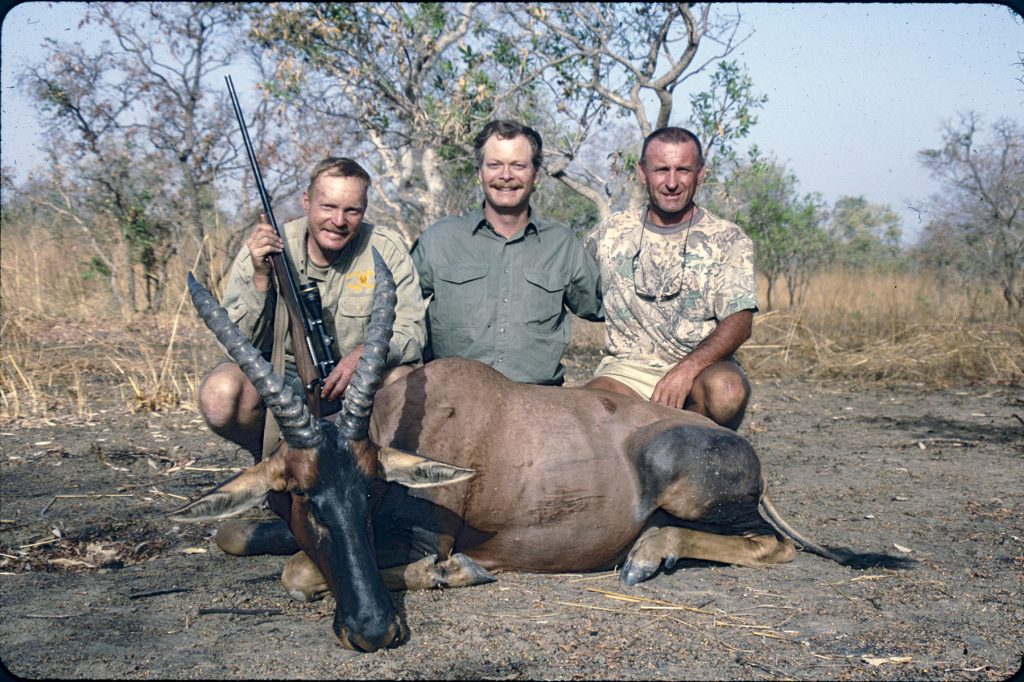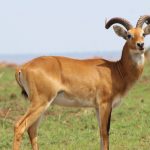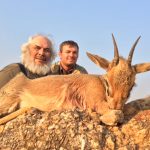
These interesting African antelopes include the topi, tsessebe, blesbok, and bontebok.
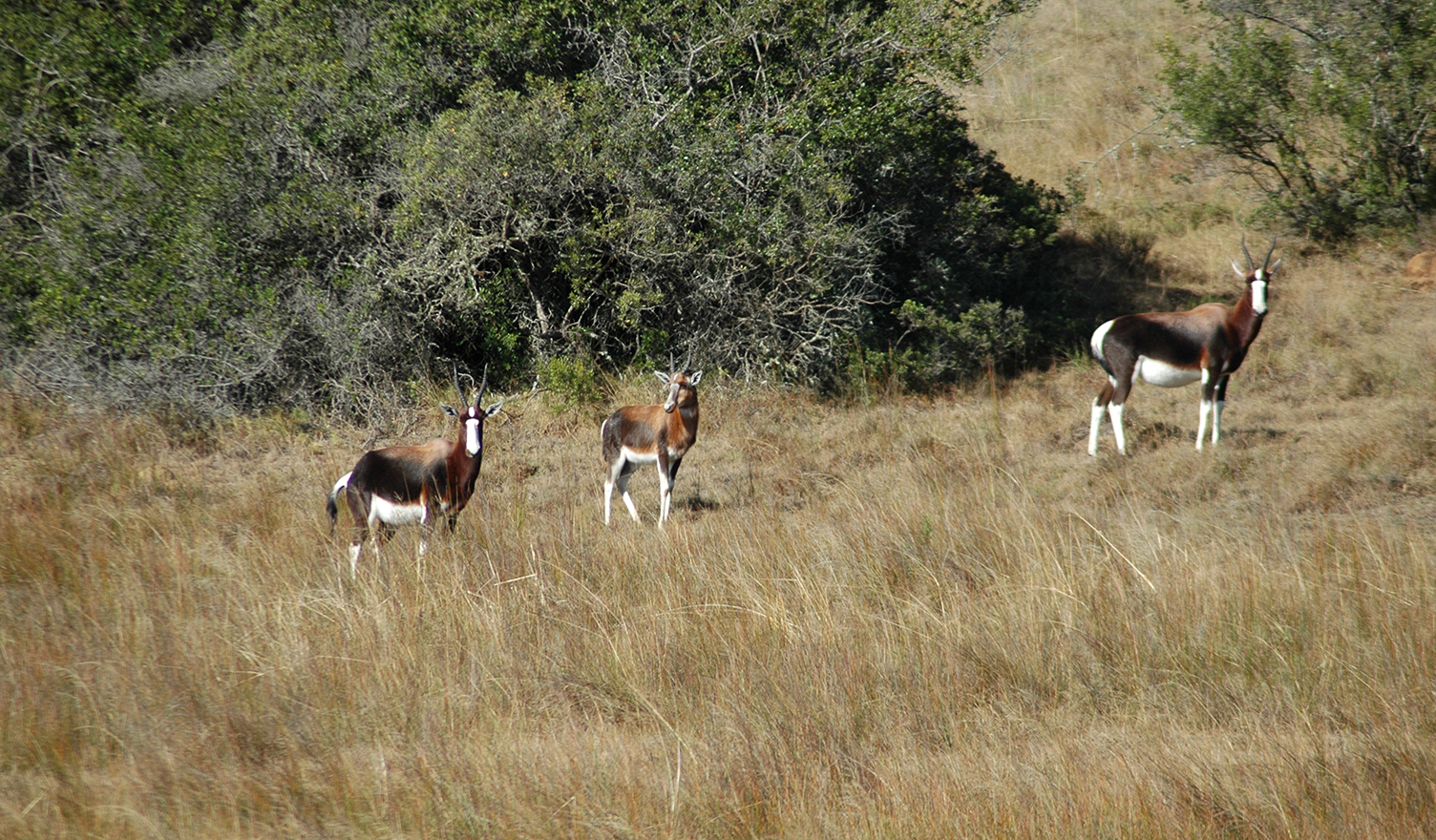
Photo above: A group of bontebok in South Africa. Although blesbok also have white faces, they lack the bright white body markings of their close cousin, the bontebok.
The damalisc antelopes, genus Damaliscus, are close relatives to the hartebeests (genus Alcelaphus), with similar color and coat, preorbital glands at the inside corners of their eyes, and similar horns on both sexes. In short, a damalisc is almost a hartebeest—but not quite! The group includes topi, tsessebe, blesbok, and bontebok, all plains-dwelling herd antelopes. In terms of wariness, they may not be the sharpest knives in the antelope drawer, but there’s nothing wrong with their eyesight, and topis and tsessebes are among the most fleet-footed of African antelopes.
I always found it interesting that the record books list “damaliscs and hartebeests” together. Horns are a primary difference. Hartebeest horns grow from massive bases, then make abrupt turns, generally ending with rearward-pointing tips. The damaliscs are at least a third smaller, with round. ringed horns that grow in gentle curves.
Within genus Damaliscus, there are just two species: D. lunatus, topi, tiang, korrigum, and tsessebe; and D. pygargus, bontebok and blesbok. Whether in horn size or shape, or anything else, none are dramatic antelopes, none considered among Africa’s great prizes. No one has ever proposed a “grand slam of damaliscs!”
However, where they occur, damaliscs are an important part of the African scene. Sometimes they are common game, sometimes local rarities, depending on where you are. They and their hartebeest cousins are among the most widespread of African antelopes. The damaliscs are discontinuous, originally found from Senegal to Kenya, and from Ethiopia to the Cape, but only here and there.
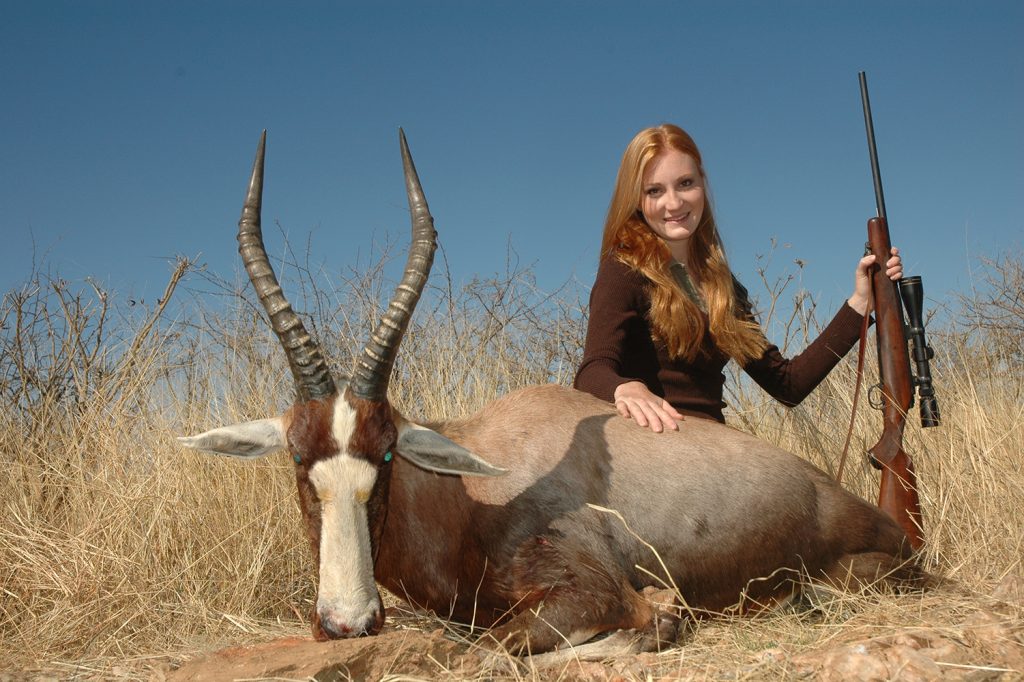
Blesbok (“buck with the blaze,” referring to the white forehead stripe) are common across South Africa and, although non-native, widely found across Namibia. Although susceptible to predators, blesbok are prolific. On safaris in Southern Africa, most hunters will take a blesbok. Like common animals worldwide, big blesbok are rare. If your PH says, “I think you should shoot that blesbok,” you probably should.
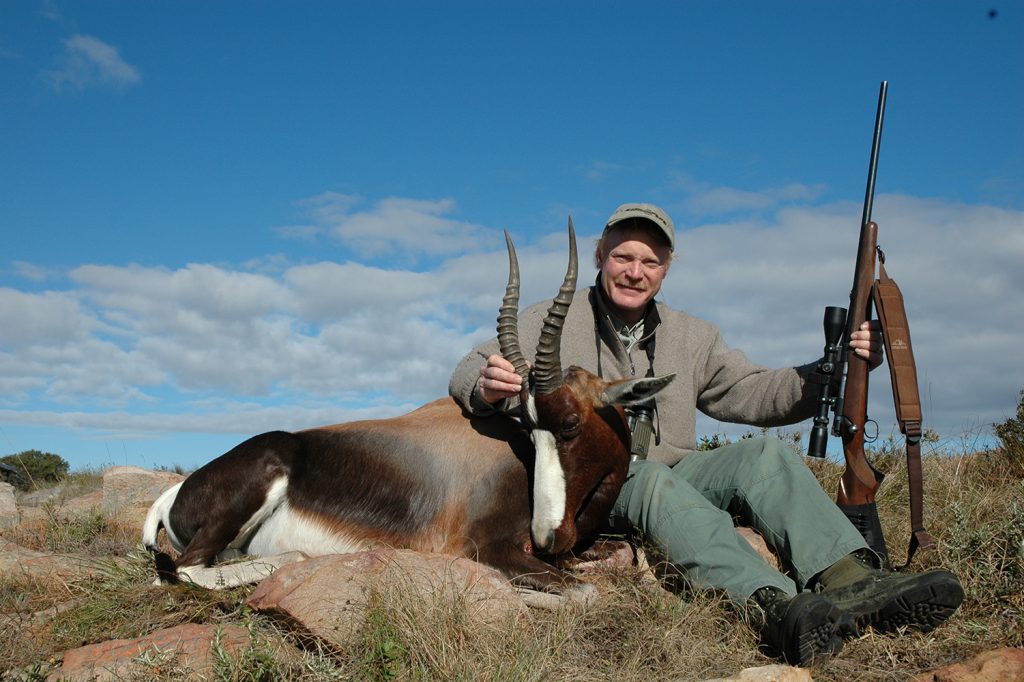
Blesbok and bontebok are subspecies, and will interbreed freely, so they cannot run together else one race will vanish. Slightly smaller, with bright white underparts, the bontebok is distinct, and almost became extinct. Primary home range was in the Western Cape, on a collision path with the Voortrekkers. Deriving from Dutch, “bontebok” translates as “patchwork buck,” referencing the white markings. In the early twentieth century, only seventy pure bontebok remained. Seventeen were captured, and in 1931 Bontebok National Park was established near Swellendam, South Africa.
Compared to blesbok, the bontebok has always been a rarity. All bontebok alive today, in numerous private herds, descend from those saved in Bontebok NP. When I took mine, it was behind a low cattle fence. It wasn’t a tough hunt, but it was technically free range. Today, “certified” bontebok herds must be behind game fences to prevent interbreeding with blesbok. Just this year, the Weatherby Foundation removed bontebok from their award ballot because it is no longer possible to take one free-range.
The other damaliscs, tsessebe, topi, tiang, and korrigum, occur farther north, and all are spotty. The tsessebe (often spelled sassaby) is native to certain areas in northern Namibia, the Limpopo Valley, Botswana’s Okavango, Zambia’s Bangweulu, western Zimbabwe, and southwest Tanzania. Populations are often many miles apart. It seems unclear is this weird distribution is natural or caused over time by human influence. Either way, tsessebes are where you find them.
I shot my one and only tsessebe with Barrie Duckworth in 1979, near Bulawayo, one of the odd pockets where they occur. Since, I’ve seen them in Bangweulu, in the Okavango, and occasionally on game ranches in Namibia and South Africa. In 2007, Donna was with me on an elephant hunt in central Botswana with Johan Calitz. We got the elephant early, and Johan proposed we go to Maun, buy plains game licenses, and spend a few days at his Okavango camp. The Okavango was shifting to photographic safaris, so it was the last chance to hunt that beautiful area.
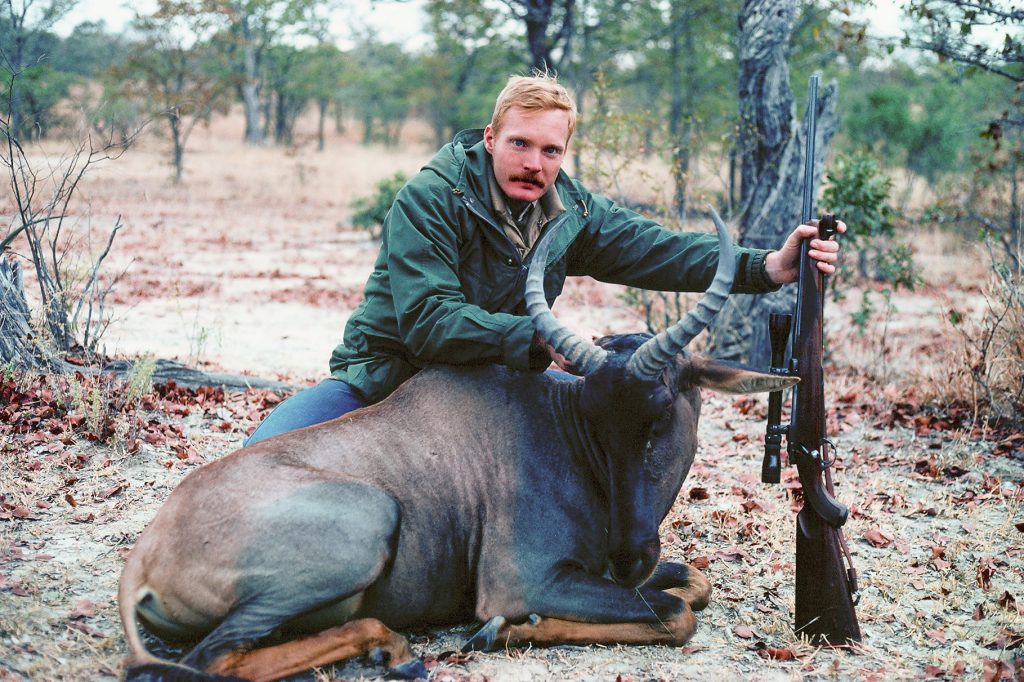
Donna had come down with something and was really sick. We made it to camp and she crawled into bed and crashed. Next day, the last thing she wanted to do was hunt, but the licenses were in her name. A tough lady, she rallied and took what were probably the last red lechwe and tsessebe to be hunted in the Okavango.
Topi and tiang are found in East Africa, well north of the nearest tsessebe. The two are visually indistinguishable. Both have a reddish coat with almost purple iridescence, in common with blesbok and bontebok. Although there is a small coastal population on the border between Kenya and Somalia, topi are primarily found in northwestern Tanzania, southwest Kenya, and on into southern Uganda. Considered common game where they occur, they are also spotty. On the upper Ugalla in 1993, Geoff Broom and I saw tracks, never an animal. They are also present in the Rungwa, but I never saw any.
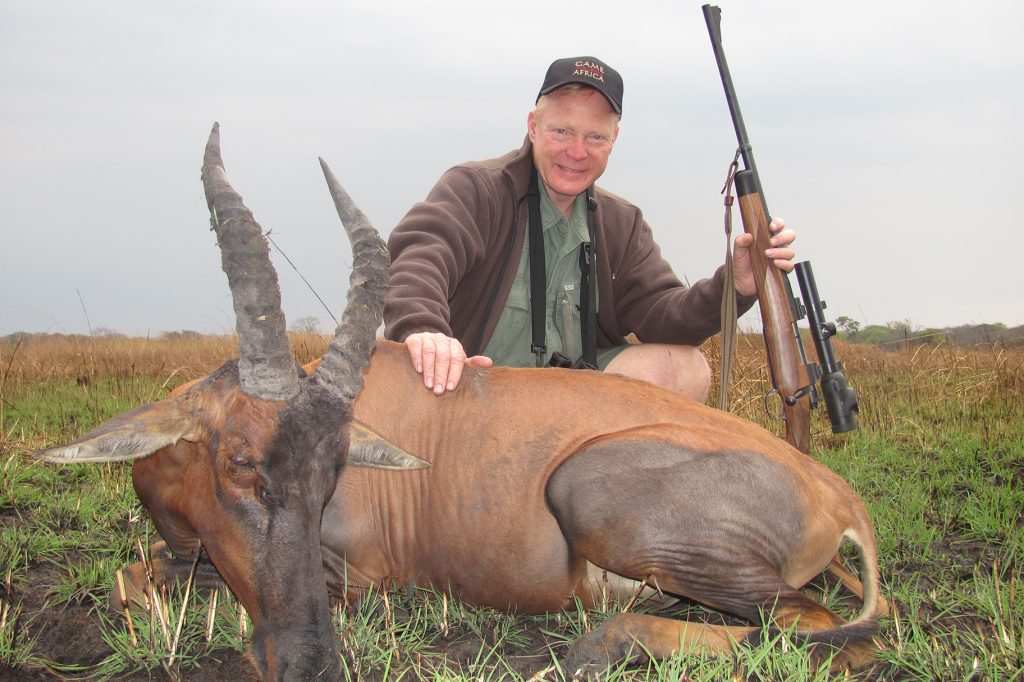
The only topi I’ve ever seen were in Kigosi, western Tanzania, east of the more famous Moyowasi. There, they were plentiful, often seen in small herds on grassy plains. Hunting with Jaco Oosthuizen, I finally got a good topi. Again, there’s a major break, with the similar but slightly larger tiang primarily found in South Sudan’s East Equatoria, east of the Nile, tipping into northwest Kenya and northeast Uganda. They are also found—and huntable—in southwest Ethiopia. I never got down there, so I’ve never seen a tiang. I probably won’t ever see one, but there’s a lot of wildlife in East Equatoria. The tiang is just one of eight antelopes that have been hunted little, or not at all, since the last Sudan safaris in 1983. Maybe peace will break out in Sudan and such a safari can be possible.
There’s another almost-damalisc, or almost-hartebeest, that I’ve never seen. Only identified in 1887, the hirola occupies a small, isolated range in northeast Kenya and Somalia. They were long called Hunter’s antelope or Hunter’s hartebeest, after HCV Hunter, who collected the first specimen. Long lumped in with the damaliscs, the hirola has more recently been ascribed to its own unique genus and species, Beatragus hunteri. Lighter in color and smaller-bodied than topi or tiang, the hirola has lyre-shaped horns like impala, but thicker with more abrupt turns. Sadly, the hirola has been extirpated in Somalia and the current Kenya population is believed to number as few as 300. Although long protected, the hirola lives in a rough neighborhood and there is no zoo population. Critically endangered, the hirola could be the first African animal to become extinct in modern times.
There is one more damalisc that I have seen and hunted. Although it is similar to topi and tiang in appearance, the korrigum is slightly larger in both body and horn. Because of this, it’s often called “giant topi,” sharing the purple coloration of its cousins, but with dark legs instead of the tan limbs of topi and tiang. It once occupied a huge range across the Sahel, from Senegal to Chad. Old-timers (even older than me) told me of vast herds of korrigum in 1970s in the giant eland country between Chad and CAR.
Recent decline has been severe. Korrigum are gone from much former range and there are no vast herds. There are isolated populations in various national parks, with the largest numbers probably in Pendjari NP in Benin, and in Waza NP in northern Cameroon. Korrigum are on license in some adjacent hunting blocks in northern Cameroon, which is almost the only place to hunt korrigum right now.
At the turn of the millennium, when the late Alain Lefol was hunting Chad, korrigum were on license and a number were taken. Although Chad is open again, as I understand it, korrigum are either not on license or not present in the areas currently hunted. In 2000, Chris Kinsey and I hunted in Chad with Alain Lefol. It was a wonderful free-wheeling safari across 500 miles of Chad, from the Ennedi Mountains near Libya, down through Dar Sila, to the CAR border. There, along the Aoukale River, out of food, low on water, with just enough fuel to get back to Ndjamena, we found korrigum. Chris got a big bull, and mine was big enough. I’m glad I had the opportunity.