Sports A Field

Giant Rats

Capybara, agouti, and paca are unusual trophies and excellent table fare.

The Independence Gun Club (IGC) Sporting Heritage Center is in the middle of downtown Independence, Kansas. The first floor now houses all my taxidermy, which is kind of fun. It’s even more fun when kids come through. Back on a shelf on the far south wall is one of my favorite mounts. Most youngsters notice it, too, and I’m surprised how many of them know what it is.

Giant guinea pig would be more apt, but it’s a capybara, largest rodent in the world. The books say it can weigh up to 150 pounds. Mine isn’t quite that big, but it’s a blocky, stocky, impressive animal. Although it’s a herbivore and essentially harmless, its teeth are impressive, too. A distinctive characteristic of rodents is two pairs of incisors, top and bottom, that continue to grow throughout the animal’s life.

The capybara, Hydrochoerus hydrochaeris, is a semi-aquatic rodent, typically living in packs or colonies along South American watercourses. They are found in every South American country except Chile, but are most common in the vast Amazon Basin, from northern Argentina northward. There is a subspecies, the slightly smaller lesser capybara to the northwest, clear up to Panama, but capybaras do not occur naturally north of the Canal.

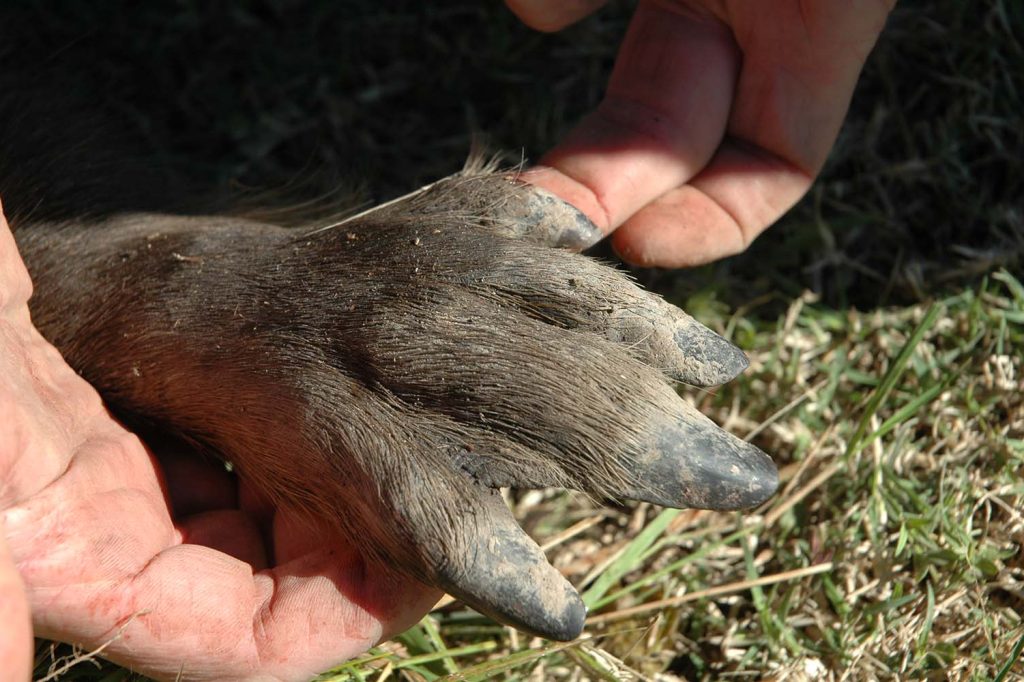
My first experience with the giant rat was while hunting with dogs along a small river system in northern Argentina’s Santa Fe Province. I’d seen the weird, splayed-toe tracks. Five toes on the front foot, three on the rear. You can’t miss that track! Otherwise, I hadn’t a clue what to expect.

The capybara’s front foot has five toes, but only the three major toes are usually visible in tracks.

At dawn, outfitter Marcelo Sodiro and I hiked along a narrow plain, swampy watercourse to our left, thick bush off to the right. Occasional yips told us the dogs were in the bush, hoping to catch animals out feeding, or working their way back toward the river.

We strolled along for maybe a half-hour as full daylight came. Then the pack lit up with raucous hound music, and Marcelo started running, leaving me little choice but to run with him. Okay, I get it. A capybara will try to lose the dogs by escaping to its water sanctuary. Our job was to get ahead and try to intercept. We dashed along a trail just up from the water’s edge, keeping the dogs to our right. After a mad dash, the baying turned toward us. Marcelo pulled up short in a small clearing, told me to get ready. In a few seconds a brown form streaked across our front, right to left, headed for the water.

As we left the truck, Marcelo had offered me a double-barreled shotgun with buckshot, but I’d kept my Todd Ramirez 7×57 which, fortunately, fits me like a good shotgun. The dogs all had white spots, highly visible. They were a dozen yards behind, safe, but closing fast.

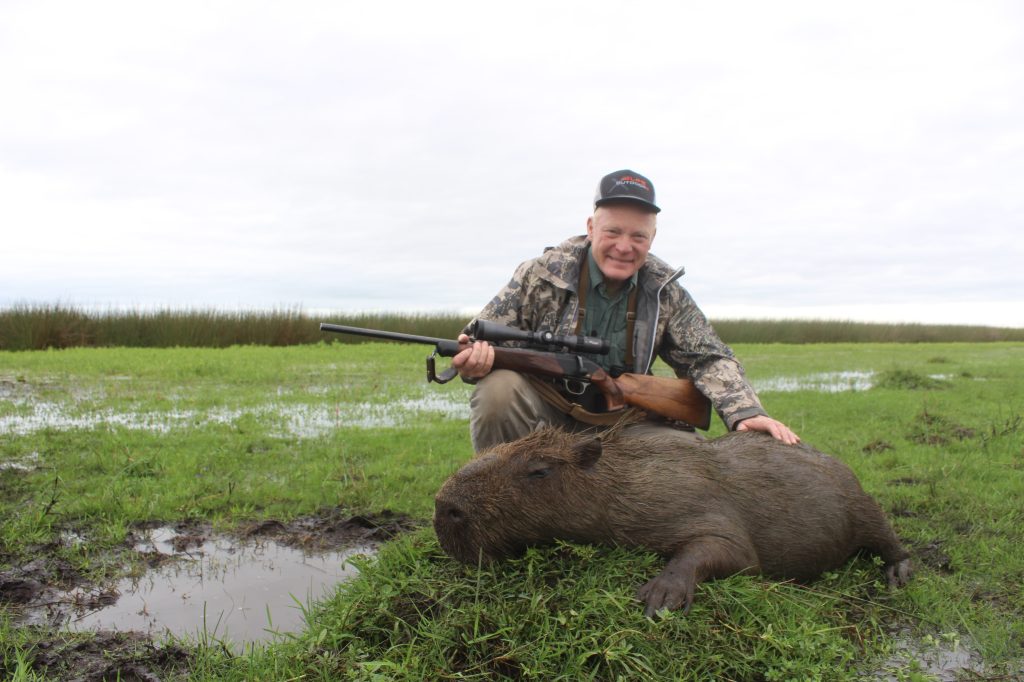
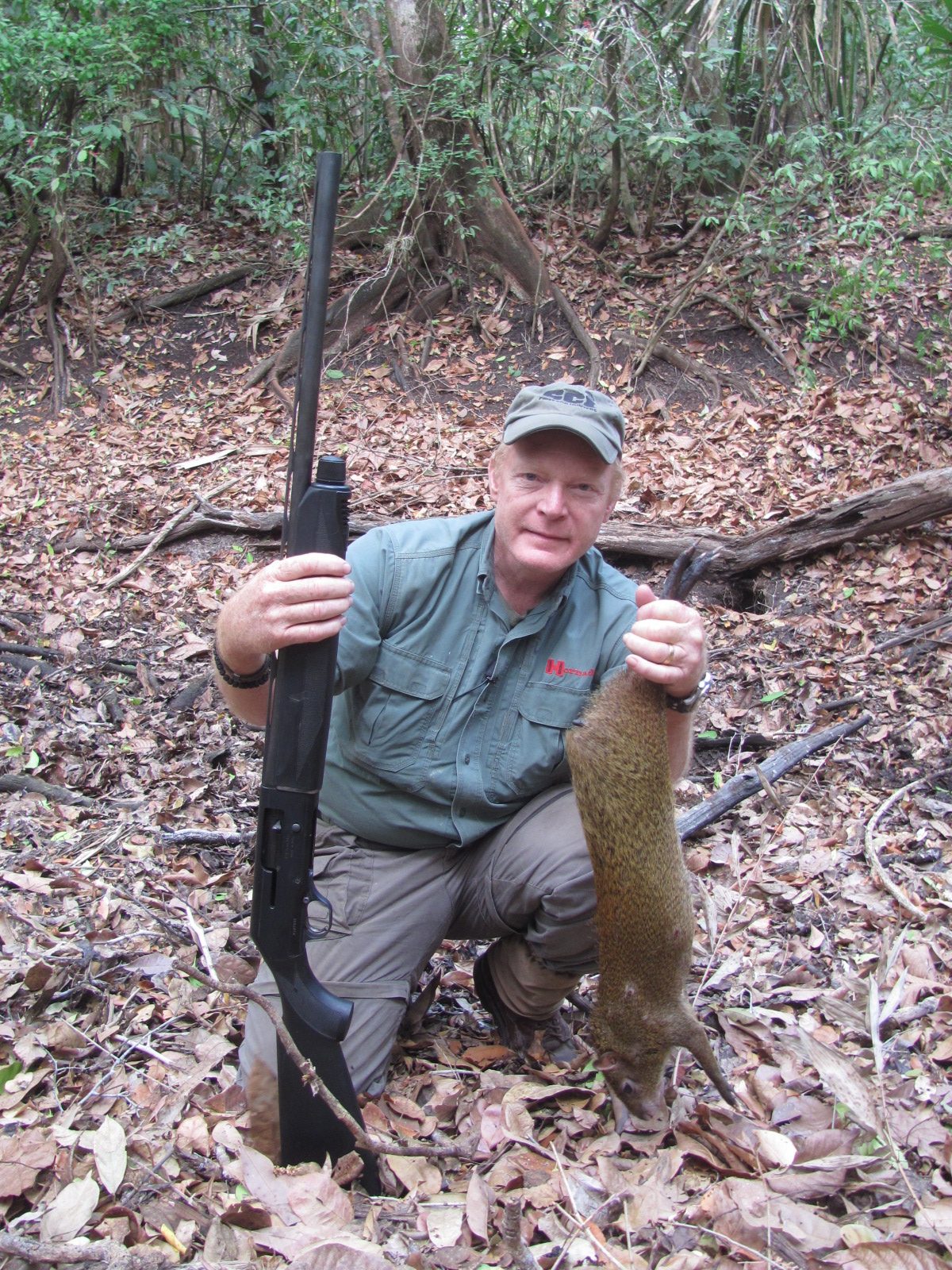
A large male capybara, taken near the Parana River. The oval bump on the nose is the about the only way to distinguish a mature male.

It was a single capybara, looked like a good-sized one. I swung with it, got the shot off, and the dogs piled in. It all happened fast, very exciting. Toward the end of the hunt, Marcelo and I did this again. Next time, I accepted the shotgun!

Capybara meat is white and mild, much like pork, and is highly prized. So is the leather. Strong, durable, attractively pebble-grained, and essentially waterproof. The leather is called carpincho from the Portuguese. Just about every shop in Buenos Aires, and I suppose in Brazil, sells carpincho items: Footwear, jackets, belts, purses. Cool stuff. Yes, capybaras are farmed, both for meat and leather.

A decade later, in 2019, I would have one more experience hunting capybara, this one quite different. I was again hunting with Marcelo Sodiro, but up in Entre Rios Province, primarily looking for free-range axis deer. We were near the Parana River, a big river. Lots of small channels and marshes. Perfect capybara habitat, and there were lots of them. This was the only time I was able to observe packs.

Hunting was by stalking carefully along the edges of marshes, looking for a big one. In a group, you can compare them but, when standing apart, there’s little to compare. One thing I learned that I didn’t know: It is possible to determine a mature male. Only the males have an odd, elongated oval bump on the snout. Subtle, but if you can get close enough to look carefully, it’s there. We looked at quite a few, shot the one that looked the biggest, but who knows? Wonderful experience to see so many, and I got some great photos.

The primary hunting opportunity for capybara is in northern Argentina. However, there’s an unfortunate wrinkle. Argentina no longer allows the export of any native big-game species, so it’s difficult to add this unusual animal to a taxidermy collection. I’m glad I had the sense to have one done life-size when I still could.

Although not nearly so large, the Americas have two more large rodents ranging from southern Mexico southward: the agouti and the paca. There are actually eleven species of agoutis, genus Dasyprocta, in Central and South America, varying primarily in color. Agoutis weigh up to about 13 pounds so, on the rodent scale, not as large as a big woodchuck.

Agoutis are common in Mexico’s Yucatan and on license. Although rarely hunted specifically, agoutis are often taken while on stand for other species, and sometimes encountered walking jungle trails.

They are diurnal, often seen and on license in Mexico’s Yucatan. When sitting on a machan for brocket deer (or whatever), it’s not unusual to hear faint scrabbling in the leaves and see two or three agoutis scampering along.

Like everything else in the jungle, the local hunters consider agoutis table fare. They’re not bad at all, but paca is the best of the best. Weighing up to 30 pounds, the paca, Cuniculus paca, is probably the third-largest rodent, after capybara and beaver. Body shape is much like a capybara, so like an overgrown guinea pig, but the paca has a thin, fragile skin patterned with white spots and stripes. Of all the jungle game, the paca is the great delicacy, with very white meat, mild and flavorful.

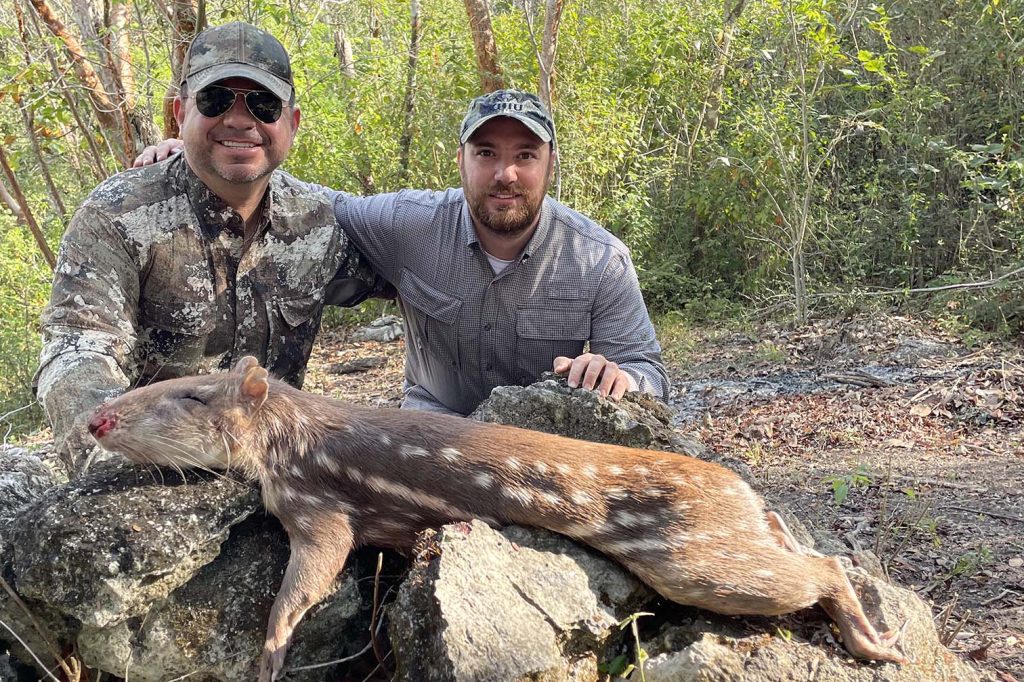
Sergio Alcazar and Yucatan outfitter Mario Canales with a big paca.

I used to think of the paca as strictly a Central and South American animal, so I was totally surprised when I learned that they are widely distributed in Mexico’s Yucatan, so they are also a North American animal. The paca is readily on license in southern Mexico. However, and maybe this is good for the pacas (because the locals love to eat them), this nocturnal, burrowing animal is exceptionally difficult to hunt.

Typically, they burrow in caves in small colonies, coming out at night to forage. Finding tracks (and, today, using trail cams), hunters find an occupied burrow, then set up in the late afternoon and hope they venture out just at last light. That’s how I got my paca several years ago, on one of my several failed attempts for a red brocket. Last year, that’s how hunting partner Sergio Alcazar got his paca.

Otherwise, there’s always blind luck, but it’s always better to be lucky than good. Ten years ago, I shared camp with a guy who shot a paca along the jeep trail on his way back to camp, just at sundown. We came down the trail just behind them, and I took photos in good light.

This year, I was in camp in Yucatan with hunter Michael Murphy. His story is even more unusual: Last year, hunting with Mario Canales, Murphy’s local guide found a paca and Murphy shot it at midday.

The Yucatan jungle is an amazing place, and nobody knows it like the local hunters. However, and whenever, it’s a happy camp when a paca is brought in. The meat is truly excellent; you’ll eat well for a couple of days.

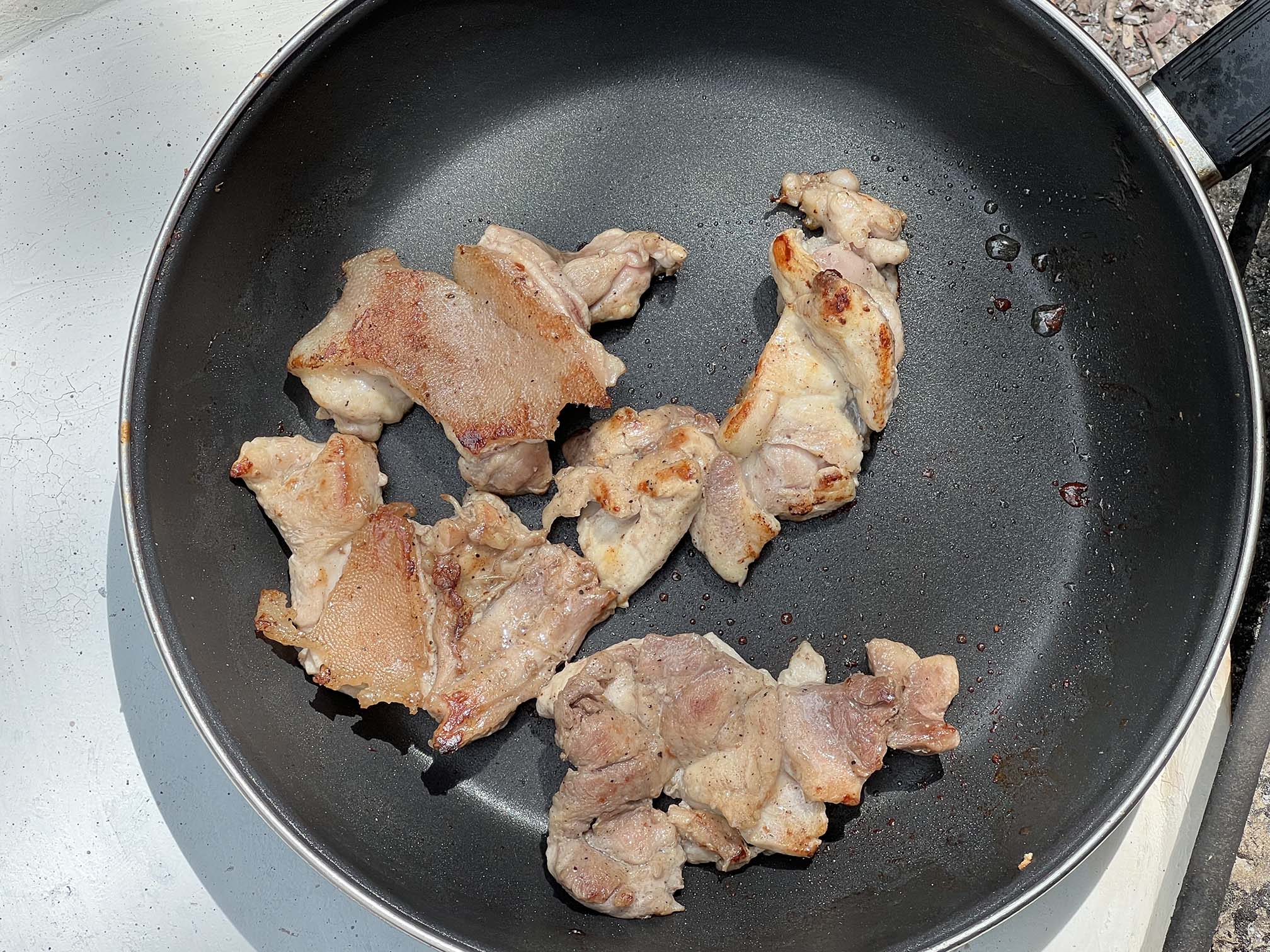
Paca in the skillet. In the Yucatan, just everything that walks, crawls, or flies is considered food, but the mild, light-colored flesh of the paca is the best of the best.

Leave a Comment

Clearing the Way for Wildlife

Creating corridors that allow wildlife to move is not only good for our game populations, it’s good for people, too.

Photo above: This wildlife crossing, one of dozens in Banff National Park, allows animals to cross the busy Trans-Canada Highway. The tops of these structures are planted with natural vegetation. Data shows they are used regularly by bears, cougars, bighorn sheep, and many other species.

In deer-rich northern Pennsylvania, where I grew up, an apocryphal story used to make the rounds every few years. An adjuster for a large insurance company in Harrisburg, the story went, got very suspicious of all the deer-car collision claims his company was getting from the northern part of the state. Figuring the rubes up north were committing insurance fraud, the adjuster decided to take a road trip to investigate. By the time he arrived in the region, he was frazzled from half a dozen close calls with deer that jumped out into the road in front of him. At that point he turned his car around, headed back to Harrisburg, and stamped all of the deer-related claims “approved.”

 Collisions with wildlife were long considered an unavoidable side effect of building roads through wildlife habitat. In the course of our normal “progress,” humans have thrown up all sorts of barriers to wildlife movement. From interstate highways to back roads, to cattle fences, to energy developments and subdivisions, deer, elk, antelope and other animals are constantly faced with dangerous and sometimes impassable obstacles in the course of their daily and seasonal movements. And, as that mythical insurance adjuster found out, as animals inevitably attempt to cross these barriers, it’s not just dangerous or deadly for them, but costly and hazardous for people as well. 

Wildlife crossings and migration corridors—the routes that animals travel between their seasonal habitats—have received much-needed attention in recent years. New research has turned a spotlight on the issue, largely because of amazing advances in GPS collars and mapping technology that have allowed scientists to get a much better understanding of where and how far animals move at different times of year in their ongoing quest for food, cover, and mates. These studies also help to identify bottlenecks where their movement is constrained by a highway, fence, or other man-made obstacle. 

Roads, of course, are one of the most common impediments to wildlife movement. The federal government estimates  at least 1.5 million deer, elk, and moose are killed by vehicles every year. Not only does that mean 1.5 million fewer big-game animals roaming the woods for us to hunt (1.5 million!), but those collisions cost an estimated $10 billion in human deaths, injuries, and auto damage. 

Overpasses and underpasses designed especially for wildlife can make a huge difference. The first-ever wildlife “bridges” were constructed in 1975: one was an overpass created for mule deer over I-15 in Utah, and one was an underpass under I-70 in Colorado for elk and deer. These were unusual projects at the time, but not anymore. Thousands of such wildlife crossings have been constructed in recent years, and, as long as they are built in the right spot, their effectiveness is impressive—in Wyoming, one set of crossings near Baggs reduced collisions with deer and antelope by more than 80 percent.

In the past few years, more money has been made available for these projects, partly because they seem to be one of the few things politicians on both sides of the aisle can agree on. Under the Trump administration, Interior Secretary Ryan Zinke signed an order addressing the importance of big-game migrations in the West, and in 2019 the Interior Department directed $2.1 million in grants to state and local partners in several Western states to conserve habitat corridors for elk, mule deer, and pronghorn. More recently, the 2021 Bipartisan Infrastructure Law earmarked $350 million to build wildlife crossings over and under highways.

Wyoming and Colorado are leaders when it comes to helping wildlife find its way. The University of Wyoming’s multi-year Wyoming Migration Initiative has identified a number of very long seasonal migration routes used by pronghorn and mule deer in the western third of the state (dubbed by some “the path of the pronghorn”), and this research has helped wildlife managers understand where they need to work with landowners, tribes, and other partners to help keep those wildlife corridors open so these populations continue to thrive.

In addition to constructing numerous highway crossings for wildlife, Wyoming signed an agreement with the U.S. Department of Agriculture last fall outlining how it plans to work with private landowners to mitigate other barriers to wildlife migration. The agreement provides $16 million to help willing landowners conduct habitat enhancement projects, lease their land for wildlife habitat, and install or remove fencing to benefit wildlife and livestock alike. 

The Colorado Department of Transportation (CDOT) has built more than sixty wildlife mitigation structures crossing above or under highways throughout the Centennial State. The most recently completed one allows wildlife to cross US Highway 160 between Durango and Pagosa Springs. According to CDOT, more than 60 percent of all the crashes that were occurring along this stretch of road were wildlife-vehicle collisions. They’re expecting those numbers to drop by 85 percent.

It takes collaborative efforts by numerous agencies, organizations, and individuals to make these projects happen. In the case of the Highway 160 project, wildlife biologists with the Southern Ute Indian Tribe provided the research data that identified seasonal migration patterns and habitat for mule deer and elk in the San Juan Basin area.

“Nineteen years ago, the tribe deployed its first set of GPS radio collars on mule deer. The results of those collars hinted at the importance of this particular spot and stretch of roadway as a migratory crossing point [for big game] on Highway 160,” said Aran Johnson, Southern Ute tribal wildlife biologist.

Colorado and Wyoming are joined by several other western states that have recently enacted laws providing dedicated funding for the study and protection of wildlife corridors. This year, Utah passed a state budget that included $20 million for the construction of wildlife crossings in a state where 5,000 deer and 1,000 elk are killed by vehicles each year. And last year, Californa passed the Safe Roads and Wildlife Protection Act, which takes a comprehensive approach to addressing ecosystem connectivity from a transportation perspective. A project is in the works to create the largest wildlife crossing in the world under Highway 101 in southern California.

While much of the focus on wildlife corridors is happening in the West, eastern states are also taking note. Back in Pennsylvania, which still has one of the highest rates of deer-car collisions in the nation, there are currently only a few wildlife overpasses, mostly in the eastern part of the state. State Representative Mary Jo Daley has been trying for several years to get the Keystone State to conduct a study on the feasibility of constructing more wildlife crossings on the state’s highways. As she reminded one news outlet, “It’s not just wildlife in the West that’s important.”

Leave a Comment

One Ton of Black Fury

Does a Cape buffalo really weigh 2,000 pounds?

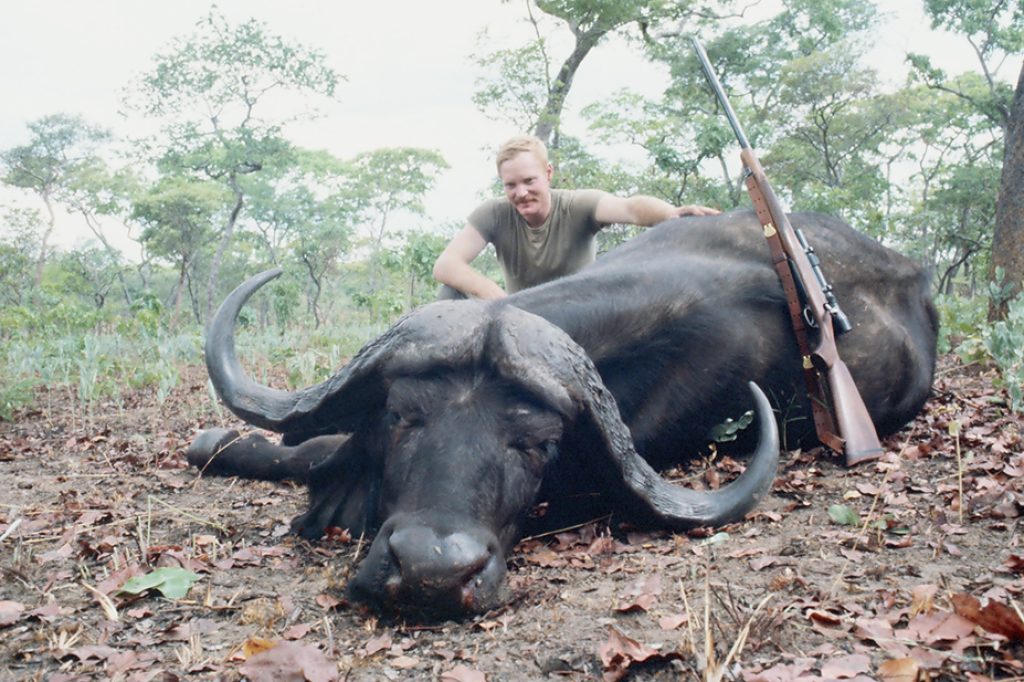
Photo above: PH Paul Smith, Boddington, and Wayne Holt with Holt’s awesome Zambezi Valley Cape buffalo, taken in 2005. Not weighed (as usual), this remains one of the largest-bodied Cape buffaloes Boddington has seen, and it had exceptional 45-inch horns.

One ton of black fury: so is Africa’s Cape buffalo often described. Or, if you prefer more drama, “a ton of black death.” It’s not unusual for we hunters to exaggerate the size of game animals. Nobody ever took a black bear weighing less than 300 pounds, though the actual average is a third less. Similarly, all male leopards approach 180 pounds, though an average tom is less than 150 pounds.

I’ve raised eyebrows when I’ve suggested that a big Alaskan brown  bear in autumn weight could reach 1,500 pounds. All these weights are possible. North Carolina and Pennsylvania black bears have been officially weighed in above 700 pounds, and I’ve seen leopards tip good scales above 200. These are unusual, outsized animals, which occur in every species.

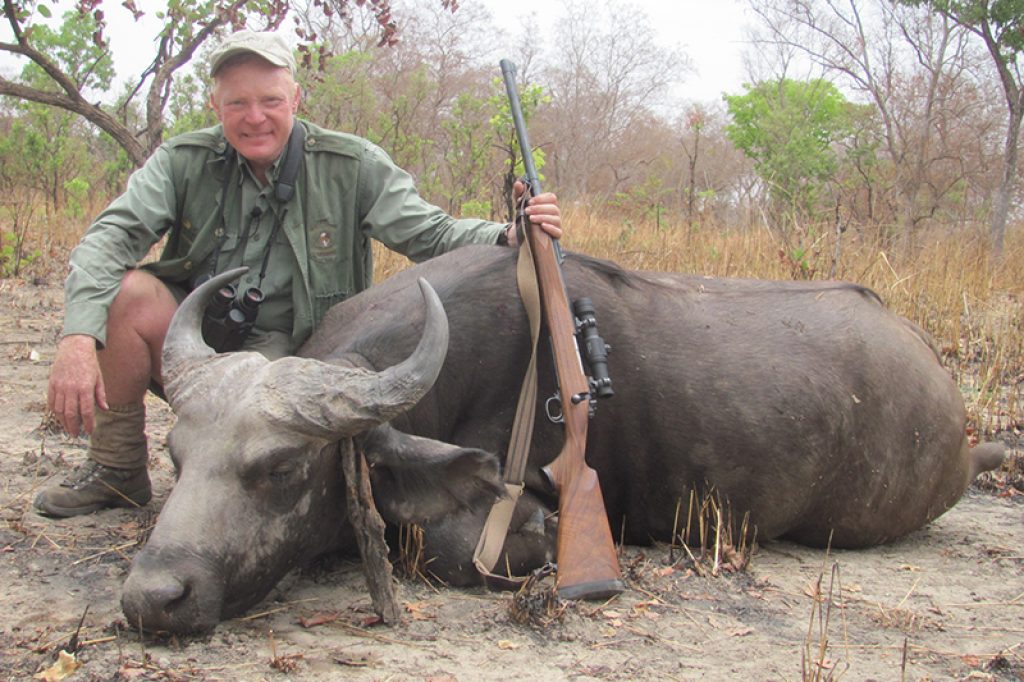
Boddington’s first “big” buffalo, taken in Zambia in 1984, appeared to have an exceptionally large body. As usual, it wasn’t weighed and, forty years ago, his point of comparison was limited.

Lacking access to good scales, we don’t often weigh game animals, and rarely recover large animals whole, so weight is just a guess. Antlers, horns, and skulls don’t lie, which is why record books rely on those measurements. Actual weight doesn’t matter much, except that the curious among us like to know how big animals get.

Despite the legend, I have always questioned the possibility of a Cape buffalo reaching a full ton. Few are properly weighed, but I’ve seen many on the ground. I’ve always figured 1,400 to maybe 1,600 pounds for a mature southern Cape buffalo bull. No science, just experience. This is where I got my theory that an outsized brown bear is similar in weight.

As for “black death,” “fury,” and the occasional reference as Africa’s most dangerous game, there is no doubt the Cape buffalo is strong, tenacious, and can be deadly. I’ve lost friends to his tribe. Robert Ruark is credited with saying “use enough gun.” He didn’t coin the phrase; it was the title for a posthumous collection. Good advice. Ruark also wrote that he’d seen buffalo taken “as easily as a cow in a pasture with a .30-06.” Today, usually not legal, but Ruark hunted various jurisdictions before caliber minimums. Wherever, generally unwise. Let’s stick with “enough gun” as the wiser course. Combining common sense with legality, I’ve seen few buffaloes taken with light calibers. However, I’ve seen a lot of bulls succumb to a single well-placed shot.

After millennia of being hunted by lions, it seems to me the African buffalo is perpetually ready to launch. We often talk about its instant surge of adrenaline. Don’t know if that’s medically true, but it makes sense. A well-placed first shot that the buffalo is physically unable to shake off seems critical. Failing that, all bets are off. According to all witnesses, the buffalo that killed great Zimbabwe PH Owain Lewis took eighteen hits from .375s on up before giving up.

The first shot, three days earlier, was not in the right place, and we can surmise that many of the seventeen bullets that followed also were not. Even so, that’s a bunch of foot-pounds. Jack O’Connor wrote of a buffalo that took fourteen hits. I’ve never seen anything like either incident, but I’ve seen buffaloes shrug off multiple good hits. However, many more have gone down readily to a single well-placed bullet.

My rule: Place the first shot as well as possible. If the buffalo is still up and additional shots are safe and possible, keep shooting until he’s down. After that, an insurance shot is situational. If you’ve heard the death bellow and there is no movement as you approach, not always. However, I’ve heard credible accounts of a buffalo getting back up after the bellow. So, approach cautiously from side or rear, never frontally, prepared to fire again at the slightest movement.

Like all other creatures, buffaloes have different character, some more aggressive than others. A few will circle and lie in wait; others seem to prefer flight to fight. You never know, and this is more relative to attitude than to body size.

That said, the old adage “the bigger they are, the harder they fall” is probably true. If my average weight of 1500 pounds is correct, then a one-ton buffalo weighing twenty-five percent more should be harder to stop. I guess.

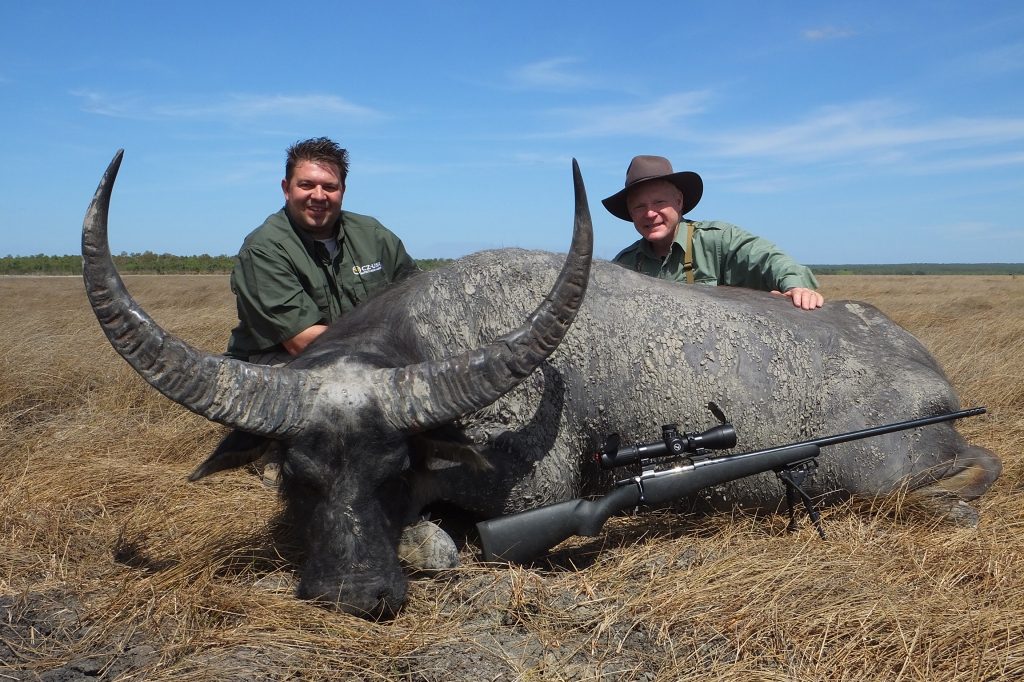
Jason Morton and Boddington with an exceptional feral water buffalo from northern Australia. Nobody knows, but Boddington always figures at least 2,200 pounds for a big bull. Morton used a .338 Lapua Magnum on a CZ action.

The American bison is a heavier animal, with large bulls averaging about a ton. The Asian water buffalo is also bigger, bulls running to 2,200 pounds and more. We know the bison’s reputation. I  have taken water buffaloes on four continents. They are unquestionably larger than Cape buffaloes. I’ve seen them hard to put down, but in my experience, never as aggressive nor as quick on their feet. I wish I had experience with gaur, the Indian bison. Largest extant bovine, up to 3,000 pounds, legendary for tenacity.

I’ve never seen a gaur in the wild, nor a whole bison or water buffalo on good scales, but I know they appear visually bigger than Cape buffaloes. Regardless of species or size, all the big bovines are dangerous. It only takes one with an attitude. Just last year, the great Mexican hunter Mario Canales Sr. was killed by a water buffalo in Argentina. The smallest African bovine, the little dwarf forest buffalo, has a wicked reputation.

So do the smaller savanna buffaloes. In Burkina Faso, they take great pains to recover game whole, back to camp at max speed. There, they take weights and measurements for the game department. So, among few buffaloes I’ve seen properly weighed, I know that my West African savanna buffalo weighed 471.6 kilograms. That’s 1,037.5 pounds. The folks there told me it was a big bull. The West African savanna is the second-smallest race, and references confirm that it’s a third smaller than the southern Cape buffalo.

In Burkina Faso, animals are recovered whole when possible and weighed, so Boddington know his West African savanna buffalo weighed 471.6 kilos (1,037 pounds), about a third smaller than Southern Cape buffalo bulls of similar maturity.

This little buffalo did try to live up to the reputation of its breed. It shrugged off a well-placed 300-grain .375 bullet at eighty yards, turned, and came straight in like a torpedo. He shrugged off the second, frontal shot, went down reluctantly to the third, and needed yet a fourth.

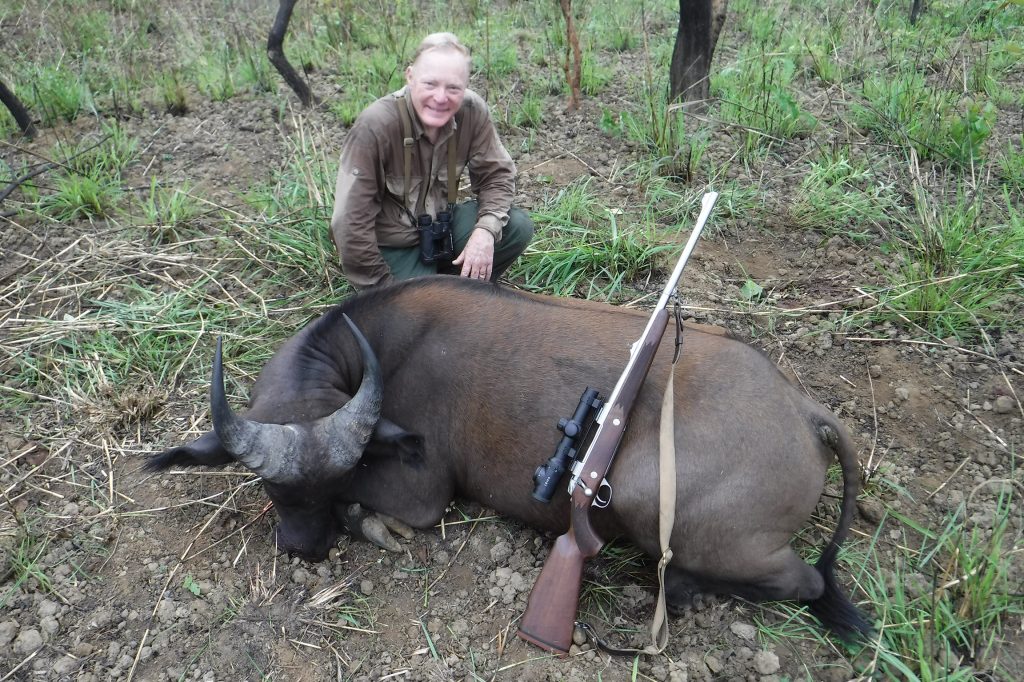
All buffaloes look big on the hoof, and big when you walk up to them. Except my one and only dwarf forest buffalo. Nice bull, fully mature. When approached, I wondered where the rest of him had gone!

The dwarf forest buffalo of Africa’s forest zone is probably the world’s smallest huntable bovine, less than half the size of a normal Cape buffalo. This is a mature bull with good horns. For comparison, look how huge the Sako .375 appears.

Otherwise, they all look big, dark, and menacing. For sure, some look bigger than others, and we comment, but rarely have the opportunity to weigh. My first “big” buffalo, taken in Zambia in 1984, looked like a tank, but I lacked experience to compare. After tracking two big-footed Zambezi Valley bulls for nine days, Wayne Holt’s 2005 bull was a giant in all ways: Big bosses, 45-inch spread, visually huge body. But, with no means to weigh whole, who knows?

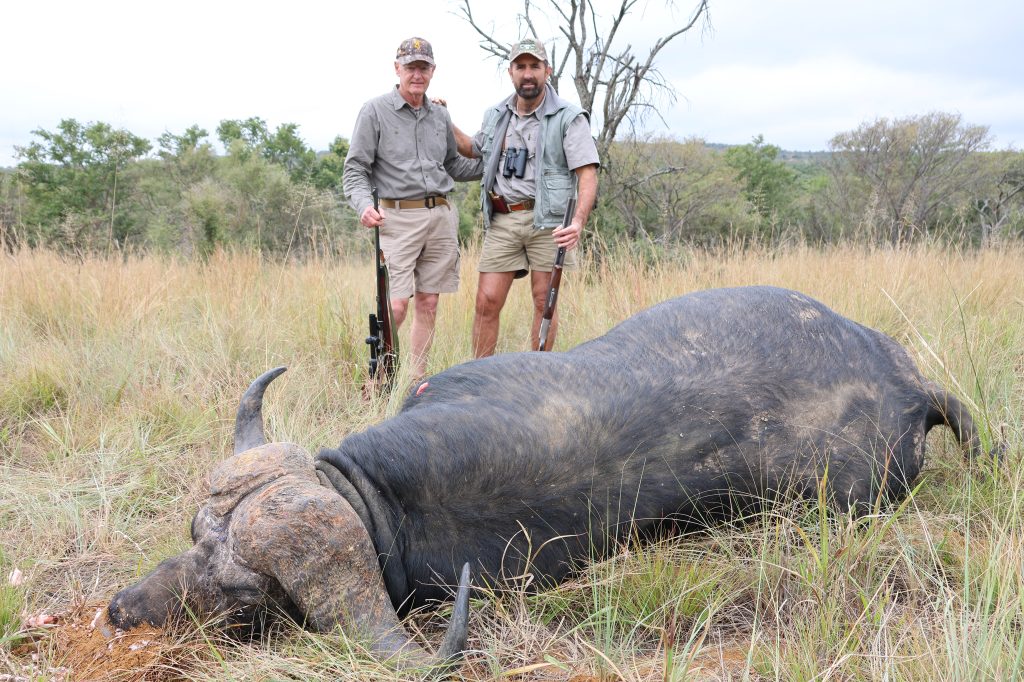
Just now (May 2023), hunting in Limpopo with Jose Maria Marzal (Chico & Sons Hunting Safaris), my friend Jim Gent shot a wonderful buffalo. Heavy bosses, good shape, fairly wide. We guessed it at 42-inch spread, spot-on. The bull was walking alone, nothing unusual until we walked up to it. Then it got bigger and bigger, easily the biggest buffalo I’ve ever seen. Jim made a great first shot with a .375 at seventy yards, obviously hit hard but not down, so another, Almost down, back up, solidly down to his third shot. No drama, no distance covered, but a mountain of a buffalo.

Jim Gent and PH Jose Maria Marzal, with Gent’s huge-bodied buffalo, taken in Limpopo in May 2023. The horns are excellent but, up close, it was unusual body size that drew attention.

All animals vary, individually and regionally. I think of the Cape buffaloes we hunt in coastal Mozambique as “normal,” whatever that is. I think mature bulls in the Zambezi Valley are a bit larger. I don’t have much experience with Limpopo buffalo. Originally, they came from Kruger, known for big buffaloes. The South Africans have been breeding disease-free buffalo for decades, so today’s buffaloes are healthy and well-fed. Stands to reason they get big, but I’ve never seen anything like this guy, visually as large as any water buffalo bull I’ve seen.

Even though he broke the winch, we managed to get him loaded whole. Nope, couldn’t weigh him, no scale big enough. In South Africa, much game meat goes to local markets. The butchery weighed the recovered meat. At 891 pounds (minus head, skin, innards, and lower leg bones), the heaviest this outlet had seen. References suggest that large bovines lose nearly two-thirds body weight from live to hanging carcass. Working the math backwards, live weight was at least 2,300 pounds.

So, after all these years, I stand corrected. An African buffalo can be “2000 pounds of black fury.” Lest anyone think super-buffalo are being bred, a couple days later I shot a good bull in the same area. Fully mature, big-bodied, horns only slightly smaller. Visually, my bull appeared “normal,” but obviously smaller. Recovered meat was 222 pounds less. Working backward again, live weight would have been possibly 1,600 pounds, about what I’ve always considered normal for a big-bodied southern bull. 

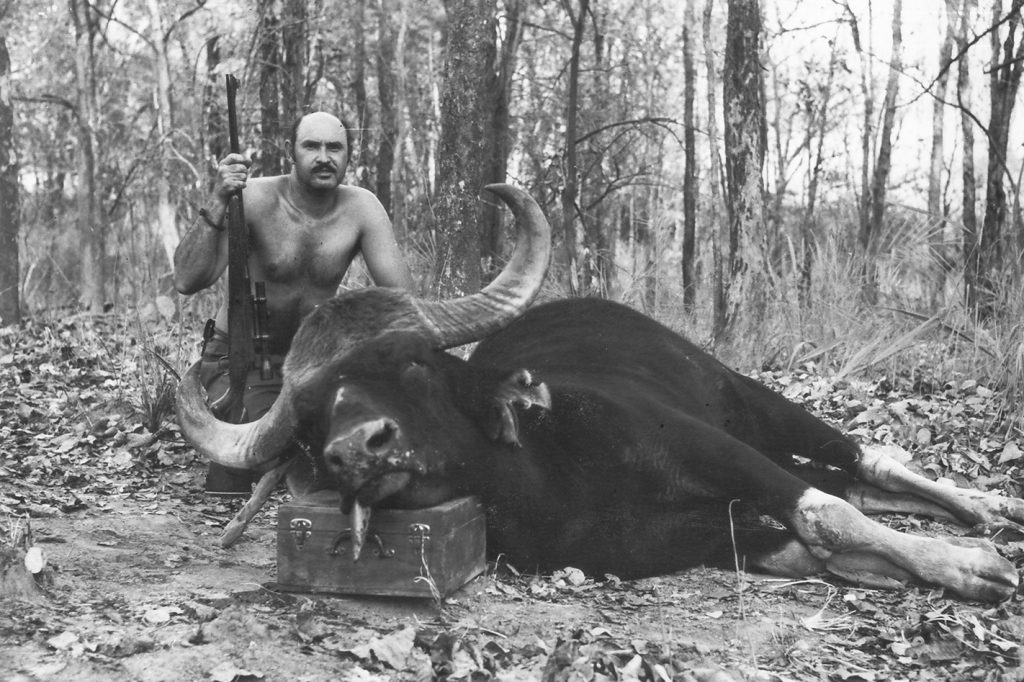
The gaur or Indian bison is the ultimate bovine, with big bulls said to weigh up to 3,000 pounds. They are no longer huntable, but in a different time, the late Bert Klineburger took this one, believed to have been in Assam. (Photo courtesy Robert Anderson)

Leave a Comment

Big Bend Barbary Rams

Hunting the “poor man’s desert sheep” during an unusually rainy week in West Texas.

West Texas is not usually known for being cold and rainy. Mostly it’s hot. And dry. Shimmering, heat-induced mirages dance across jagged ridges and rocky arroyos, while roadrunners pant in the shade. That’s what West Texas is usually like. But not today–today it’s cold; we huddle against the chill, collars turned up against the damp wind. Fog rolls in and out, making it difficult to see the distant ridges and cliff faces we’re inspecting though our binoculars. We’re searching West Texas for aoudad, the “poor man’s desert sheep,” but it feels more like we’re hunting in the Pacific Northwest. Chilled and damp, we crowd back into our truck to four-wheel to another glassing spot.

Aoudad, also known as Barbary sheep, are native to North Africa. They possess legendary eyesight and no sense of humor whatsoever, rendering them an elusive and challenging quarry to hunt. A mature ram will stand roughly three and a half feet tall at the shoulder and might weigh 300 pounds or better. They are rusty red-gold in color, sporting tough, abrasion-resistant hair. A long, blondish mane grows down the front of their neck and cascades from the fore part of their front legs, forming spectacular chaps on many mature rams. Aoudad are known for toughness, too, requiring a well-constructed bullet and accurate shot placement to achieve a quick, clean kill. 

Barbary sheep have been transplanted to multiple locations around the globe over the last century or so. Reportedly first brought to the United States around the year 1900, they were introduced into the wild in New Mexico in 1950 and Texas in 1957. Since, they have flourished across the desert ridges and badlands of both states, in many cases becoming so plentiful that they compete with native wildlife. They typically move in herds and feed indiscriminately, often badly overgrazing sensitive plants and posing a very real threat to local vegetation and habitat. Because of these proclivities, landowners, ranchers, and wildlife biologists are commonly unified in their desire to aggressively manage local aoudad populations. In Texas, Barbary sheep are categorized as an exotic species and therefore huntable 24/7/365. Management practices are determined and implemented by the landowner, often in conjunction with an outfitter who leases the land for the purpose of hunting. Aoudad reproduce prolifically and are talented survivalists, and in most cases they stay well ahead of population objectives.

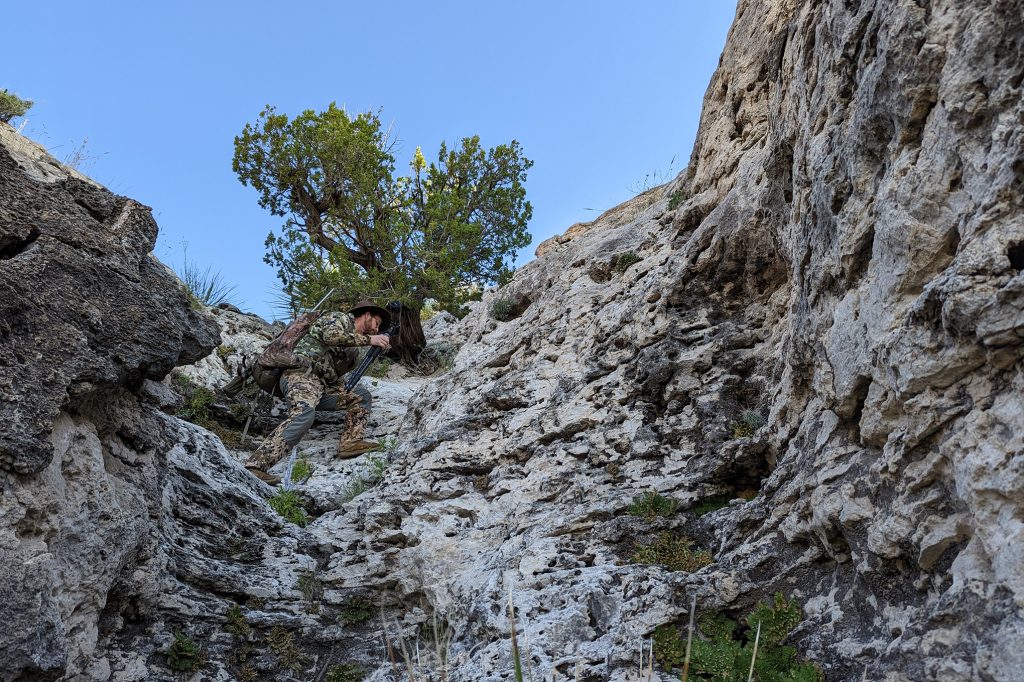
The “poor man’s desert sheep hunt” is a real sheep hunt. The West Texas terrain is rugged!

Many hunters, myself included, dream of hunting wild sheep. But for me, and for most blue-collar hunters, a hunt for native wild sheep is financially unattainable. That’s where Barbary sheep enter the scene; a good aoudad hunt will set you back roughly one-tenth or less of the cost of a desert sheep hunt, and in many ways the hunt resembles that of a desert sheep, in similar country and with similar challenges. It’s no wonder hunters have nicknamed aoudad hunting the “poor man’s sheep hunt.”

The Big Bend country of Texas is a long way from anyplace with high rises and traffic lights. Nestled into a northward-curving bend on the Rio Grande River, Big Bend National Park is a place of surreal desert beauty, shimmering heat, and deep, cliff-rimmed canyons. Rattlesnakes continue their age-old quest for packrats, cottontail rabbits, and unwary tourists. Javelinas snuffle about cactus patches, smacking noisily as they chomp down great bites of prickly pear. And sheep live in the cliffs. Desert sheep, but Barbary sheep too, especially north of the park in the vast ranchlands stretching from the badlands across the Permian Basin toward New Mexico. This is where my hunting partner Jake Burns and I are headed, the tires of our rented imitation SUV humming down the lonely West Texas highway as darkness falls. Jake’s flight was delayed and it’s almost midnight when we pull into Alpine, Texas, and stumble into a motel for some much-needed sleep.

Dawn finds our imitation SUV dead alongside a ranch road, having made it all of a quarter mile from the blacktop before blowing a tire. It’s a problem, but nothing unusual in remote ranch country. Jake and one of the guides point the vehicle back toward Alpine for a replacement tire, rolling gingerly along on the rental-company’s donut spare. I climb in with head guide Cross Moody and we continue southward, Cross’s truck grumbling carefully down the rough ranch road. Emptiness stretches for miles, reaching away into the distance to where the desert merges with a lowering, rain-promising sky. It’s a place that makes city folks nervous and anxious with too much freedom. Cowboys, desert rats, and hunters feel like they are coming home, the emptiness promising and hopeful with adventure.

An old, hand-built stone ranch house greets us as we arrive at camp, where pioneer equipment and piles of shed mule deer antlers decorate the surroundings. We unload the truck, stowing gear and a week’s worth of food inside the ranch house. Settled in, we turn our attention to the hills. The sheep await, but first I need to check the zero on my rifle. Airline baggage handlers have a way of making undesirable adjustments to shooting irons, and it’s always wise to conduct a quick test before heading afield.

Belly down on a gravely rise, I adjust my turret and steady my cross hairs on a three-inch-high by six-inch-wide rock, 500 yards distant. My first shot breaks clean and the bullet strikes a fraction of an inch over the rock. A second bullet impacts next to the first, verifying that my scope, mounts, and rifle withstood the best efforts of the baggage handlers. I’m ready to hunt.

That evening we spot a lone ram feeding through the jumbled outcropping of a broken cliff. He disappears over the top, but Cross doesn’t think he is old enough to be worth pursuing. We drive and glass, fighting the fog, searching the uncommonly sodden Chihuahuan desert for elusive aoudad. Just before dark I spot two rams silhouetted against the dusk a half-mile away on a mesa top. One looks particularly good, with heavy, deep-curling horns. We circle for a favorable wind and move in, but darkness overtakes us and we never see them again.

It’s dawn once more, and Jake has rejoined us. I watch Cross’s little brown-and-white Jack Russell shivering in the bed of the Tacoma. It’s partly from the cold but also part excitement; Spade loves to hunt. I worry about him as we drive into the broken desert; he appears about to turn into a brown-and-white hunk of shivering ice. Cross notices and gives me a hard time for allowing Spade to play upon my sympathies. The morning rolls on and so do we, moving and glassing, glassing and moving. Spade plays his cards well and ends up riding inside the truck next to me, eagerly staring out the front window in search of game. I may be a sucker, but we both enjoy the arrangement. The day passes without excitement, and I can feel Cross getting tense at the lack of game. Perhaps it’s the weather that is keeping the sheep hunkered down and out of sight.

Another day dawns like the ones before it, gloomy and damp. I enjoy the moisture–it’s far too rare in the desert to ever resent. But it does make hunting harder, and this day passes much like the previous ones, with a lot of moving, glassing, and moving. The afternoon grows old, and finally Cross spots three sheep far away and below us on the point of a ridge. We study them through our spotting scopes and they are all ewes. We continue on, moving rapidly from vantage to vantage, trying hard to find some rams before darkness falls. Luck eludes us though, and the silence is loud inside the truck as we head for camp. Cross is feeling the pressure and breaks the silence, telling us that he is trying hard to find sheep. I assure him that I know he is, but he doesn’t seem convinced. We only have one day left. Fortunately, the forecast calls for sunshine and calm. It’s the kind of day we’ve been waiting for.

Blue skies greet us at dawn, and as the sun chases the shadows from the desert, we roll carefully along the gravel ranch road toward a section of tall, broken territory. A great cliff illuminates in the morning sunshine, and just above it, Jake spots a band of sheep. It’s a big band, and Cross doesn’t spend more than a few seconds in his spotting scope before uttering the words we’ve been waiting four days to hear: “There’s a couple big rams in that group. Let’s go!”

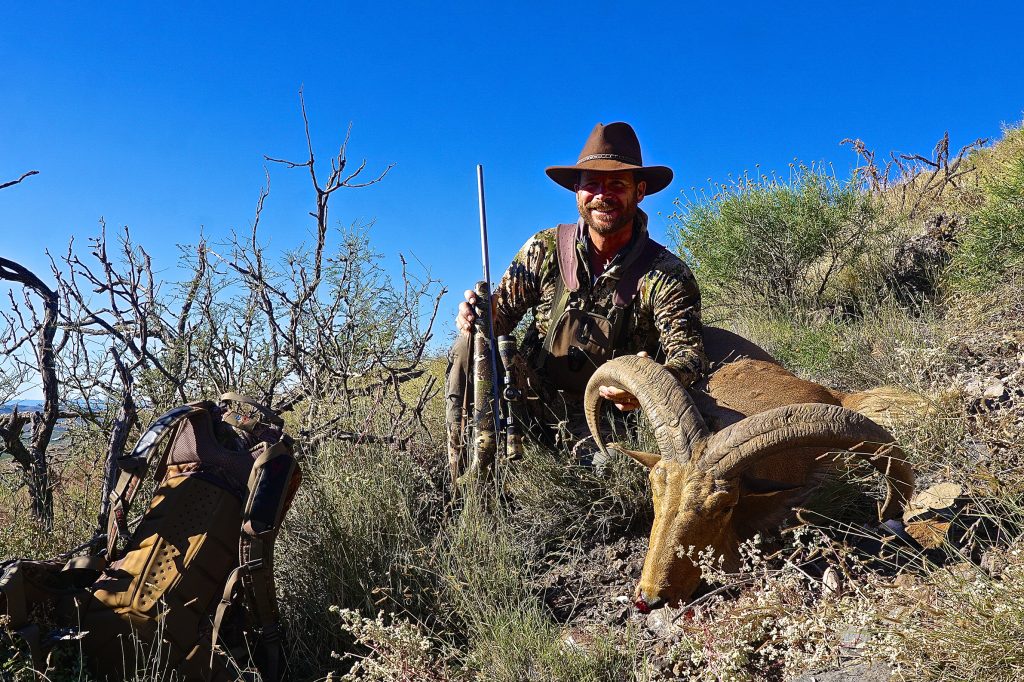
The author with his long-awaited aoudad sheep. The benchmark for a “big” sheep is 30 inches. This one went 32.

We tuck the truck out of sight behind a butte, shed some layers, and check the water bottles in our packs. Jake and I ready our rifles and correlate briefly; if a shot opportunity presents itself, I am to take the first shot. Hopefully a second ram will present an opportunity and he will get a chance too. Shouldering our packs, we head across a big alkali swale that’s rimmed by a small ribbon of slickrock opposite us. The breeze is in our faces now, but air is capricious in terrain like this and that could change once we circle the big butte to access the sheep.

The morning is bright now, a brassy sun glaring cheerfully at the desert she hasn’t seen in almost a week. The sky is blue and I feel great as we stop to shed another layer; after days of damp, overcast chill we are dressed too warmly. Moving on, we climb carefully up through a notch in the slickrock cliff. Cross slips ahead to look for the sheep.

The sheep are there, much closer than expected and moving toward us. We belly down on the desert gravel and deploy our bipods, Jake lying immediately to my right. We’re scarcely set when the wind capers and the sheep bolt, running straight away and up the steep mountainside. Big, curving horns are everywhere, but Cross directs my attention to one sheep in particular and immediately I see why. This ram is heavier and wider than any of the others, and I have no trouble keeping track of him as the band climbs away from us. The distance is roughly 360 yards and I reach up and crank the turret on my scope as the rams slows and then stops, turning his head to look back. He won’t stand for long, so I settle my cross hairs and press the trigger. The impact is obvious and the ram bolts to the right about 40 yards before slowing. He stands for a brief second and then tips over behind a big Sotol plant. My poor man’s desert sheep is down.

Another band of sheep bolts up the mountainside, weaving and leaping upward though a broken morass of jagged ribbon cliffs. Cross immediately identifies the biggest ram and gets Jake on him, but the sheep won’t stop. Higher and higher they climb, rapidly putting elevation and distance between themselves and us. Finally they stop, and Jake is ready, hitting the ram solidly at 560 yards. It staggers and then tumbles down the slope, coming to rest in some brush. We watch, but it doesn’t move again. We’ve just doubled on big Barbary rams, both accomplishing clean, one-shot kills under challenging conditions. It’s a beautiful, sunny day in West Texas as we photograph our rams and retell the story, marveling at the beauty of the sheep, the terrain, and the freshness of the rain-blessed desert air. It’s a good day to be a hunter.

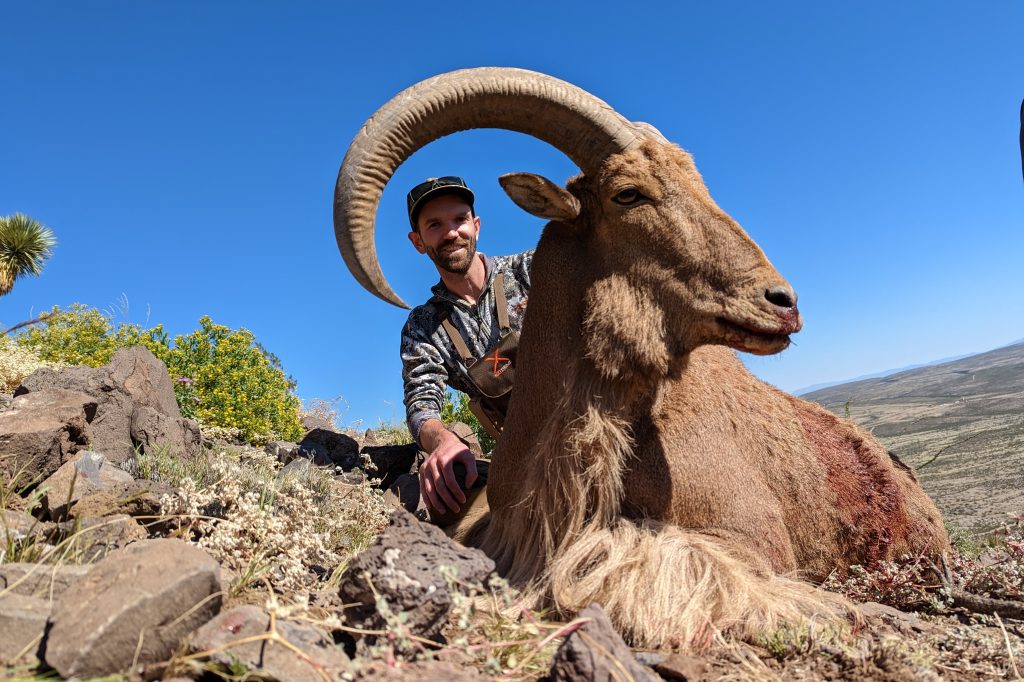
Jake Burns with a fine Texas aoudad.

Ammo for Aoudad

Thanks to tough hide and hair, dense bones, and a never-say-die attitude Barbary sheep are challenging to kill. Always use a premium bullet and place your shot with precision.

In my opinion, Federal’s Terminal Ascent bullet is the best all-around hunting projectile currently on the market. It’s accurate, but what makes it really shine is the architecture of its design and construction. The rearward shank of the bullet is solid copper and will always penetrate aggressively. The front half of the bullet features a bonded lead core and Slipstream polymer tip to initiate rapid, controlled expansion. Ballistic Coefficient is very good, as is wind-bucking ability and retained downrange energy. The entire bullet is designed to give strong terminal performance at a wide range of impact velocities.

For my aoudad hunt, I selected a Kimber Mountain Ascent rifle topped with a Leupold VX-6 HD scope and chambered in .280 Ackley Improved. It’s one of my favorite rifles and is superbly lightweight–just right for sheep hunting. Muzzle velocity with 155-grain factory Terminal Ascent ammo is 2,937 feet per second.

My hunting partner, Jake, used the same caliber and ammunition in his hunting rifle. In the end, the final moments of our hunt proved how critical to success this choice would be for both of us. Both shot opportunities were fleeting and demanded rapid execution of an accurate shot. My ram was quartered away at impact; my bullet entered mid ribcage, ranged forward through heart, lungs, off-side ribs, and shoulder muscle and bone, coming to rest under the hide at the point of the far shoulder. Terminal performance on both sheep was spectacular, the spent bullets showing perfect upset.—A.vB.

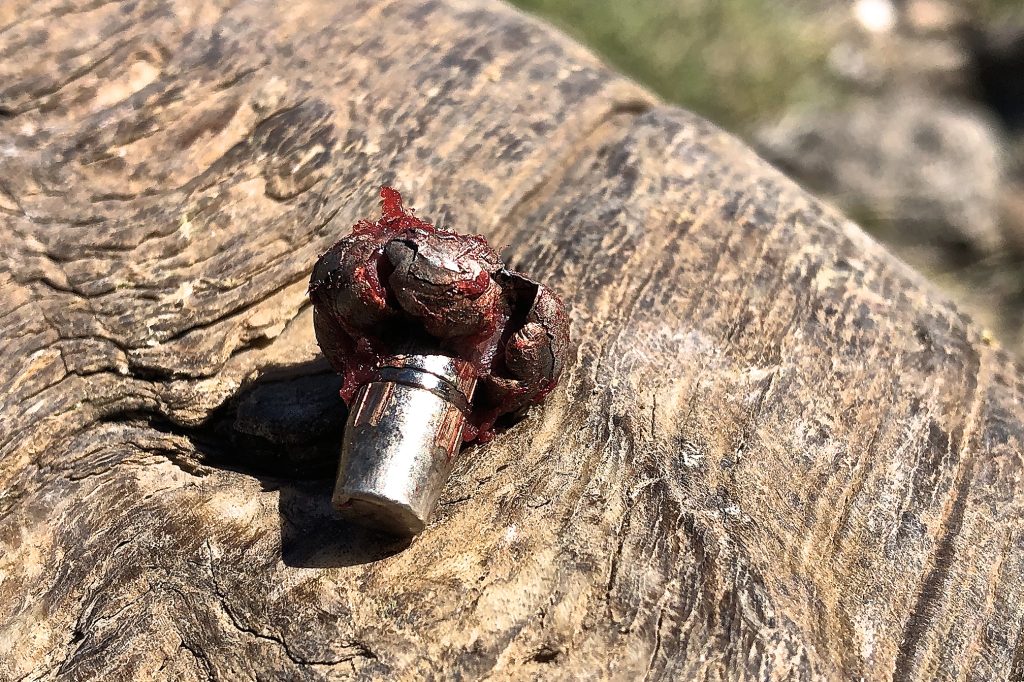
A perfectly mushroomed Terminal Ascent bullet, just moments after it was extracted from the author’s ram. Performance was flawless.

Leave a Comment

Boots for the Long Haul

For 125 years, Russell Moccasin boots have been the choice of world-traveling adventurers.

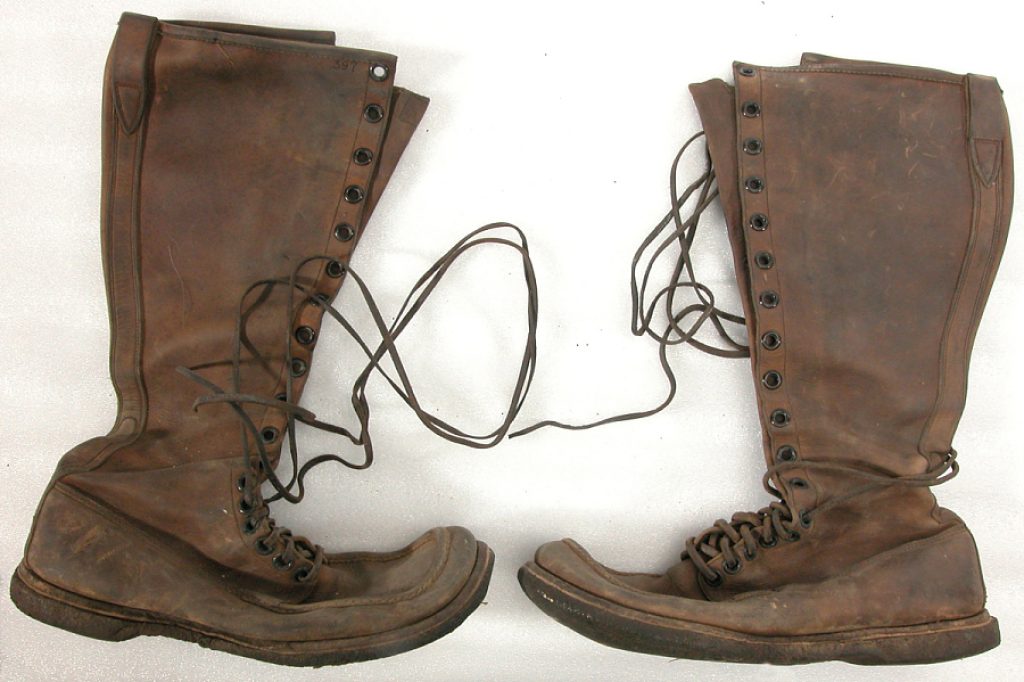
Photo above: These well-worn Russell Bird Shooter boots worn by Earl Shaffer, the first man through-hike the Appalachian Trail, are housed at the Smithsonian.

In 1948, World War II army veteran Earl Shaffer became the first person to hike the Appalachian Trail from end to end. A single pair of boots carried him the entire 2,000 miles from Georgia to Maine—a pair of “Birdshooters” from the Russell Moccasin Company. Shaffer’s motto was, “Carry as little as possible, but choose that little with care.” Modern AT through-hikers usually go through two or three pairs of modern boots on their trek, but Shaffer made his Birdshooters last, patching and repairing them often, and stopping twice along the route to have them resoled.

Shaffer’s battered boots are now in the National Museum of American History (where a curator confirmed they are still smelly from the long trek 75 years ago). Interestingly, Shaffer’s Birdshooters aren’t the only Russell Moccasin Company boots that ended up in the Smithsonian. Over at the National Air and Space Museum you’ll find another pair of Russells—this one worn by pioneering aviator Charles Lindbergh on his record-breaking flights to the Orient in 1931 and while surveying commercial air transport routes across the Atlantic in 1933.

Charles Lindbergh wore these Russell boots in the cockpit of at least two of his pioneering flights.

Over the years, Russell boots have kept many other famous feet in the game. Edward, Prince of Wales, wore them on safari with Denis Finch-Hatton. Saxton Pope and Arthur Young, the fathers of modern archery, were wearing Russell boots on their hunting trips as early as 1915. More recently, they’ve been spotted on the feet of Harrison Ford and Robert Redford.

No wonder fans of the 125-year-old W.C. Russell Moccasin Company feel that the boots on their feet are a piece of history. They also know the brand stands for craftsmanship, legacy, and quality—which is why it’s been around for well over a century.

Russell has focused on making boots to order for serious hunters and anglers since its early days.

The W.C. Russell Moccasin Company got its start on the banks of the Fox River in Berlin, Wisconsin—where the company is still headquartered to this day. William Russell, for whom the business is named, was a second-generation leather craftsman alongside his brother, Frank, and father, Charles. When the opportunity arose for his own venture, Will purchased the Wright Shoe Company from Stillman Wright and used its equipment to start the W.C. Russell Moccasin Company in 1898.

Originally he made boots for the booming Wisconsin logging industry, but soon outdoorsmen began to recognize the unique benefits of the moccasin construction for hunting, fishing, and hiking. This shift would serve to shift the focus of Russell’s efforts toward a clientele that it has dutifully served for well over a century.

In 1928, following William’s passing, one of Russell’s traveling salesmen, Bill Gustin, purchased the company. Gustin was a competitive trap and skeet shooter, hunter, and fisherman, so he had a firsthand understanding of the needs of outdoor sportsmen and began building boots specifically to meet them. In the early 1930s he introduced the now-famous Russell Bird Shooter—the boot Earl Shaffer wore on his famous trek–plus a line of oxfords, loafers and casual shoes.

The Russell legacy was carried on by Gustin’s son-in-law, Lefty Fabricius, starting in the early 1980s when Bill retired at age 92. Lefty ran the company for many decades, and was eventually joined by his daughter, Suzie Fabricius. In 2022, Lefty, Suzie, and their family sold the company to current owners Joe Julian, Luke Kolbie, and longtime Russell production manager Joe Gonyo.

Mindful of the company’s historic legacy, the new owners have restocked some longtime customer favorites, including the Safari PH and the Thula Thula PH. Countless safari hunters (including me) have worn these boots on African adventures over the years, appreciating the style, comfort, and, particularly in the case of the Thula Thula PH, the ability to stalk game almost silently.

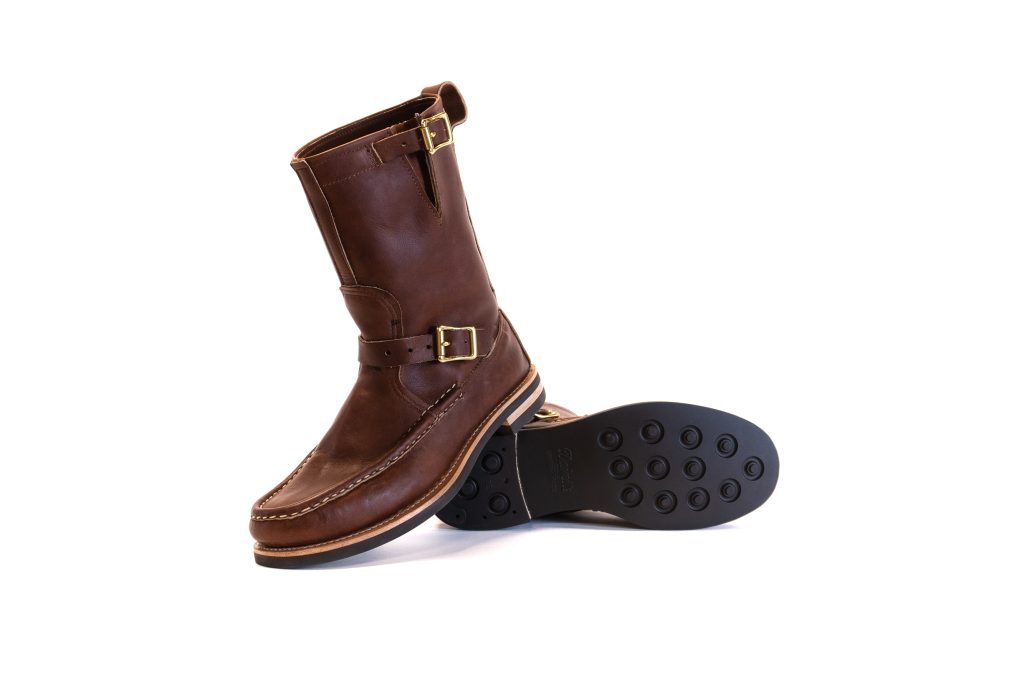
A limited edition 125th Anniversary Boot (only 125 pairs were made), the Nochaway Cavalier, is based on Russell’s original Cavalier Model, which debuted in the 1940s. The Cavalier, designed for quail hunting in the south, is one of Russell’s best-known models and was the forerunner of the very popular Russell Zephyr model. The Anniversary Boot builds on the history of the original model, combining classic style with modern techniques and materials.

Russell is making only 125 pairs of the stylish Nochaway Cavalier boots to celebrate its 125thanniversary.

As the Russell ads say, “Yes, this is your grandfather’s boot.” Russell boots are still durable, dependable, practical, and stylish, and they are still made to order in Berlin, Wisconsin. True to their history and tradition, Russell boots are still a great choice for hunting birds, deer, and dangerous game, embarking on a transatlantic adventure, or hiking 2,000 miles from Georgia to Maine.

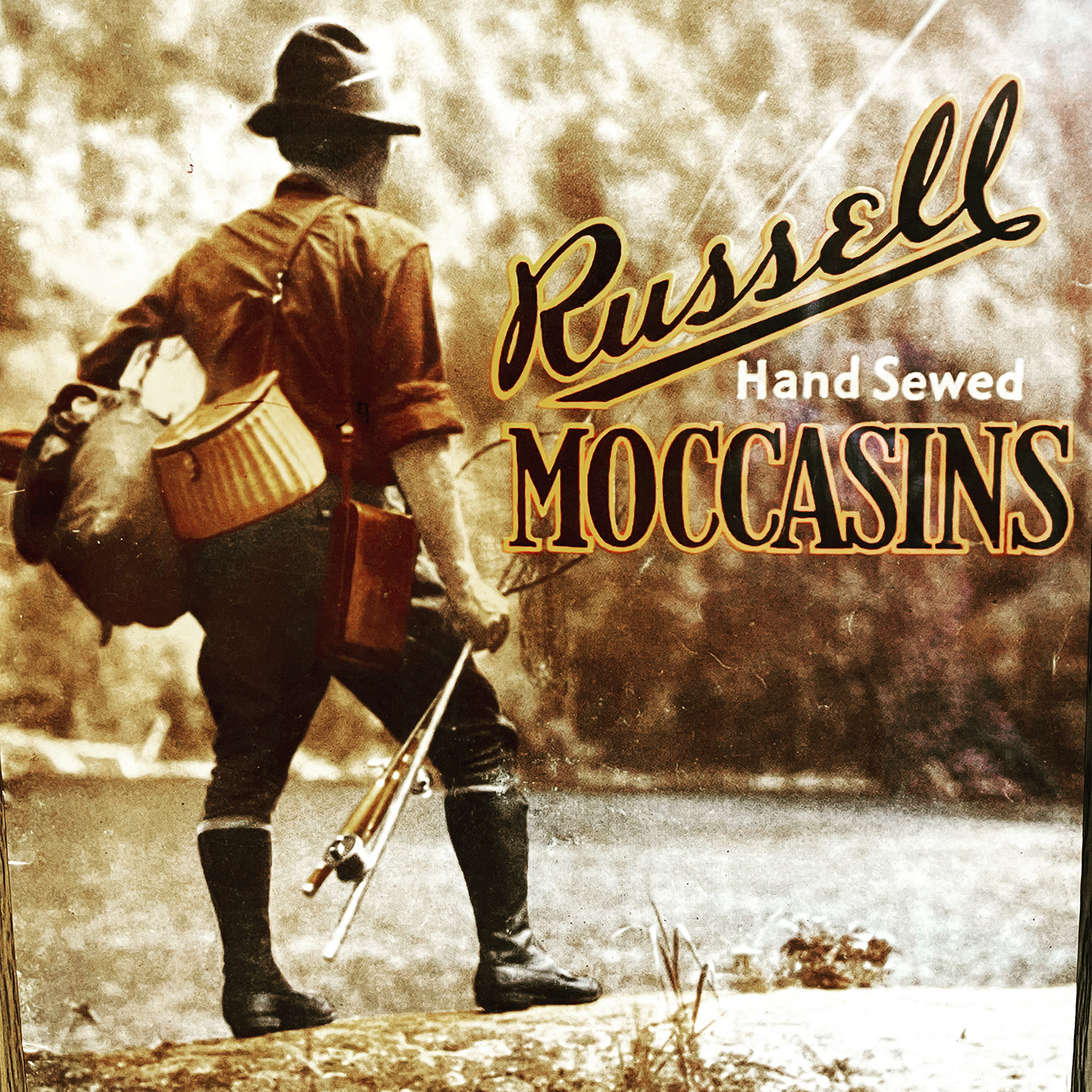
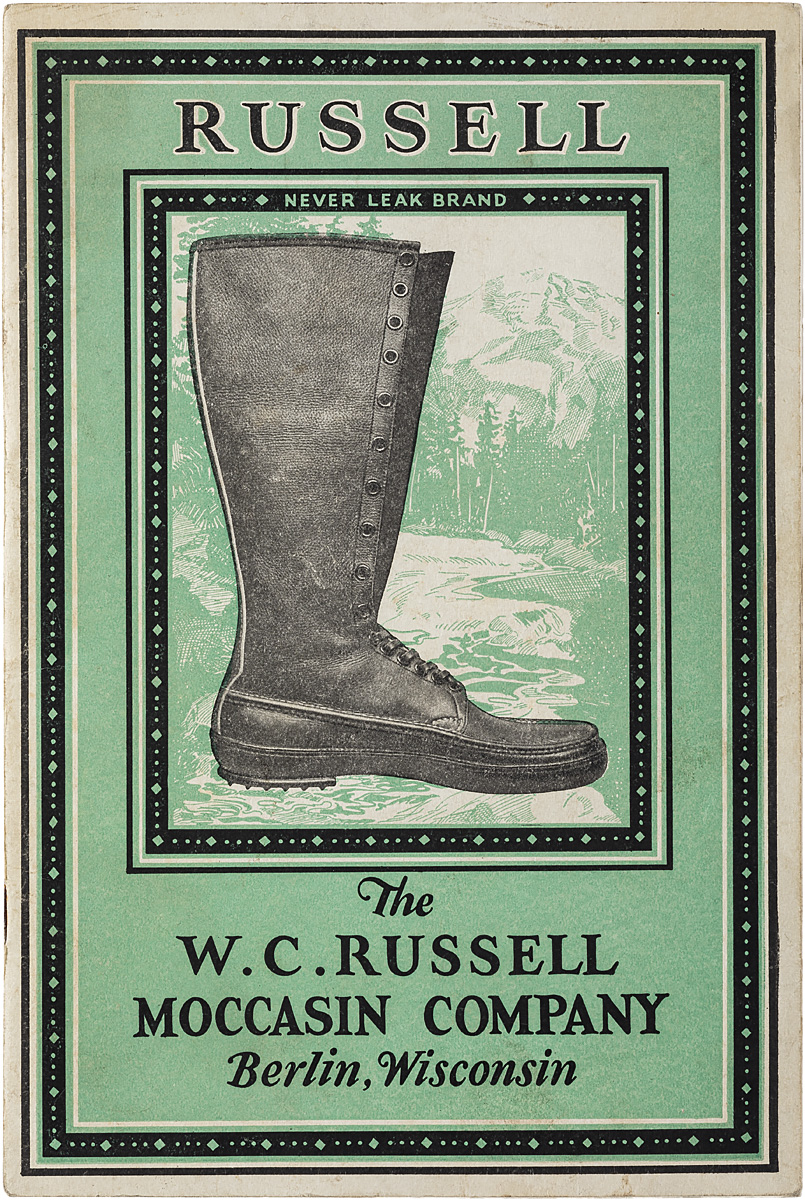
A vintage ad for Russell emphasizes the company’s focus on boots made for the outdoorsman.

Leave a Comment

Great Museum Taxidermy Collections

Four museums where you can still see impressive taxidermy displays.

Photo above: An African water hole scene at the Chicago Field Museum. Image courtesy of the Chicago Field Museum.

My high school required students to complete at least fifty hours of community service before graduation, and one of the optional volunteer destinations was the nearby Cincinnati Museum of Natural History. I chose to serve at the museum, in part because I figured walking visitors through the museum and explaining the differences between reptiles and amphibians would be more enjoyable than clearing brush along the highway during Ohio’s long, gloomy winter.

The museum gig turned out to be much better than I anticipated, especially since I was granted access to some of the behind-the-scenes locations where a treasure trove of taxidermy mounts were stored. For a kid growing up reading Hemingway and O’Connor, having the opportunity to see and touch a real greater kudu shoulder mount was fascinating. 

For generations, museum taxidermists provided the general public with up-close access to the world’s great wildlife (until the early 2000s, the Smithsonian kept a taxidermist on staff). And although many museums have divested themselves of their mounts, there are still some great taxidermy displays in museums across the country. Here are four of my favorites. 

Field Museum, Chicago, Illinois

You may already know that the Field Museum houses the mounts of the infamous man-eating lions of Tsavo, but there’s much more to see here, including Fighting African Elephants, which includes full-body mounts of two African bull elephants engaged in battle. Other key displays that shouldn’t be missed include The Watering Hole, a diorama with life-size mounts of African game including black rhino, giraffe, zebra, oryx, Grant’s gazelle, and other species set against an East African background. 

The Field Museum doesn’t just honor African game, though. Be sure to visit the Deer in Four Seasons display, which highlights the life cycle of the white-tailed deer, North America’s most popular big game animal. The museum also pays homage to Native American culture and resides on the ancestral homeland of the Three Fires Confederacy of the Ojibwe, Odawa, and Potawatomi Nations. This is just a sampling of the fascinating items on display at the Field Museum.  

University of Iowa Museum of Natural History 

The University of Iowa’s Museum of Natural History in Iowa City, Iowa, boasts one of the most comprehensive collections of preserved animals in the region, and it’s a must-see attraction when you’re traveling through the Hawkeye State. In addition to their extensive dioramas of animals in their natural habitats, the museum also houses an impressive collection of skeletons and a number of preserved insects. It’s little wonder that scientists and artists frequent this destination to examine morphological details of species from around the globe. 

“Collecting at the University of Iowa Museum of Natural History began over 160 years ago, in 1858,” says Jessica Smith, communications director for Pentacrest Museums (which include the UI Natural History Museum and the nearby Old Capital Museum). “Research expeditions in the late 1800s and early 1900s, private donations, and the acquisition of orphaned collections have been the main sources of collected materials. Today, our collections comprise over 140,000 specimens, objects, and artifacts. Our collections support research, exhibition galleries, and high-impact learning opportunities. It’s true what they say–great universities have great museums.”

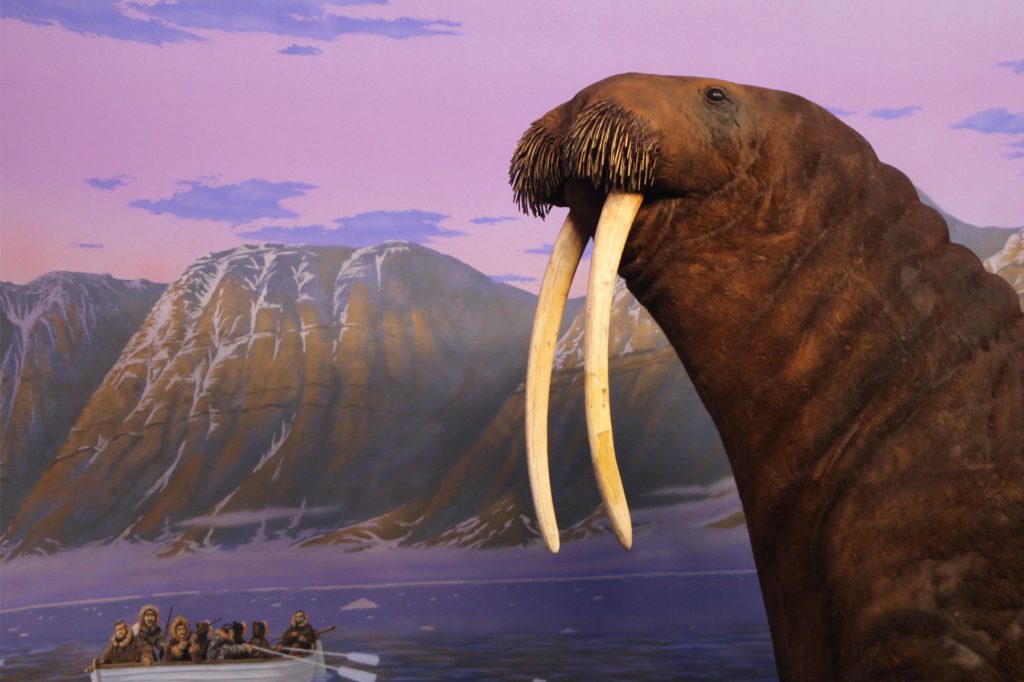
A walrus diorama at the University of Iowa Museum of Natural History. Image courtesy of the University of Iowa.

College of Idaho’s Orma J. Smith Museum of Natural History

The Orma J. Smith Natural History Museum in Caldwell is a worthwhile stop when you’re traveling in Idaho. Named one of the thirty Most Amazing Higher Education Natural History Museums by Best College Reviews, this collection, which is located in the basement of the College’s Boone Hall, boasts a collection of native and domestic species preserved by some of the region’s most outstanding taxidermists. Museum director William Clark says that the bulk of species in the collection are native to Africa and North America. Some of the taxidermists whose work is currently on display include William Lancaster and Stan Buzzini of Idaho and Cliff Brooks of California. 

Some of the mounts on display include leopard and Cape buffalo, a variety of African plains game, and North American species including black and grizzly bears and elk. The museum also houses a very large collection of bird mounts, preserved insects, and many fossils. The Orma J. Smith Natural History Museum hosts a variety of educational events throughout the year.

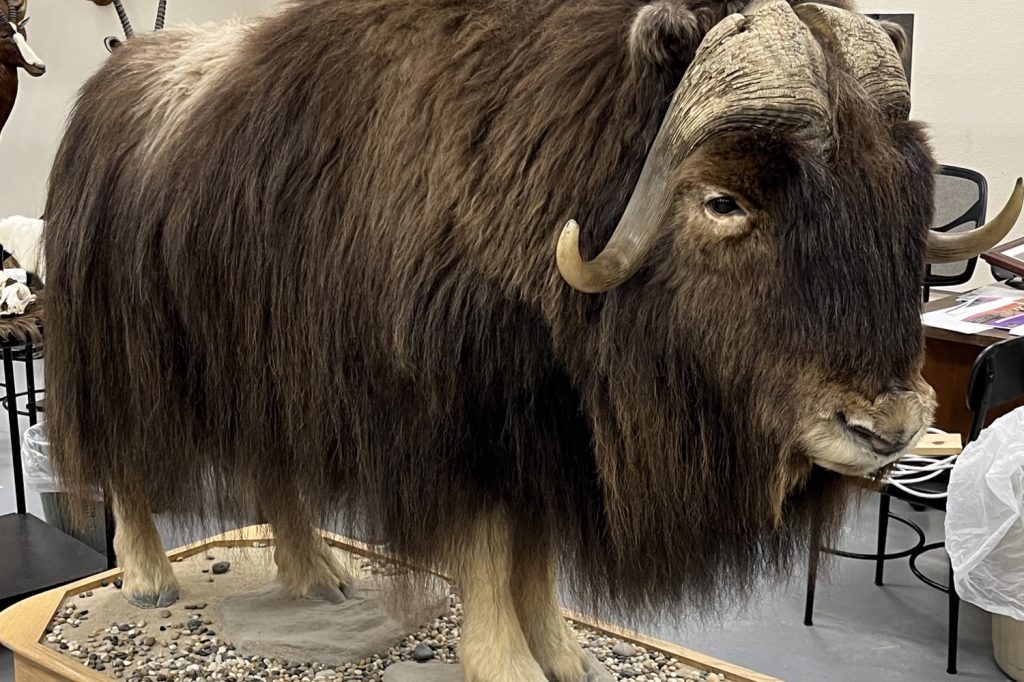
Life-size muskox mount at the Orma J. Smith Museum in Caldwell, Idaho.
Photo courtesy of Jan Summers

SCI International Wildlife Museum

SCI’s International Wildlife Museum, which opened in 1988 in Tucson, Arizona, was designed to mimic a Foreign Legion outpost that famous hunter C.J. McElroy visited while on safari in Chad. Perhaps the most impressive display is the 30-foot-tall indoor mountain that houses the great sheep and goat species from around the globe. In addition to an impressive collection of taxidermy mounts, there are also bronzes (most notably Portland-based bronze artist Lorenzo Ghiglieri’s “A King’s Roar,” which features an African lion) as well as displays of extinct species like woolly mammoths and Irish elk. But the real draw in this museum are the twenty-two dioramas featuring natural scenes with wild game mounts. One of the newest additions is an exhibit displaying game animals of southern Arizona, including the world-record non-typical Coues deer.   

In addition to the mounts there are also live animals on the property, and SCI has worked with Arizona Fish & Game to stock the property’s pond with native fish species like the Arizona chub and Gila topminnow. If you can’t make it to Tucson, that doesn’t mean you can’t enjoy some of what the museum has to offer. SCI provides online presentations to schools in the U.S. and abroad.

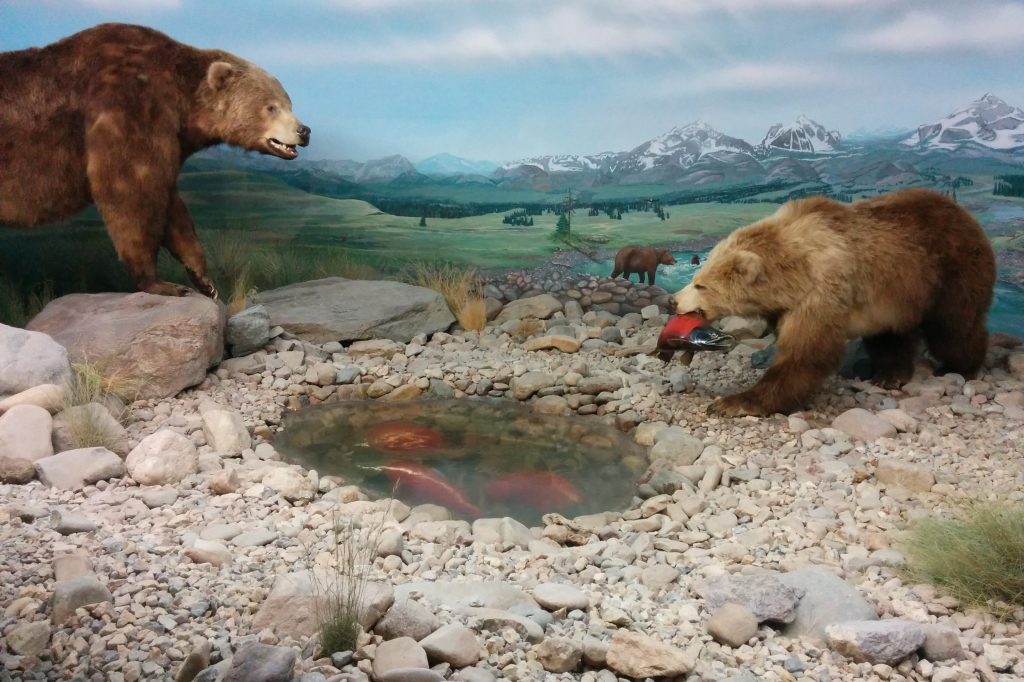
The SCI International Wildlife Museum in Tucson has many lifelike dioramas, including this one of brown bears catching salmon. Photo courtesy of the SCI International Wildlife Museum

Leave a Comment

The Deer of Summer

Hunting the most beautiful, and possibly the most delicious, deer in the world.

It’s often said the axis deer is the world’s most beautiful deer, reddish-gold, bright white spots, and three-tined antlers that grow tall, wide, thick, and gorgeous. It’s May, so across North America, our native deer are just starting to grow their antlers. Among the species, and by area, the antler growth cycle varies, as does the time when they drop their antlers. My Kansas whitetails are just showing little nubbins; like all American deer, we’ll hunt them in autumn and winter, in hard antler.

Although he’s been here a long time, the axis deer is not a native American deer. He hails from the steamy jungles of the Indian subcontinent, a tropical deer, with a different schedule. As such, and in common with many tropical deer (including our own brocket deer), that schedule isn’t as rigid as with our whitetails and mule deer. Some axis bucks can be found in hard antler in any month of the year.

Luck is always a factor. The biggest axis buck I’ve ever seen showed up at a whitetail stand on the Edwards Plateau in early December, a low-fence area that had a few free-ranging axis deer. Including this giant, at totally the wrong time of year. Could easily have shot him, but I was hunting whitetail…and I had no idea what the landowner might charge me. In my world, always an important detail. Luck aside, hunting is always a matter of trying to be in the right place at the right time, working the numbers game. The majority of axis bucks will finish growing their antlers in late March or early April and rub off their velvet in May.

The primary rut is June and July. Although the axis deer is largely diurnal, much rutting takes place at night, perhaps because of daytime heat. The axis is a vocal deer, sounding off with bellows and alarm barks. In a Texas camp during the rut, much of their calling is heard at night, with prime hunting time early morning and late afternoon.

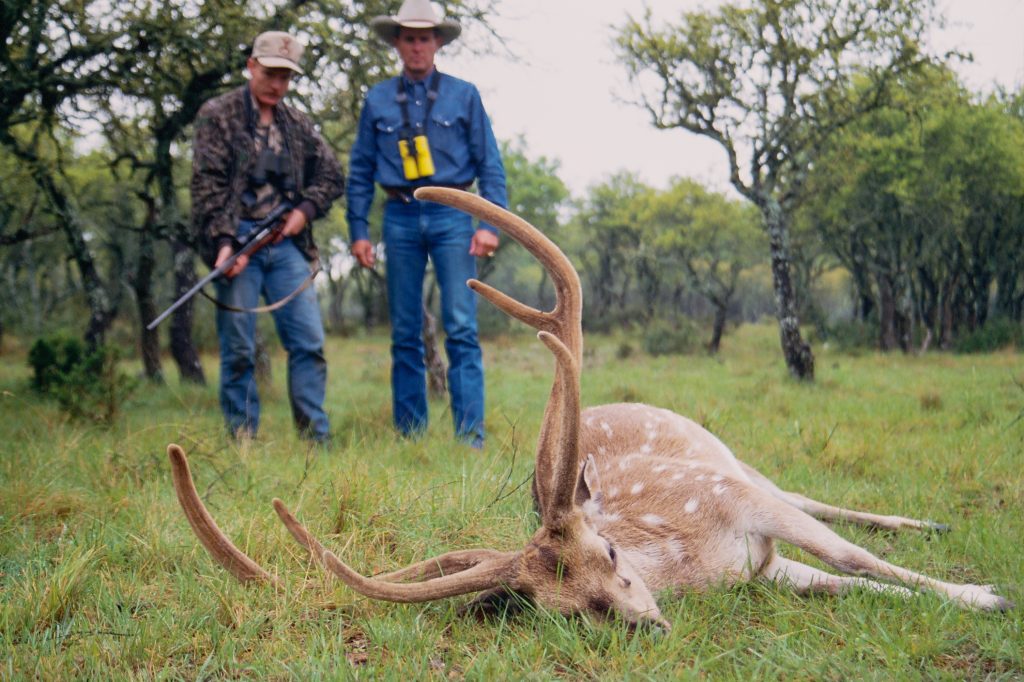
Boddington’s best-ever axis deer, tall, wide, and heavy, taken on the YO ranch 35 years ago with famous Texas guide Bo Wofford.

Several myths surround the axis deer. It is not the only deer that retains spots throughout its life. Some fallow deer and various other Asian deer are also spotted, although I don’t believe any other deer wears a blanket of spots as bright as the axis. Its common local name of chital comes from the Sanskrit word for “spotted;” the cheetah has the same derivative. Although imposing and tall (especially with exceptional antlers), the axis deer is a medium-sized buck, larger than Texas whitetails and desert mule deer, but smaller than northern deer of either species. A big axis buck will weigh over 200 pounds, but even with the best groceries is unlikely to exceed 250.

Chital/axis deer were first introduced into Texas in 1932 and today it has far the largest population and the greatest hunting opportunity. A fixture on most Texas hunting ranches, they occur in breeding, free-roaming populations in fully 27 Texas counties; a brother-in-law in suburban Austin has them all over his yard every night, almost a nuisance. They have been in Hawaii much longer, since the 1860s, initially on Molokai, but also now found and hunted on Lanai and Maui. Croatia has a small population on several islands, and Australia has a stable, but isolated free-range herd in Queensland, spilling over into New South Wales. More recently, they have been widely introduced into Argentina, both on estates and in significant free-range populations. I saw lots of axis deer in southern Buenos Aires province, and the last axis deer I shot was in Entre de Rios province, a little-known free-range population.

With all legal hunting long closed in India, the native-range situation is uncertain. They are certainly present across much original range, and definitely not threatened. Just the other day, old Marine buddy Mike Satran joined me in Texas to hunt an axis deer. Around the fire the first night, I mentioned I’d taken one “native range, free range” in Pakistan. Mike jumped on that instantly: “I thought they were from India?”

Pakistan was part of India until Partition in 1948. Most of Pakistan is too high, dry—or both—for axis deer. They occurred in the well-watered Indus River valley and, today, with no legal hunting in India, they seem to be working north and re-establishing. I took mine there, a nice buck, with little difficulty… literally just a fence-line from India. Actual original range included not only most of India and extreme southern Pakistan, but also Bangladesh, Sri Lanka, and into the lower forests of Bhutan and Nepal.

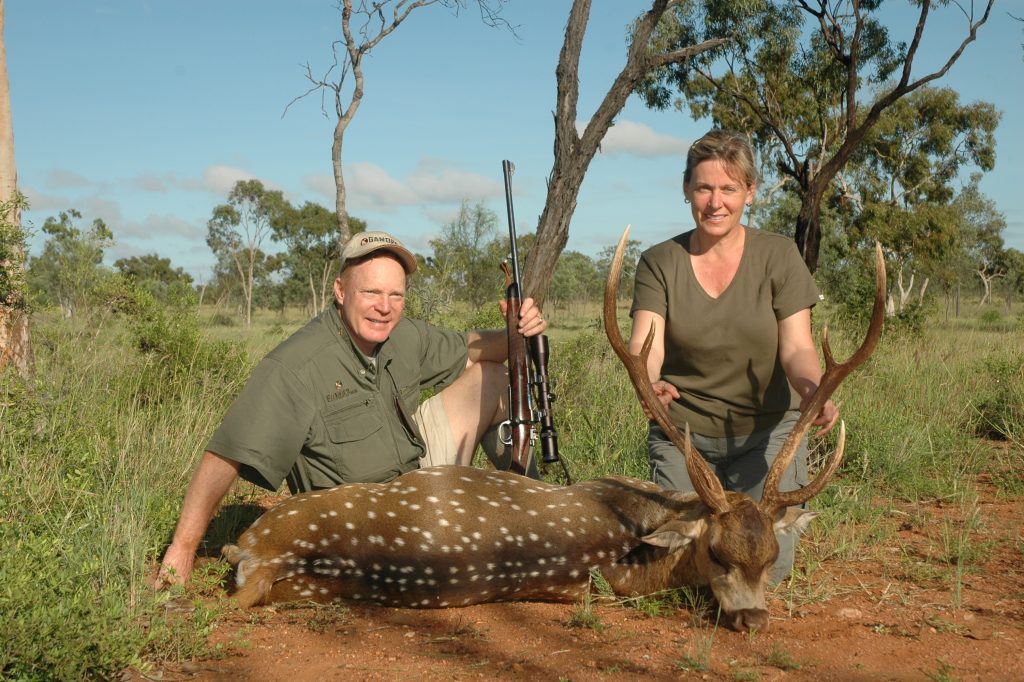
 Not a myth, but not universal, is the axiom that axis deer produce the world’s finest venison. This is generally true: it’s mild, sweet, and tender, never gamey. Time of year doesn’t matter; axis venison is the best of the best. Usually. On a cattle station in Australia’s Queensland, Bruce Keller, Donna, and I were in a rough camp, not much food (or much else). I made a sacrifice play and shot the first buck, a weird non-typical, mostly so we could have some camp meat. Our Aussie host assured us: “Mates, that ain’t fit for a dog.”

We knew better; Bruce has axis on his Texas ranch, and I’ve enjoyed axis steaks many times. It’s as good as it gets. So, we peeled out the tenderloins, marinated them, cooked them right. Looked good, smelled good. Flavor was fine but, mates, you couldn’t cut those filets with a chainsaw. I can only attribute this to the various eucalyptus, which was about all these axis deer had to eat.

They get bigger in Texas, but this is a fine axis buck, taken by Donna Boddington from a free-range population in Queensland, northern Australia. Oddly, the Australian axis deer were nearly inedible, perhaps because of the eucalyptus diet.

We still laugh about it, and axis deer is still the No. 1 venison in my book. Also, although it was fun to hunt them native range/free range in Pakistan, and it’s also fun to hunt them in strange places like Australia and Hawaii, Texas is far and away the best place to hunt axis deer. Biggest numbers, best genetics, most opportunity.

What You’re Looking For: The problem with axis deer is there isn’t much to look at. Like many Asian deer (including sika, sambar, and hog deer), the axis deer is typical with a basic three-point antler; anything more is uncommon and nontypical. The axis deer has a brow tine projecting forward just above the pedicel; second or caudal point, forward or inward, about two-thirds up the main beam; and the main beam itself. This last, far the largest and most visible, is the way we judge our axis deer, by length of main beam. A beam of 28 inches is good, but the real goal is a 30-inch main beam. They get bigger, sure do, to three feet and slightly beyond, but you must take into account the presence and size of the brows and caudals…and the shape. What I love best—and what can’t always be found—is a buck with heavy main beams that start curving outward, then rise and turn inward with a “beer-barrel” shape. Length is always in the curve, so these are the axis bucks that are most likely yield the greatest length.

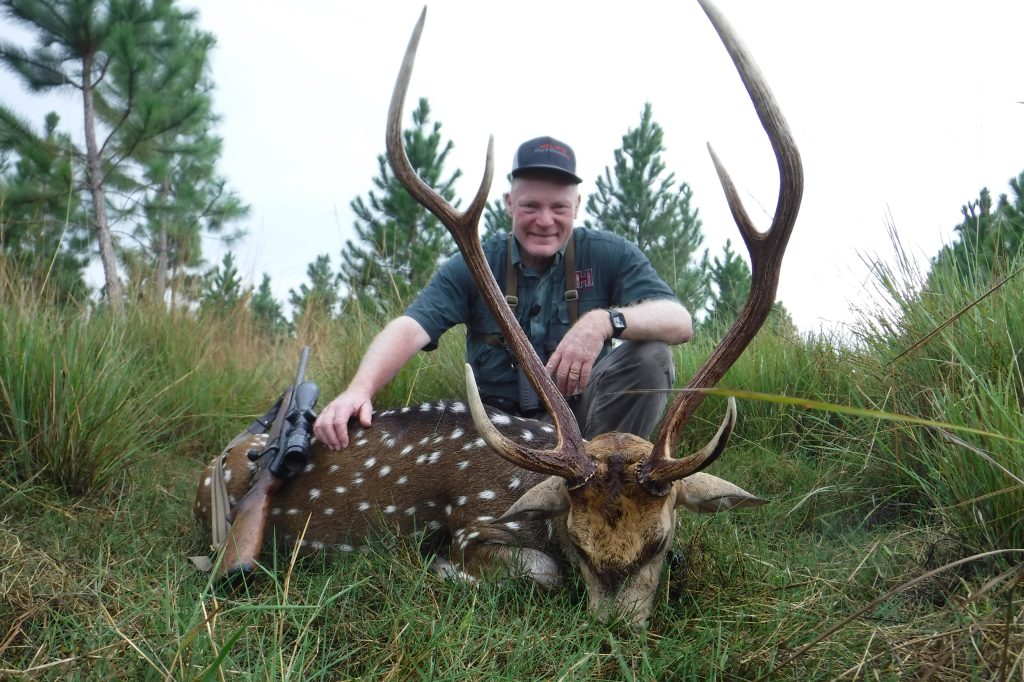
A very nice axis deer from Entre de Rios province in northern Argentina. Not all attempts have been successful, but the axis deer has been widely introduced around the world.

In recent years I’ve spent a lot of spring and early summertime in Texas, helping daughter Brittany with her She Hunts skills camps. Attendees don’t have to hunt but, because of the opportunity (and a bit of peer pressure), most do. Opportunity and time of year are ideal, so I’ve done a lot more axis deer hunting with Brittany’s ladies than I ever did for myself. She does her camps on Record Buck Ranch, which is famous for big axis, plentiful with great genetics.

Even so, it’s far from a sure thing. Like all deer, axis deer are wary and switched-on. Two more factors: In the thick, shadowed cover they love, those spots are the most amazing natural camouflage. Hard to see, hard to pick out the buck. Then, you have to pick out the right buck. In this area, axis bucks tend to run in bachelor groups, greatly complicating the issue. With axis deer, we aren’t counting points (past three). Mature bucks all look big, so it’s a matter of nuances: Shape, width, tips, make sure he’s got all three points on both sides. Difficult…and they don’t stand and look at you for long. Success is high, but it’s not a 100 percent deal. Like everything else in hunting, also depends on how picky you are. At Brittany’s March 2023 camp, Houston realtor Kelli Odum wanted a big axis. She was hunting hard and, as happens, was struggling to get a shot. I had to leave that camp early and I’d just gotten on the road when she came in with a giant, perfect buck, taken with a perfect shot.

A month later, just after the April camp, Marine buddy of fifty years Mike Satran came in, hoping for a big axis as a bucket list item. I was hopeful; timing was even better, rut not on, but bucks rapidly coming out of velvet. Honest, I figured we’d get him one…but I reckoned it would take a few days.

Mike hunted with Record Buck manager Shaun Catton, a great hunter, originally from Zimbabwe. We stared at midday, knowing nothing can happen for hours, but anxious to get started. Like all hunting, you just never know. Minutes into the hunt, not far from ranch headquarters, we ran into three bucks tucked under a shady oak. Lord, all three were shooters, take your pick…except one had the width, the shape, the length, the mass, the points…everything. First minute or last, this one was too good to pass. Using his pet M48 Nosler .300, my buddy got his bucket list axis and headed back to Oregon with the world’s best venison. The only sad thing: He really didn’t get a chance to hunt axis deer. And that’s a lot of fun on a late-spring day.

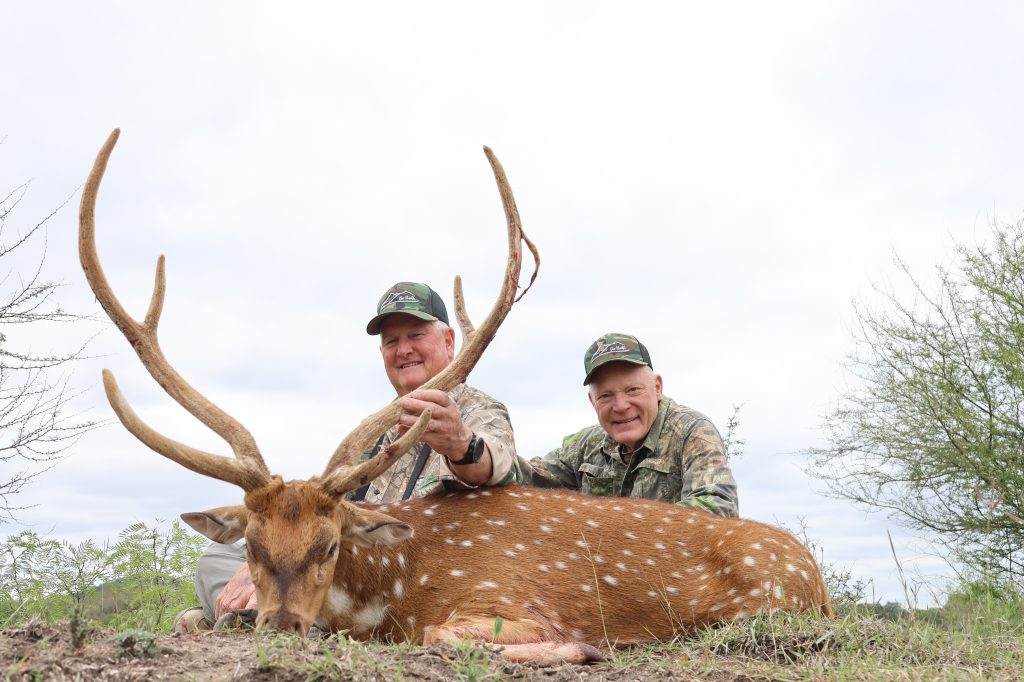
Boddington and 50-year Marine Corps buddy (and fellow Colonel) Mike Satran with Satran’s fine axis buck, taken at the end of April 2023 on Record Buck Ranch in the Texas Hill Country. It was a too-quick hunt, but you don’t pass an axis buck like this.

Leave a Comment

Backcountry Necessities

A few items of gear you should never be without in the field.

Photo above: Wilderness hunting can present danger and hardship along with the thrill and adventure. It pays to prepare for both.

The wilderness offers adventure, solitude, and good hunting, but only to those who earn them. If you venture afield unprepared you may get hurt or killed–not because the wilderness is cruel, but simply because it is indifferent to those who don’t respect it.

Years ago I made a hurried dusk-time stalk on a bunch of elk feeding near the top edge of a steep, aspen-covered mountainside. Recurve in hand, I followed them into the timber. Hope of a shot opportunity lured me onward until shooting light was gone. By this time I was deep into the timber, buried in a sea of deadfall logs and tree trunks. As I turned my boots down the steep mountainside toward camp I realized I had a problem–the night was black as hell’s kitchen, and I had no flashlight.

Stumbling, falling, and crawling through deadfall, I tried to escape the timber. Blinded by darkness, I slipped on a damp log where a small spring seeped from the mountainside. Plunging forward, I fell into the blackness. My leg wedged between logs and the bone bent and creaked as I grunted in agony and expected it to snap. Thankfully I was young and flexible, and my bone held. Swearing never to go afield again without a light, I crawled slowly down the mountainside and out of the thicket.

Since that time, I’ve developed a short list of gear that I try to never go afield without. I divide my survival gear into three categories: stuff I keep on my person at all times, items I carry in my backpack, and gear that waits at camp against a time of need. Let’s take a look at each category.

Pocket and Belt Gear 

There are a few items that live in my pockets anytime I venture afield. First is a multitool containing a sharp blade, needle-nose pliers, Phillips screwdriver, standard and tiny flathead screwdrivers, and a can/bottle opener. Second is a compact but bright headlamp. Third is a simple cigarette lighter. In certain circumstances I’ll keep an inReach device and bear protection on my person as well.

I use the multitool most. With the pliers I can twist or cut wire, untie frozen knots, and pull thorns and cactus spines from places they don’t belong. The blade acts as a backup should I loose my primary skinning and quartering knife, and I use it regularly to cut string, whittle tent pegs, and so on. With the screwdrivers I can make simple repairs on gear and even firearms, and I use the tiny flathead to adjust my spectacles and bore holes in wood or leather. Some multitools sport saw blades, scissors or files, and these tools can come in handy in the backcountry. However, don’t carry a heavy, bulky multitool unit with so many appurtenances that you can repair an airplane in the field with it. Every ounce counts when you’re climbing rugged, high-elevation territory every day.

My headlamp gets a lot of use as well, lighting my way before dawn, helping me sort gear in the tent at night, and illuminating my work as I skin and quarter game after darkness falls. For backcountry work you need a tough, compact headlamp with buttons that don’t accidentally activate. This is more important that you might think–the first time you pull your light out to process an elk after dark and the battery is dead from illuminating your pocket all day, you will recognize that. The best remedy is a button that locks, making it impossible to activate your light until you unlock the button. Finally, use a headlamp that provides a variety of beam and brightness intensities. I like a light that can alternately use a mini-USB charger or triple-A batteries. Check out the Revolt 350 made by Black Diamond; it’s built right for the backcountry hunter and sports all the features mentioned above.

For a lighter I like a simple convenience-store BIC or similar, so long as it’s not one of the cheap models. Save up and buy the $2.95 lighter, and leave the 79-cent model on the shelf. I do like to test each lighter to make sure it provides an enthusiastic flame, especially when I’m headed into high-elevation territory. Elevation robs everything of oxygen, and flame intensity will reduce the higher you climb. Carry the lighter in your pocket and make sure the flame mechanism stays clean and free of lint.

Three tools the author never goes afield without: multitool, headlamp, and lighter. With them you can accomplish small tasks, navigate in the dark, and build a fire. In other words, survive.

A fourth on-the-person item becomes paramount when hunting territory where grizzly or brown bears live. That item is, predictably, some sort of bear deterrent. This can be bear spray or a handgun, or both. Personally, if I had to choose only one it would be a handgun, mostly because I have more faith in my ability to stop a bear with a gun than with spray. My preferred handgun for bear protection is a S&W M&P 10mm, outfitted with a Streamlight TLR 8 with a green laser for nighttime illumination, and shooting 200-grain Federal Premium Solid Core ammunition. This combination shoots intuitively and hits hard while providing a lot of rounds on-tap. I mount the Streamlight as soon as dusk falls, which provides me with 500 lumens of brightness and an easy-to-see point of aim. When I’m in bear country, this setup remains on my person at all times.

Lastly, in wilderness territory I like to carry an inReach device. This enables me to communicate with my hunting partner or family when cell service is absent, and provides SOS capability in case of real disaster.

In My Pack

There are a few additional survival items I like to have readily available, but don’t keep them directly on my person. In critical scenarios they can save my hunt, or even my life. They include some sort of water purification system, a package of QuikClot, and a roll of Leukotape.

For water purification I usually carry a Lifestraw or iodine tablets. Both are superlight and relatively compact. The iodine tablets in particular cost me very little room and weight, but they are slow–after treating water you must wait thirty minutes before consuming it. That thirty minutes can be agonizing if you’re truly thirsty, believe me. The LifeStraw is faster–you can suck water directly from any decent source–but is more work and less compact. Don’t plan on using either for your main water supply; they are just backup for emergency scenarios.

QuikClot is a substance that when correctly applied to a dangerous hemorrhaging wound will rapidly form a life-saving clot. I’ve never needed to use mine, and Lord willing, never will. But I spend a lot of time in the backcountry, and if one of my companions or I ever suffers a bear mauling or a bad knife wound, I’ll be prepared.

Bad blisters can put an end to a hard-core hunt, so I always go prepared to stop a blister before it happens. As soon as you feel a hot spot forming on your foot, peel away your socks, let the skin air dry well, and then apply a layer of Leukotape directly to the irritated skin. Make the patch a bit larger than the problem area, and if it’s on a toe go ahead and wrap the tape–not tightly–all the way around. It’ll stay firmly in place, providing protection against further abrasion and damage. Add a second layer if necessary.

At Camp

These last couple items live at camp, in the case of a horsepack trip or float trip, or in the truck if I’m backpack hunting. They are mostly used to put things back together after some sort of snafu.

Suture kit: I use this on a surprisingly common basis, mostly on hunters who have cut themselves and horses that have been hurt in a wreck. Just recently a friend told me about a ferocious cut he gave himself while on a float hunt in Alaska for caribou. For days afterward he fought to keep the wound clean and the bleeding at bay. Had he possessed a simple suture kit, thirty minutes of sewing would have eliminated all that hassle and agony. You’ll want some #4 suture thread with needle, small forceps, alcohol wipes, and antibiotic powder or ointment in your kit. If possible, sew a wound soon after it is inflicted–the sewing will hurt less. If you have horses along, add livestock suture to your kit.

Wire: I keep wire in my camp kit to use kind of like suture for gear. I’ve repaired backpack buckles, stitched heavy leather, fixed rifle sling swivels, and repaired a plethora of other gear with simple wire. Keep a little roll of small-diameter tie-wire (available at any farm supply store) in camp. You’ll appreciate having it, I promise.

Finally, no list of survival gear is complete without a discussion of common sense. Indeed, your wits are the most important survival tool you will ever possess. Take the time to study, learn, and train to meet challenging situations in the wilderness. Learn to build a fire in cold, damp conditions, and practice navigating in the dark. Use your inReach until it’s second nature. Learn the surgeon’s knot and sew a few orange peels back together. Train to keep calm under pressure and make solid, common-sense decisions. When times get tough in the backcountry, you’ll be ready.

Leave a Comment

Rifle Review: Remington Alpha 1

The new owners at Remington have upgraded and modernized the classic M700, taking it to new heights.

Early in my gun writing career, one of the profession’s legendary names was among a group of writers invited by to tour some optics factories in Germany. After we got to know each other a little, I asked what he thought was the best factory rifle made in America, and he immediately answered: “The Remington 700.” 

While this guy was an avid hunter, he was also an avid target shooter in various disciplines, from short-range benchrest to longer-range “position” shooting, so one of his primary rifle criteria was accuracy. Remington 700s were indeed very accurate, and in fact after a little extra “accurizing” one of my first 700s would group three shots in around an inch at 300 yards, with a 4x scope. This was the cheapest sporter-weight 700 then made, an ADL with a walnut stock featuring “impressed checkering”—and was not chambered in a varmint or “target” cartridge, but the .270 Winchester.

Since then, Remington has gone through some hard times, eventually resulting in the company declaring bankruptcy and its various divisions being sold to other companies. The firearms division ended up with a new investment group, and they made some major changes in the way Remington firearms are made—including 700s. 

This was why a bunch of gun writers were recently invited to attend an event at the FTW Ranch in Texas, which has dozens of different ranges spread across 12,000 rugged acres in the Hill Country. I happily accepted. I have visited the ranch several times since 2010, so I knew there’s always something to be learned at the FTW.

The first lesson on this trip involved improvements that the new Remington Arms LLC has made to the 700. Both CEO Ken D’Arcy (who was between a couple of hunting trips) and Vice-President of Engineering Hunter Cummings gave presentations on these changes and introduced a new 700 called the Alpha 1. 

The 700 originated as a more esthetic version of the 721/722 rifles the company introduced shortly after World War II, made with speeded-up manufacturing techniques developed during the war by a Remington engineer named Merle “Mike” Walker. Among other things, Walker essentially perfected the ”button” rifling method while making 1903A3 Springfield barrels–the same technique used by many, if not most, rifle-barrel manufacturers today. Another quick manufacturing technique used in both the 1903A3 and 721/722 was stamping rather than machining some parts.

Of course, Remington’s then-new sporting rifles were heavily criticized by “traditional” gun writers–but they cost less than traditionally made rifles, while often shooting more accurately, partly because Mike Walker was also a pioneer in the growing sport of benchrest shooting. The dressed-up version named the 700 appeared in 1962, and it sold so well it helped put an end to the pre-1964 Winchester Model 70–an excellent rifle, but made with traditional, slow and expensive methods.

During the pre-bankruptcy period, Remington’s quality-control went downhill—so when the new company started producing 700s, they eventually made several changes that addressed criticisms made over the years. While the Alpha 1 bolt resembles that of the original 700, it’s constructed very differently. Instead of the bolt body being several parts soldered together, the new body is one-piece and fluted for easier travel, and the extraction cam has also been changed to make opening the bolt easier. 

The bolt handle now screws on—instead of being brazed, which occasionally resulted in the handle coming off. The screw-on handle not only attaches far more securely, but can be changed easily, which fits right into the modern “self-customizing” trend epitomized by AR-15s and Ruger 10/22s. The bolt-stop’s been changed from a sheet-metal stamping on the side of the trigger to a more conventional (and stronger) toggle on side of the receiver. The Alpha 1 also comes with a Picatinny rail mounted with 8-40 screws, instead of the traditional 6-48, and the trigger isn’t a Remington but a Timney Elite, adjusted to a 3-pound pull. 

The barrels have also been upgraded, first by using better steel. The rifling itself is now what’s called 5R. Rather than featuring traditional 4- or 6-groove rifling, which places lands and grooves opposite each other, five grooves place the lands opposite the grooves, resulting in less bullet deformation. The two sides of each land also slope inward slightly, for the same reason. The barrels also feature the popular 11-degree “target” crown, and their muzzles are threaded for various attachments, with a cap to protect the threads when nothing’s attached.

The rifling twists for some cartridges have been tightened to handle longer, higher-BC bullets, good examples being the 1:8 twist in Alpha 1 .243 Winchesters and 7mm Remington Magnums. Magazines and ejection ports are longer to better handle such bullets, and the barrels fluted to save weight. All of this is held in a stiff carbon composite stock, featuring a Pachmayr recoil pad.

Additionally, actions, bolts, and barrels are made so precisely that any Remington bolt and barrel of the correct size can now be switched—and chamber headspace will remain the same. 700s have always been pretty precisely made, the reason many gunsmiths (both professional and amateur) have been switching barrels on them for decades, but the headspace doesn’t always remain within industry limits. 

Longtime custom gunsmith Charlie Sisk and I (a long-time amateur gunsmith) have compared our experiences in switching 700 barrels, and we’ve both found headspace is OK about 75 to 80 percent of the time—which ain’t bad. But with the Alpha 1, it’s 100 percent, saving amateurs with barrel vises a trip to a professional gunsmith.

Half the rifles tested were 700 Elite 1s in 6.5 Creedmoor with 22-inch barrels, but the other half were a version of the Model 700 Long Range chambered in 7mm PRC. The barrels weren’t fluted, and the rifles weighed more, around nine pounds including their Swarovski X5i scopes. The ammunition was Hornady ELD Match, the 6.5 Creedmoors loaded with the 147-grain ELD-M bullet at a listed 2,675 fps, and 7mm PRCs with the 180-grain ELD-M at 2,975.

The first day, half of us shot the 6.5 Creedmoors and half shot the 7mm PRCs—then switched to the other rifle during the second day. All the shooting was done from prone with bipods, and after each shooter sighted-in at 100 yards (generally resulting in three shots touching, or nearly so), we started shooting at gongs. 

The standard gong setup at the FTW is a 9-inch round gong, representing the vital zone of a typical deer-size big-game animal, with a smaller gong next to it.  The drill was to first shoot the big gong, then as quickly as possible shoot the smaller one–and the new 700 bolt design made this noticeably easier when shooting from prone.

The test-shooting of the 7mm PRCs took place on a longer range, with pairs of gongs out to 800 yards, and a few more farther out.

The first day my squad shot the 6.5 Creedmoors, out to around 600 yards. While South Texas was hotter than usual (though no hotter than summer back at my home in southwestern Montana), there wasn’t much wind. It was relatively easy to hit both gongs—as long as the barrels didn’t get overheated, which can also affect the scope’s view. Each squad’s shooters rotated shooting at each pair of gongs, so the barrels didn’t get super-hot—and the Swarovski scopes performed perfectly during a bunch of dialing up and down.

The next day we shot the 7mm PRCs on a longer range, with a pair of gongs every 100 yards out to 800. I almost ran the pairs “clean” out to 800, but missed one small gong with the first shot, then hit it with a second. Most of the other shooters did just as well, and our general impression was that the 7mm PRC, with that particular ammo, was among the most wind-resistant and accurate loads we’d ever tried, especially in a relatively lightweight rifle.

The 6.5 Creedmoor Elites showed up on Remington’s website soon after the Texas shoot, but it took a little longer for the 7mm PRC to appear in the listings of their 700 Long Range model. Now that it has, I know several people who are going to buy one ASAP—including somebody I know particularly well!

Leave a Comment

Eighty-five Years of Pittman-Robertson

Hunters and shooters have been the primary funding source for conservation since 1937.

Photo above: Excise taxes on firearms and archery equipment paid by hunters and recreational shooters have generated $22.5 billion in support of wildlife conservation over the past eight and a half decades. Photo by Trail’s End Media.

Time passes and things change; and in the process, even important things get taken for granted. It is inevitable, it seems; an aspect of human existence we often realize only in hindsight, when our memories are jolted by some significant event. This might be a catastrophe of some kind or it might be an important anniversary. Whatever the trigger, remembering matters of consequence is important in life, not only to give recognition to the consequences of important things but also to provide perspective by imagining what the world would have been without them.

Conservation of the earth’s wildlife and natural areas is a complex business. It is, arguably, the most complex business of all, lying as it does at the intersection of culture, politics, and economics, and ultimately grappling with the endless complexities of ecology and human nature. As international conventions on biodiversity protection, animal use and trade, and climate change attest, conservation is now recognized as a global challenge. Addressing this crisis will obviously determine the kind of lives we will live and the kind of world our descendants will inhabit. 

What is equally clear is that failing to recognize and address our conservation realities will result in further wild species declines and escalating extinction rates, and an increasingly rapid deterioration in the planet’s life supporting systems. These are not problems for other countries or societies alone. No matter how well off we may be, conservation’s crisis brings unwelcomed gifts to us all. Furthermore, solving our shared problems will require many things: knowledge, determination, and commitment come to mind.  But it will also require enormous financial resources, for conservation is not an inexpensive business.

In some ways, of course, our problems are not new. At the turn of the twentieth century, wildlife in North America was in a state of crisis. Virtually all the iconic species we know and cherish today, such as bison, white-tailed deer, wild sheep, mule deer, elk, moose, pronghorn, black bear, wild turkeys, and a variety of duck and songbird species were extirpated from many regions or in very low abundance across vast areas of the continent. Other species and well-recognized subspecies such as the great auk, Merriam’s elk, Audubon bighorn, the sea mink, the Labrador duck, Carolina parakeet, and passenger pigeon were even less fortunate. Their disappearance and endless silence are a reminder of extinction’s reality and a clarion call for whom the bells toll.

Following European colonization and expansion, during the eighteenth and nineteenth centuries, living wild resources were harvested without limitation in North America, and market hunters made a living by hunting and selling animal hides, meat, and other products to insatiable European and expanding domestic urban markets. These were the culminating days of wildlife slaughter in North America, conducted at virtually a continental scale, and one that would eventually set in motion a social upheaval that would lead to the modern wildlife management systems we know today.  Its agitators were a varied lot and included artists and urban elites as well as leaders of the women’s suffrage movement. It also included a new class of “sport hunters” whose members lobbied against market hunting and for the conservation of game species, in particular. 

The foment for wildlife was intense and sustained. It resulted in various conservation actions at the turn of the twentieth century that would mold conservation’s future in America. Among a variety of other seminal legislative events, such as the Lacey Act of 1900 (making it illegal to transfer illegally hunted wildlife across state borders) and the creation of the Migratory Bird Treaty Act in 1916, one Act in particular would dramatically impact funding mechanisms for conservation and formally entwine hunting and conservation funding in perpetuity. Its long-term consequences would be enormous, for wildlife and for recreational hunting.  

On Sept. 2, 1937, President Franklin D. Roosevelt signed into law the Wildlife Restoration Act, which would go on to influence conservation for the next eighty-five years and represent the main federal-funding source for wildlife conservation in the United States. The Pittman-Robertson Wildlife Restoration Act, as it is known today, originally placed an 11 percent excise tax on long guns and ammunition. In 1970, the Act was revised to include an 10 percent excise tax on pistols and revolvers, and in 1972, an 11 percent tax on archery equipment was also added. The money derived from these taxes are allocated into a special fund, called the Federal Aid to Wildlife Restoration Fund, which is managed by the US Fish and Wildlife Service of the Department of the Interior, specifically for the purpose of wildlife restoration, conservation, and hunter education and safety programs.

Since 1939, the Act has generated over 22.5 billion dollars for conservation (2021 USD equivalents). Over the last five years, on average, the Act has generated $797 million, annually, for conservation. Currently, Pittman-Robertson funding is the highest it has ever been (even accounting for inflation). In 2022 alone, the Pittman-Robertson Act generated $1.1 billion for conservation! That is $400 million more than it generated in 2021, a 64 percent increase. 

Under the program guidelines, US states and territories may receive funding through three different grant programs: wildlife restoration, basic hunter education and safety, and enhanced hunter education and safety. The Wildlife Restoration grant may be used for wildlife-conservation research,wildlife-conservation education, and for purchasing, restoring, rehabilitating, and improving land for wildlife conservation. In addition to this, however, 10 percent of these funds may be used for “wildlife-associated recreation projects.” These projects aim to improve outdoor recreation for hunters and non-hunters alike, including the maintenance and creation of trails, bridges, observation towers, blinds, and water access points. 

So how much of these Pittman-Robertson funds are actually used for wildlife conservation versus being used, let’s say, for hunter education and public shooting ranges? The short answer is approximately 80 percent of the funds generated by the Act are allocated directly to conservation efforts. 

The remaining funds are largely allocated to hunter education and safety programs and may be used for the construction and maintenance of public shooting ranges. Further, as of 2020, the Modernizing the Pittman-Robertson Fund for Tomorrow’s Needs Act came into law, which allows hunter education and safety grants to be used to improve hunter and sport-shooter recruitment. 

In addition to these allocation areas, some of the money generated through the Act also goes towards multistate conservation grants, which are used to address conservation issues that span multiple states. These funds can go to a state, a group of states, the FWS itself, or non-governmental organizations. Some money is also retained for administration purposes.

The Act is designed such that no money generated from it can be wasted. If any interest is earned on the money generated from the Pittman-Robertson Act, this money must be transferred into the North American Wetlands Conservation Account. Further, any money that is not spent in two years must be transferred to the Migratory Bird Conservation Fund. Therefore, the legislation surrounding the Act prevents any money from seeping through the cracks—all must be used for good purpose.  One can only marvel at the forward-looking subtlety of this legislation.

The money generated by the Act is allocated to all fifty states, and all five inhabited US territories, but not Washington, DC. The funds are not given out arbitrarily but are allocated based on a formula to determine how much each state and territory should receive. For the largest share (80 percent) of the money, that given to wildlife restoration, funding is based on state land area, inland water area, and hunting license sales. States are not given a free ride, however; the state itself must generate 25 percent of the funds for each project funded under the program. Further, no state can receive less than 0.5 percent, or more than 5 percent, of the available wildlife-restoration funds. The territories, except for Puerto Rico, are more limited and cannot receive more than 0.17 percent of the total wildlife-restoration funds.

Of course, many non-hunters purchase firearms for self-defense, sport shooting, and as a hobby, which means that hunters do not generate all of the Pittman-Robertson funding. And there are some pretty wild statistics out there regarding how much money hunters versus other firearm enthusiasts actually do contribute. Estimates vary from just 5 percent, as suggested by certain animal-rights groups, to implying that all Pittman-Robertson funding is being generated from hunting, from certain pro-hunting groups. The truth, of course, lies somewhere in between, and depends upon how you search for it.

Some of these estimates of excise tax sources are derived from the National Survey of Fishing, Hunting and Wildlife-Associated Recreation. In this survey, a sample of hunters and anglers indicate how much money they spent on a variety of hunting/angling-related items, including rifles, shotguns, pistols, ammunition, archery equipment, etc. Statisticians then use this sample to estimate expenditures and excise tax payments by all hunters in the US. Based on this method, in 2016, hunting would have directly contributed $629 million to the Pittman-Robertson Act. This would represent nearly 80 percent of the $779 million generated from the Act that year—this, however, is rather far from the truth. These statistics are biased, because they rely on self-reporting. Furthermore, an unknown portion of reported expenditures may be towards used products that are not taxed, and a relatively small number of people are used to represent the entire US hunter population. 

Official tax receipts provide a more accurate assessment of how much money hunters actually contribute to the Pittman-Robertson fund. The US Fish and Wildlife Service (USFWS) keeps a record of how much funding is generated for the Pittman-Robertson Act from the sale of various hunting-related items. Importantly, however, there is no record of who purchased the products that contribute to these excise tax funds and the sample obviously includes many firearm enthusiasts who are not hunters.   

The market research firm Southwick Associates conducted a study addressing this very issue and found that hunters in recent years contributed approximately 22.5 percent of the Pittman-Robertson fund. Based on this percentage, hunters contributed approximately $179 million to the program each year (based on the latest 5-year average). Therefore, hunting is not the main source of Pittman-Robertson funding, but hunters do make an astounding contribution, through their excise tax payments, to conservation each year. Recreational shooters provide even more!

The Pittman-Robertson Act has had a major and lasting impact on wildlife conservation in the United States over the last eighty-five years. Working continuously, and often taken for granted or even unknown in many circles, it has generated $22.5 billion in support of wildlife, an amount we would have been hard pressed to find from any other source. The Act has changed over the years to the benefit of conservation, and has survived many legislative challenges; and it will likely need to continue to adapt as conservation faces new twenty-first-century problems. Thanks in significant part to this Act, terrestrial wildlife in America has recovered significantly from the mistakes of the past, affording us the freedom to enjoy abundant wildlife, and the many benefits wild species provide. 

In this eighty-fifth birthday year, we are encouraged to reflect on the Pittman-Robertson Act, on the far-sighted individuals who created it, and the multitudes of American citizens who fought for wildlife over the years that preceded it. Good ideas and wishful hopes for wildlife will never be enough to secure conservation success. In the end, it requires dedicated funding to win the battles we fight on wildlife’s behalf. 

Leave a Comment

tablet

Never Miss An Issue!Subscribe Now: 6 Issues for $34.97

More Details
WordPress Video Lightbox Plugin