A few items of gear you should never be without in the field.
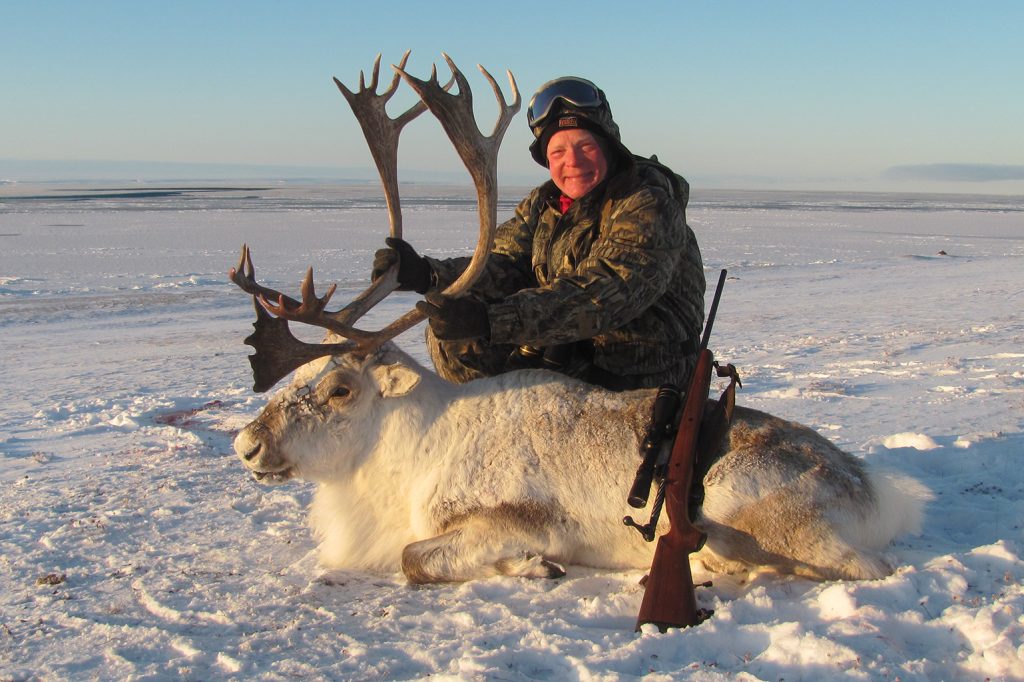
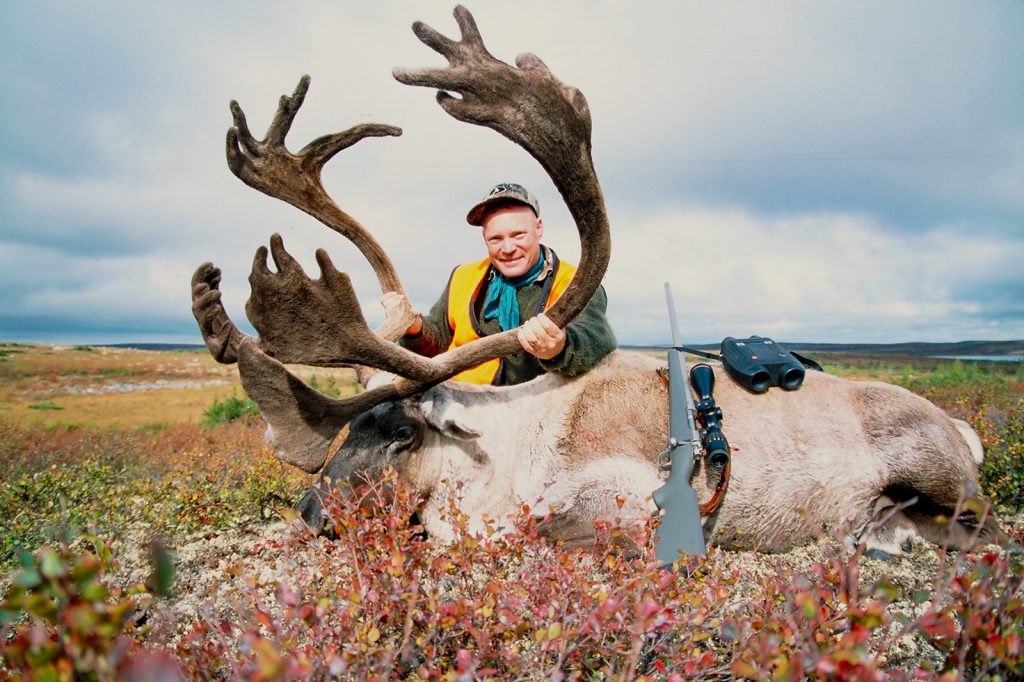
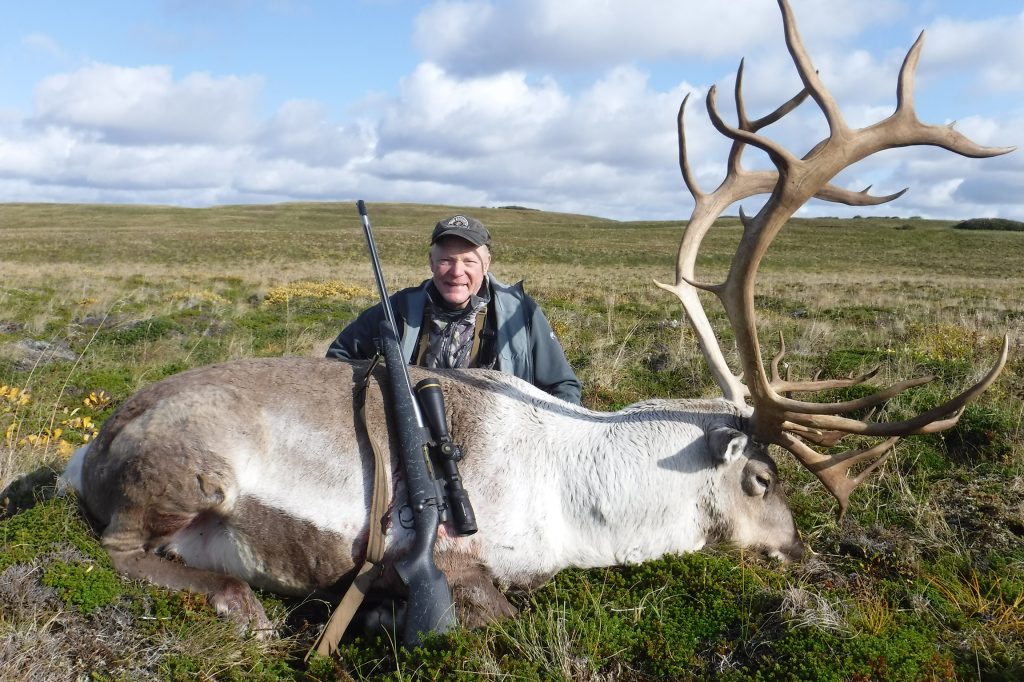
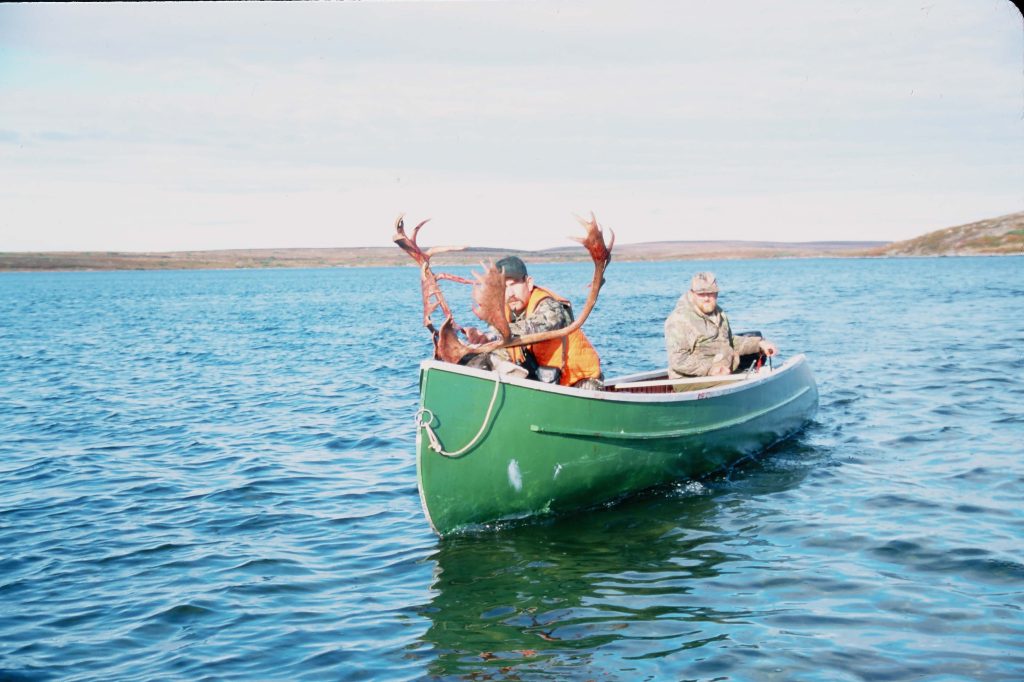
Photo above: Wilderness hunting can present danger and hardship along with the thrill and adventure. It pays to prepare for both.
The wilderness offers adventure, solitude, and good hunting, but only to those who earn them. If you venture afield unprepared you may get hurt or killed–not because the wilderness is cruel, but simply because it is indifferent to those who don’t respect it.
Years ago I made a hurried dusk-time stalk on a bunch of elk feeding near the top edge of a steep, aspen-covered mountainside. Recurve in hand, I followed them into the timber. Hope of a shot opportunity lured me onward until shooting light was gone. By this time I was deep into the timber, buried in a sea of deadfall logs and tree trunks. As I turned my boots down the steep mountainside toward camp I realized I had a problem–the night was black as hell’s kitchen, and I had no flashlight.
Stumbling, falling, and crawling through deadfall, I tried to escape the timber. Blinded by darkness, I slipped on a damp log where a small spring seeped from the mountainside. Plunging forward, I fell into the blackness. My leg wedged between logs and the bone bent and creaked as I grunted in agony and expected it to snap. Thankfully I was young and flexible, and my bone held. Swearing never to go afield again without a light, I crawled slowly down the mountainside and out of the thicket.
Since that time, I’ve developed a short list of gear that I try to never go afield without. I divide my survival gear into three categories: stuff I keep on my person at all times, items I carry in my backpack, and gear that waits at camp against a time of need. Let’s take a look at each category.
Pocket and Belt Gear
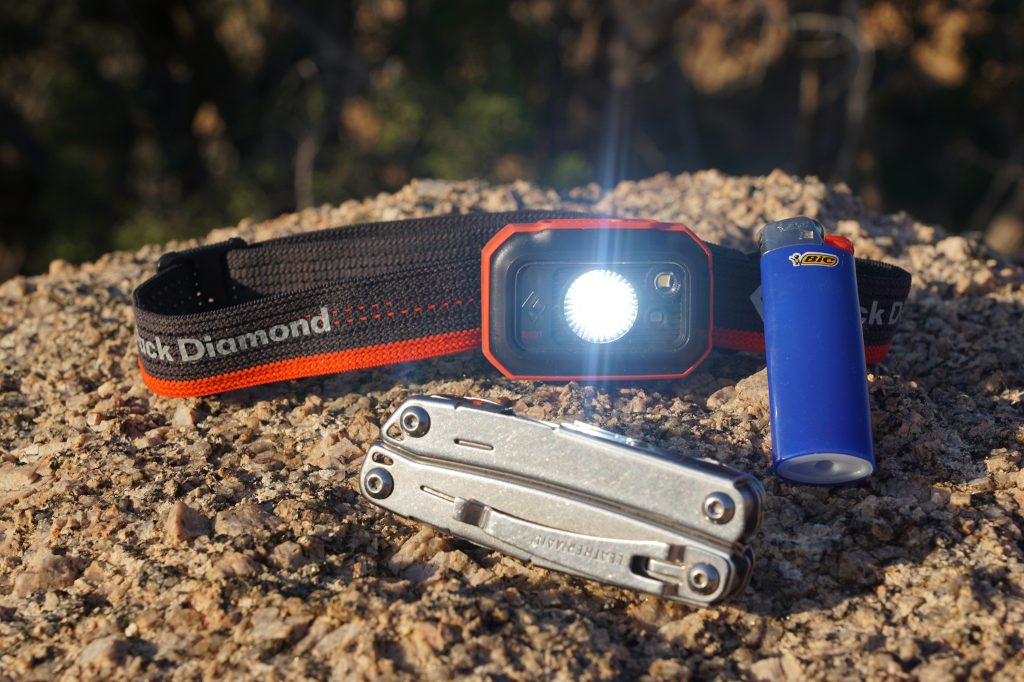
There are a few items that live in my pockets anytime I venture afield. First is a multitool containing a sharp blade, needle-nose pliers, Phillips screwdriver, standard and tiny flathead screwdrivers, and a can/bottle opener. Second is a compact but bright headlamp. Third is a simple cigarette lighter. In certain circumstances I’ll keep an inReach device and bear protection on my person as well.
I use the multitool most. With the pliers I can twist or cut wire, untie frozen knots, and pull thorns and cactus spines from places they don’t belong. The blade acts as a backup should I loose my primary skinning and quartering knife, and I use it regularly to cut string, whittle tent pegs, and so on. With the screwdrivers I can make simple repairs on gear and even firearms, and I use the tiny flathead to adjust my spectacles and bore holes in wood or leather. Some multitools sport saw blades, scissors or files, and these tools can come in handy in the backcountry. However, don’t carry a heavy, bulky multitool unit with so many appurtenances that you can repair an airplane in the field with it. Every ounce counts when you’re climbing rugged, high-elevation territory every day.
My headlamp gets a lot of use as well, lighting my way before dawn, helping me sort gear in the tent at night, and illuminating my work as I skin and quarter game after darkness falls. For backcountry work you need a tough, compact headlamp with buttons that don’t accidentally activate. This is more important that you might think–the first time you pull your light out to process an elk after dark and the battery is dead from illuminating your pocket all day, you will recognize that. The best remedy is a button that locks, making it impossible to activate your light until you unlock the button. Finally, use a headlamp that provides a variety of beam and brightness intensities. I like a light that can alternately use a mini-USB charger or triple-A batteries. Check out the Revolt 350 made by Black Diamond; it’s built right for the backcountry hunter and sports all the features mentioned above.
For a lighter I like a simple convenience-store BIC or similar, so long as it’s not one of the cheap models. Save up and buy the $2.95 lighter, and leave the 79-cent model on the shelf. I do like to test each lighter to make sure it provides an enthusiastic flame, especially when I’m headed into high-elevation territory. Elevation robs everything of oxygen, and flame intensity will reduce the higher you climb. Carry the lighter in your pocket and make sure the flame mechanism stays clean and free of lint.
Three tools the author never goes afield without: multitool, headlamp, and lighter. With them you can accomplish small tasks, navigate in the dark, and build a fire. In other words, survive.
A fourth on-the-person item becomes paramount when hunting territory where grizzly or brown bears live. That item is, predictably, some sort of bear deterrent. This can be bear spray or a handgun, or both. Personally, if I had to choose only one it would be a handgun, mostly because I have more faith in my ability to stop a bear with a gun than with spray. My preferred handgun for bear protection is a S&W M&P 10mm, outfitted with a Streamlight TLR 8 with a green laser for nighttime illumination, and shooting 200-grain Federal Premium Solid Core ammunition. This combination shoots intuitively and hits hard while providing a lot of rounds on-tap. I mount the Streamlight as soon as dusk falls, which provides me with 500 lumens of brightness and an easy-to-see point of aim. When I’m in bear country, this setup remains on my person at all times.
Lastly, in wilderness territory I like to carry an inReach device. This enables me to communicate with my hunting partner or family when cell service is absent, and provides SOS capability in case of real disaster.
In My Pack
There are a few additional survival items I like to have readily available, but don’t keep them directly on my person. In critical scenarios they can save my hunt, or even my life. They include some sort of water purification system, a package of QuikClot, and a roll of Leukotape.
For water purification I usually carry a Lifestraw or iodine tablets. Both are superlight and relatively compact. The iodine tablets in particular cost me very little room and weight, but they are slow–after treating water you must wait thirty minutes before consuming it. That thirty minutes can be agonizing if you’re truly thirsty, believe me. The LifeStraw is faster–you can suck water directly from any decent source–but is more work and less compact. Don’t plan on using either for your main water supply; they are just backup for emergency scenarios.
QuikClot is a substance that when correctly applied to a dangerous hemorrhaging wound will rapidly form a life-saving clot. I’ve never needed to use mine, and Lord willing, never will. But I spend a lot of time in the backcountry, and if one of my companions or I ever suffers a bear mauling or a bad knife wound, I’ll be prepared.
Bad blisters can put an end to a hard-core hunt, so I always go prepared to stop a blister before it happens. As soon as you feel a hot spot forming on your foot, peel away your socks, let the skin air dry well, and then apply a layer of Leukotape directly to the irritated skin. Make the patch a bit larger than the problem area, and if it’s on a toe go ahead and wrap the tape–not tightly–all the way around. It’ll stay firmly in place, providing protection against further abrasion and damage. Add a second layer if necessary.
At Camp
These last couple items live at camp, in the case of a horsepack trip or float trip, or in the truck if I’m backpack hunting. They are mostly used to put things back together after some sort of snafu.
Suture kit: I use this on a surprisingly common basis, mostly on hunters who have cut themselves and horses that have been hurt in a wreck. Just recently a friend told me about a ferocious cut he gave himself while on a float hunt in Alaska for caribou. For days afterward he fought to keep the wound clean and the bleeding at bay. Had he possessed a simple suture kit, thirty minutes of sewing would have eliminated all that hassle and agony. You’ll want some #4 suture thread with needle, small forceps, alcohol wipes, and antibiotic powder or ointment in your kit. If possible, sew a wound soon after it is inflicted–the sewing will hurt less. If you have horses along, add livestock suture to your kit.
Wire: I keep wire in my camp kit to use kind of like suture for gear. I’ve repaired backpack buckles, stitched heavy leather, fixed rifle sling swivels, and repaired a plethora of other gear with simple wire. Keep a little roll of small-diameter tie-wire (available at any farm supply store) in camp. You’ll appreciate having it, I promise.
Finally, no list of survival gear is complete without a discussion of common sense. Indeed, your wits are the most important survival tool you will ever possess. Take the time to study, learn, and train to meet challenging situations in the wilderness. Learn to build a fire in cold, damp conditions, and practice navigating in the dark. Use your inReach until it’s second nature. Learn the surgeon’s knot and sew a few orange peels back together. Train to keep calm under pressure and make solid, common-sense decisions. When times get tough in the backcountry, you’ll be ready.
The new owners at Remington have upgraded and modernized the classic M700, taking it to new heights.
Early in my gun writing career, one of the profession’s legendary names was among a group of writers invited by to tour some optics factories in Germany. After we got to know each other a little, I asked what he thought was the best factory rifle made in America, and he immediately answered: “The Remington 700.”
While this guy was an avid hunter, he was also an avid target shooter in various disciplines, from short-range benchrest to longer-range “position” shooting, so one of his primary rifle criteria was accuracy. Remington 700s were indeed very accurate, and in fact after a little extra “accurizing” one of my first 700s would group three shots in around an inch at 300 yards, with a 4x scope. This was the cheapest sporter-weight 700 then made, an ADL with a walnut stock featuring “impressed checkering”—and was not chambered in a varmint or “target” cartridge, but the .270 Winchester.
Since then, Remington has gone through some hard times, eventually resulting in the company declaring bankruptcy and its various divisions being sold to other companies. The firearms division ended up with a new investment group, and they made some major changes in the way Remington firearms are made—including 700s.
This was why a bunch of gun writers were recently invited to attend an event at the FTW Ranch in Texas, which has dozens of different ranges spread across 12,000 rugged acres in the Hill Country. I happily accepted. I have visited the ranch several times since 2010, so I knew there’s always something to be learned at the FTW.
The first lesson on this trip involved improvements that the new Remington Arms LLC has made to the 700. Both CEO Ken D’Arcy (who was between a couple of hunting trips) and Vice-President of Engineering Hunter Cummings gave presentations on these changes and introduced a new 700 called the Alpha 1.
The 700 originated as a more esthetic version of the 721/722 rifles the company introduced shortly after World War II, made with speeded-up manufacturing techniques developed during the war by a Remington engineer named Merle “Mike” Walker. Among other things, Walker essentially perfected the ”button” rifling method while making 1903A3 Springfield barrels–the same technique used by many, if not most, rifle-barrel manufacturers today. Another quick manufacturing technique used in both the 1903A3 and 721/722 was stamping rather than machining some parts.
Of course, Remington’s then-new sporting rifles were heavily criticized by “traditional” gun writers–but they cost less than traditionally made rifles, while often shooting more accurately, partly because Mike Walker was also a pioneer in the growing sport of benchrest shooting. The dressed-up version named the 700 appeared in 1962, and it sold so well it helped put an end to the pre-1964 Winchester Model 70–an excellent rifle, but made with traditional, slow and expensive methods.
During the pre-bankruptcy period, Remington’s quality-control went downhill—so when the new company started producing 700s, they eventually made several changes that addressed criticisms made over the years. While the Alpha 1 bolt resembles that of the original 700, it’s constructed very differently. Instead of the bolt body being several parts soldered together, the new body is one-piece and fluted for easier travel, and the extraction cam has also been changed to make opening the bolt easier.
The bolt handle now screws on—instead of being brazed, which occasionally resulted in the handle coming off. The screw-on handle not only attaches far more securely, but can be changed easily, which fits right into the modern “self-customizing” trend epitomized by AR-15s and Ruger 10/22s. The bolt-stop’s been changed from a sheet-metal stamping on the side of the trigger to a more conventional (and stronger) toggle on side of the receiver. The Alpha 1 also comes with a Picatinny rail mounted with 8-40 screws, instead of the traditional 6-48, and the trigger isn’t a Remington but a Timney Elite, adjusted to a 3-pound pull.
The barrels have also been upgraded, first by using better steel. The rifling itself is now what’s called 5R. Rather than featuring traditional 4- or 6-groove rifling, which places lands and grooves opposite each other, five grooves place the lands opposite the grooves, resulting in less bullet deformation. The two sides of each land also slope inward slightly, for the same reason. The barrels also feature the popular 11-degree “target” crown, and their muzzles are threaded for various attachments, with a cap to protect the threads when nothing’s attached.
The rifling twists for some cartridges have been tightened to handle longer, higher-BC bullets, good examples being the 1:8 twist in Alpha 1 .243 Winchesters and 7mm Remington Magnums. Magazines and ejection ports are longer to better handle such bullets, and the barrels fluted to save weight. All of this is held in a stiff carbon composite stock, featuring a Pachmayr recoil pad.
Additionally, actions, bolts, and barrels are made so precisely that any Remington bolt and barrel of the correct size can now be switched—and chamber headspace will remain the same. 700s have always been pretty precisely made, the reason many gunsmiths (both professional and amateur) have been switching barrels on them for decades, but the headspace doesn’t always remain within industry limits.
Longtime custom gunsmith Charlie Sisk and I (a long-time amateur gunsmith) have compared our experiences in switching 700 barrels, and we’ve both found headspace is OK about 75 to 80 percent of the time—which ain’t bad. But with the Alpha 1, it’s 100 percent, saving amateurs with barrel vises a trip to a professional gunsmith.
Half the rifles tested were 700 Elite 1s in 6.5 Creedmoor with 22-inch barrels, but the other half were a version of the Model 700 Long Range chambered in 7mm PRC. The barrels weren’t fluted, and the rifles weighed more, around nine pounds including their Swarovski X5i scopes. The ammunition was Hornady ELD Match, the 6.5 Creedmoors loaded with the 147-grain ELD-M bullet at a listed 2,675 fps, and 7mm PRCs with the 180-grain ELD-M at 2,975.
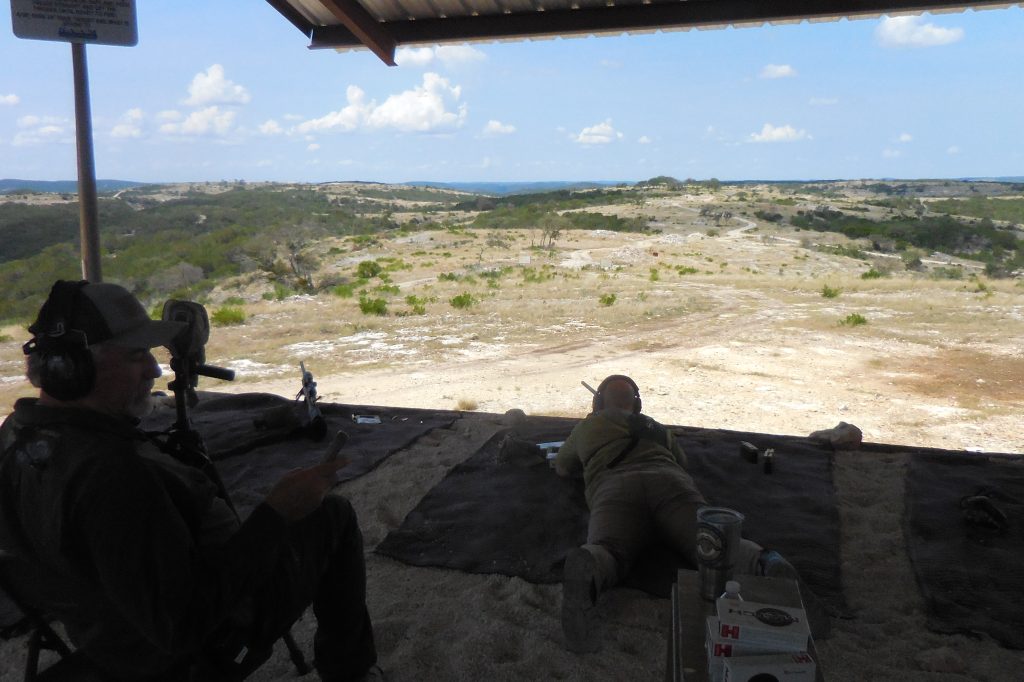
The first day, half of us shot the 6.5 Creedmoors and half shot the 7mm PRCs—then switched to the other rifle during the second day. All the shooting was done from prone with bipods, and after each shooter sighted-in at 100 yards (generally resulting in three shots touching, or nearly so), we started shooting at gongs.
The standard gong setup at the FTW is a 9-inch round gong, representing the vital zone of a typical deer-size big-game animal, with a smaller gong next to it. The drill was to first shoot the big gong, then as quickly as possible shoot the smaller one–and the new 700 bolt design made this noticeably easier when shooting from prone.
The test-shooting of the 7mm PRCs took place on a longer range, with pairs of gongs out to 800 yards, and a few more farther out.
The first day my squad shot the 6.5 Creedmoors, out to around 600 yards. While South Texas was hotter than usual (though no hotter than summer back at my home in southwestern Montana), there wasn’t much wind. It was relatively easy to hit both gongs—as long as the barrels didn’t get overheated, which can also affect the scope’s view. Each squad’s shooters rotated shooting at each pair of gongs, so the barrels didn’t get super-hot—and the Swarovski scopes performed perfectly during a bunch of dialing up and down.
The next day we shot the 7mm PRCs on a longer range, with a pair of gongs every 100 yards out to 800. I almost ran the pairs “clean” out to 800, but missed one small gong with the first shot, then hit it with a second. Most of the other shooters did just as well, and our general impression was that the 7mm PRC, with that particular ammo, was among the most wind-resistant and accurate loads we’d ever tried, especially in a relatively lightweight rifle.
The 6.5 Creedmoor Elites showed up on Remington’s website soon after the Texas shoot, but it took a little longer for the 7mm PRC to appear in the listings of their 700 Long Range model. Now that it has, I know several people who are going to buy one ASAP—including somebody I know particularly well!
Hunters and shooters have been the primary funding source for conservation since 1937.
Photo above: Excise taxes on firearms and archery equipment paid by hunters and recreational shooters have generated $22.5 billion in support of wildlife conservation over the past eight and a half decades. Photo by Trail’s End Media.
Time passes and things change; and in the process, even important things get taken for granted. It is inevitable, it seems; an aspect of human existence we often realize only in hindsight, when our memories are jolted by some significant event. This might be a catastrophe of some kind or it might be an important anniversary. Whatever the trigger, remembering matters of consequence is important in life, not only to give recognition to the consequences of important things but also to provide perspective by imagining what the world would have been without them.
Conservation of the earth’s wildlife and natural areas is a complex business. It is, arguably, the most complex business of all, lying as it does at the intersection of culture, politics, and economics, and ultimately grappling with the endless complexities of ecology and human nature. As international conventions on biodiversity protection, animal use and trade, and climate change attest, conservation is now recognized as a global challenge. Addressing this crisis will obviously determine the kind of lives we will live and the kind of world our descendants will inhabit.
What is equally clear is that failing to recognize and address our conservation realities will result in further wild species declines and escalating extinction rates, and an increasingly rapid deterioration in the planet’s life supporting systems. These are not problems for other countries or societies alone. No matter how well off we may be, conservation’s crisis brings unwelcomed gifts to us all. Furthermore, solving our shared problems will require many things: knowledge, determination, and commitment come to mind. But it will also require enormous financial resources, for conservation is not an inexpensive business.
In some ways, of course, our problems are not new. At the turn of the twentieth century, wildlife in North America was in a state of crisis. Virtually all the iconic species we know and cherish today, such as bison, white-tailed deer, wild sheep, mule deer, elk, moose, pronghorn, black bear, wild turkeys, and a variety of duck and songbird species were extirpated from many regions or in very low abundance across vast areas of the continent. Other species and well-recognized subspecies such as the great auk, Merriam’s elk, Audubon bighorn, the sea mink, the Labrador duck, Carolina parakeet, and passenger pigeon were even less fortunate. Their disappearance and endless silence are a reminder of extinction’s reality and a clarion call for whom the bells toll.
Following European colonization and expansion, during the eighteenth and nineteenth centuries, living wild resources were harvested without limitation in North America, and market hunters made a living by hunting and selling animal hides, meat, and other products to insatiable European and expanding domestic urban markets. These were the culminating days of wildlife slaughter in North America, conducted at virtually a continental scale, and one that would eventually set in motion a social upheaval that would lead to the modern wildlife management systems we know today. Its agitators were a varied lot and included artists and urban elites as well as leaders of the women’s suffrage movement. It also included a new class of “sport hunters” whose members lobbied against market hunting and for the conservation of game species, in particular.
The foment for wildlife was intense and sustained. It resulted in various conservation actions at the turn of the twentieth century that would mold conservation’s future in America. Among a variety of other seminal legislative events, such as the Lacey Act of 1900 (making it illegal to transfer illegally hunted wildlife across state borders) and the creation of the Migratory Bird Treaty Act in 1916, one Act in particular would dramatically impact funding mechanisms for conservation and formally entwine hunting and conservation funding in perpetuity. Its long-term consequences would be enormous, for wildlife and for recreational hunting.
On Sept. 2, 1937, President Franklin D. Roosevelt signed into law the Wildlife Restoration Act, which would go on to influence conservation for the next eighty-five years and represent the main federal-funding source for wildlife conservation in the United States. The Pittman-Robertson Wildlife Restoration Act, as it is known today, originally placed an 11 percent excise tax on long guns and ammunition. In 1970, the Act was revised to include an 10 percent excise tax on pistols and revolvers, and in 1972, an 11 percent tax on archery equipment was also added. The money derived from these taxes are allocated into a special fund, called the Federal Aid to Wildlife Restoration Fund, which is managed by the US Fish and Wildlife Service of the Department of the Interior, specifically for the purpose of wildlife restoration, conservation, and hunter education and safety programs.
Since 1939, the Act has generated over 22.5 billion dollars for conservation (2021 USD equivalents). Over the last five years, on average, the Act has generated $797 million, annually, for conservation. Currently, Pittman-Robertson funding is the highest it has ever been (even accounting for inflation). In 2022 alone, the Pittman-Robertson Act generated $1.1 billion for conservation! That is $400 million more than it generated in 2021, a 64 percent increase.
Under the program guidelines, US states and territories may receive funding through three different grant programs: wildlife restoration, basic hunter education and safety, and enhanced hunter education and safety. The Wildlife Restoration grant may be used for wildlife-conservation research,wildlife-conservation education, and for purchasing, restoring, rehabilitating, and improving land for wildlife conservation. In addition to this, however, 10 percent of these funds may be used for “wildlife-associated recreation projects.” These projects aim to improve outdoor recreation for hunters and non-hunters alike, including the maintenance and creation of trails, bridges, observation towers, blinds, and water access points.
So how much of these Pittman-Robertson funds are actually used for wildlife conservation versus being used, let’s say, for hunter education and public shooting ranges? The short answer is approximately 80 percent of the funds generated by the Act are allocated directly to conservation efforts.
The remaining funds are largely allocated to hunter education and safety programs and may be used for the construction and maintenance of public shooting ranges. Further, as of 2020, the Modernizing the Pittman-Robertson Fund for Tomorrow’s Needs Act came into law, which allows hunter education and safety grants to be used to improve hunter and sport-shooter recruitment.
In addition to these allocation areas, some of the money generated through the Act also goes towards multistate conservation grants, which are used to address conservation issues that span multiple states. These funds can go to a state, a group of states, the FWS itself, or non-governmental organizations. Some money is also retained for administration purposes.
The Act is designed such that no money generated from it can be wasted. If any interest is earned on the money generated from the Pittman-Robertson Act, this money must be transferred into the North American Wetlands Conservation Account. Further, any money that is not spent in two years must be transferred to the Migratory Bird Conservation Fund. Therefore, the legislation surrounding the Act prevents any money from seeping through the cracks—all must be used for good purpose. One can only marvel at the forward-looking subtlety of this legislation.
The money generated by the Act is allocated to all fifty states, and all five inhabited US territories, but not Washington, DC. The funds are not given out arbitrarily but are allocated based on a formula to determine how much each state and territory should receive. For the largest share (80 percent) of the money, that given to wildlife restoration, funding is based on state land area, inland water area, and hunting license sales. States are not given a free ride, however; the state itself must generate 25 percent of the funds for each project funded under the program. Further, no state can receive less than 0.5 percent, or more than 5 percent, of the available wildlife-restoration funds. The territories, except for Puerto Rico, are more limited and cannot receive more than 0.17 percent of the total wildlife-restoration funds.
Of course, many non-hunters purchase firearms for self-defense, sport shooting, and as a hobby, which means that hunters do not generate all of the Pittman-Robertson funding. And there are some pretty wild statistics out there regarding how much money hunters versus other firearm enthusiasts actually do contribute. Estimates vary from just 5 percent, as suggested by certain animal-rights groups, to implying that all Pittman-Robertson funding is being generated from hunting, from certain pro-hunting groups. The truth, of course, lies somewhere in between, and depends upon how you search for it.
Some of these estimates of excise tax sources are derived from the National Survey of Fishing, Hunting and Wildlife-Associated Recreation. In this survey, a sample of hunters and anglers indicate how much money they spent on a variety of hunting/angling-related items, including rifles, shotguns, pistols, ammunition, archery equipment, etc. Statisticians then use this sample to estimate expenditures and excise tax payments by all hunters in the US. Based on this method, in 2016, hunting would have directly contributed $629 million to the Pittman-Robertson Act. This would represent nearly 80 percent of the $779 million generated from the Act that year—this, however, is rather far from the truth. These statistics are biased, because they rely on self-reporting. Furthermore, an unknown portion of reported expenditures may be towards used products that are not taxed, and a relatively small number of people are used to represent the entire US hunter population.
Official tax receipts provide a more accurate assessment of how much money hunters actually contribute to the Pittman-Robertson fund. The US Fish and Wildlife Service (USFWS) keeps a record of how much funding is generated for the Pittman-Robertson Act from the sale of various hunting-related items. Importantly, however, there is no record of who purchased the products that contribute to these excise tax funds and the sample obviously includes many firearm enthusiasts who are not hunters.
The market research firm Southwick Associates conducted a study addressing this very issue and found that hunters in recent years contributed approximately 22.5 percent of the Pittman-Robertson fund. Based on this percentage, hunters contributed approximately $179 million to the program each year (based on the latest 5-year average). Therefore, hunting is not the main source of Pittman-Robertson funding, but hunters do make an astounding contribution, through their excise tax payments, to conservation each year. Recreational shooters provide even more!
The Pittman-Robertson Act has had a major and lasting impact on wildlife conservation in the United States over the last eighty-five years. Working continuously, and often taken for granted or even unknown in many circles, it has generated $22.5 billion in support of wildlife, an amount we would have been hard pressed to find from any other source. The Act has changed over the years to the benefit of conservation, and has survived many legislative challenges; and it will likely need to continue to adapt as conservation faces new twenty-first-century problems. Thanks in significant part to this Act, terrestrial wildlife in America has recovered significantly from the mistakes of the past, affording us the freedom to enjoy abundant wildlife, and the many benefits wild species provide.
In this eighty-fifth birthday year, we are encouraged to reflect on the Pittman-Robertson Act, on the far-sighted individuals who created it, and the multitudes of American citizens who fought for wildlife over the years that preceded it. Good ideas and wishful hopes for wildlife will never be enough to secure conservation success. In the end, it requires dedicated funding to win the battles we fight on wildlife’s behalf.
The world’s crocodilians have always been a source of fascination and fear.
Hic Sunt Dracones appeared with frequency on the unexplored places on ancient maps: Here Be Dragons. Even with almost every part of the earth now charted, there still be dragons. We call them alligators and crocodiles.
The crocodilians of today have a variety of other names, too, such as caiman, gharial, and mugger. They all descend from crocodylomorpha, evolving more than two hundred thousand millennia ago in the Triassic. The earlier members of the group were far more terrestrial and cursorial than the related reptiles of today, and were among the dominant land animals of the time, overshadowing the dinosaur, until dying out in the aftermath of the mega-volcanic eruptions brought on by the fracturing of the supercontinent Pangea into North and South America, Europe, and Africa some two hundred million years ago. The next iteration of these animals was the Neosuchia, the ancient clade to which modern crocodilians belong.
Our species’ relationship with crocs and gators is more intimate than we may suppose. If you use the evolution-in-one-twenty-four-hour-day model, then on their evolutionary scale, crocodilians first laid their cold eyes on us around a quarter-hour ago. By the time we hominins became persistent carnivores some two million years ago, among our genus’s traits was to settle near water, both for security–mammalian predators couldn’t splash across a creek or pond without alerting all those protohumans clustered around the black obelisk–and food. We had our work cut out in order to feed on terrestrial mammals, but the part vegans omit is that without flesh in our diet, our brains would never have grown as large as they are. (In fact, as we beggared our nutrition by growing and eating crops, our cranial capacity has actually shrunk.) Meat eating lets us tap into a singular suite of lipids–omega-fatty-acid molecules, some in existence for a half billion years–that work industriously on us on the cellular level, in anti-inflammatory, healing, and nerve- and tissue-growth processes, such as encephalization, or brain building. If “omega fatty acids” rings a bell, it is because, as we know now, aquatic animals such as fish, turtles, and even crocodiles, are rich in them. And living beside water, we had them right there at our back door, able to take them without having to compete with lions, leopards, or hyenas.
Our existence in Africa as hominins, though, overlapped with that of some crocodilians that grew to more than thirty feet in length. So our food could often make us its food, without shedding a tear. No one questions the danger of crocodilians today. Around the tropical world, “Don’t go near the water” is an endemic, if not ubiquitous, caution.
As an example of the warning, persistent to this day, a teacher being rowed to a mission school on Lake Nyasa (now Malawi) in the 1910s could not resist gliding her hand in the water.
“Ngwena, Dona!” one of the oarsman called out. “Crocodile, Madame!”
Among the more than two dozen different species of crocodilians, thirteen are known man-eaters–or killers, the mugger of Iran and India often attacking without eating—with Nile and saltwater crocodiles the two most deadly. Globally they may be responsible for a thousand human deaths per year. And another seven species are implicated in non-fatal attacks. For good reason, then, they have been held in terror and awe not just in recorded history, but throughout time.
Perhaps most notably, the ancient Egyptians both feared and worshipped the crocodile in the form of the god Sobek, crocodiles being mummified in adoration of him. Tomb walls depicted herdsmen casting spells to protect them and their livestock when they rafted across the Nile. Centuries later, Shakespeare was shaky on the origin of crocodiles themselves: in Antony and Cleopatra he had Lepidus, one of the triumvir who governed Rome after the assassination of Julius Caesar, say that they are grown by the sun from the mud of the Nile.
In something between adoration and dread, there was a ritual of hanging stuffed crocodiles from the rafters and on the walls of medieval churches and cathedrals throughout Europe. Most of these seem to have been brought back as skins or live specimens by Crusaders returning from the Holy Land and North Africa. They were placed as ex voto offerings in thanks for heavenly intercession. They also might represent evil or Satan, so there was the symbolism of the Devil bound in chains. Because of the unique durability of their hides, they have been preserved to this day, to startle unwitting tourists looking up into the vaulted ceilings.
Writing in his authoritative Description of Africa, the sixteenth-century Andalusian-Berber merchant, traveler, and diplomat Joannes Leo Africanus told of other displays of dead crocodiles. From the 1600 translation of his 1550 book:
“Of these beasts I sawe above three hundred heads placed upon the wals of Cana [a formerly major city in what is now Benin], with their jawes wide open, being of so monstrous and incredible a bignes, that they were sufficient to have swallowed up a whole cowe at once, and their teeth were great and sharpe.”
Africanus had no doubt about the crocodile’s being a “cruell and noisome beast.” It “containeth in length twelve cubites and above”–not hyperbole for the outsized length of an exceptional Nile crocodile–“the taile thereof being as long as the whole bodie besides, albeit there are but fewe of so huge a bignes.” Africanus claimed witnessing a traveling companion swept one night into a river by the swipe of the tail of a crocodile and lost in the darkness.
Africanus’s friend may have lived just long enough to experience the initial stages of the crocodilian’s method of making a kill, seemingly coming down from the Antediluvian: the death roll. If crocodilians can swallow a prey animal whole, that’s what they do. If not, they clasp the body in their jaws and twist over and over to tear out portions of skin, flesh, and bone. This is also the crocodilian’s signature move when wrestling other crocodilians who are tough enough, generally, to withstand it, though sometimes at the cost of a limb or two. With prey, crocodilians might also bash them against river banks and bottoms or against rocks, though they are also known to cache their kills to let them ripen. Even moderately sized crocodilians are big enough to grab, hold, and drown a human.
In recent history, the cruelty and noisomeness of the crocodile is seen in a tale from World War II. You remember Quint’s speech on the boat at sea at night in Jaws, about the shark attack on the U. S. S. Indianapolis’s crew after it abandoned ship. That same year, the British sent troops of the Indian Army to retake Ramree Island off the coast of Burma, now Myanmar. The attack drove nine hundred Japanese, who had offered fierce resistance, into retreat through mangrove swamps that were the habitat of enormous estuarine, or saltwater, crocodiles. Stories of random rifle fire in the night, human screams, and sounds of violent feeding, were bruited about. It was said that five hundred Japanese never came out, eaten alive. Later investigation casts doubt on this; but even if the toll were only in the dozens, which seems plausible, it remains the single largest fatal crocodile attack in history.
In the 1960s, Nile crocodiles seemed to develop a partiality for idealistic and oblivious Peace Corp volunteers. In one notorious incident, when a new group arrived on the Baro River in southwestern Ethiopia on a hot day in 1966, they decided a picnic and a cooling dip were in order. As they splashed about, one young man swam across to the tail of a sandbar. As his friends watched, he stood, then disappeared.
“We saw the tip of the nose of the crocodile,” wrote one of the fellow volunteers, “[and] it looked like Bill said something, and then he was gone. There was no struggle; he never knew what hit him.”
The crocodile was found and killed, and the human body parts collected–in particular the precisely severed bare lower legs–placed in a cardboard box, and flown out.
“I have never heard of a crocodile hunter,” wrote the professional African hide hunter Paul Potous in the mid-1950s, in his book, No Tears for the Crocodile, “having been taken by a crocodile. But,” he added, “there is always a first time to everything.”
Though crocodilians would seem to pose no direct threat to armed hunters, unless they were to go into the water after them, they present no small challenge as big game. On the whole, crocodilians take up residence in the deepest, darkest, thickest, muddiest, most-hard-to-reach places. On top of that, as Potous writes:
“Their sense of smell, hearing, and eyesight are all exceptionally keen, and there is yet another inexplicable instinct with which they are endowed–awareness of danger. Also to their advantage and protection are the movements and warning noises of the numerous birds, a wonderful variety of which are found along the African rivers [and in the habitats of other crocodilians].”
We have probably no adequate idea of how astronomically high the global population of crocodilians may once have been, even in recorded times. Exploring Florida and other parts of the Southeast just before the War of Independence, the Philadelphia botanist William Bartram wrote in his Travels:
“How shall I express myself so as to convey an adequate idea of it to the reader, and at the same time avoid raising suspicions of my veracity? Should I say, that the river (in this place) from shore to shore, and perhaps near half a mile above and below me, appeared to be one solid bank of fish, of various kinds [largely black bass], pushing through this narrow pass of the St. Juan’s [St. Johns River] into the little lake, on their return down the river, and that the alligators were in such incredible numbers, and so close together from shore to shore, that it would have been easy to have walked across on their heads, had the animals been harmless?”
With vast numbers came great size. From the Louisiana family that to this day owns the salt-dome Avery Island in Iberia Parish, seventeen-year-old “Ned” McIlhenny set out on the day after New Year’s, 1890, in a lugger–a small sailing ship–with two helpers, to wind through the bayou to Vermillion Bay to hunt geese. Across the bay at dusk, Ned crossed the silted mouth of Lake Cock on foot, and followed the bank of an old stream to hunt ducks for supper. Wading into the marsh to retrieve two mallards he had dropped, he saw what he thought to be a submerged log, which showed itself to be an enormous alligator, stupefied by the cold. With only a shotgun and shot shells, Ned killed the animal. He left it for the night, suspecting this was the largest gator he had ever seen. When the three men returned in the morning, and were unable to drag the alligator out, Ned used the thirty-inch barrel of his gun and arrived at 7⅔ lengths, or 19 feet, 2 inches. Ned went on to become the country’s foremost authority on alligators, with remarkably few questioning his report of the near-miraculous size of the monstrous gator (a certified 15-foot, 9-inch one was killed in Alabama in 2014). The McIlhenny’s famed product, Tabasco, remains an essential ingredient in that indispensable Cajun dish, alligator sauce piquante.
The largest crocodilians on earth today are the estuarine crocodiles, or “salties,” of Australia, and ranging across the Indo-Pacific from Sri Lanka and Kanyakumari at the tip of India, to the Solomon Islands. The largest ever reliably measured in captivity was one captured in the Philippines in 2011 (it was given a name, but there is something patronizing and infantilizing about calling any wild animal Shamu or Elsa, so I won’t repeat it here). It was 20 feet, 3 inches long and weighed more than 2,000 pounds. It died two years later of a heart ailment at age fifty. Crocodiles can live to seventy-five, and up to a hundred in zoos, and they grow throughout their lives, so the question is: how much bigger might it have become?
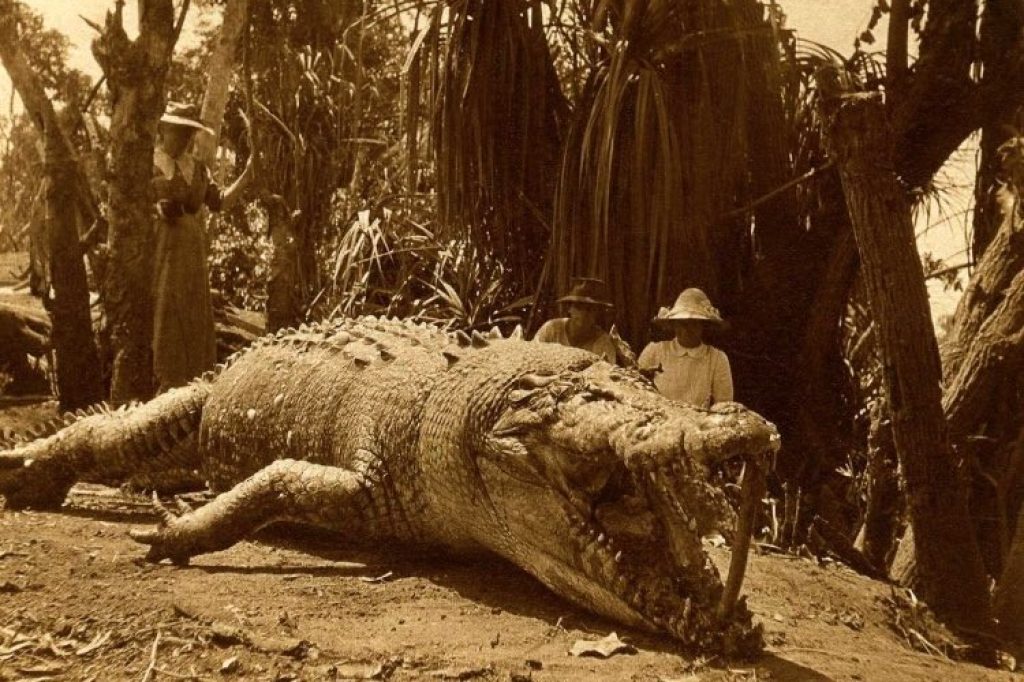
The biggest crocodilian ever killed? It would have been, again, a saltie. The only evidence, though, is a grainy black-and-white photo taken in 1914 on the bank of the Roper River that flows out of northern Australia into the Gulf of Carpentaria. The hunter was the missionary Rev. R. D. Joynt, photographed with a well-dressed “Miss Cross”–no further identification–crouched behind a crocodile said unblushingly to be 28 feet long. Though it is likely not nearly that big, and even allowing for the carcass being swollen in the hot sun and the benefit of forced perspective, it is nonetheless one hell of a croc.
This is the reputed world’s largest crocodile. The photo was taken in 1914 along the Roper River, Australia. There are obviously some camera tricks and carcass bloating going on in the photo. Still…
The twentieth century was a close shave for numerous species of crocodilians. In many parts of the world, bureaucracies tended to consider crocodilians no more than a nuisance. In colonial Africa there were C. D. O.s–Crocodile Destruction Officers–usually some old retiree who’d putter around on a lake with a fishing resource, chunking out chicken-egg-size doses of potassium cyanide sewn inside rotten pieces of baboons, monkeys, fish, hippos, even the meat from poisoned crocs. Crocodile eats. Crocodile disappears. Crocodile dies. Crocodile putrefies. Crocodile floats up. Crocodile is of no use to anyone, not even as a hide, although other crocs might consume it, thus possibly resuming the cycle.
Generally considered inferior leather at the time, tanned crocodile skins went back and forth in popularity throughout the 1800s. It was in the early 1900s when tanners learned to make a durable, pliable, commercial product and fashion houses turned it into a luxury item, and the wholesale slaughter was underway.
Among the most famous crocodile market hunters in Australia was an emigre from World War II Poland, Krystyna Pawłowska. She and her fellow Polish-emigre husband entered the saltie business when one tried to eat their toddler daughter in 1955 when they were gold prospecting in Queensland. The three-year-old was taking a bath on the bank of a river when a croc came out of the water and began stalking her. Seeing the croc, her brother yelled to his sister, and her father came out with a rifle and killed it. They decided to sell the skin and were surprised when it brought them £A10, over $360 USD today. At the time, the average weekly wage in Australia was $470.
When her husband’s partner quit, Krys began hunting with him. She proved to be an excellent shot, never wading into the muddy rivers to hunt without lipstick and nail polish, and over the next decade is said to have taken at least 5,000 crocodiles, missing only three. Just as impressive was her reputation of being able to skin, flesh, salt, and roll a hide faster than anyone else. In the mid-1960s, the Pawłowskas figured they’d killed their fair share of salties and opened Australia’s first crocodile farm. Oh, and in 1957, Krys killed a croc in the Norman River that was said to equal the one from the Roper forty-three years before. With as much hard evidence.
Maybe not the greatest crocodile hunter of all time, but certainly the most colorful, was the famed photographer and Afrophile Peter Beard. Because of concerns in the mid-1960s about the population, Alistair Graham, a zoologist, was contracted by the Kenyan government to spend a year on the fly-blown shore of isolated Lake Turkana, surveying Africa’s largest remaining Nile crocodile population. Beard came along with his camera and rifle.
Caking themselves in mud, the two floated out on inner tubes to the crocs. When hunting at night, they targeted the eyeshine they detected in their flashlight beams. Overall, they shot, skinned, and necropsied just shy of 500 in the year, living off Nile perch, some weighing nearly two hundred pounds, that were either speared or killed with a .357 Magnum pistol in the shallows. Beard’s teeth turned brown from drinking the lake’s alkaline water. His collaboration with Graham resulted in the classic Eyelids of Morning.
The American alligator was listed as endangered in 1967–controversy remains about whether the classification was ever really biologically justified–and delisted at the end of the 1970s, and it now numbers in the millions across its range. Australia outlawed saltwater-crocodile hunting in 1971. Today there are well over a hundred thousand, with a flourishing population of feral pigs to feed on, and all the ranchers’ cattle they can eat, until they get shot as “problem” animals. Salties are today probably back at the carrying capacity of the habitat, but there are no opportunities for international hunters to take them. Locals and Aboriginal people would love to take you hunting, and there some limited permits to be had, but only the Aussie permit holder can take the croc. Despite their numbers and the problems they can cause for locals, saltwater crocs in Australia are not currently huntable by foreign hunters.
Without resorting to shark hooks and seine lines, which moves the pursuit into the realm of angling, crocodilians are among the most challenging big game to hunt. Then there is the fact you can eat, wear, and mount them on the wall. There are also few more magnificent animals in creation.
Paul Potous made a statement that, while rather stupid, gives his book its title. He tells us that “no one can be cruel to a crocodile. Repulsive and loathsome, it is held in abject fear by the natives . . . Men, women or children–they are all a meal to the saurian. In hunting it, I should still have the excitement of the chase, but at its death there would be no tears for the crocodile.”
Peter Beard’s Eyelids photographs were gleefully erotic, outrageous, and grotesque, yet with something quaking about them. One is now riding on a golden record across interstellar space aboard the N. A. S. A. Voyager probe, so the only end to the journey of the image of a crocodile is the span of the universe.
The late Tom McIntyre’s book, Thunder Without Rain, will be published this year by Skyhorse Publishing.
Until recently, caribou hunts were widely available and inexpensive. That has changed.
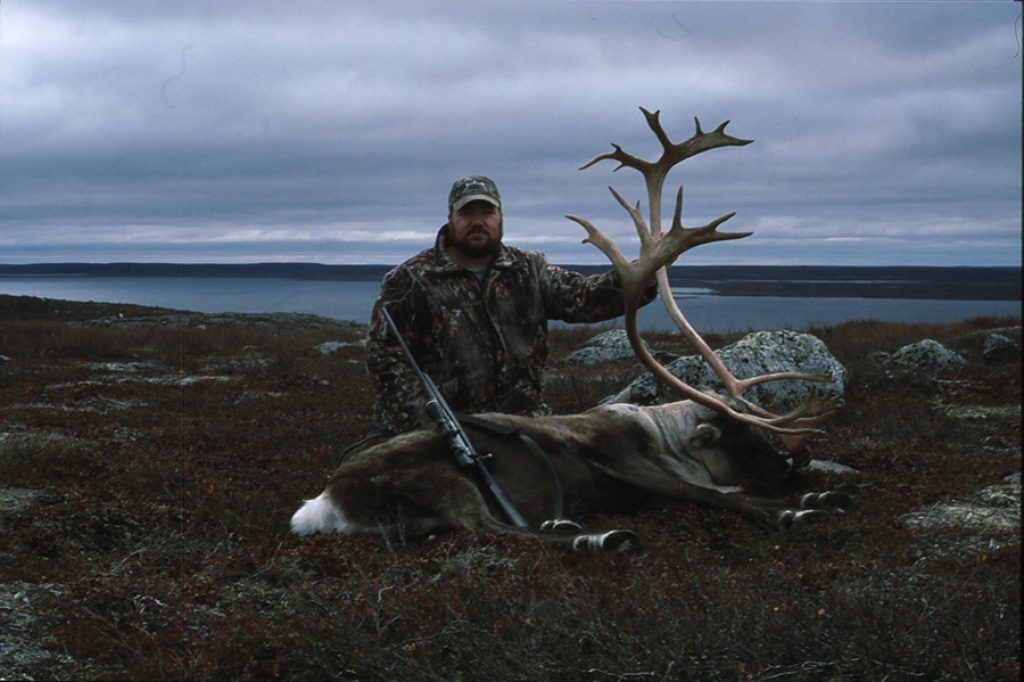
Photo above: Packing out a fine Quebec-Labrador caribou bull, back when this variety of caribou was still huntable.
A big caribou bull with heavy beams, big shovels, and lots of points is magnificent in all ways. If you get just a bit of luck with the weather, early autumn is a marvelous time to be out on the tundra, offering some of the world’s most brilliant fall colors. With more luck, you might catch a migration just right. Then, a caribou hunt will treat you to one of Nature’s greatest spectacles.
Until recently, a caribou hunt has been a grand Northern adventure, inexpensive and available, with multiple options continent-wide. You could even say that caribou hunting has been a growth industry for most of my life. I was young, but I remember when the Boone and Crockett Club decided that the caribou of northern Quebec and Labrador were too big to be the same as woodland caribou below treeline and on Newfoundland.
Thus they came to be called Quebec-Labrador caribou, and an entire outfitting industry sprang up to hunt the huge George River and Leaf River herds. Some camps were DIY or semi-guided, others fully guided, all affordable and usually successful. For decades, northern Quebec was a standard place to hunt caribou. I went three times, once guided and twice not, taking several nice bulls.
Caribou hunting on the barrens of Northwest Territories was a similar story. The Courageous Lake herd was opened to outsiders in 1980. I was one of the first to go, hunting with some local First Nation folks after winter meat. Initially we saw few caribou, suffering through an all-day and all-night rain, lots of leaks through old canvas. Dawn brought clear skies, and caribou: echelons and phalanxes marching over the horizon, headed right to us.
At the time, we considered these barren ground caribou, same as the ones in Alaska. Only later, again because of size, were they anointed as Central Canada barren ground caribou. Another caribou-based mini-industry arose, and for many years central NWT was an affordable and successful caribou destination.
There are regional characteristics, but it’s impossible to consistently visually separate the races of caribou. The strong top points on this bull are typical of mountain caribou, but this is a barren ground bull from the Bonnet Plume range in north-central Yukon.
Sadly, much of this is history. The herds crashed, and both northern Quebec and the NWT’s barrens are now closed to nonresident sport hunting. At this writing, the Quebec-Labrador caribou isn’t available at all. The Central Canada barren ground caribou is hunted only on the mainland of Nunavut, which is also home to the small, almost-white Arctic Island caribou, primarily on massive Victoria Island. These are good hunts, and successful, although logistically more challenging, and thus more expensive.
As I understand it, early Nunavut hunts are conducted from boats. Late fall hunts are done after freezeup, with snow machines and sleds for mobility. I did an Arctic Island caribou hunt in early November. My hunting partner, John Plaster, hunted muskox while I hunted caribou. It was very much an Arctic hunt, brutally cold.
The Arctic Island caribou, recognized by SCI but not by B&C, is probably the most distinctive caribou, much smaller in body and antler, with a very pale, almost white coat. This caribou is hunted in Nunavut, primarily on huge Victoria Island.
The island province of Newfoundland has always been “the place” to hunt woodland caribou, largest-bodied but smallest-antlered of our caribou. Still is, although this, too, has changed. Whether for caribou only, or in combination with moose, woodland caribou were long readily available, and the hunts were inexpensive. The Newfie caribou herd also took a nosedive, as happened in Quebec. Newfoundland dealt with it rationally, sharply curtailing hunting permits rather than instituting a knee-jerk shutdown. Numbers are increasing, so the woodland caribou remains available. However, we all know what happens when supply decreases, yet demand remains the same: Prices go up. This is actually good for the caribou, and certainly good for Newfoundland’s outfitters, but a woodland caribou is no longer an inexpensive addition to a moose hunt.
The mountain variety is the caribou of northern BC, southern Yukon, and NWT’s McKenzie Mountains. Sadly, they are also part of our caribou crisis. My first caribou was a mountain caribou, taken in northern British Columbia in 1973. Although a double-shovel bull, it was no giant. Over the years, it has been one of the few animals that I seriously wanted to “improve” upon. I tried twice in the teens, north of Smithers on the edge of Spatsizi Plateau. Saw caribou, but never a decent bull.
Mountain caribou are still on license in northern BC, but their herd has been in decline for many years. The annual harvest is small. Due to the stringent top-point minimum, it takes a helluva bull to be a legal caribou in BC, and few guide territories offer reasonable odds. Numbers are better in southern Yukon and southwest NWT but, again, a mountain caribou has become a specialized animal and thus a costly hunt.
This is a massive Quebec-Labrador caribou, tremendous mass and everything to do with it. Given a choice, Boddington prefers to hunt caribou a bit later, when the velvet has been stripped; it’s much more difficult to judge caribou in heavy velvet.
With the Quebec-Labrador caribou currently impossible, it is now an unrealistic goal to dream of taking all the varieties of caribou. I regret this for hunters coming up, but I can’t say this was ever a truly sensible goal. Our several caribou have regional characteristics in antler size and conformation. The best Alaskan bulls have heavy “C”-shaped beams. Mountain caribou have strong tops, and Quebec-Labrador caribou tend toward strong bez formations. However, if one were fortunate to take nice bulls of all the varieties and put them side-by-side on a big wall, few hunters could accurately determine which was which. I’ve hunted them all, and I could only do so with luck. The Arctic Island caribou would be noticeable as small, and perhaps the blocky woodland caribou would stand out, but no bets on the rest.
Now, to take one really nice caribou–that’s a sound goal. Alaska was always a great place to hunt caribou, but now it’s the most sensible option. Oddly, an Alaskan barren ground bull was my last caribou…and just might remain so.
Starting clear back in 1975, I held several Alaskan caribou tags, hunting guided, unguided and, too often, incidental to other game. I never punched a tag, but I did have a barren ground caribou…just not one from Alaska.
The Porcupine caribou herd, currently numbering over 200,000, migrates between northeastern Alaska and northwestern Yukon. On either side of the border, they are barren ground, while the caribou of southern Yukon are mountain caribou. Twenty-five years ago, I hunted Dall sheep in the Yukon’s Bonnet Plume range. After I took my ram, we heard a rumor of caribou moving, so we rode out, caught a group of bulls, and I shot a very nice caribou.
With strong multi-tined tops, it looks like a typical mountain caribou, but is not. The Bonnet Plumes are north of the Yukon River so, by all record books, it is a barren ground caribou, probably of the Porcupine Herd, and at that moment it was carrying a Canadian passport.
Eventually, and with the caribou crisis in full swing, I figured I’d better go after a real Alaskan bull. Alaska categorizes and manages its 750,000 caribou in 32 regional herds, many small and some huge. Alaska is not free of the caribou crisis, but it is a big place, with some herds in decline, others increasing. The largest herds and greatest numbers are in the Arctic. A big caribou is where you find it, but caribou in southern Alaska tend to grow larger in body and antler than Arctic animals.
Alaska is the only place where DIY caribou hunting is possible. In August 2019 I was in Bettles, in the Brooks Range. The local air service was doing a major business ferrying caribou hunters over the top to the North Slope; I saw some really nice racks come into the strip.
You must do your homework, and know what you’re doing, but dozens of villages across Alaska offer jumping-off points. Old and lazy, I didn’t do it that way. I did a guided hunt with my old friend Dave Leonard’s Mountain Monarchs of Alaska, down near the tip of the Alaskan Peninsula. I hunted just for caribou, which is the way to hunt caribou (or most anything). Compared to what a caribou hunt used to cost, it was expensive, but I enjoy hunting with Dave’s team and I wanted to do it right. Numbers down there are small, but the area produces big bulls.
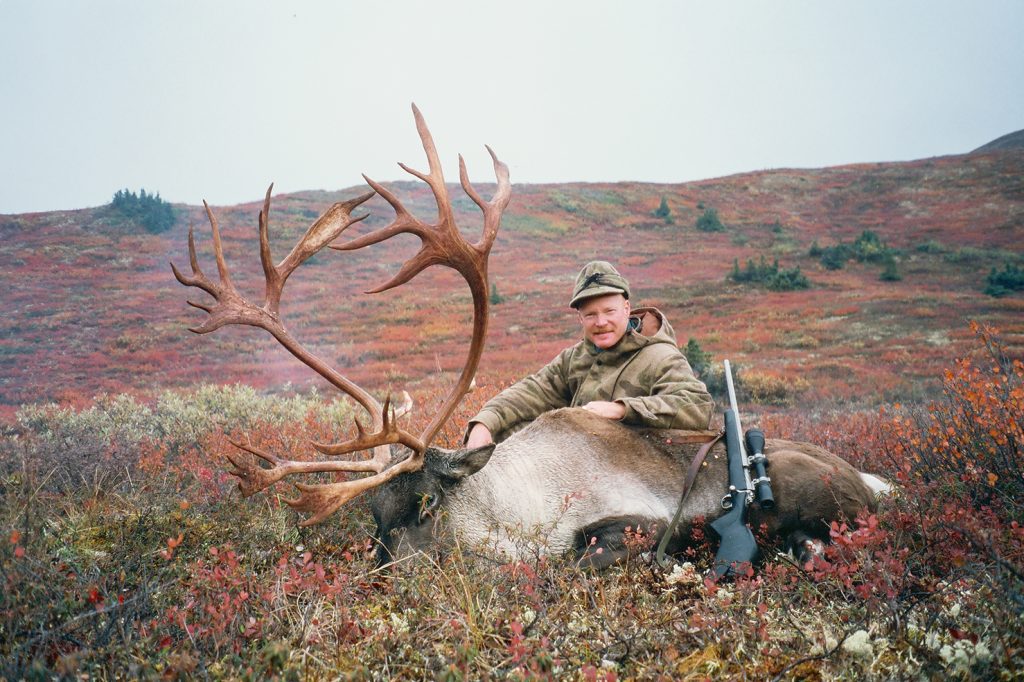
Taken on the Alaska Peninsula in 2019, this is Boddington’s only caribou from Alaska. This bull has almost everything, great tops and beams, but a bit weak on shovels and bezes. He passed this bull early in the hunt, then took him at the tail end, with time getting short and weather worsening.
On the second day, in a rain squall, I passed a lovely bull with good beams and great tops, just a bit weak on shovels and bezes. At the moment, I had time. Days later, Jordan Wallace and I glassed a herd feeding in a little valley. We spotted a nice bull, still not a giant, but the weather forecast was awful, and time was no longer on our side. As we got closer, we realized it was the same bull I had passed earlier in the hunt!
So, I made the decision to take it and it was a good one–a great bull but no giant. In any camp, not everybody can have a monster. Three other hunters in our camp took magnificent Boone and Crockett caribou. That’s as good as it gets. Perhaps I’ll try again, or maybe I’ll make one more stab at a better mountain caribou. Or maybe not. I’ve plenty of great memories of hunting caribou across the continent, in times when our caribou weren’t in crisis.
Gunmaker Lex Webernick heading in with a fine caribou. Across the Arctic, much caribou hunting is done by boat, both on lakes and along Arctic shores.
A magnificent big-game cast-and-blast adventure in Mozambique.
It had been a wonderful safari. That’s redundant, of course; being in Africa is always wonderful. This had been a special trip shared with good friends. The real magic of Africa: There’s no predicting what you might see in a day on safari. No matter how many safaris are behind you, any given day is likely to reveal something you’ve never seen before.
I’ve been hunting coastal Mozambique almost annually for nearly twenty years, mostly with Mark Haldane’s Zambeze Delta Safaris. I keep going back because the area just keeps getting better, a rare thing in wild Africa. It was good twenty years ago, and it’s even better now. In my time there, I’ve seen all the species present increase and, one by one, some have exploded. Also, I’ve gotten older, I’m not as driven to seek new horizons. I’m more content to be comfortable in a familiar place, and Mungari Camp in Coutada 11 is familiar enough that it’s almost like home.
In 2022 we decided to go in November. Hot weather is the risk, the trade-off that game movement should be excellent. The swamps are as dry as they get. In the forest, ground water is scarce, so game concentrates around remaining pools. And Haldane made me an offer I couldn’t resist: Hunt for a week, then go the coast at Vilankulo and try to catch a black marlin. I’m not a serious angler, with little deep-sea experience. But who doesn’t have a marlin somewhere on the bucket list? I was in! First, we headed to Mungari Camp for buffalo and plains game.
In coastal Mozambique, I’ve hunted all the animals, so there was no grand quest, no pressure. Go with the flow and see what Africa brings. She is bound to bring surprises, and this safari brought a surprising number of firsts. One was anticipated: At the midpoint, we celebrated my seventieth birthday. It didn’t hurt as much as I expected it to.
Boddington between Dirk de Bod from Namibia and Mark Haldane, owner of Zambeze Delta Safaris, on Boddington’s 70th birthday, a fine day in the swamp.
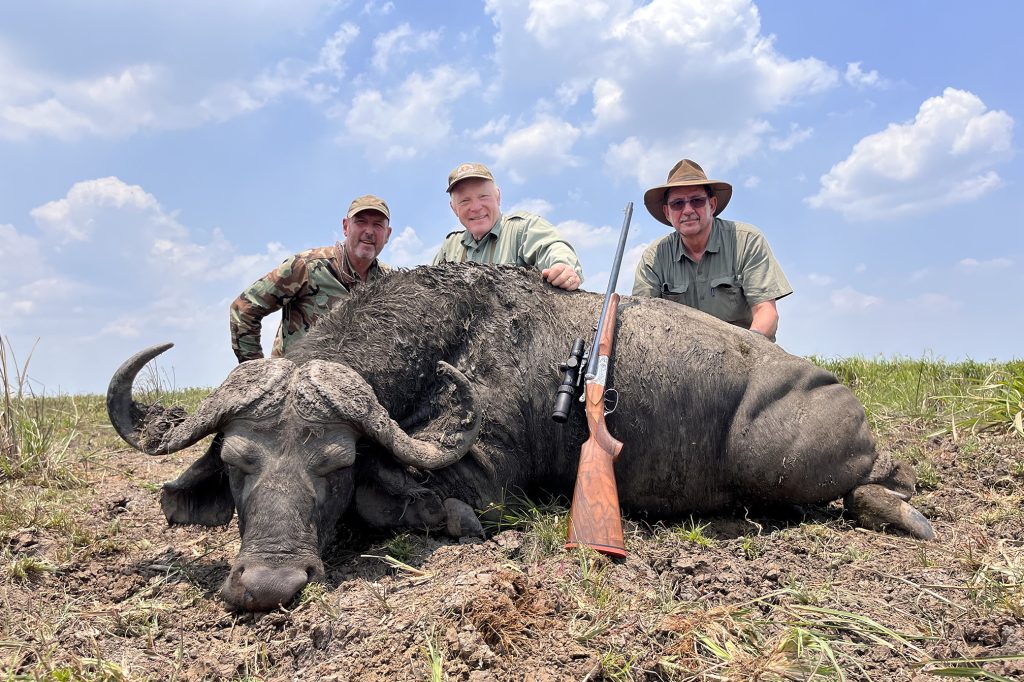
Not all firsts were mine, although they were great fun to share. My friend and business partner Conrad Evarts was there. We’ve shared many hunts, but Conrad had never taken a Cape buffalo. I stayed back, out of the way, while his team crawled into three feeding bulls, expecting a shot any second. Then the buffaloes bedded right in front of them, the hunters hunkered behind the only bush for miles. This standoff endured for a long time, as the sun sank lower.
Finally, with the sun on the horizon, the bulls stood up. Surely the sticks are going up, but Conrad and PH Bredger started to crawl some more–they hadn’t been as close as they looked. The buffaloes’ calm demeanor at sunset allowed them to gain a few dozen yards. As the sun dropped below the horizon, Conrad shot a fine bull.
Kansas City hunting buddy Mike Hagen and his wife, Susan, were in camp. Hagen has hunted extensively, and his African experience includes bongo and giant eland. Unusually, he’d never taken a Cape buffalo. The hunt was two-thirds past before he got a chance. Then, also nearing sunset, we caught five old dagga bulls, feeding on the edge of a big floodplain.
It was wide-open country and we were in the huge and noisy tracked swamp vehicles, so Haldane and our team watched the stalk from our elevated perch, even better than television. It was touch and go they could get close enough, but Mike got his first buffalo down at sunset.
The successful re-introduction of lions in this area has been widely publicized. From the original two dozen, the lions have increased to nearly a hundred. The known presence of lions changes the game when we step away from the vehicle to stalk a warthog.
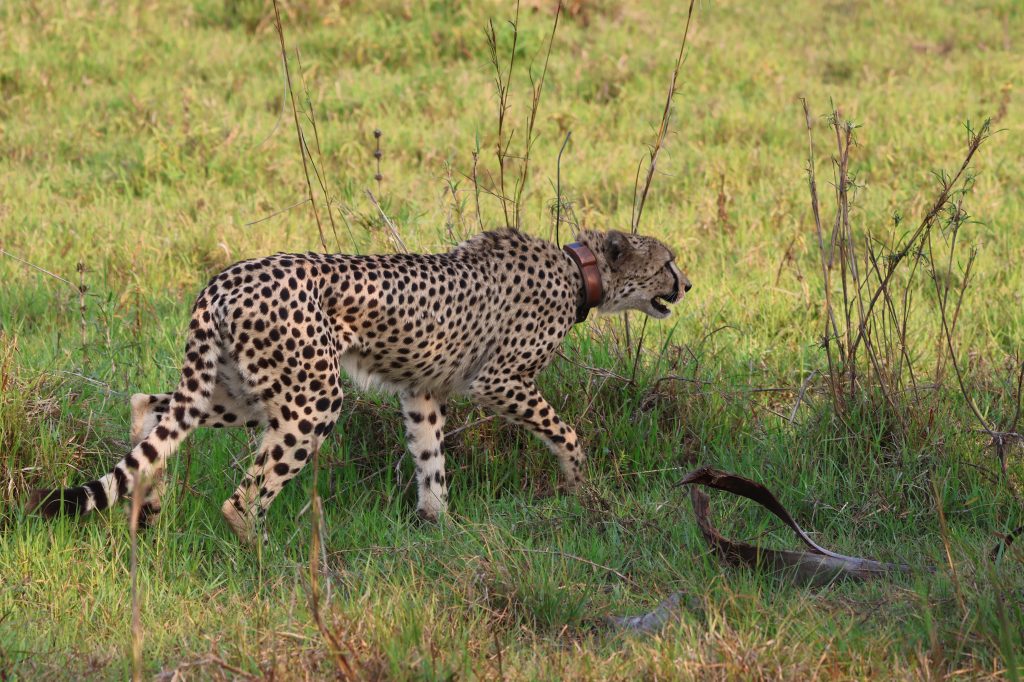
Several of our group saw lions, and some of us saw cheetahs. Eleven cheetahs were introduced to the area in 2021. The first known cubs were seen on Christmas day 2022.
Cheetahs haven’t been seen in coastal Mozambique for more than a century, but they’re back now. This collared female is one of eleven introduced in 2021. The first known cubs were spotted on Christmas Day 2022.
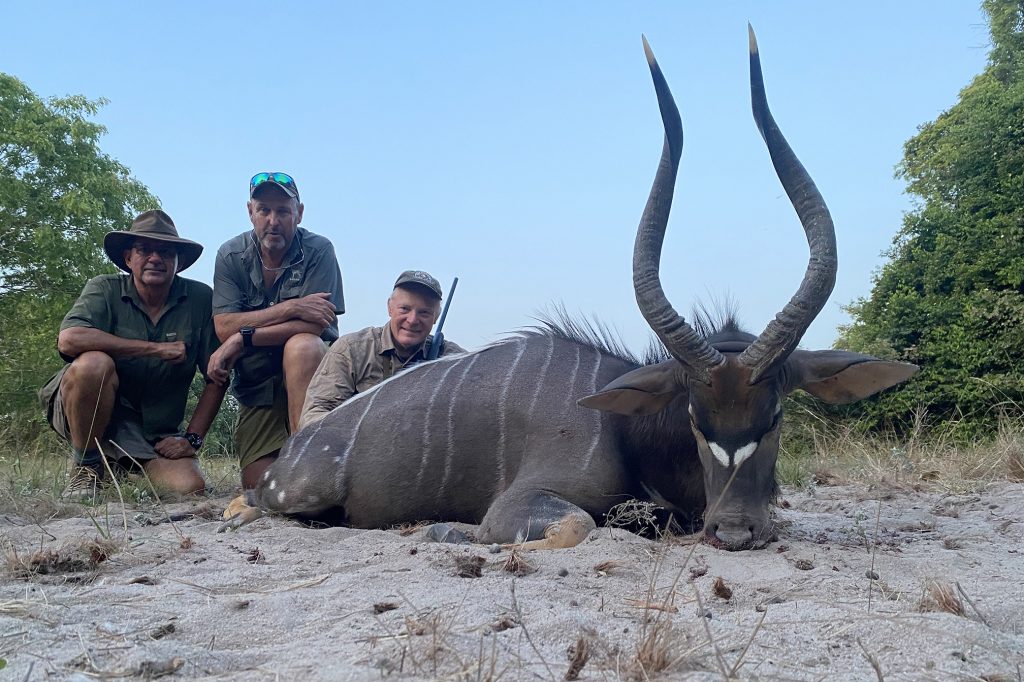
Donna and I both took nice buffaloes with no drama, and I took a fine nyala. On both my stalks Haldane and I were joined by old friend and great Namibian PH Dirk de Bod. Dirk and his wife, Rina, joined us for the birthday celebration, and went on with us to Vilankulo. Over the course of thirty years, Dirk and I have hunted most Namibian game together, but never buffalo nor nyala. (Thankfully, Haldane and I had Dirk’s adult supervision, so everything went fine.)
With a dozen friends in camp, Donna and I didn’t do a lot of hunting, but I did have an important first. In this area, the colorful nyala is my favorite antelope. I’ve hunted them before, can’t resist, and the bull I shot was gorgeous. However, combining thick brush, low light, and distance, I’ve tried for a decade to get decent nyala photos. Late season, with nyalas most active and visible, I got some dandies, the best on the last evening.
Dirk de Bod, Mark Haldane, and Boddington with a fine nyala, in Boddington’s view the premier antelope in coastal Mozambique.
Hunting Marlin
Then it was time to move on. I’m the world’s worst tourist. Going onward to the coat wasn’t my idea, but we’d long heard the Indian Ocean coast at the small Vilankulo archipelago was gorgeous, and the Mozambique Channel is a world-renowned fishery.
Safari completed, most of our group headed home. Donna and I, Woody and Teresa Wilhite, and Dirk and Rina de Bod headed down for a few days at the beach with Mark and Laurette Haldane. Vilankulo is a famous tourist area, known for white sand beaches, great snorkeling, and shopping. Just relaxing on the beach was of greatest interest to most of us, but Dirk and I did a two-day charter with Morgan O’Kennedy’s Big Blue Vilankulo.
Morgan and his team picked us up on the beach just as the sun started to come up over the Indian Ocean, and we headed out into the Channel against mild chop. Dirk’s an experienced deep-sea angler, but for me this was a whole new experience. First up was to catch a couple of bonitos for bait, caught on light tackle after finding schools skipping over the surface. Within an hour we had what we needed, the heavy rods were baited, and we headed deeper in the Channel to begin the hunt for marlin.
No, you don’t really fish for marlin; you hunt for them. You watch for schools of bait fish, often revealed by birds on the surface. And you watch for other hunters. In these waters, lots of dolphins, coming near, and then skimming by as if we were standing still.
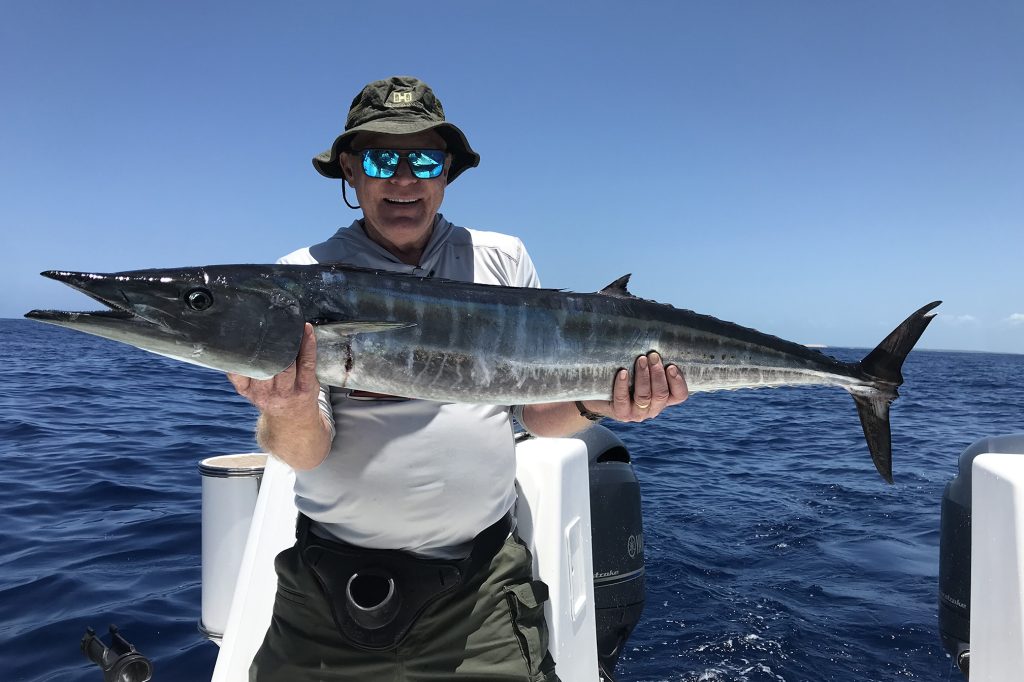
The hunt is for big black marlin, but it’s not an exclusive pursuit; blue and striped marlin are present, and some sailfish. A couple hours into the first day we hooked a big wahoo, a fast, streamlined fish, great eating and a strong fighter. It was a good practice run for me, first time I’ve ever been in a fighting chair, arms quickly numb from the strain. We had it grilled for dinner that night, fantastic.
This is a very large wahoo, one of the local fish caught for the table, a great fighter and wonderful eating.
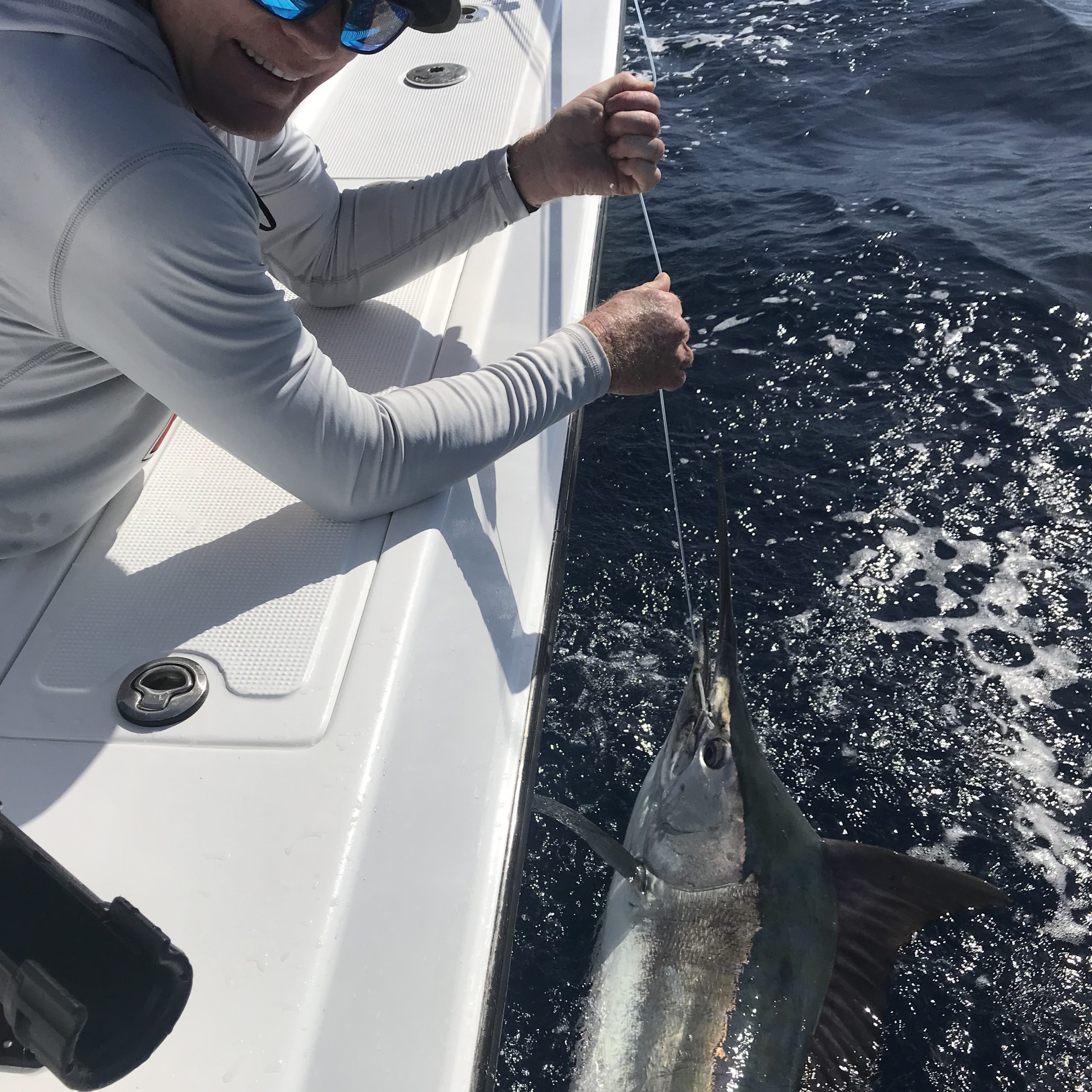
Everyone hopes for a Papa Hemingway-size marlin. Maybe it doesn’t matter so much today, because there won’t be pictures of giant fish hanging on the pier. All billfish are catch-and-release only, with photos taken fleetingly alongside the boat, then the fish is released. So, I don’t really know how big my black marlin was. For sure, no giant. Wish he had been, but maybe it doesn’t matter. He wore me out, and did his classic tail-walk. He looked plenty big broaching the surface just behind the boat. (Note: Big marlins are usually females, part of why the catch-and-release ethic is nearly worldwide today.)
Boddington’s black marlin wasn’t huge, but bringing it to the boat was a tough fight and great thrill. In the Vilankulo area all billfish are catch-and-release only.
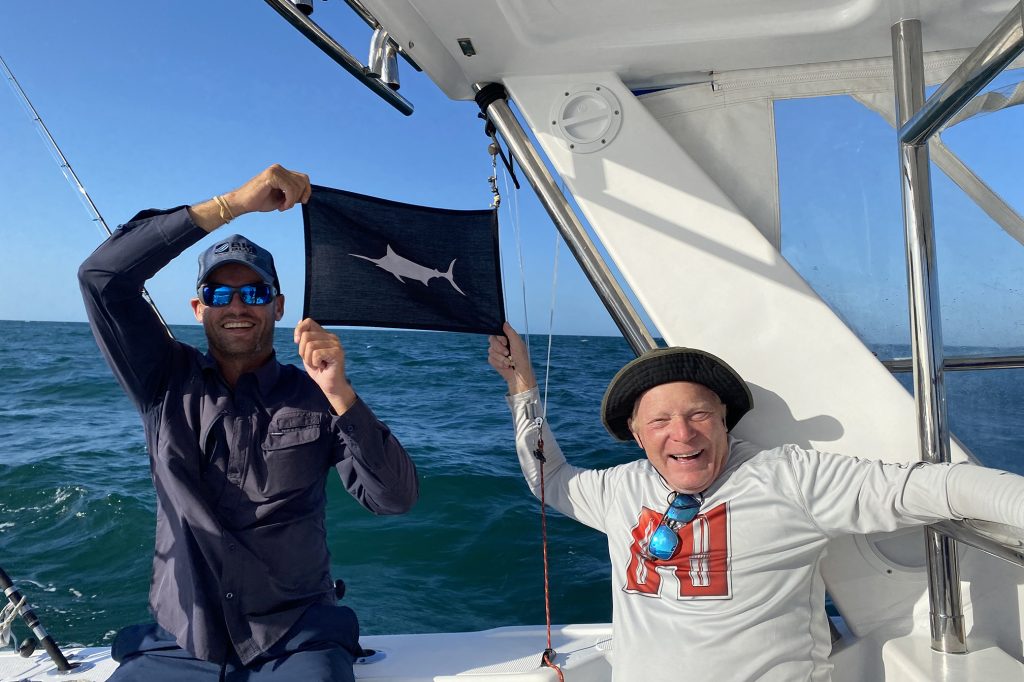
The water was calm and reasonably clear in the Channel that day, a good day with other boats catching marlins. We came into harbor flying the Black Marlin Flag for all to see. The next morning, Dirk boated a marlin a bit smaller than mine, so we could hoist the coveted flag again. A fine few days for our Captain Morgan, especially exciting for me. Might have to try that again!
It could have been even better. About noon one of the big rods bent almost double. I handed it off to Dirk and he made it to the chair…barely. Good Lord, he fought that fish for an hour. It never jumped properly, likely indicating a fouled leader. We saw the monster clearly. A giant fish, an Old Man and the Sea marlin. Dirk knew what he was doing, taking the strain on back and legs—no chance with arms and shoulders. He was red-faced, sweating profusely, gaining line, losing when the fish ran, gaining a bit more on the turn. He was winning–and then the great fish was gone. Definitely the one that got away.
Captain Morgan O’Kennedy and Boddington, headed into Vilankulo proudly flying the black marlin flag.
Getting as close as possible to a game animal is an exciting and rewarding way to hunt.
Photo above: In spot-and-stalk hunting, you’ll spend a significant amount of time glassing. Good optics are a necessity. Photo by Kelly Ross.
A few years back, a friend and I were hunting pronghorn antelope in southern Alberta. We were excited to finally be out on opening morning, glassing the open plains for “speed goats” after eight long years of applying in the draw. Lots of advance planning and scouting had been done so that we could make the most of this rare opportunity, and the first light of day found us glassing an area where we had seen a number of good bucks.
It didn’t take long to locate a herd of antelope with several bucks, including a couple of shooters, so we immediately began working on a strategy to get us within decent shooting range. Unfortunately, while glassing the terrain for a suitable route that would allow us to stay out of sight of the antelope on our approach, I soon found that we were not the only ones interested in these bucks. I could see a pickup parked in the distance and my binocular quickly picked up a couple of hunters lying prone in the sagebrush a few yards from their truck.
There was no way for us to proceed as planned, since the other hunters were between us and the antelope, on the exact route we would have used for our stalk, so we decided to sit tight and wait to see what the other hunters did. If they put a stalk on the antelope and bumped them, there was a good chance the herd might follow the ridgeline we were glassing from and give us a chance at one of the bucks.
We waited for a bit, anticipating that the hunters would follow the same route we had picked out, which would put them within a couple of hundred yards of the antelope, but the minutes clicked by and there was no sign of movement. My hunting partner had just leaned towards me and whispered, “I wonder when they are going to get moving?” when a shot rang out. We looked at each other in disbelief as the antelope instantly kicked into overdrive and began running toward us. Two more shots from the other hunters helped speed them on their way, and we just watched in silence as the antelope blew by us at warp speed.
The hunters were at least 700 to 800 yards from the antelope when they shot–way past what I would consider a “reasonable” shooting distance. All I could do was shake my head. Why the hunter attempted to take a shot at that distance was beyond me, as there was an obvious seasonal runoff depression that would easily have allowed them to get much closer to the bucks while staying out of sight.
With the antelope herd speeding toward the next county, my buddy and I walked back to the truck so we could go glass some other areas where we had seen antelope. On the way we had to drive by the other hunters, so we stopped to talk to them for a few minutes. They had been unaware that they had an audience until they saw our truck approaching, and the hunter who had done the shooting seemed to be genuinely surprised at the fact that he had missed the buck he had selected.
I asked why they hadn’t tried to get closer by following the dry creek bed and it was immediately apparent that they had not even contemplated the idea of getting closer. A rangefinder had been used to determine the distance. The shooter’s custom rifle, chambered in one of the newer 6.5mm cartridges and topped with a big, expensive scope, completed the picture. He had dialed the scope in for the distance displayed on the rangefinder, and just couldn’t understand why the pronghorn buck he selected wasn’t lying in the sagebrush.
After forty-five years of guiding big-game hunters, I have seen a lot of fads come and go. Improvements in technology have changed many things in our lives, and that applies to hunting as well. Virtually everything we use in the game fields has seen significant advances in performance and most recently this has resulted in a proliferation of rifles, scopes, and ammunition that are capable of making a 1,000-yard shot in a hunting scenario.
There is no doubt that hunters have always been fascinated with the idea of being able to take big game at long range, so it was no surprise to see many hunters jump into buying long-range shooting equipment. There are also many long-range shooting schools operating these days and they are keeping busy, but the majority of hunters who are getting into the long-range hunting game are not taking the courses offered by these schools.
The simple fact of the matter is that vast numbers of hunters are not experienced enough to be shooting at the distances we see game taken at in the various long-range shooting videos and hunting shows on the internet and outdoor TV channels. That said, the marketing and promotion certainly has caught a lot of people’s attention.
Unfortunately, as the long-range interest has gained momentum, I have seen a definite decrease in hunters’ skills at a number of things that we used to do as a matter of course. I see very few hunters who know how to use a compass or use the information obtained from topographic maps and apply it to the terrain around them. I have also observed that, when a targeted big-game animal is spotted, the tendency is to try to take a shot from where they are, with little or no thought given to attempting to execute a stalk and get closer to the animal. It would seem that many hunters either do not know how, or have simply chosen not to bother with stalking, a skill that has traditionally been inherent to hunting.
As a young lad, I was taught that a hunter should try to stalk as close as possible to a big-game animal in order to be certain of placing a shot as precisely as possible. The range at which you stop stalking and start shooting varies from person to person, depending on their shooting abilities and confidence in making the shot, but there is more to it than just the ability to pull the trigger and end the hunt. Stalking in as close as you can without being detected by your quarry gives you an adrenaline rush and significantly adds to the thrill of the hunt.
While I am a staunch advocate of learning how to shoot properly and practicing as often as possible, I also believe that knowing how to stalk big game is one of the most important skills a hunter can possess. Every situation is different, to be sure, but following a few basic rules will greatly improve your ability to pull off a successful stalk.
Caribou hunting in the far north provides excellent spot and stalk hunting. When a big bull is sighted hunters are faced with not only keeping out of sight and the wind in their favor, but must also factor in the direction and speed of an animal that is constantly o the move. Photo by Kelly Ross
Equipment
There really is no rocket science involved in your choice of gear and equipment for spot- and-stalk hunting. You need to wear quiet, comfortable clothing and footwear that suits the terrain and weather you will be hunting in. Camouflage clothing is not a bad idea, but not a necessity; you should just be sure to wear clothing that breaks up your outline and helps you blend in with the surroundings. My success at stalking game years ago was not hampered by the fact that I was wearing jeans and a plaid jacket instead of the latest camo patterns being marketed these days.
Obviously, you will have selected the appropriate rifle/scope combination, chosen your ammunition carefully, and practiced faithfully with your shooting tools prior to the hunt. The equipment that is exceedingly important and most often neglected however, is the very best binocular you can afford. A good spotting scope may also be a good idea, especially when hunting big-game animals that usually have restrictions with regards to the size of their headgear, like sheep and goats.
Glassing
In a nutshell, stalking revolves around locating the game animal before it becomes aware of your presence, then selecting a route that will allow you to get as close as possible to your intended target without your quarry spotting or smelling you. Finally, assuming the stalk has gone off without a hitch, you will have gotten close enough to precisely place your bullet and quickly bring things to a conclusion.
The first order of business is to locate the game animal you are after. You should carefully look over the area you are hunting with the naked eye. If that fails to turn up anything obvious, it is time to dig out the bino and get to work, systematically looking at every piece of ground in front of you. Take your time and carefully examine every nook and cranny, then do it again. You will be surprised how often you will suddenly have an animal come into focus that you missed on the first go-round.
Once you are satisfied that you haven’t missed anything, you can slowly hike to another location that allows you to glass new ground. Be sure to glass along the way as new areas come into view so that you do not inadvertently spook anything.
As you are glassing, keep in mind the time of day and what sort of activity your quarry is likely to be up to. Are they likely to be feeding, or should you be looking for animals that have bedded down to chew their cud or take a nap?
Remember that when it comes to glassing and spotting game, the number one mistake that hunters make is being in a hurry. Take your time and make sure you are not missing something.
Establish What Your Target is Doing
Once you have located the animal you are after, you need to figure out what the animal is doing, or likely to do, and then plan your approach. While there is no way to plan for every possible scenario, there are general guidelines that can be helpful in deciding if and when you should attempt a stalk.
Much of it is common sense, and the more you know about your quarry, the more accurate your decisions are likely to be. If you are hunting during the breeding season, a male that has acquired a group of females is going to stick pretty close to them. If the target animal is concentrating on a particular food source, chances are they will stick fairly close to the feeding area or will return to the area to feed at the appropriate time of the day.
Animals that are traveling when you spot them may or may not offer an opportunity. Spooked animals may stop on the other side of a ridge, or they may not slow down until they are on the next mountain. This is when a good knowledge base of the species in question comes in handy.
Maybe the animal is simply moving between known feeding or bedding areas, in which case you will likely have an opportunity to plan a stalk once you have established what it is doing and allow it to get to where it is going before you begin your stalk. The time of day comes into play here. If it is the late afternoon or evening, there is a good chance feeding animals will stay in the general vicinity until dark, but if it is the morning feeding period, they are likely to head for a bedding area when they are finished feeding.
Planning Your Approach
Once you have located an animal you are interested in and decided to plan a stalk, you need to carefully mark its position. This is exceedingly important, as once you start moving the appearance of the terrain will change, sometimes significantly, from how it looked to you at your initial vantage point. Not being absolutely certain of an animal’s location is a mistake that can and will come back to haunt you.
Next, you also need try and determine the location you want to reach as a shooting position. Try to memorize both the animal’s position and the shooting position by using landmarks that will help you pinpoint those locations once you begin the stalk. I cannot stress enough how different things will look once you start moving, so it is essential that you be able to recognize where you are as you make your way along the route you chose for your stalk.
It should go without saying, but when you strategically plan your route, the goal is to try to keep the animal from seeing you while executing the stalk. Always attempt to stay out of sight by keeping something between you and the animal at all times, whether it is a ridge, rocks, or vegetation.
Since most hunters these days are packing around a GPS, a cell phone with various apps on it, or both, be sure to mark your starting point on the device as it will be a handy point of reference as you work your way along the chosen route. In hilly or mountainous terrain, you can also mark the elevation you started at and make a note as to whether the animal was higher or lower than that, giving you yet another point of reference to use in determining your position during the stalk.
Doping the Wind
Pay close attention to the wind at all times. Hiding your odor is extremely important, and that can only be achieved by constantly monitoring the wind direction. Even a faint breeze is all that is needed to carry your odor to the animal and give your position away.
While being able to stalk directly into the wind is ideal, it simply is not possible in a lot of stalking situations. Crosswinds and quartering winds will work as well, provided the wind direction seems constant. Try and remain cognizant of any variations in the terrain that could potentially deflect the wind currents in a direction that may give your scent away. Swaying grass, poplar, dandelion fluff, and dead leaves can also assist you in keeping track of the wind direction.
The wind is usually steady and relatively predictable in flat terrain, but mountainous areas can be challenging. That said, understanding how thermals work will assist you in doping the wind in steep terrain. Put simply, warm air rises and cool air falls, so expect the air currents to flow downhill at sunrise, then switch and blow uphill as the day warms. During the midafternoon there can be a period of time when the thermals tend to swirl, but as the late afternoon/evening temperatures continue to drop, the thermals will head downhill again.
To assist you in monitoring wind direction, commercially made “puffers” are available that produce little clouds of talcum powder when you squeeze them, or you can make your own by dumping some baby powder in a small cloth bag. Cattail down or fireweed fluff can be kept in a small tin or a cloth bag and a pinch tossed into the air will quickly tell you the wind direction.
Executing the Stalk
During the early stages of your stalk you can usually move fairly quickly, but once you are getting close to your intended shooting position, it is time to throttle back and move slowly. Now is not the time to make a mistake, so stay focused and be sure to watch closely for anything that could jeopardize your stalk. Watch out for other game animals that could spook at your approach and subsequently spook your intended target. Try to avoid dislodging rocks or breaking branches, anything that may alert the game to your presence.
If you’ve reached your intended shooting position but the animal is not where you thought it would be, stay put and wait it out. It is not unusual for the animal to have shifted its position slightly and it may just be behind a tree, a rock, or have bedded down. All it takes is a little patience on your part before the animal will move and give away its position.
Your scouting paid off and you located the animal you were after, carefully planned and executed your stalk to get within range, and now all you need to do to seal the deal is carefully put a bullet where it needs to go. Now is not the time to let a burst of adrenaline screw things up. Stay calm, settle into a solid shooting position, take a deep breath, slowly exhale, and gently squeeze the trigger.
Additional Considerations
On the surface, planning a stalk and then executing it seems simple enough, but there are always a lot of variables to consider. The different types of terrain and species of big game that inhabit them all offer challenges you need to overcome to be successful.
Pronghorn antelope inhabit the plains and western high desert country where their exceptional eyesight and the wide-open spaces offer unique challenges that are vastly different from those experienced by spot-and-stalk hunters after the various species of sheep and goats inhabiting the rugged mountain ranges around the globe.
Learning how to successfully stalk big game takes practice, and there are different learning curves associated with different big game species. You not only need to learn the potential pitfalls of hunting in different environments, you must learn the habits of the different species and potential hazards associated with hunting them.
I think hunters do themselves a disservice if they fail to learn and appreciate the dynamics involved with stalking big game. Stalking adds a degree of intensity and reward to the hunt that is not experienced with other hunting methods.
No one really knows how many humans are killed and eaten by crocodiles every year.
Photo above: Crocodiles are able to lie in the water with just their eyes, nostrils, and a bit of upper cranium showing, a posture perfectly suited to ambushing unsuspecting prey.
Not counting herpetologists and other strange folk, most people who spend much time around wild crocodiles tend to dislike them intensely.
“Crocodiles are the enemies of all life, and should always be slaughtered without any compunction,” wrote the famous hunter Major W. Robert Foran in his classic 1933 book, Kill Or Be Killed. “Nobody should ever hesitate to kill one. It is either a murderer many times over or a potential slayer of all living things.” After killing and cutting open a twelve-footer in the Nzoia River, he found, among other items, “a woman’s foot, a man’s hand, some native beads, an assortment of bangles and anklets [and] the hoof of a waterbuck… There could be no doubt about it being a man-killer. I was glad to have been its executioner.”
Peter Capstick had a similar view. “Personally, I hate crocs. The reason is that I fear them. There could be hardly an end more horrible than feeling that death-grip of terrible teeth, knowing there was nothing you could do to save yourself.” In Africa, he added, the crocodile “may accurately be summed up as that land’s only carnivore that will cheerfully kill and eat you every time he gets the chance.”
Hopefully we have advanced from advocating the wholesale slaughter of any wild creature, even dreaded crocodiles, but that being said, it is rather difficult to like these animals, though it is very easy–and I would add, very wise–to fear them. By “them” I mean the fifteen or so worldwide species of crocodilians that frequently attack and kill humans.
Let there be no doubt, when some types of crocodiles become large enough, they don’t “turn” into man-eaters, as the atypical lion or leopard might. For a croc of a certain size, man-eating isn’t an aberrant departure from normal, human-avoiding behavior; it simply will feed on people whenever it gets an opportunity. And from a crocodile’s perspective, why not? Prey is prey, and humans, when ambushed or surprised, can be fairly easy to catch, rend into consumable pieces, and swallow. Large crocs will also attack people for reasons other than predation, as I’ll explain later. Even a beast with a full belly might take a chomp at you in certain circumstances.
But, you might ask, putting aside all dislike, fear, and sensationalism, just how common are actual attacks? How many people do the crocodilians seriously injure or kill each year?
The most honest answer is: no one really knows. Even conservative, science-based compilations always include necessary disclaimers such as: “the record of attacks we receive are a small fraction of the attacks that actually occur worldwide,” and “the vast majority of attacks are not reported or are only reported at the local level.” Whole regions in Africa, for example–entire countries–have or issue no record or reports of croc attacks. This is also true throughout much of Indonesia, Malaysia, Sri Lanka, the Philippines, and many other areas where the large and aggressive saltwater or estuarine crocodile (Crocodylus porosus) is a frequent threat to humans. Many places report some fatal attacks but leave out the frequent serious non-fatal cases where people have lost an arm or leg or are permanently crippled and disfigured. So if you read in a recent, scholarly reference that “between 2008 and mid-2013 there were 1,237 attacks worldwide, resulting in 674 fatalities,” understand that these numbers are far below the reality. There are knowledgeable people who would argue that two or three times that many attacks and deaths occur annually just in Africa alone.
But there are still things to be learned from the incomplete stats. For instance, they reveal that croc dangers are by no means limited, as some people believe, to Africa and northern Australia (where the saltwater croc or “saltie,” is a well-known threat). Salties, as already noted, have an extremely large range, and anyone traveling to those areas, whether to hunt or simply vacation, should be aware of the mostly unpublicized danger. This also applies to parts of Mexico, where many tourists would be shocked to learn that crocodiles can be a deadly menace. In 2015, Mexico reported 27 attacks and 7 deaths attributed to the American crocodile (C. acutus, which can grow to 19 feet in length and also inhabits southern Florida, Central America and parts of South America,) and Morelet’s crocodile (C. moreletti). Attacks occur on both the west and east coasts, including the popular tourist region of Cancun. The lesson in brief: if you are traveling to a tropical or sub-tropical region anywhere in the world, look into the local (often unmentioned because it’s bad publicity) potential for croc trouble. It could very well be a real danger.
By far the worst croc culprits in terms of the most attacks and fatalities are the Big Two: The large salties and Africa’s Nile crocodile (C. nilocticus). By the known numbers, 88 percent of all croc-caused human deaths are attributed to these two species, divided almost evenly. They deserve a close look, because the more you know about these formidable animals, the better your chances of avoiding or surviving an encounter or attack.
While modern crocodiles are in one sense ancient, dating back at least 160 million years, when they coexisted with dinosaurs, they are not primitive by reptilian standards. They have acute senses, including binocular color vision with vertical pupils that enhance their ability to see well at night. External ear slits (with moveable covering flaps that close before submerging) give them the best hearing of any reptile. This is abetted by nerve-dense sensory glands around the jaws and throughout the body for detecting even slight vibrations in the air and water–an aid both to homing in on prey and sensing the approach of enemies, such as human hunters. They have a keen sense of smell, and their top-positioned nostrils allow them to breathe while maintaining a minimum-exposure position in the water, showing only eyes, nostrils, and a bit of upper cranium, a posture perfectly suited for ambush hunting. Because of salt glands in the tongue which regulate osmosis, “saltwater” crocs can and do live in freshwater, and some freshwater crocs can tolerate brackish, estuarine, or saltwater environments. This means you can be attacked by a saltie in a freshwater river or lake (even far inland), or by a Nile croc near a beachside river mouth. A number of attacks and deaths occur each year because people don’t realize this is possible.
Crocodiles have seventy conical teeth, which vary in size and sharpness. Broken or lost teeth are self-replacing up to forty-five times over an animal’s lifetime. Teeth and jaws are well-designed for grabbing and tearing, but not for chewing. Crocs swallow small prey whole. Larger victims might be whiplashed side to side to break off pieces, which are then gulped down. Larger prey is usually seized in a vise grip and dragged into the water to be drowned. The croc then bites into the carcass and twists in a rapid “death roll,” tearing off limbs or chunks of meat to swallow whole. The bite-force of a large crocodile is said to be one of the strongest in nature, rated at 1.1 tons or more, enough to crush large bones and, in a number of documented cases, to decapitate human victims or sever their bodies in two.
A crocodile is considered man-eater size when it reaches approximately eight feet in length. Crocs this big and larger become increasingly wary and even timid-seeming when they are resting or basking onshore, often fleeing into the water at the first sign of an approaching human. But when hunting, they can be both bold and subtle. Large crocs like to hunt by ambush, barely visible in the water, especially in turbid conditions or when intentionally lying among weeds, floating logs or other surface debris. Although their brains are only walnut-sized, crocs are the most intelligent of reptiles, able to trace and remember the habit patterns of potential prey, including humans. When prey is spotted, the croc swims silently underwater (where it can move up to 20 miles per hour), to gain the best ambush position. At just the right moment, it lunges to grab its victim, usually by lower limbs or head. A large crocodile can vault much of its body length out of the water, canting to grab prey off of a riverbank–or a person out of a boat. Crocs can also lunge onto land, where they are capable of pursuing or chasing in short bursts that have been timed at nearly 10 miles per hour.
Most attacks on humans, whether near or in the water, happen by surprise, “out of the blue”–or more accurately in many cases, out of the murk. Attacks can occur at any time of day, but the risk is generally higher in dim light, at dusk and at night, when crocs are most active and harder to see and avoid. During breeding season, large bulls are territorially aggressive, bolder, and more prone to “defensive” attacks, even on boats. (Their powerful jaws and sharp teeth can puncture an aluminum hull.) Female crocs, after egg-laying, will defend their water-side nests fiercely should a person intentionally or accidentally come near the buried eggs or interfere in any way with the chirping hatchlings. About a third of recorded crocodile attacks are considered defensive rather than predatory. Being poikilothermic–inaccurately called “cold-blooded”–crocs are most active in temperatures between 82 and 92 degrees F., and will become sluggish to dormant near or below 55 degrees.
Let me conclude with a quick review of some do’s and don’ts to avoid or survive croc attacks:
Learn as much as you can about crocodile danger-potential when visiting specific areas. Keep an eye out for the animals or evidence of their presence when near or around water. Look on river banks or shorelines for slide or drag paths of bare earth or flattened vegetation where crocs “haul out” of water to sun-bask and slide back in to return. Slides usually mean that one or more crocodiles are not far away.
Don’t assume a body of water is safe just because no crocodiles or sign are present. Crocs will move to different waters, often travelling overland at night. They can also submerge and stay unseen for up to several hours, or be present but difficult to spot. These animals have evolved for effective ambush, and though hard to believe, a man-eater-sized croc can submerge, wriggle down and hide in as little as twelve inches of water. Crocs might inhabit or visit even very small water holes.
Take great care around water. Crocodiles like to hunt the edges, so don’t walk close to the banks or shoreline. Keep at least fifteen feet from the water’s edge. Don’t lean over banks or the sides of boats. The notion that it’s safe to swim in deep water (because crocs like the shallows) is absolutely false. Many attacks occur in the depths. A crocodile can bite, and swallow, while underwater. Never dangle feet, legs, or arms into the water, even for a few moments. Crocs can and will “map” and remember the habits of potential prey, including humans who wade, river-cross, wash, or fetch water in the same places each day. Avoid such predictable habits. Don’t camp or sleep close to a shore or bank. Crocodiles will leave the water and hunt on land at night; in a number of cases they have stalked into a campground and pulled sleeping humans from tents or shelters. It’s best to camp at least 150 yards from the water’s edge.
What do you do if you are aggressively approached or attacked by a sizeable crocodilian? On land, run away fast. Forget the common instruction to move in a “zig-zag” pattern; the best move is to sprint straight away from the animal and the water. Most crocodiles cannot chase far on land.
If you are grabbed in any circumstance, fight back. Don’t simply struggle to pull away and resist; that often provokes the animal into the “death roll” move that tears off limbs. If on land or in the shallows, do whatever is possible to keep from being dragged into deeper water, even if that means holding onto a tree limb or another person’s outstretched arm. To fight back, aim for the eyes, poking, stabbing, hitting. Next best to target are the comparatively sensitive nostrils and ears. If another person is present, that person should attack the croc’s eyes, nose and ears with whatever’s available. For someone armed, a gunshot to the croc’s head or neck area–it needn’t be precise like a normal hunting kill-shot–usually causes the animal to immediately release and drop away. Even a very large man-eater can often be driven off when confronted by more than one person.
The third option is the palatal valve. This is a flap of tissue behind the tongue that keeps water out of a crocodile’s throat and airway when it opens its mouth or feeds underwater. If a croc has you by the arm or leg, it might be possible to jam that limb down deeper into the mouth, opening the palatal valve, which lets water in and forces the croc to release you.
These tactics might sound like implausible longshots with a huge and powerful man-eater, but they have worked in multiple cases. In one instance, a man being dragged under with his arms pinned did the only thing he could think of: he bit down as hard as he could on the animal’s nose. The surprised croc released him and swam off. The man suffered serious injuries, but survived.
These spotted cats are challenging, and there are no guarantees.
Photo above: Boddington’s biggest leopard was taken in Namibia, back when hound hunting was still legal.
Convention season is upon us, the world’s largest gatherings of African outfitters converging on Dallas, Houston, Nashville, and more. There are plenty ways to find great hunts today, but there’s nothing like shopping first-hand. Maybe this year you’ve decided you’d like to hunt a leopard.
Good plan. Regardless of what you might have heard, leopards are not endangered. In fact, they are thriving. At least, in the countries where they are hunted and where we, as hunters, place value on them. Leopards are hard to count, but some estimates suggest over two million in wild Africa, and they raid chicken coops in the suburbs of every major city in sub-Saharan Africa. Outside the ’burbs, they take livestock, but are tolerated in hunting countries, again because they have value.
Okay, goat-eating leopards aren’t your problem, so why would you wish to hunt one? Well, after the buffalo, the leopard is the most available and affordable of Africa’s Big Five. The hunt is a fascinating chess game, with no certain outcome, and the leopard is very much dangerous game, considered by some the most dangerous. Thanks to antibiotics, I don’t agree, but, well-camouflaged and fast, the leopard is the most likely to hurt you. Unlike the rest of the Big Five, there is almost no danger in hunting a leopard… until you shoot. Do it right, game over. Do it just slightly wrong, and the stuff is in the fan.
When both great cats were often on license, it was common to hunt lion and leopard in concert. Today, both are very specialized hunts. Back in the day, it might not have been unusual for a hunter to take both cats on the same safari. This never happened to me, nor have I been in camp when both lion and leopard were taken.
In 2010, on safari with Michel Mantheakis in Tanzania’s Rungwa with hunter Ron Bird, a lion was the primary goal. As Dave Fulson likes to say, “we had leopards swinging from every tree.” Sitting on a bait, I saw a leopard lose its purchase and fall from a lion bait, which was comical. Another day, walking up to check a blind, we woke up a sleeping leopard. Most of the leopards we saw or had on cameras were females or young males, but we also saw shootable males. Ron had taken a nice leopard on a previous safari, didn’t want another, and got his lion on the last day.
Literally, leopards “swinging from trees.” In Zambia’s Luangwa Valley in July ’21, almost every lion bait was eventually visited by leopards. This is probably a young male, but sooner or later one mature male seemed certain to show up.
In July ’21, I was with son-in-law Brad Jannenga in Zambia’s Luangwa Valley with PH Davon Goldstone. Also a lion/leopard hunt. Brad didn’t get his lion on that try but, again, we had leopards “swinging from trees” on our lion baits. Most were females or young males, but when a big male hit a distant bait, it was time to strike.
Perfect setup. The tree was in a small opening, long grass close by, a small sand river between bait and blind site. This follows the “BOB” rule: Bait, Obstacle, Blind, with a natural barrier separating blind from bait. We quickly built a blind, cleared the shooting lane, and were sitting in the blind before 4:00.
We might have been there an hour when the cat showed up. The shot angle was okay, but weird, sort of low behind one shoulder and up through the off shoulder. The cat launched high and left, under its own power (never a good sign). We heard it land heavily in long grass, then silence.
Brad felt certain, but Davon’s video was indefinite so we gave it some time. With the luxury of light fading, we got organized, and stepped into the tall, threatening grass. Brad was right. His shot was perfect; the cat lay dead just twenty yards in.
Wow, a one-hour leopard hunt, on Brad’s first try. Forty years ago, I sat in a blind for sixty-some nights before I got my first leopard. There are more leopards today than there were back then…and some hunters are luckier than others. Sounds like Tanzania and Zambia must be the best places to hunt leopard, right? Yes, probably. However, I’ve had leopard on license multiple times in both countries, never got a leopard in either. No matter where you are, there are no guarantees on leopard.
PH Davon Goldstone and Brad Jannenga with a fine leopard from Zambia’s Luangwa Valley. Zambia isn’t known for huge leopards, but density and hunting success are both high.
With baiting, you’re trying to make a highly skilled predator accept a piece of meat the leopard knows it didn’t kill. With daylight baiting, you’re trying to get a highly skilled nocturnal predator on bait at a place and time of your choosing. Not easy.
It’s encouraging to have multiple leopards feeding, but females and youngsters do you no good. You need a mature male to take a bait. Zambia and Tanzania are great countries for hunting leopard. However, I’m not certain they are better than other options. At this writing, other countries open to leopard hunting, with trophies importable to the US, include Botswana, Mozambique, Namibia, and Zimbabwe.
I took my first leopard in Botswana, when times were different. Newly reopened, Botswana is excellent, with just seventy permits allocated in 2022. However, these are pricey safaris, and Tanzania and Zambia are also expensive. The most affordable leopard hunts are probably in Namibia and Zimbabwe. Over the years, I’ve had the most success in both countries. However, I’ve been beaten in both, and I’ve also failed in Mozambique and in South Africa.
All the current options are good. South Africa hasn’t issued leopard permits for several years, but the thick bush of the Limpopo drainage is perfect habitat, and known to produce huge leopards. Uganda has also reopened leopards with a small quota. This country was awesome for leopard before Idi Amin, and should be good again.
However, getting your leopard isn’t as much about location as strategy. Since you only need one, you can get a big leopard on bait anywhere they occur throughout Africa’s long season. That said, timing is important. Typically, odds are best early in the season, just after the rains when the bush is thick. Prey species are widely dispersed, so predators must hunt harder to make natural kills… and are more likely to take a bait. Later, as ground water dries, prey concentrates, and predators have it easier. Pay attention to when the warthogs drop their young, usually about October. When every sow has a litter, leopards have easy pickings, and in my experience it’s difficult (although never impossible) to get cats to hit baits.
With blind almost complete, Brad Jannenga checks his rest and sight picture. You want the rifle good and steady, but also enough flexibility to adjust to unexpected shot presentations.
Cool weather is good, because baits last longer… but not too cold. On an unsuccessful leopard hunt in Namibia one July, it got really cold, with our baits frozen hard, thus not giving off scent. Conditions and seasons vary from place to place, but in Southern Africa, April through July are usually good leopard months.
Hunt for as long as you can. Ten-day hunts are fairly normal today, but two weeks much better. Consult a lunar calendar, and try to have dark of the moon about, or just past, the mid-point of your hunt. All radio-collared studies concur that leopards are least active when the moon is bright, because their hunting success is reduced.
Concentrating on Old Spots is critical. My failures in both Tanzania and Zambia were largely my fault: There were other animals I wanted to hunt, and I got side-tracked. To get a leopard, you must hunt leopard. The processes of adding and freshening baits, checking baits, and dragging never stop, an exhausting and smelly business. The bait you don’t check is the one that gets hit, and there must be enough meat remaining so the leopard will return.
As a method, I support use of hounds because it’s selective as well as successful. Hounds are still used on private land in Zimbabwe and in some parts of Mozambique. Hunting with hounds is far from a sure thing and, because trained packs are few and precious, hound hunts are more expensive. Across Africa, most leopards are taken by baiting. I think chances are best in wild, lonely country, where leopards can move freely with confidence. Leopards in livestock country are clever and difficult. Where legal, night hunting ups the odds, but shooting in the dark is more difficult.
Finally, you must find a PH who understands—even enjoys—hunting leopards. Some few have exceptional track records, but be wary of this. Nobody, ever, is a hundred percent on leopards. Some outfits run long strings of success, but I’m leery of a PH who boasts that his last dozen leopard hunters were successful. Strings are made to be broken, and will be.
Find a good outfitter, in a good area. Plan well, then hunt as long and as hard as you can. You will probably be successful, but understand going in: There are no guarantees on leopards.
This is as big as leopards get, easily over 200 pounds. This huge cat was taken by PH Michel Mantheakis in Tanzania’s Masailand. These cattle-killing leopards are clever, but Masailand is one of few areas that often produces outsized cats.
Photo above: Donna Boddington took this Mozambique swamp buffalo in November ’22 with her MGA in .376 Steyr, using 270-grain Hornady Interlock. The bull dropped and was anchored by the first shot; a second insurance shot was fired, but probably wasn’t necessary.
“.375 is the legal minimum for buffalo.” This is said so often that it’s taken as an article of faith, but it’s rarely true. Not all African countries have minimum legal calibers. Of those that do, the European equivalent 9.3mm (.366-inch) is the most common actual minimum. Some caveat caliber with minimum bullet energies, sort of a dual minimum.
The concept is good. The days when the ivory hunters waded into herds with 6.5mms, 7mms, and .303s are long past; today’s intent is to take one legally authorized animal, and do it cleanly with minimal danger to the hunting party and local residents. But how much bullet weight, velocity, and energy are really enough? Almost impossible to define because no two shots are exactly alike, and no two animals react exact alike upon receiving a bullet.
Minimum caliber is simplest, but confusing because of different case dimensions with varying power levels. If the minimum is “.375,” then the .375 Winchester would also be legal. Great for black bear, but not a buffalo cartridge. The late Don Heath, long with Zimbabwe Parks and Wildlife, was a staunch 9.3mm guy. He manipulated Zimbabwe’s “minimum energy” levels to ensure the 9.3×62 and 9.3x74R made the cut.
Boddington owned this Rigby in .350 Rigby Rimless Magnum for a time. Introduced in 1908, the .350 Rigby was fairly popular and used for game up to buffalo. Although fast for its day, it was somewhat hampered by a light-for-caliber 225-grain bullet.
I agree. Both are sensible and sound minimums for buffalo, and both on the light side for elephant. But, for buffalo, how much gun do we really need? Because of the absolute necessity to obey game laws, few today have much experience with cartridges/calibers less than 9.3mm or .375. I’ve always figured that an African buffalo is in the same size/weight class as a big Alaskan brown bear, maybe three-quarters of a ton. The .375s are great medicine for big bears…but so are the .338s. So why not?
In the day, the .318 Westley Richards (250-grain .330-inch bullet) was widely used. With a 300-grain bullet, the .333 Jeffery (literally a .333-inch bullet) was probably even better. The .333 and its heavy bullet inspired Elmer Keith’s experimentation with .33-caliber wildcats. Keith used at least one of these in Africa with Bob Petersen. The photos I recall show him with a lion and a roan antelope. He took his elephants with big doubles, and it’s not clear if he used .33s for buffalo. A long time ago, I took one buffalo with a .338 with 250-grain Swift A-Frame. I had a good rest on an antheap and could visualize the high-shoulder spine shot. Not a shot I recommend, but if certain, it’s lights out. The buffalo down and dead, no insurance shot required.
Cartridge choices for buffalo that meet the legal minimums but offer moderate recoil are few. The most likely choices, left to right, are: 9.3×62, 9.3x74R, and .376 Steyr, shown with the .375 H&H, still the gold standard.
The .35s also have potential. The .350 Rigby Rimless Magnum (1908) was John Rigby’s first unbelted rimless cartridge with little body taper. Three years later, the .416 Rigby was essentially its big brother. For larger game, the .350 was hampered by a light 225-grain bullet at a then-fast 2,600 fps. For sure, it was used on buffalo. Modern .35s, with modern 250-grain (or heavier) bullets would be a better bet. Recently, a friend took a buffalo with his .35 Whelen Ackley Improved, one shot with a 250-grain bullet, no problem. The faster .358 Norma Magnum, though uncommon, certainly has the theoretical horsepower for buffalo.
Is this a useful discussion? I’m not sure, but it falls in with current thinking. Here in North America, “going minimal” seems in vogue, with .22 centerfires now legal for deer, and mild 6.5mms widely used for elk. In Africa, we have specific caliber minimums to follow, so this is mostly theoretical. But, at modern velocities with our exceptional bullets, it’s interesting to speculate on how the .33s and .35s might stack up.
Such restrictions are almost unique to Africa. Alaska and Canada don’t have different caliber criteria for big bears. Such restrictions also don’t exist in Asia, Australia, or South America, where other large bovines (mostly water buffalo) are hunted. Generally speaking, water buffalo aren’t as aggressive as their African counterparts. However, water buffalo are considerably bigger than Cape buffalo…and not all of them have read the script. A prominent and well-experienced Mexican hunter was recently killed by a water buffalo in Argentina.
Water buffalo should not be taken lightly but, absent specific legal criteria, I’ve taken the opportunity to experiment a bit, using 7mms, .30-calibers, and .35s. With heavy-for-caliber expanding bullets (or solids), the light calibers (7mms and .30s) worked wonderfully. The .35s, .350 Rem Mag and .35 Whelen Ackley Improved, were unimpressive, multiple shots required. I put this down to too-light bullets. The only available option was 225 grains; results might have been more impressive with 250-grain bullets (or heavier).
Absent minimum requirements, Boddington has “experimented” with lighter calibers on water buffalo. This bull was taken in Argentina with a .350 Remington Magnum. Performance was not impressive, but Boddington put that down to too-light-for-caliber 225-grain bullets.
Two problems with all that stuff: First, samplings are too small to draw conclusions. With African minimums in place for decades, below the standard minimums of 9.3mm and .375, there isn’t much data, and almost none with modern bullets. Second, with buffalo one must play the “what if” game. If things go wrong, bigger is better for stopping a charge so, where legal, if a lighter cartridge is chosen, somebody best be on hand with a heavy rifle!
Now, from .375 H&H upwards, what works on buffalo is pretty well known. The .375s are fine, the .416s a bit more decisive, the big bores more dramatic yet, but not essential. Although the spectrum is narrow, there is value in considering minimal options, simply because of recoil. On buffalo, where we hit them, and what bullet we hit them with, are more important than caliber, case dimensions, or even velocity and energy.
Shooting at buffalo is no different than anything else: Most people place their shots better with cartridges that are easy to shoot. And, nobody shoots well with cartridges we are afraid of. Most people can learn to handle a .375 H&H, but too many gravitate to more powerful cartridges. Faster, harder-kicking .375s; slower, harder-hitting, and harder-kicking .416s; on up to big bores. With equally good shot placement, all may take a buffalo down a bit more quickly. However, dead from a well-placed, minimally adequate shot beats wounded by a bad shot from a more powerful cartridge.
It’s still about shot placement. I’ve seen buffalo missed clean, and wounded and lost, with very big guns, including .500 Jeffery and .505 Gibbs. Maybe the same would have happened with smaller, lighter, easier to shoot cartridges…but maybe not.
So, what easy-to-shoot legal options do we have? House the .375 H&H in a heavier rifle and it’s more manageable. Also, consider bullet weight. Since 1912, the 300-grain bullet has been the standard .375 formula for larger game. With the great bullets we have today, buffalo can be taken very effectively with tough 250 and 270-grain .375 bullets, which produce less recoil.
Which brings us to the 9.3mm alternative. The 9.3×64 and the .370 Sako Magnum (9.3×66) produce about the same power as the .375 H&H, so neither offer lighter recoil. The 9.3×62, dating to 1905, was designed to replicate, in bolt actions, the performance of the older 9.3x74R in double rifles and single shots. With 286-grain bullet at 2,360 fps, they do not equal the .375 H&H’s 300-grain bullet at 2530 fps, but they are long-proven adequate for buffalo, and are street-legal in all African jurisdictions.
Recoil is milder…if gun weight is similar. I have a little Sabatti 9.3x74R. It’s amazingly accurate for a double, but it only weighs six pounds. It is not a low-recoil option! In fact, it’s a hard kicker, but it’s accounted for buffalo with a single shot. In a bolt-action of reasonable weight, the 9.3×62 is a lower-recoil option. With 117 years of use in Africa, we know the 9.3×62 is adequate for buffalo, and it’s easier to shoot than larger cartridges.
Other options are few, but there is one more. In 1999 Hornady teamed up with Steyr to create the .376 Steyr around Jeff Cooper’s “big bore scout rifle” concept. Based on the 9.3×64 case necked up to .375, it propels a 270-grain bullet at 2600 fps, producing just over 4000 ft-lbs. So, on paper, unquestionably adequate. It has not been among Hornady’s greatest successes, but we happen to have one.
Donna’s .375 H&H is on a Blaser action with a stiff barrel. Heavy enough, she handles it just fine and we’ve both shot multiple buffaloes with it. Years ago, I thought it would be a good idea if she had a lighter, handier buffalo-capable rifle, so I got Kerry O’Day at MGA to build her one. Kerry recommended a 9.3×62 but I insisted on the .376 Steyr. At the time, I didn’t predict that the .376 would become…uncommon. We’ve used it a bit, but never on buffalo. Long curious, I thought it was about time, so she used it for a Mozambique swamp buffalo in November ’22, hunting with young PH Xavier Schutte. Hornady factory load, 270-grain protected-point Interlock, shoulder shot at sixty yards. Her buffalo dropped to the shot, then tried to struggle up as they approached. A second shot at thirty yards put him down again to stay.
The .376 Steyr is not as powerful as the .375 H&H…and kicks less. Although faster than the 9.3×62, the .376’s lighter bullet has lower Sectional Density, so I’d rate them similar in performance. Bullet weight and velocity differences between the two wash each other, so felt recoil is also about the same. As always, one animal proves nothing, but I’m convinced I was right all along: The .376 Steyr is buffalo-capable, fully street-legal, and therefore among our very few reduced-recoil options.
This Mozambique bull was down and out with a single 286-grain Interlock from a Sabatti 9.3x74R. PH Ben Rautenbach is ready with his double .500, but it wasn’t needed. That’s an important point when you go “light” for buffalo: Maybe not a great idea if you’re hunting alone!