Sports A Field

The Lost Art of Stalking

Getting as close as possible to a game animal is an exciting and rewarding way to hunt.

Photo above: In spot-and-stalk hunting, you’ll spend a significant amount of time glassing. Good optics are a necessity. Photo by Kelly Ross.

A few years back, a friend and I were hunting pronghorn antelope in southern Alberta. We were excited to finally be out on opening morning, glassing the open plains for “speed goats” after eight long years of applying in the draw. Lots of advance planning and scouting had been done so that we could make the most of this rare opportunity, and the first light of day found us glassing an area where we had seen a number of good bucks.

It didn’t take long to locate a herd of antelope with several bucks, including a couple of shooters, so we immediately began working on a strategy to get us within decent shooting range. Unfortunately, while glassing the terrain for a suitable route that would allow us to stay out of sight of the antelope on our approach, I soon found that we were not the only ones interested in these bucks. I could see a pickup parked in the distance and my binocular quickly picked up a couple of hunters lying prone in the sagebrush a few yards from their truck.

There was no way for us to proceed as planned, since the other hunters were between us and the antelope, on the exact route we would have used for our stalk, so we decided to sit tight and wait to see what the other hunters did. If they put a stalk on the antelope and bumped them, there was a good chance the herd might follow the ridgeline we were glassing from and give us a chance at one of the bucks.

We waited for a bit, anticipating that the hunters would follow the same route we had picked out, which would put them within a couple of hundred yards of the antelope, but the minutes clicked by and there was no sign of movement. My hunting partner had just leaned towards me and whispered, “I wonder when they are going to get moving?” when a shot rang out. We looked at each other in disbelief as the antelope instantly kicked into overdrive and began running toward us. Two more shots from the other hunters helped speed them on their way, and we just watched in silence as the antelope blew by us at warp speed.

The hunters were at least 700 to 800 yards from the antelope when they shot–way past what I would consider a “reasonable” shooting distance. All I could do was shake my head. Why the hunter attempted to take a shot at that distance was beyond me, as there was an obvious seasonal runoff depression that would easily have allowed them to get much closer to the bucks while staying out of sight. 

With the antelope herd speeding toward the next county, my buddy and I walked back to the truck so we could go glass some other areas where we had seen antelope. On the way we had to drive by the other hunters, so we stopped to talk to them for a few minutes. They had been unaware that they had an audience until they saw our truck approaching, and the hunter who had done the shooting seemed to be genuinely surprised at the fact that he had missed the buck he had selected. 

I asked why they hadn’t tried to get closer by following the dry creek bed and it was immediately apparent that they had not even contemplated the idea of getting closer. A rangefinder had been used to determine the distance. The shooter’s custom rifle, chambered in one of the newer 6.5mm cartridges and topped with a big, expensive scope, completed the picture. He had dialed the scope in for the distance displayed on the rangefinder, and just couldn’t understand why the pronghorn buck he selected wasn’t lying in the sagebrush.

After forty-five years of guiding big-game hunters, I have seen a lot of fads come and go. Improvements in technology have changed many things in our lives, and that applies to hunting as well. Virtually everything we use in the game fields has seen significant advances in performance and most recently this has resulted in a proliferation of rifles, scopes, and ammunition that are capable of making a 1,000-yard shot in a hunting scenario. 

There is no doubt that hunters have always been fascinated with the idea of being able to take big game at long range, so it was no surprise to see many hunters jump into buying long-range shooting equipment. There are also many long-range shooting schools operating these days and they are keeping busy, but the majority of hunters who are getting into the long-range hunting game are not taking the courses offered by these schools. 

The simple fact of the matter is that vast numbers of hunters are not experienced enough to be shooting at the distances we see game taken at in the various long-range shooting videos and hunting shows on the internet and outdoor TV channels. That said, the marketing and promotion certainly has caught a lot of people’s attention.

Unfortunately, as the long-range interest has gained momentum, I have seen a definite decrease in hunters’ skills at a number of things that we used to do as a matter of course. I see very few hunters who know how to use a compass or use the information obtained from topographic maps and apply it to the terrain around them. I have also observed that, when a targeted big-game animal is spotted, the tendency is to try to take a shot from where they are, with little or no thought given to attempting to execute a stalk and get closer to the animal. It would seem that many hunters either do not know how, or have simply chosen not to bother with stalking, a skill that has traditionally been inherent to hunting.

As a young lad, I was taught that a hunter should try to stalk as close as possible to a big-game animal in order to be certain of placing a shot as precisely as possible. The range at which you stop stalking and start shooting varies from person to person, depending on their shooting abilities and confidence in making the shot, but there is more to it than just the ability to pull the trigger and end the hunt. Stalking in as close as you can without being detected by your quarry gives you an adrenaline rush and significantly adds to the thrill of the hunt. 

While I am a staunch advocate of learning how to shoot properly and practicing as often as possible, I also believe that knowing how to stalk big game is one of the most important skills a hunter can possess. Every situation is different, to be sure, but following a few basic rules will greatly improve your ability to pull off a successful stalk.

Caribou hunting in the far north provides excellent spot and stalk hunting. When a big bull is sighted hunters are faced with not only keeping out of sight and the wind in their favor, but must also factor in the direction and speed of an animal that is constantly o the move.
Photo by Kelly Ross

Equipment

There really is no rocket science involved in your choice of gear and equipment for spot- and-stalk hunting. You need to wear quiet, comfortable clothing and footwear that suits the terrain and weather you will be hunting in. Camouflage clothing is not a bad idea, but not a necessity; you should just be sure to wear clothing that breaks up your outline and helps you blend in with the surroundings. My success at stalking game years ago was not hampered by the fact that I was wearing jeans and a plaid jacket instead of the latest camo patterns being marketed these days.

Obviously, you will have selected the appropriate rifle/scope combination, chosen your ammunition carefully, and practiced faithfully with your shooting tools prior to the hunt. The equipment that is exceedingly important and most often neglected however, is the very best binocular you can afford. A good spotting scope may also be a good idea, especially when hunting big-game animals that usually have restrictions with regards to the size of their headgear, like sheep and goats. 

Glassing

In a nutshell, stalking revolves around locating the game animal before it becomes aware of your presence, then selecting a route that will allow you to get as close as possible to your intended target without your quarry spotting or smelling you. Finally, assuming the stalk has gone off without a hitch, you will have gotten close enough to precisely place your bullet and quickly bring things to a conclusion.

The first order of business is to locate the game animal you are after. You should carefully look over the area you are hunting with the naked eye. If that fails to turn up anything obvious, it is time to dig out the bino and get to work, systematically looking at every piece of ground in front of you. Take your time and carefully examine every nook and cranny, then do it again. You will be surprised how often you will suddenly have an animal come into focus that you missed on the first go-round. 

Once you are satisfied that you haven’t missed anything, you can slowly hike to another location that allows you to glass new ground. Be sure to glass along the way as new areas come into view so that you do not inadvertently spook anything.

As you are glassing, keep in mind the time of day and what sort of activity your quarry is likely to be up to. Are they likely to be feeding, or should you be looking for animals that have bedded down to chew their cud or take a nap? 

Remember that when it comes to glassing and spotting game, the number one mistake that hunters make is being in a hurry. Take your time and make sure you are not missing something.  

Establish What Your Target is Doing

Once you have located the animal you are after, you need to figure out what the animal is doing, or likely to do, and then plan your approach. While there is no way to plan for every possible scenario, there are general guidelines that can be helpful in deciding if and when you should attempt a stalk.

Much of it is common sense, and the more you know about your quarry, the more accurate your decisions are likely to be. If you are hunting during the breeding season, a male that has acquired a group of females is going to stick pretty close to them. If the target animal is concentrating on a particular food source, chances are they will stick fairly close to the feeding area or will return to the area to feed at the appropriate time of the day. 

Animals that are traveling when you spot them may or may not offer an opportunity. Spooked animals may stop on the other side of a ridge, or they may not slow down until they are on the next mountain. This is when a good knowledge base of the species in question comes in handy. 

Maybe the animal is simply moving between known feeding or bedding areas, in which case you will likely have an opportunity to plan a stalk once you have established what it is doing and allow it to get to where it is going before you begin your stalk. The time of day comes into play here. If it is the late afternoon or evening, there is a good chance feeding animals will stay in the general vicinity until dark, but if it is the morning feeding period, they are likely to head for a bedding area when they are finished feeding. 

Planning Your Approach

Once you have located an animal you are interested in and decided to plan a stalk, you need to carefully mark its position. This is exceedingly important, as once you start moving the appearance of the terrain will change, sometimes significantly, from how it looked to you at your initial vantage point. Not being absolutely certain of an animal’s location is a mistake that can and will come back to haunt you.

Next, you also need try and determine the location you want to reach as a shooting position. Try to memorize both the animal’s position and the shooting position by using landmarks that will help you pinpoint those locations once you begin the stalk. I cannot stress enough how different things will look once you start moving, so it is essential that you be able to recognize where you are as you make your way along the route you chose for your stalk. 


It should go without saying, but when you strategically plan your route, the goal is to try to keep the animal from seeing you while executing the stalk. Always attempt to stay out of sight by keeping something between you and the animal at all times, whether it is a ridge, rocks, or vegetation. 

Since most hunters these days are packing around a GPS, a cell phone with various apps on it, or both, be sure to mark your starting point on the device as it will be a handy point of reference as you work your way along the chosen route. In hilly or mountainous terrain, you can also mark the elevation you started at and make a note as to whether the animal was higher or lower than that, giving you yet another point of reference to use in determining your position during the stalk.

Doping the Wind

Pay close attention to the wind at all times. Hiding your odor is extremely important, and that can only be achieved by constantly monitoring the wind direction. Even a faint breeze is all that is needed to carry your odor to the animal and give your position away.

While being able to stalk directly into the wind is ideal, it simply is not possible in a lot of stalking situations. Crosswinds and quartering winds will work as well, provided the wind direction seems constant. Try and remain cognizant of any variations in the terrain that could potentially deflect the wind currents in a direction that may give your scent away. Swaying grass, poplar, dandelion fluff, and dead leaves can also assist you in keeping track of the wind direction. 

The wind is usually steady and relatively predictable in flat terrain, but mountainous areas can be challenging. That said, understanding how thermals work will assist you in doping the wind in steep terrain. Put simply, warm air rises and cool air falls, so expect the air currents to flow downhill at sunrise, then switch and blow uphill as the day warms. During the midafternoon there can be a period of time when the thermals tend to swirl, but as the late afternoon/evening temperatures continue to drop, the thermals will head downhill again. 

To assist you in monitoring wind direction, commercially made “puffers” are available that produce little clouds of talcum powder when you squeeze them, or you can make your own by dumping some baby powder in a small cloth bag. Cattail down or fireweed fluff can be kept in a small tin or a cloth bag and a pinch tossed into the air will quickly tell you the wind direction.

Executing the Stalk


During the early stages of your stalk you can usually move fairly quickly, but once you are getting close to your intended shooting position, it is time to throttle back and move slowly. Now is not the time to make a mistake, so stay focused and be sure to watch closely for anything that could jeopardize your stalk. Watch out for other game animals that could spook at your approach and subsequently spook your intended target. Try to avoid dislodging rocks or breaking branches, anything that may alert the game to your presence.

If you’ve reached your intended shooting position but the animal is not where you thought it would be, stay put and wait it out. It is not unusual for the animal to have shifted its position slightly and it may just be behind a tree, a rock, or have bedded down. All it takes is a little patience on your part before the animal will move and give away its position.

Your scouting paid off and you located the animal you were after, carefully planned and executed your stalk to get within range, and now all you need to do to seal the deal is carefully put a bullet where it needs to go. Now is not the time to let a burst of adrenaline screw things up. Stay calm, settle into a solid shooting position, take a deep breath, slowly exhale, and gently squeeze the trigger. 

Additional Considerations

On the surface, planning a stalk and then executing it seems simple enough, but there are always a lot of variables to consider. The different types of terrain and species of big game that inhabit them all offer challenges you need to overcome to be successful.

Pronghorn antelope inhabit the plains and western high desert country where their exceptional eyesight and the wide-open spaces offer unique challenges that are vastly different from those experienced by spot-and-stalk hunters after the various species of sheep and goats inhabiting the rugged mountain ranges around the globe. 

Learning how to successfully stalk big game takes practice, and there are different learning curves associated with different big game species. You not only need to learn the potential pitfalls of hunting in different environments, you must learn the habits of the different species and potential hazards associated with hunting them. 

I think hunters do themselves a disservice if they fail to learn and appreciate the dynamics involved with stalking big game. Stalking adds a degree of intensity and reward to the hunt that is not experienced with other hunting methods.

Leave a Comment

Croc Attack!

No one really knows how many humans are killed and eaten by crocodiles every year.

Photo above: Crocodiles are able to lie in the water with just their eyes, nostrils, and a bit of upper cranium showing, a posture perfectly suited to ambushing unsuspecting prey.

Not counting herpetologists and other strange folk, most people who spend much time around wild crocodiles tend to dislike them intensely.

“Crocodiles are the enemies of all life, and should always be slaughtered without any compunction,” wrote the famous hunter Major W. Robert Foran in his classic 1933 book, Kill Or Be Killed. “Nobody should ever hesitate to kill one. It is either a murderer many times over or a potential slayer of all living things.” After killing and cutting open a twelve-footer in the Nzoia River, he found, among other items, “a woman’s foot, a man’s hand, some native beads, an assortment of bangles and anklets [and] the hoof of a waterbuck… There could be no doubt about it being a man-killer. I was glad to have been its executioner.”

Peter Capstick had a similar view. “Personally, I hate crocs. The reason is that I fear them. There could be hardly an end more horrible than feeling that death-grip of terrible teeth, knowing there was nothing you could do to save yourself.” In Africa, he added, the crocodile “may accurately be summed up as that land’s only carnivore that will cheerfully kill and eat you every time he gets the chance.”

Hopefully we have advanced from advocating the wholesale slaughter of any wild creature, even dreaded crocodiles, but that being said, it is rather difficult to like these animals, though it is very easy–and I would add, very wise–to fear them. By “them” I mean the fifteen or so worldwide species of crocodilians that frequently attack and kill humans. 

Let there be no doubt, when some types of crocodiles become large enough, they don’t “turn” into man-eaters, as the atypical lion or leopard might. For a croc of a certain size, man-eating isn’t an aberrant departure from normal, human-avoiding behavior; it simply will feed on people whenever it gets an opportunity. And from a crocodile’s perspective, why not? Prey is prey, and humans, when ambushed or surprised, can be fairly easy to catch, rend into consumable pieces, and swallow. Large crocs will also attack people for reasons other than predation, as I’ll explain later. Even a beast with a full belly might take a chomp at you in certain circumstances.

But, you might ask, putting aside all dislike, fear, and sensationalism, just how common are actual attacks? How many people do the crocodilians seriously injure or kill each year? 

The most honest answer is: no one really knows. Even conservative, science-based compilations always include necessary disclaimers such as: “the record of attacks we receive are a small fraction of the attacks that actually occur worldwide,” and “the vast majority of attacks are not reported or are only reported at the local level.” Whole regions in Africa, for example–entire countries–have or issue no record or reports of croc attacks. This is also true throughout much of Indonesia, Malaysia, Sri Lanka, the Philippines, and many other areas where the large and aggressive saltwater or estuarine crocodile (Crocodylus porosus) is a frequent threat to humans. Many places report some fatal attacks but leave out the frequent serious non-fatal cases where people have lost an arm or leg or are permanently crippled and disfigured. So if you read in a recent, scholarly reference that “between 2008 and mid-2013 there were 1,237 attacks worldwide, resulting in 674 fatalities,” understand that these numbers are far below the reality. There are knowledgeable people who would argue that two or three times that many attacks and deaths occur annually just in Africa alone.

But there are still things to be learned from the incomplete stats. For instance, they reveal that croc dangers are by no means limited, as some people believe, to Africa and northern Australia (where the saltwater croc or “saltie,” is a well-known threat). Salties, as already noted, have an extremely large range, and anyone traveling to those areas, whether to hunt or simply vacation, should be aware of the mostly unpublicized danger. This also applies to parts of Mexico, where many tourists would be shocked to learn that crocodiles can be a deadly menace. In 2015, Mexico reported 27 attacks and 7 deaths attributed to the American crocodile (C. acutus, which can grow to 19 feet in length and also inhabits southern Florida, Central America and parts of South America,) and Morelet’s crocodile (C. moreletti). Attacks occur on both the west and east coasts, including the popular tourist region of Cancun. The lesson in brief: if you are traveling to a tropical or sub-tropical region anywhere in the world, look into the local (often unmentioned because it’s bad publicity) potential for croc trouble. It could very well be a real danger.

By far the worst croc culprits in terms of the most attacks and fatalities are the Big Two: The large salties and Africa’s Nile crocodile (C. nilocticus). By the known numbers, 88 percent of all croc-caused human deaths are attributed to these two species, divided almost evenly. They deserve a close look, because the more you know about these formidable animals, the better your chances of avoiding or surviving an encounter or attack.

While modern crocodiles are in one sense ancient, dating back at least 160 million years, when they coexisted with dinosaurs, they are not primitive by reptilian standards. They have acute senses, including binocular color vision with vertical pupils that enhance their ability to see well at night. External ear slits (with moveable covering flaps that close before submerging) give them the best hearing of any reptile. This is abetted by nerve-dense sensory glands around the jaws and throughout the body for detecting even slight vibrations in the air and water–an aid both to homing in on prey and sensing the approach of enemies, such as human hunters. They have a keen sense of smell, and their top-positioned nostrils allow them to breathe while maintaining a minimum-exposure position in the water, showing only eyes, nostrils, and a bit of upper cranium, a posture perfectly suited for ambush hunting. Because of salt glands in the tongue which regulate osmosis, “saltwater” crocs can and do live in freshwater, and some freshwater crocs can tolerate brackish, estuarine, or saltwater environments. This means you can be attacked by a saltie in a freshwater river or lake (even far inland), or by a Nile croc near a beachside river mouth. A number of attacks and deaths occur each year because people don’t realize this is possible.

Crocodiles have seventy conical teeth, which vary in size and sharpness. Broken or lost teeth are self-replacing up to forty-five times over an animal’s lifetime. Teeth and jaws are well-designed for grabbing and tearing, but not for chewing. Crocs swallow small prey whole. Larger victims might be whiplashed side to side to break off pieces, which are then gulped down. Larger prey is usually seized in a vise grip and dragged into the water to be drowned. The croc then bites into the carcass and twists in a rapid “death roll,” tearing off limbs or chunks of meat to swallow whole. The bite-force of a large crocodile is said to be one of the strongest in nature, rated at 1.1 tons or more, enough to crush large bones and, in a number of documented cases, to decapitate human victims or sever their bodies in two.

A crocodile is considered man-eater size when it reaches approximately eight feet in length. Crocs this big and larger become increasingly wary and even timid-seeming when they are resting or basking onshore, often fleeing into the water at the first sign of an approaching human. But when hunting, they can be both bold and subtle. Large crocs like to hunt by ambush, barely visible in the water, especially in turbid conditions or when intentionally lying among weeds, floating logs or other surface debris. Although their brains are only walnut-sized, crocs are the most intelligent of reptiles, able to trace and remember the habit patterns of potential prey, including humans. When prey is spotted, the croc swims silently underwater (where it can move up to 20 miles per hour), to gain the best ambush position. At just the right moment, it lunges to grab its victim, usually by lower limbs or head. A large crocodile can vault much of its body length out of the water, canting to grab prey off of a riverbank–or a person out of a boat. Crocs can also lunge onto land, where they are capable of pursuing or chasing in short bursts that have been timed at nearly 10 miles per hour. 

Most attacks on humans, whether near or in the water, happen by surprise, “out of the blue”–or more accurately in many cases, out of the murk. Attacks can occur at any time of day, but the risk is generally higher in dim light, at dusk and at night, when crocs are most active and harder to see and avoid. During breeding season, large bulls are territorially aggressive, bolder, and more prone to “defensive” attacks, even on boats. (Their powerful jaws and sharp teeth can puncture an aluminum hull.) Female crocs, after egg-laying, will defend their water-side nests fiercely should a person intentionally or accidentally come near the buried eggs or interfere in any way with the chirping hatchlings. About a third of recorded crocodile attacks are considered defensive rather than predatory. Being poikilothermic–inaccurately called “cold-blooded”–crocs are most active in temperatures between 82 and 92 degrees F., and will become sluggish to dormant near or below 55 degrees. 

Let me conclude with a quick review of some do’s and don’ts to avoid or survive croc attacks:

Learn as much as you can about crocodile danger-potential when visiting specific areas. Keep an eye out for the animals or evidence of their presence when near or around water. Look on river banks or shorelines for slide or drag paths of bare earth or flattened vegetation where crocs “haul out” of water to sun-bask and slide back in to return. Slides usually mean that one or more crocodiles are not far away.

Don’t assume a body of water is safe just because no crocodiles or sign are present. Crocs will move to different waters, often travelling overland at night. They can also submerge and stay unseen for up to several hours, or be present but difficult to spot. These animals have evolved for effective ambush, and though hard to believe, a man-eater-sized croc can submerge, wriggle down and hide in as little as twelve inches of water. Crocs might inhabit or visit even very small water holes. 

Take great care around water. Crocodiles like to hunt the edges, so don’t walk close to the banks or shoreline. Keep at least fifteen feet from the water’s edge. Don’t lean over banks or the sides of boats. The notion that it’s safe to swim in deep water (because crocs like the shallows) is absolutely false. Many attacks occur in the depths. A crocodile can bite, and swallow, while underwater. Never dangle feet, legs, or arms into the water, even for a few moments. Crocs can and will “map” and remember the habits of potential prey, including humans who wade, river-cross, wash, or fetch water in the same places each day. Avoid such predictable habits. Don’t camp or sleep close to a shore or bank. Crocodiles will leave the water and hunt on land at night; in a number of cases they have stalked into a campground and pulled sleeping humans from tents or shelters. It’s best to camp at least 150 yards from the water’s edge.

What do you do if you are aggressively approached or attacked by a sizeable crocodilian? On land, run away fast. Forget the common instruction to move in a “zig-zag” pattern; the best move is to sprint straight away from the animal and the water. Most crocodiles cannot chase far on land. 

If you are grabbed in any circumstance, fight back. Don’t simply struggle to pull away and resist; that often provokes the animal into the “death roll” move that tears off limbs. If on land or in the shallows, do whatever is possible to keep from being dragged into deeper water, even if that means holding onto a tree limb or another person’s outstretched arm. To fight back, aim for the eyes, poking, stabbing, hitting. Next best to target are the comparatively sensitive nostrils and ears. If another person is present, that person should attack the croc’s eyes, nose and ears with whatever’s available. For someone armed, a gunshot to the croc’s head or neck area–it needn’t be precise like a normal hunting kill-shot–usually causes the animal to immediately release and drop away. Even a very large man-eater can often be driven off when confronted by more than one person. 

The third option is the palatal valve. This is a flap of tissue behind the tongue that keeps water out of a crocodile’s throat and airway when it opens its mouth or feeds underwater. If a croc has you by the arm or leg, it might be possible to jam that limb down deeper into the mouth, opening the palatal valve, which lets water in and forces the croc to release you. 

These tactics might sound like implausible longshots with a huge and powerful man-eater, but they have worked in multiple cases. In one instance, a man being dragged under with his arms pinned did the only thing he could think of: he bit down as hard as he could on the animal’s nose. The surprised croc released him and swam off. The man suffered serious injuries, but survived. 

Leave a Comment

Want to Hunt a Leopard?

These spotted cats are challenging, and there are no guarantees.

Photo above: Boddington’s biggest leopard was taken in Namibia, back when hound hunting was still legal.

Convention season is upon us, the world’s largest gatherings of African outfitters converging on Dallas, Houston, Nashville, and more. There are plenty ways to find great hunts today, but there’s nothing like shopping first-hand. Maybe this year you’ve decided you’d like to hunt a leopard.

Good plan. Regardless of what you might have heard, leopards are not endangered. In fact, they are thriving. At least, in the countries where they are hunted and where we, as hunters, place value on them. Leopards are hard to count, but some estimates suggest over two million in wild Africa, and they raid chicken coops in the suburbs of every major city in sub-Saharan Africa. Outside the ’burbs, they take livestock, but are tolerated in hunting countries, again because they have value.

Okay, goat-eating leopards aren’t your problem, so why would you wish to hunt one? Well, after the buffalo, the leopard is the most available and affordable of Africa’s Big Five. The hunt is a fascinating chess game, with no certain outcome, and the leopard is very much dangerous game, considered by some the most dangerous. Thanks to antibiotics, I don’t agree, but, well-camouflaged and fast, the leopard is the most likely to hurt you. Unlike the rest of the Big Five, there is almost no danger in hunting a leopard… until you shoot. Do it right, game over. Do it just slightly wrong, and the stuff is in the fan.

When both great cats were often on license, it was common to hunt lion and leopard in concert. Today, both are very specialized hunts. Back in the day, it might not have been unusual for a hunter to take both cats on the same safari. This never happened to me, nor have I been in camp when both lion and leopard were taken.

In 2010, on safari with Michel Mantheakis in Tanzania’s Rungwa with hunter Ron Bird, a lion was the primary goal. As Dave Fulson likes to say, “we had leopards swinging from every tree.” Sitting on a bait, I saw a leopard lose its purchase and fall from a lion bait, which was comical. Another day, walking up to check a blind, we woke up a sleeping leopard. Most of the leopards we saw or had on cameras were females or young males, but we also saw shootable males. Ron had taken a nice leopard on a previous safari, didn’t want another, and got his lion on the last day.

Literally, leopards “swinging from trees.” In Zambia’s Luangwa Valley in July ’21, almost every lion bait was eventually visited by leopards. This is probably a young male, but sooner or later one mature male seemed certain to show up.

In July ’21, I was with son-in-law Brad Jannenga in Zambia’s Luangwa Valley with PH Davon Goldstone. Also a lion/leopard hunt. Brad didn’t get his lion on that try but, again, we had leopards “swinging from trees” on our lion baits. Most were females or young males, but when a big male hit a distant bait, it was time to strike.

Perfect setup. The tree was in a small opening, long grass close by, a small sand river between bait and blind site. This follows the “BOB” rule: Bait, Obstacle, Blind, with a natural barrier separating blind from bait. We quickly built a blind, cleared the shooting lane, and were sitting in the blind before 4:00.

We might have been there an hour when the cat showed up. The shot angle was okay, but weird, sort of low behind one shoulder and up through the off shoulder. The cat launched high and left, under its own power (never a good sign). We heard it land heavily in long grass, then silence.

Brad felt certain, but Davon’s video was indefinite so we gave it some time. With the luxury of light fading, we got organized, and stepped into the tall, threatening grass. Brad was right. His shot was perfect; the cat lay dead just twenty yards in.

Wow, a one-hour leopard hunt, on Brad’s first try. Forty years ago, I sat in a blind for sixty-some nights before I got my first leopard. There are more leopards today than there were back then…and some hunters are luckier than others. Sounds like Tanzania and Zambia must be the best places to hunt leopard, right? Yes, probably. However, I’ve had leopard on license multiple times in both countries, never got a leopard in either. No matter where you are, there are no guarantees on leopard.

PH Davon Goldstone and Brad Jannenga with a fine leopard from Zambia’s Luangwa Valley. Zambia isn’t known for huge leopards, but density and hunting success are both high.

With baiting, you’re trying to make a highly skilled predator accept a piece of meat the leopard knows it didn’t kill. With daylight baiting, you’re trying to get a highly skilled nocturnal predator on bait at a place and time of your choosing. Not easy.

It’s encouraging to have multiple leopards feeding, but females and youngsters do you no good. You need a mature male to take a bait. Zambia and Tanzania are great countries for hunting leopard. However, I’m not certain they are better than other options. At this writing, other countries open to leopard hunting, with trophies importable to the US, include Botswana, Mozambique, Namibia, and Zimbabwe.

I took my first leopard in Botswana, when times were different. Newly reopened, Botswana is excellent, with just seventy permits allocated in 2022. However, these are pricey safaris, and Tanzania and Zambia are also expensive. The most affordable leopard hunts are probably in Namibia and Zimbabwe. Over the years, I’ve had the most success in both countries. However, I’ve been beaten in both, and I’ve also failed in Mozambique and in South Africa.

All the current options are good. South Africa hasn’t issued leopard permits for several years, but the thick bush of the Limpopo drainage is perfect habitat, and known to produce huge leopards. Uganda has also reopened leopards with a small quota. This country was awesome for leopard before Idi Amin, and should be good again.

However, getting your leopard isn’t as much about location as strategy. Since you only need one, you can get a big leopard on bait anywhere they occur throughout Africa’s long season. That said, timing is important. Typically, odds are best early in the season, just after the rains when the bush is thick. Prey species are widely dispersed, so predators must hunt harder to make natural kills… and are more likely to take a bait. Later, as ground water dries, prey concentrates, and predators have it easier. Pay attention to when the warthogs drop their young, usually about October. When every sow has a litter, leopards have easy pickings, and in my experience it’s difficult (although never impossible) to get cats to hit baits.

With blind almost complete, Brad Jannenga checks his rest and sight picture. You want the rifle good and steady, but also enough flexibility to adjust to unexpected shot presentations.

Cool weather is good, because baits last longer… but not too cold. On an unsuccessful leopard hunt in Namibia one July, it got really cold, with our baits frozen hard, thus not giving off scent. Conditions and seasons vary from place to place, but in Southern Africa, April through July are usually good leopard months. 

Hunt for as long as you can. Ten-day hunts are fairly normal today, but two weeks much better. Consult a lunar calendar, and try to have dark of the moon about, or just past, the mid-point of your hunt. All radio-collared studies concur that leopards are least active when the moon is bright, because their hunting success is reduced.

Concentrating on Old Spots is critical. My failures in both Tanzania and Zambia were largely my fault: There were other animals I wanted to hunt, and I got side-tracked. To get a leopard, you must hunt leopard. The processes of adding and freshening baits, checking baits, and dragging never stop, an exhausting and smelly business. The bait you don’t check is the one that gets hit, and there must be enough meat remaining so the leopard will return.

As a method, I support use of hounds because it’s selective as well as successful. Hounds are still used on private land in Zimbabwe and in some parts of Mozambique. Hunting with hounds is far from a sure thing and, because trained packs are few and precious, hound hunts are more expensive. Across Africa, most leopards are taken by baiting. I think chances are best in wild, lonely country, where leopards can move freely with confidence. Leopards in livestock country are clever and difficult. Where legal, night hunting ups the odds, but shooting in the dark is more difficult.

Finally, you must find a PH who understands—even enjoys—hunting leopards. Some few have exceptional track records, but be wary of this. Nobody, ever, is a hundred percent on leopards. Some outfits run long strings of success, but I’m leery of a PH who boasts that his last dozen leopard hunters were successful. Strings are made to be broken, and will be.

Find a good outfitter, in a good area. Plan well, then hunt as long and as hard as you can. You will probably be successful, but understand going in: There are no guarantees on leopards.

This is as big as leopards get, easily over 200 pounds. This huge cat was taken by PH Michel Mantheakis in Tanzania’s Masailand. These cattle-killing leopards are clever, but Masailand is one of few areas that often produces outsized cats.

Leave a Comment

Minimum Calibers for Buffalo

It’s .375, right? Actually, it’s not that simple.

Photo above: Donna Boddington took this Mozambique swamp buffalo in November ’22 with her MGA in .376 Steyr, using 270-grain Hornady Interlock. The bull dropped and was anchored by the first shot; a second insurance shot was fired, but probably wasn’t necessary.

“.375 is the legal minimum for buffalo.” This is said so often that it’s taken as an article of faith, but it’s rarely true. Not all African countries have minimum legal calibers. Of those that do, the European equivalent 9.3mm (.366-inch) is the most common actual minimum. Some caveat caliber with minimum bullet energies, sort of a dual minimum.

The concept is good. The days when the ivory hunters waded into herds with 6.5mms, 7mms, and .303s are long past; today’s intent is to take one legally authorized animal, and do it cleanly with minimal danger to the hunting party and local residents. But how much bullet weight, velocity, and energy are really enough? Almost impossible to define because no two shots are exactly alike, and no two animals react exact alike upon receiving a bullet.

Minimum caliber is simplest, but confusing because of different case dimensions with varying power levels. If the minimum is “.375,” then the .375 Winchester would also be legal.  Great for black bear, but not a buffalo cartridge. The late Don Heath, long with Zimbabwe Parks and Wildlife, was a staunch 9.3mm guy. He manipulated Zimbabwe’s “minimum energy” levels to ensure the 9.3×62 and 9.3x74R made the cut.

Boddington owned this Rigby in .350 Rigby Rimless Magnum for a time. Introduced in 1908, the .350 Rigby was fairly popular and used for game up to buffalo. Although fast for its day, it was somewhat hampered by a light-for-caliber 225-grain bullet.

I agree. Both are sensible and sound minimums for buffalo, and both on the light side for elephant. But, for buffalo, how much gun do we really need? Because of the absolute necessity to obey game laws, few today have much experience with cartridges/calibers less than 9.3mm or .375. I’ve always figured that an African buffalo is in the same size/weight class as a big Alaskan brown bear, maybe three-quarters of a ton. The .375s are great medicine for big bears…but so are the .338s. So why not?

In the day, the .318 Westley Richards (250-grain .330-inch bullet) was widely used. With a 300-grain bullet, the .333 Jeffery (literally a .333-inch bullet) was probably even better. The .333 and its heavy bullet inspired Elmer Keith’s experimentation with .33-caliber wildcats. Keith used at least one of these in Africa with Bob Petersen. The photos I recall show him with a lion and a roan antelope. He took his elephants with big doubles, and it’s not clear if he used .33s for buffalo. A long time ago, I took one buffalo with a .338 with 250-grain Swift A-Frame. I had a good rest on an antheap and could visualize the high-shoulder spine shot. Not a shot I recommend, but if certain, it’s lights out. The buffalo down and dead, no insurance shot required.

Cartridge choices for buffalo that meet the legal minimums but offer moderate recoil are few. The most likely choices, left to right, are: 9.3×62, 9.3x74R, and .376 Steyr, shown with the .375 H&H, still the gold standard.

The .35s also have potential. The .350 Rigby Rimless Magnum (1908) was John Rigby’s first unbelted rimless cartridge with little body taper. Three years later, the .416 Rigby was essentially its big brother. For larger game, the .350 was hampered by a light 225-grain bullet at a then-fast 2,600 fps. For sure, it was used on buffalo. Modern .35s, with modern 250-grain (or heavier) bullets would be a better bet. Recently, a friend took a buffalo with his .35 Whelen Ackley Improved, one shot with a 250-grain bullet, no problem. The faster .358 Norma Magnum, though uncommon, certainly has the theoretical horsepower for buffalo. 

Is this a useful discussion? I’m not sure, but it falls in with current thinking. Here in North America, “going minimal” seems in vogue, with .22 centerfires now legal for deer, and mild 6.5mms widely used for elk. In Africa, we have specific caliber minimums to follow, so this is mostly theoretical. But, at modern velocities with our exceptional bullets, it’s interesting to speculate on how the .33s and .35s might stack up.

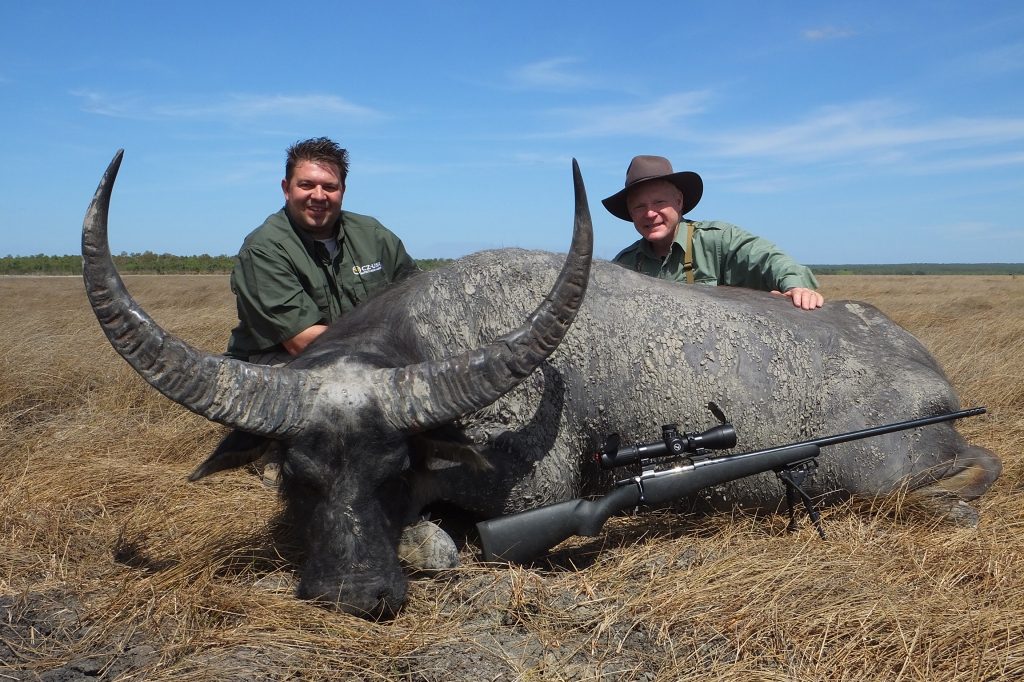
Such restrictions are almost unique to Africa. Alaska and Canada don’t have different caliber criteria for big bears. Such restrictions also don’t exist in Asia, Australia, or South America, where other large bovines (mostly water buffalo) are hunted. Generally speaking, water buffalo aren’t as aggressive as their African counterparts. However, water buffalo are considerably bigger than Cape buffalo…and not all of them have read the script. A prominent and well-experienced Mexican hunter was recently killed by a water buffalo in Argentina.

Water buffalo should not be taken lightly but, absent specific legal criteria, I’ve taken the opportunity to experiment a bit, using 7mms, .30-calibers, and .35s. With heavy-for-caliber expanding bullets (or solids), the light calibers (7mms and .30s) worked wonderfully. The .35s, .350 Rem Mag and .35 Whelen Ackley Improved, were unimpressive, multiple shots required. I put this down to too-light bullets. The only available option was 225 grains; results might have been more impressive with 250-grain bullets (or heavier).

Absent minimum requirements, Boddington has “experimented” with lighter calibers on water buffalo. This bull was taken in Argentina with a .350 Remington Magnum. Performance was not impressive, but Boddington put that down to too-light-for-caliber 225-grain bullets.

Two problems with all that stuff: First, samplings are too small to draw conclusions. With African minimums in place for decades, below the standard minimums of 9.3mm and .375, there isn’t much data, and almost none with modern bullets. Second, with buffalo one must play the “what if” game. If things go wrong, bigger is better for stopping a charge so, where legal, if a lighter cartridge is chosen, somebody best be on hand with a heavy rifle!

Now, from .375 H&H upwards, what works on buffalo is pretty well known. The .375s are fine, the .416s a bit more decisive, the big bores more dramatic yet, but not essential. Although the spectrum is narrow, there is value in considering minimal options, simply because of recoil. On buffalo, where we hit them, and what bullet we hit them with, are more important than caliber, case dimensions, or even velocity and energy.

Shooting at buffalo is no different than anything else: Most people place their shots better with cartridges that are easy to shoot. And, nobody shoots well with cartridges we are afraid of. Most people can learn to handle a .375 H&H, but too many gravitate to more powerful cartridges. Faster, harder-kicking .375s; slower, harder-hitting, and harder-kicking .416s; on up to big bores. With equally good shot placement, all may take a buffalo down a bit more quickly. However, dead from a well-placed, minimally adequate shot beats wounded by a bad shot from a more powerful cartridge.

It’s still about shot placement. I’ve seen buffalo missed clean, and wounded and lost, with very big guns, including .500 Jeffery and .505 Gibbs. Maybe the same would have happened with smaller, lighter, easier to shoot cartridges…but maybe not.

So, what easy-to-shoot legal options do we have? House the .375 H&H in a heavier rifle and it’s more manageable. Also, consider bullet weight. Since 1912, the 300-grain bullet has been the standard .375 formula for larger game. With the great bullets we have today, buffalo can be taken very effectively with tough 250 and 270-grain .375 bullets, which produce less recoil.

Which brings us to the 9.3mm alternative. The 9.3×64 and the .370 Sako Magnum (9.3×66) produce about the same power as the .375 H&H, so neither offer lighter recoil. The 9.3×62, dating to 1905, was designed to replicate, in bolt actions, the performance of the older 9.3x74R in double rifles and single shots. With 286-grain bullet at 2,360 fps, they do not equal the .375 H&H’s 300-grain bullet at 2530 fps, but they are long-proven adequate for buffalo, and are street-legal in all African jurisdictions.

Recoil is milder…if gun weight is similar. I have a little Sabatti 9.3x74R. It’s amazingly accurate for a double, but it only weighs six pounds. It is not a low-recoil option! In fact, it’s a hard kicker, but it’s accounted for buffalo with a single shot. In a bolt-action of reasonable weight, the 9.3×62 is a lower-recoil option. With 117 years of use in Africa, we know the 9.3×62 is adequate for buffalo, and it’s easier to shoot than larger cartridges.

Other options are few, but there is one more. In 1999 Hornady teamed up with Steyr to create the .376 Steyr around Jeff Cooper’s “big bore scout rifle” concept. Based on the 9.3×64 case necked up to .375, it propels a 270-grain bullet at 2600 fps, producing just over 4000 ft-lbs. So, on paper, unquestionably adequate. It has not been among Hornady’s greatest successes, but we happen to have one.

Donna’s .375 H&H is on a Blaser action with a stiff barrel. Heavy enough, she handles it just fine and we’ve both shot multiple buffaloes with it. Years ago, I thought it would be a good idea if she had a lighter, handier buffalo-capable rifle, so I got Kerry O’Day at MGA to build her one. Kerry recommended a 9.3×62 but I insisted on the .376 Steyr. At the time, I didn’t predict that the .376 would become…uncommon. We’ve used it a bit, but never on buffalo. Long curious, I thought it was about time, so she used it for a Mozambique swamp buffalo in November ’22, hunting with young PH Xavier Schutte. Hornady factory load, 270-grain protected-point Interlock, shoulder shot at sixty yards. Her buffalo dropped to the shot, then tried to struggle up as they approached. A second shot at thirty yards put him down again to stay.

The .376 Steyr is not as powerful as the .375 H&H…and kicks less. Although faster than the 9.3×62, the .376’s lighter bullet has lower Sectional Density, so I’d rate them similar in performance. Bullet weight and velocity differences between the two wash each other, so felt recoil is also about the same. As always, one animal proves nothing, but I’m convinced I was right all along: The .376 Steyr is buffalo-capable, fully street-legal, and therefore among our very few reduced-recoil options.

This Mozambique bull was down and out with a single 286-grain Interlock from a Sabatti 9.3x74R. PH Ben Rautenbach is ready with his double .500, but it wasn’t needed. That’s an important point when you go “light” for buffalo: Maybe not a great idea if you’re hunting alone!

Leave a Comment

All About Himalayan Tahr

Pursuit of this magnificently maned goat makes for a fantastic mountain hunt.

In summer, the Himalayan tahr is a drab, stocky goat seriously cheated in the horn department. Ah, but as weather cools and it’s time for winter coats, mature males grow a long, luxurious golden mane or throat ruff. During the mating season, dominant males fluff out their manes in ritual display–perhaps quality of mane replaces headgear in impressing their ladies. A bull tahr standing on skyline, presenting his colors, is one of the most dramatic sights in Nature. When a tahr stands with its head up, the horns are almost invisible, so it’s the dramatic mane that draws our eyes, more like a lion than a horned animal.

Although not closely related, the tahr has parallels with our Rocky Mountain goat: Short, unimpressive horns, with the luxurious coat an important part of the trophy. It is essential to hunt tahr when it’s in its winter coat (which lasts through spring), when the mane is full; likewise, it’s best to hunt our American goat as late as possible, when the snow-white coat is longest. The tahr isn’t as big an animal as the Rocky Mountain goat, with the biggest males at least a quarter smaller, maybe 200-plus pounds. It’s still a big animal to get off the mountain but, like our goats, they look much bigger than they are because of the long hair.

A really fine New Zealand tahr, taken by Donna Boddington on a walk-up hunt with Chris Bilkey in 2015. This bull has it all: Awesome horns, and a fantastic mane. Taken at about 150 yards with her .270 Winchester.

Although also short, horns are not similar. The tahr has much thicker bases, up to ten inches in circumference, and horn length in good bulls is around twelve inches, occasionally reaching fourteen inches with the largest known. Like most Caprinae, the horns have annular growth rings. Also like many sheep and goats, tahrs head-butt in mating battles. The sharp tips tend to curve back and down. Naturally, this is said to limit penetrating horn wounds during mating battles. It must work, because in my experience bull tahrs with broken horns are unusual. Like our goat (and chamois), female tahrs have horns, but the female’s horns are much smaller, almost vestigial.

There are actually three tahrs, once thought separate species of one genus, but they’re not so closely related, so science now identifies three genera, all with one species and no known subspecies. The two not many have heard of are the Arabian tahr (Arabitragus), believed to be hanging on in parched, rugged mountains in Oman; and the Nilgiri tahr (Nilgiritragus), still with a known, protected population in southern India.

The tahr most of us know about, and the only one of interest to hunters, is the Himalayan tahr, Hemitragus (half-goat). The Himalayan tahr is widespread and reasonably plentiful along the southern fringe of the Himalayas, native to a long strip between India, Nepal, Bhutan, and tipping into southern Tibet. This is because the tahr isn’t a creature of the highest mountains. Like most goats, they love rough country, so are found in the tall foothills, not among the higher peaks. Nepal is still the only place where the tahr can be hunted native-range and free-range.

In Nepal’s Himalayas, you look for them in steep, brushy cuts near timberline, in that latitude about 12,000 feet elevation. The blue sheep, or bharal, are found higher up, almost in the big mountains proper. Although tough, the mountain hunt in Nepal is one of the world’s best mountain expeditions. There is some chance along the way for muntjac and wild boar. Now-protected goral and serow will probably be seen, with sightings of leopards and bears possible, but Nepal is primarily a two-species hunt: Blue sheep and tahr.

Although you must climb to higher elevation for the blue sheep, in my experience tahr was the more difficult pursuit. Not nearly as plentiful, singles and small groups rather than herds, and much more difficult to glass. The tahr country is also steeper and rougher. Once you get on up to 14,000 or 15,000 feet, the blue sheep tend to be found in big, open, treeless valleys and on wind-swept ridges. In Nepal, almost everyone gets a blue sheep. Not everyone will find a shootable tahr.

Nepal was my most memorable mountain hunt, and I was fortunate to take excellent specimens of both blue sheep and tahr. We saw quite a few; partner JY Jones and I took our tahrs in just two or three days, then moved camp on up above tree line to hunt blue sheep. Although excellent in all ways, it was a tough hunt. I’d like to do it again, but that was a dozen years ago, and I’m not certain I’m still capable.

Boddington and Nepalese outfitter Mahesh Busnyat with Boddington tahr from Nepal. At the time taken, this bull was easily in the top ten. This was a spring hunt, so the coat is badly disheveled. Once cleaned up, the colors and long hair were still present.

Fortunately, Nepal isn’t the only place the Himalayan tahr can be hunted, and probably not even the best. As well as New Zealand’s Southern Alps, the Himalayan tahr has been introduced into Argentina, South Africa, a few isolated spots in Europe, and even the United States. There are tahrs on some Texas ranches, but there have also been at least three little-known free-range populations in the United States.

The tahr was part of Dr. Frank Hibben’s “ecological niche” experimentation that also brought aoudad, ibex, and gemsbok to New Mexico. Tahr persist in some remote canyons, but the population isn’t large. William Randolph Hearst introduced them onto his Central Coast “Hearst Castle” estate. At one time they were plentiful, often seen on the long driveway up to the castle, frequently wandering off onto adjacent ranches where they could occasionally be hunted. Current status is unknown, but it’s believed the now-plentiful cougars have hammered them badly. For sure, there aren’t as many as there once were; I haven’t heard of a sighting lately, but that stuff is kept pretty quiet. There was also a small breeding population on private land near the Chalk Bluffs in northeast Colorado, but I haven’t heard anything about them in years.

New Zealand was naturally devoid of large mammals. During the latter nineteenth and early twentieth centuries, widespread experimentation was done to fill that void, with numerous attempted introductions. Little-known failures included blue sheep and mule deer. Moose made it for a time but, although still rumored, have probably been gone for fifty years. The successes are better-known: Fallow, red, rusa, sambar deer, chamois, and Himalayan tahr. In 1904 the Duke of Bedford sent six tahr to New Zealand from his Woburn Abbey estate. One jumped off the boat, so only five survived. In 1909 the Duke sent five more, and all made it. These thirteen tahrs are the basis for the tahrs now widespread across the South Island’s Southern Alps.

Legally (and controversially) considered a pest, New Zealand’s quasi-management goal is to maintain tahrs at a maximum of 10,000 animals. Actual population is possibly still much larger, but they have been exterminated from much Crown (public) land by helicopter gunning. The good news: They are also plentiful on various large, unfenced private stations (ranches), where the government cannot eradicate them, and they are also a fixture on large hunting estates.

Tahr only occur on the South Island, without question the best place in the world to hunt them. New Zealand is justly famous for the world’s biggest red stags, but here’s the rub: New Zealand’s awesome stags are largely a product of decades of active deer farming (for venison and velvet), so the biggest stags are almost invariably behind wire. The majority of tahrs (and chamois) are free-range, so I rate the Himalayan tahr as New Zealand’s top animal and best hunt.

Craig and Donna Boddington with Donna’s first tahr, taken with Kiwi Safaris. This was a drop-off helicopter hunt, dropped off on top in the morning and hunting down the mountain through the day.

Helicopter access and, sadly, even gunning, are generally legal and common in New Zealand.   I don’t care for the latter, but helicopter drop-off can be an option. Especially on the west coast, the mountains rise so precipitously that it’s almost impossible (and deadly) to get up or down without technical climbing gear. The north-central mountains generally aren’t as steep, so there are a lot of areas where walk-up tahr hunting is practical.

Starting in 1988, I suppose I’ve done at least a dozen tahr hunts in New Zealand. Not all for myself; Donna has shot a couple, daughters Brittany and Caroline one each, and I have sometimes accompanied other hunters. I love it; it’s a real mountain hunt in gorgeous country for a fantastic animal. Like everything else, prices have gone up, but a New Zealand tahr hunt won’t break the bank and, if you’re up for the climb, it’s cheaper without helicopter time.

I’ve done just two tahr hunts with helicopter assistance, once on the west coast where that was the only safe way. Another time, Donna and I got dropped off on top and hunted our way down, a long day but great fun. The rest have been walk-up hunts, mostly with Chris Bilkey, who specializes in such things. Tough, yes, but never a killer. In 2011, I went along with Bilkey and Bill Jones just three months after my heart attack. I figured if I could survive that I’d be good to go, and I have been. Lord knows I don’t need another tahr, but that’s probably a climb I’ll make at least one more time!

View from the top, just after helicopter drop-off. In an hour the clouds went away and the Boddingtons hunted downhill in glorious weather. The shot came late in the afternoon, reaching the bottom just after dark.

Leave a Comment

The North American 29

Or are there actually 40 species of big game on our continent? It all depends on which list you use.

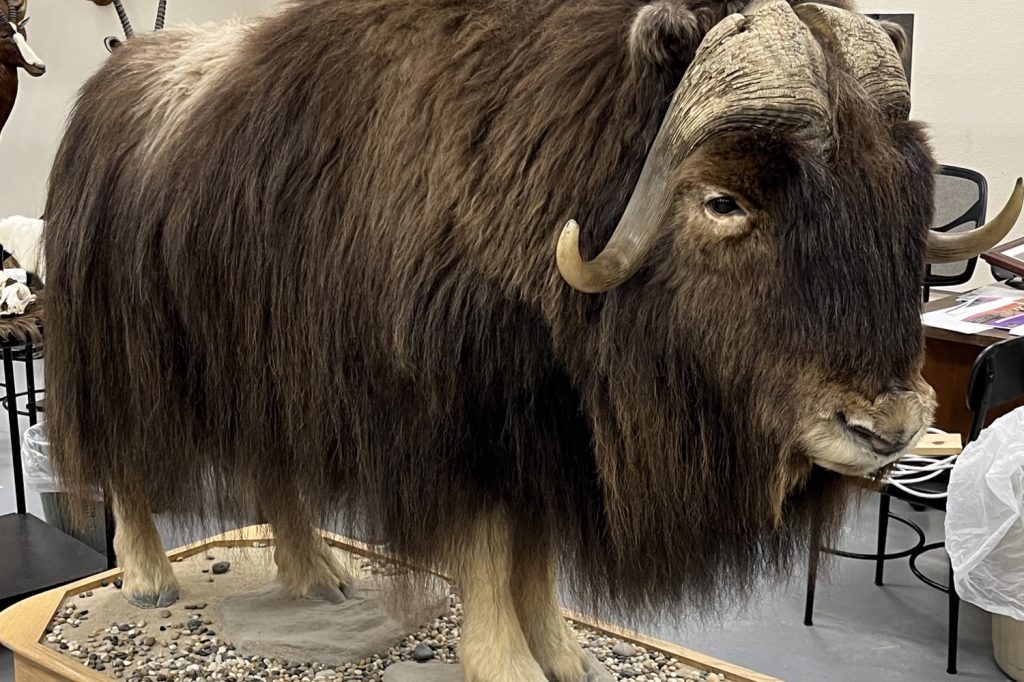
Photo above: A massive old muskox bull. Photographed in Greenland, this is (of course) a Greenland muskox. Canada has both Greenland and barren ground varieties, visually indistinguishable, but the barren ground muskoxen get bigger.

In the early 1950s, about the time I was born, New York ad executive Grancel Fitz became the first person to take all known varieties of North American big game. Quite a feat, especially in Fitz’s day, when air travel was in its infancy.

 Who knows what fuels our dreams when we’re young? I was young when I read about this, thought it was cool, and decided it was something I should accomplish. In the 1980s I was making good progress; I dared believe I might pull it off by the time I was forty.

Not even close. Polar bear hunting was coming and going, and I didn’t have a desert bighorn. I was fifty, just back from the Persian Gulf, when I ponied up a year’s worth of combat pay to hunt a desert sheep in Sonora. That left the polar bear, still open in Canada’s Arctic, but with importation getting iffier. I was in my mid-sixties when I finally choked it up and shot a beautiful white bear, completing a half-century quest. If anyone cares, my polar bear is life-size mounted in the conference room of the Leupold distributor in western Canada. I need to visit him.

Today we reckon at least twenty-nine varieties of North American big game. Grancel Fitz, instrumental in developing Boone and Crockett’s measuring system, worked off a different list than we do now. In his day, jaguar hunting was open in Mexico, as were both Atlantic and Pacific walrus hunting. The Central Canada barren ground caribou category did not exist, nor did we recognize Sitka blacktail or the then-protected tule elk.

Grancel Fitz with a fine Dall ram in 1935. Fitz was first to use a baseball term for taking all four North American wild sheep. Years later, he was the first person to take “all” North American big game species, as known in his day.

So, the “complete” list of North American big game has changed. Delete this, add that, but during my lifetime North American big game has been resilient, a testament to our North American Model of wildlife conservation, largely instituted by Theodore Roosevelt during his presidency, and initiated by he and his friends when they founded the Boone and Crockett Club in 1888.

We all know northern Quebec’s great caribou herds have crashed, with nonresident caribou hunting now closed. I recently saw a report that suggested Quebec-Labrador caribou hunting might be closed for fifty years.

Because of that caribou, this is one of few times in my life when hunting all of the North American big game species has not been a possible dream. The first time was when Mexico closed jaguar hunting. Importing a legally-taken jaguar into the US has not been possible since 1971, but hunting for them continued in Mexico for a few more years. I remember reading my colleague Jon Sundra’s story, “Last Cat from Campeche.” I’ve even seen his cat, mounted in a mutual friend’s house in Mexico (for the same reason my polar bear remains in Canada). 

Jaguars are increasing in Mexico and reoccupying their former range. From a pure management standpoint, funds from a handful of hunting permits could do much for conservation. But the jaguar is such an iconic and politicized animal that I doubt there will be another legally taken North American jaguar.

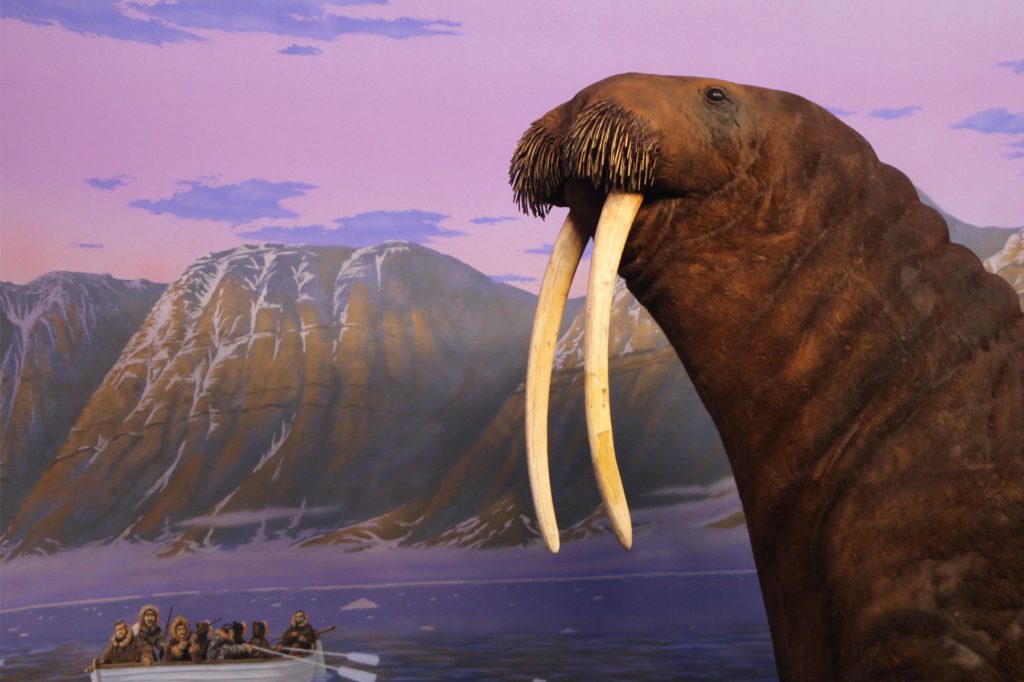
Sport hunting for Pacific walrus in Alaska has been closed since 1979 and seem unlikely to open again, despite a population exceeding 200,000. The Atlantic walrus is somewhat smaller in both body and tusk. Its numbers are also smaller, but stable, and limited hunting has been conducted in Canada’s Nunavut for some years.

Over the last forty years, we have essentially removed the jaguar and Pacific walrus from our list of huntable North American big-game animals. Now must we do the same with the Quebec-Labrador caribou?

Boddington and Dwight van Brunt with Dwight’s awesome desert mule deer. Although antlers get nearly as large as Rocky Mountain muleys, the desert mule deer is a distinct subspecies, smaller in body and paler in color.

Since the days of Grancel Fitz, twenty-nine has been the traditional magic number for North American big game. Within their world hunting awards system, Safari Club International (SCI) offers recognition for the “North American 29.” The Grand Slam Club/Ovis (GSC/O) “Super Slam” award is presented for taking twenty-nine North American big-game animals. So, for those of us who like to organize our dreams, there is more than one list to choose from.

The Super Slam list is traditional: Four bears (black, grizzly, Alaska brown, and polar); five deer (whitetail, Coues, mule, Sitka and Columbian blacktail); three elk (Rocky Mountain, Roosevelt, tule); five caribou (mountain, woodland, Quebec-Labrador, barren ground, Central Canada barren ground); three moose (Canada, Alaska-Yukon, Shiras); four sheep (Dall, Stone or Fannin, Rocky Mountain or California bighorn, desert bighorn). Plus: cougar, bison, muskox, mountain goat, and pronghorn.

So far, so good: that’s twenty-nine. There are also four auxiliaries: jaguar (if taken before 1972); Pacific walrus (taken before 1980); Atlantic walrus; and wolf. Wolves have long been hunted as big game (with seasons and licenses) in Alaska and various Canadian provinces, and they now are hunted in several Western states. The wolf is a problem creature in multiple ways, but in this case it messes up the magic number. Interestingly, in their Super Slam, GSC/O solves two problems with the wolf: it may be substituted for the now unavailable Quebec-Labrador caribou.

SCI’s “North American 29” list includes all the same animals, but adds eleven more, for a total of forty possibilities. Any twenty-nine within this list (including at least three sheep) qualify for the award. SCI’s additional animals include jaguar (darted or pre-1972), both walruses, and wolf; they also add Fannin (a natural hybrid between Dall and Stone) as a fifth sheep. SCI also adds several subspecies they track in their record book. These include: continental (inland) and coastal (Pacific) black bear; both eastern and western Canada moose; Arctic Islands caribou; desert and Tiburon Island mule deer; and alligator.

The two approaches show that it’s not a simple subject, complicated over time by more knowledge, hunting closures, and new opportunities. Maybe it’s a good thing that no such list can ever be quite perfect. Traditionally, we have always separated the Coues whitetail, based on a taxonomic error that considered it a full separate species. The Coues deer is just one of thirty-eight recognized whitetail subspecies, and twenty-nine of them occur above the Panama Canal. I love my whitetail hunting, but I’m glad I don’t feel compelled to hunt a couple dozen varieties! There are also two distinct muskoxen, Greenland and barren ground; and two bison: plains bison and the gigantic wood bison.  All offer hunting opportunities, but we rarely separate them.

A wide Quebec-Labrador caribou taken in 2001. Once over a million strong, numbers have dropped to a few thousand, with all nonresident sport hunting closed.

There is now yet another list, or new challenge. GSC/O has ascending levels for mountain hunters: Super 20, 30, even 40, for sheep and goats, but the Super Slam was North America’s pinnacle. My old friend Rex Baker felt this inadequate for our continent, so he cooked up a new list and award, the Rex Baker Super 40. Similar to SCI’s North American 29, Rex’s list is forty-four species deep, any forty required. Included are most of SCI’s additional animals, with a few differences.

Jaguar and Pacific walrus are dropped, since both are closed and few hunters still active hunted them. The bear category adds glacier bear, a color phase hunted on a black bear tag; and barren ground grizzly, hunted in Nunavut. Gray wolf is on the list, plus alligator and Atlantic walrus.

Rex’s other “new” animals are especially interesting. His sheep category separates Fannin and California bighorn, and adds aoudad, the first time a non-native animal has been included in such a listing. I tend to agree because free-range aoudad are widespread and offer a real sheep hunt. Also new to the list are wolverine and Canadian lynx. Like wolves, they are often trapped, but also can be hunted by a licensed hunter as big game. Then comes the zinger: Among the deer, both gray-brown and red brocket are added. Distinctly different, definitely North American, hunted in southern Mexico, and desperately in need of recognition. The more common gray-brown brocket is tough; the red brocket is a serious quest.

Increasingly, hunters are starting to think of eastern and western Canada moose as distinct varieties. This fine bull is from Newfoundland, so an eastern Canada moose but, whatever you call it, it’s Boddington’s best Canada moose.

Rex Baker is one of the world’s greatest living hunters. He won the Weatherby award fifteen years before I did, and I didn’t think there was much out there that Rex hadn’t hunted. When he cooked this up, he didn’t quite have forty of his forty-four choices. One he was missing was a red brocket. I didn’t have one, either. Rex finally got his in March 2022; I got one a week later. For Rex and me, it was our fourth hunt for this pesky little deer. For Rex, this completed his own forty-animal quest.

As for me, I’m close. I never hunted barren ground grizzly or California bighorn. I was booked for Atlantic walrus in 2020, but it got Covid-cancelled, and I haven’t gotten it done yet. I also don’t have a wolverine. I’ve seen several, but never when the season was open. I have no idea how to hunt one on purpose.

Hey, forty distinct Norh American animals is hard! I thought that red brocket turned the trick, but I was wrong. In 1995, out of Yakutat, Alaska, on my third hunt for a glacier bear, I took a big, navy-blue bear. I believed it was of that color phase, turning dark with maturity. So, for twenty-seven years, I’ve given myself credit for having a glacier bear, but Rex’s committee rejected it as not light-colored enough. So, that challenge is still out there!

Rex Baker with a fine red brocket, one of the most difficult North American prizes. This was Baker’s fourth attempt, completing the forty-animal challenge that he created. Boddington got a red brocket a week later, also his fourth hunt.

Leave a Comment

Reflections of a Hunter’s Hunter

Legendary PH and conservationist Robin Hurt on the future of wildlife and hunting in post-Covid Africa.

Photo above: Robin Hurt with his two beloved Bavarian mountain hounds.

The two sleeping giants arrive in square metal containers in a cloud of dust and light.  At 2:48 a.m., a flat-faced Volvo crane truck ended its all-night, 500-kilometer trek just inside the gate of a 15-acre boma in the Groot Gamsberg region of Namibia. The female white rhinos aboard have completed an unlikely journey of hope and survival.

As the truck crawls to a stop, the snap and woosh of the air brakes initiate a ballet of human hands, cables, and hydraulics.  Piling out of the cab, the transport crew works quickly beneath an array of floodlights telescoped above the truck. Harsh illumination spills down, casting an arc of white on the men and the boma’s grass; beyond it, all else is pitch black. Outrigger arms from the truck’s chassis whirr and extend like an alien insect to find the ground and stabilize the platform.  Then, finally, the team attaches the containers by cables, and the crane gently places each on the ground beside the truck.

Three of us watch from the shadows atop a spotting bench in the bed of a Toyota safari vehicle.  Mere observers at this point, we’re positioned behind and up a slight rise from the containers. The crew’s animal wrangler climbs atop a container holding what looks like a basting syringe in his right hand. He slides back a panel, and the top half of his body disappears into the darkness of a hatch on the container’s roof. The syringe holds an antidote to the sedative that followed the MD99 immobilizer that downed the white rhino cow from the Gobais region in the east of Namibia—a single drop of which would be lethal to a human.  

The wrangler explained minutes earlier he would squirt the liquid into the rhino’s ear, where it would be quickly absorbed, bringing the 4,000-pound animal out of her slumber. The first sound we hear is the flexing crash of the container’s thin metal walls as the wrangler backstrokes his way out of the hatch. The rhino is awake and not happy with her accommodations. The wall slamming continues while an assistant pulls a chain to open the roll-up door at the container’s end. The door flies up with a metallic rip, and the rhino charges out into the light. She descends the ramp and spins her massive body 180-degrees to face the crane truck and the lights. Temporarily blinded and disoriented, she lowers her head and exhales in aggressive, audible blasts that press dust clouds into the light beams crisscrossing her small patch of earth. At that moment, our safari vehicle seems entirely too close and small. As she adjusts to her surroundings and weighs her instinctual options, the lights shining directly in her eyes serve their secondary purpose of obscuring the people and vehicle from which she emerged. How is it possible for an animal weighing two tons to move so fast and change directions as if she were a weathervane hit by a sudden gust of wind? We just witnessed it–African nature at its most remarkable, but at the same time deeply vulnerable.

The two female rhinos will spend ten days in the 15-acre holding boma for observation, and then released to roam freely across 20,000-acres of wilderness. Though a man renowned among clients and colleagues alike for his focus and grit, Robin Hurt was flooded with unexpected emotion, “After all the work and planning, I couldn’t believe it was happening,” he recalls. 

Africa was Home

Born in London in 1945, Hurt’s life began amidst the turbulence of World War II. Running the gauntlet of German U-boats on a steamship from Mombasa, his father, Roger, and mother, Daphne, sailed around Cape Horn to England. Hurt’s father, a Lieutenant Colonel in the British Army, was recalled to London to receive the Distinguished Service Order from King George VI of England. Daphne was a Kenyan of British ancestry and gave birth to Robin while German buzz bombs rained down on London. Shortly after the end of the war, Hurt’s father accepted a position in the Kenya Game Department. Kenya was then a colony of the British Empire.

Reared on the shores of Lake Naivasha, Kenya, northwest of Nairobi, Robin began his education in the African bush almost at birth. Though educated in British-modeled boarding schools, a connection to the bush and the difficulties of undiagnosed dyslexia left him constantly distracted from his classwork by what lay outside the school walls. As a child, he spent most days around the family farm exploring with his Maasai friend, Tinea.

Young Robin wanted to hunt, but his father was strict with firearms, only allowing Robin to carry a rifle on his own when he could prove to be safe and proficient. At age 8, Robin received his first rifle, a .22 caliber Krico. When he grew large enough to handle its weight and recoil, his grandmother, a woman of Kenyan settler stock and nurse in World War I, allowed him to shoot her .256 caliber Mannlicher at targets. When Robin was 12, a rampaging leopard killed twenty sheep, mauled a farmworker, and snatched his grandmother’s Jack Russell terrier off the veranda. Late one night, Robin heard growling outside his bedroom window. The leopard had returned and was twenty yards from the window—surrounded and slashing with razor-sharp claws at the farm’s baying dogs. Robin retrieved the .256 from under his bed, loaded it, and crept back to the window. Opening the window as quietly as possible, he could see the leopard in the full moonlight. As soon as the circling dogs left space for a shot, he fired from inside the house. The big cat immediately jumped and ran into the shadows. Hearing the noise, his grandmother burst into his bedroom, thinking Robin had accidentally fired the rifle indoors. Robin explained he had aimed carefully but was unsure of the shot. His grandmother wisely decided they would investigate in daylight rather than pursue a wounded leopard at night. Robin’s aim was true. They found the leopard stiff and dead 100 yards from the house, and his life as a big-game hunter had begun.

Over his father’s objections, 18-year-old Robin carved a path away from the family’s tradition of a Sandhurst education (the UK’s West Point) and a military career. He elected instead to become a licensed Professional Hunter (PH). Not merely a permit to guide clients for money, an African Professional Hunter license requires both a multi-year apprenticeship and passing a series of exams that cover game identification and hunting techniques, field medicine, firearm safety, and ecology.

Hurt spent weeks in the bush with his father’s Kenyan game scouts throughout his youth. But his formal training began via an apprenticeship with Kenya’s top Hunting Safari company, Ker Downey and Selby (KDS). At KDS, Hurt learned from a legacy of experience that stretches back to the late nineteenth century. One mentor, Harry Selby, made famous to American readers by Robert Ruark’s book, Horn of the Hunter, was himself mentored by Philip Percival, the PH who guided Theodore Roosevelt and Ernest Hemingway.  

Over the next several decades, Hurt and his clients explored his native Kenya and neighboring Tanzania and more exotic regions such as the Sudan and Zaire. At that time, the areas were largely undeveloped, and warfare between rival tribal factions could and often did break out. His reputation grew as an intensely focused PH whose clients found the largest animals. Among many awards, he won the Shaw and Hunter Trophy in 1973 for a 54-inch buffalo hunted in Lolgorien, Kenya. Hurt was also the featured PH in George Butler’s documentary, In the Blood (1990). The film traces the steps of Theodore Roosevelt’s famous 1909 safari chronicled in his book African Game Trails. Joined by Theodore Roosevelts IV and V but told through the eyes and narrated by Butler’s teenage son, Tyssen, the film chronicles the family tradition of hunting and examines issues facing African wildlife. The film also features quotes and vintage film clips of then former-President Roosevelt’s safari and a shooting competition with his Holland and Holland .500/.450 Nitro Express double rifle on loan from the Smithsonian Institute and reconditioned for use in the film.

Not always glamour and adventure, the life of a PH and the safari business can be costly and sometimes deadly. When hunting in Zaire (now Congo), Customs officials extorted Hurt, refusing to return a large sum of money held as a surety on his safari vehicles and equipment. The state-sponsored theft resulted in a painful financial loss for the season and the return of deposits to nearly 20 clients whom he could not take on safari. The monetary damage forced Hurt to sell his home in England to cover the losses. Hurt was also severely mauled by a leopard in 1992. Nearly 200 pounds, the high-altitude leopard was significantly larger—both in tooth and claw—than a typical cat of that species. In less than 30 seconds, the leopard put 32 bite holes and two massive claw wounds into Hurt. The mauling crushed his right elbow and severed a large vein in his left leg requiring multiple daily scrubbings to disinfect the wounds. Over more than five decades in the African bush, Hurt has seen many close friends and fellow Professional Hunters killed by dangerous game, poachers, and the accidents that befall those who operate far from modern medical facilities.

But throughout Hurt’s extraordinary life experiences and fifty-nine seasons as a Professional Hunter, one element has remained unchanged—his commitment to supporting and protecting Africa’s wildlife and wild places. “When I began my career as a professional hunter at the age of 18 in 1963, Africa was a sea of wildlife with islands of people. Today, we have the exact opposite. Africa is islands of wildlife facing a tsunami of people.”   

In 1990, Hurt founded the Robin Hurt Wildlife Foundation (RHWF) to develop linkages between Tanzania’s sustainable utilization of wildlife, poverty alleviation, and the maintenance of healthy ecosystems. The program, funded by hunter-conservationist money and ideals, turned poachers into anti-poachers by engaging and supporting the local communities to become better stewards of the natural environment. A commitment shared by the family, Hurt’s two sons, Roger and Derek, now run the Tanzania company as well as Foundation. 

In addition to the support of wildlife, the RHWF takes a holistic approach to community engagement. Over the past fifteen years, the Foundation has donated over $3.2 million building 37 schools, 75 houses for teaching staff, and 28 health dispensaries in addition to numerous water pumps, and other life sustaining equipment such as tractors, milling machines and ambulances. More than bricks and mortar, the facilities train and educate the citizens on the value of conservation and the sustainable utilization of wildlife.  

Recognizing the critical nature of poaching’s impact on the rhino population across Africa, Hurt’s wife, Pauline, concluded the best way to protect them was to create an organization to help “spread the risk” by moving the rhinos from areas of high concentration near human populations to more remote locations. The rhinos would then freely roam and multiply, protected by professional game guards and hunters away from poaching pressure and human encroachment. From Pauline’s original idea, the Hurt’s leveraged their contacts and influence to found Habitat for Rhinos in 2014. They raised funds to secure concessions and relocate rhinos to their ranch in Namibia. More were added over time, to include a mature bull, “Big Daddy,” who has sired more babies, including two in 2021, bringing the total to eleven.  Pauline’s son, Daniel Mousley, is a professional hunter who works with Robin in the Namibian safari operation alongside the rhinos.

The rhinos on the Gamsberg Concession will not be hunted. The long-term goal for the program is to build the herd and ultimately relocate select rhinos to other remote locations managed by like-minded people committed to protecting the critically threatened species. Two full-time anti-poaching guards protect the animals. The guards track the animals daily and scout for signs of human intrusion. Support for the care and protection of the rhinos comes from the proceeds of plains game hunting on the property and donations from hunters. The Hurts also host photographic safaris and tracking the rhinos has become increasingly popular. In addition to protecting the rhinos, Habitat for Rhinos employs numerous locals that support paying guests and the ranch’s facilities.

At the 2020 Dallas Safari Club Convention, the Hurts received the prestigious Capstick Award, in recognition of the success of Habitat for Rhinos, for “long-term support and commitment to our hunting heritage through various avenues such as education, humanitarian causes, hunting involvement, and giving.”  

Hurt on The Future of Wildlife and Hunting in Africa

At 77, Hurt retains the visage of a lifetime in the sun and carries himself with the same dignified bearing and direct, precise speech that keeps his clients focused and junior PHs on their toes.  I recently spoke with Robin to get his thoughts on the future of African wildlife in the post-Covid environment.

Len Waldron: In a recent speech at the International Council for Game and Wildlife Conservation (CIC), you said Africa is on a cliff edge. Could you explain your thoughts?

Robin Hurt: It’s African wildlife that is on a cliff edge, not Africa itself. The reason I say that is because we have all this negative hunting information being sent around the whole world on the internet. It goes viral. Look at Cecil the Lion; most of that was a misunderstanding. So that’s why we live in such a dangerous time as far as the future of wildlife goes. All this anti-hunting sentiment is based on emotion—it’s not based on realism or science. And that is dangerous because if you stop hunting, like what’s happened in Kenya, the wildlife populations go down. If people do not benefit from wildlife, they will not keep it. It’s as simple as that. Recently, I wrote to Minister Goldsmith in London about this proposed ban on trophies coming into the UK. I said, “If you do this, you are signing a death sentence on wildlife. For example, on places like ours where currently we have wildlife, it will be replaced with domestic animals like cattle, and they are the biggest polluters on the whole planet.” So, I asked, “What do you want? Do you want wild animals roaming there, and we benefit, or do you want domestic animals there?” That’s really what it boils down to. The wildlife will survive forever, provided people benefit from it. But the minute people stop benefitting from wildlife; it becomes cheap meat or a nuisance. If someone’s grandmother is out collecting firewood and killed by an elephant, what are they going to do? They are going to kill it. But if that elephant is a valuable asset, they will think twice about killing it.

You cannot make the whole of Africa into a huge national park. Period. And most of the wildlife actually occurs outside the national parks. It’s those animals that are on the cliff’s edge right now.  

Len Waldron: You’ve spent a lifetime supporting the conservation of wildlife. When was that ethos instilled in you?

Robin Hurt: I grew up with it. My father was a game warden. It was mainly from my dad, but also his game scouts. All my early hunting I did with his game scouts.  

Len Waldron: What do you think hunter-conservationists have done best?

Robin Hurt: That is a very good question. To be honest with you, I don’t think we have done enough to promote what we do. That’s why in my speech last night (accepting the Capstick award), I said it’s time we put aside these differences with anti-hunters and get together and talk about conservation—and find a middle road. We can’t be at loggerheads the whole time because that is bad for wildlife. I believe in working with people rather than against them. The biggest problem is that some people don’t want to listen, even if you have all the facts. But I take the time to talk with people. I’ve talked to people who are so dead anti (anti-hunting), and then after I have explained that I am a manager of wildlife and not a killer of wildlife, they begin to realize.  

I am really adamant that this term “trophy hunting” has got to stop. We don’t go hunting just for the bloody trophy. And I use the word “bloody” because that is the result. We go hunting for the chance and the chase, for the camaraderie, for being up close and personal with dangerous animals—it’s not just to hang something on the wall. The trophy is a treasured memento of all those things. We are not communicating well with people who do not understand hunting. We are managers of wildlife. The term ‘hunt’ has become a nasty word. We are perceived to be evil people. Another problem is that antis are humanizing wild animals–we use wild animals to live on.  

Regarding poaching—there is a lot of misunderstanding amongst the general public in defining poaching and legal hunting. It’s a common mistake to place both under the same umbrella. A poacher is the illegal, un-selective user of wildlife—simply a thief bent on the extermination of wildlife for a quick reward. The legal hunter, on the other hand, is the legal steward and manager of wildlife. His or her very existence and way of life depends wholly on healthy wildlife herds and their sustainable use—a use set by careful management quotas.  

It is not legal hunting that has led to the decline in elephant and rhino numbers. It is entirely due to unchecked commercial poaching fueling the demand for these illegally obtained products. 

Len Waldron: Is there an a-ha moment when speaking with anti-hunters that you find some begin to understand an alternate point of view?

Robin Hurt: Yes, it’s very simple. They have got to understand that if you take hunters out of the bush, there is no income coming into those places, and people are not benefitting from the wildlife, so they won’t keep it. There’s not much difference between a farmer who farms cattle or sheep and a hunter that looks after wildlife. They are both managers–some people choose to manage domestic animals, I choose to manage wild animals. 

Len Waldron: We were there together when the first rhino came out of the container onto your property. For me, it was a surprisingly emotional moment. I remember it vividly. Can you describe what was going on in your heart and mind when you saw it, having seen what has happened to rhinos over most of Africa?

Robin Hurt: It was a hugely emotional moment. I could hardly believe that this had actually happened and that we had been responsible. We did it to give back. I have earned my entire livelihood my whole life through hunting and the use of wildlife. So, we want to give back. We give back in many ways through our community projects and now with the rhino projects. If I didn’t have the love for the animals, I wouldn’t do it. And that’s what a lot of anti-hunters don’t understand. They say, “how can you love an animal and, at the same time, kill it?” But it’s the same with a shepherd or a cattle herder—he loves the animals, but he uses them.

Len Waldron: What have the rhinos taught you since they have been on your property?

Robin Hurt: They’ve taught me lots of things. First, I’ve always known they were extremely dangerous animals, but I didn’t realize how far they move in a night. They walk 15-20 kilometers a night, huge distances. And that’s the way they are. If you are following tracks the next day, you are following tracks that might be six or seven miles from the rhino. Also, the births are geared mostly towards male calves because the males fight and kill each other for the right to breed—so we are hoping for some female calves in the future.

Len Waldron: What do you think the most critical steps are in the next several years for African conservation?

Robin Hurt: The biggest threat we have is too many people. The big difference between my boyhood in Kenya and now is we had islands of people surrounded by wildlife. Today, we have the exact opposite—islands of wildlife surrounded by people. And that’s becoming a tsunami of people drowning those islands of wildlife. And that is why it is so crucial that people benefit from wildlife.

Len Waldron: 2023 will be your sixtieth season. If you were talking to your eighteen-year-old self, what would you tell him?  

Robin Hurt: When I got my license (Professional Hunter) in 1963 at the age of eighteen, a lot of my mother’s and father’s friends said I was crazy to pursue this—there was no future in it. That was 59 years ago. I say to young people—there is a future in it. Do things properly and do it ethically. Do not do any of the canned hunting that goes on. Do not do any put and release hunting. Hunt naturally and hunt ethically. And if you do that, you’ll always have it. And again, take time to talk with people who don’t understand hunting.  

Len Waldron: How as the Covid pandemic impacted African hunting and wildlife?

Robin Hurt: Covid has had a terrible effect on the entire safari industry. For most operations, this has meant 18 months of no work, and most of the hunters returning are cancellations from before. But the demand is huge, and people are returning. We managed to keep our employees and focus on improving our operations and property. We chose to pull in our horns and focus on improving our operations and property. Others were less fortunate, especially if they had debt to carry.

As for the wildlife, it is good if not better. We didn’t see an upsurge in poaching—it remained the same as before. In Namibia, we have seen consistent rains which have changed the landscape after several years of drought.

Len Waldron: You have a third book coming out. Tell us about it?

Robin Hurt: Its title is A Dangerous Game; it’s a large book featuring over forty guest writers and my own stories covering the hunting of dangerous game in Africa. The stories are first-hand accounts and images going back to the early 20th century and many untold stories such as early hunting in the Central African Republic.   

Robin Hurt’s second book A Hunter’s Hunter, was released in January of 2020 by Safari Press. His third book A Dangerous Game, is set for release at the 2023 Dallas Safari Club Convention. Click here to order it.

Leave a Comment

Want to Hunt a Red Stag?

Red deer are magnificent trophies and can be hunted in many parts of the world.

The European red deer is one of the world’s only game animals that can be found on every continent (except Antarctica). This big, beautiful deer is native to Europe and Asia, and various races are widespread on both continents. Less known, the Barbary red deer is native to North Africa. Algeria, Morocco, and Tunisia still have populations of this native African deer.

Red deer have been widely introduced all over the place. Best-known introductions are Argentina and New Zealand, but there are also free-range populations in Australia and Chile. Red deer are relative common on hunting ranches in Texas, and there have been other introductions in North America.

So, if you want to hunt red stag, almost the entire world is your oyster. That makes it complicated! Probably best start with some basic questions. Is it important to hunt native range? How about free range? Want a big stag, or a good hunt for a nice stag? What about timing? Personally, I hate reality, but budget must always be part of the discussion.

Donna, Caroline, and outfitter Chris Bilkey with Caroline’s awesome New Zealand red stag. This is a free-range stag, of quality very available today at reasonable cost,

NATIVE RANGE/FREE RANGE

Native range is simple: Throughout most of Europe, and into western Asia. The majority of red stag hunting in Eurasia is free range, but this issue is more complicated. The red deer has been farmed, ranched, and bred for so long that no region is completely free of high fences. In large areas, the experience suffers little, but if you insist on “wild and free,” then you must ask the hard questions.

Outside of Europe, Argentina and New Zealand are the primary destinations. Both have free range red deer in vast areas, but both countries have active deer breeding and game ranching industries, so the hunting is a mix. You can have either, even both, but it’s important to know. These days, there are some excellent red deer in Texas and elsewhere in North America, but free-range opportunities are unlikely.

A really good red stag from Argentina, totally free range, taken on the east shore of Lake Nahuel Huapi, close to where European red stags were first introduced into Argentina a century ago.

HOW BIG A STAG?

The biggest European stags are probably in Eastern Europe. Bulgaria, Romania, and Hungary are especially famous for big stags. Spain has excellent red deer hunting, but the Spanish subspecies is smaller. Scotland also has fantastic stag hunting, but Scottish stags are also smaller.

In Europe, animals—especially large specimens—are traditionally priced by size (using the European CIC system that Americans don’t understand). Big stags of medal quality are expensive. Europeans are used to this; Americans are not. For us, the best situation is to find a “package” that puts allows a stag up to a certain size for a fixed price, as in bronze or silver medal. These can be good deals, but you must accept the gamekeeper or guide’s judgment; you may see stags bigger than you’re allowed to take (or willing to pay for).

Stalking stags in the Scottish Highlands is a matchless experience and generally free-range. Breeding of bigger stags is ongoing, but native “hill stags” are not large, and the hunt is really a harvest, where stalking on foot is an all-important art form. Stalking stags in Scotland is not expensive, but the “sports” are absolutely expected to go with the program. Expect to see magnificent “breeding stags” that are off-limits.

In Scotland, stag hunting is primarily a meat harvest. There are some good stags, but visitors are expected to help with culling. This is an above-average Scottish stag.

New Zealand is famous for producing the world’s largest red stags. Yes, but understand that deer farming (for venison and antler velvet) has been an industry in New Zealand for generations. In the 19th Century, red deer were introduced in the rugged hills above the farmed valleys. Finding an ideal environment absent predators, they bred up to nuisance numbers. Original stock was of poor antler quality and didn’t magically improve. To this day, genuine free-range New Zealand stags have modest antlers.

Deer farmers brought in superior genetics and are producing magnificent stags, but New Zealand’s biggest stags are behind wire and, sad to say, the really big ones are typically in small pastures because of their value. This picture is changing. Between escapees and purposeful releases, New Zealand now has excellent unfenced stags in the hills above the deer farms, and on large fenced estates. However, in the back country, “genuine” free-range New Zealand stags still have modest antlers.

Red deer were introduced in Argentina’s Patagonia and La Pampa regions a century ago. They flourished and, unlike New Zealand, original releases came from good stock that produced. As a combination of antler quality, experience, and cost, Argentina probably offers the world’s best free-range red stag hunting. Free-range stags are rarely huge, but can be good. Typically, the hunting is on horseback with gauchos, and is a wonderful experience.

This is the biggest-bodied red stag Boddington has ever seen, taken by Donna in the foothills of the Andes. This is a wonderful old stag, with great mass and exceptionally long beams.

Argentina also has an active deer breeding industry, working hard to catch up with the Kiwis. So, as with New Zealand, there is a mix of free range and otherwise. Same-same, the biggest stags are behind wire. In both countries, hunts for “take ‘em as they come” stags, up to potentially excellent, are reasonable, usually less than a medium elk hunt in the Rockies. Want a really big stag? Doesn’t matter where, it will cost you. 

TIMING IS EVERYTHING

A big red stag is an amazing creature, with multi-tined crowns, thick beams, and a forest of points on each side. This may surprise you, but I’ve never shot a really big stag. I avoid fences as much as possible, and genuine free range is unusual for the biggest stags. Also, different strokes for different folks. It’s just not an animal I’ve been compelled to invest that heavily in.

That said, I’ve done a lot of stag hunting: Austria, eastern Europe, western Asia, England, Scotland, Spain; multiple times in Argentina and New Zealand. I’ve been beaten, of course, but I’ve also gotten lucky. I’ve missed the rut, too early and too late. That isn’t necessarily the kiss of death; it depends on terrain and vegetation. If you can see ‘em, you can hunt ‘em, but if the rut isn’t on, you won’t hear ‘em…and you’ll miss the real magic of hunting red deer.

They call it the “roar.” The first time I heard it, with Ricardo Medem in Spain, I had no idea what I was hearing. Honest, I thought it was a domestic cow calling to her calf. Wapiti bulls challenge with their lilting three-note bugle. European red deer roar. A deep, guttural, frightening sound that couldn’t possibly come from the throat of a deer. But it does. This is odd because our wapiti and their red deer are genetically close and interbreed freely, but the vocal challenge of mating males is altogether different. It is said that the “bugle” carries better and farther in open country, remembering that our wapiti were creatures of the Great Plains. The same theory suggests that the red stag’s “roar” carries better in European forests. Both sounds are fantastic…and altogether different.

With elk, catching the bugling is a matter of seasonality; in some states, only the bowhunters get a crack at it, and they are richer for the experience. With red deer, because of limited pressure and, often, privatization of wildlife, if you plan properly, you can catch the roar.

A fine stag taken in Austria in 1991. This is a Class One or “Einer” stag, by license at least twelve years old, a rare prize.

This could be a matter of restricted hunting pressure almost throughout the red deer’s range, but in my experience the red deer is more aggressive than the wapiti. Can’t tell you how many times (or places) I’ve been in the middle of them, stags roaring like lions. Maybe the best-ever wasn’t my stag. Donna’s turn, a horseback hunt up into the Andes above Bariloche, a deep-throated stag going crazy on an impossibly thick hillside. I stayed back with the horses while her guide carried on a conversation, drawing the stag in. Just feet, hidden gray body, and antlers through a screen of foliage at forty yards. How she found a hole to shoot through I have no idea. Antlers were thick and unusually long. Points could have been better, but it was the biggest-bodied red deer I’ve ever seen…and, to my eye, the best hundred-percent free-range stag in my experience. 

Because he is so widespread, the red deer offers a weird advantage: There are two “roars.” Yeah, only one per customer (or stag), but one in the Northern Hemisphere; another in the Southern.

It varies with area, but in Eurasia the red deer roar in late September and early October (likewise North America’s introduced stags). In South America and the South Pacific, the roar and antler cycle are opposite. Again, it varies by specific area and depends on weather, but figure late March through April. Sure, with luck and hard hunting, you can miss the roar and get a great stag, but you’re also missing hearing them screaming. So, as a North American, if I wanted a red stag, I’d first decide whether I wanted to hunt in our autumn or spring. In autumn, Scotland, Spain, eastern Europe; in spring, Argentina or South Pacific.

Marcelo Sodiro and Boddington with Craig’s best red stag, taken in Argentina. This is technically a free-range stag, but, common today, this area has been augmented with enhanced genetics.

Leave a Comment

A Legend and his Legacy

Relive the golden age of outdoor adventure with a pilgrimage to the Jack O’Connor Center in Lewiston, Idaho.

Photo above: Jack O’Connor’s Grand Slam of Wild Sheep (along with a big Dall sheep shot by his wife, Eleanor), is on display at the Jack O’Connor Center.

Jack O’Connor (1902-1978) was arguably the most famous and influential outdoor writer of all time. Even today, his opinions and experiences influence our understanding of rifles and calibers, outdoor ethics, and what it means to be a hunter. Plenty of younger hunters who have never read a Jack O’Connor story have heard his name, and most hunting rifle aficionados know him as an advocate of the versatile .270 Winchester (which was a newfangled, whiz-bang caliber when he started championing it in the 1930s).

Although O’Connor sold his very first outdoor-magazine article to Sports Afield in January 1934, it was the many decades he spent as Arms & Ammunition Editor of Outdoor Life that made him famous. His sixteen books included such classics as Game in the Desert, The Big Game Animals of North America, The Rifle Book, and Sheep and Sheep Hunting.

Jack spent his early years in Arizona, where he hunted desert sheep, Coues deer, mule deer, and other species on both sides of the Mexican border. In 1948 he moved his family to Lewiston, Idaho, to take advantage of the fantastic big-game and bird hunting in the northern Rockies, and that’s where he lived out the rest of his adventurous life, taking extended hunting trips to western Canada, Africa, India, and Iran. His wife, Eleanor, often joined him, taking a large number of record-class animals herself.

In 2006, a dedicated group of O’Connor fans honored Jack’s legacy by establishing the Jack O’Connor Hunting Heritage & Education Center on a scenic hilltop in Hell’s Gate State Park in Lewiston. I visited the Center for the first time this past June during their annual open house and fundraiser, and I felt like I had stepped into a time capsule from the glory days of outdoor magazines and outdoor writing. The Center contains fascinating displays of some of Jack’s and Eleanor’s finest trophies, their custom rifles, and even their camping gear and horse tack.

But the O’Connor Center is far more than a museum about a man. Its mission is to educate today’s hunters and non-hunters about the pivotal role that ethical, legal hunting plays in science-based wildlife management. The Center furthers this goal by hosting elementary and secondary students for programs in wildlife education and shooting, and it partners with Lewis-Clark State College to offer science activities and outreach. Anyone who admires high adventure and great storytelling will find the Jack O’Connor Center well worth a visit.

ATTENTION WRITERS! Have you written (and published) a story about hunting wild sheep? Enter it in the annual writing contest sponsored by the Jack O’Connor Center. Click here for details: https://jack-oconnor.org/jack-oconnor-writers-award/

Learn more about the Jack O’Connor Hunting Heritage & Education Center at jack-oconnor.org.

Leave a Comment

A Bolt from Above

Myths and facts about lightning and what to do if you’re caught in a storm.

Much of what is popularly believed about lightning and lightning safety is dangerously wrong. If you haven’t studied the subject recently, you might be surprised by the latest science and the fact that so many widespread beliefs have been discredited. And if you don’t know about phenomena such as “earth potential rise” and “upward streamers” (which, combined, account for about 60 percent of lightning-caused injuries and deaths), you might be putting yourself at serious risk, and not only while hunting. 

Lightning begins inside tall cumulus clouds, as convective, roiling forces create distinct layers of negatively or positively charged electrical energy. When the oppositely charged fields build high enough, the normal insulating capacity of air breaks down and the fields connect in a sudden electromagnetic discharge, a massive spark, that we experience as lightning.   

Most lightning remains inside the clouds (“intra-cloud” or IC flashes), without hitting ground. What concerns us are the cloud-to-ground (CG) strikes. CG lightning begins when an invisible “stepped leader” issues downward from a cloud. This usually is a very narrow channel of negative ions which zigzags its way in approximately 50-yard, multi-branched segments toward the ground. The intense negative charge elicits a positive-charge response from the earth, causing “streamer channels” to flow upward, especially through taller nearby objects (a tree, a mountainside, a person). When the oppositely charged leader and streamer meet, an electrical connection is made and a return stroke of intense luminosity zooms back to the cloud at about 60,000 miles per second. This is the flash we see, which is so quick we can’t properly perceive its direction. There might, in fact, be more than one return stroke and as many as 20 with a negative CG strike, accounting for the flickering appearance of some lightning. 

When you hear thunder, there must be lightning, because lightning is what causes thunder. Energy from a lightning stroke heats surrounding air to more than 50,000 degrees F in a few millionths of a second, creating an explosive, audible shock wave. The loudest thunder is produced by cloud-to-ground flashes, and can be heard as far as 10 to 25 miles away. This has practical safety importance, because thunder is one of the keys to avoiding danger. Since light travels through air nearly a million times faster than sound, you can (sometimes) use the flash-to-bang formula to assess how close you are to approaching lightning. Count the seconds between an observed distant flash and the sound of thunder. Then divide that number by 5, since sound travels at about a fifth of a mile per second. If, for instance, the interval between lightning and thunder is 30 seconds, the flash was about 6 miles away. (This is dangerously close and means you are already in the risk zone.) Note that flash-to-bang isn’t always easy in the field. Multiple flashes can be hard to isolate and attach to a specific thunderclap. Even so, booms and rumbles in the distant sky are important to monitor, because they can help you apply the valuable “30-30 rule,” about which more later. 

First, though, here’s a look at a very misunderstood subject: the various ways lightning can hurt you.  

Direct Strike. As implied, this is when a bolt shoots down and hits a person straight on, usually because that person is out in the open. Contrary to general belief, direct strikes are comparatively uncommon in developed countries, comprising only 3 to 5 percent of fatalities. 

Side Flash. (Also called “splash.”) This type of strike is much more frequent, causing about 30 percent of deaths and injuries. It occurs when lightning hits another object, such as a (comparatively) tall or lone tree, travels downward, and then “jumps” to a nearby human who is unwisely seeking shelter during a thunderstorm. Side flash can also occur person to person. If three people are hunkering under a struck tree, lightning can splash onto the nearest or tallest person, and then to the next one and the next, harming all.

Contact Injury occurs when someone touches a conductive surface that has been lightning-struck. It could be a metal fence or vehicle, or indoors, a sink faucet after a nearby strike has entered the ground and gone into the dwelling’s water-pipe system. Contact strikes account for about 3 to 5% of lightning injuries.

Earth Potential Rise (EPR). This term utilizes the physics concept of “potential energy,” and refers to what happens when lightning injects its current into the earth, greatly raising its “potential,” or voltage. Lightning might hit near someone and initiate a ground current that enters the body upward through the feet. There are many cases where multiple victims–for instance, a field of athletic players–are all felled by the same branching current. Another version of EPR occurs when a house is directly or indirectly hit and someone is using an ungrounded land-line telephone. The shock is often serious, resulting in disabling long-term medical issues. (Cordless phones are safe. Contrary to myth, so are cell phones, which do not attract lightning, or raise one’s risk of being struck, indoors or out.)

For hunters and other outdoor recreationists, a specific example of EPR is particularly important, and explains why it is not safe to seek shelter from a thunderstorm in a side-slope cave or beneath a rock overhang. When lightning strikes a mountain top or slope, the spreading current can discharge in a surface arc that travels downhill (especially if highly conductive rain is also draining downward). When the arc enters the cave or underhang area, it can create a sustained electrical field capable of causing serious burns, temporary paralysis. or death.    

Upward Streamers. These are a serious but widely unknown source of danger. They occur when the ground sends an oppositely charged leader up toward a cloud’s descending step-leader, as described earlier. The up-rush of electrical energy can cause serious injury or death when a person becomes the unwitting conduit. (Hence one can be harmed by lightning without ever actually being “struck” by it.) Some medical authorities rank “streamer shock” as the most underestimated mechanism of [all] lightning injury. 

Shock waves and blunt trauma. Finally, lightning can injure or kill “nonelectrically” from concussive shock waves and shrapnel injuries (as when tree bark or even concrete “explodes” after being struck) or when a person is thrown–sometimes tens of yards– and lands with blunt force trauma. In less-developed countries, especially in Africa, lightning that strikes ungrounded dwellings with thatched roofs frequently causes multiple casualties and deaths from a resulting fire. Often, temporary paralysis of the lower limbs (a common result of being struck) prevents people from escaping a burning structure. 

Considering these many ways of being hurt by lightning, it seems a wonder that anyone can survive at all. But the surprising fact, at least in developed countries, is that most do. In the U.S. the fatality rate of lightning strikes is less than 10 percent. This is possible because of the incredible speed of many strikes, which penetrate the human body only for a microsecond before the current arcs or “flashes over” the outside of the skin (sometimes blasting away the victim’s clothing, shoes, and socks as surface moisture and perspiration vaporize with explosive force). Despite general belief, lighting injuries rarely involve deep burns–only 20 percent of victims suffer any burns at all, most of which are superficial. Immediate deaths are usually from cardiac and/or respiratory arrest. For this reason, first-aid triage for multiple lightning victims is the reverse of usual field procedure. “Treat the dead victims first,” is the rule, since many can be revived with immediate CPR that includes rescue breaths. Note that a person who has been lightning-struck is not dangerous to touch nor brimming with transferable electricity (another myth). 

After someone is hit by any form of lightning, burst eardrums are common, as are neurological disorders. “Surviving” a lightning strike in about 70 percent of cases means dealing with serious and lasting impairments. Memory loss, cognitive disability, personality changes, sleep disorders, stress syndromes, depression, job loss, chronic pain–these are only some of the many terrible aftereffects of being struck by lightning.   

The idea, of course, is not to get struck in the first place, and the best way is through the right preventative measures. One approach is the 30-30 rule. The first 30 refers to the flash-to-bang formula described earlier. If the count between a flash of lightning and the sound of thunder is 30 seconds or less, you’re already in danger and should head for safe shelter. (Some experts say even this is cutting it too close and it’s better to simply heed the maxim, “when thunder roars, go indoors.”) The second 30 means: wait 30 minutes after a storm passes and the last lightning/thunder is seen or heard before going outdoors or resuming an outdoor activity. There are good reasons for the 30-30 rule. Many people are struck well before a storm actually arrives, or after they believe it has passed. Lightning can strike ten miles or more beyond the storm cell, ahead, to the side, or behind. It can even hit while you are standing under a clear blue sky, watching what you believe is a distant storm. “Bolts from the blue” really do happen. The common belief that it’s safe to stay outdoors, or in the open, until the rain arrives, is also dangerously wrong. Lightning often strikes well before the rain starts and well after the rain has stopped.

As it turns out, a lot of the advice we’ve been given on how to stay safe during a thunderstorm has been proven wrong. The much-touted “lightning crouch” (standing in a deep crouch, lowering your head to minimize being hit by an uncommon direct strike), has been denounced as ineffective, giving people a false sense of protection. The same for sitting on a rubber sleeping pad or backpack or wearing rubber-soled boots to stay safe from ground currents; it doesn’t work. Ditto for cautions not to hold or wear anything metal because metal attracts lightning. (Not true.) Or the suggestion to lie flat if you are caught in the open–a mistake, because that actually makes you more susceptible to ground currents.

Unfortunately, experts warn, there is no truly safe place outdoors during a lightning storm. To have total protection you either need to be inside a grounded building or shelter, or in a fully enclosed metalvehicle. A shack, camper, trailer (unless all metal), tent, or thatched hut (especially in Africa and Mexico) will not protect you from lightning strike, and may in fact increase your level of danger during a storm. Semi-open shelters such as those found along some mountain trails or in parks, on beaches, golf courses and at bus stops–or your home’s porch–can actually make you more vulnerable. If these places are struck directly or by side-flash, a very dangerous electrical-field arc can be created, similar to that described for caves and rock underhangs, and you do not want to be the “conductor” caught in the middle.

Inside a grounded dwelling during a thunderstorm, don’t touch anything conductive that connects to the outside of the building. This includes metal storm doors or window frames, plumbing, attached-receiver landline phones, etc. As for metal vehicles, these will function as a “Faraday Cage,” which takes an intense electrical lightning stroke on an upper surface (roof, hood) and conducts the current down the sides to the ground, protecting those inside. It’s a myth that rubber tires ground a vehicle. They don’t; in fact, tires often explode when socked by the voltage. The vehicle’s roof and exterior must be all metal (no fiberglass, or cloth convertible-top) and must be fully enclosed. It’s also important not to be touching anything that’s part of, or connects conductively to, the exterior or the electrical system. 

Of course, while out hunting or hiking, it’s not always possible to get to one of these truly safe shelters before a storm is upon you. What to do then? 

First, try not to be caught, by paying attention to local thunderstorm reports on your various media devices, by observing incoming weather and by heeding distant flashes and thunder-rumblings in the sky. Head for safety immediately at the first roar of thunder if you can. But if that’s impossible, there are some things you can do, and not do, to improve your odds. Stay out of the open. Don’t be the tallest object in the vicinity, and don’t be near or beneath the tallest object(s). Don’t assume a nearby ridge or mountain slope or stand of tall trees will provide a protection zone. That’s another myth, as is the belief that the tallest object in an area will always be the first hit. Not true. Lightning’s leader channel is a mere 1 to 3 inches in diameter–surprisingly narrow–and it can sense upstreaming ground-leaders only within a zone of less than 168 feet. A stand of trees or a mountain slope 200 feet away won’t matter if a leader-branch senses and connects with you first. This is also why you should not stand in a clearing between trees in a forest, as is sometimes advised. 

When a thunderstorm approaches, stay off of ridges. Realize that storms and lightning are up to 5 times more prevalent in mountainous high country than down low, especially in the mid-to-northern Rockies. If caught in the heights, try to descend via gullies and drainage cuts, not along ridgelines or side-slope spines. Descend on the lee side (opposite of the incoming storm) if feasible. Seek refuge in low, rolling terrain or in an even-height stand of vegetation that is not, in itself, the tallest composite object in the vicinity. In a group of two or more people, spread at least twenty yards apart to avoid potential multiple-casualties and so that in case of a strike, the unhurt person(s) can lend first aid and call for help. Stay off of open water and away from tree lines at the edge of shores or meadows.

Finally, take lightning seriously as a threat whenever a thunderstorm is near, whether while hunting or at home. Nobody thinks they’ll be the rare unlucky person who gets hit by a bolt from above–until it’s too late, and in a literal flash, they are. 

Leave a Comment

tablet

Never Miss An Issue!Subscribe Now: 6 Issues for $34.97

More Details
WordPress Video Lightbox Plugin