Sports A Field

The Hippo as a Game Animal

This member of the “Dangerous Seven” is a worthy adversary, especially if you catch him on land.

On a hunt in the northeastern Central African Republic (CAR) in 1994, every few hours the terminalia forest would be jolted by a rifle shot. Poachers had invaded in organized gangs, drying meat and taking it home to Sudan by camel and donkey caravan. There were no “authorities,” so the outfitter had established an uneasy truce; poachers and legal hunters avoided each other; there were no problems while I was there. The French Foreign Legion would eventually clean things up (repeatedly, over decades), but much damage was done to wildlife.

By this time, the once-numerous elephants were long gone. In this new wave of meat poaching, they first worked their way down the rivers, going after hippos, which are an easy target for poachers. Although huge, a hippo’s skull is fragile. A hippo in its water sanctuary is easily potted by a poacher on the bank, who puts an AK47 bullet in the “target” forehead indentation between and just above the eyes. If the bullet is properly placed, the hippo sinks straight down. Within two hours the carcass will bloat and rise to the surface. It is roped and floated to the shore, and a ton of meat is easily recovered. 

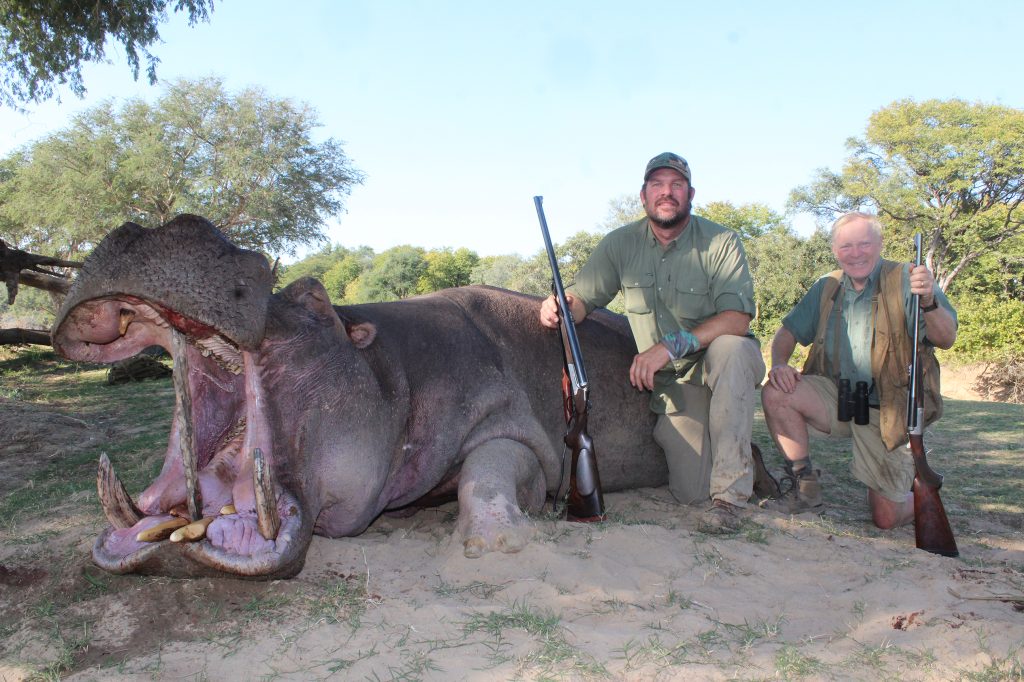
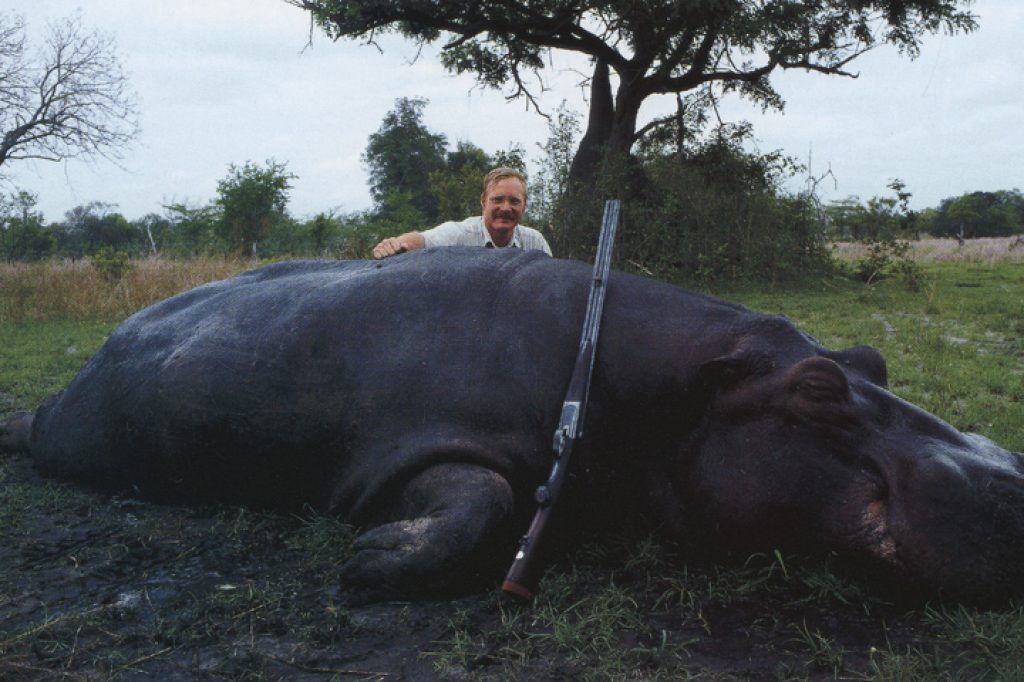
Brad Jannenga and Boddington with an excellent hippo bull, caught on land on the bank of the Luangwa River in Zambia.

Not so long ago, hippos were endemic along most of Africa’s waterways. With a burgeoning human population, and because hippos are so easily poached, they have nearly vanished from many rivers and lakes. The long-term effects remain to be seen. By eating underwater plants and creating paths, hippos perform an important function in keeping waterways open and flowing.

Fortunately, hippos remain common in many areas, especially in countries that have managed their wildlife well. So, hippos can still be seen daily along river systems such as Chobe, Limpopo, Luangwa, Rufiji, Ugalla, and Zambezi and, in some areas, there are significant concentrations. In my younger days, hippos were often “on license” and available. The major tusks of a big bull hippo, much of the length concealed in the jaw, have always been great prizes, but we didn’t really consider the hippo a “game animal” as such.

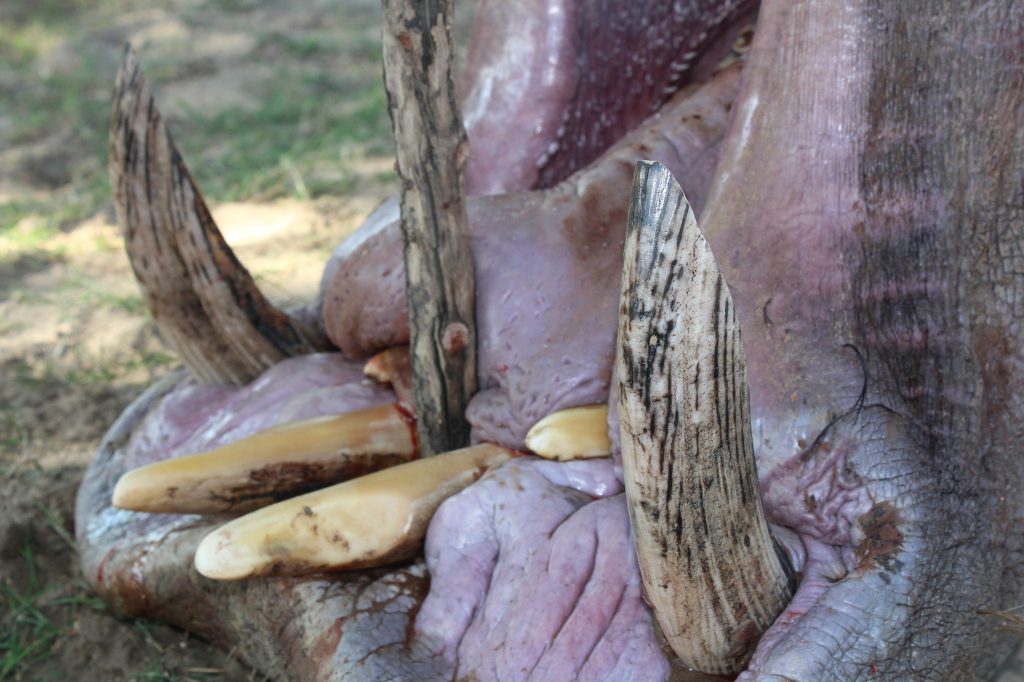
This is a big hippo bull. These tusks have good length and mass, with much tusk concealed in the lower jaw. The cutting edges on hippo tusks are razor-sharp!

Back in the days when a lion was commonly on license, the first step in lion hunting was to secure a hippo as quickly as possible. This remains true today, except that a lion safari is now a costly and specialized undertaking. Also, in areas where hippos are still hunted, quotas are usually small and carefully managed. This has greatly elevated the hippo’s status, with hunting fees usually exceeding costs for hunting buffalo.

In the early days, hunters often spoke of Africa’s “Big Four” of buffalo, lion, rhino, and elephant, excluding the leopard not because it wasn’t dangerous, but based on size. In my time, we added the leopard and called it the “Big Five.” Although the second-largest terrestrial creature (after the elephant), the hippopotamus was never part of either grouping. Today, hunters often speak of Africa’s “Dangerous Seven,” adding hippo and Nile crocodile. This is a good thing, because it has added desirability (and thus value!) to both species.

Without question, the hippo is a large, potentially dangerous, and often ill-tempered brute. It is often said that the hippo is responsible for killing more Africans than any of the rest, sometimes couched as “more than all the rest combined.” I don’t believe this is true; I’ll give that questionable kudo to the crocodile, which still takes people on a near-daily basis along some crocodile-infested rivers.

Even so, the hippo is a real hazard to rural Africans because of its habits. Hippos typically spend most of their days resting in water, but they are grazing animals requiring huge amounts of forage. At night they graze on land, often traveling miles in search of good grass. Early in the morning they return to their water sanctuary, placing them on a collision course with humans, who habitually go to fetch water and wash in the morning.

At night I’ve heard hippos placidly grazing outside my tent in a dozen African camps. No danger, but you wouldn’t go outside and try to pet one. And, you don’t want to get in a hippo’s way if it wants to go somewhere! They charge readily, all chomping jaws and razor-sharp teeth. No such thing as a minor bite from a hippo. Some hippos have attitudes, and take grave exception to small boats intruding in their tranquil waters. The dugout canoe or mokororemains Africa’s primary water craft for fishing and transport; attacks by hippo are not uncommon. My own closest call from an African Big Nasty was a hippo attack on a mokoro. Usually, however, you just need to give them a wide berth.

I totally support the concept of the hippo as a game animal, and as a member of the Dangerous Seven. However, hunting a hippo is usually not a similar experience to stalking buffalo or closing with elephant. It would be, if you could reliably track up or glass and stalk your hippo. In fact, it could be all the excitement you want, and more! On land, in daylight, a hippo is out of its element, and will often charge. If the brain shot is unavailable, or fails, the hippo is a giant bullet sponge, stoppable only with heavy rifles.

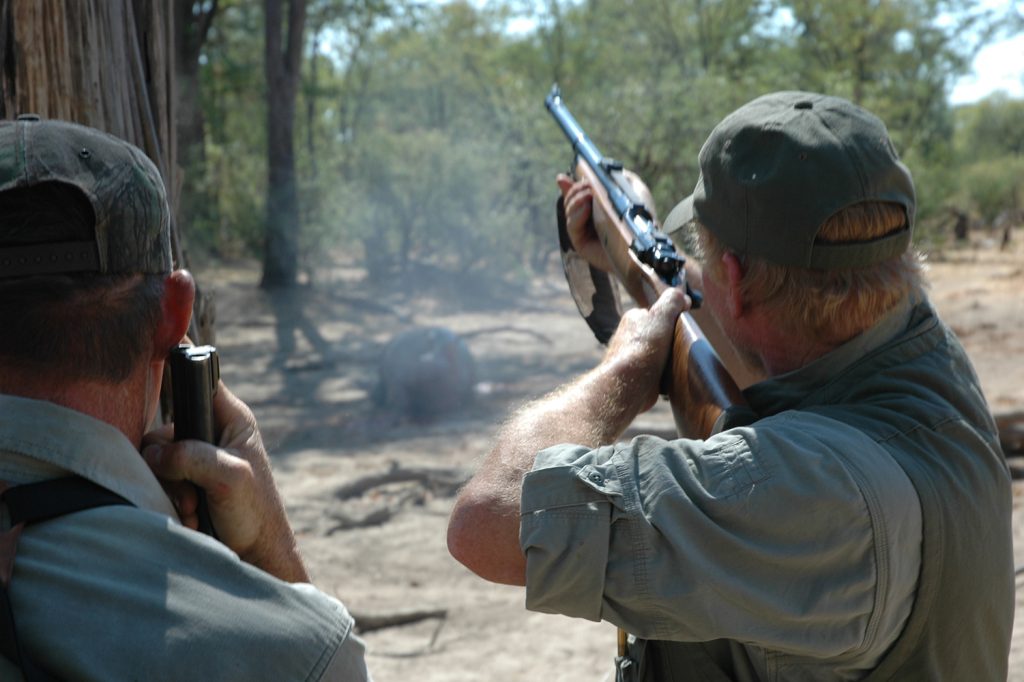
The finishing shot on a hippo in Zimbabwe’s Zambezi Valley. This hippo bull was found in a tiny pool far from any river, a fairly common occurrence…until the water dries up.

Problem is, in most areas it’s uncommon to catch hippos on land in daylight, with the odds ranging from unlikely to nearly impossible. It does happen. Tanzania’s Selous Reserve is famous as a place to find hippos sleeping in the bush far from water. In 1988, looking for buffalo tracks with Paddy Curtis, we found fresh hippo spoor far from known water. We tracked it up and found the bull sleeping in thick bush. As we approached, it heard us, woke up, and immediately charged. Plenty exciting!

I have no idea why this is commonplace there; it must occur in other areas, but only the Selous is well-known for “hippos in the bush.” In the Zambezi Valley, we occasionally encountered hippos far from the river; not common, but it happens. Often, and in many areas, a lone hippo—usually a younger bull—will take possession of a small waterhole, remaining there so long as there’s enough water to submerge.

Almost anywhere, individuals, or an entire hippo pod, will occasionally climb out onto a bank where a stalk is possible. In my experience, this seems most common on a cloudy day. Whenever you catch hippos on land, you can seize the moment, but it’s not an event you can count on. Most commonly, if you want a hippo—or if you urgently need a hippo quarter for a lion or crocodile bait—you have little choice but to catch them near shore in their sanctuary; be patient and take the brain shot.

In Tanzania’s Selous Reserve, this big hippo bull was tracked up and found sleeping in the bush far from water. This is relatively common in Selous, but highly unusual in most areas!

I am not in any way against this; absent a bit of luck, that’s the way it’s usually done. Also, if you want a big bull hippo with large tusks, taking them in water isn’t just the most selective option; it’s almost the only way to be certain. Hippos are difficult to judge, and a lone hippo is almost impossible. In a pod, resting in sanctuary, it takes patience and time, sometimes hours.

You look first for sheer size. Then, as the heads pop up to breathe, you look for prominent bumps on the upper lip on both sides of the nostrils. These are actually pockets sheathing the sharp ends of the major tusks. Bigger the bumps, bigger the tusks. Eventually, if you’re patient enough, the hippos will shift around and partially surface, exposing prominent and identifiable scars. Male hippos fight ferociously. With more patience and luck, a hippo will open its mouth to yawn and call, and you can actually see the tusks.

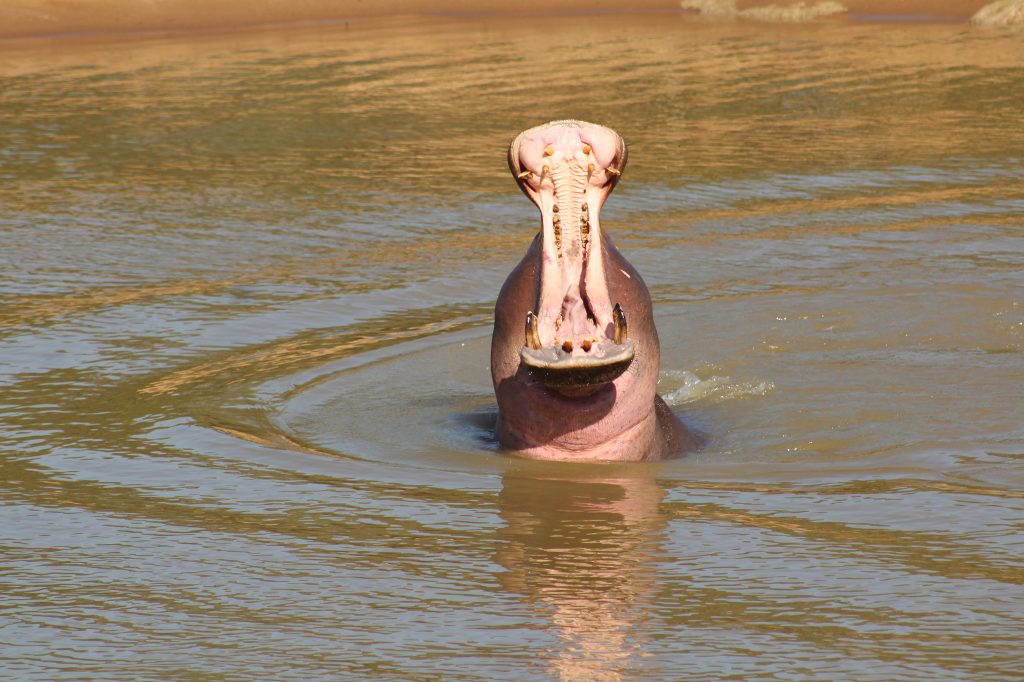
It takes patience and a bit of luck, but when a hippo opens its mouth to yawn or call you can see the tusks. This is a bull, but he’s young; the tusks are short and lacking in mass.

Now, with a bull identified, more patience and a steady shooting position is required. Eventually, the hippo will surface enough to offer a proper brain shot: Frontally, between and just above the eyes, in that weird target-like indentation. From the side, base of ear. The shot is tricky and must be precise. I’m not denigrating the practice; typically, this is the way it’s done, and there is often no option. But, let’s be clear: The hippo is in the water; the shooter is dry. There is no danger.

If the brain shot is executed correctly, the hippo sinks with barely a ripple. Two hours later it rises. You have plenty of meat for bait, for the camp, and for a couple of villages. Except that somebody has to go into the murky, crocodile-infested water to secure a line, which requires raw courage mixed with craziness! Water or land, it’s easy to flub the brain shot. Then things happen fast. Be prepared to shoot again instantly. Look for the shoulder, and don’t hesitate!


Leave a Comment

Who Gnu?

Everything you need to know about hunting the various types of wildebeest.

There are two species of wildebeest: the black wildebeest, also called white-tailed gnu; and the blue or brindled wildebeest. The black wildebeest is native to South Africa’s central plains, and prefers much more open country than the blue, so it lay square in the path of Voortrekkers moving up from the Cape. Almost exterminated in those early days, the black wildebeest was almost miraculously saved from extinction by forward-thinking Boer farmers. It is now plentiful on South African game ranches and has been widely introduced into Namibia. The black wildebeest (Connochaetes gnu) has no identified subspecies.

The blue wildebeest (C. taurinus) is common in East and Southern Africa. Several subspecies are identified but, as hunters, we boil them down to four in our record-keeping systems. North to south: white-bearded, Nyasa, Cookson, and blue.

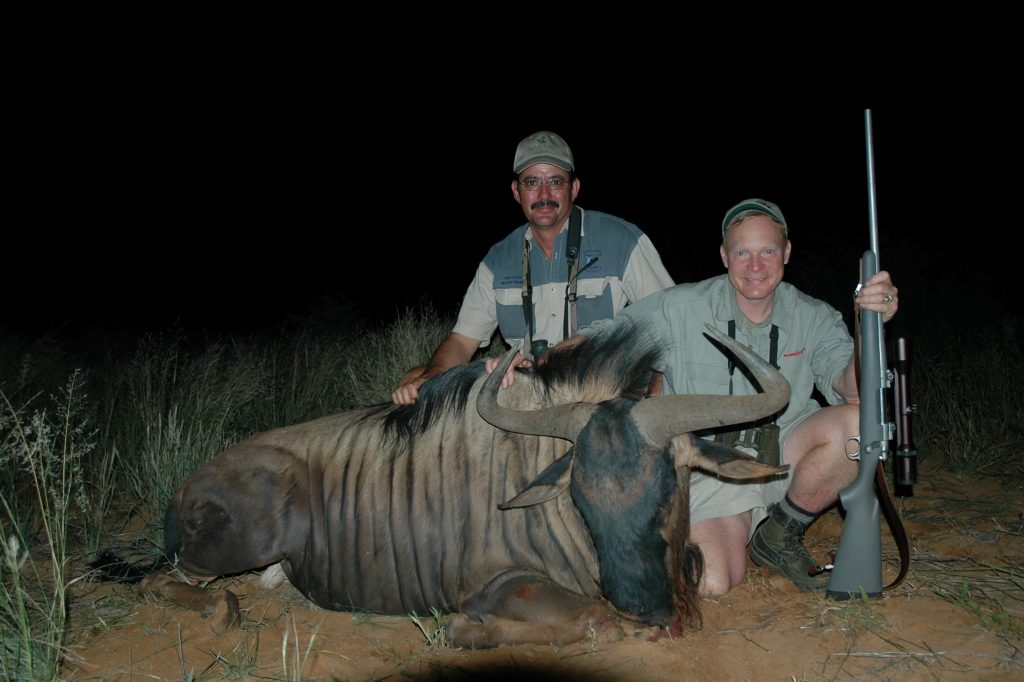
Dirk de Bod and Boddington with an average blue wildebeest bull taken in Namibia. This was a last-light shot, and Boddington was extremely happy he was shooting a .338 Winchester Magnum…never underestimate the toughness of wildebeest!

Although they have sharp eyes, wildebeest are generally not among the warier antelopes. The most difficult part is usually picking out a bull. They are nervous, constantly shifting herd animals, and both males and females have horns that, at first glance, appear similar. I think of them of as classic “common game,” offering excellent meat (enough to feed a camp or a village), interesting horns, and gorgeous skins.

By 1988 I had taken black wildebeest and all the races of blue. So, I thought I knew a thing or two about the gnu. Cookson wildebeest has the most limited range and lowest numbers, essentially confined to Zambia’s Luangwa Valley. I was there recently, accompanying son-in-law Brad Jannenga on a hunt in North Luangwa. On about the third day, in need of meat, we ran into a small herd of wildebeest, shadowed in dense mopane. Brad shot a nice old bull, and when we got him out into sunlight, I learned some things I didn’t know.

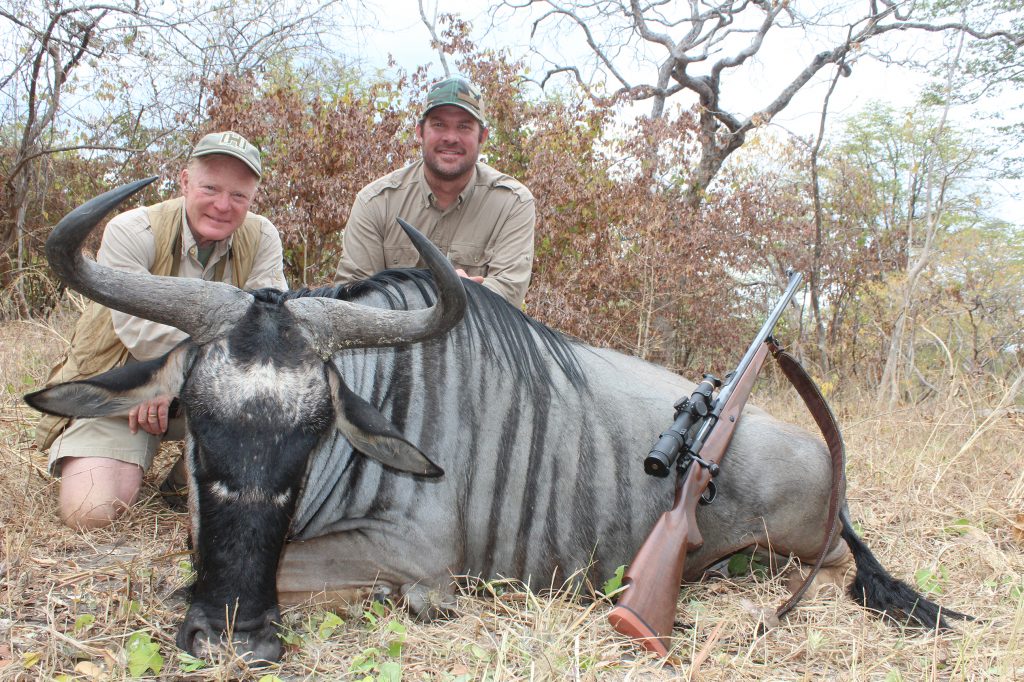
I took a nice wildebeest in the Luangwa clear back in 1983 and, ever since, have given myself credit for having a Cookson wildebeest. Technically, yes, but mine sure didn’t look like this animal! Mine had some proper color but was not as brilliant. Forty years ago, I didn’t know what to look for. Brad’s bull had a light, very gray background color, with black vertical striping from mid-section forward to neck. In good sunlight, it looked like a cross between an antelope and a zebra. So, what I didn’t know: The light color with dark striping defines Cookson wildebeest.

Boddington and son-in-law Brad Jannenga with a nice Cookson’s wildebeest from North Luangwa, clearly showing the light background and vertical black striping of this race. The white nose striping is unusual … perhaps showing influence from Nyasa wildebeest to the north?

We were in the northernmost concession of the Luangwa Valley. The true, proper Cookson wildebeest is really a North Luangwa animal and occupies a small range. As you move south, it merges into the common blue wildebeest.

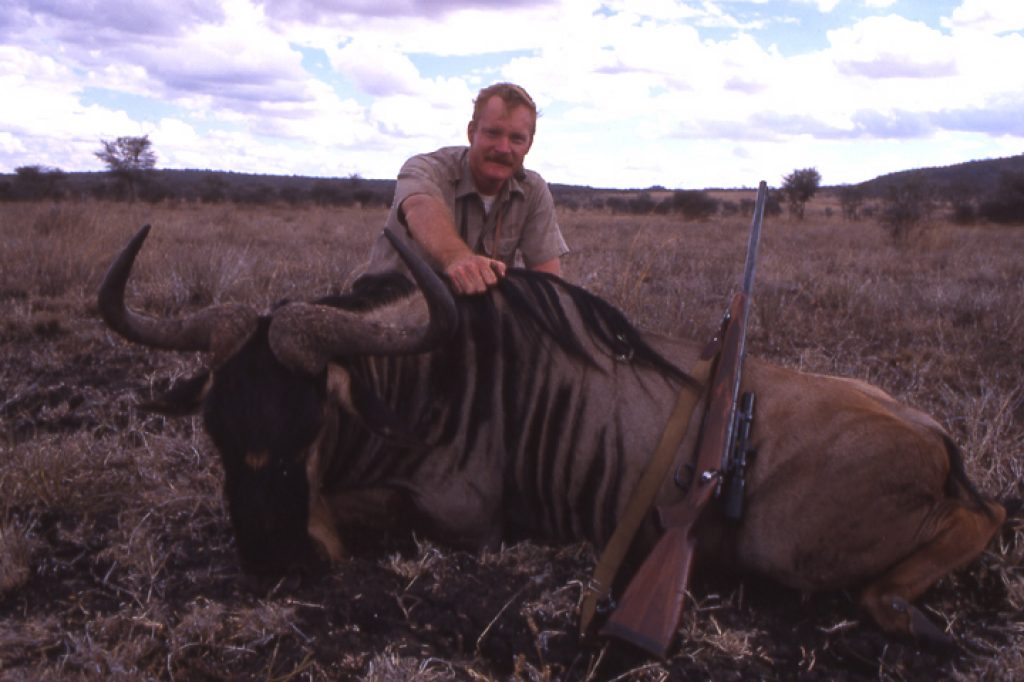
The white-bearded wildebeest, with light body color, is distinctive with cream-colored neck ruff. Found only in northern Tanzania and southern Kenya, it is possibly the most numerous because of the huge Serengeti migration, but is actually difficult to obtain because Tanzania is the only opportunity, and it does not occur in all Masailand concessions. At the tail end of a 1988 hunt, we caught a herd on the Simanjaro Plain on the edge of Tarangire National Park, and that’s my only white-bearded wildebeest.

Although perhaps the most numerous, the white-bearded wildebeest is huntable in only a few of Tanzania’s Masailand blocks. This is Boddington’s one-and-only, taken on the Siminjaro Plain in 1988. 

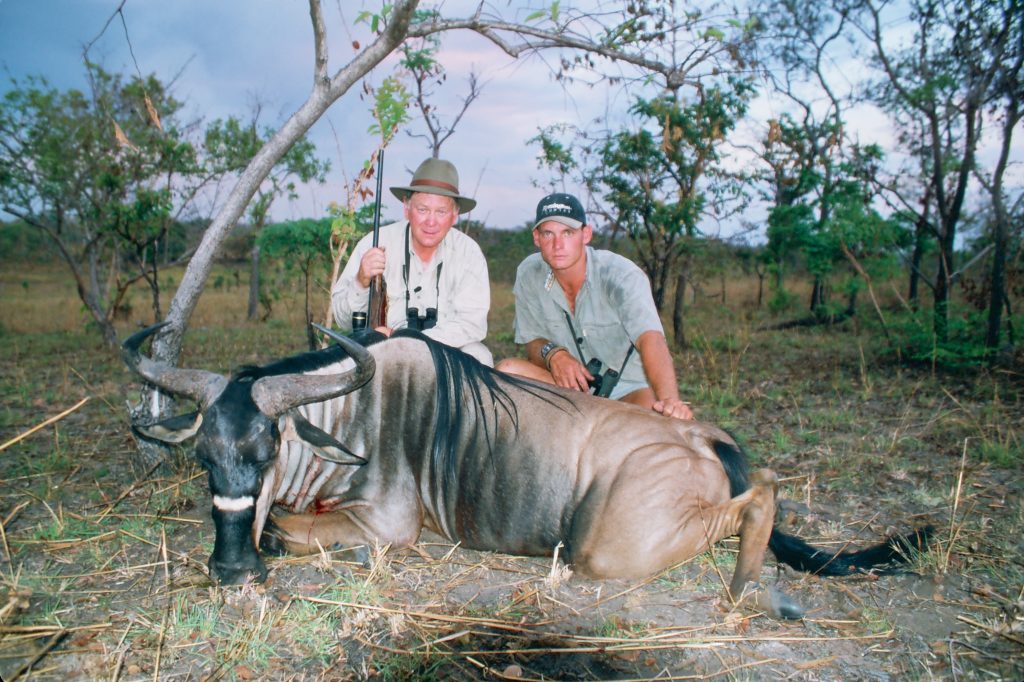
Tanzania is also the primary opportunity for Nyasa wildebeest. I’ve never seen them in big herds, but this wildebeest is commonly encountered in Selous Reserve, and ranges from southern Tanzania well down into Mozambique, also native to Malawi (former Nyasaland), but is considered extinct there. The Nyasa wildebeest is the smallest of the blue wildebeest in both body and horn. I’ve shot several in Selous, and they seem to be uniformly milk chocolate in body color. The most distinctive feature is a white nose chevron, not dissimilar from that of a spiral-horn antelope.

Boddington’s hunting partner Art Wheaton and PH Cliff Walker with a Nyasa wildebeest from Tanzania’s Selous Reserve. Said to be the smallest blue wildebeest race, the white nose chevron and milk-chocolate background color are consistent.

The blue wildebeest is the most widespread, relatively common in southern Zambia, Zimbabwe, and Botswana, and throughout much of South Africa and Namibia. Color varies from dark gray (almost blue) to brown with darker striping (the “brindled” effect of its gnu name). Cookson wildebeest is said to be larger in body, but the common blue probably has the largest horns.

With wildebeest you look for mass and curve on the horn but, unlike other antelopes, we commonly speak of blue wildebeest in terms of extreme spread: A “thirty-inch” wildebeest is the Holy Grail and a rare prize. I shot such a bull in Botswana’s Okavango clear back in 1985. One of the best (or luckiest) shots I ever made; I was shooting an open-sighted .318 Westley Richards, distance about 250 yards. The big bull collapsed on the spot, but I doubt I could repeat such a shot–certainly not today with iron sights!

The black wildebeest is quite different in color, body shape, and horn configuration, clearly deserving of its separate species identification. It is uniformly dark brown to almost black, with a weird forehead brush like a Mohawk hairdo. It is slightly smaller, and the shoulders aren’t as massive as the blue wildebeest. The horns are totally different, and differentiating males from females is more difficult. Bulls have huge bosses nearly together in the center, the horns coming straight down and then curving up into long tips. My first was in 1979, a top-ranking bull back then, when South Africa was just opening up and the black wildebeest was in short supply. Now they are common and that bull would be very average. I’ve only shot one more.  

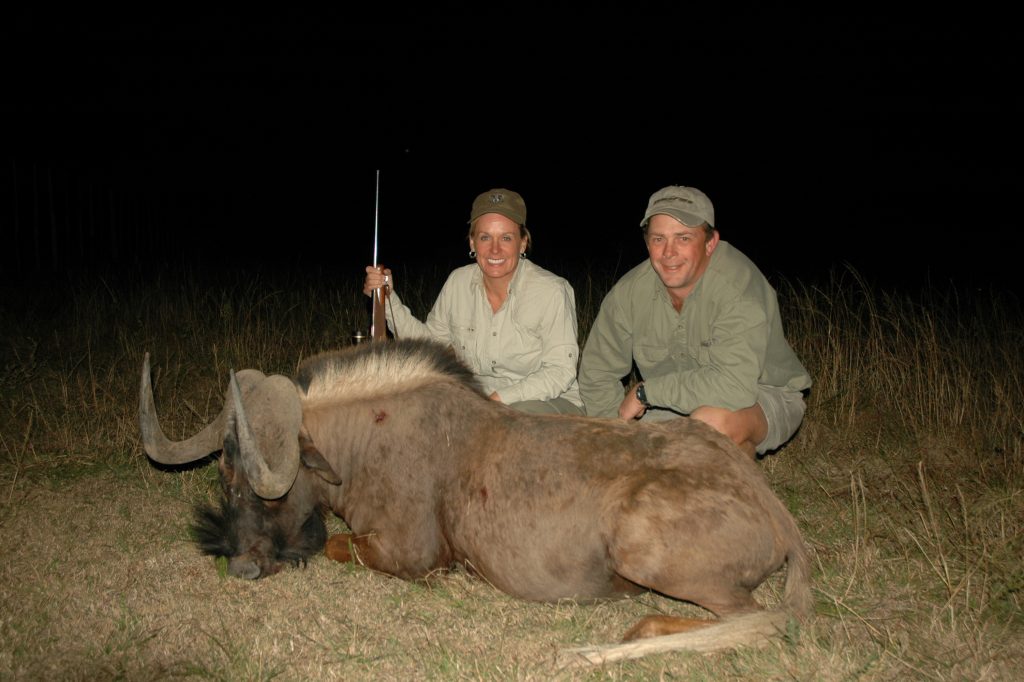
Donna Boddington and PH Russell Lovemore with an awesome black wildebeest. Tough animal to judge: Heavy boss is critical, but you also look for depth of turn and length of points. This bull was taken at last light with a .375 Ruger; even then it took some looking in the dark!

Wildebeest are sometimes described as “the poor man’s buffalo” and “clown of the African bush.” I don’t like such appellations, but neither are completely inaccurate. As to the former, wildebeest are not remotely dangerous! They are, however, buffalo-like in shape and it takes experience to sort bulls from cows. As with buffalo, we look at thickness of bosses or bases and shape. With the brindled gnus, like buffalo, we also look at spread.

As to the latter, the wildebeest puts on the weirdest antics. For no apparent reason, bulls will suddenly put their heads down and canter around in circles. This erratic behavior caused the early Dutch settlers in South Africa to name them “wild beast.”

There’s no peril to hunting wildebeest, but they are buffalo-strong, in my view one of the hardiest antelopes, and also larger than they appear at distance. A big blue wildebeest bull can weigh a quarter ton and, pound for pound, is tougher than its size.

Like all the antelopes with exaggeratedly tall shoulders, the greatest risk and most common error is to hit them too high. Concentrate on a third up from the brisket line and there should be no problem, but hit a wildebeest poorly and you can expect a long tracking job! I’ve never lost a wildebeest, but that’s only through great tracking (and some luck). I’ve had some very long days following wildebeest that were hit less than perfectly.

One, on Barry Burchell’s place in southern Namibia, was shot with a .264 and recovered miraculously six hours later. The first shot was frontal, right height, but I wavered off center just a bit. Not a matter of not enough gun, but not a good enough shot! With proper shot placement, I’ve seen big-bodied blue wildebeest taken cleanly with .260 Remington, 7mm-08, and 7×57. Of course, the .270 Winchester, faster 7mms, and .30-calibers are just fine.

That said, I have huge respect for wildebeest, and I’ve wasted a lot of precious hunting time tracking them. So, if I happen to have a .375 on hand, I’m happy to use it when there’s a wildebeest in the offing.

Years ago, in Namibia, Dirk de Bod and I spotted a herd in late afternoon. There was a nice bull in there; we stalked them endlessly, trying to get him in the clear. Sunset came and went, and the light was going fast when I finally got a shot. That’s a risky time to shoot anything, but especially such a notoriously tough animal. The herd bomb-shelled at the shot, and the direction of the bull was unclear and no blood was obvious in the growing dusk. Fortunately, I was carrying a .338 stoked with 250-grain bullets. We were just about to call for the truck and get flashlights when I stumbled over the bull, stone dead. It had only gone fifty yards.     

Leave a Comment

Now There Are Sixty

An Update on Mozambique’s 24 Lions Project

Photo above by Mark Haldane

In 2018, Brad Fitzpatrick first reported in Sports Afield about a project he termed “the largest wild lion transfer across an international border in African history.” 

The brainchild of safari outfitter/professional hunter Mark Haldane, who worked with partners including neighboring concession holder Alvaro Rola and the Ivan Carter Wildlife Conservation Alliance, the 24 Lions Project was a year’s long undertaking in the planning that resulted in the transportation and reintroduction of lions back into the Zambezi Delta area of Mozambique, with little precedent and no practical model for predicting success. Made possible by funding from the Cabela Family Foundation, the project just celebrated its third anniversary. I was in Mozambique recently to find out how things were going.

As we buzzed high over the Zambezi Delta, I felt like I was wearing the tiny R-22 helicopter more than flying in it. Mark Haldane, Zambeze Delta Safaris owner, and I were flying out in search of one of the lion prides wandering the one million acres of revitalized Mozambiquan wilderness known as Coutada 11. Would we be successful in finding the elusive top-tier predator? We would know in 30 minutes or so.

From interviews with the head of the scientific team, Willem Briers-Louw, as well as Haldane himself, I had already learned that some of the original 24 lions released three years ago in Coutadas 10 and 11 had died from natural causes or through poaching.

The good news was that those who survived had quickly disbursed across the vast landscape and established eight prides from which 24 lions had today grown to 60 cats strong. 

On our flight today, Haldane and I were searching for the most successful single pride of the project, a group known as the Tembe Pride.

The Disappearing Act of the Tembe Pride

Spotting a pride of lions in their native landscape is not as easy as it sounds, even from the vantage point of a helicopter. In fact, the very same pride that Haldane and I were trying to locate today had a knack for staying out of sight.

Named after their point of origin, Tembe Elephant Park in South Africa, the Tembe Pride – originally consisting of four females – disappeared for an entire year after release from the wire-and-wood acclimatization boma where they were held upon arrival in Mozambique. Though a fair proportion of the 24 introduced lions wore electronic collars, there were not enough to go around, and none of the Tembe lionesses sported a collar. 

There was good reason to be concerned for the safety of the Tembe lions after their release. Humans and their traps and snares were the main cause of death among the original 24 animals. Though the anti-poaching efforts of the hunting operators in the region have been wonderfully successful, the same is not true for adjoining areas. Had the Tembe females wandered out of the hunting area and into the poachers’ gin traps and metal snares? As the months went past, it seemed more and more likely that the four Tembe lionesses were not just missing, but dead.

The break in the case of the disappeared Tembe pride came like all good detective yarns, involving an unexplained observation. Briers-Louw and his colleagues had noticed for some time that lions were making kills in a localized area – frequently from the many warthogs occupying the floodplains. However, the scientists were unsuccessful in spotting any lions in this region, either from the ground or the air. The million dollar question was: Which pride was responsible for the kills? 

Then one day the guides were driving out to the floodplain in the late afternoon to relax and have a sundowner. The last thing on their minds was spotting the Tembe Pride, but as they rounded a patch of vegetation, not 150 yards away outlined against the brilliant red horizon were the four missing-in-action lionesses. The scientists now knew that the Tembe pride had survived, and importantly, they were able to dart and collar two of the females so they could now keep tabs on the pride’s whereabouts.

Within a week of their rediscovering the Tembe Pride, the scientists realized that a resident Mozambiquan male lion was with them, and, remarkably, two of the females were carrying cubs. Within a few months, the two pregnant females formed a den nearby in a place nicknamed Beto’s Island. When the scientists checked on the two females a short time later, they discovered not only the lionesses, but also seven chubby, rollicking young cubs. A few months later a third female gave birth to two cubs, and then not long afterwards, the fourth and last female produced a single offspring. The Tembe Pride now boasts the original four lionesses and 10 half- to two-thirds grown cubs.

The Hapless Karongwe Pride

If Tembe is the most successful group from the original 24 Lions reintroduction, the Karongwe Pride is the one that has been through the greatest struggles, including several tragedies. The two Karongwe lionesses making up this pride came from the Karongwe Animal Preserve near Kruger National Park. The two females failed to produce cubs the first year after their release. With other lionesses able to reproduce, Briers-Louw and his team wondered whether or not the females might be infertile.

The concern over the lack of conception soon took a backseat to the possibility that one of the females might die. On one of his helicopter patrols, Haldane happened to cross over into a neighboring area. He spotted one of the Karongwe females wandering there, and noticed that she seemed to be in some sort of difficulty. When Mark radioed his camp for help, the scientists and veterinarians rushed to the area and found the lioness with a snare encircling her body. Its ever-tightening construction had buried the snare to a depth of two inches beneath her skin. Neither the scientists nor veterinarians gave the lioness much chance of survival, but they cleaned the wound, closed the horrible gash with surgical thread and injected her with a large dose of antibiotics. Then they put a GPS collar on her in order to monitor her closely and see if she would recover.

The good news was that the lioness did indeed heal and regain full health. The bad news was that within the month she and her companion lioness returned to the same area, and she once again found herself in a poacher’s wire snare. This time, the snare lodged just above her back left paw. The signals from the lioness’ GPS collar tipped off the crew that she was not moving. The scientists and veterinarian again loaded into the helicopter and made their way to the struggling Karongwe female. When they reached her, they quickly used the hypodermic dart to put her to sleep. Once sedated, they rolled her over and found her back foot swollen to more than double normal size. Left much longer, they would have had no option but to amputate the damaged foot – a not uncommon ending for these types of injuries. Such an amputation could easily have resulted in her removal from the Delta, or eventual euthanasia. But this lioness continued to demonstrate a cat’s nine lives. As she limped away, the team of concerned watchers could only wonder if she would eventually succumb to her unwise wanderings.

While the one Karongwe lioness repeatedly encountered the poachers’ cruelty, the other lioness was having her own tragic struggles. Unlike her companion, the second female from the Karongwe Animal Preserve had been fortunate to avoid poachers. The scientific team was ecstatic when they caught up with her one year after her release and found the lioness playing with her young cub. Unfortunately, their joy was short-lived. Three months later, they located the female, and her cub was no longer with her. Briers-Louw and his team are quick to point out that such losses are “part of the process.” Yet, the catch in their voices when discussing such events communicates the level of pain that such ”natural occurrences” cause for those so invested in the individual animals of the 24 Lions project.

The plight of the Karongwe females continued after the near-loss of one female and the loss of the second female’s first offspring. Six months after the death of the cub, the GPS collars indicated that both females were together and excitingly were showing ”denning behavior,” venturing out and making kills in a small radius and otherwise limiting their movements. 

When the scientists headed out in their helicopter in search of the Karongwe lionesses, they had high hopes of finding the females with more cubs. They were not disappointed. As the helicopter hovered, the two females and a total of four cubs looked up warily at the noisy contraption. One cub belonged to the female who came close to losing her life to snares. The second female had replaced her lost cub with three more young. Sadly, these births also ended in loss. In only a few months, the lionesses’ limited movement patterns – short distances traveled back-and-forth from their den – once again widened to that of adult animals without young. Sure enough, when the team again located the two Karongwe females, they were both cubless.

Then, in August 2020, the Karongwe Pride’s story finally took a turn for the better. The females moved into a game-rich and poacher-free floodplain. Maybe the females’ instincts were changing or maybe they were just beginning to understand the landscape of their new home in Mozambique, but whatever the reason, with the abundance of game, the females became pregnant and each had a litter of three cubs. Though early on, the snared female lost one of her cubs, the remaining five are now 11 months old, and well on their way to becoming adults. The other great news is that one of the dominant males from the original 24 animals has joined the Karongwe females and is acting as the guardian of both lionesses and cubs. Yes, compared to the Tembe Pride, the Karongwe lionesses have traveled a troubled path. But, maybe, just maybe, they have turned a corner.

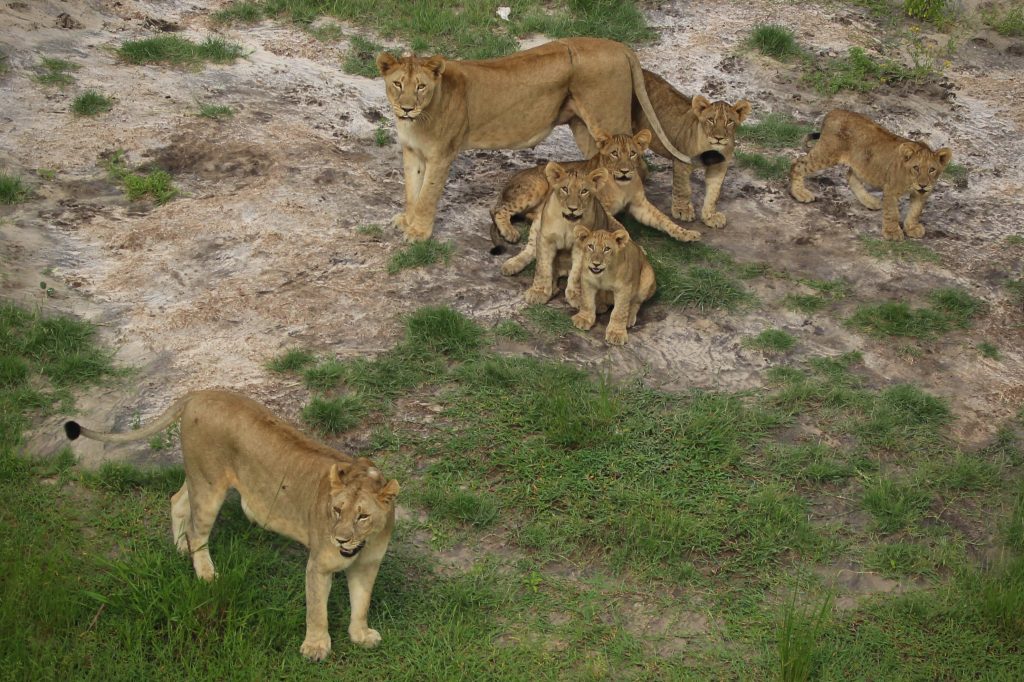
Females and cubs of the Karongwe Pride as seen from an observation helicopter. (Photo by Mark Haldane)

Stunning Success of the 24 Lions Project

As the travails of the Karongwe Pride indicate, the reintroduction begun in 2018 was not without its challenges. In total, seven of the original 24 adult lions released into the Marromeu Complex died in the first three years. During this same period, 51 births occurred, with nine of the cubs lost. Yet, in a wonderful demonstration of the marriage of great science, substantial funds, and the passion of hunters, the 24 lions introduced in 2018 have nearly tripled in number. Even the number of prides has increased, with the Mac group replicating into three separate active prides. Yes, there has been loss of adults and young to natural causes and poaching, but looked at from all perspectives, the reintroduction has been an incredible success.

Our helicopter trip was wildly successful too. As our search for the Tembe Pride continued under Haldane’s piloting, my heart and breathing rate elevated. Finally, we homed in on the GPS coordinates issuing from the Tembe lions’ GPS collars. And then, there they were below us. Staring up with what looked through the camera lens like irritation mixed with disdain – as if they were thinking, “Here come the bloody tourists again!” – they slowly, slowly slunk from one palmetto patch to the next. Their tawny hides had an iridescent quality in the rays of the morning sun. As they meandered between the temporary hiding places, their muscles rippled and their detachable shoulder blades slid to-and-fro. Simply put, they were animals that left me speechless.

Not wanting to overly upset the lions or overstay our less-than-warm welcome, we left the pride to its wanderings after only 10 minutes. As Mark turned the helicopter back toward the Zambeze Delta Safaris basecamp, I sat in amazement from what I had just experienced. Wild lions are disappearing at an alarming rate across Africa. Not as a result of trophy hunters, but mostly because they get in the way of local humans and suffer the consequences. That trend is not true for the Marromeu Complex under the watchful eyes of hunters and scientists. The number of lions there is increasing at an astonishing rate and they are dispersing across millions of acres of woodland and floodplain. Wild lions have returned and made themselves at home in Mozambique’s Zambezi Delta, thanks to a small group of dedicated people and the vision they share.

Leave a Comment

Thirty by Thirty

The global 30×30 initiative presents opportunities—and challenges—for the hunting community.

If you read Sports Afield, chances are you hunt and fish. There’s also a good chance you get wind of the constant flow of information about laws, regulations, and legislative proposals that impact your ability to hunt and fish. Depending on how you choose to spend your time in the field or on the water and where you do it, some of these policies impact you and some won’t. Occasionally, something big comes along that has the potential to impact all of it–sometimes for the better and other times not.

With constant buzz of the 24-hour news cycle in the background, it can be tough to keep things straight, but there’s a big one on the horizon. Here’s a quick synopsis—the 30 by 30 Initiative (30×30 initiative) is a multi-national campaign to protect 30 percent of the world’s lands and waters across the globe by the year 2030. Here at home, President Biden issued an Executive Order in January that establish the 30 percent target by 2030 in the United States. At the risk of stating the obvious, the global goal is an incredibly ambitious target. Here in the U.S., it’s raising some eyebrows as well as some questions. How will this goal be achieved? How much of the U.S. is already “protected”? How will pursuit of these goals impact private landowners and public lands? Most importantly for us, how will this impact hunting- and fishing-driven conservation?

Having invested more in conservation than any other stakeholder, these are just a few of the questions we as hunters and anglers should be asking now, before others define 30×30 for us. As sustainable use practitioners and advocates, engaging on 30×30 is tricky because 1) some of 30×30’s biggest cheerleaders have a hard time admitting that hunting and fishing drive conservation and 2) the initiative’s biggest champions have defined the objective without telling anyone how they plan to get there. When it comes to political decision making, this lack of definition represents both challenge and opportunity.

Fortunately, the sporting conservation community isn’t waiting for these folks to tell policymakers what we already know: how to successfully conserve land, water, fish, and wildlife while meeting the needs of people through management and sustainable use. 

Hunters and anglers are the original conservationists of our land, water, and natural resources. The contributions that hunters and anglers make to conservation in America derive from the American System of Conservation Funding a “user pays–public benefits” program. Since 1939, conservation funding has been provided through hunting and fishing license sales and excise taxes on ammunition, firearms, fishing tackle, boat fuel, and other equipment necessary to engage in hunting and angling activities. We were also at the forefront of recent victories like the Great American Outdoors Act, which provides an injection of funding for landscape conservation, in addition to increased public land access. We’re also pushing hard to drive resources to the conservation of game and non-game species through the Recovering America’s Wildlife Act.

Sportsmen and women have a duty to become engaged in the conversation about 30×30. It is essential policy makers understand and appreciate the role that sportsmen and women play in conservation and biodiversity of our lands, water, fish and wildlife. If the sporting conservation community does not ensure that measures taken in pursuit of 30×30 objectives do not constitute restrictions on hunting and angling access, we risk losing the invaluable opportunities and resources that we have willingly conserved for decades. 

As an effort to engage the sporting conservation community in the global 30×30 Initiative, the Congressional Sportsmen’s Foundation (CSF), with other leading conservation organizations, established the “Hunt Fish 30×30” coalition to augment the voices of America’s sportsmen and women and highlight the vitality of being a part of this conversation as America’s original conservationists. The coalition consists of more than fifty conservation organizations that are committed to the role sportsmen and women play in biodiversity conservation. On the coalition’s website, huntfish3030.com, the public can learn about the role that sportsmen and women play in supporting biodiversity. HuntFish3030.com is an educational resource for the public and encourages hunters and anglers to continue our conservation legacy by being a part of the 30×30 conversation.

Sportsmen and women can effectively participate in the Hunt Fish 30×30 Initiative to illustrate how they already contribute to biodiversity conservation and their unique role in nature. The Hunt Fish 30×30 coalition has established a petition for individuals to sign to recognize the importance of hunting and fishing and the future of conservation and biodiversity. This petition encourages lawmakers to support policies that promote biodiversity while protecting access to our lands and waters. Additionally, follow CSF’s updates, communication, and social media about the Hunt Fish 3030 effort and the variety of 30×30 proposals–some good, some bad–across the country.

Hunting and fishing fuel our nation’s economy, conservation, and passions. There is no other stakeholder group more familiar with, or dedicated to, conservation and biodiversity through the activities of hunting and fishing. Sportsmen and women should ensure that conservation—and our role that has made conservation so profound—remains a priority as lawmakers consider 30×30 policies. Our commitment is derived from an appreciation for the healthy habitats that provide hunting and fishing endeavors and leave the world a better place.

Finally, we need to accept that the struggle to keep hunting and fishing firmly established as a cornerstone of conservation isn’t going away anytime soon. 30×30 is just the latest battle and we need to be united, informed, and active to ensure that our legacy remains intact. I strongly encourage you to take the first step and sign the Hunt Fish 30×30 petition today at huntfish3030.com/petition. — Jeff Crane, President and CEO of the Congressional Sportsmen’s Foundation

About Jeff Crane and the Congressional Sportsmen’s Foundation

Jeff Crane has been at CSF for nearly two decades and brings nearly 40 years of experience in on-the-ground natural resource management and policy expertise at the federal, state and international levels. A life-long outdoorsman, he has experience developing wildlife habitat management plans in the United States and South Africa, where he obtained his professional hunter’s license and guided hunts for big game animals. Jeff currently resides in Maryland where he continues to pursue the hunting and fishing lifestyle.

Since 1989, the Congressional Sportsmen’s Foundation (CSF) has become the nation’s most respected and leading sportsmen’s organization in the political arena. CSF’s mission is to work with Congress, governors, and state legislatures to protect and advance hunting, angling, recreational shooting and trapping. CSF works closely with the Congressional Sportsmen’s Caucus, the Governors Sportsmen’s Caucus, and the National Assembly of Sportsmen’s Caucuses, which is a collective force serving as an unprecedented network of pro-sportsmen elected officials that advance the interests of America’s hunters and anglers. Learn more about CSF and their latest work at congressionalsportsmen.org.

Leave a Comment

Battle of the 6.5s

Which is better: Creedmoor or PRC?

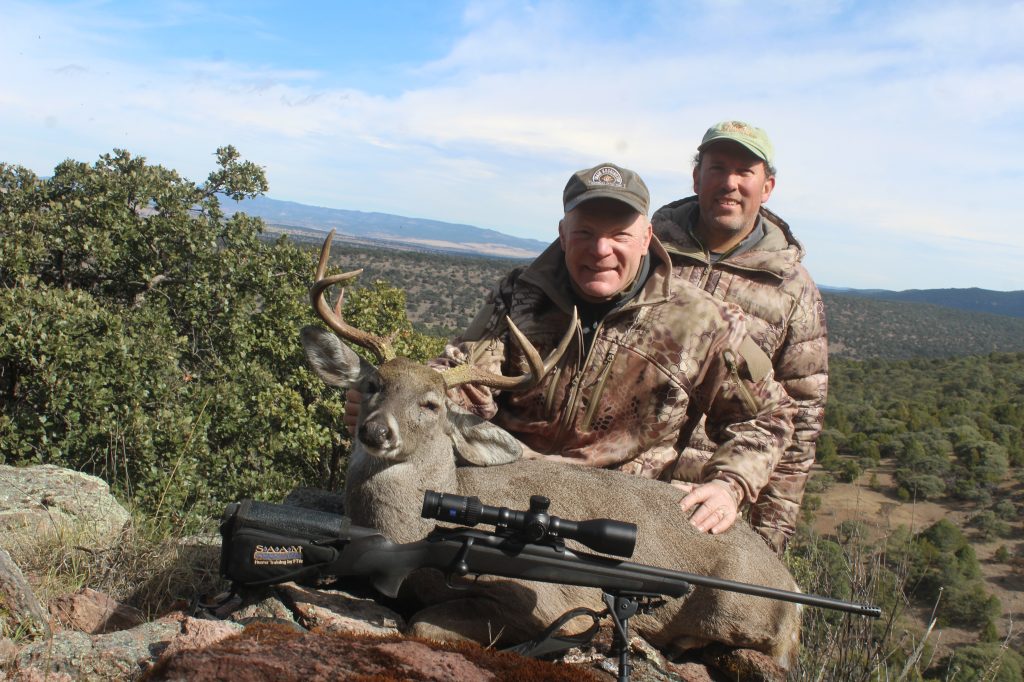
Photo above: This Georgia whitetail is the first animal Boddington has taken with a 6.5mm PRC. The rifle is a Springfield Waypoint test rifle that had to be returned, but Boddington was impressed enough by both rifle and cartridge that he’s ordered one.

The success of Hornady’s 6.5mm Creedmoor cartridge is the most amazing phenomenon I’ve seen in my career. It’s an efficient and mild-kicking cartridge with modern case design, but here’s the fascinating thing: When it was brought out in 2007, its current popularity wasn’t expected.  

Hornady saw it as a long-range target cartridge. Taking advantage of the 6.5mm’s bullet aerodynamics, it remains supersonic to ‘way out there. Based on a shortened .308 Winchester (or .30 TC) case, it can use those long bullets in short bolt-actions. Obviously, it has hunting applications but, since it was designed as a target cartridge, initial expectations were modest, and the introduction was fairly quiet. The 6.5mm Creedmoor soon started winning matches but sales languished along for several years…as anticipated.

Even the Hornady folks are a bit confused as to what happened; if done purposefully through effective marketing you’d want to bottle and sell it, but there’s no formula: About 2013, the 6.5 Creedmoor took off…seemingly all by itself, and its momentum continues. Plenty of folks already have one, and everybody else wants one. All suitable platforms are chambered to it, and factory loads continue to expand.

Boddington and outfitter Armando Klein with a whitetail from central Mexico. Using Klein’s Blaser with 6.5mm Creedmoor barrel, the shot was about 325 yards. This is well within the Creedmoor’s capability, but for longer shots Boddington prefers a faster cartridge delivering more energy.

Very little about the Creedmoor is new. I’ve often suggested that the Creedmoor can’t do anything the 6.5×55 couldn’t do before 1900. This is almost true, but the Creedmoor has definite advantages over the 6.5×55: Its short (1.920-inch) case can handle long bullets in a short action. And, thanks to its rapid popularity, it is much more available in the U.S.

The Creedmoor’s advantages over the .260 Remington aren’t as clear. Introduced in 1997, the .260 Remington is based on the .308 Winchester case necked down to take a 6.5mm bullet. I jumped on the .260 bandwagon early; both my daughters took their first game with .260 Remington rifles. The .260 has not become wildly popular, but it is almost ballistically identical to the Creedmoor. In short actions, the Creedmoor does better with long bullets, but the .260 has more case capacity and can be loaded a bit faster.

Arguments can be made either way about which is “better,” but they’re too close to call. With the most case capacity, the 6.5×55 could be faster than either the Creedmoor or .260, but 6.5×55 factory ammo is loaded to lower pressure, and reloading manuals hold the 6.5×55 to lower limits. Loads (and loaders) vary, but we can say that the 6.5×55, .260 Remington, and Creedmoor are similar, propelling a 140-grain bullet at around 2700 fps, and yielding about 2300 ft-lbs of energy at the muzzle.

Left to right, 6.5×55 Swedish Mauser, .260 Remington, 6.5mm Creedmoor. These three cartridges are very similar in ballistics and downrange performance, but the Creedmoor is by far the most available…in both rifles and ammunition.

The Creedmoor has made American shooters aware of long-available 6.5mm magic. At a modest 2700 fps muzzle velocity, an aerodynamic 6.5mm bullet can remain supersonic well beyond 1200 yards, achieving this with mild recoil and little blast. The Creedmoor tends to be accurate, thus it really is an ideal long-range target cartridge, and obviously excellent for deer-sized game. However, it is minimal for game larger than deer; and it is not an ideal long-range hunting cartridge. Thanks to its rapid popularity, too many of us seem to have imparted near-mystical powers to the Creedmoor, touting its suitability for elk-sized game at extreme range.

On deer-sized game, the Creedmoor has sensible capability to around 400 yards. At closer ranges, it is elk-capable, but it lacks the velocity and energy for large game at long range. The Creedmoor erased the “curse of the 6.5mm” that spelled failure for all American 6.5mm cartridges up to and including the .260 Remington. We have finally embraced the .26-caliber and accepted the advantages of its long, aerodynamic projectiles. We have more and better bullets, and more 6.5mm cartridges to choose from.

In 2013, the 26 Nosler was the first of Nosler’s growing family of fast, large-cased, unbelted cartridges. Weatherby’s belted 6.5-.300 Weatherby Magnum (2016) is even faster. I took a monstrous ibex in eastern Turkey when the 26 Nosler was new, and I have a 6.5-.300. Few cartridges shoot as flat but, although my 6.5-.300 is very accurate, I view the two super-fast 6.5mms as almost too much of a good thing. They are over bore capacity, limiting suitable propellants, and reducing barrel life. They need long barrels, and I wouldn’t describe them as “mild” in blast or recoil!

There are other options, offering flatter trajectories than the “Creedmoor class,” and delivering more velocity and energy. I previously described this as the “6.5mm sweet spot.” There’s no magic in any particular number, but it seems to make a big difference in performance on game if you can get a 140-grain 6.5mm bullet up to about 3000 fps. Flattening of the trajectory isn’t so significant but the additional energy matters, especially on game larger and tougher than deer. A 140-grain bullet at 3000 fps delivers 2800 ft-lbs of energy, nearly a 20 percent increase over the Creedmoor.

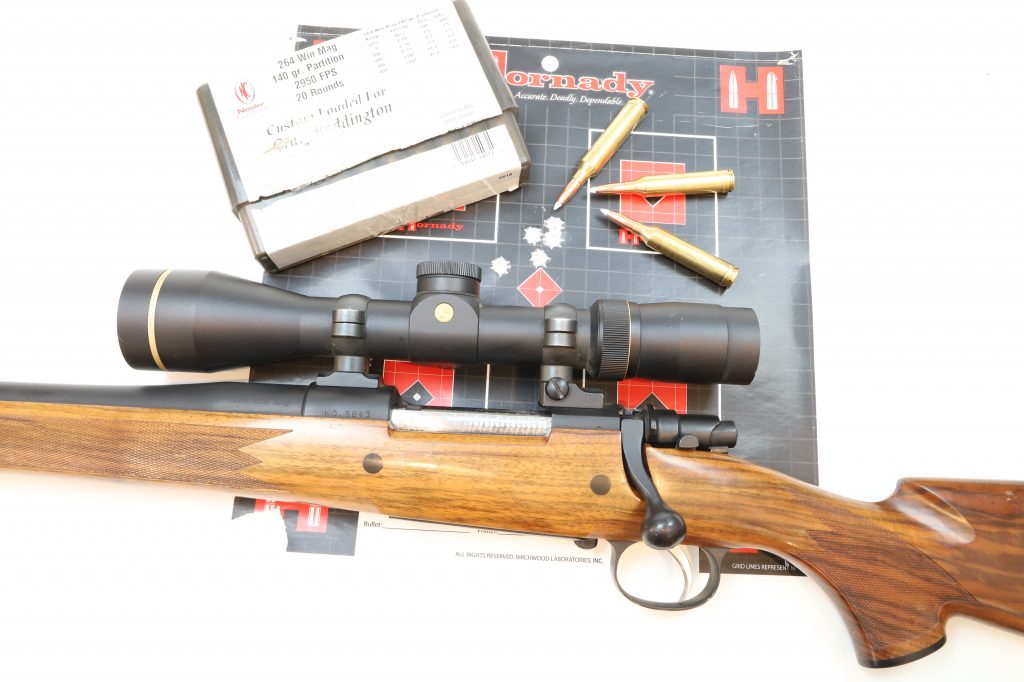
Cartridges in this class include the 6.5-06, an old and fairly common wildcat; the 6.5-.284 Norma, loaded by Norma since 1999; and the old .264 Winchester Magnum, dating to 1958. All have some following. I saw my old friend Ron Mostyn the other day and asked if he was still using his 6.5-.284. He replied with a grin: “Best cartridge ever.” Montana outfitter Ryan Counts has a 6.5-06 that he swears by for coyotes and wolves at long range. And, with no apologies, I cling to my .264.

The old .264 has a belted case and is overbore capacity, but in a good barrel accuracy can be excellent. Modern cases like both the Creedmoor and PRC are conducive to accuracy, but case design isn’t the most important factor for accuracy. This group was fired with 140-grain Nosler Partitions. The “flier” low and left was probably shooter error!

My .264 is a nice rifle that shoots well so I have no reason to abandon it. However, based primarily on sheer availability, the fast 6.5mm that seems to make the most sense is the 6.5mm Precision Rifle Cartridge (PRC). Another Hornady design, the PRC case is based on the .300 Ruger Compact Magnum case (or, if you prefer, a shortened .375 Ruger case). It is thus unbelted, but uses the same .532-inch rim diameter as most belted magnums. Depending on bullet length and seating depth, the stubby 2.030-inch case is better in short actions than the 6.5-.284 Norma. With 6.5mm bullets getting longer (and more aerodynamic), a lot of folks are putting the 6.5mm PRC in standard (.30-06-length) rather than short-actions, eliminating any concern about cartridge overall length. The efficiency of the short, fat case reduces much of the over bore capacity issues long common to fast 6.5mms. Barrel life will be a bit better; if I ever shoot out the barrel on my .264, it will become a PRC.

As currently loaded by Hornady, a 143-grain ELD-X is rated at 2960 fps. That’s a bit short of my goal of 3000 fps, but close enough. Also in the ballpark is Weatherby’s 6.5mm Rebated Precision Magnum (RPM). Based on a lengthened .284 Winchester (or 6.5-.284) case, ballistics are much the same, with a 140-grain bullet at 2975 fps. I doubt the 6.5mm PRC will ever approach the Creedmoor’s availability and popularity, but it’s catching on fast, with multiple (and expanding) sources for ammo and brass, while Weatherby remains the primary source for their 6.5mm RPM.

So, if you’ve stepped out of your cave and into the sunlight with a sudden craving for a 6.5mm rifle, I think the primary choices are the Creedmoor and the PRC. I love to champion old classics (like the 6.5×55 and .264) but, these days, availability matters more than ever. Few cartridges equal the Creedmoor’s availability. The PRC won’t catch up, but is easily the most available of the faster 6.5s, and is increasing in popularity.

Which of the two is best for you depends largely on what you intend to do. If you’re a target shooter, the choice is easy. The Creedmoor is a cartridge you can shoot all day and call it fun. If you’re a normal deer hunter, your answer might be just as simple: The Creedmoor is plenty of gun for any deer-sized critter…out to the normal ranges that most of us shoot.

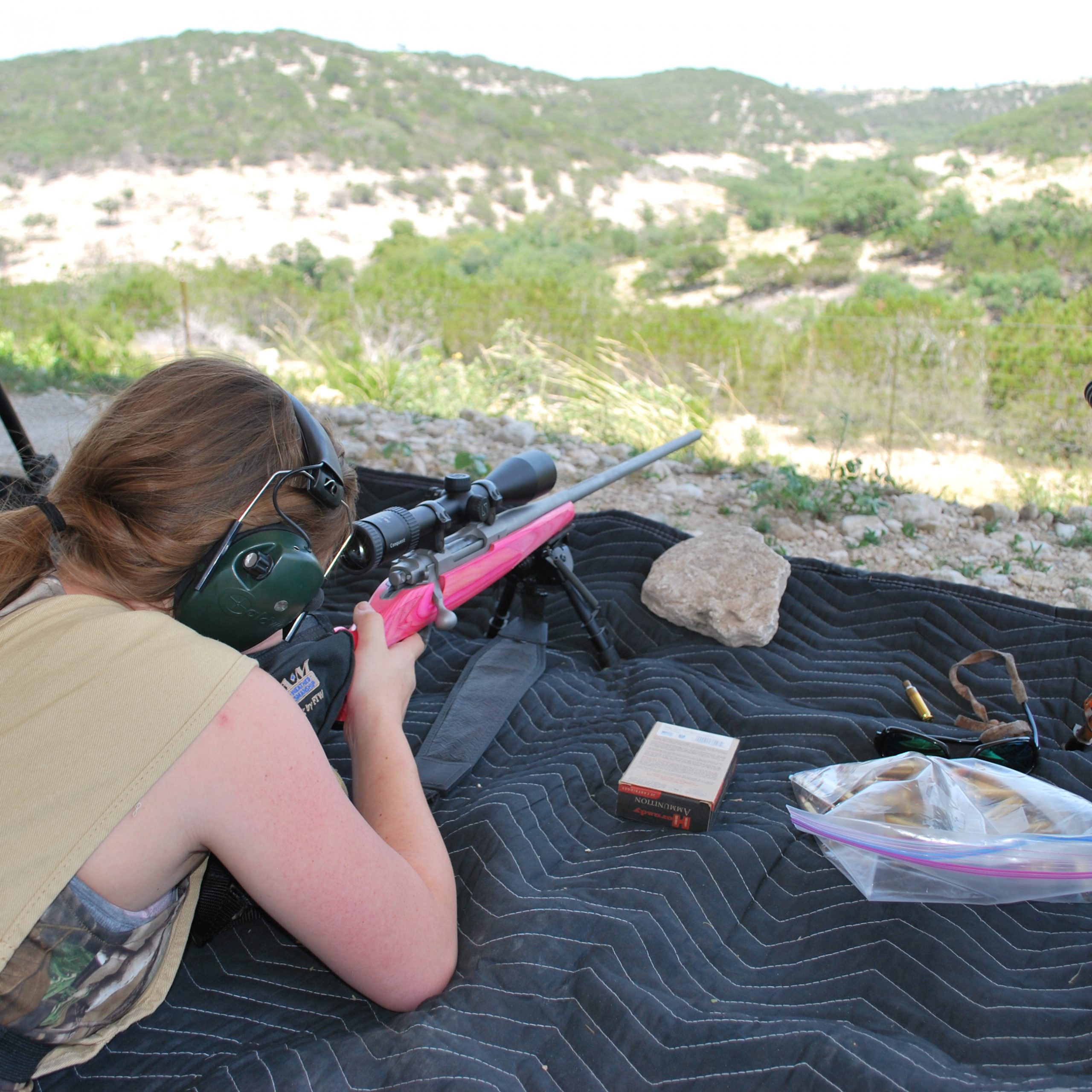
Caroline Boddington at the SAAM course, running a Ruger in 6.5mm Creedmoor out to 1000 yards. She was 16 at the time; the Creedmoor is accurate and fun to shoot, awesome for ringing steel…but that doesn’t make it a long-range hunting cartridge.

But, suppose you also hunt elk. Or, you’re a mountain hunter where the stakes are high and shots are unpredictable. Or, you’re an African hunter with a wide variety of plains game on the menu. Or, you’re an extreme-range shooter. You might want to up your game a bit and consider the PRC instead of the Creedmoor!

When you add 250 to 300 fps velocity you will feel the difference on your shoulder and in the muzzle blast. The PRC isn’t as much fun to shoot as the Creedmoor, but it’s not a hard-kicking cartridge. The difference in performance and versatility is significant, and the short, fat, modern case is conducive to accuracy. I am often not first in line to embrace new cartridges, but I have a Mossberg Patriot in 6.5mm Creedmoor that I’m happy with, fine for deer and hogs at medium range. For anything really serious I want more gun, and I’m impressed by the 6.5 PRC. I’m not going to retire my .264, but I’ve got a Springfield Waypoint in 6.5 PRC on order.

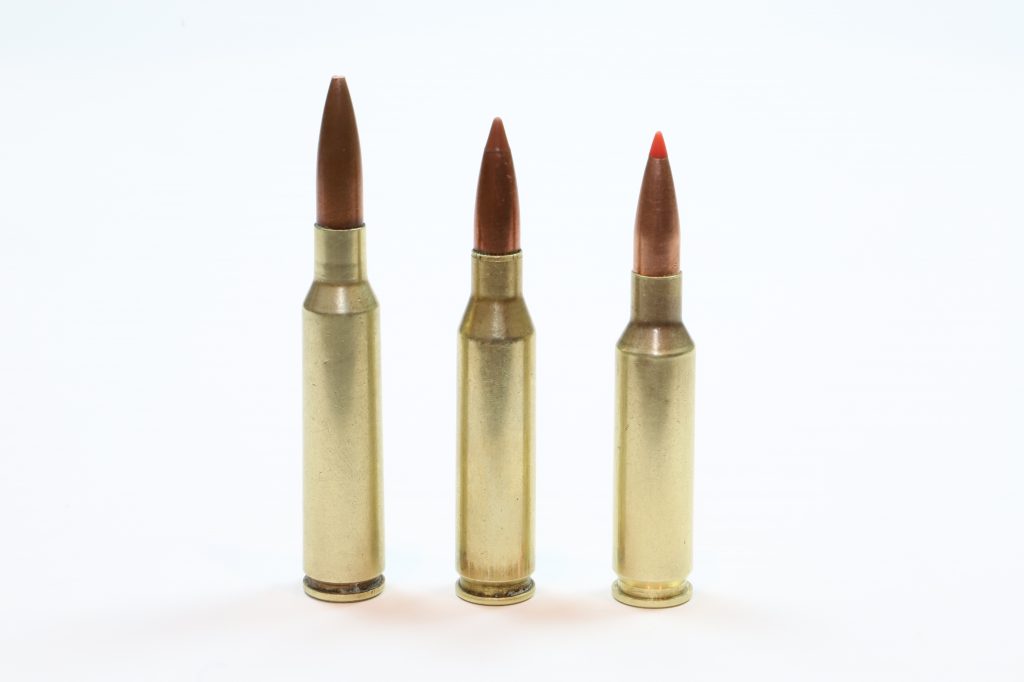
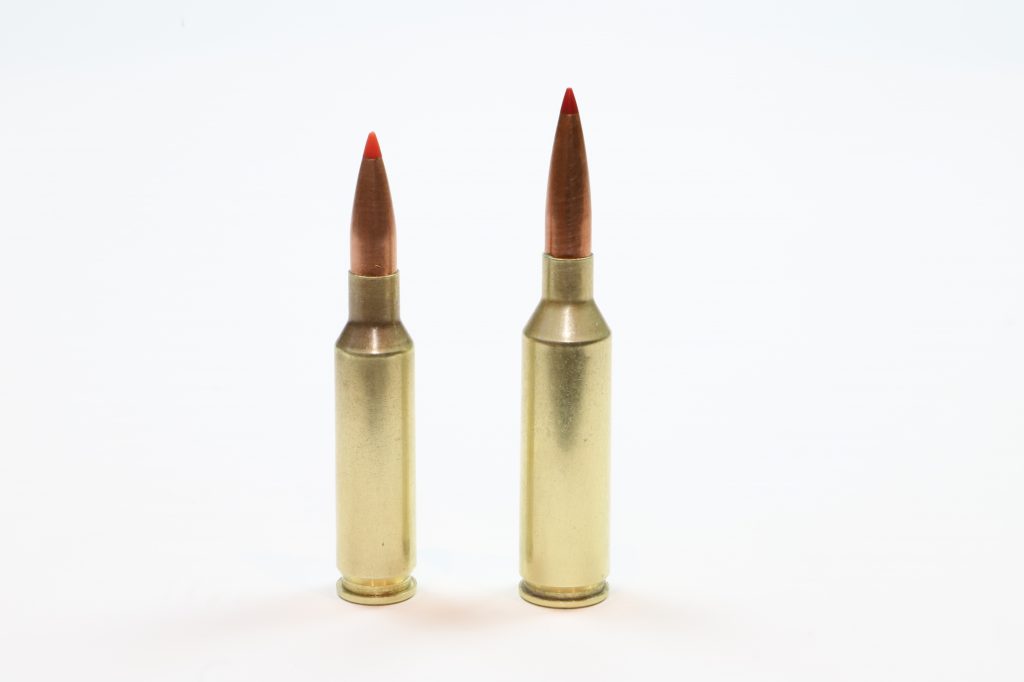
Left, 6.5mm Creedmoor; right, 6.5mm PRC. Based primarily on availability, Boddington believes these are the two best choices in 6.5mm cartridges. Power levels are quite different, so it depends on what you want to do.

Leave a Comment

Hunting 101

The New Hunter Program at FTW Ranch turns novices into well-rounded, ethical, and skilled hunters.

If you want to become a hunter and you don’t have a hunting mentor, where do you start? Sure, a hunter education course is usually mandatory, but where does a novice go for information beyond the basics—how to aim and shoot properly, how to field-dress game, how to learn what to do with all that meat? There are a number of youth mentoring programs in various states, but few places for an adult hunter to get practical training.

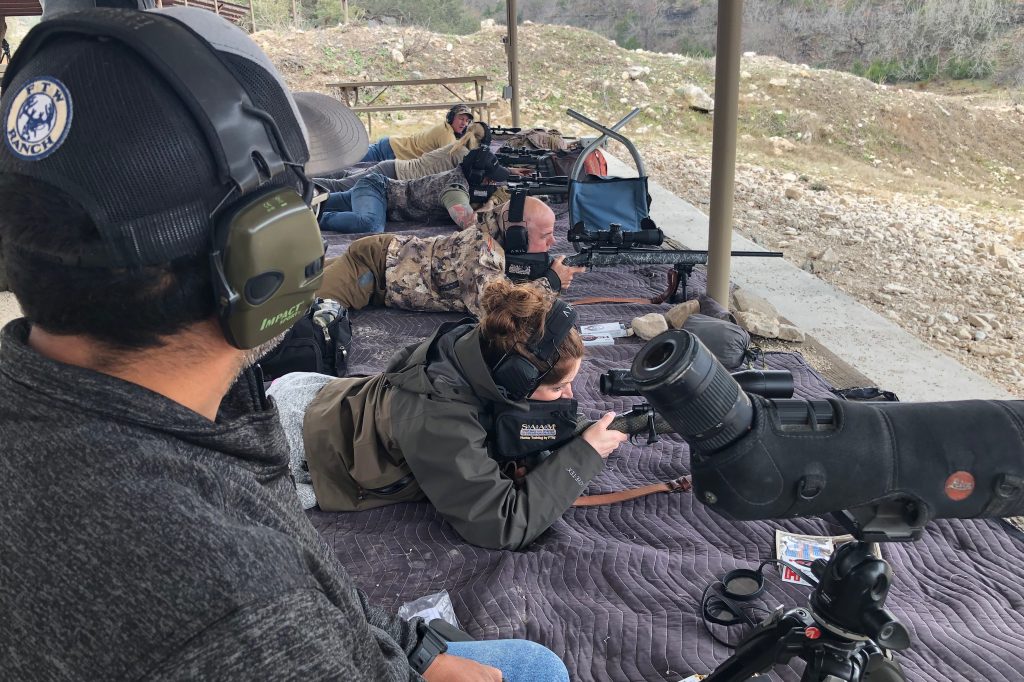
A group of instructors and friends of the SAAM (Sportsman’s All-Weather, All-Terrain Marksmanship) course at FTW Ranch in Texas got to talking about this problem one evening around the campfire. An idea formed, and the New Hunter Program at SAAM was born.

SAAM, which specializes in training hunters to improve and refine their shooting skills, used its existing resources to team devise an inspired curriculum. Tim Fallon, owner of FTW and SAAM, said, “The team put into the course all of the elements that we feel a new hunter needs at the beginning, but also will fill in the blanks for hunters with some experience but not a lot of knowledge. The goal is that everyone leaves the course a better hunter.”

Upon arrival at the ranch, students are fitted for their guns. In this case, all students were provided with a Remington 700 in 6.5 Creedmoor, topped with a Swarovski scope, and Hornady ammo—all included in the price of the course. Some students chose classic hunting-style rifles and others opted for the platform range rifle with pistol grip. 

The course starts with the foundation of shooting proficiency and firearm safety. Students spend a morning in the classroom with Doug Prichard and Dave Knesek, both former Navy SEALs who teach regularly at the ranch. Students learn about parts of the rifle and scope, MOA and mil-dots. A discussion of shot placement and hunter ethics follows, and then before lunch on the first day, students are hands-on in the work room, cleaning and getting familiar with their firearms.

Students practice the basics of breathing and trigger control from prone positions on the range. Photo by Cameron Kuenzer

Shooting sessions on the range familiarize everyone with their guns and whet their appetites for what was next. Each student in the five-day class gets to take part in a cull hunt for blackbuck and fallow deer does. At the course I attended recently, two students were assigned to each FTW guide, and the hunting began on the second day at 5:30 a.m. 

The ever-changing Texas weather was windy and cold for the first early morning hunt. The rugged canyons and cliffs of FTW provide challenging conditions for even a skilled hunter. Some of the students were successful on the first morning, but many returned empty-handed but with significantly better understanding of the process. Morning and afternoon hunts continued during the week for all students, until each one was able to bring an animal to the skinning shed and get busy.

In addition to the daily routine of range time and hunting, students heard experts gave talks on various topics. Dr. Tim Doucet discussed what deer can see versus what humans can see, helping put spotting and stalking game animals and the importance of camouflage into context. Game Warden Clint Graham discussed the role of law enforcement in protecting natural resources. Understanding how to properly use and conserve natural resources is a large part of hunting ethics. Graham also talked about the role of land managers and landowners in the equation.

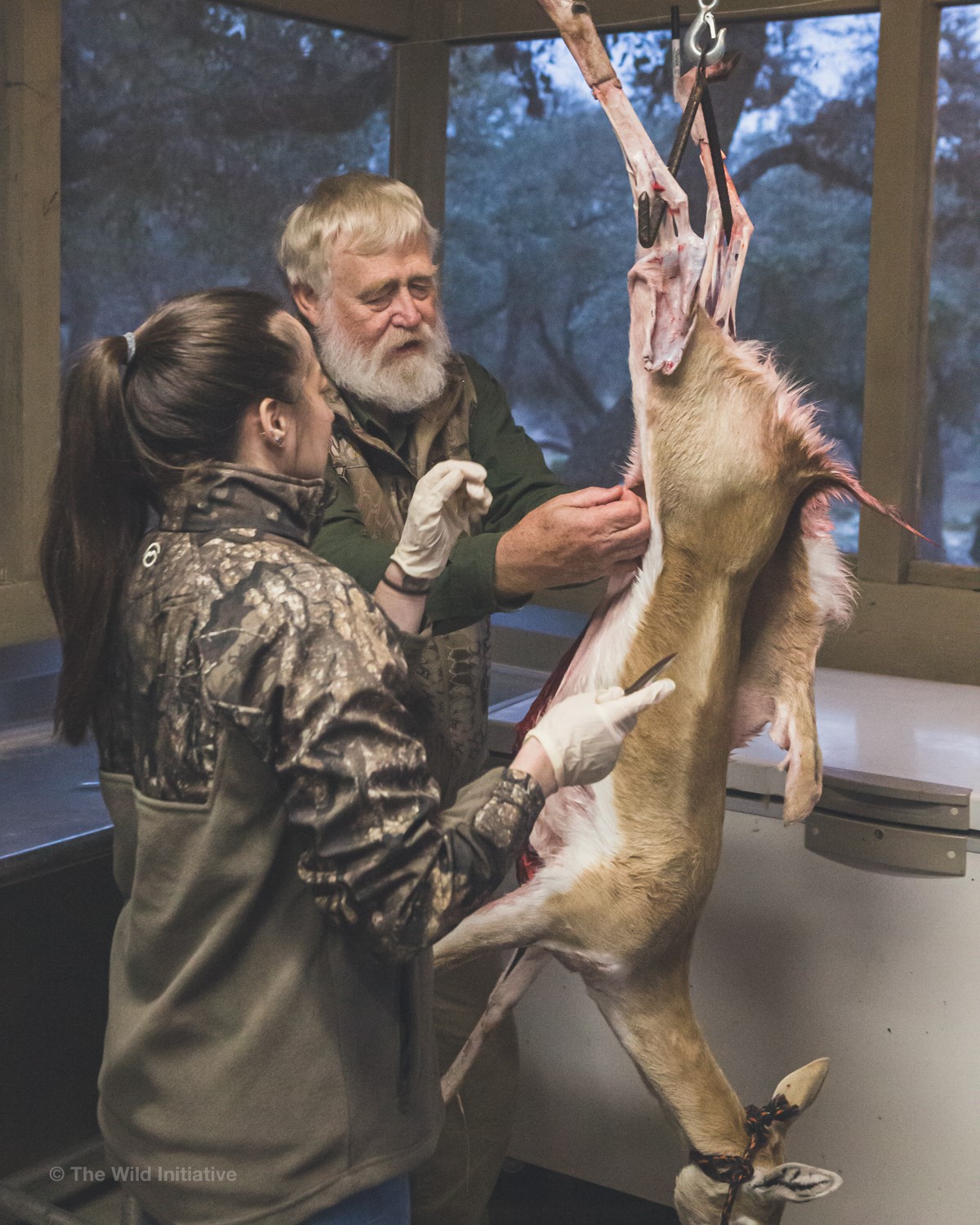
On most guided hunts, once an animal is taken, the gutting, cleaning and quartering of the animal is left to a team hired by the outfitter, and the hunter is free to celebrate, perhaps standing by and watching as the experts work. Not in this course. Each student was front and center in the skinning shed, knife in hand, learning what to do. 

Wildlife biologist and TV personality Larry Weishuhn performed a necropsy on the first animal brought in–a female blackbuck. As he gutted the animal, he not only explained the process but also discussed the various parts of the anatomy, showing the students the exact location of the vitals and examining the stomach contents to help the students learn what the animal had been eating. 

Larry was also on hand in the skinning shed with each student to show the proper way to begin skinning. As we observed the first students intently removing the skin from their animals with sharp knives, Weishuhn said to me, “This course is really remarkable in that it takes any hunter, especially a novice, and makes them a more complete hunter. The knowledge gained here will apply later to almost any type of hunt someone can undertake.”

Another instructor, Gary Broach of Rhodes Taxidermy, showed students how to prepare a skin for mounting, and also demonstrated how to quarter and butcher the animal. The results were steaks, chops, hams, and trim to be made into ground meat.

Capping off the full field-to-table experience was time in the kitchen with Chef Joshua Schwencke of Gastronomy Life Events, who showed the students how to prepare game meat for cooking and made suggestions on how to cook various parts of the kill. At the request of one student, Chef Josh prepared a blackbuck heart ceviche, which many in the group sampled. Each student also got a hands-on lesson in sausage making, using the gourmet recipes of Chef Josh—Thai-inspired or German-style. Everyone was sent home with at least a pound of sausage made from game meat mixed with pork fat and other flavorings. Dinner on the last day was a chef-prepared feast of wild game— followed by a beer tasting of local Texas brews.

One hallmark of SAAM courses in general is the team’s ability to quickly create a tight-knit culture from the diverse experience of students, instructors, presenters, and guides. Whether one is shooting for the first time, or has been at it for twenty-plus years, the camaraderie that quickly forms ensures that no one is left behind. 

The experienced instructors size students up quickly to help them form good new habits and break bad ones. Dave Knesek is one of the expert instructors at SAAM. He said, “I know how to take a look at someone shooting a few shots and immediately see which are the most significant things to correct. Once someone can fix those major things, the rest is easy.” 

Instructor Doug Prichard loves watching people learn. “Students are hungry for knowledge. We provide it and they just soak it up. That for me is the best part of this course.” Doug also addressed the maxim “failure is not an option” by turning it around. “In fact, we learn from failure. It motivates us to do better and to figure out how to do it right.” The expert instructors correct your mistakes with an eye to improving your shooting and by extension, your hunting proficiency. 

The hunting guides follow what students are learning in class and provide their own instruction in the field as students engage in spotting, stalking, discussing distances and windage, as well as observing animal behavior. By the end of the course, all students had bagged an animal to round out their experience.

Karrie Meadows with her blackbuck doe, shot at 145 yards with a Remington 700 6.5 Creedmoor. Photo by Cameron Kuenzer

Caroline Thompson, of Dallas, Texas, told me she was not sure about attending the course. Although interested in hunting, she was completely inexperienced. She wondered if she would feel safe, and if she would be able to keep up with others who were bound to have more experience than her. She wasn’t even sure what to wear. The staff worked with her before arrival to answer her questions, and Caroline ended up enjoying the experience. She said, “If you want to start hunting, this is definitely the place to go.” Caroline bagged a lovely fallow doe, which she skinned herself.

Karrie Meadows, of Plano, Texas, a novice with some experience, liked the way things were explained in an accessible and methodical way. “No matter what your background or previous skill level, this is a course for anyone who wants to learn about hunting. With a wide variety of lessons and topics, everyone leaves with a new appreciation or perspective.” Meadows had her sights on a female blackbuck, first at 300 yards, but then consulted with her guide Efren Hernandez about the wind and the shot placement, precisely as the SAAM training encourages. They decided to move to a better position at the bottom of the canyon, and Karrie made a successful 145-yard shot.

In the evening of the second day, I was watching a group of blackbuck females at 285 yards with my guide. Thanks to the earlier instruction and practice on the range, one shot to the lungs brought down the antelope. Having seen the necropsy earlier in the day helped me visualize precisely where to place the shot. 

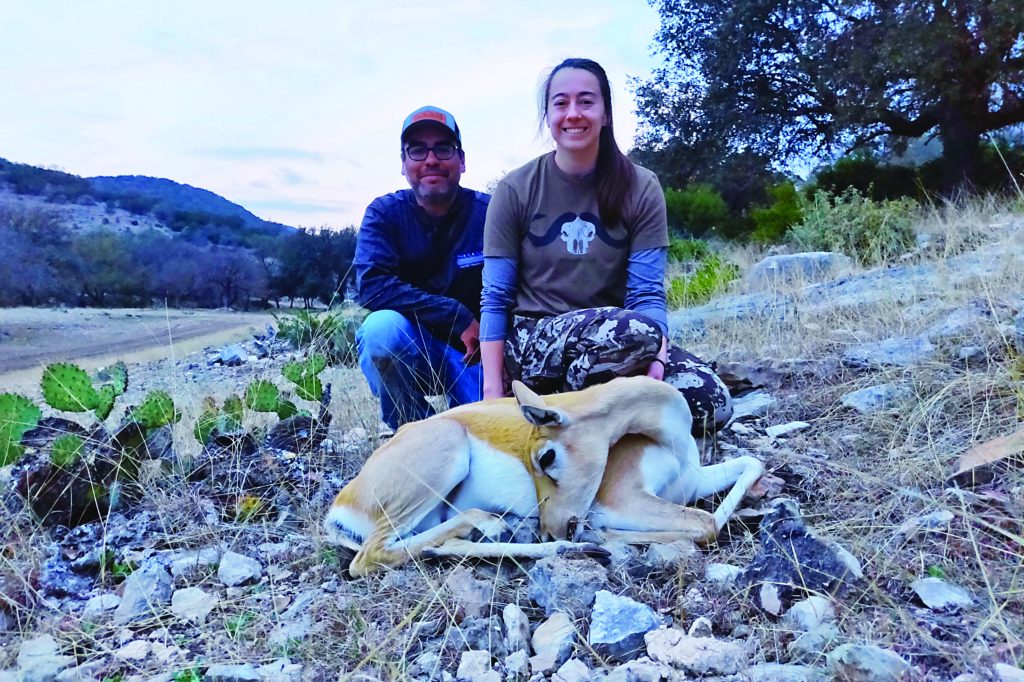
It was in the skinning shed where I could really feel my inexperience. As I wielded the knife, removing the skin from the blackbuck, I frequently asked, “Am I doing this right?” My tutor and classmates reassured me patiently every time. At the end of the process, I had quarters of meat ready for butchering and a hide ready for tanning.

Karrie Meadows and Larry Weishuhn consult on how best to skin Karrie’s blackbuck. Photo by Cameron Kuenzer

Another student, Shaman Bakshi, of southern California, also a novice hunter, sought out this course because even though he has plenty of access to urban firing ranges, he found nothing to compare with the expert instruction or the facilities of FTW Ranch and the SAAM New Hunter Program. He said, “This is the only place with accurate training that I could find—perhaps due to COVID, or because good training may not exist in a consistent way. If it does, I am not aware of it.” Bakshi plans to return to SAAM later this year for the Safari course, which provides African safari simulations combined with shot placement on moving and charging targets, more wind-calling scenarios, and training in using rifle scopes effectively.

The New Hunter Program is rare in the world of shooting and hunting. The SAAM faculty have done a brilliant job of bringing together a winning combination of location and game, classes and sessions, and personable and skilled instructors. The result is a unique and intense experience that delivers on its goal to turn novices into more complete hunters. Those who have gone through this comprehensive experience, building solid skills from a solid base, are likely to go back into the field and hunt, again and again. 

Learn about the New Hunter Program by visiting ftwsaam.com and clicking on the SAAM tab.

Leave a Comment

Best Bets for Bushbuck

Where to hunt “Africa’s whitetail.”

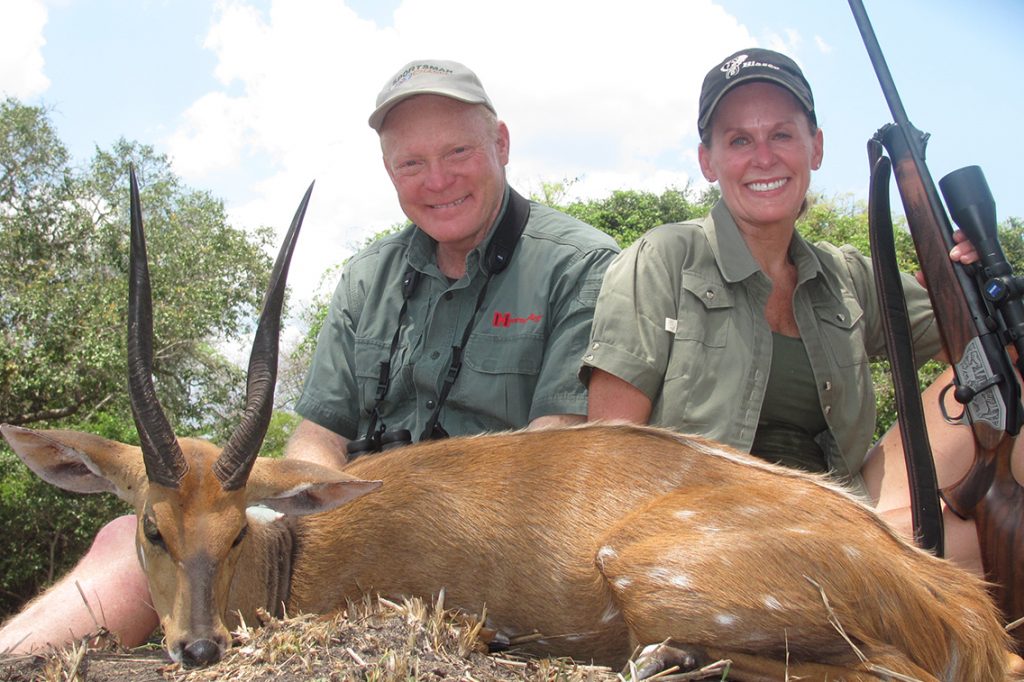
Photo above: An old harnessed bushbuck with one horn tip broken, taking a drink along a river in Benin. (Photo by Christophe Morio)

On a hunt in Uganda this past March, we spent our last few days hunting sitatunga in riverine papyrus beds, and we were successful on the last evening. On our very last day, we needed to be in Kampala by late afternoon for a midnight departure, but we had time for a morning hunt. Donna wanted a bushbuck, so we headed into mixed thornbush away from the river. Just at full daylight, hardly a half-hour from camp, she and PH Jumbo Moore stalked a big ram on a brushy antheap. It was the second bushbuck they’d stalked, but this one held for a shot.

The ram had heavy 16-inch horns, big for any bushbuck. And this wasn’t any bushbuck; it was a Nile bushbuck, one of the smaller races, so hers was exceptional. I shouldn’t have been surprised. In general, Donna is not a lucky hunter, but she’s been charmed with big bushbucks! I wouldn’t have banked on one that large, certainly not on a one-morning hunt. However, we were in a special place for bushbucks. 

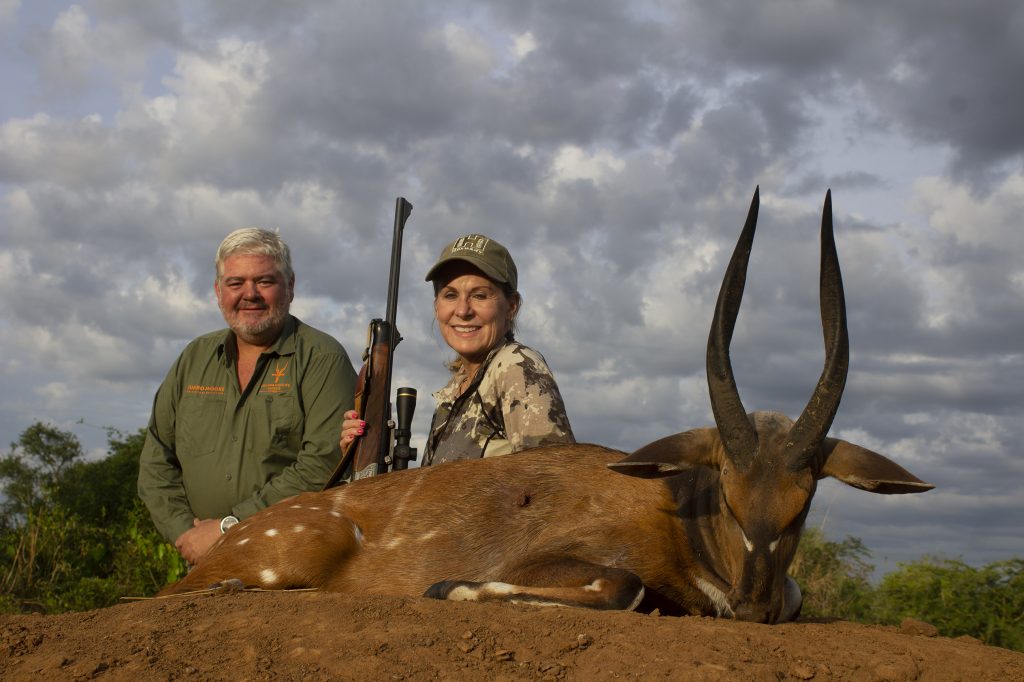
PH Jumbo Moore and Donna Boddington with her Nile bushbuck, taken along the Kafu River in central Uganda. At 16 inches, it’s big for a Nile bushbuck; these horns are longer than they appear because of exceptional spirals, with excellent mass.

We were on the Kafu River in central Uganda. The wide, shallow river holds huge papyrus beds, ideal sitatunga habitat shared with crocodiles and hippos. Away from the river, small croplands are interspersed with thick cover, and I’ve never seen such a concentration of bushbucks (of any kind). Along the Kafu, bushbucks walk around like goats. You’ll see a few at any time of day, but poke around slowly in early morning or late afternoon, and you’re almost certain to see nice rams.

The bushbuck, Tragelaphus scriptus, is the smallest and most widespread of Africa’s spiral-horned antelopes. I think of them as Africa’s whitetail, and there are many parallels: Both species are crafty and love heavy cover. When threatened, the bushbuck gives a sharp bark, just as final as the whitetail’s alarm snort. Size and color vary confusingly. In the nineteenth century, when every explorer (or wannabe explorer) wanted an animal named after him/her, there were as many as forty races identified. Many are still disputed, but some modern experts reckon something like eight regional groupings is more likely. SCI and Rowland Ward’s record-keeping systems are not in total agreement on number or nomenclature, boiling the bushbucks down to eight and nine races respectively, all by regional grouping. A major difference between the two systems: Rowland Ward classes all bushbucks in South Africa (and adjacent southern Mozambique) as the South African bushbuck, with Chobe bushbuck to the north. SCI splits this into Cape bushbuck along the coast, adding the Limpopo bushbuck in northern South Africa and adjacent Zimbabwe. 

Taking one each of all the bushbucks is a Herculean task, and I have not. By SCI’s categories, I’m missing the Abyssinian bushbuck of Ethiopia’s lowlands. By Rowland Ward’s listings, I’m also missing the (disputed) Shoan bushbuck, found only on the southwest edge of Menelik bushbuck range in Ethiopia’s high country, but smaller and with almost no white markings; and the Somalian bushbuck of Somalia’s southern coast, not hunted for many years (current status unknown).

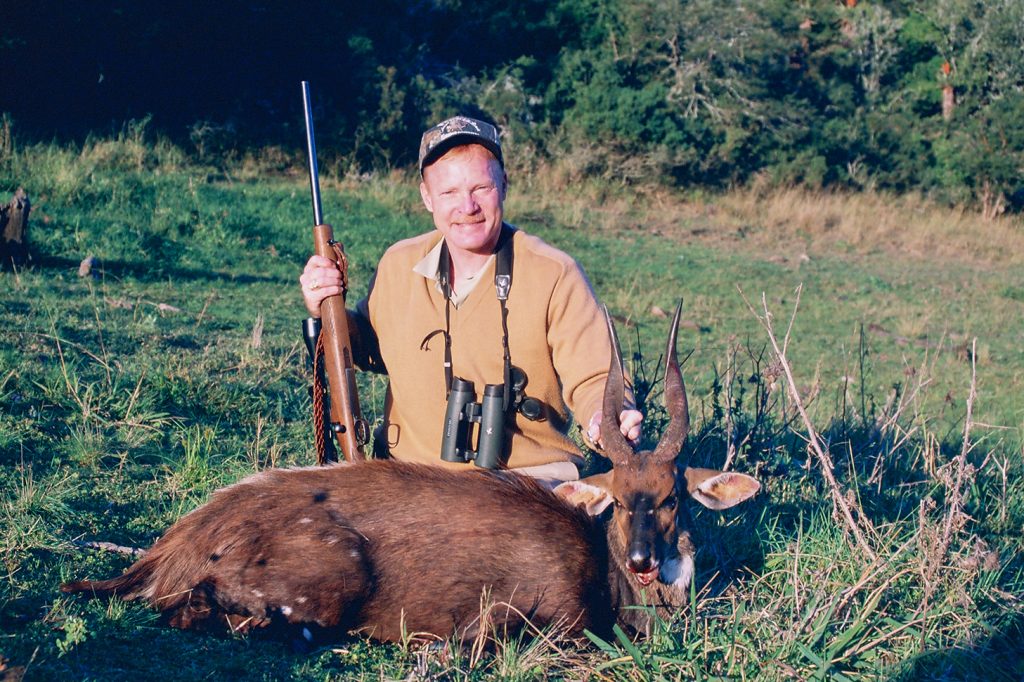
A gorgeous, dark bushbuck from South Africa’s eastern Cape, one of the great places to hunt this animal. This ram is about 14 inches, heavy and with perfect shape, a fine ram.

No matter; I like to hunt bushbucks. Rarely is a bushbuck a primary objective of a safari, but trophy fees are low and hunting them is interesting, making them an ideal add-on to any safari where they occur (which is almost everywhere except in desert habitat).  They’re crafty, tasty, and gorgeous! Typically, South African (Cape) rams are very dark, as are the Menelik bushbuck. Chobe and Abyssinian bushbucks are usually red while, in my experience, Limpopo and East African bushbucks may be very red or very dark. Most have a white throat patch and a variable patterning of white spots and stripes. The westernmost harnessed bushbuck, found throughout the forest zone, usually has the most brilliant markings, followed by the Nile bushbuck, currently hunted only in Uganda.

Throughout the races, individuals vary in markings (which largely led to the many proposed subspecies). As hunters, we usually don’t shoot bushbucks based on color; we tend to look at horns first: Spiraling gently upwards from thick bases, and usually ending in needle-sharp tips. Anywhere, an older ram with thick, worn horns may be a fine trophy at 12 or 13 inches. A 14-inch bushbuck is always good, and any ram in the 16-inch class is cause for serious celebration. In the old days, Kenya produced the longest-horned bushbucks. My first, up on Mount Kenya, had 18-inch horns, and remains my best. However, almost all of the races, even smaller bushbucks like harnessed and Nile, have produced individuals with outsized horns. It depends on your luck.

In today’s world, the Limpopo drainage probably produces the largest bushbucks, but Masailand’s scattered mountains also produce big rams. Chobe bushbuck in the Zambezi drainage in Zambia and northern Zimbabwe are generally smaller, but seem to grow exceptionally large in coastal Mozambique. The first time I hunted there, at Mahimba north of the Zambezi, I shot a wonderful 16-inch bushbuck. In a three-week period, three other hunters also took bushbucks. Mine was the smallest of the four, and I’m not ashamed of him!

Donna Boddington has been exceptionally lucky with big bushbucks. This is an exceptional Chobe bushbuck, taken in coastal Mozambique’s Coutada 11, south of the Zambezi.

The big Coutadas of the Zambezi Delta, surrounding the Marromeu Reserve, also produce very large Chobe bushbucks. However, unlike most places where I’ve hunted bushbucks, they seem to be generally (and thinly) distributed in the miombo forest, rather than tied to patches of ideal habitat. This makes them difficult to hunt specifically and on purpose. A few years ago, Donna (naturally) got a wonderful bushbuck there, but I never have. In fact, of the twenty-odd antelope varieties in the area, a big Chobe bushbuck is probably the most difficult, and one game quota that the outfitters never completely fill. Even so, that area produces several rams in the upper teens every year. It depends on your luck, and also how much time you spend specifically hunting bushbuck.

Harnessed bushbucks occur literally throughout the forest zone, but are thin on the ground and difficult to hunt in climax forest. I’ve seen them, and heard them bark, but I’ve had much better luck in the terminalia forest (“savannas”) of northern Cameroon and CAR. Benin and Burkina Faso are also excellent for harnessed bushbuck. Neither Donna nor I got one there, but we didn’t hunt them hard enough. You won’t encounter them daily in Central Africa, but you can hunt along thicker riverine growth that “just looks like” bushbuck habitat, and in the course of a week or two you will almost surely have a chance.

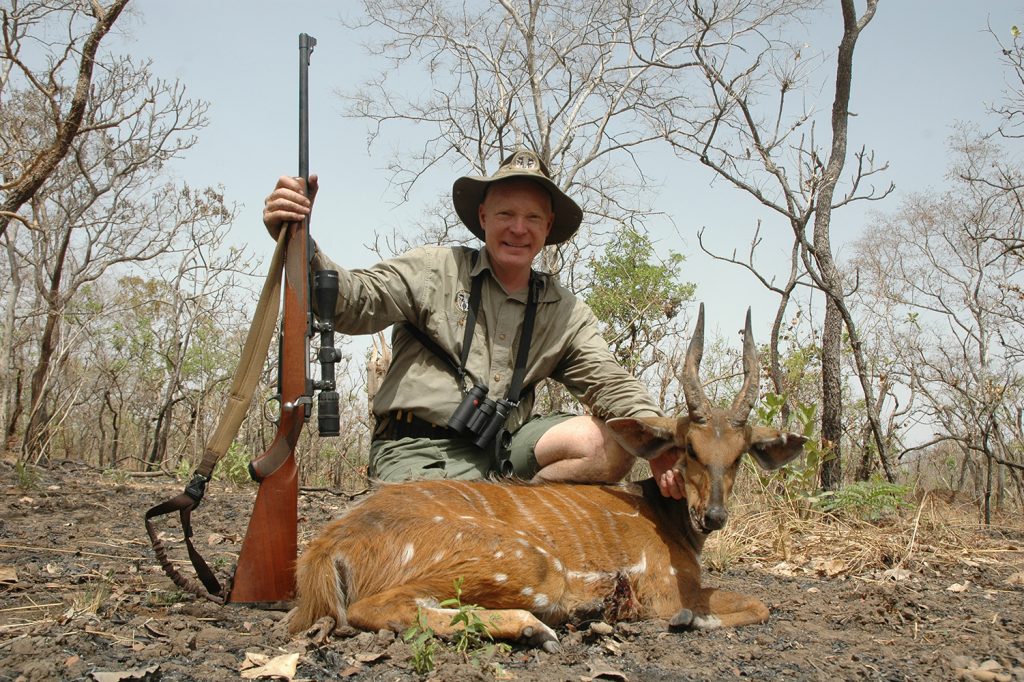
Length is modest, but this is a good, heavy-horned harnessed bushbuck, taken in northern Cameroon. The patterning of white stripes and spots gives the harnessed bushbuck its name; it’s generally the most brilliantly colored of all the bushbucks.

Places like Uganda’s Kafu River, where you can sally forth on almost any given day and expect to encounter a good bushbuck are rare, but not unheard-of. Mount Kenya was certainly like that, and I’m told Tanzania’s Mount Meru is the same. Certainly, there are riverines in the Limpopo drainage, both northern South Africa and southern Zimbabwe, where you can read the habitat, hunt it at the right time, and expect to see good rams.

South Africa’s Eastern Cape is also exceptional for bushbuck, both in the thick coastal thornbush, and in hilly country to the east. Agriculture can also be a key: Again, like whitetails, bushbucks must have heavy cover for security, but they also love “edge” habitat, thriving in the mosaic between farmland and thick bush.

The only time I hunted the nearly black Menelik bushbuck of Ethiopia’s high country, Joe Bishop and I hunted a big farming cooperative near Asela. Our outfitter, Colonel Negussie Eshete, planned just a day and a half between the mountains and the Danakil to hunt this important animal. The country sure didn’t look like bushbuck habitat, just narrow strands of cover along small streams, and big stands of mature eucalyptus with little understory. Negussie fully expected us to take our bushbucks in the allotted time, and we did. Mine was a nice ram, just peering out from behind a stout eucalyptus. As often happened when we hunted together, Bishop got a monster, one of the biggest in recent times. For bushbuck, you always have to be in the right place at the right time. To take a really big bushbuck, you also need a bit of luck!      

Leave a Comment

Backcountry Meat Care

Keeping meat clean and cold until you can get it back to civilization is daunting, but it’s doable as long as you’re prepared.

Photo above: Processing meat in the backcountry can be challenging, but if done properly will result in healthy, delicious meat for your freezer.

Wind moaned through the alders, whipping the tops of stunted spruce into a frenzy. Crouched between a couple small trees, I stared at a big eyeball peering back at me from behind a spruce thicket. Above the eye a massive antler reached outward and upward like some primeval brown wing, but that was all I could see of the moose. One eye and one antler, although he was only thirty-five yards distant.

The day before I’d picked up an old grizzly-chewed moose scapula from beside a rushing creek. Just moments before, I’d beaten the same scapula up and down the trunk of the small spruce I now hid beside, in an attempt to lure a grunting bull from his timbered hillside stronghold. It had worked better than I planned, but thanks to the intervening tree I still didn’t have a shot. Slowly, I reached the bleached scapula into the air above my head and starting rocking it back and forth where the bull could see it. His eye sharpened, then rolled back in rage at the effrontery of a perceived small bull posturing at him. He strode into the open then, and I answered his challenge with my .300 Winchester Magnum.

My friend Greg and I were deep in Alaska’s interior, floating an unruly stream in one-man packrafts in an attempt to find undisturbed moose hunting. We’d found it, but now we had a problem. This moose was BIG. Big and heavy, and after skinning and quartering it we had one and a half miles to carry the meat on foot, thirty miles of ragged, capricious stream to float, and a dozen miles of terrible ATV trail to haul the moose across before we were, literally and figuratively, out of the woods. Add the complexities of rain, bilge-washed rafts, and hungry grizzlies, and it was apparent that keeping this meat good was going to be a challenge. Fortunately, we were prepared.

Regardless whether you’re hunting Coues deer in Arizona, elk in Montana, or moose in Alaska, meat care is likely to be challenging. Heat, cold, bugs, and bacteria all create obstacles to keeping meat fresh while extracting it from the backcountry. Here are tools and tactics that will help.

Heat

The number one threat to your meat is heat, both external (weather) and internal (body heat). Bacteria only thrive in warm surroundings. Hence, it is imperative to chill your meat as rapidly as possible after harvest.

Your first task after harvesting a backcountry animal and completing your photography session should be to skin and quarter the animal. This will enable body heat to escape rapidly. I prefer the gutless method, as it renders a quicker job and cleaner meat. Use 550 paracord to hang the quarters in a shady spot till the meat cools, and develops a nice crust. Drape the backstraps and other trim meat over clean shaded branches or rocks to cool. Then bag it all in meat sacks to keep bugs and dirt away from the meat. If bugs are bad (particularly flies), you’ll need to bag the meat the minute it comes off the animal. It’ll cool fine inside the meat sacks, it just won’t develop as good a crust. During the quartering and cooling process, take extra measures to protect the meat from dirt and debris. The cleaner your meat, the longer it will keep and the better it will taste.

If the weather is cool enough, say low 40s at night and daytime highs in the 60s, your meat will keep fine for several days as long as it stays in the shade. Cooler temps are even better, and will keep the meat longer.

If temps are hot, say in the 80s during the daytime and 50s or 60s at night, you’ll need a way to chill your meat. The best and only way I’ve found to chill meat in the backcountry is to bag it in contractor-grade trash bags and submerge it in a cold spring or creek. The meat will chill rapidly, and will stay good for a long time.

Cold

Rarely indeed does cold become a problem, unless you hunt the Far North, or late-season high-elevation elk. But it can happen. Your meat will never spoil, but it may freeze so hard that you can’t reduce it to carrying-size pieces. If temps stay below 32 degrees F during the day and drop into the teens or colder at night, even big, thick elk or moose quarters will freeze solid as the rock of Gibraltar. If you need the meat boned out or reduced to a packable size, you should cut it up before it freezes solid. Keep the meat perfectly clean and cut it as though you were processing it at home, then seal it into gallon-size zip-top bags. When you arrive home, simply toss the already-frozen meat into your freezer, preprocessed in the backcountry. Later you can defrost the meat and grind, wrap, or whatever at your leisure.

Alaskan moose meat hung on a scaffold where I could view it from a distance, the better to avoid an unpleasant encounter with a grizzly. A tarp can be spread over the assembly to protect against inclement weather.

Bugs and Birds

We’ve already touched on bugs and the damage they can do to your precious meat. In my experience, the nastiest damage your meat is likely to incur will be from flies, which, if present, will lay colossal amounts of eggs in every crack and crevice of the meat. You can trim them away, but in the process you’ll loose significant meat as well as your appetite.

Another threat to your precious meat comes in the form of hornets and yellow jackets. They’re carnivorous, and can consume astonishing amounts of unprotected meat. They’re not nearly as nasty as flies, but might inspire you to employ some expletives if you inadvertently grab one while handling your meat.

Lastly, birds can be a real problem in certain locals. Camp robber jays will ruin a lot of meat in a day’s time, and ravens, magpies, vultures, and the like can devour your entire meat cache in rapid order.

The best way to protect your meat from these predators is to bag it in good meat sacks and keep it hung in a shady spot. Place each quarter in its own bag, and place the backstraps, tenderloins, and other trim meat in one or two additional bags. Tie them off tightly so even a fly can’t get inside.

Moisture

Simply put, moisture is not your friend when it comes to keeping meat good in the wilderness. Moisture harbors and encourages bacteria, which is what spoils meat. Do your best to get your meat dry and keep it that way. If you’re hunting the far north where rain is to be expected and there may be no trees on which to hang meat, carry a sturdy 8×10 tarp that you can lay the quarters on to cool. Later, you can build a small scaffold to hang your meat on, and then cover it with the tarp. If you’ll be backpacking or floating a river through rainy weather, seal the meat in contractor-grade trash bags until the time you can again hang it to dry and air.

Bacteria

Bacteria in your meat are enemy number one. Unfortunately, all meat comes with inherent bacteria, and picks up lots more as soon as you introduce it to the atmosphere, your hands, your pack, and so on. Still, keeping your meat clean will drastically reduce the amount of bacteria it must deal with, and dramatically up your odds for good, tasty, wild meat. Remember, for bacteria to grow rapidly (thereby spoiling your meat) it must be warm. Keep the meat cold and it will stay good for many days without any problem.

One interesting “fact” I encountered while hunting and outfitting in the Rocky Mountains as well as Texas, is that not all regions are created equal. Two guides who were working for me almost came to blows over a disagreement about leaving an arrow-shot elk overnight before recovery. One guide was from Utah, and used to hunting cool, high-elevation territory. The other was from southern New Mexico, accustomed to hunting much lower, warmer country. The Utah guide maintained that it was a good idea to leave bow-shot animals overnight if the hit was at all questionable. The New Mexico guide was adamant that doing so would result in complete meat spoilage.

I listened with interest before finally stepping in and telling the guides to cool it, while adding my testimony to the Utah guide’s that I’d often left bow-shot elk overnight in high-elevation areas without experiencing any spoilage whatsoever. The New Mexico guide was disgruntled and unconvinced. I later learned that he, too, had been correct. In his warmer, lower-elevation neck of the woods, meat spoils much more rapidly, and an elk left unprocessed overnight will almost certainly spoil. I can only attribute this to the presence of more aggressive bacteria. 

This point was driven home to me one cool west Texas autumn day. I arrowed a deer perfectly with my longbow three hours before dark, and watched it tip over seventy yards distant. I had a whole pocketful of deer tags, and elected to let the buck lie while I sat for the rest of the evening in hopes of taking a second deer. In my home territory in the Rockies, the deer would have been at no risk of spoiling. However, upon recovering and quartering this west Texas buck exactly three hours after shooting him, I found that the meat was already souring. I was astonished and not a little chagrined, and then remembered the disagreement between my two guides. Based on this, it is my belief that meat will keep much better and longer in high-elevation, northern territory than in lower, more southerly territories, even when temps are similar, so keep that in mind.

Wild game meat can be incredibly flavorful, healthy meat. Do yourself a favor: Next time you hunt the backcountry, go prepared to treat your meat right. Steaks sizzling on the grill and a freezer stuffed with healthy meat will be your reward.

 Half-frozen elk meat, processed and ready for a 13-mile pack out of the high country.

Meat Care Tool Kit

Here is a basic list of must-have meat care tools for wilderness hunting. It will vary slightly depending upon hunt type and species. For instance, I might carry a nice fixed-blade belt knife during a float hunt for moose or a horsepack hunt for elk, but would exchange it for a skeletonized superlight knife during a backpack hunt.

Knife and Stone: I recommend carrying two knives, so you have an extra should one get lost. I also carry a tiny diamond stone made by EZ-LAP. With it I can restore a razor edge in less than a minute. I personally don’t like replaceable-blade knives, because I don’t like how they handle and because in my opinion they pose additional danger to the user. In the backcountry that’s a significant thing.

Meat Sacks: Lightweight meat sacks are essential. I like sturdy cotton sacks best, unless I’m hunting in Alaska where conditions are more challenging. For that I recommend the premium synthetic bags that come in kit form, tailored to contain the quarters and piece-meat from one moose, one caribou, etc. You’ll pay upward of $100 for such a kit, but they are reusable and worth the money.

Parachute Cord: Fifty feet of 550 paracord will serve to hang quarters, build meat poles, secure meat sacks, and so on. I like brightly colored cordage–it doesn’t seem to disappear as readily as the olive-green stuff.

Latex/Nitrile Gloves: Sturdy latex gloves make life easier, especially when it’s time to wash up. I carry two pairs.

Contractor-Grade Trash Bags: Heavy-duty trash bags are essential for keeping your backpack clean while packing meat, cooling quarters in mountain creeks, and 101 other meat-related tasks. I carry at least two.

Leave a Comment

A Culture of Generosity

A new study finds that American hunters are incredibly unselfish about sharing the bounty of their wild harvests.

For most of human existence, hunting was an integral component of our species’ ecology, an act of pure survival and a primary means by which our communities were sustained. A successful hunt meant sustenance and security, brief but vital achievements within a tenuous, animal existence.  Understandably, both were celebrated by the hunter and the non-hunter alike. By means of story telling and mythology, both groups participated in the hunt, though certainly neither could have understood hunting in terms of recreation or sport, its beleaguered, modern terminologies. Rather, hunting was a necessity; the hunter deemed provider. And, it was the perceived generosity of the hunter, even more than his skill, that elevated him to a position of respect. Sharing his success was what mattered most, to the hunter’s status and to his community’s survival. Through this mutual benefit a core value system arose in human society, one where success and sharing became intertwined.

Today, we may often feel that this past is but an imagined whisper; a reality long dispersed and leaving us with an entirely new human world that little reflects its ancestral roots. Indeed, if you look at the declining rates of hunting participation and listen to the mounting objections of anti-hunting groups, you might conclude that hunting itself has become unacceptable and largely irrelevant in our modern world. 

Scratching the surface, however, you will find this diagnosis premature. Although it is true that only about 4 percent of the population in the United States engages in hunting activities, roughly 80 percent of Americans approve of hunting. Few activities, and far fewer controversial ones, which hunting surely is, enjoy anything close to this level of support. How and why is this support maintained? What can explain it? Could it simply be that the non-hunting population inherently agrees with hunting, no questions asked? Or is there at play some more profound human dimension that can help explain all of this? I have always felt there is, and that uncovering it will likely be a key to preserving hunting as we know it in North America. 

While there is certainly a complex set of factors at work, I believe these numbers suggest that hunting is not an isolated activity that occurs outside the experience of the majority population. Somehow, the non-participatory mass of people remains connected to hunting, or are made to feel as though they are. Somehow still, remarkably, hunting remains resonant across the larger fabric of society. But how? Is it possible that non-hunters can still perceive they benefit from hunting in some way, just as they did in the past, and thus continue to acknowledge, in a more muted process of quiet support rather than celebration, successful hunts and successful hunters? Does the broad public, in fact, still regard hunters as providers, in some atavistic way? Is this the wellspring from which the 80 percent public support rating derives? If so, what could possibly be reinforcing this societal tendency that seems so invincible to time, change, and controversy?

Traditionally, the most concrete manner in which hunters impacted the lives of other community members was through the shared consumption of wild meat. If this sharing tradition has been maintained, then this might be one way in which hunting could sustain both its presence and legitimacy in modern society. But while it is known that many non-hunters in the US have tried game meat and that hunters regularly share their wild meat harvest with others, the extent and patterns of wild meat sharing in the country are largely unknown. Without this information, it is difficult to conclude what role meat-sharing might play in maintaining public support of hunting. 

Obtaining this information lies at the heart of a comprehensive new program designed to explore the modern relevance and value of North America’s hunting traditions. The Wild Harvest Initiative represents an expanding network of partners dedicated to evaluating the varied dimensions and social impact of wild harvesting activities in the US and Canada. Uncovering, for the first time, the full economic, conservation, and social benefits of recreational animal harvests, this initiative is building an evidence-based narrative on the relevance of these activities in today’s society. As a crucial part of this effort, the Wild Harvest Initiative has set out to determine the full extent of wild meat sharing that takes place throughout the United States and Canada.

Starting with Texas as an initial point of inquiry, the Wild Harvest Initiative, in partnership with the Texas Parks and Wildlife Department, administered a Wild Meat Sharing Survey to resident hunters throughout the state. The survey findings, which were made available in 2020, are indeed remarkable. They shed new light on an ancient tradition that has been maintained long after it was essential for human survival. They open a modern passageway to our hunting past and expand our appreciation of hunting’s present.   

The survey revealed that nearly all successful hunters (98 percent) regularly share meat, and that this meat is shared with an estimated 5.8 million people across the state of Texas annually.  Considering the fact that, on average, less than 1.2 million people in Texas are hunting each year and, of this number, only around 718,000 are successful, the social reach these individuals are having is astounding. Roughly speaking, successful hunters in Texas are expanding the number of people benefiting from their wild harvesting activities by eightfold! This statistic has profound implications, especially when considering that approximately 1 in 7 people (4 million people total) in the state are experiencing some level of food insecurity. 

Significantly, individuals receiving the shared meat are definitely not restricted to those living within the same household as the hunters themselves. In fact, the majority of people receiving this meat–3.7 million (about 64 percent) – live outside the hunters’ home.  And the amount of meat involved is substantial.  The survey revealed that hunters share nearly 43 percent of their meat harvest with people living outside their domiciles, embracing a community of extended family, friends, neighbors, and associates.   

So, why do hunters do this? The Texas sharing survey also looked at the motivations behind meat sharing and hunting participation itself.  More than half the respondents stated that spending time with family and friends was a primary motivation for hunting while the most common reasons for harvest sharing were that hunters had more than enough meat for their own household and wanted to help family and friends with food stocks. Each of these responses speaks to an overall awareness and deep appreciation of family and community within the Texas hunting tradition.

While the results of this survey are specific to Texas, I suspect the story is similar in many other parts of the United States and Canada. And we will certainly find out. Building on the survey administered in Texas, the Wild Harvest Initiative has now partnered with several other state wildlife agencies to gather findings from other parts of the country. Once compiled, these results will reveal a more complete picture regarding the motivations and expansive social benefits associated with hunting in the United States.

But already the data are telling a positive, compelling story about our society and its traditions, and one that is contrary to the overarching narrative we so often hear.  We are constantly bombarded with stories of how community ties are eroding under the increasing weight of individualistic, self-absorbed pursuits and technology-mediated relationships. Generosity and magnanimity are certainly not the most often mentioned attributes used to describe today’s society. However, those who harvest wild meat, and who share so much with others, provide a powerful counterpoint to that narrative. I suspect this will be proven true of all who harvest from the natural world, hunter and gatherer alike.

This culture of generosity, demonstrated so emphatically by present-day hunters, is rooted in our evolutionary history. For tens of thousands of years communities have come together to share, celebrate, and enjoy the wild sustenance provided through successful hunts.  The Wild Harvest Initiative, through its Hunter Sharing Survey, is uncovering the modern dimensions of this historically rooted, cultural network that connects hunters and non-hunters in a community built on generosity and shared resources. The inherent beauty in these connections is worth preserving and speaks forcibly for the relevance and social value of North America’s hunting tradition. After all, who does not admire those who share?

Leave a Comment

Masailand Safari

Braving COVID and travel hassles to experience an unforgettable adventure in Tanzania.

East Africa feels like southern Africa without the guard rail. Anyone who’s ever spent any time there can attest that its danger matches its startling beauty, making the region a premier destination for the traveling hunter. Tanzania is massive, and still very wild; less than 15 percent is accessible by paved road, and medical attention can be days away.  The mosquitoes alone can kill you.  Sure, everyone knows about COVID, but locals will tell you it’s the hippos you need to worry about.  

After the international travel standstill of early 2020 had eased, my husband, Ricardo, and I made our way to Tanzania as quickly as we could.  We hunt together worldwide, but instead of just traveling with rifles and archery equipment this time, we were also armed with facemasks, industrial-strength hand sanitizer, and negative COVID-19 blood tests.  Our original booking was on Turkish Airlines, which unexpectedly canceled all flights to Tanzania for September and October due to COVID concerns; unfortunately, they had not bothered to let us know until we arrived in Chicago from Texas on the day of our departure. The clock was ticking, as Tanzania requires proof on arrival of a negative COVID test within 72 hours of departure.  Despite our efforts, we were unable to get onto alternate airlines that evening. The following morning, at 5:30 am, we caught the first flight to Dulles, for a series of connecting Ethiopian Airlines flights that took us to Addis Ababa, Ethiopia, on to Zanzibar, and finally to Kilimanjaro Airport in Arusha.  

Oh, the joys of travel, especially in this crazy COVID era. We arrived in northern Tanzania with just three hours remaining on our COVID test’s validity, and very eager to start our thirty-five days in Masailand with Tanzania Big Game Safaris. We were greeted by Lorne Ramoni, our primary professional hunter, Dustin Van Staden, our second professional hunter, and Barry Bingle, apprentice hunter.  

I was handed an arrangement of fresh flowers—well played, gentlemen–and several men assisted us with luggage and clearing Ricardo’s archery equipment through customs. From the airport, the Monduli Camp is about a three-hour drive. The company had arranged for all staff to be COVID-tested before our arrival. The staff sanitized everything daily, and they offered to have all staff wear masks.  At our request, however, the first thing to go was social distancing and face masks. 

The free-range concession area is approximately 650 square miles, which is the size of the Houston city limits and is considered relatively small by Tanzanian standards.  Arriving at our tented camp (ladies, think glamping), we were welcomed by about thirty staff members who keep the concession and lodge running smoothly. There was still enough light to allow Ricardo to sight-in his bow in preparation for the next day’s hunt.  Finally, after the hectic journey and settling into camp, we were able to sit around the fire and contemplate the riots, economic uncertainty, and health concerns of the modern world happening so far from us.  We had peace with the knowledge that tomorrow we’d be leopard-crawling through the dust after game. It was good to be back in Africa.

East African sunsets are unforgettable.

Monduli

I had previously hunted in Masailand with my father, Joe Hosmer, in the mid-2000s, and I wanted Ricardo to experience the region.  The Monduli area is rolling with a few tall, rocky outcrops and numerous dry riverbeds. It looks relatively scrubby, with a peppering of taller flat-topped acacias, the vegetation all a monotone of different winter grays and brown.  It’s not the most picturesque area, but does it ever produce some unbelievable trophy specimens of gerenuk, lesser kudu, Thomson gazelle, Kirk’s dik-dik, and Grant gazelle.

At first light we were off, bouncing about in the back of the Land Cruiser.  Walk-and-stalk-style bowhunting is not a straightforward endeavor, especially in open country; however, with the plethora of Maasai goat and cattle herders passing through, the game was used to human disturbance. While trying for a gerenuk, Ricardo and I donned the traditional Maasai red shuka fabric, walking slowly behind a big, red, two-dimensional cow decoy. This got us within about 150 yards of several antelope, but never close enough.

Dusty and Barry had seen an exceptional gerenuk in another area several days prior, and Lorne wanted to see if we could find him. As we turned a corner on the path, we spotted the gerenuk, Ricardo’s number-one priority for the hunt. We split up, with Dusty, Barry, and myself positioning ourselves on higher ground, watching Ricardo, Lorne, and the game scout as they wove in and out of the vegetation to get closer to where the gerenuk was last spotted.  As we watched with anticipation, we could hear the hollow ding-ding-ding of Masai cattle bells, and soon we spotted a cattle herd led by a Morani, a Masai warrior, who proceeded to move his herd between Ricardo’s group and the gerenuk.  Spooked, the gerenuk trotted off. The three hunters then stepped out of the vegetation, appearing like ghosts from the bushes, to the Morani’s wide-eyed bewilderment.  They chatted for a bit, and through the binocular, I saw the Masai take off his personal shuka cloth and hand it to Lorne.  Now the hunters had proper cover scent in their favor, as well as the appearance of Masai. Ricardo and Lorne followed the herder, walking upright and nonchalant, with about twenty head of cattle.  Around the bend of the path, the gerenuk stood erect, browsing with its head in a bush. As the cattle wandered around, Ricardo was able to get within forty yards of the gerenuk and make a killing shot.  

The hunters attempted to dress like the native Masai and hide behind a cow decoy to get within bow range of a gerenuk.

On another day, Ricardo had shot a Kirk dik-dik and we drove up a mountain to set up for some scenic field photos. From high on the mountain, Dusty spotted several very nice lesser kudu browsing in the valley below.  Quickly finishing up the photos, Lorne and Ricardo made their way slowly down the steep slope, wobbling on lose rocks, and pausing every few feet to untangle each other from the dense thorn thickets.  Being now at the same elevation as the lesser kudu, Lorne and Ricardo had no idea what direction the animals had moved, and with exaggerated hand signals, we guided them from above.  There was a massive flock of guinea fowl between Ricardo and the lesser kudu, and as the team slowly zigzagged their way in closer, their movement startled the flock.  The guinea fowl flew up in a massive explosion, and Dusty, Barry, and I, watching from above, thought for sure the long stalk was over.  However, the lesser kudu instinctively stopped when the birds took flight. Lorne whistled sharply, and Ricardo was able to let an arrow fly from forty yards away. The hunters watched the animal dart off into the brush, but from above, I was able to see exactly where the kudu went down in a puff of dust. It was a perfect heart shot and an impressive stalk.

Ricardo arrowed this fine lesser kudu.

One of the most challenging elements of hunting on foot in Masailand is that while stalking, you are constantly bumping into other species of game.  Often we would be stalking one species and suddenly get an opportunity for another species and have to make a split-second decision to modify the hunt.  With the quality and quantity of game on these  well-managed concessions, there were always a lot of ears and eyes in the bush.  In ten days of hunting, Ricardo collected seven species, most of which were new number ones with a bow.  At a time when so much of life seemed to be canceled or postponed, when there was so much separation from friends and family, it felt good to be back in a wild place, hunting.  As every campfire turned to embers, we counted our blessings.  

Ruvu

After fourteen days in Monduli, we traveled about four hours to another of Tanzania Big Game Safari’s concessions, also considered to be within the Masailand ecosystem, called Ruvu.  This area is known for its Cape buffalo, Patterson eland, fringe-eared oryx, East African greater kudu, Coke hartebeest, and impressive East African impala.  Most of the game was concentrated in heavy thickets of brush dotted with ancient, towering baobabs and funky-looking euphoria trees. A few weeks was not enough for intimate knowledge of this 1,000-mile- square area, but there was a quick and intense sensory absorption with the magic of hunting the land. 

In Ruvu, I helped collect some leopard bait and camp meat.  Ruvu is one of the most beautiful camps we’ve stayed in.  Expansive canvas tents and private bathrooms were well-appointed with local artifacts, handsome local textiles, and cool objects found in the bush.  The best part of the camp was its main dining room, bar area, and campfire, nestled among several huge boulders at the base of a small mountain.  The site offers an incredible vista of the surrounding hunting lands unfurling into the dusty haze.  Changing camps is like starting a new chapter–a whole new hunt.

The following evening we came across a stunning East African greater kudu standing in the brush, about 300 yards away.  There was no way for Ricardo to get within bow-shot distance in the brush with the light fading fast.  A wild-eyed Lorne grabbed me and said to get the rifle ready. This kudu was too good to pass up.  We hustled along the edge of the brush, shielding our silhouettes, and got set up on shooting sticks.  Just 100 yards away, as I watched through the scope, I could tell the kudu was uncertain where we were, but he seemed to sense our intentions. He moved, alert to danger, with straight-legged stomps, ears fanned out, and nostrils flared.  Lorne watched through his binocular and walked me through the shot, anticipating the kudu’s movements.  Catching my breath from the dash, I settled steady on the shooting sticks and balanced my right elbow on Lorne’s shoulder, and the shot was accurate and clean.

Britt with her greater kudu.

The following afternoon we had a very unusual hunting experience.  Lorne and I were stalking a herd of fringe-eared oryx that kept spooking despite our best efforts to keep the wind in our faces and our outlines concealed; there were just too many eyes aware of our presence. Then two bull Coke hartebeest moved in the same direction as the oryx herd, and broke off to the far right. The area had been intentionally burned by the Masai cattle herders, making the ground crunchy underfoot, and it was challenging to get close enough to judge the trophy quality between the two. When the hartebeest moved off, we were able to make a broad, sweeping loop to get within a hundred yards for a better view and subsequent shot. My hartebeest went down; the other, however, was confused and stayed within about fifty yards of his fallen comrade.  

The Land Cruiser was only about a half-mile away, and the crew heard the shot and came up toward us as Lorne and I hunkered down behind a bush watching the second hartebeest. Lorne scuttled back to the vehicle and told Ricardo to grab his bow. He had no time to explain the situation, and I think Ricardo was more perplexed than the hartebeest! I couldn’t help but giggle at the scurry of confusion on the vehicle.  I remained hunkered down in the bush, watching everything unfold, as Lorne and Ricardo belly-crawled past me and into position about fifty yards ahead of where I knelt. The second hartebeest had moved off, but not far. Ricardo drew, and with an arrow planted in the hartebeest’s vitals, it was game over. Two Coke hartebeest within a matter of minutes! These animals are typically very skittish, and it is an impressive feat to take one with a bow. 

In recent years, the Masai have become increasingly less nomadic and are opting more often for a semi-permanent, agrarian lifestyle. They clear the land of all brush, creating protective boma walls around soon-to-be cash crops like tobacco, corn, and cotton. The Masai cut and remove all the small trees and then line the base of the trunks of the massive trees with firewood, like a medieval witch-burning pyre, to burn down the ancient trees they cannot fell by hand. Then these giant hardwoods are burned into charcoal, adding to the illegal charcoal market.  I felt a pang of anger mingled with sympathy at all the new farms and bomas I saw being built in the hunting concession, knowing there was nothing we can do, as it is technically legal.  With new settlements come additional problems: increased human-wildlife conflict, overconsumption of ecological resources, illegal mining operations, poaching, and habitat destruction, and these are the main reasons for declining wildlife populations in Tanzania.  

Because of COVID, international hunting and tourist dollars for humanitarian aid and conservation have dried up considerably this past year. This is evident in the increased illegal timber felling and bushmeat poaching we saw firsthand, and we learned that Tanzania Big Game Safaris’ private anti-poaching teams have intercepted far more bushmeat poachers this year compared to last.  The impact of hunters traveling to remote parts of the world is crucial to conservation, and this is why hunters need to travel now, more than ever.  Hunting and eco-tourism dollars give direct value to wild places that otherwise would have greater monetary value as mines, slash-and-burn agricultural lands, and new settlements. I highly recommend taking advantage of the opportunity to travel this coming year to support wildlife as well as our outfitter friends. Despite the uncertainly we all face, we need a reason to dream.  Plan your hunts; book your adventures; the time is now–go.

Leave a Comment

tablet

Never Miss An Issue!Subscribe Now: 6 Issues for $34.97

More Details
WordPress Video Lightbox Plugin