Tony Archer was one of East Africa’s leading professional hunters during the “golden age” of safari hunting.
Photo above: Tony Archer, left, with his tracker Abakuna.
The 1950s, ‘60s, and ‘70s are considered by many to be the “golden age” of safari hunting in East Africa. Very few of the legendary professional hunters of that era are still with us, and this already short list has suffered a significant loss with the passing of Antony “Tony” Archer shortly after his 87th birthday in February 2020.
Tony’s life story easily justifies a book or two, but always averse to any form of self-promotion, Tony regrettably never penned a book about his own life. Here are a few of the highlights.
Tony was born in the Kenya Colony of the British Empire in 1933. While still a schoolboy, Tony could already track, stalk, and shoot. He was shooting antelope for the pot at age 8, shot his first buffalo and elephant at age 16, and had taken all of the Big Five other than leopard while still in his teens.
Upon completion of secondary school (high school), Tony entered military service in the Kenya Regiment and underwent training in Southern Rhodesia. After completing his national service, he joined the Colonial Police Force and served with distinction during the Mau Mau Uprising of the early 1950s. Though he seemed well suited for it, he chose not to make police work a career, and returned to the full-time pursuit of his passion.
Fluent in several native languages, a keen student of native bushcraft and hunting practices, and curious about all things wild, Tony became a recognized expert on wildlife and wild country. His knowledge was not limited to only the game animals typically sought by hunters but encompassed all aspects of the bush: the vegetation, mammals, reptiles, and in particular the bird life of Africa.
Joining the prestigious firm of Ker and Downey Safaris, he became a fully licensed professional hunter in 1957. Soon he was one of the firm’s directors as well as an influential member of the East African Professional Hunters’ Association.
During his 20-plus years with Ker & Downey Safaris, Tony guided many well-known hunters; among them the screen star William Holden, actor Robert Stack, U.S. Senator Lloyd Bentsen, Jack Heinz (the “Ketchup Heinz”), and Prince Bernhard of the Netherlands. Tony was also one of the two white hunters that guided Jay Mellon (of African Hunter fame) during his four months on safari in East Africa.
No place was too far or too difficult. Tony hunted, or guided expeditions in Angola, Botswana, the Comoros, the Congo, Ethiopia, Djibouti, Kenya, Madagascar, Malawi, Mauritius, Mozambique, Namibia, Nepal, Rhodesia, Rwanda, South Africa, Sudan, Tanganyika/Tanzania, Uganda, Zambia, and Zanzibar. The breadth of his field experience was exceeded only by fellow professional hunter Tony Sanchez-Arino.
Tony conducted or was a key member of numerous expeditions: the British Museum’s expedition to Angola in 1957, the two Machris-Knudsen Expeditions to the forests of western Uganda for the Los Angeles County Museum, the expedition for the Carnegie Museum to southwest Uganda, and the Winnifred Carter Expedition in Botswana for the Royal Ontario Museum of Canada, among others.
By the mid-1960s, elephants and hippos had so overpopulated Uganda’s Murchison Falls National Park that the associated destruction of habitat would soon result in near total loss of their populations in addition to much of the other wildlife dependent on the habitat. Tony was a partner in the wildlife management and consulting firm Wildlife Services Ltd, and the company was contracted by the government of Uganda to reduce the elephant herd by some 2,000 animals, and the hippo population by approximately 4,000 animals. Ensuring that all the meat was utilized, Tony and a small team of fellow professional hunters conducted a very disciplined and methodical operation averaging eight of these massive animals per day over a two-year period, with none of the team members sustaining injury, and importantly conserving the park and its wildlife. It was quite likely the most successful operation of its magnitude in African history.
Tony was Vice-Chairman of the East African Professional Hunter’s Association during the tumultuous period in 1977 when Kenya banned hunting and he led the effort (unsuccessful) to have the ill-advised ban overturned.
While on safari with Bob Kleburg and his daughter Helen in Botswana, Tony guided Helen to a monster lion. Significant effort was expended to bring a scale to camp, and the beast was cut up into manageable pieces over a waterproof ground sheet. Including 64 pounds of meat in its stomach, the lion weighed an astounding 598 pounds! It was quite likely the heaviest wild lion ever hunted.
Despite a lifetime of guiding clients to innumerable big-game trophies, and performing animal control work, it is testament to his knowledge of animal behavior, skill as a hunter, and professional discipline that neither Tony nor any of his clients were ever mauled, gored, or injured by their quarry. This is a record that few other hunters can claim.
In the book Inside Safari Hunting, Eric Rundgren, a legendary game control officer, and professional hunter of broad experience, wrote, “Tony possesses a greater natural gift for hunting than any man I know.”
I have tried to limit this discussion to events of interest to the hunting fraternity, but those who knew him well knew Tony also as an honorable, modest, and generous man. He was held in the highest esteem by peers, clients, and friends the world over.
Tony is survived by his wife Betty, son Nigel, and daughter Alexandra, all residing in Kenya.
Everyone can join the Wild Sheep Foundation’s Convention and Expo in 2022.
The Wild Sheep Foundation (WSF) kicks off Sheep Week with its total immersion virtual platform going live on Monday, January 10.
Within Sheep Week, the Sheep Show Convention and Expo will begin in Reno, NV, with the Wednesday night Grand Opening Banquet at the Peppermill, January 12, and run through Saturday’s Grand Finale Banquet, the 15th. The Expo will be open at the Reno-Sparks Convention Center that Thursday, Friday and, Saturday the 13th through the 15th. The week-long event will include both the in-person and virtual exhibition halls, raffles, auctions, banquets, youth events, seminars, a sporting clays shoot, and much more.
“Sheep Week is the largest celebration of all things mountain game hunting and conservation in the U.S., said WSF President & CEO Gray N. Thornton. “Our focus is bringing the wild sheep family together, having fun, and raising money for wild sheep.”
The online and nightly banquet auctions will offer nearly $6 million in hunts, trips, art, jewelry, firearms, and equipment, as well as coveted special conservation permits. The virtual expo allows mountain hunters and conservationists from around the world to experience all the excitement and community from the comfort of home or camp, even if they cannot travel to Reno.”
WSF responded to the pandemic travel and large gathering restrictions by hosting a total immersion virtual convention in January 2021. Through the success of this convention and member donations, WSF raised and directed over $6.2 million this year to wild sheep conservation and other mission programs. For 2022, this virtual option will still be available for those who cannot make the trip to Reno. For only $50, virtual attendees will be able to experience all the excitement of the in-person event along with accessing prize giveaways, streaming content, games, and sweepstakes opportunities, along with being entered to win a Desert Bighorn Sheep hunt in Mexico or an extreme spotting scope package from Swarovski.
“Hunting and conservation expos have been a valued part of our hunting culture for decades,” Thornton explained. “In our case, it’s how we raise critical conservation funding for wild sheep, but it’s more than that. Sportsmen and women are a special breed within our modern society. They are keeping alive an outdoor lifestyle and a commitment to wild places and wild things that should be celebrated. Our virtual expo is just one more example of hunters and conservationists finding a way to continue that legacy.”
Money raised is directed to programs to enhance wild sheep populations across North American and internationally through population enhancements, disease research, herd monitoring, habitat improvements, and other initiatives.
For a complete schedule of events, virtual registration, and other details, visit sheepweek.org.
The Wild Sheep Foundation (WSF), based in Bozeman, Mont., was founded in 1977 by wild sheep conservationists and enthusiasts. With a membership of more than 10,000 worldwide, WSF is the premier advocate for wild sheep and other mountain wildlife and their habitats. WSF has raised and expended more than $135 million on wild sheep habitat and population enhancements, education, and conservation advocacy programs in North America, Europe, and Asia to “Put and Keep Wild Sheep on the Mountain®.” These and other efforts have increased bighorn sheep populations in North America from historic lows in the 1950-60s of 25,000 to more than 85,000 today. www.wildsheepfoundation.org.
How to make sure your leopard is “dead under the tree.”
Photo above courtesy of Dirk de Bod
Authorities with greater experience have judged the leopard Africa’s most dangerous animal. I do not agree. With modern medicine, a human is likely to survive a leopard mauling. However, the leopard is the most likely of Africa’s dangerous game to hurt you. Usually, this happens because the first shot is not perfectly placed. If it isn’t, things get scary!
I estimate around a thousand leopards are taken annually by safari hunters, and many more by farmers protecting their livestock. In some areas, leopards are still taken with dogs. A chance encounter is uncommon today because most licenses specify “males only.” This means a leopard must be accurately judged before that critical first shot is fired.
Although unpopular today, I support hound hunting because it is the most selective technique. There are at least two opportunities to properly judge the leopard: When the spoor is found, and when the leopard is bayed or treed. Doesn’t much matter what I think; hound hunting remains legal in few areas. Continent-wide, most leopards are taken over bait.
Over bait, the light may be terrible, but the shot will be close, and usually from a good rest. It should be easy, but until you’ve been there it’s hard to imagine the adrenaline rush when a leopard materializes on your bait. Actual misses are rare, but an inordinate number of leopards are wounded, and that’s when trouble starts. I’ve done it. Not good!
When the PH gives the “go-ahead,” your job is to kill the leopard. Unlike many situations with dangerous game, there is almost never a chance for a second shot. You will be jarred by the crash and recoil, perhaps blinded by the flash. On leopard, the shooter rarely knows exactly what happened next.
Heartbeats after the shot, you want to hear a sodden thump, like a bag of wet cement dropped from a building. That usually means the leopard is dead under the tree, the most desirable outcome. Or so I’m told, because I’ve never heard that sound. I’ve taken a half-dozen and witnessed many others. One of mine was poorly hit and recovered in a charge. I don’t want to do that again!
Most of my leopards were well-hit and recovered after brief follow-ups. Except for the fear, this is common with most game animals taken. Absent brain or spine shots, it’s unusual for any game animal to drop in its tracks and stay down. Leopards are no different. Except, with a leopard, you want the cat to be dead under the tree. The follow-up is much different from tracking a whitetail.
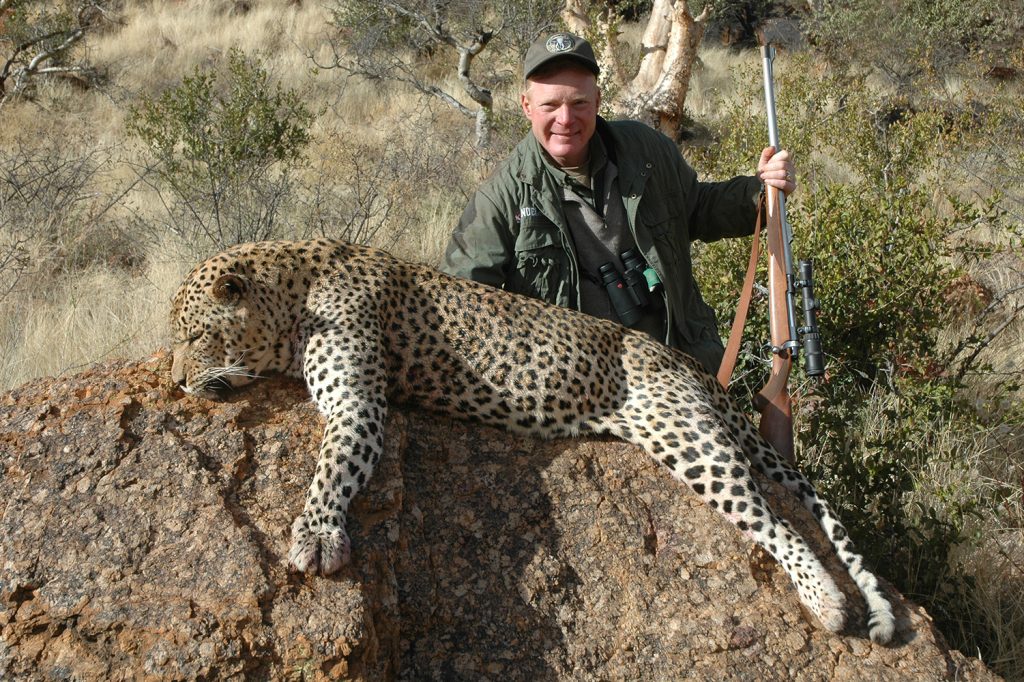
A very big leopard from central Namibia. Hunting with dogs, Boddington used a .416 Taylor. The cat didn’t go far but, today, he’s convinced powerful cartridges from about .375 upwards aren’t ideal choices.
A leopard is almost always keyed up, on full alert. The fact that most baits are hung in trees is also a factor. Up in a bait tree, it will usually depart with a mighty leap, if it can. It’s never a good sign if the leopard exits the tree under its own power. This is not definitive; just not what you hope for. In 2007 I shot a leopard in Namibia’s Bushmanland with Jamy Traut. Shooting a Kimber .375, I was confident of the shot on the center of the shoulder. However, the last thing I saw was the cat exiting the scope’s field of view, left and high. We found him dead forty yards into the long grass.
This past July, son-in-law Brad Jannenga shot a nice leopard in Zambia, also with a .375. I was in the blind with a video camera. It was almost déjà vu; the cat exited high and left. Brad was sure of the shot. PH Davon Goldstone and I weren’t because the presentation was odd, the bottom of the chest almost facing us as he crouched over the bait.
Video cameras are useful with leopards; a quick playback can show shot placement. This time, with deep shadow, even with the camera we weren’t certain, but it was clear the cat had launched into tall grass. So, with light fading, we organized and went into that nasty stuff. The cat, hit perfectly and very dead, was nearly invisible until we almost stepped on him.
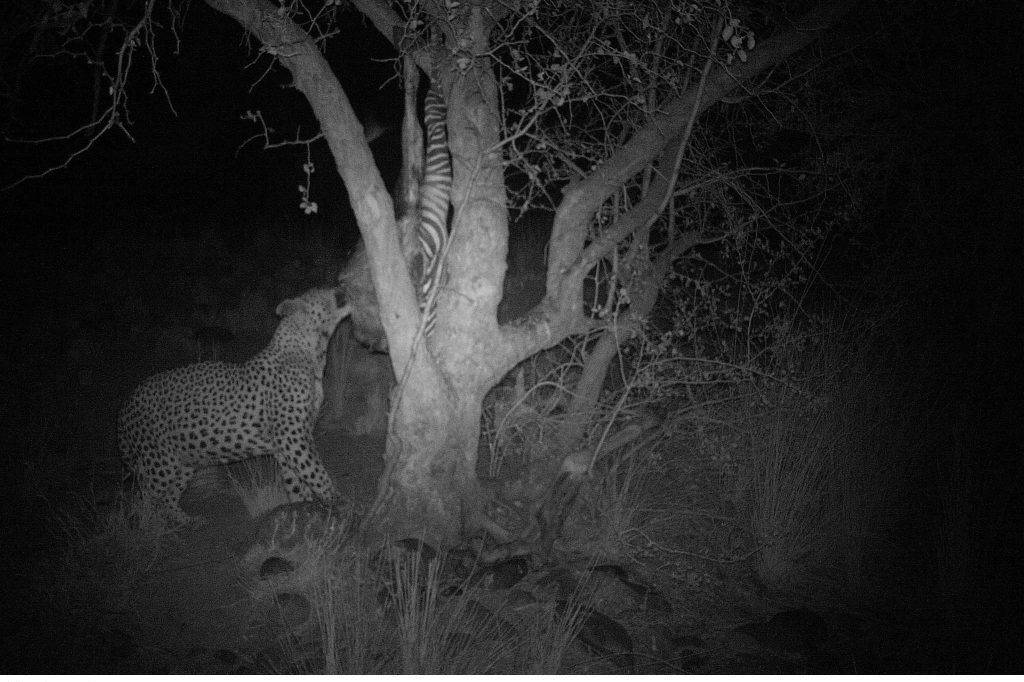
A huge male leopard captured on a trail camera. This cat is slightly quartering-to, so the best shot is in the center of that big shoulder, about a third up from the brisket/belly line. Such a shot should drop the cat instantly–but don’t count on it!
In a perfect world, you want a nice, broadside presentation. Shot placement on a leopard is no different from anything else: about one-third up from the brisket/belly line on the center of the shoulder. Or, alternatively, just behind the shoulder, following the rear line of the foreleg, no more than halfway up. The latter is a fatal lung shot, but unlikely to drop your big tom “under the tree.” Like most lung-shot animals, a leopard will run a short distance, but no animal can survive a double-lung shot.
I believe the shoulder shot is the most likely to fold a leopard on the spot. Such a shot will surely break the near shoulder and, if the leopard is truly broadside, will penetrate through the chest cavity and break the far shoulder.
When setting a bait, effort is made to orchestrate that broadside shot. Despite good intentions, this doesn’t always work! In poor light, slight angles are hard to see, and leopards get into weird positions when feeding. Brad’s Zambian leopard was a good example. Essential is to be able to visualize exactly where the chest cavity lies.
With cats, the heart is slightly farther forward in the chest cavity than with ungulates. A bullet through the center of the shoulder, one-third up, will catch the top of the heart. However, when feeding on a hanging bait, a leopard will often use out-stretched paws. This changes the game, and the center of the shoulder may be too far forward. If in doubt, the behind-the-shoulder lung shot is safe, and offers the largest target. Just expect a short period (several eternities) of tense tracking.
What you hit the leopard with matters. In some countries, the dangerous game minimum, .375 or 9.3mm, applies. Game laws must be obeyed, but I am convinced the .375, or any other cartridge suitable for thick-skinned dangerous game, is a poor choice. Cats are tenacious, but the biggest leopard is smaller than a mule deer buck. You don’t need cartridges (or bullets) designed for animals ten times bigger. Nor do you need the low magnification, straight objective scopes that are great for hunting Cape buffalo.
For the quickest results on leopards, I’m convinced you’re better served with cartridges and bullets intended for optimum performance on deer-sized animals. My central-shoulder shot placement on that Namibian leopard, taken with a .375, was perfect. He didn’t go far, but we had bad moments in long grass, light going fast. There’s no way to know, but I will always believe that was my chance to have a leopard “dead under the tree,” and I think it would have happened if I’d made the same shot with a deer cartridge with a lighter, faster, quicker-expanding bullet.
That same season, hunting with Dirk de Bod, Donna took a leopard with a Ruger .30-06, 180-grain Hornady Interlock. Hers was dead under the tree. Maybe she just shot it better, but I believe her .30-06 was a better choice. I also used a .30-06 on a Zambezi Valley leopard. But, with light going fast, I went for the lung shot, larger target, thus safer. The follow-up was done in full darkness, terrifying, but the leopard was dead within seconds of exiting the tree.
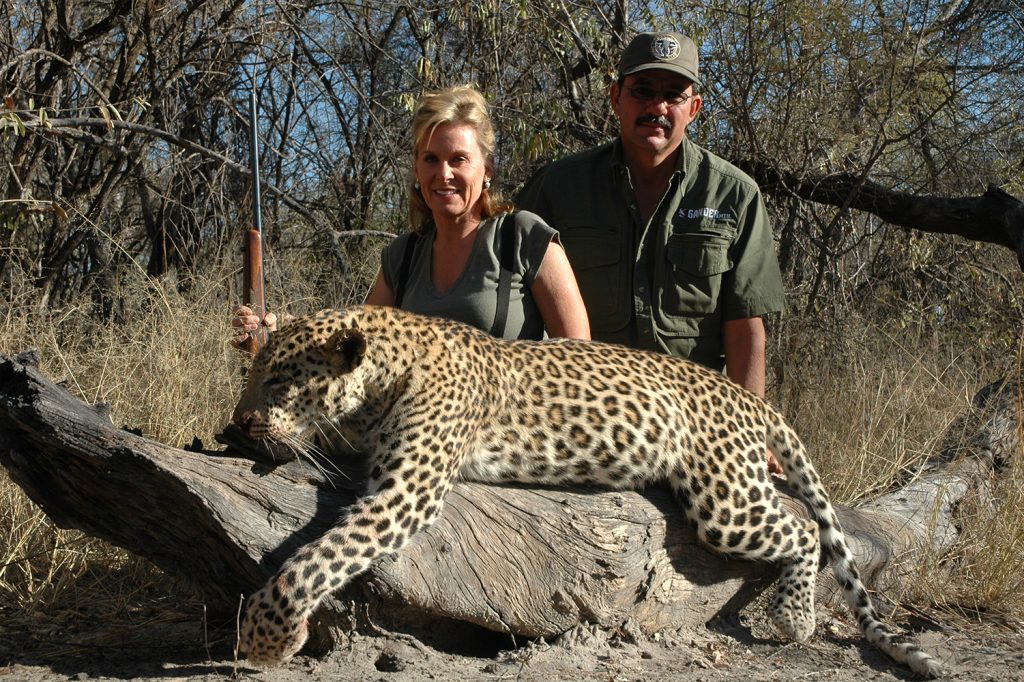
Donna Boddington and Dirk de Bod with Donna’s leopard from northern Namibia, dead under the tree with a 180-grain Hornady Interlock from her .30-06.
I love the .30-06, but I won’t pick favorites. Suitable choices run to many dozens! In some countries, 6.5mm is the legal minimum. A Creedmoor or 6.5×55 is plenty of gun, and a .270 Winchester is awesome. Harry Selby once wrote me: “Of the 103 leopards taken by my clients in East Africa, the majority were shot with my .243.” I’m not recommending a 6mm for leopard, but Selby’s rifle was well-scoped, and its accuracy and light recoil improved shot placement.
The great advantage of lighter, faster cartridges: Bullets designed to expand in deer-sized game. If local rules require a .375, consider a light bullet that can be pushed faster: The old 235-grain Speer, Hornady’s 250-grain, Nosler’s 260-grain. And, by all means, put a real scope on the rifle. You don’t need much magnification, but the brightness of a larger objective can be critical, and a lighted reticle speeds aim.
Unabashedly, I am a “big bore” guy, and leopards are dangerous. There are compromises. My first leopard, taken in 1985, is the only leopard I’ve effectively “dropped in its tracks.” The leopard was standing on the ground, and I shot it with a .338 Winchester Magnum with a fast 210-grain Nosler Partition. Quartering to, the bullet entered the on-shoulder and exited the off-hip. The leopard was down so fast I had no idea what happened. This past year, buddy John Stucker, hunting with Dirk de Bod, dropped his leopard under the tree, a feat I have not accomplished. He was shooting Dirk’s .338, loaded with the same fast, light-for-caliber 210-grain Partition. Perhaps just coincidental that both cats dropped to the shot, but the .338 does combine significant velocity with overwhelming power for leopard-sized game.
My most recent leopard hunts have been unsuccessful (part of the deal). I’d still like to take just one more. I don’t want to use the .243, love the .30-06 (also the .338), but I’d like to take my last leopard with a 7×57. If it was enough gun for Jim Corbett, it’s enough for me–and for any leopard that walks.
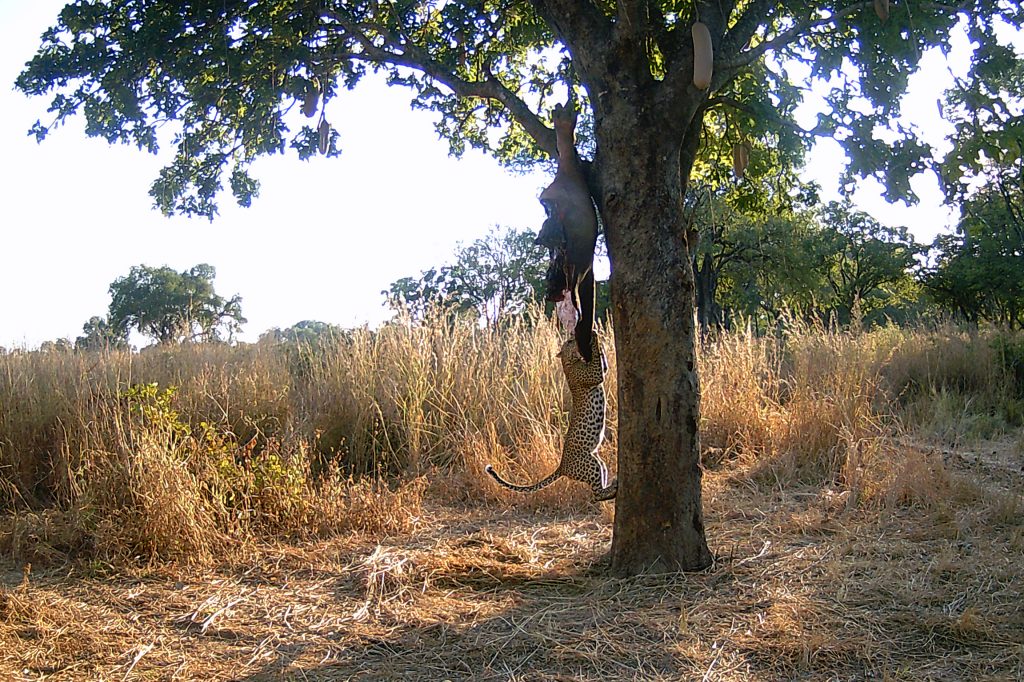
Most leopard licenses now specify “male,” with minimum sizes in several countries. Most leopards today are taken over bait, with trail cameras used pre-judge cats. This Zambian cat is a male, but it’s not very big; we didn’t sit for this leopard.
From patched round balls to today’s high-tech monolithics, bullets have evolved to be faster, stronger, and more efficient.
Rifled barrels first appeared in what is now Germany about five centuries ago. At first the grooves were straight, evidently designed as somewhere for blackpowder fouling to go when pushing bullets into the barrels of fired muzzleloaders, making it possible to load and fire more bullets between cleanings. However, the grooves actually made thorough cleaning more difficult, one reason some hunters and many armies stayed with smoothbores into the early nineteenth century.
Soon, however, it was discovered that spiral rifling resulted in finer accuracy. This occurs due to the gyroscopic stability imparted by rifling, which spins even a round ball on an axis parallel to the bore. A smoothbore barrel also tends to impart some spin, but usually sideways, resulting in a flight resembling a major league curveball. (If by some fluke a round ball doesn’t spin, it flies erratically like a knuckleball.)
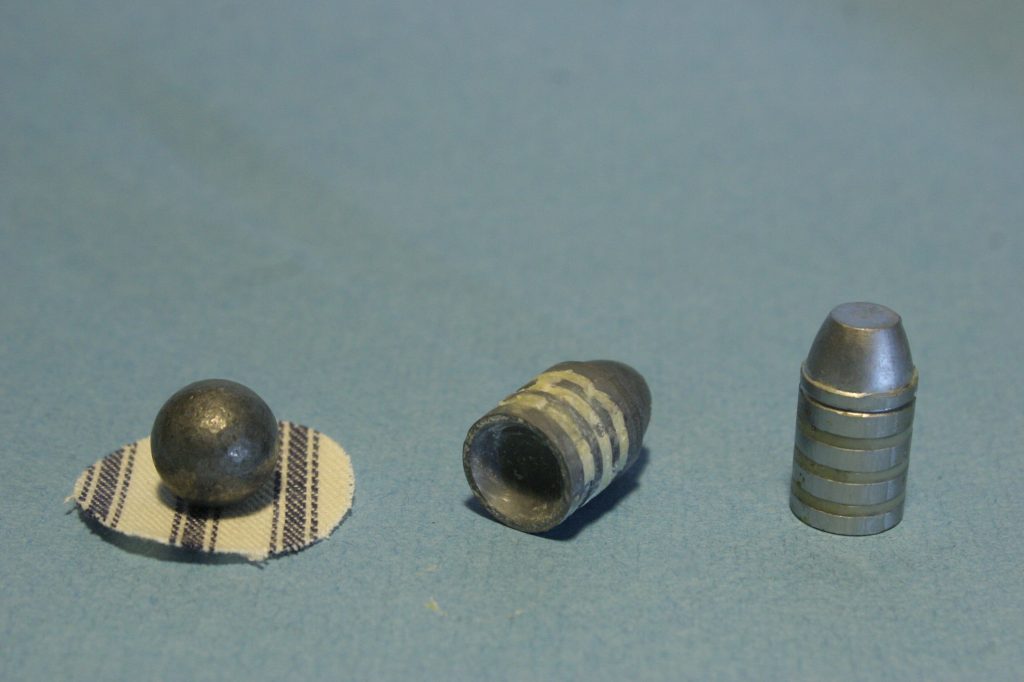
The earliest rifle bullets were made of lead, at first “patched” round balls, which eventually evolved into elongated bullets from the hollow-based Minie’ (center) to flat-based (and often flat-nosed) bullets loaded in metallic cases. They were all “monolithic” bullets, made entirely of the same metal.
For several centuries, bullets for shoulder-fired muskets and rifles were almost all made of lead, for several reasons. Lead’s relatively heavy weight helps even ballistically inefficient round balls retain velocity and penetrate pretty well. Its abundance, softness, and low melting temperature also historically made lead affordable, since it could be mined and shaped far more easily than other metals.
In fact, lead was among the most important metals utilized in the development of what humans term civilization, since it not only could be easily formed into bullets but also a wide variety of complex shapes, including containers and pipes for various kinds of liquids, and eventually even type for printing type. (The first two amendments to the U.S. Constitution, freedom of speech and the press, and the right to bear arms, both involved the practical use of lead.)
Toward the middle of the nineteenth century, a succession of French inventors began making improvements to muzzleloading rifles and projectiles. A new rifle developed in 1826 by Henri-Gustave Delvigne, a French soldier/inventor, incorporated a smaller-diameter “powder chamber” in the rear of the rifled barrel, with the front of the chamber rounded to match the contour of a lead ball just slightly smaller than the bore. When ramrodded against this radius, the ball expanded to fit the rifling.
Eventually Delvigne and others improved upon this, designing elongated bullets that retained more velocity during flight due to their improved sectional density—more weight behind the frontal surface of the bullet. This eventually resulted in the famous Minié ball, developed in 1846 by Claude-Étienne Minié, another French officer. The conical bullet featured lubrication grooves and a cavity in the rear that expanded upon firing.
During this same period, advances were also made in breech-loading rifles with self-contained, metallic cartridges. The first, a tiny rimfire round powered only by the priming compound, was patented in 1845 by another Frenchman, Louis-Nicolas Flobert. (Though named the 6mm Flobert, this was only an approximation of the bullet’s actual .222-inch diameter. It’s still produced today, and in America it is called the .22 BB Cap.) In 1857 Smith & Wesson introduced an elongated version, known today as the .22 Short, which included a pinch of black powder, and evolved into 1888’s .22 Long Rifle.
The first metallic cartridge rifles suitable for big game were chambered for larger rimfire rounds, but the thin rim couldn’t handle much pressure. The solution was centerfire cases, with a small primer surrounded by a much thicker case-head. By the 1860s the centerfire system resulted in far more effective big-game cartridges. Bullets didn’t need to be loaded from the muzzle, so they could be the same diameter as the rifling—and much longer and heavier, increasing both range and penetration.
Many of the world’s armies didn’t take full advantage of this, due to a historical fear of soldiers “wasting” too much ammunition, so they used single-shot rather than repeating rifles. Hunters, however, really liked being able to shoot more than once without reloading, and by the 1870s, larger, more powerful cartridges firing heavier bullets started appearing in repeaters and double-barreled rifles.
Some, of course, were military rounds such as the .45-70 Springfield, or improvements on the same basic case, whether necked down to around .40 caliber, improving sectional density, or simply elongated to provide more velocity to the same bullets. The .45-90 Winchester Center Fire, for example, is essentially a longer version of the .45-70. British cartridges included traditional heavy-bullet rounds, but some featured lighter bullets that approached 2,000 fps in muzzle velocity, flattening initial trajectory.
At that point, hunting bullet performance started to resemble that of modern bullets used today. Velocities and penetration increased, and terminal performance could be manipulated by changes in bullet shape, or alloying lead with other metals to harden it, increasing penetration on larger game.
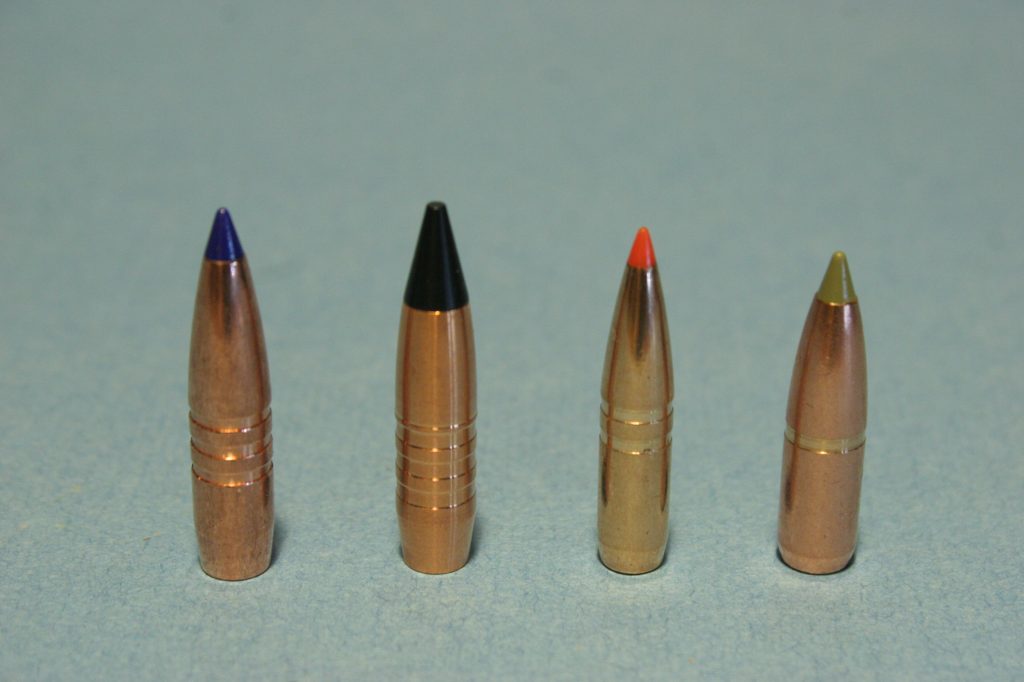
Monolithic bullets returned during the late 20th century, but instead of being made of lead were copper or copper alloys. Today almost all have grooved shanks to reduce pressure and metal fouling, and most have plastic tips to enhance expansion. (From left: Barnes TTSX, Cutting Edge Raptor, Hornady GMX and Nosler E-Tip.)
Hunters discovered that a hard-lead, flat-tipped bullet tended to kill quicker than a round-nose bullet. This is partly due to a phenomenon called cavitation, which forms a temporary “vapor pocket” in front of the bullet in liquids—including the liquids in the vital organs of big game. This vapor pocket results in more damage to surrounding tissue, and while all bullets result in some cavitation, flat-nose bullets create more.
Softer lead bullets often expanded when they hit game. This reduced penetration, but increased both the bullet’s diameter and cavitation, resulting in the development of hollow-point bullets for hunting both small and medium-sized game.
In historical terms this era didn’t last long, due to the appearance of practical smokeless rifle powders in the 1880s. Smokeless powders suitable for handgun and shotgun ammunition had been developed by the 1850s, but they burned too fast for rifle use. Eventually chemists developed various methods to slow the burn rate, allowing smokeless cartridges to push bullets to muzzle velocities over 2,000 fps.
This was too fast for even the hardest lead alloys, resulting in heavy lead fouling in the bore, which was far more difficult to remove than black powder fouling. The solution was jacketed bullets, with a lead core inserted into a relatively thin cup of harder metal, sometimes steel but more often a variety of copper alloy. The jacket and core were then swaged together into the bullet’s final shape, holding the lead core in place—at least until the fired bullet hit something.
Two basic variations of jacketed bullets soon appeared, one with the core inserted in the rear of the bullet, the jacket forming a “solid” nose for deeper penetration. The other version inserted the core into the front of the cup, and left the tip open, however slightly, so the bullet expanded when it hit game. One type of expanding bullet had a lead core that didn’t quite fill the tip, resulting in a “hollow” point. The other type used enough lead to create a “soft nose” in front of the jacket. Both forms remain with us today.
An early front-runner for jacket material was cupronickel, a combination of copper and nickel. This proved to be hard enough to penetrate well, whether in solid- or open-tip form, but also resulted in heavy bore fouling, even more difficult to remove than lead fouling. Eventually most jackets were made entirely of copper or gilding metal, a copper alloy containing 5 to 10 percent zinc, which didn’t foul bores as much as cupronickel or pure copper.
During the same era, muzzle velocities kept rising, both due to rapid improvements in smokeless powder, and lighter, faster, pointed bullets, which retained more velocity downrange compared to the heavy, blunt bullets used in early smokeless cartridges. The heavy bullets limited muzzle velocities to around no more than about 2,500 fps, and even many twenty-first-century hunters know such modest speeds tend to result in more consistent expansion with cup-and-core bullets. But as muzzle velocities increased, cup-and-cores often came apart on impact, especially when hitting bone at closer ranges.
The four basic variables in expansion of cup-and-core bullets are jacket thickness and hardness, core hardness, and the size of the hollow-point or softnose. A thicker jacket and harder core tend to hold up better at higher impact velocities, but there also has to be a sufficiently wide hollow-point or softnose to initiate expansion. One reason the original Remington Core-Lokt acquired an excellent reputation for reliable expansion and penetration before the present “magnum era” (which became widespread after World War II) was a jacket with heavy sidewalls along the shank, and a substantial cannelure to help keep the core in place. Grancel Fitz, the first hunter to take all varieties of North American big game, used .30-06 factory Core-Lokt ammo featuring various bullet weights.
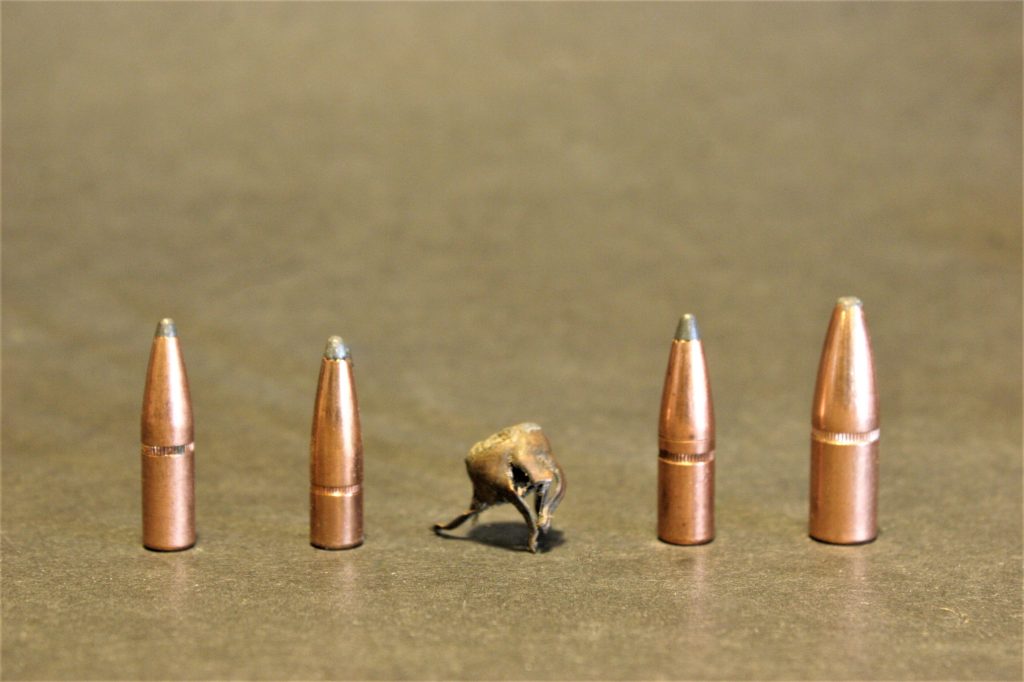
The Hornady Interlock might be considered an “advanced” cup-and-core, since it includes a small ring of gilding metal inside the shank of the jacket, which helps retain the core and limit expansion. Barsness has used Interlocks considerably over the years, especially the (from left) 150-grain .270, 139-grain 7mm, 180-grain .30 and, more recently, the 286-grain 9.3mm. The expanded bullet in the center is a 139-grain 7mm, which he used in a .280 Remington handload to take his first caribou.
Eventually the tips of some soft-nosed spitzers were capped with harder metal, primarily to prevent flattening the lead during recoil, due to impacting the front of a box magazine. While this prevented tip deformation, it could also enhance expansion a little too much, partly because the tips had to be enlarged to attach the cap. John Taylor often mentioned his dislike of “copper-capped” bullets in his books on African rifles, due to their erratic expansion, and the Winchester Silvertip, with the tips capped in tin, also acquired a reputation for erratic expansion. This could also happen with bullets featuring a separate, harder tip inserted into the nose, including the old Remington Bronze Point, and early versions of today’s wide variety of plastic-tipped spitzers.
Eventually a number of designers came up with an essentially 2two-part bullet, with a softer front end that expanded easily, and a tougher rear end that held together. The German company RWS started producing its H-Mantle bullet in 1934, which has a softer lead-alloy “nose” core and harder-alloy rear core, with a fold in the jacket at the front end of the rear core. The front end expanded easily, tending to kill smaller game quickly, while the flat-fronted rear end continued to penetrate on larger game. (Today RWS also offers a capped-tip version named the Rapid-X-Tip, which expands more violently and tends to kill smaller game quicker—important in much European hunting, to prevent animals from running onto the next estate before falling, thus becoming the property of the other landowner.)
Shortly after World War II an American named John Nosler developed a somewhat similar bullet; he was inspired to do so after a Remington Core-Lokt from his .300 H&H Magnum came apart on a bull moose’s shoulder. He developed a two-core bullet, using a jacket with a solid wall of gilding metal between the front and rear cores. Like H-Mantles, the softer front core tended to disintegrate, while the rear of the bullet continued to penetrate. His first, basically handmade, bullets weren’t very accurate, but they only had to shoot “minute of moose,” and penetrated very well on his next bull. He started selling Nosler Partition bullets to handloaders in 1947, but they didn’t appear in factory ammunition until the early 1960s, when Weatherby started loading them.
The next big step occurred in the 1970s, when an Idaho elk hunter named Bill Steigers developed a method of soldering lead cores inside heavy copper jackets. His Bitterroot Bonded Cores retained more weight than H-Mantles and Partitions, but didn’t typically penetrate any deeper, due to opening into a wide “mushroom.” This wide front, however, created a wider wound channel.
Because of limited production, BBC bullets were mostly sold locally, but they led to other bonded bullets, including the partition-jacketed Swift A-Frame, which has a bonded front core. Another early bonded bullet was Jack Carter’s Trophy Bonded Bear Claw, with a rear shank made of solid copper and a relatively small bonded front core. Both also mushroomed widely, a tendency of most bonded bullets.
In the 1980s, a Utah hunter named Randy Brooks took the solid-shank concept a step farther, developing an all-copper hollow-point he named the X-Bullet, which penetrated very deeply, due to the front end opening like a flower into four “petals.” This resulted in less frontal area than bonded bullets, with the rotating petals creating a narrower but still very effective wound channel. Barnes’ bullet went through several changes over the years, to reduce copper-fouling in bores, increase accuracy and to ensure expansion. The last occurred in 2007, with the addition of a plastic tip, which definitely aided expansion in smaller calibers.
Today many bullet companies make monolithic hunting bullets. This isn’t only because of their deep penetration, but because some jurisdictions—ranging from public hunting areas to entire countries—have banned lead in bullets, due its potential toxicity.
The latest trend in expanding bullets is, of course, higher ballistic coefficients, which result in more retained energy and less wind-drift at longer ranges—one area where lead-core bullets have an advantage over monolithics, due to being shorter in the same weight and diameter, and thus more easily stabilized in more-or-less standard rifling twists. Of course, rifling twists continue to tighten as more hunters start using high-BC bullets.
Some of the same construction advances eventually appeared in so-called solid, non-expanding bullets used on the largest big game, especially elephants. Some became actual solids, made entirely of brass, with wide, flat noses which tend to do more soft-tissue damage than the round noses of many older lead-core “solids,” and also penetrate straighter. Some of these solids even have slightly cupped noses, which increase tissue damage. Both North Fork Technology’s Cup-Point and Australian bullet maker Woodleigh’s Hydrostatically Stabilised Cup-Point have a slightly smaller-than-bullet-diameter cupped nose to allow them to feed from typical bolt-action magazines. Swift’s Break-Away Solid is a lead-core with a round polymer tip, which feeds very smoothly and breaks away upon impact, leaving a cup-tip.
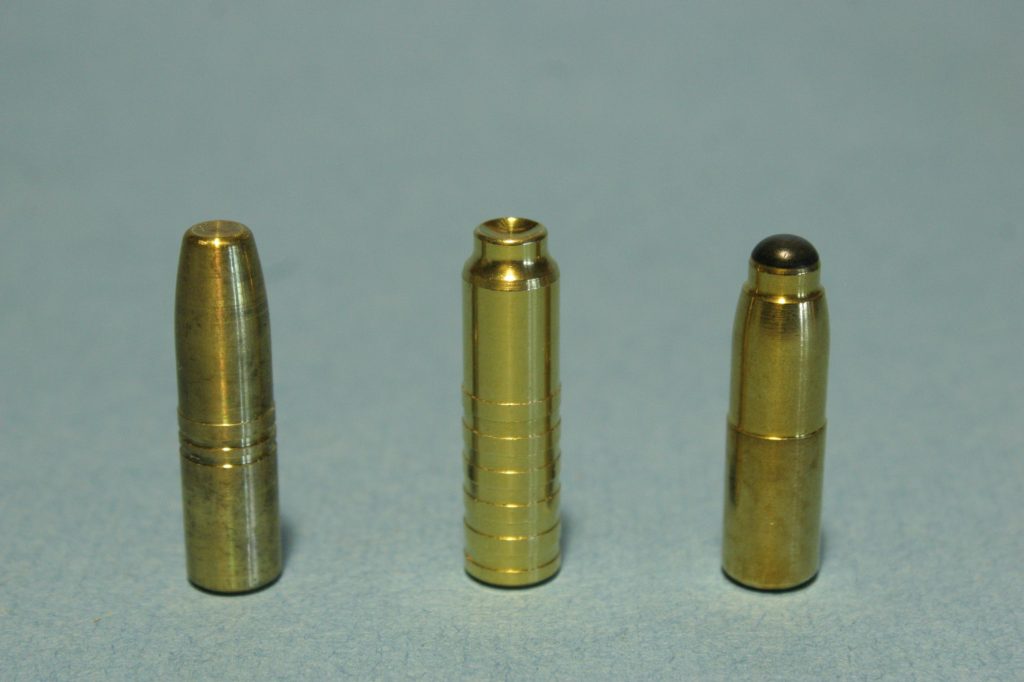
The original “solid” bullets, designed for deep penetration on the largest big game, weren’t actually solid, but lead-cores with a jacket covering the nose to prevent expansion. Today’s solids, however, are often monolithics, either with wide flat noses or “cupped” noses, which tend to create larger would channels and penetrate straighter than round-nosed bullets. From left, a Nosler Solid, a Woodleigh Hydrostatically Stabilised Cup Point, and a Swift Break Away Solid.
What’s in store for future hunting bullets? The specifics are hard to predict, but the overall trends since the first spiral rifling appeared have been toward smaller calibers, lighter weight, higher velocity, increasingly controlled expansion, and less use of lead.
New Nimrod Education Center highlights the crucial link between hunting, fishing, and conservation.
Photo above: Al Stewart, longtime Upland Bird Specialist for Michigan DNR, is the director of the new Nimrod Education Center at Hillsdale College.
The important work of helping non-hunters understand the importance of sportsmen-funded wildlife management just got a big boost. A groundbreaking new center dedicated to educating the public on the values of recreational hunting and fishing has been established through an endowment from Alan N. Taylor, founder and president of the Nimrod Society, to Hillsdale College in Hillsdale, Michigan.
The Nimrod Society is an organization dedicated to informing the non-hunting and non-fishing public about the economic, social, and wildlife management benefits of hunting and fishing. Taylor’s perpetual endowment creates the Nimrod Center for Education in the Areas of Consumptive Sport and Recreational Hunting and Fishing, known simply as the Nimrod Education Center. Combined with the resources of the highly respected Hillsdale College, the center provides a dynamic new venue to promote the benefits of hunting and fishing.
The Nimrod Education Center is led by Nimrod Education Center Director Al Stewart. Stewart recently retired from the Michigan Department of Natural Resources (DNR) after fifty years with the agency. At the DNR, he served as Upland Game Bird Specialist and Program Leader, responsible for statewide management programs for ruffed grouse, woodcock, sharp-tailed grouse, quail, pheasants, and wild turkeys.
Additional wildlife and fisheries faculty educators and staff who are avid hunters and anglers will be employed by the Center. Educational outreach activities will include courses in wildlife and fisheries management that emphasize the sportsman’s role, continuing education programs, seminars, and conferences. Scholarships will be available to students who demonstrate an interest in the subject matter.
As part of its mission, the Nimrod Education Center will help to develop and implement mass-media communication programs to inform the public about the benefits of hunting and fishing. Developing partnerships to establish Wildlife Councils in all states is an important goal of the Center. Students, faculty, and staff will work to spearhead public education programs and foster communication among sportsmen, conservation groups, and wildlife agencies.
The center is authorized to provide grants to other educational institutions and to sportsmen-focused conservation organizations to develop curricula and programs that support its goals.
“Many people are misled about the vital role that hunters and anglers play in wildlife conservation and management,” said Taylor. “Hunting and fishing license fees, along with federal excise taxes on sporting equipment, make up the principal funding for all wildlife management and protection. The mission of the Nimrod Education Center is to show the true relationship between sportsmen and conservation.”
The center will operate from Hillsdale College’s main campus and satellite campuses, and will use the College’s existing facilities to conduct its activities, including the G.H. Gordon Biological Station and the John Anthony Halter Shooting Sports Education Center. To learn more, visit Hillsdale.edu/educational-outreach/nimrod-education-center.
What’s best for buffalo hunting: open sights, red dots, or scopes?
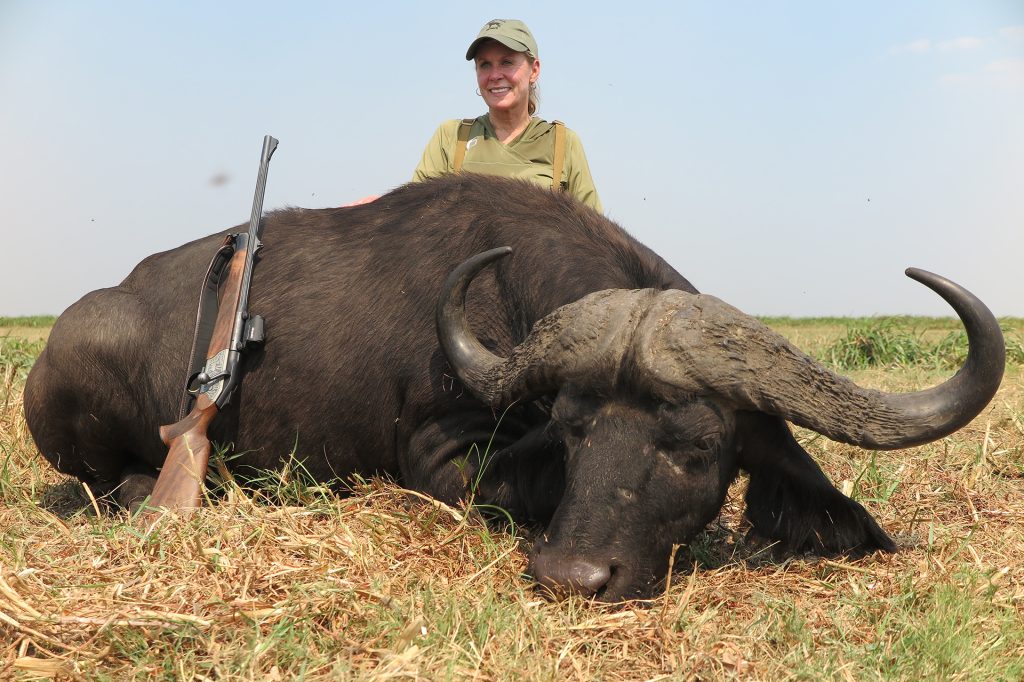
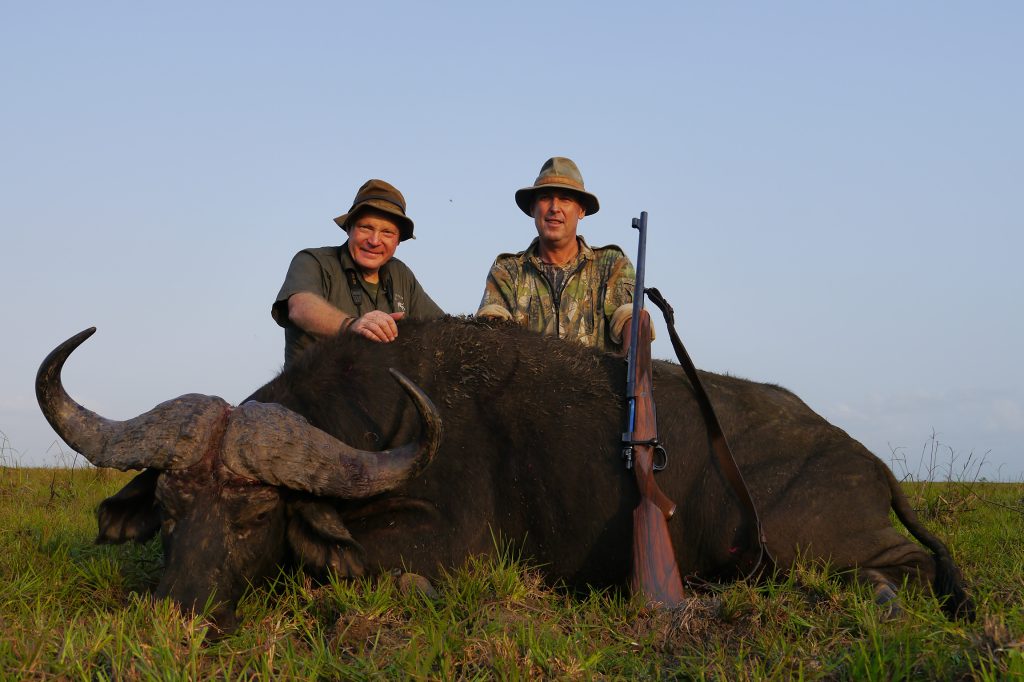
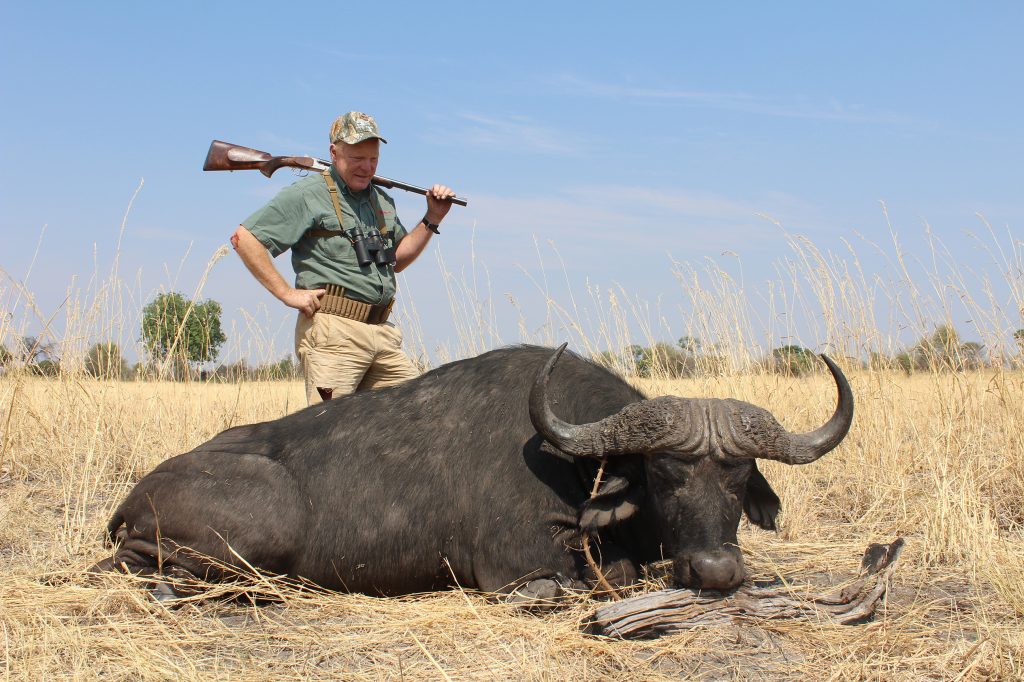
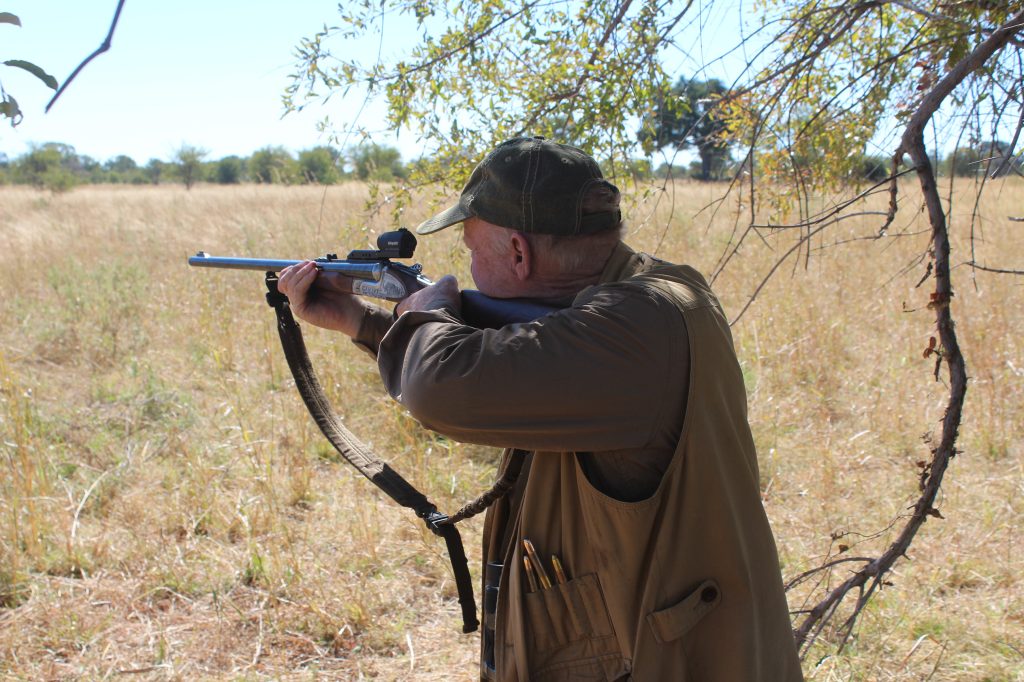
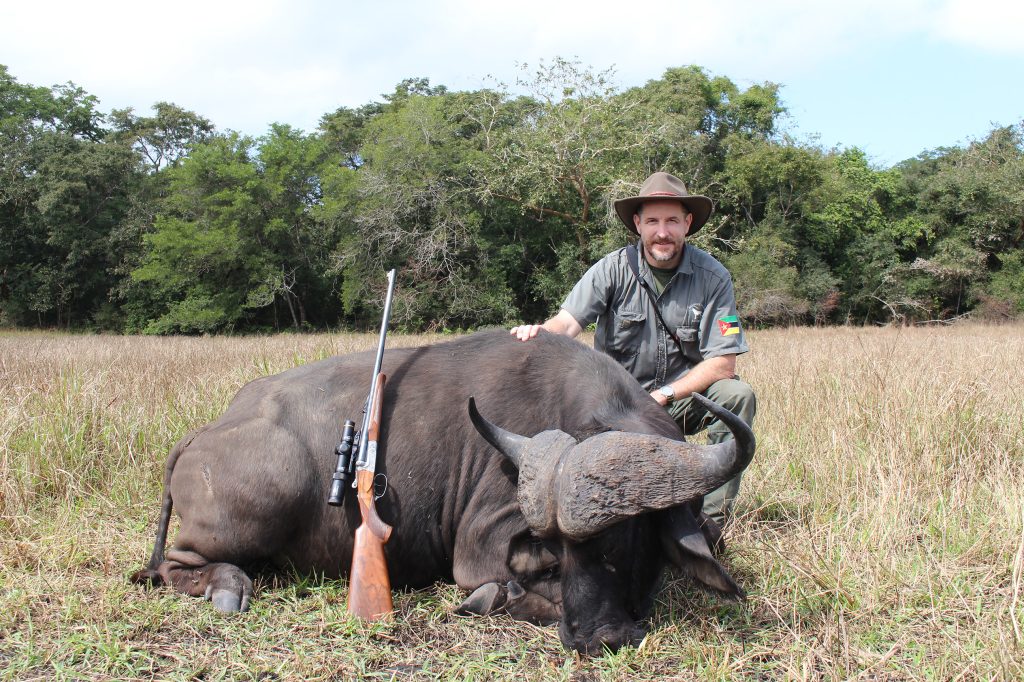
Photo above: Though not wide, John Stucker’s 2021 Mozambique bull carried exceptional bosses. Doubles are rarely scoped, but many, especially new doubles, can be. Boddington considered Stucker’s Sabatti .450/.400 3″ with 1-4X scope such an ideal setup that he borrowed it for his buffalo a couple days later.
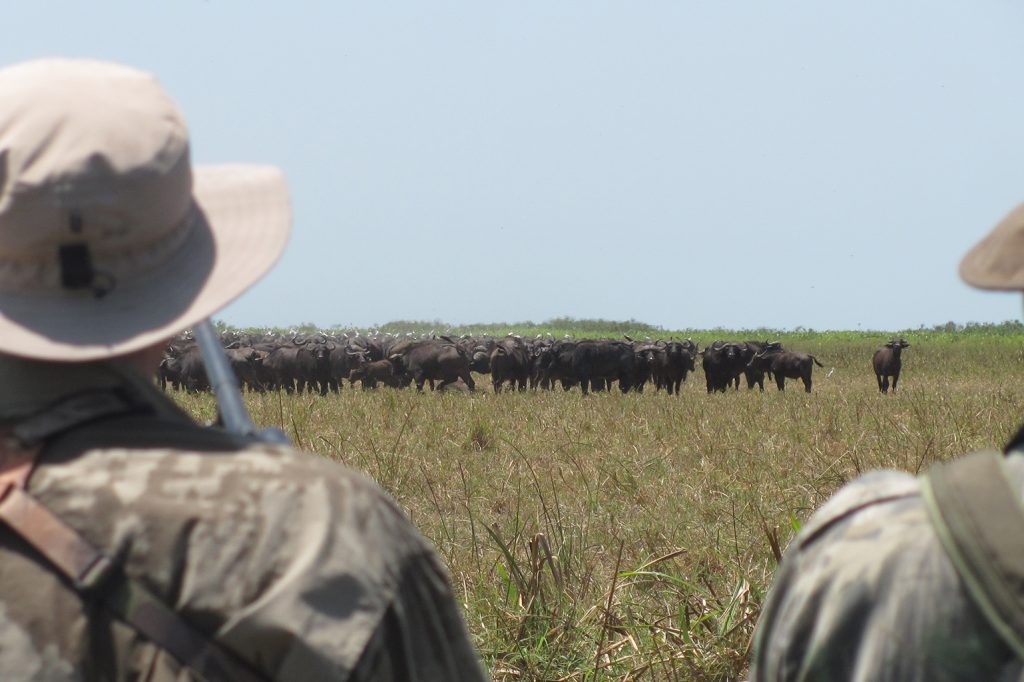
The buffalo bull was feeding greedily along a little watercourse. We were on a cutbank above him, looking down, not thirty yards. Perfect. Except: He was in eight-foot grass.
Earlier that day, Teresa and Woody Wilhite, hunting with Poen van Zyl, had seen an old buffalo bull at a waterhole. They already had their buffalo, so they told us about him at lunch. He was long gone by the time we got there, but tracks led toward a big patch of tall grass.
September ’21 in Mozambique; hunting with PH Rye Pletts. While we were figuring out the tracks, young tracker Brinko did a very intelligent thing. Unbidden, he climbed a big tree, and immediately signaled he could see the bull.
The buffalo had moved a hundred yards to a small stream cutting through the grass. The strong wind was favorable; we were on top of him in minutes. He was ancient, ribs and hip bones showing; we had the shot, but we couldn’t see the horns. Eventually he raised his head, nice old bull, but before I could get the shot off, he took two steps forward into much longer grass.
Now all I could see were black patches between waving green stripes. More or less broadside, but the head was down and hidden. The backline is where the black patches stop, but where is the shoulder?
It was tough enough through the 4X scope; I’m not I could have visualized it with iron sights. When I felt sure enough, I held down into the grass and fired the right barrel. The bull dropped to the shot and all I could see were four feet up in the air! We rushed down and gave him a finisher, and that was the end of my shortest-ever buffalo hunt.
Donna Boddington used an AimPoint reflex sight on her .375 Blaser to take this Mozambique buffalo. It doesn’t have the range of a magnifying scope, but is much faster than iron sights, and the red dot is especially visible on dark animals.
We have this romantic notion that it’s somehow “better” to take the big stuff with iron sights at close range. More traditional, yes. More satisfying, sure…if you pull it off! I remember a fellow in camp pontificating that “the only ‘proper’ way to take dangerous game is with iron sights within thirty yards.” Definitely true with elephant, because thirty yards is a long shot. Absent impaired vision, a magnifying scope is not needed. In fact, it may be counterproductive because of tunnel vision effect, and visualizing an aiming point on a big, gray wall.
I have only taken one rhino and am unlikely to take another. In that limited experience, it took days to locate the correct animal. When we did, we had little trouble closing to twenty yards, and the express sights on a .470 were just fine.
With buffalo, it’s awesome when you can get close and take your bull with a big, iron-sighted rifle. Reality is that you can’t always get close. There is another reality: Only a small percentage of my buffaloes have been solitary. Many were in herds, others in bachelor groups. Here’s the point: In a group, the hard part is often to pick out the one you want. It can be difficult to keep track of that bull as they shift. This can be nearly impossible over iron sights, especially as you approach their effective limit. (Depending on the person and the light, I figure this to be no more than one hundred yards.)
Boddington and PH Mark Haldane with a Mozambique buffalo taken with a Rigby Big Game in .416 Rigby, using open express sights. Open sights work, but you’re banking on getting close enough, and having good light. This time we did!
Oh, let me finish the story about our pontificator. After a week of tough hunting, he took an errant shot with his iron sights at the limit. Predictable result: Wounded buffalo. It happens, I’ve done it. The most common outcome is not a charge; more often, a poorly hit buffalo is never seen again. This time, there was a serious charge, stopped by the PH.
Iron sights have been in use for centuries and they work. Most dangerous game PHs carry iron-sighted rifles, for simplicity and ruggedness, for less weight and less brush-snagging protrusion…and because they’re used to them. Also, their purpose is different. They’re not likely to shoot a buffalo at a hundred yards, although most probably could. On most safaris, the PH never shoots, but his rifle is there and ready.
Boddington used a Krieghoff double in .500-3” with express open sights to take this Caprivi buffalo…at about ten yards. When you’re lucky enough to get that close, even low magnification is too much. The beauty of variable scopes is you can turn them down all the way!
For many of us, a long-dreamed of safari is a reward for a life milestone: Kids out of school, retirement from a first career, finally able to afford it. Most of us have some gray hair before we tackle our first buffalo. Let’s face it: Most of us hunt with scopes. We don’t suddenly awake in our middle years with proficiency with iron sights! Although I was young when I first went to Africa, I was no different! I’d done a lot of shooting with open-sighted .22s and used aperture sights in the Marines, but the first big game animal I hunted with iron sights was a Cape buffalo with a big double! I was surprised at how small that buffalo looked over express sights!
Iron sights work. The more you practice with them and use them, the better they work, and the more confident you become. It takes a lot of shooting and, even under the best of circumstances, effective range is limited. Using iron sights for buffalo, understand you’re giving up a lot of shots!
Long shots are out of the question, but because the buffalo is a herd animal (lots of eyes), and because they’re grazers, they can be caught in open ground with no cover. It’s ridiculous to assume that you can consistently get within fifty yards. Sometimes, but not always. The average shot on buffalo is maybe eighty yards. With practice (and younger or better eyes than mine) this is possible with iron sights. However, if that’s an average, it means that some shots will farther.
On a double rifle, a reflex sight is as non-traditional as a scope, but lighter and less bulky. Boddington put an AimPoint on his Sabatti .450-3 ¼” double, finding the red dot faster, more visible, and easier to acquire the front bead of any iron sight.
These days I’m having increasing trouble resolving iron sights. I accept that my effective range with open sights is shorter than it once was. I do better with apertures, but still not what I once could do. That doesn’t mean I’ve abandoned iron sights, just that I’m careful where I use them, and I accept the limitation. Early in ’21 I took two buffalo bulls in Uganda, using an old .470 double with typical express sights. One was about forty yards, the other half that. I knew the area, and knew it was probable I could get close enough with that rifle and its sights.
The last fifteen years I’ve done a lot of my buffalo hunting in coastal Mozambique, where we go into big herds, sometimes on open floodplains and short-grass savannas. There, I’ve taken buffalo beyond a hundred and fifty yards. With a scoped rifle, such shooting is practical. With iron sights, risky. That area is not iron sight country!
On this short-grass savanna, these hunters are as close as they can get. The distance is under a hundred yards. Given skill and confidence, iron sights might be acceptable. The larger problem is picking and keeping tabs on a bull in the shifting herd; in open ground a low-magnification scope is far superior, and will yield higher success.
The red-dot or reflex sight is a wonderful alternative to iron sights…especially for guys like me, who are having difficulty resolving the front bead. Several times I’ve put an AimPoint sight on a .375 for buffalo hunting, and I have one on a Sabatti double .450-3 ¼”. I’ve used the AimPoint enough that I’m confident well beyond a hundred yards. At one point I considered it the best option for buffalo, a great compromise between iron sights and a magnifying scope.
Red-dot sights are very good…but not perfect. In Mozambique a couple years ago, I had an AimPoint on my .450 double. Mark Haldane and I got into a big herd about a hundred yards away across a short-grass savanna. I was on sticks, and there was a crackerjack bull in the press. The herd was nervous, constantly shifting. As he jockeyed back and forth, in order to stay focused on that bull, I had to take the rifle off the sticks so I could raise my binocular.
With a magnifying scope, even just 4X, it would have been simple! Eventually the bull stood clear and we got him. I don’t know why I have to keep re-learning old lessons! In the right area I’ll still use iron sights, and for sure I’ll still use the AimPoint. However, if it’s a situation where it’s important to take a buffalo, there’s simply no substitute for a clear, bright magnifying scope.
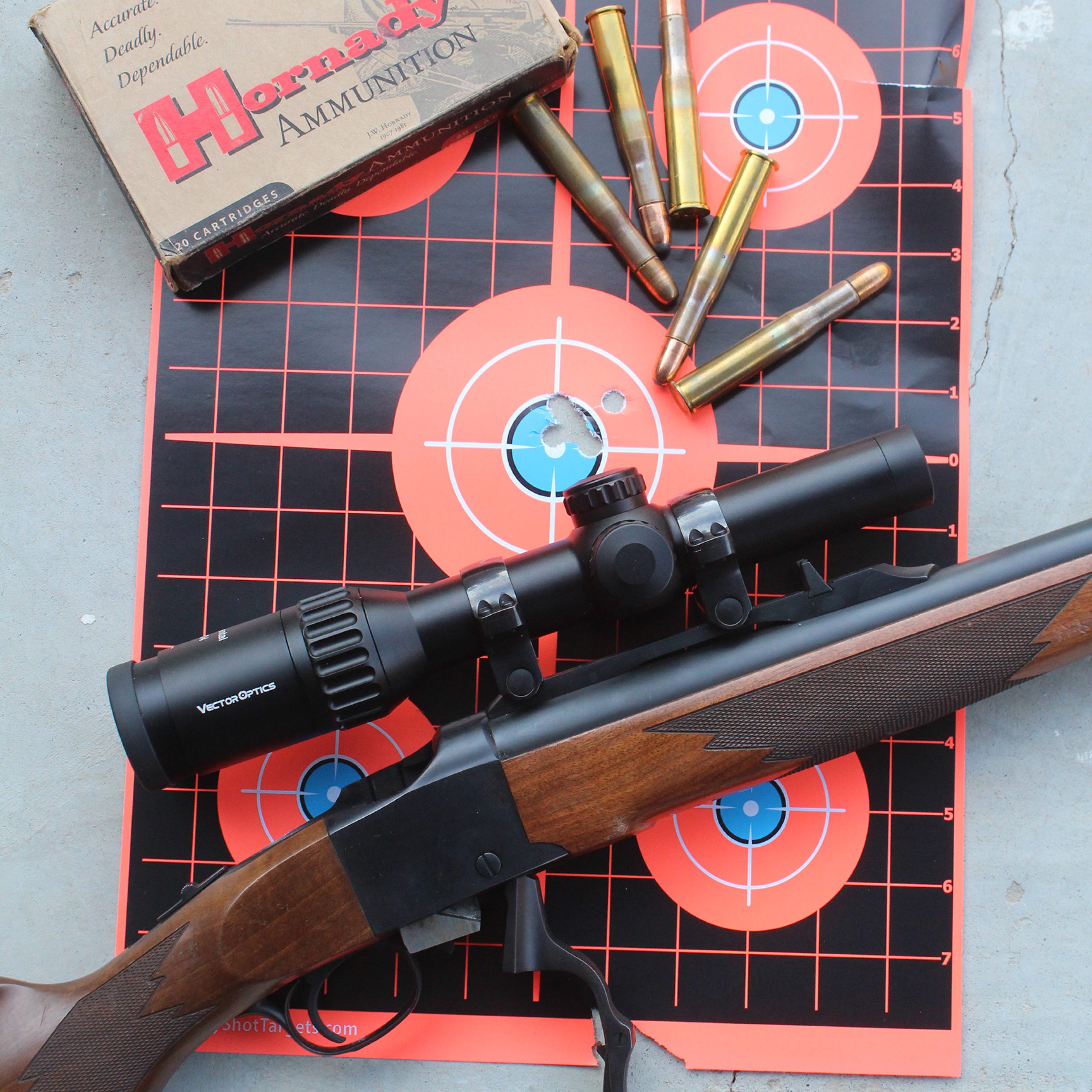
Actions, makes, cartridges, and bullets can be discussed endlessly, but this Ruger No. 1 in .450/.400-3”, topped with a Vector 1-6x28mm scope, is a fine setup for African buffalo.
You don’t need much magnification. Right now, I have a Leupold 2-7x33mm on my .375, not specifically for buffalo, but because the versatile .375 benefits from more magnification. For buffalo, the typical 1-4X, 1.75-5X, or 1-6X straight-objective “dangerous game” scope is perfectly adequate. On the buffalo I started this article with, I used buddy John Stucker’s Sabatti .450/.400-3” double with Leupold VXR 1-4X scope. Why his rifle? I had a Blaser .375 with 2-7X in camp, suitable. Stucker had already taken his buffalo, a great bull. I like doubles, and love the .450/.400. When he offered me his rifle with scope, I accepted, figuring I’d be carrying the most perfect buffalo gun imaginable!
John Stucker used his Sabatti .450/.400-3” to take this Mozambique bull at about a hundred yards. The rifle is an ideal setup for buffalo, and the 1-4X scope perfect for this shot…and for most shots on buffalo.
I sat in the shade of an old, gnarled tree. The tree was called a kiawe, though the thorns that adorned it and that poked painfully into my derriere made it seem little different than the flat-topped acacias of East Africa. The morning heat was already causing mirage, and the red dust was blowing across the sun-baked flat. If the call of a red-eyed dove or the bark of a bushbuck had graced my ears, I’d have bet money that I was on safari in one of those huge dangerous game blocks that I love so much. But the view on the horizon–a placid patch of turquoise water and an island rising upward from it–belied that. The water was the Pacific Ocean, the island was the Hawaiian Island of Lanai, and the thorns in my butt were bred on Molokai.
We had made the long trek from upstate New York to Honolulu on the island of Oahu, and caught the afternoon flight on Mokulele Airlines to Molokai. The late-afternoon trade winds, gusting over 25 mph, made for a bumpy landing, and I knew we’d have to zero our rifles in these conditions as well.
Until I was invited to Hawaii to test some new gear, I had never given a thought to hunting the fiftieth state. As I did some research, I became intrigued with the deer situation on Molokai: estimates indicate that the island is home to over 70,000 axis deer, the spotted deer indigenous to India, which are also known as chital deer. Considering that the population of Molokai is just over 7,300 people, there is all sorts of habitat for the prolific breeding of these cervids. We’d be spending the next five days in pursuit of these beautiful deer with Go Hawaii Outfitters, a family business that guides hunters from around the world.
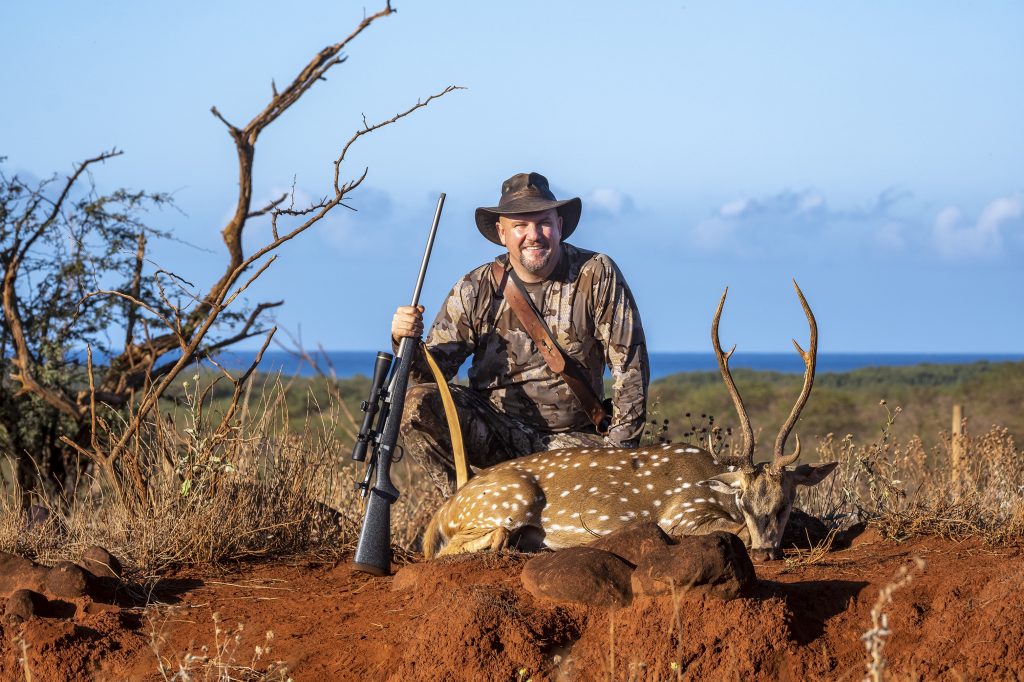
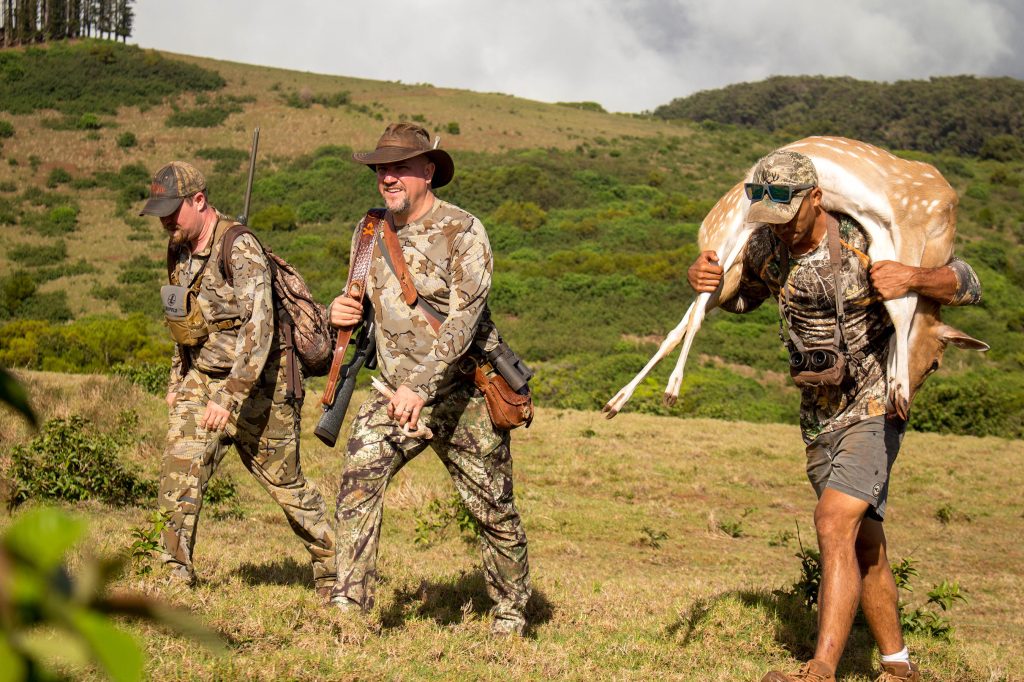
Massaro took this axis deer buck on the morning of the second day.
Just how the axis deer got to Hawaii is an interesting story; they aren’t native, but just as in Texas and Argentina, they certainly have made themselves at home in their island paradise. The British colony of Hong Kong gifted the axis deer to Hawaii’s King Kamehameha V in the 1860s and they were initially placed on the island of Molokai. Today, there are healthy, huntable populations of axis deer on Molokai, Lanai, and Maui, and all three islands have outfitters that offer hunts to the travelling hunter.
Molokai’s geography is stunning. There are beautiful beaches, tall peaks, impossibly deep valleys and canyons, large volcanic rock formations, and a diverse selection of flora. The western side of the island is drier than the eastern end. In fact, 2020 saw a terrible drought which resulted in the death of a good number of animals, and the effects of that drought are still evident. It was commonplace to see the bleached bones of animals that had succumbed to the drought, bones of both cattle and deer. My initial mental comparison to the African veld was largely because of that arid terrain, as the smell of the dried grass and the constant layer of fine, red dust which coated skin, clothes, optics, and rifles brought back memories of safaris past in Zambia, Zimbabwe, and Tanzania. As you head east, however, things change completely. Temperatures cool, precipitation increases, and vegetation thickens. Here there are open meadows reminiscent of Scotland or Ireland, and the ocean breezes bring thick fog banks that roll in quickly; a bright, sunny afternoon can turn into a cool pea-souper in a matter of minutes. We were fortunate to hunt in both environments and get the full Molokai experience.
A deep gorge on the north shore of Molokai.
Our guides were all native to Molokai, and we rotated guides each day so everyone in our party had a chance to hunt with all the guides. They were more than friendly, giving that feel of ohana (family) to the point that within a couple days their children were calling me “uncle.” Chase, Koa, Ku (assisted by his nephew Sy), DonDon, and Koa’s dad, Desmond, who made a special appearance here and there, took good care of us for the week. We stayed at a condo not too far from the hunting block, and established a routine: up at 3:00 a.m. for a light breakfast, meet the guides at 4:00 to be on watch by 4:45. The morning hunt would wrap up by 9:00, when we’d go back for a hearty brunch and a nap, only to be back up at 3:00 in the afternoon for the evening hunt. There was no lack of deer activity. On the west end of the island, where water was at a premium, the deer would make the morning migration from their feeding area to water and cover, and the reverse in the evening.
There were seven hunters, each allotted one buck and three does. The biggest bucks–easily identified by their deep voices–stayed in the thick gullies and canyons until last light, giving little opportunity for a shot. I spent the morning holding out for a good buck, but as last light of the evening hunt approached, Koa and I agreed that a mature doe was fair game if the shot presented itself. With just minutes of light left on the first day, a doe stopped at just over 200 yards to look back over her shoulder. Shooting from a set of tripod shooting sticks, I adjusted the elevation turret of the scope for that distance and broke the trigger of the 27 Nosler. The bullet took her on the rear edge of the shoulder, putting her down instantaneously. I was excited to have the delicious venison, as axis deer rank at the top of my list of the best-tasting game meat in North America.
Jon Draper and Phil Massaro accompany guide Chase after taking an axis deer doe.
The next morning was one of those magical mornings where things just line up. I was hunting again with Koa and fellow writer Natalie Krebs when a huge herd came in rapidly, from our right, within 100 yards. A mature buck, fully developed but with rather narrow antlers, presented a clean shot, and I took it. It fell as if pole-axed, and it wasn’t yet 6:00. Shots rang in the distance from different directions, giving us a good indication that it was an equally productive morning for the other hunters. Then a second herd appeared on the same path. Glassing the parade, Koa and I hastily agreed on the same impressive buck, and Natalie took her first axis deer: a 32-inch beauty. You couldn’t have chiseled the smile off her face.
The next morning was spent with eyelids closed, as the combination of early mornings and a wicked case of jet lag had taken its toll on the lot of us. A beach cookout for lunch, where we were introduced to Hawaiian Winners–the local hot dogs–was a great time, and for the evening hunt we were taken to Meyers Lake, toward the eastern side of the island. This area was emerald green, with open meadows; I took another axis doe within minutes of entering the block. The herd had stopped at just over 150 yards, and the Nosler did its one-shot trick again. For the remainder of the evening, Koa, my wife Suzie, and I sat contentedly at the top of the highest open meadow, looking down through a gorge to the peninsula where Kaluapapa was situated, listening to the echoes of two boar hogs fighting it out. The beautiful sunset was, time and again, interrupted by thick clouds rolling in from the ocean, limiting visibility to mere yards, then rolling out just as fast as they’d come in.
We had the wonderful opportunity to spend the following morning fishing for bonefish; our guide, Joe, took us in his 12-foot skiff off the southern coast, with a panoramic view of Lanai, Kaho’olawe, and Maui. Bonefish fight like crazy, and we had a great time bringing these fish to the boat, watching the sea turtles floating by, and enjoying the idyllic setting. To see Molokai from the ocean was reminiscent of Jurassic Park, what with those deep, green valleys and pronounced ridges of the volcanic islands.
I tagged out on the evening of the last day, hunting with DonDon, who was quite a character. In spite of the trade winds, which changed directions every five minutes, getting more severe toward dark, DonDon picked a stand on a hump of rocks, pointed toward a steep side hill 250 yards away, and assured me that “they’ll come out feeding across that hill.” I should’ve known better than to second-guess the guide, as the deer came out as if scripted. “Two-fifty,” DonDon said curtly, pointing with his bristled chin. “Shoot her.” I did, ending my hunt on an island paradise and creating fantastic memories with new friends.
I said earlier that I’d never given a thought to hunting on the Hawaiian Islands; now I won’t be able to see them without thinking about my time spent chasing deer on Molokai. Suzie and I spent an additional three days on Oahu celebrating our tenth wedding anniversary, but I admit I spent much of my time as a tourist there staring into the hills of the Makaha Valley, looking for axis deer.
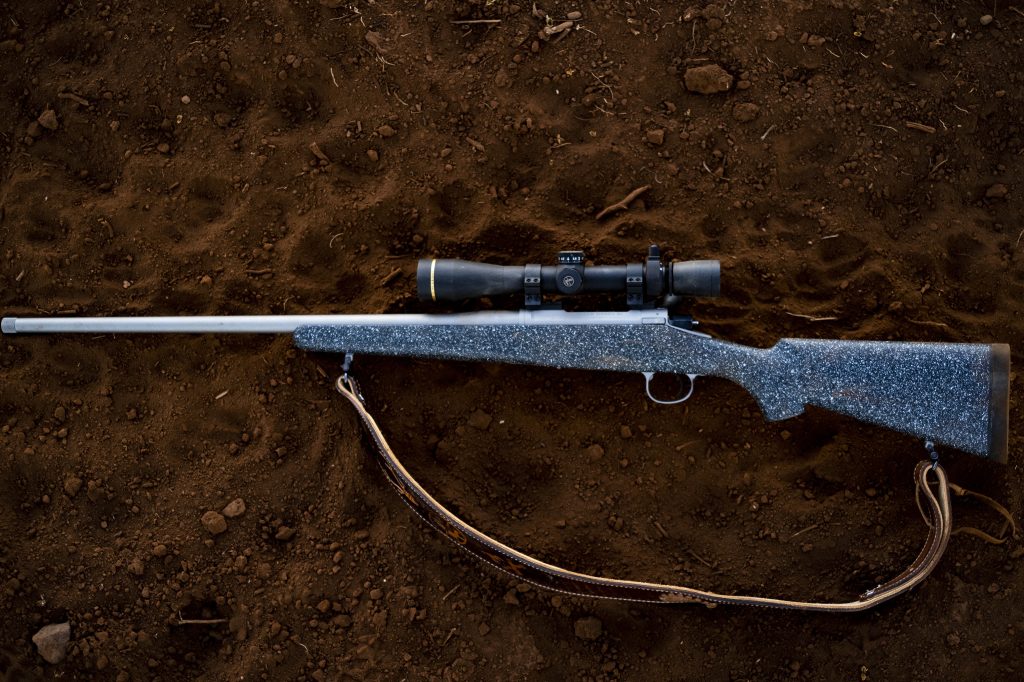
The Nosler Model 21 is a wonderfully designed rifle. A synthetic stock with a gentle, sweeping pistol grip reminiscent of classic stock designs cradles a push-feed action with a neat, fluted bolt, two-position safety, and a crisp trigger. Feeding and extraction were no issue at all, and the gun printed sub-MOA groups, even in the terrible afternoon winds. It was light enough to carry up and down the steep side slopes of those innumerable gullies and canyons, yet balanced enough to settle down for the longer shots. My gun was chambered in the speedy .27 Nosler, which sends a 150-grain AccuBond Long Range bullet faster than even the .270 WSM. It was more than enough for even the largest axis deer.
The Nosler Model 21, chambered in 27 Nosler and topped with a Leupold VX-3HD 4.5-14×40 riflescope is right at home in the deer-tracked red soil of Molokai.
The rifle was topped with the new Leupold VX-3HD 4.5-14x40mm Side Focus CDS-ZL WindPlex, a good value for any hunter. With a 30mm main tube, it is wonderfully bright even at dawn and dusk, yet can be mounted low to the bore, while offering enough elevation adjustment for hunting at longer ranges. With a zero-lock elevation turret and a reticle which allows for quick and accurate wind deflection adjustments, it is a fast system which any hunter will appreciate.
For glassing, the Leupold BX-4 ProGuide HD 10×42 binocular were light to carry, but offered enough magnification to pick out a good buck at distances best measured in portions of a mile, without any eye strain. The Hawaiian sun is unforgiving, but the Leupold Payload glasses not only protected from the tropical sun, but were amazing on the water; the polarized lenses cut glare and allowed me to see fish, turtles, and more both on Molokai and while enjoying the famous North Shore of Oahu.
While cooking wild game in camp, I made a new friend in the Camp Chef cast iron pans. I’m no cook, but my wife knows her way around a cast iron pan and fresh venison tenderloin. Based on what she and Brooks Hansen whipped up in camp, their line of products deserves an audition.–P.P.M.
The advice to fight back when attacked by a black bear is almost always wrong.
Photo above by Vic Schendel: A bear behaving in a defensive manner makes threatening noises and mock-charges; a predatory bear, on the other hand, moves quietly and purposefully.
With the North American black bear population closing in on a million animals and more people than ever living and recreating in bear country, conflicts between humans and bears are at an all-time high in many areas of the U.S and Canada. Although the subject of potential black bear danger has never been more germane, it is muddled by misinformation, confusion, and outright error. As I pointed out in part one of this article, a careful look at the best facts and studies shows that, despite some extreme and opposing beliefs, black bears are neither “mostly harmless pests,” nor are they “relentlessly predatory killers of people.” They do need to be taken seriously as powerful, intelligent animals that can sometimes be dangerous.
In this column I want to look at more key facts and, with expert help, discuss the best ways to handle various encounters and attack scenarios. First, I need to review some essential bear-safety terminology, so that what comes next can be fully understood and applied in the field. Particularly important is the distinction between defensive interactions and attacks and non-defensive ones. A defensive bear is one that feels threatened in some way, and is attacking (or putting on an aggressive display, maybe false-charging) to eliminate the threat. This might be a sow protecting her cubs, or a lone animal that feels hemmed in or encroached upon, as when someone suddenly appears too close. With grizzlies (brown bears), protecting a food source like a carcass might be another common defensive trigger, though this doesn’t seem to occur often with black bears.
“Non-defensive”–a rather clunky term–is a bear that does not feel threatened, is not defending itself, but is approaching you by its own volition. It could be merely curious, looking for food, dominance testing, or–most rarely–coming at you as a predator. Brown bears, being more aggressive and easily triggered, make more defensive attacks than black bears. (An “attack” is when actual contact is made–not merely a charge.) And because they are fiercer and often larger animals, brown bears more frequently kill people or cause severe injury during defensive attacks.
However, according to a recent study by Janel Marie Scharhag, of 210 non-fatal black bear attacks occurring in contiguous America between 2000 and 2017, more than half (52 percent) were defensive, and most of these were by females with cubs. The majority resulted in minor injuries, but a significant 19 percent were rated “severe.” Interestingly, of attempted predatory attacks (only 15 percent of the total, nearly all by male bears), just 12 percent had severe-injury outcomes. These findings have a number of implications, but one of them is that defensive assaults by female black bears, and especially sows with cubs, are worth taking seriously as a potential danger.
A few more relevant facts from Scharhag’s study will help prepare us for practical readiness in the field. For instance, 69 percent of attacks occurred in “frontcountry” (vs. backcountry) locations. Frontcountry includes “wildland-urban interface” (WUI) settings and accounts for a large portion of human-bear conflict situations, such as bears attacking people in their front yards or garages, and in such unlikely places as Pasadena or suburban New Jersey.
Attacks in frontcountry and WUI settings also make one wonder about the old “99 percent of bears don’t want trouble with people” cliche, since these places are also prime locations for the serious problems of habituation and/or food-conditioning. A food-conditioned bear is one accustomed to finding human-created edibles in state parks, campgrounds, picnic areas, garbage dumpsters, alleys with trash cans, and backyards with birdfeeders, compost piles, pet food, and other consumables; while an habituated bear–which might also be food-conditioned–is one that no longer has a natural fear of people, no longer feels the need to run away and perhaps is willing to move closer, or move someone aside, to seek a meal or whatever else it desires. Scharhag found that food or garbage “attractants” were present at 64 percent of attack locations, and that in 74 percent of attacks there had been a prior “food reward” for the bear or previous evidence that a bruin was using the area. This was especially true (93 percent of the time) with attacks that occurred while someone was camping–which is further proof that keeping a “clean camp” (no food, food odors, garbage, or other attractants nearby) is vital. Camping was the most common activity of attack victims (44 percent), followed, rather surprisingly, by being at home (21 percent). Seventy-three percent of those attacked while camping were in a tent. A common scenario was someone waking up while being bitten through the tent wall when a body part (usually leg, arm, or head) was pushing out against the fabric. The bear detects the bulge, investigates, and takes a bite, which might be more exploratory than predatory. Usually a shout or involuntary scream drives the animal away, but injuries, sometimes serious, do occur–which is why I make it a habit and advise others to keep all body parts at least one foot away from tent walls when bedding down for the night.
Turning now to actual black bear encounters, I must warn that this is a subject fraught with misconceptions, misinformation, and outright bad advice, including from “authority” sources such as some biologists and spokespeople for state and national agencies, advice that can get, and probably has already gotten, people severely injured or killed. Space doesn’t allow sharing the many quotes I could offer here, but the most frequently repeated instructions are that when encountering a black bear one should “be aggressive and loud, yell, wave your arms, throw things,” to intimidate the animal; and if attacked, “never play dead or the bear will keep attacking or feed on you; always fight back as hard as you can…” and so on.
Since the advice on this topic is so muddled, I sought the aid of a longtime friend and bear mentor, John Hechtel, to make sure I was untangling things correctly. John has been a bear specialist and biologist in Alaska for more than forty years, and has lectured and advised widely on bear science and safety.
He immediately agreed that sane information on bear attacks, and black bears specifically, is badly needed.
“I’ve been frustrated about the [advice] to play dead with a grizzly and [always] fight a black bear,” he said, “especially after we’ve tried to stress that it’s not the species, but whether the bear is acting defensively or not. There is ample evidence that grizzlies can be at least as predatory [toward humans] as black bears, and black bear defensive attacks, often provoked by dogs, are also well-documented.”
Defensive black bears, feeling threatened, tend to do one of two things: run away (or scoot up a nearby tree, which is another form of escaping), or put on an aggressive show. If you unintentionally startle a sow with cubs, the bear might react by huffing, grunting, growling, clacking its teeth, ground-swatting, or even making one or more false charges, swerving away well before contact. But–and this is key–with a defensive bear of any species, the last thing you want is to increase the sense of threat by doing what is usually advised: yell, get large, wave your arms, and throw rocks or sticks. The bear is already disturbed and is responding aggressively; there’s no sense in possibly escalating that aggression into a full-blown attack.
“I’m a firm believer in the ‘stand your ground’ approach,” says Hechtel. “The simplest and best thing to do in most encounters is to do very little.” This precludes shouting, arm-waving, or trying to run away or climb a tree. If you can slow down the interaction, that’s all to the good; it tends to make the bear less sure of itself.
“Above all,” he says, “don’t overreact [by running, screaming, etc.]; don’t make things worse.” Even if a bruin is charging or running at you, the longer you stand still (preferably with bear spray or other weapon ready to deploy), the better the chances it will stop short or veer off without making contact.
But what if it keeps coming and actually knocks you down? The most common advice is to fight back as hard as you can and “never play dead with a black bear,” but Hechtel disagrees. Once again, with a defensive attack, the idea is to remove the sense of threat; fighting back does the opposite. Sharhag’s findings support this. In a large number of defensive-attack incidents when the person fought back, the injury-outcomes were significantly more severe than when the person did not fight back. Sharhag concludes that when a black bear is “acting defensively, playing dead is more effective at stopping an attack and results in less severe injuries.”
But what about those occasional cases where a bear seemed to turn predatory after a person tried to play dead? I admit these had me wondering. But Hechtel made an important point: “I think you have to distinguish between appropriate play-dead scenarios versus people doing it prematurely, or with non-defensive bears. People wrongly playing dead definitely have resulted in predatory attacks, but rarely from defensive to predatory.”
An example of “wrong” would be someone who flops down and lies still before a bear has touched them. That virtually invites the animal to come closer and investigate, possibly take an exploratory bite, and then shift to predatory or scavenger-feeding mode. The time to drop is only after a defensive bear has actually hit you and is knocking you down. Then you follow play-dead protocol. (Face down on your stomach, legs partly spread for stability, hands interlaced behind your neck and lower skull.)
There are some instances where this strategy fails, Hechtel admits, “but far fewer cases than where fighting defensive bears resulted in extended attacks and more serious injuries. If 90-plus percent of the time playing dead works best, that’s the best advice you can give for a defensive attack where either a black or brown bear makes contact. You’re playing the odds, but going with much better odds. The numbers of cases where this fails are small and are the exceptions, as far as we can tell.”
Hechtel adds an important proviso: “I also think the need to ever play dead with either species is very rare, not a commonplace response to common bear confrontations. Standing your ground with apparent confidence is huge. And access to a deterrent, which can give people the confidence to do the right thing, is also huge.”
What about “non-defensive” and particularly the less common predatory attacks? Studies by Stephen Herrero and others have shown that the behaviors initially displayed in these cases are quite different and recognizable. Instead of the noise–huffing, teeth-clacking, growling–and visible agitation of a startled or defensive animal, predatory bears (most often lone males) are usually quiet, purposeful, and intent. They might approach directly, with a steady plod, looking right at you; or they might half-circle as they watch and assess, and then close in. Attacks can be fast and silent until contact. Facing this kind of bear, you might still want to begin with the confident “stand your ground” attitude, to see if that alone dissuades the animal by showing you are not going to be timid, easy prey. If the bear keeps approaching, now is the time to put on your own aggressive display, raising your arms to look large, yelling in a deep (not shrill) voice, throwing things and picking up or using a weapon, however crude. You do not play dead with a non-defensive or predatory bear (of any species); you fight back as hard as you can, even if only with fists and fingernails, going for the sensitive nose and eyes.
With any incoming bear, the best remedy is to have a proper “deterrent” at hand. Pepper spray works on black bears and it’s wise to keep a canister within easy reach. According to one study, spray has about a 90 percent efficacy at stopping aggressive behaviors with both defensive and non-defensive animals. As for handguns, they can be effective if you can deploy one quickly and hit what you’re aiming at despite the surprise and fear and adrenaline of the moment. One problem even then is the lethality factor. With a sow and cubs (the most likely to make a defensive charge or attack), would you rather shoot or spray the bear away? I’d rather spray and have everyone live happily ever after. This also involves much less trouble than dealing with a wounded or dead bruin, legal issues, orphaned cubs, and so on. I would, however, prefer to have an appropriate handgun available for dealing with an animal that breaks into a tent, camper, or dwelling, and for aggressive night-bears in general.
A closing thought: Focusing on a specific danger can enlarge it out of actual proportion. So I want to offer a bit of perspective by noting that, while I’ve come upon hundreds of black bears over the years, the vast majority of such experiences don’t even merit the term “encounter.” More like “sightings,” or “fleeting meetings.” I’ve had a few tense moments, but outside of assisting with problem-bear management situations, I’ve only had to draw my spray or gun twice, without firing either time. So clearly, black bears are not a dire threat one need constantly fear or worry about. But they are powerful, opportunistic forager/predators, and they definitely can be dangerous. Anyone who venture outdoors in bear country is well-advised to keep this fundamental reality in mind.
Much of what you’ve heard from “experts” about black bears is wrong.
Photo above by Vic Schendel
How dangerous are black bears? Do they really pose a significant threat to humans, or are they a benign species that wants little to do with people, except perhaps to cadge food from them when an opportunity arises?
These apparently simple questions evoke conflicting responses. On one side are those who believe “there’s no need to be concerned or worried about black bears. They aren’t like grizzlies, which are to be feared. Black bears can be pests around a camp, but they aren’t dangerous or aggressive and rarely if ever harm anyone.” Some professional biologists seem to concur, offering assurances that black bears “just don’t want to attack people. They’re basically timid animals. Ninety-nine percent of them will run away at the sight of a person.”
On the other side are those who say that black bears are extremely dangerous; they actually attack and kill more people than grizzlies and are much more predacious. In fact, according to one writer, “when black bears attack it is almost always an act of predation.” Meaning: the bears consider humans prey and attack to kill for food.
Who’s right? I will try to attempt a few clarifications of this rather confusing subject, which is more relevant than ever, since both black bear numbers and human/bear conflicts are at an all-time high.
There is no doubting that Ursus americanus is thriving throughout most of its range, which has expanded to include 41 American states and all but one Canadian province. The overall population estimate is now about 900,000 to 950,000 bears. Regionally, black bear numbers have not merely increased in many areas, they’ve multiplied in Malthusian fashion. A comparatively small and largely unwild state like New Jersey has seen its bear count leap from around 100 in the 1970s to nearly 3,500 by 2015. Tennessee went from “scarce” to harboring about 4,800 or more animals; neighboring North Carolina holds an abundant 20,500. Colorado now has as many as 20,000 bruins, up more than 5,000 in a handful of years, and the population is growing in many areas of the state. There are about 35,000 black bears in California. This is a mere sampling of an ursid population expansion that continues across much of the country.
Along with the large increase in bears has come a substantial increase in “human/bear conflicts” throughout most of the species’ range.
In 2015, Colorado had more than 1,200 reports of “problem bears.” By 2020, there were already more than 1,800 bear reports recorded by mid-July. From 2019 to the end of 2020, Colorado Parks and Wildlife received 879 calls about bears breaking into homes, dwellings, or garages. In New Jersey, a biologist said, “Conflicts are a daily occurrence. We’ve got bears everywhere you can possibly imagine, in places you can’t believe.” Florida (about 3,000 bears) recorded 5,584 human/bear conflicts in 2015, including what has been termed “a surge” in attacks, a few of which were labeled “violent maulings.”
It’s worth noting that many so-called conflicts are nothing more than reports of a bear walking across someone’s lawn or tipping over a garbage can. These incidents aren’t meaningless, but it’s important not to confuse them with attacks, yet another word that lacks consistent usage even among biologists and agency managers. But by most definitions, and speaking generally, violent black bear encounters with humans are on the rise, and the variety of scenarios is rather astonishing: Bears biting people through tent walls; ripping tents open and dragging someone out; breaking into hard-sided, occupied campers; bursting through cabin or home doors; smashing through a glass or screen window to attack a person on the other side; grabbing a man off of his front porch; attacking someone’s dog and then turning on the human who tries to interfere, and so on. Some biologists and bear defenders want to downplay or even deny these realities, and some people in the press or elsewhere want to exaggerate or sensationalize them out of proportion. I am pro-bear, but I believe in finding the truth, which lies somewhere in the middle of these two extremes.
It seems only fair to add that there are now 331 million humans occupying the United States, with more and more of us living and recreating in bear country. Mix a lot more bears with a lot more people, and it’s unsurprising that the result is a surge in “conflicts.” Especially when, as more than one biologist has noted, a high percentage of “bear problems” are more accurately described as people problems–involving those who unknowingly or carelessly do wrong things–often with food, trash or other attractants–that invite conflicts. That is not to deny, however, that there are many cases where a person does nothing wrong and still has trouble–sometimes very serious trouble–with a bear.
This brings us to the actual realities of potential black bear danger, about which there is so much conflicting opinion and misinformation. I’ll start by looking at fatalities, the number of humans killed by black bears and what we can learn from these types of attacks, while also identifying some widespread, mistaken interpretations that have been made from fatal-attack studies. This topic is particularly apropos at the moment, for during the writing of this column (May 2021), came the sad news of the death of 39-year-old Laney Malavolta, who was killed while walking with her two dogs on a private trail north of Durango, Colorado. She was attacked by a sow black bear with two yearling cubs, and her body was partially consumed. The bears were soon tracked and euthanized. A necropsy found human remains in the stomachs of the sow and one of the cubs.
There have been a number of fatal-attack black bear studies, but one of the most influential was published in 2011 by Stephen Herrero, Andrew Higgins, et al. Herrero, author of the foundational book, Bear Attacks: Their Causes and Avoidance (1985, revised 2002), focused this paper on deadly encounters that occurred from 1900-2009. He and his team found that “at least 63 people were killed in 59 incidents by non-captive black bears” in North America.(Since 2009 I have personally tallied another 13 human deaths, bringing the unofficial current total to 76.) Eighty-six percent of these fatal attacks happened between 1960 and 2009. This could indicate a rising trend in deadly bear assaults, but could also be a result of poor record-keeping in the first half of the twentieth century.
Now comes the standout finding that so many have seized upon: “We judged that the bear involved acted as a predator in 88 percent (49 of 56) of fatal incidents . . . [lone] male bears were involved in 92 percent (33 of 36) of fatal predatory incidents . . . [this] shows that females with young are not the most dangerous black bears.”
Citing these findings, the writer I quoted earlier wrote, “when black bears attack, it is almost always an act of predation.” Also: “the majority of attacks on humans by black bears are predatory in nature.” Many others have said much the same thing, which is a major and serious mistake of the kind that might be called “erroneous extrapolation.” Herrero’s study did not find that 88 percent of all black bear attacks were predatory, he found that was true only of fatal attacks, which comprise just a fraction of all attack numbers. If in fact 88 percent of all black bear attacks were predatory, we would be counting annual bear-caused human deaths in substantial double digits instead of the actual low single-digit figure.
In an unpublished preliminary study, biologist John Hechtel made some very interesting and informative computations. His look at “35 Years of Bear Attacks in Alaska, 1980-2014,” showed the following: Recorded attacks by brown bears: 178, with 196 victims (indicating some multiple-person attacks by a single bear) and 15 fatalities; compared to black bears: 20 attacks, 21 victims, and 3 fatalities. (As a side note: hunters were the second-highest category of all bear-attack victims, numbering 59. The highest category, general “recreating,” had 89 victims.) One of Hechtel’s important conclusions is that “black bears [are] not more predatory [than brown or polar bears]. Predatory attacks were less than 10 percent of total.”
In another study, Herrero and Hank Hristienko found 92 serious attacks occurring across Canada and the U.S. from 2010 to 2013. Attack numbers rose annually, from 19 in 2010 to 32 in 2013. Data showed that, despite common belief, the size of a bear is not indicative of its potential danger or likelihood to attack. In the earlier study, Herrero found 23 adult and 10 sub-adult male bears involved in fatal attacks. My personal case-history files include many instances of small bears–120 pounds or less–making deadly or severe assaults. According to one biologist, any bear 100 pounds or over is capable of killing an unarmed adult human. Herrero has remarked that young male bears might be even more prone to violent engagement than older, larger ones. “Young males . . . are more risk-taking and more aggressive, and that’s definitely the pattern here. It fits bears and men and a number of other species.”
An important new, not-yet-published study by Janel Marie Scharhag at the University of Wisconsin-Stevens Point is the first to focus solely on non-fatal black bear attacks, and reveals some fresh and illuminating information. Scharhag examined 210 agency-confirmed attacks that occurred in the 48 conterminous United States from 2000 to 2017. She defined “attack” as intentional/purposeful contact initiated by a bear on one or more humans, resulting in human injury. She did not include violent encounters that weren’t started by the bear, such as if a hunter wounded an animal which then mauled the hunter, or if someone kicked a bear that was fighting with his dog, or if a person got foolishly close while taking a photo.
Of the 210 attacks, 52 percent were defensive. (A defensive attack is one in which the bear reacts to feeling threatened in some way.) Eighty-five percent of defensive attacks were by female bears, 91 percent of them sows with cubs. Further, only 15 percent of all black bear attacks were predatory (and 95% of those were by male bears). I’ve added emphasis where the findings contradict or refute widespread claims and beliefs such as: “Most black bear attacks are predatory,” and “females and sows with cubs aren’t dangerous and rarely attack people.” Note also the disparity between Herrero’s conclusion regarding fatal attacks: “females with young are not the most dangerous black bears” and the non-fatal findings, where sows with cubs are a real threat. This provides yet another lesson in both the complexity and subtleties of the bear-danger/safety subject, and bolsters the need to be careful when extrapolating or generalizing.
Scharhag also labeled a “new” behavioral category she calls “other,” which accounted for the remaining 33 percent of attacks. (80 percent of these were by male bears.) An example of “other” would be a bear that approaches a camp, swats a person aside, grabs some food and leaves. The bear isn’t “predatory,” (trying to prey on someone), and it isn’t “defensive,” (defending itself from a perceived threat). In existing terminology most experts would include this type of behavior in the “non-defensive” category, about which more later.
An “anthropogenic” (human-caused) attractant such as food or garbage was present at 64 percent of attack locations. Attacks occurred during the day but more often (61 percent) at night. Thirty-three percent of all attacks were labeled “severe.” Another important finding is that a domestic dog was involved in 25 percent of attack scenarios. Often this was a person walking with a dog and surprising a female bear, especially a sow with cubs. The bear chased or attacked the dog and then turned on the person. These cases often resulted in severe attacks, and this seems to be what happened with Laney Malavolta near Durango.
It’s obvious that black bears are neither “mostly harmless pests,” nor are they “relentlessly predatory killers of people.” They need to be taken seriously as powerful, intelligent animals that can sometimes be dangerous.
In part two of this article, I will explain the right moves for handling encounters; discuss effective self-defense options, and examine the best ways to respond if you are attacked by a black bear. Read it here.
Africa’s second-largest antelope often takes hunters by surprise.
Photo above: Horn and body shape and face mask confirm that the roan and sable are closely related, but the roan is much larger, with shorter, thicker horns and longer ears. (Photo by Dirk de Bod)
Recently, in another publication, I noticed a photo with a caption that misidentified a roan antelope as a sable. Hey, I’m sure the writer knew what he shot, and the editor knows the difference. We all have mental malfunctions! Roan and sable antelopes are cousins of genus Hippotragus, with similar body build, white face mask, and heavily ringed curving horns carried by both sexes. Ideal country doesn’t vary a lot, mixed habitat with both savanna and woodland.
That’s pretty much where the similarities end, however. The light-colored roan is not as strikingly beautiful as the glossy black sable bull, but he is larger in body, with shorter, thicker horns and longer ears. He is also the more difficult pursuit. Roan antelope gather in smaller groups, and are somewhat more likely to be found in heavier cover. The roan has a larger range, almost throughout sub-Saharan Africa, excepting only the heart of the forest, deepest swamps, and tallest mountains. They are nomadic, and plentiful almost nowhere.
Game ranchers in Namibia and South Africa have done a good job of breeding both sable and roan, making both species more affordable and available. In wild Africa, a good roan is a hard-won prize. They seem more sensitive to man’s intrusion than sable, or perhaps just not as prolific, with fewer hunting opportunities. I have seen roan in Botswana, Mozambique, and Zimbabwe, but in all three countries they have been protected throughout my career. Native and free-range roan are currently on license in northern Namibia, Zambia, and Tanzania, as well as in C.A.R., Cameroon, Benin, and Burkina Faso.
The sable antelope is divided into three more or less distinct races: The giant sable (bigger horns and different facial markings), with a postage-stamp range in Angola, and the smaller, slightly reddish Roosevelt sable along the Indian Ocean coast from northern Mozambique to Kenya. All the rest are “common sable.” With roan, the “lumpers” held sway, identifying several regional groupings that, to my eye, are indistinguishable. I am unlikely to ever see an Angolan or Sudan roan! Most widespread, and today most numerous, is the southern roan. The East African roan is currently hunted only in Tanzania. Largest is the western race, which possibly earns the roan its oft-cited title as “Africa’s second-largest antelope.” Rowland Ward’s minimums vary but little: 26 inches for the Angolan race; 26.5 inches for East African and southern; and 27 inches for Sudan and western roan.
An ancient and excellent western roan bull photographed in Benin. Although horn potential is similar among the races, the western roan is usually the most likely to develop exceptional horn length. (Photo by Christophe Morio)
The western roan occupies a huge range, from C.A.R. all the way to Senegal, but is usually not common. We saw tracks in southern Chad and also on my first bongo safari in C.A.R., down in the southeast corner, far from typical habitat. In four safaris to C.A.R. I never saw a decent roan, although that country is one of the good places. I finally got a western roan in northern Cameroon in 2004. Hunting in the Mayo Oldiri and adjoining Mayo Nduell blocks, we saw shootable roan bulls almost every day. PH Guav Johnson kept telling me to pass. Reluctantly, I did, and was rewarded with a whopper.
I was there again in 2008 and saw several good bulls without hunting for roan. So, northern Cameroon is a good place, and almost the best place I’ve seen. In 2014, Donna and I hunted in Burkina Faso. There, the roan is the most common large antelope. Multiple daily sightings were normal, and Donna got a fine bull. Sadly, hunting in Burkina Faso was shut down by terrorist activity. Hopefully it will reopen, but I understand Benin, just to the south, is as good for roan.
In Burkina Faso they try to recover animals whole, recording weights and measurements. So, I know for a fact that Donna’s roan weighed 653 pounds. A big greater kudu bull can weigh more, as can a big bongo. The roan’s title as Africa’s second-largest antelope is thus disputable. Hers was a prime bull with good horns, but I’ve seen roan bulls that I judged heavier by at least a hundred pounds. For sure, though, the roan is one of the largest antelopes!
In Tanzania, roan don’t occur in most Masailand blocks, nor in Selous. Western Tanzania is good but they’re thinly dispersed. Hunting with Geoff Broom on the upper Ugalla in 1993, we saw tracks, but no roan. In 2010, I spent three weeks in Rungwa, also very good for roan. We weren’t after roan, but we never saw a single one. Hunting with Jaco Oosthuizen in Kigosi, east of Moyowasi, an East African roan was my primary goal. On about the tenth day, we found a small herd with a big bull, almost got him that evening but it got too dark. We found them again the next morning, finally getting a shot in the early afternoon.
Boddington and PH Jaco Oosthuizen with a good East African roan, taken in the Kigosi block in western Tanzania. Record books suggest the East African race is the least likely to produce outsized horns, but is probably the most difficult of the “huntable” races.
In the right place, Zambia is excellent for roan, and over the years Zambia has been good to me. On my first hunt there in 1983, we bumped into a small herd in hilly country above the Luangwa Valley. It wasn’t a great bull, but for many years it was my only roan. As I approached it, I’ll never forget old Bill Illingsworth’s shouted warning: “Stay away from that thing!” I’ve never forgotten: Roan are fierce antelopes, and they know how to use those needle-sharp horns.
In 1996, hunting the Mulobezi block off to the west near Kafue Park, we saw no roan until nearly the end. PH Russ Broom insisted the conditions were right and they should be moving in. He was correct; on the next to last day, we hunted a grassy area up in the northern corner. Sure enough, I got a nice bull . . . barely. The shot was quick, but wasn’t as good as it looked. A poor blood trail took us through tall grass. We weren’t certain we were still on the spoor when the bull jumped up in front of us and streaked away. I got him down. Next morning, with a charter due, the rest of us packed up while Bob Petersen went out for one last try for a roan. They came back at noon with a beautiful roan, taken with a very long shot with his .300 Jarrett.
Sable antelope are difficult to see in shadows, but their dark, shiny coats stand out like beacons in open country. Roan antelope vary in color from light sand to brown to rufous or “strawberry roan.” To my eye, they are much better camouflaged under all circumstances, and more difficult to spot. For sure, I find it more difficult to pick out a bull. With sable, only mature bulls are really black; cows and young bulls are lighter. With roan, bulls and mature females are pretty much the same color. With both species, you must look for the larger-bodied males. As with most antelopes where both sexes have similar horns, you must look for the bull’s thicker horns. This seems more subtle with roan, but that could be because I haven’t seen nearly as many of them.
With sable, the magic number is 40 inches of horn; with roan, drop 10 inches. A 30-inch roan is the Holy Grail, but it’s a rare prize. As mentioned, Rowland Ward’s minimums are much less than the 30-inch mark, while the sable minimum is 42 inches. Shootable and acceptable roans probably start in the mid-twenties, given good mass and the gnarled “secondary growth” of an old bull at the bases.
It’s difficult to hunt roan on purpose. Especially where they’re relatively uncommon (which is most places), they can pop up anywhere. With knowledge of an area and past sightings, you have some idea where to look first, but a roan can still be anywhere. In my experience, it’s likely to be a mature bull walking alone, suddenly spotted, and someone hisses, “It’s a roan!”
Zambia’s northernmost Luangwa block, Chikwa, is known to produce exceptional roan. When I was there with son-in-law Brad Jannenga in July 2021, PH Davon Goldstone insisted we would get a roan, and he knew of some grassy openings to the north where several herds roamed. We never quite got there because we didn’t need to. Checking baits and looking for buffalo, we saw exactly three roan antelope in three weeks, all solitary bulls. One was young, two were exceptional. We shot the first good one we saw, on a hot midday in thick woodland in the middle of nowhere. Davon hissed “It’s a roan,” and in seconds was setting up sticks. Brad’s bull is the largest southern roan I have ever seen, 30 inches on both horns, massive bases with amazing secondary growth, tips starting to wear. Also, it’s one of the biggest-bodied bulls I’ve seen, heavy enough to suggest that the roan may, in fact, be Africa’s second-largest antelope.
Boddington’s son-in-law, Brad Jannenga, with a magnificent southern roan, taken at the top end of Zambia’s Luangwa Valley in July 2021. In both body and horn, this is the largest southern roan Boddington has ever seen.