Sports A Field

Living the Dream

A quest for a very old dagga boy in the Zambezi Valley.

“A buffalo hunt has been a lifelong dream of mine,” said seventy-eight-year-old Frank after introducing himself to me at a recent Dallas Safari Club Convention. “I’m told you’re Mr. Buffalo, so can you please help me make it happen?” 

What a nice request this was. For the greater part of my professional life, the conservation, management, and sporting pursuit of these formidable black bovines has been my passion.

“I’m of the opinion, Frank, that a buffalo hunt should be more than just a quest for a unique animal,” I told him. “Instead it should be a wilderness experience where the search for a nice, battle-scarred old dagga boy will involve other unique, and therefore special, African experiences. Having to dodge elephant cows and their calves, or bumping into lions while following buffalo tracks, should all be part of the hunt. Also, no buffalo hunt is complete without its nights being disturbed by the grunting of hippos, the giggles of hyenas, the roaring of lions, and the wood-sawing rasps of leopard calls. Many miles of following buffalo spoor should leave you both exhausted and amazed at the skill of African trackers. And you should get the opportunity to track, stalk, and look over numerous bulls before finding the right one. This is what a proper buffalo hunt is all about. The area I have in mind will deliver all this from a tented camp on the banks of the mighty Zambezi River, with its own unique scenery, sounds, and spectacular sunsets. If you’re seriously interested in what I suggest, it’ll be my pleasure to make your dream come true. I know the perfect safari area because I’ve hunted buffalo there many times, and I know well the PH and outfitter who’ll make it all happen. I can assure you, you’ll not be disappointed.”

The hunters bumped into this young lion while tracking buffalo. Such occasions add tremendously to the whole African wilderness experience such a hunt should provide.

Frank liked my African wilderness experience suggestion, so I took him to meet Buzz Charlton of Charlton McCallum Safaris, or CMS for short. CMS is, in my opinion, as good as it gets when it comes to such matters, and as I expected, Frank and Buzz hit it off immediately. Frank ended up booking a ten-day buffalo hunt in Zimbabwe’s Nyakasanga Safari Area in the mid-Zambezi Valley for September 2019.

Frank then confessed to a problem: His left knee was in bad shape and in need of replacement, something he was reluctant to have done before the hunt. But if he wore a knee brace and walked slowly, with the aid of a hiking pole, and if the terrain was not too hilly, he reckoned he could, with some prior training, manage the required six to eight miles of daily walking. The other problem was his rifle. Someone would have to carry it for him, because with his wonky knee, he could not. This was when I happily offered my services. In exchange for the opportunity to return to one of my most favorite hunting areas, I would gladly become Frank’s rifle-bearer. 

It is often said that the planning and preparations for a buffalo hunt are as enjoyable as the hunt itself.  Being at the DSC convention was a bonus because it enabled us to start the process right there and then. In short order, a suitable rifle, a Winchester Model 70 Super Express in .375 H&H, and scope, a 1.5-5X Leupold VX III, were secured. Next on the list was ammunition, so we visited Lonnie Cribb of Superior Ammunition at his booth he was contracted to load 350-grain North Fork SPs for the initial shot, to be followed up with 350-grain Cup-Nosed Solids if backing shots would be needed. Next it was off to African Sporting Creations for a pair of Courtney boots, ankle sock protectors, and leather rifle and binocular slings. My last job was to introduce Frank to Debbie Gracy of Gracy Travel. Debbie would handle Frank’s flights to and from Harare and the paperwork for his rifle. To avoid the hassle of taking a firearm through South Africa, Buzz suggested that Frank fly to Harare via Dubai on Emirates Airlines. This Frank did, and it proved a good decision.  

Over the intervening months, Frank and I stayed in regular e-mail contact. His fitness/walking program progressed well, and soon he was walking the required daily distance with ease. September eventually arrived, and I flew to Harare to be there when Frank arrived on the evening Emirates flight. Buzz’s business partner, Myles McCallum, was at the airport to meet us and take us to our overnight accommodation, Amanzi Lodge. After his long journey, Frank was exhausted. We had a couple of Zambezi lagers, a good steak dinner, and went to bed early because Myles wanted a 6:00 a.m. start the next morning.

Our flight from Charles Prince airport to the Sugar Estates airstrip at Chrundu was uneventful. From the air, it was easy to see how desperately dry the Zambezi Valley was. All the inland pans were empty, which meant the wildlife had only two options for their daily water requirements: the Zambezi River itself or a couple of remote springs at the base of the escarpment. Buzz was at the airstrip to meet us, and within an hour we were at the fly camp CMS had set up for us on the banks of the Zambezi, a mile or so upstream from the mouth of the dry Nyakasanga River.

The term “fly camp” is somewhat misleading. Our tents were large and spacious, each with a comfortable bed and ensuite shower, basin, and flush loo. Set under large, shady trees, the camp provided all the creature comforts needed for an extended stay in such a remote location. There was even a fishing boat for evening drifts for tigerfish.  

Our drive into camp confirmed Buzz’s initial comment, “We’ll be spoiled for choice because there are buffalo everywhere.” This was evident–the spoor of buffalo herds and small groups of bulls were seen regularly, crossing the dirt track which runs adjacent to the Zambezi. It took only two shots, one with each bullet type, to confirm that Frank’s rifle was dead-on at 100 yards–the ideal sighting-in distance for the relatively close-range shots for which the Zambezi Valley, with its thick bush, is famous. 

Around the campfire, Buzz, Frank, and I had some interesting discussions regarding buffalo trophy quality.  Having recently spent five years at the Southern African Wildlife College where I had the opportunity to conduct a research project comparing the herd dynamics and trophy quality of two adjacent buffalo populations, one of which was hunted and the other not, my focus these days concentrates on the genetic sustainability of trophy hunting. My research proved conclusively that it is simply not sustainable to continually hunt better-than-average, trophy-quality bulls before they have had the opportunity to breed, or while they are still of breeding age. About this, Frank was suitably convinced, so we set an interesting challenge for his buffalo hunt: to find the oldest, most characterful buffalo in the Nyakasanga.  

Camp was set up on the banks of the Zambezi River under shady Natal Mahogany and Albida trees. Zambezi River sunsets are spectacular. 

So numerous were the small groups of bulls drinking along the river that for the first time in my extended buffalo hunting career, we were able to follow three or even four such groups a day. This was because Buzz and his two trackers each carried handheld radios and GPS units. Having radio communication with Eddie, our ever-smiling driver, made long walks back to the Land Cruiser after unsuccessful hunts unnecessary. After each hunt, Eddie would collect us at the closest road, and while driving to these collection points he would scout for additional bull tracks. This saved lots of unproductive walking and allowed us to follow many bulls. During the hunt we eventually tracked, stalked, and evaluated more that forty different bulls–a truly wonderful experience.

There are many who believe that because buffalo bulls are on their own or in small groups away from the herds they are post-breeding-age dagga boys. This is not the case. Breeding-age bulls, eight to eleven years of age, leave and rejoin the herds on a regular basis as their body condition and strength fluctuates. Dominant herd bulls have a hard life, constantly having to be on guard duty from both predators or rivals. They graze at the back of the herd on trampled grass or leaves, and don’t spend enough time resting and ruminating, and this causes them to lose weight. When too much body condition is lost, herd bulls leave the breeding herds for some R & R.  This is when they regain their strength in preparation for the fights that will ensue for social dominance come the next breeding season.  

Bull buffalo get more massive with advancing age. To compensate for this, their front hooves, which carry the majority of their weight, grow bigger. Old bulls also tend to drag their front feet as they amble along, and over time this wears flat the leading edge of their front hooves. Because of this, I believe it possible to age a buffalo bull pretty accurately just from the size and shape of his forefeet tracks. 

The underside of the buffalo’s unusually large hoof.  This is what caused such a distinctive track.The reason for this was a fractured metacarpal bone.  His whole lower leg was loose and wobbly.  With no weight being put on it, the hoof never wore down and grew to an enormous size.

We were well into the hunt when we found the tracks of the bull we came to call Bigfoot. So large and unique was this bull’s right front foot track that one of the trackers commented, “There is now a giraffe in the Zambezi Valley!” The front edge of Bigfoot’s track was worn flat, and he was a loner. All this indicated an old bull past his prime. We followed his distinctive tracks with enthusiasm, and what a fantastic hunt it turned out to be.  

Thanks to a steady breeze blowing from the east and the dry, dusty conditions, we were able to track and then stalk Bigfoot as he slowly limped his way through the jesse, feeding on its fallen leaves. Bigfoot was not putting any weight on his right front leg, and when I eventually got a glimpse of his impressive body size, his blunt-tipped horns, and well-developed chinlap, I realized he was indeed something special. He was also almost completely bald. Bigfoot was a very old bull and I initially aged him to be at least in his thirteenth year. He was just the type of bull Frank was looking for, and as a bonus, he was totally unaware of our presence.  

Buzz guided Frank in close and got him set up on the shooting sticks. They then patiently waited for Bigfoot to offer a shooting opportunity. It is customary for buffalo to graze into and across the prevailing wind in a meandering, zigzag fashion. They do this so moving air currents will alert them to the presence of lions up ahead. This is exactly what Bigfoot did. He eventually zigged to the left, exposing his shoulder as he did so. This was the moment Frank had been waiting for, and his shot was well placed. The heavy-for-caliber North Fork did its job perfectly. 

Hard-hit, Bigfoot only managed to hobble a few paces before turning to expose his right shoulder. At this, Frank fired a backup shot and Bigfoot simply dropped to the ground, all of which was caught on camera by the hunt’s cameraman, Justin Drainer.   

That Bigfoot was old was obvious. My initial estimation of him being at least thirteen was conservative.  When I eventually got to measure his lower jaws and two first molar teeth, and then age him with the Taylor method, he turned out to be well into his fourteenth year. In the Zambezi Valley and similar areas where predators occur, very few buffalo make it past fifteen years of age, so Bigfoot was close to the end of his natural life. What a bull he must have been to have survived for so long with a broken metacarpal bone, the reason for his limp and his exceptionally large front hoof–testimony to the toughness and tenacity of these incredible bovines. Frank sure was successful in his quest for the Nykasanga’s oldest and most characterful bull; Bigfoot ticked all the boxes, and then some.     

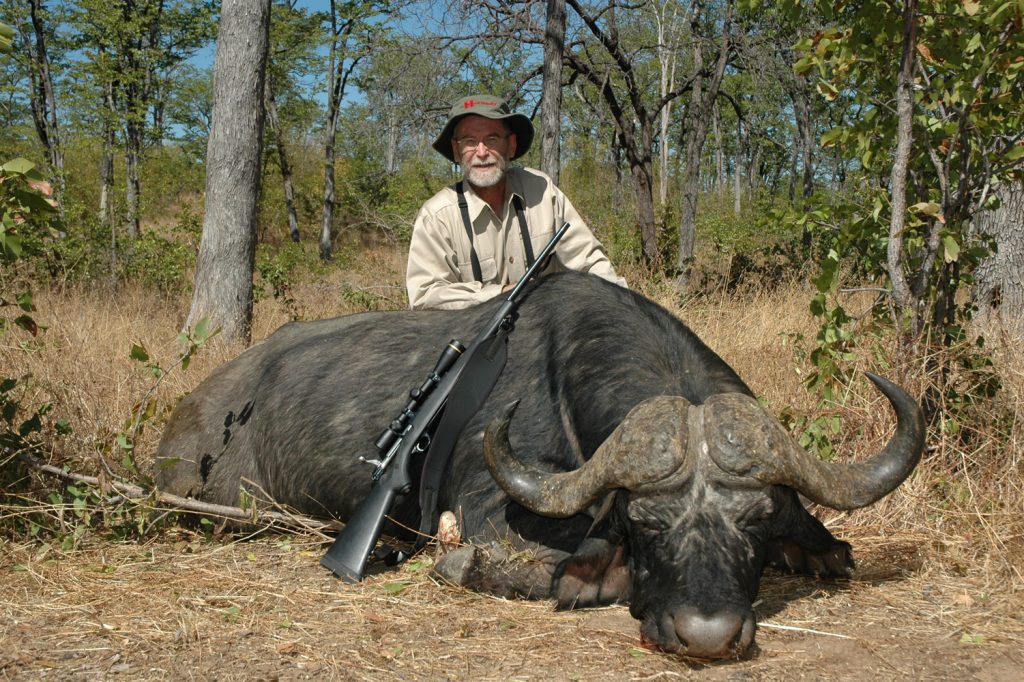
Frank’s buffalo turned out to be a spectacular fourteen-year-old bull, almost bald from old age.  


Leave a Comment

Panache vs. Practicality

Old traditions vie with new trends in the world of big-game cartridges.

Because hunting involves so many traditions, many hunters, especially those of a certain age, tend to avoid “trendy” rifles and cartridges. Many hunters older than fifty prefer wood-stocked rifles—which seems appropriate not only because rifles normally had wood stocks during the first 400-plus years of their existence, but also because of Woodstock, the 1969 music festival that, for better or worse, partly defined the generation the now includes older American hunters. 

This doesn’t mean the generations split neatly. As an example, I’m at the younger end of the Woodstock generation, but along with plenty of hunting rifles with wood stocks, a third of my collection has synthetic stocks, and barrels chambered for trendy twenty-first-century cartridges. 

However, some of my similar-age friends would never consider a cartridge born after Woodstock. One really likes the 7×57 Mauser, mentioning his affection so often some of his other friends suggest he was around when it appeared in 1892. He claims to like the “panache” of the 7×57, a word some hunters of his generation use when bragging up their antique choices.

However, if they actually knew the specific history of the word, they might not. According to the dictionary, panache originally meant a “tuft or plume of feathers, often worn as a headdress, or on a helmet.”

The same dictionary lists panache’s modern meaning as “flamboyant confidence of style or manner,” as in “he entertained in Palm Springs with great panache.” But my friend doesn’t connect the 7×57 with feathered headdresses or Palm Springs parties. Instead he believes the 7×57 imbues him with confident style, perhaps inherited from famous 7×57 fans James Corbett and W.D.M. Bell.

Like other hunters who obsess over such things, he scorns the 7mm-08 Remington, a post-Woodstock cartridge duplicating the ballistic performance of the 7×57. He points out there’s no point to the 7mm-08, since the 7×57 has been doing the same things far longer. Why use a panache-free imitation?

One reason many traditionalists like the 7×57 Mauser is it’s “panache,” but recently some companies have started stamping their 7x57s “.275 Rigby,” the British name for the round. This modern .275 is made by Mauser, which some hunters might consider as odd as chambering a synthetic-stocked rifle for the .333 Jeffery.

I’ve also used the 7×57 in places from Alaska to Africa, taking fifteen species of big game with it including caribou, elk, moose, kudu, wildebeest, and one of my two biggest-bodied mule deer, an Alberta buck. Yet the 7×57 never gets mentioned as a good choice for hunting big Alberta mule deer, whether by Internet experts or Alberta outfitters. Instead suggestions usually start with belted magnums, due to the size of Canadian bucks and possible longer shots on the high plains. (My buck fell at just under 300 yards.)

Lately, however, I’ve grown fonder of the 7mm-08, even though its ballistics are indeed exactly the same. Why? First, because it’s easier to buy brass for handloading in a wide variety of brands. Second, and perhaps more important for a traveling hunter, any 7mm-08 factory ammo works similarly in any 7mm-08. This is not true of the 7×57.

Like many early smokeless cartridges, the 7×57 originated as a military round, and like all early smokeless military rounds, it featured long, heavy, round-nose bullets. Consequently, the original chamber throat was very long. Later on, lighter spitzers became popular, and 7×57 chamber throats shrank (as they did in many other cartridges of the same era). 

Even modern factory rifles can have throats varying from short to very long. I know this because I’ve owned American factory 7x57s with throats varying in length from .375 inch, the industry standard listed by the Sporting Arms and Ammunition Manufacturer’s Institute, to so long the case neck barely grasped the rear end of a 160-grain spitzer seated near the lands. And the 160-grainer had to be seated near the lands, or the rifle wouldn’t shoot worth a hoot.

Because of this wide variation, 7×57 handloading data also varies widely, whether developed for older or “modern” rifles. Factory ammunition also varies (when you can find it), whether American or European, so you can’t always be sure it will work well in a particular rifle. Oh, and then there’s the 7x57R, a rimmed variation for break-action rifles, generally loaded to lower pressures than the rimless 7×57. The same things are often true of other cartridges that appeared until around 1905, including the 6.5×55 Norwegian-Swedish, another highly revered classic. 

Perhaps the most varied is the 7×57’s big brother, the cartridge generally known today as the 8×57 Mauser. The original cartridge was not chambered in a Mauser rifle, but in the Gewehr 1888 military rifle designed by a committee. It used a 227-grain round-nose bullet, .318 inch in diameter, so Gewehr 1888s had long chamber throats. 

After several years, the rifling grooves were deepened to .323 inch, for reasons involving pressures and barrel wear, and bullet diameter increased to match. In 1898 Germany adopted the Gewehr 98 Mauser, but in 1903 switched the bullet to a 154-grain spitzer, requiring a shorter throat, calling the “new” version the 7.92x57mm Mauser S Patrone. Most of the existing 98s had their barrels set back and rechambered—as did many Gewehr 1888s, especially a bunch Germany sent to its ally, Turkey, in World War I.

The 8×57 became a popular hunting round both in Europe and Germany’s colonies, and of course a rimmed version soon appeared. For some obscure reason most early break-actions for the rimmed 8×57, whether single-shots, doubles, or drillings, had .318-groove barrels, but eventually some appeared with .323 grooves. 

Barsness has owned rifles chambered in all four variations of the 8×57 Mauser, including these three: A Gewehr 1888 converted to the “modern” 8x57IS (top), a sporterized military 1898 Mauser with the original long throat for 227-grain roundnosed bullets, and a somewhat unusual Sauer drilling in 8x57ISR, the rimmed version of the .323 diameter round.

These various 8x57s all had different names, often confusing  Americans despite the supposedly “sensible” metric-cartridge nomenclature system. The .318 version is known today as the 8x57I or 8x57J. The “I” stands for infanterie, German for infantry, but in old German writing it looked a lot like a J—so both letters mean the same thing. The .323 round was called the “S” version, which was added to the I or J. The rimmed versions have an R at the end of the rest of their alphabet.

For even more obscure reasons, I’ve owned 8x57s chambered for most of the variations, including a Gewehr 1888 (which may have traveled to Turkey during its life, since there’s an “S” stamped on the receiver), an 1898 military rifle rechambered for the spitzer load, a Sauer drilling in the .323-groove version of the rimmed round, and a century-old German custom rifle that’s essentially a “sporterized” 98 military rifle with the original long chamber throat.  

While European hunters normally know about these variations and their names, I suspect the younger generation grew weary of them. Having hunted in various European countries for over a quarter-century, with a bunch of different resident hunters, I’ve only encountered a single 8×57 rifle. 

Surprisingly, the single most common cartridge I’ve encountered has been the .308 Winchester. This may seem odd, but after the American military adopted the .308 in the 1950s, the North Atlantic Treaty Organization (NATO) eventually adopted it as well. As a result the 7.62×51 NATO and the .308 soon became more common than the 8×57—and did not have four significant variations. In a 1996 hunt in Norway (one of the original NATO nations) I came across a barrel full of Remington .308s in a sporting goods store in Bergen, and on two other hunts, both hosted by European rifle manufacturers, I was assigned a .308 Winchester, one an over-under double. While some Americans still refer to the 8×57 as the .30-06 of Europe, it’s not.

In one instance where practicality overcame my traditional tendencies, I purchased a German single-shot, known over there as a Kipplauf (tip-up), specifically for traveling. Like double-barrel rifles and shotguns, Kipplaufs easily break down into three shorter parts: barrel, fore-end, and action/buttstock. These fit easily into a compact travel case, handy in airports and planes of varying sizes, and other vehicles from jetboats to Toyota Land Cruisers, often almost filled with camp supplies. It came from a lineup of Merkel Kipplaufs in the Houston showroom of Briley Manufacturing, which included several chamberings—including a 7x57R. 

But I resisted the temptation and picked the .308, knowing ammo could be found anywhere from Alaska to Africa—and that the .308 worked great on a wide variety of big game, even with cup-and-core bullets, due to its moderate muzzle velocities. In fact, it works just as well as the 7×57, which acquired its sterling reputation when only cup-and-cores existed, whether softnoses with the open end of the cup forward, or “solids” with the open end backward. (Oh, and my Kipplauf extracts very reliably, despite the .308 being a “rimless” case.)

Fortunately, another early military cartridge which got changed from a heavy round-nose to a lighter spitzer never suffered. The first rounds for the 1903 Springfield were loaded with the same 220-grain roundnose used in the .30-40 Krag, but shortly afterward Mauser changed the 8×57 military load to the lighter spitzer. The U.S. Army then switched to a 152-grain spitzer, converting Springfields by setting the barrels back and rechambering them with a shorter throat. This happened relatively quickly, so very few .30-03s still exist. Consequently, all .30-06 ammo works in all .30-06 rifles.

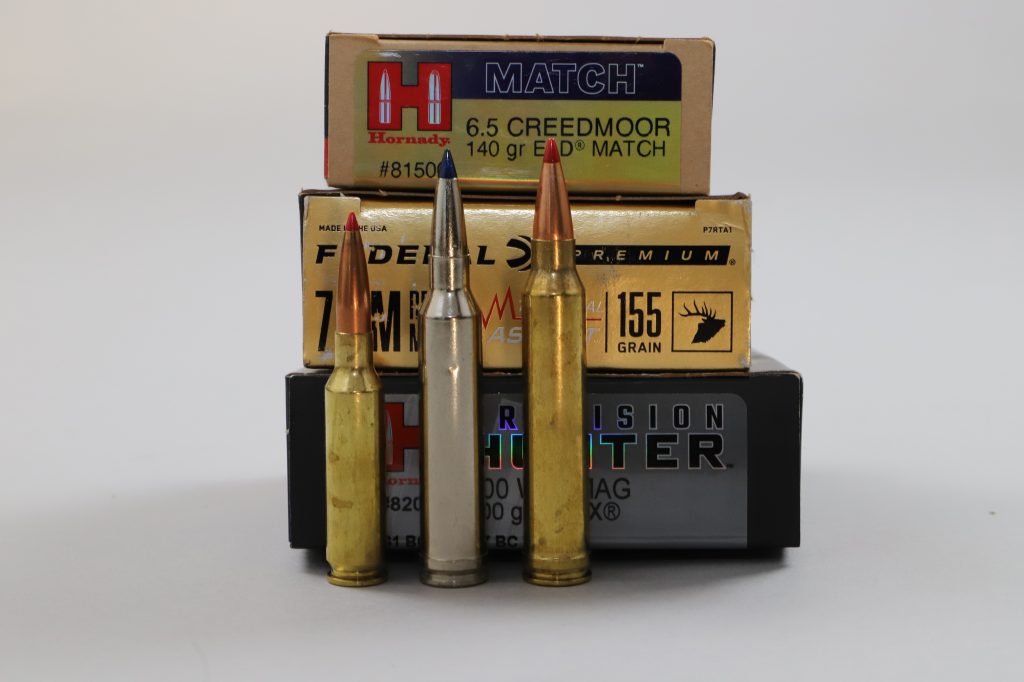
Newer, shorter equivalents of traditional rounds have started replacing the old ones among many hunters: From left, the 6.5×55 and its two modern replacements, the .260 Remington and 6.5 Creedmoor; the 7×57 Mauser and the 7mm-08 Remington; and the .300 H&H and .300 WSM.

The .30-06’s celebrity career almost matches the 7×57’s, being a favorite of various writer-hunters, including Theodore Roosevelt, who took a converted sporter on his nearly year-long African safari in 1909-10. His “little Springfield” worked so well that Springfield sporters became a national industry, made not only by custom gunsmiths but Springfield Armory. Ernest Hemingway wrote about his Griffin & Howe Springfield many times, most notably in Green Hills of Africa, using it to taking a rhinoceros, among many other animals. A Remington .30-06 was among the four-rifle battery Robert Ruark used in the same Kenya and Tanganyika country Hemingway hunted, and probably the rifle he used most. Ruark eventually gave it to his professional hunter, Harry Selby, who used it far more.

A long list of professional gun and hunting writers have used and often recommended the .30-06 to readers, starting with Townsend Whelen (“the .30-06 is never a mistake”), Capt. Paul Curtis, the shooting columnist for Field & Stream before World War II, as well as  Jack O’Connor and Craig Boddington. I have used it take more big-game animals than any other round, and in fact at one point owned six .30-06s, all in different actions—bolt, lever, pump, semiauto, falling-block single-shot, and a drilling. Eventually, however, this collection got pared down to a single New Ultra Light Arms Model 24, the polar opposite of the Merkel .308.  

But no matter how good or practical it is, eventually many rifle loonies become bored with the .30-06, apparently because despite its illustrious history, the cartridge lacks panache. Today, many dance around the .30-06’s ballistic slot with modern rounds such as the .280 Remington Ackley Improved and .338 Federal, both providing very similar muzzle velocities with similar bullet weights. Ruger even devised a “short” .30-06, the .300 Ruger Compact Magnum. Despite all this, “boring” .30-06s keep selling. (Apparently this makes .30-06 users boring, too. Around twenty years ago in a caribou camp, one of the other hunters asked what caliber my rifle was. When I said .30-06, he said, “I kinda figured you for a .30-06 guy.”)

Another cartridge developed shortly after the .30-06, Holland & Holland’s .375 Magnum, still holds the title of the greatest all-round big-game cartridge, despite being terribly flawed, according to many modern hunters. It not only features one of those antique belts, but the long, tapered case prevents the H&H from being as “efficient” as newer rounds. 

Yet the original keeps going. Rob Klemp, one of my African PH friends, owns a big sporting goods store in Kimberley, South Africa. I sometimes consult him about sporting rifle trends over there, and a few years ago Rob said the .375 H&H remains the leader among “medium bores,” because his customers tend to be traditional. Yet a year or two later he reported that 80 percent of his new-rifle sales were 6.5 Creedmoors, the cartridge many American hunters love to hate.  (Other African firearms dealers, and not just in South Africa, have reported the same trend, which means safari hunters don’t necessarily need to take cartridges over a century old to be practical. Even if they run out of 6.5 Creedmoor ammo, they can easily buy more.)  

In fact, the modern, shorter cartridges have pushed some traditional favorites to the brink of extinction. The 6.5×55 has largely been replaced not by one but two rounds, the .260 Remington and 6.5 Creedmoor, because unlike 6.5x55s, the recent rounds have consistent chamber throats. (This may be why I’ve kept things balanced in my gun safe by with two 6.5x55s, along with one rifle each in .260 and 6.5 Creedmoor.)

As with the 7×57 and 7mm-08, far more of today’s hunters buy .300 Winchester Short Magnums than .300 H&Hs, the century-old ,belted, “inefficient” .300 magnum with just about the same powder capacity and ballistics. In 2007, only five years after the .300 WSM appeared, Rob Klemp had more WSM ammo in stock than H&H. The debate over what’s traditional and what’s more practical isn’t likely to end any time soon.

Not many rifle companies chamber the .300 H&H any more, partly because not many bolt-actions are long enough. It worked fine in this limited-run Ruger No. 1.

Leave a Comment

Postgraduate Glassing

Hunting Coues deer in the desert Southwest tests your glassing skills like no other hunt will.

As decreed by Father Time, my eyes aren’t what they once were. Even so, with long practice, I’m usually pretty good at spotting game. Even without the vision I was once gifted with, experience counts. The human eye seeks movement, the flick of an ear or tail. With long practice, we also seek texture and light reflection, different on hair and horn than leaf and limb. And, when vegetation is vertical, we seek the horizontal of back and belly lines.

I hate it when somebody else sees game first, even the great African trackers, who are magicians. I’ve seen these guys pick up animals—or parts of animals—that I needed 10X glass to resolve. No hunter’s experience is complete–it’s just not possible in this big world–but mine is pretty extensive. I’ve never seen hunting that requires glassing more difficult, more extensive, or more intensive, than hunting Coues whitetails in the desert mountains of the Southwest.

Veteran Arizona hunter Mike Hughes glassing with a dual-eyepiece 70X Swarovski spotting scope. Such high magnification is useful, but heat waves, mirage, and a narrow field of view make it more difficult to use than a binocular between 12X and 20X.

They are small deer, thinly distributed in huge country, neutral gray, in a multi-colored  world of rocks and cacti, with branches, limbs, and stems in any imaginable shape. In Arizona and Mexico, finding Coues whitetails against this difficult background developed into an art form that I have long called “postgraduate glassing.” Mind you, the techniques and equipment are applicable elsewhere.  However, hunting Coues whitetails is a passion and hunting culture centered in the arid mountains of Arizona, where the Master of Glassing degree was created.

For sure, I had no influence in its creation. Nor, in times gone by, or even today, is intensive glassing always necessary. The late George W. Parker was a great hero to me and, in his last years, a friend. Over the course of nearly fifty years, Parker put seven Coues whitetails in the Boone and Crockett records. In Parker’s early days there might have been more deer, but for sure there were fewer hunters. Most of his big bucks were taken by riding slowly through desert hills, jumping deer and getting a shot. My introduction to Coues deer hunting wasn’t much different. I started with legendary Arizona outfitter Warner Glenn and his dad, the late Marvin Glenn. Hunting on riding mules, we stopped often to glass, but most deer were taken by riding slowly, jumping or spotting deer and making a quick stalk for a shot.

A few years later I got a call from a young Arizona fellow inviting me to put in for a Coues deer tag. I drew, and that was the first time I ever saw a binocular mounted atop a sturdy tripod.  It was an eye-opening experience, and we hunted Coues deer together for several seasons. Duwane Adams and I were hunkered under a cedar during a rainstorm in the Galiuros when he asked, “Boddington, if I got a guide license, do you think people would pay money to hunt these little deer?”

Adams has now been a legendary Coues deer outfitter for a long time, often called upon to give glassing seminars. What I learned from him, now forty years ago, is that 10X is not enough. For most of my hunting, and most hunting worldwide, a 10X binocular will do all you need to do. There are many situations where more magnification is useful, but in Coues deer hunting, 10X isn’t enough, and handholding your binocular doesn’t cut it. The country is just too big, and the deer too small and difficult to spot.

Over the years, Coues deer glassing developed as a cult, with 12X, 15X, and 20X binoculars secured to steady tripods as the preferred method. For most of my hunting, I still use a 10X binocular, backed up with a spotting scope on a tripod. The spotting scope is indispensable for judging antlers and horns, but you can’t really glass with it, too much eyestrain from using just one eye. There are spotting scopes with dual eyepieces, and dual spotting scopes. For this kind of intensive glassing we need to use our binocular vision but, as magnification increases, field of view shrinks.

Boddington’s best-ever Coues deer was taken in Sonora in 2000.

So, extra-powerful binoculars are probably the best tools, but the real secret is the tripod. It isn’t just distance alone; these little deer are hard to see. Regardless of magnification, the stability of a tripod greatly extends your ability to see. The theory is that the deer are there; it’s your job to find them. I don’t claim that I was ever really good at this kind of glassing; it takes extreme patience, dismantling a distant ridge one piece at a time, over and over again.

I fell in love with the Southwestern mountains, so harsh in summer and so wonderful in cooler months. Wildlife is fragile in desert habitat, so Arizona was one of the first Western states to go to across-the-board drawings for deer. In the mid-1980s I got rejected a couple of times. By then I’d become addicted to hunting Coues deer, so I started going to Mexico.

Coues deer are widely distributed in Arizona and in the Mexican states of Chihuahua and Sonora, and just tip into southwestern New Mexico. In Arizona, most Coues deer hunting is on public land. In Mexico nonresident hunting is on private land. The biggest Coues deer have come from Arizona, but my experience is the average is much better in Mexico. For sure, because you’re hunting on managed private land, you see more deer in Mexico. I hunted in either Chihuahua or Sonora almost annually for nearly twenty years. The country and techniques are the same, with glassing techniques imported from Arizona. Down there, too, I had good mentors, mostly Kirk Kelso, a master with his 20X binocular on a tripod.  After a several-year break, I hunted Coues deer in Sonora again in 2018 with Ted Jaycox of Tall Tine Outfitters. Ted’s technique is the same: Big binoculars on a steady tripod, preferably from a comfortable camp chair!

I don’t claim to be good at this painstaking glassing. I lack the required patience, but I have a lot of experience. The reward comes when one of these small, elusive deer shows up in the field of view at some absurd distance. On good ranches in Mexico you see a lot of deer, so even my short attention span isn’t sorely tested.

I’ve enjoyed the Coues deer hunting in Mexico so much that it’s been many years since I applied in Arizona. But sometimes fate throws odd curves. Early in 2020, daughter Brittany and son-in-law Brad Jannenga acquired a cattle ranch north of Phoenix–in time to apply for tags. We drew for a late October season so, suddenly, I was back in the Arizona Coues deer hunting business.

I’d been in Kansas working food plots and intended to swing home before the hunt and pick up a bigger bino and tripod adapter. Didn’t happen, so I wound up glassing with a hand-held 10X binocular. Fortunately, Brad is a good Arizona hunter and had the gear. As did his friends. In Arizona, any tag is a hard-won prize; draw a permit, and you’ll probably have volunteers to help with the glassing. Mike Hughes and Max Nichols, experienced Arizona hunters, were on hand with big glasses on tripods.

A good Sonoran buck, taken with Ted Jaycox of Tall Tine Outfitters in 2018. This was a January hunt, with the rut just kicking off. Most days more than a dozen bucks were glassed, not uncommon for good country in Sonora.

Scouting for deer had been far down the priority list in getting the ranch going, so we went in pretty cold, with good knowledge of the terrain but not much on deer. Also, it was October, still warm and very dry. I’d never hunted Coues deer this early, always in December or January. A couple of flowing springs on grazing leases proved the keys.  There were deer, and we found them. Mind you, even when you’re focused on a distant ridge, a deer can pop up anywhere at much shorter range. So, I had a few small victories in seeing deer first, but not many! Honestly, I was so under-equipped that Brad, Max, and Mike had several deer spotted beyond a thousand yards that I never picked up at all with my 10X. More than one vanished before I could get the spotting scope on the right spot. 

We had a seven-day season, and we hunted hard. Some days we saw no bucks at all, but, collectively, we glassed about a dozen bucks, some seen more than once. I got a nice buck on the fifth day; Brad got one a day later. All in all, a pretty good week of Coues deer hunting, and we finished with much better knowledge of the area. If we manage to draw that tag again, we’ll have a much better starting point, and I promise I’ll be using proper optics for this postgraduate glassing.   

Brad Jannenga and Boddington with the first buck taken on Brad’s Cross Y Ranch, October 2020. It was still warm and very dry, tough hunting and difficult glassing.

Leave a Comment

Out of the Mists of Time

Re-measuring heads that were originally recorded many years ago reveals that the Rowland Ward system is, and was, exceptionally accurate.

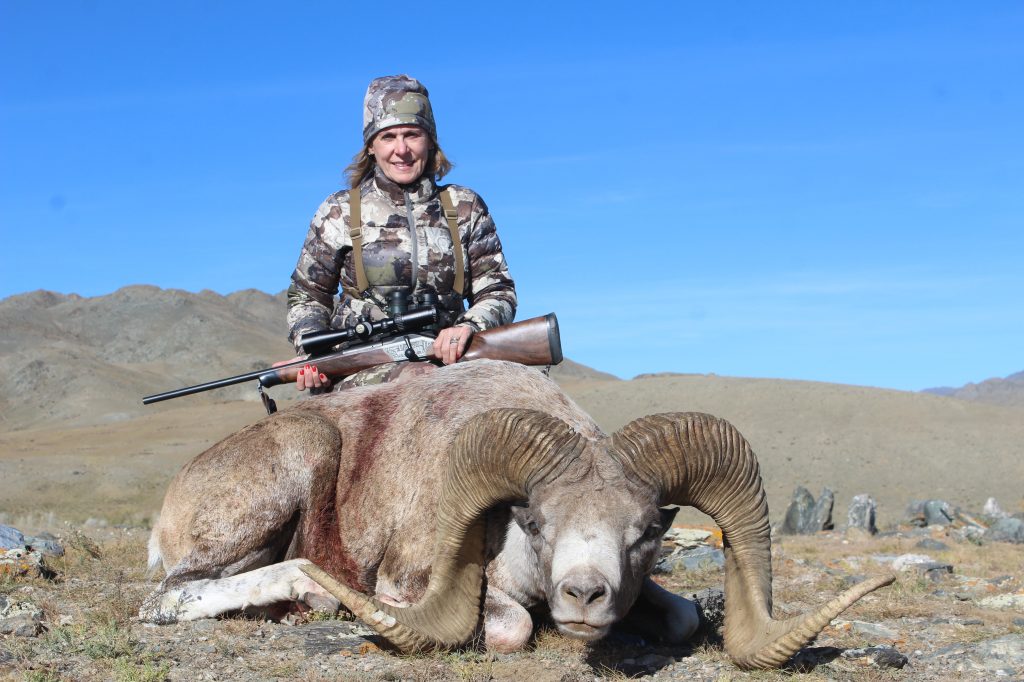
Photo above: This exceptional Marco Polo argali was taken by famous wildlife artist John Guille Millais in 1927. 

The Rowland Ward office frequently receives questions about record heads recorded a very long time ago. Because the Rowland Ward measuring system is very old, the database contains heads that go all the way back to the 1800s. Many especially fine trophies were registered between the late 1890s and World War II. Some of these heads still exist in museums, but others have long since disappeared in the mists of time. Luckily, there are trophy collectors throughout the world who have purchased many heads at auctions to preserve the finest and most unusual trophies.  This type of collection is particularly popular in Europe, and many of the collectors are not even hunters.

The accuracy of the measurements from long ago is always a point of discussion. Were there really elephants with 200 pounds of ivory in a single tusk, and rhinos with 40- or even 50-inch horns?  It is well known that some horns, skulls, and antlers shrink as they age, a process that is influenced by the conditions under which the trophies are kept, as well as the age of the animal when it died.

Clearly, it is impossible to re-measure all of the old heads; however, we do sometimes get opportunities to confirm dimensions recorded a long time ago. Two intriguing animals came across our desks in recent times: the world-record bloubok and a very large Marco Polo argali.

The world-record bloubok, dating from the 1700s, is currently in storage in a museum in the Netherlands.

The bloubok (Hippotragus leucophaeus), sometimes called bluebuck or blaubok, was a now-extinct antelope that lived exclusively in the coastal area of South Africa’s Cape. Bloubok were closely related to roan antelope, albeit smaller in body size, the largest mounted specimen being 47 inches at the shoulder.  Why they became extinct is not known, but they appear to have existed in low numbers even before European settlers arrived. Only a handful of specimens are known to science, and all are housed in museums. The world record is in the Naturalis Biodiversity Center in Leiden, the Netherlands. The museum was moved to a new building in 1998, and unfortunately the animal is no longer on display to the general public.  

However, through the efforts of the curator, Rowland Ward was recently able to get new measurements of its horns. The animal is from the 1700s and was obtained near Swellendam. It is not known when it was originally measured for Rowland Ward, but it was likely before World War II. Originally the longest horn and base was recorded as 24 4/8 and 6 3/8 respectively. In 2020, the measurements were re-recorded at 24 4/8 on both horns, with bases of 6 4/8.  

Marco Polo or Pamir argali (Ovis ammon poli) are among the most sought-after sheep in the world. Their horns grow longer than any other wild horned animal, with the greatest ever recorded at 75 inches; only a handful ever have taped over 65 inches. Recently we had an exceptional 1927 head officially re-measured. Collected by quintessential British hunter and talented wildlife painter John Guille Millais, it was recorded in 1928 with a length of 68 6/8 on the longest horn, and bases of 15 inches. When re-measured in 2019 in the UK, the longest horn was 68 7/8 and the base was 14 6/8, for a total score of 226 3/8 taking both lengths, bases, and all quarters.

Finding such small discrepancies between heads measured today versus half a century or more ago gives us great confidence in the integrity of the Rowland Ward measuring system. 

If you are interested an submitting trophies for the 31st edition, go to rowlandward.com for method forms and instructions, or contact Carrie Zrelak at Rowland Ward [email protected].

Leave a Comment

Shooting the Lightweights

Lightweight mountain rifles can be just as accurate and easy to shoot as traditional heavier rifles.

Photo above: Even with a 21-ounce Nightforce SHV scope in steel rings, Barsness’s New Ultra Light Arms .30-06 weighs exactly seven pounds, still qualifying as a mountain rifle.

Most big-game rifles weigh around 8 or 9 pounds with scope. But in the past twenty-five years or so, we’ve seen the advent of big-game rifles that are both much lighter and much heavier than that average. Here, we’ll look at the development of what are called “mountain rifles,” defined as weighing 7 pounds or less with scope. 

The modern mountain rifle started to evolve after the development of “lay-up” stocks in the 1960s, stocks made of strong, lightweight synthetic fibers held together with epoxy, which weighed far less than a typical wood stock. Even a walnut stock made of very plain, coarse-grained wood has to be pretty darn slim to weigh under 32 ounces (2 pounds), and the lightest I’ve weighed went around 26 ounces. Lightweight lay-ups generally weighed 24 ounces at most, even with a substantial recoil pad. Some only weighed about a pound, with Brown Precision’s Pound’r going right around 16 ounces without a buttpad. So many mountain hunters bought Pound’rs that they became a target for other synthetic stockmakers, some of whom made stocks weighing as little as 12 ounces, resulting in rifles lighter than 6 pounds with scope. 

Many traditionalists, of course, started whining about such rifles being not only supremely ugly but unshootable, because they kicked hard and were too light to hold steady. To a certain extent these complaints were true, but while beauty is in the eye of the beholder, it’s also conditioned by tradition. During the nineteenth century transition from flintlocks to cartridge rifles, many hunters thought repeating rifles were really ugly, especially bolt actions. Of course, later traditionalists often started referring to some bolt actions as “works of art,” especially the pre-’64 Model 70 Winchester.

The other objections, that super-light rifles couldn’t be shot well and kicked too much, were also partly related to tradition. Before lay-up synthetic stocks, the most practical way to lighten bolt-action rifles was to slim and shorten the barrel. Hardwood stocks could only be slimmed so much, and the most popular bolt actions weighed at least 2 1/2 pounds—including the 45-ounce “sculpture in steel,” the pre-’64 Model 70, and the basic 1898 Mauser.  One of the most highly prized actions for custom lightweight rifles, the G33/40 version of the Mauser, was a “small-ring” version with recesses milled in the action—which still weighed 40 ounces.

While it’s possible to make a 7-pound scoped rifle on such actions, even a light scope and mounts weigh a pound, meaning the bare rifle had to weigh around 6 pounds—with the action close to half the weight.  As a result, most early attempts at really light bolt rifles had very short “toothpick” barrels, with fore-ends not much thicker, making them extremely muzzle-light and hence hard to hold steady. 

When traditionalists heard about 6 or 7 pound synthetic-stocked rifles, they transferred their experience (if any) with toothpick rifles to the new “plastic” lightweights. But synthetic stocks allowed the use of heavier barrels of conventional length—as did newer, lighter actions, starting with the Remington 722 in 1948. The 722 was the forerunner of the short Remington 700 action, and weighed around 35 ounces. Of course, the traditionalists also whined about that as well, saying the short cartridges designed to fit their magazines lacked sufficient “killing power” for big game.

This, of course, ignored the fact that the premier short-action cartridge was the .308 Winchester, introduced in 1952 in the new Model 70 Featherweight (which still used the full-sized pre-’64 action, so ended up weighing close to 8 pounds scoped). Yet despite the .308 being “too short,” its ballistics matched original .30-06 factory ammo, a cartridge considered plenty for most big game by famous hunters from Theodore Roosevelt to Ernest Hemingway.

The major point, however, was many traditionalists already considered lightweight rifles impossible to shoot well. If and when they actually shot one, I suspect many didn’t try very hard, or grasped them very firmly in an attempt to steady the reticle. This is not the way to shoot a hunting rifle, especially from field positions.

Lighter rifles do reveal flaws in shooting technique, such as failing to hold the rifle consistently the same way every time, and pulling the trigger too quickly and firmly. Heavier rifles are far more forgiving of such flaws—although a longer, heavier barrel results in steadier holding, even in really light rifles. 

The “mountain rifle” I’ve taken more big game with than any other is a New Ultra Light Arms Model 24 .30-06, which has a 24-inch Douglas No. 2 contour barrel, measuring 0.6 inch at the muzzle. This is far from a being toothpick, and in fact is just about the same size as the standard (not Featherweight) pre-’64 Model 70’s barrels. Yet the NULA weighs slightly less than 6 1/2 pounds with a typical 12-ounce, 3-9x hunting scope, due to a Kevlar-based synthetic stock weighing 24 ounces with a 1-inch thick Pachmayr Decelerator, and the total action weighing 24 ounces. In fact, the stock and action combined are almost as light as a pre-’64 Model 70 action. Thus more of its weight is up front, promoting steady aiming.

Lighter actions and stocks allow the use of a heavier, longer barrel, helping to steady our aim. This Wyoming mule deer was taken at almost 400 yards from sitting, with the NULA .30-06 rested on a sagebrush.

A more recent trend involves putting “dialing” scopes on light rifles. In the 3-9x range, these generally weigh about a half-pound more than traditional “set and forget” 3-9x scopes–about as much as a cup of water. A couple years ago I decided to try a 22-ounce Nightforce 3-10×42 SHV on the NULA .30-06, which increased the overall weight to exactly 7 pounds—still within the definition of “mountain rifle.” 

I also used detachable steel Talley rings, so the Nightforce could be easily switched out for other scopes—mostly because I often use the NULA to test new scopes. Its combination of fine accuracy and substantial recoil quickly reveals any mechanical faults—one reason I decided to try the rugged SHV for general use. 

Another factor I discovered after hunting with lightweights for several years is they don’t group as well with the fore-end placed on a harder front rest—and even a well-packed sandbag can be considered hard with 7-pound rifles.  Eventually I tried folding the terrycloth towel in my range bag and draping it over the front sandbag, whereupon rifles that wouldn’t consistently group under an inch at 100 yards would start shooting much smaller groups. In fact, I own sub-7-pound rifles that will group three shots into around an inch at 200 yards, including the .30-06, and a couple that group even better. 

Hunters are fond of pointing that benchrests are scarce in the field—but that doesn’t mean we have to shoot off a hard rest. To a certain extent this includes bipods, the portable equivalent of a mini-benchrest—and in the semi-vertical country where a really light rifle makes a difference, I prefer not to increase its weight by adding a bipod. 

Instead, my portable rest is the fleece daypack I always carry in steep country anyway, filled with stuff from lunch to layers of clothes. Bench-testing proved the soft daypack works just as well as a folded towel, and provides some degree of height adjustment. I’ve shot big game from 300 to 500 yards in varying terrain by laying the pack flat, or on its side, or standing it upright. But I also practice a lot with light rifles, both at the range and by hunting smaller game, because (again) they are not as forgiving of faulty shooting techniques.

Eventually many traditionalists accepted lightweight rifles, partly because of growing older (as luckier traditionalists do), and realizing carrying 9- or 10-pound rifles uphill wasn’t as much fun as it used to be. Of course, to really make a difference, older hunters need to lose a lot more weight than the 2 to 3 pounds of a really light rifle, whether from ourselves (which becomes more difficult with age) or our other equipment. Luckily, far lighter gear is available today, in everything from boots to packs. A lighter rifle, though, can definitely help reduce the load and, if we learn how to shoot it well, it should not handicap our accuracy in the field.

Today’s Top Mountain Rifles

Today’s mountain rifles are lighter, easier to shoot, and more accurate than ever. Here are a few of the best, all of them weighing less (often much less) than 7 pounds.

Weatherby Mark V Backcountry Ti: Tipping the scales at less than 5 pounds, this rifle has an action machined from titanium, a carbon stock, and a fluted 24-inch barrel. A shock-absorbing 3D-printed butt pad and muzzle brake help tame recoil. It comes in 13 calibers.

Nosler M48 Mountain Carbon:  This 6-pound rifle mates the M48 action to a match-grade carbon-wrapped 24-inch barrel and pillar beds it into a Granite Green Ultra-light Mountain Hunter stock. All steel surfaces are Cerakoted, and the rifle comes with a sub-M.O.A. guarantee with Nosler ammo.

Kimber Mountain Ascent: This ultra-lightweight rifle has a 24-inch stainless steel fluted barrel, adjustable trigger, and reinforced carbon fiber stock. The 84L action has a 3-position safety and Mauser-style claw extractor. The base rifle weighs an astonishing 4 pounds 13 ounces and comes in 10 calibers.

Browning X-Bolt Pro Tungsten: Weighing in at 6 pounds 1 ounce, this rifle has a full 360-degree carbon fiber wrap stock with compressed foam core. The 22-inch stainless barrel and receiver are finished in Tungsten Cerakote, which is also on the exterior of the stock for added protection. Additional features include a detachable magazine and spiral-fluted bolt with enlarged knob. 

Sako 85 Carbonlite: The 85 Carbonlite is the lightest Sako rifle ever produced, featuring a carbon-fiber stock with a soft-touch surface, and right-hand palm swell and cheek piece. These rifles have a 20¼-inch barrel, detachable magazine, and lightweight aluminum trigger guard.

HS Precision PHL: The Professional Hunter Lightweight from HS Precision weighs less than 6 pounds. With a Pro Series  action, 22-inch 10X cut-rifled barrel and detachable magazine box, it is designed to be easy to carry on hard hunts and comes with the company’s legendary ½-MOA accuracy guarantee.

New Ultra Light Arms M20 Ultimate Mountain Rifle: Built on an intermediate-length action, this rifle is designed for exceptional accuracy with .308-class cartridges. The action weighs just 20 ounces, the finished rifle about 5 pounds. A 3-inch magazine allows extra versatility for load development.

Remington Model 700 Mountain SS: A 22-inch mountain contour stainless-steel barrel and Bell & Carlson synthetic stock reduce the weight on this classic bolt gun to just 6.2 pounds. The 700’s innate accuracy and consistency are enhanced by the adjustable X-Mark Pro trigger. Comes in 7 popular calibers.

Leave a Comment

Nature’s Remedy

New research proves that spending time outdoors improves our physical and mental health.

Photo above by Vic Schendel

August 4, 2020, marked a momentous conservation occasion in the United States. On that day the White House officially signaled that the long-pursued Great American Outdoors Act was, indeed, a reality, and the legislation passed into law on August 9. Representing one of the more significant  environmental investments in recent decades, this Act restores an impressive and permanent $900 million a year to the 1965 Land and Water Conservation Fund, while allocating an additional $9.5 billion over the next five years to support badly needed maintenance projects for the country’s national parks.  This legislation, supported by political elites and public entities on both sides of the proverbial aisle, represents a landmark decision for American citizens and the country itself. Perhaps it also signals what truly matters to the heart of the nation, emerging, as it did, in the caustic hurricane of contemporary American politics. 

For those in the conservation community, the value of maintaining public lands and our access to them cannot be overstated.  Hunters are a vital component of this community and embody a conservation ethic founded on the belief that wildlife is a public trust. But for this to be true, hunters and everyone else  must be able to access and utilize wild spaces where animals can survive and thrive. Whether we hunt, fish, forage or simply hike, we need our public lands; they are the legacy of every citizen, a true inheritance for future generations; and a vital necessity for that great majority who cannot own expansive lands of their own. 

Indeed, public lands in the United States are a relatively scarce commodity.  The majority of American lands–60 percent–are privately owned, and in some states the figure is over 90 percent. For many outdoor enthusiasts, finding a place to pursue nature engagements can be a difficult challenge, and this can be especially true for hunters. Each year hunters are forced to navigate a complex system of private land ownership; a patchwork of geography and opinion where attitudes towards hunting can vary widely and where access to even adjacent public lands may be effectively denied.  

But there is an even larger importance residing here. While we understand the value of public lands in terms of pursuing what we love, the wider benefits associated with maintaining our public lands and access to them are not as obvious as they might or should be.  As humans, we are fundamentally designed to be in nature. In this context, accessing wild spaces is, in fact, a journey home.

Certainly, there is something inside all of us that yearns for the beauty of the natural world; a longing that is fulfilled only by nature’s rhythms. We know the feeling of peace, unity, and wonder that washes over us as we crunch through forest trails, brush against dew-covered grasses, or smell the fresh earth rising beneath our every footfall. As we embrace the stillness of a forested wonderland, broken only by the melody of songbirds greeting the morning sun, something inside of us awakens. When we crest the mountain ridge we do indeed rise to new heightsof awareness and freedom. There is joy to be gathered everywhere when we journey afield.

While hunters have always understood these connections at some visceral level, it is only recently that these truths are being confirmed by medical researchers around the globe. Indeed, multiple studies reveal that being in nature can deliver a myriad of health benefits. This nature remedy can lower stress levels, reduce and prevent depression, improve physical health, and even enhance positive character traits, including empathy and generosity. Can anyone doubt that our lives and world could use a little more of these?  Indeed, numerous breakthrough studies are revealing what hunters have long known know to be true: humans need nature – it’s in our DNA. And this connection has never been more important than it is now.

Stress, anxiety, and depression have been on the rise in many countries – particularly in younger people, – for the last couple of decades. In the United States, between 2007 and 2012, anxiety disorders in teens and children increased by a startling 20 percent. According to the National Institute of Mental Health, one out of three young people between the ages of thirteen and eighteen are expected to experience an anxiety disorder. Meanwhile, roughly one third of Americans show signs of anxiety and clinical depression, according to the US Census Bureau. Even more disturbing, research presented in 2017 at the Pediatric Academic Societies Meeting revealed that the number of young people admitted to hospitals on account of self-harm or suicidal thoughts had doubled over the preceding decade.

These issues are now compounded by the COVID-19 pandemic. Mental conditions are being amplified in the current environment, and those affected by the virus– both the patients and their families– are said to be at high risk of developing anxiety and depression. 

Researchers looking at these overall trends have been unable to determine what exactly is behind them. They have yet to discover the definitive causal relationships. That said, a number of theories are gaining significant traction, many of which relate to the manner in which young people are engaging with the world around them.  Their principal access is no longer through experiences in small groups and in natural settings. Overwhelmingly, it is through the channels of technology, opening up a far different world of experiences, possibilities, and risks. 

Social media has connected people to a world where they are constantly aware of their peers’ successes. Meanwhile, by engaging in social media, individuals are, at the same time, constantly broadcasting requests for attention; requests that may be applauded, ignored, or even attacked. The psychological consequences can be devastating. Before social media, if you were being bullied at school, you at least knew you could escape that bully when you went home at the end of the day. In our current, interconnected world, there is no longer any escape. Technology has taken us prisoner in a cage of our own making.

Likewise, the many woes of the world are now livestreamed constantly into our homes and most of what appears in the media, unfortunately, only highlights the most negative aspects of humanity. This is a dark lens through which new generations can only see the world for the terror it may hold, and not for the beauty and compassion it also maintains. Underlining all of this is the fact that, increasingly, we are becoming a society that is constantly plugged in, hypnotized by our computers and our phones. All of this disconnects us from the natural beings we truly are.

Not surprisingly, many researchers are now pointing to an overall link between the rise in mental disorders and the use of social technologies; and with society’s disconnection from nature more generally. In fact, a recent study found that people living in urban settings have a 40 percent higher risk of experiencing mood disorders, and a 20 percent higher risk of experiencing anxiety disorders, when compared to people who live closer to nature.

A study conducted in 2015 compared the brain activity of individuals after they had walked for a 90-minute period in either an urban or a natural setting. Findings revealed that those who had walked in a natural setting demonstrated lower activity in the section of the brain typically associated with a fixation on negative thoughts. Another study on children with Attention Deficit Hyperactivity Disorder (ADHD), found that children who spent time in nature were able to effectively increase their attention span. 

Utilizing these insights, medical doctors are going so far as to prescribe time in nature to help cure people of the mental and emotional issues they may face. This growing field, known as ecotherapy, involves incorporating regular time outdoors to serve as therapeutic sessions in relieving a variety of medical ailments. It seems clear that even though our societies have become increasingly industrialized and our lives more urban, we, as a species, were fundamentally stitched together in a natural world and our bodies and minds remember and quietly long for this connection.  

While many of these findings may not seem particularly surprising to hunters, having evidence-based research supporting the therapeutic effect of nature is of profound importance and presents an extraordinary opportunity. The hunting community should not only embrace these findings, but work as ambassadors to communicate them. The insights emerging today have the potential to serve as a rallying point around which a larger community of citizens may stand for something that is critically important to hunters: access to the wild beauty, the sustainable wild food provisioning, and restorative power our public lands.

The signing of the Great American Outdoors Act is a win for all citizens and a testament to what can be achieved through popular and political will. We must never stop fighting to protect our public lands. Our health and well-being rely on it.

On good days, we believe we can win this fight. The signing of the Great American Outdoors Act was more than just a good day, for hunters.  It was a great day, for us all. 

Leave a Comment

The 6.5mm Sweet Spot

When choosing a cartridge in the 6.5 family, remember that velocity matters, but so does energy.

In the 1890s two parallel developments, smokeless powder and jacketed bullets, delivered unprecedented velocity and performance. The world’s military powers scrambled to replace large-caliber blackpowder cartridges with smaller smokeless cartridges that increased range. Several countries adopted 6.5mm (.264-inch) cartridges, and hunters soon found them effective.

As a sporting cartridge, the most widespread of the early 6.5mms is the 6.5×55 Swedish Mauser. Although never wildly popular in America, it has always retained a following. Until recently, most domestic 6.5mm cartridges have failed; the 6.5×55 was pretty much the only 6.5mm with lasting impact in the U.S. My, how things have changed! Since the introduction of the .260 Remington in 1997, seven more factory 6.5mm cartridges have been introduced.

It’s too early to know if all of these will achieve long-term commercial success but, clearly, the 6.5mm is “in.” The early military 6.5mms were developed with heavy 156- to 160-grain bullets, delivering amazing penetration. These were round-nose bullets; sharp-pointed and boattail bullets were later developments. However, by tradition, 6.5mm bullets have always been long and heavy-for-caliber. Mate these qualities with modern bullet aerodynamics, and you have the primary basis not just for the 6.5mm’s resurgence, but for its ascendance in popularity.

A fine Balkan chamois taken with the 6.5×68, rarely seen in the U.S., but still popular in Europe. The 6.5×68 is ballistically similar to the .264 Winchester Magnum.

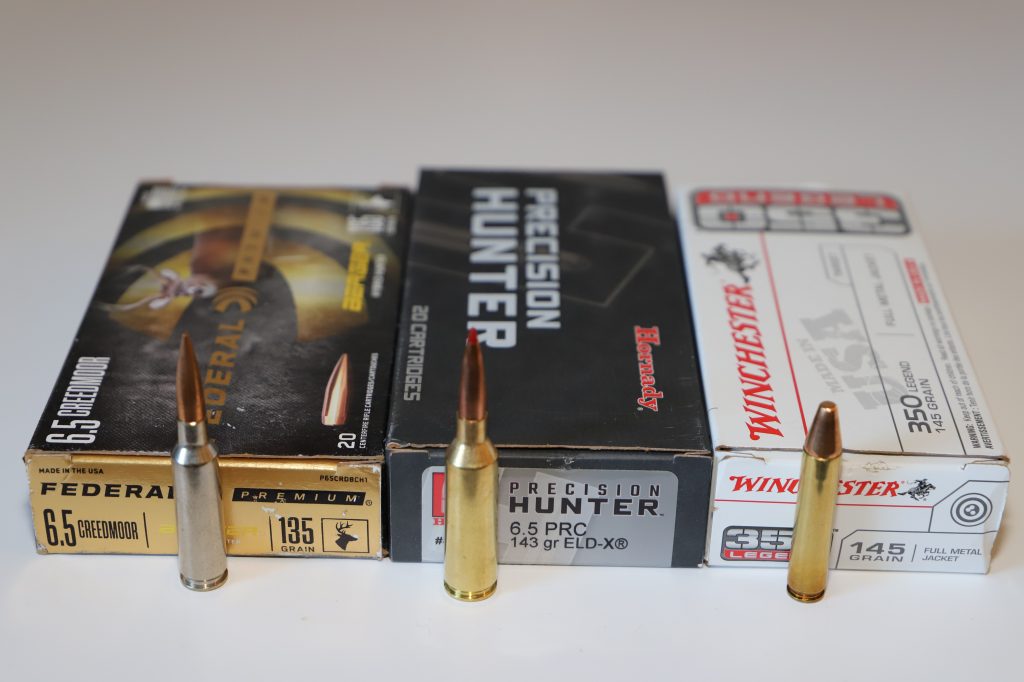
The 6.5mm Creedmoor is easily the most popular of the “new” 6.5mms, a market-grabbing wunderkind that is probably the most popular 6.5mm cartridge ever. I have one, a Mossberg Patriot that shoots very well. However, the 6.5mm Creedmoor, the old 6.5×55, and the .260 Remington are almost triplets in ballistic performance. With its shorter case, the Creedmoor is best suited to the new longer and more aerodynamic long-range bullets. However, in accuracy, range, and power, these three are too similar to argue about. None of them are fast, all pushing 140-grain bullets at about 2,700 fps.

The 6.5mm Creedmoor was developed as a long-range target cartridge, its case short to accommodate long bullets in short actions. The intent was to remain supersonic as far out as possible, yet with mild recoil. Accurate and efficient, it’s a wonderful long-range target cartridge. It’s also a great hunting cartridge, with plenty of energy for deer-size game at moderate ranges. Despite the hype, the Creedmoor is not an extreme-range hunting cartridge. It is also not an ideal elk cartridge, although it is adequate at modest distances. Personally, I think any 140-grain bullet is on the light side for elk-size game. Better be careful! 2,700 fps is not fast, and remember: The formula that derives kinetic energy (foot-pounds) uses the square of velocity.

So, using the same 140-grain bullet, a cartridge that develops just 300 additional fps yields a lot more energy. Specifically, a 140-grain 6.5mm bullet at 2,700 fps yields 2,266 ft-lbs of energy. The same 140-grain bullet at 3,000 fps yields almost 2,800 ft-lbs–and, zeroed at 100 yards, has nearly a foot less drop at 400 yards. These are significant differences. This was brought home by two incidents in the last year, odd in this pandemic year, when I’ve done very little hunting.

In January I shot a whitetail in central Mexico with Armando Klein of Sierra Madre Hunting. I used his rifle, a well-scoped (and dialed-in) Blaser in 6.5mm Creedmoor (a nice camp rifle!). My buck was ranged at 300 yards across a canyon. The first bullet struck a bit low in the chest, and I quickly shot again with a slightly higher hold.

A good mexicana whitetail, taken with a 6.5mm Creedmoor. The Creedmoor is a wonderful cartridge for deer-sized game, but a ranging error of just 25 yards caused the first shot to hit a bit low.

Between preparation and shot the buck moved a bit and was in deep shadow under some oaks. After we reached the deer, we ranged back and discovered the shot was actually 325 yards. This doesn’t sound like much difference (and isn’t). But, because of its low initial velocity, past 300 yards the Creedmoor drops quickly, and distance calls must be ever more precise. For my first shot to have been perfect, I needed to know it was 325 yards, and I should have dialed up a couple more clicks.

In September I had a Montana mountain goat tag. I drew a great area, and a wonderful local outfitter, Ryan Counts, had good horses to get my old knees up the mountains. I never doubted whether I would get a goat, but I drew a tricky shot. We’d been on the billy most of the day, and he was steeply uphill in a cliffy place where, if he hung up, recovery might be suicidal. So, we had to wait until late afternoon, when he came down to feed, to make sure he would roll down to a place we could safely reach.

God bless angle-adjusting rangefinders. The shot was steeply uphill at 468 yards, but actual shooting range was 410 yards. Simple enough: just crank the scope’s dial and shoot. Except: A bright, sinking sun was precisely in my eyes and scope. I’d be on him, then the scope would go black and, in near-panic, I’d have to start over. This is real field shooting, not a known-distance range. You get the shot you get! The goat was scampering along a steep cliff. The range wasn’t changing much, but there was no way to keep him in the field of view, manage the awful light, and dial the range!

I was shooting an AllTerra rifle in the proprietary 6.5mm SST, with a 143-grain ELD-X at 3,025 fps. I knew the bullet drop was 20 inches at 400 yards. I gave a little daylight over the withers, hit the goat hard, and then hit him again. Another real field situation: Ryan and I were lying over a boulder in a sheltered valley, where it was dead calm. Up in the rocks there was nothing to indicate wind. When we climbed up to our goat, we realized that, up there, the wind was howling. No wonder my first shot struck to the left, too far back, but nobody could have called that wind. This was another situation where extra velocity and energy matter!

After applying for 29 years, Boddington drew a 2020 Rocky Mountain goat tag in Montana. He used a 6.5mm SST with 143-grain ELD-X in an AllTerra rifle. The shot was steeply uphill at a bit over 400 yards, not a problem for a fast 6.5mm if you know the trajectory.  

Modern 6.5mm cartridges run the gamut, from Creedmoor and cousins on up to large-cased and super-fast cartridges like the 26 Nosler and 6.5-.300 Weatherby Magnum. I’ve hunted with both and I have a 6.5-.300, an awesome tool that shoots as flat as any cartridge on the books. However, it has recoil and blast, and requires a long action and long barrel, so is heavy.

In between, there are several cartridges that I have come to consider as being in the “sweet spot” for 6.5mm performance: About 3,000 fps with a (more or less) 140-grain bullet. This is not a new level of 6.5mm performance, achieved by both old and new cartridges. Charles Newton’s .256 Newton (.264-inch bullet) came close in 1913, but Newton’s several rifle ventures failed. This is the level of performance of the .264 Winchester Magnum (1958), and also the European 6.5x68mm (1939). Although rare in this country, the 6.5×68 is a great cartridge, preferred by many European hunters for chamois. Although it hasn’t been popular for many years, I still have a soft spot for the old .264. I had one when I was a kid, and still have a good one. The 6.5mm Remington Magnum (1966) comes pretty close, one of the first “short-action magnums.”

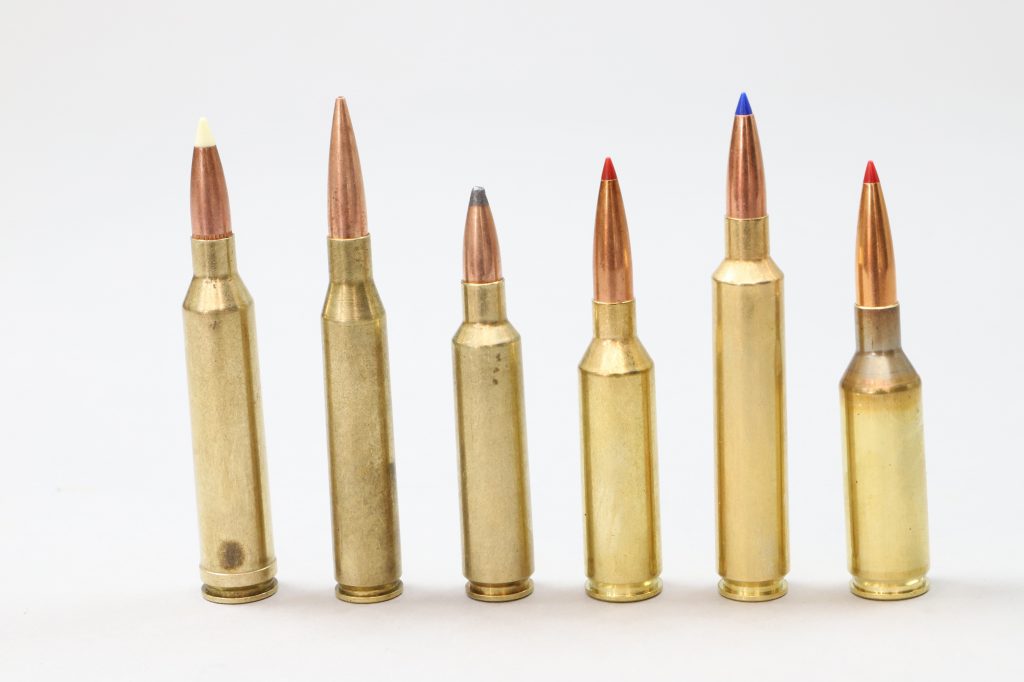
These cartridges all produce velocities of about 3000 fps with 140-grain bullets, performance that Boddington considers “just right” for 6.5mm hunting performance. Left to right: .264 Winchester Magnum (1958); 6.5-06 (wildcat); 6.5-.284 Norma (1997); 6.5mm PRC (2018); 6.5mm Weatherby RPM (2019); 6.5mm SST (proprietary).

Don’t like any of these old-timers? No problem. There are several new, ultra-modern cartridges that do exactly what the .264 (and 6.5×68) did decades ago. The cool little 6.5-.284 Norma, based on the short, fat .284 Winchester case with rebated rim, almost gets there. 3,000 fps with 140-grain bullets is exactly what 2018’s 6.5mm PRC (Precision Rifle Cartridge) does. The brand-new 6.5mm Weatherby RPM (Rebated Precision Magnum) exceeds this velocity.

If factory-available cartridges don’t appeal, you can take a step back in time to the 6.5-06. Based on the .30-06 case necked down to .264, the 6.5-06 was first wildcatted nearly a century ago. Exact velocities always depend on who is doing the loading, and barrel length, but the 6.5-06 is at least as close as dammit to producing 3,000 fps with a 140-grain bullet.

It’s amazing none of the “majors” picked up on the 6.5-06, but with 1920s propellants, it was overbore capacity and, until very recently, 6.5mm bullet selection has been limited. Art Alphin of A-Square standardized the 6.5-06 in 1997, so its proper name is 6.5-06 A-Square. There are no factory loads, so it’s somewhere between proprietary and wildcat—but it remains popular among serious handloaders.

There are other wildcat and proprietary choices. The cartridge I used on my Montana goat is the 6.5mm SST (Sherman Short Tactical), a proprietary of Sherman Wildcat Cartridges. The 6.5mm SST is based on the 7mm RUM case shortened. With the efficiency of its short, fat case, it exceeds 3,000 fps with 140-grain bullets. The AllTerra rifle I used is extremely accurate, and I appreciate that it fits into a short action and struts its stuff from a shorter barrel.

There are now many cartridge choices in 6.5mm (maybe too many). Some are modern in design, others archaic. As a hunting cartridge, I’m convinced the ideal 6.5mm velocity combining flat trajectory and downrange energy with tolerable recoil is around 3,000 fps with (roundabout) 140-grain bullets. I haven’t messed with all the cartridges that do this and probably will not, but, provided good accuracy in a given rifle, all will provide good service on deer and mountain game. All are also adequate for elk, although perhaps not at long range. My old .264 Winchester Magnum is extremely accurate, and I have no problems getting handloaded 140-grain bullets past 3,000 fps–which is why I haven’t abandoned it in favor of a cartridge with a more modern case design.

Nosler has done a good job of maintaining 6.5mm bullets and cartridges, with numerous choices in .264 Winchester Magnum. Boddington’s .264 responds exceptionally well to 130-grain AccuBond.

Leave a Comment

The Intriguing Hartebeest

It may not be the most beautiful of Africa’s plains game, but the hartebeest is fascinating and challenging to hunt.

Photo above: A Cape hartebeest. Photo by Dirk de Bod

Among the millions of words I’ve written about African hunting, this is the first piece I’ve devoted specifically to the hartebeest. This is odd, because I’ve spent a lot of time hunting and observing them, and, on most safaris anywhere in Africa, one or another hartebeest is likely to be encountered.

Long-legged and tall in the shoulder, the hartebeest is not among Africa’s more beautiful antelopes. But its thick horns, usually with sharp turns (rather than smooth curves) are unusual and interesting. So is the animal. With a distinctive “pogo-stick” gait (much like the stott of a mule deer), the hartebeest clan is among the fleetest of antelopes, especially over distance, and they are usually wary and difficult to approach.

This is Boddington’s only western hartebeest, taken in northern Cameroon in 2004. References don’t consistently validate that this is the largest-bodied hartebeest, but look at this one, giant of a hartebeest!

Relying primarily on vision and mobility for security, the hartebeest prefers open plains or mixed thornbush. Always a grazing herd animal, primary requirements are grass and water. They are not found in the forest zone, and although they do fine in semi-arid country, they are not found in the Sahara. Otherwise, one or another hartebeest is found in most hunting areas. Top to bottom and east to west, the various races of hartebeest (genus and species Alcelaphus bucelaphus) are probably the most widespread of Africa’s large antelopes.

The hartebeest appears slab-sided, narrow through the chest, so they are deceptively heavy. Bulls of the plentiful Cape hartebeest race of southern Africa weigh about 350 pounds. The East African races average a bit smaller, while the hartebeest of Central Africa are the largest, with mature bull up to 450 pounds.

As is often the case with species that have multiple similar races, science and our various hunters’ record-keeping systems aren’t always in accord. However, science and the venerable Rowland Ward book are pretty well in sync, identifying eight “genuine” subspecies. The type specimen, the Atlas or bubal hartebeest, was most recently confined to the Mediterranean coast from Tunisia to Morocco. This has been a tough neighborhood for wildlife, and this race became extinct about 1930. Also questionable is the tora hartebeest, found along the Blue Nile where Eritrea, Sudan, and Ethiopia join. At best, numbers are very low, and some authorities believe this hartebeest is also gone.

The six races currently huntable  are: red or Cape hartebeest, common in Namibia, South Africa, and Botswana; Lichtenstein hartebeest, from central Tanzania south through Mozambique and southwest through Zambia; Coke hartebeest (kongoni in Swahili) from northern Tanzania up through central Kenya; Lelwel hartebeest from Uganda westward to northern Cameroon; and western hartebeest on west to Senegal. All of these hartebeests occupy large ranges and, in general, are not scarce. There is also the Swayne hartebeest, still huntable, but with local distribution in Ethiopia’s Rift Valley.

Complicating things, there are also natural hybrids where major subspecies come together. Neumann hartebeest is a natural hybrid between Swayne and Lelwel, hunted in southwestern Ethiopia; and the Kenya highland hartebeest (not hunted since Kenya closed) is a natural Coke-Lelwel cross. Jackson hartebeest is probably also a Coke-Lelwel cross, occurring from northwestern Kenya into Uganda. Locally, hartebeest in eastern Uganda are called Jackson, but record-keeping organizations consider them Lelwel.

Steve Hornady with a very good hartebeest from Uganda’s northernmost Karamoja District. Locally these hartebeest are called Jackson’s hartebeest, but most record-keeping authorities put them in the Lelwel hartebeest category.

Among the races, normal horn conformation and body color are distinctive, but with too much variance to always be definitive. Cape hartebeest are typically dark mahogany, with thick horns that grow up and back, then bend forward, and finally turn sharply back. Lichtenstein hartebeest are lighter in color, with short, thick horns that typically end with near-parallel tips. The Coke hartebeest, which I only hunted in Kenya, is reddish-tawny with lighter legs and hindquarters, and the weirdest horns of all, growing up and outward, and then turning abruptly up or back. The Lelwel hartebeest is similar in color, but larger, with horns more similar to the Cape variety. Western hartebeest are more uniformly tan, though distinctive with a while line between the eyes, with massive horns, U-shaped from the front, and ending with backward-pointing tips.

Both males and females carry similar horns, so judging is tough. On bulls, the penis is quite far back and not always readily visible, and vegetation often obscures this irrefutable evidence. It takes experience; you must look at many to get the hang of it. The primary means to locate a bull is mass of the horn bases, often almost completely grown together. Females can have impressive horns, but never with the mass.

Regardless of race, hunting hartebeest is a matter of painstaking glassing and then a careful approach, keeping out of sight until within range. When hunting from horseback was common, early hunters noted that, when approached, hartebeest would seem to drift slowly away, but their ability to cover ground was deceptive: The horses would be worn out before any distance was closed. Provided there’s enough cover, whether vegetation or terrain, my experience is you can often close for a shot–the first time. If that doesn’t work, unless you’re desperate for camp meat or a bull appears really spectacular, once hartebeest start drifting away, it’s wiser to wave off and keep looking.

I’ve waved off lots of times, but it never hurts to try. We see a lot of hartebeest out on the floodplains of Mozambique’s Coutada 11. Sometimes distribution of African animals makes no sense: This area is below the Zambezi, which is a major natural barrier. So, I’ve always thought the hartebeest there should be the Cape hartebeest of southern Africa, but they are pure Lichtenstein, stockier and lighter in color. They’re plentiful, but horns are rarely huge. One morning Mark Haldane and I saw a giant, heavy with amazing tips, huge for a Lichtenstein. Well, of course we had to have him, but he was in a big group way out on the floodplain, zero cover and windy. We tried a half-dozen approaches; I don’t think we got within 600 yards.

We let them drift off and settle down, and started walking toward them at an oblique angle, carrying two sets of sticks. Amazingly, we closed to 375 yards. With one set of sticks under the butt, the other under the fore-end, I held a bit high and a bit more into the crosswind and dropped him with a Blaser .270.

Because hartebeest tend to be open-country herd animals, identifying and isolating a bull for a shot is often the hard part, and they are nervous, seeming to have a longer “flight” radius” than many antelopes. So, shots tend to be longer. I’ve taken a fair number beyond 300 yards, farther than usual for shooting in Africa, and always because that’s as close as we could get! That said, I’ve never considered hartebeest especially hardy. Any accurate, well-scoped plains game rifle from 6.5mm to .30-caliber should work fine, and I’ve taken several with 7mms and .270s because those are favorite calibers I often carry.

Since they are relatively narrow through the chest, given a choice I prefer bullets that open fairly quickly but, like everything else, it’s more a matter of shot placement than precise caliber or bullet. And, if shot placement is poor, a hartebeest can give you a long day. Years ago, in the Selous, hunting with Cliff Walker, I made a bad shot on a Lichtenstein hartebeest. The trail took us into a dense thicket line and led us on and on. We jumped the animal several times, too thick to shoot, and now we were losing daylight, and we lost the spoor. I cast one way, Cliff another. The bull jumped up just in front of him and he dropped it at about ten feet with his .577 double. That worked, but usually hartebeest don’t require quite that much power.

PH Cliff Walker and Boddington with a very good Lichtenstein hartebeest from the Selous Reserve. Boddington made a poor shot on this bull and, after a long tracking job, Walker shot it with his double .577.

A hartebeest isn’t usually a difficult antelope to find, but density varies widely. Across several safaris to C.A.R. I never had a chance at a Lelwel, although I finally got a “Jackson” in Uganda. Pretty much the same with western hartebeest: Saw few in northern Cameroon and almost none in Burkina Faso, seemingly the least common of the large antelope present, but I did get a good one on my third hunt in Cameroon. Although the books say the Lelwel is the largest-bodied hartebeest, the one western hartebeest I’ve walked up to was a giant, massive in the body, but that’s the only one I’ve seen up close.

In Mozambique, we can go to the floodplain on any day and see plenty of hartebeest. This is also true of many areas in southern Africa, but some places and times are better than others. Years ago, I was with Dirk de Bod in central Namibia and he told me there was a hartebeest migration passing through just behind the Windhoek International Airport, at the time (and maybe still) an unfenced area. We spent a day there, and there were hartebeests everywhere: Big herds, small groups, hundreds! The end result was obvious so we took our time, looked around, and I got my best-ever Cape hartebeest. Getting a good hartebeest generally isn’t a mission, but it’s usually not quite that simple.

Boddington’s best-ever Cape hartebeest was taken during a migration passing close by the Windhoek airport. This bull has it all, but what you look for are the long tips!

Leave a Comment

Something of Value

Having your firearms appraised helps safeguard your family from getting ripped off after you’re gone.

When I reached Duke McCaa of Gulf Breeze Firearms by phone, he was in the middle of appraising a hunter’s gun collection. This isn’t particularly surprising, considering how many appraisals McCaa does a year and how in-demand his services are. As a licensed appraiser who specializes in firearms and knives, McCaa bounces around the country—from Rhode Island to Washington to Illinois and every other state—providing private gun owners with detailed appraisals of their firearms collections. 

In many cases, these appraisals are conducted after the gun owner has passed away, and McCaa often discovers that the owner never kept detailed records of the guns in the collection—records that could have helped put a more precise value on each firearm. Most gun owners can tell you all about every gun in their collection, where they bought it, where they’ve carried it, and what game they’ve shot with it, and they assume that after they pass away, their heirs will be able to sell it for its true value. But that’s not always the case; McCaa says that there are crooks and swindlers who are only too happy to take advantage of grieving relatives, acquiring collections at a fraction of their value while posing as legitimate appraisers. 

“It’s criminal,” McCaa says. “Many of the owners of these gun collections would haggle for an hour over $20 while making a purchase. When they die, these swindlers prey on their widows.” McCaa says he’s seen family members sell $250,000 collections for $100,000 simply because they didn’t appreciate how valuable they were, and because trusted the word of an appraiser who was ultimately out to scam them.   

Think of a good appraiser as an attorney. They know the rules, they know what you deserve, and they’re willing to serve as a voice of dissent when someone is lying to you. Most gun collectors are passionate about their firearms, and a collection belonging to a family member who has passed likely represents a substantial financial investment, but it also represents an important part of the collector’s life. There may be guns in the collection passed down from older family members. There may be guns that are rare and hard to find. Perhaps there’s a special rifle they carried to Africa a dozen times or maybe it’s the shotgun they used to hunt upland game around the world. Regardless of the size or value of the collection, there are those who would gladly pay your family a fraction of the actual value to make a profit. 

And that’s why you must have your firearms appraised—and the best time to do that is while you’re still alive and kicking. Sometimes the back story makes a big difference in the value of the gun. Was it owned by a prince, a celebrity, or a notable hunter? Was the custom work on the gun completed by an in-demand gunsmith? Having this information makes it easier to evaluate the value of a firearms collection, and that’s easier when the original collector is still able to work closely with the appraiser.

How much are these guns worth? Your neighborhood “gun expert” may provide a lowball estimate in hopes of personal gain. That’s why it makes sense to hire a professional.

“If you have a gun collection, you need to have an inventory, insurance paperwork, and a maintenance schedule,” McCaa says. Compared to homeowners insurance, firearm insurance is relatively cheap—you can often cover $100,000 worth of guns for a few hundred bucks a year—and that’s an important first step in protecting your investment. Having a detailed inventory is critical in case of a loss, such as a fire or theft. 

McCaa, who has earned a solid reputation for being fair, provides clients with a “buy value” for each firearm, a number that is based on substantiated references regarding the value of the gun. A buy value represents a fair selling price. McCaa also offers to buy the gun at a portion of that price or consign it. This way, McCaa’s customers know he is willing to pay a high percentage of the buy value for the gun, or consign it for sale. At that point, the gun’s owner has multiple options—they can sell the gun to McCaa at the agreed-upon price, consign it, or sell it themselves. Whatever they decide, they’ll have a solid understanding of the firearm’s current market value. 

Don’t be fooled into believing that your firearm collection is too small to be of value and doesn’t require an appraisal. “I once sold three guns that totaled $150 in a week,” McCaa says. “That same week I sold one gun for $150,000.”

It’s rare that an appraiser has experience with evaluating both high- and low-cost firearms, and that’s one reason McCaa is in great demand. Appraisers who deal almost exclusively in low-cost firearms may not be equipped to properly appraise or sell a high-end firearm. Conversely, those who deal exclusively in high-end guns like Rigbys, Purdeys, and Holland & Holland firearms may not be able to accurately appraise guns that cost a few hundred dollars.  

Which brings up another point—can’t you simply have a friend who knows a great deal about firearms provide a rough appraisal? Not really, and here’s why: provided you trust the person (and you’d be surprised how many people will be tempted to fib on the price of a gun in the hopes of scoring a good bargain), someone who doesn’t understand true market value of a firearm won’t provide you with accurate figures. 

“I saw an appraisal sheet where the owner filled out the value of a gun at $587.25,” McCaa says. “Well, that’s what he paid for it at the store. That doesn’t necessarily represent the true value.”

McCaa says that he fields several calls a week to appraise collections, and that most of those collections contain 100 guns or more, although he’s done collections that contained far more and far fewer guns. He charges daily costs, including mileage, plus $25 a gun (except in rare cases where an extremely detailed appraisal is required). That’s on par with other leading appraisers, and while $2,500 may seem like a lot to spend having a 100-gun collection appraised, consider this: If those 100 guns are worth an average of $1,000 each, and you sell them for 75 percent of their market value, you’re losing $25,000 for no reason. And 75 percent would actually be a very good return without an appraisal. In reality, you would be more likely to get 50 percent, losing $50,000.

Should you have your gun collection appraised? The answer is unequivocally yes. If you pass away without getting an appraisal, the best-case scenario is that friends or family will offer up their best estimates of the value of your firearms. At worst, criminals will take advantage of your family at a vulnerable time, and the gun collection you worked so hard to piece together will end up helping to line the pockets of someone who has taken advantage of your loved ones. 

For more information on appraisals with Duke McCaa, visit www.gulfbreezefirearms.com  

Leave a Comment

Bear Trouble

Take careful precautions to avoid run-ins with grizzlies if you’re hunting in their stomping grounds. 

Photo above by Vic Schendel

Hunters are most likely to experience bear problems in three broad-category situations: while looking for game, while camping, and while handling, dressing, retrieving, or transporting downed animals. The primary rule when hunting in grizzly or polar bear country is to always be alert for bears, and/or to “stay bear aware.” That these maxims are practically clichés by now is unfortunate, because clichés tend to go right through people’s ears, or at most receive a gratuitous nod. “Stay bear aware, right, got it. Will do.” The advice is good, but a bit too pat and vague to be very helpful.

A biologist friend likes to be a little more specific. He tells Montana hunters, “Think grizzly, and think defensively. Assume that grizzlies are in the area, and that an encounter is very possible. Anticipate scenarios and how you will handle them. Have your self-defense deterrents within reach, and know how to use them in a hurry. Practice with gun and bear spray before you go hunting. Know the guidelines for handling different types of encounters.” 

That’s an excellent start, but to really lower the odds of bear trouble in the key situations, we need to delve into more concrete details. 

In grizzly country, for instance, “being alert for bears” means not only scanning for actual animals near and far, but also looking closely for evidence that bruins are in the vicinity. Bears tend to leave plenty of sign. Claw marks raked into tree bark; tufts of hair stuck in the bark of “rubbing trees” and fence wire; berry bushes bent, broken, and imperfectly stripped of fruit; logs torn apart (by grub-seeking bruins); digs where a bear has unearthed roots or ground squirrels; large, oval bedding depressions in grass or other vegetation; half-buried carcass caches; and of course scat and tracks. Several scat piles in one fairly small area can signal that you are near a bear’s bedding site. 

Fresh tracks are important sign, of course, and it’s worth knowing how to distinguish a grizzly print from a black bear’s. Griz tracks are not necessarily larger, but the claws are usually longer than the toe marks, and the toe marks are jammed tightly together on a fairly straight line. Black bear toe marks are spaced apart and form a noticeable arc from large toe to small, with claw marks seldom longer than the toes. Remember, the idea here is to avoid bear trouble before it happens, so if you are encountering fresh grizzly sign or an abundance of sign, the smart move might be to change course or leave the area entirely and find another place to hunt. 

Be especially alert and ready to defend yourself when hunting in the following high-risk conditions: In thick, heavy cover (where a large percentage of sudden grizzly charges occur); along noisy waterways, especially in tall cover; and on high-wind days. If you are hunting along and suddenly pick up the whiff or stench of a dead animal, don’t investigate. Back up and move well away to avoid the possibility of running into a carcass-defending griz, which could very well react with a defensive charge. 

If you see a bear that hasn’t yet seen you, move out of sight quietly and leave the vicinity. If you see or meet a bear that sees you or approaches, stay calm, don’t call out or yell, don’t run or try to climb a tree, but do stand your ground and prepare your deterrent and/or weapon. If the bear doesn’t approach, slowly move back and away. Stop if the bear comes forward and stand your ground with weapons ready.

For hunters in grizzly country, one of the most potentially dangerous situations occurs after a game animal is down. This should be considered a prime-risk, red-alert time, and treated as such. (The risk is even higher if you are alone.) Have your bear spray at hand and your rifle or sidearm loaded, with a round chambered, and within easy reach. If possible, move the carcass away from thick brush and into the comparative open. If you are alone, stop, stand, and survey the surroundings every few minutes. Stay attuned to natural sounds around you, such as rustling brush, the crackle or crunch of leaves or twigs, alarm-chattering squirrels or scolding birds–any of which might signal an approaching predator. With partners, one person stands armed (with both spray and gun) and ready while the other does the field-dressing. If both people are needed to move or lift the carcass, at least one should keep surveying the surroundings during the effort, loaded weapon(s) within reach. When the gut pile is removed, it should be immediately placed on a piece of tarp or thick plastic drop-cloth and skidded as far as feasible (100 yards if possible) from the carcass. Bears will almost always go for a gut pile first. If you must leave the carcass, or part of it, for later retrieval, mark it with a stick and bright flagging tape. On the return trip, glass the flagged stick from a safe distance. If it has been disturbed, you know a bear might have found the meat. (Even better, attach a motion-detecting alarm device like a Critter Gitter to the carcass. The high-pitched alarm and flashing lights will ward off bears and other scavengers.) Whenever possible, pack rather than drag out game meat. Dragging leaves a scent trail bears can follow. Make plenty of noise while hauling out meat, to help alert and hopefully drive off any bears in the area.  

Another prime time and location for bear trouble is while camping, and in a camp, “bear trouble” can mean more than personal safety. Anyone who has returned from a morning’s hunt to find tents, sleeping bags, packs, camp stove, lanterns, and miscellaneous other (expensive) gear torn, clawed, bitten, crushed, or carried off knows a thing or two about bear problems. I’ve also seen boats, rafts, and even a float plane wrecked or damaged by marauding bruins. (We’re talking about all three kinds of bears here: black, brown, and polar.) Camp-raiding night bears are another, more startling and serious, kind of problem, and the rare camp-invading predatory bear should be considered a possibility. 

Start by positioning your camp wisely. Of course you want to be a good distance from any known bear trails or travel routes. Bears also use human trails, game trails, river and stream banks, and lake shores as travel and foraging lanes, so it’s best not to set up camp too closely to such thoroughfares. Whenever possible, choose a clearing for your tent site and avoid camping close to thick cover. 

Everyone has heard the basic rule: “Keep a clean camp in bear country,” but not everyone realizes what a clean camp really means these days. First comes a sub-rule: Don’t sleep where you cook and eat. Ideally, the cook site should be about 100 yards from the sleeping tent, but this isn’t always realistic. Sometimes 100 feet or less is the best you can do, and that can suffice if the cleanup is scrupulous. Locate your cook site so that you can see an approaching bear while cooking or eating. (Try not to cook or eat near thick cover, or where your view of the surroundings is blocked.) Note the wind direction and remember that a bear is more likely to approach from downwind. Never leave food unattended (even if it’s sizzling in a pan). Despite being large, even cumbersome animals, bears have a way of suddenly appearing out of nowhere, especially when there are edibles to be had. Don’t try to burn or bury leftover food or garbage. What’s left behind in the fire ring or covered underground is enough to attract a bear. Ursid noses are unbelievably acute. They can smell sardines inside an unopened tin; they can pick up meat, fish, or bacon odors from as far as ten miles away, given the right atmospheric conditions. Bears have been known to break into a car and tear out the backseat to get at a food-laden ice chest locked in the trunk.

They also have a peculiar sense of what constitutes “food.” One hunter’s backpack was carried off and torn apart by a black bear because the pack contained a tube of toothpaste, which the bear ate down to the cap. Scented soaps, toiletries, and sunscreens can also attract bears. Inside a tent, crumbs from a candy bar or sandwich, a pack of chewing gum or mints, can be and have been enough to draw in a scent-following bruin. All such items, including canned goods, garbage, game scent, and clothing permeated with blood or food aromas, must be separated from the camp and either hung out of reach in bags or locked up in bear-proof storage containers. For secure tree-hanging, the bagged items should be suspended at least fifteen feet from the ground, and at least eight feet away from tree trunks. Locked bear canisters can be kept on the ground. But remember, although they are “bearproof,” they are not scent-proof. In other words, to a bear they still smell like food. So a bear can should never be kept inside or near a tent. Place it on level ground at least 100 feet away. A covering of clean pots and pans can serve as a bear alarm.

One way to make safe camping much easier, especially for hunters who have game meat or hides to protect, is to use portable electric fencing. Initially, the purist woodsman in me balked at the idea of such contraptions in the wild, but I’ve come to see the sense and value of an electric fence in certain situations. Some modern units weigh less than ten pounds, take about twenty minutes to set up, and have a very good track record at keeping out bears, including large grizzlies, even when game meat or a carcass is lying within the perimeter. (I do know of three cases where polar bears have broken through electric wire and attacked humans. True security while sleeping out in polar bear country usually involves rotational night-watches with armed guards, even when fences are used.) For an excellent review of how electric fencing works and the best ways to use it, check out biologist Tom Smith’s article, “Protecting Your Camp from Bears: Electric Fencing,” available on the Alaska Department of Fish and Game website: adfg.alaska.gov. 

Leave a Comment

tablet

Never Miss An Issue!Subscribe Now: 6 Issues for $34.97

More Details
WordPress Video Lightbox Plugin