Sports A Field

New Product Spotlight

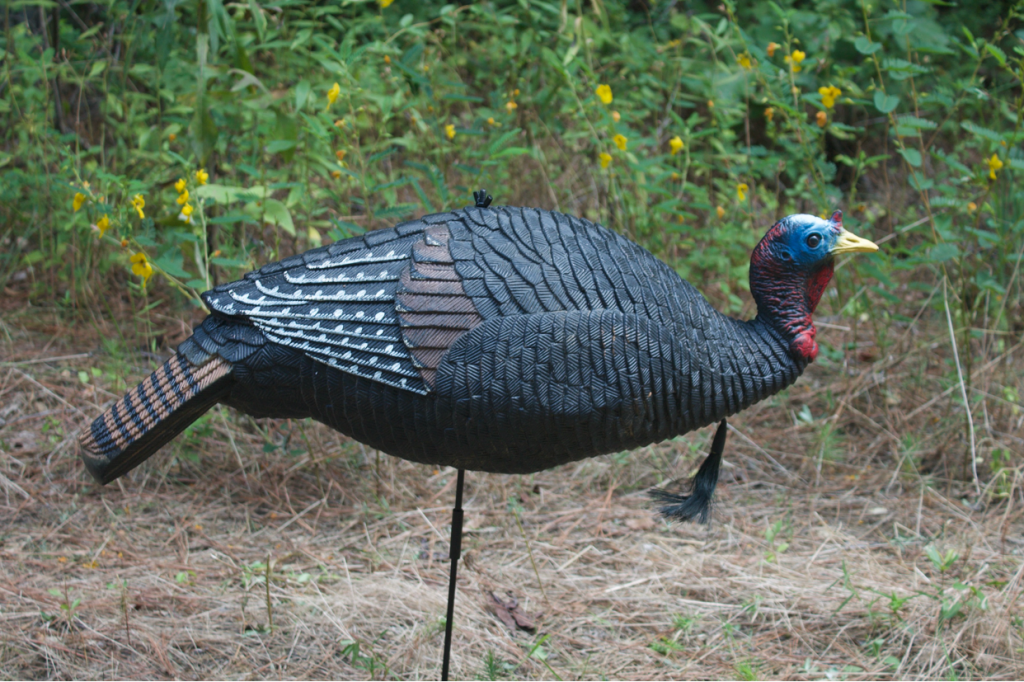
Sports Afield Jake & Hen Turkey Decoy Combo

Just in time for spring turkey hunts across the country, Sports Afield Products has introduced its new Jake & Hen Combo set of turkey decoys. This set of two decoys, one jake and one hen, are made of a foldable, rubberlike material that is easy to transport yet snaps back into shape easily. Both come with two-piece metal stakes for easy setup. The hen comes with two stake holes to allow it to be set up in two different body positions, upright or relaxed. Both decoys feature realistic paint and natural, taxidermy-quality eyes. These realistic and attractive decoys will help you punch your turkey tag this season. Available at select Costco Wholesale locations.

Leave a Comment

Five Great Winter Hunts

Beat the cold-weather blues with these off-season adventures.

Here in North America, the winter doldrums are here. I’m writing this on the eve of the New Year, with major interstates blocked by blizzards on both coasts. There are still some late deer and elk seasons ongoing, and January can be a great month for waterfowl and upland birds. But for most of us, our favorite hunting seasons are past. However, scattered here and there, it’s prime time for some great hunts. As we look ahead into a brand-new decade, here are some mid-winter getaway hunts worth planning!

Deer in Mexico

The snowbirds are heading south to Mexico’s famous beaches, but this is a perfect time to enjoy a great hunt in the desert mountains of northern Mexico, where the scenery is fantastic and the winter weather is (usually) sunny, cool, and pleasant. I’m generally thinking Coues whitetail, a beautiful little deer that offers a postgraduate course in serious glassing. For both quantity and quality, western Chihuahua and northern Sonora are, in my experience, the best places to hunt Coues deer. Prices have gone up (what hasn’t!), but Coues deer are widespread and available, and numerous competitive (and competent) outfitters keep the prices reasonable.

That said, hunting Coues whitetail isn’t the only great hunt in northern Mexico. Mid-winter is the perfect time for desert mule deer, also a great experience. With better management, desert sheep have increased dramatically in recent years, and although costs remain high, there are more sheep and more opportunity right now than ever before.

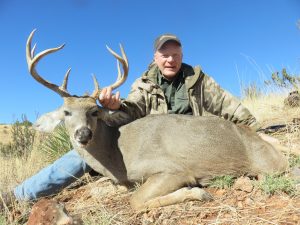
A fine Coues whitetail, taken on a January hunt in northern Mexico. This is a wonderful time to be in the arid mountains.
And there’s more. Mexico holds several lesser-known races of both mule deer and whitetail, and new opportunities are opening up. January 2020, as you read these lines, I’ll be hunting Mexico’s Central Plateau whitetail out of Zacatecas, northwest of Mexico City, with Armando Klein’s Sierra Madre Hunting. This is a medium-sized whitetail subspecies only recently available to outsiders, so something different…but I’m sure it will be another excellent northern Mexico experience.

Mountain Lions

Winter is the best time to hunt many of our predators, from foxes, coyotes, and bobcats on up to cougars and wolves. They’re hungry and hunting hard, thus are more visible during the coldest months. Late December through early February is an especially good time to hunt cougars because snow conditions are most likely to be favorable.

Donna Boddington and houndswoman Katy Kern with a fine Idaho tom, taken on Donna’s fourth attempt to find a good male cougar. It was late December, and we finally caught perfect snow conditions.
Without question there are many very good and successful dry-ground packs of hounds, but it is easier to find and hold tracks in soft snow. So, too early and you can have bare ground when snow is anticipated. Too late and snow that is either too deep or heavily crusted can make conditions too difficult. “Perfect” is thus a fairly narrow window. Hitting it right takes a bit of luck, but it’s a hunt that’s best to plan for the very best time, which is now.

The legend is that, with good hounds, a cougar hunt is a slam-dunk. Maybe, with a lot of luck, but it doesn’t always go that way. Forty years ago, I got a big tom in Arizona, dry-ground hunting with the famous Glenn family. That worked but, much more recently, Donna wanted a mountain lion. We did three hunts in good places with good people, and there was not enough snow…or too much snow! She passed on females, but never had a chance at a male. A couple years ago we went to northern Idaho with Bruce Duncan’s Selkirk Outfitters and finally hit the jackpot. Donna passed a big female on the first day and took a big tom on the third day. On the fourth day, while looking for bobcat tracks with snow falling fast, we hit another big cougar track. I went to town and got a license, and we got the cat just before sundown.

If you want a big mountain lion, right now is the best time of year to try for one!

Lone Star Aoudad

Between native game and a host of introduced species, Texas offers good hunting opportunities in every month of the year. A lot of whitetail hunting remains open after the first of the year, and January still catches some rutting activity. Of course, all the non-natives are available, although many of the deer species may have dropped their antlers. But if I had to pick a perfect New Year hunt in Texas, I’d pick aoudad.

Hunter Ross and Boddington with a very large free-range aoudad, taken in the Davis Mountains of Far West Texas.
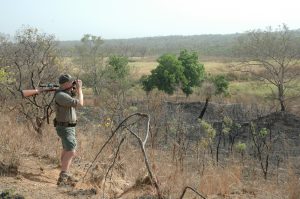
With its flowing mane and matching chaps, the Barbary sheep is a gorgeous animal and offers a fantastic hunting experience. Big-bodied, tough, and extremely wary, the aoudad is never easy to hunt. However, in the desert mountains of Far West Texas the aoudad offers a real sheep hunt! Ranges like the Chinati, Davis, and Glass Mountains are straight out of a John Ford western, and the hunt is a lot like hunting desert sheep. Except you’ll see a lot more animals and it won’t break your bank account.

Over the last decade I’ve done several aoudad hunts in Far West Texas with Hunter Ross of Desert Safaris. I like to go this time of year, in part because the weather is great and because it doesn’t interfere with fall hunting seasons. However, Ross tells me that late fall is also very good and may be even better because that’s when he tends to see large bachelor groups. You can’t prove it by me because I’ve always hunted them in late winter and have seen lots of aoudad! Take your pick, but the desert mountains are harsh, so it’s important to hunt in cooler months. Just make sure you put an aoudad hunt on your bucket list! I seriously doubt I’ll hunt another desert sheep, but I will do more aoudad hunting

Central Africa

In the Southern Hemisphere it’s the height of summer, and in many southern climes it’s also the rainy season. Remember: The Equator passes through Africa from Kenya to Gabon. So, two-thirds of Africa’s vast land mass lies north of Equator, thus in the Northern Hemisphere…with the same seasons we have.

The sub-Saharan areas of Benin, Burkina Faso; and northern CAR and Cameroon are called “savanna,” but it’s really savanna woodland or terminalia forest. This is all very wild country that’s marvelous to hunt.
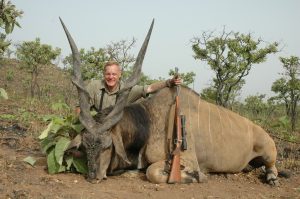
Realistically, you have be quite a bit north before you see the temperate effect. And in most areas rainy seasons should be avoided. However, you can take advantage of the short (and very mild) winter in several great hunting areas. Without question, right now is the best time to hunt in northern Cameroon and the northern savannas of Central African Republic; and this is also an ideal time in both Benin and Burkina Faso. These areas are all about 10 degrees north of the Equator, with a short, pleasant winter!

It’s still Equatorial Africa. It gets hot during the day, but from late December through February mornings and evenings are perfect and nights are cool…much cooler than in March and April, when the heat is brutal!

In northern CAR and Cameroon the Derby eland is the premier species, and among Africa’s great prizes. The distinctive black collar is winter coat, available from late December into early March; late in the season the colors fade to a uniform tawny.
This is also the time when the Derby eland bulls are in their glorious winter coats, with that luxurious black collar. Some bulls will keep the colors deep into March, but by April they’ve gone tawny. For me the Derby eland is the premier species in northern CAR and Cameroon, and Africa’s greatest antelope prize. It is a premium animal, but these two areas plus Benin and Burkina Faso are all excellent mixed-bag destinations, with good numbers of buffalo and a wide assortment of desirable antelopes, including the big western roan, kob, hartebeest, harnessed bushbuck, reedbuck, and more. Absent Derby eland, costs are reasonable, and this region is truly wild Africa, where lions roam. Just, trust me on this, go early in the year if you can…by March it’s hot, and April is an oven!

England’s “Other Deer”

The British Isles offer fantastic hunting for a wide variety of deer: Scotland is famous for red stag and roebuck. Ireland is “the place” for free-range sika deer, and England offers a long and luxurious roebuck season, plus has scattered populations of red deer and lots of fallow deer.

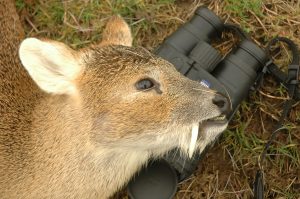
Most of this hunting is in summer and autumn, but there are a couple of interesting animals that are best-hunted in the dead of winter. The little Asian muntjac, with small antlers and fangs, was introduced in the 19th Century and is well-established and widely dispersed in central England and Wales. In fact, the muntjac is now believed to be the most numerous wild deer in England! The Chinese water deer, absent antlers but with very large fangs, is neither numerous nor widespread, but is established free range in several counties in central England.

Muntjacs are often encountered while stalking roe deer and can usually be taken if desired. The challenge, however, is that they’re tiny and it doesn’t take much cover to hide them completely. Like many tropical deer, some muntjac bucks are in hard antler throughout the year. Mid-winter is considered an ideal time to hunt them because the cover is down, so they’re much more visible—and it’s a lot easier to judge them. Chinese water deer keep their fangs year-around, but January is a prime mating month, so this is also an ideal time to hunt them.

A Chinese water deer with impressive fangs!

I will not suggest that England’s weather is perfect at this time of year. When I did it, we caught a lot of rain, but it was still a marvelous hunt! We stayed in small country inns—really pubs—and stalked when the weather allowed. We hunted muntjac down in Wales, and then hunted Chinese water deer free-range near the famous Woburn Abbey, the Duke of Bedford’s estate, where most of the United Kingdom’s non-native species were first introduced.

Although a bit soggy, it was all good, but one of the coolest things I’ve ever seen in was watching Chinese water deer bucks sparring for mating rights. It was like a ballet; absent antlers, the bucks jump over each other and strike downward with their fangs…many of the bucks carrying tattered ears as a result! My Chinese water deer was like a hundred-pound tusker, but my muntjac wasn’t big. This is a hunt I want to do again…including great English “pub grub.”


Leave a Comment

Ballot-Box Biology

California’s Proposition 117, a ban on mountain lion hunting, passed in 1990 and inspired similar anti-hunting ballot initiatives in other states. Photo by GaryKramer.net

Wildlife management decisions must be based on the best available science–not on the whims of public opinion.

I was browsing the craft booths at a summer festival in my Colorado town when a young woman bounded after me with a clipboard.

“You look like a nature lover! Don’t you love wolves?” she asked.

At first I looked at her blankly, and then I saw the sign on her booth: The Rocky Mountain Wolf Project. She wanted me to sign a petition that would place a measure on the statewide ballot in 2020 forcing Colorado Parks & Wildlife (CPW) to reintroduce gray wolves to the state. I declined–politely but firmly–and moved on.

But the encounter stuck with me. Not so much because of the particular issue, but because it was the perfect example of a decision that should be made by wildlife managers after extensive study–not decided by voters, most of whom are well-meaning but have little knowledge about the issues involved or the ultimate effects of their vote.

In this particular instance, the issue of wolf reintroduction was studied in detail several years ago by CPW, which determined it was not a good idea for a number of compelling reasons–including, believe it or not, the potentially devastating effects gray wolves could have on a fragile population of reintroduced Mexican wolves to the south. (The wolf-loving petition-promoter returned my blank stare when I mentioned this to her.) The ballot measure aims to force CPW to go ahead with wolf reintroduction anyway, overruling the scientific consensus.

Ballot initiatives that meddle with scientific wildlife management are nothing new, of course. They have been tried–with varying success–in many states. The trend really started in 1990 with California’s Proposition 117, when voters put in place a ban on mountain lion hunting that still stands. Emboldened by that success, anti-hunting groups led the charge on many other public initiatives in various states, most of them focused on restricting predator hunting and trapping. Maine has twice voted down a proposition to ban baiting and hound hunting for bears, first in 2004 and again in 2014.

Wildlife and habitat management decisions are not supposed to be made this way. They should be made by professionals using sound, supportable, peer-reviewed, published science. This is one of the seven core tenets of the North American Model of Wildlife Conservation, and in this age of diverging opinions and social change, it is one of the most crucial. Each state has its own agency, staffed with professional biologists, charged with managing its wildlife. While these agencies are far from perfect, they have, historically, done a good job studying, understanding, and balancing wildlife issues in an increasingly complex world.

The other side of the coin is that hunters, too, have an obligation to abide by the science, even when we don’t like what it tells us. For example, if studies show certain harvest regulations are having a detrimental effect on a species, hunters should be supporting appropriate changes to those regulations.

Hunters and non-hunters alike need to agree that wildlife management decisions must always be based on the best available science. Spread the word that ballots are not the right venue for making these determinations. At the same time, support the efforts of state wildlife agencies and their biologists, and examine the research behind their decisions, keeping in mind what is best for the resource. In the end, both hunting and wildlife will be on the losing end if we allow the scientific process to be bypassed by public opinion and ballot-box biology.

Leave a Comment

The Changing World of Caribou Hunting

Many famous caribou-hunting regions are now closed, but in other areas there are still good opportunities for success.

On the final morning of a caribou hunt in Quebec many years ago we awoke to a blustery, threatening dawn. I was still in my sleeping bag when one of the guys ran into the cabin saying, “Hey, you gotta see this!” Several of us stumbled out to the porch and gazed across the lake at a scene straight from a John Ford western. However, instead of angry Apaches lining the horizon, the ridge on the far side of the lake was rimmed with caribou, on the move and headed our way!

The week had been fairly slow, at least as Quebec caribou hunting was in those days, but there were singles and small groups moving around, and we’d hauled some good bulls into camp. By evening of the next-to-last day most everybody was “tagged out” with two bulls. Except gunmaker Lex Webernick (of Rifles, Inc.) had managed to hold out and hadn’t fired a shot…and I had one tag left. You could say that our camp-mates had been too hasty but, after all, there was no guarantee a mass of caribou would show up! However, it worked, and Lex and I were in the driver’s seat. We grabbed our gear, jumped in a canoe, dashed across the lake, and had our pick of exceptional bulls.

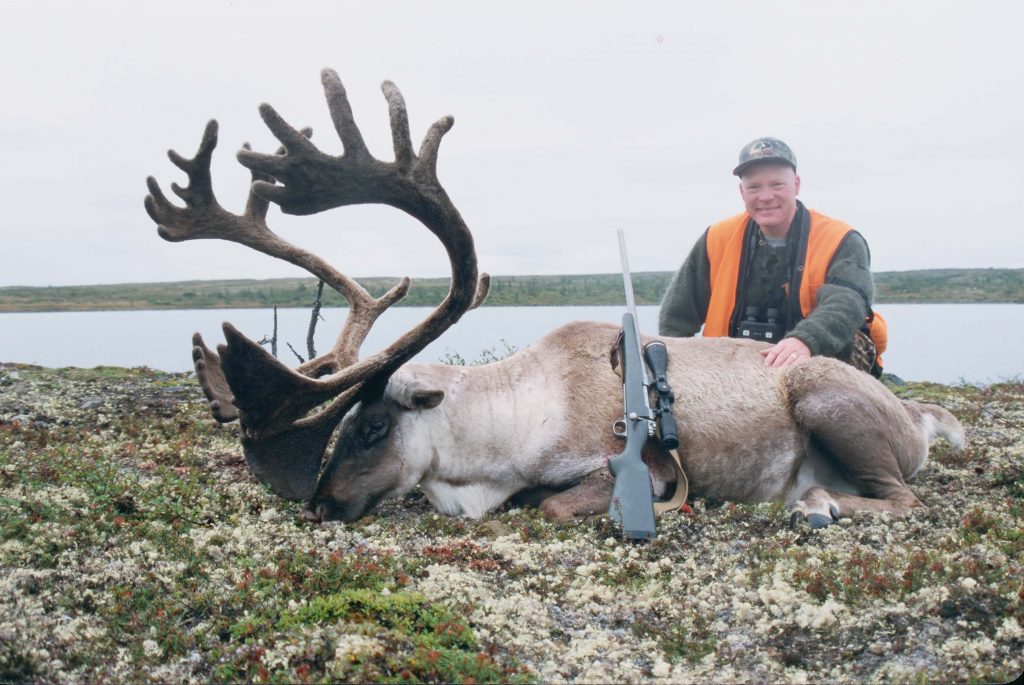
A very fine Quebec-Labrador caribou taken in 2001, toward the tail end of the golden era for caribou hunting.

It’s easy to recall exactly when that memorable hunt occurred, because we got home just a few days before the dire events of 9/11/2001. That, of course, changed our world forever, but since then, the caribou world has also changed. Twenty years ago—and even ten—caribou hunting was affordable and available across much of North America. Woodland caribou—or moose and caribou combo hunts—were readily available in Newfoundland. Quebec was wide open, with options between the George River and Leaf River herds, both hundreds of thousands strong. In Northwest Territories the Courageous Lake herd of Central Canada barren ground caribou was wide open, with good numbers of mountain caribou in the far west McKenzie District. Yukon had mountain caribou in the south and barren ground caribou in the north. The mountain caribou of northern British Columbia were in decline, but strong enough—in enough areas—that numerous great bulls were taken in the 1990s and early 2000s. Alaska’s wildlife managers figure there are thirty-two separate caribou herds in that vast state, so at any given time some will be up and some down, but back then many herds were up.

It’s a far different picture in 2019. Newfoundland’s woodland caribou declined drastically, with much discussion of a complete closure. Fortunately, cooler heads prevailed; instead of a precipitous shutdown the number of permits was seriously reduced. Although it isn’t at all clear that overhunting was a factor, the downhill slide seems to have stopped. Calf survival is up, and some great bulls are being taken. However, outfitters in caribou country now get a very small permit allocation, and, of course, are charging accordingly.

Continent-wide, the worst news comes from northern Quebec. First the George River herd collapsed, with hunting closed in 2013. Then the Leaf River herd went into a steep decline, with the last nonresident permits issued in 2018. At the time of the closure the Leaf River herd was still estimated at 150,000, plenty enough caribou to support the relatively small (but financially important) nonresident harvest. The fact that almost nothing has been done to reduce subsistence harvest says all that needs to be said about the politics of the issue. At this writing it is not clear if the Leaf River herd will stabilize or continue to crash, but nonresident caribou hunting, long an important industry in northern Quebec, is now closed. This means that dozens of camps are moldering on the tundra, along with the infrastructure that supported them. If there should be a reopening it won’t be as simple as turning on a switch.

Central Northwest Territories is similarly closed, with northern Manitoba now the only option to hunt Central Canada barren ground caribou. To the east, Nunavut is open for Central Canada barren ground caribou on the mainland; and the small Arctic Island caribou to the north, primarily on Victoria Island. In the west, the McKenzie Mountains still hold good numbers of mountain caribou, as do some of the guide territories in southern Yukon. That’s good news, because opportunities for mountain caribou are very slim in British Columbia. I was a youngster when I shot my one and only mountain caribou in northern B.C. back in 1973. I’ve long wanted a bigger bull but, in recent years, I’ve tried twice in northern B.C. Both times I saw caribou, but nothing legal or shootable. Yukon and the McKenzies have appeal, but having priced those caribou hunts, my ardor has cooled somewhat.

Northern Yukon also has good barren ground caribou, with Alaska’s Porcupine herd, estimated at 170,000, shared between northeast Alaska and northwest Yukon. All of Alaska’s caribou are considered barren ground caribou, estimated at 950,000. Her numerous regional herds vary from remnants of a few dozen to the huge Western Arctic herd at 325,000. Collectively, Alaska holds lots of caribou and plenty of opportunity.

Aside from those two blank attempts for a mountain caribou in B.C. and a frosty hunt for an Arctic Island caribou in 2012, I did almost all of my caribou hunting before 2000, in a time when caribou hunting was affordable, available, and routinely successful. I didn’t always punch both tags, but In N.W.T. and Quebec, two caribou were generally on license. Much Quebec hunting was what I’d call “semi-guided,” meaning we’d go into an established camp with logistical support and hunt on our own, a wonderful way to hunt caribou, especially when there are lots of them moving through.

There was one exception to that “routinely successful” business. Between 1975 and 2000 I hunted Alaska numerous times, both guided and DIY. I’m not sure how many caribou tags I purchased, and for sure I wasn’t always hunting caribou exclusively (or specifically)—but I never had a chance at a decent caribou in Alaska. I can’t really call it a bucket list thing, since I took a nice barren ground caribou in north-central Yukon back in 1999, but I’d long felt it was a gap in my experience.

So it was that in September 2019, I hied myself (as my old friend Colonel Charlie Askins might have said) to the Alaskan Peninsula for a caribou hunt. Now, if I were you, and hankering for an Alaskan caribou, I’d consider the North Slope of the Brooks Range, where four large herds come together and more than half of Alaska’s caribou reside. Fortunately for you, you aren’t me, and there was both method and circular thinking in my madness. On hunts for both moose and bear, the southern Alaskan Peninsula out of Cold Bay was one of the places where, back in the 1980s I’d carried (and eaten) caribou tags. So, there was some unfinished business involved. Occupying a small area with limited habitat, the Southern Peninsula caribou herd isn’t large, today estimated at just a thousand. However, these are big-bodied caribou and antler quality is excellent.

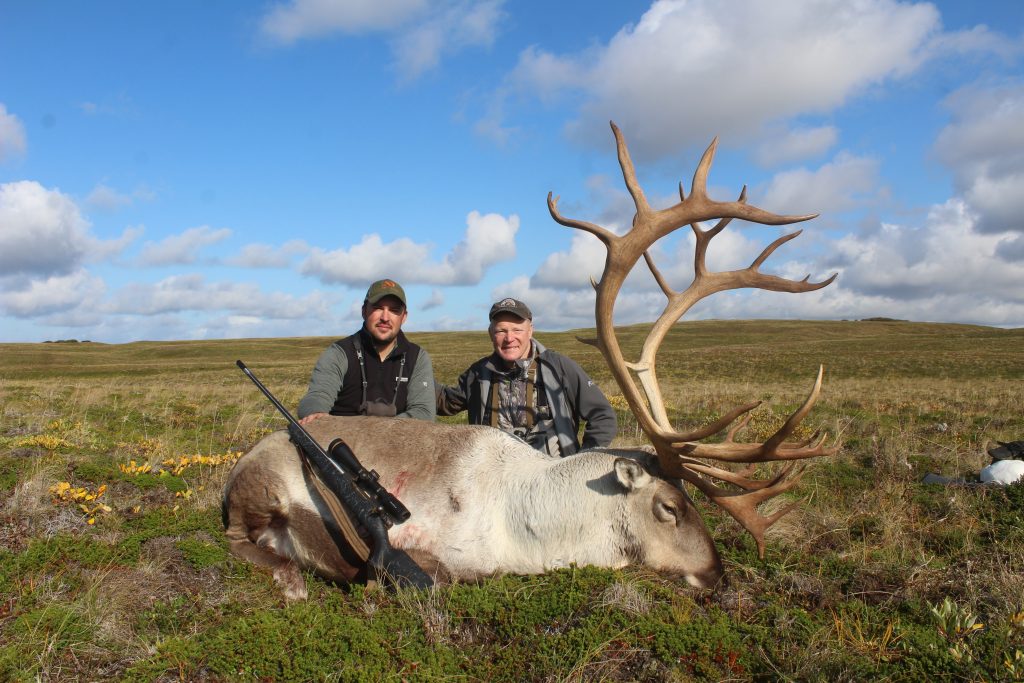
Guide Jordan Wallace and Boddington with a very nice caribou from the Alaskan Peninsula. Amazingly, this was one of the smaller bulls taken in the author’s camp.

Back in the day I saw a lot of caribou, just nothing I wanted. Then the herd declined, and for some years there was no hunting, reopened just two years ago. My buddy Dave Leonard of Mountain Monarchs of Alaska was able to add a couple of weeks of caribou hunting before his alternate-year bear season.

Hunting from his David River base camp and fly-in spike camps I had a wonderful caribou hunt, and took a very nice bull. That said, it was a lot different from so many caribou hunts in years gone by. The area does allow two bulls, but it’s not a big herd and Leonard discourages a second tag. At the current cost of nonresident Alaskan tags, that’s perfectly fine with me. Come to think of it, my friend Mr. Leonard’s fee was more than I ever thought I’d pay for a caribou hunt, but that’s the way of caribou hunting today. Alaska remains the only option where DIY caribou hunting remains possible, but, realistically, by the time you do the flying and all the freight I’m not convinced there’s much savings. Bottom line: Caribou hunting is pricier than ever before!

According to my experience this was not an easy hunt. It wasn’t like northern Quebec or N.W.T.’s barrens in years gone by. There was no sitting at a known crossing and waiting for a nice bull to amble by. It was more like hunting pronghorn on foot in big country, except with miles of spongy tundra tussocks to traverse. We glassed caribou from a couple miles; sometimes we caught up, and sometimes not. Leonard’s two groups for the last two weeks of the season were not 100 percent. Obviously, that has been my experience with caribou in Alaska, and recently for mountain caribou, but failure was unusual in the halcyon days of caribou hunting! That said, success depended on tough hiking, fairly long shooting, reasonable expectations, and luck. I saw plenty of caribou and shot a reasonable bull on my next-to-last day. I was happy; I got my Alaskan caribou. Four of my camp-mates were even happier: I saw four bulls carrying over 400 inches of antler brought into camp. The big ones were there!


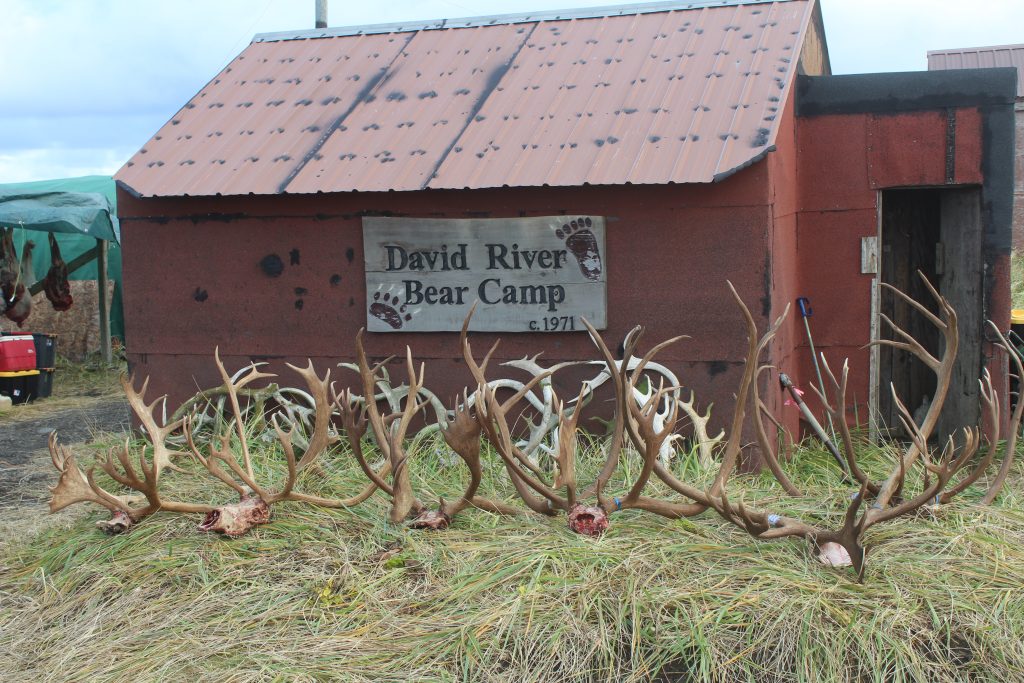
Mountain Monarchs’ David River Camp, near Nelson Lagoon on the Bering Sea side of the Peninsula, is famous for big brown bears. The caribou herd here is small, but after several years of closure the area is again producing very big caribou.


Leave a Comment

Building a Better Shooter

Gain confidence and extend your ethical field-shooting range at an Outdoor Solutions Long-Range School.

The sun was beating down out of a clear sky, but a cool breeze against my left cheek kept the heat down. It had been a wet spring, and tall bunches of bright green, tasseled grass dotted the steep mountainside. My eye was pressed against the lens of the spotting scope, staring intently at one particular tuft of grass. It was stirring and bending slightly to the left, which didn’t compute with the breeze I was feeling on my face. I twisted the dial to widen my field of view and studied the ravine running at an angle right to left just in front of the square steel target.

“Shooter ready,” said Hillary Dyer. She was locked in a comfortable seated position, her rifle resting on sticks, and had already dialed her scope for the range I had given her: 560 yards.

“Spotter ready,” I said, and paused briefly, considering. “Hold half a minute right. Send it!”

I saw the bullet strike the steel target before the satisfying clang came back to us. “Impact! Nice shot!”

“Nice wind call,” Hillary responded.

We had been working together for two days, alternating shooting and calling each other’s wind first on the range and now in the field, and we had become a good team. As students at the Outdoor Solutions Long Range School near Coalville, Utah, our shared goal was to sharpen our shooting skills under the watchful eyes of expert instructors. Head instructor Erik Lund had been standing close by, watching our approach to the 560-yard target. Now he spoke up.

“Excellent work,” he said. “The wind on this one is tricky, with that ravine in front of the target funneling the breeze from right to left. Were you able to see the trace on the bullet through the spotter?”

As we discussed the shot and the various factors at play, Erik reminded us that every long-range shot is a process. It’s crucial to work through every step of that process: Determining the range. Determining the drop, in MOA. Adjusting for the range, whether dialing a scope turret or using holdover. Judging, and adjusting for, any wind. And, of course, the basics of making any shot, long or short: building a solid shooting position, controlling your breathing, and pressing the trigger smoothly without putting any extra “energy” into the rifle. Erik had guided us through this process the day before, as we shot from benchrests on a thousand-yard rifle range, and now that we had moved into the field to engage targets at unknown distances, he had stepped back to let us work through it on our own. We found that it was becoming second nature.

Taking long-range shots at game animals is a contentious and controversial subject, but shooting an accurate rifle with good optics at steel targets out to 1,000 yards is, quite simply, a blast. Even so, I was here for more than just the fun factor—I wanted to improve my field-shooting skills with hunting in mind. While I have no intention of ever attempting a thousand-yard shot at a game animal, I knew from previous experience that the more trigger time I could log on long-range targets, the more confident and accurate I would be at normal hunting ranges, and, in addition, I would likely extend my personal range envelope, at least slightly.

This was exactly what founder Greg Ray had in mind when he founded Outdoor Solutions Long Range Schools in 2012. As a longtime hunt booking agent, Greg saw a need for practical, hands-on training with factory rifles and gear, an approachable and affordable class for the average hunter, and he developed his curriculum with that in mind.

“We would often book hunters from the East Coast or Midwest who were avid whitetail hunters and wanted to experience the West and the game it has to offer,“ he explained.  “When we would prepare clients for their hunts and explain that they needed to be prepared to shoot out to 400 yards, they would respond with disappointment because they did not have the knowledge to shoot that far.”

But why train all the way out to 1,000 yards if you never intend to shoot that far at game? “We don’t advocate shooting animals at that distance, even though there are shooters and equipment that have the ability to hit targets consistently at that distance,” Greg said. “Ethical distances vary from shooter to shooter, depending on the conditions and equipment being used. Our goal is to teach hunters not only to shoot to 1,000 yards and beyond but to understand how they did it, so they can repeat the process on their own. Once they are confident at the longer ranges, when a 300- to 400-yard shot presents itself, they will know exactly what to do and have the ability to make an ethical shot. When they take that knowledge to the field, it will result in fewer wounded animals, more meat in the freezer, and happier hunters.

“We get a lot of students preparing for big hunting trips, such as Africa,” he added. “Many families and parent-child teams attend our courses in preparation for hunts they’ve booked.”

“Our goal is simple: To make you a better shooter,” Erik had told us when we first arrived. “We aren’t trying to make you into a sniper or competitor; we just want to start from wherever you are now and help you improve your skills.”

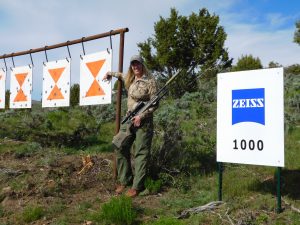
Hitting a steel target at 1,000 yards is a great confidence-builder for any shooter.

Classroom time was kept to a minimum—only a couple of hours of introductory material on the first evening. At the range on the first day, the instructors gave us hands-on training in basic zeroing, using ballistic apps, the use of riflescopes (both dialing turrets and holding over), wind and mirage, proper benchrest position, and trigger management. On day two, we applied all of these skills in the field, refined our field positions, and learned proper methods for shooting off sticks, packs, and improvised rests.

The team of Outdoor Solutions instructors includes, in addition to Erik, Director of Training Steve Aryan and Lead Instructor Ryan Long. “There are a ton of good shooters out there, but that does not necessarily translate into a good instructor,” Greg said when I asked him what he looks for in a great shooting instructor. “We look at temperament and attitude; you will not find attitudes or egos with our instructors—they love teaching as much as our students love learning. They are great with beginner students who haven’t even purchased their first rifle yet, or they can go down the rabbit hole of the most technical aspects of long-range shooting if that’s what a more experienced student wants.”

Outdoor Solutions runs schools in three locations: Texas, Utah, and Michigan. I attended the Utah school on a sprawling ranch situated at an elevation of some 7,000 feet. The six students in my class paired up and spent the first day on the ranch’s 1,000-yard range, first getting sighted-in and comfortable shooting paper targets from benchrests at 100 and 200 yards, watched closely and assisted by Erik, Greg, and Ryan.  Once we were dialed in, we began engaging steel targets at 100-yard intervals, gradually gaining confidence and increasing the range by working through Erik’s “process.” In late afternoon of the first day, all six of us—including one student who had no previous rifle-shooting experience—had hit the thousand-yard target several times.

Day two was even more fun. I enjoy shooting from field positions far more than shooting from the bench, and early on the second morning we climbed into four-wheel-drive pickups and headed into the ranch’s backcountry, where steel targets had been set up a various ranges, sometimes in devious locations with tricky thermals or steep angles. Our shooting positions sometimes had downed logs or brush that could be used for a rest, but just as likely we’d be forced to shoot from prone off a bipod or sticks, or improvise a rest with packs and jackets. It was excellent practice for the realities of Western hunting.

When a brief thunderstorm temporarily chased us off the mountaintop and back to the range, Erik gave us another challenge. First we’d shoot at a target at 400 yards by dialing our scope turrets to account for the drop. Once we made a hit, he would call out a different target—say, 600—and we were required to find and hit the target using the reticle to hold over instead of dialing the scope. The drill entailed some on-the-fly math and helped ensure we understood, and could use, both methods.

As we wrapped up our second day of shooting, I mentioned to Greg that I had a Wyoming antelope hunt booked for the fall, and I was feeling a lot more confident about my shooting. He smiled and asked me to drop him a note after the hunt to let him know how it went. “That is truly the reward for what we do,” he said, “hearing back from hunters who go through our training and who later go on a big-game hunt and have a great success story to tell us when they return.”


Going Long

The rifles we used for this course were Remington 700 Magpul Enhanced in 6mm Creedmoor, equipped with bipods and Jaeger 30 suppressors, and loaded with Barnes Precision Match 112-grain rounds. The rifles were topped with Zeiss 6-24×50 Conquest V4 scopes. The use of the Zeiss Hunting App to set up a ballistic profile was an integral part of the course. I had no previous experience with a ballistic app, but I found it remarkably easy to use after downloading it for free on my iPhone. Integral to this system is the very impressive Zeiss Victory RF binocular, which actually syncs with the smartphone app. Once you have loaded your ballistic profile into the bino, a touch of the button on the binocular tells you not just the range, but your holdover in MOA. I’ve used several brands of rangefinding binoculars in recent years, and the Zeiss is fastest and most responsive I’ve used. The binos also have a built-in weather station, which will automatically update your MOA, if necessary, based on the barometric pressure at your location.

You can bring your own rifle and optics to Outdoor Solutions courses, and the instructors will help you set up your system and fine-tune it. But most students opt to learn on the rigs provided by the school, which are always factory hunting rifles using factory ammo.

“Many people think you have to have an expensive $10,000 custom rifle setup to consistently shoot precise shots out to 1,000 yards,” Greg said. “Each one of our students will hit the 1,000-yard target during the first day using standard factory rifles, optics, and ammunition. It’s great to see their smiles when they hear the ringing of steel.”

Outdoor Solutions offers their two-day, three-night Long Range Schools in three locations around the country: Texas, Utah, and Michigan. Overnight accommodations and meals are included, as well rifles, ammo, optics, and expert instruction in both the fundamentals of shooting and more advanced skills. The basic course costs $2,500. Visit www.outdoorsolutionscorp.com for details or call 918/258-7817.—D.R.


Leave a Comment

Skookum Rams of the Brooks Range

A backpack hunt in a region so remote the sheep have never seen a human.

Ten yards. It sounds so close, but when you’re trying to slide on your back down a noisy talus slope in plain view of five bedded rams, it seemed like miles. I put my pack on my chest and my rifle on my pack and slowly began inching my way down to the small trough that would give me the view and rest I’d need for the three-hundred-yard shot. I willed myself to be invisible, but that didn’t take away the noise of the rough, hollow-sounding talus I was sliding over. Each time a stone would move with a loud clank, I’d freeze and look at the rams bedded below me. I was almost there when I looked down and one of the big full-curl rams was staring directly at me. All I could think was that I had just blown it.

I had met Lyle Becker years ago at one of the numerous conventions we both attend. We became great friends and I was excited for him when he bought his own outfitting territory and started Alaska Skookum Guides. It was about two years ago when I ran into Lyle at a show and asked him, “Do you have any Dall sheep?”

His response was, “No. Yes. Well, maybe . . . ”

Lyle explained the area he was hunting in the Brooks Range had not had any sheep tags in fourteen years, but he knew there were sheep in the area and was trying to get the state to allocate some tags. The thought of hunting rams that had most likely never been hunted in their lifetime was intriguing, an opportunity I didn’t think still existed. Moreover,  I love going on exploratory hunts and I told Lyle I would love to be the “guinea pig” on his first sheep hunt to help him gauge the possibility of offering successful hunts to clients. More than a year later I finally heard from him.

“I got the tags,” he said. “Let’s do this.”

I knew from talking to Lyle and from previous experience that this was going to be a backpack hunt and a major undertaking. I would need the best gear and need to be in the best shape for this adventure. From the nearest landing strip we would be many miles on foot with only what we could carry on our backs. I gathered gear, checked my list, gathered more, weighed, tested, and as the hunt approached, I even ordered an HS Precision PHL rifle in 6.5 Creedmoor to shave three pounds off of what I normally carry. I had done everything–everything except the most important thing. Between work and family responsibilities, I had completely failed to work out, a cardinal sin in the world of mountain hunting. But I wanted this badly, and I prepared myself mentally for the challenge ahead.

After three days of travel I landed in Fort Yukon, Alaska, and was met by Lyle. A welcome sight, except that he was supposed to already be out in the field where I would fly in to meet him. Several days of bad weather had the bush planes all stacked up trying to get hunters out of the field. We were still a few days before season opener so though a small setback we enjoyed a little extra time to sort our gear and rest. At last we were flown out to a midway point where we were to be shuttled to a remote strip via Super Cub. It was here that I met our nineteen-year-old packer, Hunter Beiler. It didn’t take long to realize what an asset he would be on this adventure.

Our Cub pilot was still running behind so we had to spend an extra day at this midway point. Now we were starting to get concerned as we were losing hunting days. We passed the time glassing caribou and were visited by an almost pure white grizzly bear.

In one of our conversations, I asked Lyle, “So why the name Skookum Guides?”

He replied, “Up here it is a common term meaning larger, better, or exceptional.“

“I get it,” I said. “So we are looking for a skookum ram.”

“Exactly!” Lyle said.

After two days stuck in limbo, we heard a plane and out of the sky came Daniel Hayden of the TV show The Last Alaskans fame. Daniel flies for Wright Air Service and had heard we were stranded. He and Lyle hatched a plan B to get us where we needed to go. Instead of flying in with the Super Cub and walking up a valley to the hunting area, we would fly into a neighboring valley with an airstrip, walk over a low pass, and drop into the area from a different direction. It was too late to fly that night and the weather was sketchy, so he decided to spend the night there with us and fly us out the next day.

The next day we woke to low clouds that blocked our ability to fly through the passes to our destination. We impatiently waited as it was now opening day, and even if we got out we wouldn’t be able to hunt due to Alaska’s “no hunting on the same day you fly” rule. At last the clouds began to lift and we were in the air. Daniel flew us up a few different valleys before finding a pass open enough to allow safe passage. Safely at the strip, we mustered our gear, donned our heavy packs, and headed out.

Being more than a hundred miles above the Arctic Circle, we had 24-hour daylight, so even though we were getting a late start we trudged our way through a few miles of boot-sucking swamp and aggravating tussocks and made our way over the pass into the hunting area we had been trying to reach for days. Tomorrow we would finally be sheep hunting! We scouted out a dry knoll above the swamp, set up camp, ate supper, and crashed for the night.

The morning greeted us with fairly clear skies so we immediately began glassing. The recent spate of bad weather had a blanket of snow on the peaks, so while spotting white sheep would normally be easy on the dark mountains, now it was like trying to make out a Bev Doolittle painting. After breakfast we made a loop up a valley behind camp and began glassing at every vantage point for our quarry. Seeing neither sheep nor sheep sign, we decided to push on deeper into our target area.

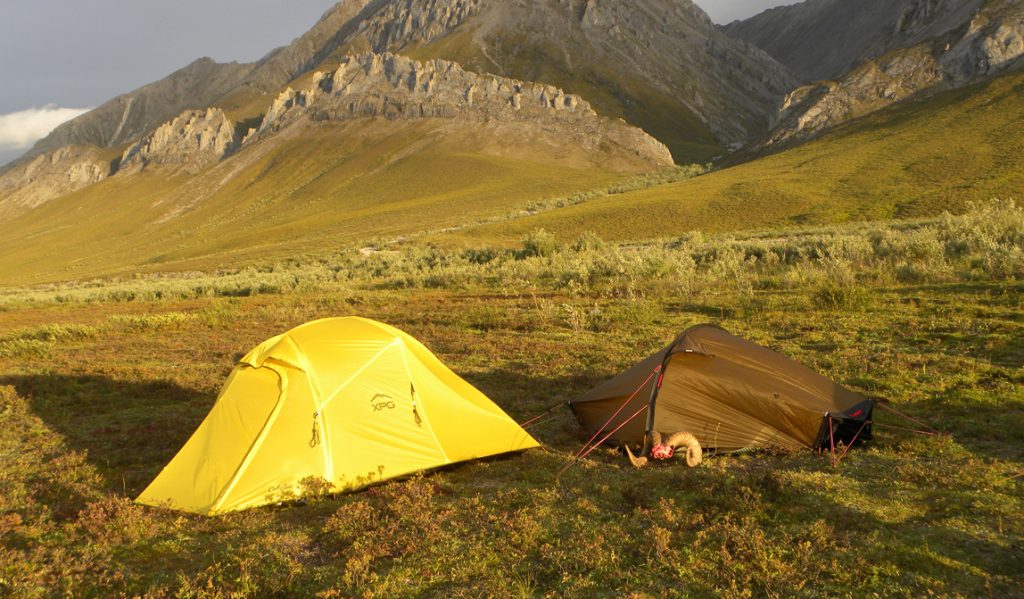
Sheep camp in the Brooks Range.

We broke camp and headed toward another pass a few miles off. Once out of the tundra, the walking wasn’t bad and the grades were gradual for the most part, for which I was grateful. I was doing far better than I had figured considering my workout regimen, or lack thereof. Taking the opportunity to glass at each new vantage point, we spotted several very promising- looking white rocks and some for-sure trophy snow patches, but no real rams had yet filled our glass.

We hit the main river drainage and turned down the valley. The views in every direction were breathtaking. We were now close to the area Lyle had originally desired to hunt before the flight complications had led to our detour. Finally, after a trek of probably six or seven miles, we arrived at a nice flat, dry spot between two drainages. We set up camp and glassed for a bit, spotting caribou bulls scattered here and there on high ridges, and after a warm meal of Mountain House settled in for an early start.

The next morning we worked our way down the main valley then up the next drainage downstream from camp. About halfway up the drainage we spotted a rock point that looked like a great vantage point to glass from, so we made our way there. Upon reaching the rocks it began to rain so we set up a makeshift awning tied to the rock face to ride out the shower and eat some lunch. We enjoyed this comfy out of the wind and rain spot but only spotted a lone caribou bull lazing the day away from his bed on a high ridge across from us.

Our next destination was a high peak on the south side of the top of the drainage. We slowly worked our way up the talus ridge leading to the peak. The view from the top was awe-inspiring. Faint trails could be seen in the talus and scree and we were now seeing droppings. There was a ridge leading from the peak we were on that arced in a circle about three or four miles and ended right above our camp. We decided to walk this ridge and this would give us a good look into numerous drainages along the way.

We glassed a couple of drainages as we made our way along the ridge, each one teasing us with what might lie just out of sight. Upon reaching the next point I dropped my pack and was glassing across and down the valley when Lyle took a few steps past me, then spun, wide-eyed, dropping to a low crouch. He pointed and mouthed, “Sheep right here!”

He came back to where Hunter and I were and told us there were five rams bedded a few hundred yards below us. Grabbing his spotting scope, he crept back out to where he could get a better look at the rams without spooking them. Moving slowly, he got in position, set up his spotting scope, and began to look over the rams. In Alaska a ram has to be more than eight years old, over full curl, or broomed to be legal. Lyle then motioned me to come down to his position. He whispered that of the five rams, two looked good but we needed to get a different angle to get a better look at them. I took a look through the scope and immediately two rams stood out from the rest, one a beautiful over-full-curl ram with lamb tips and the other a Roman-nosed, heavy broomed ram. I ranged the rams at 396 yards, steeply downhill. Doable, but I preferred to get closer. We backed up to where we had dropped our packs to formulate a new plan.

There was a saddle about a hundred yards below us that we thought might give us a better look at the rams, plus close the distance a bit and lessen the angle. The only way to get to the saddle was to back out and walk around a large point, then sidehill across a steep talus slope to our destination. We made our way as quickly and as quietly as possible on the plate-size rocks that sounded like ceramic when you stepped on them. Upon reaching the saddle we dropped our packs and Hunter and I waited while Lyle crept forward to have a look at the rams. This approach gave us no cover other than we were above the bedded rams and hopefully they wouldn’t look up. Lyle glassed the rams for a bit then motioned Hunter and I over to his position. He said two of the rams had disappeared but the two biggest ones were still bedded and he was pretty sure they were both legal, although they were sound asleep and not giving him multiple angles to judge by. There was a small trough in the talus about fifteen yards below us that would offer the best rest. Unfortunately to get there would require crawling across the noisy talus, completely exposed to the rams.

It was decided I would crawl down first while Lyle watched the rams, then Lyle would crawl down behind me while I watched them. I got on my back with my pack and rifle on my chest and began painstakingly inching down the hill. Every move was almost painful from the tension of trying to be quiet on the noisy talus. Each time a rock would move it sounded as if two china plates were rubbing together. I tried to keep an eye on the rams and also listen for Lyle. At one point the lamb-tip ram looked straight up at my position and I froze. The ram stared for a few minutes and then thankfully went back to chewing his cud. I finally reached the trough and wormed my way around until I was on my side. I placed my pack on the small crest of the trough for a rest then my rifle on top. The position was perfect and steady. I then motioned for Lyle to come down.

The three rams were still relaxed and chewing their cuds when Lyle reached my position. He took another look at the rams and said, “James, they are both legal. I like the lamb tips on the one ram but the broomed ram is definitely heavier and looks to be older. It is your choice.”

I was drawn to the broomed ram from the moment I set eyes on him. He was everything I had hoped for on this hunt. An old Roman-nosed warrior,  broomed on both sides. I ranged the rams–exactly 300 yards. I quietly chambered a round and settled into the rifle. It seemed the rams were completely comfortable so even though I could have easily taken the shot on the bedded ram I chose to wait for him to stand. We were discussing the rams in quiet tones and all the while Hunter, our eager young packer, was fifteen yards behind us,nearly dying from anticipation.

After a half hour or so, the lamb tip ram stood and stretched. He was beautiful, but I still was convinced the broomed ram was the one to take. A few moments later he rose from his bed and stretched his head to his chest, then to his back. After his stretch he turned directly broadside and I settled the cross hairs on his shoulder. At the shot, the big ram instantly lifted and curled his front leg, a sign of a perfect heart shot. I chambered another round just in case, but before I even got back on him, Lyle said, “He’s going down!”

The ram staggered just enough to fall off of the cliff he was bedded on. I said, “And he’s still going down!”

He cartwheeled once then fortunately caught on a rock and stopped right in the middle of the slide. I kept the cross hairs on him until finally I could hear Lyle saying, “Oh, James. James! Great job, buddy!”

At that point the gravity of emotion overwhelmed me. I had dreamed of an old white ram since I was a child and never thought it was a possibility. I was awestruck.

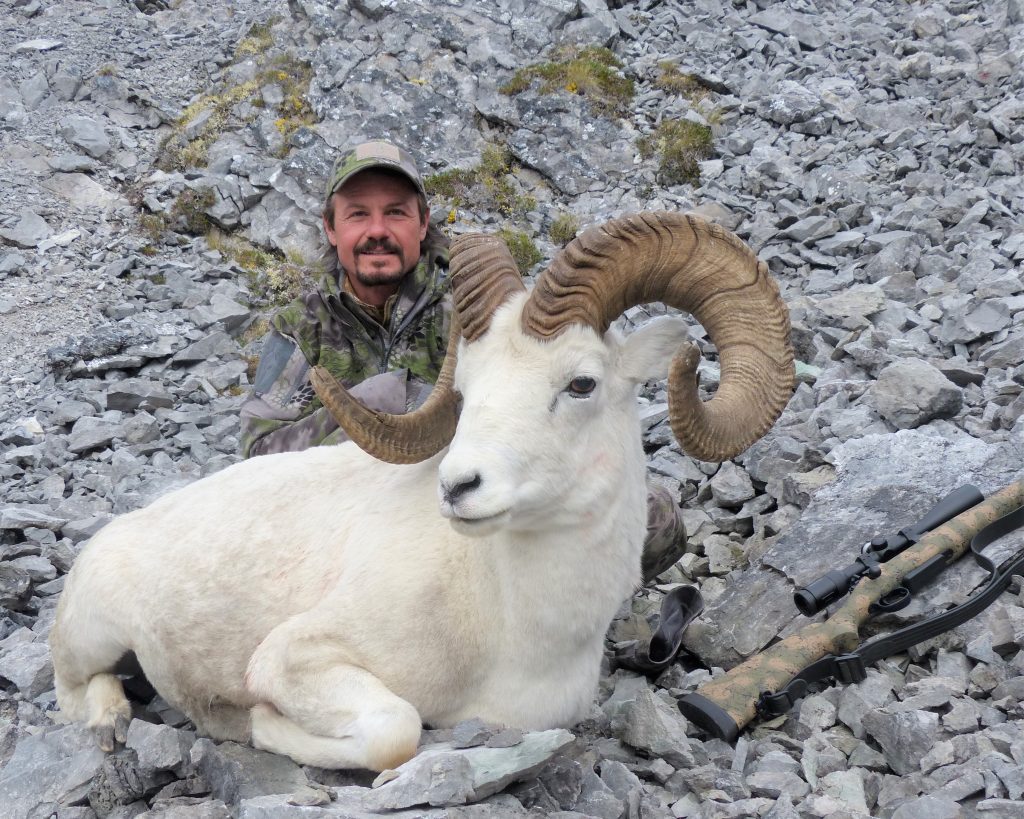
James Reed with his “skookum” ram.

I sat watching the other rams as they simply stared down the hill at their fallen comrade. Only after we stood and began making our way down the slope did they slowly move over a hundred yards or so and began feeding again. Obviously, we were the first humans these rams had ever encountered.

Upon reaching the ram I just stood and admired him for a bit before finally reaching down and touching his great horns. He was truly magnificent. I counted his age rings on his battle-scarred horns and he seemed to be 11½ years old. This is what we had come for: an old mountain monarch that had likely never been hunted by humans in his lifetime. I was humbled and honored just to be in his presence, in his world.

After pictures and processing the ram we donned our now extremely heavy packs and began making our way back up to the ridge top then back to camp. We reached camp about 1 a.m. and devoured a round of Mountain House each, then fell into our tents. The next day we fleshed the hide, packed up, and began our arduous pack out.

With packs weighing 80 to 90 pounds each, we trudged more than twenty miles over two mountain passes and through leg-killing tussocks and swamp. At times we could go only 20 or 30 yards before taking a break. I think each of us reached our breaking point a few times, but took turns encouraging each other to trudge on.

Upon finally reaching the landing strip a day a half later, we were seriously exhausted, but so joyful for experiencing the adventure and our success. All the hard work and unknowns made this hunt all the more rewarding. We had a beautiful  ram, a dream ram of a lifetime, a true skookum ram.

Author’s note: Lyle Becker’s Alaska Skookum Guides will be now offering two sheep hunts a year in this area along with his grizzly, moose, caribou, and peninsula brown bear hunts. Learn more at alaskaskookumguides.com.


 Serious Mountain Gear

On this hunt I knew every piece of gear I took would be vital not only to my chances of success but even to my survival. I needed everything to be light, tough, and functional because there was no room for extra gear or weight. One essential part of my kit was my pack. I have a hard time finding packs that fit my 29-inch waist and 145-pound frame. For this hunt I chose a Stone Glacier Sky Talus pack and it was truly exceptional. My load on the way out was 80 pounds, and I carried it more than twenty miles.

I used Kryptek’s Altitude series, featuring Schoeller fabrics. These kept me warm and dry even in the daily rain and snow we experienced, plus the numerous river crossings. Every piece from base layers to outer layers to the gloves and gators performed flawlessly.

I used Zeiss’s new Victory RF 10×42 binocular, and their clarity made the hours of glassing every day possible without eye fatigue and with the capability to load my ballistic data into them made a perfect shot possible. For a rifle I cannot speak highly enough of the HS Precision PHL in 6.5 Creedmoor. Topped with a Swarovski 3-18x scope and shooting Hornady Precision Hunter 143-grain ELD-X ammo, this combination was a tackdriver straight out of the box.  And a dream to carry weighing in at only 6 pounds with scope.

The foundation of success was my Kenetrek Mountain Hunter Extreme boots and Kenetrek socks, which have served me well for three years on several mountain hunts.—J.C.R.


Leave a Comment

She Hunts

A camp in Texas is helping women learn the skills they need to become successful hunters.


Yes, she hunts! Although hunting remains a male-dominated activity, women are the fastest-growing segment of the hunting community, and they are a much larger minority than when my generation grew up. In a time when declining numbers are the greatest threat to hunting, this is extremely important. We spend much time pontificating—and wringing our hands—over the criticality of recruiting young hunters. This has always been important, but increasingly so as our hunting demographics age.

As our society becomes ever more urbanized, the recruitment and retention challenges increase because of hunter access and ever-escalating costs. The sad reality is that potential young hunters trapped in cities—even those with innate interest—are difficult to reach. The same problem applies to all ages and sexes, but the women within our own extended circles are joining us in unprecedented numbers. From what I hear, there are still a few Neanderthals among us, but I believe (and certainly hope) most of us male hunters are welcoming.

Unlike previous generations, these days many daughters, sisters, and moms grow up with hunting as a normal thing. But unless you grow up with it, suddenly “going hunting” can be intimidating, and even with the best intentions we mentors of the male hunting majority don’t always do things exactly right.

Dani Parris-Exline stalks a “rogue elephant.” We put on a bit of pressure, with the target hidden until the last minute.
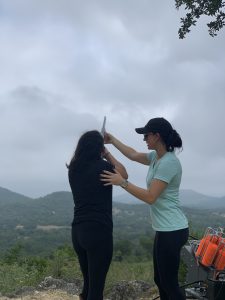
Perhaps it was because of my failings that my daughter Brittany established her She Hunts Skills Camps. Britt has been doing this for four years now, hosting groups of up to a dozen—now more than a hundred “graduates”—for busy and intensive, but also fun, four-day sessions. The ladies span all age groups and experience; some are veteran hunters, many new, and some, quite honestly, arrive very undecided about this hunting thing.

The idea is to provide a safe, positive experience, helping women to be safer, more competent, and independenthunters. Recently her camp has been held at Record Buck Ranch near Utopia, Texas, a gorgeous piece of the Hill Country. The food is fantastic, the lodge comfortable and homey, and wildlife on the ranch is amazing, hosting dozens of non-native species, plus white-tailed deer, turkeys, and oceans of wild hogs. Hunting—or “safari style” game viewing drives—are optional early morning and late afternoon activities. Experience has shown that most attendees hunt, even those who initially say they won’t.

Britt obviously can’t do it all by herself. Donna, who has a vested interest in women hunting, usually attends to help out, as does Brittany’s husband, Brad Jannenga. I’ve attended a few, and sponsors, including Krieghoff, Leupold, MGA, and Norma come in to provide expertise for various sessions. In the session just past, in mid-October, shotgunner Kayle Browning interrupted her Olympic training to give the ladies some of the best shotgun instruction I’ve ever seen. Honestly, every time I’ve attended, I’ve learned something. Kayle used some amazingly simple techniques that were absolutely certain to allow new shotgunners to break targets.

So, suppose a lady in your life shows interest in shooting or hunting? How many of us, me included, have taken her to the range, gone through the Ten Commandments of safety, and handed her a firearm ready to shoot? That’s not bad, but it’s not enough. Women are more curious than that, and most want more knowledge, beyond just hitting a target.

Brittany thought this through (without consulting me). Of course, she starts with safety, reinforced throughout, but before shooting they start with functioning and loading, then mounting a scope, then bore-sighting, and then zeroing. It makes me feel pretty stupid because I never taught my girls these things. Those were my chores. Now, there are some great shooting schools out there. She Hunts is not a shooting school, not in four days with all the rest. In military terms it’s a bit more like “familiarization fire,” not in-depth training. But shooting includes off sticks with both .22s and centerfires, shooting off the bench, and at distant targets. Basic archery is included—in this recent session several of the ladies were already bowhunters—as is basic shotgunning with, as I said, exceptional instruction.

Other seminars include conservation and hunting ethics, shot placement on game, stalking, basic gear, survival technique, and firearms maintenance. There’s even a fun thing where, with a “PH,” attendees “stalk” a life-size buffalo or elephant target, and take it on, usually with a double rifle in moderate cartridge.

One of the most confusing things in our male-dominated hunting world is “bullet basics”—cartridges, bullets, how they’re named, how they work, and what various cartridges are for. Many boys grow up reading Guns & Ammo; most girls do not. But, honestly, cartridge nomenclature is so conflicting that even many of my writer colleagues don’t really understand it. Trying to make sense of this arcane and boring stuff was my most daunting task at the last camp. Fortunately, there is no exam, but I found the ladies attentive and interested—and full of very good questions. Knowing song and verse doesn’t matter, but it’s important to know that a .30-06 is larger and more powerful than a 7mm-08 or .270…and why.

Many attendees have never used a shotgun, but Olympic hopeful Kayle Browning is able to get everyone to break clays in just a few shots.

One of the great advantages to doing something like this on a Texas ranch is the year-round hunting opportunity. Those who wish to hunt can, and plentiful wild hogs (no license required) offer an inexpensive opportunity with success highly likely. So, for the field dressing and butchering seminar, it was no great trick to produce two big wild hogs. Last time Brad and I did this together, starting with the traditional field dressing technique, from the belly. Then we did the “Alaskan” method, peeling down from the backbone, finishing with hung quarters and backstraps and tenderloins ready for the table. Field-dressing is another chore that I used to keep for myself. When Britt was a teenager, to my surprise, she begged me to show her how.

Come to think of it, my dad was a bird hunter, and I’m not sure he ever learned how to field dress a deer—that was my job! Ultimately, I suppose it really doesn’t matter who does it, but after all, it’s an essential skill that every hunter should know. As we got to the second pig, I was impressed with how many of the ladies pulled on rubber gloves and pitched in. Although this would be beyond me, the game care seminar is followed by an expert’s spin on game cooking.

Aside from availability of game, Record Buck’s facilities provide a perfect venue. Lodging for attendees is in the main lodge, with rooms off to the side and upstairs, with dining room and after-hours bar downstairs. Strap-hangers like me and “guest lecturers” are housed separately, so it’s a nice combination of privacy and coziness that brings the group together and creates a lot of camaraderie. Let’s face it, guys: Lady hunters enjoy being with other lady hunters now and then!

As for hunting, Record Buck offers plenty of opportunity, and over the course of a half-dozen early morning or late afternoon outings most hunters will have an opportunity at the game they seek. Several opted for wild hogs, which are truly a plague in this area, certainly the most plentiful and available species. One woman shot a beautiful blackbuck, another a fine axis deer, still another a scimitar-horned oryx. One young lady, Lauren, wanted a zebra! Guide Houston Erskine is a good friend and excellent (and patient) guide. Record Buck has a breeding population of zebra, but as Houston and Lauren set out, he mentioned that, as in so much of Africa, a zebra might be the most difficult animal on the ranch. I think it took four outings and several failed stalks, but Lauren took a beautiful zebra with a perfect shot, and I was delighted to be there to see it.

As usual, most of the attendees chose to hunt, and all who did shot well and effectively, with no drama. In my experience, having “created” several female hunters, this is typical. Women haven’t been subjected to macho posturing most of their lives–they start with few bad habits and are interested in listening, learning, and doing it right. And, with good instruction, they tend to do it right. With every one of Brittany’s camps that I attend, I realize I could have been a much better teacher! Brittany has four sessions scheduled at Record Buck in 2020. For information visit www.shehuntsskillscamp.com.


Leave a Comment

Grizzly!

Photo by Vic Schendel

It’s every hunter’s nightmare: A bear is crashing toward you through the brush. What should you do?

You are hunkered in a small, high-mountain clearing, calling for early season elk. Suddenly there is a crashing noise and a grizzly bursts from the brush, running straight for you. Do you rise and shout at the bear, or do you stand your ground? If the bear knocks you down, do you play dead or fight back?

Or: You see a sow with cubs approaching, about 150 yards away. She hasn’t noticed you, yet. Looking around, you see a very climbable tree a few feet away. But you’ve read the basic bear safety advice, which advises against climbing a tree in a griz situation. You’ve also read that grizzlies will go up trees to pull a person down for a mauling. You have a rifle for self-defense, and there is no inconspicuous way to leave the area. The sow and cubs are still heading your way. Should you climb the tree?

Or: You come around a bend in the trail and there’s a grizzly sixty feet ahead. It sees you and charges. You have your rifle at port arms, and there’s bear spray in a hip holster. Should you shoot the bear or try to spray it?

Or: A large griz, probably a dominant male, is fifty yards away, walking straight toward you. You aren’t sure if it has seen you or not, but it keeps coming. Should you stand your ground or back away? Should you yell and wave your arms?

Or: A bear comes into camp. Do you shout at it and act aggressive, or do you stand still and talk to the animal in a calm voice?

Or: You and your partner are charged by a bear. It knocks your partner down and begins mauling him or her. Should you try to shoot the bear with your rifle or handgun? Would it be better to blast the animal with pepper spray?

None of these scenarios are fanciful. All of them are based on one or more actual case histories or personal experiences. If you truly know the finer details of grizzly protocol, you should have a clear sense of how to deal with each of these situations. Unfortunately, most basic bear-safety info is contradictory, often ambiguous, and far too generalized.

A blatant example, which I hate to even quote because I don’t want to put it into anyone’s head, is the advice given by some state agencies for those encountering a bear: “If it’s black, fight back; if it’s brown, lie down.” The meaning is that one should “play dead” if attacked by a grizzly, and fight back if attacked by a black bear. But the maxim is both misleading and dangerous. First of all, there are black grizzlies and brown black bears. Color is not a distinguishing criterion. Second, there are times when you should definitely not play dead with a grizzly. Third, when to play dead with an appropriate bear is hugely important. Too soon, and you can encourage an attack that might otherwise not have happened; too late, and you can get more severely injured than might have been necessary. (You want to drop into a protective position just before the bear makes actual contact.) So the basic advice of playing dead in certain situations is OK, but as with so much other bear-safety lore, we have to go beyond the basics to reach a level of understanding that’s actually effective in griz country.

Good bear-safety advice is less about absolute or simplistic rules and more about playing to probabilities. If you shout and violently wave your arms at a suddenly met, close-in sow with cubs, the probability of getting charged or even attacked goes way up. If you do everything right (stand still, don’t lock eyes with the bear, talk to it calmly if there’s time while getting your spray or weapon ready for deployment), the probability of getting mauled lowers, even if the bear does elevate your heartbeat with a bluff charge.

Dealing with a Charge

And what if a grizzly does charge? This is probably the scenario we read or hear about most in the media–a hunter surprises a griz at close range and the bear “attacks.” (I use

quotation marks because, with grizzlies, a charge

is not an attack unless the bear actually hits you.) A charge can be a fearful and addling event. It can happen so fast and unexpectedly that, unless you’ve rehearsed, planned, and trained for it–and sometimes even if you have–the shock is unnerving and brain-numbing. It can make normally stolid individuals do very unadvisable things, like take off running in panic. Importantly, however, not all charges are the same.

“There are two kinds of aggressive charges,” the late biologist Charles Jonkel told me years ago in a taped interview. “There’s the bluff behavior. Sub-adults and some other individual bears will come at you with their feet wide apart, their fur fluffed up, and they come at you stiff-legged. They make a lot of noise, huffing. They come straight at you, and the head and ears will be up. They’re putting on a hell of an act. But they won’t come all the way. It’s a bluff.”

What Chuck suggested next is way beyond the basics: “In this case you face them down; do the same thing back to them. Raise your arms and huff right back at them. A person can look pretty formidable, especially when wearing a big coat. You can open the coat out to look bigger. There are times when you want to back them down. Look as big as you can, get a very firm voice, even a growling-type yell.”

Another top biologist believes it’s probably safer (for non-experts) to take a firm, but less assertive approach with bluff-charging bears. “Stand your ground, look them straight in the eye. Don’t back away; that only encourages an advancing bear. Don’t wave your arms violently. Don’t play dead. And never turn your back to the bear.”

While doing any of this, you should also have your bear spray or weapon out, ready to use, just in case.

As for the second kind of charge, Jonkel said: “When a bear’s really coming for you, it’s different. If it has its head down and ears laid back, it’s probably going to keep coming.”

One question for a hunter with a gun is: How do I know when to shoot a charging bear in self-defense, or if I should shoot?

The great advantage of bear spray is that you have much less of a dilemma. If the grizzly, whether bluff-charging or coming in hard for an attack, gets within thirty feet, you press the trigger and blast a strong cloud of pepper spray into its face. That usually (but not always) ends the confrontation. The bear takes off, uninjured. With gun-defense only, the stakes are higher. If you shoot too soon (which is common), you wound or kill a grizzly that probably didn’t need to be shot. If you wait too long, you put yourself in greater danger. Watch the head and ear position and the directness of the charge. If the head and ears are up, and the bear is hesitating, bouncing, or stiff-legging, hold fire; if the head is low and the ears are back, and the bear is coming straight-on fast, maybe uttering a deep rumbling growl, you will probably have to shoot to defend yourself when the animal is forty feet away or closer. This is an unhappy choice, because sometimes even this kind of bear will break off the attack, stop or veer to one side when it’s only a few yards or feet away. But it would be unrealistic and unsafe to expect a hunter to hold fire to such an extreme last moment.

Bear at a Distance

A very different type of encounter that seldom gets much attention is when you see a griz at a distance and must figure out what to do to avoid trouble. Taking one of my scenario examples, a large bear, probably a dominant male, is fifty yards away, heading straight toward you, walking steadily. You aren’t sure if the bear has seen you or not, but it keeps coming. What do you do?

Hopefully you won’t make the very common mistake of yelling, “Hey bear!” while waving your arms over your head–“to alert the bear that you’re human,” as some agency guidelines advise. To me, that’s asking for trouble, and there are manycase histories where the yelling/arm-waving approach triggered an instant charge, even from bears 100 yards away or more. The better procedure (assuming there is no available safe exit), is to prepare your deterrent or weapon, stand so that you are clearly visible, and talk toward the bear in a calm, but not overloud, voice. There is no need for arm-waving; when the bear sees (and hears) you it will know you’re human. (Grizzly vision is better than formerly believed–nearly as good as human vision.) Odds are a bear in this situation will not attack or charge, especially a male or lone female. (A sow with cubs might be more prone to a defensive charge.) If the bear stands on its hind legs, that’s a sign of curiosity, not aggression. It’s getting a higher-angle look at you while sampling the air current for scent. If it keeps coming, stand your ground. Don’t back away unless the bear stops its forward movement. If backing away encourages the bear forward, stop and stand your ground. Talk to the animal in a normal voice.

“Say something reasonable to the bear,” Jonkel advised, “because that creates body language. I tell people to say exactly what you want the bear to do, and your body will act out the message.”

If the bear doesn’t get the message, or disagrees with it and suddenly makes a run at you, the previous advice on handling a charge applies.

In my second griz-in-the-distance scenario, there’s a sow with cubs 150 yards off, heading your way. She hasn’t seen you yet, and with the wind direction she isn’t going to catch your scent until she’s very close. Because of the terrain, there’s no feasible way to make a retreat or wide evasive move without being detected, but there is a very climbable nearby tree. Should you climb it?

I experienced this exact situation while elk hunting in the Cabinet Mountains of northwest Montana. I had a rifle and bear spray, but my thinking was: Why risk a shootout, or spray-out, with a mother griz when I can get up this tree and maybe avoid any violent conflict, or even a nervous face-off?

I was twenty feet up and solidly perched (rifle and spray at the ready, just in case) when I heard, then saw, the bears moving near. I stayed still and quiet as the animals came closer, the cubs bobbing, tussling, and gamboling around the mother bear, who had her nose working. Fifteen feet away she looked up, clearly saw me, regarded me briefly as if to say, “I know you’re there,” but showed no stress or agitation. I was a mute statue with a slightly averted gaze. (Locking eyes with a bear is a signal of aggression or dominance, and can potentially trigger a defensive grizzly like this sow into a charge or attack.) She and the cubs moved on by. I stayed in the tree for twenty minutes, then quietly worked my way back down and got on with the hunt–my senses much sharpened and heightened.

Later I mentioned this incident to one of my bear mentors, an experienced biologist who often makes a point of telling people not to climb trees to escape from grizzlies. He admitted to doing the same thing himself on several occasions. He said: “If you’re up in a tree before the bear sees you, and then she comes along and does see you up there, you’re probably fine. It’s very unlikely the bear will come after you. The thing you don’t want to do is run for or try to scramble up a tree after a bear has seen you. More often than not that will trigger a chase response and a possible attack.”

Biologist Steve Herrero adds the cautionary tale of a man in Alberta who climbed a tree to avoid a sow and cubs that were 100 yards away, but who then made the mistake of shouting at the bear, hoping to haze her off the trail. The sow charged instantly, tore fifteen feet up the tree and pulled the man down for a brief, injurious (but fortunately not fatal) mauling.

It’s rarely wise to intimidate a defensive bear, which is one that feels threatened in any way by your presence, or is protective of its young.

One of the most dangerous scenarios is encountering a female grizzly with cubs. It’s crucial not to act aggressively toward the bear in this situation. Photo by Vic Schendel


Bears on the Offensive

An offensive (or “non-defensive”) grizzly is a different matter. This is a bear that is seeking you out on purpose. It might be mistaking you for a prey animal (as when you’re calling game and perhaps wearing camo and masking scent); it might be moving in to scavenge an easy meal while you’re field-dressing game; it might come into camp looking for edibles, or it might (in rare instances) be tent-invading or hunting you as human prey.

In one of my scenarios a bear comes crashing into the clearing where you are using a game call for early season elk. This is an offensive bear, one seeking you out, probably because it has mistaken you for whatever your call represents (calf, cow, even a bugling bull elk). With this kind of bear your response should be very different from what it would be with a defensive sow-and-cub or carcass-defender. Ideally, you would stand (if there’s time), shout loudly, and blast the animal in the face with a full load of pepper spray. In some actual cases, just standing and shouting was enough to cause a startled bear to skid to a halt and reverse directions. (The bear was expecting a prey animal, not a large, aggressive human.) In other instances the grizzly was so locked in with predator intensity it kept coming and needed either a blast of spray or, less fortunately, a bullet, to startle it out of predator mode and into retreat (or death).

Whether or not there is time to deploy a weapon, a hunter attacked in this situation should not play dead, but should do whatever is possible to fight off the bear. (Using gun, knife, binocular, rock, kicks to the head, jabs to the eyes, etc.)

In most cases like this, when a bear realizes it’s tangling with a human and not a prey animal, it usually quits the attack and runs off, leaving the hunter wounded but alive.

Another offensive-grizzly scenario is a bear coming into camp. Do you yell at it, wave arms and act aggressively, or do you stand still and talk to the animal in a calming tone of voice?

Short answer: You yell at it, bang pans, throw things at it, maybe even try a warning shot in the air, or into the ground near the animal’s feet and face. Everyone in camp should group together to put up an intimidating, loud, startling front. If the bear is in range, you should hit it with spray, and all available firearms should be readied and aimed. If the bear comes at you or another person aggressively, and spray isn’t on hand or hasn’t worked, it’s lethal force time. This is more emphatically true with a night bear, especially one that is attempting to break into your tent (or has broken in). If you are ever attacked by a camp-invader or a night bear, never play dead; always fight back as hard as you can, with whatever you’ve got on hand.

Your Hunting Partner is Attacked

Final scenario: You and your partner are charged by a grizzly. It knocks your partner down and begins mauling him or her. Should you try to shoot the bear with your rifle or handgun? Or would it be better to blast the animal with pepper spray?

This has happened often over the years, and in more than a few cases, sad to say, the mauling victim has been killed not by the bear, but by the partner’s errant, well-intended bullet. However, in many instances a mauling bear has been driven off when a partner shot the animal in the face with pepper spray. So if spray is on hand, that should be the first weapon of choice. If a firearm must be used, it needs to be used up close. This is easy to say while sitting at a keyboard; not so easy in reality. A mauling grizzly is a furious creature, a terrifying one. I’ve never witnessed a human mauling (I have viewed several on video, which is awful enough), but I’ve seen adult bears fighting, and once saw a large boar maul and nearly kill a sub-adult. The power and violence and fury is shocking. So running up to a grizzly as it mauls your partner or family member is a sheer act of guts and courage.

With spray, you can shoot from ten to twelve feet (if you’re too close the spray doesn’t aerosolize as effectively), but with a firearm you need to get to point-blank range, where there’s little chance of accidentally hitting the mauled victim. With a gun you can try for whatever target is available–behind the upper foreleg (heart), the neck, skull, even the open mouth if the bear presents it. Often the shot need not be fatal to drive the bear away. Despite common belief, case histories show that far more often than not, a wounded grizzly will take off rather than continue or intensify an attack.

These last two scenarios show the inarguable value of hunting or hiking with a partner (or two) while in griz country. During any type of encounter, two humans present a more intimidating presence (from the bear’s perspective) than one. When game-calling or field-dressing a downed animal, one person can work the call or knife while the other stays alert, with spray or firearm at ready, scanning and listening for an approaching bear. In any instance where there is a serious charge, two weapons provide better odds of a successful hit. And as shown, in case of an actual attack, a partner can move in to stop the mauling and drive off the bear– and then provide aid and assistance for evacuation to medical help.

I can’t overemphasize the value of making a response plan for various types of encounters, such as those I’ve described, focusing on how you will react and what you will or won’t do in specific situations. As sports and military trainers often say, “If the mind has never been there before, the body will not know how to respond.”

Leave a Comment

Transporting your Taxidermy

If you’re moving, and you have a taxidermy collection, the experts at Trophy Transport can help.

A couple of years ago, my husband and I relocated from southern California to northern Colorado. Long-distance moves are complex and expensive, especially if you’ve been in one place for many years, as we had. Arranging for movers to pick up our furniture was simple enough, but our taxidermy collection was another story. How on earth were we going to move some 20 shoulder mounts and an equivalent number of European mounts and racks without damaging them, and without breaking the bank?

The first option we considered was to have each head professionally crated by a taxidermist, and the crates placed on the moving truck. But with so many large heads (including a kudu, a gemsbok, and a 66-inch Alaska moose) the crating alone would have been incredibly expensive, not to mention the additional cost for the square footage the enormous crates would take up on the moving truck. And once we unpacked, we’d be stuck with enough crating material to build a fair-size cabin. We quickly abandoned this idea.

Fortunately, I discovered Trophy Transport, a moving company that specializes in moving taxidermy over long distances. Not only do they understand how to handle taxidermy without damaging it, they know exactly how to pack it so it won’t shift—no crates needed. Best of all, the price they quoted me to pick up our mounts in California, store them briefly at their headquarters while we moved in, and then bring them to us at our new place in Colorado, was far less than having them crated and shipped.

Skulls and racks were attached to padded bars in the truck with stretch wrap.

The big Trophy Transport rig pulled up to the curb in front of our California house in early February, and husband-and-wife team Dino and Janice went to work, expertly carrying our mounts to their truck and carefully securing them via super-strong stretch-wrap to metal load bars in the trailer. The larger shoulder mounts were placed on backing boards, which were then secured with titanium screws to the floor of the trailer or to plywood shelves on the metal bars. Soft packing materials protected the ears and noses of the more fragile mounts. Cleats on the floor of the trailer provided total stability for the carefully packed load. I was impressed with the job and how securely each head was attached. They had our collection loaded up within a couple of hours, leaving us free to finish our packing and hit the road without worrying about our mounts.

Trophy Transport could have delivered the load to our new place immediately, but we opted to wait until we were settled in. In early May, once we had our new home organized, the familiar big rig pulled up to our curb once again. The mounts were unloaded in no time and carefully placed in the rooms where we wanted them. I inspected them all and found they were in great shape, with barely a hair out of place. Now all the was left was to find places for all of them on the walls in our new house.

If you’re planning a move, don’t risk damaging your irreplaceable taxidermy. Contact Trophy Transport: 877/644-9757; trophytransport.com

The mounts arrive at our new place and are safely unloaded on a fine spring morning.

Leave a Comment

Wild Africa

True wilderness is getting harder to find on the Dark Continent.

Mentor, friend, and great hunter the late Jack Atcheson Sr. once said to me: “True wilderness is characterized by the absence of wildlife.” Atcheson was from Montana. As historical record, the Lewis and Clark expedition almost starved in what is now great elk country. Today, animal densities are much lower in wild places like the Bob Marshal Wilderness than in ranch lands. Perennial concentrations of wildlife are most likely to be found in areas where permanent water and year-around food can be found, which usually means the hand of man has been at work: Developed water sources and, often, agriculture.

This is an almost universal truth, and it certainly applies to Africa. If you want to see a lot of animals on a constant basis and rack up a big bag, then there are no places on Earth better than the well-manicured and often over-stocked game ranches of southern Africa. There is nothing at all wrong with these places or this approach, but don’t delude yourself that this is wild Africa or that, having savored the amazing bounty, you have experienced wild Africa.

A typical scene at a waterhole in Etosha National Park, Namibia. If you want to see a lot of African wildlife—and you should—visit the great African Parks and enjoy, but don’t assume that typical hunting areas will hold such an abundance of wildlife.

Certainly, across the unimaginable vastness of Africa there are unusual areas that, by accidents of habitat, naturally host concentrations of wildlife. Many of these special areas have been preserved as National Parks, famous places such as Etosha, Kruger, Masai Mara, Ngorongoro, Serengeti. By long-established law and tradition, these are not hunting areas, no more than Yellowstone and Denali. There are parallels: If you want to view concentrations of North American wildlife in beautiful natural settings, visit our National Parks. Likewise, if you wish to view African wildlife in ideal habitat, visit the great Parks.

Naturally, many non-hunters don’t know the difference, and anti-hunters don’t want to know the difference. However, most hunting areas in wild Africa are marginal lands, often arid or swamp, unsuited for pasture and agriculture, and lacking the natural beauty and species diversity to be preserved as Parks supported by ecotourism. We crazy hunters are willing to visit such places because we’re willing to work harder for fewer encounters, savoring the wildness.

Obviously, “wilderness” is derivative of “wild.” In North America, large areas of more or less pristine wilderness have been set aside, with intrusion restricted, including use of mechanical devices, including vehicles and chainsaws. To be honest, true African wilderness is elusive. With Africa’s burgeoning human population, there are few areas (if any) that have noindigenous population. Human encroachment is forbidden in most National Parks (that are not hunted) and many game reserves (that are hunted), and even some hunting areas. For example, human habitation is forbidden in Zimbabwe’s Designated Safari Areas, set aside primarily for hunting.

Regardless of regulation and intent, almost universally there are roads, camps, and, business being business, there is almost always natural resource exploitation, such as logging, mining, and poaching. Absent some form of development, none of these things could exist—nor could lawful and well-managed hunting, or, for that matter, ecotourism. Thus, true, untouched African wilderness may not still exist. For sure I have never seen it. If it did exist, I probably couldn’t survive, pampered child of the West that I am. However, some areas are wilder than others!

Trying to be realistic in our twenty-first century, when I think of “wild Africa” I’m thinking of places where there are no fences, no major human development, and a minimal human population with inevitable agriculture and livestock. In such areas, wildlife can roam free as it must. Such areas exist all across Africa, and in fact are the norm in the majority of Africa’s twenty countries that currently offer regulated sport hunting. What I call the “roll call” of these African hunting countries is less than half of the nearly fifty sovereign nations that comprise Africa—and occupy less than a third of her land mass. Most African countries have National Parks vying for tourism. However, it is sad fact that wildlife has disappeared from vast tracts of Africa beyond these protected enclaves. The hunting countries are exceptions, with lands beyond sacrosanct Parks and reserves where wildlife still flourishes naturally because wildlife has value, generating revenues for both governments and local populations, brought in by sport hunting regulated as a sustainable harvest.

This is the reality of “wild Africa” today. Across Robert Ruark’s “MMBA” (Miles and Miles of Bloody Africa) situations vary widely, but animal densities are lower and conditions are more challenging than on intensively-managed private lands. That’s okay because we hunters don’t mind working for the experience.

An amazing bongo from the Congo forest. This was the only animal taken on a two-week safari, and one of only a half-dozen actually seen. In the forest, this is normal, and it was a very successful safari!

I suppose the “wildest” part of Africa I’ve spent time in is the forest zone, where heat and thick vegetation combine to offer difficult hunting conditions. There’s actually a lot of wildlife in the forest—but you don’t see it! I know hunters who have encountered bongos on forest roads, but I haven’t! Last year, in Congo, driving hundreds of miles looking for tracks, I saw one bay duiker, brief glimpses of a couple of scampering Bates pygmy antelopes and a female sitatunga. That’s it! Hunting hard and specifically, my hunting partner and I each took a bongo, and we called the safari a resounding success.

The forest is a special case; one goes there with limited and specific objectives, hopefully understanding you won’t seea lot of game, and you’ll sweat buckets for every encounter. Much of today’s “wild Africa” hosts wildlife in significant density and variety—but that depends on wise stewardship. Today there are great hunting areas in Ethiopia, Mozambique, Tanzania, Uganda, Zambia, and Zimbabwe, to name just a few. However, these countries also have depleted areas, where effective anti-poaching has not been conducted, or where game quotas have been too liberal, or where human encroachment has not been managed.

In the past I have considered the presence of lions an essential element of wild Africa, so much that I used the phrase “where lions roar” as a book title. I haven’t exactly re-thought this, but hearing lions roar cannot be a part of every excellent safari experience. Lions aren’t creatures of the forest, and wild lions will not be encountered on the game ranches of southern Africa. Sadly, across Africa lions have vanished from much historic range. However, a wonderful part of the African experience is to lie in your tent and hear lions roaring. You are in wild Africa. The days are over when this sound might be heard across wild Africa, but I’ve had recent experiences that give me hope.

Coastal Mozambique has become one of my favorite African areas. Following Mozambique’s long civil war little wildlife remained. In the last quarter-century the outfitters operating the big Coutadas surrounding the Marromeu Reserve have brought it back! These areas are supported only by hunting revenue, and they have wrought a miracle: From 1,200 remnant buffaloes in 1992 to 30,000 today, along with thousands of waterbucks, sables, nyalas, and so much more. In the 1960s, lions were plentiful in the area. Although none have been hunted in years, the lions never made a comeback. Occasional wandering males came through, probably from Gorongosa National Park seventy miles inland—but there was no breeding population. Area operators agreed lions were needed to make the area complete. In summer 2018, just a year ago, twenty-four wild lions were brought in. Widely publicized, this was the largest international transfer of wild lions, engineered and funded by Mary Cabela and son, Dan, of the Cabela Family Foundation. Habituated in enclosures and then released on the edge of a game-rich floodplain, the lions almost immediately formed small prides and began making natural kills.

“Mary’s Lions,” snacking on a reedbuck just a few days after being released into the wild in Mozambique’s Coutada 11. For unknown reasons the area was lacking in lions, so the Cabela Foundation introduced two dozen lions. After just a year they have doubled!

I was there shortly after the release and watched a lioness snag a reedbuck. My cameraman, Bill Owens, had the amazing fortune to be there when one of those elusive Mozambican males claimed three lionesses. Now it’s a year later and I’m back in Coutada 11, site of the release, with Zambeze Delta Safaris. In just a year the initial two-dozen have doubled. So far “Mary’s Lions” are subsisting primarily on reedbuck, warthogs, and bushpigs, but before long it’s almost certain we’ll have to share the buffalo with the lions, and that’s just fine!

I’ve spent a lot of time in Namibia, a beautiful country offering a vast amount of game. Most of it is private land, and except for the Zambezi Region in the far north, not much of it is lion country or “wild Africa.” But an area I hadn’t seen until recently is Kaokoland in the northwest.

I was there in June with Jamy Traut and saw a side of Namibia I didn’t know existed. His Kaokoland concession encompasses two tribal conservancies, 1.6 million acres: No fences, a few small villages and a scattering of nomadic herdsmen, and a surprising amount of wildlife for such arid country: Lots of mountain zebra, plentiful springbok and giraffe, good kudu. Plus bonuses: Kaokoland is too arid to be buffalo habitat, but has a permanent population of several hundred wandering elephants, and a breeding population of black rhinos…very possibly the last completely free-roaming black rhinos on the African continent. And, yes, it’s lion country! The estimate is about a hundred and fifty lions in several prides, with individuals coming and going from Etosha to the east. We saw their tracks; they stole our leopard baits—and we lay in our tents and heard them roaring. By any and all definition, this remote corner of Namibia is wild Africa.


Leave a Comment

tablet

Never Miss An Issue!Subscribe Now: 6 Issues for $34.97

More Details
WordPress Video Lightbox Plugin