Photo above: Sports Afield’s distinctive “hunting cabin” is a fixture at the entrance to the annual DSC convention.
Since 2009, wildlife conservation, education, and ethical hunting have been the beneficiaries of an ongoing partnership between Sports Afield, the premier big-game hunting adventure magazine, and DSC, a premier international conservation organization. A new five-year agreement, starting this year, will continue the partnership well into the next decade.
As a result of the agreement, Sports Afield will continue to be the
title sponsor of DSC’s annual convention in Dallas, Texas. Over the past
decade, the show has grown exponentially as a result of the combined marketing
efforts of both groups.
“The growth of DSC’s convention
over the years has been extremely impressive,” said Sports Afield
publisher Ludo Wurfbain. “The DSC with Sports Afield Convention and Sporting
Expo is the must-attend event for serious hunters as well as for
every major player in the hunting industry. We are especially happy with DSC’s
emphasis on fair chase and ethical hunting combined with the sound conservation
projects they fund, and we are helping to push this message to a broader
public.”
Sports Afield’s considerable reach helps bring national exposure to DSC and its
important conservation and education programs. A special section in each issue
of Sports Afield carries international hunting and conservation news
from DSC staffers and volunteers who have their finger on the pulse of the most
important developments in the hunting world.
“DSC is thrilled to continue our partnership with Sports Afield, the benchmark for
sporting magazines,” said DSC Executive Director Corey Mason. “This
partnership allows two great brands to align to further education about the
beneficial role that legal, regulated hunting plays in the conservation of
wildlife and wildlife habitat around the world.”
About Sports Afield :Sports Afield, the premier hunting adventure magazine, was founded in 1887. A high-end hunting and firearms magazine with an emphasis on North American and African big-game hunting and fine sporting firearms and equipment, it serves serious hunters who pursue big game around the world.
About DSC: DSC has become an international industry leader and innovator. An active and progressive organization for the uncompromising hunter, DSC’s mission is to ensure the conservation of wildlife through public engagement, education and advocacy for well-regulated hunting and sustainable use. Since forming in 1972, DSC has contributed millions of dollars to programs benefitting wildlife, habitat, people and the sporting community.
The DSC with Sports Afield annual convention in Dallas, Texas, is one of the premier outdoor and conservation events in the nation.
Photo above: Lois Wilde at her office at the old Sports Afield headquarters in Minneapolis in the early 1950s. Photo courtesy Cathy Larson.
Lois Elizabeth Wilde, longtime Associate Editor of Sports Afield and Trustee of the North
Dakota Museum of Art, died on May 10, 2020, at Edgewood Parkwood Place in Grand
Forks, North Dakota. She was born in 1922 in Grand Forks, attended local public
schools, and graduated in 1944 from the University of North Dakota with a major
in journalism and a minor in political science. One fortuitous outcome of the
war years was that with the campus stripped of most male students, Lois was
named the editor of the Dakota Student—a harbinger of things to come.
According to Dave Vorland in a 1983 UND Centennial
interview with Lois, after graduation she and a coterie of female friends from
the Dakota Student crew moved to Chicago. She took a job at Sears
Roebuck before joining the editorial staff of Sports Afield, which was then based in Minneapolis. When the magazine
moved its offices to New York in 1953, Lois discovered a new love: the city of
New York. Later, however, she resigned her editorial job when she realized she
was making considerably less than the man sitting next to her “who had a family”
but was doing the same work.
Lois spent ten years in advertising, and in 1977 Sports Afield again came calling. Editor-in-Chief
Tom Paugh was worried that the existing editorial focus had gone awry. He
planned to reduce the magazine’s readership to 500,000 and focus on publishing
important writers of exciting adventure stories, well-informed how-to-do-it
pieces, and conservation as it impacted hunting and fishing. Such writers would
need to be matched with highly skilled, experienced outdoor editors. Lois was
among them. She accepted.
Surprisingly, it wasn’t hunting or fishing that occupied her
private life, although over the years she learned much about the outdoor world.
For example, an artist was commissioned to submit an illustration of a cougar
to the magazine. When the painter turned it in to Lois, she quickly pointed out
that cougars have rounded, rather than pointed, ears. The artist corrected the
picture, explaining that he had used his house cat as his model.
In 1976 she went to Kenya on a trip with a group from Sports
Afield. She followed up this African adventure on her own with excursions
to Tanzania and South Africa. Decades later, one of her greatest pleasures was a drive to Kelly’s Slough Wildlife Refuge
west of Grand Forks to see which birds had taken up residence or were migrating
through.
What truly dominated Lois’s personal life was the arts. Once
ensconced in her fifth-floor walk-up apartment in midtown Manhattan, she
squirreled away her money to give herself a four-year sabbatical doing nothing
but immersing herself in New York’s cultural life. Even after returning to
work, four nights a week found her at the opera, the theater, the ballet, or on
weekends at matinees or art exhibitions.
When Lois reached
retirement age, she knew she couldn’t afford to stay in her beloved New York,
so she moved back to Minneapolis. Then, in 2004, she returned to Grand Forks to
be near her family. Between 2001 to 2017, she continued her immersion in the
arts and travel, joining a small Minneapolis group on thirty-four trips to
attend operas in the leading opera houses of the world, including La Scala in
Milan and La Fenice in Venice; Teatro Colon, Buenos Aires; The Bolshoi in
Moscow; New York’s Lincoln Center; The Sydney Opera House; and the Teatro di
San Carlo in Naples.
Lois immersed herself in the Grand Forks cultural scene, supporting groups such as the community’s Symphony Orchestra, but especially the North Dakota Museum of Art, where she seldom missed an exhibition or a concert, be it the Classical Series or Summer Concerts in the Garden. She also resumed her lifelong engagement with language by becoming the Museum’s volunteer editor. Her final job was Eliot Glassheim’s last book, My Father’s Keeper. From 2010 until her death, she served as a Museum Trustee. Lois’s last requests were that she be buried in the Thompson, North Dakota, cemetery, that she be given a celebratory toast at the Museum, and that memorials should be given to the North Dakota Museum of Art.
Lois celebrating her ninety-second birthday at the North Dakota Museum of Art. Photo courtesy of the North Dakota Museum of Art.
Museum Director
Laurel Reuter described her as “intelligent, thoughtful, a lovely companion and
conversationalist with that sprightly giggle of hers. She was fun! Her personal
code was don’t gossip, don’t complain about how you feel, stay cheerful for
yourself and those around you, and stay engaged in the world.”
The Wilde family
were early settlers in North Dakota’s Red River Valley. Lois’s great-grandfather,
Franz Louis Wilde (1832 – 1907), came to America from Germany in 1852 when he
was 20 years old. He married Doretta Kreitzer (1831 – 1887). They were followed
by Lois’s grandparents, Charles A. Wilde (1863 – 1934) and Delilah A. Wardman
(1878 – 1909).
Lois is survived by nieces and nephews Linda (Russ) Penn, Grand Forks; Vickie Lee, Grand Forks; Scott
(Sheryl) Wilde, Thompson; and Jeffrey (Kristine) Wilde, Thompson. She was preceded
in death by her father, Edwin Ralph Wilde Sr. (1898 – 1951); her mother, Esther Ovida Burr Wilde (1897 – 1954); and her brother, Edwin
Wilde Jr. (1923 – 2010).
Women shoot better with rifles that fit them well, just as men do.
Photo above: The top rifle is Eileen Clarke’s .308 Winchester, made by Gene Gordner to fit her, since like many women she has sloping shoulders and a relatively long neck. The bottom is Barsness’s 7×57, made by Gordner to fit his square shoulders and a relatively short neck.
One interesting fact often lost in the pessimism about declining hunting license sales is that the number of women hunters continues to rise. About 20 percent of Americans who buy hunting licenses are now female, and in some parts of the country, the percentage may even be higher. Here in Montana, one of four states where more than 25 percent of residents hunt, all new license buyers must take a hunter-safety course. In my small town, the most recent class was half girls.
Consequently, more hunting rifles are being made specifically for women. When my wife started hunting in the early 1980s, the primary factory option was a “youth rifle,” the same basic rifle made for adults but shortened at both ends. Luckily, Eileen was only slightly shorter than the average American male, so she could use a “standard” hunting rifle, with the 13. 5-inch length of pull designed for a man about 5 feet 9 inches tall.
But other differences soon became apparent. We didn’t have much spare money back then, so she used one of my family’s heirloom rifles, the Remington 722 .257 Roberts given to my paternal grandmother, acquired in 1953. The first thing I did was work up a handload approximating factory ballistics, a 100-grain bullet at 2,900 fps.
Eileen practiced considerably with a pellet rifle and .22 rimfire before trying the .257 a couple of months before hunting season. I assured her it didn’t kick hard, but at the first shot she yelped and rubbed her shoulder. That was due to one common difference between women and men–not as much muscle over the shoulder joint.
It was August, so she was wearing a thin cotton shirt, and the Remington had an aluminum buttplate, which hurt. Luckily, I had a towel in my range kit. Doubled a couple times, it served as a shoulder pad, and soon we discovered a relatively light hunting jacket provided sufficient padding in the field. Of course, nowadays even affordable factory rifles usually have recoil pads, but the harder rubber pads found on many older factory rifles (and even some made today) can be uncomfortable for women to shoot due to some of their physical characteristics.
On average, men tend to have squarer shoulders and shorter necks, while women tend to have longer necks and more sloping shoulders. This is why many men are convinced the straight-combed, classic-style buttstock reduces felt recoil. For many men it does, because their square shoulders aren’t that much lower than their faces, especially after leaning the head forward when aiming. As a result, recoil shoves the rifle back in a relatively straight line, reducing upward jump, and the butt pad makes plenty of contact with the shoulder.
Unfortunately, when women with sloping shoulders and longer necks shoot a classic stock, the pad sits higher on their shoulder, often with the “toe” of the pad on the middle of the joint. On classic stocks the toe is often pointy, apparently for aesthetic reasons, so it jabs many women in the least-muscled part of their shoulder.
However, even a hard-rubber recoil pad that fits better can still hurt, because nerve-filled breast tissue extends upward to the area between the collarbone and shoulder. A straight buttstock also tends to prevent a good “cheek weld” in women with longer necks, so their cheekbone gets whacked as the rifle rises in recoil. This can be just as painful as being jabbed in the shoulder.
Consequently, many women find a Monte Carlo stock more comfortable to shoot and easier to aim. The raised cheekpiece allows them to look comfortably through a scope, while the lower recoil pad contacts more of their shoulder, spreading kick over a larger area.
This has been known to some custom stockmakers for quite a while, especially those who make stocks to fit a specific customer, rather than making one basic stock (often classic style) and only changing the length of pull. Eileen eventually ended up with exactly such a stock, thanks to Gene Gordner, the stockmaker for what was then Serengeti Rifles, and is now Kilimanjaro Rifles.
Eileen spent a couple hours in Gene’s shop while he did the final fitting for a walnut-stocked .308 Winchester built on a Kimber 84 action. Despite it being chambered in a larger cartridge and weighing a pound less than the old .257, her new rifle kicked a lot less. (Eileen also says the rifle points so naturally it’s like cheating: When she raises it to her shoulder, the scope is right on the animal.)
Not so coincidentally, when Weatherby introduced its Camilla rifle a few years ago—“designed by women for women”—the stock’s dimensions were very similar to the Eileen’s .308. In fact, when she picked up a Camilla (named for Roy Weatherby’s wife) in a local sporting goods store, she remarked that somebody finally got it right.
It’s also not a coincidence that Roy Weatherby was fond of Monte Carlo stocks. He had more sloping shoulders and a longer neck than most men, which is why some men also find Weatherby-style stocks more comfortable than classic stocks. Even though women and men are obviously built differently, there’s still considerable crossover in shoulder and neck dimensions, and that’s why some women can comfortably use classic-stocked big-game rifles.
Of course, many men are convinced women can’t use “real” big game cartridges (generally defined as anything from .300 magnums up) because of the increased recoil. Until recently, most women were introduced to hunting by men (primarily their fathers or husbands), which resulted in an odd contradiction: Many of the men were convinced that women can only use wimpy cartridges, such as the .243 Winchester for deer, or something in the .270/7×57/.308 class for larger game.
Even Elmer Keith, the legendary “big bore” advocate, once wrote that he considered a .33-caliber bullet weighing 250 grains the minimum for elk and even big mule deer. Yet he often suggested rounds like the 7×57 for women.
This still isn’t an uncommon attitude. I know one guy, a decade or so older than me, who remains convinced that elk can only be adequately slain with a Keithian cartridge such as the .338 Winchester or .340 Weatherby Magnum. This resulted in an interesting conversation at a hunting camp, when one of the women present asked him, “So why do men need bigger cartridges to kill the same animals women drop with smaller ones?”
Of course, just as some women are suitably built for classic stocks, some are comfortable with considerable recoil, which often doesn’t have anything to do with being big or strong. One prime example is Coni Brooks, co-founder of Barnes Bullets. Coni is smaller than most women, yet prefers the .338 Winchester Magnum as her “light” big-game rifle, whether deer for hunting deer and elk in North America, or plains game in Africa. And she shoots the .338 very well.
Phoebe Haefele is the daughter of my good friend Fred, and she wanted not just a deer rifle but something suitable for elk. Instead of assuming what she needed, Eileen and I invited her to try some of our collection, chambered for cartridges from the 6.5×55 to the .30-06, with various stock shapes, and we’d loan her whichever rifle she liked best.
Phoebe’s about the same height as Eileen, and has been shooting quite a bit already. She shot allof the rifles well, but picked a 7mm-08 Remington, a tang-safety Ruger 77 that had been rebarreled with a light-contour Douglas barrel. I’d found it shot great with Hornady’s American Whitetail factory load with 139-grain Interlocks, and also shot a handload with 140-grain Barnes Tipped TSXs to the same place. She used one Hornady to take her first big-game animal, a whitetail doe, with a perfectly placed shot at 160 yards, but did not find an elk. Maybe next year!
But in the meantime, Phoebe found a rifle she shot well, not through somebody else making the decision, but by trying several to see how they suited her. And that is the best way for any hunter to choose a big-game rifle.
Two Rifles Made for Women
Two manufacturers have designed rifles specifically tailored to women. Weatherby’s Camilla rifle incorporates a high comb, a buttstock that is angled away from the body, and a slim pistol grip. The 13-inch length of pull and a slender fore-end reduce overall weight and length without compromising feel and balance.
The Savage Model 11 Lady Hunter also incorporates a raised comb and slender grip and fore-end. Length of pull is 12.5 inches, and the balance point of the 20-inch light-taper barrel has been shifted for proper balance.
Bonded, homogeneous alloy, tipped, low drag . . . how to sort through today’s confusing array of hunting bullets.
Before World War II, it was pretty simple: Expanding bullets were primarily simple copper-cup-and-lead-core bullets, expansion somewhat controlled by thickness of jacket, amount of lead exposed at the tip, and weight for caliber. For really large game, buffalo and upward, full-metal-jacket non-expanding “solids” were almost universal. Some folks, not trusting expanding bullets, used solids for everything. W. D. M. “Karamoja” Bell wrote of one his .275 Rigby rifles, that its barrel was never “polluted by the passage of a soft-point bullet.”
The Remington Core-Lokt came out in 1939, using mechanical features to reduce jacket and core separation. Nobody likes every bullet out there, but the Core-Lokt was and is a pretty darned good hunting bullet. John Nosler’s Partition (1948) is generally considered to be the first “premium” bullet, a dual-core bullet, with the front and rear cores separated by a wall of jacket material. In game, the front core expands quickly and some lead is wiped away, while the rear core acts like a mini-solid, often exiting. Many hunters like the exit wounds common with Partitions; others hate the loss of weight and the fact that recovered Partitions aren’t “pretty.” Again, nobody likes every bullet out there, but the Nosler Partition was—and is—a darned good hunting bullet.
Bonded Core
Bill Steigers’ Bitterroot Bonded Core (1965) was the first commercial bullet to chemically bond jacket to core. Core-bonding greatly reduced the lead core wiping away and jacket and core couldn’t separate. The Bitterroot retained more weight than was thought possible and quickly became a backwoods legend, but the bullets were virtually made by hand and hard to come by. Jack Carter’s Trophy Bonded Bearclaw bullet, developed in the late 1970s, performed marvelously, promising and delivering 95 percent weight retention. Carter’s bullet was much more available than the Bitterroot, and the legend grew. Federal began manufacturing the Bearclaw under license, and still does.
Today, core-bonding is common; Federal, Hornady, Norma, Nosler, and Swift, among others, offer bonded-core options. All bonded-cores are tough bullets that offer wide expansion, but retain much weight. Unique among them is the Swift A-Frame, which combines dual-core with core-bonding. The A-Frame probably offers the greatest weight retention of any lead-core bullet, with some of the widest expansion. The A-Frame is fantastic for any large game that should be hunted with an expanding bullet. If it has any downsides, it is an expensive bullet to make (and buy), and is “medium” in aerodynamics.
Homogeneous Alloy
The Barnes X, developed by Randy Brooks in about 1985, was the first copper alloy expanding hunting bullet. Copper fouling and pressure spikes were minor issues, both greatly alleviated by the TSX (Triple Shock X) with engraved driving bands. Hornady’s GMX followed, along with Nosler’s E-Tip, Federal’s Trophy Copper, and many more.
Although copper alloys differ, as do width and depth of nose cavity, but all of these bullets work similarly: Upon impact, the skived (serrated) nose peels back in petals. It is always possible for a petal (or two) to break off, and expansion is limited by depth of nose cavity. Expansion is not as wide as most lead-core bullets, but if all petals remain intact, weight retention can approach 100 percent.
The “copper” bullets are penetrating bullets. Exit wounds are likely (which many hunters prefer). The opposite theory, of course, is that any bullet that exits an animal expends (“wastes”) energy on the far side. No bullet can please everybody!
Wound channels are often not as wide as lead-core bullets because there is less expansion. Today many hunters swear by these bullets and, in “lead free” areas, these are what we must use. No question, they work! My unedited opinion is that, in a perfect world, these bullets are tougher than necessary for smaller game, but really come into their own on animals larger than deer. As with any type of bullet, some barrels shoot them very well, but some do not.
Tipped
With all tipped bullets, upon impact the tip is driven down into the bullet and initiates fairly rapid expansion. Remington’s Bronze Point was the first tipped commercial hunting bullet I’m aware of, followed by Winchester’s (original) Silvertip of my youth, both using metal tips. O’Connor believed in expansion and swore by the Bronze Point. The old Silvertip (in .338 and .375) was admired by some for game up to brown bear and buffalo. Others considered it unreliable and inconsistent. With these early and all current tipped bullets, I think bullet construction behind the tip is far more important than the tip itself!
The first polymer-tipped bullet was the Canadian Sabre-Tip. The next one I saw was the Nosler Ballistic Tip (1984). The first one I saw used on game was spectacular, through-and-through on a big California boar from Chub Eastman’s 7mm-08. Later we realized that the original Ballistic Tips were accurate, but were velocity-sensitive and exploded like bombs at high velocities.
Now everybody makes polymer-tipped bullets. The polymer tip in rainbow colors looks sexy, doesn’t batter in the magazine, and gives a true Ballistic Coefficient (BC) downrange (provided it doesn’t melt off). However, in performance on game, again, it’s what behind the tip that matters. Hornady, Nosler, and Swift, among others, combine bonded-core with polymer tips (InterBond, AccuBond, Scirocco). Barnes (TTSX and LRX), Federal (Trophy Copper), and Hornady (GMX and MonoFlex), combine polymer tips with copper-alloy bullets.
Polymer-tipped bullets are extremely common. The tip prevents battering in the magazine and looks cool, but more important is the bullet construction behind the tip. These tipped bullets include bonded-core, homogenous alloy, and plain old cup-and-core.
Low Drag
Seem complicated enough so far? The super-high-BC bullets open a major can of worms! “Match” bullets have always been designed for maximum accuracy, generally with superb aerodynamics for use in long-range events, but historically with no intent for use on game–except they are used on game. Some are non-expanding FMJs; others are hollow-points, expanding explosively at high velocity, sometimes performing well at middle distance, and occasionally not expanding at long range, where velocity and energy have bled away.
I admit it: I have hunted with Sierra Match King, Hornady ELD-Match, and Berger hollowpoint match bullets. Such use has never bit me in the behind, but I have seen failures. A few hunters swear by them, but they will be bit in the behind. Bullets designated as “match” bullets are not intended for use on game and should be avoided.
The primary culprit in this mis-use is neither the bullet nor the individual hunter, but rather our cultural shift toward long-range shooting. Those who thirst to take game at extreme ranges are drawn towards the bullets with the highest BCs. Some bullets are designed for this: Barnes, Berger, Federal, Hornady, and Nosler all have off-the-chart low-drag bullets intended for long-range use on game. Several of these are tipped, but some are hollow-points.
I have hunted a lot with Hornady’s ELD-X and been very happy, and a bit with Barnes’s LRX and Federal’s Edge-TLR, but I don’t have enough experience throughout this new class of “long-range hunting bullets” to have a firm opinion. I may never, because I am not of the extreme-range school on game.
Just a few of relatively new “low drag” high-BC bullets. From left: 185-grain .30-caliber Berger; 127-grain 6.5mm Barnes LRX; 200-grain .30-caliber Hornady ELD-X; 200-grain .30-caliber Federal Edge TLR.
Heavier Bullets
This I can say: We have an awesome but somewhat confusing selection of great bullets. Oddly, to some degree we’re circling back to 1939. I’ve often said that the best way to correct sins in bullet construction is to add weight. Back then, the 220-grain .30-caliber was king for larger game. By today’s standards its construction was primitive, but with massive weight-for-caliber, it worked well, and created the legend of the .30-06.
Years ago, I used a lot of 200-grain .30-caliber bullets for larger game, mostly Partitions and Sierra Game Kings, with awesome performance. In .30-caliber I’ve mostly been a “180-grain guy,” and have argued that, with modern bullets, we can sacrifice bullet weight, reduce recoil, increase velocity, and achieve equal performance. This remains true, but the low- drag bullets are changing the equation again. Rather than a 180-grain bullet, my current preferred .30-caliber hunting bullet is a 200-grain ELD-X in magnum .30s. Federal’s Edge-TLR .30-caliber is also 200 grains, and Berger specializes in extra-heavy bullets. I am not yet convinced that performance is better than with good 180-grain bullets. However, with their off-the-chart BCs, these bullets start slower but catch up fast, and I’m sure the extra 10 percent in bullet weight helps on larger game.
Excellent groups with a Rigby .416 Big Game Rifle. Top left, 400-grain Swift A-Frame; top right and center, Hornady DGX Bonded. Both bullets are excellent choices for buffalo and the biggest bears.
Best Bullets?
Today there probably aren’t any “bad” bullets out there. The secret is matching the bullet not just to the game, but to your expected hunting conditions. For deer-sized game we often over-think the situation. There’s still nothing wrong with old standards like Hi-Shok, Core-Lokt, and Power Point. If your deer stands are in close cover, you’ll be amazed at how hard an old-fashioned round-nose hits.
For deer-size game (which includes sheep and goats), I usually want a reasonably aerodynamic bullet that will open up and hit hard. No one can have equal experience with all bullets. I shoot a lot of Hornady Spire Points and SSTs, and Nosler Ballistic Tips and Sierra Game Kings, all hard-hitting deer bullets. And, no, I don’t care if these bullets exit.
For elk and the run of African plains game I usually move to bullets that are tougher and/or heavier, but still fly fairly flat. Homogenous-alloy bullets work very well, but this is a good arena for “tipped and bonded”: Federal Trophy Tip, Hornady InterBond, Nosler AccuBond, Swift Scirocco.
For really large game, which pretty much means buffalo and our biggest bears, you need the toughest there is, but you no longer care much about aerodynamics, because there is no long shooting at such game. Terminal performance is everything, and there are lots of good choices. Some prefer copper alloy, usually X-series or GMX, while others prefer lead-core bullets, which include Hornady DGX (now bonded), Swift A-Frame, and Woodleigh. These last do not penetrate as deeply as the copper-alloy bullets, but deliver more expansion. In coastal Mozambique, where so often we work buffalo in big herds, we do not use homogenous-alloy bullets because we worry about over-penetration and hitting another buff on the far side. And for sure, we don’t use solids. This is a sea change from days gone by, when everybody recommended solids for buffalo. Now, we worry that modern expanding bullets are so good that they penetrate too well!
How international hunting is helping a young woman in Tajikistan build a better life.
Photo above: Latifa and Gulbek in the village of Ravmed. Photo by Trail’s End Media.
Thirteen years ago, when Latifa Gulomamadova was ten years old, her mother drowned. Her mother’s name was Dilshod, and she was 29 when she died.
Latifa grew up in the village of Ravmed, which is in the Bartang Valley of Tajikistan. Ravmed means “go to the dream.” About 300 people live there, in houses made of rock and peeled logs.
Ravmed is at an elevation of 9,800 feet in the Pamir Mountains. The village is across a river from an unpaved road that goes from the Bartang Valley up into the Pamirs. You can see several peaks over 20,000 feet high from Latifa’s house. In the winter, the snow pushes ibex down to the river. Wolves often follow them. Snow leopards and brown bears occasionally visit the outskirts of Ravmed.
The river next to Ravmed is called Sharvido, which means “little river.” It is a tributary of the Bartang River, which in turn flows into the Panj River, which is the boundary between Tajikistan and Afghanistan. There is a big boulder in the Sharvido, right next to Ravmed. Down from the boulder, there is an eddy, and at the tail end of the eddy the river gets shallow for a few yards. As long as the water is not too high, a person can wade across the Sharvido there. Downstream from Ravmed, there are four other places where a person can ford the Sharvido.
One year, Chinese livestock traders came to the Bartang Valley. Latifa’s family needed cash. Dilshod decided to take some sheep across the Sharvido to see how much the traders would offer. Latifa’s mother was herding a dozen of the family’s sheep across the ford below the boulder when she lost her footing on the smooth rocks and got swept downstream by the cold current. There is no place in Ravmed to practice swimming. The waters of the Sharvido filled Dilshod’s billowing dress and dragged her underwater.
Gulbek, Latifa’s father, is the most skilled hunter in Ravmed. Especially when food was scarce, he would bring meat from ibex and other game down from the Pamirs. After his wife drowned, he lost his appetite for hunting. He still has an ancient matchlock rifle, but hasn’t fired it in the thirteen years since Dilshod died.
Gulbek grew potatoes, carrots, and onions in the rocky soil, farming by hand, the same as everyone else in Ravmed, the same as people there have done for centuries. He had some sheep and checkens, and also some apple, apricot, pomegranate, and almond trees. He and his two daughters barely got by without Dilshod’s help and without the meat that Gulbek used to bring back from the mountains.
Some time after he gave up subsistence hunting, Gulbeck discovered that he could earn money by guiding foreign trophy hunters for ibex. This was a lucky windfall for him and his family. He remarried. He and his second wife have two young sons.
Nine years after Dilshod drowned, Latifa’s younger sister died. Davlatbakht was 16. She collapsed suddenly at home and died half an hour later, squeezing Gulbek’s weathered hand. It takes two hours to drive from Ravmed to a hospital. Nobody knows what caused Davlatbakht’s death.
Gulbek is now in his fifties, and his back and legs hurt most of the time. He can’t walk as fast as he used to. He does not know how much longer he can guide hunters in the mountains around Ravmed.
Latifa is twenty-three now, and she is tired of being poor. People have told her that she should go to Russia and work as a waitress. Wages are a lot higher there than in Tajikistan, where the salary for a schoolteacher is about $80 a month.
She has seen her father’s hunting clients, with their brand-name hunting clothes: Patagonia, Kuiu, Cabela’s, Sitka, Prois, Kryptek, and North Face. Latifa was surprised when she found out how much these outfits cost. She was even more amazed when she learned how much the hunters wearing these clothes paid for the chance to shoot an ibex, urial, argali, or markhor, animals that people in the village used to eat when there was little else to be had.
She has also seen hikers and bicyclists from Europe and the United States. Her country is becoming a popular destination for adventure tourism.
Latifa wants to be a hunting guide, like her father.
This is a big step for a young woman from a remote village in a socially conservative, Muslim country. There are a few women in the capital city who have learned English, German, or Russian so that they can lead tours of museums and the presidential palace. The hunting guides are all men, lean and hard as bent, rusty nails. Most of them speak local dialects and know Russian from when Tajikistan was part of the Soviet Union. None of them speak English.
Latifa is taking English classes. She goes out of her way to practice English with American tourists.
When her father takes hunters into the Pamirs, a translator has to be part of the group. A year ago, Latifa helped Gulbek guide two American women on an ibex hunt. Both women killed impressive ibex. One of them gave Latifa some Gore-Tex clothing.
Latifa avoids the young men in Ravmed. “Boys say they want to marry me. I ask them if they will let me work as a guide, and they say they will never allow that, especially if the hunter is a man.”
“I can’t get married,” she says. “I want to be able to do the work I love. I don’t want to be poor all my life, to have to worry about food. I don’t want to die while I am still young. My father understands. I want to work. I want to be a guide.”
Hunters, think about where your money goes. Cui bono? Who benefits? When you book an international hunt, you are giving rural people like Gulbek and Latifa a chance for a better life. For me, that’s a moral imperative.
Hunting roan and sable antelope in South Africa’s Eastern Cape.
It was midmorning in South Africa’s Eastern Cape when the tracker, Atti, perched on the high seat behind the cab of the Hilux, tapped on the roof. Professional hunter Lambertus “Lammie” Ferreira pressed on the brake, watched Atti’s hand gestures in the mirror, and then killed the Toyota’s engine.
“Sable.”
The two-track dirt road we were following cut a narrow path between forests of coastal Cape thornbush, and in the red dirt I could see the heart-shaped tracks of a sable bull. Atti slipped down from the high seat and followed the spoor, and Lammie and I followed close behind. The bull followed the road for almost a hundred yards, but in a depression the sable veered off and the track led into a tangled mesh of Karoo thorn, plum trees, and prickly pear. This was the end of the line for us.
Drought conditions have plagued southern Africa for a couple of years, but here on the coast, fog from the Indian Ocean provided enough moisture to keep the vegetation thick and green. That heavy cover has made the Doornkom Game Reserve, where I was hunting sable with Africa Anyway Safaris, a haven for a variety of big-game animals. Except for the few dirt roads that weave through the bush and the scattered open areas beaten back by grazing herds of impala, wildebeest, blesbok, and other game, Doornkom is dominated by impenetrable coastal thorn. Our only hope to find the sable was to climb a nearby ridge and glass the cover for any sign of the bull.
Our primary targets on that South African safari were roan and sable antelope, but another objective of the trip was to test Benelli’s new Lupo bolt-action rifle. Benelli’s technical director and the man behind the Lupo, Marco Vignaroli, joined us on the hunt, and Benelli’s Vice President of Marketing, Tim Joseph, was attending as well. I was hunting with Benelli USA Product Manager George Thompson.
While sable and roan were on the top of my wish list, they were not the only animals that we planned to hunt at Doornkom. From a ridge high above where we’d lost the sable Atti and Lammie spotted a herd of impala with a mature ram half a mile away. We drove to a valley still darkened by morning shadows and set off on foot in a semicircular path that led to the high point where we’d last seen the impala herd. Lammie led the way, and at roughly six-and-a-half feet tall, he could see above the fearsome Karoo acacia trees that ringed the open hilltop where we’d last seen the antelope. The diminutive Atti, stopping now and then to look for tracks and to study the thorn bush surrounding us, was overshadowed by the towering PH. Suddenly Lammie stopped, and when he raised his binocular, I did the same. Through them I could see the rust-red rear leg of an impala, and then a head came into view over the crest of the ridge. They were just in front and above us, feeding down from the open ridgetop into the saddle where we were positioned. Lammie set out the sticks and I maneuvered the Lupo into position, sliding the tang safety forward as the ram’s horns crested the hill. As he cleared a ewe, I pressed the Lupo’s trigger. The Hornady .30-06 GMX bullet struck and the impala jumped twice before dropping from sight.
“Something like that,” Lammie said and slapped my back.
The impala was a mature male with a deep saddle and long, wide upright points. It was the second animal taken by the Lupo—we heard over the radio that Marco took a large bushbuck ram on the far side of the property—but it would hardly be the last.
Fitzpatrick with a nice impala taken early in the safari.
Searching for Sable
Atti and Lammie’s partnership developed under grim circumstances. Following his military service in Angola, Lammie worked as a detective for the Port Elizabeth Police and while he was investigating a brutal murder, he saw an African man squatting underneath a tree outside the victim’s home with a group of onlookers.
“I asked the man if he could track, and he said he could,” Lammie says. Atti followed the murderer’s tracks over the dry earth and led Lammie and the police to a house where the offender was hiding. When Lammie left the police force to become a professional hunter in 1999, he went in search of the Port Elizabeth man who’d helped him track down the killer. Lammie hired Atti as a tracker, and the two have been working together ever since.
That long partnership has made Atti and Lammie a superb team, and when Atti spotted another sable track shortly after I shot the impala, I took the Lupo from its soft case and followed close behind. By midday the sun was high, and even though it was winter the temperature rose to nearly 90 degrees. I shed my fleece vest and slung the rifle, trotting to catch up to the PH and tracker as they followed the spoor. The bull, likely the same one whose tracks we’d cut earlier, walked a quarter-mile down a dirt road before ducking into another tangle of thorns where he’d likely spend the heat of the day. We broke for lunch.
After returning to the field early that afternoon, Lammie spotted an impala ram that he wanted George to try for. Leaving Atti with the truck, we headed out on foot through the still heat of afternoon, startling a trio of ibis that rose on black wings and uttered raucous, nasally calls.
Impala are among Africa’s most alert animals, and the group of rams that we were following seemed to know that they were being pursued. Through the dust and dry heat we continued, trying to intercept the rams in what turned into a drawn out cat-and-mouse game that didn’t end until late afternoon when they finally slipped out of reach. Lammie called for Atti to bring the vehicle and Lammie, George, and I sat in the shade of a clump of plum trees near the crest of a hill waiting for our ride. When we heard the drone of the Toyota’s motor we saw that Atti pointing to the east as he pulled the truck alongside the plum trees.
“He’s seen three sable bulls,” Lammie said after he and his tracker conferred. “Come, let’s try and find them.”
Atti had seen the sable on an open hilltop not far from where the impala chase started, and we fell in line and moved through the acacia bushes as quickly as possible. A black-tipped thorn caught the tip of my elbow, sending a sudden jolt of pain up through my shoulder, but there was no time to stop.
When we finally caught up with the sable it was late afternoon and the bulls were in the open. I saw the brilliant black and white facial markings and one sweeping horn rising above the thorns, but the bulls moved out of sight and we followed, trying to use the available cover to parallel the animals and get set up for a shot. When we finally saw the sable standing in a patch of thorns, Lammie dropped the sticks and I drew a breath. The largest of the three bulls was in the middle and I centered the cross hair of the scope just above the junction of the leg and the chest cavity. In my periphery I saw the lead bull moving and knew that I had to shoot.
The Lupo cracked and the GMX bullet landed just above the place where I’d aimed, hitting the bull hard and staggering him. I cycled the action and we moved again, jogging around fountains of Karoo thorn as we closed the gap. Two of the bulls were visible, running headlong toward the forest. The last of them, the bull I’d shot, stood for a moment under a tree, and then went down.
Sable bulls, with their contrasting black-and-white markings, upright mane, and arching black horns, are among the most breathtaking of all African trophies. As I knelt beside the bull I was overwhelmed by the beauty of the animal and was equally astonished at its toughness. The 180-grain GMX bullet struck right on the point of the shoulder, but somehow the sable had managed to go almost fifty yards. With the sun setting over the forests of the Cape we set him up for pictures and then loaded the bull into the Hilux. It was nearly nightfall and the lights of Port Elizabeth were just visible far in the distance. Beyond the glow of the city lay the vast, dark emptiness of the ocean.
North for Roan
Two days after I took the sable, our hunting party headed north to another property near the town of Graff Reinet. Wolma Kemp, who owns and operates Africa Anyway Safaris, has access to some of the best properties in southern Africa and I would be hunting roan in the mountainous Camdeboo region just north of Graff Reinet. Our first stop on the northward journey was the Graff Reinet Men’s Club, the oldest club of its kind in South Africa that is still in its original location. We stopped there for lunch and I walked into the main bar area, an unforgettable piece of Africana where the walls are lined with pictures from as far back as the Boer War and weapons from that era. Patched holes in the massive hardwood bar are the scars left by officers who, after imbibing, fired their pistols into the wooden bar. The newest of these blemishes is a grey splatter of lead on the wall which has been framed. The date reads 2008.
We stayed at a lodge in the Camdeboo Park near Toorberg Mountain. Some members of our party headed up into the surrounding hills for Cape kudu, while I stayed at a lower elevation and searched for a roan.
Camdeboo lies in the Karoo semi-desert, and in the low plains between the mountains the dry earth was scorched by prolonged drought. Roan favor the broken country along the Karoo’s rivers, which are now mostly dry, and hunting them is a matter of stalking the brushy watercourses to find a mature bull. Wolma Kemp, or simply Kemp, was my professional hunter, and we came across a trio of roan early during our stay in Camdeboo. But the animals were wary and the dry brush and sand made stalking difficult, and the last we saw of the animals was a rising cloud of dust as they galloped out of sight. We decided to leave them and come back another time.
Our second attempt at roan was more successful. We spotted a bull far down a dry river, and his position allowed Kemp and me to drop into the river and use the high banks as cover. The problem was that other animals along the dry rivercourse—impala, duiker, vervet monkeys—burst into full flight as we passed and threatened to ruin the stalk. Kemp and I worked our way slowly down the winding riverbed, stopping periodically so Kemp and his tracker Ricardo could move to the edge of the riverbed and find the roan. After one such pause Kemp turned to me and then turned back toward the bank, pointing at an angle ahead of our location.
“He’s right there,” Kemp said.
I unslung the Lupo and leaned close.
“How far?”
“Just over the hill,” Kemp said. We’d closed to within 200 yards and would have to climb up the steep, shaded bank to get into position for a shot.
The wind was unstable and shifted directions frequently, and it wouldn’t be long before it betrayed our presence to the bull. I followed Kemp up the bank and moved into position behind a spindly acacia. Unlike the bold, black sable antelope, the roan’s dusty brown coat blended perfectly the winter-dry Karoo vegetation, and all I could see was the fringed ear and black and white facial markings as the bull stepped to the edge of a line of acacia bushes. The roan took two more fast steps and stopped on a short hill less than 100 yards ahead of us. Kemp set up the sticks and I slid the Benelli into position. I pivoted behind the rifle, centering the cross hairs just as the roan bull turned and took a step forward. His head was high and his ears were alert. He’d smelled us.
When the bull stepped clear and stopped once more, I aligned the scope and pressed the trigger. Roan are large, powerful antelope—second only to eland in size in Africa—but the GMX landed squarely on the point of the front shoulder with an audible thwack that indicated a solid hit and I saw the effects of the bullet’s impact. The bull’s head dropped as he stumbled forward, and he sank down in the sand.
Tim Joseph had accompanied on my roan hunt, and as we were snapping photos Kemp saw that another roan bull had been accompanying mine. Tim moved forward into position, but the second bull refused to give him a clean shot. Eventually Tim and Kemp followed the bull forward and caught up with the roan. Tim’s shot, through a narrow window of cover, was perfect. By the time the sun set and shadows stretched across the Karoo plains, both Tim and I had trophy roan on the ground.
We celebrated that night with the Africa Anyway team at Camdeboo’s lodge, but eventually the long hours of hunting prompted us to return to our cabins for showers and sleep. When I walked through the double doors into the dark courtyard I was halted by the brilliant glow of thousands of stars stretching across the night sky overhead. I recognized the Southern Cross, and above it the curled tail of the constellation Scorpio. But when I pulled my phone to check the star map I realized that there was a dim constellation between those two, a group of stars first identified by Ptolemy when he mapped the galaxy in the first century BC. It was Lupus, the wolf, taken from the same Latin term from which the Italian term Lupo is derived. It’s rare that a new rifle’s success is written in the stars, but in the case of Benelli’s new bolt gun, that just may be the case.
The Benelli Lupo features Italian styling in a practical design.
The Benelli Lupo
There is no shortage of bolt-action rifles from which to choose, but the Benelli Lupo is something different. For starters, it offers unique technology-forward styling by Italian designer Marco Guadenzi with a receiver design that narrows back to front and angular lines on the stock, receiver, and trigger guard. It looks like a modern hunting rifle that’s been sharpened in a wind tunnel—the Ferrari F8 of bolt guns.
The Lupo isn’t just about looks, though, and the real brilliance of the Benelli is the way in which Marco Vignaroli and his team left no stone unturned during design and production. Perhaps the most groundbreaking design element is the incorporation of an aluminum chassis in a hunting rifle. The threaded CRIO barrel is attached to the receiver in a manner so there’s no reaming following manufacturing, and this allows for a high level of consistency and perfect headspacing on each rifle. The Lupo also offers unparalleled modularity, allowing the shooter to adjust length of pull, comb height, cast, pitch, and drop, as well as trigger pull weight. The Lupo utilizes Benelli’s Progressive Comfort recoil reduction system which utilizes interlocking flexible buffers to reduce rearward impact without the eardrum-splitting noise increase associated with muzzle brakes. The CombTech system allows the shooter to adjust comb height and the high-density polymer and leaf spring design softens recoil impact on the face.
Additional features include a six-hole drilled receiver that comes with Benelli mounts (a single-piece metal rail is available as an accessory), a durable polymer stock, ambidextrous tang safety, AirTouch grip, a threaded 22-inch barrel (1:11 twist with four grooves as tested in .30-06) and a narrowed receiver opening that maintains rigidity while still offering enough space to top-load the rifle.
The bolt itself features three locking lugs and a portion of the bolt body has been fluted to reduce weight and friction for faster cycling, and the fluted design also accommodates an extra round in the magazine. The trigger is outstanding and the drop-out polymer magazine is divided and holds five rounds in standard calibers (four in magnums). There are a host of other nice additions like flush-fitting sling studs (with the option to install another stud and mount a bipod), wraparound fish scale checkering on the stock, a comfortably-angled pistol grip, and a flat-bottom forearm with finger groove. The Lupo I tested in .30-06 weighed just under seven and a half pounds.
Is it accurate? My, yes. With Hornady GMX ammo the gun grouped well under one inch for three shots and even kept five shots under MOA at 100 yards. The ergonomics are excellent and felt recoil is noticeably reduced—especially when you adjust the Lupo to fit you. It’s available in .300 Win Mag, .30-06, and .270 Winchester in 2020, but rest assured that more caliber options and configurations will follow. MSRP is $1,699, which is a good deal for what is essentially the world’s first aluminum chassis hunting rifle—especially considering the build quality and accuracy potential. Find out more at benelliusa.com. –B.F.
North America’s biggest hunting culture centers around deer, which are, for most of us, the most available and accessible large game. But the rapid expansion of feral hogs is changing this, and in some areas, already has. Our town of Paso Robles is in the center of California’s Central Coast pig population. For decades, our year-round hog hunting has seen more hunter participation than our deer season, and much greater economic impact.
Strategically situated halfway between L.A. and San Francisco, Paso Robles at its peak had twenty-some local outfitters, plus spin-off: Meat processors and taxidermists, and services such as food, fuel, and lodging. Some outfitters vanished when California’s long drought reduced hog numbers, but feral hogs are incredibly prolific. With good rains, numbers have rebounded, and we still have a solid core of local guides. Sure, they also hunt deer, tule elk, quail, and wild turkeys. However, wild hogs are the biggest draw for urban hunters looking for a getaway.
Donna Boddington with a perfect “eatin’ size” Central Coast hog, a good, fat sow. Red, brown, and black pigs are common here, but belted, spotted, and light-colored hogs are also encountered.
If you haven’t hunted wild hogs, it’s a blast! Seasons are long, bag limits are liberal and, under most circumstances, any hog is legal. At first, most hunters want a “tooth pig” with big tusks. Older boars exist in every pig population, but are a small percentage, and tend to be warier and more nocturnal than younger pigs. Honestly, chances of getting a big boar on a short hunt are not good. Experienced hog hunters often don’t look for big tuskers, because the pork from a big sow or younger boar is a lot better.
One of the downsides to California hog hunting is that, since the 1980s, our pigs have been a bona fide big-game animal. This means no baiting or night shooting, legal “methods of take” apply, and a hunting license and a tag is required for every pig. Not a big deal for residents, but for the out-of-staters that visit local outfitters the nonresident hunting licenses and tags (per pig) are pricey. Elsewhere, this varies. As of September 2019, Texas (with 4 million wild hogs) dropped all license requirement for wild hogs–please shoot more. A “minimal” license requirement is more normal for most states with established feral hog populations. Early this year I bought a Georgia license so I could hunt hogs on a buddy’s place: A one-day nonresident license was $20, extendable for $6 a day, so a reasonable $40 for four days.
Now that I am a Kansas resident, I keep a California nonresident license and pig tag, together $254.63. That’s a big ouch to hunt a hog (just one tag, thank you!). But I pay it. I still love our Central Coast hog hunting, for decades my year-around bullet-testing laboratory. In Texas and the Southeast, much hog hunting is done from stands, over food sources (or bait). Amid our rolling ridges, hog hunting is spot-and-stalk, and a lot of fun.
Boddington and Chad Wiebe with a really good Central Coast boar. In this area the feral hogs are a mini-industry; Wiebe is just one of several outfitters in San Luis Obispo and Monterey Counties deriving much of his living from hog hunting.
Nationwide, our feral hogs are a problem. Able to deliver multiple litters per year, increase and expansion can be exponential. One estimate suggests a population of 9 million feral hogs, with sightings in all of the lower forty-eight states, and annual agricultural damage exceeding $2 billion. My friend Zack Aultman has a pine plantation in southern Georgia, awesome for whitetails, turkeys, and hogs. Feral hogs have probably been present since the Civil War, and there were pigs when I first hunted there a dozen years ago. Back then, sightings were infrequent; just a few dozen were taken annually, mostly incidental to deer hunting. This continued for a while, and then hogs got out of hand. Zack keeps records; in recent years the harvest has exceeded a thousand, with little indication numbers have been reduced.
Our California feral hogs have also been present for decades. For sure they do damage. Barley is a common dry-land crop here; when the barley ripens in late spring, a herd of hogs can destroy a field overnight. However, it seems to me our hogs are somewhat self-regulating because of periodic drought. Fifteen years ago, before a long drought, we could glass from a high point at dawn and watch hundreds of pigs streaming up out of valleys, moving toward bedding cover in the chaparral ridges. Through ten dry years we could still find hogs—but numbers were obviously down. With recent rains they’re coming back, but today we still have to hunt much harder than in years gone by.
Our California hogs have been big-game animals for decades. In our area, perhaps uniquely, feral hogs are a resource as much as a pest. Here, in parts of Texas and the Southeast, and in various other parts of the world, including Argentina and Australia, feral hogs are or are becoming the most numerous, available, and accessible game animals. In the Western Hemisphere, and in the South Pacific, we’re dealing with feral hogs, essentially a non-native invasive species, with unknown long-term effects on native fauna and flora.
In Europe, and on through Asia, the pigs are mostly the real deal: the Eurasian wild boar. Feral hogs, domestic swine, and the Eurasian wild boar are conspecific, lumped together as Sus scrofa. All of these interbreed freely, but the true wild boar has specific characteristics: Tall and humped at the shoulder, sloping down to hams, with an erect mane of stiff bristles. Color varies, but vari-colored hair is common, and piglets are striped. It seems to me pure Eurasian is a very dominant strain. Here on the Central Coast, William Randolph Hearst introduced pure European blood nearly a century ago. Our feral hogs run the gamut: Black, brown, red, spotted, belted, but we see some hogs that still look very much like the real thing. Pure European blood has also been introduced in other areas. It’s apparent and can be readily seen in the Texas Hill Country, but pigs I’ve hunted in Florida, Georgia, and other parts of Texas seem obviously plain old feral hogs.
The various Old-World races of Eurasian wild hog vary in size, but food, and climate have great influence. Donna Boddington with an awesome boar from Turkey, always one of the great places to find really big pigs.
This may be based primarily on climate and food, but it seems to me feral hogs are more prolific than true wild boars. Even so, the Eurasian wild boar is the world’s most widespread large mammal. Extinct in the British Isles for 800 years, park escapees in central England started re-establishing in the 1970s. As we have learned in North America, once a breeding population of hogs gets started, they’re almost impossible to get rid of. From Continental Europe eastward to China and Siberia, on east to Japan, Formosa, and Indonesia—and south to North Africa—the wild Eurasian boar exists in about sixteen subspecies. Size varies depending on race and conditions. In Western Europe the biggest boars might weigh 200 kilos (440 pounds). The largest races occur in northeastern Asia, where boars up to 350 kilos (770 pounds) have been recorded.
The biggest pigs I’ve encountered have been in Turkey. Central Asia is also known to have very large pigs. Throughout this region this is partly because the primarily Muslim population leaves them alone. Unmolested, boars grow to full potential. In heavily populated Europe, the wild boar is a major management issue. For many European hunters, the wild boar is the most plentiful and available game animal, pursued avidly, though often as a matter of necessity rather than sport. Crop damage from pigs is a significant problem, with the solution quite different from the way we handle things in North America. In Europe much available hunting land is leased, sometimes to individuals but often to groups or local hunting clubs. A common nuance to a European hunting lease is the leaseholders are liable for local agricultural damage! Harvest goals must be met, and better be right.
Depending on situation and time of year, Europeans do a lot of pig hunting from stands, over bait or feeding areas. To some extent, America’s feral hogs are throwing our traditional concept of “legal shooting hours” out the window. In California, with our pigs full-fledged game animals, we observe shooting hours. In other states, where controlling feral hogs is a goal, night shooting is often done. Shooting hours are rarely observed in Europe, although a common rule is “natural light.” A lot of European pig hunting is done by moonlight. In winter, add snow to moonlight and it’s not too difficult to pick out the burly profile of a big boar.
Whether hunting over bait or feeding areas or during drives, most European hog hunting is done from elevated stands, in part to increase safety and ensure shots are directed down into the ground.
Selective hunting for boars, however, has little influence on pig populations. So, over there, the traditional driven hunt is the primary means for achieving management goals. Many of these are small affairs; in Estonia I hunted with a local club that does limited drives almost every Saturday. A one-day bag may be small, but by staying at it, they achieve their management goals. Other drives are large, well-organized affairs; I attended one in Germany that had more than seventy “guns” and a couple hundred drivers or “beaters.” Large drives like this are essentially “cleanup.” Pigs may not be the only authorized species, but a primary goal is usually to achieve the harvest goal on hogs to reduce crop depredation and avoid overpopulation. Over here and over there, pigs are a management challenge, and an increasingly important game animal.
Whether you pursue them close to home or all over the continent, hunting turkeys is a magical experience.
It’s March, spring is in the air, and a hunter’s fancy turns to turkeys! Spring gobblers are probably North America’s second most popular hunting pursuit, following fall deer seasons. This is a recent phenomenon; the wild turkey’s continent-wide recovery and expansion is an amazing conservation story, and brought one of the greatest changes in American hunting culture, and it all happened in my lifetime.
I’ve often written that I grew up in a Kansas with no deer season, but I often fail to mention that, when I started hunting, there might not have been a single wild turkey in Kansas! Kansas is now an important turkey state, with Eastern birds near Missouri, and Rio Grande in the rest of the state. Two wet springs have been hard on our birds, so we’re hoping for a good nesting season.
At moments like this spring turkey hunting is as exciting as it gets! A big gobbler is there and in range, but you must wait until he’s clear.
I admit that I’m no great shakes as a turkey caller, but I’m getting better. It was the last day of the season last year when, shortly after dawn, two big gobblers flew down on the far side of a big food plot. Somehow or other, I managed to call them across the field, and I shot one in my decoys at 15 yards.
According to the National Wild Turkey Federation (NWTF) distribution map, my farm is within Eastern gobbler range but, according to the Kansas wildlife department, I’m in the “hybrid zone” between Eastern and Rio Grande turkeys. Honest, it doesn’t matter to me; we don’t sell turkey hunts and for sure I wouldn’t guide a turkey hunt. My birds—whatever they are—are my “down home” birds. I hunt them myself, often by myself, and when I take one it’s a major victory, as it is for millions of hunters every spring.
Whatever your local turkeys happen to be, there are others. Whether my turkeys are Easterns or hybrids, I don’t have to go far to hunt Eastern or Rio Grande birds, and I have. Today, many turkey hunters travel from one side of the continent to the other (east to west and north to south) to hunt our various turkeys. It’s a big deal; hundreds of hunters have registered “grand slams” of turkeys with NWTF, comprised of Eastern, Rio Grande, Osceola (central and south Florida only), and Merriam’s (primarily Rocky Mountain region).
A “world slam” of turkeys includes the big and gorgeous Gould’s turkey, primarily in northwestern Mexico, with limited range (and opportunity) on the U.S. side. And then there’s the “royal slam,” which adds the smaller, much different, and gorgeous ocellated turkey of southernmost Mexico and adjacent Central America. Any of the turkey slams are very doable achievements, but they require planning, effort, a bit of luck, and will probably incorporate some frustration.
Kendall Kelso and Boddington with a nice Rio Grande gobbler, taken near Hutchison, Kansas. About the western three-fourths of Kansas has Rio Grande turkeys, with Eastern turkeys close to Missouri.
Few things in the hunting world are more exciting than a big gobbler coming to the call, so I’m not throwing a wet blanket on turkey hunting. However, I’ve already admitted that I’m not an expert turkey hunter; turkey hunting has been an occasional spring pastime, but never an obsession. Heck, I hunted the entire 29 varieties of North American big game before I (finally) took the last of the six turkeys, a Gould’s gobbler, in northeastern Sonora in May 2017.
None of us can live long enough to hunt everything, so we all hunt in accordance with our interests, time, and budget. In retrospect, it’s worth mentioning that, even when you must travel far and spring for a guided hunt, turkey hunting in the best camps is a lot cheaper than most big-game hunting. And, when the birds are working right, a spring turkey hunt is a magical experience, as exciting as anything in our hunting world.
As with so much hunting, time and place count for much. Wherever you live, your backyard turkeys, whatever they are, are probably the easiest and most accessible. With a base in Kansas, for me the Rio Grande turkey has long been easy and accessible. I’ve hunted them close to home in Kansas, and also in Oklahoma and Texas. For the largest number of American hunters, Eastern gobblers are the “hometown” turkeys. This makes them the most call-shy and hunter-wary. I’ve probably hunted Eastern gobblers more than the rest, in Kansas and Missouri, and in a half-dozen Southern states.
For me, the Osceola turkey was the most difficult. On my first attempt I spent ten days, failed utterly, and realized these tropical birds don’t talk much. A couple years later I did a tour at U.S. Central Command in Tampa; in the spring I hunted turkeys almost every weekend, but never got a shot. Of course, when it finally happened, it happened quickly and easily: Time and place!
The colorful ocellated turkey is also a different deal; these turkeys don’t gobble, but they do “sing” on the roost, and are hunted quite differently, typically by stalking or ambush rather than calling. The Yucatan jungle is an amazing place, much different from any other North American habitat, and these smaller turkeys are shockingly beautiful.
The ocellated turkey of southern Mexico and adjacent Central America is the most unique of the wild turkeys, with feathers reminiscent of the peacock. Males do not “gobble” so they are often hunted by ambush rather than calling.
However, my two most memorable turkey hunting experiences were a Merriam’s turkey in the shadow of the Rockies and a Gould’s turkey in northern Mexico.
Years ago, I hunted Merriam’s turkey during fall deer/elk hunts, and did another spring hunt that was snowed out (which can happen) so it wasn’t a new experience, but until spring 2017 I’d never done a “proper” spring hunt for Merriam’s gobbler. We hunted southeast Colorado with Fred and Michele Eichler’s Full Draw Outfitters. Weather and timing were perfect. We hunted high plains country east of Trinidad, and in the shadow of the Rockies to the west. There were lots of birds; Donna shot a gorgeous gobbler near the mountains with magnificent white tail tips. A couple of days later, off to the east along the Arkansas River, I shot a huge gobbler. Every day, we saw elk, mule deer, whitetails, and pronghorns–a wonderful hunt in an awesome area.
Funny how these things work; just a month later I went on my first hunt for Gould’s turkeys. I’d seen them on numerous Coues deer hunts in northern Mexico, but had never hunted them. Gould’s turkey is not the heaviest North American turkey. However, they are considered the largest, and are by far the tallest, a huge, imposing bird with white tail-fan tips similar to Merriam’s turkey.
I joined a Mossberg group on Rancho Mababi in northeastern Sonora with Ted Jaycox’s Tall Tine Outfitters, little more than an hour south of Douglas, Arizona. As with all turkey hunting, time and place are critical, but on this week in May we were in the right place at the right time. Hunted little, it’s probable that Gould’s turkeys are susceptible to calling, certainly more gullible than most Eastern birds, but there’s also luck in being there at the right time. In good places I’ve occasionally seen more Rio Grande birds, but I’ve never seen gobblers respond as well. It was an amazing experience, and every member of our party took two fine gobblers with little difficulty.
Success is great, but good hunting isn’t just about game; it’s also about experience and circumstance. I cherish every gobbler I’ve taken on my place! In every hunter’s book of memories, there’s probably no replacing the animals and birds we’ve taken on our own, with our own tactics, techniques, and mistakes. Continent-wide, most of the many thousands of gobblers harvested annually are taken by DIY hunters doing it their way, as I hunt my own Kansas gobblers.
A diaphragm mouth call is probably the best type of call, but for those who have trouble with them, slate calls work great.
However, if you decide you want to hunt all of our North American turkeys you will probably need some help. Mexico’s current system essentially requires an outfitter. If you want to hunt one of the races that lives hundreds of miles from your home, it might be practical to do the planning and do it on your own, but, considering the low price of outfitted turkey hunts, it could be just as sensible (and not much more expensive) to set up a hunt with an outfitter who has the right place and can recommend an ideal time. Or, equally good, maybe you’re perfectly happy with the turkey hunting you have in your own backyard.
Depending on where you go in Africa, it might be an impala, springbok, reedbuck, gazelle, or kob.
Thanks to Chevrolet, the impala is probably the best known and most recognizable African antelope. An attractive reddish-gold in color, highly acrobatic, and topped with black, heavily ringed, lyre-shaped horns, the impala occupies a broad range across most of Southern Africa, and on up through East Africa into Uganda. The impala is a gregarious, highly prolific creature of thornbush and open forest.
Across most of his range he is usually the most common medium-size antelope. Few hunters will put the impala on top of their wish list, but most will hunt him, and well they should. As camp meat, impala is as good as it gets. Fresh impala liver is mild and delicious, a real treat! As the most available antelope, often with the most liberal quota, impala is a preferred leopard bait for many PHs. A shoulder-mounted impala is a classic piece of Africana and, unlike many African antelopes, will be readily recognized.
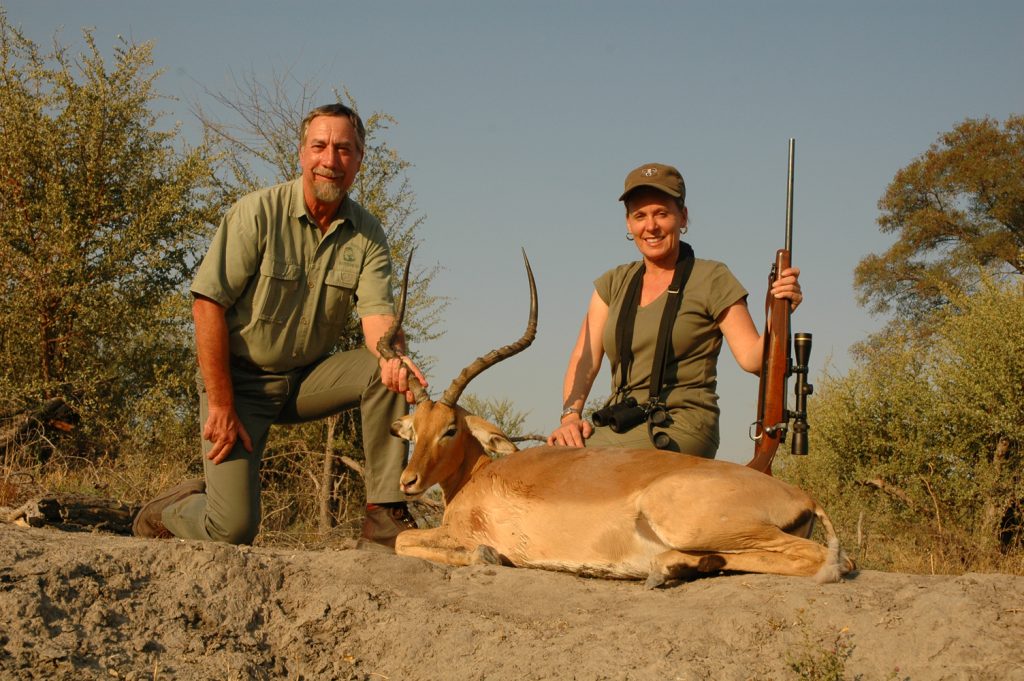
Johan Calitz and Donna Boddington with a very good southern impala from Botswana, with good shape and long, parallel tips.
As I’ve often said, common game isn’t always so common. Impala are usually plentiful and highly visible. However, all predators love impala, so they are extremely nervous, constantly alert, and usually difficult to approach. And, like exceptional specimens of most plentiful animals, really good impalas are few and far between.
A big ram may be found as the patriarch of a large harem, making the approach difficult because you must stalk past sharp-eyed ewes. Older rams are also found in bachelor groups, often of like age, so now you must sort him out through a shifting forest of similar horns. Most of the time it takes multiple stalks to get a shot.
The legend that African game is somehow “tougher” than other game is mostly malarkey. However, pound for pound, the little impala, maximum 150 pounds, is one of the tough ones. Perhaps it’s because they are always keyed up, but an impala must be hit properly, or else you’re in for a long tracking job. It was on one of those long tracks on a hot day in the Zambezi Valley, following an impala hit just a bit far back, that Tim Danklef commented, “It’s a good thing impala aren’t as big as buffalo, otherwise we’d all be dead!” African professional hunters consistently exhort their clients to forget the behind-the-shoulder lung shot and go for the shoulder. Regardless of what you’re shooting, an impala ram needs to be shot on the center of the shoulder, unless you like tracking with uncertain conclusion.
If a good impala ram is desired (and one should be), then most hunters will be successful. Length of horn is all you have to go on, but shape is important. Ideally, you want the bottom half of the horns to flare out, then end with long tips that are more or less straight up and parallel. Not all impalas achieve this shape, but a ram with tips that curve inward usually has some growing to do.
We identify three races of impala. Most widespread and plentiful is the southern impala. The East African impala is larger in body with much longer horns. Most limited is the Angolan or black-faced impala, found from Etosha Park north into Angola. A bit smaller in both body and horn, the black-faced impala is distinguished by a prominent black stripe down the nose. Regrettably, this impala in not importable into the U.S., a fact that greatly hampers management.
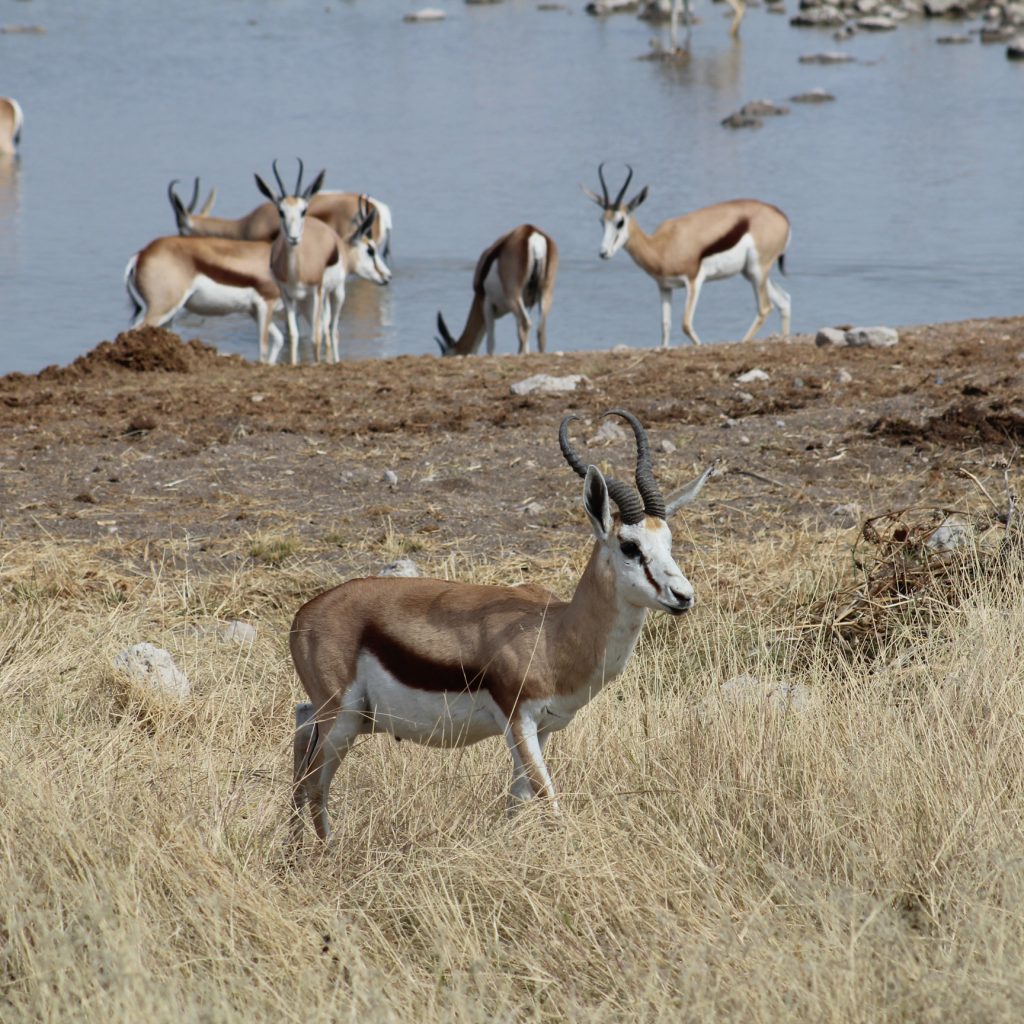
A herd of springbok drinking in Namibia’s Etosha National Park. In southern Africa’s deserts the springbok is the most common antelope, sometimes seen in hundreds.
Impalas are generally not found in deserts, nor in marshy habitat. In the deserts of southern Africa, the springbok takes over as the most common medium-size antelope. The national animal of South Africa, the springbok is technically a pseudo-gazelle, while in arid country in East and North Africa his place is taken by one of the several true gazelles, ranging in size from very small, like Thomson and Dorcas gazelles, to the various races of Grant gazelle, which are similar to the impala in size. All these desert antelopes are hunted much like we hunt our pronghorns; they are sharp-eyed open-country animals that are difficult to stalk. They’re also small targets that require longer and more precise shooting than many African antelopes.
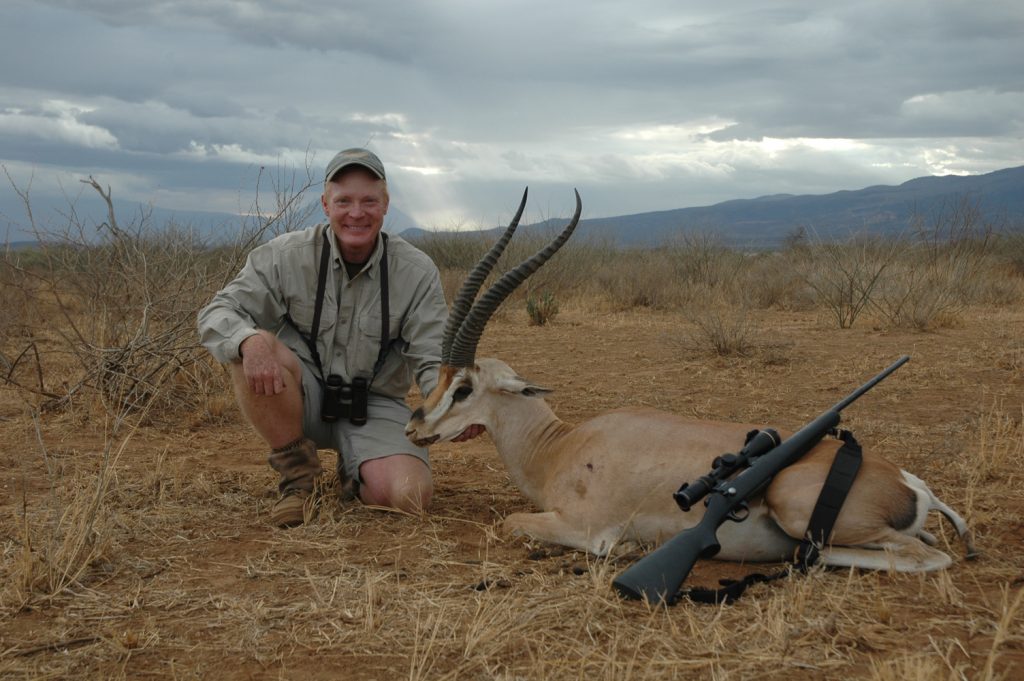
In arid country in North and East Africa the gazelles typically become the most common antelope. This is a Grant gazelle, one of the largest in body size…just one of at least twenty different varieties of gazelle.
In grasslands, and on floodplains near marshy areas, the reedbucks often take over as the most common antelopes. From Natal up through coastal Mozambique, the common reedbuck is far and away the most plentiful medium-size antelope. In the big Coutadas near the mouth of the Zambezi impalas occur, but they are uncommon, while hundreds of reedbucks might be seen daily. The common reedbuck varies from tan to gray. A blocky, robust antelope, he is heavier in the body than the impala, with straight, ringed horns that curve outward and tilt usually tilt forward into sharp tips. All the reedbucks have soft, pulpy bases, incipient horn growth that is difficult to preserve. The common reedbuck is widespread in northeastern South Africa, and extends northward into Tanzania. By the way, reedbuck are even tastier than impala.
There is just one common reedbuck, but there are two other species, the mountain reedbuck and bohor reedbuck, both with multiple races. Bohor reedbuck are much smaller, a typically a brighter, yellowish tan, with short, thick horns, rarely with much spread and a radical forward curve. We divide them into regional groupings, to me visually indistinguishable. The East African bohor reedbuck starts in Tanzania and is common in Uganda. The Sudan bohor reedbuck is found to the northwest; the Abyssinian bohor reedbuck in Ethiopia. Farther west lies the Nigerian bohor reedbuck; and in West Africa the Nagor reedbuck. Typically, the bohor reedbucks are found in pairs and small groups in grasslands, often near riverine cover or marshy habitats.
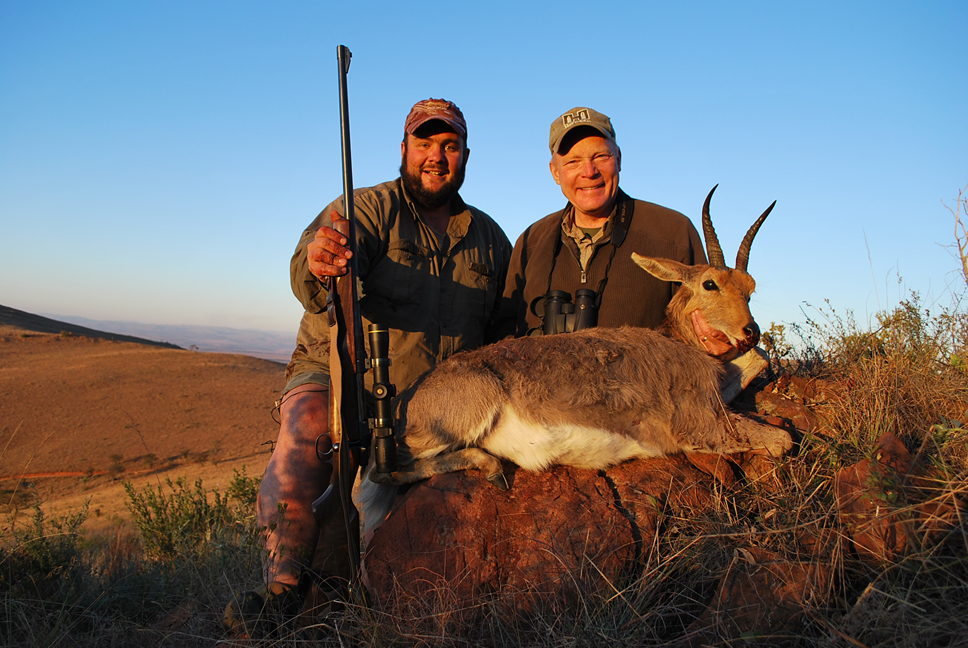
Charl van Rooyen and Boddington with an exceptional southern mountain reedbuck, glassed from afar and stalked in its bed.
Smaller still and gray in color are the mountain reedbucks, typically found on grassy slopes at higher elevations. Most numerous and widespread is the southern mountain reedbuck, found in most of South Africa’s ranges. Even smaller, the Chanler mountain reedbuck is found on some mountains in Masailand, on north through Kenya into Ethiopia, and on west into Uganda. Smallest and rarest is the western mountain reedbuck, known to occur in just a couple of spots in northern Cameroon. Long protected, I actually saw one while hunting eland in the Mayo N’Duell block. It was unmistakable small and gray, definitely not a bohor reedbuck.
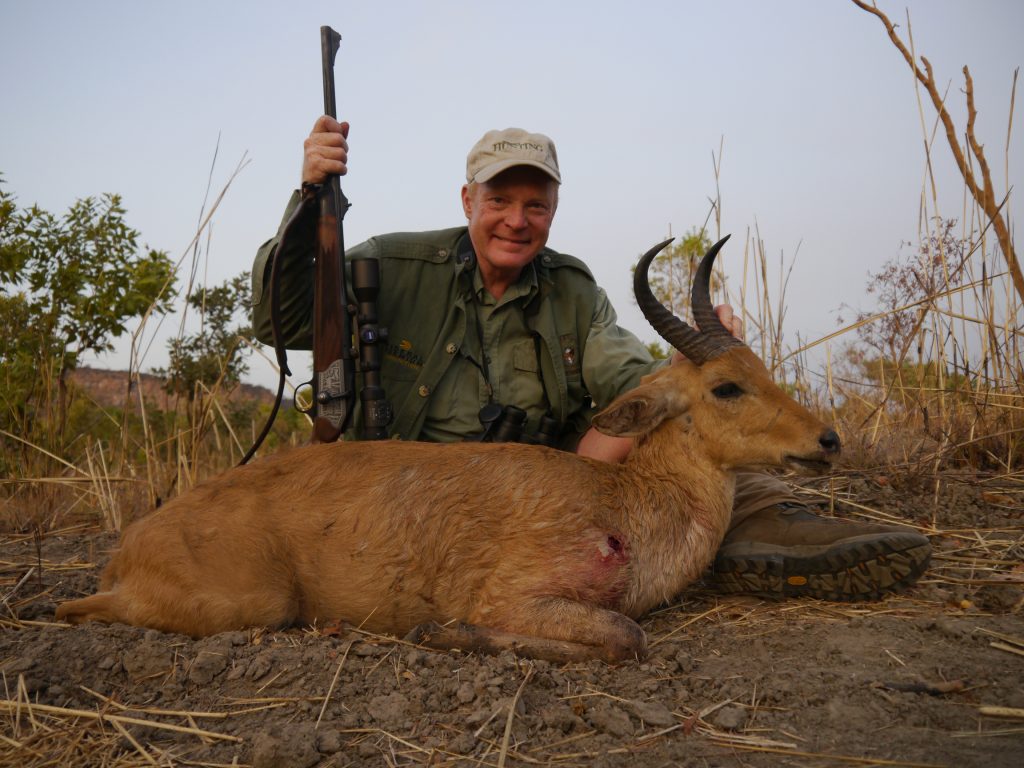
A Nagor bohor reedbuck from eastern Burkina Faso with classic forward-pointing horns.
When disturbed, the reedbucks give a shrill and distinctive alarm call, which is one way of locating them. Unless badly spooked, all the reedbucks are likely to run a short distance and then go to ground in the long grass they love. Mark the spot well! That’s an opportunity for a stalk, but it’s likely to result in a running shot when the animal jumps up at your feet.
In western Uganda we run out of the impala’s range, but there’s a lot of great hunting country to the west, north of the forest and south of the Sahara, all the way across the huge bulge of West Africa. In proper habitat there are bohor reedbuck throughout, but across this huge region the kobs usually take over as the most plentiful and widespread medium-sized antelope, and become the “common game.”
This is a spectacular western kob! (Photo by Christophe Morio)
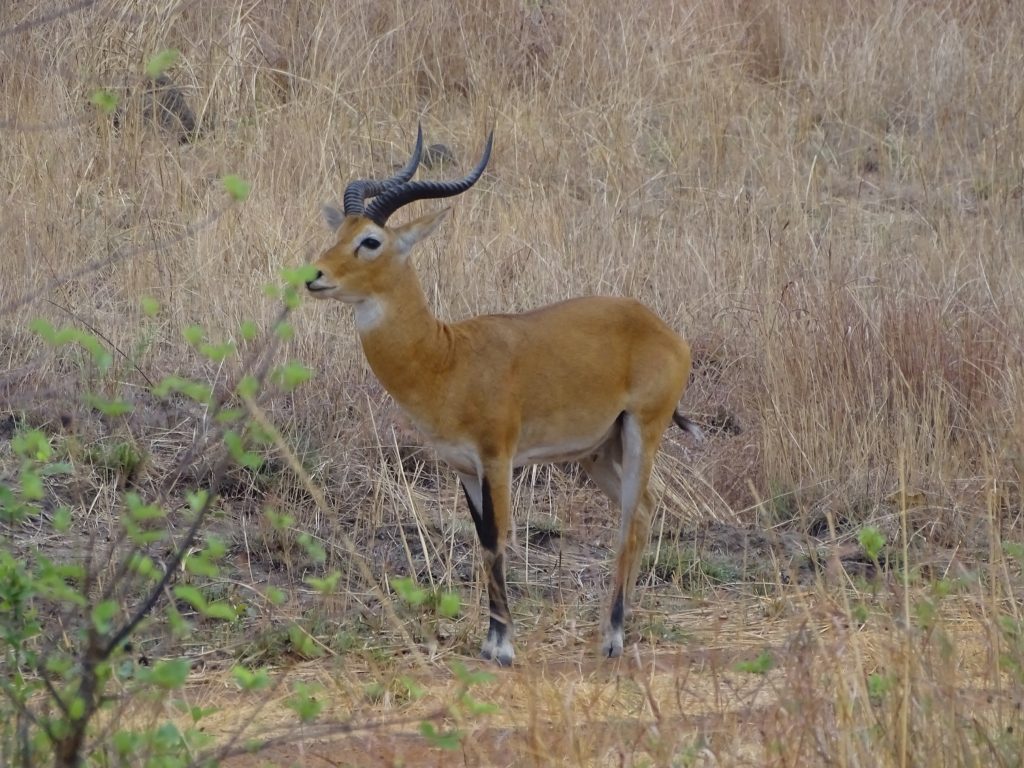
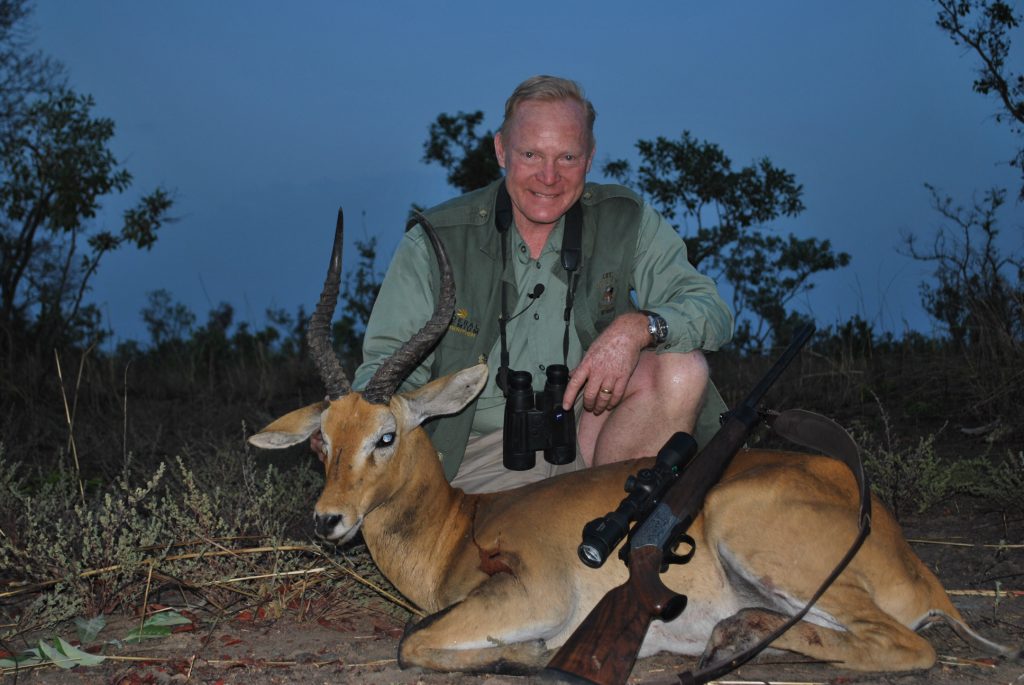
The waterbucks, kobs, lechwes, and reedbucks are related, and are all associated with well-watered areas with lots of grass. The puku, also known as Vardon’s kob, is discontinuous from Angola across Zambia and into southwestern Tanzania. The white-eared kob, though common in South Sudan’s East Equatoria, hasn’t been hunted since the early 1980s. Just this year, a white-eared kob was seen in Uganda’s Karamoja, not far from the Sudan, the first known sighting in decades. Uganda’s national animal, the Uganda kob, is plentiful in northwestern Uganda, and probably is the most common antelope. The smaller western kob is found north of the forest in C.A.R. and Cameroon, and extends westward across the Sahel to Guinea.
The Uganda kob and white-eared kob are about the same size, up to 200 pounds, with thick, ringed, lyre-shaped horns up to about 24 inches. Mature white-eared kob have distinctive white ears, white facial markings and white underparts, and are the darkest, with some males almost black. The Uganda kob has more muted white markings with reddish body color. The western kob is smaller, up to 150 pounds, with smaller horns and a lighter, more golden body color. Farther west, both body and horn size declines, and to my eye body color keeps getting lighter. Because they are smaller, some references separate the kob from Nigeria westward as West African kob. In the few hunting areas in the Sahel—northern C.A.R., northern Cameroon, northern Benin, and eastern Burkina Faso—the kob is definitely the most plentiful antelope. It is a handsome animal, and, like all of our “most common” antelopes, it is very tasty.
The farther you get to the west the smaller the kobs become. This is a pretty good specimen of western (or West African) kob from Burkina Faso.
A unique pro-hunting curriculum is teaching outdoor skills to tens of thousands of public school students every year.
Above: Students in the Outdoor Adventures program at Mount Pleasant Junior High School work on their fire-building skills.
School sure has changed a lot since most of us in the older generation went through it. I often reminisce with hunters who remember when it was no big deal to stash a .22 rifle in their locker for an after-school small-game hunt. In my Pennsylvania school district, the first day of buck season and the first day of doe season were both school holidays. As my dad, a history teacher, once told me, that wasn’t because the administration worried the kids wouldn’t show up. It was because they knew the teachers wouldn’t.
Things sure have changed in schools today, especially middle and high schools in urban areas. Most teachers have little or no knowledge of the role hunting plays in wildlife conservation, and many pass on an anti-hunting message to their students, intentionally or not. Many kids have never had the chance to learn outdoor skills, and far too many spend their leisure hours glued to a phone or computer screen instead of exploring woods and fields.
But what if we could teach outdoor skills—including hunting, shooting, and fishing—in schools? What if such a course also explained sustainable use and the North American Model of Conservation? Amazingly, there is exactly such a curriculum, right now, in more than 500 middle and high schools in 35 states across the country—and I’m not talking about just rural schools. Tens of thousands of kids in big-city schools are getting a full-fledged education in the great outdoors, thanks to the work of the Outdoors Tomorrow Foundation (OTF).
The nonprofit OTF, based in Dallas, Texas, has reached more than 250,000 participants through its Outdoor Adventures curriculum since its inception. The foundation started in 1981 as a regional entity called the Dallas Ecological Foundation. In 2014 it received an infusion of new funding, renamed itself, and went national. Since then, participation in the Outdoor Adventures program has skyrocketed, netting an average of 30 percent more participants and schools every year. Students get a PE credit for taking the class, and in nearly every school where it’s offered, demand to get into the class is high. This year there are 50,000 students enrolled.
OTF education coordinator Scot McClure noted that 90 percent of the participating schools are found in urban areas. “The outdoors has no bias,” he said. “Everyone can enjoy the outdoors as long as someone shows you how to do it. That’s what we do.”
He also cited several examples of how these classes are especially effective at reaching many troubled and non-engaged students, giving them a newfound confidence. “They’re not afraid to admit ‘I’ve never caught a fish. I don’t know how to hold a rod and reel,’ because the curriculum is designed to teach you the basics and build you up,” he said. “It gives them all a chance to see success. Now you have a bunch of students who want to be in class, who want to be in school, and behavior improves.”
The program is not only a potential game-changer for the teens, but also for wildlife conservation. The North American Model of Wildlife Conservation is a primary focus in the Outdoor Adventures curriculum. Nowhere in public school education is this strategic model presented except in Outdoor Adventures. Not only that, every student comes out of the course having completed his or her hunter education certification, even though most of them didn’t know anything about hunting when they enrolled.
“We’re teaching students to have an appreciation for wildlife,” he said. “We have wildlife today because we have folks out there that will spend extra money on licenses and extra money on gear and ammo. All those extra taxes go back towards saving wildlife.”
School may have changed a lot since I was there, but I envy today’s kids who have the chance to take an Outdoor Adventures class. To learn more about this great program, and to find out if the curriculum is offered in schools in your neck of the woods (and to help get it started if it isn’t), go to GoOTF.com.