Sports A Field

Prep Time

How to prepare for the upcoming hunting season.

Here in North America, most hunting seasons are geared around autumn. We American hunters are accustomed to short autumn seasons that we look forward to and plan around. Many European hunters, on the other hand, enjoy a six-month roebuck season spanning spring, summer, and fall. Some African countries have set seasons and others do not, but ideal times generally trend toward either cooler months or the dry season. But here in the U.S., our long-awaited hunting seasons are almost upon us, and we want to be ready!

GET IN SHAPE. Keeping in condition is probably the most time-consuming item on my list. And, as I’m unfortunately learning, the older I get the more constant effort is required. “In shape” is a flexible term, depending heavily on your age and overall health, and just as heavily on the kind of hunting you want to be ready for. Hunting whitetails from stands is probably the most common American hunting situation. You don’t need to be an Olympic athlete, but you need to be able to get to and from your stand and be limber enough to get in and out safely (if not gracefully).

Mountain hunting on foot is a different order of magnitude, and most everything else is somewhere in between. I’m neither a marathon runner nor a personal trainer (and for sure I’ve never had a personal trainer!), but I can offer a few thoughts. First, being in shape for hunting season is not an exam you can cram for. How long it takes depends on your starting point and the level of condition you wish to reach, but we’re talking regular exercise for weeks, perhaps months and even years. Therefore, it’s best to establish some sort of regimen and stick with it, although you can certainly step up your program as a particularly challenging hunt nears.

Second, always see your doctor before starting a new exercise program, and listen to your body. Muscle soreness is normal, but no matter what you’re doing, work up slowly and don’t overdo it: If you hurt yourself, you’re defeating your purpose and delaying your goal.

Distances, difficulty of terrain, and required load varies widely, but most hunting requires at least some walking, at least a light pack, and usually does not require sprinting or long-distance running. Therefore, I am convinced that walking is the best preparation for most hunting. We walk the dog regularly, and pound some of hiking trails near home in the coastal mountains with packs and hiking poles. These days, I strap on knee braces! In between, I go to the gym, focusing on primarily cardio and lifting light weights. Unfortunately, I travel a lot, and travel plays havoc with any fitness schedule. If I can’t do anything better, I jog wherever I am. This year I ran almost daily while in camp in Cameroon, again in Namibia. You need a safe place, but little space and equipment. Walking is as good and maybe better, but takes longer!

I don’t recommend taking up jogging, certainly not without a doctor’s clearance. However, you have to figure out what works for you. I’m too uncoordinated for team sports, I don’t play golf, and traveling with a bike is awkward. Long-term running is hard on the body but, thanks to the Marines, I’ve run all my life. So, when I’m short on time, I strap on my knee braces. These days, I can’t justify my Forrest Gump shuffle as “running”–but, for the purpose, it’s more a matter of time and distance than speed. Again, find exercise you like to do (and thus can make yourself do regularly). Start early and stick with it.

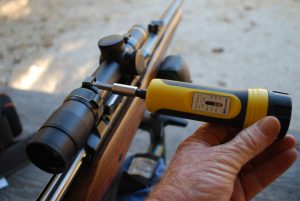
The shooting bench, with the rifle safe and muzzle pointed downrange, is a perfect place to do a careful inspection. Start by making sure all screws are tight, and finish with a thorough function check.

CHECK RIFLE AND AMMO. This shouldn’t take very long, but it can’t be left to the last minute because: What if there’s a problem? Mechanical problems can happen at any time but, typically, they don’t pop up overnight. So, whether Old Betsy has been in storage since last season, or is an old friend that goes to the range often, this final grace period before hunting season is a good time to do a careful butt-to-muzzle inspection. Make sure all screws are tight: Action, scope mounts, and rings.

Obviously, you want to do this in complete safety, so I follow an important member of the “Ten Commandments of Gun Safety” and treat guns as if they’re loaded when I take them out of the safe and make sure they’re cleared and empty. One of my pet peeves is screw-in sling swivel studs that become loose. The problem with loose studs is they tend to keep working looser. If they pop out when the rifle is slung (and they can), then your rifle is likely to take a hard fall. Screw-in studs can usually be re-secured with Loc-Tite or epoxy.

Visual inspection and this kind of trouble-shooting can be done on your workbench. Much of the rest I do on the range because, unless you’re a handloader and have created dummy rounds, you need to work cartridges through the magazine and into and out of the chamber to do proper function-checking. Made sure that the basic functions of feeding, extraction, and ejection are smooth and trouble-free. Since we’re at the range, actual firing will also be checked.

It’s unusual for something bad to suddenly develop, but it can happen. Extractors, ejectors, and springs can become worn. When this happens either a trip to a gunsmith–or time to locate parts–is in order, which is why this stuff shouldn’t wait until the last minute. Sometimes, however, a good cleaning can fix the problem. Rust can develop in storage, and excess lubricant can collect gunk and inhibit functions.

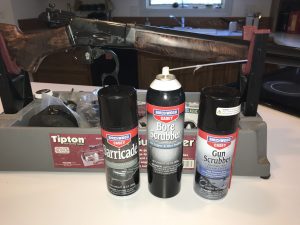
Boddington does most of his gun cleaning at the range, making sure he includes cleaning gear with his range kit. The only advantage to doing it at the range: After cleaning you can fire fouling shots, and then your rifle is ready to go hunting.
I wouldn’t wish to admit this in front of my old Drill Instructor, but I don’t necessarily clean my rifles every time I fire them. It depends on the conditions, and how many shots down the barrel since the last cleaning. Instead, here’s what I do: I take my cleaning gear to the range for the last practice or zero session before I take a rifle on a hunt. Then, when I’m just about done and I’m happy with the zero and the load, I clean thoroughly on the range. Most rifles put the first couple of shots from a freshly-cleaned barrel to a different point of impact than after the barrel is slightly fouled (which, with my rifles, is a more natural state!). The difference is often slight, but can be a couple of inches. So, after cleaning and when I’m all done, I fire two or three “fouling shots.” Then I’m really done, so I’m ready to pack up.

Except for one more thing. Toward the tail end of that last range session before a hunt, it’s wise to run all the cartridges you’re taking with you through the magazine and into and out of the chamber. Just recently I was in camp with a gent who had a gorgeous rifle. Half his ammo was somebody else’s handloads—and they wouldn’t chamber in his rifle. Yeah, I know how silly this sounds, but obviously it happens. I don’t shoot other people’s handloads, and I don’t loan mine to anyone else. Problems with factory loads are rare, but once in a while you run into a dented case, bad case mouth, etc. It’s wise to visually check all ammo for a hunt, first to make sure everything matches, and then to make sure all cartridges feed and chamber in your rifle.

PRACTICE SHOOTING. Shooting practice really should be ongoing and continuous. As with conditioning, no one can say how much is enough, but nobody can spend too much time practicing. The only caveat to that is don’t overdo it: If you beat yourself up and acquire a flinch it’s gonna take a lot of work to undo it. So, practice smart. With hard-kicking rifles, limit your exposure per range session. Half a dozen or ten shots may be plenty, and twenty is probably too much. Intersperse with a good old .22 or a mild-recoiling varmint rifle.

Much effective practice shooting can be done with a .22, minimizing recoil and cost, and reducing barrel-cooling time on summer days. Everything you need to know about shooting over sticks can be learned with a .22.
A solid benchrest is essential for checking zero and evaluating loads, but in my view shooting off the bench isn’t practice for hunting. Get away from the bench and do as much shooting as you possibly can from positions you might actually use in the field: Shooting sticks, bipods, impromptu rests, and the good old basic NRA shooting positions of prone, kneeling, sitting, and standing. Whatever your hunting rifle happens to be, you need to shoot it enough to be completely familiar and comfortable, but a lot of this practice shooting can be done effectively with a good old .22, with no recoil and little cost.

I love long summer days, when you can start shooting early and stay late if you wish. However, summer heat changes the game. Barrels heat up quickly, and the pencil-thin barrels common on light sporters today heat up very quickly. Accuracy can deteriorate fast, so it’s important to be patient and plan on spending a lot of time waiting for barrels to cool. How long, and after how many shots depends on ambient temperature, bullet velocity, and barrel thickness, but you can’t learn anything shooting a hot barrel. Take your time, and spend more time shooting your .22.


Leave a Comment

Explaining Ourselves

A new study provides some practical insights on how to talk to non-hunters about the importance of hunting.

Almost every hunter has been asked the question at some point: Why do you hunt? Sometimes it’s framed more negatively: How can you kill an animal?

When you’re asked such a question, don’t get defensive. Answering thoughtfully presents a great opportunity to communicate the benefits of hunting to someone who probably doesn’t know much about it and doesn’t (yet) have an opinion about it.

Recently, the Colorado Wildlife Council (the entity behind the state’s “Hug a Hunter” pro-hunting ad campaign) commissioned in-depth exploratory research aimed at providing guidance to the Council on how best to continue to reach out to non-hunters to increase support of hunting and fishing. The research, conducted by Benenson Strategy Group, a global research firm, Is some of the most in-depth research ever done in terms of delving into how non-hunters feel about what we do, and it provided some fascinating insights that any of us can use any time we talk to a non-hunter about hunting.

The researchers conducted the study in three phases, surveying 969 registered Colorado voters in early February. The study focused on voters aged 18 to 35 who neither strongly support nor oppose hunting. First, online journals helped the researchers get an idea of the mindset and core beliefs that shaped non-hunters’ views. Second, in-person focus groups explored arguments for and against hunting and tested their effectiveness. Third, the researchers combined the results from the first two phases and quantitatively tested the best support and opposition messages and explored why they did or did not succeed.

One of the most important findings was that non-hunters typically don’t feel strongly about hunting one way or another, so they are receptive to hearing arguments on both sides. That presents an opportunity for hunters—and also for anti-hunters—to sway them. Interestingly, some 80 percent of the people in the survey said they know someone who hunts. That means hunters have the opportunity to reach out to a large percentage of non-hunters with a positive message.

The non-hunters in the study had, overall, a surprisingly live-and-let-live attitude. They professed respect for individual liberties and the rights of others. Asked whether hunting was something people should have a right to do, regardless of how they personally felt about it, 87 percent either strongly or somewhat agreed.

Researchers found, however, that most non-hunters did not think that hunting affected them personally in any way, so it was important to make clear that hunting has direct benefits to them. The most effective arguments for hunting involved the fact that license fees from hunting are major sources of funding for forests, rivers, and places they hike. It’s crucial to tie hunting’s benefits back to the things people personally enjoy. This includes the fact that most non-hunters appreciate seeing wildlife, and revenue from hunting is the most crucial source of funding for protecting, improving, and managing wildlife populations.

They also found it was effective to humanize the economic benefits—letting them know that individual taxpayers would have to pay more if hunting were restricted, and highlighting the many small-business owners, manufacturers, and people in the tourism industry who would be hurt by hunting restrictions.

In addition, the researchers found that almost all of the non-hunters in the survey had deep concerns about animal welfare, and little knowledge of hunting laws or how hunters utilize their animals. There is a prevalent “trophy hunting” myth that makes many people think hunters simply take the heads or antlers and leave the meat in the field. Learning that it was illegal to waste the meat of animals hunted was both eye-opening to many of the people in the survey, and a very persuasive fact for the pro-hunting side. Hunters often do not realize how little non-hunters know about hunting regulations. When people learn the simple fact that hunters are required by law to take the meat of animals they harvest, and utilize the hides of furbearers, and that they can be punished with fines and criminal charges if they don’t, it can make a big difference in how they feel about hunting.

The researchers also tested several arguments that did not prove particularly effective in swaying non-hunters’ opinions. One was the argument that hunting is an important part of human culture and heritage. This is something that is very important to hunters, but proved of little interest to the non-hunting public.

Overall, the findings boiled down to four main points that any of us can easily use when talking to a non-hunter. Start by building a connection with the person via our shared respect for individual liberty: Even though not everyone hunts, we can all respect the rights of others to do so, just as we respect people’s rights to engage in many other activities. Second, make clear that hunting benefits them personally: License fees protect and provide access to the land you use for hiking, and helps manage and improve populations of wildlife you enjoy watching. Third, confront their animal-welfare concerns: Hunters make every effort to kill quickly, cleanly, and ethically; the meat is required to be utilized; and there are many hunting regulations in place. Last, talk about the economic benefits using specific numbers, and then put them in human terms: Hunting supports 27,000 jobs in our state and contributes $3 billion to the state economy, and further restrictions on hunting would have dire consequences for small business owners, tourism providers, and individual taxpayers.

This research will help guide the Colorado Wildlife Council in crafting future messaging to reach out to the all-important “70 percent in the middle” who will have a direct effect on our hunting in years to come. It can also help you and me to do our part to talk to people we know and help them understand that even if they don’t hunt, hunting is important to all of us, with direct benefits to our public lands, our wildlife, and our economy.

Learn more about how to spread a positive message about hunting by contacting the Nimrod Society via www.nimrodsociety.org. The Nimrod Society’s mission is to educate the public about the important contributions hunters and anglers make to society and conservation.

Leave a Comment

Conservationists Should Support Trophy Hunting

Courtesy of PERC
Photo courtesy of Ragnhild & Neil Crawford.

With the Intergovernmental Science-Policy Platform on Biodiversity and Ecosystem Services (IPBES) reporting that 1 million species are at increased risk of extinction in the coming decades, ending trophy hunting may seem logical. However, bans on trophy hunting are likely to increase the challenge of conserving the world’s biodiversity. This is why 133 conservation researchers and practitioners, myself included, signed a letter published in Science Magazine last week highlighting why the trophy hunting bans currently being debated in the United States, United Kingdom, and Europe Union are ill advised.

Read more here: https://www.perc.org/2019/09/06/conservationists-should-support-trophy-hunting/

Leave a Comment

Sports Afield Makes the List… Again!

For the fourth year in a row, Sports Afield was selected as one of License! Global magazine’s Top 150 Global Licensors. License! Global magazine is the leading publication in the brand-name industry. The editors compile a list of the top 150 global brands each year.  We again made the cut in 2019, and we cannot not tell you how proud we are.  To be ranked among Coca Cola, NASCAR, Stanley, National Geographic, and Lamborghini is a thrill. Thank you to the network of Sports Afield Trophy Properties brokers, the Sports Afield Consumer Product company out of Kansas City,  and to Team SA and SATP here in Huntington Beach, as well as our team members in Idaho and Colorado.


Leave a Comment

Hunting the Giant Rat

Is the capybara South America’s most interesting animal?


Among other regrettable traits, I have a terrible addiction to taxidermy. I’m trying to curb it, but I have some pretty cool stuff in my house. Visitors don’t exactly ignore the big cats, the African antelopes, or the sheep and goats, but there’s one animal that, consistently, almost everyone asks about. It’s a life-size capybara, perfectly mounted by the folks at The Wildlife Gallery in Michigan, and it looks like a giant-size guinea pig. Which, in fact, it is!

The capybara, locally called carpincho, is by some margin the largest rodent in the world, potentially weighing over 150 pounds. The orderRodentia, with outsized front teeth for gnawing, is large and diverse. Like the familiar guinea pig and hamster, the capybara has a very short tail and completely oversize head. Size-wise, no other rodent approaches it. Next in size is the paca, also a South American animal, but the paca isn’t even a quarter the size of the capybara. Semi-aquatic, the capybara lives along waterways, lakes, and estuaries from northern Argentina up through the Amazon Basin. It does not extend up into the isthmus of Central America and is not found north of the Panama Canal. Surprisingly, its smaller cousin, the paca, extends into southern Mexico, so is technically both a South American and North American animal. Ground-burrowing and very nocturnal, I hunted paca in Mexico’s Yucatan. It’s an interesting animal (and also very tasty), but not nearly as cool as the capybara.

Hunting always depends on time and place. (Ideally, through planning, you put yourself in the right place at the right time.) However, luck is always a factor, so difficult animals can come easy, and common animals can come hard. The old saying, “never look a gift horse in the mouth” is totally true, but when success comes easy the overall experience suffers, and so does knowledge. So it was with capybara.


Boddington shot this medium-sized capybara in Argentina’s Santa Fe Province in 2008 and had it mounted.
Back in 2008 I was hunting in Argentina’s northern Santa Fe Province with Marcelo Sodiro. Of course, I wanted a capybara. The area didn’t have large numbers of them, but they were certainly present. Early in the morning we hunted along waterways with hounds, hoping to catch capybaras out in the brush. This was fast-paced hunting: When the dogs lit up, the capybaras would head for water, so the game was to race ahead of the chase and catch them before they reached their sanctuary. I shot two that way, one with a buckshot-loaded shotgun and another with my 7×57. Both were good-sized capybaras, and it’s the larger of the two that I have mounted. I agree with my occasional visitors: It’s one of my favorite mounts! However, those two were the only capybaras I actually saw, so that chapter closed with me knowing almost nothing about them.

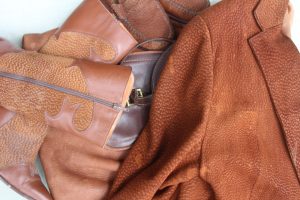
Most shops in Argentina will have an assortment of carpincho leather products, from handbags and wallets to packs, footwear, and jackets. The distinctive pebble-grained leather is nearly waterproof, usually showing marks from fighting. Capybaras for leather are generally farmed for the purpose, not hunted in the wild.
Well, not exactly nothing. I knew of their affinity for water, I knew their meat is highly prized and tasty, and that their hides make awesome leather that is pebble-grained and essentially waterproof. Carpinchos are widely farmed for both meat and leather, and throughout Argentina (and elsewhere in South America) you can find footwear, handbags, jackets, and more made from their attractive and distinctive leather. Rarely are the skins perfect. Capybaras fight viciously with those razor-sharp teeth. The leather shows distinctive scars, and when we were hunting with hounds I was urged to shoot quickly and decisively to avoid risk to the dogs.

In March 2019 I was again hunting with Marcelo Sodiro’s South American Adventure Safaris, a complex trip that started in the north with some dorado fishing and bird-shooting, and finished down in Patagonia where the red stags were roaring. The second stop was at Malalcue Lodge in the northern Corrientes Province, where my hunting partners and I hunted free-ranging axis deer and blackbuck. Area manager Sergio Wizensky, who I’d hunted with before, let slip that the ranch we’d be hunting was overrun with capybaras.

Most hunting in Argentina is for introduced species, but, subject to seasons, a few native species are still huntable, including brocket deer, peccaries, and capybara. Sergio told me that, if we had time, we could hunt capybaras and perhaps find a really big male. Regrettably, native game can no longer be exported, but I was still intrigued. I wouldn’t have another one mounted anyway—and I wanted to learn more about this strange animal.

It was a sweltering midday and we were fruitlessly stalking blackbuck in tall grass. Rains had been generous and the low spots had formed into small lakes or lagoons. So, sweating and searching for small antelopes swallowed up by the grass, I glassed along the shore of a lagoon and saw the first of a dozen capybaras slipping along the edge. As the day went on we would see more, near almost every pond or stream. The place really was overrun with them! Later that day we got really lucky and shot a very fine axis deer, so the capybara hunt was on.

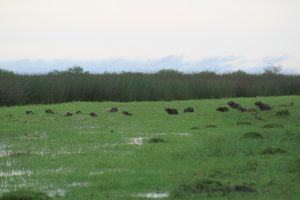
Capybaras gather in family groups or packs. I count fourteen in this photo, but there were actually over thirty in this pack.
Capybaras typically form into herds or packs; a dozen to twenty is common, but along one swampy area we counted more than thirty in one group. Having never seen them in the wild, I was struck by how rodentlike they really are in appearance: At a distance they reminded me a lot of prairie dogs. Water, however, is constant. They will never be far from it, spending much of their time partially submerged. When alarmed, they will immediately head for deeper water, splashing in much like a pod of hippos.

This was fascinating but, remember, our mission was to find a big male—and that’s where my real education began. When looking at a group it’s pretty easy to tell which ones are larger than most of the others. It’s also easy to see which ones are alone, and which are obviously mothers with young. However, as with many rodents, the females are often larger than the males. Obviously, there are no horns or antlers, and in grass or water, evidence of sex is always completely hidden. Typically, the dominant male will be at the edge of a pack, often a few yards away. However, the only surefire tell-tale sign is tricky: The males have a raised oval bump on the snout just in front of the eyes that the females do not have. With age, this bump becomes more prominent and almost hairless. Marcelo and Sergio have lived with capybaras their entire lives; with binoculars they could instantly pick out a male at two hundred yards. I could not!

On this ranch they are hunted little and were quite calm, and eyesight appears not be their strong suit. Combining these factors, we were able to closely approach several groups. Sergio and Marcelo painstakingly pointed out males, always off to the side, but I had to look carefully at several before I “got it.” The bump is definitely there, but you need a side profile or frontal view to see it, and even then it’s subtle, but once you see it you get the idea.

In this unusual place, finding capybaras was not an issue, so we made a number of approaches, turning down a number of males that were judged too young or not big enough. Fortunately, I wasn’t doing the judging. After a few trial runs I could see the bump, but I needed my local experts to tell me when we found the right one.

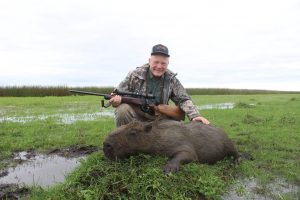
We got within a hundred yards and then I stood on sticks for an eternity, waiting for him to turn and offer a shot. He finally did, and he was indeed a very big one. The gauchos were happy: Carpincho is a real delicacy!

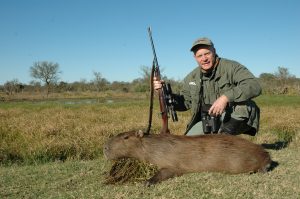
A big male capybara, taken in Corrientes Province in northern Argentina. Like bears and boars, the capybara is a dense animal, heavy for its size. I think this one probably weighed about 140 pounds. The nose bump is very obvious on this animal.
 

Leave a Comment

Adventure in the High Pamirs

High-altitude hunting and a unique cultural experience make for an unforgettable ibex hunt in Tajikistan.

The sun dipped below the jagged peaks of the Pamir Mountains, leaving them bathed in a pink glow. The evening chill descended instantly on our rock-strewn spike camp, and I scrambled to the small tent to retrieve my down jacket, fleece hat, and gloves. My friend and hunting partner, Kirstie Pike, was right behind me, and we bundled up quickly. At 14,000 feet, even a relatively mild fall evening carries a sharp chill that drives right to the bone.

As we emerged from our tent, layered in high-tech warmth, the young assistant ranger, Latifa, was waiting for us. “Come quickly,” she urged us. “You must see this!”

Figuring she and her fellow rangers had spotted some ibex on one of the many mountainsides surrounding the camp, Kirstie and I grabbed our binoculars and followed Latifa to an outcropping where our hunting team had gathered, everyone training their optics on the backlit ridge to the west. The young Tajik spoke surprisingly good English, but it was still a struggle for her to explain to us where, exactly, to look. But once I was focused on the right spot, I gasped.

“It’s a snow leopard!” Kirstie exclaimed. “I can’t believe it!”

The big cat, perfectly silhouetted on the spine of the ridge across the valley from us, strolled casually into a small saddle, its big body and long tail clearly visible through my 10X binocular. Then it stopped and sat, upright, turning its head from side to side. Soon it moved on, walking along the ridge again, then stopped and scratched at the dirt. It continued to prowl the ridgeline, slowly, as the light began to fade. Then it moved behind a small pinnacle and emerged again on the other side, hunkering down slightly.

“There are female ibexes below,” Latifa murmured. I had been so glued to the cat I had not noticed what it was stalking. The cat remained unmoving on the dizzying height above its prey, apparently not intending to make its move until nightfall. Eventually, darkness descended and we could no longer watch the drama, so we headed back into the ring of tents to warm up with some hot tea and talk excitedly about what we had just seen. Visiting Americans and native Tajiks alike, we all knew we had just witnessed something incredibly rare and special.

We had known there was at least one snow leopard in the area. Several days before, shortly after arriving at this high camp from which our hunt for mid-Asian ibex was based, the rangers had spotted its calling card in the form of a mostly eaten ibex carcass far across the valley. On our daily forays after ibex, they had pointed out several places where a snow leopard had left scratchings in the meager soil. But to actually catch a glimpse of the apex predator of the Asian mountains was more than I had dreamed of.

Spike Camp

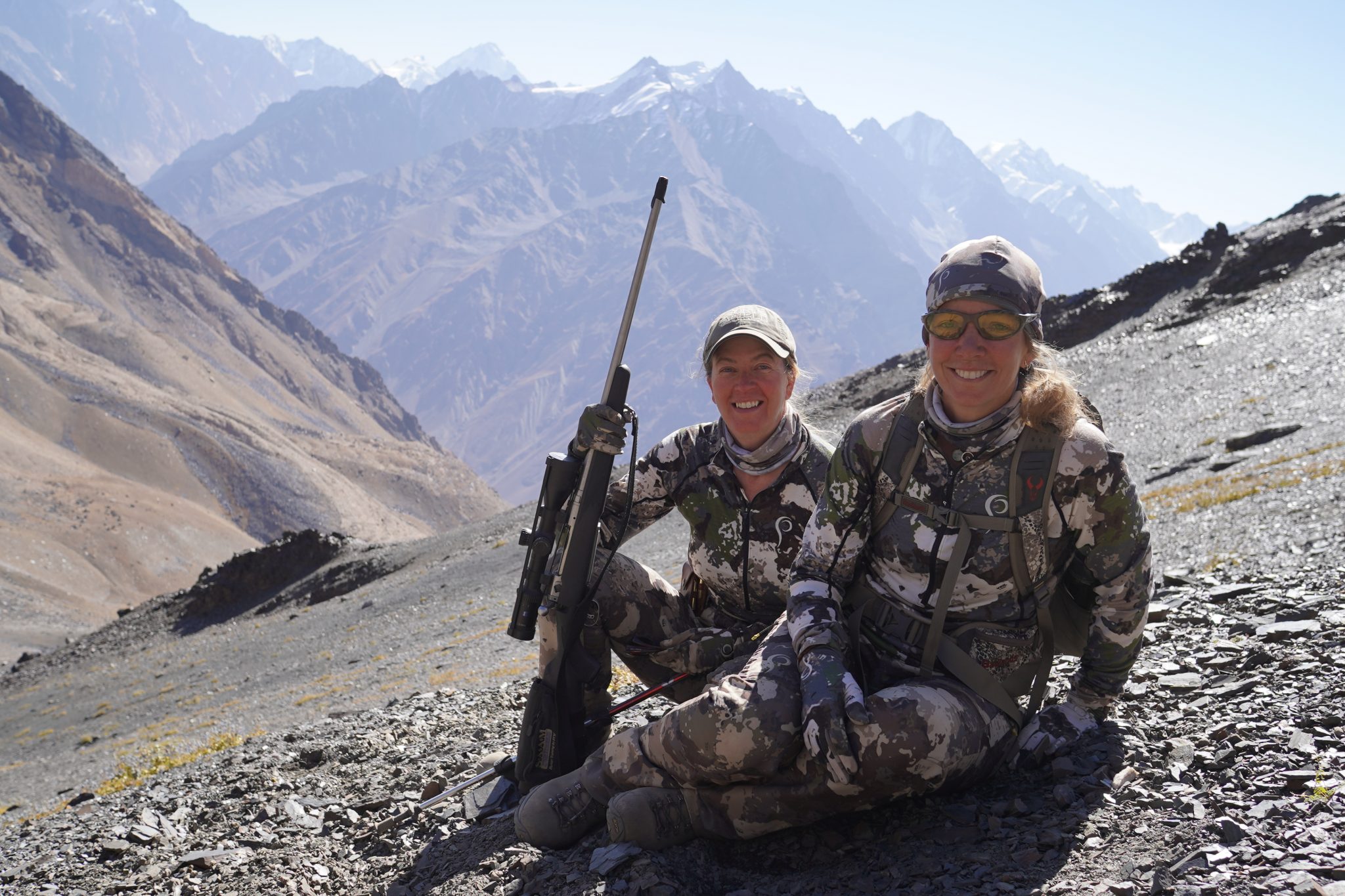
After hunting ibex in Kazakhstan several years before, I had fallen in love with the pursuit of these long-bearded Asian goats and their rugged habitat. The first hunt, while challenging, had been conducted at relatively low elevations, with the peaks of the truly high mountains looming tantalizingly in the distance. Despite taking a magnificent ibex on that hunt, I felt I needed to go back to central Asia. I wanted to experience a hunt in the Pamir Mountains, to see if I could handle a sojourn on the “roof of the world.” When the opportunity came, in 2018, to travel to a high-mountain village in Tajikistan and hunt ibex in a community conservancy, hosted and guided by the people who lived there, I jumped at the chance. I invited Kirstie, founder of Prois Hunting Gear and a fellow mountain-hunting junkie, to join me.

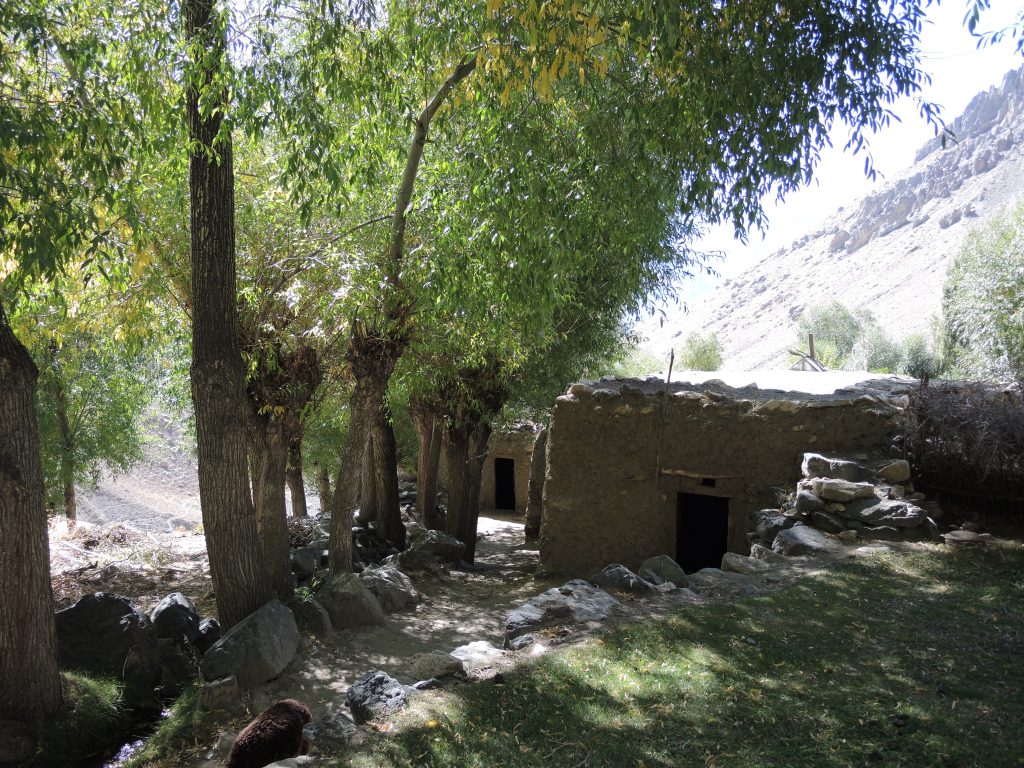
The hunt had been a full-on adventure right from the start, and it kept getting better—and tougher. We arrived at our hunting area in eastern Tajikistan, the Parcham Conservancy, via a long drive from the capital, Dushanbe, on the spine-jarring Pamir Highway, which follows the Panj River along the border with Afghanistan. From there, a four-wheel-drive trek up a winding mountain road only a few years removed from its origins as a donkey path deposited us–dusty, jet-lagged, and exhausted–in the village of Ravmed. This scattering of square houses built of earth and rock is nestled in a narrow, stunning mountain valley at 10,000 feet. It was late September; a few small, tiered grainfields were in the process of being harvested, and women were digging enormous carrots from vegetable gardens sandwiched between the carefully tended homes. Several thin donkeys, goats, and a few cattle were tethered wherever sparse grass grew.

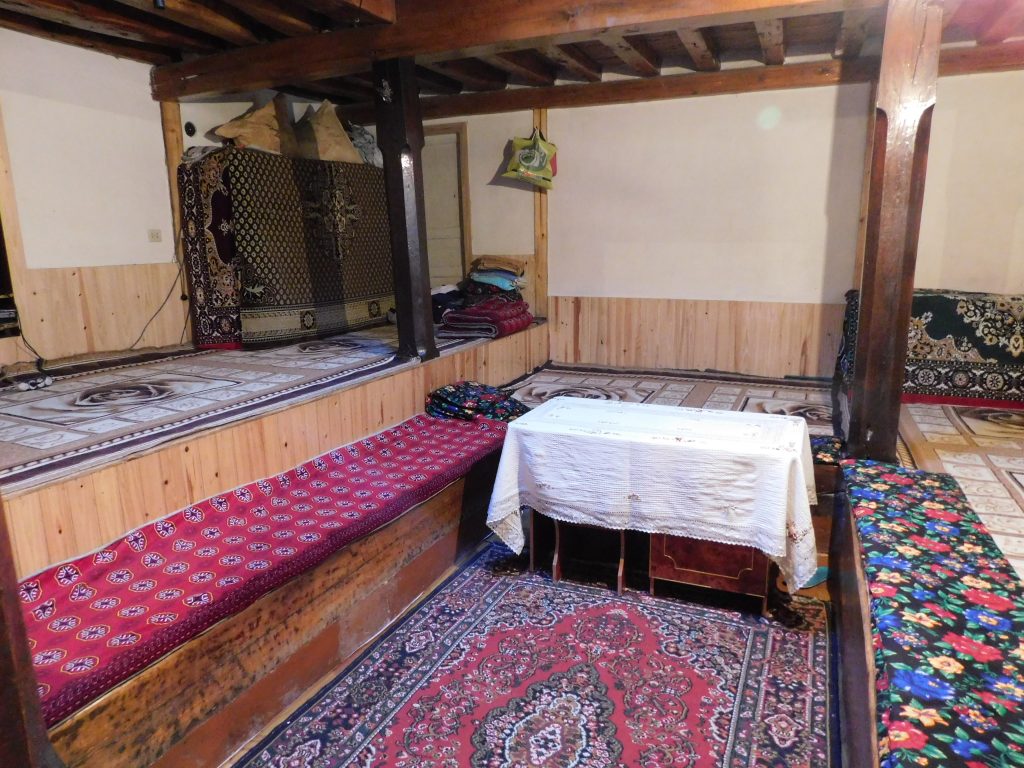
Inside a typical Pamiri home.

The residents of Ravmed welcomed us with open arms. We were ushered to our guesthouse—actually the home of one of the wealthier families in the village, who had temporarily vacated their living quarters to make room for two visiting American hunters. The inside of the traditional Asian home was clean and well-tended, its dirt floor sprinkled daily with water to keep the dust down, pretty carpets covering the seating areas and walls. The only running water came from a diverted creek nearby, and the outhouses were traditional squat style. The residents plied us with hearty food, all of it grown or raised in the village, and gallons of hot tea.

A view of the village.

The house had electricity from the village’s small hydroelectric facility, which powered a generator. This, as well as the recently upgraded road, a community-owned four-wheel-drive vehicle, and educational opportunities for young people like Latifa, were among the improvements that had come to this hardscrabble subsistence village through the money paid by visiting ibex hunters like Kirstie and me. There was a reason the villagers made us feel so welcome: We were.

But there was little time to relax and soak up this unique cultural experience. It was time to go hunting. We were instructed to pare down our gear to the bare minimum needed for a few days of camping on the mountaintop. Unsure how long we’d be up there or what we’d actually need, Kirstie and I loaded our daypacks with cameras, ammo, energy bars, a satellite phone, Diamox, and extra socks. We packed our sleeping bags and an extra layer or two of clothing into my waterproof duffel bag, which one of the Tajiks would haul up the mountain for us, along with a lightweight tent.

At 2:00 in the morning we were awakened and dressed ourselves in light, wicking layers for what we knew would be a tough climb—ascending some 4,000 vertical feet above the 10,000-foot village. A full moon lit our path, so we didn’t even need headlamps as we followed the head ranger, Gulbek, on a faint, switchbacking trail that climbed nearly straight up from the village. The guides on Tajikistan’s conservancy hunts are known as rangers. They’re local residents who know the surrounding mountains, and the habits of its wildlife, better than anyone. Many of them are former poachers who have, since the advent of paying hunts, become staunch conservationists and protectors of wildlife because of its benefits to their communities.

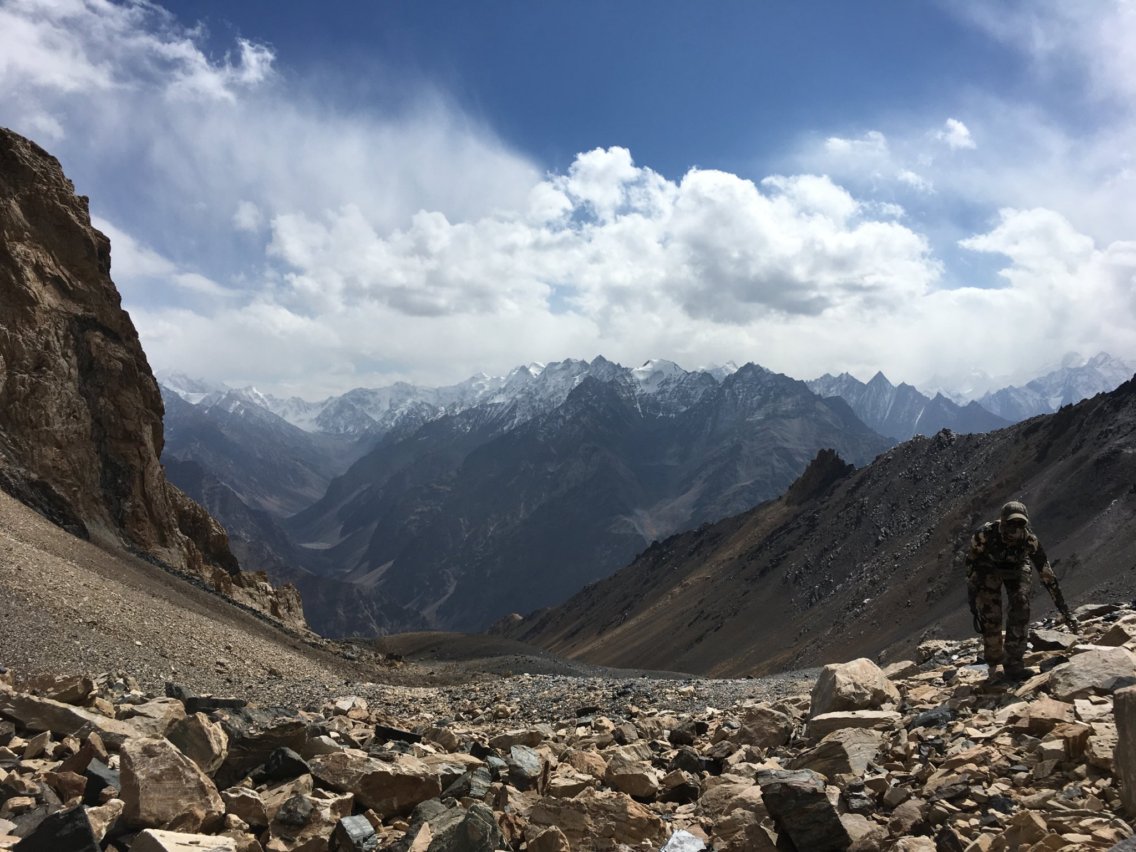
To our relief, Gulbek set a slow, steady pace, and Kirstie and I managed to keep up with him for most of the five-hour climb, with a line of other rangers and packers strung out behind us on the mountain. Every moment of the hiking and fitness routine I’d followed all summer paid off as I labored up the steep, rock-strewn mountainside. Some three hours into the hike, I stopped and leaned hard on my hiking staff, a wave of altitude-induced nausea washing over me. Kirstie, a veteran of high-altitude hiking, urged me to eat a Clif bar and drink some water. I did, and my stomach settled down and, blessedly, stayed that way.

It was a relief, around 7 a.m., to arrive at the mouth of a broad high-altitude basin. At its base was a series of rock ridges strewn with jumbled boulders. Throwing down our daypacks, Kirstie and I collapsed on the rocks, as did the packers who were hauling the tents and sleeping bags. Gulbek and another ranger, Rakhim, climbed a pile of boulders, staying low, binoculars in hand. Returning to us, they reported a group of six male ibex in the basin. In a few minutes we had recovered enough from our hike to crawl up and take a look. The goats, unfortunately, were on a wide-open slope well above us, and with the morning sun now fully up, the wind was funneling uphill.

There was nothing easy about this high-altitude hunt.

The fact that we couldn’t do much until the ibex moved into a better position was actually, from our perspective after a grueling five-hour hike at altitude, good news. Our position on a small bench beneath the basin, screened from it by the rock ridges, gave us good cover and no fear of spooking the ibex. Latifa, who was Gulbek’s daughter, and Anisa, another young female ranger-in-training, seemed unfazed by the tough hike. After glassing the ibex with us, they fired up a small camp stove, boiled water for tea, and dispensed bread, cheese, and fruit. I spent the morning and part of the afternoon alternately napping in the warm sun and staring at the stunning vista of tremendous peaks that surrounded our position like jagged fangs.

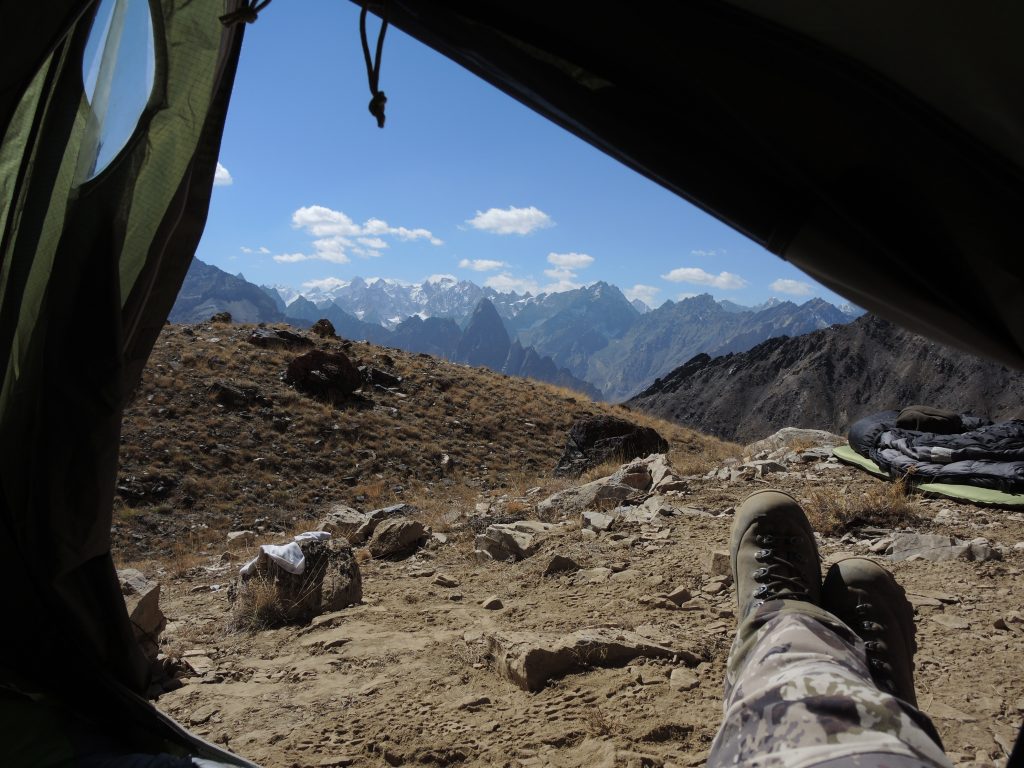
That afternoon we ventured out into the basin, hiking and climbing over endless rocks to a spot where we could get a better look at the ibex herd. There were six males, four of them quite impressive specimens, and two younger billies. The wind was still not in our favor, so around dusk we hiked back to our rocky retreat. Small tents had been set up, and Kirstie and I unpacked our sleeping bags and prepared for our first night in our high-altitude spike camp as the sun dropped behind the peaks, leaving a frigid darkness behind. We were in great spirits, thrilled to be in ibex country.

Tajik Tough

After a frigid start to the morning that made slithering out of our sleeping bags an excruciating ordeal, the sun’s rays hit the high camp and turned the day bright and beautiful. After a breakfast of hard-boiled eggs, cheese, a meat-filled turnover, and coffee, Kirstie and I and two rangers embarked on a long day of stalking the ibex herd in the high basin. We crossed the rock ridges that screened us from the basin, then skirted the eastern edge of the hanging valley, sticking to the steep, rocky mountainside, which climbed gradually but relentlessly. We had eyes on the ibex most of the day, or at least our guides did—most of the time my eyes were focused on negotiating a steep ravine or slippery scree slope.

The view from spike camp.

We worked our way clear up to the head of the basin, more than a thousand feet above camp, crawling over fields of sharp rocks that shredded our gloves, and worming our way up the crests of steep rises in the terrain. The weather was fine and sunny most of the day until we got to the highest point, when a brief snow squall blew in and obscured our view for a few minutes, but it quickly passed. We refilled our nearly empty water bottles from a small seep in the rock, and, spurred by friendly reminders from Kirstie, I continually recharged myself with Clif shots and energy bars, even though I didn’t feel at all hungry.

Eventually we crossed to the other side of the basin and began working our way along a steep mountain wall on the other side. There were small ridges to move up and peek over, and we thought the ibex herd was behind one of them, but we didn’t know which one. At some point, however, they winded us and gave us the slip. Then followed a dispirited, three-hour slog back to camp. By this time my legs had nearly given out and I was doing frequent face-plants in the rocks. We arrived long after dark, dead on our feet. With the extreme elevation and the difficulty of the terrain, it had been the most difficult hunting day I’d ever experienced. Crawling into the tent, however, we congratulated each other—challenging as it was, we now knew we could do it, and surely we were bound to kill an ibex sooner or later.

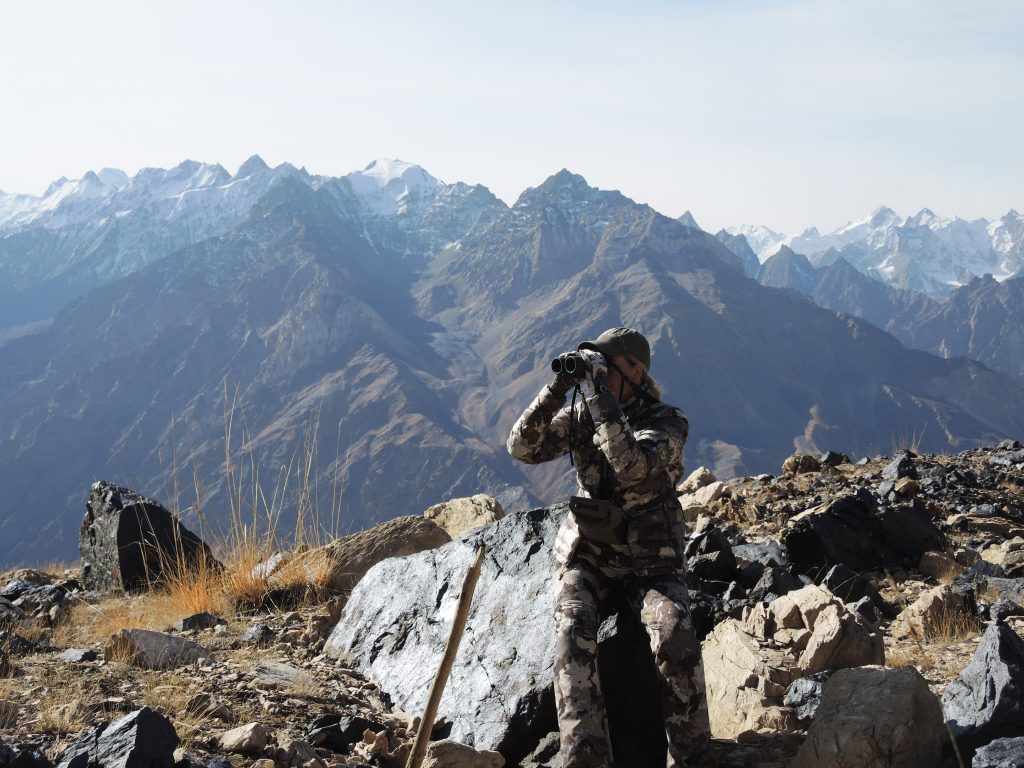
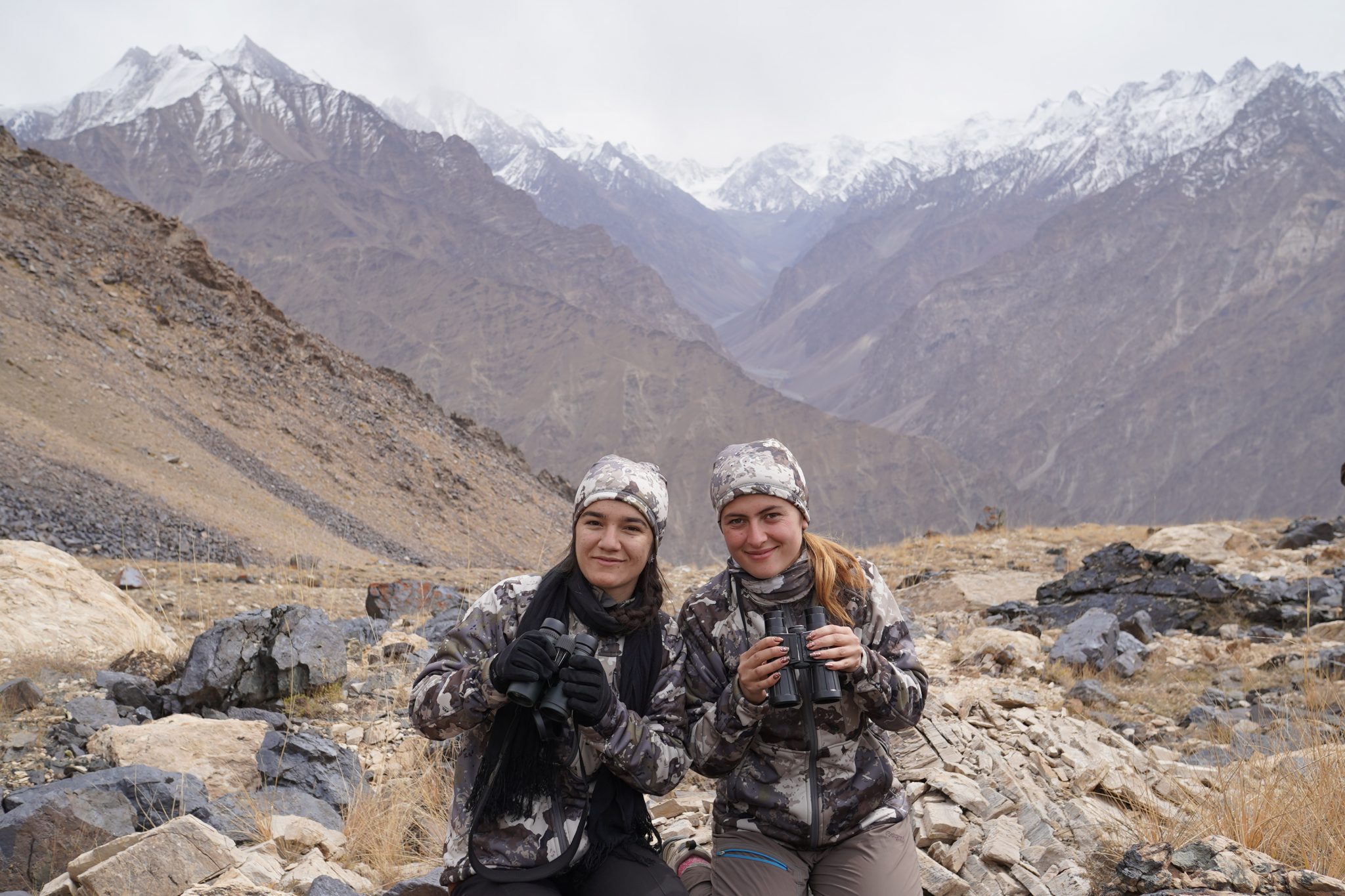
Diana Rupp and hunting partner Kirstie Pike on a high ridge in the Pamirs.
As the next day dawned, we were relieved to find the ibex herd was still in sight, but high on the ridge above us where we could not stalk them without risking blowing them out of the area entirely. We rested in camp, drinking tea and water in preparation for our next attempt. Latifa and Anisa took on the arduous task of water duty. The nearest source of water was nearly halfway back down to the village. The two young women made several treks down, climbing back up with heavy packs filled with loaded water bottles. We were also tremendously impressed by our male guides. Lean and wiry with not an ounce of fat, they carried heavy packs, insisted on toting our rifles, and literally ran up and down mountainsides that took us hours of gasping and panting to traverse. They seemed to subsist only on a few nibbles of bread and cheese, and smoked thin cigarettes from tobacco grown in the village, which they hand-rolled in bits of old newspapers. We hadn’t seen them drink a drop of water, eschewing it in favor of tea.

“I’m going to coin a saying for those fitness junkies back home,” said Kirstie. “You think you’re tough? I guarantee you’re not Tajik tough!”

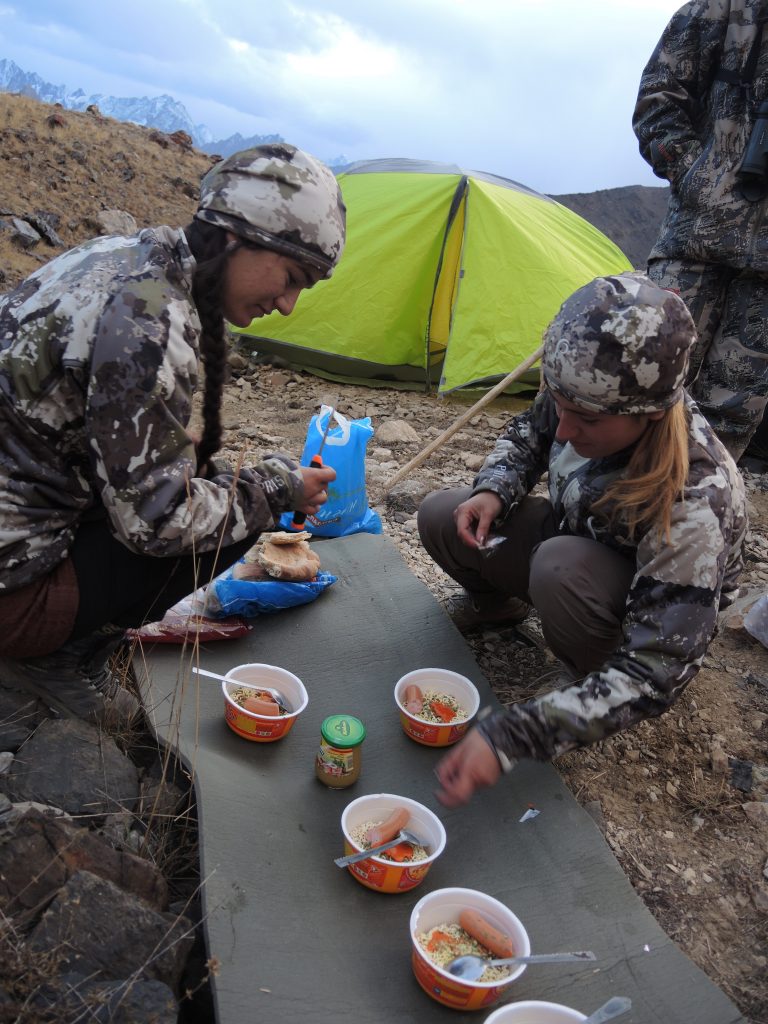
Assistant rangers Anisa and Latifa prepare the local version of ramen noodles at spike camp.
That evening, as we sat watching the snow leopard stalk his prey on the ridge across from camp as described at the beginning of this story, I knew that whatever happened next, my experience in the high Pamirs had already been one of the highlights of my hunting life.

Up and Down

The next morning, the ibex herd was far up the basin again, and early on, the guides watched them top the ridge on the west side. Now we could go after them. Kirstie and I, with Gulbek and Rakhim, set out to scale the ridge. Kirstie and I were gaining confidence in our abilities and we made a strong climb, topping out at what we later determined to be 5,000 meters—16,404 feet. We felt pretty good about ourselves.

Once over the ridgeline, though, there was a steep, loose scree field to cross. I lost my footing and slid a few feet at one point, which scared me, and a few minutes later, Kirstie’s water bottle came untethered from her pack and went rolling down an avalanche chute—we watched helplessly as it leaped and bounced far out of reach. I gave her my spare bottle, but by now, both were nearly empty, and the slope we were on was nothing but dirt and shale. We rested on a finger of rock with a yawning chasm below us until we had somewhat recovered our sense of humor, which had pretty much abandoned us.

Glassing for ibex.

After a time we continued on, following the rangers. We came unexpectedly back into view of the ibex and spent more than an hour pinned down, lying on a flat rock in odd, skewed positions, afraid to move as the animals gazed alertly in our direction. Eventually, the herd moved over a rise, and we were able to make our move across some more loose rock and up to a little ridgeline. Though we couldn’t see the ibex, the guides gestured that they were just on the other side. It was very late in the afternoon, and the sun was about to set. It was now or never.

We shoved our packs up on the ridgeline and the guides placed our rifles on top of them. As I crawled up and pressed my cheek to the stock, it was immediately apparent that the situation was not good. The six ibex had spotted us and were getting out of Dodge—not running, but moving at a good clip. We were going to have to shoot simultaneously, something I don’t like to do. We tried for a few moments to coordinate our shots as the ibex moved farther away, but whenever I had a clear shot, Kirstie did not, and vice versa. Finally, with the herd at more than 400 yards and still moving, we had to act. Kirstie counted to three and took her shot. A split-second later, I picked a trotting ibex at random, placed the cross hairs just in front of it, and touched off a rushed shot. Both animals flinched, but they kept running with herd, vanishing over a high saddle into the next basin. A moment later, dusk dropped on us like the curtain on a stage play with an anticlimactic ending.

Silence descended on the high, lonely ridge. The rangers found a flat spot to make camp; two more rangers arrived after dark with tents and sleeping bags. We sat around the sputtering camp stove glumly waiting for water to boil for tea, and I kept replaying the scenario in my head, wishing I had not taken such a risky shot. Using hand signals, Gulbek explained he and Rakhim would go after our ibex at first light, and I reassured Kirstie it was a sure thing they would find hers—it had obviously been hit hard, and we had both seen it lagging behind the others as they ran. I knew my own shot had been a poor one, however, and I was worried my ibex might not be recovered. We crawled into the tent and I tossed and turned despite my exhaustion.

Gulbek and Rakhim headed out early the next morning, giving us reassuring smiles. As much as we wanted to go with them, we knew we would only be a liability—who knew how far they might have to track the ibex, or through what kind of terrain? We were already at 16,000 feet, and the ibex had been headed up into a saddle when we had last seen them. Breakfast was a sparse meal of cheese and stale bread; we had now been on the mountain for five days, and food was running low. I found a last remaining energy bar at the bottom of my pack. The rangers who had joined us helped us pack up the tents, and we slung our packs and began the steep, four-hour trek down the mountain, back to the village.

It was midday when we came in sight of Ravmed, which now took on the aspect of a luxury spa. The women of the village welcomed us back in the best possible way, heating water in buckets over a fire and filling a tank atop a shower house. Kirstie and I took turns standing under a trickling faucet, washing off the dust and grime. It felt heavenly. We were further restored after a hearty meal of goat stew and fresh vegetables, and we spent the afternoon taking short walks around the village and hovering anxiously around the guesthouse, waiting for word from the rangers.

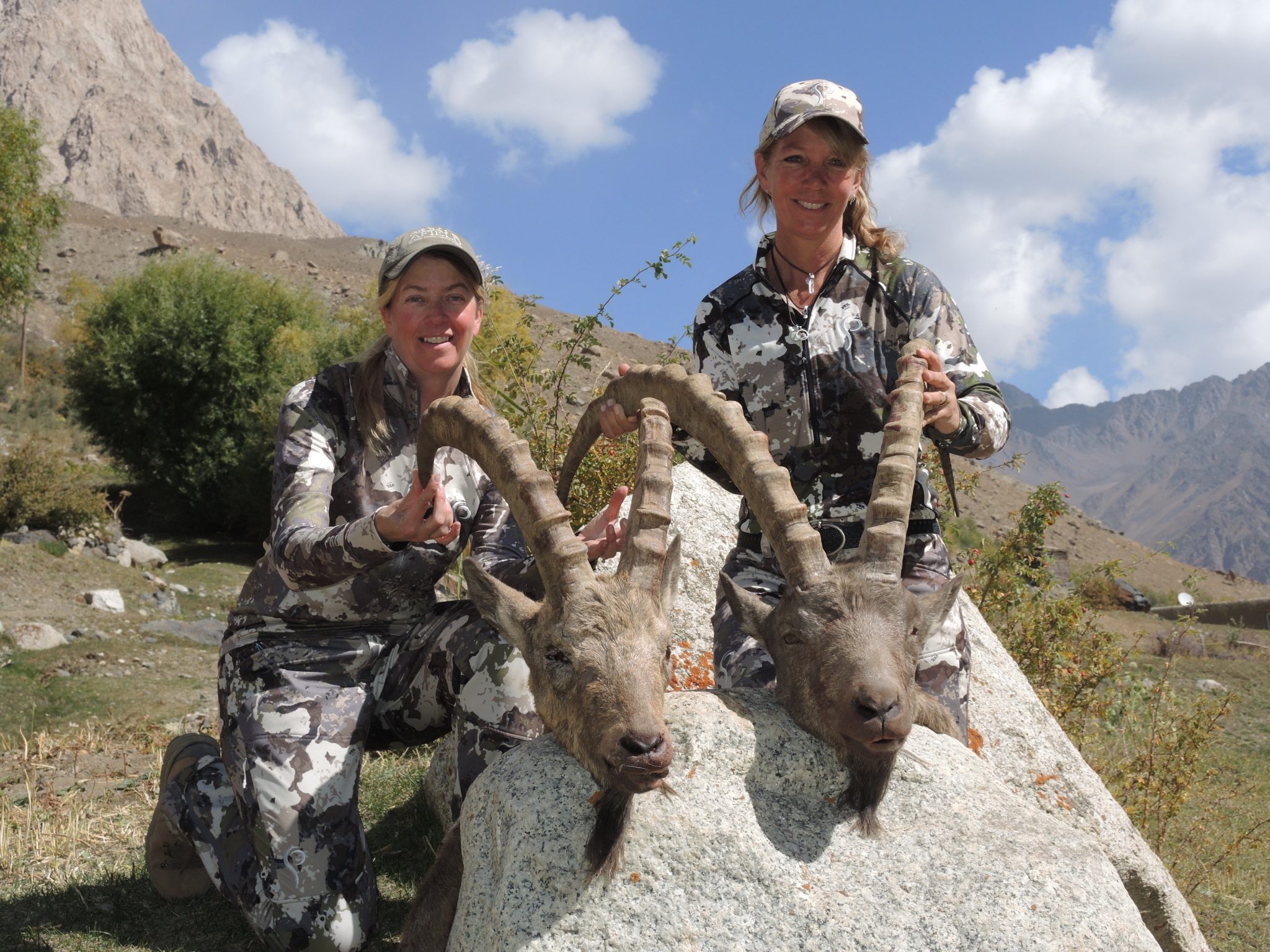
To our joy and relief, Gulbek and Rakhim returned in triumph late in the afternoon, bearing the capes, horns, and some of the meat from both ibex, and sending another group of rangers back up the mountain to recover the rest of the meat before a snow leopard could eat it. They had found the two animals not far apart. Kirstie had shot a beautiful nine-year-old ibex with impressive horns curving over 41 inches. My ibex turned out to be one of the younger males in the group—my own fault for not staying calm and focused enough to make a trophy judgment, but somewhat understandable, I guess, considering the difficulty of the shooting situation.

We thanked Gulbek and the rest of the rangers repeatedly for their dedication and hard work in recovering our animals. Our hunt was a success thanks largely to their resourcefulness and signature Tajik toughness.

Rupp and Pike with their ibex, back at Ravmed village.

The entire village turned out for the photo session, with everyone, from kids to grandmothers, eager to pose with the ibex. Not a single scrap of either animal went to waste. The meat was divided and distributed throughout the village. The organs–lungs, heart, kidneys, liver, stomach, and all–were chopped up and boiled into a paste-type dish the Tajiks devoured. The cheeks, or facial muscles, were the most sought-after delicacy.

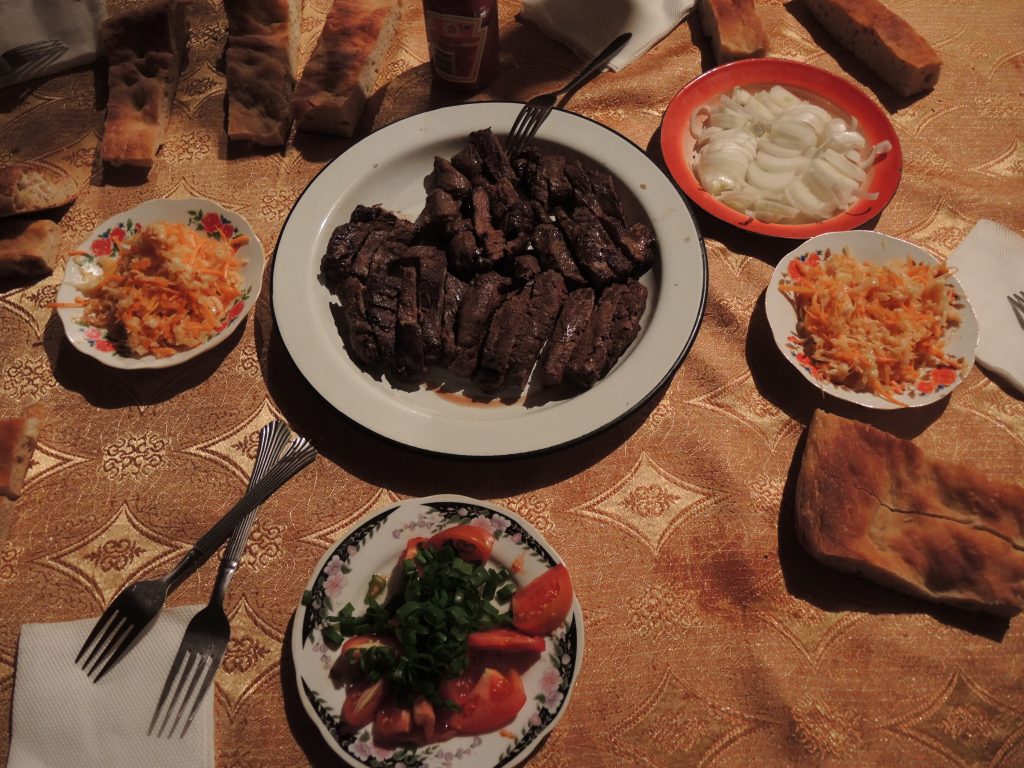
Ibex backstrap accompanied by traditional Pamiri side dishes. Delicious!
The next night we had a huge dinner in the guesthouse, featuring traditional Pamiri dishes along with ibex meat. Locating an electric skillet, we Americans introduced the Tajiks to sliced backstrap grilled medium-rare. We thought it was delicious, but the Tajiks were taken aback at the idea of eating meat with pink in it. With no refrigeration in the village, they would boil the remaining meat and can it without delay.

Later that evening, two musicians with an accordion and a hand drum played traditional Tajik tunes on the patio of the guesthouse, and all the villagers turned out to dance. The music filled the mountain air with upbeat yet haunting melodies as the dancers moved with skillful steps, turning and clapping. As the festivities wound down and our hosts said good night, the overwhelming quiet of the mountains returned. I stood for a while in the door of the guesthouse, gazing past the small collection of homes and dusty fields at the jagged peaks faintly visible in the starlight. It had been an incredible experience, and I felt both blessed and humbled to have experienced the raw and mighty beauty of the Pamir Mountains in the company of the tough, resourceful people who live in their embrace.

Conservancies and Conservation

The Association of Hunters of Tajikistan (ANCOT), formerly H&CAT, is acoalition of eleven communal conservancies in various regions of Tajikistan, formed to train and empower the residents of poor, high-mountain villages to conserve and protect their wildlife and serve as year-round rangers and hunting guides. Visiting hunters live and hunt alongside locals who know these mountains better than anyone. It was unlike any hunt I have ever experienced because of the involvement and interest of everyone in the community. On most hunts you stay in a separate camp and interact only with your guides. On this hunt, we were immersed in village life and made to feel a part of it.

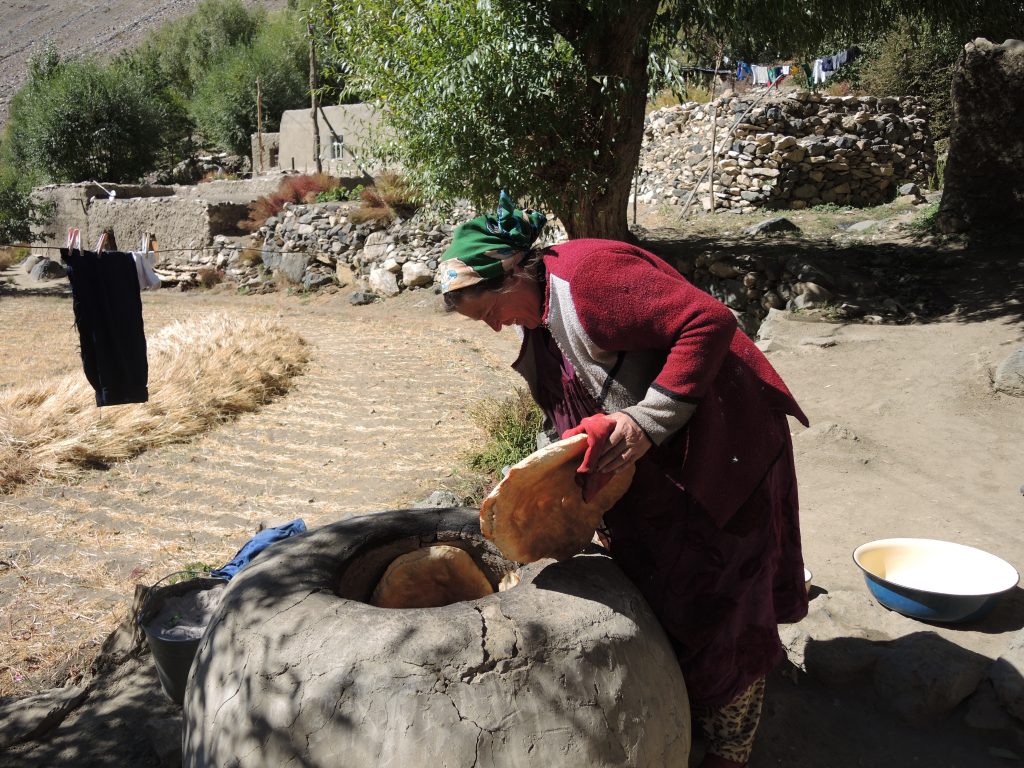
One of the women of Ravmed village making bread in a stone oven.
Other than the government license fee, every cent of the money paid for these hunts goes directly to the local people in the conservancy—there is no outfitter or middleman. The villages have used this money to upgrade their standard of living dramatically. The program has had phenomenal success in bolstering the country’s populations of ibex, Marco Polo sheep, markhor, and snow leopards. It has turned local villagers into front-line champions and protectors of Tajikistan’s mountain wildlife. The members of the Parcham Conservancy, where I hunted, are going to great lengths to protect their wildlife for visiting hunters. They have even made certain areas around their village off-limits to their own grazing animals in order to improve habitat for the ibex.

For information and prices, go to BookYourHunt.com and type “Tajikistan” in the search box. Depending on what you decide to hunt, you’ll experience an extraordinary hunt for ibex, Marco Polo sheep, or markhor. But even more important, by participating in a conservancy hunt, you will be supporting what is arguably one of the finest hunter-funded conservation projects in the world.—D.R.

Tajik Trailblazers

Among the crew on my ibex hunt were two impressive young women who are rangers-in-training. As part of its work to involve all locals in the conservation of wildlife, the Association of Hunters of Tajikistan is training a group of enthusiastic Tajik and Pamiri women to guide tourists and hunters—a move that makes sense with the increasing number of adventurous female hunters and trekkers heading to the magnificent mountains of central Asia. As you can imagine, this is not a traditional career path for women in this country, and these women are pioneering this new ground with incredible enthusiasm. I can attest that they’re tireless hikers and climbers, tough as nails, and are always upbeat and encouraging no matter how steep the mountain.—D.R.
Watch a video of scenes from this hunt at this link: https://www.youtube.com/watch?v=OyB1-cLBiZE

Leave a Comment

My Favorite Zebra

The Hartmann mountain zebra is plentiful in Namibia and parts of South Africa, and is a challenging game animal with excellent meat.

The first Hartmann mountain zebra I ever saw stood alone on a rocky ridge leading up into the heights of Central Namibia’s Erongo Mountains. I can still see the dry wind whipping its mane, and in my mind’s it’s a stallion, defying us before turning to join his hidden herd. But maybe it was a lone mare–with a quick glimpse at a couple hundred yards, it’s hard to be certain!

That was forty years ago and it didn’t matter; a mountain zebra wasn’t a goal the first time I hunted Namibia and wasn’t in the budget anyway. I had taken plains zebras elsewhere, and a zebra is a zebra, right? That’s a typical assessment for folks hunting Namibia for the first time, especially if they’ve previously hunted in other African countries. Although normal and understandable, I think it’s a huge mistake to write off Hartmann mountain zebra as “just another zebra.”

The Hartmann’s zebra is larger, with a distinctive striping pattern that, to me, is more beautiful than the plains or “common” zebra. Facial stripes are usually brown, darkening with maturity, but body stripes are stark black and white, without the gray “shadow stripes” of Burchell’s zebra, southernmost race of plains zebras. Older individuals, especially males, tend to have a pronounced dewlap, and all mountain zebras have a distinctive and attractive triangular pattern of stripes above the tail called the “Christmas tree.”

The triangular “Christmas tree” rump marking is distinctive of the mountain zebra. This big stallion was taken in the Erongo Mountains in central Namibia.

The two mountain zebras (Hartmann and the smaller Cape mountain zebra) are a separate species (Equus zebra) from the several races of plains zebra (E. quagga). In Southern Africa game ranching has moved animals around for decades, so the mountain and Burchell zebras frequently bump together. One could theorize that this also happened naturally, with Burchell zebras in the valleys and mountain zebras up in the rocks. The two are not known to interbreed.

Just a couple weeks ago I was in Kaokoland in northwest Namibia, big, rugged country. It was ideal mountain zebra habitat, and they were plentiful. We were headed back to camp after a morning hunt, still hoping for a zebra for leopard bait, when we spotted a small group resting in shade along a rocky canyon. Outfitter Jamy Traut took Dan Baker on a quick uphill stalk. A few minutes later we saw the zebras as they spooked over a ridge. The hunters soon came back shaking their heads. They were Burchell zebras, not usually present in the area, and not on quota.

In good light the common zebra’s shadow stripes are apparent, but there’s another tell-tale sign, and the fastest way to tell the two apart: On mountain zebras the vertical body stripes come to a point and stop and the belly is pure white; on plains zebras the body stripes come all the way around the belly.

All zebras are beautiful and wary and difficult to stalk, with keen senses. I think the mountain zebra’s black-and-white skin is more attractive than the Burchell zebra with its prominent shadow stripes. However, farther north there are other races of common zebra with stark black-and-white striping that are equally gorgeous.

What sets the mountain zebra apart is the fact that it really does prefer mountains, and offers an entirely different hunt. Sure, you may find plains zebras quite far up in hills and you can catch mountain zebras crossing valleys. In their native habitat of tall, rocky ridges the mountain zebra offers a genuine mountain hunt, a matter of diligent glassing and careful stalking—and, often, a lot of hard work!

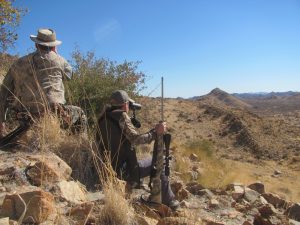
Glassing for mountain zebras in typical habitat in Namibia. In natural habitat like this Hartmann zebra offers a true mountain hunt, a wonderful experience.

The second time I hunted in Namibia I remembered that lone zebra I’d seen, and I put a mountain zebra at the top of my wish list. In those days Namibia’s safari and game ranching industries were in their infancy and all species were less plentiful and more localized than today. Mountain zebras were scarce and pretty much restricted to high, remote areas. Getting one was a tough and difficult hunt that I have never forgotten. Today mountain zebras are plentiful and have expanded (both naturally and through introduction) across most of Namibia, except that from Etosha and on northward and eastward, the plains zebra dominates.

It doesn’t matter if you’ve hunted elsewhere and already have a zebra rug. The mountain zebra is different enough, and offers a different enough experience, that I strongly recommend hunting one when you’re in their domain—especially if it’s native habitat. The spine of the Erongo range is still superb mountain zebra country, but there are other great places. A few years ago, Donna and I hunted southwest of Windhoek, where the high escarpment drops into the Namib Desert, creating a moonscape of boulder-strewn ridges and deep canyons. Mountain zebras were plentiful, great country for glassing and stalking. Just now we found much the same conditions in Kaokoland. Excepting big herds of springboks in the valleys (and excepting that out-of-place herd of Burchell’s zebras), mountain zebras were the most plentiful large animal. Hunting them offered a great experience but, in the midst of what might be a hundred-year drought in Namibia how they manage to thrive is a mystery. In one area we knew of nosurface water nearby. Dan Baker shot a huge stallion, the largest-bodied zebra I’ve ever seen. Its stomach was full of water, so obviously the animals knew the area better than we did!

Hartmann mountain zebra occurred naturally from arid southwestern Angola all the way south through Namibia, discontinuously following mountain chains and tipping over into South Africa’s Northern Cape. From there it probably extended into the Western Cape and eventually morphed into the once-endangered Cape mountain zebra. Although definitely smaller, the Cape mountain zebra is visually indistinguishable from the Hartmann mountain zebra, same markings, same habits and preferred habitat. Thanks to intensive efforts, the Cape mountain zebra has recovered and can be hunted, but it cannot be imported into the United States.

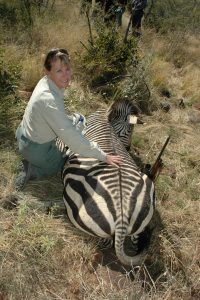
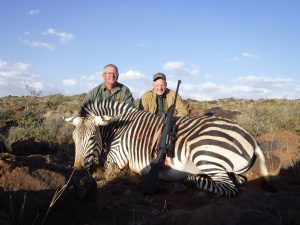
Mike Birch and Boddington with Boddington’s first South African Hartmann zebra, taken near Kimberley.
The original range of Hartmann zebra in South Africa isn’t precisely known, nor, after the excesses of the pioneering era and the ravages of the Boer War and its long aftermath, is it known exactly where Hartmann left off and the Cape mountain zebra picked up, with recent DNA research showing little difference between the two. In the past I’ve considered the Hartmann mountain zebra a Namibia specialty, and thus hunting them in South Africa a bit of a travesty. Well, you don’t know what you don’t know. On the way back from Namibia I spent a few days with outfitter Mike Birch near Kimberley, a part of South Africa I hadn’t seen in decades. The tall, rocky hills were ideal mountain zebra habitat, and I have never seen such a concentration of Hartmann mountain zebra.

The first morning I climbed a tall hill to glass without realizing Hartmann’s zebra were present. I quickly picked up a small group on the next ridge, saw the stripes, and realized what I was looking at. There was another group down in the valley and more to the right and left. Without changing location, I lost count at forty.

A couple of days later, after a long and difficult stalk with Mike’s excellent tracker, Albert, I shot one, but it took a step as I fired and I knew the hit was a few inches back. Any wounded zebra is bad news, and this one took us across the valley and up the next ridge. The spoor suggested entry and exit and showed lung blood. I was sure we would find it quickly and we did, precisely on the top of the next mountain! We called for help, rolled the zebra into a tarp with handles, and carried it whole a half-mile down through the rocks. The guys suggested that, next time, I should shoot my zebra in the valley, not on the top! My aching back agreed, but one way or another, a zebra is always recovered. The skin is priceless and the meat is quite good. For those who care, mountain zebra flesh is leaner and tastier than plains zebra. We all keep learning, and now I realize it doesn’t much matter whether they’re hunted in Namibia or South Africa. The Hartmann mountain zebra is still my favorite.


Leave a Comment

Rowland Ward Records of Big Game, 30th Edition

Native staff members pose in front of a safari tent with Rudolf Grauer’s record elephant tusks. This photo was printed in two books by German hunter Konrad Schauer; in the first one he admits they were shot by an “Austrian friend,” but in the later one he claims them as his own.
No. 15 in RW 29th edn. page 787 169 lbs Uganda 1913 (GAT says 1905)
The latest edition of Rowland Ward’s record book features several new world records, detailed maps, and fascinating photos of long-lost trophies.

Photo above: The Peter Rous kudu, one of the “long lost” trophies featured in the new record book.

The 30th edition of the Rowland Ward Records of Big Game (Africa) is in full production and will be available this fall. The Rowland Ward staff in Huntington Beach, California, spent two and a half years converting the database software to a new system and entering additional data from old scanned and paper archives. Additionally, the editors gained access to two significant old archives, one in the U.S. and the other in the United Kingdom, which yielded a great deal of the old Rowland Ward Ltd. paperwork from when the company was based in the heart of London, at 166 Piccadilly, prior to the 1970s.

The newly discovered archives included old albums, measurements, articles, photos, notes, and more. Some of this was collected by James Rowland Ward, the company founder. Many interesting photos and a great deal of data were unearthed, all of which will be featured in the new edition. In total, the Africa volume of Rowland Ward’s Records of Big Game now lists in excess of 40,000 records dating back to 1840.

Besides this work, the editors have received more than half a dozen new world records since the last edition (2014), including Damara dik-dik, common nyala, waterbuck, island sitatunga, mountain nyala, and southern impala, as well as the new No. 3 Nile buffalo. This is in addition to dozens of new top-10 records. Several new elephants were entered with tusks in excess of 130 pounds per side; while these were not shot in recent times, they had never before been recorded. Also newly recorded is a lesser kudu of more than 33 inches shot in Tanzania.

This photo of a Southern greater kudu taken by Peter Rous was long thought to be lost.

Of great interest is the recovery of several long-lost photos of very large heads from the past: four elephants over 150 pounds per side; a mountain nyala with 44-plus inch horns; and the much-debated James C. Rous kudu, which was shot in 1916 but amazingly photographed, with the hunter and the mounted head, after World War II.

The new edition will feature a new ranking method for the three larger buffalo varieties in Africa (Cape, Nile, and Central African) by adding together the sum of the two bosses and the spread. As before, the two smaller varieties of buffalo, dwarf forest and Western, will be ranked on horn length and boss measurements.
The editors take particular pride in the new maps featured in this edition. A total of about 100 were created; they feature current game distributions on the continent of Africa in great detail and full color.

The new edition will be issued in a limited edition of 150 leather-bound copies that are signed and numbered by the editors, as well as a linen-wax-impregnated cloth-bound edition. The leather edition will sell for $375 but can be preordered before August 1 for $350. The cloth-bound edition is $125 but can be preordered for $100 before August 1. Order yours from the Safari Press web site, safaripress.com.

New world-record island sitatunga.

Leave a Comment

The Tale of the Tacoma Bighorn

A long-lost sheep head may be the real world record.


In 2018, a new world-record bighorn sheep was announced. The large head was found in the fall of 2016 on Wild Horse Island, in Flathead Lake, Montana.  Apparently it died of natural causes at approximately nine years old, which is not really old as far as bighorns go.  The massive head got a lot of attention on the internet and at hunting shows this past winter, and reportedly weighed 50 pounds with a clean and dried complete upper skull.  Few Asian argali sheep have horns that weigh more than this, albeit some Altai argali will surpass this mark.  The Flathead ram is a remarkable testament to North America’s excellent game management.

The head scored a total of 217 2/8 gross B&C points (before deductions) and it beats by 7 6/8 inches a 14-year-old Alberta ram scoring 209 4/8, which was killed by a car.  Typically world records of sheep and goats only surpass the last record by an inch or two, so an increase of 7-plus inches seems almost incredible. But as we shall see, this is not necessarily an isolated incident.

The Wild Horse Island ram net-scored 216 3/8 after deductions.

Is the Flathead ram really the biggest bighorn ever recorded?  Possibly not.  In the late1890s, a fur dealer form Tacoma, Washington, by the name of William F. Sheard publicized a ram that likely would surpass the Flathead ram by a significant amount.  Sheard was a collector of trophies and he bought the head from a Canadian.  Sheard said the head had been examined by a representative of Rowland Ward Ltd., and in 1899 the head was duly recorded in the third edition of Rowland Ward’s Records of Big Game. Sheard thought the head was killed in the Selkirks of British Columbia in 1885, but because he did not communicate with the man who shot the sheep, the location and date were likely not correct. At the time he offered the then-phenomenal amount of $500 to anybody who could present him with a head bigger than the Tacoma ram.

By 1900, several articles had been published in the sporting press with clear photos of the head, and it caused a sensation.  Well-known British hunter William Baillie-Grohman devoted a significant section of his book Fifteen Years Sport and Life(London, 1900) to this sheep.  Grohman spent years traveling the Canadian and American West in search of adventure and big game.  He was very familiar with the habits, distribution and many of the top trophies of early American game animals and wrote a 403-page book about it, replete with maps and pictures.  Grohman knew the actual hunter of the sheep, a man by the name of Scotty MacDougal. The ram was shot near Fort Steele in the Rockies, not in the Selkirks, in the winter of 1892-1893.  Grohman learned this from MacDougal whom he had employed in years past.  Apparently MacDougal was killed in an avalanche a few years after killing the ram and the ownership of the trophy passed to MacDougal’s partner, who sold it to Sheard.  The head even took on its own name, as all great trophies seem to do: the Tacoma Head.

Views of the spectacular Tacoma head. Its record horn measured 521/2 inches, making it the longest horned North American wild sheep ever recorded. The bases measured 18 1/2 inches. Its whereabouts is unknown. Photos courtesy of the Department of Library Services, American Museum of Natural History (Neg. Nos. 313757 and 313758; photo: Irving Dutcher and H.S. Rice)

As often happens with any large trophy, claims and counter-claims were made about the Tacoma head by naysayers.  In 1913 Sheard had a fire at his premises and it was thought the head was burned.  But it turned out the head had previously been sold to a wealthy East Coast family, where it stayed until the 1950s when it disappeared in an estate sale when the heirs sold and moved.  The head has not been seen since, but noted sheep biologist Dr. Raoul Valdez believes it to be authentic from studying the old photos, of which there were quite a few.

So how big is the Tacoma bighorn?  Before World War II, sheep were not measured on a total score but were ranked on their longest horn while the bases were measured as supplemental data, so unfortunately there is no way to make an exact comparison with today’s scores. Only one side of the Tacoma head was recorded, but in the photos the horns appear very symmetrical, so let us assume that both horns were identical. Taking the original measurements listed in Rowland Ward, we know the head had a longest horn of 52½ inches with 18½ bases. Studying other giant bighorn sheep measurements, it might be reasonable to assume the quarter measurements would have been 16 ½, 15, and 11 inches for the first, second, and third quarters.

The Tacoma head is the only sheep in North America ever measured with a horn length of 50-plus inches, other than the Chadwick Stone sheep ram which was shot in 1936 in on the Muskwa River in British Columbia.

Questions have been raised about the Tacoma head’s bases recorded at 18.5 inches. In the old days, these were probably measured along the contours of the edge of the horns rather than in an even circle as is now the case.  If so, this would knock the head from 18.5-inch bases to somewhere around 16 or 17 inches, which is more likely as no bighorn measured after World War II has been recorded with bases over 17.5 inches.

Until the Tacoma head resurfaces, it will be impossible to know what its exact score is.  It is a great tragedy  it has been lost in the mists of time, but we can rejoice in the fact that modern populations of bighorn sheep produce ever bigger heads, and someday a new record bighorn may approach the measurements of this legendary ram.


Leave a Comment

Anti-Poaching Pays Off in Mozambique

A recent visit to Coutada 10 provided an up-close look at one safari company’s efforts to deter poachers.


Above: The anti-poaching teams at Mozambique’s Marromeu Safaris gather for a group photo after the Rowland Ward-sponsored snare-finding contest.

Recently a member of the Rowland Ward staff was on a hunt in Mozambique, with two other hunters, looking for buffalo along the south side of the Zambezi River with Marromeu Safaris (Coutada 10).  While in camp, they noticed the anti-poaching efforts headed by Willem Scheepers of South Africa, who commands a crew of 28 employees to combat wildlife thieves.  Their efforts are intense and consist of three teams that patrol various sections of the concession, which is over half a million acres in size.  A huge swath of land that abuts the Indian Ocean and the Marromeu Reserve, this concession is so large that patrols looking for poachers need to stay out for days at a time, sleeping in the bush.

The area is divided into zones to systematically co-ordinate anti-poaching activities and keep the poachers guessing where the patrols will be next.  While the romantic view of anti-poaching may be an image of tough hombres shooting it out with greedy ivory killers, the reality is more like police work in a big city; loads of planning, paperwork, coordinating with wildlife officials, and plenty of time spent with “feet on the ground,” searching for signs of criminal activity; physical confrontations are rather scarce.  When poachers do get caught, they are handed over to the wildlife authorities.

Much of the anti-poaching efforts concentrate on removal of snares and traps, checking for illegal burning, and, most important, creating a constant presence of humans to discourage wildlife criminals in the area.  Despite the fact that we as hunters care very much about the large mammals in a given area, anti-poaching is often concentrated on illegal fishing (it leads to other wildlife violations), and stopping habitat destruction in the form of timber poaching and food plot clearing via illegal burning.  All of these seriously impact wildlife, and need to be checked whenever possible.

After spending a few hours with the anti-poaching team, Rowland Ward decided to spontaneously sponsor a snare removal contest.  Scheepers would let each of the three teams pick a zone of their choosing to police for three days to recover snares; the team with the most snares found would get a cash prize.

The hunters came back to the anti-poaching compound three days later to be surprised by the large amount of snares that had been removed.  The winning team had 53 snares while the runner up had 38 and the third team 27. In addition, several gin traps (similar to the Conibear) had been unearthed.  Because no point system had been assigned to the snares verses the metal gin traps, the exact “value” of the recovered devices was somewhat murky, so it was decided that all teams would get cash prizes with the team with the most snares getting a bonus.  Rowland Ward was the sponsor of this contest and the photos show the teams holding Rowland Ward brochures and stickers in appreciation of their rewards.

The highlight of the afternoon was yet to come when Sheepers and the captains of the three patrols gave the hunters a demonstration of how the traps worked, from large snares big enough to catch a zebra or hartebeest, to medium snares to catch warthog-size animals, to tiny snares to catch birds such as guinea fowl.  It was educational to see how a primitive trap made out of nothing but a nylon string and a bent sapling can be so effective; in this case, the Hollywood version of a snare hidden on the ground that catapults an innocent victim up in the air comes pretty close to the truth.

A member of the anti-poaching team demonstrates the use of a simple snare of the type used by poachers. This one is large enough to catch a big-game animal.

A couple of snares and gin traps were set off by poking a stick in them to show the results.  To set a gin trap, a 10-foot pole of 8 inches in diameter is needed to leverage the jaws open by two or three adults, and once the trap is set it is carried into the field and carefully buried.  Made from the leaf springs of trucks, they have so much tension that their impact can break the leg of a large mammal when triggered.

Marromeu is actively working with the local communities as a well-managed safari area must in modern Africa; all meat not consumed in the hunting camp is distributed among the local population to discourage poaching.  A water well, clinic, and a small school with supplies have been built on the edge of the concession to encourage local indigenous people to stay in one area and not roam throughout the concession.  Community outreach works with village elders to get the message across that hunters mean meat, money, and employment, and hunters only show up if there are animals in the area.  The conservation efforts by this safari company have been great ones, and the results show; the concession is teeming with game. The hunters saw hundreds of warthog, sable, waterbuck, reedbuck, buffalo, and hartebeest as well as healthy numbers of three different duikers, nyala,  eland, zebra, and a great many game birds.


Leave a Comment

tablet

Never Miss An Issue!Subscribe Now: 6 Issues for $34.97

More Details
WordPress Video Lightbox Plugin