Sports A Field

Paper Plate Accuracy

As long as you can keep your shots inside a paper plate, you’ll likely hit the vital zone.


With big-game animals it is always essential to hit a vital zone. Misses don’t count and near-misses are far worse than clean misses. For most of us the “vital zone” means center-chest, the heart and/or lung area. We can debate which is better, but a projectile through the heart or great vessels on top of the heart—or perforation of both lungs—is a hit that will very quickly be fatal. On larger, tougher animals one lung may not be enough, but, considering quadruped anatomy, a shot that catches just one lung wasn’t taken at a very good angle, and perhaps shouldn’t have been fired.

Paper plates are excellent for practicing shooting standing unsupported…something we should all do regularly. This is a Mossberg M64 .30-30 with factory iron sights.

Over the years I’ve talked to and gotten mail from a few hunters who maintain they “only” take brain/neck/spine shots. Such genuine specialists probably exist, but to my thinking a steady diet of head and neck shots would be practical and sustainable only under fairly controlled conditions that kept ranges fairly short. Or maybe these folks just shoot a lot better than I do! Seriously, stand hunters who do most of their hunting from the same stands season after season (especially over feeders or bait piles) have fairly controlled conditions. I’ve heard the same from hunters who hunt hogs with hounds. When a hog is at bay they’re able to get in very close. Some use handguns and a few, where legal, use knives and spears.

I hunt my Kansas whitetails from a daily choice of a couple dozen stands. None require long shots, but quite a few are in thick woods. I wouldn’t want to be held to the precise head or neck shot there, nor, honestly, anyplace else. My North American experience is mostly as a Western hunter, spot-and-stalk hunting that might yield almost any imaginable shot. Mountain hunting is the same the world over, and although long shots are unusual in Africa, you really don’t know what kind of a shot you might get. There are times and places where brain shots and neck shots are appropriate but for most situations I want the largest target possible—and that’s usually what I aim at.

The chest area of even smallish deer and pronghorns is actually a fairly large target. Worldwide there are a number of smaller “big-game” animals: Africa’s pygmy antelopes, the gazelles, European roebuck, muntjac, even our brocket deer and peccaries. However, across the board, the chest area offers the largest target, and as animals increase in size the target area just gets bigger.

An old adage is that “pie plate accuracy” is good enough. I wrote this not too long ago and a particularly precise reader took me to task, asking the exact size of the pie plate I’m talking about. I guess that’s actually a pretty good question because I don’t have a clue! I skipped home economics class and I’ve never baked a pie. I’ve also never shot at a pie plate and I don’t think Donna would be pleased if I did.

So, instead, and much less destructive, let’s talk about “paper plate accuracy” instead.  Turns out that’s not terribly precise, either. I got a tape measure and discovered that, right there in the kitchen cabinet, we have three different sizes of “big” paper plates: Nine, ten, and ten-and-a-half inches in diameter. So, when I say “paper plate accuracy” which size am I talking about?

It doesn’t matter! A nine-inch circle is plenty big enough, and another inch or so doesn’t matter. If you can keep your shots on the plate you should be able to keep them on your animal. You can, of course, draw a circle in the middle for a more precise aiming point. However, game animals don’t have bullseyes painted on their hides, so there’s training value in just shooting at the plate and trying to center it. Another old adage to “aim small, miss small” applies perfectly. All hits count, but central hits build confidence. At any distance your hits start wander off the plate, well, that distance should be your limit for shooting at game.

So, do my paper plates take the place of printed targets with precise aiming points? Heavens no! Paper plates are ridiculously cheap and printed targets are expensive—but I keep both on the range. I generally use the plates for short-range platforms: Iron sights, red dots, big bores that are unlikely to be used past a hundred yards. For precise zeroing and shooting the best groups possible there’s no substitute for real targets. Being lazy, I like the multi-color “splatter” targets that easily show bullet holes, and I also like a printed grid so that I can look through the spotting scope and count the inches I need to move the strike.

Hornady’s Birchwood targets are a favorite for zeroing and shooting tight groups, especially with high-magnification scopes. Squares and diamonds offer very precise aiming points, and the half-inch grid makes adjustments easy. This a Ruger No. One in .204 Ruger.

Exactly what kind of aiming point works best depends somewhat on reticle and magnification. For fine cross hairs, I prefer squares or diamonds. If you’re having trouble centering the square you can align your crosshairs on one of the corners.For coarser or illuminated reticles and red dots round aiming points are better for my eyes. I keep a stack of Birchwood Casey’s Dirty Bird splattering targets with a one-inch grid and five bullseyes (center and four quadrants), ideal for scoped rifles with modest magnification. For the most precise work I like Hornady’s Birchwood targets with small center diamond, four squares, and a half-inch grid.

Then there are paper plates. We also have plain old bull’s-eye targets in the range locker. However, during the last couple of years my near vision has slipped, causing increasing difficulty resolving iron sights. I have a hard time picking out a front sight against a black bull’s-eye—even when it’s a bold white or gold bead. For me, plain old white paper plates are easier and more visible for a consistent sight picture. The plates are round, as are most front sights. It is thus sort of an optical thing, at least two superimposed circles—and three with the open circle of an aperture sight. So, I’m doing most of my practice with open sights and apertures on paper plates—and I use them with red dots as well, from big-bore lever actions to double rifles.

I have to accept that my effective range with iron sights is greatly reduced from what it once was but, combining paper plates with a new eyeglass prescription, I’m seeing improvement I wasn’t sure I’d see again. And the rules for “paper plate accuracy” haven’t changed: Whether for sighting equipment, visual acuity, unsteadiness, or the inaccuracy of the firearm, at whatever distance shots start to wander off the plate, I’m done.

Paper plate groups with this Savage 99 in .300 Savage weren’t impressive but, honestly, that’s about as well as I could see the sights. I was able to keep shots reasonably in the center of the plate…and that’s plenty good enough for close-range hunting.

Last year I came into a vintage Savage 99 in .300 Savage with aperture sights. 1920 forerunner to the .308, the .300 Savage is definitely a 200-yard cartridge, but with aperture sights I no longer have 200-yard vision. Working out on paper plates, at 50 yards I could keep my shots well-centered. Mind you, with aperture sights I can no longer determine how accurate a rifle is or isn’t—but I had pig hunting in mind, so I was thinking “minute of plate” equaled “minute of pig.” My hundred-yard plates weren’t impressive—but I was still minute of pig, and I figured that would work fine.

In the field it’s just like combat: The best plans go awry when the first shot is fired. I missed an easy shot at 60 yards, dark animal in dark shadow, probably shot over. So much for all my paper plate drills, not impressive. Figured it was just me, and I figured right. Just at sunset I rolled a hog, quartering away at 125 yards. Another evening I shot another pig at about 100 yards. Still minute of pig.

Back when I could reallysee iron sights the Winchester Model 71 in .348 was a favorite. I haven’t had one for a while, but I just picked up a 1937 M71 with factory aperture on the bolt. With Hornady’s new LeveRevolution .348 load it passed the paper plate drill just fine. I think I’ll take it black bear hunting in a couple of weeks.

Animal silhouette targets are excellent, especially for inexperienced hunters because animals don’t have aiming points. This is a 100-yard group with my .30-30 Trapper with aperture sights…shot when I could see iron sights much better. A group like this is no longer possible with irons!


Leave a Comment

Don’t Overlook the .30-06

Despite all the emphasis on new cartridges, this old standby is still an all-round champ.

The cartridge wars continue! The 6.5mm Creedmoor remains a hot seller. Many of us want more, so we turn to faster cartridges. We used to call them “magnums” and most of them wore belts. The belt never meant much, but I guess we over-used the word “magnum.” Now we call our fast cartridges all sorts of things: Compact, Precision, Short, Ultra, more. They’re all good. Thanks to the proliferation of chronographs, today’s data, published factory ballistics and handloading data, is very accurate. Today’s cartridges do pretty much what they’re supposed to do.

This “raghorn” Montana bull was taken with a tough downhill shot at 350 yards. The rifle is a Savage 116 in .30-06, always a great choice for elk.


More important is to not get too caught up in hype and decide what level of performance you need, and how much recoil you’re comfortable withstanding. Performance isn’t free! The 6.5mm Creedmoor is an awesome long-range target cartridge. It is nota long-range hunting cartridge, moderate in both bullet weight and energy. It’s a fine cartridge for deer-size game, and it’s adequate for elk, but only to very medium range. The many faster cartridges project more energy farther downrange, but always at a price in increased recoil (and often action length and gun weight).

Without question long-range shooting is “in,” but not everybody wants to shoot at extreme range, and many who wish to have no business trying! Despite all the current malarkey, there is a tried-and-true veteran cartridge that performs extremely well on fairly large game as far out as most of us really shoot, and has done so for more than a century. Many of you have one, but if you don’t, I’ll bet your dad or granddad did. It is the .30-06 Springfield, properly the “Ball Cartridge, caliber .30, model of 1906.” It served us well through two World Wars and Korea, countless smaller actions, and although technically replaced by the 7.62x51mm NATO (.308 Winchester) in 1957, the .30-06 continued in various roles throughout the Vietnam conflict. Over time it became America’s most popular sporting cartridge and remains among our perennial best-sellers. Despite the dozens and dozens of newer cartridges, many of which are faster and some more efficient, the .30-06 remains one of our very best all-around choices. Jack O’Connor, champion of the .270, was also a lifelong .30-06 fan, and conceded privately that the .30-06 was “more versatile” than his beloved .270.

The unusual and little-known red buffalo of northern Angola. Killed by Geoge Parker with a .30-06 during an expedition to Angola in 1952.

The .30-06 is no pipsqueak. Bullets and velocities changed over its 50-year service life, but the .30-06 was the most powerful cartridge ever adopted by a major military. Generations of recruits whined about its brutal recoil! It is an awesome deer cartridge. However, .30-06 power is not really needed for any North American deer hunting. Eleanor O’Connor, herself an especially accomplished hunter, was a 7×57 fan. She considered the .30-06 a cannon, but that’s what she chose for hunting tigers and, with a 220-grain solid, she took her elephant with a .30-06. My old friend George Parker, contemporary of O’Connor, put more Coues whitetails in Boone and Crockett than anyone else, eightbetween 1926 and 1969. A distinguished competitive shooter as well as a hunter, George told me that he wasn’t crazy about recoil. For his deer hunting he came to prefer a .25-06. For bigger game he preferred a .30-06, which he used on several African safaris and a long sojourn in Southeast Asia with his lifelong buddy Colonel Charles Askins

George Parker’s “pet” was a .30-06 Improved, body taper removed for increased powder capacity. Velocity increase with an improved chamber depends a lot on the rifle and who is doing the loading; sometimes there’s a substantial gain and sometimes not. Either way, in the rarified world of magnum cartridges the .30-06 is not a speed demon—but it is not “slow.” And its trajectory is flatter than you might think. For many years standard .30-06 loads with 180-grain bullets have yielded 2,700 fps. Guess what? That’s exactly the same velocity as the vaunted 6.5mm Creedmoor with a 140-grain bullet. Use an aerodynamic 180-grain .30-caliber bullet with a Ballistic Coefficient up into the .500 range and your trajectory will be almost the same as the Creedmoor with a 140-grain bullet. However, I can assure you the 180-grain .30-caliber bullet will hit a whole lot harder! It will also kick more, which is why I suggest that it’s not essential for deer, and why I prefer 6.5mms, .270s, and 7mms for my deer hunting.

An advantage to cartridges with long-term popularity is availability: Everyone loads .30-06 and there are hundredsof factory loads. Another advantage is continued development, both in factory ammo and handload recipes. If the .30-06 sounds too slow to you it can be juiced up a bit. In preparation for my first African safari I handloaded 180-grain Nosler Partitions to 2,800 fps. Although I used that load for years with no pressure signs, it’s no longer on today’s charts. However, depending on which manual, there are still published loads that break 2,800 fps with a 180-grain bullet. There are also extra-fast” factory loads. In their Superformance line Hornady’s 180-grain SST load is rated at 2,820 fps; their 165-grain SST is rated at 2,960 fps, edging into .300 short magnum territory.

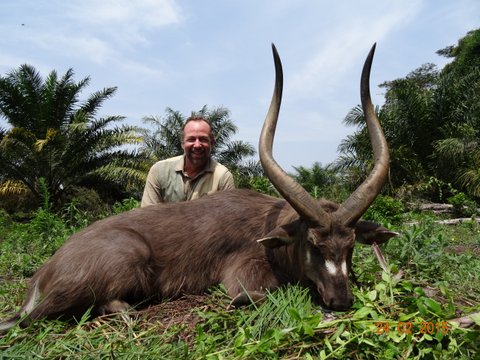
This sable antelope was taken in Mozambique with a Ruger M77 .30-06 firing 180-grain Interlock bullets. An advantage to the .30-06 is that all .30-caliber hunting bullets are intended for .30-06 velocities, so excellent bullet performance is routine.

I’ll be honest, I rarely choose the .30-06 for mountain game. However, you certainly can. O’Connor took several of his early sheep with a .30-06, as did my uncle, Art Popham—and their (and my) mutual friend John Batten. Back in the 1950s Grancel Fitz was the first person known to take all North American species. He used a Griffin & Howe Springfield .30-06, including for all four sheep. Much more recently, J.Y. Jones (One Man, One Rifle, One Land) used a battered Remington .30-06 to take all North American species, also including all four sheep. Personally, I consider mountain hunting a specialized pursuit and I think there are better tools. So, I usually use faster cartridges. Magnum .30-calibers are frequent choices, but sheep and goats don’t really require .30-caliber power, so I have also chosen faster 6.5mm, .270, and 7mm cartridges.

Obviously, the .30-06 could be used, but I think it’s better suited to somewhat larger game or situations where its versatility really shines. The .30-06 is a fantastic elk cartridge. I’ve hunted elk with a lot of cartridges from .270 upwards, but I’ve taken more bulls with the .30-06 than anything else. It hits hard, and has all the range I really need. One subzero day in northern Colorado I crawled in to about 125 yards and shot a medium-sized 6×6 on the shoulder with a 180-grain Barnes X. The bull dropped so hard it bounced and never moved. Another time, in Montana, I had a tough downhill shot at about 350 yards which, despite all the stuff, is not a close shot. The .30-06 came through just fine!

I’ve used the .30-06 on all the continents, but where it really shines is in Africa because: 1) You never know what you might run into. The .30-06 handles all the non-dangerous species just fine, from very small all the way up! The exception is eland, but a .30-06 with a good bullet will handle an eland. 2) Long-range shooting as we think of it is very rare in Africa; the .30-06 shoots plenty flat enough for any African hunt or area I’ve experienced. 3) On the typical plains game safari you may shoot every day, and sometimes a few times a day. Recoil can be cumulative! A hard-kicking .300 may be fine on a one-animal hunt, but unless you’re really comfortable with it, daily shooting can be a different deal. 4) In my opinion the .30-06 is perfect for leopard, and in my experience more effective than larger cartridges like the .375s, which are better-suited for much larger game.

Donna Boddington and PH Dirk de Bod with a fine leopard, dropped “dead under the tree” with a 180-grain Interlock from a Ruger .30-06. Boddington believes the .30-06 is perfect for leopard, and more effective than larger cartridges.

Now, to be absolutely fair and impartial, everything said about the .30-06 can be equally applied to the .308 Winchester. Because of greater case capacity, the .30-06 runs at least 100 to 150 fps faster than the .308 with all bullet weights, the gap widening with heavier bullets. So, the .30-06 shoots flatter and delivers more energy. Most game animals won’t notice the difference. The .30-06 also kicks more, requires a longer action, and on average isn’t quite as accurate. I prefer the .30-06, but if you prefer the .308 you won’t get any argument out of me.


Leave a Comment

Thomas Mattanovich: 1937-2019

The hunting world has lost a pioneer.

Thomas Mattanovich, “dean” of professional hunters in Ethiopia, passed after a long battle with Parkinson’s disease on 17 February. He was 82.

Thomas immigrated to Ethiopia with his parents and elder brother in 1950 at age 13 from what was then Yugoslavia.They settled in Wondo Genet, southern Ethiopia, then a very remote and wild place. Thomas adapted quickly, and while still a boy, he learned the first of three Ethiopian languages he would become fluent in.

As a teenager, after training and employing a team of local Anuak tribesmen to be boatmen and skinners, Thomas hunted crocodiles on the Baro River. The salted and dried skins were then exported to Italy via Ethiopian Airlines.

Receiving his Professional Hunter’s license in 1959, Thomas pioneered hunting in the Gambella region, which is home to the great migration of white-eared kob and Nile lechwe, the second largest migration of wildlife on the continent. He trained and employed a number of local people, and as they and their families settled around his original safari camp, it gradually grew to become a small village.  Government maps of the Haile Selassie era identify the location officially as “Tom’s Camp,” perhaps the only place on the entire map of Ethiopia having a non-native name.

Thomas went on to hunt throughout the country, and was among the first to conduct safaris for the rare desert species of the Danakil and Ogaden regions of eastern Ethiopia, as well as the endemic species like mountain nyala and Menelik bushbuck in the Arussi and Chercher Mountains.

Thomas guided everyone from European royalty to a logger from Washington state, and many returned to Ethiopia to hunt with him multiple times. He guided 19 hunters that went on to win the Weatherby Award. His clients have put over 100 trophies in Rowland Ward’s Records of Big Game,and though he ceased active guiding in 2003, a dozen-plus of those entries still rank in the current Top Ten.
Thomas was a life member of the International Professional Hunter’s Association, and an active member of Game Conservation International, a precursor to today’s hunting and conservation organizations. He participated in and contributed his invaluable knowledge and experience with the diverse wildlife, habitat, and people of Ethiopia to the numerous conservation projects conducted during his life.

Thomas is buried in the Petros we Paulos Cemetery, in Gulele, Addis Ababa. He is survived by his wife, Samrawit, three children, and two grandchildren.

Leave a Comment

Close Encounters with Buffalo

The classic way to shoot a Cape buffalo is up close with a double rifle, but that’s not always possible.

As the herd moved closer, our little tree seemed to offer less cover. At thirty yards the group split; we had buffalo passing to the right at twenty yards, and another bunch coming straight toward us on the left. The breeze was strong on my face, quartering slightly from right to left. The buffalo to the right were good, and for the moment we were OK on the left, but as they strung past they would eventually catch our wind. We needed to make a decision before that happened.

I was hunting in Namibia’s Caprivi Strip (now officially known as the Zambezi Region) with Dawid Muller. In arid Namibia, buffalo habitat is limited to the well-watered Caprivi and a few other spots in the north. This means buffalo permits are limited, but with little hunting and good genetics, horn quality is very good. Muller’s Daggaboy Safaris, with his concession sandwiched between two parks, has one of the larger quotas. Because of small supply (and plenty of demand), Namibian buffalo are a bit pricier than some other areas.

On the other hand, Namibia has an unusual system. The northern areas are conservancies, pooled tribal and private lands. In addition to trophy permits for both buffalo and elephant, there is an “own use” quota. This is not the same as “non-trophy” permits or “PAC” (Problem Animal Control), both of which have been experimented with (and sometimes abused) in other countries. “Own use” means the meat must be recovered and distributed, and nothing is exportable. The intent, however, is to take animals with worn or broken horns (or tusks), or animals unlikely to grow them.

So, in 2018, I had an “own use” buffalo permit. And I knew that, hunting in Dawid’s area with his team, we’d get close to buffalo. Right now we seemed to be plenty close, but soon the leaders on the left were sure to get our scent. Several young bulls with good horns had passed. The hope was some older bulls might be trailing the herd, but we were running out of time. Then, with buffalo on both sides almost close enough to touch, we saw him coming. He wasn’t an old bull, but he was mature, with narrow, ugly horns. I stepped into the clear with my double .450; the shot was about ten yards.

As buffalo exploded everywhere, this bull shrugged off the 480-grain bullet with almost no reaction and tried to run with the herd. He lagged behind in just a few dozen yards; as soon as he was clear I shot again, and he went down with no incident.

Few things are more exciting than getting really close to buffalo like that. This is the romantic concept of buffalo hunting that we all dream of, up close and personal with a big-bore rifle. The only thing is, it’s a difficult thing to orchestrate, a matter of time and place and luck. Time: We had it right, with the herd drifting slowly past, but in seconds the front of the herd was sure to get our scent and there would have been no shot at all. Place: Where buffalo occur in Namibia, they’re fairly plentiful. Muller’s area adjoins Botswana, with big herds coming and going. With a limited quota, the buffalo receive little pressure and, while lions are present, they are not plentiful. So these buffalo are fairly calm.

The calmer the buffalo, the closer you can get, but even under the best of circumstances it takes some luck to get a very close shot. The more buffalo in a group, the harder it is to get close! Terrain and vegetation obviously make a huge difference. Much of Muller’s area looks like a sea of grass, and in fact all low areas remain flooded long after the rains. Even so, there are lots of little folds and hummocks hidden in the grass, and quite a few termite mounds, plus the occasional tree and small patches of brush. In my limited experience there, it is possible to get reasonably close without crawling. You still need luck with the wind and the fortuitous location of those scattered trees and clumps of bush.

An experienced hunting team is also a factor. A couple of years earlier, the first time I hunted with Dawid Muller, I had a regular permit. We got onto three bachelor bulls, much easier to close with than a mixed herd. Although the sea of grass looks the same to you and me, apparently the buffalo often graze in consistent patterns, flowing along almost invisible channels. Minding the wind, we made a big circle—walking, never crawling—and came in behind a little patch of thorn. We stood for a few minutes, and then the three bulls appeared in our laps. I shot the best bull at about twenty-five yards. That time I used a Krieghoff double .500 with open sights.

Boddington’s first Namibian buffalo, hunting with PH Dawid Muller, was taken at about twenty-five yards in seemingly open country. He used a Krieghoff double in .500 3-inch, one shot and down.

It was truly a classic encounter, and although I’m getting sketchy with open sights, I can still handle a shot like that. Over the years I’ve been that close to buffalo many times, but it isn’t easy. In 2018 I carried a Sabatti double in .450 3¼-inch, but, thinking that close shot might have been a fluke, I hedged my bet with an Aimpoint Micro H-2 sight. Of course, at ten yards I could have made the shot without optics–but how do you know?

I have much more experience with buffalo in the Zambezi Valley and in coastal Mozambique. The Valley is difficult to characterize. The bush is uniformly thick and there are plenty of lions and quite a bit of hunting pressure. Getting within twenty-five yards of a buffalo is difficult and unusual, but I’ve seen many shooting opportunities within fifty or sixty yards. On the other hand, there are scattered openings, broad sand rivers, and some significant ridges and ravines. It depends on where you catch your buffalo, but hundred-yard shots are not uncommon.

There was a time (not so long ago) when I could reliably shoot that far with open sights. Many can’t, and today I can’t resolve them well enough. True, most PHs use open sights, but their job isn’t to shoot the buffalo; it’s to stop it. As Zim PH Andrew Dawson said years ago, it’s perfectly OK to use iron sights if you wish–just understand you’re giving up 60 percent of your shooting opportunities. Sometimes you just can’t get as close as you’d like.

Coastal Mozambique is a different story. The majority of the buffalo are in the swamps and floodplains in and around the Marromeu Reserve. This country is dead-flat. Papyrus channels and sawgrass flats are interspersed with broad short-grass savannas. Strands of papyrus and fingers of sawgrass offer marvelous cover for stalking, but the buffalo like to graze and bed on the savannas. There are almost no lions out in the swamp and, with over 25,000 buffalo, the harvest is insignificant. These are the calmest buffalo I have ever hunted. However, you can’t just walk up to them, and most of the hunting is in big herds, lots of eyes and ears. Crawling is usually required, and everyone carries gloves and kneepads. This is fun buffalo hunting, but the downside is the shots are, on average, the longest I’ve seen. In a dozen straight years of hunting these swamp buffalo I’ve seen few shots at less than fifty yards. The average is probably ninety to one hundred yards, still possible with open sights, but there are situations where it is essential to reach out beyond a hundred yards. This is no longer open-sight territory! I love the red-dot sights and often use an Aimpoint. However, in coastal Mozambique, you are almost always sorting your way through big herds. Picking out the bulls is difficult—and then you and your PH must pick out the right bull. You will use your binocular, and a low-power riflescope is probably the best choice.

Of course, you can always pass on a shot and wait for a close encounter. That depends on how big the bull, how much time you have and, realistically, how hot and tired you are after crawling hundreds of yards in the hot sun with no shade for many miles. It is a marvelous experience to have a close-range encounter with a buffalo and take him down with a classic iron-sighted big bore. Just understand this won’t happen all the time. Regardless of where you’re hunting, you will take more and bigger buffalo bulls with optical sights, and, overall, kill them more cleanly.


Leave a Comment

Giant Rams of Montana, Vol. 1

New book by Montana hunter celebrates the impressive bighorn sheep of Big Sky Country.

Anyone who is fascinated by bighorn sheep, and especially big rams, will be intrigued by this fascinating new book by Butte, Montana, author John “Timmer” Reeves. Giant Rams of Montana, Vol. 1, is a 272-page softcover book containing a collection of stories and full-color photos of the largest bighorns ever taken in Montana.

The book begins with the story of the new world record bighorn ram, found dead on Wild Horse Island and certified as a record in 2018. The rest of the book is a wonderful collection of first-person hunting stories, told by the successful sheep hunters themselves, with impressive color photos of each ram. Included are 16 rams with scores over 200 B&C, 14 rams scoring between 180 and 190 B&C, and 8 rams scoring over 180 B&C.

Later chapters include stories of other sheep hunts that may not have resulted in rams scoring in the top echelons of the record books, but were nonetheless exciting and meaningful to the fortunate hunters. The last section of the book includes descriptions of Montana’s sheep hunting districts, a listing of the top Montana rams from the B&C record book as of 2018, and information on the Wild Sheep Foundation and the Montana Wild Sheep Foundation.

Montana really is the Land of Giant Rams, and Giant Rams of Montana, Vol. 1, is a must-have addition to any sheep aficionado’s library.

Leave a Comment

Settling the Score

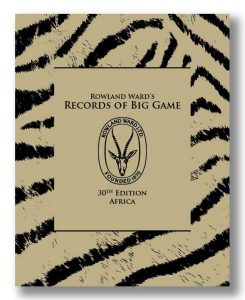
The 30th Edition of Rowland Ward’s Records of Big Game will debut a new way of scoring African buffalo.

Go on a Cape buffalo safari almost anywhere in Africa, and you will hear professional hunters talk about a “38-inch bull” or say, “I saw one today I am sure would go over 40.” Since African sport hunting began, more than a century ago, a buffalo with a horn spread of 40 inches or more has been considered a very good head.  Spread means how far the horns extend in a straight line at a 90-degree angle from the skull–not total length of the horns from the tip around the horn toward the skull. In most hunting grounds in Africa, obtaining a head with 40 inches of spread or more is not easy, even in the those areas with the best trophy potential, such as Zambia and Tanzania. The Rowland Ward minimum for inclusion in its record book has, for decades, been 42 inches of spread. Rowland Ward measurers have also always recorded the width of the bosses and the straight-line, tip-to-tip spread, as supplemental information.

In the past two years the editors of Rowland Ward held many in-depth discussions with biologists, game department officials, client-hunters, and professionals alike to determine what would encourage the best management practices for buffalo herds and their age structure and what measurements would reflect the most desirable buffalo trophy and, above all, encourage the shooting of older bulls.  By about age seven, the spread of a buffalo is set.  At that age, its overall horn length (if measured from the tip of the horn curling back toward the skull) is probably at peak.  But the bosses are still “green,” or soft, and have not formed into a hard keratin material, which only happens when the buffalo reaches nine or ten  years of age, according to Dr. Kevin Robertson.  As a result of these discussions, in the upcoming edition of Rowland Ward’s Records of Big Game, Cape, Nile, and Central African buffaloes will be ranked on a total score that includes spread and the width of both bosses.

Rowland Ward does not allow for the measuring of green boss material, nor should it, as it occurs exclusively in up-and-coming bulls that are yet to become herd bulls–that is, the males that do most of the breeding. In extraordinary cases, some buffalo grow “airplane wing” horns that extend out and down to form horns that are shaped somewhat akin to the bottom end of the paddle of a canoe; very flat, thin, wide, and often curled. Such animals, even when very old, have almost no bosses, and often they are hermaphrodites, or bulls that have had their reproductive organs injured through fighting or predators.  Such heads may have a very large spread.  Under the new ranking system, however, such heads will drop down considerably in the ranks, because they have little or no bosses.

By combining the spread measurement, plus the width of the two bosses, Records of Big Gamewill encourage the harvesting of older bulls and emphasize the attributes that hunters like best in Cape buffalo: spread and hard bosses.  The changes will be implemented in the 30thedition of Records of Big Game, which comes out in November 2019.

This “airplane-wing” buffalo was shot shortly after WW II by Clary Palmer-Wilson, in Tanzania.  With its exceptional spread (64 inches) the head scored at the top of the list for several decades. The animal has virtually no bosses and, in fact, had been castrated in an accident many years before.
This buffalo was shot in 1973 in Kenya by Karl Flick, on the right, seen here with PH Robin Hurt.  It has exceptional bosses and superb spread (54 inches). Under the new ranking system, it will score well above the Palmer-Wilson head.

Leave a Comment

The Future of Hunting

Hunter numbers have declined in the last few decades, but wildlife advocates are working hard to turn the tide.

Photo by Vic Schendel

Hunters are a distinct minority in today’s world. Recent data from the U.S. Fish & Wildlife Service suggest that there are about 15.4 million hunters in the U.S.–that’s only about 4.9 percent of the population. This is down from an estimated 16.2 million hunting license holders in 1980–6.87 percent of the U.S. population.

Before you get secretly excited that fewer hunters in the woods means a higher probability of success for you next hunting season, here’s a wake-up call: The exact opposite is true. Hunting license sales and federal excise taxes on hunting equipment provide the primary source of funding for wildlife conservation and habitat. This money amounts to 80 percent of the funding for state fish and wildlife agencies, and they are the primary managers and caretakers of our wildlife resources. If this funding decreases, our wildlife populations could go downhill, fast.

Numerous initiatives have sprung up with the goal of reversing the decline in hunter numbers. Chief among them are what’s being called “R3,” short for recruitment, retention, and reactivation. These efforts, spearheaded by fish and wildlife agencies and local and national conservation groups, include youth outreach, “Learn to Hunt” days, and mentoring programs. Among the more successful of these programs are the National Archery in the Schools Program, the Scholastic Clay Target Program, and the Becoming an Outdoors-Woman program.

These are all fantastic efforts, but they tend to be somewhat localized, and often the people they reach are those who are already hunters or who come from a hunting family. In an effort to widen these efforts and make them more effective, a coalition of state agencies, conservation groups, and industry partners combined to form the Council to Advance Hunting and the Shooting Sports (CAHSS). Research and resources provided by CAHSS are helping to develop and implement more effective programs to reach potential new members of the hunting community. (To learn more, see cahss.org.)

These are excellent efforts and badly needed. As I see it, there is also a “fourth R”–recognition–that should go hand-in-hand with the R3 efforts. Reaching out to potential new hunters is crucial, but so is addressing the overwhelming percentage of non-hunters with a positive message about hunting. Not everyone wants to become a hunter, but everyone should have the opportunity to learn why hunting is important to wildlife conservation and our economy, and they will be far more likely to support it at the ballot box, online, and in person.

A great example of a “fourth R” program is Colorado’s “Hug a Hunter” TV ad campaign, which is targeting general audiences watching network television during prime time with a friendly, pro-hunting message that is resonating with a non-hunting urban audience. A group called the Nimrod Society is working to get these pro-hunting ad campaigns started in other states. (To learn more, see nimrodsociety.org.)

All of these are efforts that hunters should wholeheartedly get behind. Hunter numbers are dwindling and public support for hunting is declining. Let’s work together, now, to turn the tide.

Leave a Comment

Nine-Three

The 9.3, not the .375, should really be considered the minimum caliber for dangerous game.

It’s a longstanding article of faith that the .375 is the legal minimum for Africa’s thick-skinned dangerous game. This has been the “letter of the law” in some African jurisdictions, but in many cases, it is simply not true. Some African countries have no caliber stipulations at all. The most rigid I know of was the rule imposed by the East African Professional Hunters Association (EAPHA) that imposed a .40-caliber minimum for elephant, rhino, and hippo throughout the British sphere. This restriction essentially went away when the EAPHA formally disbanded in late 1977, following the closure of hunting in Kenya.

In most countries that have actual caliber (or cartridge) requirements, the more common minimum is not .375 but its European equivalent, the 9.3mm (caliber .366). Zimbabwe has perhaps the most complex rules, stating minimum energy requirements for various classes of game. Sounds good, but in the game laws these are expressed in the European kilojoules of energy, inexplicable to we non-metric Americans. Some years back the minimum energy requirement for “buffalo and larger” game fell right at the .375 H&H level, or about 4,000 foot-pounds of energy. The late Don Heath was in charge of Zimbabwe’s rigorous PH testing and licensing. Don was a staunch 9.3mm fan; twenty years ago he rewrote Zimbabwe’s game laws so that the minimum energy requirement for the largest game would include the 9.3x62mm Mauser and 9.3x74R, which produce a bit over 3,500 foot-pounds with the standard 286-grain bullet.

Boddington’s Sabatti 9.3x74R double groups inside of two inches at 100 yards, making it an effective and useful 200-yard double rifle. 93x74R doubles tend to be much less costly than big-bore doubles and can be built very light. This rifle weighs about seven pounds.

I believe strongly in the old adage to “use enough gun” for dangerous game. However, regardless of exactly how the law is written, common sense must be applied. Should a “.375 minimum” include the .375 Winchester, 250-grain bullet at 1,900 feet per second (fps) for barely 2,000 foot-pounds of energy? I think not! Most such rules clearly exclude the fast .33s which, with heavy-for-caliber bullets of 250 grains and more can develop well in excess of 4,000 foot-pounds of energy. Especially with the great bullets available today, I can assure you a .338 Winchester Magnum, Remington Ultra Mag, or Lapua is plenty adequate for buffalo. The same can be said of “fast .35s” with heavy bullets, such as the .358 Norma Magnum and .350 Rigby. However, regardless of theoretical adequacy, these may not be strictly legal.

Local game laws must be followed, even if they don’t always make perfect sense, and it’s not a bad idea to factor in conventional wisdom based on generations of experience. Not all of us are even amateur ballisticians. It’s perfectly OK to consider .375 as a sensible minimum for Africa’s largest game, but you need to think “.375 H&H” level of power. Included would be the .375 Flanged Magnum (the rimmed version for doubles) and the .376 Steyr (developed around Jeff Cooper’s “big bore Scout Rifle”). Both are slower than the .375 H&H, but can approach 4,000 foot-pounds, so are certainly adequate for buffalo. Excluded would be “mild .375s” like the .375 Winchester and the old 9.5x57mm Mannlicher-Schoenauer.

I’m perfectly fine with considering the 9.3mm as an alternative minimum standard. But, as with the .375, it’s important to understand which 9.3mm cartridges we’re talking about. Starting around 1900, the 9.3mm (.366-inch) became a standard and popular European bullet diameter. Cartridges of the Worldlists seven 9.3mm cartridges introduced early in the twentieth century. To this list must be added the .370 Sako Magnum (European designation 9.3x66mm), introduced into the U.S. in 2008 as a joint project between Federal and Sako. Half of these eight 9.3mm cartridges should be ignored because they are mild, on the order of the .35 Remington, and unsuited for dangerous game.

This Mozambique buffalo was taken cleanly with a single 286-grain Hornady Interlock from a Sabatti 9.3x74R double. The 9.3mms are probably marginal for elephant but even this mild 9.3mm is fully adequate for hunting buffalo.

That leaves four that are viable, useful, and adequate: 9.3x62mm Mauser; 9.3x64mm Brenneke; .370 Sako Magnum; and 9.3x74R. The first three are rimless bolt-action cartridges based on the 8mm Mauser or .30-06 case and able to be housed in standard .30-06-length actions. The 9.3x74R is a long, tapered rimmed cartridge, still a common chambering in Continental double rifles. The 9.3x62mm is by far the most popular. Like many older cartridges it’s enjoying quite a comeback, readily available in Europe and loaded by both Hornady and Norma. Introduced in 1905, it was essentially developed as a bolt-action version of the 9.3x74R. The two are ballistically identical; the most common loads for both feature a 286-grain bullet at 2,360 fps, yielding 3,530 foot-pounds.

Although case capacity and shape are similar to the 9.3x62mm, the “hottest” 9.3mm is Wilhelm Brenneke’s 9.3x64mm, introduced in 1910 and based on the .30-06 case. It is much faster, propelling the same 286-grain bullet at 2,690 fps and developing 4,580 foot-pounds. In Europe it was never as popular as the 9.3x62mm and is almost unheard-of in this country. The much newer .370 Sako (9.3×66), also based on the .30-06 case, pretty much falls in between the 9.3x62mm and the 9.3x64mm Brenneke. As loaded by Federal Premium, it features a 286-grain bullet at 2,560 fps, developing 4,147 foot-pounds.

In practical terms one can figure that the .370 Sako is the equal of the .375 H&H with 300-grain bullet, while the 9.3x64mm Brenneke exceedsthe .375 H&H. The 9.3x62mm and 9.3x74R, ballistic twins, are not quite the equal of the .375 H&H. My opinion is that all the 9.3mms and.375s are very marginal for elephant but, with heavy-for-caliber solids, will provide adequate penetration. Today, however, the buffalo represents the great majority of the dangerous-game universe. The 9.3mms are definitely adequate for any and all buffalo hunting.

The 9.3x62mm Mauser is the most common and most available. As usually loaded, with a 286-grain bullet at 2,360 fps, it offers an effective and mild-recoiling alternative. An advantage over the .375 H&H is that it can be housed in a .30-06 action, offering a lighter, trimmer package. Obviously the same can be said of the .370 Sako (9.3x66mm), except that it is loaded faster, pretty much equaling the .375 H&H and thus producing about the same recoil. In 2008 a group of us took .370 Sako rifles to Zimbabwe using Federal ammo with 286-grain Barnes Triple Shock and 286-grain Barnes Super Solids. Together we took about ten buffalo and (using the solids) a couple of tuskless elephants. Performance was awesome, no problems, so when I say it equals the .375 H&H with 300-grain bullets I’m basing it on this experience.

Exactly why the .370 Sako hasn’t taken off baffles me, but it hasn’t become nearly as popular as the old 9.3x62mm Mauser. Although possibly the best of the bunch, the 9.3x64mm Brenneke is a rare bird, especially in the U.S. On the other hand, there’s nothing wrong with mild recoil provided you have the performance. I just got a light, handy, gorgeous 9.3x62mm from the Montana Rifle Company. I’m taking it to Cameroon soon for one more (hopefully one last!) try for a dwarf forest buffalo.

Based on the .30-06 case, the .370 Sako Magnum is equal to the .375 H&H but in shorter and trimmer case. The 286-grain Barnes Triple Shock was recovered from a buffalo; the 286-grain Super Solid was recovered from an elephant, perfect performance from both.

The 9.3x74R is also not be overlooked. Continental 9.3x74R doubles are much less costly than big-bore doubles, and can be built wonderfully light. I have a Sabatti 9.3x74R double with detachable Contessa scope mount. It groups both barrels under two inches at 100 yards, making it a viable and useful 200-yard double rifle. Last year in Mozambique we got onto a herd of buffalo in miomboforest and I had a shot at a nice bull at about eighty yards, almost broadside but quartering slightly toward me. That rifle weighs just over seven pounds with scope and it bounces pretty hard! The bull took the 286-grain Interlock hard, but was gone before I could get back on him. He crashed away, then silence, and in a few seconds heard his death bellow. We found him quickly, stone dead.

One of the trackers commented, “I wasn’t sure you could kill a buffalo with that little rifle.” Having never taken a buffalo with that cartridge, I wasn’t 100 percent sure, either, but I am now!


Leave a Comment

Great Winter Reads

A selection of books for reading by the fireside on a winter evening.

When the snow flies, the time is right to curl up by the fire with a good hunting book. Whether you prefer the classics or are looking for something brand-new, here are a few can’t-miss favorites.

One of the most interesting hunters of the twentieth century has been nearly forgotten today, but Sasha Siemel’s exploits live on in his excellent book, Tigrero! His hunts for the fierce jaguars in the jungles of Brazil—armed only with a spear—will leave you breathless. He guided many notables, including Theodore Roosevelt Jr., on expeditions and hunting adventures in the South American jungles. Siemel was so famous in the 1930s, ’40s, and ’50s that he appeared in liquor advertisements, Hollywood films, and even in a full-length feature article in the New York Times. His autobiography was published in 1953, and this new edition has been revised and expanded to include new stories by Siemel and a large selection of photos and illustrations.

No one could write a riveting story about tracking down a man-eater the way Jim Corbett could. Corbett wrote six books about his terrifying hunts for tigers and leopards in India. They’re all so good it’s tough to pick just one, but fortunately you can buy the whole set: Temple Tiger, Tree Tops, Jungle Lore, Man-eating Leopard of Rudraprayag, Man-eaters of Kumaon, and My India, housed in a printed slipcase. If you’re looking for something really special for your office bookshelf, a leather-bound version of the collection was recently commissioned to commemorate John Rigby & Co.’s acquisition of Corbett’s legendary .275 Rigby rifle. Each book in this limited edition of 275 numbered copies is signed by Rigby CEO Marc Newton and the set comes in a beautiful leather slipcase.

There are almost too many great books about African hunting to count, but if you re-read just one again and again, a good choice would be Robert Ruark’s Horn of the Hunter. This book-length story of his first African safari, shared with his wife, Virginia, and professional hunter Harry Selby, is one of the best accounts of a 1950s-era (or any era) African safari ever written. Ruark is evocative, funny, and self-deprecating, and his rollicking adventure through East Africa in what could be considered the glory days of the African safari is not to be missed.

Books by early North American hunters are not as well-known as those of classic Africana, but there are some excellent ones out there. One of these is Charles Sheldon’s The Wilderness of the Upper Yukon,in which the well-known hunter details his expeditions through the Yukon Territory to study wild sheep in 1904 and 1905. Just getting there was an adventure—he traveled by steamboat, canoe, horseback, and boot leather—and his companions included Frederick Selous, William H. Osgood, and the artist Carl Rungius. While sheep were the main focus, the explorers encountered moose, grizzlies, and caribou. The profuse photographs and paintings in this book bring these long-ago travels to life.

Readers who have enjoyed Walter “Karamojo” Bell’s other books—especially his classics Karamojo Safari and The Wanderings of an Elephant Hunter—will not want to miss two brand-new volumes of this great hunter’s writings. Compiled over the last several years from long-lost manuscripts left by Bell upon his death, both books have all the adventure, description, and riveting writing style Bell is known for. Incidents from an Elephant Hunter’s Diary is a collection of his never-before-published short stories, exploring Karamoja, Uganda, and the French Congo. Reminiscences of an Elephant Hunter is the complete autobiography of Bell, recounting his full life story, as well as more great adventure stories he wrote over the years, and an interesting section of letters and records from Bell’s varied and adventurous life. It’s a treasure trove for anyone interested in this exceptionally fascinating man.

Arguably the most famous hunting writer alive today, Craig Boddington has penned numerous books that are always interesting and entertaining reads, full of know-how and advice gleaned from his unparalleled hunting and shooting experience. Craig has now been hunting in Africa for more than forty years, and every ten years he has written a book chronicling the most recent decade of his adventures. His latest is From the Cape to Kasserine, detailing his hunts from 2007 to 2016, and it does not disappoint. From driven wild boar in Tunisia to elephants in Botswana, buffalo in Mozambique, lions in Tanzania, and offbeat trips to Ghana, Burkina Faso, and Liberia, he explores both popular and little-known hunting destinations and takes us along for a most enjoyable ride.

If you’ve ever watched professional hunter Buzz Charlton’s hair-raising elephant-hunting DVDs, you know this Zimbabwe PH is a fearless and personable character. In his new book, Tall Tales: The Life of a Professional Hunter in the Zambezi Valley, Charlton tells stories of his twenty-five years guiding safari hunters in the field. His stories range from his learning days as an apprentice PH—some of the funniest tales in the book—to adventures with clients of every imaginable stripe. Known for tackling crop-raiding elephants and ornery tuskless cows in the thick jesse of the Zambezi Valley, Charlton has had plenty of adventures, and he recounts them well.

All of these books are available from Safari Press, and if this lineup doesn’t get you through the entire winter, you can find dozens more titles at safaripress.com.

Leave a Comment

Hunt It to Save It

Photo by Vic Schendel

Many think species protection requires the ending of hunting and protection by the government. Neither are true.

It was the last clear, bright day of September, and I went out onto the plains to hunt sage grouse. A brace of the oversized birds makes a limit, but there’s still the kicking up of them among the brush and cactus, and seeing the English cocker run, overjoyed.  These are birds to pluck, much too special to skin before eating.

It occurred to me as I hunted that the sage grouse had gone from straightforward upland game to a genuine trophy bird–like the wild turkey or the Eurasian capercaille. A cockbird mounted with its spiky pinnated tail feathers fanned, wings down, white breast feathers fluffed, and gular sacs expanded (curiously reminiscent of Mae West bundled in white furs at a Hollywood premiere), is a striking, unique addition to a hunter’s home.

With that in mind, I e-mailed an old friend who is a guide and outfitter in the grouse’s home range, asking if he could recommend anyone I might recommend to readers to take them hunting.  I thought more hunters should get to know the bird, gain an appreciation of it, and take an interest in its well-being as a species.

My friend’s somewhat gratuitous reply: “Sorry Tom, but sage grouse have become as rare as hen’s teeth, so we don’t hunt them anymore.  They used to be common, now we’re just trying to protect the vestiges of that population.” This is from a professional hunting guide, someone who should know that no game species is more orphaned than one nobody hunts anymore.

I realize many sincerely believe the sage grouse to be standing on a precipice, and certainly conscientious efforts at conservation must be, and are being, made.  Yet probably much of the energy expended in attempting to get the bird placed among the animals covered by the Endangered Species Act of 1973 is motivated by the desire to give the federal government increased power over the management of millions of acres, both public and private, that the grouse inhabits in almost a dozen Western states, and to take away power from the “yokels” who already live there.  And one of the tactics of those wishing to see the bird listed is the claim that this will protect it from hunters, as always the “usual suspects” in the decline of any species.

The grouse’s situation is complex, but the implications of those advocating for ESA status are clear: not hunting an animal is how you save it–and even hunting guides, it seems, can be made to believe this simplistic notion.  Add to that the other suggestion, that it takes the central government to preserve it.  But how true is that

Central governments have for years encouraged and/or orchestrated the killing of wildlife on a grand scale, especially predators.  Take the British as an example.  The cause of the tiger’s waning on the subcontinent is most often placed in the hands of pith-helmeted “Bungalow Bills” seated in howdahs on the backs of elephants.  Mark Twain, though, writing about his travels in British India in the mid-1890s, noted that “the government’s work is quite uniform. . . it about doubles the tiger’s average” of killing, each individual instance of maneating by the species met by the officially sanctioned culling of twice as many tigers80,000 big cats were destroyed in this fashion from 1875 to 1925 (after ending sport hunting in 1971, India turned some 1,800 remaining tigers into 1,411 after 34 years of “protection” and the expenditure of $400 million in “conservation” funds). 

Touring Britain’s East African territories in 1907 as Under Secretary of State for the Colonies, Winston Churchill promised, “Zebra, rhinoceros, buffalo, and other picturesque and fascinating nuisances will be driven from or exterminated within the settled areas, and confined to the ample reserves of uninhabited land.”  True to Churchill’s words, and as just one instance, famed professional hunter, J. A. Hunter, was tasked by the Kenya-colony government with killing 1,000 rhinos to sweep a region clean for a hopeless agricultural scheme. 

As President in 1906, the hero-father of American conservation, Theodore Roosevelt, moved to preserve the “finest deer herd in America.”  The mule deer on Arizona’s Kaibab Plateau had fallen to 4,000 with the carrying capacity of the land arbitrarily estimated at 30,000.  To protect them, Roosevelt created the Grand Canyon National Game Preserve and banned all deer hunting on it. Even Roosevelt, a lifelong hunter, in this case displayed a distinct lack of faith in the efficacy of hunting as a wildlife management tool. Meanwhile, as livestock overgrazed the plateau, the U.S. Forest Service was killing every predator it could find in the preserve, hundreds of lions and bobcats, a score of wolves, and nearly 7,500 coyotes.  Deer numbers exploded to 100,000 by 1924 and then proceeded to die off in the thousands from starvation in the succeeding years.  By 1939, the population was 10,000.

The Animal Damage Control Act of 1931 gave the U.S. Fish and Wildlife Service the mandate that helped eliminate the gray wolf from the Lower 48, at taxpayer expense; and now the USFWS has spent hundreds of millions of those same taxpayers’s dollars to reintroduce the wolf they were once empowered to destroy, amounting to wildlife management à la “Sybil.”  The Act  also led to the wholesale killing of other prized big-game animals, such as cougar and black bear. 

There is hardly any need to reprise the fate of wildlife in Kenya after its government banned safari hunting in the late 1970s, except to recall the well-known remark that all great world-historic facts . . . appear, so to speak, twice . . . the first time as tragedy, the second time as farce.”  Thus to the ending by the Botswana government in 2014 of regulated safari hunting on public land in that country, to the detriment of wildlife and the delight of anti-hunters. 

In the abstract to a recent peer-reviewed report on Northern Botswana, Joseph Mbaiwa, Professor of Tourism Studies at the Okavango Research Institute at the University of Botswana, writes, “Results indicate that the ban led to a reduction of tourism benefits to local communities such as:  income, employment opportunities, social services such as funeral insurancescholarships, and income required to make provision of housing for needy and elderly . . . Reduced tourism benefits have led to the development of negative attitudes by rural residents towards wildlife conservation and the increase in incidents of poaching in Northern Botswana.”

It is manifest what can be accomplished when hunters, not governments, are the ones who concern themselves with, or if you wish, just follow their selfish interests to, the conservation of a species.  Simply look at ducks, turkeys, elk, and sheep and the efforts of non-governmental hunters’ organizations such as Ducks Unlimited, the National Wild Turkey Federation, the Rocky Mountain Elk Foundation, and the Wild Sheep Foundation. Markhor are now doing well in Pakistan due almost exclusively to the work, and the passion, of hunters.  The Père David’s deer exists today because the last survivors of the Chinese species were placedin theNanyuan Royal Hunting Garden on the outskirts of Beijing, until the Boxer rebellion overran the park in 1901.  Luckily, some deer had already been sent to Europe for zoological collections; and later they went to places like Texas and Argentina to be hunted, increasing enough as hunting trophies that they have been reintroduced into their native range. 

Still, hunters’ best efforts can be thwarted.Even if brakes can be applied to the federal administration, that still leaves state executives to sign orders ending hunting, as New Jersey Governor Philip Murphy did in August, halting the black-bear season on public land.  Or ballot initiatives that really began with the outlawing of cougar hunting in California in 1990, and the killing of about 2,500 lions on depredation permits in the state since.  Around the country in the following years, some forty“animal-protection” initiatives were approved by state voters–remember, there is no state in which hunters are not a minority–often because of mawkish, dishonest appeals to the emotions of a non-hunting electorate.  Then there is the judiciary.

As expected, Chief Judge Dana L. Christensen of the U.S. District Court of the District of Montana in September returned the grizzly bear in Idaho, Wyoming, and Montana to the Endangered Species list, dismissing over forty years of successful conservation and restoration efforts.  According to a Mike Garrity, executive director of the Alliance for the Wild Rockies, grizzlies will “now truly have a chance to recover” and “their habitat will be protected until they are recovered.” “Recovered” as in never, or at least not as long as judges like Christensen sit on the bench.

However this picture ultimately turns out, not many of us here today are likely still to be around to read the credits.  But I know turning my back on the sage grouse (or any species we hunt), leaving it to meet its fate alone, is not salvation. Maybe I can’t be sure what salvation is, or if I am able to contribute toward itbut I plan, if I can, to go out after sage grouse again next year with my dog, secure in the knowledge that by sharing its world, despite what anybody may care to tell me, I am ratifying the continuing million-and-a-half-year existence of Meriwether Lewis’s “Cock of the Plains” on the land where it belongs. 

Leave a Comment

tablet

Never Miss An Issue!Subscribe Now: 6 Issues for $34.97

More Details
WordPress Video Lightbox Plugin