Sports A Field

Slowing Down

The old still-hunter’s mantra is a good lesson for the woods, and for life.

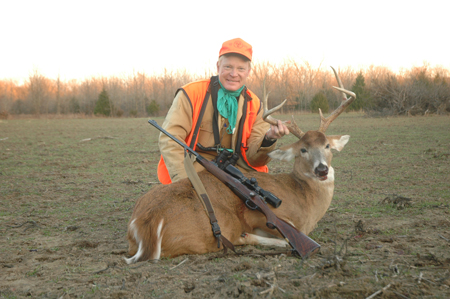
The end of the year is a time to reflect. It’s also a time to take advantage of the wonderful hunting adventures we enjoy here in North America. Depending on where you live, the seasons are either ramping up or winding down, but throughout the continent hunters are stocking their freezers, and their memory banks, with the fruits of this year’s hunts.

Such reflections got me to thinking about a recent experience I had while deer hunting in Pennsylvania, the state where I was born and raised, and where I still return often to try my luck on its exceptionally wily, wary whitetails.

It was a snowy day two Decembers ago, the kind of northern Pennsylvania winter day I remember from my childhood. A couple of feet of soft snow were on the ground, large white flakes drifting gently into my face from the slate-gray sky. There was deer sign all over the ridge top I was on: tracks, droppings, and places where they had pawed through the snow to get to some hidden treat.

It was the second week of the rifle season. I had both a buck and a doe tag in my pocket, and I had been hunting for the better part of the week without filling either of them. I’d seen some deer, but every sighting had played out the same way–tails bouncing away through a maze of tree trunks, or a momentary face-off with an alert brown form that instantly rocketed away.

I was making silent progress through the fresh snow toward the edge of the ridge, where I figured I would stop for a break and look down the other side. As I came over the top, three deer that had been bedded just on the other side exploded practically at my feet like a covey of ruffed grouse, bounding away down the hill and out of sight. I dropped to one knee, searching frantically for a target but finding only gray tree trunks. I lowered the rifle and sighed with frustration.

Sitting down in the snow, I had a drink of water and thought about the week. My lack of success boiled down to a simple fact: The deer were seeing me before I saw them. That meant I had to do two things: one, go slower, and two, see better.

I possessed the means to see better: the excellent high-end binocular hanging around my neck. I thought about the way I normally used it: picking apart a big sage-covered hillside in the West, piece by piece, in hopes of spotting a deer or elk. I rarely used it in the thick northern Pennsylvania woods, where you can barely see fifty yards. It seemed silly. But no sillier than spooking all those deer. I resolved to start glassing as if on a Western hunt, studying everything below me and ahead of me with extreme care.

The other thing I needed to do was slow down. Like most human beings in the modern world, slowing down is not something I’m good at. The old still-hunter’s mantra: “Go as slow as you can, then go slower,” was fine in theory, but I rarely put it into practice. But now I resolved to do so. I shouldered my pack and my rifle, got to my feet, and took a couple of steps. Then I stopped. I glassed ahead and around me. I took two more slow steps. And stopped and glassed again.

My brain screamed at me: This is pointless. You’ve already spooked the deer out of this area. You need to get to a new spot, fast. You need to cover more ground!

I took a deep breath and studiously ignored the doubts. Two silent steps in the soft snow. Stop. Glass carefully.

It took a while, but a strange thing happened. I got into a quiet cadence. My brain settled down. Birds and squirrels went about their business, seeming to take little notice of my presence. I began to feel like a part of the woods instead of an intruder. It had been a long time since I had been able to slow my impatient steps enough to feel this way.

I stopped worrying about what time it was. So I don’t know how far I had silently stolen along the ridge at my glacial pace when, studying the trees below me through the binocular, I spotted an ear.

Just an ear. I swapped binocular for scope and a deer’s head took shape. It was a mature doe, standing stock-still, fifty yards below me, looking straight ahead. It hadn’t seen me.

I watched it for a moment through the scope. I had done it. After a week of spooking every single deer I had encountered, I had turned it around. The ear flicked and the doe turned its head slightly to look down the hill. That snapped me out of my reverie. I dropped the cross hairs to the deer’s chest, slid the safety forward, and pressed the trigger. The boom of my mom’s old .30-06 carbine shattered the snowy stillness.

After reloading and engaging the safety, I made my way down the steep hillside to where the deer had been standing, noting a large splash of bright red in the snow and a toboggan-like trail where the deer had slid down the hillside. At the end of the plowed-up snow, piled up against an old tree stump, was a fine big doe.

I slid down and put my hands on her warm hide. She represented a freezer-load of delicious steaks and chops, but she also meant much more. She had reminded me I did not need to do everything at breakneck speed. I shed my pack and coat, filled out my tag, pulled out my knife, and then sat in the snow for a while, just enjoying the moment, before getting to work. For once, I wasn’t in a hurry.

Enjoy your late-fall adventures, and be sure to take some time this season to slow things down and immerse yourself in the natural rhythm of the woods and fields where you hunt.

Photo copyright Vic Schendel

Leave a Comment

Use Enough Gun!

But how much gun is enough?

There is a difference between what you can (sometimes) get away with, and what you should do. The title phrase predates Robert Ruark, but Use Enough Gun is the title of his excellent posthumous collection, published shortly after the author’s death in 1965. Ruark was referring mostly to dangerous game, which in his short but peripatetic safari career he had rich opportunity to pursue: Lots of buffalo, several big elephants, a score of leopards. Ruark was badly mauled by an Asian leopard. He blamed faulty Indian ammunition, but in those days of unrestricted travel I’ve always wondered why he was using questionable ammo? Ruark took two lions on his first safari, and apparently had no desire to hunt them again, but he shot multiple tigers. He also took his famous Westley Richards .470 on an Alaskan brown bear hunt, so he practiced what he preached.

With dangerous game, common sense tends to rule. Generations of experience—and some local laws—suggest sensible parameters for dangerous game rifles and cartridges. In Botswana thirty years ago, a local hunter came in behind us on a buffalo herd, wounded one, and got himself badly unzipped. He was using a .30-06, which tradition suggests is unwise, and Botswana law said was illegal.

Unfortunately, it isn’t always the brash hunter who bears the consequences. Veteran B.C. guide Cy Ford was guiding a hunter who wounded a huge grizzly with a 7mm Remington Magnum, despite warnings the cartridge was too light. The shot was fairly good, but not good enough. Ford went into thick stuff after the bear. The search party later found the bear, dead in a small clearing “like a black Volkswagen beetle.” Several hours passed before they found Ford’s mangled body. His .30-06 was unfired, and it appeared he never had a chance.

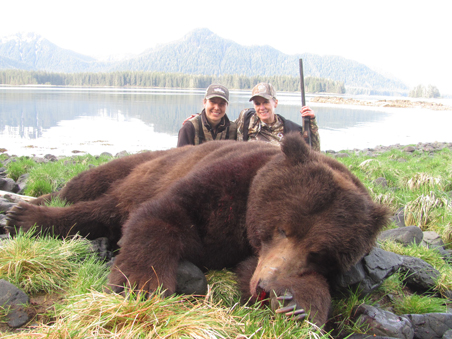
Guide Alisha Rosenbruch-Decker and Donna Boddington with a big Alaskan brown bear taken cleanly with a .338 Winchester Magnum. Decker’s experienced outfit prefers a .375 minimum for brown bear, a thought worth considering.
Big bears can be tough. In 2013 Donna took a giant brown bear with a .338. I think that was a good choice, but we either missed (or possibly ignored) the outfitter’s stipulation of “.375 minimum for brown bear.” Fortunately, she pasted her bear perfectly; her follow-up shot was unnecessary. Only later did guide and famous bear hunter Alisha Rosenbruch-Decker tell us that this was the only brown bear she’d seen taken cleanly with a .338. The .338 should be enough gun, but this is food for thought.

Most of us accept that big, dangerous animals require more power, and most of us comply. Some would say that I often “over-comply.” I am a child of the first magnum phase, the 1950s and 1960s. Good Lord, I shot my first elk (and my first sheep, caribou, and moose) with a .375! That was unnecessary power, but it worked. I’ve mellowed, but I find being “overgunned” a more elusive concept than being “undergunned.” The downsides to the former are you’re carrying more gun weight and sustaining more recoil. You are not necessarily ruining more meat, because large-caliber bullets tend to punch through. However, without question, you are not carrying the ideal tool. To me, the downside to not using enough gun is worse. On non-dangerous animals nobody is going to get hurt. But, as ethical hunters, isn’t it our credo to take game as cleanly as possible? Lack of “enough gun” leads to wounded animals and wasted game, and this is not acceptable.

A century ago, when smokeless powder velocities and jacketed bullets were new, we had almost simultaneous smallbore fads in both Africa and North America. They were different because African hunters were euphoric over the awesome penetration from long-for-caliber “solids” in early smokeless military cartridges from 6.5mm to 8mm. In the early 1900s these cartridges were widely used for game up to elephant. They worked, but times were different; if you read old accounts carefully you’ll discover a wounded-and-lost rate that would be unacceptable today. By the 1930s the argument in Africa was pretty much over; cooler heads had prevailed and things were much as they are today: The 9.3mms and .375s are considered minimal, and many hunters use larger calibers.

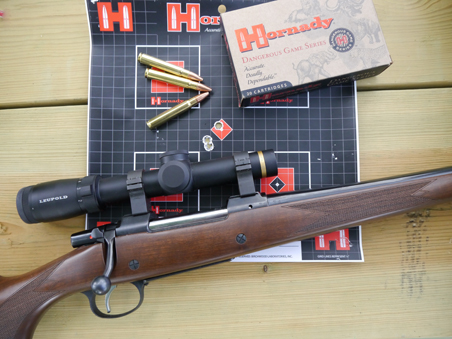
An accurate CZ chambered to the old 9.3×62 Mauser. Today this cartridge is generally considered a bare-bones minimum for African dangerous game. Mild in recoil with heavy-for-caliber 286-grain bullets it’s a sensible minimum based on decades of experience.
In North America we ran out of mammoths in the last Ice Age and, by the time of smokeless powder, the bison were nearly gone. Our “adequacy issues” started in 1912 with the .22 Savage Hi-Power and continued in 1915 with the .250 Savage, the first commercial cartridge to reach 3,000 feet per second. The Savage Hi-Power used a 70-grain .228-inch bullet at 2,700 feet per second. Unlike .22 centerfires that followed, it was intended for deer-sized game. The .250 Savage used a light 87-grain bullet to achieve its velocity. Both were ground-breaking cartridges, and both suffered from lack of bullet technology to withstand the velocity. The .22 Hi-Power was briefly the darling of the sporting press, and then came the .250-3000.

Both were used on all manner of game much too large for their caliber, power, and bullet performance. When all went well they dropped game like lightning, but things didn’t always go well. Word got out. Centerfire .22s came to be considered varmint cartridges. The .250 Savage is a fine deer/pronghorn cartridge, but it achieved its lasting reputation with 100-grain bullets at lower velocity.

It seems we have to keep learning the same lessons. Today’s great bullets make a huge difference; with heavy bullets (and in careful hands) the .22 centerfires are effective deer cartridges, but nobody advocates their use for elk or black bears, and no one should. In North America we don’t have the Big Five. Our “special case” animals are our big bears, plus a few bison, muskoxen, and walruses. We have deer-sized game: Deer, sheep, goats, and pronghorns; caribou aren’t enough larger than deer to up the ante. Black bears are potentially bigger and always tougher. So are wild hogs. However, we also have elk and moose, much larger than all the rest! Moose, though bigger, are not especially tough; elk are very tough, and a mature bull elk is a whole different order of magnitude from a tasty cow or spike.

The current popularity of the 6.5mm Creedmoor is an interesting phenomenon. It’s a great little cartridge, ballistically identical to the .260 Remington, also a great little cartridge, though not as popular. Both are awesome for deer-sized game at medium ranges. Likewise, the 7mm-08, and old-timers like the 6.5×55 and 7.×57. Their standard 140-grain bullets, all at similar velocities, are capable of taking elk-sized game cleanly at moderate range. Mild recoil aids good shot placement, but I am concerned about the seemingly magical properties currently ascribed to the 6.5mm Creedmoor. It uses a 140-grain .264-inch bullet at 2,700 feet per second. This is not a giant slayer. Although a wonderful long-range target cartridge, it is not an ideal long-range cartridge even on deer-sized game; and it is marginal for elk. This group of cartridges do not equal the fast 6.5mms, and they do not equal the .270s. These, to my thinking, offer sensible minimums for elk, but not at longer ranges. If you want a low-recoil option for elk, think about the .308 Winchester, but keep to medium distances. It will take time for the word to get out, but, as autumn seasons get underway, it is a fact that, right now, elk are being unnecessarily wounded with mild 6.5s and 7mms. I predict the euphoria will pass, as it has before.

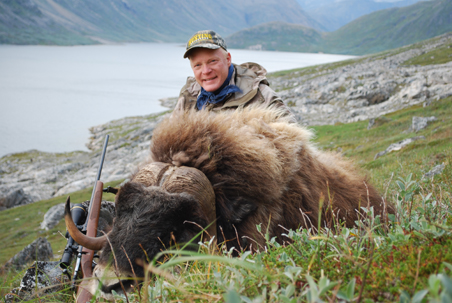
This Greenland muskox was taken with a single 130-grain Barnes X from a .270. Reasonably and sensibly, the outfitter prefers a .30-caliber minimum for muskox. When one goes against conventional wisdom there’s always unnecessary risk.
Over the course of extensive hunting experience most of us, for various reasons, will push the envelope now and again. Knowing one is inadequately armed leads to extra care, so most of the time we get away with it. One year in northern Mexico my gun case didn’t arrive, so I went mule deer hunting with the ranch rifle, an old CZ in .222 Remington. One shot and down; I got away with it, but I knew it was risky. In Greenland outfitter Bjorn Birgisson stipulated a reasonable .30-caliber minimum for muskox. For some reason I pitched up with a .270. With a tough bullet it worked fine; it’s a good thing, or the “I told you so” would have been unpleasant. It is impossible to gauge exactly how much bullet weight, frontal area, and kinetic energy is required because every shot and every animal is slightly different. Still, we have generations of experience to rely upon. Little has changed since the shift to smokeless powder, and we have an ever-increasing mandate to take our game cleanly, efficiently, and humanely. And we have lots of choices. There is no compelling reason to defy those decades of experience to see what we can get away with.


Leave a Comment

Feathered Fiesta

Discovering the bounty of white-winged doves and colorful ducks along Mexico’s Sea of Cortez.

There’s something almost magical about watching an expert wingshot. The way the shotgun comes up as if an extension of the shooter’s body; the long smooth moment when the bird and the barrel seem to move as one; the shot that brings the bird down cleanly, folding and dropping.

“Nice shot,” I said admiringly as my hunting partner, Tim Joseph, dropped a widgeon into the water. The sun was coming up behind us and casting a rosy glow onto the calm waters of the Sea of Cortez. I shifted slightly on my stool, which sat on a temporary platform built along a marshy shore redolent with mud and saltwater. A screen of tall reeds and grass hid us from the decoy spread. A warm breeze touched my face; the morning had a balmy, tropical feel.

There was a sudden flurry overhead and Tim and I ducked low behind the reeds. A flock passed above us with a chorus of whistling wings. The birds wheeled, stalled, and several ducks came straight for our decoys, wings cupped.

“Now!” Tim said. We stood up and both shotguns spoke. Three ducks dropped and the rest roared back into the air as we shoved more shells into our guns and grinned at each other.

“Incoming!” I swung smoothly on a passing pintail and pulled the trigger just as the barrel cleared its beak. Smoke curled from the muzzle of my shotgun as I watched the duck splash down in front of the blind, a single feather drifting down after it in the still air.

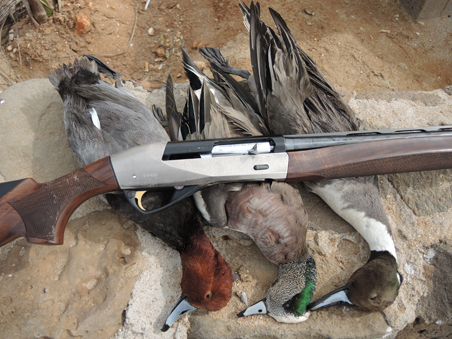
The action continued all morning–flocks large and small, pairs and singles, some aiming straight for our decoys, and others whistling on past, presenting us with a variety of challenging shots. Tim accounted for the lion’s share of our morning’s bag, but I was pleased with my own stack of ducks, primarily widgeons, redheads, and pintails.

As Vice President of Marketing for Benelli, Tim has been honing his wingshooting skills for many years, chasing ducks, geese, doves, and upland birds from coast to coast. He and Josh Ward, who handles PR for Benelli, had invited me, along with a group of other writers and editors, on a mid-December trip to sample some of Mexico’s fabled duck and dove hunting and to put Benelli’s 20-gauge Ethos shotgun through its paces. Our hunt was based out of a comfortable lodge in the modern, bustling city of Ciudad Obregon in southern Sonora.

Obregon is in the Yaqui Valley, part of Sonora’s coastal agricultural region. This part of Sonora is the staging and feeding ground for wintering Pacific flyway ducks, and from November through March it is home to an estimated population of 2 million ducks–pintails; gadwalls; green, blue, and cinnamon teal; black ducks; canvasbacks; Pacific black brant; widgeon; redheads, and many others—sixteen species in all. Mexico’s liberal bag limits and the sheer diversity of species makes this a can’t-miss destination for anyone who wants to experience duck hunting the way it must have been in the “good ol’ days” north of the border.
Hunters are delivered via airboat to natural and man-made blinds along shallow-water estuaries, marshes, and freshwater ponds adjacent to grain fields. We shot over a decoy spread on a saltwater bay one morning, and over a small freshwater pond on the next.

Having a chance to duck hunt by the ocean is a rare treat for me, and between flocks I savored the balmy salt air and the muddy smell of the shoreline marsh. By the time the sun was well up, Tim and I had accounted for a good number of ducks, and more just kept coming, many getting more suspicious and slicing past us with fast fly-bys that made for challenging crossing shots. It was a blast.

Every hour or so the deafening noise of the airboat shattered the peaceful bay as the guides roared past, scooping up the ducks we had dropped and piling them in the bow of the boat. Once they’d retrieved the birds, they returned to the dock and quiet would descend once again on the bay, punctuated only by the periodic pow-pow-powof our semiautos when a new flock came in for a closer look at our decoys. Several times I was privileged to hear that distinctive whistling sound made by the wings of a large flock passing low over our heads, something I had read about but had never experienced firsthand.

Cactus-Field Doves

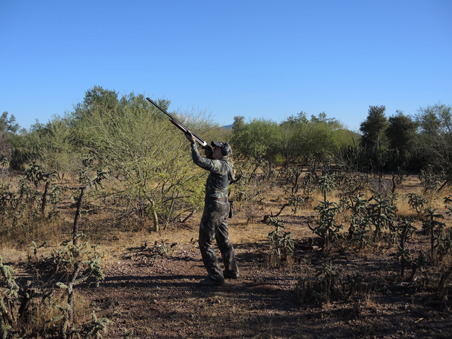
The vast fields of sorghum, sesame, corn, and cereal grains in the Yaqui Valley region, bordered by thick, brushy areas of mesquite and chaparral, support millions of both white-winged and mourning doves. These are resident birds that trade back and forth between the fields and cover year-round. It was my first time shooting whitewings, which are large, strong-flying, beautiful doves. On our first afternoon we set up near a power line in a lovely field studded with mesquite brush as well as a variety of beautiful, spiky cacti, including ocotillo, cholla, and prickly pear. Doves were whirring overhead before I could even fumble the first few shells into my gun.
Each shooter had his or her own “bird boy,” whose job was to help us spot incoming doves, keep us well-stocked with shells, and pick up the birds we dropped. Assigned to me was Edgar, a bilingual and well-traveled young man in his twenties, and throughout the shoot we chatted amiably about hunting and places we’d been. The action was nearly nonstop, with concentrations of doves to rival those in South America, and the shooting was incredibly challenging. Before long I had picked up enough Spanish to be able to make excuses for missing in two languages.

“Muy alto,” I’d grin at Edgar after missing an especially tall bird. “Dang it. Muy rapido!”

But the doves seemed plentiful beyond numbers, and Edgar tossed more and more of them into my slowly growing stack.

During occasional lulls, Edgar told me about the culture of the Yaqui Valley. We had arrived on December 12, the day Mexico celebrates the Feast of Our Lady of Guadalupe, and on our way to the dove field we had passed an impressive shrine carved into the side of a mountain, with a crowded and colorful fiestagoing on below. Edgar explained that people walk and drive from all over the region to pay their respects to the Virgin Mary and say some prayers, and then they hang around to socialize and drink a few cervezas with friends.

I was impressed at the ability of all the bird boys to spot and find nearly every dove we dropped, no matter how fast and furious the shooting. At the end of the day, the communal pile of dead whitewings and mourning doves was impressive. Happily, the joy we had in shooting these birds was not the last they would provide. As we drove back to the lodge, we detoured through a hardscrabble village along an irrigation canal; its residents would be the grateful recipients of the day’s bag. A group of barefoot kids spotted the logo on the outfitter’s truck and darted out of small adobe houses, racing across yards of packed dirt to meet us with joyous shouts of “Palomas! Palomas!” (Doves! Doves!)

On our last evening in Mexico, we sipped frothy margaritas in the cool shade of the lodge patio and sampled homemade guacamole as a mariachi band entertained us. In the morning we would head north again, taking with us memories of balmy mornings on a saltwater bay, warm afternoons in a field of cacti, and the sound of wings in the Mexican sky.


If You Go: Hunting in Mexico

Plenty of bird hunters fly right over Mexico on their way to more famous wingshooting destinations in South America. After experiencing the incredible dove and duck hunting on the west coast of Mexico, though, I’m not sure why. This region is a much shorter flight for the average American hunter and offers tremendous numbers of doves—both whitewings and mourning doves—and a huge variety of waterfowl. Best of all, you’ll be escaping to the tropics when winter is clamping down north of the border. Travel to Mexico gets a bad rap these days, but we flew into Hermosillo and drove south to Ciudad Obregon with the outfitter, and I never felt the slightest bit unsafe. Gun importation, facilitated by our outfitter, was no problem. Timing is important, of course. The best dove shooting is August through October, while the best waterfowl hunting (including a chance for Pacific brant) happens in the winter months. Our trip in mid-December was a bit of a compromise, providing good shooting for both doves and ducks although not the highest concentrations of either.

Frank “Gabino” Ruiz runs Gabino’s Outdoor Adventures, headquartered in a comfortable, welcoming lodge in downtown Ciudad Obregon, and he offers hunts all over Sonora’s Yaqui Valley. You can book this hunt through Ramsey Russell’s GetDucks.com.


What to Take: The Benelli Ethos 20-gauge

The star of the show on this Mexican hunt was actually a beautiful Italian—the Benelli Ethos 20-gauge shotgun. The Ethos is a sleek, nimble, graceful semiauto. Originally produced in 12-gauge, Benelli added the 20-gauge version a couple of years ago (it now comes in 28-gauge as well), and its light weight and easy-swinging feel is ideal for the long days in the field and hundreds of rounds you’ll shoot at fast-moving birds when you’re hunting south of the border.

The Ethos has an elegant, traditional look, with an AA-grade satin walnut stock and nickel-plated and engraved receiver. It’s designed to be exceptionally practical as well, with an inertia-driven action, progressive comfort recoil-reduction system, and lightweight carbon-fiber rib with interchangeable fiber-optic sight. It’s easy to load thanks to a beveled loading port, redesigned carrier, and two-part carrier latch that allow shells to glide into the magazine quickly, which is great when the doves are coming in one after another. In several days of hunting I never had a problem cycling even the lightest loads. The Ethos also has a slightly oversized trigger guard that is great for shooting while wearing light gloves, as I prefer to do.

It’s a cinch to disassemble for cleaning, too, with a magazine cap that unscrews easily and doesn’t bind in dusty or muddy conditions. The Ethos comes with a custom-fitted hard case, five choke tubes (cylinder, improved cylinder, modified, improved modified, and full).


Return of the Zambezi Delta Lions

Hunter-funded conservation reaches new heights as wild lions are reintroduced to one of Africa’s most important ecosystems.


In June 2018, 24 wild lions were flown from South Africa to Mozambique’s Zambezi Delta where they would spend the next six weeks in fenced bomas for observation before eventually being released. This project—the largest wild lion transfer across an international border in African history—is essential to the future of the  species, but completing such an ambitious project required years of planning, research, and millions of dollars of funding—funding generated by hunters.

In truth, the story of this lion reintroduction began in 1994 when professional hunter Mark Haldane brought his first client into the Zambezi Delta to hunt buffalo. In the mid-twentieth century Mozambique was a premier African hunting destination. The firm Safrique controlled much of the Zambezi Delta and counted such legendary ivory hunters-turned-PHs as Harry Manners and Wally Johnson on their payroll. However, the area was decimated during the lengthy Mozambican Civil War that raged from 1975 until 1992 when local militias set up a base of operations in the delta and indiscriminately killed the local wildlife to feed troops and for profit. After the end of the war, displaced natives repopulated the depleted delta. At that time Mozambique was one of the poorest nations in the world and starvation was killing thousands of Mozambicans each year. In order to obtain meat, delta residents constructed lengthy brush fences with periodic openings which they lined with snares and leghold “gin” traps that further depleted the already devastated wild game populations in the area.

Initial game counts in the delta following the civil war told a grim tale; an aerial survey found that the population of 45,000 cape buffalo had been reduced to roughly 1,200 animals in Coutada 11’s half-million acres. A total of 44 sable antelope were found in the area, and there were less than 100 waterbuck. Selous zebra were once numerous in the area, but by the time the war ended only 5 animals could be located. A long-time delta resident recalled that when he arrived in 1998 it was not uncommon to drive for several hours without seeing any game in the area at all.

That didn’t stop Haldane.

“I fell in love with the area and I saw its potential,” he told me as we waited for the lions to arrive. Mark Haldane bought into the first safari company that operated in the area following the civil war—Zambeze Delta Safaris—and immediately began building an anti-poaching unit that initially numbered 5 officers who patrolled the vast area on foot. Haldane provided full-time employment for delta residents—a luxury few people in the area had ever known—and supplied starving villagers with a steady supply of meat, building strong relationships with the local people. Perhaps more importantly, he convinced the residents of Coutada 11 that a thriving ecosystem with healthy populations of wildlife could provide them with a valuable, renewable resource that would help improve their lives and the lives of their children. Mark’s work paid off, and the tide began to turn in the delta.

By 2013, the Zambezi Delta had been transformed by these efforts. Under Haldane’s watch buffalo numbers had risen to roughly 20,000. Sable antelope were estimated at 3,000, and the area currently has more sable per square mile than any other wilderness hunting area in Africa. Nyala, hartebeest, warthog, and eland were common on the floodplains. When Haldane began hunting the area he was offered one waterbuck tag per year that oftentimes went unfilled because he rarely saw a mature bull. When I arrived for the lion release in 2018 I saw a single herd of waterbuck bulls that numbered over 60 animals—one of several herds we saw that day. Selous zebra, nearly extirpated in the delta by the mid-90’s, now number in the thousands. Additionally, Haldane oversees one of the most successful and well-trained anti-poaching units anywhere in Africa. The area is now patrolled daily by helicopter which was funded by the Dallas Safari Club and fast-reaction anti-poaching teams that rely on motorcycles to rapidly intercept poachers. The funding for all of this came directly from hunters, though Haldane has reinvested a substantial amount of his own earnings back into the community and the delta. In addition to employing over 90 local villagers full-time, Haldane routinely patrols the area himself by helicopter. As game numbers increased so have the number of foreign hunters coming to the delta, and that influx of revenue has allowed the Zambezi Delta team to build a school which they supply with books and stationary, to dig wells, install a mobile corn mill (villagers previously had to carry corn over 35 miles to the nearest mill, and a portion of their corn was collected as payment for the service) and to provide villagers with transportation to hospitals in the event of a medical emergency. Prior to that delta residents had to walk a half-day to obtain medical attention—which they oftentimes didn’t reach in time.

For all Haldane’s success in the delta there was something missing, and that something was the roar of wild lions. The reason that lions had not repopulated such a game-rich area has not been positively identified, but a flight around the perimeter of the delta offers some insight into the forces that likely kept the big cats at bay. Flying in from Beira, south of the delta, there are vast unprotected areas where forests have been cleared for subsistence farming and villages. To the north, one of Mozambique’s busiest roads—and the human populations that reside along it—prove a natural boundary between the delta and nearby Gorongosa National Park. The delta, and all its rich wildlife resources and miles upon miles of prime habitat, was an island the cats could not reach due in large part to human interference.

In 2013 Haldane and Ivan Carter were sitting around a campfire at Haldane’s Mungari Camp in the delta and Carter proposed an ambitious plan to offer his support in reintroducing lions to the area. Though he was in favor of lion reintroduction, Haldane understood how difficult the task would be. But slowly the two men developed a plan of action that would, as Ivan Carter puts it, “move the needle” on wildlife conservation in Mozambique. There would be many risks and challenges involved with moving lions, and the cost in time and resources would be high, but both men agreed that the potential outcome—the return of a viable wild population to one of Africa’s most intact and well-protected wildlife areas—was worth the effort.

Carter, through his Ivan Carter Wildlife Conservation Alliance, began raising funds to help Haldane’s efforts. The ICWCA, as Carter says, “identifies heroes on the front lines of conservation and provides them with the tools, training and financial resources they need”. Haldane was the perfect candidate for such a program. ICWCA provided funds to purchase motorcycles for the anti-poaching teams, brought in experts from the Southern African Wildlife College to help train troops in modern anti-poaching tactics, provided support for helicopter reconnaissance operations to stem poaching and assisted with community engagement and upliftment projects. Of equal importance, the ICWCA enlisted the help of Doctor Byron du Preez, a lion biologist with 10 years of experience who played a crucial role in the highly-successful Bubye Valley lion restoration project in Zimbabwe. With the use of helicopters and radio collars provided through the alliance, Dr. du Preez began a long-term sustainability project to study the delta wildlife and determine whether or not a lion population would be viable in the delta. He found that, in addition to abundant prey animals, the delta had an especially attractive feature for lions—extensive ecotones. Ecotones are boundaries between various habitat types, and in the case of Coutada 11 these are represented by miles of palm savanna that separate the delta’s floodplain from the region’s sand forests. Lions, according to Dr. du Preez, tend to prefer these ecotones and spend most of their time there. To find an area with so few people, plentiful prey, zero livestock and long stretches of ecotones made the Zambezi Delta an ideal landscape for lions.

With the scientific data to support the lion move, Carter looked to enlist the financial support needed to begin the ambitious process, and that came through the Cabela Family Foundation. The Cabela family is one that is familiar to hunters, and they wanted to provide the financial assistance required for such an important recovery effort.

“Preserving wild Africa is very important to our family,” says Dan Cabela. “Ivan brought several different projects to us, and they were all great, but this lion project hit home. I knew this is one we would be interested in because of my mother’s (Mary Cabela) love of Africa and love of lions.”

All the essential elements were in place. The important next step was to procure lions, and for that the team turned to South African game reserves with wild, free-ranging cats. But moving wild game—especially a species like lions—is not an easy task. With Dr. du Preez’s data in hand, the team began finding lions with varied genetic backgrounds to prevent the possibility of inbreeding. The operation required filling out mountains of paperwork that included permits from local and national authorities, veterinary clearance, and much more. The process was anything but streamlined due in large part to the complexity and scope of the project, and the last official documents were signed and delivered only hours before the scheduled charter flights were booked and the darted lions were set to be transported to the delta. Another key element to the success of the project was to bring residents of the delta on board with the project so they would support the team’s efforts. Because of the presence of tsetse flies in the delta and the diseases they spread to livestock there were no domestic herds in Coutada 11, but if the local population was not in support of the lion move it could never succeed. Haldane’s long-standing relationship with the local villages plied the way for discussion, and Byron du Preez spoke to every individual in Coutada 11 about the cats and answered questions from an audience that was, at times, understandably skeptical about the prospect of having wild lions released near their villages. But the strong relationship that Zambeze Delta Safaris had forged with local communities provided the framework for an agreement to be reached, and with the support of the community and Coutada 11’s Chief Thozo the last hurdle was cleared. The largest international lion transfer in African history as set to begin.

Haldane and Alvaro Rola, who owns the government lease on the neighboring Coutada 10, forged an agreement between the two companies—essentially competitors—to work closely together on the transfer. Lions would be introduced to both coutadas, and I was present when the very first load of sedated lions, ten young females of breeding age, arrived at the airstrip beside Haldane’s Mungari Camp deep in the delta. A crowd of perhaps a hundred locals, most of whom had never seen a wild lion, watched as the first jetload of lions arrived on the delta. Carter and Haldane flew customs officials from Beira to Mungari Camp to facilitate competition of transfer permits when the lions arrived, the symbolic last step in the five-year process.

One-by-one the ten lionesses were offloaded as a veterinarian kept close watch over them while a sea of onlookers caught their first glimpse of a lion. Once the cats were loaded into Land Cruisers they were transported 45 minutes through the delta to a fenced boma where they would spend the next six weeks before their release into the wild. Local school children were brought out from the surrounding villages to examine the cats first-hand, a critical step since their attitudes toward the lions would eventually determine, in large part, the success or failure of the entire operation. Dan and Mary Cabela were on hand throughout the entire process. In addition to the lion transfer, the Cabela Family Foundation, in keeping with their “whole community benefit” philosophy, also funded construction of a medical clinic that would provide health care to the local residents. It was due to open the month after the transfer and would provide a higher level of health care to the residents than they had ever known.

As darkness fell there was a rush to transport the sedated lions to the boma where they would spend the next several weeks. Just before dark, the convoy of trucks and helicopters arrived and the cats were rushed one-by-one into the fence with no time to spare. Already having been under anesthesia for ten hours, the veterinarian made the decision that the cats must be given the antidote immediately and as quickly as the lions were laid out in the boma they were given a shot that would reverse the effects of the drug. Within a few moments the first of the eight lions (two others were on their way to a similar boma in Coutada 10) lifted her head and looked out into a foreign landscape hundreds of miles away from where her journey began as the last member of the lion transfer team slipped through the boma’s gate. Eventually all the lions rose and walked on unsteady legs into a grove of trees to sleep off the drugs. Byron du Preez watched their progress through a FLIR thermal scope to ensure that there were no ill effects from the anesthesia. When the last of the eight lionesses disappeared into the tall grass the long day ended with celebration.

I asked Mary Cabela, wife of the late Dick Cabela, why she was involved in the program.

“They say one person can’t make a difference,” she told me. “But we were able to make a difference here. I think Dick would be very proud.”

I agreed. As Dr. du Preez kept watch over the cats, accompanied by his wife and daughters, we loaded into the trucks and headed back to camp through the African night. In two days the second load of lions would arrive, and three lays later the final shipment would be in the delta.

The return of lions to the Zambezi Delta served to heal one of the last scars of Mozambique’s gruesome civil war. But there’s hope that the delta lions will become more than just a symbolic gesture of the return of wild Africa. Coutada 10 and 11 cover roughly a million acres of the finest game habitat on the continent, and with no cattle and very few people the area is a crucial wilderness. For perspective, Kruger National Park in South Africa covers an area that is roughly twice the size of the Zambeze Delta Ecosystem but Kruger is home to over 20 permanent camps and sees over a million visitors each year. The cats of the Zambezi Delta will live, in large part, free from human interaction. According to Dr. du Preez’s estimates the delta cats could eventually represent ten percent of the entire wild lion population on the continent. And even though the transfer was funded by hunters these cats were not brought here to hunt—a fact that Haldane and Carter both emphatically point out. Once the population rebounds there may be hunting here, but that days lies far in the future. These lions were relocated to improve the overall health of the delta’s ecosystem.

African lions don’t benefit from good will or caustic social media debates. What African lions need is habitat and protection from poaching, and both of those are now offered in the delta because of efforts Mark Haldane began a quarter-century ago. When these lions are released from their bomas they will walk out into an oasis that, not all that long ago, was virtually a wasteland. Hunters helped change the face of the delta, and now hunters have had a hand in one of the most ambitious and important wildlife relocation efforts in Africa’s history. But the work is not done. Poaching continues to be a problem, as evidenced by the mountain of wire snares and steel traps Haldane has collected, and his anti-poaching team recently arrested two Malawians who had heard about the delta’s wealth of wildlife and traveled hundreds of miles to exploit the area’s riches for profit. For now, though, these poachers will be met with a team of dedicated individuals who are willing to risk everything for the future of wildlife.

It won’t be long until the roar of lions can once again be heard in the delta. The needle has moved.

Learn more about this initiative at www.24lions.org. If you want to play a direct role in funding habitat restoration and anti-poaching efforts, please visit Zambeze Delta Anti-Poaching (www.zambezedeltaantipoaching.com), the Ivan Carter Wildlife Conservation Alliance (www.ivancarterwca.org), or the Cabela Family Foundation (www.cabelafamilyfoundation.org). You can also support the initiative through Ivan Carter’s Raindrop Initiative at www.theraindropinitiative.org.


Use Enough Scope

But not too much!


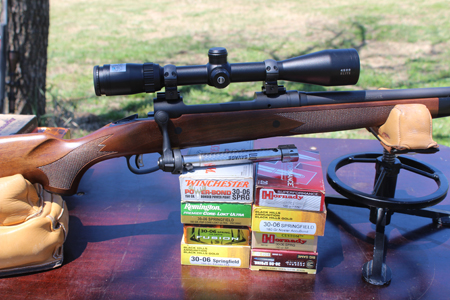
Guys like me who are fascinated by hunting rifles and cartridges probably belabor the point. We agonize over the exact “perfect” choices when there are usually lots of suitable rifles and cartridges (and bullets and loads) that will work just fine for the job at hand. The old adage “beware the one-gun man” remains true…but if you’re a rifle nut settling on just one versatile and familiar choice would take away much of the fun, wouldn’t it? Also, I’d be out of a job as a gunwriter!

Fortunately for me there seems a near endless supply of rifles and cartridges to write (and argue) about, so our traditional campfire discussions over the “best” choices are in no jeopardy. But while we’re agonizing over the right rifle, cartridge, bullet, and load, are we giving enough thought to the most ideal sight or scope?

My favorite whitetail rifle is my Todd Ramirez 7×57…I’ve experimented with more powerful scopes, but it usually wears this Schmidt & Bender 1.5-6×44, clear and bright, and enough magnification for the country I use it in.

Recently my decisions got easier. There are certain specialized applications where iron sights, either open or aperture, may be superior to the magnifying riflescope. Unfortunately, I have reached the point where my eyes can no longer resolve iron sights well enough to be competent with them. I believe there are still situations where irons are sound options, but now I have to caveatthat with “if you can still see them!” I cannot, but there are other options; the non-magnifying reflex or red-dot sight offers a fast, accurate, and visible alternative to iron sights. There are also many close-range situations in which magnification isn’t necessary and may not be helpful. Again, the red-dot or reflex sight offers a marvelous alternative.

However, most hunters today are children of the scope era, so we probably think first of the magnifying riflescope. Although riflescopes saw effective use in the mid-19thCentury, they didn’t come into widespread use until after WWII. When I was a kid in that postwar era the “standard” hunting scopes—and my own first riflescopes—were fixed 4X. Larger scopes existed for varmints and target shooting, but variables hadn’t quite yet been perfected and were widely distrusted. Pundits of the day, certainly including Jack O’Connor, advised that, for big game hunting, there was no need for higher magnification than 4X. In the 1970s variable-power scopes came into common use, and in recent years scopes have just gotten bigger and bigger.

In an odd turn of fate several of today’s better-known gunwriters are almost exactly the same age: John Barsness, Ron Spomer, Wayne Van Zwoll, yours truly. Grumbling, as we become the curmudgeons we once abhorred, all of us have written that a fixed 4X is “enough scope” for most big-game hunting. Yes, it is, and many optics firms still offer a good old fixed 4X. I’m sure I have one or two around somewhere, but I can’t remember when I actually used a fixed 4X in the field!

I got my first 3-9X variable scope in about 1976, and I remember being enthralled by that hugemagnified image…and how much easier it made longer shots. I got spoiled, and I’m still spoiled. I like magnification! It reduces aiming error and allows for more precise shot placement. How much is enough depends on distance and size of target; more magnification can be used on small varmints than is needed for deer and elk!

A Bushnell Elite 4500 scope in 1.5-10X, mounted on a left-hand Savage 110.30-06. The author believes a “medium-sized” variable scope in a similar power range is the most versatile, suited for a wide range of hunting purposes

On the other hand, there can be too much magnification. There are reasons for this. First, because of mirage and heat waves there are many situations where high magnification cannot be used. Prairie dog towns are bad for this, but in big-game hunting I’ve seen many situations where I couldn’t use magnification higher than about 15X. Second, on close shots too much magnification runs the risk of seeing just a blur of hair in the scope. The beauty of the variable-power scope is the highest magnification setting is there if you need it…but you aren’t obligated to turn the scope all the way up. It’s best to leave allvariables somewhere at a low to medium magnification until you want more power. If you can remember you aren’t required to use all the magnification at your disposal then there’s no harm in having it except it comes at two prices, one physical, the other literal. The larger the variable range the bigger and bulkier the scope! Why carry it if you don’t need it? Also, why pay for it if you don’t need it? Compared within the same product line, the higher the range of the variable the more expensive it will be.

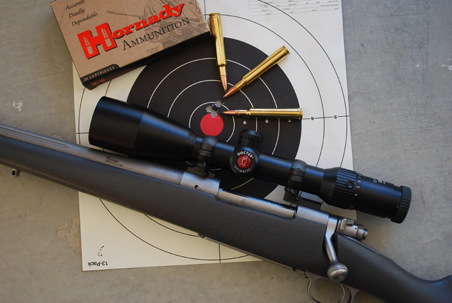
Okay, as with choosing rifles and cartridges there are broad ranges of suitability, so it’s hard to make a “bad” choice. But some are better than others; it depends on the country and the game, but even then you never know exactlywhat kind of shot you might draw. For instance, last January I hunted Coues deer in northern Sonora. Few other hunts in the world are as optics-intensive, or as likely to result in a longish shot at a smallish animal. We were using Bushnell’s new Forge line; I put a 4.5-27x44mm scope on a Mossberg .300Winchester Magnum. Okay, so I was over-gunned and over-scoped, but the rifle was the new walnut-stocked Patriot Revere. At that moment caliber choices were limited. I went with the .300 and was ready for long shooting as needed. The scope, with that huge variable range, is obviously one of many scopes developed for the growing interest in extreme-range shooting. It was bright, and clear. It was also large and heavy, but I was set up for a worst-case long shot.

In the event it was clear, bright, and warm. Heat waves came up early, and there was no way to use all that magnification. When I shot my buck, we made a stalk and caught him in a pocket just over a little ridge, very close (as Coues deer go!). I don’t recall the setting, but I turned the scope ‘way down. Again, that’s the beauty of having higher magnification: You don’t have to use it unless you need it. So, the only real issues with the “big” variables currently in vogue is you have to pay for and carry capability you may not use.

That said, I’d rather have too much magnification available than not enough when I need it! Again, I started with fixed 4X scopes. I also had other fixed-power scopes from 2X to 3X. Call me spoiled, lazy, or just getting old, but today I want more magnification…and if I don’t, I’ll probably forget magnification altogether and slap on an Aimpoint!

Throughout most of my career America’s most popular scope has been the 3-9X variable. There’s no magic in that exact power range; you could throw 2.5-8X, 3.5-10X, and similar scopes into the same group. Again, I’m not an extreme-range shooter at game, so scopes in this class offer all the magnification I really need, including out to the longest distances I’m likely to shoot. Such scopes are usually of moderate bulk and weight…and, within any product line, are less costly than larger scopes.

These are the ranges of variables worn by most of my “general purpose” hunting rifles; I still find the good old 3-9X variable that I discovered forty years ago hard to beat. That said, I concede: Magnification is seductive, so on flatter-shooting rifles that might be used in big, open country I often take a step up. For years “three times zoom” was standard, but today five and six-times zoom (and more) is increasingly common, and this enhances capability without increasing weight and bulk. I have a couple of 2-12X (and similar) scopes, and my Jarrett .300 is wearing a Leupold VX6 in 3-18X. I haven’t needed to turn it all the way up in the field, but it’s a trim and fairly light scope and I don’t mind having its capability!

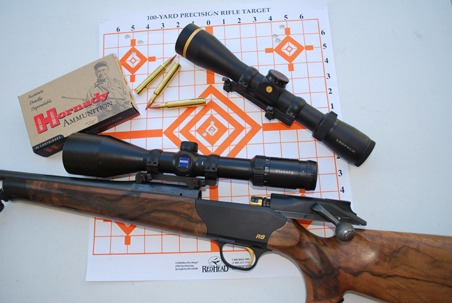
For sure, it’s better to have too much scope at your disposal than not enough! The biggest mistake we make, at least in my world, is our employment of the low-range “dangerous game” variables. Typically between 1-4X to 1.75-5X with a straight 24mm objective, these scopes are light and handy, ideal if you knowyour shot will be fairly close. If, for instance, you know you’re going to shoot a bear or a buffalo, your worst-case shot won’t be 200 yards, and you have plenty of scope.

This class of “dangerous game scope” is just fine for bears, boars, and buffaloes, and lots of other things I can think of). It is notfine for other uses one might have for the same rifle, often on the same trip. Your .375 (or .416) might be pressed into service for plains game, and you might see a wolf while bear hunting. The newer “dangerous game scopes” in 1-6X (or even 1-8X) offer more capability and versatility. These days, however, I often bypass this class of scope altogether. I’ve used a Leupold VXR 2-7x33mm on several .375s and .416s. Whether for dangerous game or plains game, this is enough magnification without adding much more weight and bulk, and the slightly larger objective adds light-gathering capability. Just now, on a forest hunt in Congo, using “camp rifles,” I had a choice between a Leupold 1-4x24mm or an Aimpoint. I used the Aimpoint for tracking in the forest, perfect…but when we sat in machansfor sitatunga and such I went with the magnifying scope. At the distance 4X was plenty, but scopes with straight objectives don’t gather much light; at dusk it was over quickly! A third option of a scope that gathered more light would have been welcome!

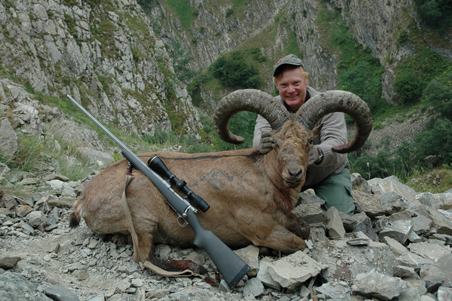
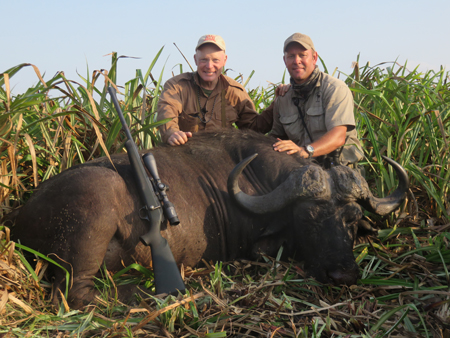
 Although non-traditional, I used a Sig-Sauer 2.5-10X scope on a Blaser with .416 Remington Magnum barrel to take this buffalo. Although larger scopes add weight and bulk, one thing about having extra magnification is you don’t have to turn the scope up unless you need to.


Leave a Comment

Working for Wild Sheep


Photo by Donald M. Jones

Good news and bad news from sheep country.

The world of North American wild sheep has been rocked by plenty of news lately, both good and bad.

First, the good news: Sheep populations, overall, are larger and healthier than they’ve been in decades. The Wild Sheep Foundation (WSF) estimates that somewhere between 170,000 and 190,000 sheep roam the North American continent. About 50 percent of these are “thinhorns,” the Dall and Stone sheep of Alaska, Yukon, Northwest Territories, and British Columbia. Some 80,000 are bighorns, an impressive number. And these sheep are growing big, especially in Montana, as evidenced by a couple of tremendous Rocky Mountain bighorns that stormed into the record books this year. A ram found dead on Montana’s Wild Horse Island in 2016 shattered the world record when it was found to score 216 3/8. Also this year, a young Montana hunter named Justin Sheedy shot a beautiful ram that tied the longstanding hunter-killed world record of 208 3/8.

All of this means that the hard work and years of effort on the part of wildlife managers and hunters to enlarge and nurture wild sheep populations are paying off.

But an ominous cloud formed on the sheep-hunting horizon in March with the long-feared news that Mycoplasma ovipneumoniae, a pathogen that carries a respiratory disease fatal to wild sheep, had been discovered for the first time in Dall sheep and mountain goats in Alaska.

Unfortunately, wild sheep are highly prone to fatal respiratory disease, which can sweep through herds and cause massive die-offs. Domestic sheep and goats are known to carry this pathogen, infecting wild sheep when they come into contact with them. Wildlife managers have long struggled with deadly pneumonia outbreaks in bighorn sheep herds, but the diseases have never been a problem in Dall and Stone sheep, which tend to live in wilder country farther removed from their domestic cousins.

“This alarming news out of Alaska confirms what many wild sheep conservationists have dreaded, that a domestic sheep and goat pathogen has somehow made its way into Dall sheep in Alaska, home to more than 25 percent of all wild sheep in North America,” said WSF president and CEO Gray Thornton.

The news seems to have galvanized at least some lawmakers on the state and federal levels, with the Alaska legislature passing a resolution (unfortunately nonbinding) to “support enhanced efforts to protect wildlife and domestic animals in the state from infectious diseases…” Meanwhile, in Washington, in the final proposed spending bill for FY18, Congress reissued its directive to the Department of the Interior and U.S. Forest Service to “find solutions to the risks of pneumonia die-offs in bighorn and potentially thinhorn sheep.”

Ultimately, though, any solution will require broad cooperation between state agencies, hunters and other advocates for wild sheep, holders of public land grazing permits, private landowners, and the livestock industry. It won’t be an easy task.

As has been the case throughout the history of North American wildlife conservation, however, hunters are taking the lead in finding solutions. The Wild Sheep Foundation and its state affiliates are working hard to proactively address the disease issue and other problems in sheep country. Thousands of dedicated volunteers, most of them hunters who will probably never get to hunt a wild sheep themselves, are pouring time, money, and effort into ensuring that sheep populations remain strong for future generations.

If you love the mountains, and the magnificent game animals that call them home, these organizations deserve your support.


Leave a Comment

You Don’t Know What You’ve Got Till It’s Gone

Fewer young hunters entering the field has helped fuel a decline in hunting participation over the last five years. Photo by Vic Schendel

The decline in hunter numbers over the last five years is sparking concern about the funding model for wildlife conservation.

To quote the inimitable Gomer Pyle, “Surprise, surprise, surprise!”  Who knewthat conservation in America is largely undergirded by hunters?  Too few, apparently.

Unique to this continent is the North American Wildlife Conservation Model. Going back to the middle of the nineteenth century, hunters and anglers saw wildlife in crisis.  There were virtually no game laws; and a large proportion of the population wanted to keep it that way to be able to exploit wildlife without restraint–or eliminate it and sweep the land clear for farmers and ranchers.

Far-sighted individuals, such as Theodore Roosevelt, who was first and foremost a hunter, witnessed the cascading destruction of the big game he loved so much to hunt in the West, leading him to found the Boone and Crockett Club, whose mission statement is “to promote the conservation and management of wildlife, especially big game, and its habitat, to preserve and encourage hunting and to maintain the highest ethical standards of fair chase and sportsmanship in North America.”  With him at the founding of the Club were the most prominent conservations of the era, hunters all.

As Roosevelt came to power, he broughtwith him the Wildlife Model’s principals known as the Seven Sisters of Conservation: wildlife belongs to the people, government holding it in trust; market hunting must be outlawed by making it illegal to sell wild game meat; allocation of wildlife must be regulated by law; every citizen should have the freedom to hunt; wildlife was not to be wantonly wasted or mistreated; wildlife does not recognize borders, so migrating animals required the protection of international treaties; and decisions about wildlife must be based on the best science.  And now we seem to be losing much of that wisdom.

Even before Roosevelt entered the White House, the Lacey Act, authored by Iowa Congressman John F. Lacey, another member of the Boone and Crockett Club, made it a federal offense to transport illegally taken wildlife across statelines and international borders.  Upon assuming the executive office, Roosevelt turned to Lacey again to get through Congress the Antiquities Act, whichlet the president establish national monuments.  Roosevelt also helped enactthe National Wildlife Refuge system. Later came migratory bird acts, in consort with Canada.

The U.S. hit upon a “user-play, user-pay” system for funding its wildlife conservation.  The Pittman-Robertson Wildlife Restoration Act has,since 1937,taken the excise tax on firearms and ammunition and dedicated it to conservation, the amount distributed to wildlife agencies, along with the excise tax on angling equipment under the Dingell-Johnson Federal Aid in Sport Fish Restoration Act,together totaling some $19 billion, matched by $5 billion in state funds drawn from license and permit fees. And the Migratory Bird Hunting and Conservation Stamp (the “duck stamp”) has raised another $8 billion.  Sixty percent of monies utilized by state wildlife agencies to manage this nation’s wildlife is drawn from these funds, along with license and permit fees.  And these are all, it should be noted, voluntary payments from hunters, not tax dollars strong-armed by theI.R.S.

Not satisfied with, or entirely trusting in, a government-only approach, private hunter-conservation groups like the Rocky Mountain Elk Foundation (RMEF), Foundation for North American Wild Sheep (FNAWS), and Ducks Unlimited (DU), have pursued their own fundraising conservation projects in conjunction with state and federal agencies.  The RMEF has opened, secured, or improved public access to more than 1.2 million acres of elk habitat; FNAWS puts nearly $5 million per year into conservation and other mission-program funding; while DU has conserved 11.6 million acres, and counting, of waterfowl habitat across North America.  Wildlife conservation in our country has been a chiefly hunter-driven effort.  And non-hunters are at last coming to recognize that, and worrying that it all may be about to end.

Every five years since 1955, the U.S. Census Bureau and the U.S. Fish and Wildlife Service haveissued aNational Survey of Fishing Hunting, & Wildlife-Associated Recreation.  And between the current one and the previous, a decline of more than 2 million hunters in the country has been seen, enough to draw the attention of National Public Radio (NPR), in a recent broadcast segment.

Whether the weakened interest in hunting is real or perceived, we can take the numbers at face value.  NPR recognized that this could have negative effects on wildlife conservation in this country, based on a withering of the wildly successful model that hasbeen fueling it for a century.

What may be the reasons for that?  In NPR’s tallying, they arethe all-too usual ones:  increased urbanization; restricted access to huntable areas; lack of free time; the rise of Netflix, video games, and all-consuming youth sports; and the erecting of a demographic wall as hunters “age out” starting around age sixty-five, and are not replaced by enough young hunters.  How this affects funding for conservation, at least from the federal government, is that in order to secure Pittman-Robertson money, for example, state wildlife agencies must match at least a significant percentage–so reduced license and permit fees from a state’s hunters equates to reduced dollars from the feds.

NPR’s story offers solutions such as “change”and“evolve.”Suggestions for replacing hunter dollars include use of sales taxes, proposing legislation to redirect revenues from energy and mineral development on federal lands to state wildlife programs (tried before without success),and attempting to get “non-consumptive” users of wild lands–wildlife watchers and birders, along with hikers, campers, canoeists, etc.–to pay for the privilege of following their bliss by taxing equipment such as tents, sleeping bags, and optics.

Of the latter, efforts at it have never gone anywhere, thanks to the opposition of lobbygroupssuch as the Outdoor Industry Association, which represents such arch-druid environmentally correct companies as Patagonia.  The shameful truth the industry and its consumers do not want to face is,as explained in a quote in the NPR piece from the Vermont Fish & Wildlife Department, wildlife viewing“provides no significant revenue stream to the department that would allow for the management of the resources viewed.”In cold cash, a wildlife watcher spends an average of $882 per year on his pastime. A hunter spends $2,237, demonstrating a much higherlevel of commitment.

If you want one more gauge of non-consumptive outdoorspeople’s eagerness to pay for the opportunity to see wildlife, consider what happened when the National ParkServiceproposedlast year to raise the seven-day entrance fee at some venues from $30 to $70 per vehicle. A typical response from an environmental group, the Outdoor Alliance for Kids, was to point to a bipartisan poll they commissioned showing an overwhelming majority of Americans believe our parks should remain open and available to all, whatever that means–in effect, no raise. Seventy dollars for admission for a carload of people for a week is thought to be an outrage against park visitors, yet how many of these balk at paying $103 for the least expensive child’s one-day admission ticket to Disney World’s Magic Kingdom?

The NPR piece skated around what is perhaps the main reason for the decline of hunters.  Fifty or sixtyyears ago, hunterswere admired or at least tolerated (you could watch The American Sportsmanon network televison onSundays).  At worst,we might be thought of as eccentric:  Who sits hour upon hour in the woods, waiting for the appearance of lone animal?  But that eccentricity proves the intrinsic worth of hunters when all their sedentariness might result in observations of the habitat and the wildlife that could advance the work of conservation, and that might not be noted by any other source. As long as hunters are in the forest, a falling tree will make a sound.  (A concrete example of the critical expertise hunters possess through experience:  When the government was reintroducing raptors in the 1970s, they needed to tap into the unique knowledge of veteran falconers who had never lost touch with the birds’ behaviors.)

For two generations, though (thank you,Dan Rather and “The Guns of Autumn”), American hunters have been openly, unabashedly, and relentlessly caricatured and vilified.Even today, it is impossible not to hear in words such as “clinging” and “deplorables” the thoughts of certain groups about hunters.  For many of those who use that sort of language–primarily coastal elites–most of the land where hunting is still accepted is inhabited, according to them, by a kind of faceless, if not slack-jawed, wad of grubby hillbillies.

My use of the word “environmental” previously should be corrected.  There was an implication that all environmentalists are anti-hunting, which is patently absurd.  I am an environmentalist, and I hunt; and most, if not all, of the hunters I know are profoundly invested in the environment at well.  Many environmentalists who do not hunt and likely never will nonetheless recognize the worth of hunters and hunting in maintaining the environment.

There are those, though–call them, what? enviro-progressives, animal-rights radicals?–who could with good conscience and righteous glee watch the last of a species vanish as long as it had not been hunted, even though hunting might have conserved it.  Such sentiments are real and have their impact on the way hunters and hunting are perceived, coloring, if only tangentially, wildlife policy and discouraging, however vaguely, hunters from carrying on. Whatever the attitude of such ideologues, it does not represent the Seven Sisters principal that wildlife decisions must be based on the best science, rather thanonprejudice.

For all the innovative schemes suggested by NPR (which even they conclude are hardly likely to work), the strongest source of funding for conservation will remain hunters, who have the greatest, most personal stake in the wild and wildlife. A basic step in supporting them would be to view hunters with more respect than they currently receive.  That should come as a surprise to no one.


Read the original NPR article at: https://www.npr.org/2018/03/20/593001800/decline-in-hunters-threatens-how-u-s-pays-for-conservation


Fewer young hunters entering the field has helped fuel a decline in hunting participation over the last five years.

Vic Schendel

Leave a Comment

Elephants, Science, and Politics

Zimbabwe is struggling with an overpopulation of elephants in many areas, despite media reports to the contrary and public hysteria over the issuance of export permits for legally hunted animals. Photo by Denver Bryan/Images on the Wildside

Elephants in Zimbabwe are under threat from the very efforts intended to “save” them.

In the March issue of Sports Afield we looked at the story behind the U.S. Fish & Wildlife Service’s (FWS) decision on Zimbabwe elephants under the Endangered Species Act (ESA) in late 2017. The finding—that legal hunting will enhance the survival of elephant there–should have allowed American hunters to import elephant trophies once again, but the White House responded to the media firestorm by putting permits on hold.

The landscape has changed somewhat since then. In response to a DC Circuit Court decision, the FWS withdrew all country-wide enhancement findings in a March 1 memorandum, stating that permits for elephants, lions, and other listed species would be considered on a case-by-case basis. That means permits should, once again, be a go, but none have been issued.

Now is a good time to look at the gulf between the priorities of FWS and those of the Zimbabwe Parks and Wildlife Management Authority (ZPWMA), which faces complex elephant management issues that vary from region to region.

The FWS treats trophy hunting of elephants as though it were a key part of species management, lumping it in with other offtakes. In reality, hunting quotas are a fraction of a percent and the few elephants killed by hunters have no effect on the biological status of elephants in Zimbabwe. Zimbabwe’s expensive efforts to address the FWS import suspension have mainly distracted from what should be a more important issue: the fact that three of the country’s four elephant subpopulations are considerably larger than ZPWMA wants them to be.

Ecologist and wildlife consultant Rowan Martin worked for what is now ZPWMA from 1972 to 1997, also serving as Zimbabwe representative to CITES. According to Martin, much of the country’s protected woodland areas are paying a price for continued inaction over high elephant densities.

Says Martin, “Canopy woodlands begin to disappear when elephant densities exceed one elephant to five square kilometers, and the worst problems are in Matebeleland North. Hwange National Park itself is an ‘eco-slum,’ with over 45,000 elephants at a density of 3 per square kilometer. There has been an increasing migration of elephants from the park into neighboring safari areas (rather negating the hypothesis that elephants would seek haven from trophy hunting in the park) and Matetsi now has some 5,000 elephants at 1.1 per square kilometer.

“There is considerable vegetation damage in the Lower Zambezi Valley, which consists almost entirely of hunting areas, including communal CAMPFIRE areas. Despite the high level of illegal hunting taking place, elephant densities are still unacceptably high (0.7 per square kilometer). Elephants in the Southeast Lowveld, including Gonerezhou National Park, have reached densities exceeding 2 per square kilometer, causing widespread habitat degradation. Incredibly, Zimbabwe received a congratulatory message from FWS for the ‘good news’ that the park population had reached 12,000 elephants.”

Martin notes that biological species management and management for trophy game are separate matters, a point that seems to confuse FWS. “In the 2014 finding that started the suspension, they wrote ‘In order to manage any population to ensure an appropriate population level and determine whether sport hunting is having a positive effect, it is vital to have sufficient data on population numbers and/or population trends to base management decisions.’ This is incorrect. With adaptive management, sport hunting can be managed indefinitely using the feedback from trophy quality (e.g. mean tusk weight) to increase or reduce quotas. If trophy hunting is benefitting the population, it doesn’t matter what the biological status of the population is.”

Because of the ESA’s demand that hunting enhance the survival of the species, FWS has developed a fixation with high numbers and an obsessive concern with offtake. But concerns about elephant densities and the health of the ecosystem as a whole largely glossed over. Populations are artificially high in national parks, largely because of pumping that maintains water pans throughout the dry season.

Rose Mandisodza-Chikerema is the chief ecologist for ZPWMA, and oversees research and management across Zimbabwe. She confirms that Zimbabwe wants to address the high elephant populations, particularly in Matabeleland North.

‘There is an overabundance of elephants, and the biggest effect is modification of the habitat. Another impact that you also have is a decline in plains game species like giraffe, impala, and zebra. For example, game count results in northwest Matabeleland show increasing elephant and declines in a number of herbivore species.” Mandisodza-Chikerema says that there may have been even more marked declines in antelope during the rapid elephant growth after Zimbabwe halted culling programs in the late 1980s.

Despite this, current plans don’t involve culling elephants. “We may translocate some animals to areas like those in Sebungwe and the Lower Zambezi Valley, says Mandisodza-Chikerema. There may also be some live sales, not to manage the population, but to raise funds. In areas like northwest Matabeleland we may look at the option of closing some of the waterpoints.”

Mandisodza-Chikerema notes that culling would only be a temporary solution, because the artificial water holes allow the elephant population to rebound rapidly.

Vernon Booth is a freelance wildlife consultant who began his career as an ecologist with the ZPWMA, working in the Matetsi for thirteen years beginning in 1979. He says that the park is heading toward a critical juncture.

“What’s happening in the region now is the same thing has happened in Chobe National Park in Botswana, where the only trees left are miombo and other unpalatable species. In Chobe you still have buffalo in the floodplains, but virtually all antelope have taken flight. It’s an insidious and slow process. There isn’t a lot of hard data on the effects on other species, but impacts are visible. The area around Sinamatella Camp in Hwange was called ‘Impala Park’ with 200 impala per square kilometer in the 1980s, and now impala are virtually absent. That’s to say nothing of what’s happening to reptiles, insects, and other animals. No one knows. The big problem is the water pan pumping. I think somewhere along the line that population is going to keep growing and growing and we’re going to a situation like in Tsavo in Kenya on our hands, where much of the wildlife dies off.”

A fierce debate burns about whether there can be “too many elephants,” with some biologists arguing that elephant-dominated landscapes are part of a natural cycle that took place in the pre-colonial era. There are, however, very few protected wildlife areas in Africa that don’t have permanent artificial waterpoints within close proximity, causing elephants to complete dominate the landscape. Recent research has turned to waterpoints, suggesting that woodland biodiversity may be maintained if permanent pans are better managed. Waterpoint management may prove to be an effective strategy for Zimbabwe in curbing biodiversity loss. If so, elephant numbers will drop, a point that the international community should be willing to accept.

For hunters and wildlife managers, the bottom line is that elephant populations have exploded in much of Zimbabwe, and there is no reason why the country should continue to go without key revenue from elephant hunting. Says Mandisodza-Chikerema, “In some ways we have been punished for conserving our elephants while other countries have been less sucessful. FWS has treated the country unfairly by not allowing Zimbabwe to see the rewards from its successes.”

While revenue from trophy elephants may not make or break ZPWMA, it may tip the scales for communal wildlife areas in the CAMPFIRE program, some of which have already turned hunting areas to other uses, such as farmland. This means compressing elephants in ever-smaller spaces.

Whatever the good intentions of the FWS, the fixation on numbers and data around a few charismatic species will continue to obscure difficulties facing ecosystems in Africa. These problems are local in nature, and poorly served by the broad strokes of ESA policy.

In mid-March, Secretary of the Interior Ryan Zinke issued a statement on Twitter saying, “Let’s be clear: Since the President’s statement, we have not issued a single permit for elephant trophies. We support the President’s policy.” Zinke seemed to be referring to Trump’s November tweet putting permits on hold. It is not known when, or if, this policy will change. It clearly isn’t based on science, as ESA policy is supposed to be.

When the ESA is being controlled by political whims, it’s time for the U.S. to walk back our outsized influence on wildlife management in African countries.


Leave a Comment

Caution Advised at Miami Airport

One hunter’s guns go missing–for three months.

On June 4, 2017, I arrived at the Miami Airport on an overnight flight from Buenos Aires with two over and under shotguns in my checked baggage.  The guns were properly declared in BA to the local authorities and the airline upon departure.  My flight arrived at 7 a.m., and after clearing U.S. immigration, I went to the secure luggage area to get my guns and duffel, clear customs, and transfer to my next flight. After my duffel appeared but not my guns, I went to the Information Desk at customs.  In the meantime a fellow hunter who was with me on the same trip had neither his guns nor duffel.

Upon inquiry and presenting the claim slip, I was told my “bag is in the building” according to “the computer information” and to wait by the oversize luggage belt even though my gun case is not oversize.  After waiting another forty minutes, I went back and explained I was in danger of missing my 9:30 a.m. connection to Los Angeles and asked how to file a missing luggage report.  I was told, “Your bag was likely transferred to L.A., which sometimes happens by accident.”  I was unable to file a missing luggage report with the Information Desk within customs.  So I cleared customs, checked back in for my next flight, went through security, boarded my connecting flight, and left.

In the meantime, my friend had missed his flight.  Having nothing to do, he made inquiries and eventually ended up in a U.S. customs office where they showed him his gun case and where, he noticed, my gun case stood in plain view.

My friend presented his 4457 Certificate for Registering Valuables and was given his guns.  As soon I landed in Los Angeles, I filed a missing luggage report with the airline.  I was told my luggage would be delivered the following day.  My duffel bag did arrive, but my hard case with the guns in it had been removed.  (I have a double-bottom duffel with wheels where you can put the hard gun case inside the bag.) After a dozen phone calls to the airline and U.S. customs, I finally got to speak with a Miami U.S. customs supervisor, Mr. Amyx.  He told me his computer showed no guns seized for the day of my arrival and “the guns must be with the airline.”  When I insisted that my friend (who is a medical doctor and 100 percent reliable) had seen my gun case in the possession of U.S. customs, he said that they must have returned them to the airlines.  When I asked if U.S. customs would return a firearm to an airline without any kind of paper trail, he said, “You assume we had the guns to begin with.”

Obviously this type of circular logic was getting me nowhere.  In the conversation, something interesting came to the fore when Mr. Amyx told me that it was U.S. customs procedure at MIA to “hold all guns in arriving luggage back and wait for the passenger to come to customs to claim their guns.” A search on Google show no such policy posted anywhere, and obviously nobody in the MIA luggage area was aware of this, either.

Later that week I wrote a registered letter to the MIA Port Director Mr. Christopher D. Maston, explaining my situation and pointing out this is not the way U.S. customs should be acting.  Then on Saturday night, June 10, I got a call from Mr. Brian Amyx and Herman Ouran of U.S. Customs and Border Protection.  Without any apology, I was told, “We have your guns here.”  I was asked to e-mail proof of ownership and a copy of my driver’s license.  Mr. Amyx again repeated the story that MIA airport, for security reasons, holds back guns headed for the carousels.  I bit my lip, for I wanted to ask both men, “Why did you repeatedly deny having my guns?”

Now the guns were handed over to a contractor from American Airlines, and I would have expected that they would be placed on the next available flight from Miami to Los Angeles.  No such luck.  It would take till August 7 before I would see my guns. I was assigned to a Mr. John Hallal in the Phoenix, Arizona, lost luggage center of AA. When I finally got him on the phone he contended that I had “abandoned” the guns and the only way to get them back was to return to Miami and pick them up there in person.  After much up and down he agreed that a person with a notarized letter from me could pick them up in MIA.  On the day that person was to drive to Miami airport, Hallal changed his mind, so this idea was dropped.  I then went up and down with Hallal as to how to get the guns but he eventually settled on this: “An FFL dealer needs to come to MIA and pick them up and transport them to you.”  The cost for this service and the transport would be mine.

I made a mistake in trying to work it out with Hallal too long; it was obvious I had done nothing wrong, and Hallal had taken it upon himself to dictate policy at AA.  Several calls, even to his supervisor, had no effect.  I then did the right thing and wrote an intense, detailed, and very polite letter to AA CEO Doug Parker.  That letter was sent on August 2 and arrived in Ft. Worth on August 7 via registered mail.  Much to AA’s credit, I got a phone call Monday morning, August 7, saying that my guns were in L.A.  I drove to the airport that day and claimed them.

As these events happened, I kept careful note of all dates, names, and occurrences. Now, more than three months later, I feel this was the worst ever gun/airport encounter I have ever had and I have no desire to repeat it.

There are some lessons to be learned: First, some airports have procedures regarding guns that are not posted, and the airline personnel may not even know what they are. Keep asking questions if your guns do not show up. Expect the unexpected.

Second, writing a polite letter helps.  In both cases when I did, I had immediate results.  Making dozens of calls and sending three dozen emails was much less helpful.

Now that I know what is going on at the Miami Airport, I think it is fine to travel to and from it with guns.  But I do wish the ground personnel inside the luggage area and the airline personnel would have told me what the rules were when I inquired.—Henry van den Broecke

The shotgun in the photo above, in their case, went missing at Miami Airport for almost three months.

Leave a Comment

tablet

Never Miss An Issue!Subscribe Now: 6 Issues for $34.97

More Details
WordPress Video Lightbox Plugin