Sports A Field

Henry Lawton’s Winchester 1886

One of the most expensive rifles ever sold belonged to the cavalry officer who captured Geronimo.

In April, 2016, one of the rarest and most desirable Winchester rifles of all time landed on the block at Rock Island Auction. It was a Winchester Model 1886, serial number 1, and it belonged to Henry W. Lawton, a captain in the 4th Calvary. The rifle sold for an impressive $1,265,000.

Lawton and his men were credited with the September, 1886, capture of Geronimo and his group of Apache fighters after a 1,300-mile chase across Mexico and the Arizona Territory. Geronimo’s capture effectively marked the end of a 25-year battle between the United States government and Apache forces. Lawton received the Congressional Medal of Honor for his service and the rifle was presented to him as a gift by Lieutenant George E. Albee, a fellow Medal of Honor winner who was a close friend of the Browning family. In addition to the rifle, the lot contained a gold pocket watch made by C. Howard & Company that was presented to Lawton by the Cattlemen of Central New Mexico after Geronimo’s capture.

Lawton was born in 1843, enlisted in the 9th Indiana Volunteer Infantry in 1861 and subsequently re-enlisted in the 30th Indiana Infantry. During the American Civil War he fought at the battles of Atlanta, Shiloh, Chickamauga and other conflicts before being awarded the Congressional Medal of Honor in August, 1864 for distinguished gallantry at the battle of Atlanta. In 1867, he was commissioned as a Lieutenant in the 41st Infantry and four years later he transferred to the 4th Calvary and fought against the Kiowa and Comanche before being named a Captain. In 1886, under orders from General Nelson A. Miles, Captain Lawton and Captain Gatewood led a force comprised of Calvary officers and Apache scouts into Mexico in pursuit of Apache leader Geronimo and his Chiricahua fighters. After trailing Geronimo for more than 1,300 miles across the desert landscape Lawton captured Geronimo and negotiated the Apache leader’s surrender. Lawton was later named a Major (1888), a Lieutenant-Colonel (1889) and finally a Colonel (1898). He fought in the Spanish American war, including service at the Battle of San Juan Hill, and in 1899 was promoted to Major-General and traveled to the Philippines to lead the 1st Division, VIII Corps soldiers. On December 19, 1899, he was killed at the Battle of San Mateo and was honored as a hero for his lengthy and distinguished service record. The town of Lawton, Oklahoma is named in his honor.

The rifle that Lieutenant George Albee presented to Lawton was a Winchester Model 1886 Sporting Rifle in .45-70 outfitted with a 26-inch full octagon barrel and a full-length magazine tube. The following is a description of the rifle from Rock Island’s records:

“The barrel has a standard sporting front sight with nickel silver blade and a folding leaf rear sight marked ‘1876’ at the top of the leaf. The barrel, magazine, bolt, and loading gate are blued and the forearm cap, receiver, hammer, trigger, lever and crescent buttplate are color casehardened. The stock and forearm are straight grain American walnut with a polished finish. The factory inscription ‘ALBEE TO LAWTON’ is located on the top barrel flat between the rear sight and the receiver. The serial number ‘1’ is stamped in script on the lower tang between the lever and the rear tang screw. The two-line legend (MANUFACTURED BY THE WINCHESTER REPEATING ARMS CO. NEW HAVEN. CONN. U.S.A.) is roll-stamped on the top of the barrel ahead of the rear sight. ‘45-70’ is stamped in script numerals on the top barrel flat between the inscription and the edge of the receiver. The upper receiver tang is roll-stamped MODEL 1886 between the tang screws. The 1884 and 1885 patent markings found on the lower tang of later production rifles are not present on this rifle.”

The Winchester’s condition at the time of sale was listed as Excellent. Rock Island listed the condition of the bluing on the barrel and the magazine tube as 95 percent, and the bluing on the bolt was near-perfect. The case colors on the receiver was listed at 90 percent, and the condition of the color case on the forearm cap, hammer, trigger, lever and crescent butt plate were listed at 95percent. Even the wood stock remained in superb condition, with “a few scattered and relatively minor handling marks.” Estimated sale price was $500,000 to $750,000 at the time of sale, so the Lawton Winchester sold for well above its expected value.

Lawton’s lengthy military career is quite impressive, and he stands as one of the preeminent American soldiers of the nineteenth century. His military career spanned nearly forty years, and he fought in some of the most important engagements in our nation’s history. It’s unlikely that anyone will ever match his record of service, so it’s no surprise that his personal rifle brought such a high price. We’re not likely to see a weapon of this quality and historical significance for sale any time soon. –Brad Fitzpatrick

For more information about Rock Island Auctions visit their website at www.rockislandauction.com

Photo courtesy Rock Island Auction

Leave a Comment

Bring or Borrow?

Is it better to bring your own rifle on an overseas hunt or to borrow one from the outfitter?

If you’re a dedicated gun enthusiast, part of the fun in planning any hunt is figuring out just exactly the perfect rifle, cartridge, and load to bring. Even if you’re more of a serious hunter than a rifle nut, it may seem just as important to bring a rifle that’s a comfortable old friend, one in which you have total confidence.

I’m a bit of both, but these paths don’t always coincide with my job. Whether I’m writing articles or involved in that strange phenomenon we call “outdoor television,” I often don’t get to use my own favorite rifles. Therefore, it’s extra fun when I can start from scratch, planning a hunt and deciding which favorite old rifle I’ll bring with me.

My next major hunt, to Congo, started out that way. My primary quarry is dwarf forest buffalo. They’re small, maybe 700 pounds, so a cannon isn’t needed, but they are buffalo, and encounters are likely to be close. The area also has a lot of bongo. I don’t want another bongo, but Jason Hornady and I are hunting together and the bongo is his main quarry. There is other game, so versatility is needed. Forest hunts are hard on equipment, and the rains should be starting. Not a good place for a nice rifle, and you need something light and fast-handling. I decided on my Ruger Hawkeye in .375 Ruger, and Jason made the same decision.

Then we learned that it’s difficult to bring rifles into Congo and we needed to use “camp guns.” So, we inquired as to exactly what these might be. Once in a while great minds really do think alike: The rifles we’ll be borrowing are Ruger M77 Hawkeyes in .375 Ruger…with 300-grain Hornady DGX.

Don’t count on coincidences like that, however. I’ve hunted in a number of places where it’s impossible to bring firearms. Ghana, Liberia, Peru, and the Philippines come quickly to mind. You use what they have. Otherwise, there’s a conscious decision: Bring or borrow? I travel with firearms a lot. So long as you follow the rules problems are rare, but there are extra hassles: More paperwork, protracted border clearances, necessity to safeguard them, and schlepping that heavy case all over the place. It’s easier to travel without firearms! So, honestly, when I learned we couldn’t bring our guns to Congo one part of me was bummed…and the other part was relieved!

The Philippines was a place where firearms could not be imported, and private ownership is pretty much limited to shotguns. The lone outfitter, now deceased, borrowed M14s from the local gendarmery! This is a Philippine bearded warty pig, taken with an M14 using military ammo.

Because it’s simpler, a lot of hunters leave their guns at home. The wisdom of this depends on the destination. In Africa, Europe, both Americas, and the South Pacific, most reputable outfits have suitable firearms available. If, by local law, you can’t bring a gun, it’s common for both firearms and ammunition to be supplied. If you can bring your firearms but choose not to, then gun rental and/or ammunition fees are common. This doesn’t seem out of line to me. Firearms and ammunition are expensive. Normal wear and tear is unavoidable and there is genuine risk of damage. Don’t be surprised if borrowing guns isn’t free. If you are considering not taking your own firearm(s) ask your outfitter what they have available for you to use—and what the charges might be. Only then can you make a considered decision.

Oh, I left Asia out. In Asia, “good” rifles and optics are probably the rarest on the planet. You could well be handed an open-sighted military rifle! There are exceptions; a few outfitters have managed to obtain one or two good camp rifles.

Some countries are also exceptions. There are plenty of good guns in Pakistan and Turkey because both countries have strong hunting cultures. I’ve taken my own rifle on most of my Pakistan hunts, no problem, but last year I did a hunt for axis deer and wild boar with Pir Danish Ali and there was no time for a gun permit. Danish had an accurate Blaser in 7mm Remington Magnum and, very cool, a Winchester Model 70 7×57. Then came a big surprise. Danish organized a driven partridge hunt and hauled out the camp shotguns: well-worn but very fine English doubles! You bet, there are some very fine guns in Pakistan.

For an “add-on” driven partridge shoot in southern Pakistan the Indus Safaris team trotted out a selection of fine British doubles. I used a gorgeous Boss sidelock, a far better shotgun than anything I’ve ever owned!

Aside from legalities and pure convenience, there are other reasons why it may be difficult or impossible to bring your own rifle. For instance, anyone planning a European stopover or other tourism before or after a hunt can have problems.

So let’s get down to business. Realistically, if you do bring a gun case, and assuming you do all the paperwork correctly (U.S. Customs Form 4457, airline notification, transit airport clearance if needed, arrangements for temporary permits where you will be hunting), there are still four possible outcomes. First, and by far the most likely, you and all your baggage will arrive together and on schedule, and you and your guns will have a great hunt. Second, you and your gun case will arrive, but your duffel bag with all your other gear and ammo will be mysteriously delayed somewhere along the way. Third, you and your duffel bag will arrive, but your gun case will be mysteriously delayed. Fourth, you will arrive…but all of your baggage will be mysteriously delayed.

The last three aren’t common, but do happen. Usually misplaced bags turn up in a day or two; permanent losses are almost unheard-of today. Against this eventuality, good insurance is the only assurance. Delays are not as unlikely, but when bag(s) are delayed you usually don’t know when they will turn up. This creates hard choices because, increasingly, you must personally do the Customs clearance. Thus, you either wait for them, losing valuable hunting time; or you go on to your hunting destination, hoping that your bags will catch up if that is possible; or they will be held by Customs until you return to that airport for your trip home.

Obviously, this varies with the country. Your outfitter has dealt with it before and will offer whatever solutions exist. But there are certain things you should do against the last three eventualities.

1. Activate “international calling” on your cell phone, carry a satellite phone in your carry-on, and have phone numbers for your outfitter, travel agent, and booking agents so that you can notify everyone as soon as you know bags are delayed. Traces can be started and alternate plans can be laid.
2. Pack your carry-on as if this is the only bag you will receive. I’ve said this before, and it remains critical. All medications, camera, binoculars, extra eyeglasses. You can beg, borrow, or buy enough clothes and toiletries to get by, so think it through…and wear shoes you can hunt in.
3. In the second instance, receiving gun case but no duffel, consider avoiding oddball cartridges. This is why I have a lifelong aversion to wildcat cartridges. There are good gun shops in Namibia and South Africa that will have common cartridges, likewise Europe, Australia, and New Zealand. Elsewhere you must rely on “camp stashes,” which may be nonexistent, but in my experience, depending on where you are, most likely are .270 Winchester, 7mm Remington Magnum, .308 Winchester, .30-06, .300 Winchester Magnum, maybe .300 Weatherby Magnum, maybe .375 Ruger, and definitely .375 H&H. I took a .264 Winchester Magnum to South Africa a couple years ago and, sure enough, I got the rifle but it was a week before I got my duffel. I figured it was hopeless, but Safari & Outdoors in Pretoria loaded me up some .264 handloads! I have also purchased 7mm-08 in Namibia. But neither cartridge is likely in remote areas.
4. If you can’t match your ammo, and definitely in the third and fourth cases, you’re gonna borrow a rifle and ammo. This doesn’t happen often, but it does happen…so why not prepare for it? When booking a hunt, perhaps these are “what-if” questions you should ask: What firearms and ammunition does the outfitter have on hand (or readily accessible)? What are the fees for gun rental and/or ammo used? Plans are good. Backup plans can be even better!

You pack your bags with high hopes but, realistically, although delays are rare there is never any real guarantee your bags—or your rifles and ammo—will arrive on schedule. It’s wise to know what alternatives are available…and mandatory if you plan on borrowing or renting firearms.


Leave a Comment

The Lion’s Breath

With a lion just inches away, a hunter faces down his darkest fears.


“Want to swap your leopard for a lion?” asked Alex, my professional hunter.  “We’ve got a permit left.”

The offer came as a surprise. But then, the whole safari had been a surprise. Even the proposal to travel here had caught me off guard. It was in 2011, and I was at the stage in my life when everything was about work. I was toiling frantically over ambitious projects. Work displaced everything else: my family, my relationships, my time, my strength, my health, my soul. If the offer to go on safari hadn’t reached me then, I don’t know what would have become of me.

It was my first African safari, and my experienced friends advised me to start small, with antelopes, for example. But I wanted something out of the Big Four. But what? An elephant seemed too big and too pricey. A lion felt kind of frightening. On the other hand, buffalo and leopard sounded just right. I know now that most PHs consider lions less dangerous than leopards or buffalo, but subsequent events showed that the gut feeling that had tried to warn me against lion hunting was not completely groundless.

At the end of July my friend and I arrived in Lebombo, in Mozambique. This hunting concession stretches for 25 miles along the border of one of the country’s biggest national parks. I felt like I had stepped into a TV show. It was hard to believe my eyes when I saw the thousands of antelopes crowded next to the water holes. I felt the magic of the place and the way it enchants and draws in people from other continents. It was like a fairy tale. We were dumbfounded, and couldn’t adjust to the new reality at first. One thing that helped was the warning from the PHs not to leave tents at night without a light. We were in the middle of the bush, and a curious leopard or lion could turn tables on us and make the hunters the prey. It was a good reminder that the African fairy tale could become a horror story.

In the next few days, while I amused myself chasing antelopes across the savanna, my friend got a leopard. It was one hell of a leopard, a huge male that weighed 187 pounds. Naturally, it got me fired up and eager to go after the big cats. It was my turn now, but my luck just wouldn’t cooperate. We spent day after day driving around from bait to bait and seeing nothing. Finally, one of the baits was eaten , but not by a leopard. It was a lion.

That was when my PH, Alex, surprised me with the suggestion to exchange.

My first thought was of that old saying that a brave man is frightened by a lion three times. How does it go? The first time is when he thinks about lion hunting, the second is when he first hears a lion, and the third is when he first sees the lion through his sights. I’m not sure if I got it exactly right, but the first part proved as true as can be. A surge of fear ran through me. A lion can break your back with a single blow of a paw. It’s a killing machine. Was I ready to challenge it?

But, I thought, if that’s the way fates have it, why not try? I could live with the idea. In a few more hours, it began to excite me. We returned to the camp to have a midday rest, and at 3 p.m., we drove back to the bait.

What happened next would come back to me many a time in the next few months, and I think I’m going to keep the memory until the end of my days.

The bait hung from a lone tree, about five feet from the ground. It was a rear leg of a buffalo with lots of meat on it. We were to wait in a blind, made out of a small tent, which was set on a slope of a hill facing the tree, some sixty yards from it. Right below the tent the slope went almost vertically steep, and there was a small lake below, between us and the bait, so everything looked perfectly lion-proof.

In the front the tent was reinforced by two sticks dug into the ground, with another lying across them like a cross-bar. This bar had a dual purpose– it served as the rest for my rifle. They even tied my rifle to it with a rubber band, aimed at the bait. This is done for convenience and speed of aim. It is not easy to focus on and to find the target in your sights in the light of a flashlight. The tent was further camouflaged with some fresh branches until you couldn’t tell it from a bush.

We approached the tent from the left, and we expected the lion to come from the right. As the PH and I settled in the tent, the fear went away, it even felt like fun. We were happy and even tried to joke in sign language. The rest of the team drove off, far enough not to spook anything. Everything was quiet and peaceful. A long way away, to our right, baboons started to cry. As the sun was going down behind the horizon, we heard a rustle in the bushes. It came from the right, just as we expected. That was why the baboons must have been crying. Alex looked out of the little window in the tent and signaled that our quarry was there.

At first, the hunters were relaxed and joking in the blind. Then things got scary.

The lion, however, didn’t go to the bait. Something was holding him back. Meanwhile, the light was going, and darkness was settling in. The lion’s time came. Lions can see at night five to six times better than us, and much better than most other animals. It is at night that the lion really is the king. During daytime he may be wary, but at night he has no fear. He walks through his ‘hood like a mafia boss.

When it was fully dark, the lion roared nearby, and I remembered the saying again. The feeling is too much for words. Low and loud, the roar passes through you, making every internal organ tremble in resonance. Somewhere deep inside us the primeval terror that our ancestors felt for of the majestic animal comes back to life. The lion roared again, just to show us who was the boss here. In the distance a lion that held the neighboring territory thundered his reply. No matter how I tried to hold it back, fear, sticky and obtrusive, was soaking under my skin, making my heart beat frantically. Keep calm, I kept telling myself. Soon, I thought, he would approach the buffalo leg and it would be our turn.

But the lion didn’t go to the bait. In the next moment, the roar sounded thirty yards to our left. That was not what we had planned for. In the darkness I felt Alex pick up his rifle from the floor. Something was wrong. The lion couldn’t miss crossing our tracks now–and what would he do next?

My mind painted apocalyptic pictures. A save-and-protect prayer went pulsing through my head like a faulty record. If the lion attacked, what could I do? My rifle was tied to the cross-bar and pointed at the tree. The only thing I had was ae knife. I could possibly cut the rubber bands and would be free to wield my rifle, but could I do that in the split second that would take the lion to attack? Or, after freeing my gun, I could jump forward into the little lake. If I didn’t break my neck in the fall, there might be a chance to face the lion and shoot . . .

This maze of thoughts ran through my head at terrible speed, blended with prayers. But fifteen minutes passed, and the lion didn’t show its presence anywhere. He had probably caught our scent and decided it wasn’t worth the risk. Thank God!

Then, right behind me, a stone rolled down and came to rest against my back. My heart jackhammered. The lion was there. All that time he was sitting just a couple of steps behind us. He had approached without any sound and was taking his time to study our tent. There was no time to lose. I reached for the knife to cut the rubber bands, but Alex stopped me with his hand. Wait. Sit tight and wait.

Now there was terror. The lion decided he didn’t have to hide, and decided to openly investigate what was going on. Picture yourself on a park bench, with a big, angry dog–a Doberman, or even a Great Dane–circling you and sniffing at your legs. Now imagine it’s a totally wild animal, three times bigger than the biggest dog, taking in your smell through little holes in a tiny tent. There were only twenty centimeters and a thin layer of cloth between us.

At that moment I felt my time had come. Did I really have to travel so far to leave this world? What about my family, waiting for me now at home–what are they going to do if I stay here forever? Those were not even half the thoughts that ran through my mind in the twenty minutes that the lion spent padding around our tent. You can do a lot of thinking in twenty minutes if death is just outside the door. The lion examined every hole in the tent, sticking his nose through each of the tiny side windows. One of the windows was just over and behind my ear, and I felt the huge nose suck in the air in long steady inhales.

This was surely the end unless I did something. But what could I do? Make noise and shout? What if it only made matters worse? If I had given my trust to Alex in this world, so alien to me, then I should do what he expected me to do. And he did everything to show that I had to keep calm.

All right, then. I was calm. I was cool. I turned into a stone. I kept calm even as the lion’s breath reached my ear. My hearing became sharp enough to hear ants crawling under my feet. Every gulp of saliva sounded like Niagara Falls. If I am to stay here forever, I told myself, I’ll take it with dignity. I won’t squeal like a piglet. My heart was beating steadily. Let God decide what will become of me. I accepted my fate and was ready for anything.

Then everything was over as suddenly as it began. The lion simply disappeared. But he wasn’t gone for long. We heard the sounds of bones crunching from the place where the bait was. The lion finally thought it was lunchtime, and the good news was the lunch wasn’t us. Or he might have thought the two white-skinned creatures in the tent would make a nice dessert–who can tell?

A boma at a safari camp in Mozambique, lit by firelight.

Alex checked if the lion was on the bait and confirmed that he was. His next question turned me out of the stonelike condition which I had so fortunately entered.

“Are you ready to shoot?”

Was I ready to shoot?

We’d been balancing on the edge of life and death for half an hour. All my nerves were jammed in one tight ball of barbed wire.

Was I ready to shoot?

I fully realized that if I made a bad shot, the lion knew exactly where to look for the source of his suffering.

Was I ready to shoot?

Of course I was. We had to play this out to the end.

I held the stock of the rifle tight against my cheek and took a couple of deep breaths. I was ready. Alex switched on the light.

I couldn’t see anything. The lion had disappeared. It was just gone. What was wrong with our luck and how long it was going to last? Alex looked through his binocular again and saw him. The lion had torn off a big chunk of meat from the bait and was enjoying it while lying down in the grass two yards below the tree. You can’t shoot a lion lying down because the internal organs move out of place and you can’t be sure of a good hit. So be it. We had to wait. The good thing was that the light didn’t seem to bother the lion at all.

Finally he got up, walked to the bait, and stood broadside to us. It was now or never. I held behind the front leg and pulled the trigger. Boom. The lion bent up and began to thrash around. If anyone could have measured the time I took to work the action, I’m sure it would be the world record or close to it. I pulled the bolt back and slammed it shut with such force that the metal took the skin off my fingers. I was ready for a second shot but it didn’t look necessary. The lion thrashed around for a few seconds and lay still.

Alex turned off the light. For about five minutes we just sat there in the dark. I had no power to speak, and no words to say; everything seemed to freeze and time seemed to stop.

When I could open my mouth again, all that came out of it was a single four-letter word that starts with F. Alex echoed with the same short and expressive reply and we kept silent for another five minutes. I asked Alex to turn on the light again and see if the lion was there, or if we were in for more surprises. But he was there, all right.

It was time to call up the truck and the rest of the team. As luck would have it, the radio signal couldn’t reach them. So we went for a walk through a forest full of beasts, in the dead of the night, until we were close enough for radio contact. But now, at least, there was a rifle in my hands, and I was feeling much better. We walked as if we were starring in an action movie, back to back with rifles at the ready. A quarter-mile later the truck crew heard us, picked us up, and we headed back to the scene.

The lion was right where we left him. He looked unbelievably powerful, with steely, muscled paws, huge claws, and enormous teeth. It took four of us to load him into the truck.

I could have put a full stop here. Great hunt, great trophy, traditional celebration, end of story. But I couldn’t get rid of the feeling that there was something more to this hunt than simply killing a lion. There were lots of joking and laughing in the truck as we drove back to the camp, but I was shaking all the way back. I just couldn’t get to be my old self again.

I have spent a lot of time since then living through the events of that night again and again in my mind. That night, I felt frightened and helpless. Or, to be precise, first came helplessness, then fear. What causes fear? The feeling of helplessness? The unknown? The potential loss of your life, your family, your comfort, your money? In the blind I wasn’t just facing the lion, I was facing my own fears.

As a child, I suffered from nightmares about lions and panthers that somehow escaped from zoos and circuses and came after me. When I grew up, these nightmares didn’t bother me as often, but still, whenever I was stressed or anxious, they came back. This is probably why I was so reluctant to hunt lions in the first place—lions embodied my subconscious fear. But the hunt turned into a real-life therapy session and liberated me. The nightmares left me, never to return. I had killed my fears along with the lion.

This lion stands now in my house as a full mount. Every night before going to sleep, I visit him with a cup of tea, look in his eye, and thank God for the life He gave me, and for the joy and glory of living every new day.

The author with the magnificent lion, taken in Mozambique.


Leave a Comment

Tracking and Trailing

You follow for as long as you can . . . and then you keep going.


Last summer, hunting in South Africa with Diekie Muller, I made a terrible shot on a buffalo. I was using a big handgun, a .460 S&W. It’s plenty of gun if I’d made a good shot, and a bad shot is always the shooter’s fault. The presentation was perfectly broadside. I was steady on sticks at less than 60 yards, with an Aimpoint on the big revolver. All was perfect…except the buffalo turned away as I finished the trigger squeeze. It was too late to call back the shot, and I knew I’d hit a bit far back.

That was about 9 a.m. There wasn’t much blood and it was slow going, but we tracked him until dark, jumping him two or three times in stuff too thick for a shot. The next morning, we started again. Now there was almost no blood, but we had to assume the bull had stayed in some thick riverine bush, so I stayed with the trackers, painstakingly working our way, while Diekie looped ahead of us. It was noon, another five hours on the trail, and Diekie was just out of sight beyond some thick, dark thorn. We heard one snort, then the boom of Diekie’s Krieghoff .470…slight pause, then the second barrel. Diekie was still standing, reloaded; the buffalo was down at his feet. I paced six steps from the buffalo’s nose to Diekie Muller’s shoelaces.

A tracker searches for blood. The great African trackers have two great attributes that we can all learn from: Uncanny powers of observation, plus patience. A third, almost impossible to learn without great experience, is a sixth sense of where the animal might go.

On the next-to-last evening of our 2017 Kansas rifle season my buddy Derek Barnes hit a buck, exactly the kind of buck he looks for, mature but with funky antlers. I was on a stand not far away, so I came to him and we took a look. He was shooting a 7×57 and felt good about the shot, but the deer had been in shadowed timber. His buck had run, then stood and there was plenty of blood. We took the trail, but less than an hour later, with light fading, we were down to just a drop every few yards. Not good, and in our heavy oak leaves any disturbance can quickly erase what trail there is. We flagged the trail and called it until morning.

Going slowly, we managed to follow the trail off neighbor Chuck Herbel’s place, across the road to my place, and along the ridge. At about a mile and three-quarters we lost the blood completely, but the direction had been pretty straight, and headed toward a creek at the bottom of the ridge. Chances were good he headed for water, so we kept going, following faint disturbances in the carpet of leaves. I found one more spot of blood a couple hundred yards above the creek, and just perhaps some scuffing where an animal had headed downhill. We separated, looking into every thick patch, and eventually reached the creek. Derek was off to my left; I took a few steps, looked into a patch of weeds along the creek, and called out, “Derek, here’s your buck.”

Just after Dallas Safari Club I went to Sonora on a Coues deer hunt with Mossberg’s Linda Powell and a couple other writer/friends. Three of us got nice bucks quite easily, no drama, but just before dark on the fourth evening our last hunter shot a monstrous buck at about 300 yards. It was dark by the time they got over there, so they wisely waited until morning, and then we went up there with me, all the guides, and cowboys on horses.

At dusk things had looked really good. The buck jumped high at the shot and hurtled downhill, and they’d found blood immediately at the hit site. In stark morning light things didn’t look so good. Guide Ron Shelton had found and flagged blood at the hit site…but there wasn’t much more, just enough to get a downhill angle. Honestly, this didn’t mean that’s all there was; the crumbling granite with sparse vegetation is horrible for tracking. But we couldn’t find any more. Working downhill and sidehill, and back uphill to do it again, eight of us searched all day and never found another trace. The next morning, our last, all the guides surrounded the mountain and glassed until their eyes fell out. No further trace.

At the hit of a Coues whitetail just a few drops of blood were found…and not much more. With very little sign it proved impossible to determine where the animal might have been hit, and, ultimately, exactly which direction it went. Two days of searching yielded nothing, and now the hope is for birds or coyotes to tell the tale.

In the first instance, on that buffalo, I was horribly embarrassed because I made a bad shot. And, since it was a buffalo and not a buck, I was deeply relieved that nobody got hurt. In the second instance I just happy we found Derek’s buck. I’d be the first to say there was some luck involved, but it is home turf and we’ve trailed deer there before. Usually we—or one of the neighbors—eventually find them along a creek.

In the last instance, well, that’s a tragedy. We didn’t have enough to go on, not even enough to have a clear idea of where the buck might have been hit. That one, by the way, is not over. At this writing three weeks of the season remains. This was a distinctive buck with a tall frame, and the rut is in full swing. If he’s hale and hearty somebody will glass him chasing a doe…and if he’s not birds will lead the cowboys to him.

It’s still a regrettable tragedy, but the reality is that, even with the right equipment, careful preparation, and the best of intentions shots are not always perfect. Even if you’re not certain of a hit ethics require an exhaustive search. Once one drop of blood is found any and all effort must be expended to recover the animal. I personally like the African ethic that “one drop of blood equals an animal taken.” It makes one more careful with the shot! Sometimes, however, tracking is necessary. Bowhunters tend to be pretty good at this because even perfect hits often require trailing. African trackers are legendary, and most guides are pretty good at it because they’ve had practice. But we all need to be as good at it as we can be, and exhaustive in our search.

The most important thing, I think, is patience. Derek’s buck was hit just slightly back and low, hardly two inches from perfect…but that buck took us two miles. So, a primary ingredient is patience. Good bowhunters like to wait at least a full hour before taking a track. This is a good idea unless you’re reasonably certain of the hit. The first step is to mark carefully and precisely where the animal was standing when the shot was taken. There often won’t be a single drop of blood for thirty or forty yards, but you can usually find running tracks where the animal took off.

After maybe a hundred and fifty yards the assumption should be made that the hit wasn’t mortal, at least not immediately. The blood will give often give clues: Bright pink lung blood, good news; very red muscle blood, maybe okay, maybe not; dark blood with stomach matter, bad news. Don’t look just at the ground; you need to examine grass and leaves for the faintest smears and splashes. Remember exactly how the animal was standing and try to get a feel for where the animal might have been hit. Things are not always as they seem!

Mornings are wonderful because you have all day and can take your time. Last-light hits are problematic. If you push the animal in the dark you may mess things up badly, so unless a really good hit is reasonably certain I prefer to back off and wait for good light. This means a long, sleepless, and worrisome night…but if it was your or my errant shot we deserve that. Aside from risk of pushing the animal ahead of you, there’s also a risk of erasing the trail while bumbling around in the dark. On the other hand, leaving it until morning runs the risk of predators intervening. That makes this a tough call, but it depends on the sign, and also terrain and cover.

Because they are so often shot late this is a common decision with leopards…and hyenas are a serious risk. Most PHs will give it a couple hundred yards in the dark, and then wait until morning. The only guy I knew who preferred to follow wounded cats at night was the late Ian Gibson. He believed his chances of avoiding a charge were better at night because the lights would pick up the eyes. Maybe…but I’ll pass on wounded cats in the dark!

Due to presence of hyenas most PHs will trail cats up to a couple hundred yards in the dark, but then a wounded animal must be declared and the track resumed in daylight. This leopard was found dead within a hundred yards, a happy conclusion after a few scary minutes.

Perhaps the hardest part is deciding when to quit, that all traces and all hope are gone. Regrettably, this happens. It’s a decision that must not be made lightly, only after all routes and all possibilities have been thoroughly examined. If you’re alone some serious soul-searching is required: Have you truly done all you can? If in a group, it needs to be a consensus decision. Is everyone certain that all that can be done has been done? If so it’s something you must live with, but if you’re a real hunter, it will haunt you for a long time.


Leave a Comment

The .416s

A look at the various cartridge choices in the .416 class.


First, let’s answer the most critical question: Do you really need a cartridge of .416 (or similar) power? Honestly, probably not, but it depends on your hunting plans. The .375s are adequate for buffalo. However, the .416s and their ilk are more adequate for buffalo! The .375s are, in my opinion, very marginal for elephant. The .416s, however, are fully adequate. In fact, because of higher velocity and smaller frontal area a 400-grain bullet from a .416 or similar caliber will consistently penetrate better than a 500-grain bullet from a big bore between, say .450 and .475. The .416 class is also more versatile than a true big bore. So it depends on what you intend to hunt: The .375s are more versatile on smaller game; the .416s are more versatile on the upper end.

Of course, truly needing a rifle and wanting one aren’t the same. If you want a rifle in the power class of the .416s so be it…but now you have to make choices. As a class, what John Taylor (African Rifles and Cartridges) referred to as the “large medium bores” goes back to the turn of the previous century with the .450/.400, first in 3¼-inch case length and later in 3-inch; both are rimmed cartridges intended for double rifles and single shots. Based on the .450 case necked down, these cartridges propel 400-grain .41-caliber bullets at about 2,100 feet per second, yielding about 4,000 foot-pounds of energy. In 1909 William Jeffery introduced the .404 Jeffery, a 400-grain bullet of .423-inch diameter. Initial loadings essentially duplicated .450/.400 performance, but the rimless .404 case was designed for bolt-actions. In the same year Westley Richards introduced the .425 Westley Richards cartridge. Firing a 410-grain bullet of .435-inch diameter, the .425 produced 2350 feet per second, yielding just over 5,000 foot-pounds of energy. John Rigby countered in 1911 with his .416 Rigby. This cartridge has the largest case of the three and requires an extra-large “magnum” action; the initial (and traditional) loading is a 410-grain bullet at 2,370 feet per second, yielding 5,100 foot-pounds of energy.

Left to right: .500/.416, .416 Ruger, .404 Jeffery, .416 Remington, .416 Rigby, .416 Weatherby Magnum. Though velocities vary a bit the five cartridges on the left are identical in performance on game. The .416 Weatherby Magnum is much faster and noticeably more powerful—but at a price in recoil.

The .404 was by far the most common of the “large mediums,” although the .416 Rigby was probably the most famous. However, by the 1960s ammo was scarce for all of them; the cartridges were kept alive primarily by American handloaders, shooting Barnes’ original lead-core bullets. The .416 emerged as the most popular bullet diameter. Rigby cases could be made by turning the belts off of .460 Weatherby Magnum cases and necking them down, but actions large enough to house the .416 Rigby remained scarce and costly. So American handloaders created their own .416 cartridges. The .416 Taylor, based on the .458 Winchester Magnum necked down, was popular in the 1970s and almost made it into factory form. In the 1980s the .416 Hoffman, based on the .375 H&H case necked up, became a popular wildcat. My first .416 was a .416 Hoffman, built in 1985 by Barnes Bullets’ Randy Brooks. I used that .416 Hoffman for buffalo and my first elephant, and performance was awesome—but, clearly, wildcat cartridges aren’t for everyone, so through the 1980s the large mediums were uncommon.

The world changed in 1988. Late that year Remington introduced the .416 Remington Magnum. It is very similar to the Hoffman, except that Remington necked up their own 8mm Remington Magnum case instead of the .375 H&H case. A few months later Federal added the .416 Rigby (and .470 Nitro Express) to their Premium line, and at about the same time Weatherby introduced the .416 Weatherby Magnum, based on the belted .460 case necked down. Now, suddenly, we had three factory-available .416 cartridges to choose from. There are others, both proprietary and wildcat, but these three—.416 Remington, Rigby, and Weatherby Magnum—have remained the primary choices, joined in 2008 by the shorter-cased .416 Ruger, based on the .375 Ruger case necked up. Krieghoff also introduced the .500/.416, a 3.25-inch rimmed case producing a bit less velocity than the Remington or Rigby.

The old .404 Jeffery never quite died away; though uncommon in the U.S. it was always loaded in Europe. In recent years it has made quite a comeback; .404 Jeffery ammo is now available from multiple sources, and modern loadings are faster than the original, generally propelling a 400-grain bullet over 2300 feet per second, yielding at least 4,500 foot-pounds. The .450/.400s are also available again, with Hornady’s .450/.400-3-inch load the most common large medium in new doubles.

Boddington used a scoped .416 Rigby on a double-square-bridge Mauser action to take this excellent Caprivi bull. Regardless of which cartridge, the various .416s with 400-grain solids generally offer better penetration than true big bores in the .450 to .475 class.

So, which to choose? Well, if you want raw power, that’s pretty easy. The .416 Weatherby Magnum is by far the fastest, a 400-grain bullet loaded to the gills at 2,700 feet per second, yielding nearly 6500 foot-pounds of energy. Two things: A full-up magnum action is needed to house it, and although the high velocity gives it about the same trajectory as a .30-06 with 180-grain bullets recoil is punishing.

Now, with all the rest, excepting the mild .450/.400, performance is so similar that there isn’t much to argue about. The .404 Jeffery, .500/.416, and .416 Ruger are a bit slower than the .416 Rigby and .416 Remington—but close enough that no game animal is likely to notice the difference. Most available in far-flung corners of Africa are probably the .416 Rigby, .416 Remington, and .404 Jeffery. The least costly rifles (and ammunition) are probably the .416 Ruger in Ruger’s Model 77 Hawkeye; and the .416 Remington Magnum, available in multiple factory rifles. The .416 Rigby still requires an extra-large action, so rifles are costlier. The .404 Jeffery can be crammed (barely) into a .375 H&H-length action, but it’s a standard chambering only in CZ’s sturdy Mauser.

If you have a yen for a double rifle or a big single shot I think there are just two choices, the .450/.400 or .500/.416. This is because these two alone have rimmed cases. Double rifles really need the rim for extractors or ejectors to get a good bite. This applies to most single-shots as well, although the ejector on the Ruger No. 1 is pretty foolproof. I personally prefer the .450/.400 3-inch because recoil is so mild. We have taken several elephants with this cartridge, but although more effective than a .375 I think it’s marginal for elephant—but it’s just plain perfect for buffalo! The .500/.416 has a lot more recoil, but clearly it’s a more powerful cartridge, the double rifle equivalent of any other .416. Ruger has chambered the No. 1 in .450/.400 3-inch, but the action isn’t quite large enough to house the .500/.416.

Boddington and PH Mark Haldane with a good Mozambique buffalo, taken with a single 400-grain softpoint from a Rigby Big Game Rifle in .416 Rigby. A scoped .416 isn’t quite as versatile as a scoped .375, but offers much more capability on larger game.

In bolt-actions the world is your oyster. The most traditional choice is the .416 Rigby, truly a marvelous cartridge. However, cost is higher and the rifles will be heavier. Combining all factors, I tend to think the .416 Remington Magnum is a fine choice. There is a rumor out there that .416 Remington ammo is loaded a bit too hot and can produce sticky extraction in African heat. It is absolutely true that the .416 Rigby, with its extra-large case, operates at lower pressure. However, I have tried to run this rumor to ground and I have not yet found a verified problem. Ballistically, the .416 Remington Magnum and the .416 Rigby are equal, most commonly loaded today with a 400-grain bullet at 2400 feet per second. The Remington will usually be a cheaper and lighter rifle, and ammunition is at least equally available. The little .416 Ruger will be an even lighter rifle—but Hornady is the single source for ammo.

So, for romance and nostalgia, the .416 Rigby is the one…but practical considerations lean toward the .416 Remington. I’ve taken large game with all the common .416s, as well as multiple wildcats and proprietaries but, perhaps oddly, I don’t actually own a .416 right now. Instead, I have a .404 Jeffery! Which, if you just want something a bit different, is another wonderful choice. Campfire arguments about which is best will go on forever, but no buffalo, elephant, hippo, or rhino is likely to know the difference.


Leave a Comment

Not Just a Guy Thing

Women are taking to the hunting fields in increasing numbers.

This past year my good friend John Stucker did a really fine thing, something that I very much wish I’d been able to do: He took his Mom to Africa. She loved it.  My Mom would have loved it. Not to make excuses, Mom wasn’t the problem: Dad wouldn’t go. He flew off carriers in the Pacific; at the end of war he climbed out of his F6F and swore he’d never again fly over blue water. We had some great North American hunts, but Pop never again crossed an ocean.

I should have taken her after Dad passed away—she would have gone—but I lost a couple years to the new Gulf Wars and then, health-wise, it was too late. Mom could have been a serious hunter. She was a great pistol shot and when I was a kid she’d often hunt quail or pheasants. She had an English degree and as long as she was able to read she devoured the outdoor magazines and made brutally accurate comments on my stories.

Craig Boddington with his mom on an antelope hunt in 1978.

Mind you, there have always been serious female hunters. Some, from the goddess Diana forward, have been legendary. But it wasn’t common. In previous millennia, until now, in order to hunt women had to break through the good old boys’ club—or just do their own thing, which was probably almost as difficult. My Mom didn’t try to “intrude,” but in her heart she was a hunter. Regrettably, she started down the long, horrible Alzheimer’s road quite a long time ago. She would have gotten a huge kick out of the major role women are playing in modern hunting!

Whether we’re talking hunting or shooting sports in general, women are the fastest-growing segments. Relative to hunting, the reality is that women represent some of the only genuine growth in our ranks. So, God bless ’em, and welcome! I think most barriers have been broken…but there are still some Neanderthal holdouts among us. My old friend and veteran hunting consultant Bev Wunderlich  tells me there are still a few outfitters who don’t welcome women into their camps, and there are probably some hunting camps here and there that feel the same. Some guys still need to grow up!

Fortunately, we’re mostly past that. The secrets we males tried to keep for thousands of years are now known to the growing group of female hunters: Hunting is exciting, exhilarating, challenging…and just plain fun. Also, often, exhausting, frustrating, and disappointing–and thus all the more rewarding.

My Mom’s problem was historic; in her day, hunting was retained as a guy thing. Young women were rarely offered the opportunity and mentoring of their male siblings. My sister was not, and to this day doesn’t really understand it. Mentoring is important, because this is a complex activity to delve into. Today our world has changed, in this area for the better. It’s commonplace today for male hunters to introduce their partners to hunting, and for parents to introduce their daughters and sons equally. In our changing society, it is increasingly common for women who hunt to offer it to their non-hunting partners; and for single mothers to mentor their children.

For residual Neanderthals who question the abilities of women in the field I want to share a few thoughts based on experience. First, physical capabilities. It’s true that, on a level playing field, men tend to have greater upper body strength, and thus are possibly better at certain tasks such as dragging and loading heavy animals. But the playing field isn’t level, and there’s no point comparing oranges to apples. Across the board it depends on general health, physical condition, and age. In terms of getting up the mountain, trust me, there’s no gender advantage or disadvantage. I can probably carry a heavier load than Donna—I outweigh her by a third. On the other hand, I can’t possibly keep up with her on an uphill hike!

Second, overall expertise. This depends entirely on experience. Thanks to the good old boys’ club highly experienced female hunters are uncommon, but they’re out there, and increasing. Female guides are probably an even smaller minority, but I’ve been guided by some good ones (and no bad ones). On a hot October hunt in coastal Mozambique our PH was Debbie Visser, who is tough as nails. She walked us into the ground in hundred-plus heat. Debbie is very good on buffalo, and I have no question of her abilities with the .404 Jeffery she carried.

In coastal Mozambique Debbie Visser, an excellent PH, gets hoisted up on a pole so she can glass for buffalo over the sawgrass and papyrus.

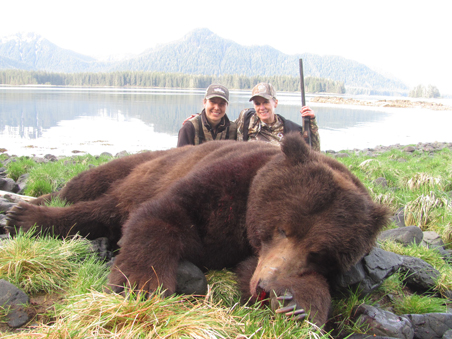
On Donna’s 2013 Alaska brown bear hunt we had the pleasure to be guided by Alisha Rosenbruch-Decker, also tough as nails. A year or so later she finished a brown bear hunt just days before giving birth to her second child (try that, guys!). This young lady knows her bears. She performed the most amazing feat of judging a bear that I’ve ever seen, and then orchestrated a perfect approach. At that time she was still too young, but now she holds Alaska’s coveted Master Guide rating. I understand she is only the second woman to be an Alaskan Master Guide; her mother, Maryanne Rosenbruch, was the first.

It’s no secret that I’ve spent much of the past few years chasing the Weatherby Hunting and Conservation Award. Previously, my old friend Natalie Eckels was the only woman nominee; sadly, she never won. Recently two strong female contenders joined the fray. When, after much cajoling, Renee Snider finally got her ballot together, I knew she’d be unstoppable. Renee has hunted darn near everything, and is one of world’s most accomplished mountain hunters. In 2014 she became the first woman to win the Weatherby. The second was Barbara Sackman, who is the hunting partner and wife of 2008 Weatherby winner Alan Sackman. Barbara won in 2015. In more than a half-century of the Weatherby no woman had ever won, and in 2014 and 2015 two women won it back to back. That may not be a trend, but it’s a statement!

Finally, shooting ability. Gentlemen, we don’t have a chance! Once again women are often at a disadvantage because of experience–few grew up shooting like many boys do. They make up for it quickly. For unknown reasons females approach this stuff more calmly than men, and they lack bad habits and preconceived notions. Anyone who teaches shooting will confirm this: Women listen, and tend to shoot very well. This has consistently been my experience with my family, including a long procession of nieces and my daughters’ friends that I’ve taken to the range for their first-ever shooting experience. Consistently, they find it fun, and for a woman in today’s world a word I often hear is empowering.

Regarding hunting, some folks will take to it and some will not. With Donna and two daughters that are most definitely hunters I’m quite sure gender has nothing to do with it. Instead, it’s just as Robert Ruark wrote 65 years ago: “The hunter’s horn sounds early for some. . .later for others. For some unfortunates…the horn of the hunter never winds at all.”

So you never know. Some hunters have sons who are not interested but daughters who are. It does require opportunity. This is relatively easy for children and partners of hunters, but how might an adult woman with no previous exposure know if she might be interested in joining our ranks? This is something we should ponder.

We as hunters are not growing in numbers. At best we’re holding steady, which means we’re declining as a percentage of the population. Recruiting youngsters has been our mantra, and it’s important—but as our society grows ever more urban we are losing hunters to city jobs and city life, and they are losing the opportunity to bring their children in. The influx of women into our sport is thus of critical value in the numbers game. It also alters our image from the stereotypical male redneck hunter. This alone is important, but women can also be passionate and eloquent spokespeople for hunting…and perhaps more likely to be listened to than folks like me!

My daughter Brittany, together with British Columbia hunter and licensed guide Shannon Lansdowne, is a couple of years into running an outdoors training program for women called “She Hunts Skills Camp” (www.shehuntsskillscamp.com). There are other similar programs, some unisex, others designed for women. Hunting is not the easiest pastime to break into, and sometimes parents and partners aren’t the best teachers. Training is a great way to get exposure and see if you like it or not.

Just last week I joined the latter part of a session at Jeff Rann’s 777 Ranch to give the ladies a brief seminar and range session on dangerous game. I was there in time to share the excitement when several women—from teens to 50s—took their first game animals. Wow! Trust me, hunting isn’t just a guy thing.

Brittany Boddington with her first game animal. Wild hogs are perfect for beginning hunters because they’re tasty…and they aren’t cute and cuddly. Brittany has been a serious hunter ever since she shot this hog.


Leave a Comment

Supporting Conservation Force

Sports Afield is proud to be a corporate sponsor of Conservation Force.

Above: John and Chrissie Jackson, the founders of Conservation Force.

In keeping with its strong support of and focus on wildlife conservation efforts around the world, Sports Afield is proud to announce it is now a corporate sponsor of Conservation Force.

The mission of Conservation Force is the conservation of wildlife and wild places. Conservation Force stands for three forces. First, that hunters and anglers are an indispensable and essential force for wildlife conservation. Second, that Conservation Force is a collaborative effort combining forces of a consortium of organizations and, third, that Conservation Force itself is a proactive force to be reckoned with because of its record of conservation successes.

“Conservation Force has been very selective about our corporate sponsors,” the organization said in a statement. “Sports Afield, the world’s premier hunting and adventure magazine, established in 1887, is the oldest outdoor publication in North America. That is the kind of sponsor we want to have.”

Conservation Force is the culmination of four decades of pro bono wildlife conservation advocacy. It began as a law firm conducting minor pro bono legal services in the early 1970s. By the early 1990s, the firm began achieving an unprecedented number of victories for traditional conservation interests around the world. During that period, the law firm became an around-the-clock international communication headquarters and advocacy “war room” for governmental and sportsmen’s conservation organizations. The firm provided services that led to a great number of conservation and bio-political successes, including the Elephant Initiative, Mozambique Leopard Initiative, and importation of horn from darted black rhino. It was also instrumental, through a collaborative effort of many individuals and organizations, in the reform of the Marine Mammal Protection Act to permit the importation of polar bear trophies.

The activities were led by John J. Jackson, III, a lifetime sportsman with four decades of service and leadership in hunting and fishing conservation organizations. In the 1990s, John, his wife, Chrissie, and a network of volunteers and organizations formalized Conservation Force as a non-profit (501 (c)(3)), public charitable foundation to continue in perpetuity and expand the services and support that the principals had been providing to the hunting-conservation community.

Conservation Force’s work led to the first reform of international and diplomatic policy toward range nation conservation programs under the Endangered Species Act and CITES in a quarter of a century (CITES Trophy and Quota Resolutions at COP9.) It unearthed the inadequacy of the Endangered Species Act provisions for foreign mammals, which are most listed mammals. Today, Conservation Force continues to lead in the development and implementation of ESA reform. Conservation Force maintains its independence and is organized to service the conservation community directly, efficiently, and effectively. Learn more about Conservation Force at www.conservationforce.org.

Sports Afield joins Rowland Ward Ltd, Fauna & Flora, Ripcord, and Hornady as corporate sponsors of Conservation Force’s invaluable efforts in wildlife conservation.


Leave a Comment

Trophy Property of the Month!

Davis Irrigated Farm

Trinidad, Colorado

Just seven miles from downtown Trinidad, Colorado, the Davis Irrigated Farm offers a compelling blend of agricultural utility, comfortable living, valuable water rights, and proximity to one of Colorado’s most historic and scenic small towns.


Spanning approximately 227 acres, this working farm includes 167 irrigated acres serviced by a gated pipe system, fed by 625 shares of the Picket Wire Ditch, one of the area’s strongest and most reliable water rights portfolios. With a history of producing two hay cuts per year—and occasionally a third depending on moisture—the Davis Farm holds strong production value for alfalfa or grass hay, with further potential for diversified crops or pasture with modest improvements. The remaining acreage supports livestock grazing, making the property ideal for a full-scale ranching or hobby farm operation.


Owned by the same family for nearly 30 years, this is one of the rare irrigated properties in the region that combines solid infrastructure, generous water rights, and turnkey usability. The farm includes a comfortable, lovingly maintained four-bedroom, three-bath home. The home features an eat-in kitchen, large pantry, formal dining area, spacious living room, a primary suite, guest suite, laundry room, and fenced front yard ideal for gardening.


Additional structures include a shop/garage with a concrete floor and massive loft, a Quonset hut for equipment storage, and various barns and sheds. Additionally, there is a vintage 1920s farmhouse on-site that could be restored or repurposed.


Despite its peaceful rural setting, the Davis Farm lies just 3.5 miles from Interstate 25 and is just minutes from key amenities including medical services, restaurants, shopping, and Trinidad Lake State Park. Trinidad itself, rich with frontier heritage and set against the majestic Sangre de Cristo Mountains, is a growing destination for outdoor enthusiasts and history lovers.


Whether you’re seeking a fully operational farm, a self-sufficient rural retreat, or an investment in Colorado land with water, the Davis Irrigated Farm is a property that offers long-term value, production, and potential.

See more details about this amazing property and many more at sportsafieldtrophyproperties.com

Photos courtesy of Sports Afield Trophy Properties

Leave a Comment

Standard Solutions

Do you really need a magnum cartridge when the good old standards still serve us so well?


During the first magnum craze, late 1950s to early 1960s, I was just an impressionable kid. I survived, but it was some years before I could take an unbelted cartridge seriously. Most of us have survived the second, turn-of-the millennium, magnum craze. Over just five years we were asked to accept more than a dozen new unbelted magnums, all with fat cases of varying lengths. Just a few of these have gained significant followings, and some are already gone.

Right now, it seems to me there’s a reactionary trend in the air, back to standard, non-magnum cartridges. Although it’s been around for nearly a decade, Hornady’s mild little 6.5mm Creedmoor has recently skyrocketed and become the shooting world’s poster child. Everybody is making them…and it seems that everybody wants one. Guilty as charged. I don’t have a Creedmoor, but I’ll probably get one this year. I’m waiting for better left-handed availability.

I have used several Creedmoor rifles for various articles, right-handed rifles that I returned. Designed for long-range competition, the Creedmoor is a great little cartridge that, in my experience, has consistently delivered fine accuracy. However, because of all the buzz I think it’s misunderstood. Taking advantage of 6.5mm bullet aerodynamics, it remains supersonic well past 1,000 yards, yet has minimal recoil and blast, great advantages in long-range competition. It is also a fine cartridge for deer-sized game and, with the right bullets, could be used for elk. Except: While it’s a fine long-range target round and a useful hunting round, it is not a long-range hunting cartridge. Designed for mild-mannered efficiency, it just doesn’t have the retained energy or bullet weight for big-game beyond medium range.

Exactly why the Creedmoor has suddenly “caught on” is a mystery. Both the .260 Remington and 6.5-.284 Norma pre-date it and are slightly faster. I don’t have much experience with the 6.5-.284, but among the rifles I’ve used I have found the Creedmoor more “on-average accurate” than the .260. However, that may be more about platforms and ammo than cartridge design. All three of these modern mild 6.5mms have won long-range titles. All are great hunting cartridges. None, because of frontal area, bullet weight, and velocity and retained energy, are truly versatile hunting cartridges. At least in my opinion.

On the bench with a Ruger Precision Rifle in 6.5 Creedmoor. Like all the 6.5mm Creedmoor rifles I’ve used, this one was spectacularly accurate, but while it’s a great long-range target cartridge, it is not a great long-range hunting cartridge.

This is not exactly new. Exactly the same can be said about the great 6.5x55mm Swedish Mauser. Dating back to 1894, it remains popular in Europe and, although rarely chambered in new U.S. rifles, it retains a loyal American following. In the Nordic countries, with heavy bullets, it’s still a standby for moose; over here most of us think of it as a mild-mannered and effective deer cartridge. On average it probably isn’t as accurate as the three newer 6.5mms. As factory-loaded today, it also isn’t quite as fast. Neither matter because no one thinks of it as a long-range hunting cartridge, and few Americans use it for game larger than deer. Thus, as a hunting cartridge, it fills the same niche as the 6.5mm Creedmoor and its peers.

Although I’ve long admired the 6.5×55, I’ve never owned one. I’m sort of fixated on another standard solution that, for me, fills the same niche and does it better. That’s the 7×57 Mauser (aka .275 Rigby), developed in 1892. Yeah, I know, Walter Bell shot bunches of elephants with it, and O’Connor used it for most of his desert bighorns. I don’t see it in either role; for me it’s a fantastic medium-range cartridge for deer-sized game and wild hogs. It’s also a fine cartridge for African plains game, in part because, in Africa, shooting much beyond 200 yards is unusual.

You could switch out the 7×57 for another standard cartridge, the more recent (1978) 7mm-08 Remington. The relationship of the 7×57 to the 7mm-08 is much the same as the 6.5×55 to the 6.5mm Creedmoor. The only possible difference is that, because of both case capacity and action length, the 7×57 has the capability to use 175-grain bullets; the 7mm-08 really does not. I prefer the 7×57 because of history and tradition, but both fill the same purpose: Mild-recoiling and effective medium-range cartridges, ideal for deer-sized game and adequate up to elk.

There are, however, three non-magnum cartridges that I do see as general-purpose hunting cartridges. Perhaps not for this current specialized silliness of extreme-range shooting at game, but certainly for almost all of the hunting most of us actually do. Despite the magnum crazes and the current Creedmoor hysteria, standard solutions have long been in place: .270 Winchester, .280 Remington, and .30-06; all based on the .30-06 case.

Left to right, .30-06, .280 Remington, .270 Winchester. These three non-magnum cartridges are among our most versatile options for the majority of big-game hunting in North America and the rest of the world.

Jack O’Connor is best-known as the .270’s champion. From the 1940s he shot most of his sheep (and piles of other game) with the .270. But he owned 7×57 rifles for the rest of his life, so perhaps he came to see it the same way I do. He also owned .30-06 rifles for the rest of his life, and admitted privately that the .30-06 was more versatile than the .270.

I like both cartridges. The .30-06 is probably over-powered for deer-sized game (which includes sheep), but with 180-grain bullets it’s a much better elk cartridge than the .270. That said, my personal longest shot on an elk was made with a .270 and a 150-grain Nosler Partition: Just over 400 yards, one shot and down. The .30-06 is also better for the full run of African plains game. But, that said, Donna and I both have taken a lot of African game with .270s.

Somehow, perhaps because of all the fast .30-caliber magnums, the .30-06 has a reputation as a slow old-timer. It is not. Standard velocity with a 180-grain bullet is 2700 feet per second (fps), adequate though not impressive. However, handload recipes can push a 180-grain bullet beyond 2800 fps, and extra-fast factory loads like Hornady’s Superformance do this right out of the box. If you don’t need the heavier bullet, 150-grain loads at 3000 fps are available. These velocities are close to “magnum” performance—in lighter, more compact rifles, with lighter, more compact ammo.

With 130- or 140-grain bullets the .270 is faster and shoots flatter. It is enough gun for any North American deer that walks, and effective at any sensible range. I think O’Connor was pretty much right: It’s an ideal sheep/goat cartridge…but the .30-06 is more versatile for larger game. If you need to push the envelope, .30-caliber bullets in 200 and 220 grains are readily available and there isn’t much these heavyweights can’t handle.

Now, if you’re looking for the ideal compromise, consider the .280 Remington. Introduced in 1957, it may be the best (or at least most versatile) cartridge based on the .30-06 case. It is faster and flatter-shooting than the .30-06…and slightly faster than the .270 with 140 and 150-grain bullets. It takes advantage of the 7mm’s superior bullet aerodynamics, and can push 175-grain heavyweights at meaningful velocities. Thus it’s just as good for mountain game as the .270, and with heavier bullets it’s almost as good as the .30-06 for elk and such.

The only thing: You must be somewhat of a contrarian to choose the .280 over the .270 or .30-06. Despite its attributes it has never been as popular as its siblings. Selection and availability of factory loads is more limited, and in order to love the .280 you must be prepared to take a lot of guff from your hunting buddies. I don’t mind either limitation; I’ve had .280 rifles and they’ve performed well…but I don’t have one now. Whether I’ll someday have a .280 again or not I simply can’t say, but it’s been many, many years since I’ve been without at least one .270 and a couple of .30-06s.

If you’re looking for a versatile hunting rifle that won’t kick you into next week all three are sound choices. It’s pretty much as Jack O’Connor laid it out so many years ago: The .270 is ideal for mountain game (and, from me, for deer-sized game). The .30-06 is more versatile because it’s better for larger game. Or, split the difference and consider the .280 Remington, provided you don’t mind being a bit different.

Below: A good Arizona desert sheep taken with a CZ in .270 Winchester at 250 yards. Jack O’Connor was right about the .270: It’s an ideal cartridge for mountain game, and it’s adequate for game up to elk, but the .30-06 is more versatile for larger game.

Leave a Comment

Return of the Markhor

Hunting wild sheep and goats in community-based game management areas in Tajikistan is a win-win for wildlife conservation and local livelihoods.

It’s early morning at the gorge of the Panj River in Tajikistan’s Darvaz Mountain Range; it is still dark and the foreign hunter has to climb a steep, rocky slope. He is assisted by guides of the Hunting and Conservation Alliance of Tajikistan (H&CAT), who know every stone. As dawn breaks, the spectacular mountains on the opposite side of the river appear. Their lower parts are covered by scattered woodlands of juniper, with small and very steep fields in between. Above are snow-covered peaks. Soon the local guides spot a group of more than a dozen screw-horned goats, females with kids from the last season, a few young males, and several mature males with long beards and very long corkscrew horns. But the old male, which had been spotted by the guides few days ago moving over the steep cliffs, is not among them. The guides scan the rocks with the spotting scope and suddenly see a shadow moving between the rocks–a snow leopard. Nearby, between the almond and Judas tree bushes, they see a pair of familiar-looking horns. The searched-for trophy markhor has already become the trophy of another hunter, the ghost of the Central Asian mountains.

During the next few days, the visiting hunter hikes many miles and climbs hundreds of feet. Finally he gets another markhor twelve years of age and with a horn length of almost 50 inches–a very old animal. Meanwhile, one of the rangers who protect this community-based game management area has been filming the snow leopard at its markhor kill. It turns out the big cat did not eat the huge markhor alone, but shared it with his mate. After having long been skeptical of snow leopards, seeing them as enemies and competitors, the managers of the conservancy now understand that the big cats and the markhor and ibex can all thrive at the same time. Although the occasional markhor or ibex is taken by predators, populations of the wild goats have grown and are healthy, structured with a good proportion of mature males. Increasingly these days, markhor are observed in the hillsides along the Panj river upstream from Zighar village, which long had been the border of their range.

The mountains of Tajikistan are some of the most remote and beautiful in the world.

Population surveys by the Academy of Sciences of Tajikistan, together with government agencies and rangers of game management areas as well as independent scientists and NGOs, revealed that during the last few years markhor numbers have reached historic heights. At the end of the 1990s there were probably less than 350 Bukharan or Heptner’s markhor in Tajikistan; a survey in 2012 revealed that numbers were much higher, with more than 1,000 markhor recorded by the observers. In 2014 in a similar survey, 1,300 animals were observed, and during a partial survey in 2016 in key areas alone, close to 1,450 markhor were spotted. In February and March 2017, another survey took place involving participants from the Wild Sheep Foundation and the Caprinae Specialist Group of the International Union for Conservation of Nature (IUCN). The survey covered those areas of the markhor range in the country known to harbor most of the magnificent wild goats. The surveyors, after assessing and removing all possible repeated observations of the same animals, recorded 1,901 markhor in an area of 213 square miles. Among the recorded markhor, 78 of them were old males eight or more years of age that would qualify as huntable.

What is the background of this conservation success story? In the January/February 2017 issue of Sports Afield, Brad Fitzpatrick wrote about two markhor hunts in Tajikistan outfitted by Shikar Safaris. This article correctly states that the strong interest of big-game hunters has made the markhor an animal of great value to the local people and stimulates its conservation. However, there is a bit more to the story. In the first place, the local people, who stopped poaching and introduced effective protection of the markhor population, deserve the credit.

When I started to develop a project for community-based conservation of mountain ungulates in Tajikistan in 2007, the focus was on Asiatic ibex, a much lower-profile species with less controversy surrounding the hunting of it. Most ibex populations were down because of poaching and lack of any feeling of ownership by the local people. Similarly, Marco Polo sheep were rare or absent in substantial parts of their range, including the protected areas. On the other hand, some hunting concessions were obviously successful in keeping high populations of Marco Polo sheep, thanks to the income delivered by sport hunters. What I heard about the situation of the Bukharan markhor did not sound promising, however. The remaining animals were thought to be largely restricted to a protected area with immense security problems caused by its location along the border with Afghanistan, from where armed smugglers regularly intruded to kill markhor and urial. There were also reports about illegally organized trophy hunts, despite the species’ official protected status and listing under CITES Appendix I.

In 2008, the Mountain Ungulates Project was started with support from the German government and its development agency, Gesellschaft für Internationale Zusammenarbeit (GIZ) GmbH, as well as the Zoological Society for the Conservation of Species and Populations, a German nonprofit specializing in conservation of animal species often overlooked by the general public. In the Pamirs and its southwestern spurs, we met dozens of traditional hunters. These people were considered poachers by officials and most conservationists. We took another approach and recognized their traditions and interest. With our help and encouragement, several groups emerged and registered as legal entities, usually as non-commercial non-government organizations (NGOs). These people agreed not to poach, to protect wildlife, and to rehabilitate the game population, in the vague hope that future legal hunting opportunities would lead to income from hunting and nature tourism. Tajikistan’s government agencies in charge of wildlife assigned to these groups their traditional hunting grounds as game management areas.

By then, in the range areas of markhor, two families already had established small enterprises offering hunting trips for wild boars and Asiatic ibex, M-Sayod LLC and Morkhur LLC. During the next few years another small enterprise, Saidi Tagnob, emerged, as did a local NGO, Muhofiz, which unfortunately so far did not yet become an effective game management entity due to internal conflict and tensions in the local communities. The founders of these small businesses and their staffs were mostly informal hunters in the past. One of them once admitted that he had killed “hundreds” of markhor and never came back from the mountains empty-handed. These people know exactly how poachers access the areas and kill markhor, and they know how to prevent it. They also have a strong connection to “their” animals and they are excellent game scouts.

Regular wildlife surveys in the newly established community-based game management areas soon began to show increases in and stabilization of the populations of mountain ungulates–Asiatic ibex, Marco Polo sheep, and markhor. Now these areas host about 2,000 ibex, 500 Marco Polo sheep, 1,800 markhor, and 50 Bukhara urial, which is closely related to Afghan urial, with 200 more urial in new community-based conservancy areas under development. Hunts for ibex are available every year. In the 2013-14 season, the government by special decree issued the first hunting quota on Bukharan markhor in Tajikistan. Since then, the government, by annual decrees, has issued quotas of six or seven markhor per season.

The markhor is one of the world’s most challenging game animals to hunt because the of the rugged country it calls home.

As a result of a roundtable of government agencies, scientists, NGOs, and game managers, organized with support by the German Government via GIZ, the first Marco Polo sheep quota was allocated to the local NGO Burgut this year. This community-based organization managed to rehabilitate the population of this magnificent sheep in an area close to Alichur village in the eastern Pamirs, where it was almost extirpated by poachers. As of this writing, two permits have been sold to American hunters. This will be the first argali hunting in a community-based conservancy ever, and will further boost the conservation efforts by the local traditional hunters and the support by the entire community in this remote mountain region.

Strong and healthy game populations, which offer great opportunities for hunters to experience a memorable hunt and to collect an exceptional trophy, are only possible where the local people protect the wildlife from poaching, regularly survey the status of the populations with involvement of outside experts, and do their best to preserve the entire ecosystem. This is achieved when local traditional hunters feel responsibility for the animal populations, get a substantial share of the money paid by the visiting hunters, and are at the same time accountable for the effectiveness of protection against poaching. Currently more than 150 rangers and more than 100 families directly benefit from income created by community-based game management in Tajikistan. Furthermore, all the other local community members need to see benefits from supporting wildlife conservation, game management and critical habitat, which sometimes comes at the expense of reduced grazing and fuel wood collection and some conflict with carnivores. The small enterprises M-Sayod, Morkhur, and Saidi-Tagnob in the markhor range areas, and the NGOs Parcham, Yoquti Darshay, Yuz Palang, and Burgut in the Pamirs, use the earned income for these purposes. They invest in conservation and in local community development, such as road repair, water supply, children’s education, and more.

Collectively, these organizations, with financial assistance and advice by the International Council for Game and Wildlife Conservation (CIC), have established the nonprofit Hunting and Conservation Alliance of Tajikistan (H&CAT) for joint marketing and contact with brokers and outfitters, for mutual assistance in logistics for hunting and other tourism, and for fundraising for and implementation of joint wildlife conservation and management activities. H&CAT also supports research in the conservancies. A Tajik Ph.D. student, who is studying “traditional ecological knowledge” in this context, was the recipient of the CIC Young Opinion Award in 2017.

Population trends, increasing trophy quality, satisfied sport hunters, income created, and livelihood improvements all add up to a success story for H&CAT, which the CIC in 2014 honored with its prestigious Markhor Award. However, there are also some critical challenges that the entities collaborating within the H&CAT struggle with.

The reputation of Tajikistan as a hunting destination is sometimes called into question by doubtful hunts organized by third parties. These can take the form of illegal offers, which are often difficult to identify as such; hunts in poorly managed areas with a high incidence of poaching and overhunting; and hunters being encouraged to shoot young animals, shoot at unrealistically long ranges, or engage in other unethical hunting practices. There are also rumors about staged hunts and manipulated trophies.

The high prices of hunts, especially markhor hunts, create a lot of interest by various actors to capture as much of the money spent by the hunter as possible. Often hunts are marketed by outfitters who rely on one or several intermediaries who take a substantial share of the money. Thus from a markhor hunt sold, $50,000 may be paid for the permit and logistics related expenses, a large amount may be taken by the broker and involved intermediaries, and less than half of the price of the hunt may actually reach the local small enterprise, which has to pay its rangers year-round and support its community. As the community-based conservancies get more experienced, many brokers, outfitters, and hunters are making direct contacts (facilitated by H&CAT) with the game area managers. This diversity of the market allows for an optimum share of the revenues to reach the local level. On the other hand, there are also intermediaries, which may not contribute to the conservation management of game and its habitats or to local development, but are only interested in quick profit.

Hunts of doubtful scientific justification and legal basis, unethical practices, capture of high shares of hunting revenues by outsiders, attempts to monopolize quotas and take over game management areas–all of these can put at risk the achievements that have been made in wildlife conservation and in the welfare of local communities. This can result in the good managers losing motivation and opportunities for action; and poaching may again become rampant and lead to a fast decline of the just-rehabilitated populations of markhor and other game. Such a situation would hurt hunters first, as they would experience unsatisfying hunting trips with no success, and later might be confronted by bans on hunting and trophy import to their home countries. The seriousness of the latter risk is shown by the recent trophy transportation boycotts by airlines, and by the import restrictions and bans by the US, European Union countries, and Australia on species like lions, elephants, hippos, polar bears, and more. Such a ban on markhor would not only harm hunters and the hunting industry, but would risk the end of this conservation hunting success story.

It is in the hands of hunters, brokers, and outfitters to prevent the bleak scenario described above and to ensure the sustainability of markhor and other mountain ungulates conservation and hunting in Tajikistan. One important part is to avoid unnecessary and costly intermediaries. The community-based conservancies can be contacted via the Hunting and Conservation Alliance (H&CAT, [email protected]), which acts as their joint contact, communicates in English, and takes care of all aspects of the preparation and conduction of the hunt, including all permits, logistics in the country, and assistance with trophy shipping. If you prefer booking via your broker, ask him in what game management area the hunt will take place and if he is in direct contact with H&CAT and/or its partners.

While hunting, you should care about the ethics of hunting. Often local guides feel strong pressure and may encourage hunters to take too young animals or to try risky shots. Hunting should be about the whole experience, but also about the contribution to the conservation of these magnificent creatures and the support of local communities. There can never be a 100 percent guarantee of taking the desired trophy, as some brokers may promise; hunting of free-ranging animals, not farm-raised ones, always includes some uncertainty, and this is a crucial part of the hunt. Trophy hunting should not necessarily target the most beautiful and largest animal, but the oldest one, an animal that has had the opportunity to pass his genes to the next generation. Its horn tips might be broomed or broken, thus being possibly an inch or so shorter than those of another one at the full height of breeding age. Current trophy scoring systems tend to undervalue such old animals and give higher scores to animals that are at the height of their reproductive potential. The best hunters know that it is not the highest score that matters, but the fact that you helped to preserve a healthy and genetically fit population. Never accept any offers to take another, “better,” trophy, as this can trigger killing beyond the quota, and possibly even creation of artificial trophies from animals shot earlier, sometimes bought from local poachers–all with negative impact on the status of the population and the reputation of trophy hunting.

Only responsible hunters can ensure that the incredible experience of hunting in Tajikistan’s mountains will be possible in the future and that markhor, ibex, urial, and argali can thrive together with snow leopards and other wildlife and benefit the rural people of this beautiful region.


Editor’s note: Stefan Michel is a biologist from Germany who has worked in Central Asia since 1993. Since 2008, Stefan, supported by the German development cooperation agency GIZ, has worked in Tajikistan and facilitated the development of sustainable, community-based conservation and management of wild mountain ungulates. He is a member of the IUCN Species Survival Commission Caprinae Specialist Group and affiliated with the NGOs Nature and Biodiversity Conservation Union Germany (NABU) and the Zoological Society for the Conservation of Species and Populations.


Leave a Comment

tablet

Never Miss An Issue!Subscribe Now: 6 Issues for $34.97

More Details
WordPress Video Lightbox Plugin