Sports A Field

Which .375 Should You Choose?

Comparing the .375 H&H, .375 Ruger, .375 RUM, and .375 Weatherby, and more.

The .375 cartridges shown above are all suitable for dangerous game. From left to right: .376 Steyr, .375 Flanged Magnum, .375 H&H, .375 Ruger, .375 Weatherby Magnum, .375 Remington Ultra Magnum, .378 Weatherby Magnum.

The .375 has reigned supreme as the world’s most versatile caliber for more than a century. As hunting in both Africa and India developed, a consensus grew that hunters of the big stuff were safer and more effective with cartridges of adequate power. Over time the standard minimum for larger game came to be recognized as the .375. Actually, this is more legend than fact: Some African jurisdictions have no legal minimums, and the European equivalent, 9.3mm (.366-inch bullet diameter), is often the actual minimum.

In North America we don’t really need a .375, but a lot of riflemen are fascinated by powerful cartridges. Sales of the big boys have always far exceeded actual need—and today we have lots of big cartridges to choose from. The European 9.3s are available, and the proliferation of over-.40 cartridges is amazing. But the .375 still occupies its traditional position as the versatility king: Cartridges in this bullet diameter tend to shoot flat enough for most game under most conditions, yet the power is there for the really big stuff if needed.
Ah, but which .375? We often confuse cartridges with calibers. The .375, lacking qualifiers, is simply a bullet diameter, a caliber. Unique case dimensions define a cartridge. There are actually quite a few .375-caliber cartridges. Most have enough case capacity to propel bullets of adequate weight fast enough to render them useful on really large game, but a few do not.

Early in the last century the 9.5mm Mannlicher was introduced in Europe. It was a very mild cartridge, but it started to become popular. In 1905 Holland & Holland countered with the .400/375, also a mild (and unsuccessful) cartridge. A generation back Winchester introduced the almost-forgotten .375 Winchester, using light-for-caliber bullets at moderate speeds. All of these, and some others, are .375-caliber cartridges. They’d be fine for black bears and wild hogs…but they are not dangerous game cartridges.

In 2000, in cooperation with Steyr, Hornady developed the .376 Steyr, following Jeff Cooper’s concept of a “big bore scout rifle”—light and handy, yet powerful enough to keep you out of trouble with the big stuff. The case is .30-06-length but slightly fatter; it propels a 270-grain .375 bullet at 2600 fps, meaningful velocity that develops just over 4000 ft-lbs of energy. It has not been popular, but it’s a very good little cartridge that offers a minimalist approach to a .375.

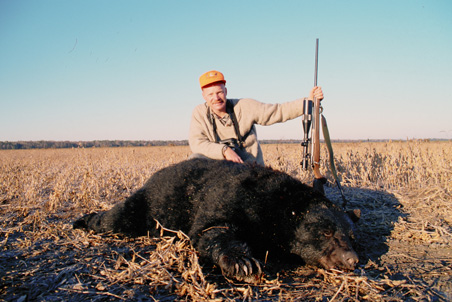
I have a .376 Steyr; the cartridge is absolutely buffalo-capable…but it’s also a useful North American cartridge for tough game. It hasn’t been to Africa, but it’s been as far afield as Greenland for muskox and Donna has it on a bear hunt in Idaho while I’m scribbling away.
Although it fits handily into a .30-06-length action, few manufacturers offer it. Ours is an MGA rifle on a left-hand Remington action. Ammo is single-source from Hornady. In addition to the 270-grain load they offer a 225-grain load at the same velocity. The light bullet reduces recoil significantly for range work, and would be fine for anchoring hogs and such. If heavier bullets or solids are desired, handloading or custom suppliers are the only options.

When most folks say “.375” what they usually mean is the .375 H&H. Introduced in 1912, the .375 H&H is by far the most popular .375-caliber cartridge. It was introduced in both the common belted version and a rimmed (“flanged”) version, still with us but uncommon. With a 2.85-inch case a full-length bolt-action is needed…but every manufacturer who has an action long enough chambers to it. All ammo manufacturers load it and you can find it almost anywhere. Although there are other options “standard” loads are a 270-grain bullet at 2,690 fps and a 300-grain bullet at 2530 fps. By today’s standards these velocities are not flashy, but a spitzer 270-grain bullet shoots flat enough to be used almost anywhere, and the 300-grain bullet has long been proven adequate for any game on Earth.

Proliferation of the “lower .40s” has folks questioning the adequacy of the .375 for big stuff. Although 300-grain solids penetrate well (and 350-grain solids even better) my view is any .375 is marginal for elephant, especially in the heavier cover where most elephant hunting is done today. As for buffalo, the .375 H&H is absolutely fine. This was so in 1912 when the .375 H&H was brand-new. It remains true today. Buffalo have not gotten tougher…but with today’s better bullets the .375 has gotten tougher and even more effective. In addition to buffalo it is near-perfect for lion and eland, a fine choice for the biggest bears…and versatile enough to be used as a one-rifle safari battery, or on an Alaskan hunt that includes other game along with a big bear.

The .375 H&H is the benchmark. All “full-power” .375s kick, but with adequate gun weight (perhaps nine pounds) most shooters can learn to handle it. Its availability and long-term popularity are huge advantages; most African camps will have a cache of .375 H&H cartridges. This is not generally true of other .375-caliber cartridges.

In western Tanzania in 2010 Boddington used a Dakota M76 in .375 H&H. This East African roan was his most-wanted prize; the shot was in open country at nearly 300 yards. That’s getting to be a long poke for an H&H, but if you know the cartridge and its ballistics it will come through.

There are, however, faster .375s, and all are good. Increase velocity and trajectories flatten and energy yields increase. These are good things; they make the .375 even more versatile…and more effective on larger game. This is especially true today because we have tougher bullets able to hold up and perform at higher velocities. The commercially available “faster .375s,” in ascending order of velocity, include the .375 Ruger, .375 Weatherby Magnum, .375 Remington Ultra Magnum (RUM), and .378 Weatherby Magnum. All have two limitations: Increased recoil; and reduced availability. All four are currently loaded by just one major supplier, although handloading and custom loads are always options.

The .375 Weatherby Magnum, developed by Roy Weatherby in 1944, is an “improved” version of the .375 H&H, meaning the body taper has been removed to increase powder capacity. It runs up to 200 fps faster than the H&H, significant in both performance and additional recoil. Its big brother, the .378 Weatherby Magnum, was introduced in 1953. Its case is a belted version of the big .416 Rigby case, meaning it requires an extra-large action. It is a lot faster, shooting nearly as flat as a .30-caliber magnum and developing as much energy as a .458 Lott: Spectacular! However, it has never been popular. Initially this was partly because 1950s .375 bullets couldn’t stand up to the velocity. This is not true today; tough .375 bullets hold up just fine. However, it remains true that the .378 Weatherby Magnum is one of the hardest-kicking of all commercial cartridges, hitting you fast as well as hard. The performance is awesome, but not all shooters can handle it.

The .375 RUM made its debut in 2000. Like the H&H and Weatherby it requires a full-length (.375 H&H) action. With a fat, unbelted case based on the .404 Jeffery case necked down it has more case capacity than the .375 Weatherby, thus in handloads is potentially faster. However, in Remington factory ammo it’s about the same velocity as the Weatherby. Like the Weatherby its increased energy yield makes it hit about like a .416 Rigby or Remington…and it shoots flatter. Also like the .375 Weatherby its primary limitations are increased recoil and greatly reduced availability. However, of these two “fast .375s,” the .375 Weatherby and RUM, the .375 Weatherby has one awesome advantage: Since it’s simply an improved version of the H&H, in a pinch .375 H&H ammunition can be used in absolute safety. Theoretically the case expansion of using H&H ammo in a Weatherby chamber costs some velocity, but over a chronograph I’ve seen negligible difference.

The .375 Ruger is sort of a special case. It used an unbelted .30-06-length case with a .532-inch- width body, the same as the rim and belt of the .375 H&H. Thus it has greater case capacity and more efficiency. A joint project between Hornady and Ruger, when released in 2007 it was probably the most successful large-caliber cartridge introduction in history. However, a decade later Hornady remains the primary ammo source. Due almost entirely to case design efficiency standard loads are about 100 fps faster than the H&H. However, with handloads or “extra-fast” loads the .375 Ruger and the .375 H&H are about equal. It has the advantage of fitting into a .30-06-length action, which results in a lighter, more compact rifle that is usually (like the Ruger Hawkeye) less costly than most .375 H&H rifles. However, even if velocity is the same a lighter .375 Ruger will kick more than the H&H. After the H&H the .375 Ruger is the second-most-popular .375-caliber cartridge. Its availability is thus second—though a distant second—to the H&H.

So, which one to choose? Honestly, I like them all, except that I admit that the recoil of the .378 Weatherby is too much of a good thing for me. I’ll go for the majority vote: The .375 H&H makes the most sense, followed by the .375 Ruger. In performance on game there is no noticeable difference between the two, and difference in recoil is mostly dictated by gun weight. Higher velocity and increased energy are really not needed, but if you feel you must have them the .375 Weatherby and .375 RUM are also indistinguishable. I’ve used both; they hit buffalo noticeably harder than the H&H or Ruger…but the cost in added recoil is also noticeable and must be considered. I like the modern case design of the RUM a lot, but if you want more velocity (I said “want”—you really don’t “need” it) the nod must go to the .375 Weatherby Magnum. Not only can .375 H&H ammo be used; almost any .375 H&H rifle can easily be converted to .375 Weatherby Magnum by opening up the chamber, a simple reaming job—and .375 H&H ammo can still be used.

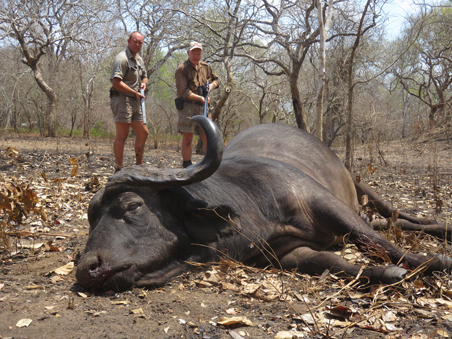
Some people question the adequacy of the .375 for buffalo. It remains perfectly adequate: Craig and Donna Boddington took these bulls from the same herd with a total of three 300-grain Hornady DGX bullets. The single follow-up shot probably wasn’t needed.

.

Leave a Comment

Ding and the Ducks

How a conservation-minded cartoonist helped save America’s waterfowl.

In the 1930s, the Dust Bowl was taking a tremendous toll on ducks and their habitat. Poaching, a lack of law enforcement, and draining of wetlands had been causing waterfowl populations to decline for years, and now the drought in the Midwest dried up the remaining breeding habitat. As waterfowl populations fell precipitously, sportsmen began to realize that dramatic action on the federal level would be required to stem the losses.

Ideas had been floating around for some time about how to restore duck habitat and how to pay for it. As early as July 1921, an editorial appeared in Sports Afield, advocating the institution of a Federal Hunting License for waterfowl and migratory birds. It decried the loss of wetland habitat and noted: “Surely no man who hunts migratory game birds would balk at paying 50 cents a year, the money to go into a special fund to ensure his sport…” The money, the editorial went on to suggest, would be specifically used for “the better enforcement of the Federal game laws and the purchasing of suitable marshes for public shooting grounds and refuges. With this much money available each year, the Government would be able to acquire large tracts of land for refuges, and the question of the preservation of our migratory game birds and the sport of hunting them would be settled for all time to come.”

Enter Jay Norwood Darling (1876-1962). He was born in Michigan but his family soon moved to Iowa, where he spent much of his life and became an avid duck hunter. While in college, he began signing his drawings with a contraction of his last name—D’ing—earning him the nickname Ding. Ding drew editorial cartoons for the Des Moines Register and the New York Herald Tribune between 1917 and 1949, and he won the Pulitzer Prize for Editorial Cartooning twice, once in 1924 and again in 1943.

Ding’s love of hunting led naturally to an interest in conservation, which became a frequent topic of his cartoons. He was also instrumental in several conservation initiatives in his home state of Iowa, including a move to change the state’s wildlife agency from a political entity to a nonpartisan commission—making Iowa the first state to do so. In 1934, despite the fact that Darling was a staunch Republican, President Franklin D. Roosevelt appointed him to a blue-ribbon Committee on Wildlife Restoration to study the problem of rapidly declining wetlands and waterfowl habitat. His committee came up with several ideas, but in the heart of the Depression, there was no money to fund any of them. So Ding decided to develop and expand on the federal license idea, which had been floating around duck camps for some time, as reflected in the early Sports Afield editorial.

The result was the Migratory Bird Hunting Stamp Act, better known as the Duck Stamp Act. Passed in 1934, the act required anyone over the age of sixteen who wanted to hunt waterfowl to purchase a federal duck stamp in addition to the already-required state hunting license. The cost of the first stamp was $1.

A crucial part of the Duck Stamp Act was that revenues from duck stamp sales did not go into the general federal treasury—they went directly to a Migratory Bird Conservation Fund, and a minimum of 90 percent of this revenue had to be used for the purchase, development, and maintenance of refuges for waterfowl. (Today, the law requires 98 percent.)

In the ensuing eighty-three years, the Duck Stamp has been one of the most successful conservation programs the world has ever known. Since its inception, it has netted more than $800 million and enabled the acquisition of 5.7 million acres of wildlife habitat. Anyone can buy a Duck Stamp, but the majority of stamps are purchased by hunters.

Ding himself created the first Duck Stamp artwork at Roosevelt’s request, drawing a couple of mallards landing on a pond to illustrate the inaugural stamp. The yearly duck stamp competition went on to become the only art contest sponsored by the federal government. There is no monetary prize involved, only great prestige for the winner.

Even if you’re not a duck hunter, buying a Duck Stamp (they now cost $25) is still one of the best things you can do to help ducks, geese, and other wildlife.

Ding’s contributions to wildlife conservation weren’t finished just yet. He was soon named head of the U.S. Biological Survey, forerunner of the U.S. Fish & Wildlife Service. He didn’t have much in the way of staff to work with, since the fledgling agency only had twenty-four law enforcement agents to cover the entire country. Ding worked closely with local law enforcement and sportsmen, however, and was surprisingly successful at curtailing poaching. In addition, Ding put in place several laws that are still on the books today, including making it illegal to bait waterfowl, use live decoys, and hunt with shotguns capable of holding more than three shells.

Ding was elected to membership in the prestigious Boone and Crockett Club, and after his retirement in 1935, he went on to become president of the National Wildlife Federation. Appropriately, he has a National Wildlife Refuge named after him—the J.N. Ding Darling NWR on Sanibel Island in southwest Florida, which is known for harboring exceptional populations of migratory waterfowl.


Leave a Comment

The Bedroom Window Ram

A young sheep hunter braves the hazards of the Idaho mountains in search of a very special bighorn.

As I watched the bighorn ram bedded beneath the cliff, I wondered what was taking my son Logan so long to arrive. He had been glassing above me, and I when I spotted the ram I had motioned him to come down, around a large cliff face, to where I was. Suddenly I heard some rocks falling from the cliff and then experienced a father’s nightmare. Out of a crack in the cliff something fell, landing on the rock slide below, and began rolling down the jumble of rocks. Watching in horror, I saw arms flailing and hunting gear strewn down the mountain face. What should have been a great moment suddenly turned to a jolt of fear for my son’s life.

Logan began his hunting career at a very young age, and his interest in hunting and trapping is insatiable. Only fourteen years old, he has continually impressed me with his patience and skill in hunting situations. I was thrilled when he told me in the spring of 2016 that he wanted to put in for the draw for bighorn sheep in the unit by our house in our home state of Idaho.

I had put in for sheep in multiple states for nineteen years and never had success in drawing. I found out in June that the draw results were available and hurried to check what I knew would be a familiar “sorry, you were unsuccessful” response. I typed in our numbers, closed my eyes, and hit “enter.” When I opened my eyes I was shocked to see on the screen, “Congratulations! You are SUCCESSFUL in drawing a bighorn sheep tag.” BOTH of us had drawn. We now had two of the only four tags in this unit. I had drawn in my twentieth year of trying, Logan in his first.

As I related in my story in the July/August issue, earlier in the season we had tried shooting at two rams at the same time. I got mine, but quickly went from sheer exuberance to a feeling of guilt realizing Logan had missed. But Logan said, “You know, Dad, I’m actually glad it worked out this way. I would have loved to have gotten that ram but at least it was a clean miss and I got to share the experience of you getting your ram. Plus, now our hunt isn’t over, which means we get to spend more time on the mountain together.”

After packing out my ram, we regrouped and headed back up the mountain in search of a ram for Logan. We searched for two days but could not locate the same band of rams again. In the afternoon of the third day we had traveled several miles along the ridges where the rams had been all summer. Then the weather began to turn. Soon it was blowing and starting to rain and then snow. We decided instead of spending an uncomfortable night on the mountain, we would head down to the house.

The following morning I looked out at the mountain and saw it was still clouded over. We slept in a while longer and when I awoke, the clouds had lifted.  I walked into Logan’s room and woke him. As we were talking, I looked out of his bedroom window and noticed something on the mountain. I told him there was an animal over there and hurried to grab my binocular. As I put up my bino I couldn’t believe my eyes. I had spotted a bighorn ram from my son’s bedroom window!

We hurriedly gathered our gear and headed out. After crossing the Salmon River we watched the ram cross back over a saddle and out of sight. We worked our way up the steep face to get to the top, hoping the ram had bedded in the cliffs just beyond the saddle. It took us an hour to reach the top of the mountain and we circled to get the wind in our favor and slowly approached the top of the cliff overlooking where we thought the ram had gone.

Logan Reed with his hard-earned bighorn ram.

We crept to the edge, slowly peeking over, and saw nothing. We moved along the rim, looking down in the rocks below, but could not locate the ram. We then moved to a point overlooking the saddle where the ram had made his appearance and subsequent retreat. I figured if he did reappear, he would use this saddle again.

An hour or two passed with no sign of the ram. We decided on a plan where I would circle and slowly make my way along the cliff face. If the ram was still there, I might push him into the saddle where Logan had a great shooting position. I went back and down the mountain and began slowly working my way toward and underneath Logan’s perch.

There was ram sign everywhere. Beds, tracks, and droppings littered the area. This ram had clearly been living here. I rounded a point and could see Logan on the cliff a few hundred yards away. I moved just a few yards more and something caught my eye up next to the cliff face. Tucked behind a boulder was a ram’s white butt! I dropped down and began frantically trying to get Logan’s attention. I finally did and gestured furiously to indicate I had spotted the ram and he should work his way around to my position. Of course, in my mind these frantic hand signals conveyed a clear message, but to Logan, not so much.

Eventually I saw him gather his gear and head in the direction I had signaled, and then I lost sight of him. I sat, anxiously awaiting his arrival. That’s when I heard rocks rolling from the cliff and saw the rolling mass with what appeared to be arms flailing, leaving a path of hunting gear strewn down the mountain.

I hurriedly grabbed my binocular and, to my relief, saw that what had fallen down the cliff was just Logan’s backpack, not Logan himself. I was still concerned—where was he? I was relieved when he soon appeared and began gathering his gear. I tried to signal him to go lower and work his way over to me, but to my dismay he went back up to the base of the cliff and began working his way across the bottom of the cliff face. The path he was on would take him within ten yards of the ram. I frantically waved my arms, then resorted to jumping up and down and waving my hat, but Logan took no notice. I was sure the ram would notice the commotion at any moment and bolt.

Logan was now within thirty yards of the sheep. I decided I had nothing to lose at this point and I figured he should at least be ready for a possible shot when the ram bolted, so I yelled, “Logan!” Incredibly, he didn’t hear me, nor did the ram move. Now he was only twenty yards from the ram and I yelled louder, “Logan!” This time he froze, trying to locate me. Unbelievably, the ram stayed bedded through all of this. I motioned to Logan to go back. He reversed course and headed back across the boulder field.

About halfway across the rock slide, a rock rolled under his feet and down he went. I saw him hug the rifle as he tumbled two full rolls down the steep slide. He sat for a moment to gather himself and then soldiered on, eventually reaching my position. I looked him over. He was cut and bruised, but gave me an exhausted smile. He had saved the rifle from any hits as well, but his arms and shoulder had paid for it.

He explained what had happened. He had misunderstood my very clear (to me) hand signals, and came down the cliff in a crack. He got to a spot where he was hung up so he unraveled a para-cord bracelet he had made and lowered his pack with it. He lost his grip on the rope and that is when his pack came tumbling down the mountain. It was the sleeves of his coat, which was tied to his pack, that appeared to be arms flailing as the pack rolled down the mountainside. We both began to giggle, astonished that all of this had unfolded and yet the ram was still bedded a mere 100 yards away. After composing ourselves, we wondered if the ram were deaf or dumb. I had yet to see the ram’s head to determine his size, but we knew it had to be the ram we had spotted from the bedroom window. I told Logan the ram would eventually get up and turn around and bed back down, as rams always do. But another hour or two passed and the ram hadn’t even twitched.

Logan said, “Maybe he’s dead.” That started us giggling again.

I told him to be ready for a shot as I was going to try to slip out and get a look at the ram. I scooted across the ground until I could finally see one side of the ram’s horns. His head was up so he was definitely alive. I crawled back to Logan and told him the ram’s horns were fairly long and flared out, but they weren’t real heavy, so the choice was his.

He replied, “Dad, we might be able to go and find a bigger ram somewhere else, but we could never top the story behind this one! I always wanted to shoot one where I could look out of my window and see the mountain where I shot my ram, but I never figured we’d actually SPOT the ram from my bedroom window!”

Finally the ram stood and turned and bedded back down, never offering a shot. Logan could now see the ram’s head and vitals. He said, “He does flare out nice. I think I’m going to take him.”

He settled in for the shot and I told him where to aim the .300 Ultra Mag. At the shot, the ram came tumbling down the mountain toward us and lodged against a boulder. I told Logan to get ready and stay on him. After a few minutes and no movement from the ram, I hugged Logan and told him how proud I was of him. We gathered our gear and began working our way up to the fallen ram. I was ahead of Logan and heard him say something. I turned to ask him what he said and, wide-eyed, he exclaimed, “He’s up!”

I turned and couldn’t believe it–here was the ram stumbling across the rock slide above us. Logan quickly reloaded and took an offhand shot, which finished the ram.

After reaching the ram I congratulated Logan and then told him to go to the top of the mountain to see if he could get a cell signal to call my wife, Mariah, and have her bring a vehicle to the road below us. After about an hour, just at dark, I had the ram ready to pack out. I could see Mariah coming along the road below and flashed my headlamp at her. A short while later she had climbed up to the kill site carrying our two-year-old daughter, helping our four-year-old son, and followed by our other two daughters. All of them clawed their way up the steep mountain to admire the ram and congratulate Logan.

Logan and I loaded up our heavy packs. I held the four-year-old’s hand, Mariah carried the two-year-old, and with the other two in tow we headed down the mountain to the truck waiting below. One more trip up and down the mountain, and we were done. Logan was so proud of his ram and during the course of both hunts had taken several very nice photos, including one that appeared on the cover of the January/February issue.

The next day we took the rams to check them in and get the horns plugged. The whole family went along and the Idaho Fish and Game biologist, Jamie, included the kids in the process, explaining what she was doing and why, and the various things they were testing for. This was truly a family sheep hunt and one that will stand out among my most special hunting adventures.

Logan was proud of his ram, but it wasn’t long before he asked me, “Dad, can I start putting in for the draw in other states?” And thus another sheep hunter is born.

A heavy load he’s happy to carry.


Leave a Comment

Super Thirty

The story of the original .300 magnum.

Peering through the Leupold scope, I could see my last shot was tucked nicely against the first two. I couldn’t help but smile as I got up from the shooting bench in my backyard and walked out into the pasture to retrieve the target. For almost forty years I had been trying off and on to find a specific rifle and cartridge combination, and now that I finally had it, it was proving to be an extremely accurate one.

I had read about the Super Thirty when I was a kid, but had never actually known anyone who owned one. Better known as the .300 Holland & Holland, there were never very many of them that made it into the hands of hunters north of the 49th and by the time I actually held one in my hands, the .300 Winchester and Weatherby Magnums had already pushed the old Super Thirty into obscurity.

My first exposure to the cartridge was a pre-’64 Model 70 in the hands of one of the first big-game hunters I guided on my first guiding job during the fall of 1976. The hunter was a really nice chap from the Seattle area, and he had owned the rifle for several decades and used it to kill a large number of Roosevelt elk. Not surprisingly, at least to me, the hunter dropped his mountain goat with a well-placed shot at a couple of hundred yards and that was that. What else would you have expected from the combination of the Rifleman’s Rifle and the Super Thirty?

To this day I can remember holding that rifle and cycling the action. There was just something about it that left a lasting impression, and I made up my mind right there and then that I would some day own one. Little did I know that the combination of rifle and cartridge would prove to be an elusive goal for many years, for one reason or another.

Designed by the famous British firm Holland & Holland around 1920, the .300 H&H Magnum was introduced to the market in 1925. It was based on the .375 Belted Rimless Nitro Express, which had been introduced in 1912 and became more affectionately known as the .375 H&H Magnum. The .375 case was necked down to .30 caliber, retaining the 2.850-inch-long case, but producing a sleek profile with a long sloping body and shoulder.

H&H cartridges, as with many during that era, were quite long due to the use of Cordite as a propellant. Cordite was manufactured in long spaghetti-like sticks and was used in the UK until approximately 1915, when a shortage occurred as the Cordite was being used in munitions during World War I. The shortage forced UK ammunition manufacturers to look for an alternative and resulted in a switch to US-developed smokeless powders.

The .300 H&H is an excellent choice for a plains game hunt and is suitable for hunting most thin-skinned game around the globe.

The long, sloping body and shoulder of their cases resulted in the incredibly smooth feeding of both the .375 and .300 H&H, and helped to ensure easy extraction during bad situations, such as the high pressure spikes that Cordite-loaded cartridges were susceptible to in hot weather. Since the big British cartridges were routinely used in India and Africa prior to the World War II, the British developed reduced “Tropical” loads for many cartridges to minimize the potential for problems due to pressure spikes.

Head spacing and extraction in the early part of the twentieth century were usually obtained with a prominent “flanged” rim, but the Super .30’s parent cartridge’s rimless case head design would not provide positive head spacing with the long sloping shoulder. To fix this problem, H&H added a small belt at the case head on the .400 and .375 NE cartridges in 1904, and on the .375 H&H Magnum in 1912. The .375 and .300 H&H’s belted cases are generally credited with solidifying the term “belted magnum” in the minds of the shooting public.

Initially both the .375 and .300 H&H were proprietary cartridges patented by Holland & Holland, which meant that no other firearm manufacturer could build rifles or produce ammunition for either of the cartridges without the firm’s consent. Not surprisingly, Holland & Holland’s bolt-action rifles, which were built on reworked model 98 Mauser actions, were best-quality rifles of the time and required hundreds of hours of work by highly skilled craftsmen. They were not produced in large numbers and only hunters with deep pockets could afford a Holland & Holland rifle.  (Some things never change.)

When H&H released the patent rights to the .375 and .300 cartridges during the later part of the 1920s, New York’s prestigious Griffin & Howe and a number of other custom gunmakers began to build rifles in these calibers. Despite this, the .300 H&H continued to fly under the radar in the USA because of limited availability and prices beyond what the average working schmuck could afford.

But things changed rapidly after American shooter Ben Comfort used a Griffin & Howe .300 H&H Magnum built on an M1917 action to win the 1,000-yard Wimbledon Cup in 1935. The .300 H&H Magnum cartridge became the center of attention in the USA after the Wimbledon victory, and in 1937 Winchester began offering both the .300 and .375 H&H Magnum chamberings in its new Model 70 bolt action.

Winchester was the first major firearms manufacturer to offer these cartridges to the general public in a quality rifle at affordable prices, and Western Cartridge Co. simultaneously began offering a number of loadings for the .300 H&H—loads that  were eventually some 200 fps faster than the British ammunition. Originally, velocities for 150-, 180-, and 200-grain bullets were on the anemic side, listed as 3,000, 2,700, and 2,350 fps, respectively. Anyone who was using a .30-06 at the time would see little benefit in switching, as these velocities were about the same as those being achieved by commercial ammunition for the tried-and-true Springfield. However, the .300 H&H received a significant boost in performance with the Western Cartridge Co.’s new commercial loads, a 180-grain bullet at a little over 3,000 fps and a 220-grain bullet at 2,700 fps. Remington and Winchester followed shortly thereafter with commercial loadings that also bested .30-06 velocities by a couple of hundred feet per second with respective bullet weights.

For those in the know, the .300 H&H became the high-velocity magnum by which all others were judged for the next quarter of a century. Weatherby introduced the .300 Weatherby, which is a blown-out version of the .300 H&H case, in 1944. It was faster, claiming a 200 fps increase over the .300 H&H. It didn’t, however, have much of an effect on the market share of the .300 H&H because it was also a proprietary cartridge and available only in expensive Weatherby rifles that were beyond the reach of the average shooter.

Norma of Sweden developed the .308 Norma Magnum in 1960, yet another .30-caliber magnum based on the old H&H case. Although it offered similar velocities to the .300 H&H, it suffered from a lack of availability in rifles that were familiar to the American shooting public and consequently never really gained a lot of traction in the USA. Per capita, it was probably more common in Canada than the USA, as European firearm manufacturers such as Parker Hale and Husqvarna exported many rifles chambered in the Norma cartridge to Canada. Even today, used rifles chambered in the .308 Norma are not that difficult to find in Canada.

The fatal blow to the supremacy of the .300 H&H as the “go to” .30-caliber magnum occurred in 1963, when Winchester introduced the .300 Winchester Magnum. It was the last year that the now famous pre-’64 Model 70 was produced and, not surprisingly, Winchester dropped the .300 H&H from its list of chamberings in order to promote its new .300 magnum. Here again, Winchester’s new kid on the block was based on a shortened and blown-out .300 H&H case.

Suddenly production of affordable factory rifles chambered in the Super .30 took a nosedive and, not surprisingly, the shorter .300 Winchester Magnum was an immediate success with the shooting public. To make matters worse, the Remington Model 721, which was the only other recognizable American-made rifle that offered the .300 H&H chambering, had been discontinued in 1962. Anyone who wanted a .300 H&H now found themselves having to look for a used rifle or face the expense of having a custom rifle built, and why would you do that when the new .300 Winchester Magnum was so easy to lay your hands on?

With the .300 H&H no longer being offered as a regular chambering in readily available commercially made rifles, it did not take long for the ammunition manufacturers to follow suit. For the most part, the .300 H&H became a handloader’s cartridge, and many shooters with rifles chambered in .300 H&H opted to have their rifles rechambered to one of the newer .30-caliber magnums for ease of operation.

As it turned out, my first .300 H&H was a very used Remington 721 that I found in the consignment rack at a local store in the early 1980s. The Remington was probably a much rarer duck than a pre-’64 Model 70, but it simply did not have the rock-star status that the pre-’64s had at that point in time. Pre-’64 collectors were gobbling the good ones up and the more heavily used rifles were being bought up and torn apart to use the actions in custom builds.

Finding ammunition or cases to reload was also quite a challenge at that time, but I managed to find enough to get going and soon realized the .300 H&H was not difficult to load for and it shot really well. I had no trouble getting 180-grain bullets to clip along at 3,000 fps, as verified by the chronograph that we rented from the local range back in those days.

I packed that rifle around for several years and used to it to take several moose and elk, a few mule deer, and a couple of black bears. I had no complaints about the rifle or cartridge, but then a shiny Mark V in .300 Weatherby got my attention and I traded the old 721 off on the promise of even more velocity. I very much regret having done that, but I console myself with the knowledge that I just didn’t know any better at the time.

In the post-’64 era, the people who collect rifles and refuse to alter them, as well as the few who enjoy the nostalgia of carrying an eminently useful rifle in a “defunct” cartridge, have kept the .300 H&H alive. There have been a couple of special limited runs by manufacturers of a model chambered for the Super .30, such as the Remington Model 700 Limited Edition Classic in 1983 and the Ruger No. 1S Kudu in 2008 and 2009.

The Remington Limited Edition Classics show up once and a while listed on one of the online auction sites, but the Ruger No. 1S Kudu is primarily a collector’s edition and not easy to find. There were only 250 of the special edition No. 1 Kudu rifles in .300 H&H produced. Ruger got together with Lipsey’s and Craig Boddington to produce a special five-rifle set, each in a different caliber appropriate for one of Mr. Boddington’s five favorite African big-game animals.  Another limited run of Ruger No. 1s in .300 H&H was produced for Cabela’s 50th anniversary in 2011.

Ammunition manufacturers have had on-again, off-again runs of .300 H&H ammunition over the years. Of course some of those coincided with the limited special production runs by the firearms manufacturers, but there have been others. Most of the big companies producing reloading components have offered .300 H&H brass over the years as well, so people with the old Super .30s have been able to keep them in the field without too much trouble.

Currently, quality factory ammunition is offered by a number of companies, including Federal, Hornady, and Nosler.  Hornady offers a single load with the 180-grain Interbond, while Federal offers three different 180-grain loads with the Trophy Bonded, Trophy Copper, and Nosler Partition. Nosler is the big surprise, though, with several different loads offered in both their Trophy Grade and Nosler Custom lines of ammunition: everything from the 150-grain Accubond to the 180-grain E-Tip and 200-grain Partition.

Commercial ammunition for the Super Thirty is not difficult to find these days, with Federal, Hornady, and Nosler all offering high-quality factory loads.

Over the last forty-five years I have spent a fair amount of time with the other .30-caliber magnums that were all based on the H&H case and can honestly say that I haven’t ever done anything with them that I couldn’t have accomplished with the old Super .30. I know there is a fleet of newer .30-caliber short mags and large case capacity ultra mags out there, but I just have never really felt the need for them. I have shot some of them, to be sure, but none of them has fallen into the short list of “keepers” for me.

In recent years I dropped using a .300 magnum all together, relying instead on a .338 magnum of some description. But a couple years ago I began to get the itch for a big .30 again to fill that void in my gunroom. I decided to go back on the hunt for that pre-’64 Model 70 in .300 H&H that had eluded me in the past.

It took a while to find one that fit my needs north of the border, as there just aren’t the numbers of pre-’64 rifles up here that you find in the Lower 48. Kids of my era, and even our parents, were much more likely to start out their hunting careers with an old sporterized .303 British on an Enfield action, a budget-priced Parker Hale, Husqvarna, or an old Savage Model 99 lever action. Very few people owned the Rifleman’s Rifle.

I kept running into a couple of problems during my search. The first was that there were a lot of formerly .300 H&H pre-’64s that had been rechambered to .300 Weatherby at some point in their lives. There were even a couple I looked at whose current owners did not even know that the rifles had been rechambered.

The second problem was that the rifles I liked tended to fit into the almost pristine collector grade and were out of my price league. Fortunately I found a gentleman with a nice pre-’64 that was in great condition, but not so nice that I would be reluctant to use it, and he was convinced he needed a .257 Weatherby I had that was collecting dust. So the trade was made, and for a change I think I may actually have come out on top.

In short order I had a scope on the old Model 70 and I obtained a few boxes of Federal factory loads with 180-grain Nosler Partitons. I have no complaints about the old girl as she consistently groups inside of an inch with the Federal load, which averages just shy of 2,900 fps. Even more encouraging are the handloads I have developed using the 180-grain Nosler Accubonds and E-Tips. With a case full of RL 22, both produce groups under three-quarters of an inch with velocities just shy of 3,100 fps in the 26-inch barrel.

There are a number of powders that perform well in the .300 H&H, including RL 22 and 25, both Hodgdon’s and IMR’s 4350 and 4831, IMR 7828, W760, and Norma’s MRP, to name a few. And as anyone knows, there is an almost endless supply of good .30-caliber bullets out there in a wide range of weights, with something to handle just about any job required.

It is unlikely that the Super .30 is ever going to make a big comeback when current trends seem to be focused on ultra-high-velocity cartridges, really big scopes, and the desire to take big game at distances that would never have been considered in the past. But for those that want a .30-caliber magnum for what they were originally intended for—to produce the extra power and flatter trajectory needed to cleanly and ethically take big game at 100 to 150 yards beyond the reach of the venerable .30-06—well, the .300 H&H is as good as the rest of the cartridges that fall within those parameters.

With the better factory loads and handloads, there is no real-world difference between the .300 H&H and its Norma, Winchester, or Weatherby offspring in both velocity and accuracy. There is no other .30-caliber magnum cartridge that feeds or extracts as smoothly and easily as the .300 H&H, something that actually has to be experienced to appreciate, especially for all of the shooters out there who have only ever known the sharp shoulders and short, fat cases that are so popular today.

I have also found, and I have read the same sentiment expressed by writers in the past, that the recoil of the .300 H&H is not as sharp as that of the other .30-caliber magnums. This is no doubt due in part to the smooth acceleration curve during ignition in the long, tapered H&H case, and a little-known fact about the Super .30 that was mentioned in an article by Ken Waters years ago in his Pet Loads: The Super .30 is, on a ratio of powder charge to velocity, the most efficient of all .30-caliber magnums.

The old Super .30 is a classic and eminently useful cartridge. For proof, look no further than the other outstanding cartridges that have been developed from it.


Great New Hunting Books

Check out the latest offerings from top hunting writers this fall.

Looking for a great hunting book to take along on your travels or to hunting camp this fall? The new books listed below provide plenty of armchair adventures.


Incidents from an Elephant Hunter’s Diary:
This book of W.D.M. Bell’s newly discovered, never-before-published short stories is a delight. Once again the legendary hunter marches through the wilds of Africa, traversing a land untouched by modern civilization in search of adventure and ivory.


Reminiscences of an Elephant Hunter: The brand-new, complete autobiography of W.D.M. Bell was compiled from a treasure trove of the famed elephant hunter’s newly discovered notes and diaries. Part 1 is Bell’s incredible life story, Part 2 has original, previously unpublished stories by Bell, and Part 3 includes Bell’s letters, official records, and newspaper articles.


Great African Trophies: This photographic showcase of some of the greatest game trophies ever taken on the Dark Continent includes elephants, buffalo, the big cats, spiral-horned antelopes and dozens of other magnificent animals. Top five SCI and Rowland Ward trophies as well as historic, unlisted, and little-known trophies are included—read their fascinating stories here.


Celebrating 130 Years of Sports Afield: Just in time for Sports Afield’s 130th anniversary, the magazine’s staff has assembled a complete history of the publication. The book features more than 400 beautiful handpainted covers, all digitally restored. A historical overview of the magazine on a decade-by-decade basis and period articles from each era complement the covers displayed in the book and give readers a glimpse of the sporting life in America through the years.


Hunting Wild Sheep and Goats Around the World: George Latham Myers II set out in 1995 to hunt all of the world’s sheep and goats. Since then he has hunted on five continents and eleven countries. Come travel with Latham as he hunts the Rockies, the Caucasus, Siberia, and New Zealand. Here is a mountain hunter who has done it all and tells the stories well.


COMING SOON! From the Cape to Kasserine: Craig Boddington has been writing a book about his African adventures every ten years since 1987. His latest covers the years 2007 to 2016, and he recounts the stories of safaris to Tunisia, Botswana, Mozambique, Tanzania, and a host of other places in a conversational style that makes the reader feel as if they were along on every adventure.

Find more great hunting books by visiting Safari Press: www.safaripress.com


Leave a Comment

How Much Does A Safari Cost?

It’s less expensive than you might think.

An African safari is one of the greatest adventures remaining on planet Earth, and a plains-game safari in Southern Africa is one of the best bargains in the entire hunting world. Such a hunt doesn’t cost an arm and a leg, and is actually within reach of most working Americans, although it may take saving, planning, and prioritizing.

“Southern Africa” in this context refers to Namibia and South Africa, and “plains game” excludes dangerous game. Africa is a big place, with at least 18 countries offering organized hunting. Conditions and prices vary radically. Prizes like bongo and giant eland are costly to hunt, and even in Namibia and South Africa, safaris that include dangerous game are costlier than plains game safaris. It is thus impossible to put a firm number on what a safari costs, but we can categorize the line items. You need to ask the hard questions, and ultimately come up with total numbers that you can compare as you do your shopping.

DAILY RATE: This is the basic charge for your hunt, including your professional hunter, camp, and food and services provided in camp. This usually includes basic trophy care (skinning, salting and drying, preparation for transport)—but not veterinary certification, crating, and so forth. In many situations the daily rate is the major cost, but in some situations licenses and trophy fees will exceed it. Daily rates can vary from as low as perhaps $300/day to, well, add a zero in the costliest countries. Generally, the more remote the area the higher the cost of outfitting, and this is passed to the customer.

There should be little mystery to the daily rate. However, many outfitters don’t express this as “X dollars/day,” but instead quote, say, ten days, fourteen (and so on) at “Y dollars.” You can do the math and compare against other “daily rate” charges. Also, many outfitters offer “package deals” that include the fees for certain animals. You should shop around and get a feel for what outfitters who price a la carte charge for these animals, thus what the package is really worth.

For comparison, things to consider: Are the days of arrival and departure considered “hunting days?” If your safari includes changing areas, are the “transfer days” considered “hunting days?” Is airport pickup/transport to camp included or separate? You can expect daily laundry service, and local beer (pretty good!) is often cheaper than soft drinks…but are (reasonable quantities) of alcoholic beverages included?

Boddington and Frontier Safaris’ Scot Burchell with a good black wildebeest taken in 2017. Like many operators, Frontier Safaris prefers to market “package hunts” that include certain pre-paid animals. Packages are often solid deals, but you need to shop around a bit to determine the value of the animals on your list.

LICENSES AND TROPHY FEES: Some countries are “trophy fees only,” which means, according to a printed schedule, you only pay for game taken (or wounded and lost, so don’t shoot unless you’re sure). In both Namibia and South Africa game on private land is privatized, so daily rates are low and operators derive much of their income from trophy fees. Farther north “government trophy fees” become the norm. Realistically, an outfitter’s trophy fees may include “add-ons” to actual government fees, but this is usually reflected in higher or lower daily rates. Some countries, such as Tanzania, have license fees, payable up front, in addition to trophy fees for game taken. Ethiopia is fairly unique in that, as in North America, specific licenses must be purchased up front for any animals you intend to hunt, and are not refundable.

Your total cost is largely controlled by your hunting success. If you’re on a tight budget, exercise restraint on your trigger finger! But I submit this: Once you’re there, you don’t know if you’ll ever be there again. Within reason, a few extra trophy fees for awesome animals you didn’t plan for may be the best bargain you’ll ever get.

OTHER FEES: These do not apply in all countries, but in some areas “concession fees,” “anti-poaching levies,” and taxes (such as VAT, essentially our sales tax) may apply. These should be listed in the outfitters’ price list, but may not be totally obvious. Ask!

TRANSPORTATION AND TRAVEL: Basic air fare from the U.S. or Europe to Africa hasn’t gone up much during my career so, in real terms, it’s gone down quite a lot. By planning early and shopping around you can find excellent fares. However, I strongly advise using a travel-savvy, hunter-friendly travel agent who really understands international travel with firearms. Some airlines no longer carry firearms, and most now require advance notification. Some European countries don’t allow transit with firearms, and some require police clearance. It is not impossible to work through this labyrinth on your own, but it’s a whole lot easier to work with a gun-savvy travel agent. Baggage allowances keep going down and excess charges keep going up, so pack wisely and expect to pay up to a couple hundred bucks each way for baggage.

Do not allow close connections; ground arrangements can get complicated if you miss a flight. Even so, it can happen, so make sure you have good phone numbers and either a satellite phone (inexpensively rented) or an international chip in your cell phone (preferably both).

Will you need to overnight in a hotel, or will you be whisked straight to camp? Hotels/meals before and after the safari are generally on your nickel and must be added to the total cost. Johannesburg’s O.R. Tambo airport is the hub for most hunting in Southern Africa, now including Mozambique and Zimbabwe. The South African gun permit is free, but can be done in advance for an average of $150; and there are inexpensive guest houses that cater to hunters. However, if I’m not actually hunting in South Africa but going onward to another country I usually schedule flights so that I pass through Johannesburg “in transit.” For me this saves time and a little bit of money, but it makes a long trip even longer. Which is best is your call.

How are you getting to camp? If charter flights are required these are expensive in Africa and can add a lot to the total cost, depending on distance. Driving is not necessarily an option; a short distance on an African map may mean many hours on African roads. If charters are required make sure you get firm quotes on the costs. Fuel costs are high in Africa, so unless the distance is quite short it’s normal for outfitters to charge for “airport pickup/drop-off” and road transport to/from camp. However, those days should not be counted or charged as hunting days.

Consider really good trip cancellation insurance, and for sure get a medical evacuation membership. Chances are you won’t need either, but if you should, you need them badly!

HIDDEN COSTS: There shouldn’t be much left. If you choose not to take your own guns most African camps have suitable rifles, and charges for gun rental and ammo should be in the price lists. If levied, these are probably a fair tradeoff against baggage fees and gun permits.

After the safari there are some little details nobody likes to talk about. Tipping should not be considered optional to your camp staff nor to your professional hunter if he/she has done a good job. Every camp has a sliding scale. Too little is being chintzy, but too much places a burden on hunters who follow you. I have yet to meet an outfitter or PH who likes to talk about this, but they will if you pin them down. For the camp it depends on how many people, the length of the safari, and also the standard in the country. For a seven- to ten-day plains-game safari a few hundred bucks to the camp is normal, and perhaps the same to the PH. This must be in your planning figures!

“Dipping and packing” means veterinary clearance, paperwork, and crating for shipping. Some camps have a flat fee, others a fee per animal. Especially in Namibia and South Africa, where good taxidermists are plentiful, they may handle these chores; in other countries they may be handed off to a shipping agent. Either way, this is a multi-faceted burden. At some point after the safari you will probably be charged separately for “dipping/packing/crating,” shipping, and of course eventual taxidermy. It is impossible to get exact pricing up front, but do your very best to pin your outfitter down so unpleasant surprises are avoided.

Be aware: Shipping charges for trophies are getting out of hand. These costs are controlled by how much you shoot and how much you have sent home. That said, overseas shipping is usually by cubic measurement rather than weight, so removable horns (especially long horns like kudu and oryx) save cubic inches, and skins make little difference. To some extent you are captive to the circumstances—some countries offer very few options, and rampant through the industry are kickbacks to outfitters from taxidermists, and from taxidermists to shipping agents. The trophies are yours, but after you go home you have little control over them. So the time to exert your preferences is at the conclusion of your safari, as you’re working out the final details and payments.

Part of a season’s trophies at Zambeze Delta Safaris, salted, dried, tagged, and ready to start their long journey. Once properly dried these skins are as hard as concrete. Stored in low humidity they will be just fine for several years before tanning and taxidermy are required.

Sea freight is a much less expensive option than air freight. It takes longer, but it will probably be months before raw (salted, dried, dipped and packed) trophies are shipped, so a few extra weeks in transit means little. Shipping is very much a “hidden cost”—but you can and should ask about the options (understanding they may be limited). In Southern Africa, AHG Shipping (www.ahgshipping.com), recently established by hunters, vows to cut shipping costs by up to 30 percent, a huge step forward.

Unless you live near a designated port and have the time (and patience) to clear a shipment yourself, you (or your shipper) will engage a customs house broker to clear your shipment. You obviously can choose your broker, but your taxidermist and/or shipper can recommend a trophy-savvy broker. Just insist that your shipment arrive at a designated port as close to your home as possible, because unless you physically go retrieve your cleared trophies there is another unavoidable cost in trucking them to wherever you want them.

Taxidermy costs are controlled by you (whether you have it mounted or not). These bills don’t start for many months but, ultimately, they are part of the safari cost. In much of Africa there is little choice: Your salted, dried, and disinfected trophies will be shipped home, cleared, and then sent either to you or your taxidermist. In Southern Africa, uniquely on the continent, there are excellent taxidermists. So now you have a tough choice: Ship your raw trophies home and get them to your taxidermist; or have the trophies mounted there and the finished products shipped.

African taxidermy can be very good. The price differential isn’t what it used to be, but it is usually a bit less expensive and will usually be quite a bit faster. African taxidermists do know what African animals are supposed to look like. Smaller taxidermists in North America may be great artists, but may not be familiar with African animals. This suggests the wisdom of using larger studios, which may increase costs and require further shipping to your home. Since shipping of large items is always more by cube than weight, shipping of raw trophies is less expensive than shipping of mounted trophies. However, again, where practical, detachable horns save a lot of space, and thus shipping cost.

Determining the full and final cost of your safari is not simple. There’s a lot to think about, and there are unknown variables (based mostly on hunting luck), but unless you really don’t care, it’s a good idea to do some figuring and come up with an approximate bottom line. However, I’ll leave you with one last thought: Whatever it costs, I can assure you it will be worth it!


Leave a Comment

Salmon River Rams

A forty-year dream of taking a bighorn sheep leads to the hunt of a lifetime in Idaho’s Salmon River Country.

I first became obsessed with bighorn sheep when I was a young boy. Every year my family would pack up our camper and head west from our Iowa home to the Rocky Mountains for a vacation. When I was about ten years old we found ourselves in Yellowstone, hiking up to the summit of Mount Washburn. I was ahead of the rest of my family, just trucking up the hill. I topped a small rise when a noise quickly caught my attention. I lifted my head and there a few yards away stood a mature bighorn ram. I ran down the mountain and yelled to my dad, “Dad! Dad! Bighorn sheep! Thousands of them!” I dragged my dad up the mountain to the rise and there stood, well, not thousands, but three bighorn rams. I was hooked.

After moving to Idaho in my late twenties I began putting in for bighorn sheep draws in several states, only to endure nineteen years of “sorry” letters. I was preparing to put in for the Idaho draw in 2016 when my fourteen-year-old son, Logan, said “Dad, I want to put in for sheep this year.” I decided to put us in together for the draw, figuring maybe Logan’s new blood would buoy my chances. Still, there are only four tags available in the unit I put us in for, and I knew the odds of being drawn for two of them were very slim.

A couple of months later I received a message from one of my friends that he had drawn an Idaho mountain goat tag. I congratulated him and then remembered the sheep draw. I punched in my number on the Fish and Game website, closed my eyes, took a deep breath, and hit “enter.” I slowly opened my eyes and was met with “Congratulations!” I was in disbelief. I punched in Logan’s number and saw, “Congratulations!” It was unbelievable–we had both drawn once-in-a-lifetime bighorn sheep tags!

Since the unit was right by our house in Idaho’s Salmon River country, Logan and I began taking the entire family on our nightly scouting trips. I felt fortunate to be able to share this experience with my family, but scouting with a two-, four-, six-, and eight-year-old in tow does have its challenges. We had a ball, though, and having the kids bugging me throughout the day–“Dad, is it time to go sheep scouting yet?”–warmed my hunter’s heart.

The sheep scouting crew.

I also asked my rancher neighbors to keep their eyes out for rams. My friend and neighbor Preston Cutler told me a spot to check, and the next night we headed out. I unloaded my crew of young sheep scouts and began to glass. I had barely put up my bino when I spotted six rams. I set up the spotting scope and could see there were two small rams, three medium rams, and one that dwarfed the others in both body size and horn. We watched, took pictures, and filmed them until we started running out of light.

Every night for a week we went back, but we never saw the rams again. I decided we should try the other side of the mountain. After getting to the top of the mountain I got the kids situated and began glassing. Nothing. I glassed for over an hour and we were just getting ready to head out when something caught my eye. I put the scope on it, and sure as heck it was a ram. I soon found the other five. The big ram was still with the band and I got a better look at him. Definitely a shooter, and three other rams in the band were as well, though they were not of the big ram’s caliber.

I scouted other areas but didn’t find anything of interest. On one scouting trip about three weeks before the season, on my own and several miles back in the middle of nowhere, I wrecked my motorcycle on a wet log in a rainstorm and wrenched my knee. I thought I had broken my leg at first, but after gathering myself soon realized it was my knee and that I could put no weight on it. I struggled to get the bike upright and carefully made my way out to my truck. My hunt was in peril and I began to think about how I could get Logan on the rams without me. I even wondered if I could get permission to forego my tag until next year. Twenty years of trying to draw, and now this. No way. I bought a knee brace and decided I would have to tough my way through it.

Four days before the season opener, Logan and I backpacked in to our camp at 9,500 feet and about a mile from where I had last seen the rams. The next day we set out to find them, in hopes of keeping an eye on them until opening morning. After setting up in a nice spot and glassing for a couple of hours, we heard a commotion below us and saw the rams disappearing into the small timber in the head of the drainage. I feared we had blown it. I hoped they had only caught a bit of our wind in the fickle mountain drafts.

After a tense while we started spotting bits and pieces of the rams feeding on the far side of the trees. The big ram appeared and led them out into a shale slide where he began scraping out a bed. Eventually seven rams worked their way out to the slide and bedded down for the afternoon. We watched them for about five hours as they slept, fed in a small opening with scattered trees, and bedded down again. I was a real treat to enjoy the day with my son in the presence of such majestic creatures high in the mountains. As long as they stayed here, we had an ideal plan for opening morning.

Then all hell broke loose. Rams came busting out of the trees in full panic-flight mode. Down the shale they ran, into the bottom of the drainage, and they were gone. I told Logan I didn’t know what happened, but I guessed that one of them had run into a mountain lion, for we knew no other humans were anywhere near. Dejected, we headed back to camp.

Once in camp we started thinking about what to do. We decided to take the chance that they had only moved one canyon over, and decided to glass not far from camp the next morning.

Up at daylight, we headed to a small island of about five trees looking across into the drainage where the kids and I had spotted the rams a couple of weeks prior. We got comfortable and started glassing as soon as it was light. Logan spotted the rams first in the shale slide across from us. We watched the rams from this spot for twelve hours that day, never leaving the shade of our tree island. I was thrilled and proud to see the patience and maturity Logan showed on this long day. One thing of note was that one of the smaller rams was missing, which seemed to lend credence to my mountain lion theory. Tomorrow was the opener and we had them in the perfect spot. We glassed until we could sneak out in the dark and headed back to camp to prepare for opening morning.

I gave Logan first pick of the rams and he chose a wide three-quarter-curl ram. I chose the big, over-full-curl ram, the leader and king of this band. There was another full curl ram that was pretty but thin-horned, and another that was almost a twin to Logan’s ram, and three smaller rams. Now if our plan would only work!

We were up well before daylight on opening day, excited to be sheep hunting. We moved into our spotter’s nest from the previous day and waited for it to get light enough to see. We soon spotted the rams on the same shale slide where we had left them, but they were higher than they had been the night before. All good so far. Now if they just would move down the slide, we could easily move into a shooting position. As we watched, they instead moved up over the top and back into the drainage they had run from two days before.

Logan and I packed up and headed across a large saddle and across the shale slide to where the rams had crossed. We moved to where we had tree cover and crept over the ridge edge. Nothing. Not a ram in sight. Slowly we sneaked down the ridge to try to find a place to glass from. Then we heard shale sliding, and froze.

Down the ridge to our left were the rams, digging in the shale, just 200 yards away! Slowly we crouched and scooted to a bit of cover and a shooting position. I slid up to a downed log and Logan was to my left. The ram I had chosen was perfectly broadside and in the clear, but the ram Logan had chosen was still obscured by brush. We had decided if the opportunity occurred for both of us to take our rams, we would count to three and both shoot. This would be easier said than done, however, especially with the pressure and excitement of a once-in-a-lifetime ram in the cross hairs.

We waited and waited for an opportunity at both rams until they fed down the slide and out of sight. Had we just blown the only chance we would have at these rams? Should one of us have taken the shot? We stayed put in our position for hours, hoping the rams would return. The sun was beating down on us, cooking us where we sat, with no shade available.

A few hours into our sit, a small ram appeared in the clearing directly below us. Anxiety was at a high again as we got into position, hoping the big rams would follow the smaller ram out into the open. Another small ram appeared, and then they disappeared and the wait was on again. The wind was swirling toward where we thought the rams were bedded. We debated whether to move down the ridge or get out of the drainage completely to keep from spooking the rams.

Eventually Logan stood and crawled up on a log to stretch and instantly exclaimed, “There they are!” The rams were working back toward us across the same slide where we had found them then lost them earlier. We got into position again and they disappeared into a narrow band of timber where we should be able to see their movement in any direction. Nothing. Another few hours passed and with the fickle winds we decided to move to keep from spooking the rams. Just as we stood, we spotted them again in the same shale slide but this time feeding back up toward where we had missed our opportunity nine hours prior.

The ram Logan had chosen was feeding broadside in a clearing but my ram was behind a rise with only his horns visible above the rise. This began a frustrating game of peek-a-boo which went on for half an hour. One ram would present a shot but the other would be obscured, then vice versa. I had known that pulling off a double would be difficult, but this was almost more than we could bear. The rams split, with several going high on a course that would bring them out into the shale in the open, and our two rams coming over the small rise and feeding directly toward us.

Our emotions were on a roller-coaster ride as we had to watch both groups of rams and hope the wind wouldn’t betray us. Our two rams continued to feed toward us, head on, neither offering a shot, now at thirty yards and closing. They stopped just before the trees directly below us. I had the cross hairs on my ram, directly between his shoulders. But Logan had no shot at his ram. This was it. Another few moments and we would be spotted at close range by these rams and blow them clear out of the country.

Suddenly Logan whispered, “Dad, the pretty full-curl ram is broadside. He’s beautiful. I am going to take him if you have a shot on your ram.”

I asked if he was ready and he nodded yes. I whispered, “One . . . two . . . three.”

The mountain exploded with the report of two rifles as one. My ram dropped in his tracks and began rolling down the shale slope. I instantly turned to Logan and asked what happened.

He said, “I’m not sure. He ran straight down the slope.”

We gathered up and moved just a bit to where I could see my ram piled up against the only boulder on the shale slide–he was down for sure. We headed over to where Logan’s ram had been standing. Nothing. I began looking for hair and blood to confirm any sign of a hit and sent Logan down to follow the obvious tracks on the shale. Now I was feeling an odd mix of elation and worry.

Logan reappeared and said, “Nothing. I missed.”

My heart sank. What should have been a moment of complete euphoria–a crescendo and the culmination of a challenging day–now turned to guilt. I was thrilled to have cleanly taken my ram but at the same time overcome with sorrow that Logan didn’t get his.

Then Logan said, “You know, Dad, I’m actually glad it worked out this way. I would have loved to have gotten that ram but at least it was a clean miss and I got to share the experience of you getting your ram, and plus now our hunt isn’t over, which means we get to spend more time together on the mountain like this.”

I’ve never been more proud of my son than that moment. I gave him a big hug and tears welled up in my eyes. I was so proud of his maturity and his respect for the animal and the hunt, and thrilled that he still relished time spent with his father. We headed down the slope to check out the fallen king.

Upon reaching my ram, we were both wearing ear-to-ear grins. I put my hands on the magnificent horns and thanked the ram for giving his life. I have judged many sheep in my life, but I had misjudged this ram. Knowing most of the rams in this unit averaged 14 to 14½ inch bases, I had guessed he would score in the low to mid-170s. But as I ran my hands over this warrior’s battle gear and counted the growth rings on the over-full-curl horns, I knew I had underestimated him. He was truly an exceptional ram and befitting a once-in-a-lifetime tag. He was nine years old, with a Roman nose and scars from years of hard-fought battles.

James Reed with his beautiful bighorn ram, taken in Idaho’s Salmon River country.

We sat, absorbing the moment. The mountains were silent now and almost reverent. We snapped pictures, and as the light was fading from the sky I told Logan to prepare for a long night on the mountain. We were both nearly out of water and dehydrated from the long sit in the unrelenting sun during our ten-hour wait. As I dressed the ram, Logan gathered wood for a fire and scouted out a flat spot to camp for the night. He found a nice little bowl about fifty yards above us, which would provide shelter from the wind and be a safe spot to have a fire all night in the shale, and most important, keep us from rolling down the mountain while we slept.

I finished up with the ram about midnight, laid the meat out on the big boulder, and spread the life-size cape out on a fallen tree to cool. Logan had a fire going and we had intended to cook some sheep loins over it but we were both too exhausted and dehydrated to eat. Logan was soon asleep and I simply lay there looking up at the stars, enjoying the moment and time on the mountain. I looked at my son, who, I thought, had transformed into a man on this hunt. I looked at the magnificent ram’s horns, dimly lit by the flickering firelight. I looked at my old friend Orion in the clear night sky, and thanked him for being there on another great hunt.

I knew I was in for a long, chilly, uncomfortable night, but as a tear ran down my cheek, I knew in truth the night wouldn’t last long enough. Then it occurred to me: We still had another sheep tag to fill.


Leave a Comment

Sweepstakes Rules

Official Rules: Sports Afield Buffalo Safari Sweepstakes

Definition of Terms: Sports Afield is a magazine published by Field Sports Publishing Inc, a California Corporation, herein called Sponsor from time to time.

1) ELIGIBILITY: Open and offered only to legal residents of the United States and all other countries where legal, winner must be 21 years of age or older. Sweepstakes void where prohibited by law (Please note that many countries states and possessions have rules against sweepstakes; please check your local laws). Employees, officers, and directors (and their immediate family/household members) of the Sponsor and any of its parent companies, affiliates, subsidiaries, advertising and promotion agencies, are not eligible.

2) DEADLINE: Sweepstakes starts 1 May 2019 and ends 28 February 2020. To be eligible, entries must comply with these official rules and be received by 28 February 2020.

3) ENTRY INSTRUCTIONS: Complete and pay for an order for a subscription to Sports Afield magazine via mail, by phone, or at www.sportsafield.com between 1 May 2019 and 28 February 2020 (all paid subscriptions and renewals with a valid email address are automatically entered); or type your name, complete address, phone number, email address, and age on a postage paid postcard and mail to: Sports Afield, Safari Sweepstakes, P.O. Box 2129, Seal Beach, CA 90740-9972. Postcard must be received between 1 May 2019 and 28 February 2020 to be eligible. Postcards MUST BE TYPED to be legible. ONE ENTRY PER HOUSEHOLD. MULTIPLE ENTRIES INVALIDATE ALL ELIGIBILITY. NOTE that ALL ENTIRES WITHOUT AN EMAIL ADDRESS are INVALID.

4) ENTRY CONDITIONS: By entering, entrant agrees: (a) To abide by these sweepstakes rules (exact compliance is essential); (b) To accept as final and binding the decisions of the Sponsor, administrators, and their agents in all matters relating to this sweepstakes; (c) That all entries submitted become property of Sports Afield and will not be acknowledged or returned; (d) To the collection of all information on each entry and its use for promotional purposes by Sports Afield, and to its transfer to third parties.

5) PRIZES: There is one prize, the GRAND PRIZE which includes a fully outfitted 10-day Cape buffalo safari for one hunter in November 2020, outfitted by Marromeu Safaris in Mozambique. The hunt includes the daily rate for a 10-day buffalo hunt, which covers the services of a professional hunter, accommodation, all meals, drinks, camp staff, trackers and skinners, field preparation of trophies, land transport within the area, one rifle permit or rental rifle, hunting license, community taxes and fees, and meet & greet service at the Beira, Mozambique airport. Does not include government imposed trophy fee for one buffalo (Approximately $1,750 in 2019 but this is subject to change by the Wildlife Authorities of Mozambique). Nor does it include personal firearm importation fees. Winners may shoot additional animals and may bring a companion at standard rates set by Marromeu Safaris.  The GRAND PRIZE also includes a CZ 550 rifle in .375 H&H, a Z8i 1-8×24 riflescope from Swarovski Optik, and a cartridge belt from Trader Keith. Sponsor reserves the right to substitute or alternate any and all from those listed above. The prizes are awarded on an as-is basis, and the Sponsor makes no warranties as regards to the prizes. Prizes cannot be assigned, transferred, redeemed for cash, or substituted except at the sole discretion of the Sponsor, who may substitute the prize with one of equal or greater value if the prize becomes unavailable.

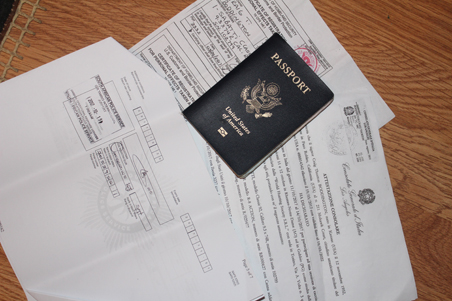
Grand Prize winner must pay for his/her own airfare to Beira, Mozambique, and will also be responsible for round-trip transportation via charter flight from the airport to the hunting area, about $3,500 USD (less if shared), as well as hotel accommodations before and after the hunt, trophy fee for the buffalo, veterinary certificate, and dipping and shipping of trophies. Winner must also obtain all necessary visas and heath certificates as required to travel to and from Mozambique and possess a valid passport acceptable to Mozambique immigration authorities. Scheduling for the hunt is to be arranged between the Marromeu and the winner, but the hunt must commence no later than 15 November 2020 and will be subject to available openings.  If winner is unwilling or unable to travel, or cannot travel during the time period offered for the hunt, hunt is forfeited and no compensation is offered. Cash value is $1.00. The winner(s) will be asked to sign a liability waiver in camp before commencing the hunt. Neither Sports Afield nor Marromeu Safaris shall be liable to perform if failure to perform is caused by supervening conditions beyond Sports Afield and Marromeu’s reasonable control, including but not limited to acts of God, civil commotion, war or armed hostilities, strikes, labor disputes, government demands or requirements. In such cases the hunt is cancelled and no compensation will be made.

6) ODDS: The odds of winning are approximately 1 in 25,000 but exact odds will depend upon the total number of eligible entries received.

7) WINNER SELECTION: Winner will be selected by the Sponsor on or about 10 days following the close of the sweepstakes in a random drawing from among all eligible entries received.  ALL WINNERS WILL BE INITIALLY NOTIFIED VIA EMAIL.

8) WINNER NOTIFICATION: Winner will be notified by email on or about 20 days following the close of the sweepstakes. Winner must complete, execute, and return each required Affidavit of Eligibility and Liability Release, Publicity Release, and/or any other document required by the Sponsor. If a firearm is part of the prize, winner must provide a valid and current Federal Firearms License where the firearm may be transferred; winner will be responsible for all costs associated with the transfer of the firearm; and winner must provide proof of age and fill out and sign an agreement, indemnification, and liability release form which must be witnessed and sealed by a notary public.  After making contact with the winner via email Sports Afield will send  documents to be signed. Each required document must be returned within ten (10) days of postmark receipt of notification. All notifications will be sent overnight express with acknowledgement of receipt.  Entrants must use a postal address where people are available to sign for the mail on a daily basis. If no communications reach Sports Afield after 10 days of the date of notification the prize will be offered to an alternative winner. Failure to respond in a timely manner after having responded to the initial emailed notification will also cause the prize to be awarded to an alternative winner. Return of any prize or prize notification as undeliverable or notification to Sports Afield by the carrier of no person available to sign for the notification or  the finding of the winner to be ineligible or otherwise not in compliance with these Official Rules, will result in disqualification and the selection of an alternate winner by random drawing.

9) GENERAL CONDITIONS: By entering, entrants agree and by accepting a prize, winners agree that Sports Afield, the Outfitter and its parent companies, affiliates, subsidiaries, advertising and promotion agencies, and all of their respective officers, directors, employees, representatives, and agents, and all others associated with the development and creation of this sweepstakes;

(a) are indemnified, released and held harmless from any and all liability, for any damages, injuries, or losses of any kind to persons, including death, or property damage, arising directly or indirectly from the acceptance possession, use, or misuse of any prize or participation in this sweepstakes or any sweepstakes related activity;

(b) are not liable for any postal entries that are lost, late, damaged, stolen, tampered with, garbled, incomplete, misdirected, delayed in transmission, delivered postage-due, forged, illegible, mutilated, or otherwise not in compliance with these Official Rules;

(c) are not liable for any delayed, misdirected,  late, damaged, corrupted, tampered with, garbled, incomplete, emails that attempt to reach potential winners. If an email does not reach the potential winner the Sponsor shall make a reasonable attempt to reach the winner via other forms of communication.  If this fails for a period of 10 days another winner will be chosen. NOTE that ALL ENTIRES WITHOUT AN EMAIL ADDRESS are INVALID;

(d) do not assume any responsibility for typing/printing error, human error, omission, theft, destruction, unauthorized access, alteration, or technical malfunction of any kind that causes any injury, damage, or loss to any computer or person resulting from participation in this sweepstakes;

(e) reserve the right at their sole discretion (and without notice to recipients of this offer and/or sweepstakes entrants) to disqualify any individual who tampers with the entry process, and to cancel, terminate, modify, or suspend this sweepstakes in whole or in part (in such case, winners will be chosen from among all entries received prior to date of termination) if a computer virus, bug, tampering, unauthorized intervention, fraud, technical failure, or any other cause beyond control of Sponsor and/or its agents, corrupts or affects the administration, security, fairness, integrity, or proper conduct of this sweepstakes; and

(f) may use winner’s names, hometown, state, prize won, picture/portrait likeness and/or voice (except where prohibited by law) without further compensation for advertising or publicity purposes.

10) VOID WHERE PROHIBITED: This sweepstakes is void where prohibited or restricted by law. All federal, state, and local laws, rules, and regulations apply.


11) NO PURCHASE OR PAYMENT OF ANY KIND IS NECESSARY TO ENTER OR WIN. 
A purchase will not improve your chances of winning.

12) SPONSORED BY: Field Sports Publishing (herein referred to as the “Sponsor”).

Leave a Comment

Taking a Non-Hunter on Safari, Part 2

Ten more destinations that can be enjoyed either before the hunt, or after its completion.

The Crags
The Crags region, near Plettenburg on the Garden Route in the Western Cape Province, is actually very different from the Garden Route. The Crags region is close to a beautiful lagoon at Nature’s Valley, although the swift current can make swimming somewhat hazardous. There’s a lot to see and do, and can be best appreciated by taking the Cruise the Crags Tour.
Monkeyland is home to abused and abandoned primates; they came from labs, or were abandoned as pets. You can take guided walks through a natural forest where you will encounter spider monkeys, gibbons, vervet monkeys, howler monkeys and many more. Some of the tamer animals often play with the guests.

The Drakensburg
The Dragon Mountains, or to the Zulu – uKhahlamba (Barrier of Spears) – are a wall of rock that rises from the Natal grasslands forming a natural fortress surrounding the mountain kingdom of Lesotho, and the Letseng diamond mine; the world’s highest diamond mine at 10,000 feet elevation. In 2006 the 603 carat white diamond “Lesotho Promise” was unearthed. It’s the 15th largest diamond ever found. Drakensberg is a World Heritage site, and is known for its large collection of rock art. The best times to visit are during the spring (September-October) or late autumn (late April-June).

The Eastern Cape
The Eastern Cape is South Africa’s most diverse province. Its capital is Bhisho, but its two largest cities are East London and Port Elizabeth. It was created in 1994 from the Xhosa (“Click Language” people) homelands of Transkei and Ciskei with part of the eastern portion of the Cape Provence thrown in for good measure. The landscape is quite diverse. The western interior is arid, while the east is wet and green. The Eastern Cape has over 500 miles of virtually-untouched coastline. All of the “Big Five” can be seen in this malaria-free environment.

The only snow skiing in South Africa is available at the Tiffindell Resort in southern Drakensberg. The Adodo Elephant National Park is home to 170 elephants, 400 Cape buffalo, and at this writing, 21 black rhino.

For the surfers, there’s Jefferys Bay where the wild coastline is backed by some of Africa’s most spectacular rain forest. It’s the site of surfing “supertubes” – South Africa’s longest and most consistent waves. If wine is your desire, the town of Whittlesea near Queenstown, is the home of Harrison-Hope winery, the first winery in the Eastern Cape. Recently Inkosi Wine was opened in April of 2017.

There’s the Amatole region around East London whose forests, peaks, rock formations and waterfalls are an outdoor lover’s dream. It has been said that J.R.R. Tolkien’s inspiration for his Middle Earth and the living trees in Lord of the Rings came from this area.

The Elephant Coast
Elephant Coast, KwaZulu-Natal is home to the Hluhluwe-iMfolozi and iSimangaliso Wetlands Parks. KwaZulu-Natal’s best private lodges lie in northern Zululand and Maputaland near the border with Mozambique. The area is less than 130 miles in length and right at 43 miles in width, full of South Africa’s most beautiful scenery – long beaches, rivers and forests. A visitor can swim with sharks, surf, hike, deep sea fish, scuba dive, observe whales and dolphins, or just kick back and watch the world go by. The best times to visit are winter, autumn, or spring, as the summers can be extremely hot and humid.

The Garden Route and the Little Karoo
The Garden Route consists of the 130-mile coastline stretching from Mossel Bay to Storms River along the Southern Cape of South Africa. Mossel Bay is known as the place where the first Europeans landed in South Africa – Bartolomeu Dias landed there February 3, 1488. The Bay’s continuous occupation by humans can be traced back more than 160,000 years.

The Route contains spectacular and diverse scenery, rugged cliffs that fall into the ocean, long beaches, lakes, forests and the Outeniqua and Tsitsikamma Mountain ranges.
It’s these mountains that trap the wet ocean winds and provide the abundant rains that keep the area lush and green. It’s these same mountain ranges that keep the interior arid, creating the semi-deserts the Little Karoo and the Great Karoo.

The Little Karoo stretches from the east side of the Outeniqua range to the Swartberg range. It’s a desolate land of rocks and scrub brush. It is noted for its ostrich farms and Cango caves. The Caves are found in the Precambrian limestone foothills of the Swartberg Mountains near the town of Oudtshoom. Cave paintings and artifacts found in the caves indicate that they were occupied during the Middle and Late Stone Ages. Tours are conducted most days. They are broken into two types “Standard Tour” that takes one hour, and “Adventure Tour” which requires 90 minutes. The Adventure Tour involves climbing up steep rock formations, and crawling through small passages; definitely not for the claustrophobic or those with a fear of heights.

The national parks of Knysna, Tsitsikamma and Wilderness have now been incorporated into the Garden Route National Park system. Each one has different vistas, forests and coastlines to offer the traveler.

The KwaZulu-Natal Midlands
The KwaZulu-Natal midlands are an inland area of South Africa that is outside Pietermaritzburg but stop at the Drakensburg Mountain Range. The Midlands Meander is a collection of well-laid out routes created in 1983 that include almost 200 shops, galleries, restaurants, accommodations and more. They run through various small towns and villages, and provide a great opportunity to shop for high quality South African arts and crafts. It’s an easy one-hour drive from Durban, and four and one half hours from Johannesburg.

After meandering, you can visit the KwaZulu-Natal battlefields where the bloody battles between the British, Boers, and Zulu impis took place. Visit the sites of the famous 1879 battle sites of Islandlawana and Rorkes Drift. Two years later, the British and the Boers were at war in what became known as the First Anglo-Boer War fighting their battles across this same stretch of land.

The Northern Cape
South Africa’s largest province is also its least populated. About one-third of the country, it is mostly desert and semi-desert land containing the Karoo, Kalahari, Namaqualand, and Richtersveld deserts in an area that stretches from the Orange River in the north to the Western Cape border in the south. It covers 225,665 square miles, but contains a population of fewer than one million people mostly in a few small towns. In the 1870s, the town of Kimberly became known as the City of Diamonds. Between 1871 and 1914, over 13,600,000 carats of diamonds were dug out using only picks and shovels. This mine became known as the “Big Hole”; covering 42 acres and having a depth of 790 feet. The Big Hole is now a world class tourism facility.

The Northern Province is best seen by car. Accommodations and food may take a bit of work to discover, but it will be worth the effort. It’s a place to meet the Khoi San people who first inhabited the area about 100,000 years before the arrival of other black people or European settlers.
The Northern Cape has the second-largest national park, Kgalagadi Transfrontier Park, the first park of its kind. It adjoins Gemsbok National Park in Botswana and comprises an area of 15,000 square miles. The park consists of sand dunes, sparse vegetation, the occasional tree, and many dry riverbeds of the Nossob and Auob rivers. They are said to flow only about once every 100 years. This less-traveled province could well be the high point of a safari to South Africa.

The Western Cape
Cape Town is the Western Cape’s prominent city. It’s an area known for its fine wine, abundant wheat fields, produce, abalone, crayfish and kabeljou (food fish). From June to November, hundreds of whales return to the Cape’s shores to calve. It’s considered one of the best places for land-based whale watching in the world.

Valley of a Thousand Hills
During the first part of the 19th century, wagons traveled from Durban through the hills and valleys to the Pietermaritzberg area to service and supply the burgeoning mining industry. Today, the Old Main Road still runs through small villages and over ridges and valleys while offering spectacular views of land dotted with Zulu villages. The road runs through villages filled with restaurants, coffee shops, galleries, pubs, inns, B&Bs and lodges. Almost around every turn is a spectacular view of the gorges.

Zululand
The Zulu are a Bantu ethnic group of people with a population estimated to be between 10-11 million people, with the majority living in the province of KwaZulu-Natal. The Zulu formed a powerful state under their leader Shaka Zulu in 1818. They are probably the best known African tribe with many books and movies about their culture. Fifty years after King Shaka’s death, the British still considered the Zulu nation a threat. Their solution was to start a war in 1879 to destroy the Zulu nation.
Many battles were fought and interest in the historic battlefields is growing. The best way to tour the battlefields is with a knowledgeable guide, because many of the battlefields have returned to open grassland with little more than a stone cairn to identify them.

These are just a few of the attractions to be found in South Africa. If you are interested in before- or after-safari side trips, check out a reputable safari broker like www.discountafrican hunts.com for help in organizing and planning your hunt and South African visit.

Leave a Comment

An Old Letter

Reader Guy Thornberg sent us this article, written on old Sports Afield letterhead, which he found in a 1949 book by George Leonard Herter. The letter is titled “Streamlined Fly Tying” by Major Jerome M. Sackheim and appears to be an article he wrote for Sports Afield, probably in the 1950s. Click on the link below to read the entire letter.

Sports Afield Letter-Article

Leave a Comment

tablet

Never Miss An Issue!Subscribe Now: 6 Issues for $34.97

More Details
WordPress Video Lightbox Plugin