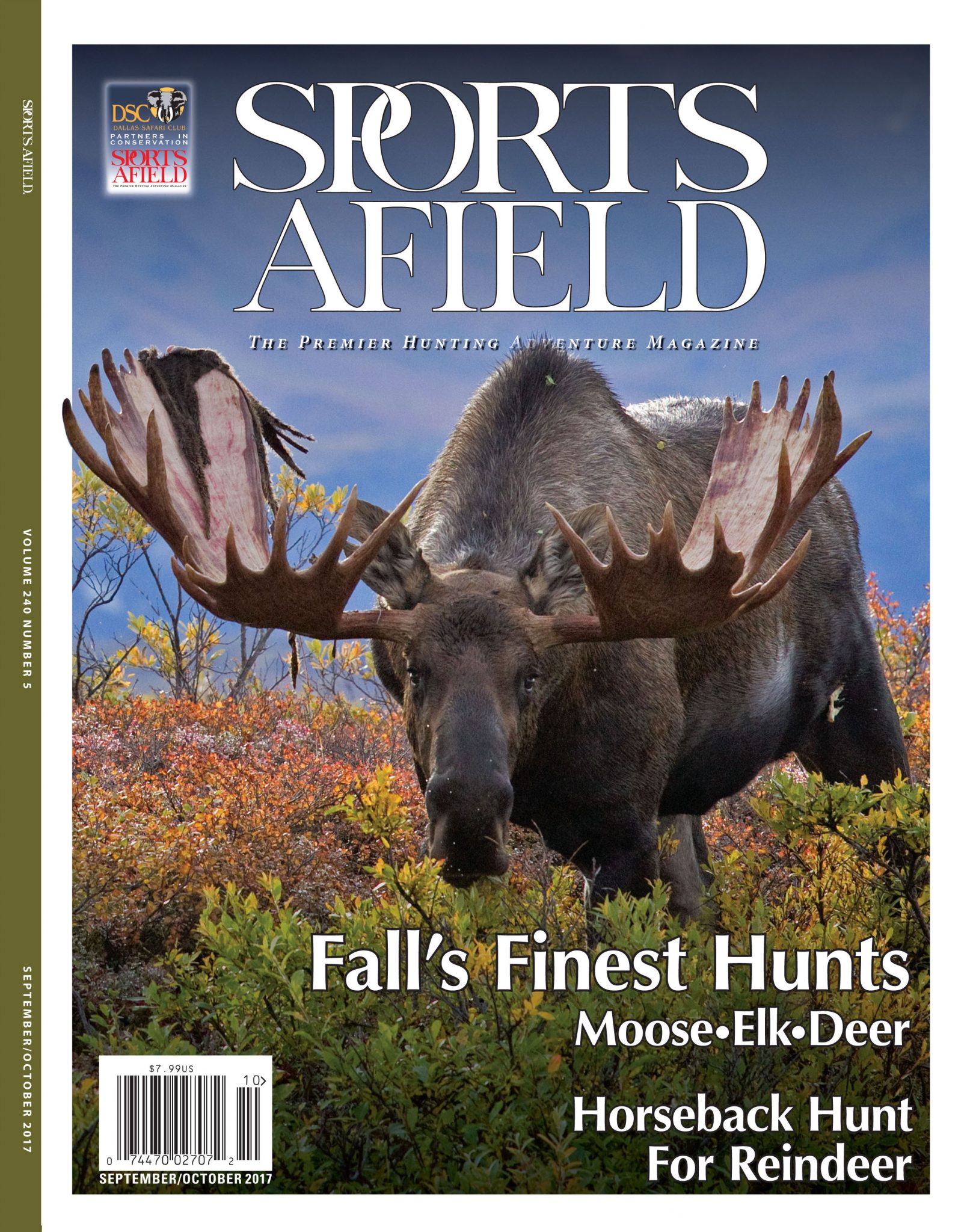
Sports A Field

Pack the Perfect Rest

Tips and tricks for making the most of your daypack to help you make steady, well-aimed shots in the field.

I honestly can’t recall the first time I used a pack as a shooting rest. For sure I didn’t when I was kid. I was a fledgling gunwriter well into my twenties before I understood the necessity for taking good field photographs, so I didn’t haul around a full-size SLR camera in a pack. Also, I was doing a lot more horseback hunting back then. Provided you don’t intend to get too far from your horse, saddle bags work just fine, and a pack is a pain in the neck on horseback. Yet another point: In collegiate smallbore shooting and in the Marines I’d concentrated on formal “position” shooting. So in those days I was more likely to use prone if I could, or a tight sitting position if I couldn’t.

At some point, though, carrying a daypack became standard operating procedure. Obviously they’re handy for rain gear, lunch, an extra layer, knife sharpener, fire-starting stuff, first aid kit and more—sometimes a spotting scope and tripod. It’s easy to weigh yourself down, but I’ve avoided carrying two or three spare chain saws and a pontoon bridge. However, it was the need to carry cameras that drove me to the pack. These days perfectly adequate digital cameras have gotten very compact, but for years I carried two full-size SLR film cameras, one for color slides and one for black and white, and of course I carried a lot of 35mm film. (For those who don’t remember, this was celluloid stuff that came in little canisters.)

Somewhere in there the revelation hit me that a pack could be used to provide an almost ideal shooting rest. I don’t claim proprietary knowledge; I must have seen someone do this or perhaps I read about it, but I came to it without any formal instruction. And since I almost always carried a pack using it became my “go to” option for field shooting. I’m older today; I carry less and I carry smaller cameras, but I still almost always carry a daypack, and using it is still my “go to” shooting rest.

June 2015, shooting a red stag in New Zealand. The slope was so steep that it was essential to hold the fore-end with my supporting hand, and also so steep that, if you look close, I have my left foot on Brittany’s leg to keep from sliding down the hill!

In recent years I’ve actually received formal instruction. As the SAAM shooting schools they will give you great ideas on how to use a pack—or, adding your buddy’s or a guide’s pack—a couple of packs to “build your house” for a steady shooting rest. I’m happy to say that the way I’d been doing it for perhaps thirty years was pretty well in sync with the way the instructors recommended.

Now, at the SAAM course they also recommend bipods. The bipod is an extremely useful tool, and I do use them sometimes. However, one of my favorite rifles for long-range shooting is the Blaser R8. The forward sling swivel stud is mounted horizontally at the tip of the fore-end, so it not suitable for the most common bipods, like the Harris, that clamp to a vertical sling swivel stud mounted toward the fore-end tip. So I’ve gone through the SAAM ranges using a pack instead of a bipod, and I’ve gone through the same ranges using a bipod and, on many shots, a pack with a bipod. The most obvious disadvantage to an attached bipod is it adds gun weight and yet another projection to snag on brush and make noise, but it’s a very useful tool that provides many options, especially the top-of-line models with telescoping legs for different heights.

One of the challenges I’ve noted with bipods, however, is they can be very difficult to use when shots are angled uphill or downhill, very common situations in mountain hunting. It’s hard to get the height right! Sometimes, on uphill shots, you can put the bipod on a pack to gain needed height. But for shots in steep country I’m pretty well convinced that the pack is a more versatile rest.

The idea is simply to lay the pack down and rest the fore-end across it. Prone over the pack is probably most common, but you can always plunk your pack down on a rock or log, both to gain height and to cushion the rifle. For uphill shots you may need to plump it up a bit, or even add a rolled-up jacket or another pack. You can also turn it sideways instead of laying it flat. Whether daypack or full-on backpack, these days I usually carry a daypack with an internal frame, but if I’m carrying a full-size pack it will also have a frame. This means that, for certain angles, I can set the pack on end and sit or kneel behind it. For downhill shots you may find yourself pushing the rifle farther forward and actually lying somewhat on top of the pack, with your chest resting on it.

There are innumerable ways to use a pack, including setting one atop a boulder or log to gain the right height. There is nothing orthodox about this kneeling position, but getting steady is more important than form.

Then there are the little tricks. A second pack (or rock or rolled-up jacket) can be used to stabilize your shooting elbow, which is very helpful. I think most people probably use the supporting arm to hold the fore-end atop the pack. This works, but I usually go to standard benchrest technique and use my supporting hand under the butt, scrunching it into my shoulder. I freely admit one disastrous miss when the fore-end slipped off a high spot on the pack just as I squeezed the trigger! This wouldn’t have happened if I’d been holding the fore-end, so make sure the darned thing is steady. If you use your supporting hand as I usually do, under the butt, then you can also use it to adjust your height. Depending on angle and plumpness of pack, sometimes you can do this with your hand, but you can also use a glove or a light beanbag. To give proper credit, this last is a trick from SAAM, and since seeing it I’ve used it several times.

The pack can also be used under a leg to augment the kneeling position…or to the side to stabilize the shooting elbow. The thing is, there are lots of ways to use a pack to gain stability. But almost none of them, or anything else, is useful if you’re on a mountainside, the animal is standing there, and you’ve never practiced this stuff or even seen it done. This was brought home to me in spades when we had a doctor friend of ours on a tahr mountain in New Zealand. She is a very good and precise shooter…but this was her first mountain hunt. She had never shot prone over a pack, but this was the best option under the circumstances. She missed and was devastated, shaken to the core. By chance we were spending the next day hunting fallow deer at Ritt Richards’ farm…and he happens to be an experienced shooting instructor with good ranges on his place. We started over with some good instruction, the lights went on, and the next day she marched up the mountain and shot a great bull tahr perfectly, prone over a pack.

There is more than one lesson here. The pack is an extremely valuable shooting aid, but it’s a lot easier if you’ve practiced using it, and this is something that can easily be practiced on most any range. In the larger sense, there are lots of shooting positions and lots of ways to get steady…but none of them are particularly easy if you’ve never tried them before. Out in the field, with a fine animal in front of you and buck fever rearing its ugly head, is not the time to learn new ways to get steady.

Leave a Comment

Where Wildlife Thrives

Once a cattle region, now a hunting mecca, Zimbabwe’s Bubye Valley Conservancy shows how hunting can help both humans and wildlife to flourish.

Zimbabwe’s Bubye Valley Conservancy (BVC) lies in the southern portion of the country, comprising portions of both the Matabeleland South and Masvingo Provinces. In the early 1900s, huge cattle operations were established on the two-million-acre property and livestock remained the principle source of revenue in that area until the early 1980s. But there are issues inherent to such large cattle operations in southern Zimbabwe; the fragile Lowveld soil is not conducive to large livestock; native species competed with domestic cattle (and were subsequently exterminated); and local communities did not share in the profits from these operations. In addition, periodic drought is common in the region, and die-offs of domestic stock were commonplace in especially dry years. Lions, elephants, rhinos, wild dogs, and buffalo were extirpated, and a bounty was paid for anyone who presented the tail of a zebra or wildebeest as these two species represented the primary competition for the domestic herds.

When the Bubye Valley Conservancy was formed, elephants were reintroduced along with many other native species.

Following the brutal droughts of 1982¬1983 and 1991¬1992, ranchers in the region began to face the reality that cattle operations were not the best financial option in the arid Lowveld. A group of investors, spearheaded by Charles Davy, purchased the remaining LEMCO (Liebigs Extract of Meat Company) lands and several adjacent farms and established the Bubye Valley Conservancy. A double, seven-foot electrified perimeter fence was erected around the entire boundary of the 1,250-square-mile property (larger than the King Ranch in Texas); the double fence had a 30-foot gap to separate the conservancy’s buffalo from neighboring cattle to control the spread of hoof-and-mouth disease. A number of native wildlife species were then reintroduced into BVC. Since they were adapted to the environment, these native species—lions, buffalo, elephants, wild dogs, rhinos, and many others—thrived in the BVC. And, of equal importance, they did not damage the habitat as the domestic livestock had. As wildlife populations grew, the habitat improved, and soon the massive BVC landholdings looked much as they did in the days prior to the introduction of cattle. Shareholders paid the bills for the establishment of safari camps, game reintroduction, anti-poaching measures, and the perimeter fence until the funds from safari hunting could support BVC operations.

The funds generated by sport hunting have helped not only the wildlife in BVC but also local communities around the conservancy. The statistics speak for themselves: Since 2011, eight bore holes have been drilled to provide fresh water to schools and villages, youth athletic teams have been able to afford uniforms and transportation to sporting events, cold rooms and refrigeration units have been established to store fresh meat, schools were provided with new buildings, restrooms, doors, windows, and roofs. Most important of all, more than three and a half tons of fresh meat is donated monthly to local schools, villages, and orphanages. The lengthy list of improvements continues (for complete totals visit bubyevalleyconservancy.com), but the message is clear: When wildlife is managed for hunting and local communities either benefit or become shareholders in the responsible use of natural resources, then wildlife has a future in Africa.

From the establishment of the first cattle ranches in the region until the early 2000s, rhinos were scarce in the BVC—the sole population was a handful of white rhinos that had been imported from South Africa. That changed in 2002, when 135 black rhinos were reintroduced to BVC, making the area home to the third-largest population of black rhinos in the world and the largest collection of rhinos on private ground (only Etosha Park in Namibia and Kruger Park in South Africa are home to larger herds).

“This population is highly valuable not only in terms of numbers of individuals, but possibly more importantly in terms of genetic viability,” says professional hunter John Sharp, who operates in the BVC. “The black rhinos in BVC are of Zambezi Valley stock—in fact some of the black rhinos living on BVC today were actually born in the Zambezi Valley. The 35-year-old bull, Shrapnel, was captured in 1992 in Chete. The forty-year-old cow, Inunwa, was captured near Rekomechi Bridge on the way into Mana Pools. These rhinos contain vital genetic diversity as they are from what in the late 1980s was the world’s largest population of black rhinos, estimated at in excess of 1,700—over half the world’s population at the time. South Africa and Namibia had barely 500 black rhinos each at this time.”

The War on Poaching

The Bubye Valley’s rhino population is carefully maintained and monitored, but even this remote corner of Africa is not immune from the infiltration of poaching gangs who—fueled by a rise in the value of rhino horn and equipped with an effective arsenal of semiautomatic and automatic weapons with telescopic sights and silencers—began targeting the BVC rhinos mercilessly in the late 2000s.

In early 2008, criminal syndicates behind the massive rhino poaching in South Africa turned their attention to BVC in conjunction with Zimbabwean gangs who had almost annihilated the rhinos in other areas within Zimbabwe. Between 2008 and 2009, an adjacent property lost all seventy-two of their rhinos to these gangs, and BVC scouts suddenly had to shift their attention from local poachers using dogs and snares to well-funded, well-organized militias bent on exterminating rhinos for profit. The funds generated by hunters and non-governmental organizations helped equip the anti-poaching units to fight a more sophisticated and far more dangerous enemy.

BVC issued each of its eighty scouts semi-automatic .223-caliber rifles. Secure communication networks were established. Training in basic tactics was conducted to build confidence. Working with staff from other conservancies, intelligence was gathered on the poaching syndicates. By mid-2010, after losing some fifty rhinos, the tide turned and losses dropped dramatically as the opposition suffered several major setbacks and found that there were easier pickings elsewhere.

Unfortunately, the potential profits for slaughtering rhinos spurred these armed syndicates to regroup and reorganize. Soon poachers began incentivizing BVC scouts to provide intel that allowed them to operate once again in the Bubye Valley.

A key factor that assisted the resurgence of poaching was there being cell phone coverage in most parts of the BVC. This provided poachers with real-time intelligence on deployments, detection of incursions and whereabouts of rhinos. Poachers also perfected a system of crossing the two perimeter fences without leaving any evidence of their passing. (They put socks over their shoes, foiling even expert trackers.) They also became very mobile, on occasion traversing the BVC from east to west, some forty-four miles, in twelve hours, negating the efforts of stop groups. But the BVC did not back down; the rhinos in their charge were not their own property but the property of the Zimbabwean people, and with funds from hunting and private donations, BVC upgraded its fences, paid substantial sums for information leading to the capture of poachers, organized a rapid-response unit to quickly address poachers, undertook more advanced training and, in 2016, added a canine response unit. Poachers have responded by trying to ambush rangers; to date, thankfully, there has only been one relatively minor injury. The BVC has become one of the hotbeds in the war on Africa’s poachers, but thanks to the funds generated by hunting and the selfless efforts of dedicated scouts on the ground, the BVC rhinos are surviving. Were it not for hunter dollars, these valuable animals would have been lost long ago.

The King is Back

“As the apex predator, lions are a vital component of functioning ecosystems,” Sharp says. “However, without the incentive of trophy hunting, we could not afford to have as many lions as we do. Lions eat other animals, and in real terms consume hundreds of thousands of dollars’ worth of wildlife on the conservancy each year. Lion hunts are not cheap, but this is why. If we were unable to continue harvesting our lions, their population size would unfortunately need to come down, and this means culling them, as there is currently nowhere left in Africa to introduce a viable lion population.”

The future of places like BVC is crucial to the future of lions in Africa.

Lion ecology is widely misunderstood. The general public seems determined to vilify trophy hunting when, in reality, the loss of habitat, a rapidly-growing human population, and poaching for profit are the true risks to wild lions. To that end, the BVC has partnered with the University of Oxford Wildlife Conservation Unit to help study these cats in the BVC.

“Lions are an important cog that makes the ecological machine work, and we don’t want to lose the lions,” Sharp says. “Responsible trophy hunting cannot significantly affect lion population density or survival, as it is only the old males no longer contributing to the gene pool or protecting their pride that are hunted. Indeed, the lion abundance has increased exponentially despite, and indirectly because of, hunting.”

Sharp points out that the BVC’s success with lions has resulted in the area accounting for more than a third of the CITES harvest quota for the entire nation of Zimbabwe. In late 2015, BVC representatives, along with lion experts from Hwange Park and the Save Valley Conservancy, met with officials from the U.S. Fish and Wildlife Service to discuss the future of lions and lion hunting in Zimbabwe. According to the official USFWS statement, “The Service found that sport-hunting, if well managed, may provide a benefit to the subspecies. Well-managed conservation programs use trophy-hunting revenues to sustain lion conservation, research and anti-poaching activities. However, the Service found that not all trophy hunting programs are scientifically based or managed in a sustainable way. So in addition to protecting both lion subspecies under the ESA, we created a permitting mechanism to support and strengthen the accountability of conservation programs in other nations.”

The fact that there are any lions at all in the conservancy is a testament to the BVC’s commitment to conservation. While lion populations continue to decline across much of the continent, the Bubye Valley’s population of big cats remains stable thanks to careful management bolstered by ecological research. More importantly, the future of lions in the valley is a benefit to the shareholders who live alongside these cats. Since there are more wild lions on hunting areas today than in parks and preserves in Africa, it is time that the world began to understand why the future of places like the BVC is congruent with the future of the lion as a species.

The Bubye Valley Conservancy is an example of what hunter-based conservation can accomplish in Africa. The financial success of the BVC has provided for local people and incentivized them to protect wildlife. The funding has also helped provide ground troops to fight the war on poaching. It’s important to note that the original shareholders who established the BVC twenty years ago have not seen any personal financial gain from the success of the conservancy; the money returns directly to the communities and to the preservation of wildlife. The vast, remote BVC remains one of Africa’s great ecosystems, with healthy game populations and a goal for long-term conservation in a world consumed with rapid profit. And we have hunters to thank.

Leave a Comment

An Economic Colossus

Hunting is by far the largest funding mechanism for wildlife, and the economic benefits go far beyond conservation.

Gifford Pinchot, first chief of the United States Forest Service and the twenty-eighth governor of Pennsylvania, famously declared, “Unless we practice conservation, those who come after us will have to pay the price of misery, degradation, and failure for the progress and prosperity of our day.”

While many of us now accept the truth in this, it is imperative we also recognize that conservation is not free. There is a price to pay for the management, protection, and enjoyment of our natural world. Wildlife abundance is no accident, and it isn’t free, either. Somebody, somewhere, pays the bills.

While there are many institutions that play a role in conservation, state agencies in the United States are on the front lines. Yet, despite the fact that the average U.S. state wildlife agency requires a budget of $40 million annually to operate, it seems the American public remains largely unaware or indifferent to the costs of conservation. Citizens certainly benefit from the conservation services state agencies provide, but seldom is there public recognition for how the agency staff and programs are funded. It is time this was recognized.

The current system of funding for U.S. state conservation programs relies heavily, though not exclusively, on expenditures by hunters, and anglers. On average, more than half a state agency’s budget comes directly from sales of hunting and fishing licenses or other user fees. How much money are we talking about? Well, in 2015, there were approximately 35 million hunting licenses, tags, permits, and stamps sold in the United States at a cumulative cost of $821 million. The great bulk of this money went to conservation, in one form or another.

It is true that approximately one-quarter of the average state wildlife agency’s budget comes from federal funding. However, this funding is almost entirely provided by the Pittman-Robertson Act (Federal Aid in Wildlife Restoration Act of 1937), which imposes an 11 percent excise tax on the sale of firearms and ammunition products. Since 1939, $10.1 billion of these tax dollars has been awarded to states in support of conservation initiatives. When combined with contributions derived from angler taxes via the dedicated Dingell-Johnson Act of 1950 and the Wallop-Breaux Amendment of 1984, this number increases to an impressive $18 billion dollars in direct funding for state conservation efforts. Can anyone name any other source of conservation dollars that even approaches this?

But that is not the end of the story. Tax contributions and user fees aside, it is estimated that American hunters contribute an additional $400 million dollars per year to wildlife conservation through membership dues and donations to organizations like DSC, the Wild Sheep Foundation, Pheasants Forever, Quail Forever, Rocky Mountain Elk Foundation, and many others.

No other country in the world has such conservation funding mechanisms in place. Nor does the United States itself have an alternative mechanism to replace these funding sources, should they decline or disappear. This is not to say that other citizens do not financially support conservation; they certainly do. What it does say, however, is that hunters (and anglers) make enormous contributions and have been doing so for a very long time. This fact ought to be acknowledged, if for no other reason than to provide insights as to how other communities might be incentivized to financially support wildlife conservation programs.

While the numbers quoted are impressive, the economic significance of hunting and angling extends far beyond conservation itself. Overall, hunting in the United States generates $25 billion dollars in retail sales and more than $17 billion dollars in salaries and wages each year, while creating sales tax, and state and federal income tax revenues for government agencies and public services of all kinds. American hunters spend $5.3 billion dollars each year on hunting-related travel, $6.4 billion on hunting equipment, and $8.4 billion on other, related, “big-ticket” items. All things combine for an annual expenditure of $2,800 per hunter. Economic multipliers may be used to estimate the compound rippling effect of these expenditures, showing an economic impact of more than $86.9 billion dollars a year to the U.S. economy.

These numbers are incredible, of course, and comparisons with other economic drivers help put them in perspective. The Congressional Sportsmen’s Foundation reports that sportsmen and women spend $605 million a year on hunting dogs, which is more than skiers spend on ski equipment, and that the annual federal income tax revenue generated by hunter spending could cover the annual salaries of 100,000 U.S. Army troops. Between 2006 and 2011, USFWS reports that the number of hunters in the U.S. increased by 9 percent. However, in the same time frame, spending on hunting-related products and services grew by more than 30 percent. As an economic driver, therefore, hunting is actually growing in importance. Even following September 11, 2001, when the U.S. travel industry was in dire straits, hunters spent a remarkable $276 million dollars on lodging alone. The National Shooting Sports Foundation reports that if hunting were a company, the amount spent by American sportsmen and women to support their activities would make it number 73 on the Fortune 500 list. Hunting, by any standard, is not only personally important in the lives of millions of U.S. citizens; it is big business.

But don’t be blinded by the statistics. This economic activity has real consequences for real people. In fact, hunting related activities and services annually employ more than 600,000 Americans. These jobs are often created in rural areas where employment opportunities may be limited. In some rural areas, dollars spent by sportsmen and women during hunting and fishing seasons can be enough to keep small businesses operational for another year. By doing so, these traditional activities remain the lifeblood for many small towns and businesses across America today.

The American traditions of hunting and angling fuel an enormous economic engine of tremendous value to conservation as well as to the socioeconomic well-being of the nation. True, these pursuits are not for everyone. Yet, whether one supports these activities or not, it is important to recognize the contributions they make and to appreciate that we have yet to devise any alternative funding sources that can replace them. Indeed, our pursuit of such new funding sources ought to reflect our conservation commitments and thus we should seek to add to the benefits of this economic colossus, not replace it. In a world challenged by human population growth and climate change, wildlife conservation is becoming more expensive, not less. We need to increase our conservation efforts; not just maintain the status quo. To do so will require a greater effort by a wider community of citizens dedicated to never losing our priceless wildlife heritage.

Leave a Comment

A Thirty-Year Plan

The Friedkin Family and Tanzania’s government make a long-term commitment to conservation.

The hunting news from Africa is often troubling these days: dwindling game, rampant poaching and corruption, massive habitat encroachment. But this article is about some good news for a change. At the center of the story is an American safari company with a history of conservation leadership that is doing remarkable things in Tanzania.

plan

The story began, for me at least, on my first safari to Tanzania’s Maswa game reserve in 2001 just a couple of days after 9/11. Very little news got through to us in the bush, isolated as we were amid more than a thousand square miles of thornbush and rocky hills, and the contrast between our remote little corner of Eden and the turmoil rampant in the rest of the world couldn’t have been more pronounced. On subsequent safaris to Maswa in 2003, 2008, and 2011, that sense of blessed isolation remained intact even as the pressures on wildlife and habitat increased throughout East Africa. We continued to see elephants calmly parade through camp, the cows leading tiny calves past our tents to water in the evening, and the other animals—the buffalo, the myriad antelope species, the baboons, the birds—seemed to increase in number with each visit.

This year, professional hunter Paul Olivier came around a corner in Maswa not far from the Mbono River and stumbled on three black rhinos. The rhinos had apparently moved into the area from the nearby Serengeti, found Maswa to their liking, and decided to stay. In a hunting area. That just doesn’t happen much in Tanzania, and probably not anywhere.

The magic behind Maswa, not surprisingly, is not magic at all but a long history of hard work and substantial investment. The Houston-based Friedkin Family Companies, a group of prominent hunting and photographic safari outfitters that includes Legendary Adventures, Tanzania Game Trackers Safaris, Wengert Windrose Safaris, Legendary Expeditions, and Ker & Downey (Tanzania), have long been associated with some of the best hunting areas in Tanzania: Maswa, Lake Natron, Moyowosi, Ugalla, and Malagarasi to name a few. Since 1987 the Friedkins have invested nearly $300 million into habitat protection, community development, infrastructure, camps, and facilities. Perhaps most importantly, much of that investment has funded, through the Friedkin Conservation Fund, an extensive anti-poaching program that has become a model for others in Tanzania and elsewhere.

The company’s efforts have yielded remarkable success, as witnessed by my own experiences in Maswa over the years. Careful management of wildlife and habitat, combined with a famously passionate commitment to pushing the standard for luxury safaris to new heights, has secured the company’s reputation among the continent’s best safari outfitters.

But with success has come enormous risk. East African politics are rough and tumble, and those wildlife areas that still remain are a valued commodity. Turnover happens, often involuntarily, often for reasons that have little to do with game management. Since 2010, in particular, the Tanzanian safari industry has suffered considerable upheaval.

After losing several key areas in one round of reallocations and barely holding on to another through two years of litigation, the Friedkins found themselves forced to reevaluate the viability of their investment. Profitability was never the goal—the Friedkins make their money through other businesses and their safari companies have long been managed primarily as philanthropic endeavors, with hunting and photographic revenues being ploughed back into conservation programs. But investing millions into areas only to see them turned over to others with a different agenda was simply too much. If the company was to continue its investment in Tanzanian conservation, it needed longer-term stability.

So, in early 2015, the Friedkins approached the Tanzanian government with a proposal. In return for their commitment to continue their conservation and community development initiatives in their safari areas, and specifically to invest an additional $100 million in those areas over the next ten years, they asked to be granted Strategic Investor Status under Tanzanian law, which would assure them a thirty-year renewable franchise in each area. The proposal included detailed plans for boosting tourism and broadening resource utilization in a manner consistent with sound conservation, constructing new camps in certain areas, and creating new infrastructure and employment opportunities for local communities. After extensive discussions, on August 17, 2015, the Tanzanian government agreed to the plan and granted three of the Friedkin companies Strategic Investor Status with associated guarantees and protection.

The Friedkins emphasize that while the long-term security the company’s new status provides is critical to their ability to offer first-quality safaris, the more important news is how inextricably hunting has become linked to conservation policies and to non-hunting uses of hunting areas. As the company’s public statement notes, “Conservation practices were relatively easy twenty-eight years ago. Today they are complex. We must balance the demands for land and water between a burgeoning rural population and wildlife.”

While hunting safaris once contributed far more revenues to conservation than photographic or other uses, demand for photographic safaris in the Friedkins’ areas is now increasing much more quickly than hunting demand. It is becoming increasingly difficult for safari operators to reserve vast areas exclusively for hunting use. Mixed use seems increasingly the norm.

In consequence, it’s difficult to say exactly what the Friedkin’s success signals for the future of safari hunting. African politics are simply too volatile, too uncertain, and controversies regarding African hunting will doubtless continue for some time. But there is something unmistakably cheering about Tanzania’s tangible recognition of the Friedkins’ contribution to the future of African wildlife. Committing private capital and private effort to wildlife just because it’s the right thing to do, a quintessentially though not uniquely American value, is exactly the policy Teddy Roosevelt advocated a century ago: “Of all the questions which can come before this nation, short of the actual preservation of its existence in a great war, there is none which compares in importance with the great central task of leaving this land an even better land for our descendants than it is for us.”

President Roosevelt’s message is as relevant to Tanzania in 2015 as it was to America in 1909. The Friedkins have demonstrated beyond question that American hunters can play a crucial role in preventing the poaching and habitat destruction that threatens African wildlife, and the Tanzanian government has demonstrated that it is willing to make substantial commitments to encourage and reward such efforts. For other investors with similar interests who step forward, the path seems a little less daunting, the future of African wildlife a little brighter.

Leave a Comment

Deadly Encounters

A new book by Craig Boddington shares the stories of people who have been on the receiving end of animal attacks.

Incidents of hunters, trackers, professional hunters, and innocent bystanders getting injured or killed by dangerous game animals crop up every year, and the trend toward hunters becoming the hunted seems to be on the increase.

Bears, both in Asia and North America, still take bites out of humans on a regular basis. In Africa, hardly a year goes by when at least one PH, tracker, or hunter gets killed by a Cape buffalo. Leopards have always been plentiful in Africa and are no less dangerous now than they were thirty years ago. Hippos and crocodiles may take the largest toll of all, so it pays to be cautious whenever you approach an African river.

In his new book, Deadly Encounters, Craig Boddington does a masterful job of unearthing the facts and sometimes gory details of what happens when a creature with sharp teeth, claws, and colossal strength decides to close in on a human. His stories include everything from attacks by wild lions to bears stalking and preying hikers. Boddington discusses and dissects the incidents to explain what went wrong and why.

Order Deadly Encounters from Safari Press: www.safaripress.com. A portion of the sales of each book will go to the DSC Frontline Foundation. DSC Frontline Foundation provides financial relief to trackers, PHs, camp staff, and their families who are killed or injured in the course of providing professional hunting services.

Leave a Comment

This Land Is Our Land

Turning over federal lands to the states would be a huge blow to hunting and the funding that supports wildlife conservation.

Wouldn’t you love to own several hundred million acres of game-rich mountains, forests, and plains, crisscrossed with trout-streams and always open for you to hunt, hike, camp, or ride on? Guess what—you already do. You, I, and every other citizen of this great country own 640 million acres of some of the most incredible wildlife habitat in the entire world. I bet you’ve hunted on some of it, since 72 percent of sportsmen who hunt in the West hunt on public lands. I’m one of them—I killed a cinnamon-phase black bear and my first elk on national forest land in western Montana, and I’ve been fortunate to hunt in many other national forests over the years.

There’s a small but vocal bunch of people right now who want to take all that great hunting land away from you. Of course, they’re not telling you they want to take your land away. They’re saying they want to take land away “from the federal government.” Um, excuse me, but last time I checked, federal lands, although they are managed by the federal government, are owned by us. You, me, our sons, daughters, nieces, nephews, and grandkids.

Part of the reason for this push is because the federal government is doing an abysmal job of managing our land right now. That’s not entirely their fault, however. Despite a federal budget that is increasing by leaps and bounds, the Forest Service and BLM coffers have been chronically underfunded for years, especially their crucial but unglamorous programs geared toward timber management, habitat restoration, and forest health.

Legislatures in a number of western states have recently introduced bills that seek to transfer ownership of our federally managed lands to state governments. There are also a couple of bills floating around the House of Representatives right now along the same lines, including HR 3650, sponsored by Rep. Don Young (R-Alaska), which would allow individual states to acquire, own, and operate millions of acres of national forests.

OK, you say, what’s so bad about the states owning the land? I understand the question. After all, when I lived back East, I hunted on lots of state-owned land, and it was great. Having lived and hunted in both regions, though, I can tell you that the West is very different than the East in the way public lands are considered and managed. In western states, state-owned lands are not necessarily synonymous with “public lands.” They’re “trust” lands, set aside for generating revenue, and often not open to the public at all. In Colorado, for example, 80 percent of state lands are leased for commercial use and are not open to the public for recreation.

The real problem, though, is that no state can afford to manage all that land. States are simply not equipped to shoulder the enormous costs associated with fighting wildfires, maintaining roads and trails, treating noxious weeds, and conducting habitat restoration. For example, a recent study showed that Idaho would run a deficit of $111 million per year if it were to take on management of just half of the federal lands within its borders.

You think the feds are doing a bad job? The states, struggling with budget issues, would almost certainly cut their losses pretty quickly and sell it off—and there is no shortage of willing buyers salivating for these lands to go on the market: billionaires, foreign corporations, and resource-extraction interests. Once privatized, these lands will be off limits to most sportsmen forever.

This may sound alarmist, but it’s not, as hunters in Oregon are finding out. Two years ago, their state sold part of the 92,000-acre Elliott State Forest, prized by generations of black-tailed deer hunters, to a timber company because it could no longer afford to manage it. Most of the sold-off portion is already closed to the public, and the state put the remainder of the forest on the auction block this year. Fact is, western states have a long history of selling off state lands to the highest bidder. In an extreme example, Nevada only has 3,000 of its original 2.7 million acres of state-owned land left.

In study after study, people cite lack of access to places to hunt as the major reason they don’t hunt more—or at all. What would happen if almost all of our public hunting access was taken away or sold off? Rural economies that depend on outdoor recreation would collapse. Hunter numbers would drop like a rock—and with them, the vast majority of the money that supports wildlife management in the United States. Our entire North American Model of Wildlife Conservation depends on hunters being able to hunt—and they do that, more than anywhere else, on public land. Fewer hunters mean fewer hunting licenses sold, fewer hunting rifles purchased, and less money going into wildlife agency coffers and Pittman-Robertson funds. That translates into less money for habitat conservation and wildlife management.

Idaho Republican Mike Simpson testified in a hearing on the Forest Service budget in February. “Let me tell you why people live in Idaho,” he said. “They like Idaho because they love their public lands, and the access they provide to places to fish and hunt.” Simpson acknowledged the problems with federal land management, but made a good analogy: “It’s like a landlord relationship. You’re always P.O.’ed at the landlord. If we turn this land over to the state, we’d be P.O.’ed at the state.”

Simpson argued that a better solution would be for Congress to restore reasonable funding to the Forest Service so it can go back to properly managing our land. Now that’s something that we, the proud owners of 640 million acres, can get behind.

Leave a Comment

George Bird Grinnell

Editor, hunter, and conservationist, Grinnell made it his life’s work to save the American bison.

The life of George Bird Grinnell is an inspiring story of how one person can truly make a difference, even to the point of saving an entire species from extinction. Not only was he a driving force in wildlife conservation, Grinnell lived a life of high adventure, was an avid big-game hunter, and shared campfires with some of the most famous characters of the Old West.

Grinnell was the editor of one of the leading outdoor magazines of the late nineteenth century, a weekly publication called Forest and Stream, generally considered the forerunner of all other American outdoor magazines. He had a PhD from Yale and was also a naturalist, paleontologist, and a prolific writer. He studied and chronicled the fast-disappearing culture and lifestyle of Native Americans, helped found two major conservation organizations, and was largely responsible for the establishment of Glacier National Park. But he is best known for his heroic efforts to save the American bison from extinction, helping to establish a new American conservation ethic in the process.

Born in 1849 in Brooklyn, New York, Grinnell grew up on the country estate that once belonged to John James Audubon. The ornithologist/painter’s widow, Lucy, was one of his early influences, and his interest in the outdoors, wildlife, and hunting was sparked at an early age. He made his first trip West in 1870, shortly after graduating from Yale, with an archeological expedition led by one of his professors. It was a life-changing experience for the young Easterner, who collected fossils, saw elk and bison, and met Buffalo Bill Cody. He made three more trips west in the early 1870s, participating in a traditional bison hunt with Pawnee Indians, exploring the Black Hills with George Armstrong Custer (where they discovered gold), and studying the wildlife and natural history of the new Yellowstone National Park, created in 1872.

In 1876, back in New York, Grinnell landed a job editing a natural history column for the three-year-old outdoor magazine Forest and Stream. The magazine’s founder and editor, Charles Hallock, prided himself on pulling no punches when it came to excoriating hunters and anglers for unethical behavior. When Grinnell took over as editor and publisher in 1880, the magazine continued to be a strong proponent of the emerging conservation ethic, and one of Grinnell’s main targets was the situation in Yellowstone Park.

Grinnell used his popular magazine as a powerful platform to editorialize for protection of Yellowstone and particularly its bison, which were by then the only remaining wild bison in the country. Because Yellowstone was the nation’s first national park, no one seemed to know exactly what to do with it. The most pressing problem was a lack of law enforcement. Although a law had been passed, at Grinnell’s urging, prohibiting the killing of game within park boundaries, no provision was made for enforcement, and poachers had free rein to operate virtually unchecked. Grinnell spent years editorializing about the issue and lobbying Congress for action.

In 1885, Grinnell published a review of a new book by a young politician named Theodore Roosevelt called Hunting Trips of a Ranchman. His rather condescending review caused an annoyed Roosevelt to storm into Grinnell’s offices. The confrontation soon turned into an amicable discussion as the two men discovered their shared love of hunting and concern for conservation. Grinnell and Roosevelt soon began talking about creating an organization centered around sportsmen, and in 1887, at a dinner party at Roosevelt’s home, they and several other like-minded hunters formed the Boone and Crockett Club, which proved to be a driving force in the early conservation movement and greatly aided Grinnell’s work in achieving protections for Yellowstone and its bison.

A report published in Forest and Stream in 1894 of a thrilling raid on a poacher’s camp finally galvanized public and legislative support for enforcement and stiff penalties for poaching in Yellowstone. It was just in time–by the turn of the century, the park’s bison herd had dwindled to just twenty-three, and there’s no doubt that had it not been for Grinnell’s relentless efforts in the preceding two decades, the species would have become extinct in the wild.

Bison, however, were not the only focus of Grinnell’s conservation work. In an 1886 editorial, he wrote, “We propose the formation of an association for the protection of wild birds and their eggs, which shall be called the Audubon Society.” The very next year he launched the first issue of Audubon Magazine, which noted there were already 20,000 members in the newly formed association, which was dedicated to ending the commercial trade in songbird eggs and feathers.

And, even as he fought the Yellowstone fight, Grinnell was hiking and exploring in a region of northwestern Montana he called “the Crown of the Continent,” and he used his considerable resources–writing, editorializing, lobbying, and working with the powerful and politically connected members of Boone and Crockett–to champion legislation to turn the region into another national park. In 1910, his vision was realized when President Taft signed a bill creating Glacier National Park.

In his excellent 2010 book, How Sportsmen Saved the World, E. Donnall Thomas Jr. summed up Grinnell’s enormous contributions to the conservation community: “Grinnell convincingly demonstrated the power of a responsible outdoor press in the fight to preserve wildlife and habitat. His key role in the founding of the Audubon Society and the Boone and Crockett Club established important models for the numerous wildlife advocacy organizations that would arize in the twentieth century. Finally, he demonstrated that sportsmen could and would not just accept but champion appropriate restrictions on hunting when the common good called for it, as it did in the case of Yellowstone’s wildlife.”

Grinnell died in 1938 at age eighty-eight. The New York Times called him “the father of American conservation.”

Leave a Comment

Two Great Elephant Books

A pair of the greatest elephant-hunting books ever published are now back in print.

Safari Press recently reprinted two of the great elephant-hunting classics of the post-World War II era. These extraordinary books, Kambaku by Harry Manners and Bell of Africa by W.D.M. Bell, are autobiographical tales of two of the most adventurous hunters who ever walked the elephant trails of the Dark Continent.

Kambaku is the life story of Harry Manners, one of the greatest elephant hunters of all time. Harry was born in South Africa, and his family moved to Portugese East Africa, now Mozambique, when he was six. Harry shot his first elephant when still a teenager, using a 10.75mm Mauser. The bull had tusks of more than 80 pounds per side, and Harry was hooked.

He began his market-hunting career in 1937 and continued until 1958, when commercial ivory hunting was closed in Mozambique. With his beloved .375 H&H he hunted buffalo for meat and elephants for ivory during this period. Thereafter, he was the first professional hunter to be employed by Safarilandia, the company owned by the famous hunter Werner von Alvensleben. Kambaku, which means “Old Bull Elephant”) is mostly about Harry’s years in the commercial ivory trade, when he lived and hunted in an area he referred to as Shangri-La. The book includes many excellent black-and-white photographs from those days. Among his many magnificent trophies was an incredible pair of tusks that weighed 185 and 183 pounds, the fourth-largest African elephant tusks ever recorded.

Few men have lived a life of adventure as daring and courageous as Walter Maitland Dalrymple Bell. Born in 1880 near Edinburgh, Scotland, he made it to Africa for the first time before he was even seventeen years old. After some false starts and a detour to the Yukon, Where he mined gold and shot game for the mining camps in the Klondike, he was able to return to Africa by enlisting in the Canadian Army and getting sent to fight the Boer War.

After the war ended in 1902, Bell made his first ivory-hunting expedition. He developed a taste for the trade, and subsequently spent sixteen years making what are generally considered the greatest ivory-hunting expeditions ever conducted by a single hunter. He hunted in Kenya, Uganda, Abyssinia, Sudan, the Lado Enclave, Ivory Coast, Liberia, and the Belgian Congo. He became known throughout the continent by his nickname, “Karamojo” Bell.

Bell was an outstanding writer with a flair for describing his adventures and the extraordinary people he met along the way. He began writing Bell of Africa, his third and last book, in the late 1940s, but he died before it was completed. Colonel Townsend Whelan took over the editing and finished the book, which contains some revised sections of Bell’s earlier books but is, for the most part, made up of all new material.

This book contains Bell’s own original drawings that depict scenes from his youth as well as his much-praised sketches of where to place brain, heart, and lung shots on elephants. Bell was a superb marksman who emphasized the importance of precise shot placement, which made possible his use of smaller-caliber rifles for elephant hunting. The drawings he made, based on his many years of experience and extensive study of elephant anatomy, were for a long time the only anatomical studies of the position of an elephant’s brain that were available to hunters.

Both books are now available from Safari Press: safaripress.com; 714/894-9080.

Leave a Comment

The .45-70: Still Going Strong

New bullet designs and construction have given new life and new versatility to the venerable .45-70 Government.

While big bore lever-actions have long been a favorite of deep woods whitetail hunters, 21st Century reloading components and ammunition have made the .45-70 much more versatile and easily capable of taking moose and elk out to 250 yards.

As a young man growing up in British Columbia in the 1960s, I had little exposure to lever guns or the cartridges associated with them. If I did see someone with a lever-action it was either an old Savage Model 99 in .308 Winchester or the then-racy Winchester Model 88 in .284 Winchester. Bolt-actions were the norm and young big-game hunters usually started out with a budget-priced “sporterized” Lee Enfield in .303 British and aspired to eventually move up to a new Parker Hale bolt-action chambered for .30-06.

The old .45-70 Government was something I had read about, but had never actually seen, and it wasn’t until the mid-1970s that I finally saw one in use for the first time. As was the general consensus of pretty much anything you read on the cartridge in those days, I believed the .45-70 to be a cartridge for close-range work, shooting a big, heavy bullet with the trajectory of a brick.

I was elk hunting in the Kootenay region of southeastern British Columbia and had located a small meadow with lots of elk sign. Wanting to get a better handle on when the elk were coming and going, I found a comfortable spot to glass and settled in for the evening vigil. About fifteen minutes before the end of legal shooting light a few cows and calves began to filter out of the spruce trees on the far side of the meadow and were soon followed by a raghorn bull.

As it turned out, I was not the only one who had noticed the elk sign. While watching the young bull through my binocular, I saw him stagger from the impact of a bullet as it slammed into his right shoulder, and simultaneously heard a loud report. The bull stumbled forward a few yards, fighting to stay on his feet, and piled up. Moments later I spotted the lone hunter as he exited the forest edge, walking slowly towards the downed elk.

My elk hunt was definitely over, so I stood up, whistled to get the hunter’s attention, and then walked over to meet him at the elk. As I approached the hunter and the downed elk, my focus shifted from the bull to his rifle, as it was not the type of firearm you usually saw being carried by an elk hunter in the Canadian Rockies. Turned out the lucky hunter was carrying a Sharps reproduction chambered in .45-70 Government and he had made a 250-yard shot with open sights, using a heavy cast bullet. Needless to say, I was impressed by both his shooting and the real-world performance of the rifle and cartridge on a big-game animal that has a bit of a reputation for being rather tenacious.

Designed for use in the Model 1873 “Trapdoor” Springfield, the .45-70 was originally called the .45-70-405, which stood for the cartridge being .45-caliber, using 70 grains of black powder behind a 405-grain cast lead bullet. This load produced a velocity of about 1,300 fps in the long-barrel version of the Springfield that was carried by the infantry. A reduced load with 55 grains of black powder, with a muzzle velocity of 1,100 fps, was used in the shorter-barrel carbines carried by the cavalry.

As is usually the case with cartridges designed for military use, many thousands of veterans developed an appreciation for the .45-70 and it quickly gained popularity with sportsmen in the United States. In order to meet the new demand for rifles in this cartridge, manufacturers quickly began producing rifles chambered for the .45-70, rifles which helped define an era, such as the Sharps 1874, Winchester’s Model 1885 High Wall and Model 1886 lever-action, and the Remington Rolling Block. These were followed a few years later by Marlin releasing the lever-action model M1895.

Even when using the simple, paper-patched cast bullets available at the time, the .45-70 was an extremely potent round and gained a reputation for being very effective on large, tough game such as the plains bison and grizzly bear. Through the 1880s and 1890s, the .45-70 was arguably the most popular big-game cartridge in the USA. Initially the commercial designation for the cartridge was .45 Government, but it was later changed to .45-70 U.S Government and eventually shortened to .45-70 Government or .45-70 Govt.

With the development of smokeless powder, “high velocity” sporting cartridges arrived in the 1890s. In the early stages of their development the smaller caliber smokeless cartridges encountered many problems with bullet design—increased velocity caused some to fall apart on impact and failed to give adequate penetration. Others, beefed up in an attempt to counteract that problem, penciled through game without creating a large enough wound channel.

Eventually, however, bullet designs improved and many of the performance issues were overcome. The twentieth century’s newer generation of hunters embraced the high-velocity smokeless cartridges and the practical implications of a flatter trajectory. The writing was on the wall, so to speak, and the popularity of the old big-bore blackpowder cartridges began a steady downhill slide. Marlin discontinued the M1895 in 1917 and Winchester discontinued production of the 1886 rifle in .45-70 in 1935.

For about four decades the .45-70 teetered on the edge of extinction, kept alive mostly by a few handloaders and blackpowder enthusiasts. Too good to die, the .45-70 finally got a new lease on life during the 1970s. Marlin began manufacturing the new model 1895; Ruger offered the chambering in their classy No. 1 single-shot rifles, and Shiloh Products Inc. of New York began producing Sharps rifle reproductions.

The reintroduction of Marlin’s new model 1895 in .45-70 drew a lot of attention from bear hunters and guides, who immediately recognized the benefits of this fast handling powerhouse. Not too long after my encounter with the Sharps-packing elk hunter I had my second encounter with the .45-70.

I was guiding fall coastal grizzly hunts in British Columbia. We hunted the big bears by slowly wading up shallow tributaries of coastal rivers, where the bears had gathered in large numbers to feast on the fall salmon runs. The floatplane arrived with supplies, our two bear hunters, and their gear. Once the hunters were settled in at camp, we put up a target to check their rifles and I found out that the hunter I would be guiding was packing a new Marlin M1895 in .45-70. This generated a lot of discussion, as most clients at that time were carrying shiny new Weatherby Mark Vs or Remington Model 700s chambered in one of the popular fast-stepping magnums.

As it turned out, the .45-70 proved to be very much up to the task at hand. The hunter killed a big boar, dropping him in his tracks at forty yards and then quickly worked the lever and put in an insurance round. It was over rapidly and it gave me a new appreciation for both lever guns and the centenarian cartridge.

With .45-70 ammunition, the strengths and weaknesses of the various rifle actions are used to split reloading data for the .45-70 into three categories. The weakest are the Trapdoor Springfields and early lever-actions and single-shots. The next category is the higher-pressure loads for the modern lever action rifles like the post-1972 Marlin M1895. The third category and highest-pressure loads are those for the Ruger No.1 single-shot rifle or custom bolt-action rifles built on modern actions.

All .45-70 ammunition produced by the major U.S manufacturers is loaded to very safe pressures for use in antique arms. To some extent, this precaution has limited the popularity of the .45-70, but as many older firearms are still in circulation and in use, low-pressure factory ammunition is an unfortunate necessity so manufacturers can protect themselves against litigation.

Maximum pressures in factory loads are typically limited to 28,000 CUP or 28,000 PSI so that they will work safely in all categories, and in truth, most factory loads do not come anywhere close to that pressure. Reloading guides usually suggest maximum working pressures of 40,000 CUP for the second category of higher-pressure loads for the Marlin M1895 lever-action, and 50,000 CUP for ammunition used in the Ruger No. 1 and custom bolt-actions.

Remington, Winchester, and Federal all produce loads for 300-grain jacketed bullets with velocities between 1,600 and 1,800 fps in 22- to 24-inch barrels. In the new Marlin M1895 category, 300-grain bullets can be safely driven at 2,200 to 2,300 fps and in the Ruger No.1 category at 2,400 to 2,500 fps. Needless to say, there is a marked difference in the trajectory with the significant difference in velocities.

Many question whether there is a significant enough difference in the pressures that can be handled by the robust Marlin action and the Ruger No. 1 to warrant three distinct load categories, believing that the number of pressure-related categories for reloading could be simplified to just two: low and high velocity. With that in mind, I have noticed that several publications have, in fact, started to do just that.

With traditional cup-and-core style bullets, the weights that have usually been offered in factory ammunition are 300, 350, 400, and 405 grains. More recently Hornady introduced the 325-grain FTX. The lighter bullets were intended for deer-size game and the heavier bullets for larger game, such as elk, moose, and bears.

As mentioned earlier, factory loads have always been rather anemic due to potential liability issues. An example of this is Remington’s load with its 405-grain soft point. The advertised velocity was just over 1,300 fps, but in reality, usually chronographed at about 1,200 fps. Even the newer and highly touted Hornady LeveRevolution ammunition with its 325-grain FTX rubber-tipped bullet chronographed at just over 1,900 fps in my Marlin 1895 Classic.

Getting the true potential out of the .45-70 has traditionally only been possible for handloaders, but there are a couple of smaller ammunition manufacturers that are producing ammunition that increases the old cartridge’s performance to a whole new level. One of these companies is Buffalo Bore Ammunition of Salmon, Idaho. They offer a load with a 405-grain jacketed bullet at 2,000 fps and a 300-grain load at 2,350 fps.

The many new mono-metal bullets being offered by the bullet manufacturers has also created additional options and improved downrange performance for the .45-70. Mono-metal bullets are long for their weight when compared to conventional bullets, with increased sectional density and in some cases higher ballistic coefficient. The expected performance of mono-metal bullets in the field is much different than that of conventional jacketed bullets. They typically provide a wider wound channel than conventional heavy-for-caliber .45-70 bullets as well as superior penetration.

Barnes offers handloaders its TSX bullets in 250, 300, and 350 grains. Buffalo Bore offers its ammunition in two different loads with Barnes TSX bullets, the 300-grain TSX-FN at 2,350 fps, and the 350-grain TSX-FN at 2,150 fps.
Recently Hornady introduced a 250-grain mono-metal bullet with a flexible rubber tip called the MonoFlex and are offering it in their LeveRevolution ammunition.

Another company that is now offering a line-up of exciting mono-metal bullets designed with the .45-70 in mind is Cutting Edge Bullets of Drifting, Pennsylvania. Their solid brass, precision machined, .458 caliber Lever+Raptor bullets come in 250, 295, and 370 grains. These bullets are designed to create a massive wound channel and provide maximum penetration.
Those who prefer to use heavy-jacketed bullets in the .45-70 also have many options these days from a number of premium quality bullet manufacturers such as Hawk, North Fork, and Swift. Commercial cast lead bullets are also available from several companies in a variety of weights and bullet shapes, and, of course, Lee, RCBS, and Lyman offer all the equipment necessary for those who would prefer to roll their own.

Garret Cartridges of Texas is a custom ammunition manufacturer that offers .45-70 loads with specially designed hard cast bullets. Their Hammerhead bullets have a wide meplat and are available in their ammunition in weights from 420 to 540 grains. These bullets provide hunters using their .45-70s on large, heavy game with outstanding penetration.

The .45-70 has been typecast for many years as a cartridge that shoots big, heavy bullets at very modest velocities and is therefore a cartridge only suitable for close-range hunting in heavy cover, despite the fact that it was originally designed and intended to be used by the U.S. military at ranges up to 1,000 yards. Despite untold improvements in reloading components over the years that have breathed new life into many old cartridges, the .45-70’s inherent potential has been deliberately suppressed by manufacturers of commercial ammunition due to liability issues.

New bullet designs and construction offer significant improvements in the .45-70’s downrange performance. While it has only been possible for handloaders to tap into these improvements in the past, custom ammunition companies are now offering ammunition that capitalizes on the newly available components and the .45-70’s inherent accuracy, extending its useful range by at least 50 yards.

In the not-too-distant past the .45-70 was considered to be at its best inside 150 yards, with 175 to 200 yards being about as far as a prudent hunter should consider shooting. With a bit of practice and the right ammunition, there is no reason why the .45-70 cannot now be used effectively out to 250 yards. And that makes this grand old cartridge viable for the majority of hunters, as most big-game animals are taken inside of 200 yards year in and year out.

The .45-70 Government is much more versatile than many realize, and with the right bullets it is capable of cleanly taking the biggest game animals in North America, including the big bears, moose, and bison. It has been used many times by hunters for plains game in Africa and has successfully taken all of the Big Five. Few cartridges have survived and maintained their usefulness as long as the .45-70.

This past fall I had the pleasure of hosting a hunter from southern California on a black bear hunt. Aaron’s rifle of choice was a Shiloh Sharps in .45-70, shooting a heavy 512-grain hard cast bullet with a .3-inch meplat that he had cast himself with a Lyman custom mold.

It was definitely a case of déjà vu. Forty years had gone by since I had watched that young bull elk get hammered by a heavy cast bullet from a Sharps replica in .45-70.

Just two days into his bear hunt, at last light, Aaron squeezed the trigger on his Sharps and sent that heavy cast bullet on its way. The bullet smashed a shoulder and traversed the chest cavity of the big bruin, which then ran a few yards and collapsed. Some things just work.

In recent years bullet and ammunition manufacturers have introduced premium bullets and ammunition that bring new life to the .45-70. New lighter mono-metal bullets and increased ballistic coefficients offer superior downrange performance.

Leave a Comment

The Hunter’s Bookshelf

Collecting great hunting books is an enjoyable way to further your appreciation of the hunting tradition.

Like many hunters, I was fascinated with sporting literature from a very young age. Great works of hunting literature such as Ruark’s Horn of the Hunter and Capstick’s Death in the Long Grass provided hours of enjoyment and offered an opportunity to share in experiences that I was sure I would never get to experience first-hand. For many of us, books like these inspired dreams of adventure in far-off lands.

I still have my copies of those books as well as many others, and I still venture back to those exotic places through their pages. Over the course of the last century, some of the greatest hunters and literary figures have chronicled their lives in the field, and today we are fortunate that many of these texts still exist. From Theodore Roosevelt’s African Game Trails to Jim Corbett’s Man-Eaters of Kumaon and J. A. Hunter’s Hunter, these works serve as a unique historical collection of sporting literature and a glimpse into the lives of famous hunters from a bygone era.

Today, there is a robust market for classic works of sporting literature, and some of the earliest editions of these classic titles are worth a great deal of money. The works of authors like Hunter and Corbett, along with Russell Annabel, Archibald Rutledge, Jack O’Connor, and a host of other famous names in sporting literature, command a high price among collectors. Finding these works of classic literature can be difficult, but like the search for Hemingway’s kudu in The Green Hills of Africa, the pursuit is part of the experience.

Great hunting books provide hours of enjoyment during the times you can’t be out in the field.

According to Ludo Wurfbain, owner of Safari Press and publisher of Sports Afield, it is still possible to find these books in secondhand bookstores around the country. But, as with the hunting landscape, times have changed, and the competition from large online markets has resulted in a reduction in the number of such bookstores. The odds are getting slimmer that you’ll stumble upon one of the great works of the world’s most famous sporting authors collecting dust on store shelves. The rise in online bookstores, however, has made these classic books more accessible, and if you’re simply looking for a copy of a long-lost classic to read for your own enjoyment, online bookstores provide a simple and affordable option.

“If you’re looking for a reading copy, Ebay, Amazon, Good Reads, and other online marketplaces will likely have the books you seek,” said Wurfbain. But, he warns, these outlets aren’t always the best place to purchase collectible books. That’s because sometimes the high value of collectible first editions prompts sellers to overstate the condition of the book, and the authenticity of the work may be questionable.

“Collectible books may sometimes be sold with fake pages, they may have pages removed, or they may not be in good condition,” Wurfbain says. “But reprints and reading copies are usually fine.” If you’re purchasing a book simply for entertainment, these online stores make the master works of sporting literature accessible and easy-to-find, and often you’ll have a copy of the book you want in a few days. The search for collectible books is more complex. There are only a few copies of the most desirable first editions, and these works command a high price among collectors.

“Condition is everything,” says Wurfbain. The most valuable works will be first editions that are in prime condition and have a jacket, and they are worth a premium. Some of the classic editions have watermarks that verify their authenticity, and this adds to the value. Signed copies from the most notable authors will cost even more, and these books will be rare treasures that are hard to locate. But for the collector, that’s all part of the process, and adding a vintage classic to the bookshelf in your trophy room is a special event.

Most hunters can only name a handful of titles that have been published on hunting, but in a 2004 journal article Wurfbain noted that there have been approximately 4,800 English-language titles published on hunting over the last two centuries. The bulk of those titles, as one might expect, were written on the topic of North American hunting (about 1,600). Europe was the second-most-popular destination for English-language sporting authors, and until 2004 there had been approximately 1,300 titles written on the subject.

Asian hunting has been the topic of about 1,000 works, but there have been very few titles published since 1970 that were devoted to hunting in Asia, primarily a result of the closing of much of the continent’s most famous hunting grounds. Corbett and Kenneth Anderson wrote eloquent and popular works on their time hunting man-eaters in India, but that country has since closed to hunting and although there is still plenty of opportunity for hunting across the continent of Asia, very little modern writing focuses on that topic.

Africa, despite its popularity as a hunting destination and the famous titles devoted to the pursuit of game on that continent, ranks fourth, with 850 titles published on the topic. There have been books written on hunting in other locations such as the South Pacific and Central and South America, but those works are far fewer in number than the titles that have been devoted to the four destinations listed above.

With so many texts on so many different subjects, it would require a lifetime commitment to collect even a sizable portion of world’s sporting literature. The topics and destinations are diverse, as is the writing style and quality, but there are plenty of great works on hunting to keep even the most ardent reader busy when they’re not in the field. Deciding which works you’ll seek out and add to your collection is largely a matter of personal taste, and often the best resource is other hunters who appreciate sporting literature.

“You will often hear other hunters recommend books,” Wurbain says. “Someone will ask, ‘Have you ever read Horn of the Hunter by Ruark?’ Authors will often mention other books in their own writings, and members of your hunting or shooting club may offer suggestions on the books they’ve read.”

Wurfbain has his own personal collection of favorites, a list of some of the greatest works ever written on the subject of hunting. Among his personal picks are Hunting and Fishing in Alaska by Russell Annabel, Gene Hill’s Sunlight and Shadows, and the works of Archibald Rutledge and Jack O’Connor. In African hunting literature, he suggests Capstick’s Death in the Long Grass, Ruark’s Horn of the Hunter, Karamojo Safari by W.D.M. Bell, and J.A. Hunter’s timeless autobiography Hunter. Of the classic books on Asian hunting, he suggests Corbett’s Man-Eaters of Kumaon and The Man-Eating Leopard of Rudraprayag.

For those who are seeking out reading copies of these books, most of them are widely available at reasonable prices. If you’re a serious collector, though, getting your hands on the title you want in good condition can be a difficult and sometimes costly task. With some first editions fetching upwards of twenty thousand dollars, the rarified market for highly collectible works is limited. But it’s a very special experience to hold a signed original copy of one of the master works in your hand. In addition, books are an easily hidden investment.

“A robber might come in your house and steal your flat screen television and your coffee maker off the kitchen counter, but they’ll walk right by your signed first edition of Hunter that is worth five thousand dollars,” said Wurfbain. “There aren’t ten criminals in the world that know what that book is worth.”

Classic hunting books are a sound investment, and they should be treated as such if you’re a serious collector. By and large, books don’t require special care, and as long as they are placed flat or standing upright and aren’t exposed to direct sunlight and insects, they’ll generally maintain their condition. There are, however, some important considerations with regard to collectible books. They should never be written on or in, and pages obviously should not be torn or dog-eared. One of the greatest risks to the pages of classic books is acidification, which results when acids from other objects such as newspaper clippings or photographs bleed onto the pages of a book, so never store anything in a collectible book. And be careful who you allow to handle your collection.

“You don’t want your grandkids thumbing through the book with dirty hands or kicking your mint-condition originals around the trophy room like soccer balls,” said Wurfbain.

Wurfbain suggests that book collections be protected on a rider on your homeowner’s insurance if the investment is very large. Usually, he says, riders on existing policies are relatively inexpensive and offer peace of mind against loss or damage.

Whether you’re collecting reading-copy hunting books for entertainment or amassing a valuable library of the world’s finest hunting literature, there are thousands of titles available to occupy your time. Those of us who appreciate the thrill of the hunt and great writing are fortunate that hunters past have taken the time to record their experiences for us to share. Many of us will never have the opportunity to hunt in the places that they describe, and in some instances the hunts described are a thing of the past, but owning a collection of sporting literature ensures that, on any given afternoon, we can escape into the wild and relive some of the greatest hunting stories ever told.

Leave a Comment

tablet

Never Miss An Issue!Subscribe Now: 6 Issues for $34.97

More Details
WordPress Video Lightbox Plugin