Sports A Field

A Visit to Bristol Bay

Hunters, anglers, and other conservationists continue to fight a proposed mine in Alaska’s game-rich Bristol Bay region.

Flying over southwest Alaska, I’m surprised at the sparseness of the landscape. It’s not the jagged mountains and snowcapped peaks I’ve been imagining since Scott Hed of Sportsman’s Alliance for Alaska invited me to come along on a fact-finding trip to King Salmon, Alaska. The tundra, pocketed with lakes and cut by rivers, looks more like Minnesota than the alpine environment I imagined.

On the flight out of Anchorage, Scott and I are joined by Ben Bulis, President of the American Fly Fishing Trade Association; Rich Hohne of Simms Fishing Products; and our host, Jerry Shultz, a Dallas Safari Club Life Member and owner of Rapids Camp Lodge. The plan is to take a look at the proposed Pebble Mine site, talk to locals, and get a sense of what the proposed site means to the people and environment of the Bristol Bay region of Alaska. Oh, and we might try to fish a little, too.

The background on this mine bears repeating. In 1988, a mining company discovered a large deposit of copper, molybdenum, and gold fifteen miles upstream from Lake Iliamna, the largest lake in Alaska, approximately 200 miles southwest of Anchorage. In 2001, the claim was purchased by Northern Dynasty Minerals, which has been exploring and seeking to develop the site since then. Because of the low-grade ore quality, the most efficient way to mine the site is an open pit-style mine. The proposed pit mine at Pebble would be approximately two miles wide, 1,700 feet deep, and require two earthen dams to hold the waste rock in man-made lakes. The largest of these proposed dams would be over four miles long and 740 feet tall, bigger than the Three Gorges Dam in China.

Additional infrastructure including a port on Cook Inlet and over 100 miles of roads crossing twenty streams would have to be built to support mine operations.

Unfortunately for Northern Dynasty, this region of Alaska, known as the Bristol Bay watershed, is also home to the largest wild salmon run in the world; in fact, all five Eastern Pacific species spawn there. The Kvichak River, which drains from Lake Iliamna and is downstream from the mine site, is home to the largest sockeye salmon run in the world. Because mining is an industry with a poor environmental track record, to say that this proposed mine has been a hot topic would be an understatement. On one side, you have millions of dollars invested into an environmentally questionable project, promising thousands of jobs and money to a traditionally low-income area of Alaska. On the other, you have an environmentally sensitive area that hosts one of the last great salmon runs in the world and boasts a $1.5 billion commercial and sport fishing industry that employs 14,000 people. So which side should we choose to support?

After touching down in King Salmon, the next three days are a blur of flights, fishing, bears, too much food, and late night discussions. We spend two days fishing legendary Alaskan rivers like the Moraine and Little Ku, and what looked to me from the air like barren tundra is truly a paradise. It is clear, cold rivers and lakes teeming with fish, bears feeding and then disappearing into the brush like ghosts. You’ve heard the expression “keystone species,” but you can’t understand its true meaning until you see the connection that salmon has to southwest Alaska.

While we’re there, we visit with locals, tourists, guides, and business owners, many of whom wear “No Pebble Mine” hats or shirts. The one phrase we keep hearing is, “If people could just see it for themselves…” By the time we board our flight back home, we understand. If everyone could see this place for themselves, the Pebble Mine would have been stopped before it started.

There is no doubt–this a complicated issue, but for me it comes down to two simple choices: throw caution and common sense to the wind, or draw a line in the sand and stand up for one of the last truly wild places in the world. I’m proud to tell you that Dallas Safari Club has joined over 1,000 hunting and fishing groups and businesses from across the country including Sportsman’s Alliance for Alaska, AFFTA, Simms Fishing Products, Trout Unlimited, Conservation Force, Pope and Young Club, Sturm Ruger & Co., and the Theodore Roosevelt Conservation Partnership in their opposition to the Pebble Mine.

In late September, a few weeks after getting back to Dallas, Anglo American–an English company and the major investor in the Pebble Limited Partnership–announced that it is withdrawing all funding from the Pebble Mine project. Even more recently, Rio Tinto, which oversees billions in pension fund investments for both California and New York and is a major investor in the Pebble Limited Partnership–was asked by the Comptrollers of each state to withdraw its $25 million dollar stake in the project.

Yes, this is exciting news in the fight to save Bristol Bay, but it brings to mind an expression from boxing: “You don’t stop punching until the other guy is on the mat.” I encourage you to get involved in the fight against Pebble Mine.

To learn more, visit: www.SportsmansAlliance4AK.org,
www.SaveBristolBay.org, www.PebbleScience.org.

Leave a Comment

Sports Afield Acquires Assets of Cabela’s Trophy Properties

The Ultimate Source for Property Listings for Outdoor Enthusiasts

Sports Afield, America’s oldest outdoor magazine, has announced the acquisition of the assets of Cabela’s Trophy Properties, LLC, the real estate listing arm of Cabela’s. The new company, known as Sports Afield Trophy Properties (SATP), is a broad-based network of property listings, and is the ultimate source for the outdoor enthusiast’s recreational property needs.

For ten years, Cabela’s Trophy Properties (CTP) has been the leading source for recreational property listings, with a network of experienced brokers who are recreational real estate specialists and who live, breathe, and understand the outdoors. By retaining this experienced broker network and high-quality Web site, Sports Afield Trophy Properties expects a seamless transition to providing the same excellence in property services customers have been used to under the CTP brand.

Sports Afield Trophy Properties participating brokers know the areas and territories they service, including the wildlife species, climate, water sources, hunting and fishing opportunities, and other local conditions. SATP will be supported by a broad-based marketing campaign, including an extensive, searchable Web site database, national advertising on television and in a wide variety of print media, a dedicated catalog, and syndication with numerous property-listings Web sites.

“Sports Afield Trophy Properties will be partners with qualified independent real estate brokers around the country to market recreational properties for sale,” said Ludo Wurfbain, CEO of Sports Afield Trophy Properties. “If your passions are hunting, fishing, hiking, or equestrian sports, or you are just looking to purchase property in the great outdoors as an investment, our participating brokers can help you find the property of your dreams. We are pleased and excited at this opportunity to acquire this excellent listing service from one of the greatest outdoor names in the country and plan to continue to build on its success.”

“Sports Afield is part of the outdoor heritage of the United States and Cabela’s. Cabela’s got its start from an ad placed in Sports Afield by Dick Cabela in 1961,” said Tommy Millner, Cabela’s Chief Executive Officer. “They are perfectly situated to continue the success of Cabela’s Trophy Properties, which we are turning over to them to more fully focus on our core retail businesses.”

Sports Afield is the oldest outdoor magazine in America and one of the most recognized outdoor brands. Established in 1887, Sports Afield stands for country living, conservation, and the wise use of natural resources. It is a name that carries the assurance of the highest quality products, services, and outdoor experiences. With a dedicated and concentrated audience of outdoor enthusiasts, Sports Afield is ideally positioned to connect North America’s most active and affluent sportsmen and women with the properties of their dreams.

Learn more at www.sportsafieldtrophyproperties.com.

Leave a Comment

Elephant!

The Renaissance of Hunting the African Elephant

Craig Boddington’s hotly anticipated new book on the African elephant is out, and not surprisingly, it’s an excellent read. While there has been plenty written about elephant hunting in the glory days of the early twentieth century, there are few books out that tell the real story of hunting the big tuskers today.

Boddington, who has been hunting elephants (and plenty of other game) all across Africa for twenty-five years, gives the reader detailed information on how elephants are hunted, including tracking, approaching, and judging ivory. Detailed chapters on elephant rifles and cartridges, as well as bullet performance and penetration and an illustrated discussion of shot placement are included. There are chapters on each of the major countries in which elephants are hunted: Botswana, Mozambique, Namibia, Tanzania, and Zimbabwe. The entire book is laced with beautiful full-color photos that capture the magnificence of elephants and elephant country.

Elephant!, however, is more than just an instructional resource. Boddington talks about the history and heritage of elephant hunting on the continent, tells stories of some of his most exciting elephant hunts, and takes a honest look at what the future might hold. This is valuable and fascinating insight from one of the most knowledgeable hunting writers of our time.

Limited edition of 1,000 numbered, signed, and slipcased copies. $100 from Safari Press: 800/451-4788.

Click here for more information and to purchase this book.

Leave a Comment

Breath of Africa

This book by French big-game hunter Edouard-Pierre Decoster is one of the most unusual hunting books I’ve ever read. Though they are presented in loosely chronological order, each chapter is a standalone vignette from the author’s forty years of hunting in Cameroon, C.A.R., Tanzania, Mozambique, Zimbabwe, and other parts of Africa. The stories are far more than tales of animals killed—in the tradition of Hemingway, they are poignant tales of life, death, and survival on a continent where, as one of his trackers puts it, “the earth is often the color of blood.”

Some of the stories, such as “Friends,” a tale of two lions, brought tears to my eyes. Others, like the story of Tanzanian game scout Mister Mrosso, made me laugh out loud. Beautifully written in an intelligent, literary style shot through with honesty, emotion, and nostalgia, this book is a highly rewarding read. Decoster has a way of capturing perfectly the bittersweet combination of joy and sadness that accompany a hunter’s success, the depths of the friendships that form on safari, and the tremendous hold that Africa exerts on those who are fortunate to hunt there. Breath of Africa may be one of the finest collections of stories on African hunting published in modern times. $39.95 from Safari Press: 800/451-4788; safaripress.com.–Diana Rupp

Click here to purchase this book from Safari Press.

Leave a Comment

Safari Guide II

When Safari Guide 2007-2008 was published two years ago, it took the hunting world by storm as the ultimate reference for aspiring and experienced African hunters alike.

Now completely revised and updated, with the latest information, pricing, and advice for hunting fifteen different African countries, Safari Guide II is even bigger and better than its predecessor. If you’ve ever wondered how much it costs to hunt in Africa, which countries to visit, what rifle to take, or what you need to know to get through customs, Safari Guide II has all the answers. Divided into easy-to-read sections with plenty of maps and photos, the book features a “What to Expect” essay for each country that takes you from your flight to Africa, through customs, into the hunting area, and back to the airport. You’ll find detailed information on prices, country facts, visa requirements, rules, regulations, and customs of each country.

Click here to order from Safari Press>>

Leave a Comment

Months of the Sun

Forty years of elephant hunting in the Zambezi Valley

Here’s an unusual book for those interested in Africa the way it used to be–wild, hazardous, and unvarnished. Months of the Sun is a memoir by the notorious elephant-poacher-turned-game-warden Ian Nyschens (pronounced “nations”) about his hunts in Rhodesia in the 1940s and 1950s. His elephant hunts were conducted in thick, nearly impenetrable jess, far more dangerous conditions than those of most of the other well-known elephant hunters of the twentieth century, and Nyschens was an irascible loner who was as tough and unapologetic as the unforgiving land he explores.

Nyschens died on December 6, 2006, at the age of eighty-three, just as this brand-new reprint of his Months of the Sun became available to hunters who are interested in his fascinating life in the African bush.

Click here to order from Safari Press>>

Leave a Comment

Taking A Pass

Remember, the first day of a hunt is as good as the last.

The stand overlooked a big field of almost impenetrable CRP grass. The wind was howling that day and I didn’t expect to see much. Also, I had no particular expectations. I was in western Nebraska, unfamiliar country, unguided hunt, on some country leased by Hornady (a Nebraska company, of course). Neal Emery was sitting with me on that frosty morning, and I was grateful for an enclosed blind and a propane heater. (Hey, one of the things I learned in the Marines is it’s not necessary to practice to be miserable!)

We saw nothing until mid-morning—and then whitetails started to pop up like mushrooms. Mostly we saw antlers, the rest of the animal hidden in the tall growth. But as we watched the antlers float along there were occasional glimpses of body. Again, I had no expectations; it was just a deer hunt with friends. So I could have shot an OK 8-pointer, then a spectacular tall, heavy 8-pointer, and then a weird 4×3 with cool palmated beams. All of these were in easy range. Lacking expectations, I was mesmerized…and it never really occurred to me to shoot.

At my place in Kansas, neighbor Chuck Herbel and I pool our properties and lease some ground for deer season. It would be grandiose to say that we “outfit,” but we take a dozen or so whitetail hunters annually, and I was doing exactly what I exhort my hunters not to do: I was “stockpiling” whitetails. Worse, I was doing it on a time-constrained hunt, in country I didn’t know…and passing bigger bucks than I’d expected to see in the first place.

I think I can say that I knew I was doing this and didn’t care. I was enjoying different country and I was seeing bucks…bucks that I understood only an idiot would pass. The enticing thing was that CRP field was full of bucks, and they never spooked. So, foolishly, I figured I’d see a couple of them again. For the moment, I was having fun watching deer.

The next day was dead calm. As a whitetail hunter my biggest failing that I hate to sit still! I’m usually good for about four hours before I start to go insane. On that day, absolutely expecting to see (and shoot) at least one of several bucks I should have shot the previous day, I sat all day, dawn until dark. I saw a couple of bucks moving along the far edge of the CRP, out of range, and, toward dark, a couple more in a green wheat field on a neighboring property, out of bounds. None were familiar, and in the CRP I saw only two small bucks. In other words, all the bucks I’d passed had vanished.

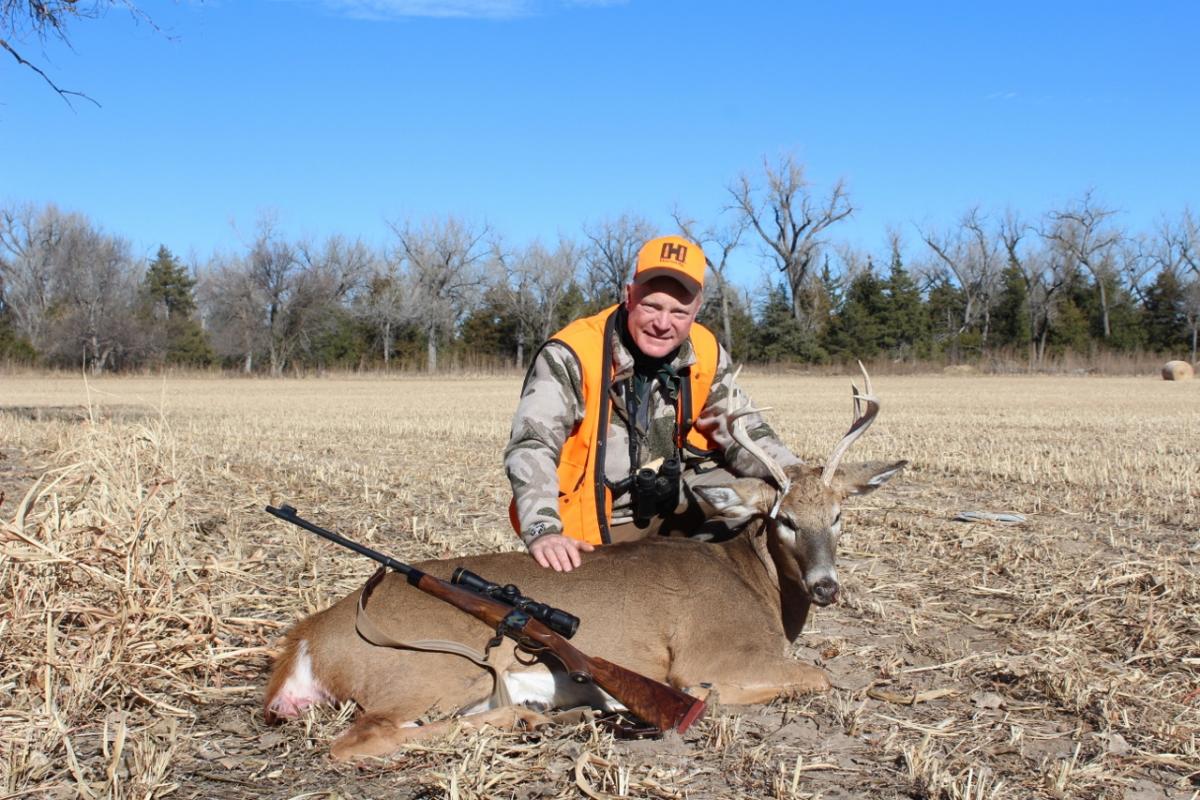
Far sillier, I’d taken these gambles on a three-day hunt. Madness! On the last morning I crawled into a tripod on the edge of that CRP. Just at dawn I watched a buck swagger up a mowed strip toward me. Well, I was also watching my watch. It said we were about three minutes into legal shooting when he was as close and as clear as he was going to get, and I shot him. It’s not fair to say there was ground shrinkage. It’s more honest to say that I never studied the antlers or counted points. I knew he had antlers, and he had the body shape of a mature buck. That was enough.
2016-nebrasa

I shot this Nebraska buck on my last morning…but on the first day I passed a half-dozen larger bucks.

A few days later another of my editors, Scott Rupp, told me he was headed back to his native Pennsylvania to hunt with a Savage 99 in .300 Savage with aperture sight. I commented that, for some of us, using the rifle is more important than the deer we take. That was surely me on that Nebraska hunt; I was itching to take a deer with a gorgeous Dakota M10 in .275 Rigby (aka 7×57). And, on the last morning, I did.

So, exactly, why did I pass better bucks than I expected to see in the first place? Part of it was lack of familiarity with the area. We don’t have much CRP in my part of Kansas. I didn’t know that, on a windy day, it creates a protected shelter that whitetails gravitate to, and on calm days they’re more likely to be somewhere else. Most of it, however, was pure folly, if not stupidity. You can’t stockpile whitetails, meaning pass a buck now and expect to see him again. Actually, this applies to most big-game animals throughout the world, so it’s a general lesson with a specific example.

You want honesty again? I hate taking an animal early in a hunt. That makes it hard to build a story, and it’s worse with the TV camera rolling. You have to film backwards, really awkward. But that’s business, and hunting is reality. My reality: I’ve taken a lot of nice whitetails, but I admire really big eight-pointers. On that first morning in Nebraska I passed two dandies. Folly, foolishness, stupidity! Ten days later, when the Kansas rifle season opened, I took my own advice and shot a big 8-pointer on opening morning. Two of our hunters took my advice as well, filling their tags with good, solid bucks. Maybe we’d have seen bigger deer if we’d passed, and maybe not. With our tags filled, we’ll never know. So if you take the first animal you see, make sure you’re happy with it!

My longtime personal credo is that, when Mother Nature offers a gift, one shouldn’t kick sand in her face. The last day of a hunt is as good as the first, so one must keep trying, but let’s not ignore the corollary, that the first day is as good as the last. Obviously it depends heavily on your personal goals, which are yours to set. It’s okay to go for greatness–the long ball, or nothing. Note: the higher your self-imposed standards, the most likely you are to go home empty-handed! It’s also okay to set “minimum standards.” But what if you encounter that minimum standard on the first day? In some circumstances it is okay to look around for a bit, but never expect that an acceptable and satisfactory animal encountered will ever be seen again!

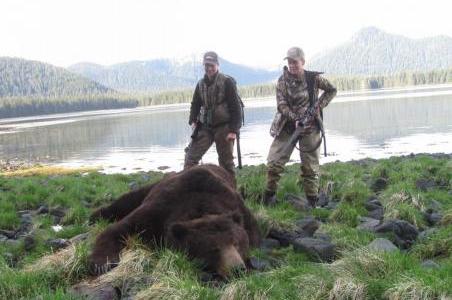
I’ve played this game so many times. I love the hunt itself, so aside from business concerns (building a story, building a TV show) I am reluctant to shoot early in a hunt, but I also recognize the risks in passing. Clear back in 1981 I took a monstrous Alaskan brown bear on the first hunting day. We spotted him at distance, and my guide, Slim Gale, started stripping his pack. I said something stupid like, “Hey, it’s the first day, there’s no hurry.”

Slim said, “Good Gawd, man, what’s wrong with you, that’s a ten-foot bear.”

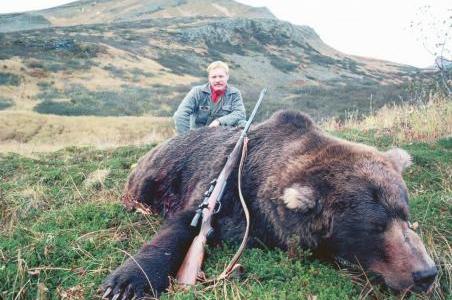
Totally bemused, I went along with the deal, and Slim was wrong. It wasn’t a ten-foot bear; it was an eleven-foot bear, probably my best North American animal–and I had wanted to pass!
large_1981-ak-brown-bear

This huge Alaskan brown bear was taken on my first hunting day back in 1981. Since it was the first day I tried to pass the bear; fortunately my guide insisted, and obviously he was correct!

More than twenty years later we were looking for a brown bear for Donna. It was the first day, and we were passing the southern tip of Admiralty Island, enroute to another spot, when guide Alisha Decker spotted a bear at incredible range. More incredible, she knew it was a big bear. This time I didn’t argue, but I was intrigued. As we worked toward shore she was sharpening her skinning knives, so I asked her, “You’re serious, aren’t you?” She grinned and whispered, making sure Donna couldn’t hear above the spray, “Oh, yes, that’s a ten-foot bear. We’re going to get him if we can.”

The latter was certain: This young lady (and Alaskan Master Guide) was determined. We beached gently, wind good, and I took on the role of boat handler while Alisha and Donna made the stalk and shot the bear. This was a very expensive hunt and initally we weren’t happy about a first-day bear . . . somehow it seemed wrong (as, I suppose, mine had been so many years earlier). However, Donna’s bear was exactly ten feet, as called; the biggest bear of that season and, realistically, a bigger bear than Admiralty Island should produce. And it was taken on the first day, which is as good as the last day.
large_img_0029-1280x960_1

Guide Alisha Decker and Donna Boddington approach Donna’s bear. Donna was very reluctant to shoot on the first day and she’s just starting to realize how big this bear is. Unusually large for the area, passing it would have been a mistake…on any day!

Leave a Comment

Range Days

How to make sure you and your rifle are ready for hunting season.

The “exams” that the fall seasons bring us can’t really be crammed for, so I hope you’ve whiled away some of the summer doldrums at the shooting range. If you haven’t, you’re coming up on your last chance to make sure both you and your equipment are ready for whatever challenges lie ahead.

This really is a two-part evolution: You and your rifle. Getting rifles ready is a series of mechanical processes that have almost nothing to do with field shooting, while getting you ready is a matter of practice. The latter is much more time-consuming and should be ongoing–but let’s first talk about rifle readiness, and then we’ll come back to practicing for hunting season.

Since part of what I do is write about guns my range time is (literally) precious, but that’s not necessarily a good thing because I usually wind up hauling a half-dozen rifles to the range. Sometimes I get to all of them and sometimes I don’t, but there’s always a priority: The shooting I absolutely must get done, and the shooting I’d like to get done. Most of you probably don’t have that problem, and I don’t recommend it; you’re better off concentrating your efforts on one or two centerfire rifles…and maybe bring a .22 and plenty of ammo so you can do some plinking while your barrels are cooling.

large_range-gear

Some range sessions are more complicated than others, but make sure you bring everything you could possibly need, including wrenches and tools…and just maybe, if this is your last chance before a hunt, a backup plan in case something goes wrong.

Some of us may be fortunate enough to step out the back door and sit down at a shooting bench, but for most of us range time requires traveling some distance. So, the first thing is to make certain you have absolutely everything you need. Correct rifles and ammunition are obvious, but it’s worth double-checking. Yeah, you bet, I’ve gotten out to the range and discovered that I’ve forgotten one or another type of ammo. Of course you need eye and ear protection, targets, staples and staple gun, spotting scope and tripod, shooting rest, maybe a PAST recoil shield—or at least a towel you can fold over your shoulder. It’s okay to be a complete wimp while shooting from a benchrest, because this is all about the rifle and has little to do with you. What about a chronograph? If you’re serious about shooting at longer ranges the first step to understanding your trajectory is to know the actual velocity of your load in your rifle, so a chronograph becomes an essential tool.

Less obvious: Troubleshooting gear! Do you have all the screwdrivers and properly fitting Allen wrenches so you can check scope mount and ring screws and action screws? If you’re messing with a new rifle or one of our increasingly complex scopes with built-in range compensation, did you bring the instructions? What if a scope mount breaks or a scope goes out? Lately I’ve had a rash of scope mounts breaking at the range. Such events can’t be anticipated and it isn’t always practical to consciously bring spares. But for those times when you simply must get a certain rifle ready for an impending hunt, figure that Murphy’s Law applies. Try to think through what could go wrong, and have a solution on hand…and the tools to implement that solution.

Last, bring cleaning gear. I’m big on gun cleaning at the range. It can be done while waiting for a barrel to cool, and of course cleaning expedites cooling. Also, doing it on the range is less messy than in the garage! But maybe you’re one of those super-organized folks who, as a ritual, clean your guns at home before you put them away. Fine, but let’s suppose it takes a few more rounds than you expected to achieve a perfect zero, and you also want to do a bit of practice shooting with that rifle. We all have our own protocols about how often to clean a rifle barrel…but no two barrels are alike in the state of cleanliness at which they shoot their best.

Depending on rifle and cartridge I like to clean after somewhere between fifteen and twenty-five rounds. It’s easy to go past either number while comparing loads for accuracy. If you’re handicapped by a fouled barrel you really can’t know what you’re dealing with. So I clean periodically at the range. If the rifle is going on a hunt soon I clean the barrel at the end of the range session…and then I fire a couple of fouling shots and check zero one last time. Yeah, the purists are howling: That means I’m putting away a dirty rifle. Yep, sure am, but it’s ready to go hunting, and by my own cleaning protocol I’ve still got at least a dozen rounds to go before I have to clean. That will get me through most big game hunts anywhere in the world. Of course, if the rifle is going on a prairie dog hunt there might be a cleaning break every hour or so.

large_cleaning-on-range

I’m big on cleaning at the range, with my protocol to clean after an average of about twenty shots. If the rifle is going on a hunt soon I clean after I’m done shooting, then I fire fouling shots and check zero one last time.

A major issue in our modern world is time. No one has enough of it, but range time simply cannot be rushed. Whether zeroing or checking loads for accuracy, there is no learning curve if you let your barrel(s) get hot. This is perhaps one area where my job-related system of taking multiple rifles to the range pays off. I put up multiple targets, and I can shoot groups sequentially, letting one barrel cool while I’m shooting something else.

Realistically, combining fast cartridges, pencil-thin sporter barrels, and blistering hot summer days, you may get only three meaningful shots and then you have to wait ten or fifteen minutes before you can resume. How hot is too hot is subjective. Some barrels continue to shoot well when quite warm, but I’ve seen ultra-lightweight sporters that are only good for two-shot groups, with the third shot already starting to walk out of the group. Generally speaking, however, uncomfortably hot to the touch is the limit. One important point: If you have rifles chambered to different cartridges with you on the range, be very careful to keep only ammunition for the rifle you are shooting on the bench! You’d be surprised at how many mismatches can be chambered…and may actually fire, obviously with potentially disastrous results.

The benchrest is all about the rifle, checking accuracy and establishing the perfect zero you want. Depending on what hunting you’re planning (and also on the cartridge), some of us establish zero for a specific distance, whether one, two, or possibly three hundred yards. Others follow Jack O’Connor’s rule, sighting perhaps two to as much as three inches high at one hundred yards. That’s up to you, and perhaps worthy of separate discussion, but the benchrest is for establishing that perfect zero and learning the degree of your rifle’s accuracy. The bench has very little to do with field shooting and in fact, properly done, the goal to benchrest technique is to remove the human element as much as possible.

large_bench-with-lead-sled

Accuracy off the bench is about being steady and comfortable. I often use a Caldwell Lead Sled to attenuate recoil, and if using sandbags I pad my shoulder with a PAST recoil shield.

Shooting off the bench has diddly to do with field marksmanship, so shooting groups from a solid benchrest, although invaluable for load selection and confidence, must not be considered “practice for field shooting.” Don’t be lazy! While you’re at the range, get away from the bench and do some genuine practicing from potential field positions. Because we use them a lot in the field we always do some shooting off sticks, and although I don’t practice them all during every range session, I make a point to frequently shoot prone, sitting, kneeling, and offhand. You can also get creative, using packs and whatnot to replicate field shooting positions.

Some of this “position practice” should be done with your hunting rifle, using the load you intend to hunt with. That’s a good time to run through full magazines, not only practicing working the action from shooting positions, but also ensuring reliable feeding. However, sparing your shoulder and your wallet, effective position practice can be done with a .22 rimfire. In a perfect world a .22 with similar action and sighting equipment to your big-game rifle is the ultimate training tool, but shooting is shooting and all shooting is good. Just don’t confuse shooting for accuracy off the bench with effective practice for field marksmanship.

large_sticks-with-22

A good old .22 rimfire, painless and inexpensive to shoot, is an invaluable tool for “position practice” at the range. Donna and I always bring sticks and a .22 to the range, and we intersperse centerfire shooting with a few magazines of .22 Long Rifle.

Leave a Comment

Staying Safe

All travel has its risks, so do your best to be prepared for them.

Hunting is supposed to be fun, and it’s also, statistically, more injury-free than a lot of other hobbies and sports. There are, however, irrefutable principles to keep in mind. First is Murphy’s Law, “whatever can go wrong will,” and then there’s the corollary to Murphy’s Law: When something does go wrong it’s most like to happen at the worst possible time. There’s also the simple reality that, despite the very best preparations and precautions, bad things can and occasionally do happen to good people. I’m not a gloom and doom guy, and I don’t spend a lot of time brooding over stuff that might happen, but it’s always wise to keep the famous Boy Scout motto in mind: Be prepared!

While we tend to focus on catastrophic events such as getting bitten by a snake or a lion, the reality is that genuinely serious accidents are rare. Also, just like going to the grocery store at the corner, less glamorous events like vehicle accidents are more likely anywhere. As are ailments such as tummy issues from unfamiliar food. We’ll deal with more serious events in a bit, but minor cuts and scratches and inconvenient but non-life-threatening ailments are going to come along now and again.

Most outfitters have well-stocked medical kits for real emergencies, so it shouldn’t be necessary to take a heavy medical kit on outfitted hunts. Do-it-yourself expeditions are obviously different, but across the board it’s always a good idea to pack a personal first-aid kit against the little stuff. Most of the contents should be obvious: Band-Aids of various sizes; antiseptic wipes, and for sure antibiotic ointment. It depends on where you’re going, but it’s amazing how quickly even the smallest scratches can get infected in tropical climates. Obviously you must talk to your doctor about medications, but analgesics, a general antibiotic, and an anti-diarrheal such as Imodium can come in handy. If you’re lazy like me, African Sporting Creations is a good source for ready-to-go first aid kits.

large_elephant-charge-zim-1280x851

As hunters we probably focus too much on incidents with dangerous animals. They do occur, but more mundane incidents such as vehicle accidents and unexpected illness are far more common.

The silliest thing I ever did was once in Namibia. Looking at the ground for tracks when I should have been looking up, I caught a thorn in my lower eyelid. Facial cuts always bleed profusely, but I must have hit an artery because I couldn’t get it stopped. Yep, we Super-Glued it, worked like a charm!

So, let’s get on to the really bad stuff we all worry about. Fortunately, catastrophic incidents are rare. They can’t necessarily be avoided, but the best way I know to mitigate them is to carry a medical evacuation membership. Today I have Global Rescue, so I carry a Global Rescue card. But here’s the thing: It’s important to understand how the card should be used. No matter the company, if you have a head cold or get mad at your outfitter, you are not eligible for evacuation. There are exceptions, but typically if you have a problem, you get to a local care facility, and that’s when your medical evac folks get into gear. However, some providers offer field rescue service that will actually deploy help right to your location in the field if warranted.

Maybe they bring you home or maybe to a care facility in South Africa or Europe and then, when things are a bit better, they bring you home. But here’s the big thing: How do they know what action to recommend unless you contact them? So this a three-part deal: First, you have your membership card. Second, you have communications (like a sat phone). Third, you have the common sense and will to use them.

This last is where I personally failed. I like to say that I had my heart attack on a mountain in Uganda, but actually it was a wimpy little ridge. On a very hot morning we tracked a buffalo to the top, and I was oddly out of breath. Eventually we shot the bull, and I was doing high-fives with the game scout when the world started to spin and I went out cold. They fanned me and poured water on me, and after a bit I crawled to the buffalo and we did photos and TV.

Here’s where the stupid part starts. I didn’t know what was wrong, but I had the tools in my daypack: My medevac card and a satellite phone. I should have called immediately, and perhaps a real doctor could have made a proper diagnosis and got me on the road to help. Instead, tougher than common sense dictates, I waved it off. I didn’t make the call. The International Hospital in Kampala missed it, giving me a bag of antibiotics for a pulmonary infection. The commercial flight home was horrible. By the time I landed I couldn’t breathe, and Donna took one look at me and said, “You’ve had a heart attack.” It took the folks at French Hospital ninety seconds to confirm that diagnosis. Privately, they told Donna I wouldn’t have lived through the night. I lived, but the drama was unnecessary. I had the card, and I had the sat phone. A consultation could not have averted the incident, but would have gotten me to proper care sooner, and home in much better shape.

Three things: Medical evacuation membership; well-charged satellite phone, maybe with an extra battery; and the common sense to use them. You don’t need to own a sat phone; you can rent one. My go-to is Explorer Satellites; they rent phones (with minutes) for reasonable rates, and they can recommend the correct system for your destination. Iridium has long been the standard, but Inmarsat is better in the Southern Hemisphere (i.e. southern Africa, Australia, South America). Few of us need multiple systems, so it’s probably better to rent and let experts guide you.

large_p1030094-1280x960

Part of the deal with all reputable medical evacuation providers is round-the-clock consultation with a doctor. This is smart business because evacuation may not be required, but if it is the wheels can be set into motion via satellite phone.

I didn’t expect to have a heart attack. Nor did Angie Heister, walking down a trail in Zimbabwe, accompanying her husband on safari, expect to be flattened and gored by a Cape buffalo. The difference: They not only had their medical evacuation cards, they had enough sense to use them. The outfitter’s preparedness got her to Victoria Falls by helicopter, but with her lungs collapsed, a huge wound in her thigh, and serious spinal injuries. Weeks passed before she could be moved back to the United States. Just remember that Mr. Murphy awaits the unwary and unprepared, and that bad things, however unlikely, can happen to good people.

Lastly, let’s also remember that bad things happen to good trips planned by good people. Hey, traveling is what I do as a major part of my business. I take my chances. There are, however, uncertainties in many part of the world, so in recent years, personally and when giving seminars, I have advised folks to take out “travel insurance,” but I’ve rarely followed my own advice.

Recently, much to my chagrin, I learned that “travel insurance” is not the right term for what is needed. In April 2016 I was headed to Armenia, an out-of-the-way Asian destination. In previous years I’d been burned on plane tickets to Iran, only to find I could not get a visa. So, this time, Donna bought travel insurance from Allianz Global Assistance, recommended by the airline. Three days before the hunt, Armenia and neighboring Azerbaijan started a little border war. Figuring it was sort of like a shrew attacking a mouse, I was all for ignoring it until they told me that the reserve we were headed to was under artillery fire, and we would be hunting within observation of enemy snipers. Carrying a rifle? Not a good idea! So the cancellation was unavoidable, but I was content that the non-refundable plane tickets were covered.

Turns out, when I read the fine print, they were not covered. Travel insurance might cover you in case of traditional issues such as death in the family or medical emergency, and these things can happen to hunters, but we also deal with destinations where other serious stuff happens. Last week two buddies of mine were headed to the Central African Republic. The day before departure their outfitter was attacked by supposed rebels. He and his client managed to escape, with their vehicle shot up and tires shot out, but no injuries.

I recommended the hunt, but also knowing C.A.R. has been dicey for years, I recommended the hunters get travel insurance. Wrong words! What you need, instead, is “travel cancellation insurance,” and make sure it’s good. Global Rescue, for example, offers “CFAR” (Cancel For Any Reason) coverage. That’s the type of insurance I should have had, and that’s what my C.A.R.-bound buddies needed.

Always read the fine print and ask specific questions. There is a story of a guy in Zimbabwe who, while standing on the edge of a draw waiting to hear the death bellow of a buffalo, somehow managed to shoot half his foot off with a large-caliber double rifle.

Horrible, but it got worse. He had a temporary membership to a medical evacuation service. He had called the company to activate the membership; he gave them his departure, and they gave him a start date. But when he needed help badly, coverage was denied because his membership was required to start twenty-four hours before departure. The fact that their office gave him the start date didn’t matter; they refused evacuation. Obviously Mr. Murphy was right there beside this unfortunate gentleman, and it was clearly not his fault because he was misled, but it’s important to always read the fine print. It’s a small but critical issue in the art of being prepared.

large_dsc_2408-1280x853

Helicopters save countless lives because of their speed and agility. Regrettably they aren’t available everywhere we crazy hunters go, but in a real time-sensitive emergency a chopper is the usually the best option to get to help.

Leave a Comment

Tough to Beat

The .300 Winchester Magnum is versatile, effective, and widely available.

The 7mm Remington Magnum was introduced in 1962, the .300 Winchester Magnum a year later, in 1963. Remington’s Big Seven took off like a rocket, and for many years was the world’s most popular cartridge to wear the “magnum” suffix. The .300 Winchester Magnum was slower to catch on. There were reasons for this. Cartridge design theory has it that a cartridge case needs a “full caliber neck” to properly grip the bullet. This means a .30-caliber cartridge should have a neck of at least .308-inch. In order to cram as much powder space as possible into a case that would fit into a .30-06-length action, Winchester’s engineers gave it a 2.620-inch case, longer than the 2.494-inch case of the .30-06, but with a short neck of just .264-inch.

Purists suggested that dog would never hunt, but there was more. The .300 Winchester Magnum was designed to replace the long-beloved .300 H&H, then the world-standard fast .30-caliber. Just a year later the even more beloved pre-1964 Model 70 was replaced by the post-1964 Model 70, and Winchester’s new .300 was stranded in an unpopular platform.

large_300-lineup-2_0

Left to right, .300 H&H, .300 Winchester Magnum, .300 Weatherby Magnum, .300 Remington Ultra Magnum. These four are the fast .30s Boddington has the most experience with. All have their attributes, but the .300 Winchester Magnum is the most popular and most available, and today the velocity gap has narrowed between it and the longer-cased, faster cartridges.

I like the 7mm Remington Magnum, and I’ve taken a lot of game with it over the years; it’s effective, accurate, and has little recoil. However, at heart I’m a fast .30 guy. I had a .300 Winchester Magnum back in the 1970s, a great piece of walnut surrounding a Mark X Mauser action. I never hunted with that rifle before it was lost in a burglary. In the rebuild I got a left-handed Weatherby Mark V in .300 Weatherby Magnum, and I’ve been a fan of Weatherby’s .300 ever since.

Mind you, I’ve dabbled with most of the fast .30s. In the early and mid-2000s I spent a lot of time with the .300 Remington Ultra Mag, a great cartridge. I’m a recent fan of the .300 H&H; with handloads it’s amazing what this old cartridge will do, and that long, tapered case feeds like a dream. In 2010 I took a Blaser R8 in .300 Blaser Magnum to Nepal. It was impressive, but when it became apparent that the Blaser unbelted magnums weren’t going to be marketed in America, I traded that barrel for, you guessed it, a .300 Weatherby Magnum barrel.

In 1989 and again in 2007, for my Safari Rifles and Safari Rifles II books, I did surveys of all the African professional hunters I could reach, both times receiving more than a hundred responses. Certain differences in these surveys were interesting. In 1989, under the heading of “recommendations for medium plains game” the .30-06 was the favorite (thirty-three mentions), followed by the 7mm Remington Magnum (twenty-five) and the .300 H&H (twenty-two). The .300 Winchester Magnum was barely there with just five mentions. Fast-forward eighteen years. In 2007 the 7mm Remington Magnum nearly dropped off the survey, as did the .300 H&H. The .30-06 remained strong, but in appropriate game categories the .300 Winchester Magnum came in right behind the .30-06.

Although I’ve never been a fan, the .300 Winchester Magnum has been an inescapable cartridge. As a gunwriter I’ve used it in many rifles, and I’ve hunted with it quite a bit. Despite the short neck, as we’ve all learned, it’s a very accurate and efficient cartridge. During the Gulf Wars it’s gotten a tremendous boost. Many of our Special Operations units now use it because it’s accurate, has a lot more reach than the 7.62x51mm NATO round, and can be built into a lighter platform that doesn’t kick near as much as a .338 Lapua.

From what manufacturers tell me, this is just a small microcosm of what has happened. The 7mm Remington Magnum remains popular, but its demand is not what it once was. At the same time, the .300 Winchester Magnum has surged ahead, and is now the world’s most popular “magnum cartridge.”

large_groups-lawandjarrett

When this photo was taken the barrel on the Jarrett .300 Winchester Magnum (bottom) was brand new. Accuracy with the production LAW Model 704 was very similar, and both, depending on the load, were plenty good enough for any hunting purpose. Today, after break-in, the Jarrett has a slight edge, but both are superbly accurate rifles.

So why this turnaround? Well, in part the 7mm market has been diluted. The 7mm Weatherby Magnum goes back to the 1940s, but now we have the 7mm STW and 7mm RUM, and the 7mm WSM and 7mm RSAUM do everything the 7mm Remington Magnum will do, but in short actions. But that’s not really a valid argument, because there have long been faster .30s, and now we have the .300 RUM, .30-.378 Weatherby Magnum, and a slew of faster wildcats and proprietaries.

I think, instead, the truth is finally out, and 7mm fans aren’t gonna like it. The 7mm offers a lower-recoil alternative to the .30, and this is valuable. Its heavy-for-caliber bullets are efficient and effective. But a 7mm will not do what a .30-caliber will do. Although the 7mm is awesome on the deer/sheep/goat-caribou classes of game, all of my life both western guides and African PHs have admitted that 7mms have wounded a lot of elk and large plains game. On the other hand, there isn’t much you can’t do with a 180-grain .30-caliber, and a bit more that you can do with a 200-grain .30 caliber. So I think the 7mm Remington Magnum and .300 Winchester Magnum, the world’s two most popular magnums, have flip-flopped positions based primarily on the greater versatility of the .30-caliber.

Still, the .300 Winchester Magnum is a cartridge I’ve been slow to accept. As I said, I’m a .300 Weatherby guy, although I readily concede that the unbelted .300 RUM has more case capacity and, from a case design standpoint, has more accuracy potential. Honestly, I probably wouldn’t have recognized the true (and current) worth of the .300 Winchester Magnum if it hadn’t been forced on me. My friends at the new Legendary Arms Works (LAW) came on board as a sponsor of our The Boddington Experience TV series. For filming I needed a rifle with maximum versatility, and to me that’s always a fast .30-caliber. They weren’t yet chambering for .300 Weatherby or RUM so I got the next-best thing, a .300 Winchester Magnum. I’ve used it to film most of our episodes for the last two years.

large_kudu-jarrett

A fine Eastern Cape greater kudu taken at 300 yards with the Jarrett .300 Win. Mag. No matter where you are, there are few things you can’t do with a fast .30-caliber and a good bullet.

In the same period, a couple of years ago, South Carolina riflemaking legend Kenny Jarrett convinced me that I had to have a rifle on his new receiver (which he was making in left-hand action). Of course he preferred that I get his proprietary .300 Jarrett. That’s an awesome cartridge, but non-standard cartridges complicate my life. So I pushed my default button and asked him to build me a .300 Weatherby Magnum. It was at a show, and we old shooters are all a bit deaf, so I guess he didn’t hear me. When, in due time, the rifle arrived I was horrified to see that it was a .300 Winchester Magnum.

Now, two years down the road, I’m thinking I might have been wrong all along. Accuracy is more about good barrels and good ammo than cartridge design, so we can theorize that the .300 RUM or Jarrett or WSM might be the most accurate fast .30, but well-built rifles make you question that. Over the years I’ve seen a lot of .300 Winchester Magnums that were stunningly accurate, and both of these are. You’d expect the Jarrett to be but, initially, the LAW .300 edged it out. Now that the Jarrett barrel is broken in it groups a bit better. Both rifles shoot under one MOA with almost anything, and both group well under a half-inch with loads they like.

Although it may not be as personal a statement as an oddball cartridge, there’s nothing wrong with choosing a popular cartridge. Honestly, I no longer have time to handload like I once did. Everybody loads for the .300 Winchester Magnum, so there’s a rich load selection. Both rifles really like Hornady’s 180-grain SST, but I just got in some Black Hills Gold with 180-grain AccuBond; on a too-windy day the first group out of the Jarrett was just over a half-inch. Looking good!

We can certainly say that a full-length fast .30 with a 2.85-inch case holds more powder than a 2.62-inch case, so has the potential to be faster. However, I’ve long known that my .300 Weatherby Magnums and RUMs needed a 26-inch barrel to strut their stuff.

As a primarily Western hunter I’m not bothered by long barrels but, realistically, if you aren’t getting a lot of goody out of the extra length there’s no real reason to carry it around. Not being a .300 Winchester Magnum guy, there’s something I’ve missed. The popularity of the cartridge has led to a lot of load development, and with newer propellants the velocity gap has narrowed.

In Weatherby’s ammo (loaded by Norma) the .300 Weatherby Magnum is now rated at 3,250 fps with a 180-grain bullet; the .300 RUM the same. Other loads for the .300 Weatherby Magnum are a bit slower, down in the 3,100s. The .300 Winchester Magnum has traditionally been rated at 2,960 for standard loads with a 180-grain bullet. There’s no real magic in getting a 180-grain bullet to 3,000 fps, but it sounds better, doesn’t it? That standard Black Hills Gold load I just shot delivered 3,015 fps over the chronograph. Hornady’s Superformance load with 180-grain SST is rated at 3,130 fps…but in both of these rifles (with 24-inch barrels) it actually delivers about 3,180 fps, which is knee-deep into .300 Weatherby Magnum territory.

large_chrono-superformance180

Cartridge popularity means load development, and with newer propellants .300 Winchester Magnum velocities have been increasing. Rifles vary in velocity, but in Boddington’s rifles Hornady’s 200-grain ELD-X clocks well over 2900 fps; Black Hills Gold’s 180-grain AccuBond load exceeds 3000 fps; and Hornady’s fast Superformance 180-grain SST load is nearly 3180 fps, well into .300 Weatherby Magnum territory. Obviously factory loads will vary in accuracy, but with the .300 Winchester Magnum, there’s a wide choice.

Of course, at some point velocity is just a number; way out there, aerodynamics and bullet performance are more important. Hornady’s new Precision Hunter load with its 200-grain ELD-X bullet is thus very interesting. Construction aside, bullet weight covers a lot of sins, so for elk and African plains game I’ve often hedged my bets with 200-grain .30-caliber bullets. That Precision Hunter load is rated at 2,850 fps, on the fast side for a 200-grain bullet in the .300 Winchester Magnum. Except that’s another conservative rating: In my rifles actual velocity averages about 2,920 fps. I took the .300 Winchester Magnum to South Africa last year, where I could mess with some different loads at different ranges. I’m going to do it again this year. Mind you, I have not yet fully converted from my beloved .300 Weatherby Magnum—we go back too far—but these days, when you combine versatility, efficiency, and effect on game with availability, I have to admit it: The .300 Winchester Magnum is pretty hard to beat!

Leave a Comment

tablet

Never Miss An Issue!Subscribe Now: 6 Issues for $34.97

More Details
WordPress Video Lightbox Plugin