Sports A Field

A Scope for All Seasons

Leica’s Amplus 6 3-18x44i is a robust scope with a sleek look and high-end features that belie its affordable price point.

When you have the opportunity to use high-end scopes and binoculars, as I’m often fortunate to do, you get spoiled—fast. There’s nothing like the razor-sharp views and light-gathering capabilities of premium optics. The problem, of course, is the sticker shock. Premium comes at a price—and while such optics are unquestionably worth what they cost, owning a scope that costs well north of $2,000 is not doable for everyone. So I was intrigued a few years ago when Leica—one of the top makers of high-end European optics—came out with a scope called the Amplus 6, which it touts as an “attractive entry into the premium class.”

The version I tested during two whitetail hunts last fall was the 3-18x44i model with the L4w BDC MOA reticle. This scope has a list price of $1,499, but a quick internet search finds it retailing for $1,199 at EuroOptic.com. Despite the price point, the Amplus 6 incorporates Leica’s proven optics technology, including top-quality lenses with 90 percent light transmission, state-of-the-art coatings, and a shock-resistant aluminum housing.

Despite its billing as a no-frills optic, the Amplus 6 is a sleek scope with the same high-end look and feel of other Leica scopes I’ve used. With a 30mm main tube, this model weighs 23 ounces—not ultra-lightweight by any means, but certainly trim enough to ride well on most hunting rifles. The glass is incredibly clear and the L4w reticle is sharp and uncluttered, with elevation and wind hold markings in MOA. It sits in the second focal plane so it stays the same size regardless of magnification. Cross hair thickness is 0.8 cm. In a word, it’s precise. The reticle also features an extra-fine (0.6 cm) illuminated dot with ten manually adjustable levels of brightness. The dot is small enough that it won’t obscure even a distant target and has no annoying glare.

I mounted this scope on a Ruger American Gen II rifle and took it to the range, and one of the first things I noticed was its exceptionally wide field of view at the lower powers. When I turned the magnification down to 3x and studied my target, I had an unusually broad view downrange. The other thing I appreciated was the generous eye relief—a big plus for a hunter who may need to take a shot from an odd angle in the field.

The 6 in Amplus 6 obviously stands for 6x zoom. The 3-18x magnification range is perfect for a wide range of hunting styles. While I kept it set on 6x during my Pennsylvania deer hunt, I cranked it up to 12x when I found myself in a tree stand in Missouri where I could see out to 400 yards—and I was glad to know there was more magnification available if I needed it. The 44mm objective lens allows for a large exit pupil while keeping the scope from being overly bulky.

This is a “no frills” scope only if you don’t consider an elevation turret, adjustable parallax, and illuminated dot to be “frills”—which I guess, these days, they aren’t. 

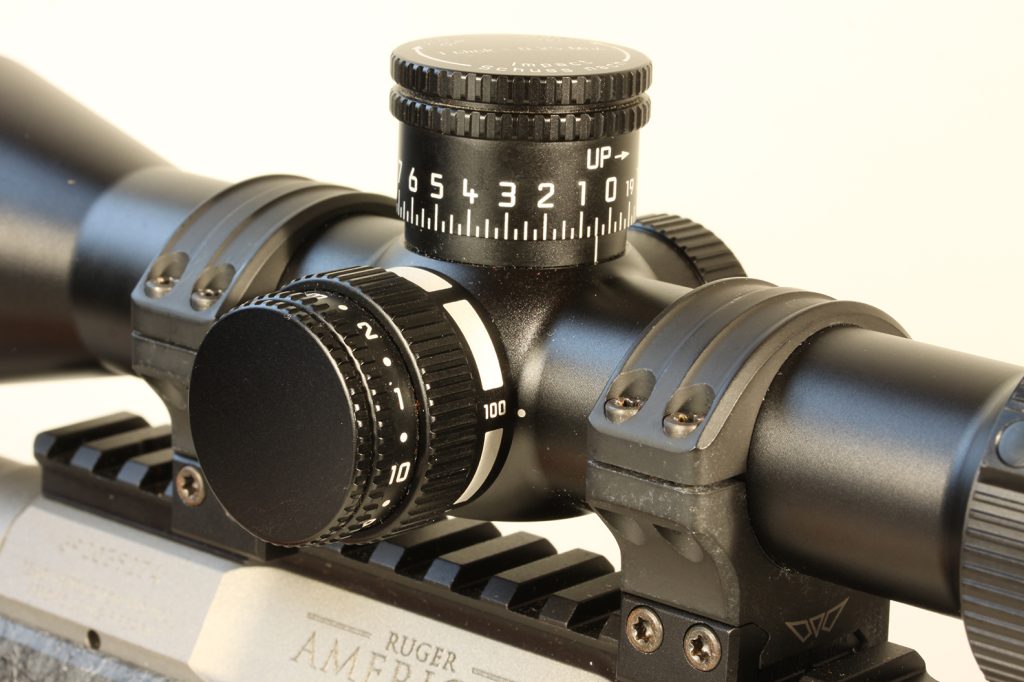
Leica’s BDC system lets you adjust the reticle so you can quickly dial to various shooting distances. The elevation turret features very solid, audible one-quarter-MOA clicks and large, easy-to-read numbers, and it tracks with great accuracy.

The elevation turret features solid one-quarter-MOA clicks and easy-to-read numbers. On the left-hand side of the scope the parallax adjustment ring sits next to the light-level settings for the illuminated reticle dot.

The turret also has a mechanical zero stop. After a quick online search, I found a YouTube video explaining how to set it up. It’s easy. There are two knurled rings on the elevation turret. After sighting in, hold the bottom one while unscrewing the top one. Once you remove the top cap, pull straight up to expose the interior of the turret. Loosen three screws with the included Allen wrench and turn the turret clockwise until the zero stop engages. Tighten the screws, replace the turret and cap, and you’re done. It’s one of the easiest-to-adjust turrets I’ve used.

On the left side of the scope is a parallax adjustment ring with a range of twenty yards to infinity. On the same left-side turret there are ten light-level settings for the illuminated reticle dot that alternate on and off. The windage adjustment is a capped turret you can turn by hand and has the same one-quarter-MOA adjustments the elevation turret does.

There’s no doubt this scope is robust. It took a few knocks during my fall hunts, including a couple of times when I was raising and lowering the rifle on a rope from my tree stand and I cringed as it banged a little too hard against the ladder. But my zero never budged.

Leica offers an impressive transferable warranty on optics sold in the USA and Canada. Their 30-year manufacturer’s warranty guarantees against defects in the optical system and their 10-year Passport Protection Plan promises to repair or replace your scope if it is damaged or becomes defective. 

With excellent light transmission, wide field of view, precise tracking, tough construction, and that fantastic warranty, there’s no doubt the Amplus 6 is a true premium scope—without the premium price.—Diana Rupp

Leave a Comment

A Big Win for Wildlife

The defeat of Proposition 127 in Colorado is a blueprint for saving science-based wildlife management throughout North America.

Photo above by VictorSchendelPhotography.com

This past November, the North American hunting community celebrated a potentially game-changing victory with the defeat of Proposition 127 in Colorado, a measure that would have permanently banned the hunting of mountain lions and bobcats statewide. Despite Colorado’s heavily urban voter base and the backing of a powerful group of anti-hunting activists that outspent the pro-hunting side 2 to 1, the ballot measure not only went down, it failed by a fairly decisive margin of almost 10 percent.

When I first became aware of the issue in fall 2023, I assumed, as many other hunters did, that science-based wildlife management would come out on the losing end of this latest attempt at ballot-box biology, just as it had with Colorado’s voter-mandated wolf reintroduction in 2020. Instead, something very interesting happened. For the first time I can remember, I saw hunters come together in an organized way with a purpose and a plan.

A nucleus of determined people who believe in the benefits of hunting and scientific wildlife management joined forces to counter the emotion-filled falsehoods of the anti-hunters. They united behind an organization called Coloradoans for Responsible Wildlife Management (CRWM), led by the bearded and indefatigable Dan Gates.

Awareness of the issue spread rapidly throughout the Colorado hunting community, and by the time elk season was underway, thousands of volunteer-created “No on 127” signs sprouted along Colorado roadsides, with messages like “Let Scientists, Not Activists, Manage Wildlife.”

There were many facets to the success of the opposition to 127 that other states can learn from when — not if — anti-hunting groups attempt to disrupt their hunts. On a recent episode of the Hunter Conservationist podcast, Charles Whitwam and Mike Costello of HOWL for Wildlife, an organization that has helped beat back recent anti-hunting initiatives in several states, discussed what worked.

They noted that it was important to have focused, consistent messaging. Outreach to urban communities was critical, and this was done through social media, advertising, and, interestingly, face-to-face contact. The campaign actually set up tables in downtown Denver and Boulder and talked to passers-by, with surprisingly positive results.

One of Whitwam’s remarks that stood out to me was this: “This whole war is won through public education.” He explained that the vast majority of people, especially in the cities, know absolutely nothing about hunting. They are not automatically against it; they just know nothing about it. Once they hear from hunters, they start to understand that wildlife is managed under a carefully regulated, science-based system, and that the information they are getting from the other side is not trustworthy.

The bottom line, and what the majority of Colorado voters ended up agreeing on, is that decisions about wildlife management should be made by biologists and state agencies — Colorado Parks & Wildlife, in this case — not by voters.

As hunters celebrate this win, anti-hunting groups are continuing their efforts in Colorado and elsewhere. We now know the hunting community is capable of effective action. So the next time the antis try to come for our hunting licenses, we know we can beat them. We need to be ready.

Leave a Comment

Spartan Javelin Pro Hunt Tac Bipod and Ascent Tripod

Lightweight and rock-steady, these are game-changers for backcountry hunting.

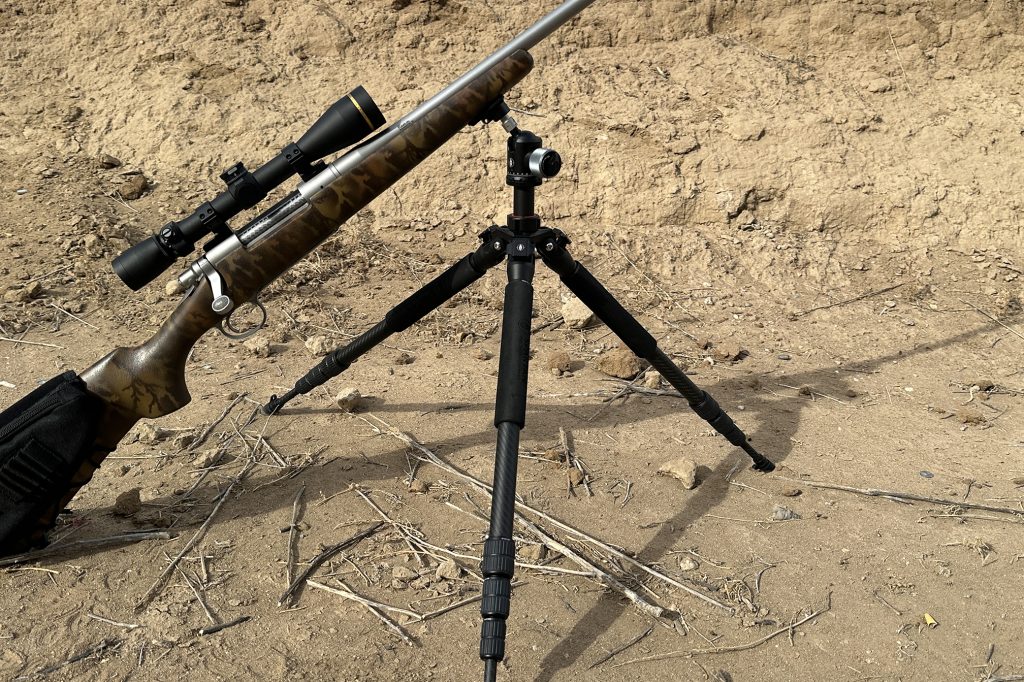
Photo above: The Javelin Pro bipod is lightweight, easily adjustable, and quick to deploy.

For years I was not a big fan of having a bipod on my hunting rifle. Most of the ones I tried were heavy, clunky, and noisy to deploy. And of course, you can only use them when shooting prone, which isn’t always possible depending on the terrain and the game you’re hunting. Instead, I generally rely on using my pack for a rest when shooting prone, and carry some sort of tripod or shooting sticks on which to rest my rifle if I end up shooting from a sitting or kneeling position. But good shooting sticks can also be heavy and unwieldy. So when I first heard about Spartan Precision’s range of lightweight bipods and tripods using a quick-detach system, I was intrigued. 

Designed specifically for backcountry hunters, the system uses rare-earth magnets to quickly and securely mount rifles and optics to a versatile range of ultralight carbon-fiber bipods and tripods. Built for simplicity and low maintenance, the system is easy and quick to use and ideal for any hunt where you are doing a lot of hiking don’t want to carry too much weight, but might need to shoot from a variety of field positions.

The first step is to attach one of Spartan’s adapters to your rifle. Spartan offers a range of adapters compatible with a wide selection of rifles. They call their system MagnaSwitch, and once you have an adapter on your rifle or optic, you can attach any of the compatible accessories since they all use the same attachment system. 

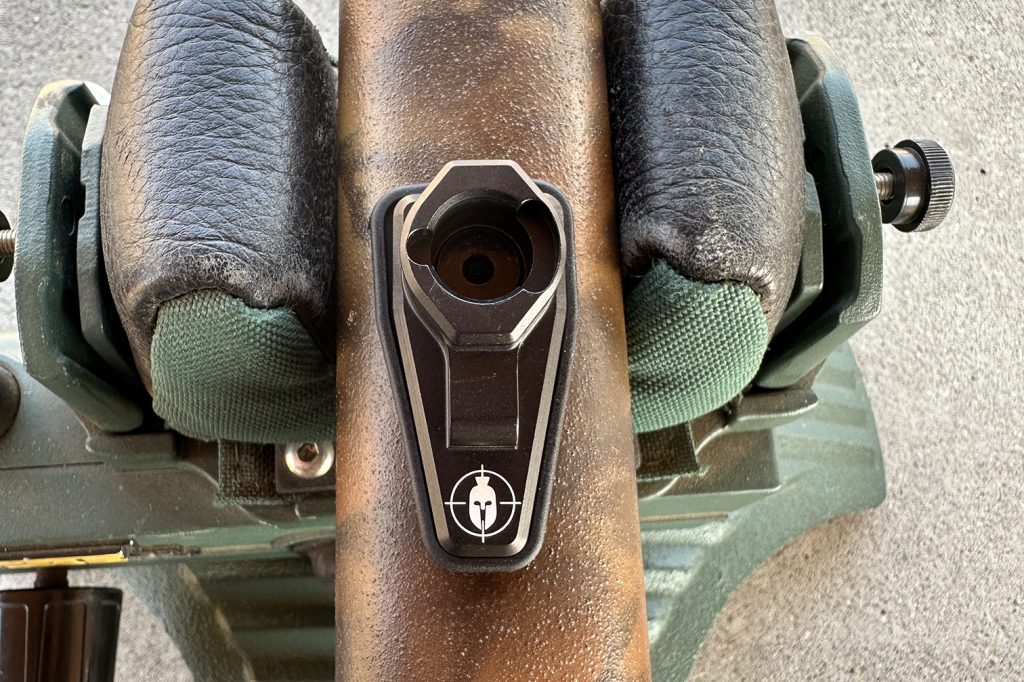
The Classic Rifle Adapter is a no-brainer to install; I put it on a Remington 700 .25-06 in a couple of minutes. Just unscrew the front sling swivel stud from your rifle’s fore-end and replace it with the adapter, which consists of the rare-earth magnet and a sling attachment behind it (so you can still attach your sling). The adapter kit comes with several different screws; pick the one that most closely matches the sling-swivel stud on your rifle, tighten it up, and you’re done.

Note that the Classic Adapter works on a lot of different types of rifles, but not all. It worked perfectly on the Remington 700, but it didn’t work on my Ruger American. However, Spartan offers a wide variety of different adapters for different rifle platforms, including Picatinny, M-Lok, and Arca adapters, as well as one called the Classic Gunsmith Adapter that will work on my Ruger, but must be installed by a gunsmith. Spartan Precision’s website has a list of rifles that work with the DIY-friendly Classic Adapter.

Spartan’s Classic Rifle Adapter is easy to install. Just remove your rifle’s sling swivel stud and replace it with the adapter.

I couldn’t believe how light the Javelin Pro Hunt Tac Bipod was when I first picked it up. Made of aluminum and carbon fiber, it weighs just 7.6 ounces, and the legs extend from 7 to 9 inches. You can adjust the height easily with one hand. Tungsten tips with tethered rubber boots lets it sit on pretty much any surface without slipping.

Once I’d installed the adapter on my .25-06, the bipod was super easy to attach and detach. You just place it in the adapter and the rare earth magnet pulls it tight. It does take a little practice to slip it in without making a loud click, and that’s definitely something you’ll want to practice before you hunt with it so you can do it as quietly as possible without alerting the game (it will still go click, but more softly). Removing the bipod is just a matter of grasping it and pulling firmly downward. I love being able to have a bipod with me without having it hanging off the fore-end of my rifle all the time. (Spartan also sells a handy holster for it so you can keep it on your belt.)

The bipod has two modes, which you control depending on which way you attach it to your rifle. In hunting mode, the bipod rotates so you can track moving game. In target mode, it’s locked in and won’t move. Even in hunting mode, it’s incredibly steady. I shot better groups with the .25-06 with the Javelin Pro off my prone mat at the range than I did off the bench.

The Ascent Tripod is even more impressive, and to me, more useful for most of the hunting I do. But the best part is I can have both the bipod and the tripod along with me on any given hunt, since they use the same adapter. When I click the .25-06 on the tripod and drop into a sitting position behind it, I feel rock-solid. The tripod has a wide range of elevation and cant adjustments, and four different leg-pitch positions. 

Like the bipod, the legs have tungsten carbide tips with tethered synthetic boots, and I couldn’t make them slip anywhere I set it up, no matter the terrain. The Mountain version of the tripod that I have extends to as tall as 50 inches and can go down as low as 11 inches. You can use the tripod for your spotting scope or binocular as well; you just need to install Spartan Precision’s Heavy Duty Optics Adapter.

No tripod is ultralight, but this one is as close as it gets at just over three pounds. Another neat feature is that you can detach the legs and use them as trekking poles. Spartan sells pole handles with wrist loops that attach easily to the tripod legs. Simply unscrew a tripod leg, screw in the handle, and you’ve got a nicer set of trekking poles than almost any on the market—without having added another piece of gear to your kit.

When you’re shooting at a game animal, you owe it to yourself and your quarry to make a clean kill. The Spartan Precision system is the niftiest and most practical setup I’ve ever seen for backcountry hunting. It has everything you need to get into a rock-steady field position and make that first shot count—without hauling a bunch of extra weight in the process. Learn more at javelinbipod.com.—Diana Rupp

The Ascent Tripod makes for a solid shooting platform. As a bonus, the legs can be quickly detached and used as trekking poles.

Leave a Comment

Hunting for Fish

A group of hunters takes to the sea in search of the ocean’s biggest game.

Photo above: Steve McInnes, owner of the Strictly Business with a good striped marlin. On this unusual day, everyone on board boated a striped marlin. As soon as this photo was taken, the marlin was released.

Like most hunters, I also like to fish. I’m neither avid nor expert, and fishing is generally not what I write about. I might as well write about do-it-yourself brain surgery. However, if you must know, one of the first articles I ever sold was a fishing story, to Fur-Fish-Game magazine, for $35. Real cash money!

There are very few fishing stories among thousands of articles that have followed. I don’t fish as much as I did when I was young. But I still enjoy it, and I love bringing home fresh fish. For years, I’ve done an annual salmon trip with my friend and hunting partner Jim Rough, owner of Black Gold Lodge in Rivers Inlet, BC. I call it my annual “meat hunt.” Here’s what I like most about it: You don’t fish passively for big salmon. You hunt them. I’ve learned a lot from Jim Rough. And, since he’s a hunter, while we’re hunting for big salmon, we talk about hunting.

I figured a big salmon would be the pinnacle of my limited angling career. But other prizes await. Billfish lurk as an ultimate adventure. Part of this is because of fishing/hunting literature: Ernest Hemingway was an avid hunter of marlin. So was great Western writer Zane Grey. Hunting a marlin became a bucket-list thing for me, which I accomplished on a 70th birthday soiree with Morgan O’Kennedy’s Big Blue Vilankulo off coastal Mozambique.

In hunting, the outcome is somewhat controlled by the decision to press the trigger. In fishing, although we bait and hunt specifically, we have little control over which or what size fish takes the bait. My black marlin wasn’t big, but I loved the experience, and I wanted to do it again.

Last year, while I was hunting in Alaska, my wife, Donna, was in Mexico’s Cabo San Lucas with a lady friend. They went fishing on the Strictly Business and slammed ’em: blue and striped marlin, dorado, big tuna and wahoo. I had FOMO (Fear of Missing Out).

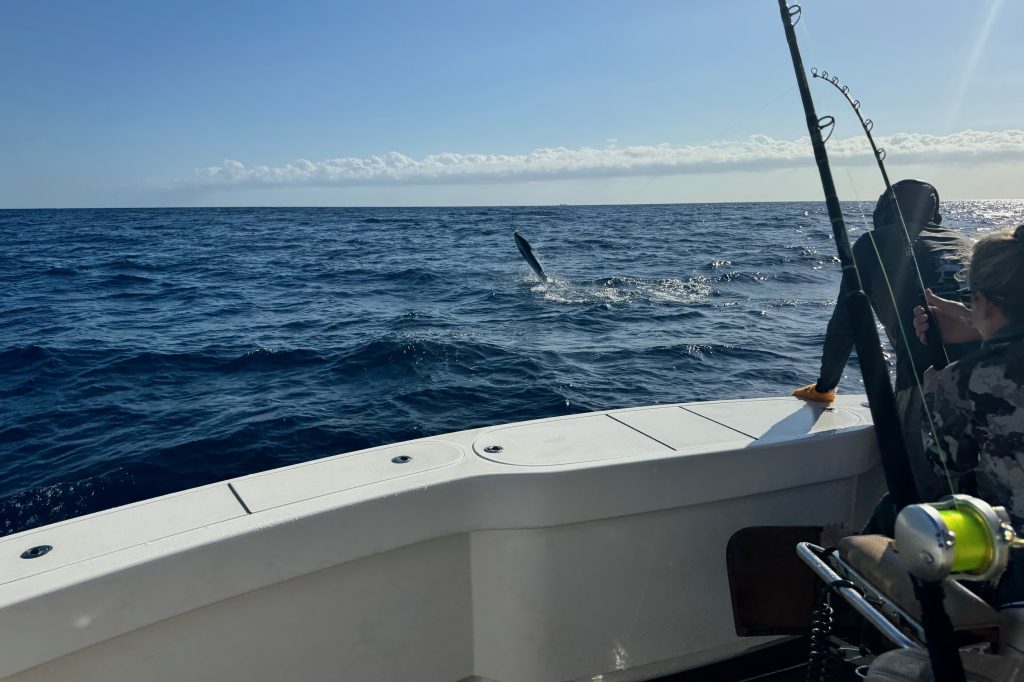
Seeing marlin jump is an important part of the whole experience.

Fast forward a year. I joined Donna on the Strictly Business in early November. Our group also included my friend JR Inman, his brother Roger, their adoptive brother Rick Eldredge, and Strictly Business owner Steve McInnes and his family. The whole group consisted of seasoned hunters, mostly with African experience. The rest of the group were experienced deep-sea anglers; I was the novice. The discussion on the main deck was mostly about hunting and firearms: best cartridges, old and new, favorite handload recipes. They were on home turf (water); I was on unfamiliar ground (water). Wanting to learn, I got polite answers to questions about fishing. Then the conversation swung back. An audio tape would suggest we were standing around a campfire in game country, not grinding through swells in the Sea of Cortez.

As with forest and plains, the water looks much the same in all directions to you and me, but not to the creatures who live there. Hunting for salmon, I learned to look for the nuances of currents and tide lines, and watch for birds diving on bait fish. Even with no land in sight, there was little difference. Out there, we are not the only hunters. Dolphins aren’t jumping for our pleasure; they’ve found something tasty near the surface.

Most of this falls on experienced captain and crew, who have a better vista from the upper decks, and understand what they’re seeing. I couldn’t influence the action, but I wanted to understand the process. Much hunting can be described as “hours of boredom, spiced with moments of extreme excitement.” Ocean fishing is like that. Patience is not my virtue, but I don’t find waiting for game boring. Sometimes it’s agonizingly tedious, but those adrenaline-fueled moments are worth the wait.

Our first morning, we followed dolphins to tuna, and caught some dandies for bait, for lunch, and to take home. Then we got serious about hunting marlin. Serious DIY hunters look askance at guided hunters as little more than trigger men. I follow both routes; with no apology, I accept some truth in this. Deep sea fishing from a modern boat is not The Old Man and the Sea. The angler more is reeler than artist. It’s a team sport; success is unlikely without a good crew. In my case,as  an aging beginner, I needed coaching: “Rod up. Keep tension. Let him run. Now reel.”

I fought my fish from the fighting chair. That’s hard enough, but I haven’t yet hooked one likely to drag me over the transom. On our second day, while Donna fought a nice striped marlin in the chair, we had another hookup. Roger Eldredge fought it freehand from the gunwale. It was the biggest marlin we hooked—it took 500 yards of line. I’m not sure I could have handled that, and I was happy to use the chair.

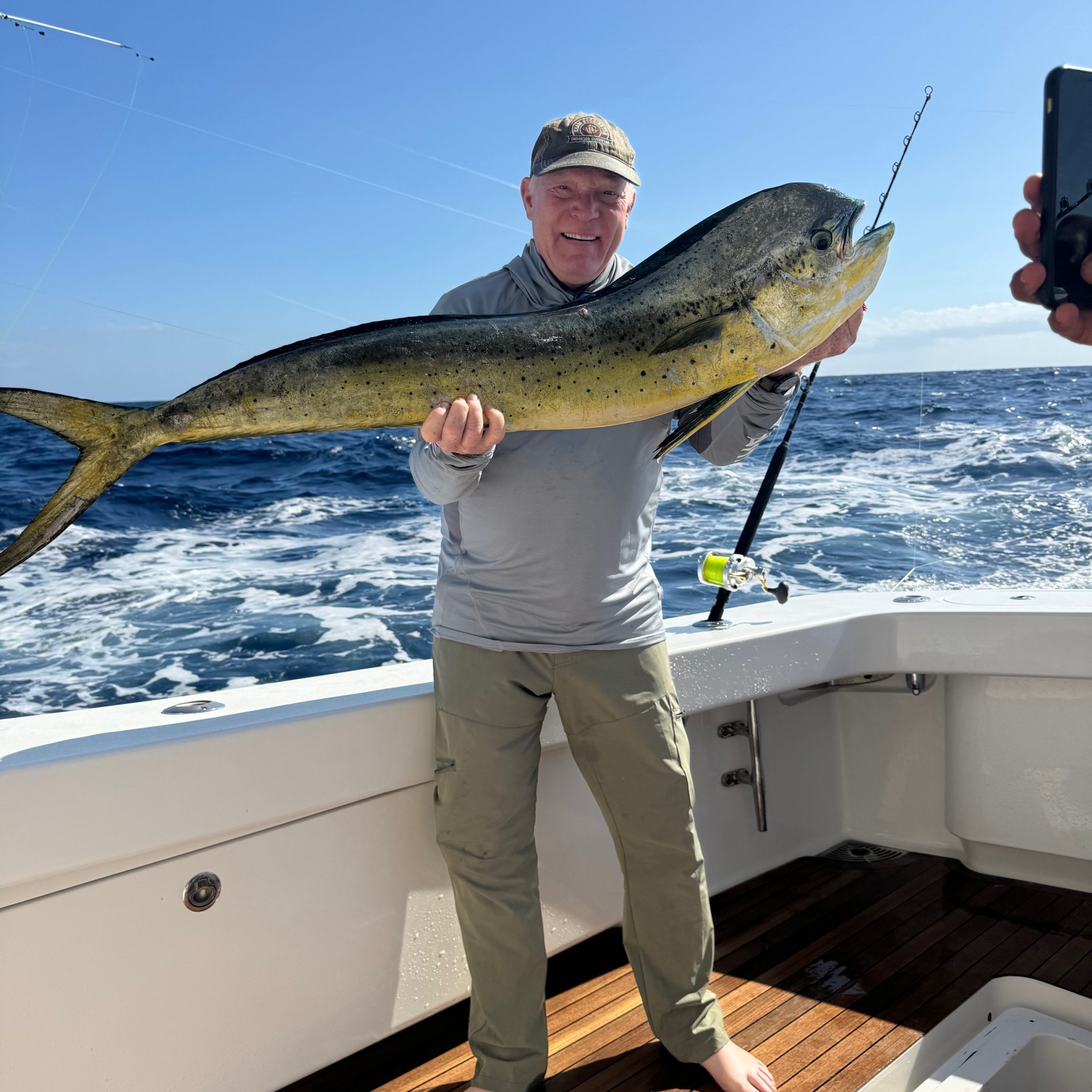
The target fish is one thing, what hits is another. When I asked what fish we might catch, JR told me “everything but dorado; they’re just not in.” Guess they all didn’t get that memo; on the second day I fought a fish we didn’t know was a dorado until it got close to the boat. It was a great-eating fish, and I was happy to have caught it. Everyone was surprised.

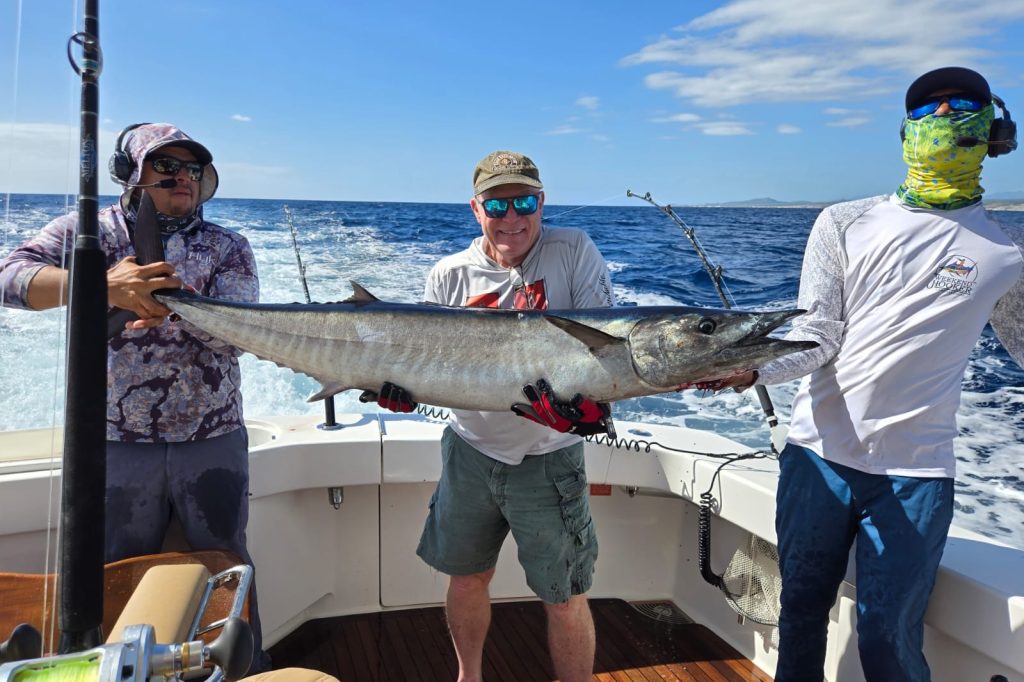
An exceptional wahoo. This fish bit off the leader at the boat, then was caught two hours later (and miles away) with the first lure in its belly.

The wahoo is sort of an incidental catch, a long, fast torpedo of a fish, hard fighter, also great eating. In the late morning, Donna caught a big wahoo. Just an hour later, we had an even bigger one at the boat when the leader broke, bitten through by sharp teeth. Two hours later, it was my turn, and we got a monster wahoo on board. While filleting it, something deep inside flashed in the sun. It was our lure–bitten off two hours earlier. There is so much under the surface we can’t know. Clearly, this fish followed us for two hours and many miles, contemplating another bite.

Where we were fishing, black, blue, and striped marlin all occur in descending order of size and numbers. All the marlin we caught on this trip were striped. It’s the smallest variety but the most plentiful there at that time, still an awesome and athletic fish. My striped marlin gave a heroic fight. With good coaching—and my arms and back aching—we got him to the boat. I put a picture on social media, and got an instant response from a troll: “Not very big. I hope you released him.”

Striped marlins aren’t ever as big as the giant black marlins Papa Hemingway caught ninety years ago. In hunting, you can back off the trigger when a smaller animal is in your sights. In fishing, you cannot prevent a smaller fish from taking your bait. Regardless of size, billfish are handled gently. They are never gaffed; they are hauled up by hand for hook removal, a quick photo is taken, and then they are released.

Regardless of size, it is an amazing experience to haul in such a legendary fish. It’s a thrill to watch them jump and tail-walk. Sometimes it’s close, other times it’s a silvery flash a quarter mile behind. On our second day, taking turns, everyone caught a marlin–an amazing day. 

It happens like this: baits set, lines out, we languish, talk guns and hunting. Then one of the rods twitches, bends, the reel screams. “Fish on!” The designated hitter makes his/her way to the chair. Other lines are brought in or cleared to avoid fouling.

You can’t know the size of the fish, even be certain of the species, when you take the rod, but then you feel the power of the fish. Then, controlled panic sets in. Everyone has a job. The most critical skill lay with our excellent young Captain Reuben, working the boat with or against waves and current, backing to gain line, maneuvering to ensure the fish didn’t get under the boat and foul the propeller. For a lifelong hunter, albeit casual angler, big-game fishing is an amazing and altogether different experience.

Boddington with the only dorado caught on this trip. Often common in early November, they just weren’t there this trip. Also called mahi mahi, the dorado is excellent table fare.

Leave a Comment

The Sable Turns the Tables

South Africa is now one of the top places to find a big sable antelope.

This past June, in big, brushy country in the western Limpopo Valley, my friend Bryan Pettet took one of the most beautiful sable antelope I’ve ever seen. It was 48 inches-plus on both horns, secondary growth six inches up the bases. I never thought I’d get a chance to run my hands over sable horns like that, and especially never thought it would be possible in South Africa. 

The magnificent sable has always been a premier animal, for much of my career ranking just behind the Big Five in desirability and value. Hippotragus niger has a large range, from South Africa north through most of Mozambique, Tanzania, Zimbabwe, Zambia, and into southern Congo; west across northern Botswana, northern Namibia, and into southeastern Angola. In the north, sables end in southeast Kenya.

The sable is an edge antelope, both a browser and grazer, typically found in savanna woodlands interspersed by grasslands. Sable are herd animals, typically a dozen to thirty females and youngsters, usually with one dominant herd bull. Males are often found singly or in bachelor groups up to a dozen. Large and dark, sables are highly visible when caught in the open, although in shadowed trees they disappear like ghosts.

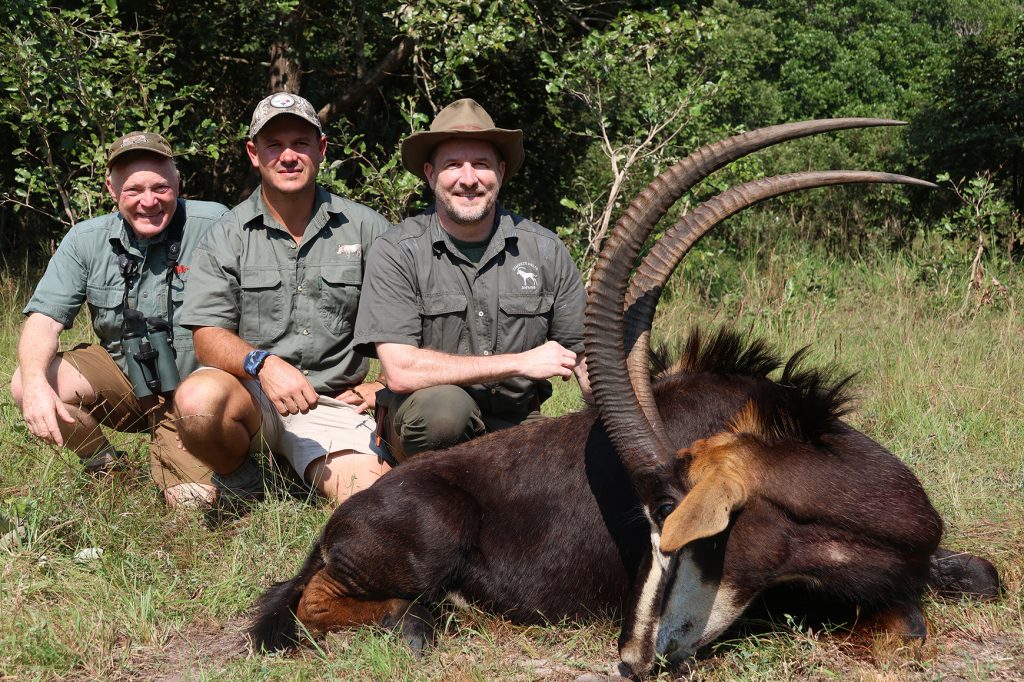
Boddington, PH Poen van Zyl, and John Stucker with Stucker’s 2024 sable, taken in Mozambique’s Coutada 11. Although old and in terrible body condition, at just over 40 inches this bull is exceptional for this area.

I don’t consider them especially wary, certainly not to compare with the spiral-horned tribe. If you can locate a good bull, chances of closing for a shot are pretty good. However, densities vary widely and rarely are sables plentiful. Hunting them isn’t usually difficult; finding them in big country can be the real trick and, in woodlands, almost impossible. Against this, sables are somewhat habitual: A group seen in an area is likely to be seen there again. First, however, you must find them.

In 2010 I did a three-week safari in the Rungwa region in central Tanzania with Michel Mantheakis. Rungwa is one of the best areas in Tanzania for a big sable. We were trying to get Ron Bird a lion, which we did on the 21sr day. Before then, we rolled tires for countless miles, looking for tracks and hunting lion bait. We saw a lot of game, but never one sable, which was surprising.

In 2006, at Mahimba in coastal Mozambique with JP Kleinhans, we did a long filming safari. Sable don’t grow big horns there but they aren’t uncommon. Early on, producer Dave Fulson missed a fine bull. No shame, his rifle had come disastrously out of zero. We had time, expected to see Dave’s bull again and he’d achieve redemption. Weeks passed before we saw that bull again, bedded in open grass two hundred yards from where he’d been shot at.

Three races are generally recognized: Common sable (H. n. niger), most plentiful and widespread; Roosevelt’s sable; and the giant sable. The giant sable, H. n. variani, is isolated in small areas in east-central Angola. The giant sable is larger and its horns start where common sable horns end, potentially into the mid-60 inches. Endangered and protected, the giant sable has barely been hunted within hunting living memory.

Slightly smaller in body and horn, with mature bulls typically having a reddish tinge, Roosevelt’s sable is found from Kenya’s Shimba Hills south along the coast. Named in honor of Kermit Roosevelt, it was long thought the Roosevelt sable stopped in Kenya. Recent DNA research proved Roosevelt’s sable continues south through coastal Tanzania, including Selous Reserve.

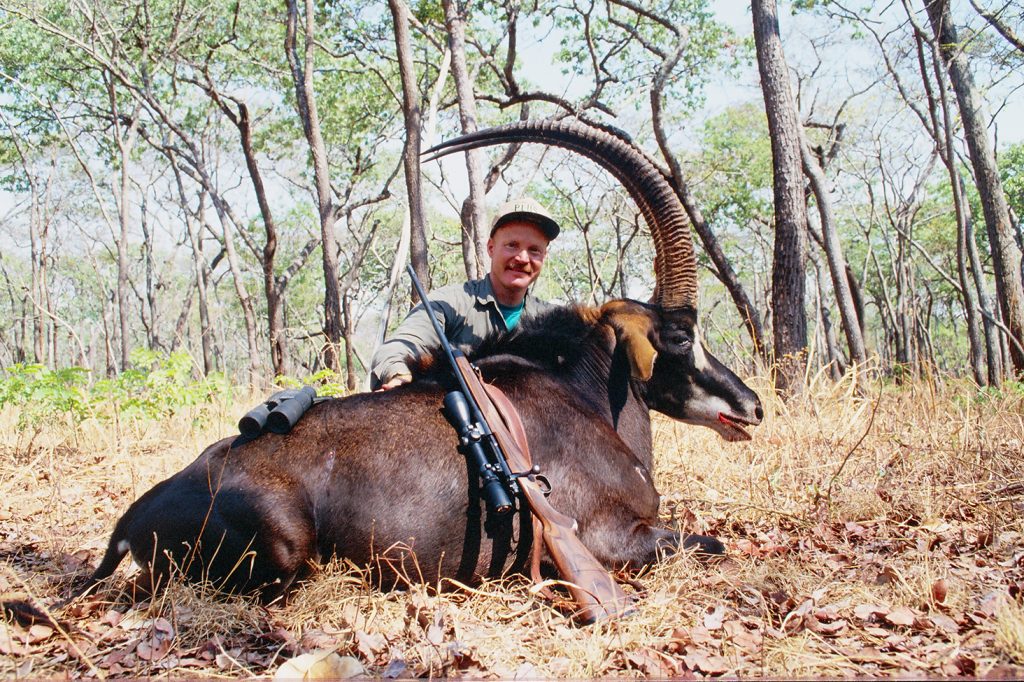
A nice common sable bull from western Tanzania, taken along the Ugalla River in 1993.

Roosevelt’s sable probably progresses into Mozambique. Her coastal sables are smaller, with reddish tints. I believe Roosevelt’s sable persists at least as far south as the Zambezi, but that DNA research has not been done. When I shot “Fulson’s sable” at Mahimba, I gave myself credit for having a roosevelti, but it wasn’t technically true. Later, I shot a big sable in the Kilombero Valley, so can claim I have a “proper” Roosevelt’s sable.

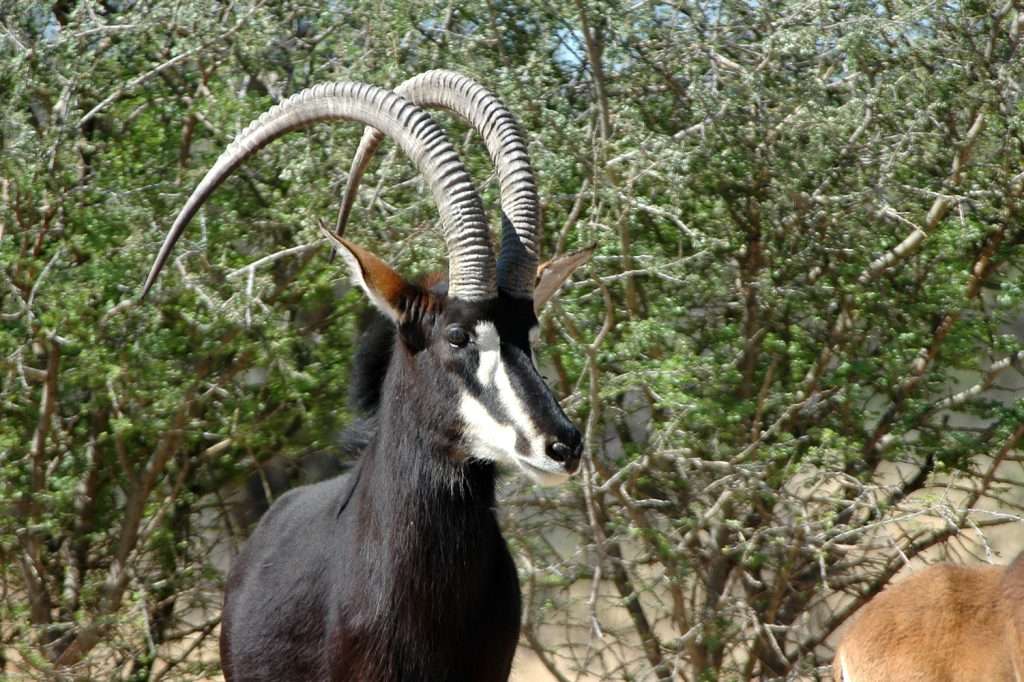
I’ve taken good common sables, in Mozambique, Tanzania, Zimbabwe, and Zambia, but never a monster. Both sexes grow similar horns, curving up and sweeping back to sharp tips that sables know how to use. Males are larger in body, with horns that are usually longer and always thicker. Young sables are tan, darkening with age. Some females get very dark, but only mature bulls achieve that jet-black coat, offset by white belly and brilliant white face mask.

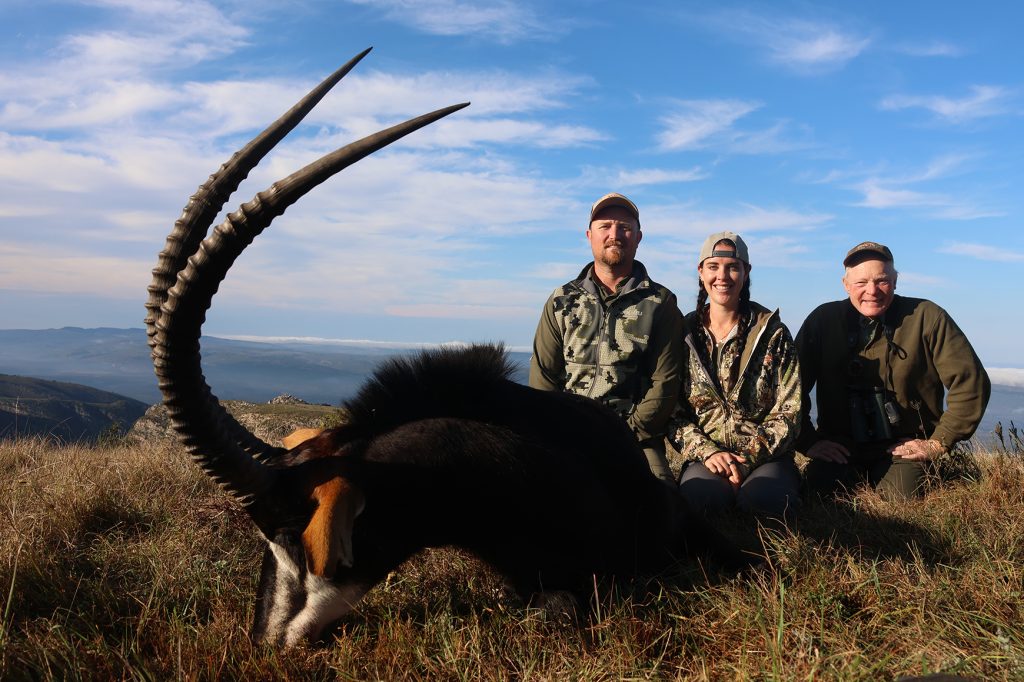
Thad and Tiffany Campbell and Boddington with Thad’s sable from South Africa’s Eastern Cape. Unusually, this bull was taken on top of a mountain. Fully mature and about 38 inches, beautiful bulls like this are available all across South Africa today, and more reasonable than ever.

Sable horns continue to grow, but growth slows with age, and at some point tip wear exceeds growth. Maximum horn growth is probably about seven years. Older bulls show a smoother “secondary growth” at horn bases, below the well-defined rings. Male mortality is high from fighting; in the wild, old sable bulls are uncommon.

At full maturity, a sable bull’s horns may be just 34 inches. In most areas a mature bull with 38-inch horns should be considered good. The Holy Grail is a bull with 40-inch horns; the Rowland Ward minimum for common sable is even bigger at 42 inches. Both are tough marks to meet, depending on area. Where I hunt in coastal Mozambique, the Marromeu complex, sables have prospered, now among the more common large antelopes. The quota is large, but horn length rarely extreme. Years back, a young PH brought in a 45-incher, unheard of in that area, just one out of hundreds taken. Every year, the skinning shed sees a handful of bulls with 40-inch horns, but in this region, good mature bulls are usually in the 36 to 38-inch class. Those are nice sable bulls.

They do get bigger in some areas. Rowland Ward lists an astonishing thirty-five sable bulls of 50 inches and larger. Of these, twenty-six are recorded from Zambia. Of the rest, three from Zimbabwe, two from RSA, one from Zaire, and three of unknown origin.

Throughout my lifetime, western Zambia has been the best place for big sable. My personal best came from Mumbwa in Kafue in 1984. At 43 inches, it was a great sable. Hunting in Kafue in 1996, Bob Petersen took a huge bull. Not 50 inches but close. Wish I’d put a tape on it.

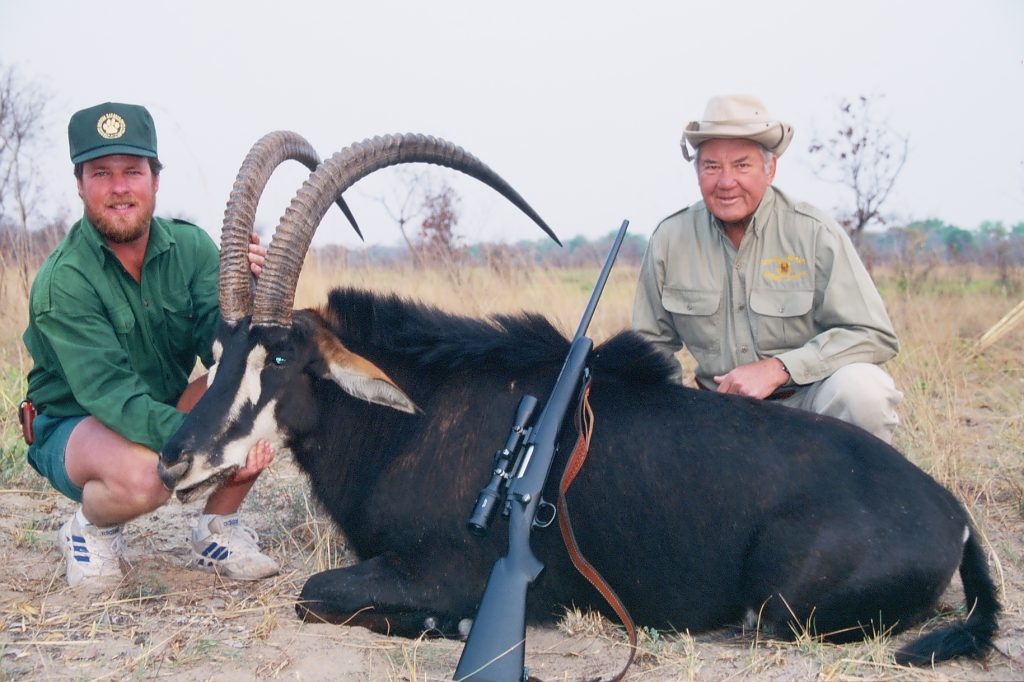
PH Russ Broom and Robert E. “Pete” Petersen with a fantastic sable from the Kafue region in western Zambia, 1996. Western Zambia has produced the majority of Africa’s biggest common sables. Sables are not plentiful in that area and it’s tough hunting, but the big boys are there.

Western Zambia clearly has the genetics. However, it’s iffy. Big country with ideal habitat, sables present but not common. Not every hunter will get a monster, and many won’t see a shootable bull. Northwest Zimbabwe, especially Matetsi, is also known for big sable (one 50-incher in RW, taken in 1978). I saw gorgeous sables there back in the 1980s, but no monsters. Par for the course when hunting sable, even in great places.

 RSA produced the RW world record (55 3/8 inches) in 1898, and another 50-incher in 1980. Genetics are thus present, but until recently I considered South Africa a poor choice for sable. From the late 1970s South Africa’s game ranching industry took off slowly, then accelerated like a freight train. Exceptional breeding bulls existed, but sables were found on few properties. Available bulls were scarce, quality mediocre, and prices exorbitant. Safaris have long been costly in Tanzania and Zambia. Combining availability, cost, and success, Zimbabwe was the best place to hunt sable. Then Mozambique came back, since 2000 also a good choice for a sable safari. In Namibia, numbers were similarly low and prices high, but quality was excellent. A decade ago, I considered Namibia a better choice for sable than South Africa.

South Africa’s sables were sort of like her buffalo: I missed the sea change. Under my nose, game ranchers have been hard at work for decades, breeding valuable sables for both quality and numbers. It didn’t happen suddenly, but a tipping point was reached. Sables are now widely available in South Africa, quality has increased, and prices have dropped. Right now, South Africa offers Africa’s best opportunity for a great sable bull. Yes, it’s true that most aren’t strictly free range, also true that extra-large bulls are costlier. It’s still the best and most affordable destination for sable.

In June 2024 I was hunting in western Limpopo with Jose Maria Marzal’s Chico & Sons. We were mostly hunting buffalo, with several hunters coming in sequentially. Along the way we saw sables, including one exceptional old bull. Just because I didn’t want him doesn’t mean I didn’t appreciate him. We saw him twice and took photos.

A couple weeks later, my friend Bryan Pettet took his buffalo on that property, and then he suggested he might be interested in a big sable. We knew where such a sable lived. The two times we’d seen him he was alone, and we knew he might not be easy to find. He wasn’t. But on a hot midday, we glassed down from a rimrock and there he was in some brush near a small waterhole, one of the places we’d seen him before. The stalk was on, Bryan made a fine shot, and I was able to run my hands over those wonderful horns. The fable of the sable has changed.

Today South Africa probably has the most and most affordable sable, but Namibian game ranchers have also done a great job. This giant bull lived and bred on Joe Bishop’s ranch in central Namibia. (Photo by Dirk de Bod.)

Leave a Comment

Father David’s Deer

This unusual cervid may be the world’s weirdest-looking deer.

Photo above: A big bachelor herd of Pere David’s deer at Woburn Abbey in England, photographed in January with deer in heavy velvet. A nucleus herd gathered at Woburn by the 11th Duke of Bedford saved the species, and the estate still manages one of the world’s largest herds.

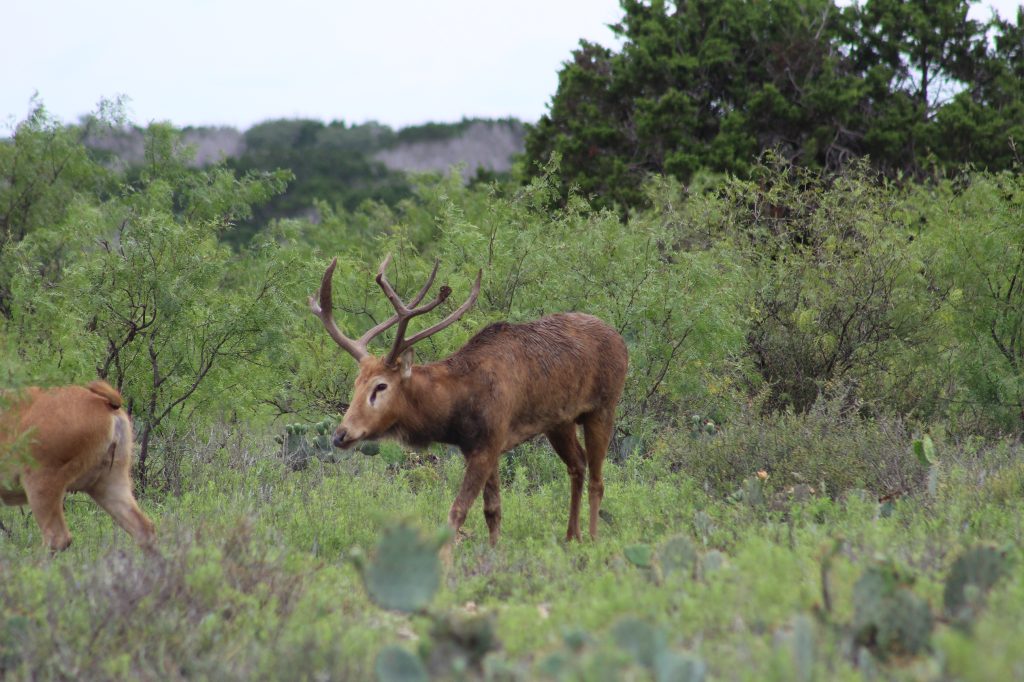
Pere David’s deer is a large-bodied, semi-aquatic deer, considered a primitive deer that’s an offshoot of the round-antlered deer family Cervidae, genus elpahurus, one extant species, Elaphurus davidianus. It may be the world’s weirdest-antlered deer. Main beams point nearly straight up, and it is the only deer that has the longest typical tines pointing backward. Antlers are thick and heavily pearled, but there isn’t much apparent symmetry to their racks. Unlike most antlered animals, Pere David’s deer sometimes shed and regrow antlers twice per year.

If the antlers are odd, so is this deer’s appearance: Long tail, long face and neck, big hooves, tall, stout body. Its proper Chinese name is milu. It entered Chinese folklore during the Ming Dynasty (1368-1644) as sibuxiang, the mount of mythical character Jiang Siya in a classic Chinese fantasy. Translated, sibuxiang means “four not alikes,” described as: The tail of a donkey, the head of a horse, the hooves of a cow, the antlers of a deer. Not a bad description.

Aside from unique appearance, the milu has an interesting conservation story. It is believed to have been widespread across China, scarce by the nineteenth century. The milu is not especially wary. It’s a calm, phlegmatic deer. They can run, but rarely do. Hunted to near-extinction, a herd of milu were kept within the walls of the Emperor’s hunting gardens in Beijing (then Peking).

Although large herds are uncommon, today many Texas ranches have nucleus herds of Pere David’s deer. These were photographed at the YO Ranch Headquarters near Mountain Home, Texas.

In 1866 French missionary Father Armand David (Pere David) sent the skins and antlers of three milu to Europe. Until then, the species was unknown, so it was named in his honor. Over the next decade a small number of milu were exported to zoos in Europe.

In 1895 a flood breached the Emperor’s garden walls. Deer escaped and were eaten by hungry peasants. It’s said that thirty remained in the garden. Fortunately, this tranquil; deer breeds well in captivity. It’s unknown how many might have been in the gardens of the Forbidden City when the next calamity struck five years later: the Boxer Rebellion, aimed to drive “foreign devils” from China.

On June 20, 1900, rebels surrounded the Legation Quarter, housing diplomats of eight nations: Austria-Hungary, France, Germany, Great Britain, Italy, Japan, Russia, and the United States. Each nation had a small contingent of soldiers, sailors, and marines, just 409 troops, against thousands of rebels, soon joined by elements of the Chinese army. The siege lasted 55 days.

Among the small US Marine contingent were some of our Corps’ great heroes. Daniel Daly, then a private, won the first of his two Medals of Honor by holding his position on the Tartar Wall—alone—with rifle and bayonet. In 1918, at Belleau Wood, First Sergeant Dan Daly is credited with rallying his troops to charge German machineguns by shouting, “C’mon, you sons-o’-bitches, do you want to live forever?” Also present in Peking was young Lieutenant Smedley Butler, “Old Gimlet Eye.” Wounded on the relief column, Butler fought in countless actions, served to Major General, and was the only other Marine to receive two Medals of Honor.

Despite high casualties and appalling conditions, the Legation Quarter held, an eight-nation relief column fighting its way through on August 14, 1900. The milu in the Emperor’s Garden didn’t fare as well. As a Marine, the way I like to tell the story, it was hungry Marines who killed and ate the last of them. In truth, it was probably German Imperial troops, since they held that sector. In any case, no Pere David’s deer survived the fighting in Peking.

After 1900, the only Pere David’s deer left were in captivity in Europe. Herbrand Russell, 11th Duke of Bedford, maintained a large deer park on his Woburn Abbey estate southwest of London. A hunter and pioneer conservationist, he had already experimented with various species, including Chinese water deer and muntjac. The significant free-range populations of both species in modern England descend from escapees when another storm broke the brick wall encircling Woburn. The Duke recognized the perilous status of Pere David’s deer and gathered a nucleus herd from European zoos.

At Woburn Abbey, they thrived. All Pere David’s deer in the world descend from these deer. Although uncommon, they are found on numerous Texas ranches, also in Argentina’s Patagonia, and in several English deer parks. The best part of their story: Reintroduction to China began in 1985, five males and fifteen females, followed in 1987 with eighteen females, all from Woburn Abbey, donated by Robin Russell, 14th Duke of Bedford, Herbrand Russell’s great-grandson. There have been other reintroductions, from various sources. The population in China is now estimated at 8,000, so the Pere David’s deer is stable, protected, and back in China to stay.

Current hunting opportunities include Argentina, England, and Texas. Again, let’s get real: This tranquil deer does not offer a sporting challenge. In most situations, the term “free range” does not apply. I have seen them in Argentina where they are not fenced, thus technically free-range, but happy in well-watered valleys they are unlikely to leave. In the purest sense, taking a Pere David’s deer is a collection, not a hunt. But within that context, there are valid reasons to harvest them: To apply value, to manage a herd, or to enhance a display of deer. Because Pere David’s deer are like no other antlered animal.

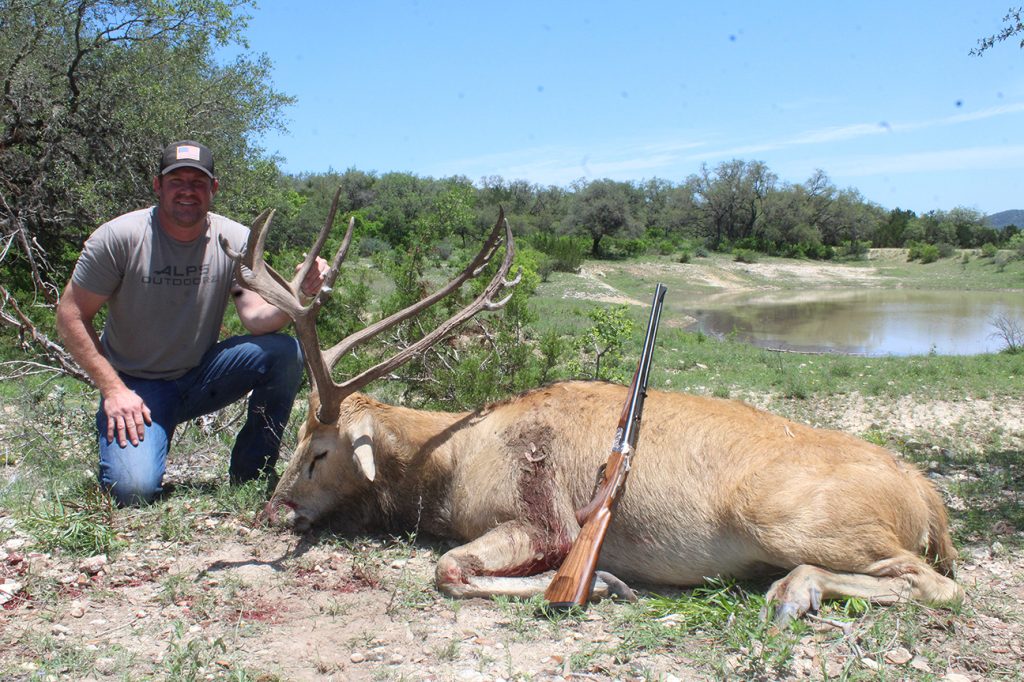
Brad Jannenga took this fine Pere David’s deer on Record Buck Ranch near Utopia, Texas. With Pere David’s deer, you look for long back points and tall, upright main beams with bifurcation, and as many extra points as possible.

I’ve seen them at Woburn Abbey, still one of the largest single herds. Awesome to appreciate their history, conservation, and survival saga. My lifelong friend, Sports Afield publisher Ludo Wurfbain, took one in England. For years I was somewhat jealous, eventually accepting I could die happily without adding a Pere David’s deer to my life experience.

I’ve seen and photographed these deer on Texas ranches, as well as in Argentina and England. I don’t know what they were like when they had to worry about being eaten by tigers; my experience is they are placid and much too trusting.

Still, I was curious, because these deer are so different. I’d never seen one up close, never had the chance to wrap my hands around an antler. Several years ago, during one of daughter Brittany’s She Hunts camps on Record Buck Ranch in Texas, son-in-law Brad Jannenga decided he wanted to take a Pere David’s deer. Which, after all, is why game-ranching properties allow wildlife to drink their water and eat their grass.

We caught a small herd drinking and mudding-up at a waterhole. I had a catbird seat, watched him creeping and crawling. Brad was carrying a Krieghoff open-sighted double in .30-06. Perfect, gotta get close. He did, maybe 70 yards, pasted a big buck well and then again. Awesome bull, and I got to wrap my hands around the antlers and help load it. A blocky animal, they are heavier than I thought. References suggest 470 pounds for males, but I’m sure his was much heavier.

Since then, I’ve seen a couple more taken. Depending on feed, a big bull is likely 600 pounds, bigger than a cow elk, smaller than a mature bull. Estimation based on limited experience, but never accurate scales. Having seen this uncommon animal up close, I’d accepted that I would never take one. There are lots of animals I haven’t hunted, many that I never will.

So, last week, Brad and I were sitting in a deer stand on his Aspire Wildlife ranch in Texas, hoping for a management whitetail. Because it was the most interesting rifle in camp, I was carrying the same Krieghoff double in .30-06. Brad has a growing herd of Pere David’s deer, and they showed up at the end of the meadow, dozen cows tended by an old bull with poor antlers.

“Hey, that’s my last original bull; I don’t want him inbreeding. Let’s take him if he gets close enough,” Brad said. I demurred…but I didn’t protest too much. I thought this weird deer would a nice addition to our little wildlife museum in Kansas.

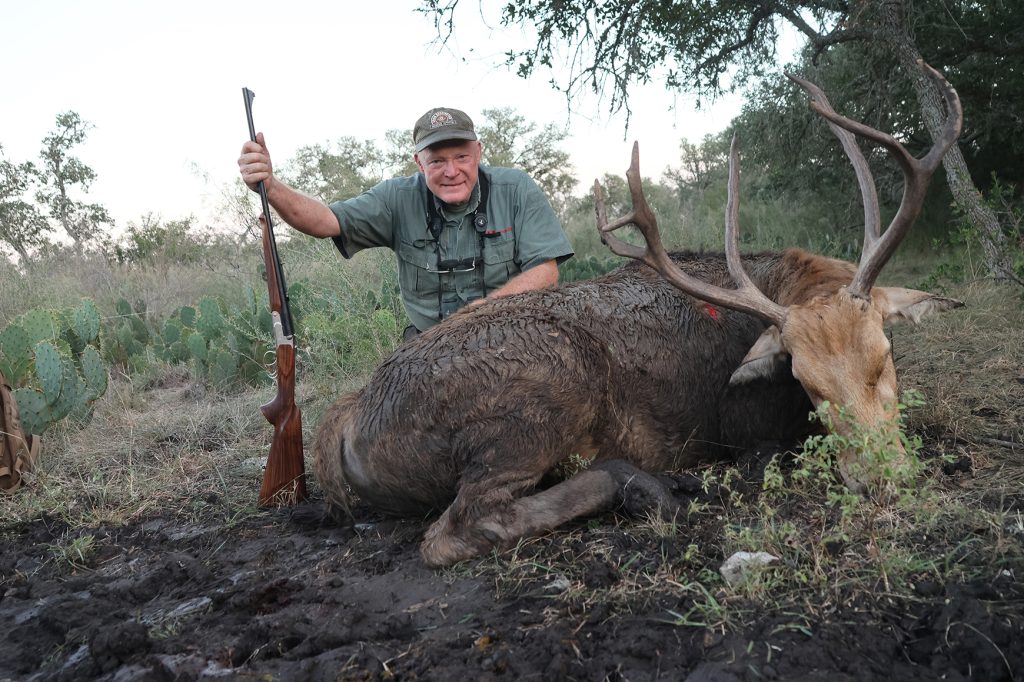
These days, I have sharp limits with iron sights. For an hour, the deer languished at 110 yards, too far. Then, slowly, the old bull made his way toward a waterhole. Just at sunset, he was within 50 yards when I took the shot. I needed both barrels and a spare. In my limited but consistent experience with these deer, like moose, they aren’t tough, but seem impervious to bullet shock.

Naturally, he went down in the mud, so we had to get the tractor. We had no accurate scale, but I’m still holding to my guess: around 600 pounds, a big animal. He was very old, antlers probably on the downhill side, but that was just fine with me. It’s still one of the world’s most unusual deer.

Boddington’s Pere David’s deer, taken on son-in-law Brad Jannenga’s Aspire Wildlife ranch in Texas, was an extremely old bull, probably with antlers on the downhill side, but still maintaining the weird typical conformation. He used Krieghoff side-by-side double in .30-06.

Leave a Comment

A Tale of Two Deer Seasons

From one of the nation’s earliest seasons, in coastal California, to one of the latest,  in Kansas.

Photo above: Dan Guillory shot this Kansas buck while it was tending a scrape sixty yards from his stand. When a buck like this shows up, don’t hesitate.

I split my time between California’s Central Coast and southeast Kansas. That puts a big spread between what I think of as “deer season.” On the Central Coast, archery season starts in July, and rifle season starts on the second Saturday in August. It’s one of earliest deer seasons in the United States.

Our short Kansas rifle season lasts for twelve days starting the Wednesday after Thanksgiving. Since Turkey Day slides, that Opening Day slides back and forth. In 2024, it starts on December 4, the latest the calendar allows. Although preceded by three months of bowhunting, plus a youth hunt and muzzleloader season, that makes it one of the latest primary deer seasons in the country.

American hunters number about 12 million, the largest hunting public in the world. Among us are big-game hunters, turkey hunters, waterfowl hunters, small-game hunters, upland hunters, varmint hunters, more. Many of us take advantage of multiple opportunities and hunt a variety of game, but deer hunters are the single largest group, possibly 10 million of us. According to surveys, few Americans travel to hunt. Most of us pursue game close to home. So, we hunt our deer. In the West, mostly mule deer, although Arizonans love their Coues deer. On the Pacific Coast, the blacktail is king. Across two-thirds of the country, the whitetail reigns supreme. Doesn’t matter what your local deer are. They’re your deer, and your deer season is important to you.

I don’t follow the normal pattern of only hunting close to home. In most years, I hunt in multiple states. Even so, both of “my” deer seasons are important to me.

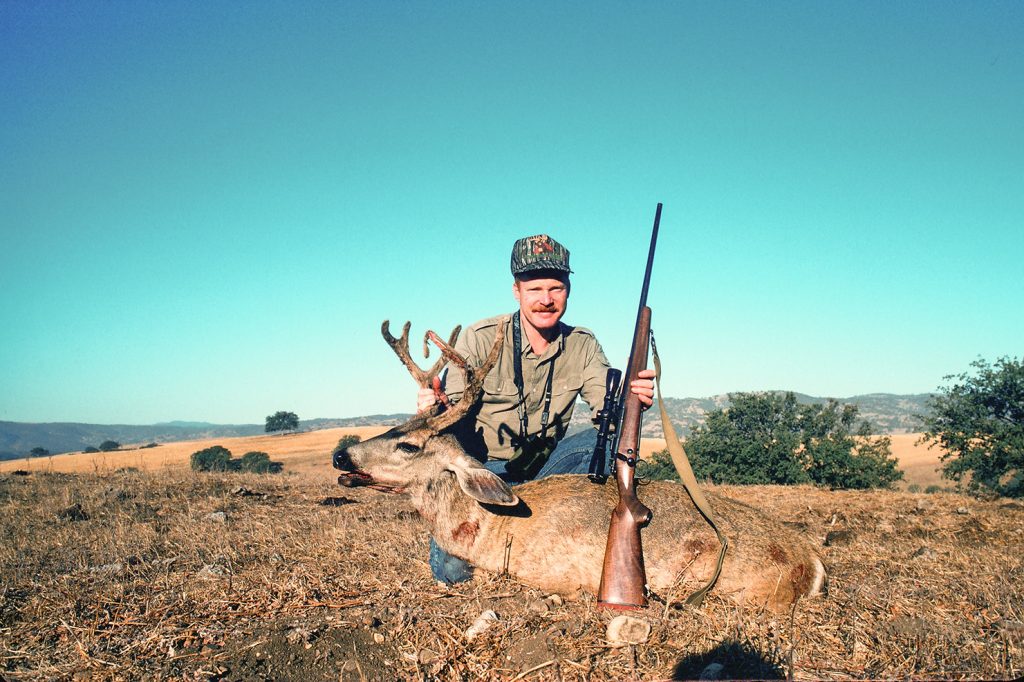
Camp Pendleton, California, was my first post in the Marines. My tattered Hunter Safety card is dated from the base natural resources office, 1975. Deer hunting on base was by drawing. In those days, the Kansas deer herd was still building. Deer hunting was for residents only, all tags by drawing. I discovered the California Coast Zone deer hunting. Over-the-counter tags, two-buck limit, six-week rifle season. Close enough to dash up for a weekend.

Most coast zone bucks grow modest antlers; a three-by-three like this buck is above average. Taken at the start of the season, this is the only August buck Boddington has taken still in full velvet; by the start of rifle season, most bucks have at least started to shed.

Although mornings are pleasant, midday temps often exceed 100 degrees F. California’s Central Coast has the biggest average low-to-high temperature swing in the Lower 48. Evenings eventually cool, but the afternoon hunt is short. If you get a buck in late morning, it’s a race against spoilage to the cooler. It’s difficult hunting for bucks of modest size, but I embraced the Coast Zone, and for many years it was “my” deer season. During the years I worked in Los Angeles, I’d often run up to the Central Coast, and I settled there after I left the editorial office.

At first, August deer hunting in the blazing coastal hills seemed crazy but, like most North American seasons, there’s method in the madness. Our coastal blacktails have no winter stress. Winter is the mild rainy season, plenty of food and water. Their tough time is the long, hot, dry summer. By mid-August, most bucks are in hard antler. And they rut early, so that fawns can be dropped in late spring and gain strength before the harsh summer.

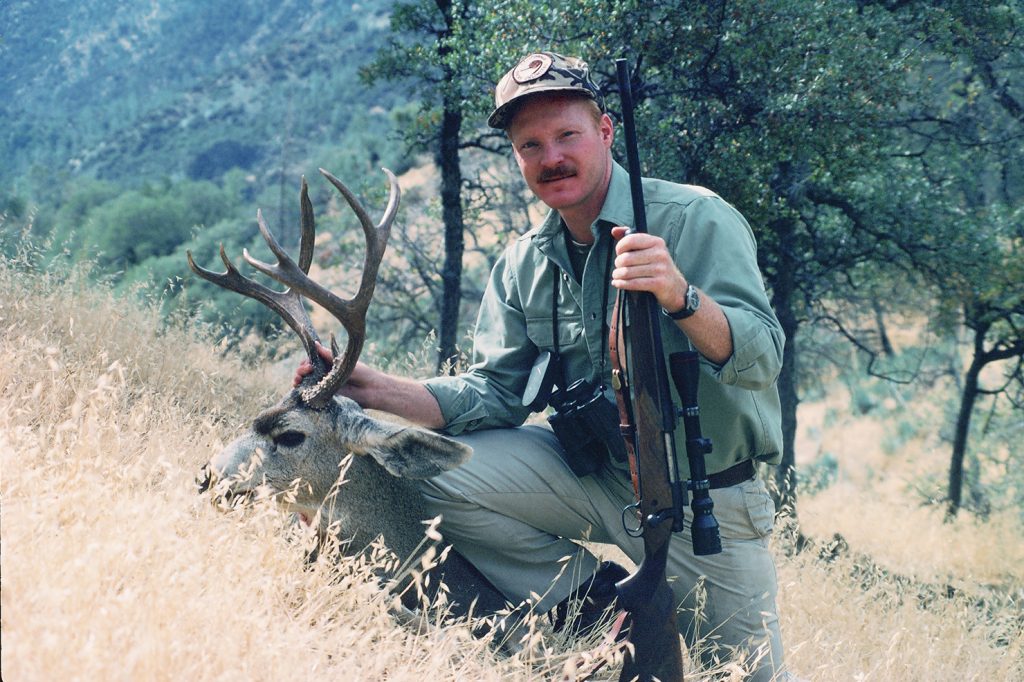
This is Boddington’s best coast zone buck, taken late in the season near King City.

The season carries on through the third week in September. By then, the rut is on, and temps have dropped a bit. So, if one is patient, the end of the season is best. When I was a California resident, I fought the brutal August heat with relish. I took some nice blacktails early (and raced to the cooler), but my better coast bucks came toward the end of the season.

Today, I buy the basic licenses to hunt birds and hogs, but I don’t spring for a nonresident deer tag every year. When I don’t, I miss it. Last September, I was in Kansas working on food plots and Donna was back on the Central Coast. She got an invite for a last-chance deer hunt. She bought a license, gathered her .270, and shot a nice buck on the last day of the season. Central Coast buddy John Sonne has a ranch north of town. Since that’s his deer season (and his ranch), he hunts hard from start to finish. This season was tough, very hot, no deer moving. He just sent me a pic of his last-day buck, a monster for our area. That buck had never been seen; it showed up on the last day.

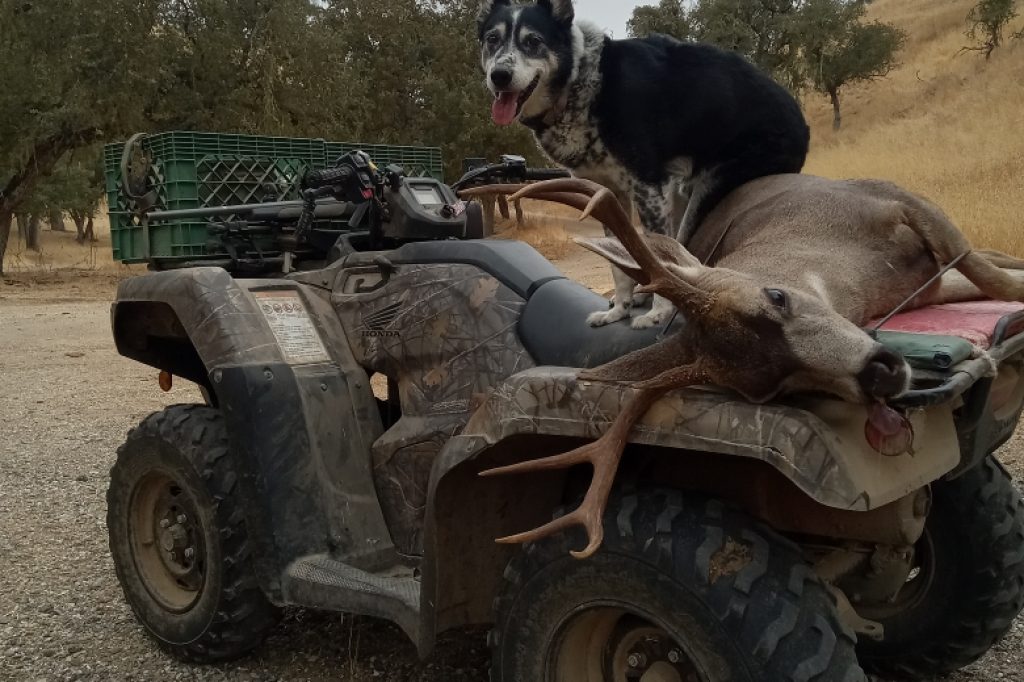
This is an exceptional buck for the hot, dry coast zone, taken by John Sonne on the last day of the 2024 season. In this area, patience and persistence count: The end of the season is usually much better than the beginning.

For most of us, deer season lies ahead. In most states, October and November is prime time, while “my” Kansas rifle season is still two months away. Kansas opened a modern deer season in 1964, and it was residents-only for thirty years. Today, the state offers 30,000 nonresident permits. They are by drawing only, specifying unit and season. When we bought the Kansas farm, I could initially buy a “nonresident hunt own land” whitetail permit. Now that I’m a Kansas resident, I buy an “any whitetail” permit that’s good statewide from September archery through the end of rifle season, then again archery to the end of the year. Pretty good deal for a kid who grew up with no deer season.

I (mostly) wait for rifle season. With a blown shoulder, I no longer bowhunt, although I occasionally go out with a crossbow. I have no excuse for not participating in the muzzleloader season. Except that I’m fascinated by rifles, however limiting the season, and have trouble getting excited about other launching platforms.

At least in theory, states set seasons based on management goals, with archery seasons commonly set before firearms. Our Kansas rifle season was set decades ago, intentionally a post-rut hunt, the idea for our few bucks to breed before primary deer season.

We have a lot more deer now, but seasons have changed little. Most serious Kansas whitetail hunters do at least some bowhunting. We see good pre-rut activity (rubs) in October, with scrapes and rutting activity in early November. The biggest buck I’ve taken on my place, with a crossbow, was rutting hard. It’s easy to remember the date, November 12, because it was my birthday. I figure the rut in southeast Kansas peaks about November 20. This year, that’s two full weeks before rifle season.

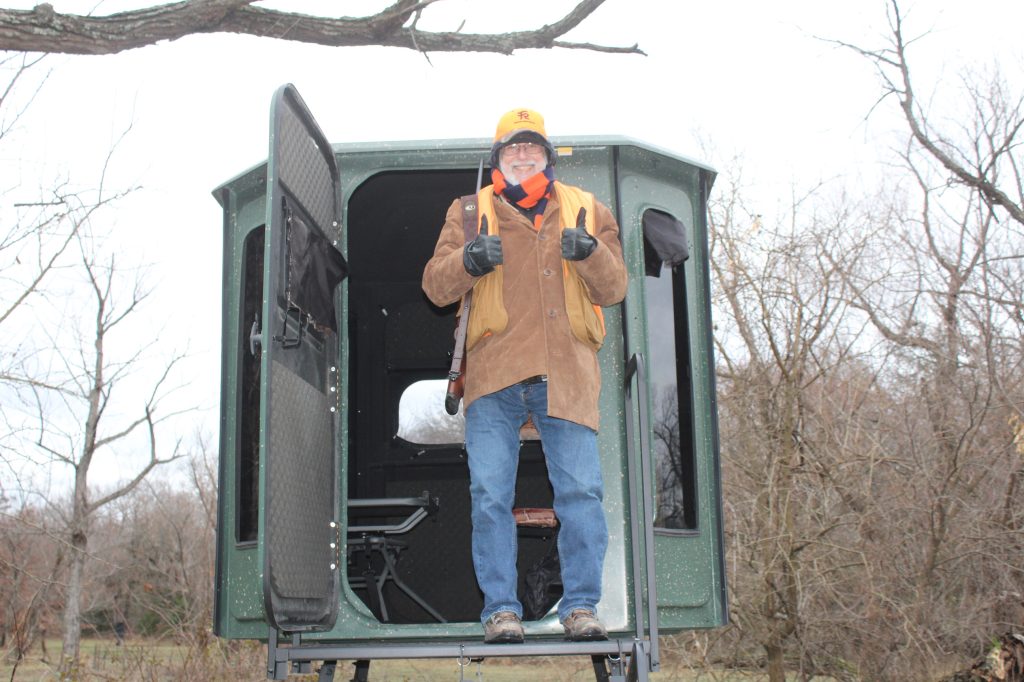
Ron Silverman at one of the Redneck blinds in Kansas. Boddington generally prefers open treestands, believing he can see and hear better, at least in mild weather. But when its cold, wet, and/or windy, enclosed blinds are game-changers.

Well, seasons are when they are, unlikely to change, and Kansas rifle season is my primary deer season. Whitetail hunters talk about the peak of the rut as if it was set in stone. Fortunately, it is not. Timing varies, and the whitetail rut is not a one-night stand. Since our rifle season is based on Thanksgiving, it moves around. When it starts at the end of November, the peak may have come and gone, but we still see good rutting activity. Weather matters. A couple years ago, a warm front moved in, 30 degrees F warmer on opening morning than the evening before. Understandably, our deer shut down. Few sightings and no bucks on opening day, or the next. Friday morning was cooler, and deer started moving. Lee Newton shot a great buck, and all camp tags were filled by sunset Saturday.

Hunting our coastal blacktails is quite different from hunting thick-timber whitetails. On the Central Coast, all hunting is glassing and stalking; in Kansas, with a foot of oak leaf litter, stand-hunting is the only option. There’s also a difference in mindset. With a six-week coastal season, patience is possible. Don’t like the August heat? Don’t like the moon phase? Wait until the weather cools or the moon wanes. With our twelve-day Kansas season, we have no such luxury. We can’t change the weather—or wait it out—and the moon phase is what it is. There’s no choice but to go for it, whatever the conditions.

On a Kansas opening day in December, this nice eight-pointer was one of six bucks pursuing a lone doe. Boddington thinks was the largest, but the cover was so thick he can’t be certain. 

This year the calendar puts Opening Day as late as it can be. With luck, it should be getting frosty, which will help. I haven’t even looked at the moon phase, can’t do anything about it. I expect the primary rut to be almost over. 

There is good news. The secondary whitetail rut, as unbred does recycle, is pronounced in our area, probably because of a high buck-to-doe ratio. Early December is when I expect to see a beleaguered doe pursued by multiple bucks. Not all our hunters see this spectacle, but it’s not uncommon. One opening day—the last time our season started this late–I shot a fine 8-pointer, one of six bucks pursuing a lone doe. Sometimes they sneak through, other times dash past without offering a shot. You must be on your toes and ready. It’s unlikely you’ll see a buck more than once, and you probably won’t see him for long.

Leave a Comment

Bugles in the Backcountry

Hunting elk on horseback in Idaho’s Frank Church-River of No Return Wilderness.

Photo above copyright VictorSchendelPhotography.com

My sleep-addled brain woke slowly as I removed my earplugs in time to hear Ron say, “He sure is asleep!”

I mumbled, “Not any more,” but then sat bolt upright in my cot as I heard the terrified whinnying of the horse outside our tent and a chorus of wolf howls from nearby.

I grew up in West Texas, where coyotes yapping at the moon are a common occurrence. This was not yapping–this was a rich cacophony of baritone and bass voices announcing the demise of an unfortunate elk, moose, or deer. Like the unseasonably warm weather, the wolves were an unwelcome addition to our hunt. But even though both represented obstacles that were conspiring against our attempts to take home a trophy elk, they could not dampen the joy of being in these imposing mountains that, two centuries before, had formed a formidable barrier for the Lewis and Clark Expedition.

Several days earlier, as the twin-engine Britain Islander skimmed across the rugged hilltops and sailed over the intervening chasms of the Salmon River Mountains, I had pondered Lewis and Clark’s Herculean feat in crossing these mountains. For us, the journey from Salmon, Idaho, to the grass airstrip that gave us access to the Frank Church-River of No Return Wilderness was a smooth one. 

Set aside by Congress in 1980, the Frank Church-River of No Return extends across 2.3 million acres, making it the largest contiguous wilderness in the Lower 48. The name of this wilderness has two origins. “The River of No Return” reflected well the early days of exploration of this area because boats could navigate downstream on the Salmon River, but not upstream, because of the fast-flowing water and numerous rapids. The addition of the name Frank Church, a long-serving senator from Idaho who worked broadly for protection of natural areas, including authoring the Wild and Scenic Rivers Act of 1968, came in 1984.

I was confident as I could be when heading into the backwoods after game because I had been in camp once before with the same outfitter. On that first hunt, I fulfilled a lifelong goal of doing a real wilderness hunt, and in the process I collected a trophy black bear. This second trip would consist of the same key ingredients; high quality guides, a great base camp, and an extremely remote hunting area with only horses, mules, and our own feet and backs to find and bring back the game. Although we all had deer and bear tags, we three hunters–Ron Differ, my brother Randy, and I–had come primarily for the chance to hunt elk during the bugle.

Saddles and tack at the backcountry elk camp.

Idaho has a rifle season coincident with the period that should include the elk rut (mid-September to early October). Elk, however, don’t always decide to bugle during this time, especially, as in the fall of 2003, when the temperature is high enough to roast a chicken on an exposed rock.

Being a relative neophyte to elk hunting, and never having hunted during the rut, I was blissfully unaware of the steep odds against our hunting party as we made the five-hour ride from the airstrip to our alpine base camp. As we began the final, steep descent into the 6,500-foot elevation meadow where camp was located, the chime of the bells hanging around the necks of the grazing horses and mules, the warm, golden glow of the lantern light through the sides of the cook tent, and the smell of woodsmoke from the camp stove filled our senses with a comforting welcome. Randy commented that this combination of sounds, sights, and smells never failed to lift spirits at the end of a long, exhausting trail.

Our first hunting day was typical of our outfitter’s program: a predawn wake-up by a guide lighting our tent’s lantern and stove, a hot breakfast, a several-mile ride or walk into the surrounding country, still-hunting throughout the morning, an “elk nap” in the middle of the day, glassing the afternoon away, traveling back to base camp in the dark, a hot dinner eaten in an exhaustion-induced daze, and a final grateful collapse onto the cot. The only discordant note from this first day came from the lack of animals spotted by our three two-man teams.

For guide Gary Gingerich and me, the second day was much the same, except that we found elk tracks on top of our previous day’s horse tracks on the main trail to camp. I was also thrilled when we still-hunted to within forty yards of a mule deer doe, two fawns, two young bucks, and a 2 1/2-year-old 4-pointer. Nowadays I live in Georgia, and I regularly see whitetail deer, but mule deer always elevate my heart rate. To me, their ears appear to be two feet long and completely full of thick, soft hair. These six deer inspected us nervously and then moved slowly down slope and out of sight. Though fulfilling, seeing the mule deer could not remove the nagging worry that hot weather and wolf packs might foil our search for elk. That night, the same story repeated itself as the other hunters and guides drifted back into camp–they, too, had seen plenty of heat, dust, and flies, but no elk.

Like the two before it, day three dawned bright, dry, and with the threat of increasing temperatures. However, this morning, Randy and his guide, Dave, along with Gary and I, had risen and left camp even earlier than usual so that we could reach a distant ridge near the headwaters of Bear Creek. Gary and I left Randy and Dave just short of the ridgeline that would mark the boundary between our respective hunting areas. We continued to the ridge, where we unbridled our horses just before 8 a.m., tethering them with their halters to trees in an island of young pines.

Following the guide back to camp with an impressive load.

We had traveled no more than fifty yards from the glade when I thought I heard a distant bugle. Gary looked at me doubtfully when I told him what I had heard. His skepticism came from my repeated attempts in the days prior to turn braying mules, singing birds, and creaking trees into bugling elk. However, the bull almost immediately sounded off again. This time the elk’s clear notes seemed to match the dry, crisp, alpine coolness.

When Gary unleashed his response bugle, the elk gave an immediate answering grunt. We moved farther along the ridge while waiting for another call. We did not have to wait long as we carefully picked our way along the ridge. This next call sounded closer and was not a grunt, but a full-blooded bugle. We would conclude later that we were working two bulls, or maybe more accurately, two bulls were working us, but at the time we thought it to be one very talented performer. 

For the next hour and a half our hunt followed a scripted pattern, one that hunting-video producers, I am sure, wish they could capture: Gary called; the elk responded with grunts and complex bugles; we moved slowly and carefully along the ridge before answering; Gary called again; after a brief pause, the elk responded. Forty-five minutes passed, and Gary had to decide whether to go after the bull or try to set up and entice him to us. After a short discussion, we chose to set up just below the ridgeline. 

Gary motioned to the tree he wanted me to sit beneath and whispered, “I’ll stay behind and to your right to try and draw the bull’s attention away from you.” Our stand appeared to be nearly perfect; the wind was in our faces, coming from the direction of the bugling bull, and we had a good view of the valley below and the slope opposite us. However, calling elk is a fluid process. After only fifteen minutes on our stand, Gary joined me to say that, because the steadily lessening volume of the bull’s grunts suggested he was moving away from us, we might have to go after him. Gary gave another blast from his tube and my heart skipped a beat because the answering call seemed to be right on top of us. Gary switched to a cow call and then followed up immediately with a bugle. 

The elk answered, and Gary whispered urgently, “There he is–he’s a six-point!” and then, because I was looking at the opposite slope, he asked, “Can you see him?” 

I answered “No,” but then a golden flash in the valley bottom made me glance in that direction. I raised my rifle just as the elk moved behind a stand of fire-killed trees. The bull stretched out his neck and let out a mosaic of sounds. Gary cow-called and then bugled, and the bull responded immediately. More cow calls emanated from Gary and as I watched through my scope, the bull turned and faced our position. Though he remained screened, I could just make out the curve of his barrel-like ribcage. As he turned in our direction, he began a series of barks. Each time he barked, his ribcage gave a sudden jerk due to the violent expulsion of air. 

In answer to the barks, Gary bugled long and loud and then mewed through his cow call. I slowly raised my right leg so that the tree and both legs would brace me. But as I slid my right elbow onto my raised knee, my right leg began to tremble uncontrollably. That wouldn’t work. I lowered it back to the ground and rested my supporting hand across my still-steady left knee.

After an eternity, I watched through my scope as the bull slowly swiveled to his right. First, his nose inched out from the screen of trees. As Gary and the bull continued to exchange insults, his eye appeared and then the base of his antlers, followed by his impossibly thick neck and finally, ever so slowly, his shoulder slid into view. The recoil from my rifle rocked me back a fraction of a second after the cross hairs rested behind his shoulder. As I worked the bolt of my rifle, the elk froze and then turned slowly to trot into the stand of dead pines that occupied the valley floor. The faint rattling of the elk’s feet in the timber followed. Gary threw his arm around my shoulders as I stumbled to my feet and exclaimed, “Now, was that worth the price of admission?”  

“Unbelievable, absolutely unbelievable,” was my answer.

The next moment Gary asked the million-dollar question. “How did your shot feel?” 

I answered slowly, “My sight picture was just behind his shoulder, so I think it was solid.” Gary, too, felt the shot was good because the bull had momentarily frozen, rather than bolting immediately out of the valley. He also thought he had seen a flash of antlers as if the bull had fallen somewhere in the timber. 

Then he spoke the words I hate the most: “We’ll just wait and give him time to die or lie down.” No matter how sensible the advice, I have no patience for waiting to see if I messed up a shot. But we waited. And then after ten minutes or so, and with me muttering a prayer under my breath, we slowly made our way down the slope.

When we reached the spot where the elk had stood when I first fired, we found no blood. We cast out farther, but we still did not find any blood. And then, fifty yards to our left, the bull thrashed on the other side of a downed tree. I shouldered my rifle and aimed, but Gary stopped me with the words “Wait, but if he gets up, hit him again.”

Guide Gary Gingerich with the author’s 6×6 wilderness bull.

I needn’t have worried. The elk was done, and after a five-minute wait, we approached the ultimate symbol of a wilderness hunt in western North America.

As I ran my hands through his luxurious mane and down his golden back, I marveled that the combination of lousy weather and hungry wolves had done their worst and yet still had not defeated Gary and me. I then ran my hands over the long, pine pitch-stained antlers, and savored the sweet, musky smell that I remembered from my only other elk. This time, though, I was not contemplating a raghorn bull, but instead a monarch who had seen many winters, who had avoided numerous hunters, and who had likely fathered several successors. I was deeply grateful for this magnificent animal. 

In the years since, this trophy has been the spark that endlessly rekindles memories of long trails that weave along mountain ridges and pass through alpine forests, and end, as darkness falls, with the chime of horse bells, golden light from the cook tent, and wood smoke hovering over frosted ground.

Three happy hunters and their guides. Left to right: the author and Gary; the author’s brother, Randy, and guide Dave Hettinger; guide Jeff Stone and Ron Differ.


Leave a Comment

On Top of the World

Hunting a bighorn ram high in the Colorado Rockies.

I stared pensively into the flames of the campfire as they popped and crackled, consuming the aspen logs and sending a fragrant plume into the September sky. Mingling with the wood smoke was the delicious aroma of elk brats roasting on a metal grate propped atop the logs. It was a glorious evening at our sheep camp at 9,500 feet in the Colorado Rockies, and the last glow of sunset had painted an orange blush on the rocky peaks that surrounded us. But when I glanced up at those ramparts I felt like they were daring me to scale them, and making it plain they cared not one whit whether I succeeded.

Under normal circumstances, I would have been relaxing and reveling in this wonderful place. Instead, I tore my gaze away from the crags and looked back at the campfire, sipping a Gatorade, my stomach churning with nerves and my mind riddled with doubts. Can I do this? Am I in good enough shape? Will we see a good ram? If we do, can I make the shot?

Drawing a Rocky Mountain bighorn sheep tag had been an incredible stroke of good fortune, but I had not anticipated the stress I felt once I had the coveted permit in hand. If a bighorn tag is not once in a lifetime, it’s close enough. If you don’t fill it, it’s very unlikely you’re ever going to get a second chance. The pressure I had put on myself had been building all summer as the hunt got closer, and now, the evening before opening day in my unit, it felt as crushing as a hundred-pound pack.

Around me was the low, reassuring murmur of conversation from my hunting team. My guide, Jesse Bauer, and the two assistant guides, Trevor and Chad, were whipsaw-thin and tough as rawhide, sharp-eyed veterans of the high country with decades of sheep-hunting experience between them. My husband, Scott, had given up his elk tag and spent the summer getting into sheep shape with me so he could come along to provide motivation, support, and an extra set of eyes. He had even loaded his pack with extra water, food, and gear so I could go in as light as possible. 

In short, I had quite possibly the best sheep-hunting team in the state of Colorado in my corner. But there were so many wild cards: The mountains. The weather. The sheep themselves. And, of course, me. 

Unexpected Challenges

I had first set foot in the magnificent San Juan Mountains of southwestern Colorado a month prior, when Scott and I had made the eight-hour drive from our home in northern Colorado to accompany sheep guide Justin Adkisson and his son, Ridge, on a scouting trip. 

The country was everything I had imagined in my sheep-hunting dreams: steep, rugged mountains flanking long, narrow valleys, high alpine meadows filled with lush grass and tiny wildflowers, hot sun and cool breezes, the coarse calls of magpies and Steller’s jays, and trickling headwater creeks filled with native Rio Grande cutthroat trout. 

We went in on four-wheelers, rumbling up the trail until it narrowed to singletrack, and then parking the vehicles and making a circuitous nine-mile hike, all of it at more than 10,000 feet of elevation. Following rumors of ram sightings passed on by the inhabitants of a backcountry fishing camp, we climbed and glassed, and climbed and glassed some more, spotting only a group of ewes. This time of year, Justin explained, the rams and ewes stayed in separate herds, but the rams would often be just one drainage over. 

We went back to the four-wheelers and negotiated a rocky trail into the next drainage. Justin’s sheep savvy proved correct, and we spent the afternoon and evening glassing a group of rams very high on the crest of a ridge and studying what looked like a good one in the mix. I was simultaneously thrilled at finding rams and humbled by the difficulty of the terrain. I had been working out hard, and I had a month left. I determined to double my efforts in the time remaining.

Glassing for rams on a summer scouting trip.

But on the way back to the trailhead that evening, disaster struck when the four-wheeler I was on rolled over on a sharp turn. Just before it flipped, I jumped off, landing on my left leg, hard.

It could have been a lot worse. A trip to urgent care when I got home showed no bones broken, but I was in significant pain, barely able to hobble around the house, much less hike. I rehabbed the injury with single-minded determination, and a little more than two weeks later I was hiking again, albeit with a marked decline in my hard-won fitness level. 

Around the same time, I began to have problems with my rifle. The groups I shot with the rig I had planned to use were unsatisfactory, and it developed feeding problems to boot. I turned to the trusty rifle I had been using on our DIY elk hunts, a Ruger American .30-06. It was lightweight, accurate, and dependable—everything a sheep rifle needs to be.

I topped it with the Swarovski scope that had been on the other rifle, joking to Scott that my scope cost four times as much as my rifle. During the weeks I couldn’t hike, I spent my mornings at the shooting range, practicing out to 300 yards, lying on a prone mat and shooting off my pack.

At last, just days before the hunt was to begin, my leg was healed and I had a rifle in hand I trusted. Scott and I loaded our truck with camping gear, hunting packs, rifle, ammo, and two big coolers, and we hit the road for the high country.

Into the Mountains

Trevor had spotted a nice ram several days prior to our arrival, but he had not been able to find it since then. So at daylight on the first morning, the plan was for the five of us to split up and glass the two drainages we had scouted back in August. Jesse, Scott, and I headed up the drainage where the ATV wreck had occurred, while Trevor and Chad hiked up the valley just to the west of it, where we had seen the ewes on our scouting trip.

The morning dawned clear and beautiful—a perfect fall day, and I felt much better as soon as we started hunting. My head cleared, my insides unclenched, and my mind focused on the task at hand. The three of us scoured the mountainside thoroughly with our binoculars and spotters, seeing nothing but a few elk. Some three hours later, Jesse was certain the rams weren’t in this drainage. It was time to go join Trevor and Chad.

The sheep are up there… somewhere.

We left the ATVs where the trail narrowed to a footpath and shouldered our packs for the hike up the next drainage. After about a mile and a half, we found Trevor sitting next to the trail, glued to his spotting scope, which was trained on the opposite ridge. I plopped down beside him and he gestured for me to take a peek. I held my breath as several blocky gray forms came into focus through the glass. Rams!  

There were probably a dozen rams in the group, mostly four- to six-year-olds, and we spent the morning enjoying watching them feed, sniff each other, lick rocks, and do other sheepy things. Just before midday, they went into a copse of trees and bedded down.

In the meantime, Jesse and Chad had climbed the slope behind us, where they had a higher vantage and could see a group of four rams a little way past and above the bunch we were watching—and one of them looked big. They were bedded in a rocky, cliffy spot, but Jesse thought we might be able to get to within 300 yards of them, if the wind didn’t change and the other group of rams didn’t blow our stalk. 

We discussed the problem at length. Scott studied the grass on top of the ridge through his 15X binocular and determined the wind was blowing left to right up on the ridge. He said that if we stayed to the right of the young rams, we should be able to get around them to where the big ram was without spooking them. But it was a risk.

In the end, Jesse looked at me. “It’s your call,” he said. “That ram is in a tough spot. We can climb the mountain and try it, but there are no guarantees it will work. We might blow it. We can also watch him and wait to see if he moves into a place where it would be easier for us to stalk him.” 

I had already made up my mind, and it wasn’t a hard call. There was a big ram up there on the mountain. The stalk might or might not work, but one thing was for sure: I wasn’t going to kill him sitting down here. 

“Let’s go,” I said. The midday sun was warm, and I stood up and began stripping off all my outer layers and stuffing them in my pack. Everyone else followed suit. 

It wasn’t an overly long climb, but it was straight up, more than a thousand feet of elevation gain, and the altitude made it brutally tough. I followed Jesse, and Scott and Trevor followed me, while Chad stayed at the base of the mountain to watch the proceedings unfold through his spotter; that way, if we spooked the rams, he would be able to see which way they went, and if we were successful, he would come up and join us to help pack out the ram.

The first part of the climb involved clambering through thick timber and over deadfalls. My legs felt like someone had hung lead weights on them, and I hauled myself up the slope by grabbing bushes and small saplings. Finally we were above timberline, and a near-vertical slope stretched before us, all rock and loose scree. 

Once we got up there, everything started to go wrong. The wind, which had been blowing lightly but steadily left to right as Scott had seen, switched, and with horror, I felt it touch the back of my neck. Shortly afterward, I dislodged a large rock, which bounded down the mountain sounding like a drum solo at a rock concert. We all froze, clinging to the unstable scree. A moment later, I saw a young ram run across the cliff face to our front. I was sure we were busted. 

But Jesse kept going, picking his way across the loose rock, and I followed him, taking extra time to place my feet as carefully as I could. A pika scurried in front of me with some plants in its mouth and ducked under a rock. Then I saw Jesse crawl up to a little notch with a rock ledge almost like a windowsill and peer over it with the rangefinding binocular I’d loaned him.

I dropped to my knees, stripped off my pack, unclipped the rifle from it, racked a round into the chamber as quietly as possible, checked the safety, then crawled up behind him, pushing the pack and rifle ahead of me. A huge alpine bowl opened in front of me, studded with enormous boulders.

Sheep guide Jesse Bauer points out the location of the big ram in the alpine basin.

Jesse hand-signaled two-six-zero. I felt a rush of adrenaline; the sheep were in range. I breathed deeply, slowly eased the pack on top of the rock ledge, and shoved the rifle over it.

Then Jesse said, “They’ve winded us; they’re up.” 

My heart sank, sure we had done the tough climb for nothing. But wonder of wonders, the rams weren’t running. They were only standing, looking curiously our way. I settled in prone behind the rifle, working the fore-end into my pack, steadying it just as I had done countless times on the 300-yard range back home.

Jesse talked me calmly onto the rams until I had them in my scope. The big ram, he said, was third from the front. I panned past one, two, and then–wow! This ram was much bigger than the others. He was standing broadside at the base of an enormous boulder, looking right at me. He was the embodiment of every adjective I had ever heard applied to bighorn rams: Royal. Majestic. Magnificent.

Then he took a few steps forward. He was walking, and I wasn’t ready. To my complete astonishment, Jesse bellowed a loud, “BAAA.” The ram stopped and looked toward us again. 

My cross hairs were on him, but it wasn’t quite right. This shot had to be perfect. There could be no doubt at all. I breathed, shifted, got steadier. And the ram started walking again. 

Once again, Jesse let out a “BAAA!” The ram stopped again, broadside, looking right at me. The rifle was zeroed at 200. I adjusted for the holdover. The cross hairs came steady. It was right. Trigger squeeze. The shot was like a thunderclap in the mountain basin.

And the rams were running.

“You hit him. Reload.” I heard Jesse, but I was already racking the bolt. All four of the rams were running straight up the mountain, including the big ram. Straight up. Not good.

I knew I had to stay calm and make the follow-up shot. I asked Jesse for a range, and he said 300. I reached up and dialed the scope turret to 300 and settled back down behind the rifle to get the ram in my sights. He had stopped. I breathed and steadied myself. And then, before I could do anything else, the ram dropped right out of the scope.

After his initial forty-yard bolt up the mountain, he simply collapsed in his tracks and rolled down the mountain like a loose cannonball. I heard Jesse shout, “He’s rolling!” The bullet had done its job and the tough old ram had been dead on his feet; he just hadn’t known it. 

I let out a long breath, rested my forehead on my rifle, and said a heartfelt prayer of thanks. Then I turned to Jesse and gave him a hug. “Thank you so much,” I said. 

Jesse’s million-dollar smile was a mile wide. He said, “Thank you for not missing!”

Trevor and Scott came running up with congratulations and hugs. They had been crouched low behind us, and hadn’t seen the ram, but they had seen the shot and our reactions. 

Scott said to Jesse, “I heard you go BAAA!”

Jesse said, “I can’t believe that worked!”

After unloading my rifle, I picked my way out into the scree field behind the others. We looked for the ram near the boulder where he had originally stood, thinking he had rolled back down close to it. But he wasn’t there. Trevor ranged farther up the mountain, Scott went to the right, and I stayed close to Jesse, but we were looking for a rock-colored ram in an ocean of rock-colored scree. 

I felt panic rising. Had he really been dead? Did he get up and run after that awful fall? Or did he roll all the way to the bottom of the basin, which dropped off in sheer cliffs far below us?

Jesse and Trevor were looking around, shaking their heads, crisscrossing the slope. I had gone from rocket-ship high to a deep low in just minutes. And then I looked up the scree field to my left and saw something yellowish-brown. It was an animal. A large, dead one, with horns.

“Jesse!” I yelled, pointing. 

“It’s him!” He shouted, and he and Trevor bounded over. 

It seemed to take me forever to get there; it was difficult to move on that loose scree. Scott was right beside me, and we gasped in the thin air, slipping and stumbling in our eagerness to get to the ram. The altimeter on my watch read 11,800 feet.

When I finally got to the ram, the others stood back and I knelt and put my hands around the bases of his magnificent horns, marveling at their mass and how it carried through to the broomed tips of his three-quarter curl. He was everything I had imagined, and more: a fine, mature ram, eight or nine years old. I thought of all the preparation and stress, the hikes, the injury, the mornings of shooting, the dry firing, the workouts, the doubts, the fears. It all came together as I held the ram and looked down from the lofty heights he had called home to my own world far below.

Diana Rupp with her long-dreamed-of Rocky Mountain bighorn ram.

That evening found us around the campfire again. Four ghostly white shapes–the sheep quarters in their game bags–swayed from nearby tree branches where we had hung them to cool. I had trimmed the tenderloins from the ram, sprinkled them with salt and pepper, and laid them on the metal grate over the logs. Exhausted, hungry, and jubilant, our little group of sheep hunters watched in companionable silence as they cooked.

My aching muscles and the bruises I had sustained from countless falls on the way down the mountain with the ram’s head on my back told me it had all really happened. But every few minutes I had to get up and touch the horns, just to be sure.

When I looked up at the jagged peaks above us, silhouetted now against a star-filled sky, I felt humbled and grateful to have briefly been granted entry into the rarefied world of the bighorn sheep. They are the ultimate symbol of these mountains, an integral and essential part of the high country, and of hunters’ dreams.

It’s a long way down from 11,800 feet, but it’s all good if you’re packing out a load like this one.

Gear for the Sheep Hunt

My rather unconventional sheep rig was a Ruger American rifle in .30-06 topped with Swarovski’s Z6 2.5-15×44 HD. Weighing just over 7.5 pounds, this turned out to be an outstanding combination, and I wouldn’t hesitate to take it on another high-stakes mountain hunt. Barnes VOR-TX ammo with the excellent 168-grain TTSX bullet shot consistent sub-MOA groups and exhibited deadly terminal performance on my tough old mountain ram.

Top-of-the-line glass is perhaps the most crucial gear item on any sheep hunt. I carried my trusty 10X Swarovski EL Range binocular, which has stood me in good stead on many hunts. At the moment of truth, I handed it to my guide so he could glass and range my ram while I prepared to shoot. 

For long hours of glassing, Steiner’s HX 15x56X binocular on a Leupold ProGuide Carbon Fiber tripod proved to be ideal, much more powerful than 10X binocular and far easier to use and pack than a spotting scope. We used it to spot sheep on our summer scouting trip and on the hunt itself. However, I was glad Scott was carrying it up the mountain and not me.

Kuiu’s Pro 3600 is my favorite hunting pack, weighing almost nothing by itself, yet able to handle very heavy loads, including all my gear and the ram head on the way down. I wore my trusty, well-broken-in Kenetrek Mountain Extreme Boots. Without their rock-solid ankle support and aggressive tread, I would have likely fallen off a mountain long before now.—D.R.

This hunt was outfitted by Rio Grande Outfitters and guided by Justin Adkisson and Jesse Bauer with Crazy Horse Outfitters. For information about backcountry hunts for big game in southwestern Colorado, contact Justin Adkisson at [email protected] or 970-731-HUNT.

Leave a Comment

Close Encounters of the Turkey Kind

Hunting gobblers in the shadow of Devils Tower with the newly updated Benelli M2 Field.

One of the coolest things about hunting on the ranches near Carlile in northeastern Wyoming is the way you are treated to frequent and unexpected views of the region’s most famous monolith. Almost every time you top a hill or come around a curve on a gravel road, you’ll see, looming on the horizon, the iconic form of Devils Tower, a magnificent rock formation made famous in the 1977 sci-fi classic Close Encounters of the Third Kind.

The famous rock aside, the landscape in this section of the Black Hills is  exceptionally beautiful, with rolling, grassy hills, scattered trees, and an abundance of antelope, mule deer, whitetails, and Merriam’s turkeys. This spring, I was lured there not by mysterious aliens, but just as irresistibly, by the siren song of a big gobbler.

The other reason for the trip was to test out Benelli’s newly updated M2 Field shotgun. For nearly twenty years, the M2 Field has been considered the reliable workhorse of Benelli’s semi-auto shotgun stable. Continuing the equine analogy, the company is billing the updated M2 Field—introduced in 2023–as “workhorse rugged with thoroughbred speed.”

Benelli’s M2 Field has been a workhorse shotgun for nearly twenty years. An updated version released last year has made it even better.

The M2 Field is offered in numerous configurations, including 12- and 20-gauge versions with 24-, 26-, and 28-inch barrel lengths and 2 3/4- and 3-inch chambers. Finish options include black synthetic, Mossy Oak Bottomland, Gore Optifade Waterfowl Timber, and Realtree Max-7 across both the standard and compact models.

The major changes to the updated M2 Field involve the stock and bolt. The fore-end and receiver are sleeker, with a longer grip surface on the fore-end. The buttstock has an extended AirTouch surface behind the pistol grip for better grip with wet or gloved hands.

The new bolt design is supposed to be smoother, quieter, and stronger than the old one—I can’t speak to that, but I will say that my gun cycled flawlessly and the action seemed much quieter than other semiauto shotguns I’ve used. The bolt release has been changed from a conventional round button to one with a longer bar shape that is easy to find and quick to manipulate, even with gloves on. 

Benelli puts a lot of thought into recoil reduction, which is one reason I’m a fan of their shotguns. The updated M2 has their new Micro Cell recoil pad, which works in conjunction with a recoil tube and stainless-steel spring inside the stock that significantly reduces felt recoil. You can buy the recoil pads in varying widths to adjust the length of pull. 

This is an inertia-driven shotgun, designed to handle a wide range of loads from light field loads to heavy payloads for turkeys and geese. The system is strong and made with durable steel locking lugs on a rotating bolt head.

The gun I hunted with was the 20-gauge version of the M2 in black synthetic with a 24-inch barrel, kitted out with an Aimpoint Acro S2 reflex red dot optic. I had a chance to shoot it shortly after arriving at the lodge at Trophy Ridge Outfitters; outfitter Ralph Dampman has a nice shooting bench and target frames out back of his lodge, and we tacked up turkey-head targets for patterning the guns at thirty yards. 

The M2 utilizes Benelli’s Crio System barrels. The company says that cryogenically treating a barrel creates a smoother bore surface that patterns better (13.2 percent more pellets on target) and stays cleaner longer. All I can say is that I was impressed with the tight patterns I shot off the bench.

Speaking of tight patterns, I loaded the M2 with Fiocchi’s Golden Turkey TSS load. Nearly 70 percent denser than lead, tungsten shot has revolutionized the shotgun world in recent years. It’s expensive, but since once you pattern your gun you’ll likely only use one shot on a gobbler, a box or two of high-performance tungsten loads are a sensible investment for a turkey hunter.

Fiocchi’s Golden Turkey TSS uses shot made of 18 g/cc tungsten, much denser than lead with better range and performance.

I don’t have a lot of experience with red-dot sights, but I liked the Aimpoint Acro S-2 and found it very easy to use. Specifically designed to mount on ventilated shotgun ribs (interchangeable base plates accommodate most rib sizes), it is small, light, sleek, and doesn’t get in the way. When you mount the gun, there’s a clear field of view through it with both eyes open, and the large 9-MOA dot is quick and easy to center on the target. It has ten different intensity settings that you can easily adjust with a push of a button, which was a useful feature since our hunting days started well before dawn and continued through the bright sunlight of midday. 

A great thing about the Acro S-2 is you don’t have to worry about turning it off. Aimpoint says it can operate for 50,000 hours on a single CR2032 battery. I left mine on for the entire three days of hunting, including overnight, with no problems.

Aimpoint’s Acro S-2 red-dot sight is specifically designed to mount on a ventilated shotgun rib.

Northeastern Wyoming was having a cold spring, and unfortunately the turkeys weren’t cooperating, so I spent a lot of time hoofing around the countryside and setting up in different spots to call. At just 5.8 pounds, the M2 Field was a delight to carry over miles of hiking in the rolling country. During three days of hunting I got a lot of experience handling the gun and working the bolt release, finding it fast and easy to load and unload, even in the frigid predawn darkness with gloves on.

There is no shortage of turkeys in this region, and I had numerous encounters with gobblers, but they none of them ever quite moved into a position where I could close the deal. On the first morning, I had the gun trained in the direction of a gobbler that needed to take a couple more steps to give me a clear shot—but he turned and went the other way. On day two, we had a gobbler with a flock of hens nearly in range, but a barbed-wire fence stood between us, and they declined to cross it. 

On the last morning, my guide and I figured we had a foolproof plan. We set up a couple hundred yards from a roost tree in a pop-up blind placed where a big field pinched down into a funnel. We had noticed that the turkeys in the roost tree had been flying down and heading this way, so we figured we could ambush them. 

It was 24 degrees that morning, and when I reached down for my water bottle, I discovered it was frozen solid. But the turkeys were talking as they flew down, and as it got light, we saw the flock gathering at the other end of the field. Soon a few hens came our way and walked right by the blind. 

There was a lull, and then another hen came by, and I saw another lone turkey making its way in our direction—another hen, I figured. Most of the flock was still at the end of the field, and we could hear a gobbler and see him strutting down there. Focusing on the distant flock, I paid little attention as the lone turkey walked casually past the blind. Then, out of the corner of my eye, I noticed it had a beard—not a long beard, but not a jake beard, either. This gobbler had never fanned out or gobbled, just moseyed past us in a sort of gobbler stealth mode. Unfortunately, by the time I spotted the beard, the bird had scooted on past the blind and my chance was lost. 

We continued to hunt for the rest of the morning, but I’d had my best chance and blown it, making me the only hunter out of the eight in our group who went home empty-handed. But I wasn’t unhappy—I could only laugh ruefully at the way I had been outsmarted by a pea-brained bird. I’d been more than fortunate to have the chance to hunt the beautiful rolling hills of Devils Tower country with a sleek new shotgun and enjoy some close encounters of the turkey kind.

Full-choke pattern density with the TSS load was excellent. Seven hunters made one-shot kills with this load.

Leave a Comment

tablet

Never Miss An Issue!Subscribe Now: 6 Issues for $34.97

More Details
WordPress Video Lightbox Plugin