Sports A Field

Let Us Spray

Just like practicing with your firearm, practicing the use of bear spray is crucial and could save your life.

Photo above: In most grizzly encounters, people become aware of an approaching bear when it is less than 100 feet away. Photo copyright VictorSchendelPhotography.com

Even though bear spray has been on the market for more than thirty years and has been widely publicized and promoted, I’ve noticed that many hunters still don’t know the correct ways to use the deterrent. They carry the spray canister improperly, fumble with detaching the trigger guard, and don’t understand when and how to release spray in various types of situations. Adding to the problem are some dubious procedures often recommended in training videos and materials. There are also a number of fine points and recent scientific findings, not widely known, that can be important when dealing with aggressive bears.

As for hunters who don’t trust a can of pepper-based spray to stop a charging grizzly, or who believe their rifles and handguns are a better form of self-defense, I offer a few brief thoughts worth considering. First is the reality that a bear charging you at 30 mph (some top-speed estimates for grizzlies are closer to 40 mph) is covering forty-four feet per second. Next, as a 2018 Alaska study showed, in 86 percent of cases the person(s) involved first became aware of a charging bear when it was less than 100 feet away–and the average distance was less than 30 feet. This explains why, in almost 20 percent of surprise-charge encounters, those with guns couldn’t even get the weapon into play, and many more who did get a shot off missed. When bear spray is carried and triggered properly, it can be deployed in about two seconds, does not need to be precisely “aimed,” only pointed in the bear’s direction, and delivers a pressurized cloud-plume of deterrent rather than a small projectile.

As studies have also shown, gun users are much more likely to be seriously injured, even when the bear is eventually stopped, and of course, many bears get wounded or killed. Injuries do happen to spray users, but at a significantly lower rate, while success percentages are higher and no bears are permanently harmed. (Obviously, there are some situations where a firearm, if used skillfully, is a better bear-defense weapon, as we’ll see.)

First, a brief review of what bear spray actually is, and how it works. The spray itself is a mix of three components: oleoresin capsicum (OC), a thinning carrier agent, and a propellant. OC is a mix of oleoresin oil and 1 to 2 percent capsaicin and related capsaicinoids, which are derived from hot peppers. Capsaicinoids are high-powered irritants that cause intense burning sensations and membrane inflammation, particularly in the eyes, nose, mouth, and respiratory tract. When charging or aggressive bears approach, they are first startled by the spray’s loud hissing noise and the billowing red or orange cloud coming at them. This “startle effect” is very important, surprising and confusing many bears, causing some to turn or run off. The effect is compounded if the animal hits the cloud of spray and breathes it in. The bear’s sense of smell is suddenly shut down, its eyes burn and may be temporarily blinded, impaired by blepharospasms (involuntary eyelid muscle contractions); and its airway is restricted, sometimes causing coughing and choking. No surprise, then, that most bears quickly break off the charge, attack, or aggression and run away. 

But for all this to happen, you need to be carrying the right product, bear spray, not pepper spray. Bear spray is regulated by the Environmental Protection Agency (EPA), while pepper sprays are not. The latter are used by law enforcement and for individual self-defense against human assailants and (perhaps) dogs. They are not adequate for bear protection. Legitimate bear spray will have the words “To Deter Bears from Attacking Humans” and an EPA registration number on the label. It will contain 1 to 2 percent (not more or less) capsaicin and related capsaicinoids. You want a canister that holds at least 7.9 ounces, and has a spray duration of at least six seconds, with a range of at least 25 feet. The best sprays–the ones I carry–last seven-plus seconds and reach thirty feet or more. (Brands I personally use and trust are Counter Assault and UDAP; there may be other good ones.) Always know the distance and duration numbers of your spray. Also check the expiration date. Propellant leaks from the seals over time, so cans that are four years old or older should be replaced. 

Having the right spray is essential, and having immediate access to it is equally important. I don’t know how many case histories I’ve reviewed where the mauled hunters involved said they had bear spray but it was their daypack, or they couldn’t get to it in time, because the canister was buried in a coat pocket or clipped to a pack strap. I carry bear spray in a hip holster, as I would a handgun. If there is a protective hood over the trigger/nozzle head, I remove it or tuck it tightly out of the way. I want direct, quick access to the finger-ring grip and the trigger guard. Chest holsters are sometimes touted, but most big-game hunters already have a binocular hanging there, and things can get tangled. If you’re making a stalk, or want to shoot from a prone position, is the chest holster going to be in the way? (The same considerations need to be made for handgun carry options.)

With a hip holster, your hanging hand is already near the spray canister–you don’t have to reach or dig for it. With a bit of practice, it takes a second to get your index finger in the grip-ring while you also nip the trigger guard back with your thumb. (Place your thumb against the upcurled lip of the trigger guard, not on top of the guard surface, and pop it backward.) Then, if there’s time, as happens in some kinds of encounters, you can lift the canister from the holster and hold it in front of you handgun-style, ready to point and deploy. 

But in a sudden-encounter, charging-bear situation, you do not need to unholster and lift the canister (as is usually taught in various training formats, and as you would have to do with a handgun). You can, and in many cases should, spray right from the holster. All you have to do is point the nozzle toward the bear (you might need to pivot your body) and press the trigger button. Adjust spray direction and elevation as you fire and as the animal moves. Every bear expert/biologist I know–people who, combined, have sprayed hundreds of bears–agrees with this approach, which they all use themselves. 

A few more details about sudden encounters, which are the most common kind of aggressive-bear situation hunters experience, and which might involve being charged. (Remember, a charge is not necessarily an attack. Many bears charge but stop or veer off if the person simply stands his or her ground and does nothing to provoke a full attack–like yelling, arm waving, running, or trying to climb a tree.) A close review of cases indicates there are three major mistakes people make with bear spray in encounter situations. One, they wait too long to shoot their spray. Remember the speed factor mentioned earlier–a bear coming in at 44 feet per second. If someone waits until the charging animal is twenty feet away (“to be sure of hitting it in the face”), by the time the spray actually deploys the bear is nearly on them, and its momentum can carry it right through the spray cloud and onto the person. Also, capsaicin is more effective when it fully aerosolizes, which it can’t do at three to five feet.

With a bear charging all out, you might need to hit the trigger button when the animal is at the fifty- to sixty-foot mark, so it collides with the aerosolized spray at about thirty feet. This socks the bear with a full dose of irritant but also gives it time to react, veer off, and hopefully run away. With a bear that charges from closer in, thirty feet or less, shoot immediately and continuously, being sure to tip the canister nozzle slightly downward, avoiding mistake number two, which is pointing the nozzle (or letting spray “recoil” tip it) upward, sending the cloud too high, over the bear’s head. You want to spray in front of the bear’s face, not on its back. 

An important side note here: If you are carrying a rifle in the traditional slung position, and a bear bursts toward you at close range, you’re probably better off using your spray–hitting the button in the holster–than trying to unsling the gun, lift it to shooting position, aim, and fire. But if you are carrying a loaded rifle in a ready or near-ready two-handed position, and a bear suddenly rushes you and keeps coming, point/aim the rifle while clicking off the safety and shoot! Anyone who expects a hunter to put aside or drop a firearm to reach for bear spray has no sense of the reality of these situations. 

The third mistake is the opposite of the first: spraying too soon, when a bear is so far out it won’t be much affected by the initial whoosh and color-burst, and the plume becomes so dissipated the bear might run right through it without impact. In terms of actual distance measurement, “too far out” depends on what the bear is doing, whether it’s running full speed, walking steadily, or jumping forward then stopping, half-charging and halting, or hopping on stiff forelegs. With a bear steadily walking toward you or test-charging, keyed in on you, pick a spot thirty feet away–a rock or shrub, for instance–and if the bear is still coming forward at that mark, blast it with spray.

Avoid the commonly advised strategy of spraying a short burst at a bear that isn’t charging, but is acting either curious, unafraid, or menacing. The idea here is that the short burst might dissuade the animal and send it on its way. But a 2020 study on factors influencing bear-spray performance revealed a surprising finding: that more than half of a new, 7-second-duration canister’s propulsive pressure is lost in the first 1 second of spraying. Which means that the remaining contents, when needed, will not project as fast or far as they would had the canister not been fired.

This fact is so important I want to set it apart for emphasis, especially since some manufacturers have recommended “test firing” new bear spray before taking it afield. Do not test fire your bear spray! And replace any canister that has been used even briefly with a new one before heading out again. Also–something I’ve rarely seen mentioned–it’s wise when feasible to have a second canister with you for backup, perhaps in a daypack. If you do need to spray a bear while deep in the wild, what do you have to get back with? Also, in a number of instances a sprayed bear has returned (as have gunshot ones) to attack a second or even third time. Backup spray could save your life in such situations. 

The same study proved that cold temperatures, below freezing, can affect spray efficacy. At about 9 degrees F, the spray plume was narrow, did not aerosolize well, and had a range of only thirteen feet. It’s suggested that in very cold weather, spray canisters should be carried inside your coat, or in a pocket to keep the contents warmer, though I advise doing this with some thought, practicing how you will quickly remove and deploy from that kind of carry. When camping in cold weather, keep the canister inside your sleeping bag at night so it stays warm enough to function normally.

Wind can be a serious factor when using bear spray. The study showed that even in fairly strong head- and cross-winds, spray could reach targets approximately 6.5 feet in front of the user. Six or seven feet is awfully close–too close for comfort with a charging bear. The study doesn’t mention blow-back (into the user’s face, or a companion’s) but as anyone who has thoroughly tested bear spray knows, blow-back from a headwind is a real issue and can be highly unpleasant to incapacitating. (In strong wind situations, an appropriate handgun might be a better self-defense choice, assuming the person is skillful in its use.) The study also neglected to look at the effects of rain on bear spray. In my experience, even a light, steady rain can seriously inhibit the spray plume, and a heavy rain can negate it. Handgun backup for such conditions would be preferred.

When handling dead game in grizzly country, have spray ready to grab and go, and also have your firearm nearby, loaded with a chambered round and the safety on. With a companion, have one person standing ready with both holstered spray and a loaded firearm, surveying the surroundings.

If a companion is attacked in any situation, move within about ten feet and spray the bear directly in the face. Don’t be concerned about also spraying the person; any injury the capsaicin might cause is nothing compared to the damage a bear can do in just a few seconds. In most cases, when sprayed, mauling bears break off the attack. In about one in ten instances, the bear then turns on the rescuer, though usually it quickly ceases and runs off. When firearms are used for “rescue,” there have been a number of mauling victims accidentally shot, and sometimes killed, by the well-intended bullet(s). 

It’s common sense that if you want to rely on a weapon of any kind for self-defense, you must practice with it until the skills involved become efficient and automatic. Practice placing your index finger in the ring-grip of the hip-holstered canister while at the same time flicking back the trigger guard with your thumb. This should become so reflexive you can do it instantly, without looking down or fumbling. Then practice turning and pointing the spray nozzle in various directions, sometimes with the aid of a body pivot. 

Next comes experimenting with an inert spray can. These look and act like actual bear spray, but lack the capsaicin. They are about half the price of real spray and can sometimes be gotten for free from local fish and game departments, which universally encourage hunters to carry bear spray. Practice shooting from the hip, right from the holster. Mark off thirty feet and sixty feet, perhaps placing a wheelbarrow or similar object at those points to represent the bear. This is to reinforce a visual sense of actual key distances. Remember with spray you are “directing,” pointing the spray plume in front of an incoming animal, not aiming it precisely. Also practice lifting the canister from the holster (after flicking off the trigger guard) and holding it handgun-style in front of you with both hands, keeping the nozzle tipped slightly downward, as though pointing at an incoming bear. If you are going to be wearing gloves, practice the ring-grip, guard-flick, nozzle-direct sequence with the same gloves you’ll be using. 

Whenever possible, try to replicate actual field conditions, clothing and gear, including a slung rifle. For periodic refresher tune-ups, my habit is to take expired but otherwise unused real-spray canisters out to a safe place and deploy them while imagining a variety of realistic encounter scenarios. Even experienced gunslingers need to practice!

Leave a Comment

Just Keep Shooting!

When hunting dangerous game, it doesn’t matter how many shots are fired—what matters is that you finish what you started.

If you mess up on a dangerous animal, bad things can happen. Thanks to all the stuff we’ve read and seen on videos, it seems that if you shoot a Cape buffalo poorly, a charge is almost certain, right? Yes, it does happen, and not all charges can be stopped.

In my experience with buffalo, however, if you make a bad shot, a hair-raising charge is not the most common result. More likely, that buffalo will never be seen again. The vital area is not small, but it has lots of non-vital stuff around it. All Cape buffalo seem to surge with adrenaline when hurt. However, their attitudes differ. Some will circle and lie in wait. Others focus on escape.

In the years when we were doing a lot of filming in the Zambezi Valley, the annual quota exceeded a hundred buffalo, so we saw many buffalo shot. It seemed to me nearly one in ten was wounded and lost. This sounds like, and is, a high percentage. Contributing factors include hard ground with difficult tracking. Also, it’s a roadless wilderness. There is no opportunity to leapfrog forward; you just follow the track as far as possible. Many of our hunters were taking their first buffalo. There were lots of jitters. 

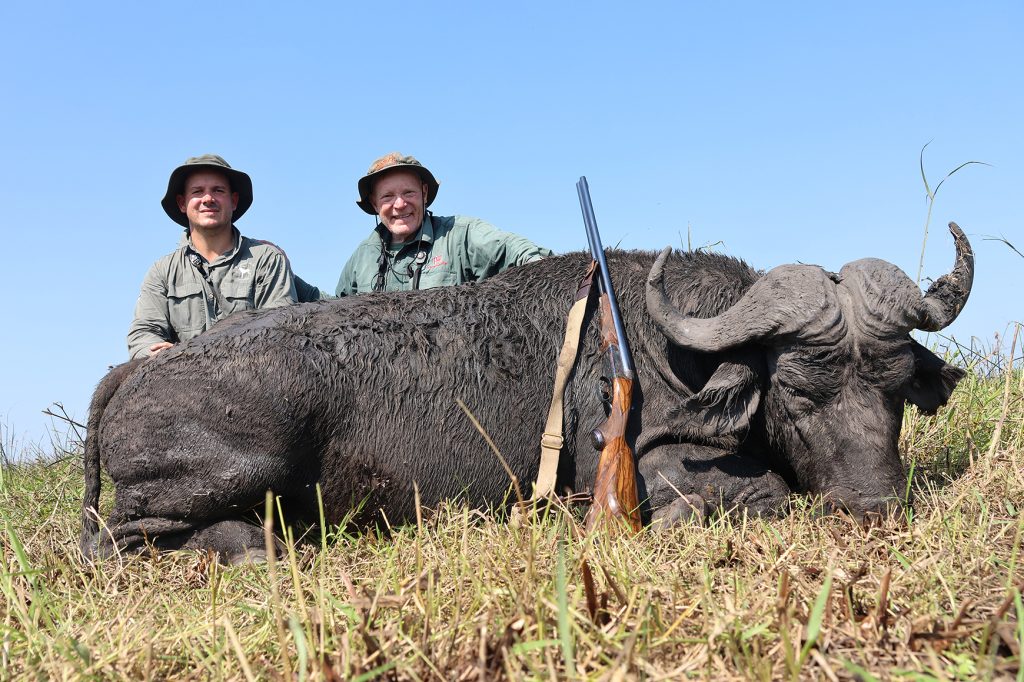
PH Poen Van Zyl and Boddington with an old Mozambique “swamp buffalo” taken in June 2024, cleanly taken with one shot from Boddington’s .470. The only reason he didn’t fire his second barrel was that his bull was instantly in the herd, so there was no opportunity.

While we lost maybe ten buffalo a season, there were no more than one or two charges. This suggests not all buffalo have the propensity to wreak vengeance. Maybe one in five, perhaps only one in ten. But that’s enough if you draw one of those.

I didn’t hit my first buffalo well, and we lost it. Dark animals have a way of confounding the human eye. The most common error is to see that massive black shoulder and shoot too high, up in that “no man’s land” between the top of the lungs and the bottom of the spine, not much damage, not much blood. On that first buffalo, our trackers thought I shot too far forward, which may be even worse.

I compounded the error by not being quick enough to shoot again. PH Willem van Dyk tried to help. He was carrying a European over/under .458. When he backed me up, both barrels went off simultaneously. While working my bolt, I heard a weird sound like a massive bell ringing. I glanced to my left and saw the rifle spinning end over end, Willem propelled backward. His bullets went into space. Meantime, the buffalo was still running, toward the edge of Mount Kenya’s high bamboo forest.

I can still see my cross hairs on that broad behind as the cover closed around it. I didn’t get the shot off, and 47 years later, I still kick myself for it. Even more now than then, because there’s another statistic I believe in: Of several hundred buffaloes I’ve seen shot, until recently I had never seen a buffalo wounded and lost that was hit more than once in the first encounter.

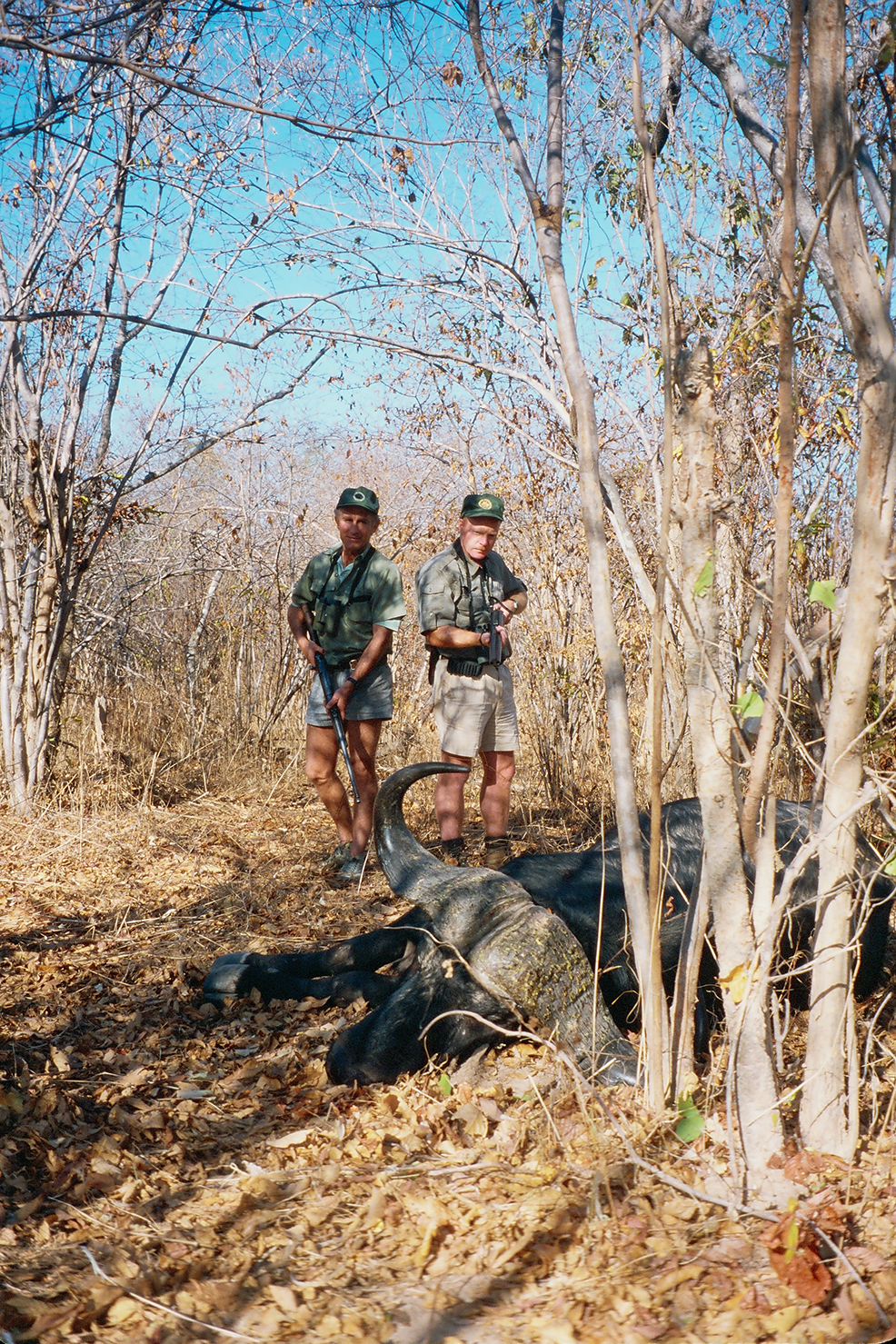
The end of a long, scary tracking job in the Zambezi Valley. Boddington shot this bull poorly a full day earlier, just his one shot fired.

This isn’t to say a buffalo hit only once, even if poorly, can’t be recovered. I’ve been in on a lot of scary tracking jobs, even caused a couple of them. African trackers are fantastic. So long as there’s blood, they can follow. Sometimes they can even follow if there isn’t. It depends on where the buffalo is hit, and whether it stops or just keeps going.

The first shot is the most important, and should be the best because it’s the most deliberate. Despite good intentions, it won’t always be perfect. Even if it is, any bullet can fail. We can’t know until the animal is recovered. Additional shots are usually rushed, often at a moving animal, so ideal shot placement is less likely. Even so, provided the target animal remains clear, I believe strongly that additional shot(s) should be fired. 

David Gibbs pays the insurance on a Mozambique buffalo. The coup de grace isn’t always necessary, but it’s rarely a bad idea.

Once the ball game is opened, it needs to be finished. Additional bullet(s) increase the blood trail, perhaps slow the animal, and might reduce danger. For decades I’ve preached the credo to “just keep shooting” if a dangerous animal remains on its feet. I’ve reinforced this with my homespun statistic: I had never seen a buffalo lost that was initially hit more than once.

Until a couple of weeks ago, when I was hunting buffalo with a friend.  He took his shot off sticks, quartering to, at seventy yards. The impact looked good–good enough that our PH hesitated perhaps a millisecond too long as the buffalo turned away and ran up a slight rise. At the top, just past a hundred yards, our PH unleashed his double .500. The impact knocked the buffalo down. Then it struggled over the crest, out of sight. We congratulated each other. Then, we advanced over the ridge, fully expecting to find a dead buffalo.

Nothing. Maybe four drops of blood. We had video, and did the instant replay. It hadn’t looked like it, but my friend’s shot was high, into that “not much up there” space. Our PH intended to put a 570-grain solid up the buffalo’s bum. If he had, we would have found the buffalo, or the buffalo would have found us. The video showed that his shot also went high, over the hips and into the top of the shoulder, angling into heavy neck muscle, apparently miraculously avoiding bone. That’s not an easy shot with open sights at that range. We looked for three days, but that buffalo is one that got away. Absent infection, it may have survived.

Regardless of caliber, I must now concede that extra holes offer no guarantee. Even so, on dangerous game, I maintain my mantra to “just keep shooting” until there is clearly no danger. It is essential to practice with a full magazine in a repeater, learn how to quickly use the second barrel in a double, or to practice fast reloading of a single-shot.

On dangerous game I tell my guides and PHs to use their judgment and shoot if they deem it necessary. Naturally, trigger-happy guides are poison. For me, it’s also not good for guides to cling to the ethic “it’s the hunter’s animal” and not fire if collaboration appears called for. Once that deadly ball game is opened, it must be finished. Hunters who practice repeat shots and follow up quickly are less likely to require—or receive—assistance.

Other than a bruised ego, it doesn’t matter who else fired. What does matter is if the animal is lost or someone gets hurt in the follow-up. It also doesn’t matter how many shots are fired.

The buffalo that killed excellent Zimbabwe PH Owain Lewis was hit just once, too far back, in the first encounter. It is unknown if Owain or the hunter had a chance to fire again. The bull was in a group and, often, things happen too fast, or the target animal isn’t clear.

What is known is that they followed intermittent spoor for three days. Many PHs would have given up. Through persistence and great tracking, they found the bull lying down and shots were fired. Instead of succumbing, the buffalo rose and attacked. Owain took the charge and apparently died instantly. In that final deadly encounter, as many as seventeen shots were fired. Sure, we can conclude they weren’t all good. If any of the first few shots took effect, Owain might have survived unscathed.

Shot placement always matters, but in such a wild melee, stuff happens. I’ve never seen anything like that, but African buffalo are incredibly strong. I’ve seen many drop quickly—rarely instantly—to one well-placed shot. I’ve seen others take, well, several shots before giving up. Although every shot should be placed as well as possible, if they are not hit in the brain or spine, some buffalo don’t give up.

With hippos, the brain shot is often what is offered. With elephants, those of us who read too much Karamojo Bell always dream of making a brain shot. With both species, when the brain shot works, it is lights out. When it doesn’t, at least you know immediately. Just keep shooting. On such large animals, the heart/lung shot is not instantaneous, but it is certain. Study the anatomy, place your shot as well as possible, then back it up.

On elephant, the frontal brain shot is wonderful when it works, but it often doesn’t. You know instantly; if you’re prepared you should be able to back yourself up with a side brain or heart/lung shot.

Whether Alaskan brown, polar, or a huge grizzly, the largest bears are similar in weight to a Cape buffalo. I’ve seen big bears fall to one perfectly placed shot, but I’ve also seen them shrug off good hits from powerful rifles. While I admittedly have less experience with bears than with buffalo, I think big bears are buffalo-tough.

Thirty years ago in Southeast Alaska, Jack Ringus and I were backpacking up a valley when another distant hunting team opened fire. I counted thirteen faint shots. There was no satcom back then, so we didn’t know until days later that nobody was hurt; it was just a tough, extra-large bear. That may seem like a profligate expenditure of ammo—it couldn’t happen to you or me, right? Always carry plenty.

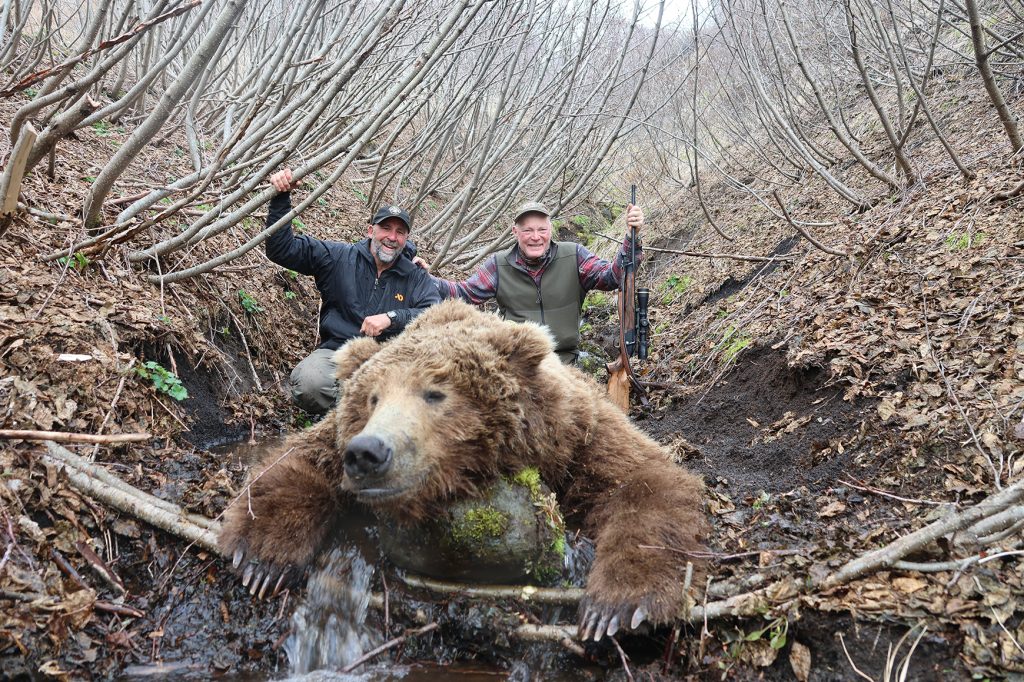
This past May, on the southern tip of the Alaska Peninsula, guide Dave Dye and I had a stalk on a big brown bear go awry. We went up a ridge and there was our bear. We were trapped in tall alders and the bear was a couple hundred yards above us, and there was no option to take a rest. I fired, we heard my bullet hit, and Dave knew what to do. We kept shooting, and we got the bear.

Guide Dave Dye and Boddington with Boddington’s big Alaskan brown bear, taken in thick alders. Several shots were fired, but they got the bear.

Leave a Comment

Nine Years in a Row!

Sports Afield is once again recognized as one of the top brands in the world.

For the ninth consecutive year, Sports Afield has had the prestigious honor of being chosen as one of License Global magazine’s Top Global Licensors. As the foremost publication in the brand-name industry, License Global meticulously curates a list of the most influential global brands annually. This year, 2024, we are thrilled to announce that Sports Afield has once again made the cut, solidifying our position among the industry’s elite. The entire team at Sports Afield is proud of this achievement, and we sincerely thank our loyal supporters for their unwavering trust and continued patronage.

Our dedication to providing exceptional products and experiences remains steadfast, and we look forward to scaling new heights in the years to come. This recognition is not just a testament to our hard work and innovation, but also to the enduring bond we share with our community. As we continue to push the boundaries of excellence, we remain committed to upholding the values that have made Sports Afield a trusted name. The future holds exciting prospects, and we are eager to embark on new ventures that will further enhance the legacy of the Sports Afield brand.

Leave a Comment

Three-Seven-Five

It’s the world’s most versatile big-game cartridge.

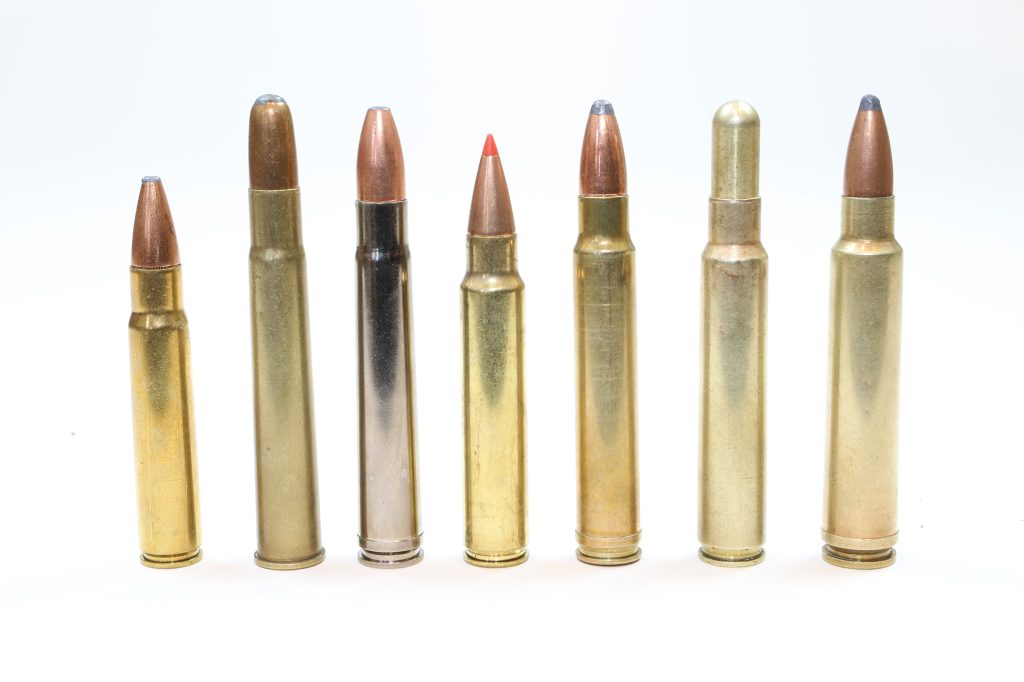
Photo above: Nobody talks a lot about .375 accuracy because the caliber is typically used for larger animals, and because recoil makes tight groups difficult. But accuracy is usually excellent, as this .375 RUM shows with several different loads.

For worldwide use on game of all sizes, it’s hard to imagine a complete rifle battery that lacks a .375. To be fair, we could lump the .375 with its European equivalent, the 9.3mm (.366-inch). There’s not enough difference in bullet diameter or weight to make serious arguments. However, in the English-speaking world, the .375 is dominant. The 9.3mm, despite its merits, is little known.

Legend has it that Holland & Holland introduced the .400/.375 Belted Nitro Express in 1905 as the answer to the 9.5x57mm Mannlicher. That’s unlikely, because the 9.5 didn’t come out until 1908. The excellent 9.3x62mm Mauser, designed by Otto Beck, also came out in 1905. It took off, and it remains the most popular 9.3mm cartridge. The .400/.375 was the world’s first belted cartridge. Underpowered, it didn’t catch on. H&H apparently believed in the .375-inch bullet. So in 1912 they tried again with the .375 H&H Magnum: same diameter, larger case. The belt was retained as a headspacing index, which was essential with the new cartridge’s tapered case and minimal shoulder.

Although the magnum suffix connotes “larger and more powerful,” it wasn’t applied strictly for sales hype. “Magnum” comes from the French term for an extra-large bottle of champagne. In the staid British gun trade, magnum was only applied to a more powerful cartridge using a bullet diameter previous to that firm. So, rival firm John Rigby’s .350 Rigby Rimless Magnum, following the .400/.350, was termed magnum. The .416 Rigby was not, because it was the first .416-caliber cartridge. Since it followed the failed .400/.375, the .375 H&H was a magnum by all definitions.

To this day, the .375 H&H is one of the world’s most versatile cartridges. It is fast enough and flat-shooting enough for use in plains and mountains, and powerful enough for the world’s largest game. Sure, it has more power than is needed for most game, but it gets the job done. I always argue that the .375 is marginal for elephant, hippo, and rhino. However, it’s on the correct side of the margin, and gets those jobs done as well. Also, it is “street-legal” for the largest game.  

Current .375 factory cartridges, in ascending order of velocity: .376 Steyr, .375 Flanged, .375 H&H, .375 Ruger, .375 Wby Mag, .375 RUM, .378 Wby Mag. All are effective, but recoil goes up sharply with velocity. The .375 H&H and .375 Ruger are the most likely choices for most shooters.

Despite its versatility, the .375 is perfect for just a few species. Lion, eland, and the biggest bears come immediately to mind. I almost included buffalo, but held back. The .375 is just fine for big bovines. However, the “lower .40” cartridges are probably more ideal for Cape and water buffalo.

So, which .375-caliber cartridge should you choose? Initially, there were just two: the .375 H&H Magnum and its rimmed counterpart, the .375 Flanged Magnum. The original belted magnum loads were: 235-grain bullet at 2,800 fps; 270-grain bullet at 2,650 fps; 300-grain bullet at 2,500 fps. The rimmed or “flanged” version was downloaded slightly to reduce pressure in doubles–likely not enough for any buffalo to notice. Some new doubles are so chambered, but the .375 Flanged is mostly seen in older rifles. 

The 235-grain load has gone by the wayside, and current .375 H&H loads are faster. Standard velocities today: 2,530 fps for the 300-grain load; 2,690 fps for the 270-grain load. Trajectory of the latter load is about the same as 180 grains in the .30-06. Careful handloading and/or modern loads (such as Hornady’s Superformance) can increase .375 H&H velocity by 100 fps or so. Again, no buffalo is likely to notice.

Yielding something over 4,000 ft-lbs, performance of the .375 H&H on large game remains a gold standard. That said, with increased case capacity .375 bullets can be pushed faster, flattening trajectory and increasing energy yield. The simplest way is to ream out the .375 H&H chamber, removing body taper. In the 1950s, my uncle Art Popham took all his dangerous game with a .375 Improved. Developed in 1944, Roy Weatherby’s .375 Weatherby Magnum is the most common version. The .375 Weatherby Magnum increases velocity by as much as 250 fps, increasing energy yield to more than 5,000 ft-lbs, much the same as the .416 Rigby and .416 Remington Magnum.

In 1953 Weatherby one-upped himself with the .378 Weatherby Magnum, sort of a belted version of the .416 Rigby case. Velocity is sizzling, pushing a 300-grain bullet to 2,900, a .270-grain bullet well over 3,000, with energy yield up to 6,000 ft-lbs. Remington’s .375 RUM was introduced in 2000. In case capacity, the RUM lies between the .375 and .378 Weatherby Magnums. So it’s fast and flat, developing well over 5,000 ft-lbs. The two Weatherby cartridges and the RUM are the only “fast .375” factory cartridges, but there are numerous fast and faster wildcats and proprietaries.

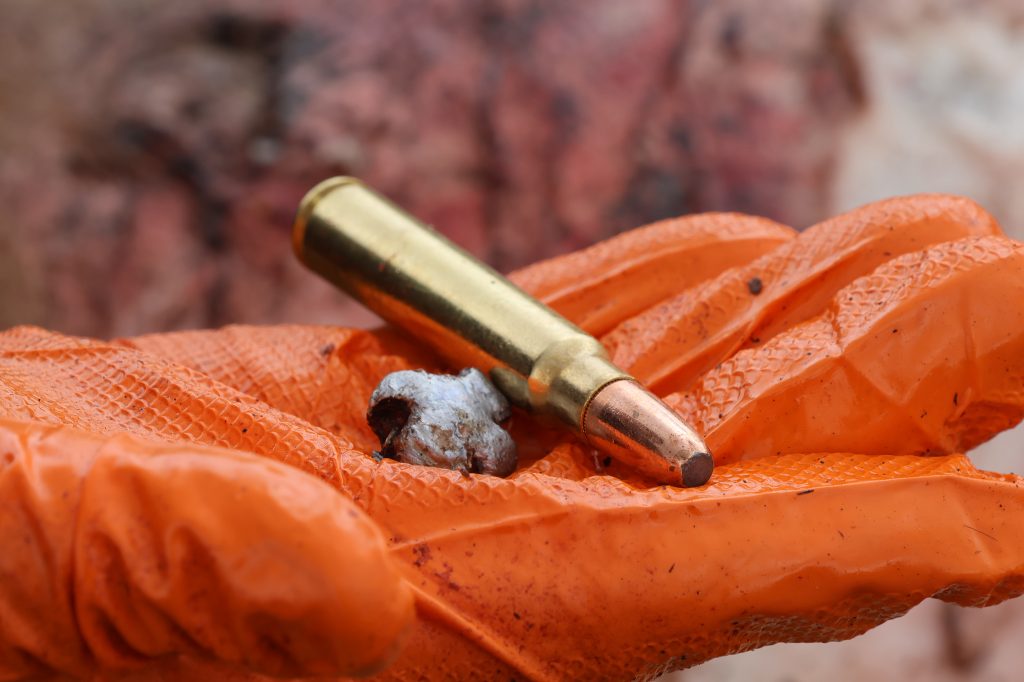
The .375 Ruger isn’t offered in nearly as many loads as the .375 H&H, but the few options are good. This 300-grain DGX Bonded was recovered from an Alaskan brown bear.

If a little .375 velocity is good, a lot must be better, right? To a degree. When you step up from the .375 H&H, the biggest problem is recoil. I find the .378 Weatherby Magnum one of the worst-kicking rifles on the planet, hitting you fast and hard. I haven’t hunted with it, but I’ve hunted quite a bit with both the .375 Weatherby Magnum and .375 RUM. The performance is there. It seems to me both cartridges perform on buffalo much the same as the .416s. That makes sense, because energy is similar.

This is good, but the cost is high. With added velocity, muzzle energy goes up exponentially. So does recoil. The .375 RUM and Weatherby Magnum produce up to 80 ft-lbs of recoil, about double .375 H&H recoil. I loved the raw performance of the fast .375s, but I gave up on them as too much of a good thing, especially since .375 H&H-level performance has been demonstrably adequate since 1912. The beauty of the .375 H&H is that it’s shootable. It kicks, but most people can learn to handle it. The fast .375s aren’t fun, and many people have trouble shooting them well.

Most of the .375s are suitable choices for one-rifle safaris, effective for everything from tiny antelopes on up. The African context magnifies the recoil issue. It’s one thing on a one-species American hunt; it’s another to take fast .375 RUM or Weatherby Mag to Africa and shoot it every day. After a ten-year fling across several safaris, I abandoned the fast .375s twenty years ago. If their performance were essential, I’d deal with the recoil, but in my experience, it is not.

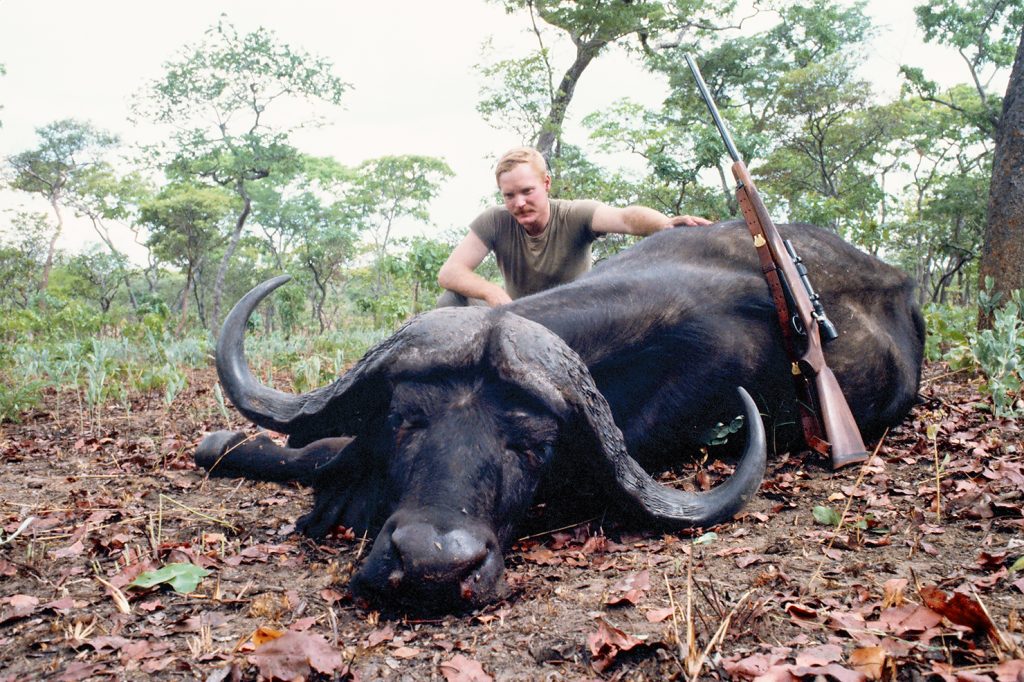
Boddington’s first “big” Cape buffalo, taken in 1984 with a .375 H&H. Because of a bad experience on his first safari, Boddington questioned the efficacy of the .375 on buffalo for years. He was wrong: Shot placement is everything, and the .375 is plenty of gun.

The .375 H&H is not the only shootable .375. The .375 Winchester, introduced in 1978, is a potent cartridge, with performance like the old 9.5×57 Mannlicher and .400/.375. All three of these were effective short-range cartridges for medium game, lacking in power for larger stuff. All three are pretty much dead.

Recent .375 cartridges include the .376 Steyr (1999), and .375 Ruger (2007). The .376 Steyr was developed to fit Jeff Cooper’s “Super Scout Rifle” concept: Short and light, with a forward-mounted scope, yet capable of handling larger game.  I’m not much on the scout rifle thing, but the .376 Steyr is a capable cartridge, shooting a 270-grain bullet up to 2,600 fps, producing 4,000 ft-lbs of energy. It has less recoil than the .375 H&H, yet still legal worldwide for the largest game. My wife, Donna, has one built by MGA on a Remington action in Cerakote and synthetic, and it’s a great rifle. Last time we were in Mozambique, she took it to the swamp and dropped a good buffalo with one shot.

The only thing about the .376 Steyr: It is not popular. Ammo is scarce, and its case is based on the 9.3×64 Brenneke, which is rare in the US. The idea was a lighter rifle for Donna, yet with less recoil than a too-light .375 H&H. MGA’s Kerry O’Day suggested building her a 9.3×62. I insisted on the .376 Steyr. We are happy with the .376 Steyr and we have plenty of ammo, but I concede he was right.

Available worldwide, the H&H is the most popular .375 cartridge. The Hornady-designed .375 Ruger is a not-so-distant second. We first saw it while filming Tracks Across Africa in 2006 and spilled the beans prematurely, resulting in an a shockingly successful release. Since then, sales have cooled but remain steady. Based on a brilliantly simple new case, the .375 Ruger uses the .532-inch rim and base diameter of a belted magnum—without the belt—thus increasing case capacity while using standard belted magnum bolt face and magazine. Case length is 2.580 inches, housed in a .30-06-length action. The H&H’s 2.85-inch case requires a full-length action.

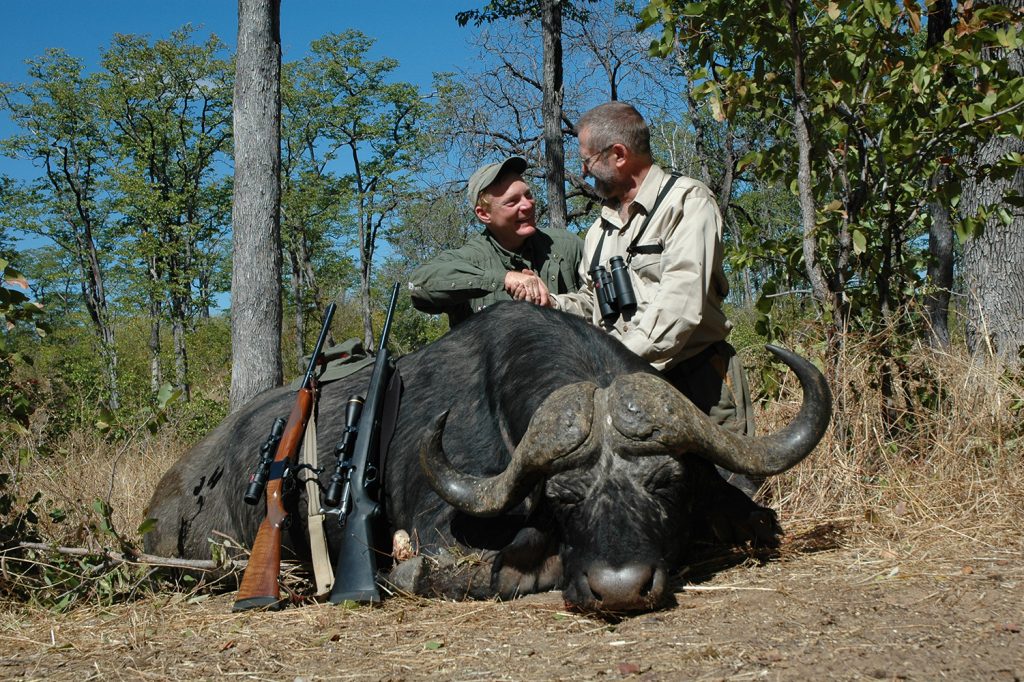
Boddington and Steve Hornady in 2006, with the first buffalo taken with the then-new Hornady-designed .375 Ruger.

The .375 Ruger has found favor with manufacturers who don’t make .375-length actions. In platforms such as the Savage 110, Mossberg Patriot, and Ruger Hawkeye, the .375 Ruger is now the world’s most available and affordable dangerous-game rifle. I used a Mossberg Patriot in stainless and laminate on my polar bear hunt, and it was perfect for the Arctic. Just a month ago I was in a spike camp for brown bears on the Alaska Peninsula. There were two hunters, two guides, and a packer, with five rifles between us. Three were Ruger Hawkeyes in .375 Ruger, plus a Gunwerks in .375 Ruger. I was the lone holdout; I carried a .338 Winchester Magnum.

The .375 Ruger’s modern, unbelted case fits in a shorter, lighter action with shorter bolt throw than the .375 H&H. Absent body taper, despite its shorter case it offers 4 percent greater case capacity than the H&H. Add the efficiency of the shorter, fatter case, and the .375 Ruger exceeds the .375 H&H by about 150 fps, obviously delivering more energy. This is not enough of an increase to create excessive recoil, nor put it in a different power class. However, be careful with a .375 Ruger: You don’t want it in too light a rifle! 

The choice today depends largely on the rifle platform you prefer. Since 2007 I’ve used both. There’s nothing the H&H will do that a .375 Ruger can’t do, and vice versa. Being a bit of a nostalgia freak, I suppose I prefer the .375 H&H. I doubt the .375 Ruger will become more popular than the H&H, nor offered in as many loadings from as many sources. But I concede that, in all the ways I can think of, the .375 Ruger is a better cartridge.

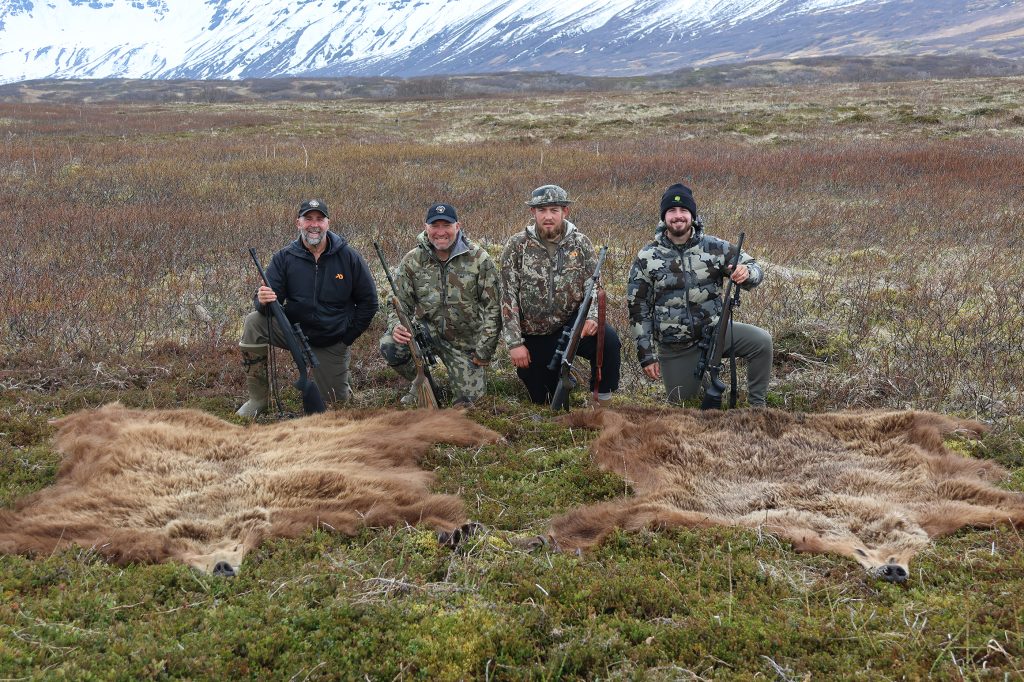
Spring bear camp in Alaska, May 2024. Left to right: Dave Dye, Pete Mayall, Austin Pierce, and Matt Balis–all four carrying .375 Ruger rifles. The .375 Ruger is not as popular as the .375 H&H, but it is more common than one might think.

Leave a Comment

The Moose Mecca

A fly-in wilderness hunt in British Columbia with his father four decades ago still sparks wonderful memories.

Oh, how the years have slipped away. More than forty years have passed since that frosty morning in late September found us transferring our hunting gear and supplies from the back of Dad’s pickup to a small bush plane on a gravel landing strip in a remote area of northern British Columbia. This would be my dad’s first real wilderness hunt.

It had been a hard sell, convincing my dad to accompany me on a wilderness hunt, especially when planes were involved. He hated flying, even in big commercial jets, so when he looked at the little single-engine plane perched on its big “tundra tires,” I could see he was more than a little distressed. Thinking it was probably best not to give him too much more time to dwell on the situation, we quickly loaded our gear and stuffed him in the plane.

Our family tended to be a pretty tough crowd, where good-natured ribbing was the norm, and any chance to get a dig in was rarely squandered. Realizing that I had a rare opportunity before me, I pointed at the fabric skin of the fuselage, and poked it with my finger. My dad watched as the skin moved in and out with the pressure of my finger and I said, “Huh…it’s cloth!” At that moment the engine roared, and we were off.

About 45 minutes later we circled the drop-off point high in the Northern Rockies and the pilot set the plane down as pretty as you please on a gravel bar next to a crystal-clear mountain stream. We quickly unloaded the gear and minutes later the little plane departed. We were alone in God’s country, with nine days of hunting ahead of us.

You must remember that when this hunt took place and the plane left, you were on your own. There were no cell phones, no GPS, no satellite phones for the working class. If something went wrong you had to tough it out until the plane flew back to get you…weather permitting.

The main purpose of our hunt was to target a couple of the big bull moose that northern British Columbia is famous for, but I had also purchased sheep, mountain goat, and grizzly tags just in case an opportunity presented itself. In those days big-game draws were rare and most big-game licenses were available over the counter.

We quickly moved all our gear up into a small clearing about a dozen feet above the creek and set up camp so that we could do a bit of scouting and glass the area, and make a battle plan for the next day. Our hunt had been planned to hit the rut, and it was obvious we had timed things perfectly, as we soon located fresh rubs and several fresh rut pits within a few hundred yards of our camp.

I climbed up onto a small knoll a quarter-mile downstream and immediately noticed a small lake set back into the spruce trees a short distance away. It looked like an ideal place to hunt the next day, and my suspicions were quickly confirmed when I raised my binocular and a couple of dark spots on the lake’s shoreline turned into two cows and a decent-sized bull.

The scenery was absolutely breathtaking, and I could tell my father was suitably impressed as he took it all in. Our glassing didn’t turn up any more moose, but we did see a herd of about 30 mountain goats on slope a couple of miles upstream, and a bunch of stone sheep in a small basin directly above us. It was a heck of a good start for our first day in what appeared to be a hunter’s Shangri-La.

Back at camp we spent an hour gathering firewood to last a few days and as the light faded, we cooked a couple of steaks over the coals of the fire and got our gear ready for the next morning. Later we enjoyed a sundowner next to the fire and listened to a couple of wolves howl in the distance. Anticipating the next day could be a busy one, we hit the sack early.

The thermometer tied on my pack read 25 F the next morning, as I crawled out of the warmth of my sleeping bag. The little Coleman stove soon had the coffee perking, and we quickly downed a greasy breakfast of bacon and eggs, grabbed our rifles and day packs and headed off toward the little lake we had found the previous evening.

As we got closer to the lake, I marveled at the moose trails that were two feet deep in places, and all of the fresh sign indicated that the area had to be absolutely filthy with moose. So, not unexpectedly, when we were a few hundred yards from the lake I could see a couple of moose on the shoreline ahead, so we stopped and carefully glassed the area. A couple of moose soon turned into eight moose, including three bulls, a decent bull with a spread in the high 40s, and two young satellite bulls whose rutting enthusiasm made up for what they lacked in the antler department.

As it was our first morning and it was obvious there were a lot of moose In the area, we backed quietly out of the area and spent the rest of the day exploring and glassing. Toward the end of the day, we spotted a big bull about half a mile in the other direction from camp. It was too late in the afternoon to try and get closer, so we called it a day and headed back to camp.

The next morning, we decided to split up as my dad wanted to try and get a better look at the bull we had spotted the previous afternoon, and I would make my way back down to the little lake. We would meet back at camp after the morning hunt and make a plan, which would hopefully involve quartering a bull.

Now familiar with the route, it didn’t take long for me to sneak back to the lake. Once again, there were a few moose puddling around at the edge of the lake, including several cows and calves, and the two young bulls we had seen previously. I did not see the bigger bull, but I could hear the odd twig break and saw flashes of movement back in the spruce trees. I waited for a bit to see if the other moose would move out to where I could get a glimpse of them, but nothing happened, so I decided to call and see if that got any reaction. I let go with a couple of grunts and instantly had a bull reply and could hear it moving in my direction. I saw the flash of a palm and figured it was probably the bigger bull from the previous morning, but out came a different bull, a bigger bull.

This bull had nice wide palms, lots of points, and was definitely over 50 inches, so I wasted no time in sending a Partition on the way. The Nosler did its job, punching through both lungs and, in true moose fashion, the bull thought about things for a few moments and then did a slow-motion pirouette and toppled to the ground. 

After gutting the bull, I made my way back to camp and found my dad was already there and had made some lunch. He had seen the bull he was looking for and decided he would take it, given the opportunity, as it was an older bull with antlers that carried a lot of mass. Unfortunately, the bull was way up the side of the mountain and would be too difficult to pack out, so when he heard me shoot, he decided to head back to camp. 

We spent the rest of the day quartering my bull and getting the quarters out and hung in some trees near the creek. In the evening, we decided to try calling the bull my dad was after. Perhaps we could convince it to move closer to the creek, where packing the big ungulate out would be less onerous.  

The following morning was crisp and clear, and felt very moosey. As luck would have it, not two hundred yards from camp stood a nice big bull on the gravel bar the plane had landed on. It was a nice big bull with heavy antlers and my dad was pretty certain it was the same bull he had been focusing on. Moments later the big bull was down, and our moose hunting was officially over.

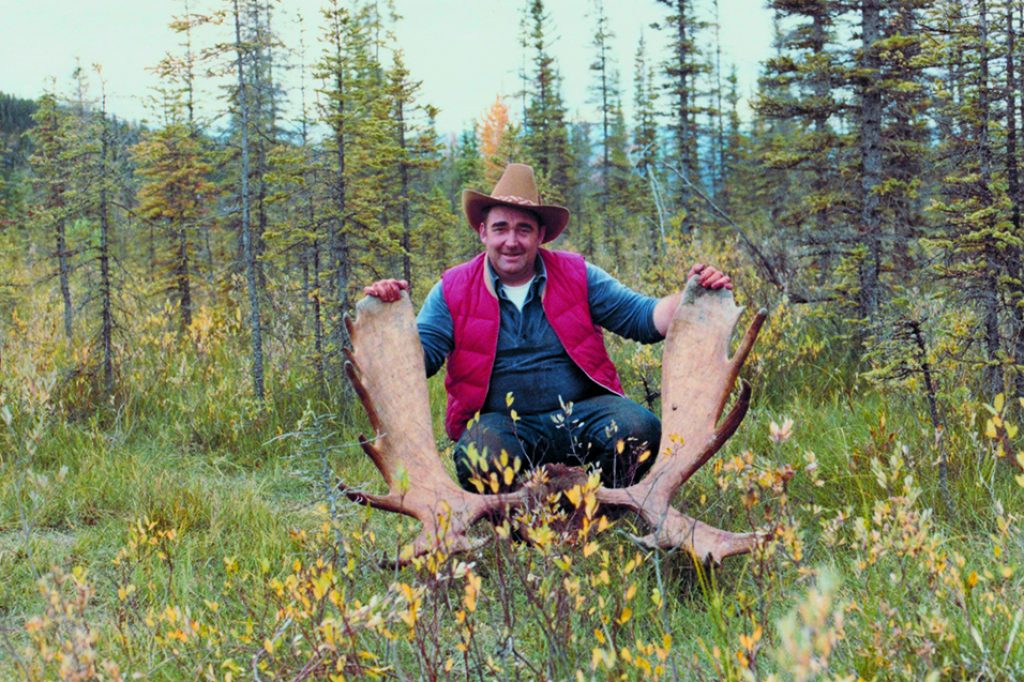
The author’s father with the antlers of his old bull. His moose was later aged at fourteen years.

 We spent most of the next day cleaning up the quarters of our two bulls and bagging them with cheesecloth. In the late afternoon we did a bit of fishing and caught a couple of nice trout for dinner. After doing the dishes we made ourselves a drink and sat around glassing. I looked at the ridge right above camp and was just in time to count seven Stone rams as they walked over the top and into the basin behind. I knew exactly what I would be doing in the morning.

We left camp at first light, and after about three hours of steady climbing we made it to the ridge above camp. Using some big rocks as cover, I peeked into the basin and could see the rams were bedded down in the shale on the far side. With my spotting scope I could tell that two of the rams were legal full curls and decided to go for it.

My dad decided he was not up to any more climbing and said he would stay behind while I attempted the stalk. Not wanting him to overdo it, I said that was absolutely okay, as sheep were small, and I could easily handle the pack out with the horns and meat if I got lucky.

The stalk was pretty much textbook. I dropped down below the ridgeline and then circled around the backside of the basin, checking periodically to make sure the rams had not decided to move and to keep track of where I was. I pinpointed a specific bump on the ridge that appeared to be above where the rams were bedded and when I figured I was in the right spot I slowly inched up and peered over the edge.

The rams were still there, bedded down and looking off across the basin. I figured they were about 250 yards away, but I would have to wait until they stood up before shooting. The two legal rams were about the same size, but the one ram had the classic Stone sheep coloring with a light-colored head and upper neck, with dark shoulders. That was the ram I wanted, so I settled in with a good rest and waited for the ram to get up.

I only had to wait about fifteen minutes before the rams started to fidget and they began to get up. When my ram stood, I was ready, and when the .300 Weatherby barked he dropped and slid a few feet in the shale and stopped. His companions paused for a few seconds and then trotted off around the basin and disappeared over the far ridge.

I had my first sheep. Dad couldn’t complete the stalk with me, but when I got back to him with a pack full of meat and the lovely amber-colored horns, I found out that he had been able to watch the whole thing go down through his binocular.

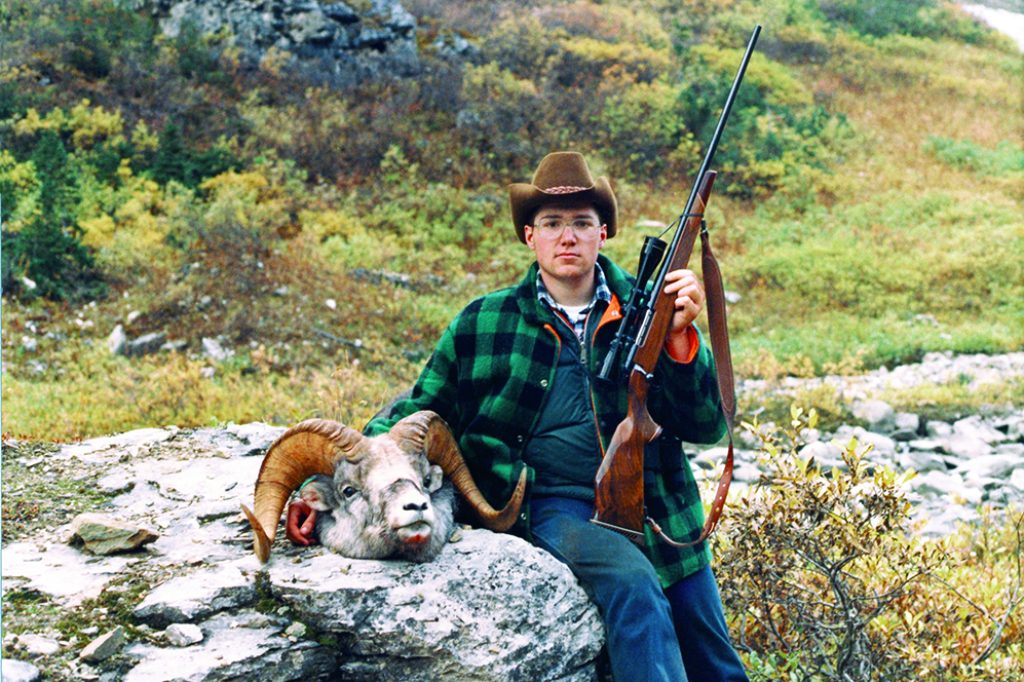
The author with his Stone ram, taken at the end of the hunt.

I spent the next day skinning, fleshing, and salting the cape of my ram and that evening we had an extremely memorable meal of sheep ribs cooked over the coals of our fire. It was an outstanding meal and one that neither of us would ever forget.

As luck would have it, the pilot dropped in the next day to check on us and see how we were getting along. Sadly, the pilot said that there was a chance the weather was going to change, with rain and flurries a possibility. Since a couple of extra flights were needed to get us and all of the moose meat out, the prudent course of action would be to do the flying while the weather was still decent.

It was a fantastic hunt, but at the time I certainly had no way of knowing that some forty-plus years later I would be looking back and considering it to be my greatest hunt. Getting a Stone ram on my own certainly rates right up there as one of my best hunts, and my dad and I both taking a big bull moose on the hunt would have been a fantastic hunt in and of itself.

As the years have gone by and life’s unexpected challenges and curve balls have occurred for both of us, as they do for everyone, my perception of that hunt we shared together has changed. The experience also taught me that you should never put things off to do in the future, because you simply do not know what the future holds.

My father passed away two years ago. After that great hunt we shared, he never again went on another true wilderness hunt, and it was really the last time that we got to share that sort of experience together, just the two of us. Time restraints due to career paths, and later, health issues that both of my parents had to deal with, combined in such a way that they prevented any further opportunities for us to experience another hunt together, let alone another hunt of that magnitude.

I have been on lots of great hunts, and I hope I have a few more ahead of me. But for now, at least, I must rate that hunt with my father all those years ago as my greatest hunt.

Leave a Comment

HATS Off to Outdoor Stewards

The Outdoor Stewards of Conservation Foundation is working to improve public perceptions of hunting and shooting.

Image above: The “Fill a Bag while Filling your Tag” initiative encourages hunters to pick up any trash they find in the field as a way to bolster our image as responsible stewards of the outdoors.

Hunters, anglers, trappers, and recreational shooters are the backbone of conservation in North America. We know this, but most of the rest of the world does not. And that may be part of the reason that the public’s attitude toward what we do is trending more toward disapproval all the time.

“Hunters and shooters are good at a lot of things, but we are not good at communicating what we do,” said Jim Curcuruto, Executive Director of the Outdoor Stewards of Conservation Foundation (OSCF). 

The decline in cultural acceptance of hunting and shooting is a huge potential problem for the future of our outdoor traditions, and that’s the reason Curcuruto launched OSCF, a 501c3 nonprofit organization. Its mission is to work with all facets of the outdoor industry to improve the public’s perception of traditional outdoor pursuits using research-based communications and engagement programs. 

Curcuruto’s decade-plus stint leading research, market development, and recruitment efforts for the National Shooting Sports Foundation (NSSF) gave him a close-up look at the problem and spurred him to start OSCF in 2021. While the majority of non-hunters are still not overtly opposed to hunting, a survey in 2023 conducted by OSCF and Responsive Management showed an alarming 4 percent decline in the general public’s approval of these activities. 

OSCF is working to buck this trend by publicizing and celebrating all the good things done by hunters, anglers, trappers, and shooters, which it refers to with the shorthand HATS. “It was definitely time for an organization dedicated to promoting everything that we do,” he said.

OSCF has several major initiatives. First and foremost is “Connecting with Conservation,” a communication program formed with a wide range of industry and agency partners to spread the word about how conservation is funded in America. Through a series of professionally produced videos and social media postings that can be used and shared, OSCF explains how HATS fund conservation through excise taxes and license fees. 

Further, through its newly formed Outdoor Industry Communication Council (OICC), OSCF is working to amplify these communications efforts through coordinated partnerships with outdoor gear manufacturers, state fish and wildlife agencies, and conservation groups. Curcuruto points out that all these entities share the common goal of increasing participation in hunting and angling, but they rarely work together. The need for coordinated messaging was recently recognized by the Association of Fish & Wildlife Agencies and the US Fish & Wildlife service, which awarded a multistate conservation grant to OSCF to develop an integrated communications strategy to educate the masses on conservation topics. 

Through this, OICC has made available a series of free articles written by professional outdoor writers that they are encouraging their partners to reprint and share on websites, social channels, e-newsletters, podcasts, and printed publications.

Articles available for immediate distribution include an overview of the outdoor industry’s $80 billion economic impact, details of the 400,000 American jobs that are created or sustained by the outdoor industry, and how a single hunter’s seasonal purchases help fund wildlife management. Additional features profile a production-line manager at a firearms manufacturer, how to get started in recreational shooting, and how to recruit the next generation of hunters and target shooters. 

OSCF is also currently developing public service announcements that explain how conservation is funded. These 60-second and 30-second TV spots will be provided to 11,000 TV stations in a pilot project this year.

A second OSCF initiative, “Fill a Bag while Filling your Tag,” focuses on the unsung ways that HATS are stewards of nature. “So many hunters and anglers pick up trash when they’re out in the woods,” Curcuruto said. “In fact, 80 percent of HATS say they clean up nature on a regular basis, versus 60 percent of general outdoor users.” 

OSCF works with its industry and agency partners to distribute reusable, biodegradable bags all over the country, encouraging people to take the bags with them while out hunting, fishing, trapping, or target shooting and use them to take out any trash they find while outdoors. Bags are preprinted with messages that ask HATS to post photos or short videos of themselves with their bag and trash to their social media accounts to show others who the true stewards of conservation are. (Posters should include the hashtag #TrophyTrash to be tracked on social media sites such as Instagram.) It’s another way to bolster our image as responsible, caring stewards of the outdoors.

The third initiative, which OSCF calls, “Come With!” is a challenge to all of us to invite someone new to come along with them to the range, field, or lake. Millions of dollars have been spent by agencies and organizations over the past decade trying to figure out how to recruit new hunters and anglers to our ranks, but Curcuruto says it all boils down to a very simple concept.

“The number-one way to recruit new people is not through a youth program—it’s to have somebody who is experienced in outdoor pursuits invite someone who isn’t experienced,” said Curcuruto. “Some 25 million Americans say they have an interest in these pursuits—they are just waiting for someone to invite them.”

To learn more about OSCF’s work, or to donate and receive a “Trophy Trash” bag, see outdoorstewards.org.—Diana Rupp

Leave a Comment

Spring Bear Hunting

Black bear hunting is available, affordable, and typically successful. But bears are tough to judge!

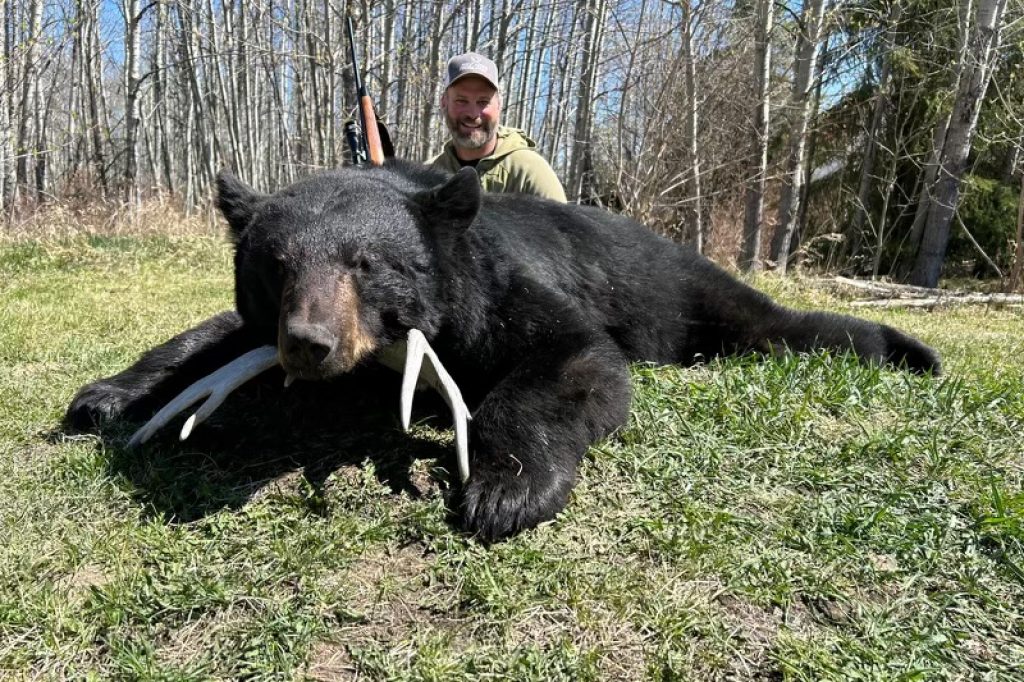
Photo above: This bear has all the hallmarks of a big boy: The head appears small, legs seem short, body is ponderous, ears seem wide apart on the skull.

For many hunters, spring is about turkeys. And as I wrote last month, for European hunters, spring is about roebuck. For me, though, spring is about bear hunting. Primarily black bear hunting, because the hunts are widely available, affordable, and highly successful. Early in spring, only the big boars are out of their dens. Now, in June, they’re all out. This time of year, we have to be careful to watch for sows with cubs, which may be hidden back in the brush a bit. But the advantage of hunting in June is that the boars are getting amorous.

This is the first spring in several that I haven’t gone black bear hunting. I’m missing it, but don’t feel sorry for me; I’m in Alaska looking for a big brown bear. Honestly, I have no great reason or excuse to take another bear of any kind. But I like bear hunting; it is interesting and exciting. I expect this to be my last hunt for a brown bear, but I’ll do more black bear hunting. What’s not to like about a hunt that is so available, affordable, and typically successful?

Everybody wants a big bear, of course. And everybody wants a beautiful bear. June is a great time to hunt, but the older boars have been out for a while. Especially if the weather is warm, some hides are rubbed. This is not always easy to see, especially in poor light; you just have to look as close as you can. If the fur looks patchy and thin, it may be a giant bear, but it may make a poor rug.

Personally, I like black bears that are black. Maybe this is because I’ve shot brown and cinnamon-colored black bears. Maybe it’s because I’ve shot brown/grizzly bears that are anything except black. I don’t know; to each his/her own. The various color phases of black bears are exceptionally beautiful, and many bear hunters are crazy for them. However, you can hunt black bears for size or color, but it’s difficult to do both with equal results.

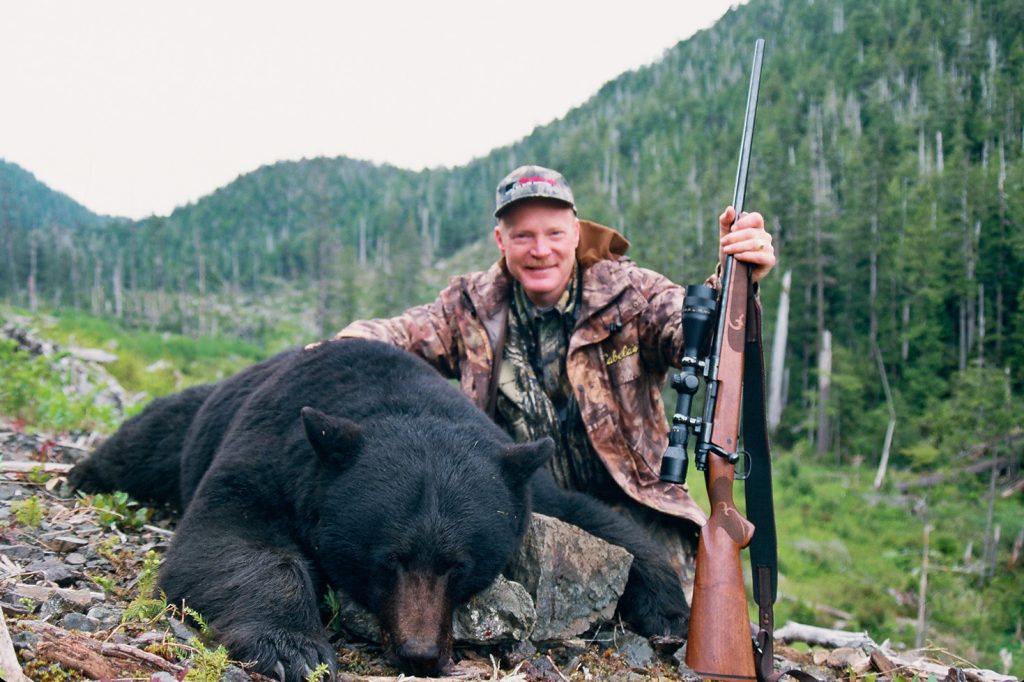
A good black bear from Vancouver Island. Although color-phase bears are fairly common on BC’s mainland, they are extremely unusual on the island.

In a perfect world, I like two-bear areas. With black bears, unlike most North American big game, there are lots of multiple-bear areas, including parts of Alaska, several Canadian provinces, and northern Idaho. I’ve been skunked many times on hunts when I would have been delighted with one chance at one bear. But let’s enjoy our perfect world: For many, a perfect black bear hunt would be to take one big black bear, plus a pretty, color-phase bear.

I shot my first black bear in Montana in the spring of 1973; it happened to be a beautiful, brown-colored bear. Since then, I’ve taken two bears in two-bear areas, one bear in one-bear areas, one bear in two-bear areas, and no bears at all in both one and two-bear areas. All multiple times. I don’t go every spring, but I like black bear hunting. But in fifty years of black bear hunting, exactly once have I taken a black-colored black bear and a color-phase black bear on the same hunt. That was with Trapper Don McRae in northern Manitoba, some forty years ago. 

My young Kansas friend Michael Persinger, cousin to my neighbor and whitetail partner Chuck Herbel, was recently headed to Alberta on his first black bear hunt and first-ever guided hunt. He was apprehensive; nervous about hunting with a guide, nervous about bears. Understand, Kansans don’t live with bears; all we know about bears is the scary horse-pucky. Well, he had his Dad’s Remington M700 .30-06, won in a raffle in 1985. His Dad wasn’t a hunter, so it was still a new gun, broken in on Michael’s first Kansas buck. The .30-06 is not a big gun, but it’s plenty for any black bear that walks, especially when hunting over bait, where shots will be close.

So he was well-armed, and headed to a good two-bear area, hunting with Red Willow Outfitters in central Alberta. He told his guide, Taylor, “I really hope to get a color-phase bear and a big black bear.” Well, who doesn’t? The outfit must know what they’re doing, because Michael’s black bear measured 7 feet 4 inches, an awesome bear with a big skull.

In May 2024, Michael Persinger hit the jackpot on a hunt in central Alberta with this huge black bear… but it was a two-bear area, and he wasn’t done hunting.

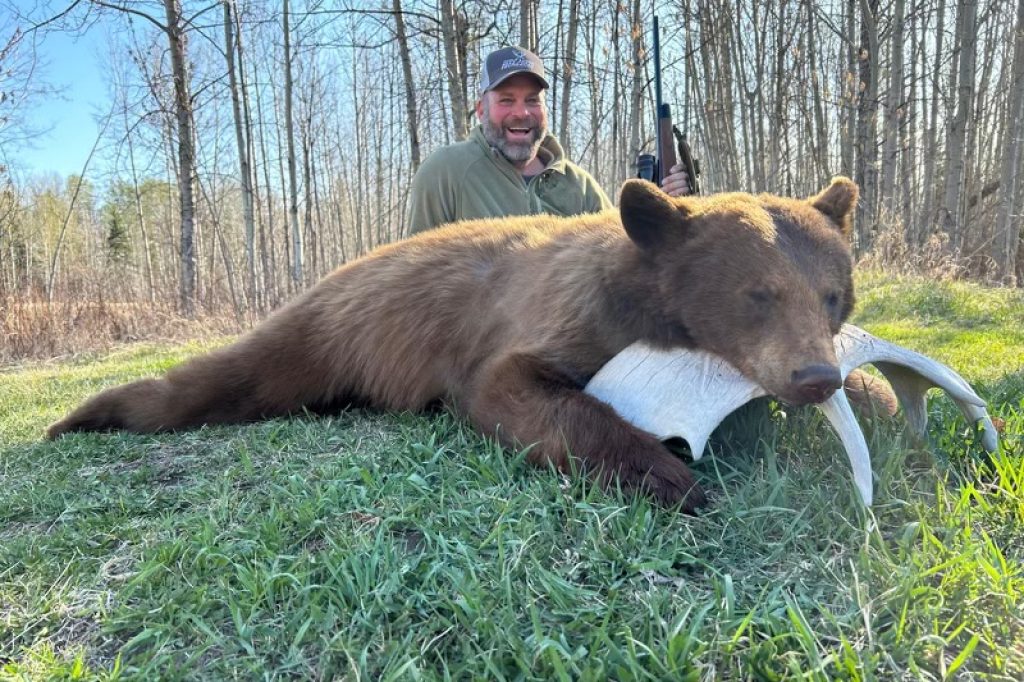
Then he took a beautiful, red-colored bear, not a small one. He might do a lot of black bear hunts in a lot of places and not do that again.

Michael Persinger with his exceptional cinnamon-phase bear, taken on the same hunt as the big black bear pictured above. On one hunt, this doesn’t happen often!

Big black bears are difficult. They exist wherever black bears occur (which is now almost continent-wide) but the biggest problem is to judge them. Even after fifty years, knowing full well what a big bear looks like, I still make mistakes. We’ll come back to that. Color phases are perhaps even more difficult than big bears.

Black bears occur in a wide color spectrum. Brown, blond, tan, red, and cinnamon bears probably occur almost anywhere black bears exist. The white (also called Kermode or “spirit”) black bear is mostly confined to the Queen Charlotte Islands. The “glacier,” or blue-gray, color phase occurs rarely in the Yakutat area of southeast Alaska, and is almost unknown elsewhere.

The tan-red-brown phases are common in some areas, rare in others. Central Alberta, where Red Willow operates, has a high percentage of color-phase bears. Color-phase bears are plentiful in much of the Rocky Mountain West, on up into central Canada. But, glacier bears aside, color-phase black bears are rare in Alaska. They are not uncommon in British Columbia, but scarce on Vancouver Island. It’s spotty. Because I prefer black-colored black bears, I don’t know enough to suggest where color phases are common, or where they are unicorns. I do know the odds are better in some places than others.

In 2022 and 2023, I hunted in extreme northern Alberta, right on the NWT line, with Wally and Louisa Mack’s WL Guide Service. The hunt used a similar methodology to what Michael described: Bait barrels to judge size, stands set close to baits for dual archery/rifle use. Both years I hunted there, most hunters took two bears. I took two nice bears both years. I was part of a group, other parties overlapping, so in twenty days in Wally’s camp I saw thirty bears come into the skinning shed. Every single one was coal black! So that’s not the place to look for a color phase, although they take them occasionally and have seen them on trail cameras.

The other thing about color-phase bears that must be understood: They are usually not the biggest bears. There are exceptions, but there is radio-collar evidence that color-phase bears sometimes turn darker (black) at full maturity. Now, the North American black bear population runs into the low millions. Hunting pressure is generally light, and the bears are a major nuisance in some areas. So there are sound management reasons why seasons are long with multiple-bear options; and why, typically, any bear without a cub is legal game. Don’t second-guess it to death, just accept that color-phase bears are beautiful, but usually, they’re not huge.

It’s okay if you get carried away by the color, and there may even be an optical illusion at play: Light-colored bears look bigger. But all bears are difficult to judge. If you see a bear on a hillside, and then you see a basketball-sized black object beside her, that’s easy: it’s a sow with cub, so quit looking. See any lone bear on a hillside, though, and it’s tough. Sure, there are signs: Ears seeming wide apart on the skull, short legs compared to the body, small head compared to the body, ponderous gait, broad chest. All of that, and it’s still easy to get fooled.

Spot-and-stalk is one of the most enjoyable ways to hunt black bears, but probably the worst for properly judging a bear. On a distant hillside, they all look big at first, and are easy to misjudge.

The two most selective methods for hunting black bear are over bait, and with dogs. The former works because the bait barrel is the yardstick, or because actual yardsticks have been set near the bait. The latter works because the encounter is too close for error, and because the track has been seen before the dogs are released.

Otherwise, judging bears is an imprecise science. Guides and outfitters who take more bears in a season than most will in a lifetime have an edge; we amateurs cannot compete. However, judging a lone bear on a hillside is always fraught with risk. Absent a cub, it will be legal to take, but often it is not the bear you think it is. Even after fifty years of hunting black bears, I can say this: they all look big when you first see them.

Leave a Comment

Jim Green African Ranger Boots

If you’re looking for a good pair of boots for safari, take a look at what the professional hunters wear.

I had been searching for a pair of really good safari hunting boots for the last few years, but hadn’t found anything that impressed me. On my last Mozambique safari, my guide, Rye Pletts, was wearing exactly the type of boot I’d looking for and when I asked him the brand, he told me they were Jim Green boots. Later that evening, I noticed that almost all the PHs in camp were wearing Jim Greens, and everyone seemed pleased with them. Since guys who made their living hunting big game in remote areas had nothing but praise for these boots, I knew I needed to take a closer look at them.

Mark Haldane of Zambeze Delta Safaris put me in touch with Gareth Crouch, a third-generation shoe and boot maker from Pietermaritzburg, South Africa, and the managing director of his family’s Jim Green Footwear company. Prior to working in the boot-making industry, Crouch served as a game ranger and safari guide in Kruger National Park, so he had firsthand knowledge of how hunting boots should be made.   

In 1987, Gareth’s father and grandfather left the shoe factory where they worked and formed their own company, Crouch Footwear. Gareth’s father, Peter, and his business partner then founded a separate boot company in 1992 and called it Jim Green, after the frogs of the same name that are found along rivers in the Midlands Meander of KwaZulu Natal. Originally, Jim Green boots were built for farmers who needed a sturdy leather shoe that could last for years. Later, the company’s Razorback boots became the favorite footwear of miners and contract workers across southern Africa. 

In 2013, Gareth joined the company. He developed a social media platform to help spread the word about the company’s boots, but soon he realized that the brand needed to be available to more customers. 

“I approached my father about selling our boots on Amazon, and he told me that was a crazy idea,” Gareth said. “I did more research and went back to him after a month, but he still said no. After the third attempt, I decided I was going to go ahead and sell on Amazon anyway.”

Gareth purchased thirty to fifty Jim Green boots at a time with his own money and began selling them on Amazon. Eventually, he saved enough money to purchase 2,000 pairs of boots and shipped them in a container to the United States. Jim Green boots began to develop an international following, particularly among hunters. 

Gareth designed the company’s popular African Ranger boot and wore them for six months, making improvements to the design as needed. Once the African Ranger design was finalized, Gareth shipped sixty pairs of boots to rangers in Zimbabwe’s Gonarezhou National Park in Zimbabwe for a year-long trial. At the end of the test period, the rangers were so impressed they purchased 150 pairs. Gareth agreed to match their initial purchase, shipping an additional 150 pairs at no cost. 

“If shoe companies pay athletes to support their brand, we wanted to support rangers who often work behind the scenes,” Gareth said. Today, Jim Green continues supporting rangers by donating one free pair of Ranger boots to a game ranger for every ten pairs sold. To date, Jim Green has supplied more than 2,000 African game rangers with boots.

Jim Green boots feature attractive styling that make them suitable for everyday wear, but they are also rugged, high-quality boots with ample ankle support and a comfortable fit. The wedge-style rubber sole allows hunters to stalk quietly through the bush, even over dry leaves.

When Gareth sent me a pair of Ranger boots, I was immediately impressed. These boots support the foot and offer protection against thorns and rocks, yet they are more comfortable than most hiking shoes. Perhaps most important, the wedge-style rubber sole allows hunters to stalk quietly through the brush, even over dry leaves. They’re lighter than many competing boots, and the insole is stitched to the upper using double-stitched 2.2mm braided nylon cord. To further enhance durability, there’s a steel shank between the insole board and the sole, and heel and toe stiffeners offer additional support. The toe, heel, and eyelet areas feature a double layer of 2.2mm full-grain leather, and the hooks and eyelets are very heavy duty to stand up to years of hard use. 

I haven’t spent a full year in these boots like the Gonarezhou Rangers did, but my initial tests have been very impressive. These boots are extremely comfortable with ample support and a secure fit, and they’re the quietest stalking boots I’ve ever tested. Even after hiking several miles, there was no soreness or blistering, and they are suitable for rough, rocky terrain. Superior materials and excellent build quality ensure that these boots will last, and the attractive styling (complete with green laces and a signature Jim Green frog wearing a top hat and boots and holding a rifle and flag) make them suitable for everyday wear. 

After years of searching, I’ve finally found my go-to safari boots, and it’s good to know that the brand is reinvesting in conservation of African wildlife by supporting game rangers. In fact, I like these boots so much that I’ve just purchased a second pair. African Ranger boots are available in black, brown, and fudge colors and carry an MSRP of $169. There’s also a Cape buffalo skin version ($220) as well as an 8-inch version known as the AR8 that offers additional support ($209). For more information, visit JimGreenFootwear.com

Leave a Comment

Caribou of the Colville Country

A challenging and rewarding hunt in one of the most remote places on Earth.

The headwaters of the Colville River begin along the northern edge of Alaska’s Brooks Range, and from there the river runs north and east for about 350 miles before it spills into the Arctic Ocean west of Prudhoe Bay. Along its course the Colville, located entirely above the Arctic Circle, doesn’t pass anything resembling a town. When the river flows (it’s covered in ice for more than half the year), it passes through hundreds of miles of empty, treeless tundra. Researchers have named the confluence of the Colville and its tributary, the Etivluk River, the most remote place in all of North America. 

After ten hours riding upstream in a Zodiac loaded with caribou-hunting gear, I had no trouble believing this was indeed the most far-flung destination on the continent. Neal Emery, who worked for Hornady at the time, rode in the bow of the boat while I was draped across guns and equipment amidships and our nineteen-year-old guide, Geordy, manned the steering column from the stern. The din of the outboard motors made talking impossible, so I spent long hours searching the hillsides for mammoth tusks, which sometimes become exposed on cliffs along the river. 

The Colville–a river where it’s more common to see a woolly mammoth’s tusk than another boat. The term “remote” doesn’t accurately describe the area, a place where hunters watch as columns of storm clouds build up fifty miles away, with nowhere to escape and without a single tree under which to shelter. The storms march across the barren moonscape and dump cascading sheets of water on the huddled visitor before continuing toward the Brooks Range and the Alaskan interior. In the Arctic there’s no place to hide from the elements.

What draws hunters this deep into the tundra is the annual caribou migration. Beginning in August the Western Arctic caribou herd, which has spent the long summer days farther north around Prudhoe Bay, begins a southward migration toward the Brooks Range. If you’re in the proper place at the proper time you may see thousands of caribou in a single twenty-four-hour stretch, and there are accounts of unbroken herds passing by camps around the clock for days on end. 

By the time we reached our camp thirteen hours upriver, though, we had not bumped any big herds. In fact, we’d only seen a few caribou and a single wolverine rooting along the riverbank. Eventually we reached a gravel bar where three tents shuddered against the north wind.

Camp on a gravel bar in the Colville River country of northern Alaska.

Striker Overly’s caribou camp is situated on a gravel bar that’s just long enough for him to land his Piper Cub, and despite its remoteness the camp was well-outfitted. We were exhausted after the long ride, but in late August the light hung around until after midnight. I fell asleep on my cot to the sound of water rushing over the rocks in the braided river outside.

I was sharing my tent with fellow outdoor writer Tom Beckstrand. By the time I awoke Tom was gone, and I could hear boots crunching on smooth river stones and voices from the mess tent. The long boat ride and uninterrupted daylight had disabled my internal clock and I wasn’t sure if I’d slept an hour or ten, so I was relieved to learn that it was morning. 

There are two ways to hunt this section of the Arctic. The first and less fruitful method is to set out on foot, using the tops of the high rolling hills to glass for game across the tundra, but the vastness of the region (it might be two miles between glassing points) makes this grueling and generally unproductive. The second method is to run the boats along the Colville and its tributaries, find a patch of high ground, and glass for game. By boating from one glassing location to the next, it’s easy to cover larger tracts of land, and over each hill there might be a herd of a thousand caribou.

We didn’t find a herd of a thousand animals, but I did spot a single bull topping a hill on the horizon. Shawn Skipper from Leupold centered his spotting scope on the caribou, which was standing halfway up a slope and grazing on low-growing mosses and lichens. 

“He looks pretty big, but he’s 1,800 yards away,” Shawn said. He tilted his head down, studied the caribou, then looked at me. 

I didn’t bother to ask Geordy what he thought. An Alaskan hunting guide in his late teens, Geordy could cover the distance so quickly the mosquitoes would struggle to keep pace. It was up to me. I looked through Shawn’s spotting scope, examining the velvet on the antlers crowing the bull’s head. The velvet looked strangely silver instead of the usual deep green, but the bull was big. He was relatively close by—at least by Arctic standards. The next caribou bull might still be hundreds of miles away toward Prudhoe Bay.

“Let’s try it,” I said to Geordy. Shawn nodded in approval. 

We used the raft to cross the tributary river and then began our stalk. The mosquitoes had no issue keeping pace with me, and a curtain of buzzing insects whined around my eyes and ears while I hiked. The first hundred yards after the river crossing were covered by smooth gravel with tufts of moss and lichens, so walking was easy. However, the next swale was a swampy series of tussocks—also commonly called muskeg–that continued for another quarter mile. 

If you’ve never crossed tussocks, I’ll pass along the first and only advice I was given on the subject: don’t step on top of them, and don’t step beside them. If you’ve reasoned that leaves nowhere else to place your booted foot, you’ve learned the first, last, and only lesson for getting across muskeg—there’s no stable or fast or efficient way to cross the stuff. It’s a slog, one foot ahead of another, tripping and sinking the entire time.

I tried to embrace the challenge. I moved as quickly as possible, which wasn’t very fast at all, and soon I’d sweated through my clothes. I removed the waterproof outer layer and cold air chilled my damp shirt and pants. Too late, I was soaked through. We kept on, first over one ridge and then through another wide tussock tundra and then to a second larger hill. By my calculations, when we crested that hill, the bull would be within rifle range. 

Carefully we edged up to the crest, but the bull was gone. That meant another plod across a tussock field. By the time we reached the top of the next hill, we’d finally caught up with the bull. He stood alone halfway up the next ridge, moving slowly from left to right. 

I laid down and rested my Savage .280 Ackley Improved on Geordy’s pack. The regiment of mosquitoes were still swarming my face, buzzing in and out of my ears and settling on my eyelids, but I managed to pull the rangefinder from my pocket and range the bull: 301 yards. Since the rifle was zeroed at 200, I held high on his shoulder and squeezed the trigger. When I settled out of recoil, the bull was down. 

The author with his nice caribou, taken after a challenging stalk across more than a mile of muskeg.

We reached him ten minutes later. His antlers were tall, though they lacked a deep curl, and the velvet did indeed have a distinct silver color that may have been age-related or simply a genetic abnormality. We began the chore of skinning and butchering the bull with Geordy handling the bulk of the work. He cut away every piece of meat, including everything between the ribs, and we filled our packs for the hike out. 

We cut at an angle toward the river which reduced the length of the walk to about a mile, but it was the hardest mile I’ve covered. The tussocks were even more troublesome under the weight of the caribou meat, but we had dedicated ourselves to carrying the entire load out in a single trip. I tried to keep pace with Geordy, but eventually had to tell him to go on ahead. It seemed with every step the uneven ground shifted under my boots and I had to readjust, balancing the load on my back so I didn’t topple over. Mosquitoes had reached plague numbers by that stage. Neal and Shawn sat by the river, watching the whole sad spectacle unfold. 

When I got to the river and unloaded the last of the meat and antlers into the boat, I was soaked through once again. Some was sweat, some blood, but I knew I had to do my best to wash myself clean before we reached camp an hour away. We slipped into the raft and made our way into the main channel of the river and upstream. At some point I fell asleep on a warm game bag, and when we reached our camp on the gravel bar I smiled as the others congratulated me. They asked what had happened and I gave them the abridged version. I’d finish in the morning, I told them, after breakfast. 

I realize my greatest hunt was also one of my most difficult, and perhaps that’s not a coincidence. There were challenging times on the trip, but there was also time to fish, to graze on the seemingly endless blueberries, and to watch storms rush across the empty landscape, exceptional experiences that combined to make that adventure my favorite. 

I also had a great team. Despite the difficulties inherent to wilderness hunting Neal, Tom, and Shawn made the experience enjoyable. Had anyone decided to focus solely on the tough parts or complain, it could have been a miserable experience indeed. Instead, we tried to embrace the challenge, the work, and the isolation. We also appreciated—and often discussed—how fortunate we were to experience this place.  The Colville country is true wilderness that looks very much as it did when the last mammoth died here 4,000 years ago, and to spend time anywhere that makes you reflect on your own relative fragility and insignificance is worthwhile. It’s the element of hunting that those who condemn the sport can never fully respect or appreciate, but I believe it’s the quiet call that draws us to wild places, not strictly the desire to fill a tag.

In The Green Hills of Africa, Hemingway wrote, “It is pleasant to hunt something that you want very much over a long period of time, being outwitted, out-maneuvered and failing at the end of each day, but having the hunt and knowing every time you are out that, sooner or later, your luck will change . . .” You don’t hunt the Arctic because it’s comfortable, or convenient, or because the hunting is easy. You do it for the challenge, and the challenge is as essential to the experience as the trophy itself. 

Leave a Comment

ALPS Outdoorz Elite pack system

Field-testing the newest hunting pack from ALPS Outdoorz.

Whether you’re packing gear for a backcountry hunting trip, hauling a tree stand into the deer woods, or packing elk quarters back your truck, the new Elite Series ultralight hunting pack system from ALPS OutdoorZ can do it all. 

For years, ALPS OutdoorZ has been manufacturing a popular meat-hauler frame and pack system called the Commander X. In 2022, the company took that proven design and made it 30 percent lighter, 30 percent stronger, and much more versatile, with additional modular features that let the user customize the pack system to any use. 

The heart of the system is the Elite Frame, which is made of a high-performance thermoplastic composite and weighs 3 lbs. 10 oz. Designed for adjustability and comfort, it features a cushioned, contoured pad in the lumbar region with a nonslip pad in the center and breathable mesh covering the pad and straps. You can adjust the frame for a wide range of torso lengths by removing the straps and positioning them up and down from an XS position to an XXL position. The frame’s meat shelf has numerous adjustments to accommodate quarters from antelope to elk and has plenty of lashings to secure the load. Load lifters and anti-sway waist belt straps keep everything stable on the hike out.

The removable waist belt on the frame is exceptionally well designed, with large zipper pockets on either side for phones and other small items you need to have at hand. Don’t like the pouches? They’re removable, so you can attach different pouches, a holster, or other gear to the MOLLE connectors on the waist belt.

There are two pack sizes available to attach to the Elite Frame: The day-pack-size Elite 1800 (1 lb. 12 oz.) and the roomy Elite 3800 (2 lbs. 7 oz.). Both packs, like the meat shelf on the frame, are made of sturdy, highly water-resistant 500 D Nylon Cordura. Attaching and detaching the pack bags is a breeze. Six attachment points on the pack frame allow the packs to be quickly clipped in. Simply attach the bags to the unloaded frame for your hike in. When your hunt takes a lucky turn, unclip the pack, strap your game bags to the frame and meat shelf, clip the pack bag back on top of the meat, and cinch everything down tight with the pack’s compression straps to pack out the full load. It’s easy and intuitive. 

The pack bags themselves were obviously designed by an experienced backcountry hunter.  Both have a large zippered top compartment for quick access to lunch and smaller items. They are set up for a hydration bladder and have ports on both sides for the tube.  The main compartment in both bags zips fully open so you can lay the pack flat and see everything inside, and the interiors of both main compartments have five zippered mesh pockets so you don’t have to go digging for smaller items. Both packs come with a rain cover zipped into a dedicated bottom pocket and a drop-down pouch that allows you to strap a gun or bow to the pack for hands-free hiking or climbing. Both packs have open pouches on both sides to accommodate water bottles or tripods, and the 3800 has an additional zippered side pocket for a spotting scope.

I have used ultralight pack systems that are slightly lighter in weight than this one, but with its excellent adjustability, rugged construction, features, and ease of use, the Alps OutdoorZ Elite Pack System compares favorably with anything on the market and is an excellent value for the money. I’d like to see the company add an intermediate pack size option for longer day trips or single overnights, but the current system should be ideal for most of my fall elk hunts and summer scouting trips. The frame retails for $249.99; the 1800 pack for $149.99; and the 3800 pack for $199.99.

Leave a Comment

tablet

Never Miss An Issue!Subscribe Now: 6 Issues for $34.97

More Details
WordPress Video Lightbox Plugin