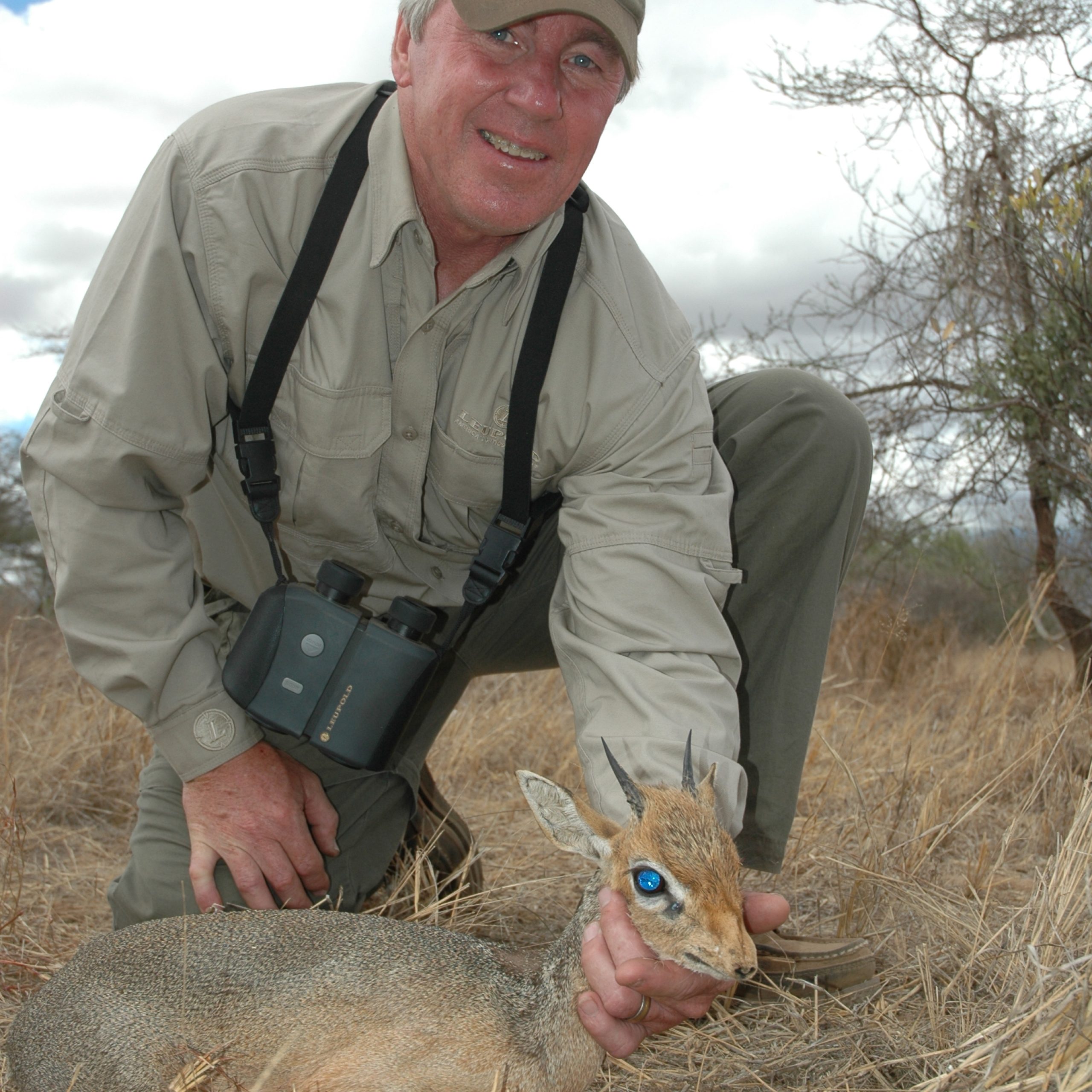
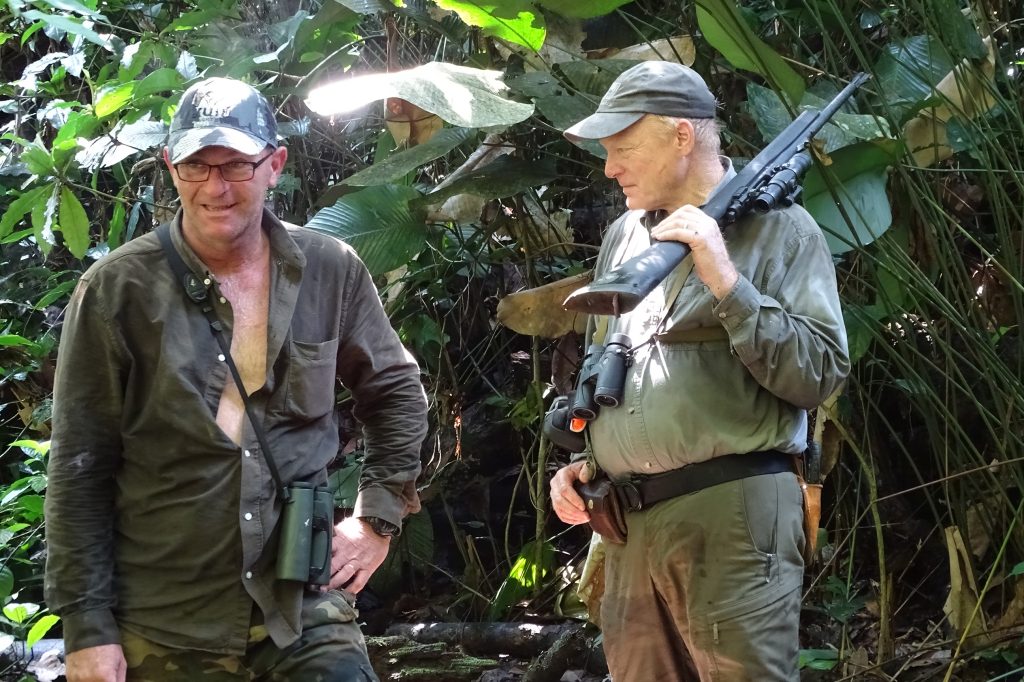
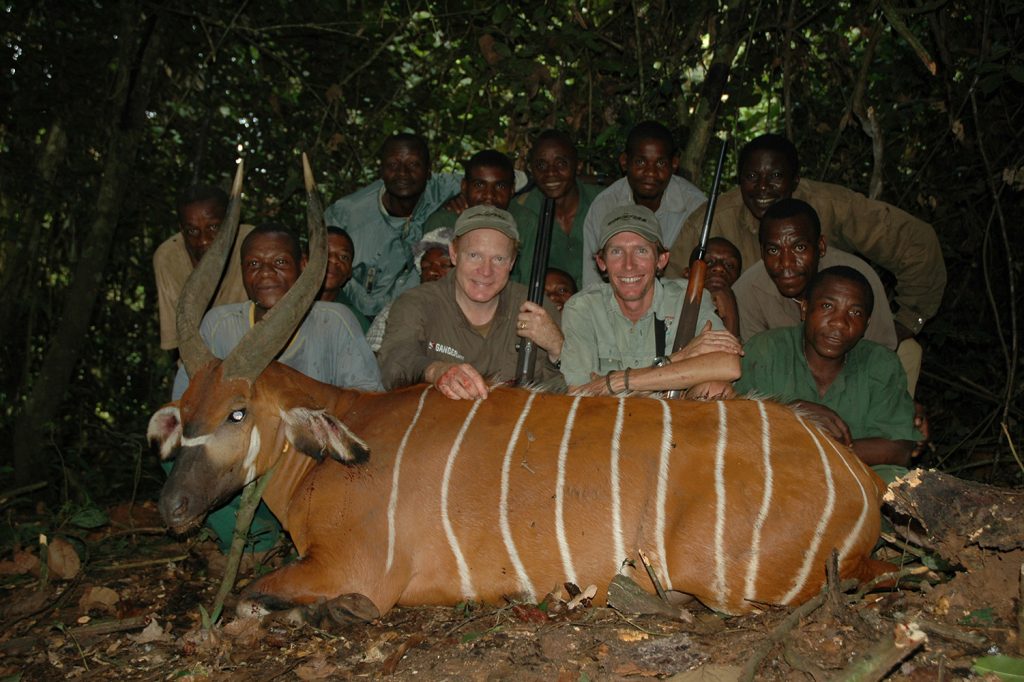
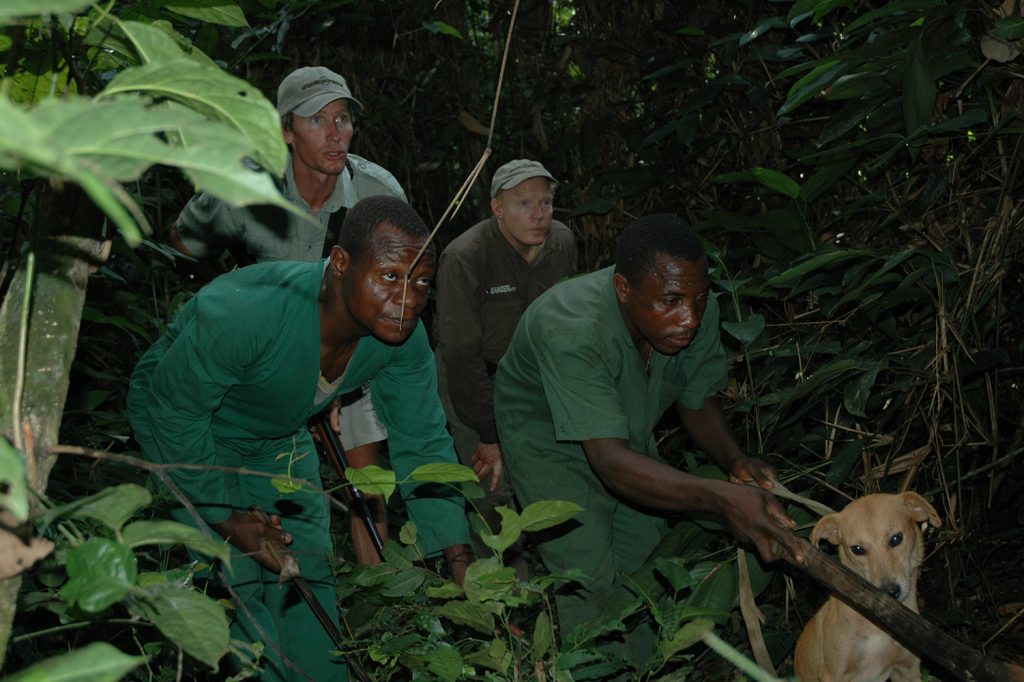
If you’re looking for a good pair of boots for safari, take a look at what the professional hunters wear.
I had been searching for a pair of really good safari hunting boots for the last few years, but hadn’t found anything that impressed me. On my last Mozambique safari, my guide, Rye Pletts, was wearing exactly the type of boot I’d looking for and when I asked him the brand, he told me they were Jim Green boots. Later that evening, I noticed that almost all the PHs in camp were wearing Jim Greens, and everyone seemed pleased with them. Since guys who made their living hunting big game in remote areas had nothing but praise for these boots, I knew I needed to take a closer look at them.
Mark Haldane of Zambeze Delta Safaris put me in touch with Gareth Crouch, a third-generation shoe and boot maker from Pietermaritzburg, South Africa, and the managing director of his family’s Jim Green Footwear company. Prior to working in the boot-making industry, Crouch served as a game ranger and safari guide in Kruger National Park, so he had firsthand knowledge of how hunting boots should be made.
In 1987, Gareth’s father and grandfather left the shoe factory where they worked and formed their own company, Crouch Footwear. Gareth’s father, Peter, and his business partner then founded a separate boot company in 1992 and called it Jim Green, after the frogs of the same name that are found along rivers in the Midlands Meander of KwaZulu Natal. Originally, Jim Green boots were built for farmers who needed a sturdy leather shoe that could last for years. Later, the company’s Razorback boots became the favorite footwear of miners and contract workers across southern Africa.
In 2013, Gareth joined the company. He developed a social media platform to help spread the word about the company’s boots, but soon he realized that the brand needed to be available to more customers.
“I approached my father about selling our boots on Amazon, and he told me that was a crazy idea,” Gareth said. “I did more research and went back to him after a month, but he still said no. After the third attempt, I decided I was going to go ahead and sell on Amazon anyway.”
Gareth purchased thirty to fifty Jim Green boots at a time with his own money and began selling them on Amazon. Eventually, he saved enough money to purchase 2,000 pairs of boots and shipped them in a container to the United States. Jim Green boots began to develop an international following, particularly among hunters.
Gareth designed the company’s popular African Ranger boot and wore them for six months, making improvements to the design as needed. Once the African Ranger design was finalized, Gareth shipped sixty pairs of boots to rangers in Zimbabwe’s Gonarezhou National Park in Zimbabwe for a year-long trial. At the end of the test period, the rangers were so impressed they purchased 150 pairs. Gareth agreed to match their initial purchase, shipping an additional 150 pairs at no cost.
“If shoe companies pay athletes to support their brand, we wanted to support rangers who often work behind the scenes,” Gareth said. Today, Jim Green continues supporting rangers by donating one free pair of Ranger boots to a game ranger for every ten pairs sold. To date, Jim Green has supplied more than 2,000 African game rangers with boots.
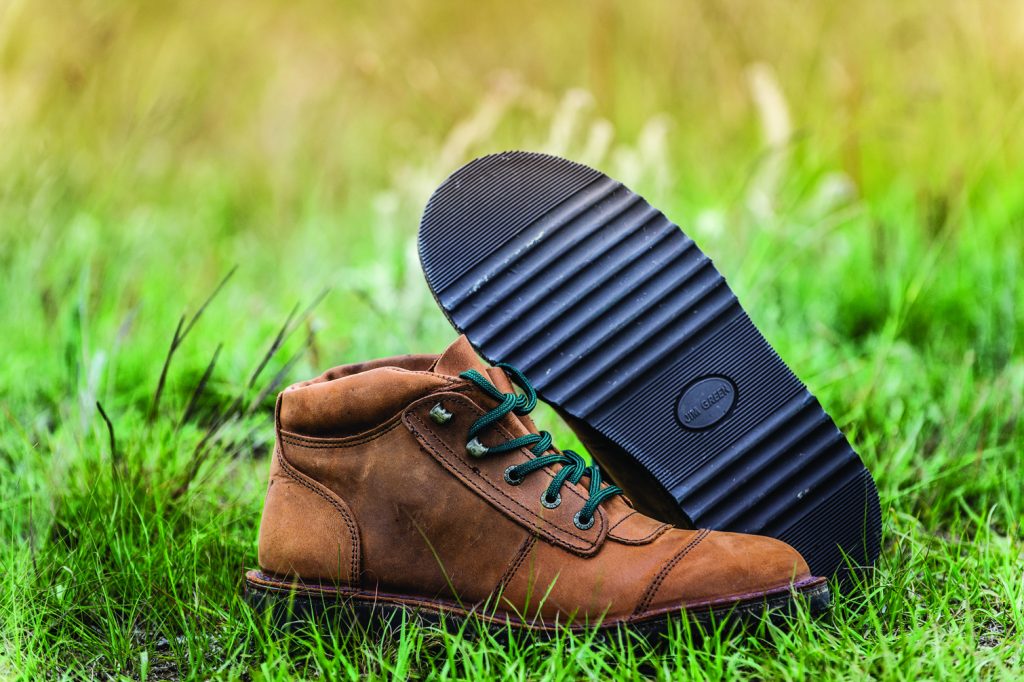
Jim Green boots feature attractive styling that make them suitable for everyday wear, but they are also rugged, high-quality boots with ample ankle support and a comfortable fit.The wedge-style rubber sole allows hunters to stalk quietly through the bush, even over dry leaves.
When Gareth sent me a pair of Ranger boots, I was immediately impressed. These boots support the foot and offer protection against thorns and rocks, yet they are more comfortable than most hiking shoes. Perhaps most important, the wedge-style rubber sole allows hunters to stalk quietly through the brush, even over dry leaves. They’re lighter than many competing boots, and the insole is stitched to the upper using double-stitched 2.2mm braided nylon cord. To further enhance durability, there’s a steel shank between the insole board and the sole, and heel and toe stiffeners offer additional support. The toe, heel, and eyelet areas feature a double layer of 2.2mm full-grain leather, and the hooks and eyelets are very heavy duty to stand up to years of hard use.
I haven’t spent a full year in these boots like the Gonarezhou Rangers did, but my initial tests have been very impressive. These boots are extremely comfortable with ample support and a secure fit, and they’re the quietest stalking boots I’ve ever tested. Even after hiking several miles, there was no soreness or blistering, and they are suitable for rough, rocky terrain. Superior materials and excellent build quality ensure that these boots will last, and the attractive styling (complete with green laces and a signature Jim Green frog wearing a top hat and boots and holding a rifle and flag) make them suitable for everyday wear.
After years of searching, I’ve finally found my go-to safari boots, and it’s good to know that the brand is reinvesting in conservation of African wildlife by supporting game rangers. In fact, I like these boots so much that I’ve just purchased a second pair. African Ranger boots are available in black, brown, and fudge colors and carry an MSRP of $169. There’s also a Cape buffalo skin version ($220) as well as an 8-inch version known as the AR8 that offers additional support ($209). For more information, visit JimGreenFootwear.com
A challenging and rewarding hunt in one of the most remote places on Earth.
The headwaters of the Colville River begin along the northern edge of Alaska’s Brooks Range, and from there the river runs north and east for about 350 miles before it spills into the Arctic Ocean west of Prudhoe Bay. Along its course the Colville, located entirely above the Arctic Circle, doesn’t pass anything resembling a town. When the river flows (it’s covered in ice for more than half the year), it passes through hundreds of miles of empty, treeless tundra. Researchers have named the confluence of the Colville and its tributary, the Etivluk River, the most remote place in all of North America.
After ten hours riding upstream in a Zodiac loaded with caribou-hunting gear, I had no trouble believing this was indeed the most far-flung destination on the continent. Neal Emery, who worked for Hornady at the time, rode in the bow of the boat while I was draped across guns and equipment amidships and our nineteen-year-old guide, Geordy, manned the steering column from the stern. The din of the outboard motors made talking impossible, so I spent long hours searching the hillsides for mammoth tusks, which sometimes become exposed on cliffs along the river.
The Colville–a river where it’s more common to see a woolly mammoth’s tusk than another boat. The term “remote” doesn’t accurately describe the area, a place where hunters watch as columns of storm clouds build up fifty miles away, with nowhere to escape and without a single tree under which to shelter. The storms march across the barren moonscape and dump cascading sheets of water on the huddled visitor before continuing toward the Brooks Range and the Alaskan interior. In the Arctic there’s no place to hide from the elements.
What draws hunters this deep into the tundra is the annual caribou migration. Beginning in August the Western Arctic caribou herd, which has spent the long summer days farther north around Prudhoe Bay, begins a southward migration toward the Brooks Range. If you’re in the proper place at the proper time you may see thousands of caribou in a single twenty-four-hour stretch, and there are accounts of unbroken herds passing by camps around the clock for days on end.
By the time we reached our camp thirteen hours upriver, though, we had not bumped any big herds. In fact, we’d only seen a few caribou and a single wolverine rooting along the riverbank. Eventually we reached a gravel bar where three tents shuddered against the north wind.
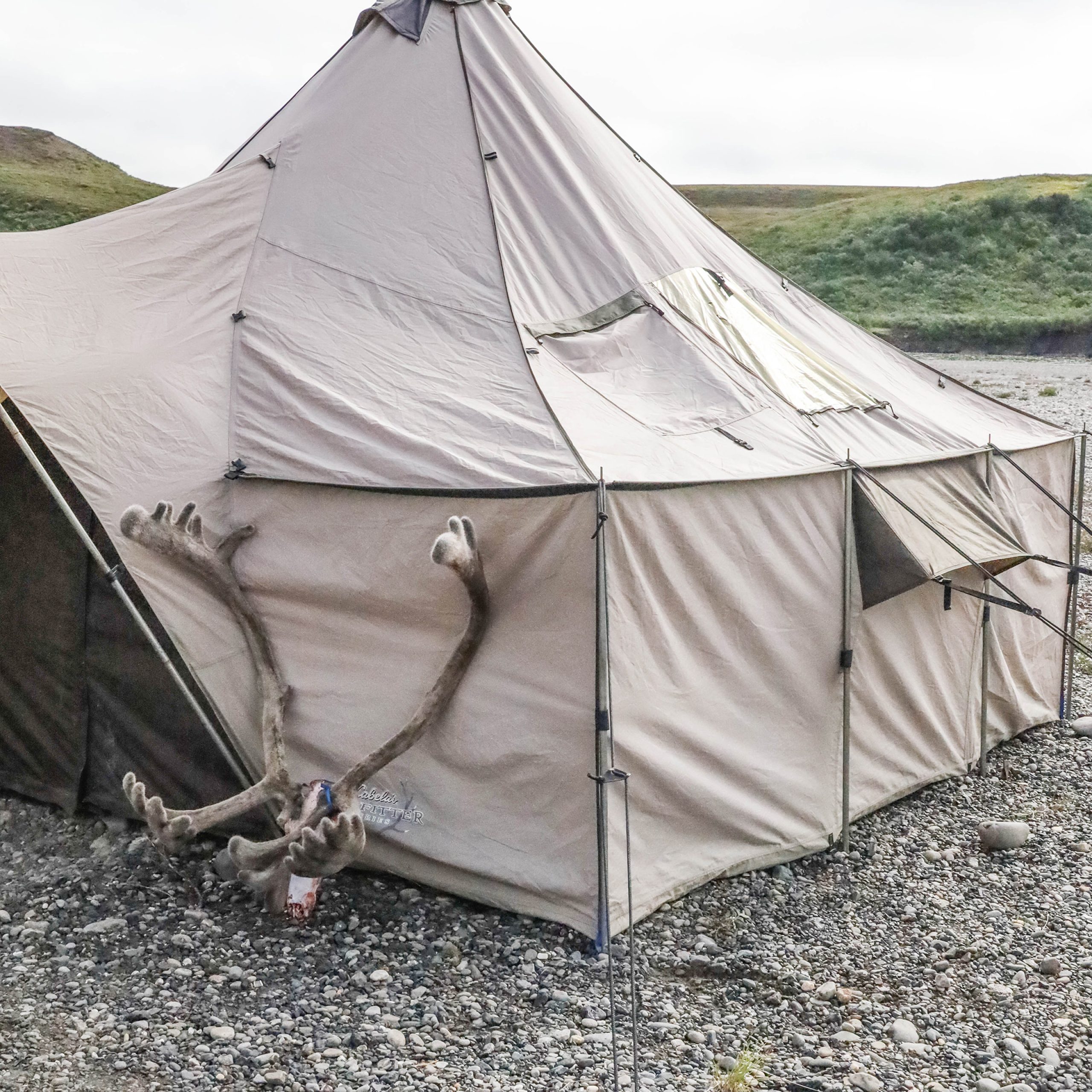
Camp on a gravel bar in the Colville River country of northern Alaska.
Striker Overly’s caribou camp is situated on a gravel bar that’s just long enough for him to land his Piper Cub, and despite its remoteness the camp was well-outfitted. We were exhausted after the long ride, but in late August the light hung around until after midnight. I fell asleep on my cot to the sound of water rushing over the rocks in the braided river outside.
I was sharing my tent with fellow outdoor writer Tom Beckstrand. By the time I awoke Tom was gone, and I could hear boots crunching on smooth river stones and voices from the mess tent. The long boat ride and uninterrupted daylight had disabled my internal clock and I wasn’t sure if I’d slept an hour or ten, so I was relieved to learn that it was morning.
There are two ways to hunt this section of the Arctic. The first and less fruitful method is to set out on foot, using the tops of the high rolling hills to glass for game across the tundra, but the vastness of the region (it might be two miles between glassing points) makes this grueling and generally unproductive. The second method is to run the boats along the Colville and its tributaries, find a patch of high ground, and glass for game. By boating from one glassing location to the next, it’s easy to cover larger tracts of land, and over each hill there might be a herd of a thousand caribou.
We didn’t find a herd of a thousand animals, but I did spot a single bull topping a hill on the horizon. Shawn Skipper from Leupold centered his spotting scope on the caribou, which was standing halfway up a slope and grazing on low-growing mosses and lichens.
“He looks pretty big, but he’s 1,800 yards away,” Shawn said. He tilted his head down, studied the caribou, then looked at me.
I didn’t bother to ask Geordy what he thought. An Alaskan hunting guide in his late teens, Geordy could cover the distance so quickly the mosquitoes would struggle to keep pace. It was up to me. I looked through Shawn’s spotting scope, examining the velvet on the antlers crowing the bull’s head. The velvet looked strangely silver instead of the usual deep green, but the bull was big. He was relatively close by—at least by Arctic standards. The next caribou bull might still be hundreds of miles away toward Prudhoe Bay.
“Let’s try it,” I said to Geordy. Shawn nodded in approval.
We used the raft to cross the tributary river and then began our stalk. The mosquitoes had no issue keeping pace with me, and a curtain of buzzing insects whined around my eyes and ears while I hiked. The first hundred yards after the river crossing were covered by smooth gravel with tufts of moss and lichens, so walking was easy. However, the next swale was a swampy series of tussocks—also commonly called muskeg–that continued for another quarter mile.
If you’ve never crossed tussocks, I’ll pass along the first and only advice I was given on the subject: don’t step on top of them, and don’t step beside them. If you’ve reasoned that leaves nowhere else to place your booted foot, you’ve learned the first, last, and only lesson for getting across muskeg—there’s no stable or fast or efficient way to cross the stuff. It’s a slog, one foot ahead of another, tripping and sinking the entire time.
I tried to embrace the challenge. I moved as quickly as possible, which wasn’t very fast at all, and soon I’d sweated through my clothes. I removed the waterproof outer layer and cold air chilled my damp shirt and pants. Too late, I was soaked through. We kept on, first over one ridge and then through another wide tussock tundra and then to a second larger hill. By my calculations, when we crested that hill, the bull would be within rifle range.
Carefully we edged up to the crest, but the bull was gone. That meant another plod across a tussock field. By the time we reached the top of the next hill, we’d finally caught up with the bull. He stood alone halfway up the next ridge, moving slowly from left to right.
I laid down and rested my Savage .280 Ackley Improved on Geordy’s pack. The regiment of mosquitoes were still swarming my face, buzzing in and out of my ears and settling on my eyelids, but I managed to pull the rangefinder from my pocket and range the bull: 301 yards. Since the rifle was zeroed at 200, I held high on his shoulder and squeezed the trigger. When I settled out of recoil, the bull was down.
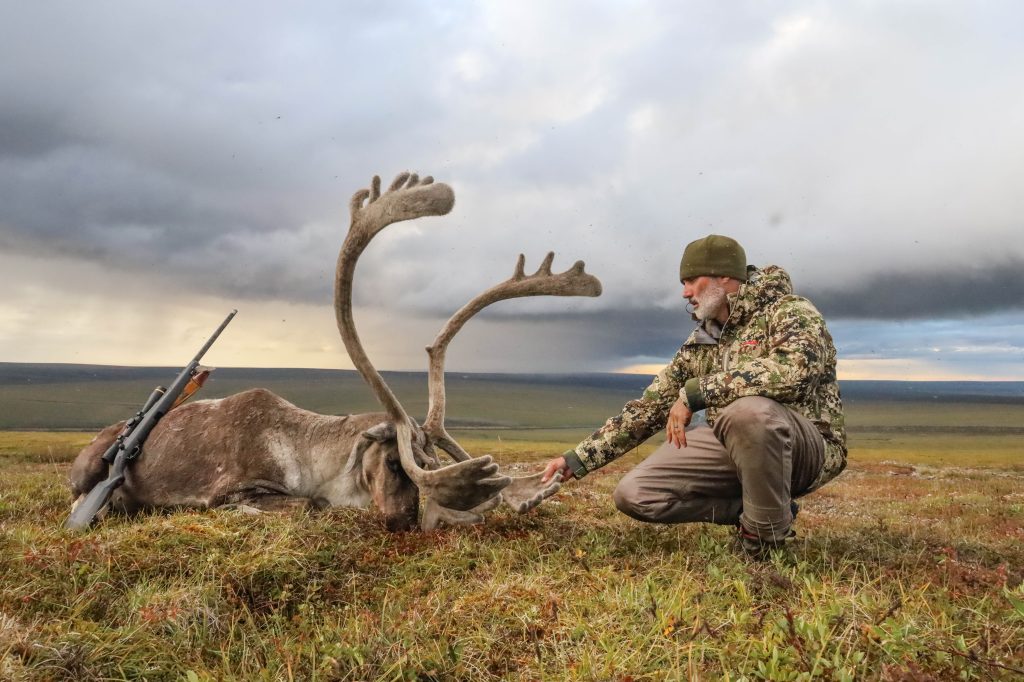
The author with his nice caribou, taken after a challenging stalk across more than a mile of muskeg.
We reached him ten minutes later. His antlers were tall, though they lacked a deep curl, and the velvet did indeed have a distinct silver color that may have been age-related or simply a genetic abnormality. We began the chore of skinning and butchering the bull with Geordy handling the bulk of the work. He cut away every piece of meat, including everything between the ribs, and we filled our packs for the hike out.
We cut at an angle toward the river which reduced the length of the walk to about a mile, but it was the hardest mile I’ve covered. The tussocks were even more troublesome under the weight of the caribou meat, but we had dedicated ourselves to carrying the entire load out in a single trip. I tried to keep pace with Geordy, but eventually had to tell him to go on ahead. It seemed with every step the uneven ground shifted under my boots and I had to readjust, balancing the load on my back so I didn’t topple over. Mosquitoes had reached plague numbers by that stage. Neal and Shawn sat by the river, watching the whole sad spectacle unfold.
When I got to the river and unloaded the last of the meat and antlers into the boat, I was soaked through once again. Some was sweat, some blood, but I knew I had to do my best to wash myself clean before we reached camp an hour away. We slipped into the raft and made our way into the main channel of the river and upstream. At some point I fell asleep on a warm game bag, and when we reached our camp on the gravel bar I smiled as the others congratulated me. They asked what had happened and I gave them the abridged version. I’d finish in the morning, I told them, after breakfast.
I realize my greatest hunt was also one of my most difficult, and perhaps that’s not a coincidence. There were challenging times on the trip, but there was also time to fish, to graze on the seemingly endless blueberries, and to watch storms rush across the empty landscape, exceptional experiences that combined to make that adventure my favorite.
I also had a great team. Despite the difficulties inherent to wilderness hunting Neal, Tom, and Shawn made the experience enjoyable. Had anyone decided to focus solely on the tough parts or complain, it could have been a miserable experience indeed. Instead, we tried to embrace the challenge, the work, and the isolation. We also appreciated—and often discussed—how fortunate we were to experience this place. The Colville country is true wilderness that looks very much as it did when the last mammoth died here 4,000 years ago, and to spend time anywhere that makes you reflect on your own relative fragility and insignificance is worthwhile. It’s the element of hunting that those who condemn the sport can never fully respect or appreciate, but I believe it’s the quiet call that draws us to wild places, not strictly the desire to fill a tag.
In The Green Hills of Africa, Hemingway wrote, “It is pleasant to hunt something that you want very much over a long period of time, being outwitted, out-maneuvered and failing at the end of each day, but having the hunt and knowing every time you are out that, sooner or later, your luck will change . . .” You don’t hunt the Arctic because it’s comfortable, or convenient, or because the hunting is easy. You do it for the challenge, and the challenge is as essential to the experience as the trophy itself.
Field-testing the newest hunting pack from ALPS Outdoorz.
Whether you’re packing gear for a backcountry hunting trip, hauling a tree stand into the deer woods, or packing elk quarters back your truck, the new Elite Series ultralight hunting pack system from ALPS OutdoorZ can do it all.
For years, ALPS OutdoorZ has been manufacturing a popular meat-hauler frame and pack system called the Commander X. In 2022, the company took that proven design and made it 30 percent lighter, 30 percent stronger, and much more versatile, with additional modular features that let the user customize the pack system to any use.
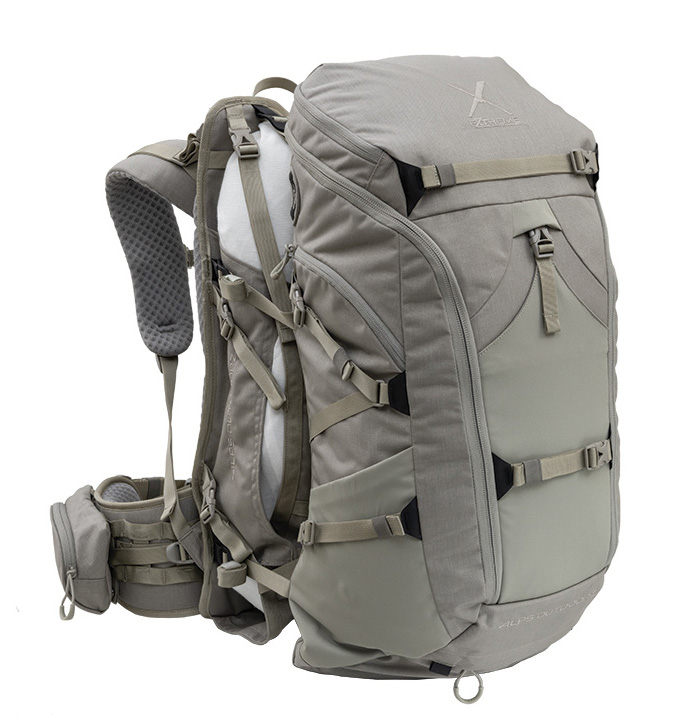
The heart of the system is the Elite Frame, which is made of a high-performance thermoplastic composite and weighs 3 lbs. 10 oz. Designed for adjustability and comfort, it features a cushioned, contoured pad in the lumbar region with a nonslip pad in the center and breathable mesh covering the pad and straps. You can adjust the frame for a wide range of torso lengths by removing the straps and positioning them up and down from an XS position to an XXL position. The frame’s meat shelf has numerous adjustments to accommodate quarters from antelope to elk and has plenty of lashings to secure the load. Load lifters and anti-sway waist belt straps keep everything stable on the hike out.
The removable waist belt on the frame is exceptionally well designed, with large zipper pockets on either side for phones and other small items you need to have at hand. Don’t like the pouches? They’re removable, so you can attach different pouches, a holster, or other gear to the MOLLE connectors on the waist belt.
There are two pack sizes available to attach to the Elite Frame: The day-pack-size Elite 1800 (1 lb. 12 oz.) and the roomy Elite 3800 (2 lbs. 7 oz.). Both packs, like the meat shelf on the frame, are made of sturdy, highly water-resistant 500 D Nylon Cordura. Attaching and detaching the pack bags is a breeze. Six attachment points on the pack frame allow the packs to be quickly clipped in. Simply attach the bags to the unloaded frame for your hike in. When your hunt takes a lucky turn, unclip the pack, strap your game bags to the frame and meat shelf, clip the pack bag back on top of the meat, and cinch everything down tight with the pack’s compression straps to pack out the full load. It’s easy and intuitive.
The pack bags themselves were obviously designed by an experienced backcountry hunter. Both have a large zippered top compartment for quick access to lunch and smaller items. They are set up for a hydration bladder and have ports on both sides for the tube. The main compartment in both bags zips fully open so you can lay the pack flat and see everything inside, and the interiors of both main compartments have five zippered mesh pockets so you don’t have to go digging for smaller items. Both packs come with a rain cover zipped into a dedicated bottom pocket and a drop-down pouch that allows you to strap a gun or bow to the pack for hands-free hiking or climbing. Both packs have open pouches on both sides to accommodate water bottles or tripods, and the 3800 has an additional zippered side pocket for a spotting scope.
I have used ultralight pack systems that are slightly lighter in weight than this one, but with its excellent adjustability, rugged construction, features, and ease of use, the Alps OutdoorZ Elite Pack System compares favorably with anything on the market and is an excellent value for the money. I’d like to see the company add an intermediate pack size option for longer day trips or single overnights, but the current system should be ideal for most of my fall elk hunts and summer scouting trips. The frame retails for $249.99; the 1800 pack for $149.99; and the 3800 pack for $199.99.
A combo hunt for birds and big game in central Argentina.
It was late morning, and the day was warming up fast. My outfitter, German, and I were walking quietly, quartering into the wind, when the bulky, reddish-brown forms of two red deer moved ahead of us in the thick brush. I caught a glimpse of what looked like a very large set of antlers disappearing behind the prickly branches of a calden tree.
Momentarily stupefied by the sight of the enormous rack, I stood rooted to the spot. I glanced at German, who mouthed silently, “Wait.” I nodded almost imperceptibly.
The stags had probably been bedded in the brush before they heard us coming, but the thick vegetation obscured us as well as it had hidden them—I hoped. With that and the wind in our favor, they likely hadn’t seen or smelled us, so maybe they wouldn’t go far.
After what seemed an eternity, but was probably only ten minutes, we had seen no other movement nor heard any sounds other than the incessant flutter of doves in the treetops. German made a downward gesture with his hand: Slowly. We moved ahead a step at a time, exercising as much stealth as possible in the thick undergrowth. My eyes flicked from the path ahead to my feet, trying not to step on even the smallest twig. We worked our way another fifty yards or so toward where we had seen the antlers disappear.
And then, there they were. Rising above the tangle like the thick branches of old oak trees were two of the most incredible racks I had ever seen. The two magnificent red stags were browsing calmly in the brush just over a hundred yards away, the sunlight gleaming on a veritable forest of tines.
German set up the shooting sticks, and I rested the .300 Winchester Magnum on them and studied the stags through my scope. They both appeared massive, but German whispered, “The one in front is bigger.” I focused on that one, and at that moment, his head came up and he stared alertly in our direction.
I reminded myself to ignore the rack and focus on the vitals, which were partially obscured by thick brush. As soon as I broke the shot, I was worried it might have landed a bit high. Moments later, the stag was down, but I worked the bolt quickly and put a second shot into him to be sure. As German and I approached the fallen monarch, we heard the sound of branches breaking, and I caught sight of the rocking-chair rack of the second stag as he vanished in the brush.
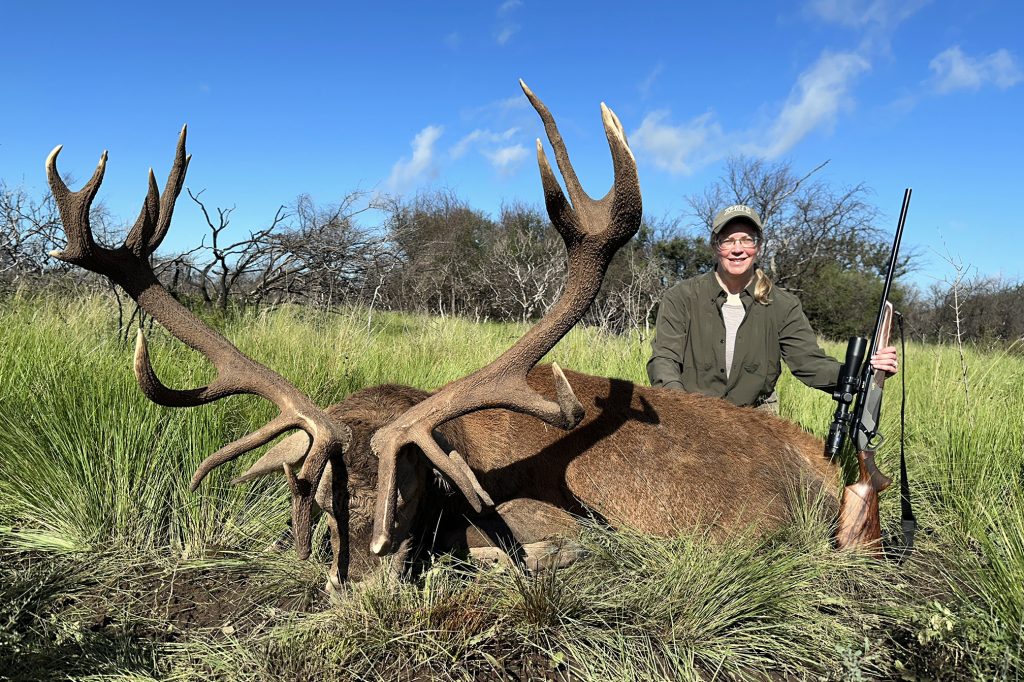
As I knelt to pay my respects to the stag, the size of his antlers took my breath away. “That’s a gold-medal stag,” German affirmed. “Likely eleven or twelve years old.” I tried to count the myriad points, coming up with 10 on one side and 7 on the other.
The stag was in great condition, with a large body and sleek reddish hide. It was March, and still early in the roar, or brama, as they call the red-deer rut in Argentina.
Diana Rupp with her red stag from La Pampa Province, Argentina.
Once we had finished our photos, two of German’s assistant guides set to work on my stag, quartering it in minutes using a couple of the most gigantic knives I had ever seen. German suggested we head back to the lodge for lunch, but I was in no hurry to leave, fascinated as I was by watching these experts wield their traditional gaucho knives, which, I later learned, they used just as handily to trim a tree branch or slice a piece of steak.
Big red stags, among the world’s most magnificent antlered animals, are the first thing big-game hunters think of when they think of Argentina. Red deer were brought to Argentina’s La Pampa Province from Europe in 1906, and they found the brushy habitat to their liking. With good management, populations grew and thrived.
As my hosts explained it to me, for a red stag in central Argentina, la vida es buena—life is good. They have all the advantage of ideal habitat, plenty to eat, and a far milder year-round climate than they had in their native environs. As a result, Southern Hemisphere stags grow antlers of eye-popping dimensions.
But, as stunning as they are, stags are not the real reason Argentina is the most popular hunting destination in the world, attracting more than 20,000 visiting hunters every year—more than every country in Africa combined. That reason is the ubiquitous eared dove. The resident flocks, numbering in the tens of millions, are considered agricultural pests, consuming as much as 30 percent of the crop yield, and the local farmers encourage hunters to come and shoot as many doves as their shoulders can stand. Avid wingshooters come from all over the world to do exactly that.
While Cordoba is the most common destination for dove shooting, and the foothills of the Andes are the most famous region for stags, La Pampa Province is the place for the hunter who wants to do it all. Its easily accessible location in central Argentina makes it ideally suited to a combo hunt for birds and big game. That’s why I had shepherded both a rifle and a shotgun through Argentina’s complex importation process: I was here to experience the best of both hunting worlds.
From the moment I arrived at the GBH Safaris lodge and game preserve in La Pampa, about 100 miles north of the capital city of Santa Rosa, the terrain in the region, and in fact, the whole hunting vibe, reminded me of Africa. The landscape, consisting of broad openings of tall grass surrounded by large areas of thick brush and dotted with thorny, mesquite-like trees known as calden, is reminiscent of the Dark Continent, as are the fiery orange-red sunsets that paint the horizon every evening. And of course, there’s the familiar thrill of seeing the Southern Cross hanging in the night sky over a crackling campfire—a thrill that never gets old.
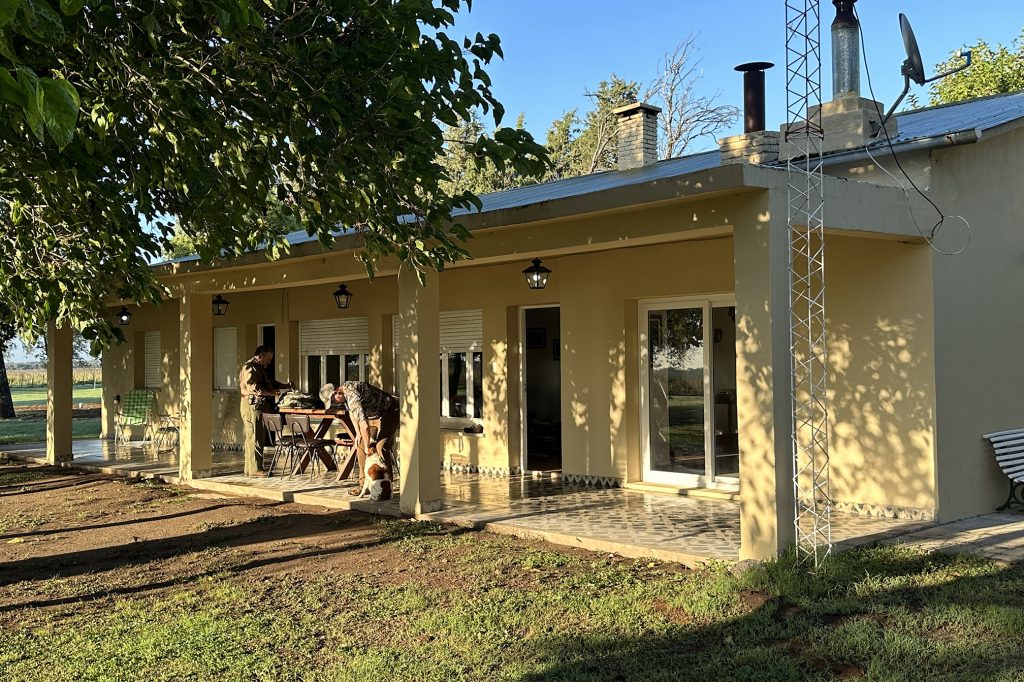
The comfortable GBH Safaris lodge in La Pampa Province, Argentina.
The Argentine culture, however, is rich and distinctive. Hunters enjoy a hearty midday asado, followed by a long afternoon siesta. Late-night dinners are accompanied by goblets of excellent local malbec. Seemingly every local is drinking mate out of a gourd with a straw. If you’re lucky, you’ll glimpse gauchos on horseback working cattle, many of them wearing traditional dress and riding effortlessly on sheepskin-lined saddles. And over it all soar seemingly endless flocks of the speedy and challenging game bird the locals call palomas.
I had awakened on my first morning in Argentina to a deafening cacophony of birds. As I would soon learn, the pampas are home to an astonishing array of feathered flying creatures, including noisy flocks of green parakeets, crested caracaras, eagles, flycatchers, and woodpeckers. The doves are in huge flocks nearly everywhere you look, lifting from the trees in shifting black clouds and rocketing over your head on whistling wings.
Because central Argentina’s balmy climate allows for year-round staggered planting and harvesting, doves breed prolifically and they rarely lack for a good meal. I had read about the incredible numbers of these birds, but it was still mind-boggling to stand in a field and watch them wing overhead by the thousands.
Doves and pigeons are considered agricultural pests in Argentina. Dove numbers are legendary, and the opportunity to shoot large numbers attracts hunters from all over the world.
The way of life in Argentina involves late nights and a long afternoon siestas, so for me it took a bit of getting used to, but it works very well for hunting. On a typical day, we would have a morning dove shoot, a hearty lunch and a long break in the afternoon, then head back out for stags or blackbuck in the evening, followed by an after-dark sojourn for pigs or varmints. Dinner would be served as late as 11 p.m. or midnight, followed by a few hours of sleep and another enjoyable day in the field.
The lodge was surrounded by fields of standing corn and cut sunflowers, so we didn’t have to go far to find great dove shooting. Four or five shooters would typically spread out along a field edge or fence line and target birds as they flew across it. While we didn’t have individual “bird boys,” as many lodges do, German’s guides walked along the line periodically, keeping us well supplied with shells and drinks and anything else we needed.
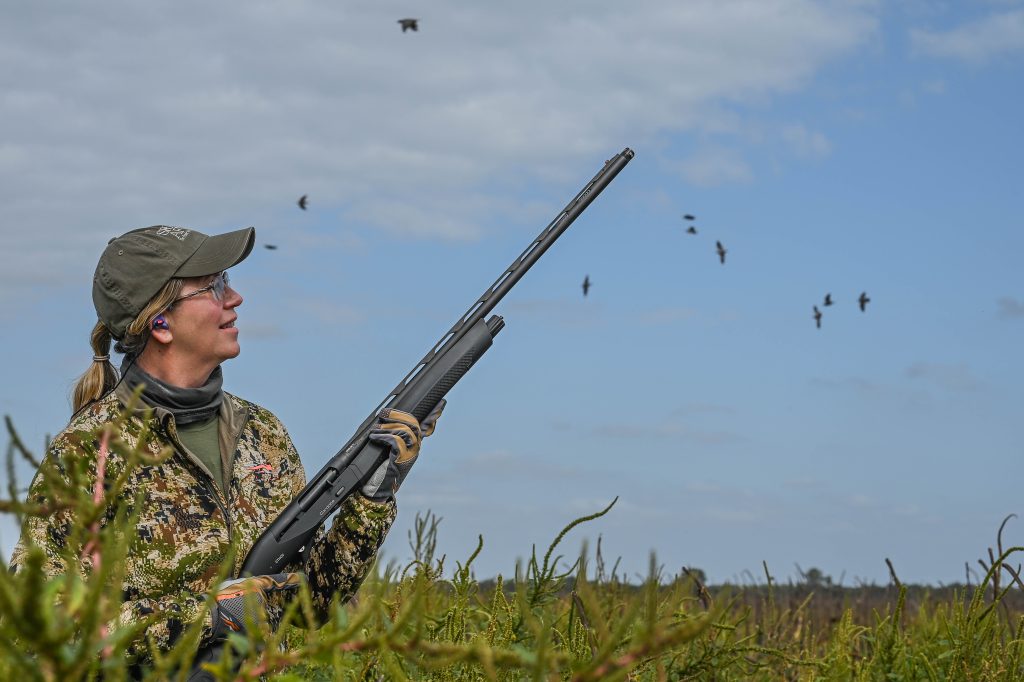
The little palomas are blazing fast and wary. They say doves can fly 55 mph, and I don’t doubt it. I quickly learned not to bother with birds that had flown past me, as they would have already put on their afterburners. Instead I concentrated on incoming doves and crossing shots. As long as I was able to conceal myself behind a tall weed, I had the best luck on incomers, frequently dropping them on the toe of my own boot.
After we’d been in the field for a few hours, the guides would roll up in a truck to pick us up. They’d usually find me surrounded by a pile of doves and a much larger pile of empty shell casings, tired, slightly sunburned, and grinning.
Doves are a challenging gamebird to hit, but the vast numbers of them in Argentina give you plenty of opportunities to hone your wingshooting skills.
In addition to red stags, our big-game list included blackbuck and wild boars. The boars are largely nocturnal, and although I ventured out a couple of nights after dark, I never saw one, although I was treated to sightings of Patagonian hares, a silver fox, and a black-and-white rodent called a vizcacha.
I was, however, hoping to close the deal on a blackbuck, another introduced species (this one originally from India) that has thrived in central Argentina alongside the red deer. Significantly smaller than our pronghorn, these animals have tall, twisting horns and dark, beautifully marked coats from which they get their name. I spent several enjoyable hours spotting and stalking these lovely, elusive little antelope, but each time they gave me the slip in the thick bush.
Late one afternoon I was sitting in an elevated blind with a guide named Matteo, who had taken some time out of working his wizardry on the lodge’s outdoor clay oven and barbecue grill to help me look for a blackbuck, which he called antilope. I know very little Spanish, and good-natured Matteo didn’t speak a word of English, so we had plenty of laughs as we attempted, with varying degrees of success, to communicate.
As evening approached, a bachelor group of blackbuck rams materialized out of the brush about 500 yards away. I studied them through my binocular, then turned to Matteo, who was doing the same. He looked at me with a grin and said, “Grande!”
That was good to know, but there were a dozen rams in the herd. They all looked grande to me, but I was certainly no expert. As the herd worked its way toward us, feeding slowly, I studied the rams but could tell little difference between them.
As they began to move into range of our position, I searched every corner of my brain for my limited Spanish vocabulary. Finally I came up with, “Todos?” (All?)
Well, that made it easy. About 150 yards from the blind, the herd stopped and began milling nervously, and I figured it was now or never. A nice-looking ram was standing clear of the others, and I rested the rifle and carefully squeezed off a shot. Hit through both lungs, he bolted forty yards and dropped stone-dead as the other rams scattered into the trees.
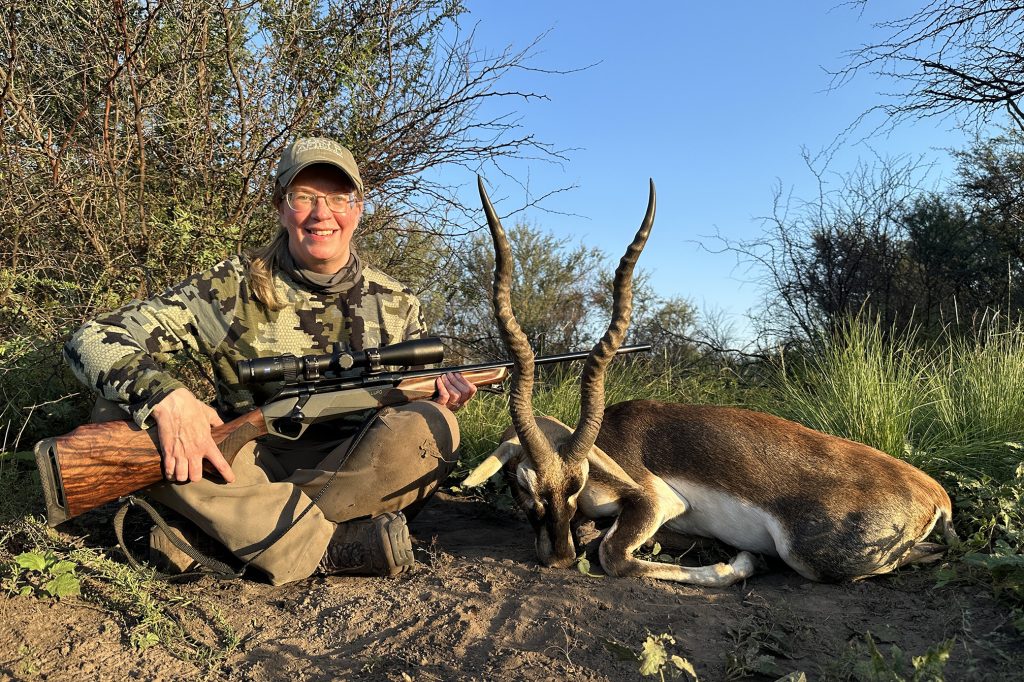
Indian antelope, also called blackbuck, were introduced to Argentina in the 1920s.
The blackbuck turned out to be a very fine, mature ram. We walked up to him as a stunning sunset bathed the pampas in an orange glow. With Matteo’s help, I photographed the beautiful animal in the evening light as a flock of doves fluttered into a waterhole nearby. For a hunter in Argentina, la vida es buena.
For more information on this hunt, contact German Brandazza, GBH Safaris: gbhsafaris.com.ar.
The Lupo and the Cordoba
Argentina is not an easy place in which to import your own firearms, so if you’re going to go through the hassle of bringing your own guns for a bird-and-big-game combo hunt, they might as well be the best possible tools for the job.
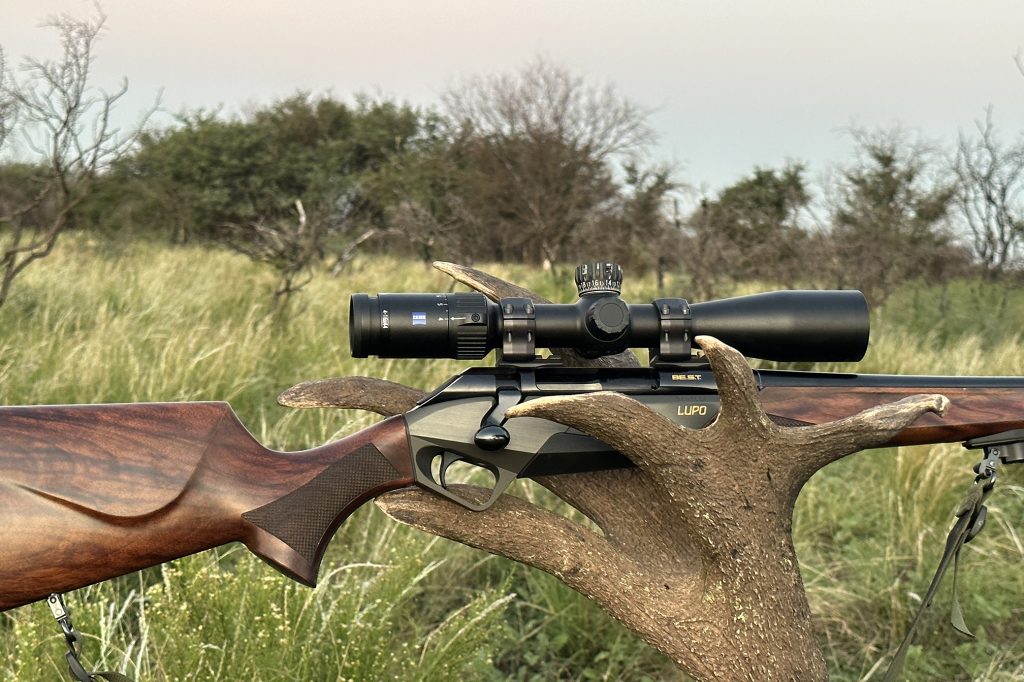
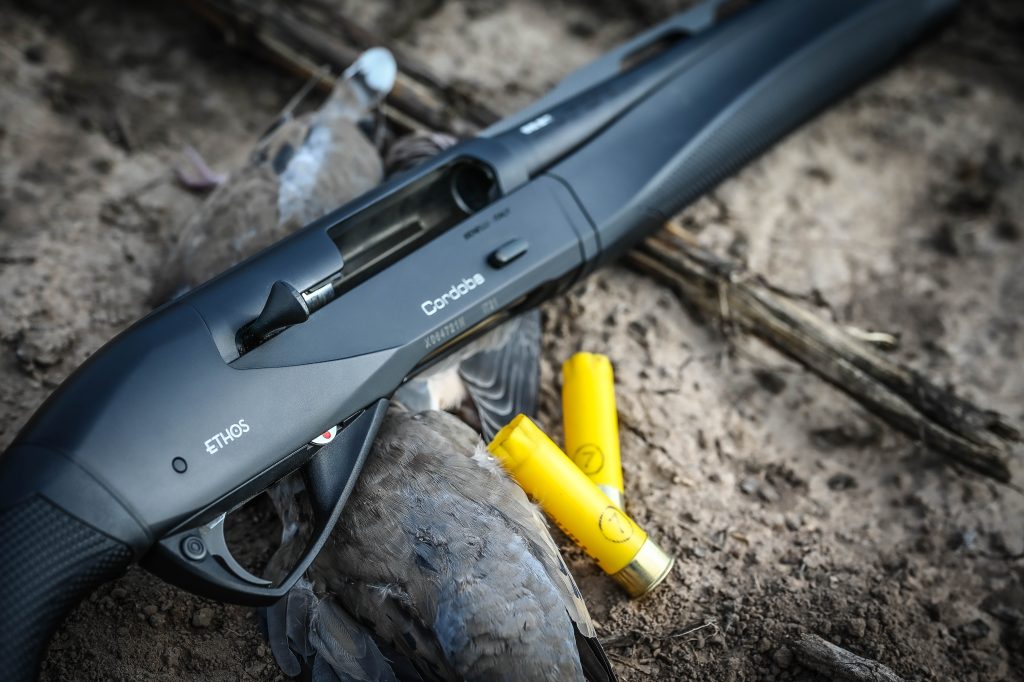
I can’t imagine a more ideal rifle/shotgun combo than the one I used on this hunt: Benelli’s Lupo BE.S.T. in .300 Winchester Magnum and the Ethos Cordoba BE.S.T. shotgun in 20-gauge.
The Benelli Lupo BE.S.T. in .300 Winchester Magnum is both beautiful and extremely accurate.
The Lupo rifle comes in several configurations, and every one of these guns I’ve tested has been extremely accurate and consistent. The Lupo BE.S.T. rifles are particularly special, featuring premium AA-grade walnut stocks and Benelli Surface Treatment (BE.S.T.) finish, guaranteed against rust and corrosion for 25 years. Beautiful and bombproof is a pretty irresistible combination in a rifle. I fed the Lupo Hornady’s Precision Hunter ammo with 178-grain ELD-X bullets, which performed perfectly on both the stag and the blackbuck.
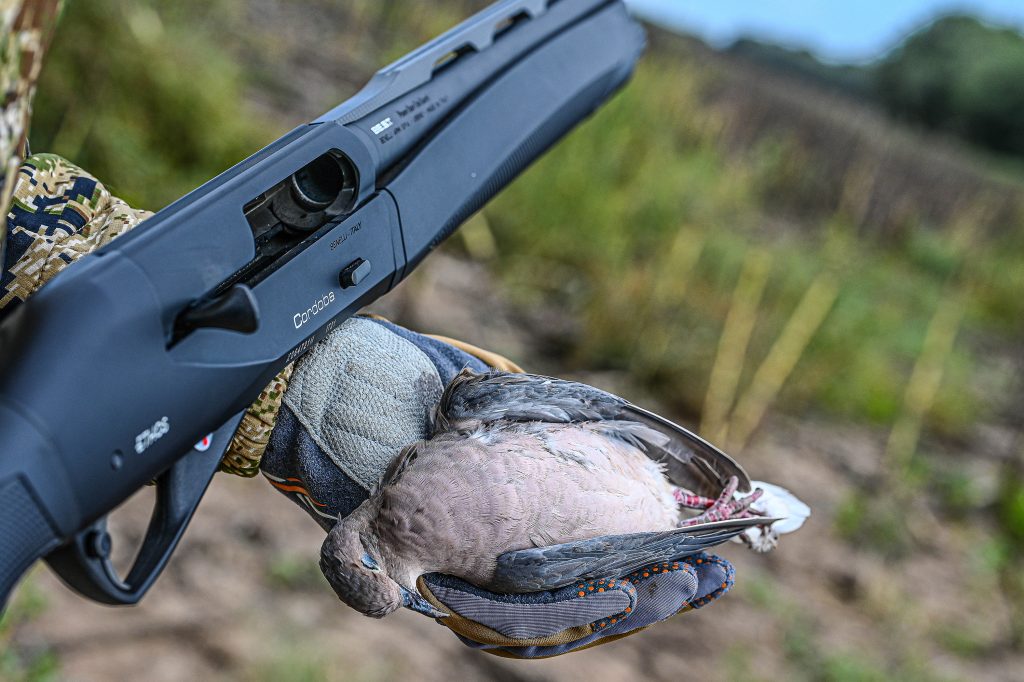
Benelli’s Ethos Cordoba shotgun in 20 gauge was an excellent choice for dove shooting.
If you’re going to shoot boxes and boxes of shells at doves, you need a soft-shooting but extremely durable and dependable gun that fits you well. The sleek Ethos Cordoba BE.S.T. shotgun fits the bill. Ported barrels and the ComforTech recoil-reduction system helped my shoulder withstand the rigors of repeated shots, and the inertia-driven semiauto proved flawlessly reliable. I also liked the beveled loading port, large bolt handle, and enhanced trigger guard, which made it easy to load and shoot while wearing my lightweight shooting gloves. And since it also has the BE.S.T. finish, this shotgun boasts excellent rust and corrosion protection.—D.R.
Early in the season may be the best time of all to hunt roe deer.
Image above: This is a nice roebuck with typical three-tined antlers, nothing special, just a nice, average roebuck–sort of like a decent 8-point or medium 10-point whitetail.
The world over, most deer are in hard antler in autumn, so deer hunting is generally a fall pursuit. What that means depends on where you are. In the Northern Hemisphere, it’s September, October, and November. In the Southern Hemisphere, with the seasons opposite, March, April, and May are prime time for red and fallow deer. Tropical deer mess this up a bit. At least some axis, hog deer, muntjac, sambar, etc. are in hard antler in any month. Most of North America’s introduced axis deer come into hard antler in the spring, and rut in July.
In its natural state on its native turf, the roe deer of Eurasia are the primary exception. Males are in hard antler in May, and will shed in early November. Most European countries have rigidly set hunting seasons, just like American states, based around sustainable harvest goals. The biggest difference: That harvest goal is achieved by a much smaller hunting public. Bag limits are generally unknown; it doesn’t matter how the quota is divvied up, just so it’s met. And, by our standards, seasons are ridiculously long.
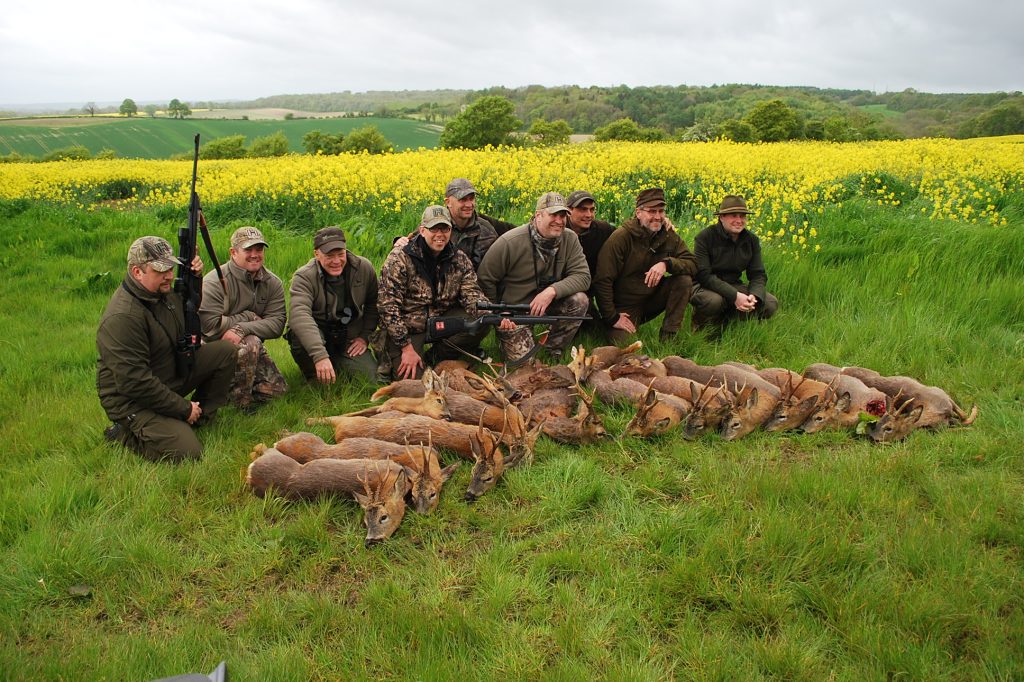
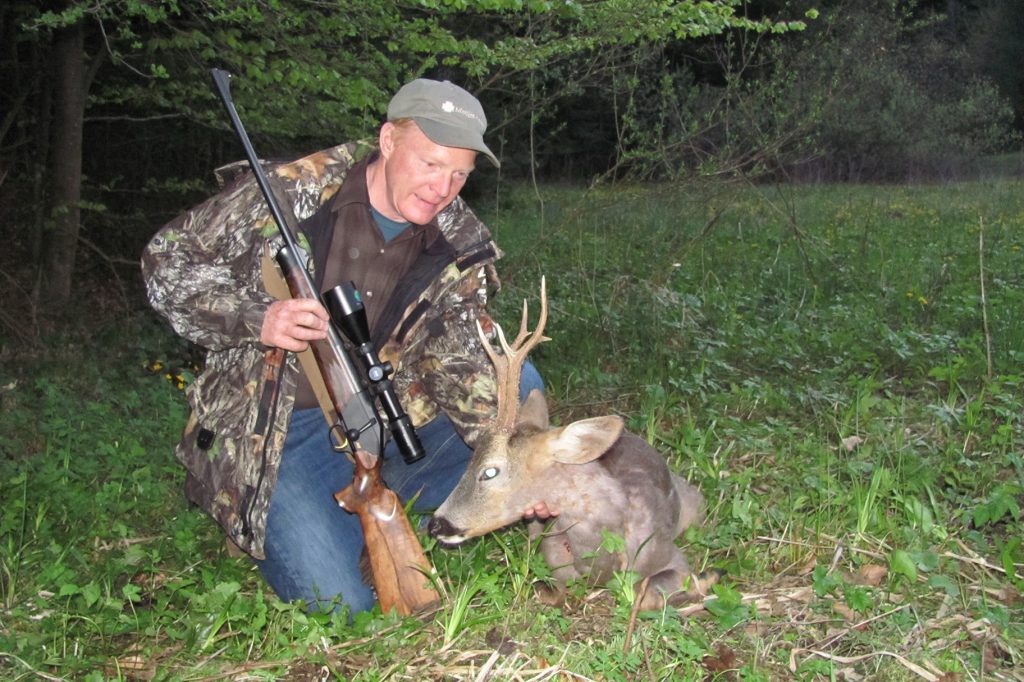
In Europe, hunting is very much a harvest, with management quotas established. These bucks were taken on a May hunt in southwestern England, with the wildflowers in full bloom. These bucks range from small to fairly large, and the venison is all spoken for by local restaurants.
Seasons vary from country to country, but most roebuck seasons start between April 1 and the beginning of May. Typically, they run into or through October, shutting down before the males start to lose their antlers. Because of management goals, some places run later seasons for females only. I did a driven hunt in Germany in November, with roe deer females on the hit list. I’m guessing European hunters in the group, with more experience, could judge sex more readily than I could. I saw several bucks, pedicels obvious and off-limits, but as small, gray deer drifted (or dashed) through, I didn’t have the confidence to even consider a shot. I waited for pigs.
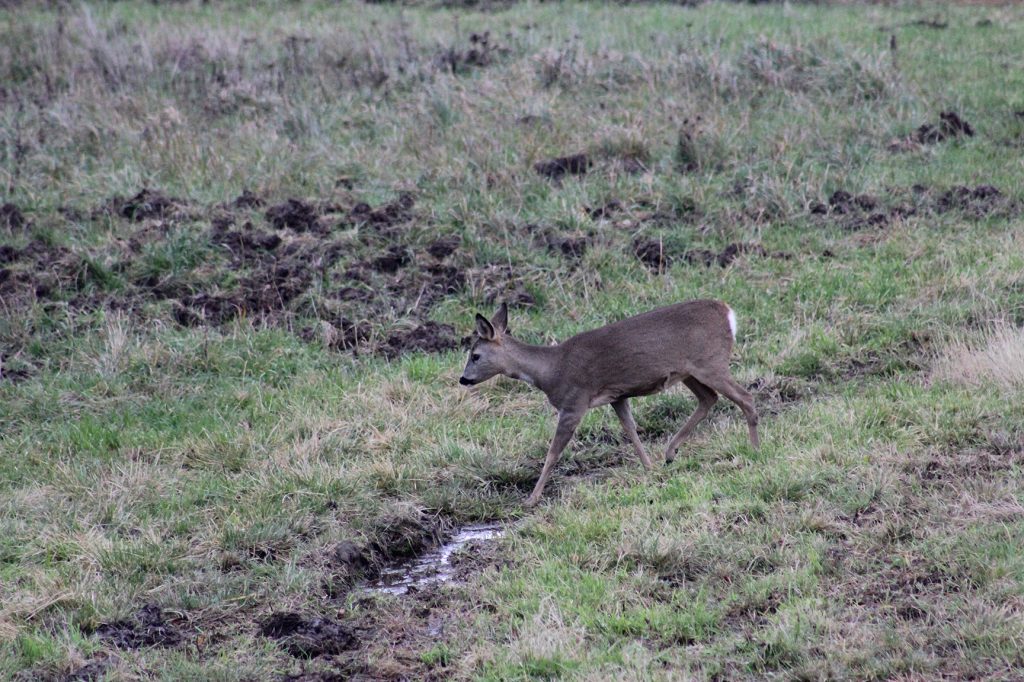
A dainty roe deer doe crosses a small stream. Experienced European hunters would probably know instantly from body shape that this is a female. Outsiders must look for the antlers, which are often partially obscured by the ears.
With six- to seven-month seasons, hunting pressure light throughout, and Europe’s intensive wildlife management, there’s really no bad time to hunt roebuck. In Austria, Czech Republic, and Italy, I’ve had good roebuck hunting in September and clear into October. However, with ideal hunting for other game (such as red and fallow deer) taking precedence in the fall, most European hunters feel there are two ideal periods to hunts roebuck: The first few weeks of the season, and during the rut, which is in July.
Roebuck hunting in the rut is a little like whitetail hunting in the rut. Older bucks come of the woodwork searching for females, and that’s when big bucks nobody has ever seen before might wander in. Also, it’s the period when skilled hunters have the most success calling roebuck, which is one of the most exciting ways to hunt almost any game (when it works).
Given a choice, I prefer to hunt early. In part, this is because of my North American roots: We tend to be overly focused on the criticality of Opening Day: we feel we must get in there while the game is undisturbed and strike before the orange-clad hordes stink up the woods. The latter doesn’t happen in Europe, but the undisturbed aspect is valid everywhere. With roebuck in spring, there are other advantages. After the long winter, things are greening up, and deer are coming out of the thick stuff and feeding on succulent new growth.
Taken in Romania on the first of May, start of the season, this is a good roebuck, reasonable bases, good length and tines, but not medal class.
Also, and perhaps more important, spring is a wonderful time to be in the woods. Weather is still cool and crisp, wildflowers are everywhere, mushrooms are popping. In North America, we see this with spring turkey hunting, sometimes with black bear, but we don’t get to savor the long, soft days of spring and early summer while deer hunting.
The roebuck, Capreolus capreolus, is a small-bodied deer, large bucks weighing up to perhaps 75 pounds, with short three-tined antlers. Taxonomy places them in the same sub-family as the North American deer of genus Odocoileus, and indeed they have many parallels with our white-tailed deer. They are browsers, bedding in cover and thriving in edge habitat. I like to describe them as “Europe’s whitetail,” widespread and popular.
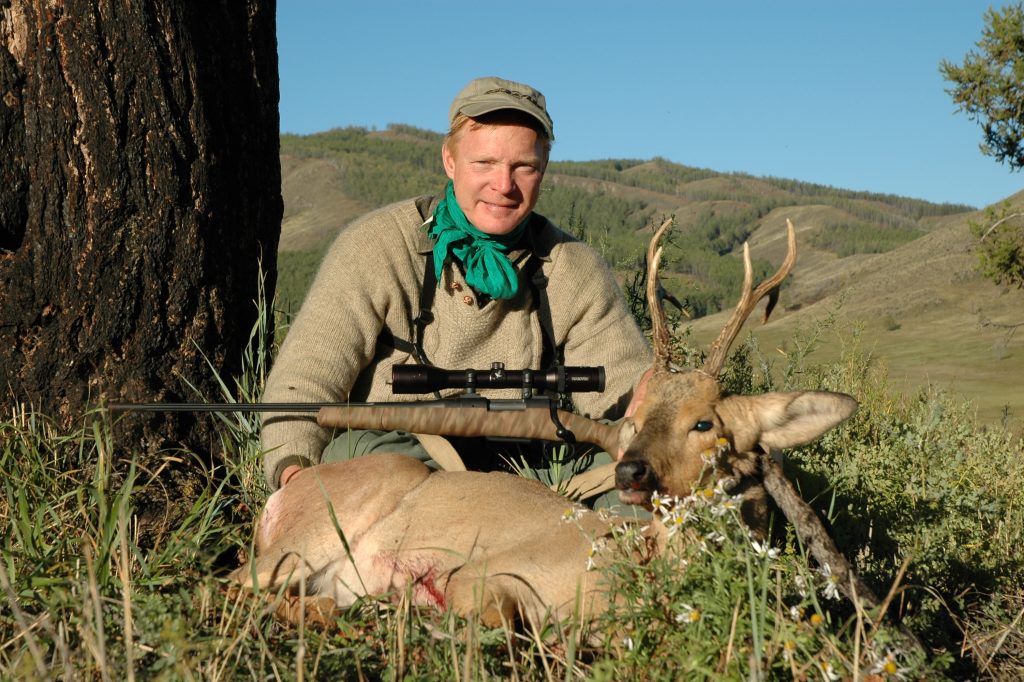
There are major differences: We have dozens of whitetail races and subspecies. Continent-wide, from the British Isles to eastern Turkey and Iran, there is just one European roe deer. Some biologists separate the isolated populations in Italy and Spain as unique subspecies. Not all agree, and hunters’ record-keeping systems recognize just one European roebuck. The only other roebuck is the Siberian roebuck (C. pygargus), found in varying densities from Kazakhstan to Korea. The Siberian roebuck is much larger, big males up to 130 pounds, similar antlers but longer and taller. I took my one and only Siberian roebuck in the forests of northern Mongolia twenty years ago; otherwise, I know little about them.
The Siberian roebuck of Asia is a significantly larger animal than the European roebuck, with bucks weighing over a hundred pounds. This is Boddington’s only Siberian roebuck, taken in northern Mongolia in 2005.
In recent years I’ve often been asked, “are roe deer found in Texas?” Or anywhere outside of Europe? Well, you can find almost any living creature on one or another Texas ranch. Vague references suggest roe deer have existed in Texas since the 1930s. I don’t doubt it, but I have never been on a ranch that boasted a breeding population. While European red deer have been widely introduced in the Western Hemisphere and South Pacific, this has not been the case with roe deer. You want to hunt roe deer, you need to go to Europe.
This is not a problem. Top to bottom, east to west, Europe offers a lot of opportunity to hunt roebuck. European hunters are accustomed to pay-as-you-go hunting. They love their roebucks, and costs are high for “medal class” trophies. Not so much for nice, representative specimens. Interestingly, to Europeans, roebuck quality is typically judged by mass and pearling at the base, per their CIC system. American hunters are more immersed in systems that place more emphasis on beam and tine length. So, what you or I find impressive, and might consider spectacular because of height and tine length, might not even make bronze by European standards.
Costs vary by country, but much roebuck hunting is wonderfully affordable. Since almost all hunting in Europe is considered a harvest—with a necessary quota—it’s commonplace to have the opportunity to take multiple bucks.
With their wide range, big roebucks are where you find them, like whitetails. Also like whitetails, some areas are known for producing bigger antlers. At the far north of their range, Sweden produces exceptional roebuck. So does Eastern Europe, perhaps especially the rich farmlands of the Danube Valley. My best buck was taken on a wonderful May hunt in Hungary, during gorgeous weather, a couple of roebucks in virtually every field. I took another exceptionally long-antlered buck in Romania, at the very start of the season. Not historically known for big roebuck, Spain has produced some dandies in recent years.
The only catch: As with whitetails, costs are likely to be higher in areas known for exceptional antler quality. I think some of my most enjoyable roebuck hunting has been in England and Scotland. There are big bucks in both places. Jason Hornady got a big one in southwestern England on a May 2014 hunt, by far the largest among a score of bucks taken by our group. Realistically, however, exceptional bucks are few and far between in the UK. That’s just fine. It’s a harvest, with the venison all spoken for. Wonderfully inexpensive, lots of bucks, take ’em as they come. No pressure, just plain fun.
Anywhere, some hunting may be done from stands (often just like whitetail stands), but almost all of my roebucks have been taken by spot-and-stalk, working around the edges of agriculture. It’s always an enjoyable way to hunt, but especially pleasant in mild spring and early summer weather. The fields are turning emerald green, and there are often wildflowers everywhere. You won’t take a buck on every stalk, or on every morning or afternoon outing. It’s not unusual to average 50 percent. In the fall, I love whitetails. In the spring, it’s hard to beat stalking roebuck.
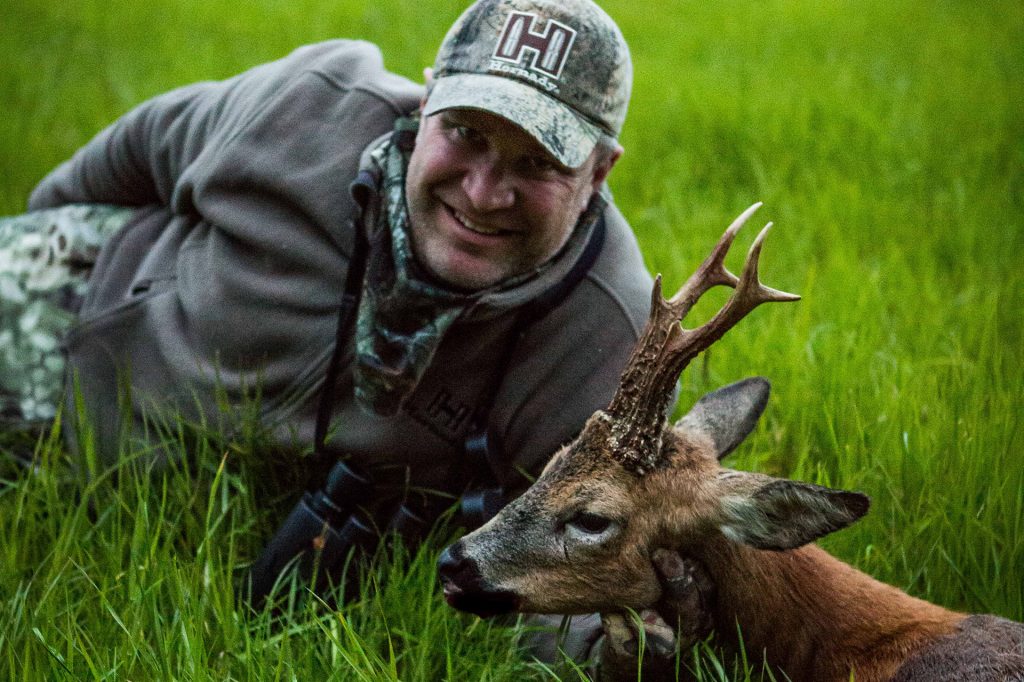
Like whitetails, big roebucks are where you find them. Jason Hornady took this excellent buck on a May hunt in southwestern England.
Complicated present-day realities conflict with popular perceptions. Can there really be too many elephants?
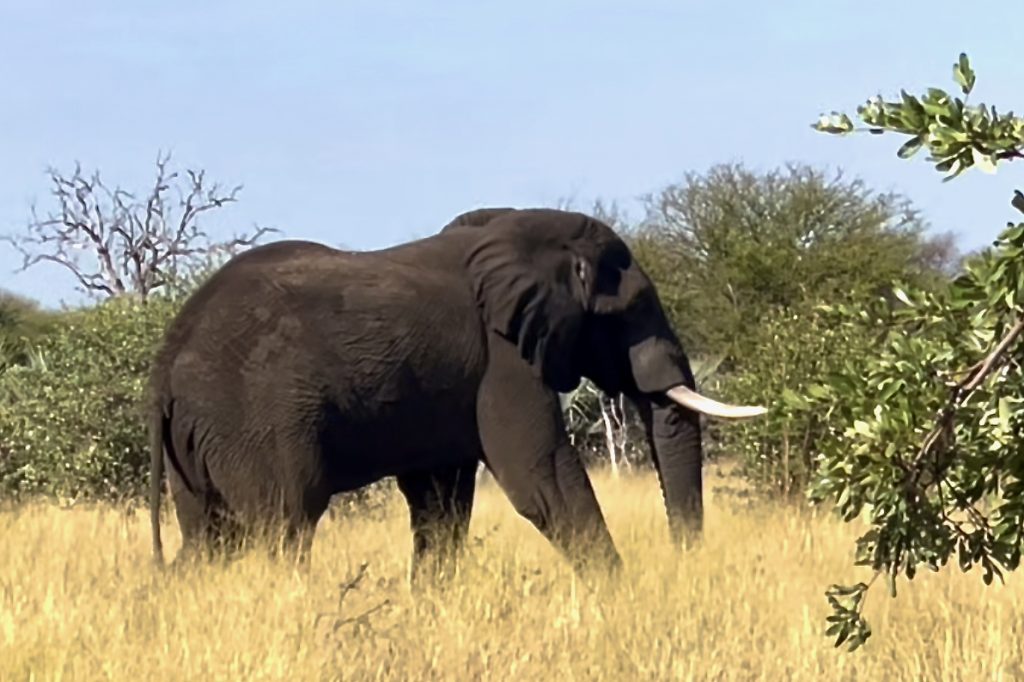
Image above: Elephants in Bwabwata National Park in northeastern Namibia.
The expression on my face in the photos afterward sums it up: still wide-eyed, slightly somber, almost confounded. It isn’t the look of a hunter enjoying what time and effort in the field has finally brought his way; an old Cape buffalo or eland would have had me smiling and perhaps relieved. But I never thought to shoot an elephant.
To a boy riveted by the tales of the old Africa hands, ivory hunting seemed the most romantic and dangerous way imaginable to make a living, and I used to wonder if I’d have the grit to confront and try to kill the largest mammal on land with a chunk of metal the size of a fingertip.
But that was then, and today I try to live in the present. Because they are social, intelligent, evidently thoughtful, and even self-aware, elephants for me abide on a plane above their fellow species of savanna and forest. I have stalked elephants until I could look at them through my sights (and whisper Boom!), but truly killing one seemed beyond the pale—never mind the crazy trophy fees. Once or twice the need to maybe shoot one in self-defense has come up, but the situations evaporated. This time, though, I was asked to do it. Or rather, I was offered the opportunity to do it and I couldn’t say no. It seemed to be a part of safari that few people experience now, and (in the absence of a veterinary team) there was a compelling reason to shoot this one.
An elephant had appeared in the meadow on the far side of the river—the Okavango, in northeastern Namibia. He moved slowly along the high bank until it flattened out and he could step into the water with dignity, and from there he angled out into the current, wading and then swimming. It is commonplace to see elephant and buffalo in that meadow, but this elephant was solitary and massive and center-stage, and he held our attention until he disappeared from the binoculars.
The next morning we came upon him a few miles away, still alone—and bedded down. The Mahango core wildlife area, in Bwabwata National Park, is alive with elephants; it’s unusual to see just one, and I’ve never seen a mature bull anywhere but on his feet. Tracker Gideon hopped off the truck and jogged toward him, clapping his hands. The elephant stood up and moved away, laboriously. In fact, he was limping, heavily favoring his right forefoot. I had to wince, watching him. Jofie Lamprecht, our Professional Hunter, grabbed eight seconds of video and WhatsApped it to the district warden.
An hour and a half later, the warden responded. Jofie studied his phone and turned to me: “Want to shoot an elephant? The warden says, ‘Take him out before he collapses.’ That’s when the vultures will arrive and the predators start eating on him.”
The Caprivi District, Namibia, 22 May 2023: The injured elephant.
It wasn’t hard to find him again, or to stalk within a few yards. It is a sobering sight, an animal of that size and presence throwing up its head and crumpling to the ground. I didn’t hear the shots, didn’t feel the recoil, and can’t tell you exactly where I put the coup de grâce into the top of his skull from behind. My mind was taken up by the enormity of it all. Then there was a stillness before Jofie and Mike and Gideon and Nadila solemnly shook my hand.
People vs. elephants
A century ago, Africa was thought to have 10 million elephants. When I began to visit, 35 years ago, there may have been about 1.1 million of them remaining. Today there are, reportedly, barely more than 400,000 and everyone “knows” that elephants are “endangered.” I’ve been scolded for killing even one of them.
Yet virtually everywhere in Southern Africa that I’ve stayed has been heaving with elephants. I get to go to prime wildlife country, though, not where agribusiness, mining, or other development is going on, or even where villages are expanding into the bush and families are hacking out room for a few stalks of mealies and a herd of goats. It is elephant habitat that is disappearing—and taking the elephants with it.
Ian Parker, who became an outspoken wildlife consultant after leaving the Kenya Game Department in 1964, reminded me (by email) of some hard truths: “Jonathan Kingdon [author of Mammals of Africa, Vols. I-VI] mapped East African elephant range at three points in time—1925, 1950, and 1975. It had declined progressively by over 60 percent. In a nutshell, elephant and human distributions were mirror images of one another. At 20 people per square kilometer, elephant populations were vestigial. At 40 to the square kilometer they were gone. In 1900 the [human] population of Africa was estimated at ~140 million, today it is 1.460 billion, a 10-fold increase; elephant range has declined in similar proportion and will continue to do so for as long as human increase persists.”
Yet, paradoxically, in many of their shrinking ranges—the parks, reserves, hunting concessions, and other conservation areas, and the less-accessible corners that have not yet been hard-hit by humans—elephants are multiplying, sometimes well beyond capacity, and human-elephant conflict is intensifying, despite uncommonly high tolerance by some rural African people. Ecologists are warning us that elephants can bring their own, and other species’, demise with them. They can eat trees, after all.
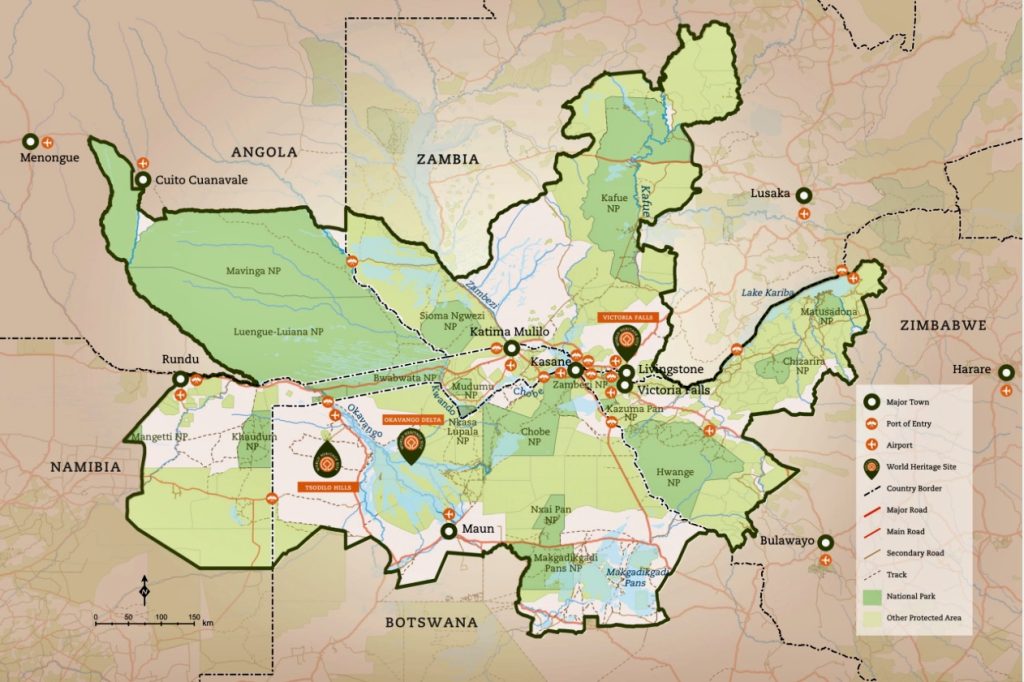
At 201,000 square miles, KAZA TFCA is the world’s second-largest conservation area, spreading across five African countries. Map courtesy of LTandC.org (Linking Tourism & Conservation)
The recent KAZA survey
In 2022, an aerial survey of KAZA, the Kavango Zambezi Transfrontier Conservation Area—201,000 square miles, 128,640,000 acres, across parts of Angola, Botswana, Namibia, Zambia, and Zimbabwe—found 227,900 elephants, likely more than half of Africa’s remnants.
Aerial wildlife surveys are notoriously difficult, especially in Africa, but this is 10,930 more elephants than were counted there in 2014-15. Is this a real increase or due to survey variations or migration? In any case, the “carrying capacity” of KAZA has been bumped up by large sums of conservation money—spent, for example, on drilling artificial water holes and opening up migration corridors—so the region may be able to sustain more elephants for longer than previously possible. However, the survey also found slightly more elephant carcasses this time; Darren Potgieter, the survey coordinator, said this would be studied, and cautioned that “factors such as aging populations, improved sampling methodologies, environmental conditions, and poaching could all be at play here.” But wildlife biologists now point to elephant deaths in KAZA due to drought and disease and to vegetation destruction, which may signal elephant overpopulation. Climate disruption surely plays a role too.
Some breeding herds and bulls migrate across KAZA, but the new survey found by far the most elephants within Botswana: 131,909. (Also 3,840 in Zambia; 5,983 in Angola; 21,090 in Namibia; and 65,028 in Zimbabwe. Yes, these add up to 227,850, not 227,900.) This is 1,970 more than the earlier survey found in Botswana—and about 120,000 more elephants than Botswana was thought to have c. 1960, when safari hunting began to develop there.
Botswana’s elephant numbers
No one knows just how many elephants Botswana actually can absorb, but in 1991 its Dept. of Wildlife and National Parks decided that “no more than 55,000 elephants could be sustained without habitat degradation” and recommended “adaptive management.” Botswana is now the epicenter of concern about elephant overpopulation, and some observers are sounding the alarm about “desertification.” Botswana’s 82-page 2021-26 Elephant Management Plan notes the “undesirable impact” that elephants can have on their habitats, and that in some areas canopy trees are being killed by elephants faster than they can re-grow, but adds that “impacts on other species, loss of biodiversity, effects on essential processes and on the ability of the ecosystems to sustain the elephants may all be disputed due to lack of evidence.”
However, “elephant-induced vegetation change” in Botswana has been formally studied since at least 1993 and probably earlier. The best layman’s discussion of the situation I’ve read is a long article (“Elephants: A Crisis of Too Many, Not Too Few”) by Dr. Brian Child that I prepared for the April 2020 issue of the e-zine Conservation Frontlines.
Elephants gouging the trunk of a baobab tree in Botswana. Photo by Ronnie Crous.
Dr. Child has a PhD from Oxford in wildlife and livestock economics; he grew up in Botswana and Zimbabwe, where his father was a national park ecologist and director. In short, to curb the destruction of vegetation in Botswana by elephants, and the resulting impact on other wildlife, he proposes a return to the nation’s successful and apparently sustainable commercial “conservation estate,” which from about 1960 to 1990 derived employment, revenue, hides, ivory, meat, clothing and artifacts from game—all while wildlife numbers rose steadily and elephants apparently were kept in balance. The nation has taken a step in this direction by building a $15 million multi-species abattoir in Tsabong, to support game farming and hunting. (Can it process elephants?)
Managing elephant populations
Maintaining elephant numbers is one thing; reducing a large surplus is entirely another. Ivory poaching has decreased and become almost negligible, at least in reducing overall elephant numbers; and safari hunters (Botswana may also allow “citizen hunters” to take elephants at sharply reduced fees) likely could not take off enough elephants even to blunt their average annual replacement rate of about 5 percent, much less bring present populations down to ecologically healthier levels. Foreign hunters in Botswana and Zimbabwe, where elephant numbers are highest, presently “harvest” about 500 elephants annually; simply to begin to flatten elephant population growth, these hunting numbers would have to increase approximately 20-fold.
The villagers who now descend upon an elephant kill with pangas and ecstatic cries might begin to roll their eyes and say, “What, elephant again? How about a nice hippo instead?” Trophy fees would have to drop dramatically, to put elephants within reach of more hunters, and hunting companies might see this as more work and risk for less pay—or new operators might arrive, setting off turf battles and causing problems through inexperience. The off-take could not all be bulls, either, for this would drastically skew herd dynamics. Inevitably, in some areas photo-tourists would encounter more elephant kills, with the opportunity for more social-media friction between hunters and anti-hunters.
Regardless of these market conditions, elephant populations must be managed. Botswana’s elephant plan does not mention culling. Culling is still included in South Africa’s National Norms and Standards for the Management of Elephants, updated in 2008, but to my knowledge it has not been carried out there—or anywhere else—since 1994, in Kruger National Park. From 1960 to 1991, Zimbabwe reportedly culled or hunted 46,775 elephants. Following the Trans Africa Drought of 1977-81, South-West Africa (as Namibia was then) said it culled 570 elephants to reduce pressure on black rhinos and roan antelope in especially dry areas.
Culling is not a one-time adjustment; elephant births may increase afterward because more food is available, and the need for culling becomes ongoing. Culling can be effective and inexpensive, but it does have drawbacks and logistical challenges.
Leaving tons of carcasses to rot in one spot can lead to outbreaks of disease, and heaven help the national park whose visitors come upon a charnel ground of 40 or 50 elephant carcasses, old and young, male and female, piled together and reeking in the sun. To prevent social disintegration, entire family groups are wiped out together. Selectively killing a few “problem” animals, as every elephant-range country does occasionally, is not culling in this sense; nor is generally illegal “retaliatory” killing by rural people who’ve been harmed by elephants.
In Kruger Park, in northeastern South Africa, where roads are good, the carcasses were taken in closed trucks to abattoirs that canned the meat for sale in markets. The BBC News pointed out that these contractors and distributors could not gear up for the work without some assurance it would continue—another factor in an overall culling plan. (But in Botswana, trucking elephant carcasses out of the Okavango Delta, for example, is impossible; those animals would have to be intercepted elsewhere along their migratory routes—if even feasible.)
Reportedly, the canned meat sold well. If CITES, the Convention on International Trade in Endangered Species of Wild Fauna and Flora, were to lift the counterproductive ban on regulated trade in elephant ivory, the economic—in addition to the ecological—incentive for culling might be even stronger.
Besides the C-word, other controls
Would it be strong enough to enable KAZA countries to shrug off the subsequent firestorm of protest by international animal-protection groups? And at least the threat of a tourism boycott? Candidly, this is what politicians and bureaucrats fear most about culling elephants—videos on social media, followed by accusations of a return to “apartheid-era” or “colonialist” thinking. In 2021, a news report that Zimbabwe’s Parks and Wildlife Authority was considering culling elephants drew instant condemnation from a group that equated culling with extinction.
So what’s a nation with too many elephants to do? Recently Namibia and Zimbabwe sold a few hundred live-caught elephants to China and Middle Eastern countries for zoos. The goal was not to reduce elephant numbers but rather to raise some much-needed cash for conservation. The animals were captured and moved under veterinary supervision, but nevertheless an international public outcry followed.
Relocating elephants in-country—away from villages, for example—has been tried too, with little success; elephants tend to return. As well, the cost is prohibitive; in 2018, Zimbabwe reported that capturing and moving 100 elephants cost about $400,000, an unsustainable expense.
Fertility control for elephants has been studied extensively, beginning with the reproductive physiologies of cows and bulls and proceeding to the social aspects of breeding among different age classes, and then gestation and lactation periods and intercalving intervals among cows. My favorite part is comparing NDVI, the Normalized Differential Vegetation Index, to fecal progesterone metabolite concentrations during estrus and in pregnancy, and how these vary in the wet and dry seasons.
Briefly, then, it’s not just a matter of darting elephants with a vaccine—which hasn’t been developed yet, or tested—from a helicopter. Even if it were, the effects of contraception on elephant behavior have not been determined. (The behavior of animals that weigh tons is consequential.) The final considerations are methodology and costs, which are, respectively, complex and high. The impacts of birth control are not immediate, either; population numbers will begin to go down only when the mortality rate finally exceeds the birth rate. A cow elephant’s gestation period is nearly two years.
Meanwhile, in Namibia . . .
To return to the nation where this story began: With respect to wildlife, and especially elephants, Namibia may be unique. Its Constitution mandates the “maintenance of ecosystems, essential ecological processes and biological diversity . . . and utilization of living natural resources on a sustainable basis for the benefit of the Namibians, both present and future.” (“Sustainable use” has become code for “hunting.” Namibia strongly supports managed hunting, for a variety of reasons.)
Not only has Namibia’s total elephant population approximately tripled, to about 24,000, since independence from South Africa in 1990, but thanks partly to the nation’s communal conservancies, its elephant-distribution range is actually expanding; no habitat shrinkage there. (Only northeastern Namibia lies within KAZA; The nation has elephants in the northwest too, which add to the 21,090 counted in the 2022 survey.)
This is not to say that elephants are not a concern in Namibia—human-elephant conflict is worsening—but that, in the second-least-densely populated country on earth, there is still room for elephants and people to prosper. And, overall, Namibia sincerely appreciates its elephants; they draw visitors.
Namibian hunting operators are presently allowed to export 93 elephant bulls per year. The nation’s 119-page National Elephant Conservation and Management Plan 2021/2022 – 2030/2031 contains but one sentence that could refer to culling: “Other ways of reducing overconcentration of elephants (lethal removal, translocation) are used as means of last resort.”
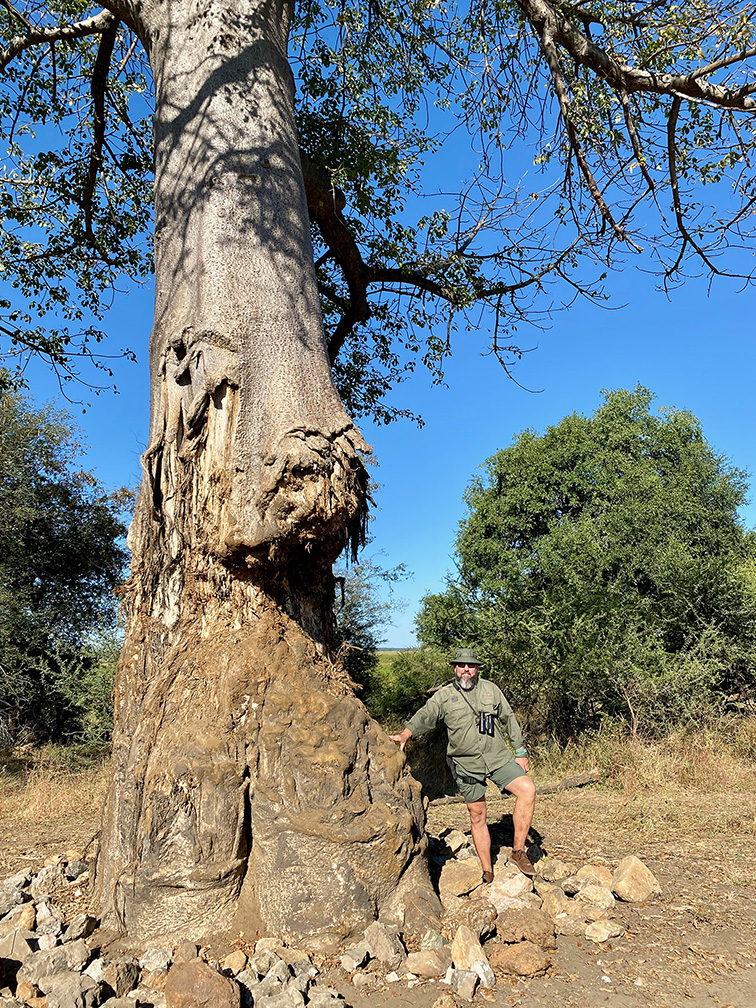
A young baobab tree killed by elephants. The collar of rocks around the trunk was meant to deter them, but if it isn’t maintained eventually the elephants roll the rocks away.
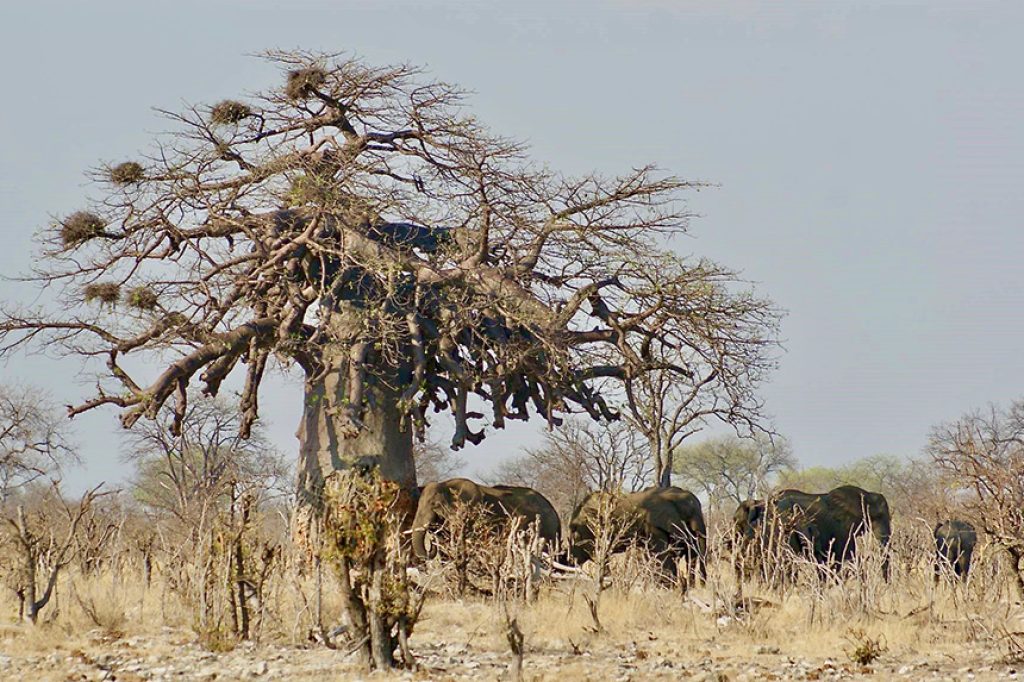
In June 2021, I returned to Bwabwata National Park, in Namibia’s Caprivi District, for the first time in 16 years. Lions roared along the river almost every night, something I’d not heard in 2005; I also saw many more elephants than in 2005. In June 2023, when I shot the injured tusker, we came across even more elephants than in 2021. This is likely coincidental; but it was clear that, in two years, more of the baobab trees had been attacked—the bark stripped away and the trunks splintered—by elephants. With their enormous canopies and root systems, their fruit and their ability to store moisture, baobabs are fundamental to the semi-arid savannah ecosystem; and they may live for centuries—if unmolested.
The lessons of Tsavo
The worst elephant boom-and-bust of modern times was the Tsavo die-off of 1970-73 in Kenya, when elephant overpopulation and drought turned 8,000 square miles of woodland into a moonscape. Poachers and native hunters as well as the drought were blamed, but the reality was that elephant “conservation” had been too successful within Tsavo National Park. According to Peter Beard (The End of the Game), “A director of the Tsavo Research Team estimates that thirty thousand elephants died there from starvation, constipation, and heart disease—all attributable to density and mismanagement.”
Concerning the evident increase in elephant numbers in Bwabwata National Park and their impact on the baobab trees, Dr. Malan Lindeque (former Permanent Secretary of Namibia’s Ministry of Environment, Forestry and Tourism) told me that he doesn’t think a Tsavo scenario is likely there because BNP is part of KAZA—an interconnected system that enables elephants to move from the park into adjacent Angola, southwestern Zambia and Botswana. In other words, there’s still room. I didn’t ask for his thoughts on what Botswana should do with its 130,000-plus elephants.
Harking back to Dr. Child’s comments about Botswana’s “conservation estate”: By 1980, a company called Botswana Game Industries was buying hides, furs, ivory, and other raw materials from more than 5,000 local Batswana hunters and refining them into millions of dollars’ worth of wildlife products. After diamonds and cattle, BGI reportedly was Botswana’s largest revenue producer.
Ian Parker was a shareholder in and consultant to the company; in 1983, he told me, he advised management to change course: “I’d been tracking the success of the animal-rights movement worldwide in convincing a gullible public that it was ethically wrong to buy wildlife products.” Since BGI couldn’t afford an equally powerful counter-PR campaign, Parker felt it best to bow to the inevitable and switch over to processing cattle hides. But today, Parker says, African nations that heed foreign animal-rights groups and anti-hunting politicians have only themselves to blame.
A different standard for Africa
Ironically, while hunters kill enormous numbers of animals across North America, Great Britain, and Europe, some uninformed or misinformed citizens of those countries have let themselves be convinced that it is proper to demand that nations thousands of miles away cease the killing of their wildlife, however damaging, dangerous and over-abundant it may be. Is this not neo-colonialism? And did these Western countries not wipe out, or nearly, some of their own megafauna before learning basic conservation lessons?
Legislation to ban the import of hunting trophies has come before the British Parliament three times in recent years. In March 2024, six African nations sent delegations to London to protest the proposed ban on the grounds that it would reduce funding for wildlife conservation (including anti-poaching patrols to protect elephants) and severely impact people that rely on hunting for jobs, revenue, and meat.
Botswana’s Assistant Minister for State President offered to send 10,000 elephants to London’s Hyde Park so that Britons could “have a taste of living alongside elephants, which are overwhelming my country. In some areas, there are more of these beasts than people. They are killing children who get in their path. They trample and eat farmers’ crops, leaving Africans hungry. They steal the water from pipes that is flowing to the people. They have lost their fear of humans.
“Elephant numbers, just like those of Scottish stags, have to be controlled. Hunters in the Highlands pay to shoot deer and put their antlers on their walls. So why is Britain trying to stop Africa doing the same?
“Botswana is the most successful country in the world at looking after elephants, buffalo, and lions. We don’t want colonial interference from Britain.”
Well-managed hunting can be a significant component of conservation, particularly in funding and incentivizing it. Culling, or cropping—of deer, wolves, bison, and any number of invasive species, from cane toads to feral housecats, rats to mink—is routine in the Western world, and springbok, impala, and other antelope are still periodically thinned in Southern Africa. But all this cuts little ice with people who believe the best way to conserve charismatic animals is to, well, not kill them.
Killing elephants in particular has become taboo, and even many sensible, experienced hunters say they would not do it; they may grasp the need, but it’s a personal choice. Why are elephants different? We know why; I said it myself, in the third paragraph: They are intelligent, social, thoughtful, self-aware. Elephant-range states face stark choices.
About the author: Silvio Calabi is a retired publishing executive and a lifelong conservationist and hunter. He lives on the coast of Maine and in the mountains of Colorado.
These small antelopes are part of Africa’s Tiny Ten.
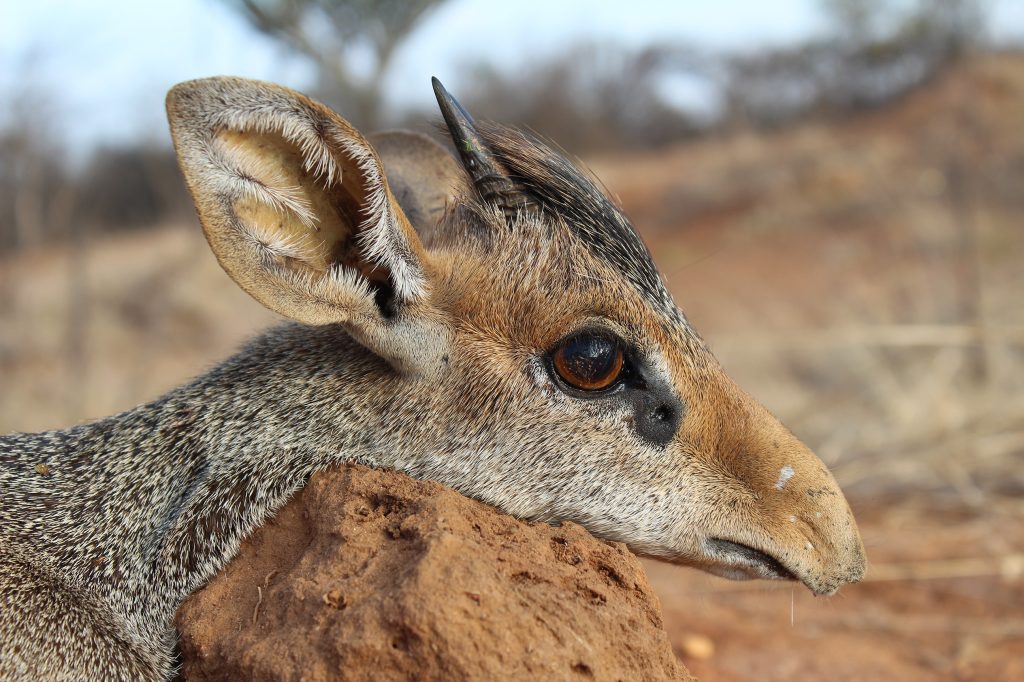
Photo above: A fine Damara dik-dik ram.
Get your mind out of the gutter. The dik-diks are tiny African antelopes, adapted to arid, semi-desert thornbush. The name comes from Somali, mimicking the female’s chirping alarm call.
Dik-diks are sort of gray to almost rufous, with a distinctive bulbous snout, and a forehead tuft that makes it tricky to see the male’s small, ringed, needle-sharp horns. Depending on race, dik-diks weigh six to maybe thirteen pounds, pencil-legged, a foot to possibly a foot-and-a-half tall. Think “small jackrabbit.” Most of the races have produced horns up to four inches, but three-inch horns are always spectacular. That’s the Rowland Ward minimum for the most-hunted Kirk’s dik-dik of southern Kenya and Tanzania. The Rowland Ward minimum for Namibia’s Damara dik-dik and Guenther’s dik-dik is 2.5 inches–not much horn to look for peeking past the forehead tuft.
Like all dwarf antelopes, dik-diks are tender and tasty, with meat more like a rabbit than an antelope. Although a dik-dik will be savored, they are too small to provide adequate camp fare, and too small for most larger predators to bother with. To many hunters, however, despite its small size, the dik-dik is a major trophy animal, requiring effort and expense.
At least twenty species of dik-diks have been proposed. To this day, their exact differences, boundaries, and classification are debated. With one exception, dik-diks are found only in northeast Africa. The largest one, the Damara dik-dik, is found in northwest Namibia and into Angola. That means the Damara is separated from other dik-diks by a huge stretch of Africa. In animal distribution, such a gap is unusual.
All dik-diks are of genus Madoqua, divided into long-snouted, and short-snouted groups. Damara, Kirk’s, and Guenther’s are considered long-snouted dik-diks. Despite the huge separation, Kirk’s is geographically closest to the isolated Damara, while Guenther’s ranges to the north of Kirk’s. Rowland Ward identifies five short-snouted dik-diks. SCI categorizes six, and their nomenclature is not in agreement. To some extent, it’s a moot point, because several races are found in Somalia, Djibouti, and Eritria, which are not open to hunting. Within living memory, it has never been possible to hunt all the dik-diks.
Guenther’s dik-dik is northernmost of the “long-snouted” dik-diks. Characteristic to all dik-diks: Bulbous proboscis, large eyes, and upright tuft on the center of the forehead.
Depending on which authority one prefers, Ethiopia has four or five distinct races. You’d have to travel the length and breadth of that huge country to hunt them all. Currently, the most huntable dik-diks are probably the Damara in Namibia, Kirk’s in Tanzania, Guenther’s in the northeast corner of Uganda and southern Ethiopia, and Harar and Salt’s dik-dik, also in Ethiopia.
This last is in some dispute. Rowland Ward considers all dik-diks in northern Ethiopia to be Salt’s, this species ranging on through Djibouti and Eritria to Sudan. SCI considers the dik-diks of Ethiopia’s Awash River basin to be a smaller subspecies of Salt’s, called Cordeaux (M. saltiana cordeauxi). In 1993, Joe Bishop and I camped on the Awash and hunted this dik-dik. I’m no expert and can only say that these were very small, visibly half the size of the Damara.
Thanks to Namibia’s large outfitting industry and good management, the Damara is the least costly to hunt. When I first hunted what is now Namibia in 1979, I saw several dik-diks, but at the time they were fully protected. A quarter-century later, one of these little antelopes was a primary goal of a Namibian safari. Then, the “Tiny Ten” of Southern Africa had not been proposed; I just wanted one of these cool little guys. Today, the popularity of the Damara dik-dik has increased because of its necessity for the Tiny Ten. Value promotes protection, which equals more animals. Numbers and availability have increased, although the Damara dik-dik remains a limited-permit animal in Namibia.
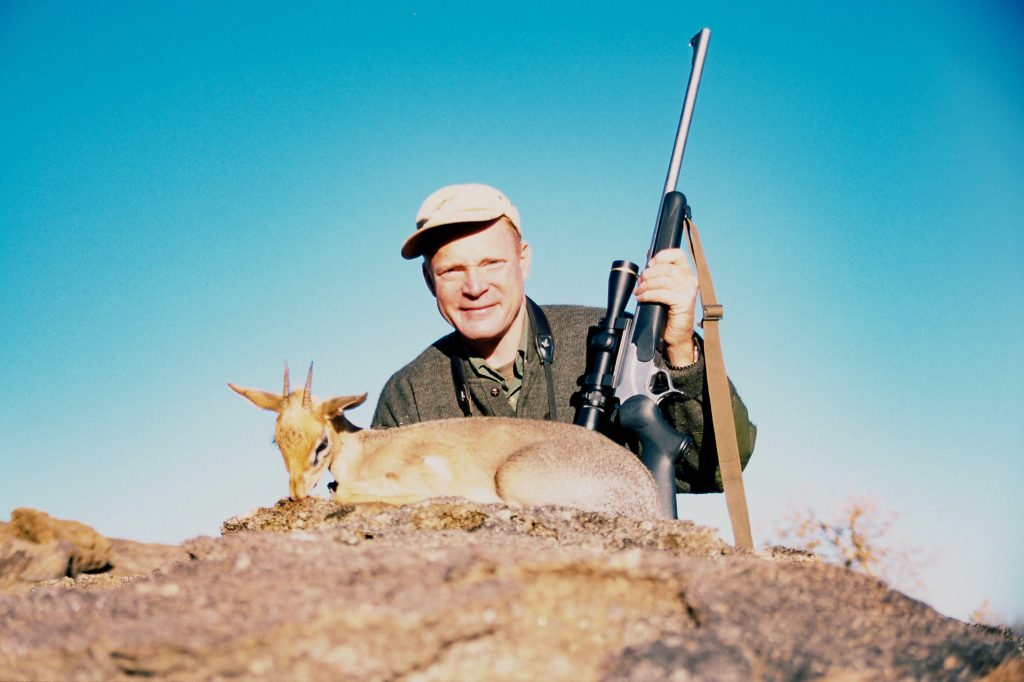
Boddington’s Damara dik-dik was taken in 2003, at the time a giant, still a good one. This was his first use of a .22 Hornet in Africa, still his pick as the perfect cartridge for smaller African antelopes, plenty of power, but almost no damage.
I’ve accompanied several hunts for the Damara dik-dik, so I have some experience with that one. I took an excellent Kirk’s dik-dik in Kenya, likewise have seen many in Tanzania, so I also have a little experience there. Joe and I had no trouble finding Cordeaux dik-diks in Ethiopia, but that’s my only experience with a “short-snouted” variety. On my second Uganda hunt in 2017, a Guenther’s dik-dik was at the top of my wish list. From our buffalo camp in Karamoja, we had to go far east near the Kenya border. Once in the dik-dik area, we saw plenty.
Based on this limited experience, all dik-dik hunting seems similar. You look in dry thornbush, glass into shadows. Adults are usually seen in pairs, sometimes with smaller offspring. Dik-diks tend to mate for life, so if a hornless dik-dik is seen, keep looking. Her mate is likely close-by.
Dik-diks are highly territorial. If spooked (as usual) they will scamper off. Don’t panic. Sit tight, or back off and come in from a different angle. Give it a half-hour and they often come slipping back. My Damara, at the time a giant, was taken that way. We spooked a pair from some bushes below a rocky kopje. Hunting with Dirk de Bod, we circled up into the rocks, came back down, and sat among some boulders. Wasn’t long before the female drifted back, soon followed by the big male.
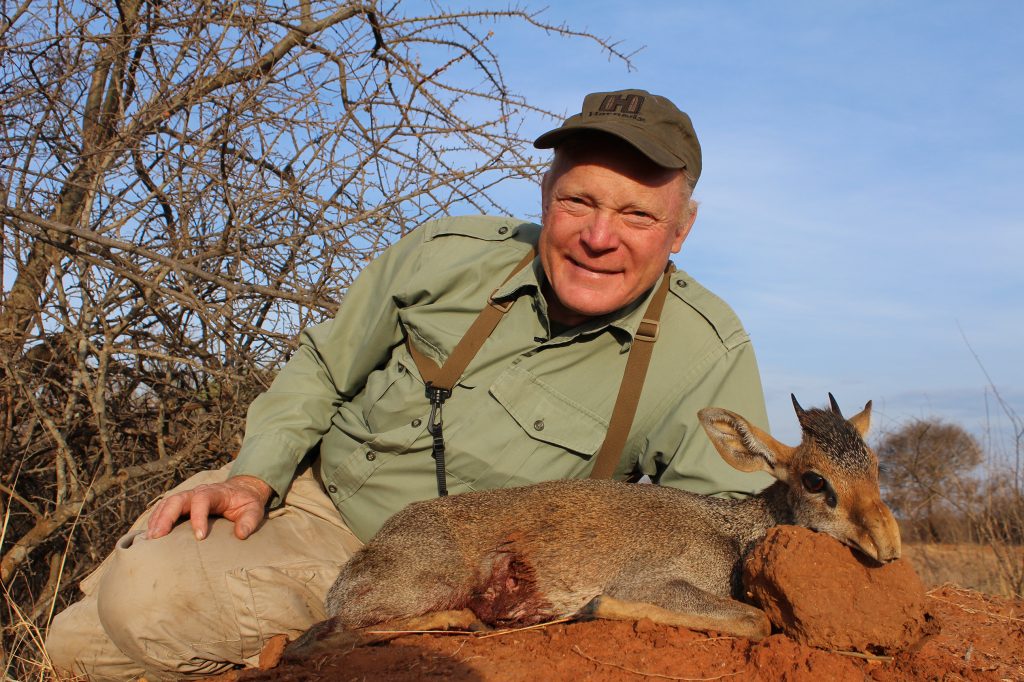
With small antelopes and too-powerful rifles, best to ignore shot placement rules and shoot for the middle to avoid extreme damage. This Guenther’s dik-dik, a primary goal on a 2017 Uganda safari, was taken with Steve Hornady’s .223. Still too much gun for dik-dik, but it dropped instantly with repairable damage.
Many are taken in chance encounters. Always, you know dik-diks are in the area, on license, and on your wish list. When you see good horns, you take the shot. With this little antelope, the quandary is what to shoot him with. The dik-dik is a special animal, worthy of a life-size mount (which takes up little space) The problem: Taking him effectively without making a mess.
Cover-dwelling dwarf antelopes like forest duikers are customarily taken with shotguns, avoiding cape damage. Dik-diks are nervous little guys living in semi-open scrub, rarely taken within effective shotgun range. The challenge with a rifle is to avoid destruction, so we need accuracy without excessive power.
In Ethiopia, we used outfitter Colonel Negussie’s scoped Brno in .22 rimfire. In Namibia, daughter Brittany used Dirk de Bod’s son’s youth model .22. Placed well, a .22 Long Rifle hollowpoint is adequate, and a .22 is present in most camps. However, effective range is limited. Because of their small size and ability to hide behind a few blades of grass, rarely can dik-diks be seen and judged at distance. Up close, they’re likely to bolt before horns can be judged. In my experience. many opportunities are between 60 and 100 yards, pushing the limits of a .22 LR.
In Kenya, I carried a few 180-grain full-metal-jacket Match loads, which shot to the same point of impact as my 180-grain Nosler Partitions. I figured they’d be perfect for dik-diks and duikers. That was the last and only time I carried two loads for a plains game rifle! It was too complicated to try to switch when an animal was spotted. I managed it on the dik-dik, but even with a solid, the .30-06 was far too powerful. We salvaged only a shoulder mount, a shame for a beautiful dik-dik.
In Uganda in 2017, Steve Hornady brought a .223, which I borrowed for my Guenther’s. I purposefully shot it too far back, and dropped the animal without irreparable damage, but it was still too much gun. On other hunts in Namibia, Trijicon’s Stephen Bindon and my wife Donna used camp .17 HMRs for Damara dik-diks. They were perfect, plenty of range and power, almost no damage. That outfitter, Corne Kruger, happens to have .17 HMR rifles in camp, but they’re not common in Africa.
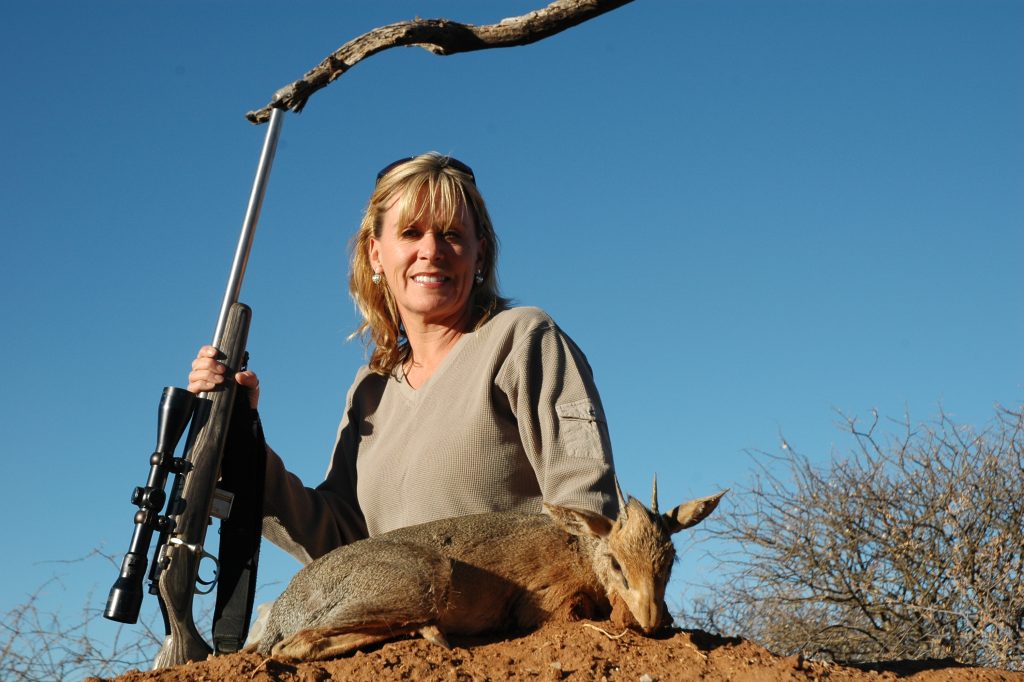
Donna Boddington’s PH, Corne’ Kruger, had a Marlin .17 HMR available. Both .17 HMR and .22 WMR are uncommon in Africa, but when available are near-perfect for the tiniest antelopes.
When I went for my Damara dik-dik, I took a .22 Hornet barrel for a T/C Encore. We shot two, one for me and one for Dirk, both down on the spot, no visible damage. Since then, I’m convinced the .22 Hornet is ideal for small antelopes. And, unlike the .17 HMR and .22 WMR, it is also versatile, powerful enough for antelopes up to reedbuck and impala. Realistically, it’s awkward to take any rifle on safari that’s perfect for just one animal. So, for a highly specialized animal like dik-dik, we often borrow a camp gun. It makes sense to find out what might be available.
The .22 Hornet remains surprisingly popular in southern Africa. A couple years ago, Harley Young, at eighty-something, came to Frontier Safaris in Namibia needing a klipspringer and Damara dik-dik to complete his Tiny Ten. His 6.5 Creedmoor was perfect for the klippie, but that’s a cannon on dik-dik. Barry Burchell had an Anschutz .22 Hornet but no ammo, so we repaired to his loading bench and whomped up a few rounds, then checked zero. A day later, Harley had a fine Damara dik-dik with a perfect skin.
Tom Fruechtel, then CEO of Leupold, took this exceptional Kirk’s dik-dik in Tanzania’s Masailand. Because of long availability in both Kenya and Tanzania, Kirk’s has probably been the most-hunted of all the species and races of dik-diks.
UPDATE: Proposition 127 was defeated in November by Colorado voters. Read our analysis here.
Read this before you buy into the claims made by supporters of Colorado’s proposed lion-hunting ban.
Photo above: A mountain lion in Colorado. Photo copyright Victor Schendel: VictorSchendelPhotography.com
Anti-hunting groups have launched a full-on misinformation campaign in their push to ban mountain lion and bobcat hunting in the state of Colorado. A group called Cats Aren’t Trophies has collected enough signatures to place a measure on the statewide ballot this fall, Proposition 127. The initiative’s backers make numerous false claims about scientific wildlife management in Colorado, and specifically about the legal, regulated hunting of mountain lions and bobcats. (The initiative also mentions lynx, even though lynx are classified as endangered and have not been legal to hunt or trap in Colorado for decades.)
Coloradoans for Responsible Wildlife Management (CRWM), a coalition of science-based conservation groups opposing the initiative, noted in a flyer, “This isn’t about fair chase or management concerns; it’s a deliberate attempt to misinform.”
The truth is that Colorado has thriving and well-managed populations of both mountain lions and bobcats. Hunting and trapping may not be everyone’s cup of tea, but these activities are highly regulated, humane, and selective. And many people don’t realize it, but hunters do eat the meat of their mountain lions, and it is delicious.
Let’s take a closer look at some of the questionable claims being made by those who are behind Proposition 127.
Myth: Lions and bobcats are declining
Colorado Parks & Wildlife (CPW), the state agency that oversees wildlife in Colorado, employs a staff of trained biologists to monitor wildlife populations through scientific modeling and field research. CPW’s official statewide estimates of the number of independent male and female lions (not including kittens) is 3,800 to 4,400 statewide.
The agency’s research shows Colorado’s lion population has been growing since 1965, which was the year they were classified as a big-game species. The agency reports: “Both informal and recently collected empirical data suggest Colorado’s lion population is strong and lions are abundant in appropriate habitat.”
Bobcats are also widespread and doing well. Bobcats are the most common wild cat in North America, with some 1.4 to 2.6 million bobcats nationwide. In Colorado, CPW biologists assess five different metrics each year to make sure bobcat populations are healthy. The information indicates Colorado’s bobcat populations are stable and likely increasing in some areas.
Lynx were reintroduced into Colorado in 1999, and although their population is stable, they are currently listed as endangered in Colorado. Lynx are protected by both state and federal law, with hunting and trapping entirely prohibited.
Mark Vieira, CPW’s Carnivore and Furbearer Program Manager, explained that the agency tracks population models for mountain lions in various regions of the state and that biologists have collared hundreds of lions in field studies to verify the population models.
“Observations of mountain lions point to a growing, healthy, and increasingly expanding population,” he said in a recent presentation detailing how Colorado’s professional biologists manage and monitor cat populations. (Watch his full presentation here.)
Myth: Lion and bobcat hunting is a “trophy hunt”
When the authors of proposed Initiative 91 use the term “trophy hunt,” they are implying that hunters are only interested in the head and hide of the mountain lion and not in taking the meat. First off, that’s not what trophy hunting means, but that aside, here are the facts:
Colorado, like other states, has a “wanton waste” law. That means that hunters who take big-game animals like mountain lions are required by law to take and prepare the meat of the animals for human consumption. Bobcats are classified as furbearers rather than big-game animals and as such are exempt from this requirement, but many hunters also prepare and consume bobcat meat.
Americans tend to have a cultural bias against eating cat meat, but there is no health or taste reason for this. As lion hunters have discovered, the meat is, in fact, highly palatable. Outdoor writer and hunter Don Thomas, who guided mountain lion hunts for many years, says, “Lion meat is lean, light, fine-grained, and delicate, and can be prepared in any manner suitable for pork or veal.” He once converted a skeptic by serving him a meal of sweet and sour lion scallopini. The doubter loved it.
Those who aren’t as adventurous with their cuisine often make the meat into sausage. One hunter told me he had his lion meat made into spicy snack sticks, which were a hit with everyone who tried them.
Yes, most hunters also mount their lions or preserve their hides, which is a way of honoring the animal and preserving the experience of the hunt. Before they do, successful hunters are required to present the hides of their lions and bobcats at a CPW office for a mandatory check. The information gathered by the wildlife technicians at these checks is a source of valuable intel for biologists who study these animals.
Myth: Mountain lion hunting is unsporting; it’s like “shooting fish in a barrel”
Mountain lions are secretive and extremely wary animals, and there is nothing easy about hunting them. CPW’s Vieira cited statistics showing that only one in five Colorado mountain lion license holders is successful in harvesting a lion, which hardly sounds like “shooting fish in a barrel.”
Lions can be hunted in several ways, but one of the most common ways is by finding fresh tracks in the snow and then using hounds to trail them until they tree. Like hunting itself, this type of hunt is not everyone’s cup of tea, but it is a method of hunting that has been used for centuries, and it often turns into an extreme physical challenge, since the hunter must follow the cat and hounds on foot (or with skis or snowshoes) over rugged, mountainous, roadless terrain, often for long distances. Nor is a successful chase assured—lions often give hounds the slip.
The main reason for allowing the use of hounds for hunting lions is that it allows hunters to be selective. Colorado’s lion regulations are specifically designed to limit the harvest of adult female lions. “States that don’t allow the use of hounds for lion hunting have a higher harvest of females,” Vieira said.
That’s because it’s easy to quickly tell whether a deer or elk is male or female, but it’s difficult to know the sex of a cat without getting a close look. Hunters can positively verify the sex of a lion in a tree. They can then choose to let the lion go, or make a quick, clean kill.
“I have heard the ‘fish in a barrel’ complaint often, sometimes from other hunters,” Thomas, the former guide, said. “Hard to keep that in mind when I’m making a five-mile hike through treacherous terrain in sub-zero weather! I would guess that we treed fewer than half the cats we chased and shot far fewer than that. Even back when I was in top shape, I’ve never felt as exhausted as I did at the end of some of those hunts, which often did not end with a dead lion.”
Myth: Lion hunting orphans kittens
It’s important to note that female mountain lions with kittens are never allowed to be hunted. Lions are solitary animals, so if you see more than one set of lion tracks together, it’s most likely a female with young. Since lions are almost always hunted in the snow, it’s easy for lion hunters to avoid following multiple sets of cat tracks. Because of this selective method of hunting, female cats with kittens are left alone.
Colorado takes the education and selectivity of lion hunters very seriously, requiring anyone who wants to buy a mountain lion license to take and pass an online test to ensure they understand the rules.
Myth: There is no management reason for hunting cats
Many people wonder why we have to manage wildlife at all—can’t we just let nature take its course? That’s an attractive sentiment, but Colorado now has 5.8 million people within its borders, and humans are heavily encroaching on wildlife habitat—building more and more houses and roads, running four-wheelers and snowmobiles, hiking, skiing, and biking in the backcountry. All of this has a huge impact on wildlife populations, altering the carrying capacity of the land. Like it or not, humans have to step in to help restore the balance. One of the ways this is done is through controlled hunting. Removing a carefully determined number of animals is a tool that helps maintain stable and healthy wildlife populations.
This is not about “getting rid” of lions or other predators. Thriving lion and bobcat populations are an important part of Colorado’s ecosystem. The state is scientifically managing the cats with a plan designed to maintain the populations at or above their current, sustainable levels. “Our strong lion populations also support the overall biodiversity of Colorado, interacting with deer and elk herds and providing ecological services as they have for thousands of years,” said Vieira.
Mountain lions prey on herbivores such as deer, elk, and bighorn sheep, and CPW’s scientific wildlife management approach helps keep the populations of all of these species in balance. Every wildlife management decision has complex ripple effects on many other species, which is one of the reasons these decisions should be made by trained biologists who spend years developing and implementing management plans that take all factors into account.
Myth: This proposition will stop lions from being killed
In 1990, the state of California passed Proposition 117, which banned mountain lion hunting in the Golden State. But the state still issues large numbers of depredation permits for lions that are killing livestock or threatening people, as Colorado would need to do as well. Paid trappers and sharpshooters (at taxpayer expense) kill an average of 98 lions every year on these permits, four times the number that were killed under such permits before the ban. In addition, the lack of a hunting season for the past thirty-odd years has not resulted in healthier lion populations in California. A recent survey pegged the state’s lion population at between 3,200 and 4,500, which is much lower than previously thought in a state that is a third larger than Colorado.
Well-intentioned people who simply want to “stop the hunt” believe they are helping to protect wildlife. The truth is that trained biologists using scientific methods are the people best qualified to help wildlife populations thrive. Let’s let them do their jobs without interference from agenda-driven ballot measures. That’s how we, as informed voters, can show we truly care about wildlife.
The fact that I hung a rack of antlers on my wall does not mean I left the meat behind.
Many of the recent attempts to shut down various types of hunting through legislation or state ballot measures have been couched as bans on “trophy hunting.” It’s an effective tactic, because poll after poll shows that the general public mostly approves of hunting for meat or management purposes, but opposes “trophy hunting.” The problem with the term is that what most people think it means, versus what hunters mean by it, are worlds apart.
If you ask the average non-hunter, they will likely tell you that “trophy hunting” means the head and horns were taken and hung on the hunter’s wall, and the meat was left to rot. However, true trophy hunting, as hunters understand it, means being extremely selective in holding out for the biggest and oldest animal possible (which is often also the wariest and most difficult to hunt), and when and if it is taken, it is utilized completely—all the meat is recovered and consumed, and the head, horns, and hide are preserved, retained, and prized.
Whether the “trophy” in question is a big-antlered bull elk, a brawny old male mountain lion, or an African buffalo, such an animal rarely makes the pursuit easy for the hunter. If the hunt is done right, the animal is killed cleanly, and is then consumed, appreciated, and honored—and likely spared the far more gruesome end it would inevitably meet if left to live out its life in the wild.
People who don’t hunt are often surprised to learn of the strict rules hunters have to abide by, including nearly universal “wanton waste” laws. These laws mandate that any hunter who kills a big-game animal is required by law to recover all of the edible meat. These days, our hunting world has regained the appreciation of the wide range of edible wild game meat that our forefathers had, and this requirement has expanded to cover animals that were not always hunted for meat, including bears and even mountain lions. (Everyone I know who has eaten mountain lion meat says it is excellent, with a flavor resembling that of pork.)
It is true that there are cases in which hunters don’t or can’t personally consume all of the meat of their kills, such as when hunting in a foreign country from which importing meat is prohibited. In those places, the meat is not wasted, and the hunter’s role is that of providing high-quality meat to the local residents. Nothing goes to waste in places like Africa and Asia: every scrap of meat and offal from a hunter’s kill goes to feed a populace that desperately needs, and greatly appreciates, the protein.
Craig Boddington, one of the most experienced and respected hunters in the field today, recently posted a thoughtful explanation of trophy hunting on his Facebook page:
“Trophy hunting involves a selective harvest, with the highest financial contribution to the system for the fewest number of animals taken. The targeted specimens, often the oldest, largest, and most resource-needy, are used entirely—contributing to local economies and sustaining ecological balance. Whether akin to a child’s first trophy in T-ball or the prestigious Lombardi trophy, hunting trophies vary widely, commemorating the effort, pursuit, and success, while taxidermy preserves the meaning and value of the animal that the hunter harvested.”
I don’t consider myself a trophy hunter in the truest sense, because I rarely hold out for the largest possible specimen, although I have tremendous respect and admiration for those who do. I am almost always happy to take a good, mature animal. However, when I am successful in that endeavor, in addition to bringing home a freezer full of delicious, healthy, organic meat, I almost always keep and display some part of the animal—rack, skull, or taxidermy replica.
You will call these trophies, and they are. But most people who see a photo of a hunter with a kill, or see an elk head on the wall, don’t realize that a beautiful hide or set of horns (of any size), a freezer full of meat (whether consumed personally or provided to those in need), and a memorable and fulfilling experience, are all equally important components of nearly every hunt.
We should stop using terms like “trophy hunting,” “recreational hunting,” and even “meat hunting.” Each one assigns a narrow meaning to an endeavor that we engage in for a variety of reasons. We emerge from every outing, successful or not, with a greater understanding of the natural world and our place in it. In the end, we are simply hunting.
I realize that not everyone appreciates the natural artistry in a set of moose antlers, or the sheen of light on a beautiful bearskin draped over a chair. But for hunters, long after we’ve grilled the last moose steak and polished off the final container of bear stew, the heads on our walls, the racks over the fireplace, and the hides on our furniture remain, bringing us joy through both their inherent beauty and the memories they contain.
I can’t say it any better than deer hunter and writer Paula Brandreth put it in her 1930 book, Trails of Enchantment:
“The deerskin rug on our study floor, the buck’s head over the fireplace, what are these after all but the keys which have unlocked enchanted doors and granted us not only health and vigor, but a fresh and fairer vision of existence.”
All about hunting the most impressive antelope of the African forest.
Photo above: A good trail camera photo of Boddington’s 2018 Congo bongo, taken 19 days before the hunt.
When I was a kid, Warren Page’s story “Bongo in the Congo” made me want to hunt that mythical forest antelope. Page (1909-1977) was the long-time Gun Editor at Field & Steam. He is often described as “Jack O’Connor’s opposite number,” because O’Connor held the same title at Outdoor Life.
“Lefty” Page probably wouldn’t smile at that description. After leaving F&S, Page was Executive Director of the fledgling National Shooting Sports Foundation (NSSF). An avid benchrester, he was more technical than O’Connor, and contributed immensely to our knowledge of rifle accuracy. As a hunter, he didn’t take as many sheep as O’Connor, but had wide experience, and much more in Africa.
In 1957, Page was one of the first Americans to hunt bongo in the French colonies. His story created a big stir, essentially starting the Central African bongo hunting we have today. Despite the excellent article title, Page didn’t hunt in Congo. He hunted in the Congo Basin in Central African Republic (CAR). I used the same geographic subterfuge in a book chapter on my first bongo safari, also in CAR.
A seldom-seen denizen of thick, dark forest, the bongo is one of the tough ones. In 1997, Joe Bishop and I hunted for three weeks in southwestern CAR, forty-two hunting days between us. The only animal taken was my bongo. This was my second try. The year before, Sherwin Scott and I also did a three-week hunt, on the opposite side of CAR. Scotty got a nice bongo. I did not.
Professional hunter Christophe Morio and Boddington take a break in the Congo forest. On his left hip Boddington has the most essential piece of forest gear: Small gardening shears in a belt holster, invaluable for snipping through vines.
In ’96 and ’97, between Joe Bishop, Sherwin Scott, and me, we spent 84 hunting days for two bongos, six weeks of hard hunting for each. Or, if you prefer, on each 21-day safari we hit 50 percent. That was par for the course back then. Today, bongo hunting is much more successful. Like most animals, it depends somewhat on luck, and how and where one hunts them.
The bongo was first described by William Ogilby in 1837, genus Tragelaphus (“goat-deer” from Greek), species eurycerus (“broad-horn”). Initially called “broad-horned antelope,” the name bongo was first used in English in 1861, ascribed to both the Fanti and Kele native languages. The bongo is a big, blocky antelope with mature bulls weighing up to 600 pounds and more. It is one of the most colorful antelopes, with bright orange flanks, a dozen or so brilliant white vertical side-stripes, white nose chevron, black nose and darker chest, and black and white leg markings. Both sexes grow thick, smooth horns twisting in a gentle spiral. Potential length is to the upper 30 inches, with the horns of males usually thicker.
The bongo occupies a broad range across Equatorial Africa, in three distinct populations. The eastern or Kenya bongo, T, e. isaasci, is a larger subspecies, darker on neck and chest. Seriously threatened today, the Kenya bongo occurs in the high, thick bamboo forests of Mount Kenya, the Aberdares, and the Mau Forest. Not hunted since 1977, Kenya bongos were always the devil to hunt. PH Robin Hurt and James Mellon are among the last living hunters who took bongos in Kenya.
The western bongo (T. e. eurycerus) occurs from western Uganda across southwestern Sudan, southern CAR and Cameroon, the northern half of both Congos, and into Gabon. Then, there is a break across the Dahomey Gap, with bongos picking up again in Benin and Togo, ranging across southern Ghana, Ivory Coast, Liberia, and Sierra Leone into Guinea.
The bongo is so secretive that, although he was long rumored to occur in westernmost Uganda, only in 2017 was his presence confirmed by trail camera. Similarly, little is known about the current status of bongo in West Africa. It seems unlikely they still occur in Benin, Togo, or Ghana, but who knows? It’s a big forest. I saw old bongo horns in Ghana. Older local hunters I spoke to in Liberia had taken bongo, just one or two, in many years of constant hunting.
Boddington with PH Guav Johnson and their team of Pygmy hunters with a bongo from southern Cameroon, taken in 2004. This is not a giant, just a good, solid bongo bull. This bull has only 10 vertical side stripes; 12 to 14 stripes is more common.
It’s a different story with the Central African population. In the heart of the forest, across southern CAR and Cameroon, and northern Congos, the bongo is plentiful, the most common large antelope. That doesn’t make him easy to hunt, but he is not scarce.
When southern Sudan was open, the bongo was hunted in “finger forest,” strands of forest broken by savanna. There, it was possible to drive bongo from patches of forest into openings. Sudan closed in 1983. Since then, we have hunted bongo in big forests to the west. It’s difficult, mitigated only by the fact that there are lots of bongos in these big forests. There are three options: Pure tracking, tracking with dogs, and sitting over clearings or mineral licks.
Warren Page shot his bongo over a large clearing surrounded by forest. In ensuing years, the same clearing accounted for several more. Natural mineral licks are a treasured feature in the region. Locating bongo bulls at licks (using tracks and trail cameras) and sitting for them is common. Especially early in the season, March and April, when it’s dry, because forest animals move more when the rains start.
Sitting works, and is not as physical as tracking. The only thing: It takes more patience than I possess. On my first bongo hunt, we got no rain the last half. (The forest adage: “No rain, no bongo.”) We sat several nights over a mineral lick with bongo tracks. I hated it. Australian friend Greg Pennicott sat it out for several nights, then shot his bongo at first light on his last day with the camp 6.5×55–not my idea of a bongo rifle. There are irascible elephants in that forest. I used a .416 Rigby for my first bongo, a borrowed Krieghoff double .500 for my second, the camp .375 Ruger for my third and last.
Tracking is hard work. But it depends on your psyche; I much prefer walking to sitting for days on end. Although pleasant after a rain, it’s usually hot and humid in the forest. But you go slowly, walking in constant shade.
I haven’t found the African forest all that buggy, although biting ants are a constant threat. Long sleeves, long trousers, and light leather gloves are necessary. Perhaps the worst is constantly ducking under vines with thorns and stinging nettles. There’s a reason why the Pygmies are short. They can jog upright down forest trails. I’m average height, and must constantly duck. I can’t imagine what it must be like for tall people. The most essential piece of forest gear: Small gardening shears, carried in belt holster, so you can snip your way through.
I mentioned there were two options for tracking, with dogs and without. There is a weird “holier than thou” belief that tracking without dogs is “better” and more ethical. I bought into this at the start of my bongo-hunting odyssey. On my first bongo safari, I heard bongos get up and crash away. I saw one flash of a red form, gone. You can’t believe how thick and dark it is in the African forest. Mount Kenya was even thicker. Tracking without dogs gave bongo hunting its reputation for low success.
Although the forest is usually hot and humid, tracking bongo isn’t as physically demanding as often reported. Tracking is slow and steady, always in shade. When dogs are used, they are leashed until a track is very fresh. Then things get crazy.
If it was ethically “better,” I’m all for it. The problem with pure tracking: You follow a big track and if you’re lucky you eventually shoot at a spot of red. Almost never will you see the horns. My first bongo, ’97, we followed a big track and I shot a patch of red. It happened to be an awesome bull, but there was no way I could know that for sure.
Bongo hunting became routinely successful when forest PHs started working with Pygmy hunters and their amazing dogs. Success is not assured, but it is far better than in days gone by. Find a big track, keep dogs leashed until the track is very fresh. There are no wild canines in the forest, so the dogs are an unfamiliar threat. It’s not a sure thing; I’ve seen bongo bulls walk away from the dogs and evaporate into the forest. Typically aggressive, like bushbucks, they will often hold for a bit and fight. Then it’s a mad scramble to get there.
Usually you see the horns. My second bongo was taken in southern Cameroon, in 2004. As usual, we found fresh bull tracks after a rain. An hour on the track, then the scramble. Not a giant bull: 27 inches, the Rowland Ward minimum. Thus, by definition, it was too good to pass. I saw the horns, knew what I was doing. No disappointment, no bonus.
My third and last bongo was in the Congo in 2018. There are lots of bongos in the Congo forest, but I wasn’t there to hunt them. I wanted a dwarf forest buffalo, generally less common and more difficult. One morning, after a rain, we couldn’t find buffalo tracks to follow. Instead, we found fresh and huge bongo tracks at a salt lick where a giant bull had been captured on trail camera. We followed through still-wet forest for an hour, found hot dung, and loosed the dogs. They jumped the bull almost immediately, then there were several desperate minutes of sprinting and slipping in mud.
The fight was in thick stuff beyond a five-yard clearing. I saw the white stripes first, then the wide, heavy horns. For sure, it was the bull on the trail camera. It was a great bongo, big in both body and horn, and without question, my best African animal.
Boddington’s best (and last) bongo was taken in Congo Republic in 2018. He wasn’t specifically hunting bongo until they saw the tracks. Huge in both body and horn, this bull was taken with a .375 Ruger.