Sports A Field

A New Adventure

Hunting antelope in Wyoming is always fun, but helping to pass on the hunting tradition makes the experience even better.

The first week of October is my favorite time to be on the high plains of central Wyoming. The cottonwoods in the creek bottoms have turned golden, a few low shrubs are showing their fall colors, and the weather is generally beautiful. Best of all, though, are the hundreds of antelope (in Wyoming, they don’t call them pronghorn) spread out across the sagebrush-dotted landscape. This time of year, the big bucks are jealously guarding their harems of does. When you spot the towering horns and black cheek patches of a mature buck in your binocular, you know that this is what you came for.

As my friend Kristie and I stood on a rimrock cliff overlooking a magnificent swath of Wyoming ranchland, I could see by her expression that she appreciated the experience of being in this landscape as much as I did—perhaps even more so, since this was her first antelope hunt. Kristie didn’t grow up hunting, but she caught the bug in her early twenties and began actively seeking mentors and advice. The two of us are fishing buddies who have spent lots of time together on our favorite rivers in northern Colorado, and I was thrilled to have the opportunity to help her realize her newest outdoor passion. Like me, Kristie has a strong interest in knowing where her food comes from and in taking the responsibility of acquiring meat from its most natural source.

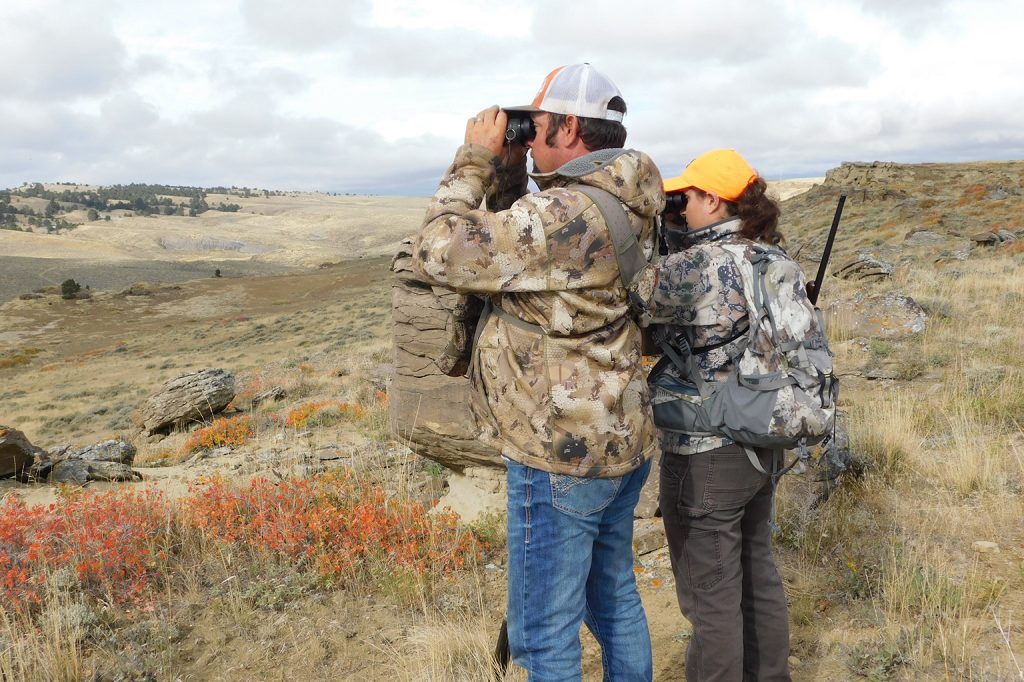
Kristie and her guide, Marc, glass a lovely sweep of Wyoming landscape.

There’s a lot to figure out when you start hunting. The first order of business was finding her a rifle. During our initial trip to the range, I realized that at 5 feet 2 inches tall, Kristie had a hard time shooting most of my standard rifles because the stocks are too long; she was always struggling to get into a comfortable shooting position. But when I had her try my Savage 11 Lady Hunter in 6.5 Creedmoor, it was love at first shot. The short, high-combed stock fit her perfectly, and soon she was shooting impressive groups off the bench at 100 yards. I let her borrow the rifle for a mentored mule deer hunt with Colorado Parks and Wildlife, and she used it to bring down her very first buck.

Last year, Kristie expressed a desire to go antelope hunting, which happens to be one of my favorite things to do in October. I booked us a hunt with SNS Outfitter and Guides, based in Casper, Wyoming, one of the country’s most antelope-rich regions. At that point, Kristie realized she needed a rifle of her own. There was no doubt it would be a Lady Hunter—but what caliber? Because elk are on her eventual hunting wish list, she decided on .308 Winchester—a great do-it-all caliber for big game in the West.

After her rifle arrived, we spent many evenings at the range getting it dialed in. Despite a high-pressure job and a demanding travel schedule, Kristie prioritized her hunting preparations, dry-firing her new rifle at home and testing several different loads at the range. We found a 168-grain factory load shooting Berger Classic Hunter bullets that her new rifle loved, and on our final range trip before the hunt, Kristie shot a one-inch group at 200 yards. She was ready.

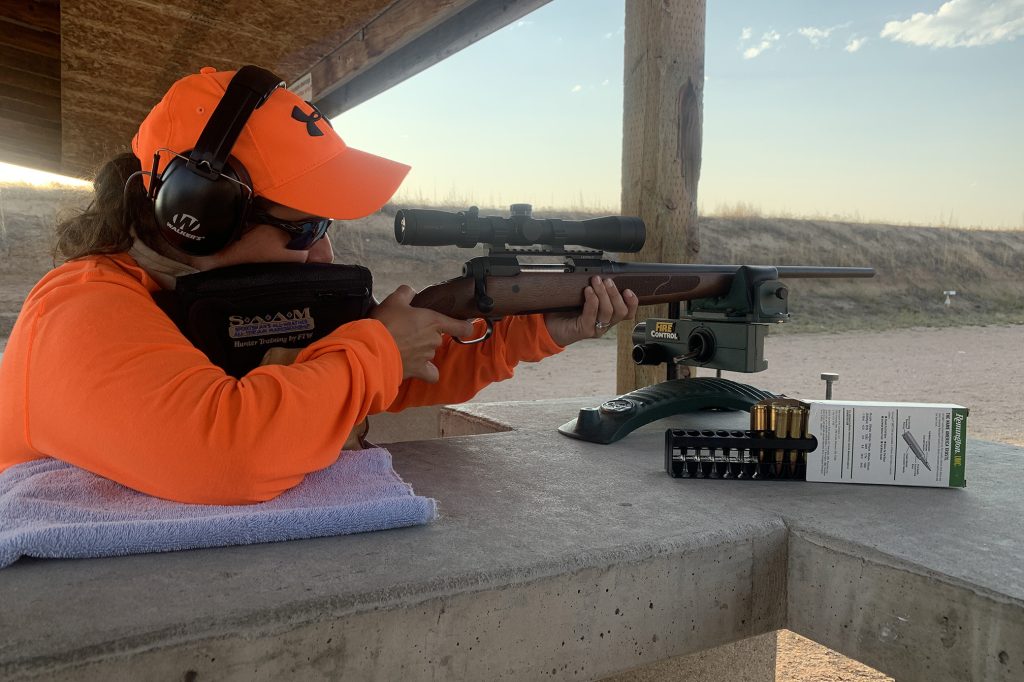
Kristie spent many evenings at the range before the antelope hunt, testing various loads and getting used to shooting her new .308.

We drove to Casper, enjoying glorious fall weather and spotting lots of antelope along the roadside, which added to Kristie’s (and my) excitement. On the first morning of our hunt, we explored the large ranch, spotting an impressive number of antelope. Our guide, Marc, patiently showed us numerous bucks, explaining their behavior and how to judge their horns, and this helped us get a feel for the lay of the land. When we spotted a nice buck hanging out with a single doe on the far side of a small rise, he parked the truck on the ranch road and asked Kristie if she was ready to stalk an antelope. She was! 

We hiked several hundred yards through the sagebrush, taking advantage of the rolling terrain to screen us from the antelope. As we got closer, we dropped to hands and knees and I handed Kristie my leather gloves, a necessity for crawling pain-free through the abundant prickly pear. She and Marc belly-crawled to the top of a small rise and glassed the buck, which was bedded below them. Marc set up the shooting sticks and Kristie rested her .308. The antelope stood, and Kristie wisely waited for it to turn broadside before squeezing off her shot.

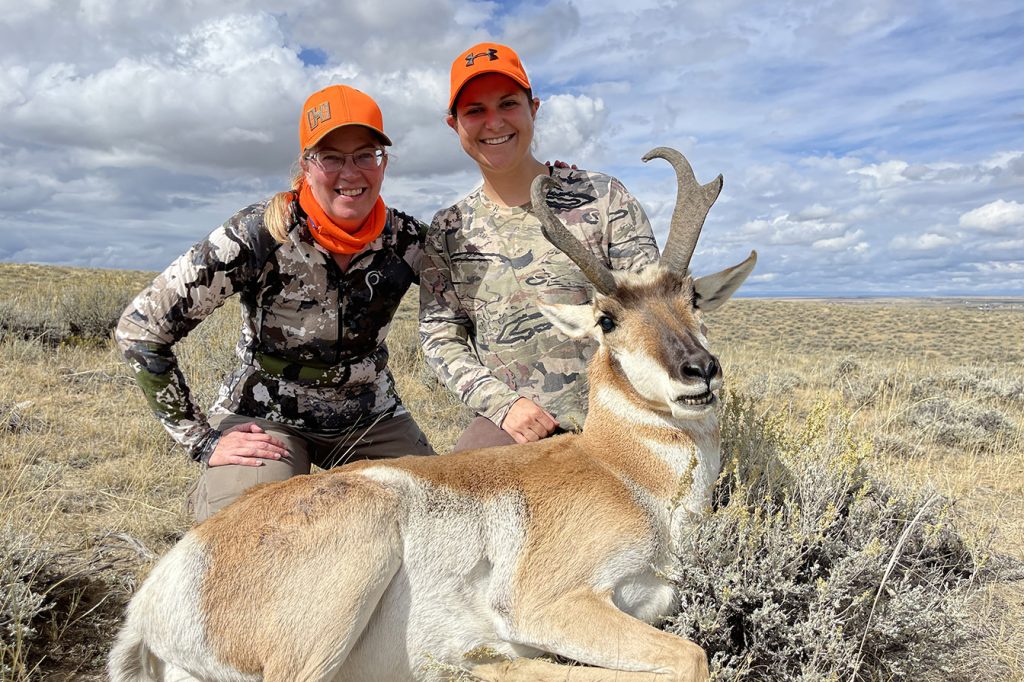
Her first shot landed a bit too high, and the antelope began to move off. I could only watch as she and Marc moved to reposition for a second shot. I was a nervous wreck, but Kristie remained remarkably calm—a crucial skill for any hunter–and executed a perfect follow-up shot at 230 yards, dropping her antelope in its tracks. As the adrenaline rush subsided, all three of us overflowed with excitement as we walked up to her buck and admired its striking tan-and-white coat and impressive horns. 

Success! Diana and Kristie with Kristie’s first antelope. Kristie was shooting a Savage Lady Hunter rifle in .308.

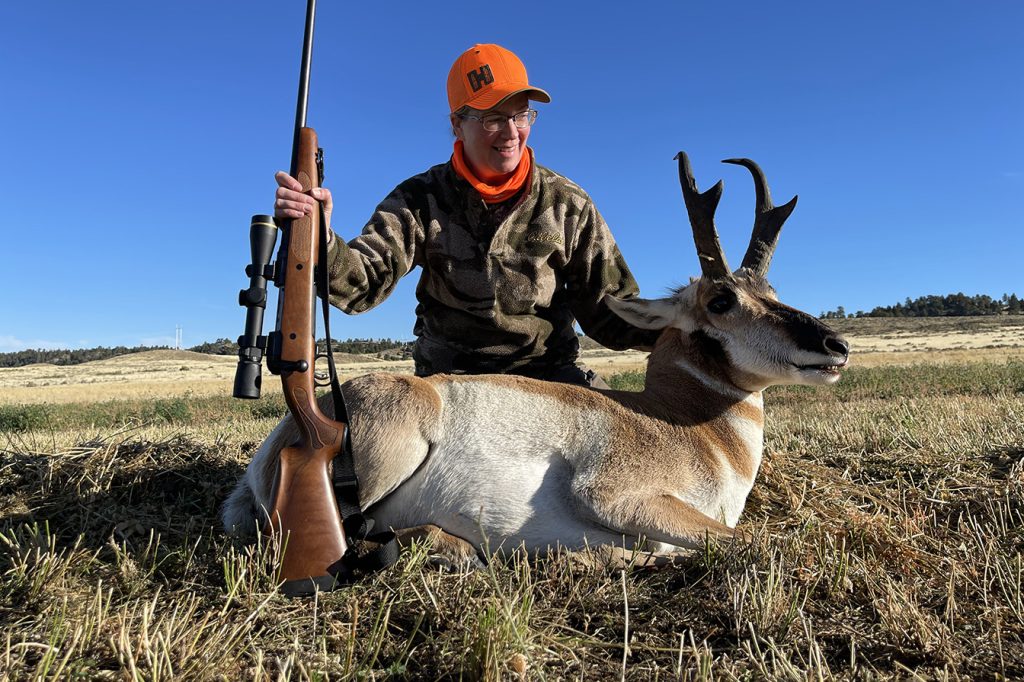
The next day it was my turn, and Kristie tagged along on a fun stalk as Marc and I played cat-and-mouse with another nice antelope buck who was busily tending a herd of does. I finally got a shot from the top of a small rise and dropped the buck with one shot from my 6.5 Creedmoor. 

We headed home the next day with the big cooler in the back of my truck loaded with prime wild meat, a couple of lovely antelope skulls for our walls, and memories of a magnificent adventure on the high plains of Wyoming. For me, though, the best part was seeing my friend take a giant step in her journey as a hunter, a journey I know will provide her with a lifetime of memorable and rewarding experiences.

For information on guided antelope hunts in Wyoming with SNS Outfitter & Guides, go to huntwyo.com.

Learning to Hunt

Learning to hunt as an adult, especially if you have no hunting-savvy family members to guide you, is not easy. The learning curve is steep, and it can be especially tough to find places to hunt and people to hunt with. I have great admiration for people like my friend Kristie—highly motivated and determined to learn, she sought out information, advice, and mentors from numerous sources. Through her experience, I learned there are many organizations providing mentorship opportunities for aspiring “adult-onset” hunters. Here are a few great resources: 

State game agencies: The year before our antelope hunt, Kristie shot her first mule deer on a mentored hunt with Colorado Parks & Wildlife Hunter Outreach Program. Many states offer similar programs, and most offer opportunities for adults as well as kids. Check your state agency’s website or give them a call.

Conservation organizations: Most of the major conservation and hunter-advocacy organizations have mentoring programs and organize in-the-field opportunities for new hunters. Contact the national offices or your local chapters of organizations such as Rocky Mountain Elk Foundation, National Wild Turkey Federation, Ducks Unlimited, Delta Waterfowl, Pheasants Forever, and Backcountry Hunters & Anglers. 

Field-to-Table courses: Field-to-Table and New Hunter courses can be pricey, but there is no better way to learn to hunt, since these several-day workshops teach everything from shooting to hunting skills to field-dressing, butchering, and cooking your wild game. Two I can personally and very highly recommend are run by Outdoor Solutions: fromfieldtotable.com; and Sportsman’s All-Weather, All-Terrain Marksmanship (SAAM): ftwsaam.com.

NRA’s Hunter Ed program: For working adults, finding a hunter safety course that fits into a busy schedule can be a real challenge. In an effort to help with this, the NRA has developed an excellent and very comprehensive free online hunter education course. It’s currently approved to certify hunters in thirteen states. Check it out at nra.yourlearningportal.com

About Savage Lady Hunter Rifles

Both of our antelope were taken with Savage 11 Lady Hunter rifles; Kristie’s in .308 and mine in 6.5 Creedmoor. Savage developed these rifles specifically to fit the female frame,with an oil-finish American walnut stock with a raised comb custom-tailored to a woman’s contours, as well as a shortened length of pull and slender grip and fore-end. The balance point of the 20-inch, light-taper barrel has been shifted, making it feel lighter, yet it provides enough weight to absorb recoil. These are good-looking and great-shooting rifles that are also light and handy to carry in the field; mine shoots sub-MOA at 200 yards and I have used it to take both deer and pronghorn. Learn more at savagearms.com.

Diana Rupp with her antelope buck, taken with a Savage Lady Hunter rifle in 6.5 Creedmoor.

Leave a Comment

Not Just Black and White

Africa has several types of zebras, each of them of a slightly different stripe.

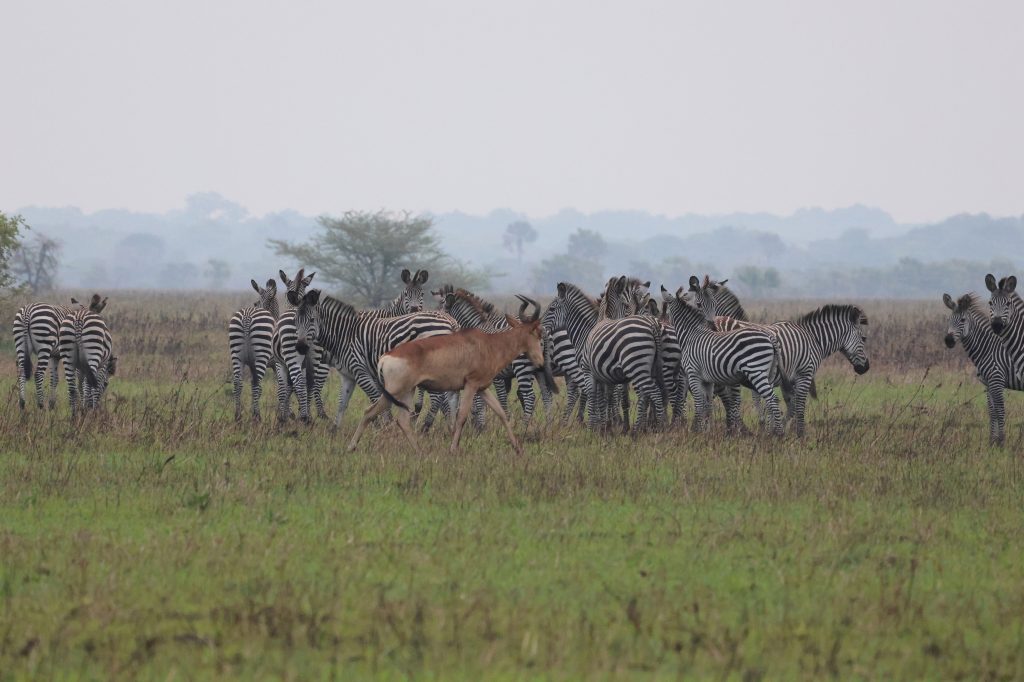
Photo above: A family group of Cape mountain zebras, in typical mountain habitat in South Africa’s Cape Mountains. Both Hartmann mountain and Cape mountain zebras are typically found in small family groups, rarely in larger herds.

Is there a more recognizable African animal than the zebra? I’m fascinated by the similar—yet so different—striping patterns in different types of zebras. It took me forty years, but I’ve seen all the recognized species, subspecies, and races of zebras. The last was the Sudan maneless zebra, which is not exactly maneless, but with a distinctively short mane. They are starting to drift into Uganda from Sudan’s far-southeast East Equatoria Province. I saw some in Uganda’s Karamoja District in 2017, and got some excellent photographs of a small group there in 2021.

It would be silly to try to hunt all the zebras. There are differences, but few people in your neighborhood would remark on the different striping. Also, it can’t be done. The Sudan maneless zebra is protected, as it should be. Likewise, so is the pin-striped, big-eared, distinctly different Grevy zebra. Licenses were available when I hunted in Kenya, but we didn’t get up into the far north where they occur. Joe Bishop and I saw quite a few Grevy zebra in Ethiopia’s Danakil Depression in 2000, but they were off-license and protected.

So, you won’t catch me talking about a “zebra slam.” However, regardless of where you are hunting in Africa, or which set of stripes you are looking at, I recommend a zebra be included on a first-safari wish list. Yeah, I recognize that horse-lovers have issues. Okay, but the zebra is not the same animal as a horse. With keen senses and surprisingly effective natural camouflage (in shadows and brush), the zebra is not easy to hunt. Also, it can be the very Devil to sort out a stallion, which is usually the goal.

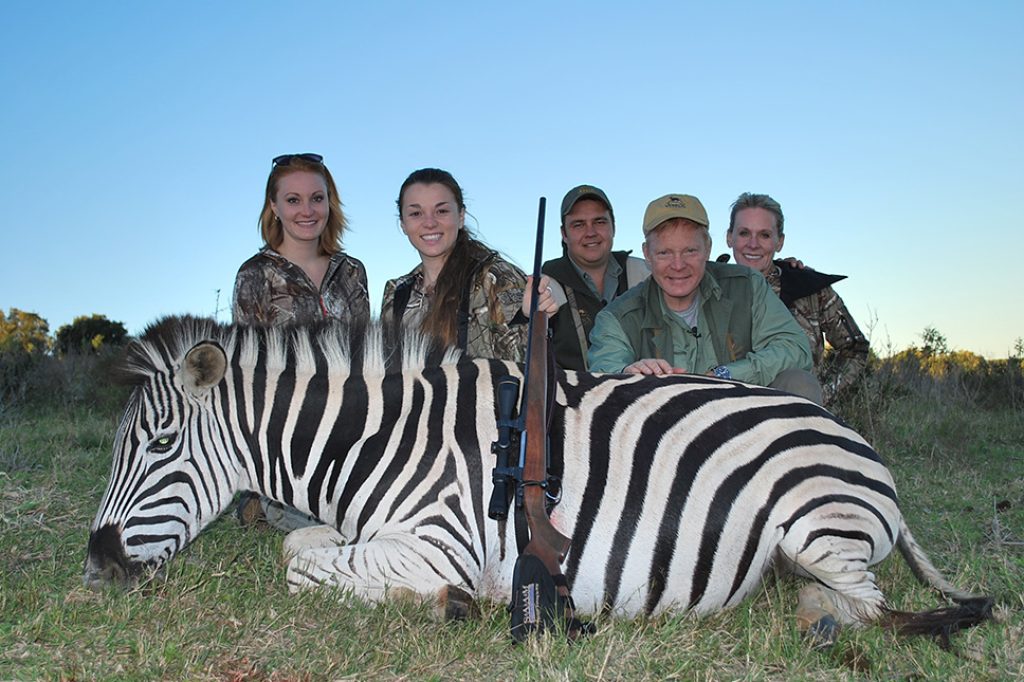
Brittany and Caroline Boddington, PH Carl van Zyl, and Craig and Donna Boddington with Caroline’s Burchell’s zebra. This southernmost plains zebra almost always shows gray “shadow stripes” between the black stripes.

My two daughters, Brittany and Caroline, both put zebras at the top of their wish lists on their first African hunts. Must have listened to my propaganda. Like many young ladies, they were horse-lovers, but wanted zebra rugs…and both were surprised at how difficult it was to get close, find the right animal, and get clean shots.

According to current thinking, there are three species of zebra, all in the Equus genus: Plains zebra, E. quagga; Grevy’s zebra, E. grevyi; and mountain zebra, the type specimen, E. zebra. Without question, my favorite zebra has long been Namibia’s Hartmann mountain zebra. Large-bodied, with distinctive “Christmas tree” rump markings, the best thing about the Hartmann zebra is that it offers a marvelously fun and often difficult hunt in their native mountains along the spine of central Namibia.

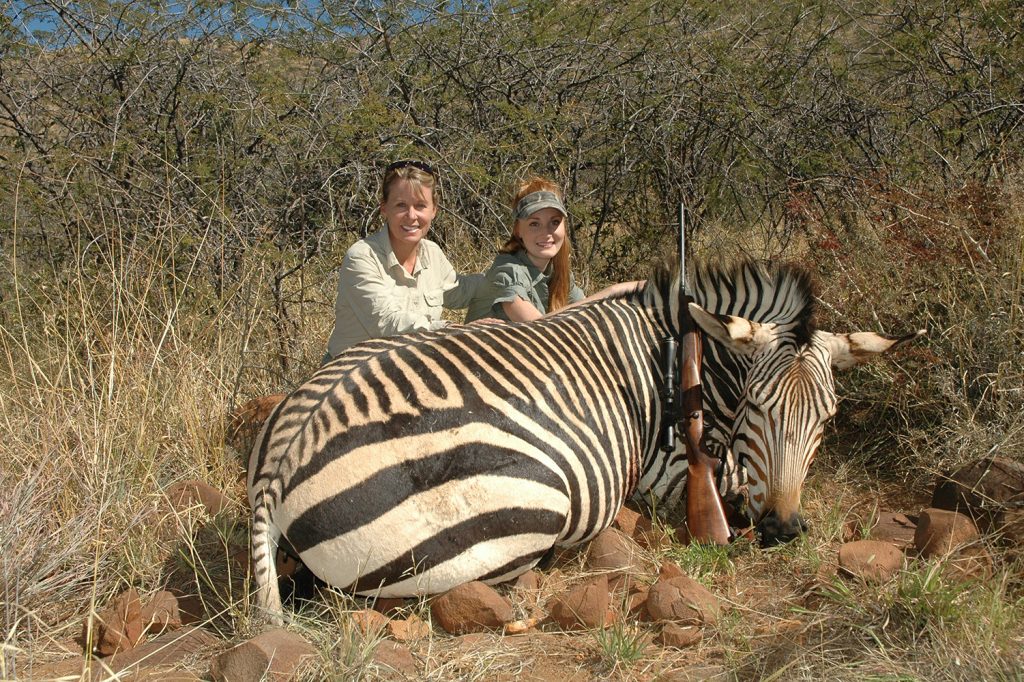
Donna and Brittany Boddington with a huge Hartmann zebra, taken in Namibia’s Erongo Mountains. Hartmann zebra run larger than the Cape mountain zebra, but this is an outsized stallion. The distinctive “Christmas tree” pattern is visible on the rump.

Today, it isn’t always a mountain hunt. Hartmann zebras have been widely introduced, and are now often found on the same properties with common, plains, or Burchell zebras. There’s probably no harm, because they don’t seem to interbreed, but hunting them is not the same experience. I saw a Hartmann zebra on my first hunt in Namibia in 1979, a lone stallion far up on a mountain. I was enthralled; back then the Hartmann zebra was uncommon.

In 1981, Ben Nolte and I started from the bottom, climbed the spine of the Erongo Mountains, heard zebras whistling, worked in above them. Looking straight down on a small group, it took us forever to be certain which was the stallion. I was shooting a Ruger No. 1 in .375 H&H.

Since then, I’ve taken a couple more, always a great hunt in genuine mountains where they are native. Hunting with Mare van der Merwe at his African Twilight outfit southwest of Windhoek, we hiked far up into the mountains and Donna took a big stallion from one canyon to another. As she likes to say, “No girl can have too many zebras.”

A group of plains zebras. Naturally, on plains. These are the Selous race, a smaller zebra with pure black-and-white stripes, generally absent the gray shadow stripes of the Burchell zebra.

There are several races of plains zebra, some regional and arguable, somewhat confused by the late nineteenth century colonial race, when everyone wanted an animal named after them. Significant variations include pure black-and-white striping, like the Grant zebra of East Africa; and the gray shadow stripes of the Burchell.

There are two mountain zebras: The more common Hartmann mountain zebra (E. z. hartmannae), primarily in Namibia, but extending into southwestern Angola and introduced into northwestern South Africa. Then, there’s the Cape mountain zebra, E. z. zebra, identified in Cape Colony before Europeans set foot in now-Namibia. I saw some at a distance years ago but wouldn’t have a chance to appreciate the differences until I shot one, in 2023. Here’s the big visual difference between the mountain varieties and all plains zebras: With mountain zebras, vertical body stripes stop low on the flanks. With plains zebras, stripes continue to the belly line.

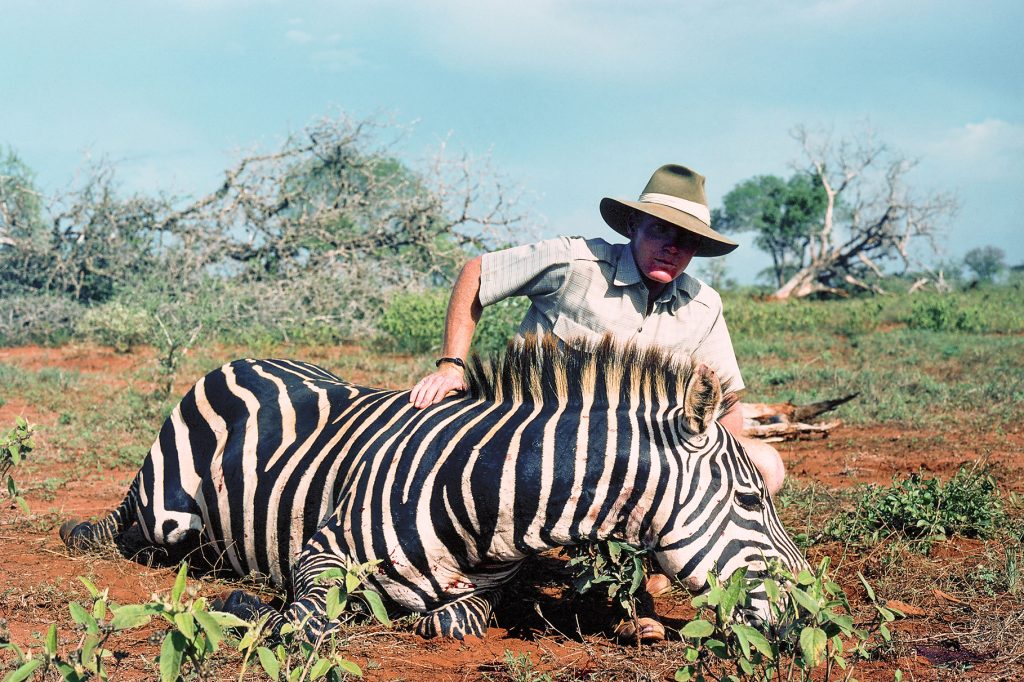
Boddington’s first zebra, taken in Kenya, was a plains zebra of the Grant race. This northernmost plains zebra has beautiful black and white striping, no gray shadow stripes.

References suggest the Cape mountain zebra is the smallest zebra. Maybe, but the Selous zebra of coastal Mozambique (and formerly, Malawi) is noticeably smaller than other plains zebras. I’ll give you that the Cape mountain zebra is smaller than Hartmann…but not by so much. It was apparently always restricted to a small range in rough country straddling South Africa’s Eastern and Western Cape provinces. Like several other indigenous South African species—blaubok, bontebok, black wildebeest, quagga—the Cape mountain zebra was almost extirpated during the settlement era. The bontebok, Cape mountain zebra, and black wildebeest were saved from extinction only by a few farmers who had the last of their kind on their land and were forward-thinking enough to understand they should be conserved.

That wasn’t the end of the story. The Mountain Zebra National Park was established near Craddock in 1938, but that population died out by 1950. Fortunately, private conservation by a few landowners had continued. Zebras were reintroduced into the Park from neighboring farms, and genuine recovery began. Today there are not many, just a few thousand, in Mountain Zebra and other parks, and on private land.

It may seem unthinkable that such a scarce animal could be hunted, but it’s important to understand South Africa’s management system, which works. Nationwide, it has allowed a thirty-fold increase in wildlife in the last forty years. In South Africa, wildlife is largely privatized, at the discretion of the landowner. If it pays, it stays. If it doesn’t pay, there is livestock that will. With South Africa much like Texas, primarily private land, this system has worked well for wildlife.

The IUCN Redbook of Threatened Species has now declassified the Cape mountain zebra from Endangered to Vulnerable. US Fish and Wildlife takes a more rigid stance: Americans are not allowed to import Cape mountain zebras into the United States. This is unfortunate for the farmers who are protecting them and feeding them instead of more profitable species, wild or domestic.

The opportunity was unplanned and unexpected. In July 2023, I was hunting with Fred Burchell at the Burchell family’s Frontier Safaris in the Eastern Cape (yes, the Burchell zebra is named after a direct ancestor). Fred manages the taxidermy side, and he wanted a Cape mountain zebra for the lodge. It didn’t take much arm-twisting to talk me into it. The farm we went to was a couple hours farther east, deeper into the Cape mountains.

The older gentleman who owned the farm had a nice and growing herd of Cape mountain zebras. His harvest is conservative and sustainable at three or four per year. He could take a couple more, would like to. But in that region, most visiting hunters are Americans. Unable to export the skins, few wish to hunt them. For me, it was a rare opportunity. I knew I couldn’t take it home, but Fred wanted the skin. 

We spent a couple of hours glassing and looking, seeing little, then spotted a lone zebra trotting over a ridge. We started climbing, saw the herd from the ridge-top, then hiked over a couple more ridges, me feeling the 6,000-foot elevation.

They held up in a tight valley, a small herd. We worked in to 250 yards and I set up against a stout, stubby tree, rifle over my pack. We thought we knew which zebra was the stallion, but we needed to be 100 percent certain. It (he?) didn’t move for long eternities, then finally two of the mares moved off to the right and the supposed stallion followed. Yes, for sure.

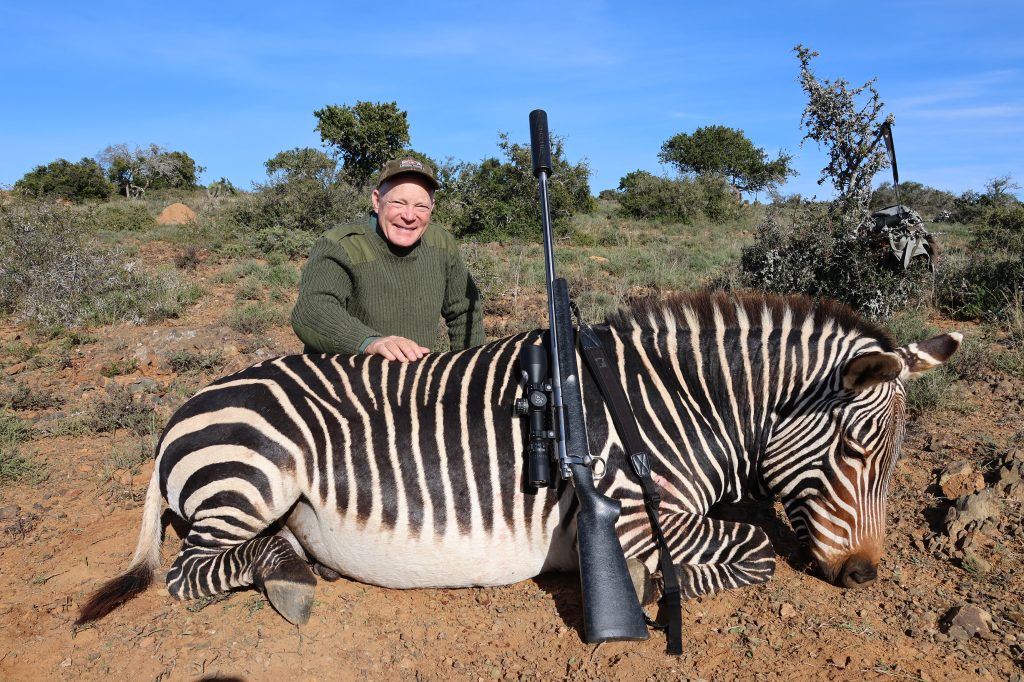
A beautiful Cape mountain zebra stallion, taken in July 2023. The black and white stripes tend to be broader than in most zebras. The most visual difference with mountain zebras: Vertical body stripes stop low on the flanks.

I was shooting Fred’s Remington M700 Sendero in 7mm Remington Magnum, plenty of gun for zebra, but I was concerned about the 150-grain bullet. Zebra stallions are large and tough, and we weren’t sure we’d have enough penetration for the classic broadside shoulder shot.

But we couldn’t have orchestrated it better. The now-for-sure stallion took a couple steps, and gave me a quartering-away shot. I pressed the trigger with the vertical crosshair in the crease behind the shoulder. He made two steps and was down.

Although a big stallion, he was somewhat smaller than most Hartmann zebras I’ve seen, gorgeous skin unscarred and perfect. Coloring was darker, body stripes very black. His face and “Christmas tree” were much like the Hartmann zebra. Most striking—as the books say—the jet-black rump stripes were broader than on any zebra I have seen. I wish I could take him home, but I can’t, and I think that’s short-sighted management. I was happy for the experience, and I’ll be back at Frontier Safaris. I look forward to visiting him there.

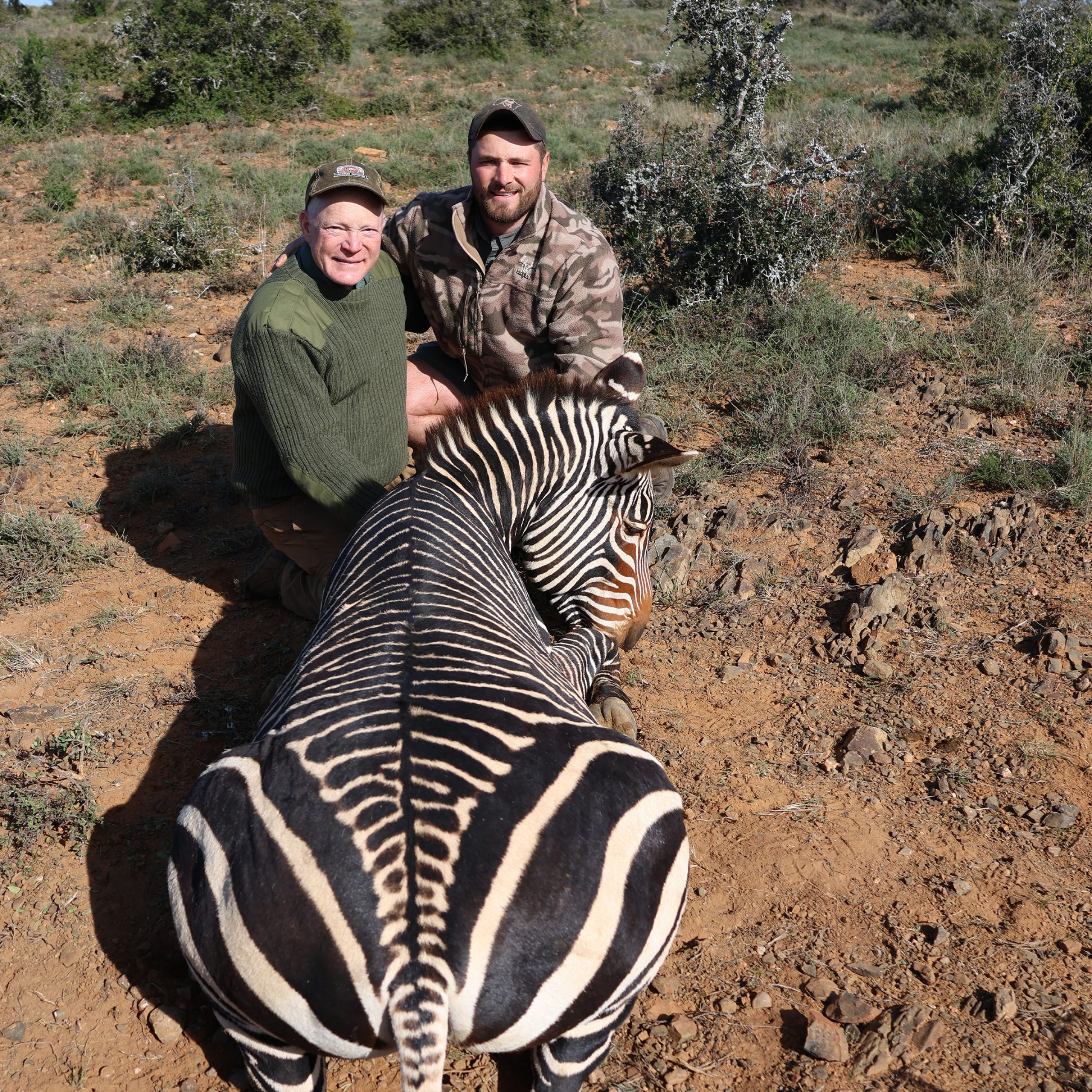
Boddington and PH Fred Burchell with their Cape mountain zebra. The “Christmas tree” rump markings are essentially the same as Hartmann zebra, but the rump stripes are clearly much broader.

Leave a Comment

“Woman’s Work”

Martha Maxwell left a legacy as one of America’s most influential taxidermists.

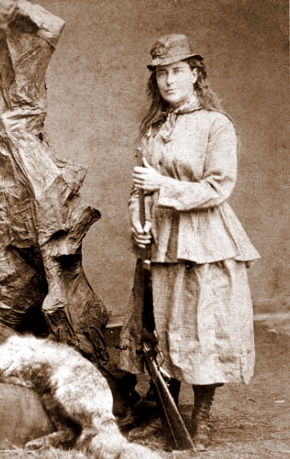
While wandering around the fascinating Cowgirls of the West museum in downtown Cheyenne, Wyoming, recently, I came across a photo that stopped me in my tracks. The blurry black-and-white image showed a display of mounted mule deer, elk, pronghorn, and bighorn sheep to rival any trophy room in the Great Hunters books, all of them arrayed in natural-looking habitats. Next to this photo was a studio shot of the taxidermist who had created the display—an intrepid-looking woman leaning on a rifle, a hound at her feet. Reading the accompanying text, I learned that the taxidermy display was featured at the 1876 Centennial Exposition in Philadelphia, and was one of the most popular exhibits at the international fair. The woman’s name was Martha Maxwell, and she was, like me, a native Pennsylvanian who ended up living and hunting in Colorado. Intrigued, I set out to learn more about her. 

 Born Martha Dartt in 1831 in Tioga County, Pennsylvania, Martha developed an appreciation for the natural world from traipsing the hills of northern Pennsylvania with her grandmother.  Her family ended up in Baraboo, Wisconsin, and in 1854 she married James Maxwell, a local businessman twenty years her senior with six children. In 1857 they had a daughter of their own, named Mabel. Around the time Mabel was born, James apparently lost everything in the Panic of 1857. Looking for a new start, the couple headed west, joining the Pikes Peak Gold Rush. They left Mabel with Martha’s family in Baraboo, and arrived in the Colorado Territory in 1860, settling in Nevadaville.

Like most of the hopefuls who staked a mining claim, James failed to strike it rich. Martha was smarter, making money off the miners themselves, first by doing washing and other chores, and later opening a boardinghouse. She invested the money she earned, and bought a cabin on the plains east of Denver. Legend has it when the couple attempted to move into the cabin, they found a squatter already living there. The squatter, a German, turned out to be a taxidermist, and when they booted the man out, Martha found a big collection of mounts in the cabin. This apparently sparked her desire to learn the art, and she sent away for a how-to book on the subject. 

In 1862 Martha returned to Wisconsin to take care of her daughter and ailing mother, and while there she continued her study of taxidermy. She returned to Colorado in 1867 at the behest of her husband, and that’s when she got into serious hunting and collecting. She began taking extended hunting trips into the Rockies, starting out with small animals such as chipmunks and hawks, and later taking a great many species of big game, including bison, elk, and pronghorn. Within a year or so she had more than 100 specimens, and received an invitation to exhibit them at the 1868 Colorado Agricultural Society exhibition. She surrounded each animal with its realistic natural habitat; she has been credited as the first taxidermist to do so. Her display was a hit and she won a $50 prize.

A few years later, in an attempt to turn her hobby into a moneymaking career, Martha opened her own museum in Boulder, where animals including a bear, a mountain lion, and a bison were on display, surrounded by her signature elaborate habitats. In 1875 she moved the museum to Denver, where she hoped to attract more visitors. 

By then, Martha had become an expert taxidermist.  She developed a number of new techniques, experimenting with plaster molds and iron frames over which she stretched preserved skins. Most taxidermists of the day were simply sewing skins together and then stuffing them with filler, which led to some horrible-looking mounts.

Martha was also an expert naturalist, and she kept up a correspondence with biologists at the Smithsonian. She sent them the first black-footed ferret they had ever seen; the animal had been described by explorers, but Martha was the first to mount one. She also discovered and described the western subspecies of the screech owl, which was subsequently named Otus asio maxwelliae (Mrs. Maxwell’s owl).

In 1876, the Territory of Colorado sent Martha to Philadelphia for the Centennial Exposition. She created a complex diorama that included numerous species she had hunted and mounted. She placed plains species and mountain species in their appropriate habitats and posed them at representative elevations. Her display even included small live mammals, including prairie dogs. The display was a huge hit—most Easterners had never seen Western animals or Western habitats, and Martha’s display immersed them in both. 

Apparently some visitors were skeptical. “How could a woman do it?” “Did she kill ’em all?” “What sort of a woman is she?” were some of the questions that bombarded Martha’s half-sister Mary Dartt, who was helping out at the expo. Annoyed, Mary put up a sign that read, “Woman’s Work” and assured visitors that yes, Martha had done all the hunting and taxidermy work that went into the display. Between May and November 1876, the expo attracted some 9.8 million visitors.

Unfortunately the “Colorado Huntress,” as Martha was known by then, never returned to Colorado. Estranged from her husband and unable to make her various attempts at museums financially successful, she moved to Rockaway Beach, New York. By this time she was suffering from cancer, which was apparently not unusual for early taxidermists as a result of their work with potent chemicals. Martha died in 1881, having left a legacy that later influenced America’s greatest taxidermists, including Carl Akeley and William Hornaday.

Martha Maxwell is credited with being the first female taxidermist. She developed new and innovative techniques for preserving and displaying wildlife.

Leave a Comment

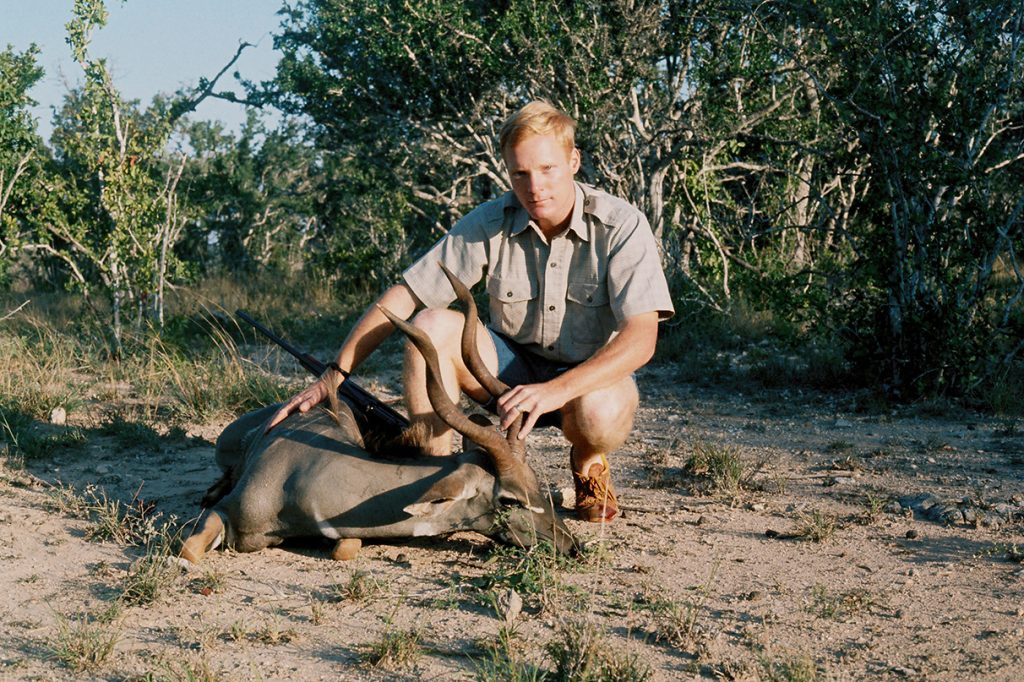
The Not-so-Common Eland

This huge antelope is a challenge to hunt and fantastic on the dinner table.

We were looking for a big kudu. If kudu is on license and your menu, you’re always looking for a big kudu! We were headed west, about an hour before sunset. Kudu o’clock was coming fast, our intention to use the last rays to glass a big north-facing ridge.

Fred Burchell hissed, “Eland,” and eased the Land Cruiser to a halt. Three bulls off to the right, across a brushy flat, trotting along the base of a rocky ridge. Few animals are as switched-on as eland. I didn’t move at first, expecting them to continue that mile-eating eland trot, around the corner of the ridge and gone,

Amazingly, they stopped under a scruffy tree and began to feed. Three hundred yards. When Mother Nature offers a gift, one shouldn’t kick sand in her face.

Now we moved. Slowly and quietly, Fred out the right and back to grab sticks, me out the left with rifle and forward, hoping to clear some brush. No way this would go down—the elands were sure to run—but we had to go through the motions.

Fred was with me in an instant. Bullet path clear, rifle up and steady, three mature eland bulls standing without a care in the world. The only slight problem: The low sun was straight into the scope. I’d have them, then the scope would go black. Then I’d have them again. “Which one?”

“Any of them. Let me look again.” Trust me, this is not a dilemma I’ve faced on eland. Then, “I think the bull on the left is the oldest.”

He was standing broadside, head to the right. Then the scope went black again. Fred Burchell is young, but I’ve known him for years, good hunter and PH. Seeing the problem, he took off his cap and angled it between objective lens and sun.

Now I could see them. Same position, bull on the left, other two just in front of him, clear. Conscious that I wasn’t shooting a big gun, I held at the back of the burly shoulder, just below the midpoint.

The shot felt good, impact sounded solid. The eland didn’t run. The chosen bull simply swapped ends, now facing left. Fred confirmed, “On the left. Shoot him again.”

Same hold on the opposite side, couple inches higher in case I’d misjudged the drop. Same weird result, no immediate reaction. I had just started a third trigger squeeze when he swapped ends once more, and went straight down.

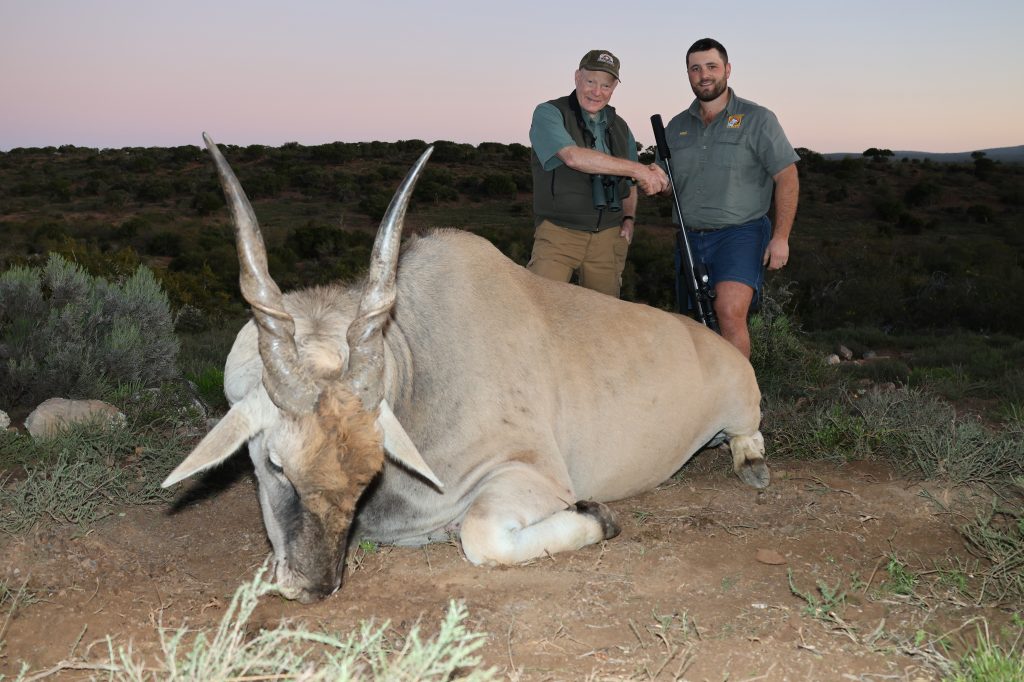
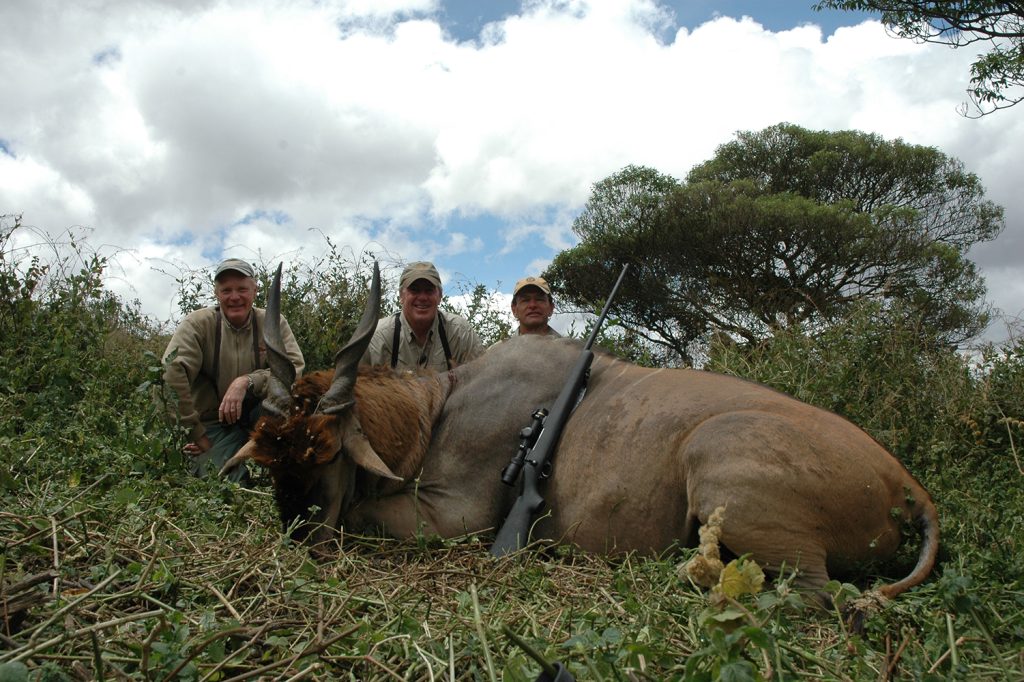
Boddington and PH Fred Burchell with a fine Cape eland bull, taken in an unusual and unexpected chance encounter in July 2023. Boddington used what he had, a 7mm Remington Magnum. With careful shot placement, it worked.
 

The eland is not the most beautiful of Africa’s antelope. He is not as dramatic as a greater kudu, as stately as a waterbuck, nor as breathtakingly majestic as a sable. He is the largest African antelope. Mature bulls vary in size and weight. References start at 1,300 pounds. This is minimal. I’m convinced that outsized bulls on good feed can top a ton. Live weights are elusive but, visually, a mature eland bull is bigger than a Cape buffalo.

Also, tastier. To me, eland is the finest wild meat in the world. Tender, flavorful, almost marbled like good beef. My advice to anyone considering taking an eland: Try to get him in the first few days. You’ll eat well the rest of the safari.

Sound logic, difficult to pull off. Although widespread, the eland is difficult to hunt. Not only are they (usually) wary, they cover a lot of country with that ground-eating trot. There’s no predicting where or when you might run into them. Unlike smaller antelopes, eland leave tracks that can be followed. I’ve tracked both common and Lord Derby elands for many miles, and I’ve stalked others over hill and dale.

This was the first eland I’ve ever taken in a pure chance encounter. Mother Nature offered; we accepted. Not something to be proud of; sometimes you just get lucky. I was at the Burchell family’s Frontier Safaris in South Africa’s Eastern Cape, a big area running from high mountain to deep valley. Eland need a lot of room, so I wouldn’t say they’re plentiful, but they’re around. I’ve taken eland there before, after careful looking. A year earlier, we hunted hard for eland for much of the safari, never got one. You never know.

This awesome bull was a wonderful gift at sundown on the second day. We were going to eat well. First, we had a problem: Fred’s winch was out and we needed to load him.  It took some bush engineering, multiple attempts, and a lot of grunting and straining. Fortunately, there were five of us (four young and strong). We got it done just an hour after dark.

It seems to me a disservice to call this animal the “common” eland. There is nothing common about it. However, there must be nomenclature to distinguish Taurotragus oryx from Lord Derby giant eland, T. derbianus. Despite the name, I’m not convinced that giant eland are consistently bigger in the body. For sure, they are bigger in the horn; giant eland horns start where common eland horns stop. The giant eland also has much more color: black nose, black neck collar (in winter coat), and brilliant white side stripes. They are geographically separated, with no hybrid zone. Today, their range is restricted to Central African Republic and Cameroon, above the big forest, with a small population remaining far to the west in Senegal.

Although habitat differs, hunting all eland is similar: usually difficult. We divide common eland into three races. Since I was in South Africa’s Eastern Cape, mine was unquestionably a Cape eland. Shortest horns, smallest body, although outsized bulls may dispute this. Our bull was normally big, not outsized, otherwise we’d never have loaded him whole. The biggest difference: Mature Cape elands have no vertical body stripes. Color is generally tan or fawn, although older bulls can run to gray, what they call “blue bulls.” Cape elands are found throughout South Africa, southern Botswana, and most of Namibia except the far north.

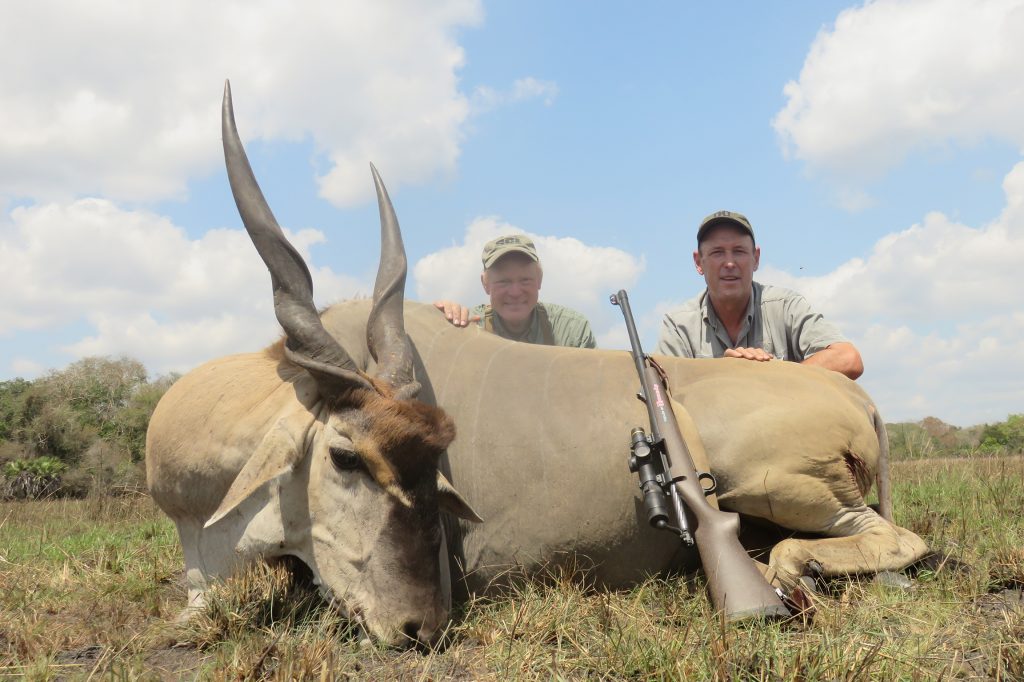
Boddington and Mark Haldane with a good Livingstone eland from coastal Mozambique. This bull has it all, great horns, heavy brush, massive body. Although not bright, the vertical white stripes are continuous down the flanks.

To their north, up through Mozambique and Zambia, is the Livingstone eland, with defined vertical white stripes. Livingtone eland has the longest horns among the common eland, and is (again theoretically) the largest in body. Off to the northeast, in Kenya and Tanzania, elands are considered East African or Paterson eland. The book says they have vertical white stripes, but there are variances. The bull I took in Kenya, near Tsavo, did not, but I’ve seen bulls in Tanzania that did. Often, the stripes are so muted as to be almost invisible.

Namibia has a hybrid zone between Cape and Livingstone. Per the books, only the eland in the very far north are Livingstone. However, in central Namibia, south of Etosha, I’ve seen bulls that had faint vertical stripes, and others that didn’t.

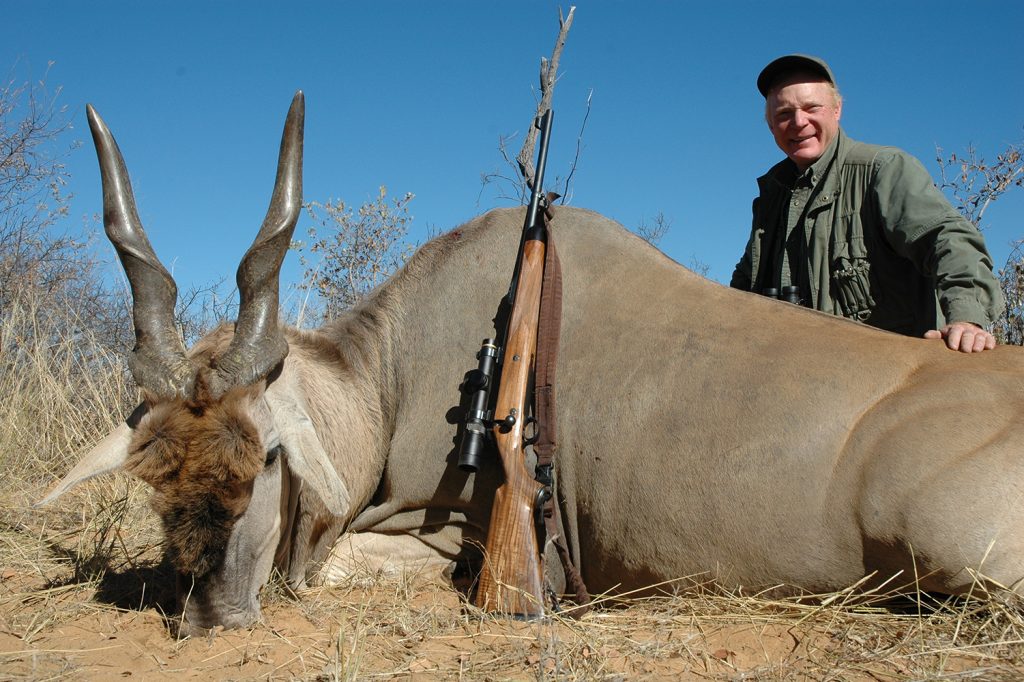
This bull was taken in Namibia well north of Etosha, so theoretically it is a Livingstone eland. The stripes are present if you look closely, but they are extremely muted.

Doesn’t matter. All the eland are tasty, all mature bulls are magnificent, and the bull I lucked into was a dandy. We had a couple young guys with us, so I’m not sure if Fred was speaking for my benefit or theirs, but what he said as we were admiring our eland is worth repeating:

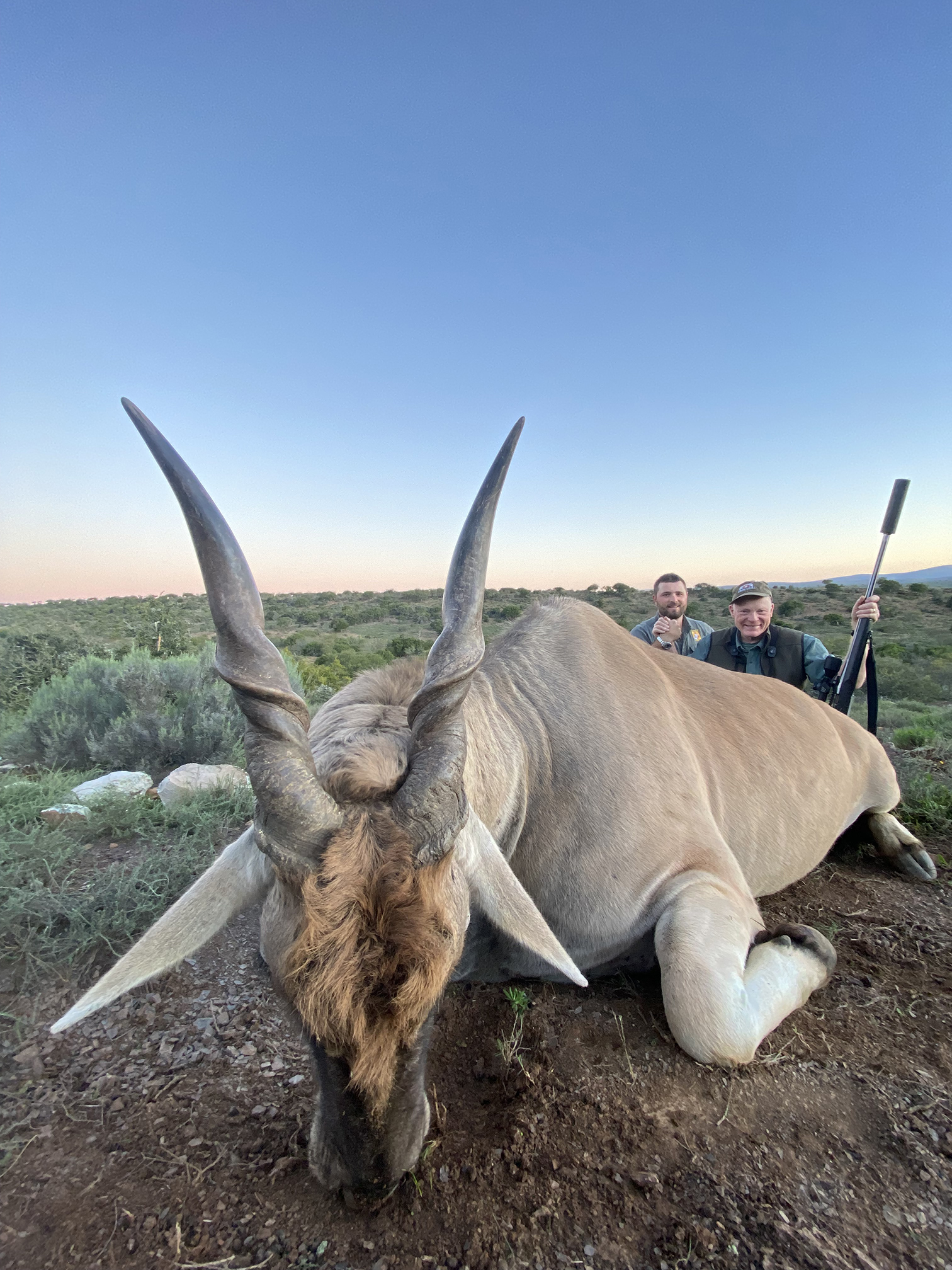
“Here’s what you look for in an eland bull. First, body. Mature bulls are visibly larger than females, with massive shoulders and a big dewlap. Second, color. Most bulls grow darker as they age, and stand out in a herd. Third, look for the forehead brush, darker and longer on dominant bulls. Finally, look at the horns.”

With eland, males and females grow similar horns. In a herd, it’s not easy to sex them, and more difficult with younger bulls. A mature bull will have significantly heavier horn bases, and usually a well-defined spiraling keel on the lower horn. Older bulls wear down their tips, so often have horns that are short and very thick; cow horns are often longer, but always thinner. My bull had just started to wear his tips. For perfection, he could have been a year or two older, probably would never have been longer. Another saying: Don’t look a gift eland in the mouth.

Taken by Leupold’s Tom Fruechtel high on a mountain in Tanzania’s Masailand, this is the most colorful common eland Boddington has ever seen. Dark, almost rufous body; stripes highly visible near the spine, but quickly fading out.

I’ve shot a couple eland with fast .30s and heavy bullets, couple more with medium magnums (8mm and .33). That said, eland bulls are huge, and I believe strongly they’re in “.375 territory.” We weren’t looking for eland, and I used what I had. Which was a 7mm Remington Magnum with too-light 150-grain bullets. Legal, but risky. That’s why I was careful to place my shots tight behind the shoulder: I doubted the bullet would penetrate the heavy shoulder. On a behind-the-shoulder shot, I knew the bullets wouldn’t exit, but believed they would reach deeply into the lungs, which is what both bullets did. There was not much reaction, but he was down on the spot.

I don’t recommend being undergunned for eland—or anything else. But I wasn’t going to kick sand in Mother Nature’s face, and I was looking forward to some fine eland steaks.   

A close view of the forehead brush on Boddington’s 2023 Cape eland. Used for rubbing and marking territory, the brush is highly visible on mature, dominant bulls. This bull’s brush is exceptionally luxurious.

Leave a Comment

Thunder without Rain

Thomas McIntyre’s last book is truly his magnum opus.

Thunder without Rain: A Memoir with Dangerous Game–God’s Cattle, the African Buffalo is Thomas McIntyre’s last book, completed shortly before his death in November 2022 and published by Skyhorse Publishing this spring. The title comes from a saying by the Yoruba, the natives of the region that is now Nigeria, Benin, and Togo: “When you hear thunder without rain, it is the buffalo approaching.”

The buffalo is central to the cultures and traditions of many Africans, and it can also become a powerful influence in the lives of people like the author who travel to Africa to hunt it. This is not a book that is easily categorized. As the author says in the Preface, it’s not a natural history, biography, scientific treatise, or literary essay, although it contains elements of all of those things. It is, in fact, a memoir, albeit an unconventional one.

From the time he first set eyes on a mounted buffalo head at the age of four, McIntyre’s entire life was profoundly influenced by his ongoing quest for Syncerus caffer. That head sparked far more than just the desire to travel to Africa–it set him on a lifelong search for what makes the African buffalo so compelling. He takes us along as he seeks the buffalo not just in the physical environs of Africa but also in history, science, literature, art, and tradition. He shares the fruits of this quest with us in this powerful and fascinating book.

There is plenty of hunting action in Thunder without Rain; the author includes vivid descriptions of segments of his safaris in Kenya, Zimbabwe, Central African Republic, and Burkina Faso over a space of fifty years. Between and related to the safari stories is an incredible amount of wide-ranging and well-researched information about the buffalo and its effects on humankind, reaching back through archeological exploration and colonial settlement. The author discusses how buffalo affected and influenced other hunters, including such famous names as Samuel Baker, Frederick Selous, and Theodore Roosevelt.

McIntyre’s safari memories are interspersed with reflections on his childhood, especially his troubled relationship with his father. The effects of his African experiences on the rest of his life come through potently in McIntyre’s retelling, as he finds solace and meaning in treading the game trails of Africa. Grappling with the demons of his childhood also sparks thoughts on the meaning of courage, and the facing of a buffalo charge as a metaphor for gaining the fortitude to embrace life is a recurring theme throughout. Courage is also required as the author bears witness to changes beyond his control that negatively affect the continent of Africa and its wildlife, including his beloved buffalo.

A full third of Thunder without Rain consists of Endnotes. You don’t have to read them to enjoy the book, but I suggest you spend some time paging through them, since they add interesting and amplifying information to the rest of the text.

I had the privilege of editing Thomas McIntyre’s Backcountry column in Sports Afield magazine for many years, and I always admired the depth of his writing, the amazing breadth of his knowledge, and his meticulous research. But the magazine article format is rather limiting, and McInytre was always at his best in his many excellent books, where he had the free rein to really delve into his topic.

It’s possible he knew Thunder without Rain might be his last book. It’s been called, accurately, his magnum opus. It’s a deep dive into the essence of the African buffalo and the search for what it means to live a full and true life, a life that for the author was deeply enriched by his experiences with one of Africa’s premier dangerous game animals.

If you have your own fascination with buffalo, Africa, and all things wild, you should read Thunder without Rain. It’s available from Amazon.com and other booksellers.

Leave a Comment

Sports Afield is a Top Global Licensor–Again!

It’s incredible to see our brand on the front cover of License Global’s Top Global Licensors issue! For the eighth consecutive year, Sports Afield has been honored with the prestigious recognition of being chosen as one of License Global magazine’s Top Global Licensors.

As the foremost publication in the brand-name industry, License Global meticulously curates a list of the most influential global brands annually. This year, in 2023, we are ecstatic to announce that Sports Afield has once again made the cut, solidifying our position among the industry’s elite.

The entire team at Sports Afield is filled with immense pride and gratitude for this remarkable achievement, and we sincerely thank our loyal supporters for their unwavering trust and continued patronage. Our dedication to providing exceptional products and experiences remains steadfast, and we look forward to scaling new heights in the years to come.

Leave a Comment

First Deer of the Year

California’s Central Coast has some of the earliest deer seasons in the country.

For most of us, August is for fishing or baseball, with deer season weeks (or months) away. Here in Central California, however, our coastal rifle season starts the second Saturday in August. Around here, rifle deer hunters are getting ready. Bowhunters are already in the woods; the 2023 archery season opened on July 8th.

I tell folks this and they look at me like I have three heads. Deer hunting in August? This has been our “A-Zone” season for decades. I know it goes back fifty years, probably much farther. Since it’s traditional, I can’t explain the management rationale. Seems to me that most rifle deer seasons across the country are either purposefully pre-rut or post-rut. Those of us who get to hunt the rut are fortunate.

In our case August is obviously pre-rut, but not by as much as you might think. Our winters are mild and usually catch most of whatever rain we get. There is no winter stress, but summers are long, dry, and brutally hot. Our deer probably didn’t ask when the season should be set, but they have their own unique schedule. Typically, they are in full rut by late September, essential so the does can drop fawns in early spring, when conditions are still soft and green with plenty of water.

Our early season isn’t as bad as it sounds for rifle hunters. This year it opens August 12 and runs until September 24. September will see pre-rut activity, and the bucks should be chasing hard by the last weekend of the season.

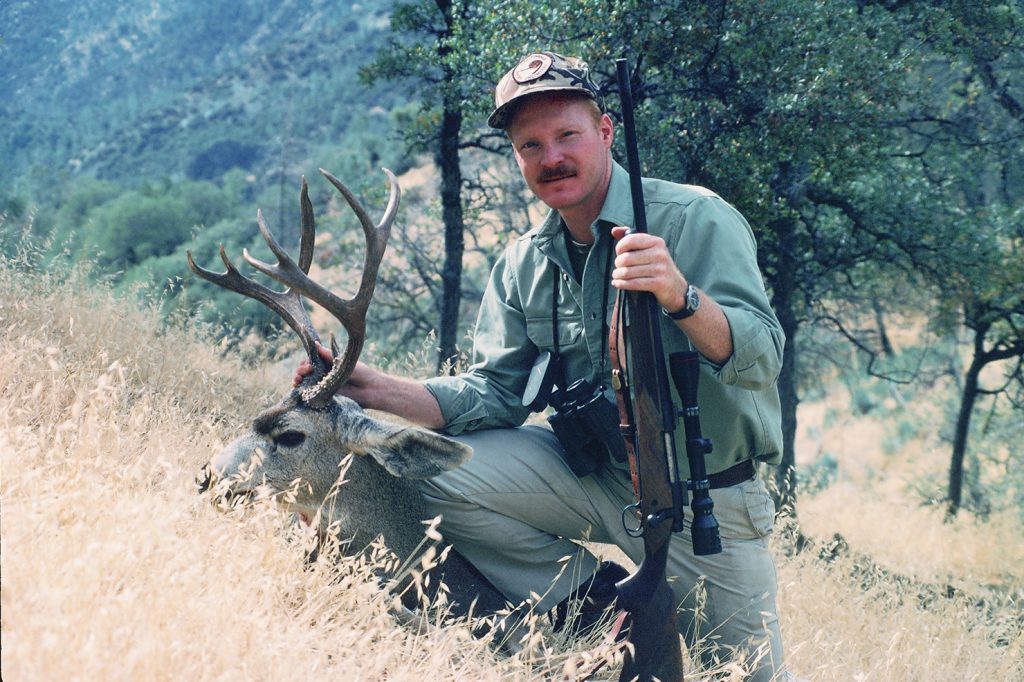
This 4×3 is Boddington’s best-ever Central Coast blacktail, taken near King City with a .30-06.

Personally, I’m not crazy about taking antlered game in velvet; antlers are more difficult to judge, and development may not be complete. Because few seasons are held this early, a lot of hunters are attracted to bucks in velvet as “something different.” This I can’t guarantee. During our July bow season bucks are in heavy velvet. However, they start to rub by early August, so it’s a grab bag in rifle season.

Just before Covid, Donna shot a magnificent 4×4 on opening day. That’s a big buck in our part of the world, fully developed and in full velvet. Whether in early August or on through September, most of my coast zone bucks have been in hard antler.

Some discussion is needed as to what our deer are. Obviously, they’re a mule deer subspecies, but which one? Local hunters call them “Pacific bucks,” a nonexistent subspecies. I live in San Luis Obispo County and have done most of my coastal deer hunting in Monterey County just to the north. The Boone and Crockett line for Columbian blacktail deer starts just north of Monterey Country, so, our deer are not Columbian blacktails by B&C standards.

Technically, our deer are mostly blacktail, with black-striped tails and small ears. To the south and west there is potential for California mule deer influence, and that’s B&C’s position. SCI takes a more liberal stance, including our deer as Columbian blacktails in their record book.

Our deer are small-bodied and, because of summer stress and poorly managed genetics, antlers are small. A buck that meets B&C standards for Columbian blacktail is highly unlikely in our neighborhood. I have never taken a clean 4×4 in the Coast Zone; my best local deer was an awesome 4×3, taken in September up near King City, 50 miles north. At full maturity, many of our better deer are 3x3s, and many bucks never get past two points per side. Doesn’t matter, these are our deer, and this is our deer season. 

Ours is not the only August deer season.  South Carolina’s “low country” whitetail season also opens in August, long traditional with no limit on bucks. Obviously, whitetails are plentiful (and overpopulated), but with a limit like that quality is generally not good, and buck-to-doe ratios are poor. I hunted there just once, took a nice 8-point just stripping his velvet. Naturally, it was warm and humid, but not miserable, stand hunting like most whitetail hunting. What I remember most vividly is looking down and realizing I was sharing the stand with a copperhead. Not my best moment, but probably the most benign of South Carolina’s venomous serpents. Early season in South Carolina is probably the place to take a whitetail buck in velvet.

Alaska opens its Sitka blacktail season in August, but that’s different: August isn’t early in Alaska, with caribou and sheep also open. Sitka blacktails are absolutely in hard antler in August; these deer drop their antlers before Thanksgiving. Cover is thick and green and the deer are higher up, but August is a mild, early fall month up there.

I don’t have much experience in South Carolina and haven’t hunted Sitka blacktails that early, but I have plenty of experience with our coast zone August hunting. It is not mild. Usually, it’s blazing hot, with midday temps often exceeding 100 degrees Fahrenheit. Sounds miserable, but wait. California’s Central Coast has one of the largest average “midnight to noon” temperature swings in the continental United States. A 50-degree change is normal, 60 degrees not unusual.

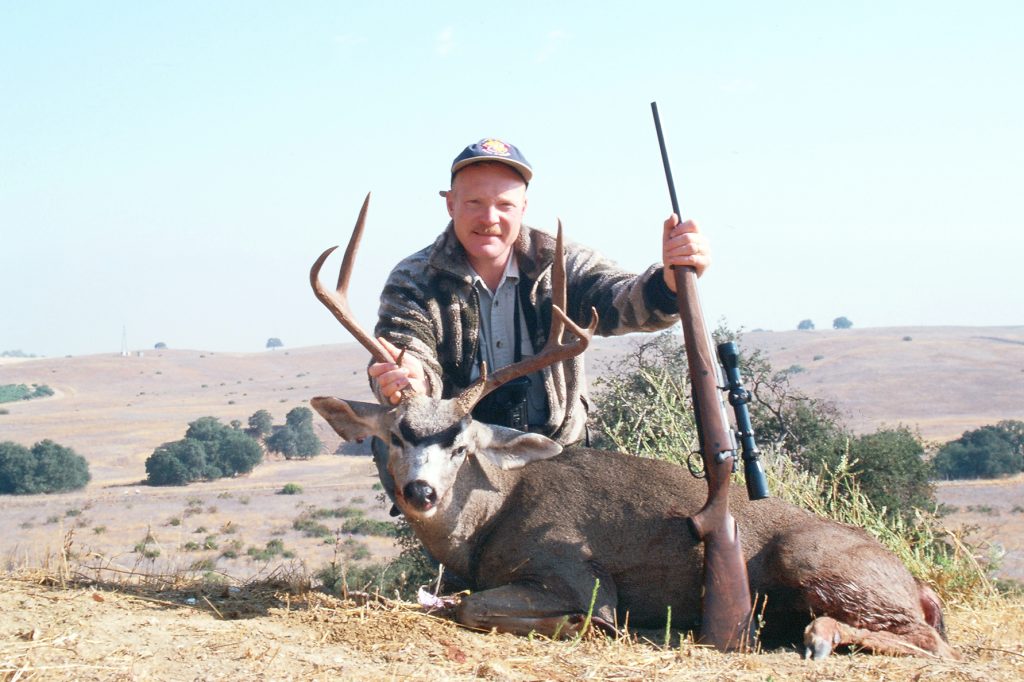
Many Central Coast bucks are fork-horns at full maturity. This is a big-bodied buck with good antlers for what these deer are.

In large part, that’s what makes our coastal deer hunting enjoyable. You start at dawn needing a good jacket, peeling layers as the day heats up. There is a caution. For many years, my coastal deer hunting was DIY, either on public land or private ground where I had permission. Better have a good plan. Get a deer down late in the morning and it’s a foot race to the cooler. At noon, when the mercury pushes toward 110, it’s dangerous to be packing deer. You can say “it’s a dry heat,” all you want, but it’s still plenty hot.

Years ago, Payton Miller and I were hunting with the late Durwood Hollis on a piece of property he had adjoining Fort Hunter Liggett. Payton and I were back in camp, Durwood missing, couple hours after dark when he stumbled in with a nice buck on his pack frame. Long out of water, he was in bad shape.

Typically, we get in a good morning hunt, then it’s a long, leisurely day and a short evening hunt. Usually, the temperature doesn’t drop noticeably until the sun gets low, so it’s pretty much the last hour before deer start to move. It’s also a short night. Dark comes late, dawn comes early.

Despite the heat, there is a surprising amount of midday movement. These deer live in the summer heat. They aren’t going to stay bedded from dawn to dusk and will often drink at midday. Tom Willoughby and I were sitting in the shade one blistering afternoon, watching some water. I thought he was nuts but, sure enough, about half past one three bucks appeared out of nowhere, one a very nice 3×3.

There are good outfitters in our local area, in part because we are the epicenter of California’s wild hog hunting. Hogs are their big business, but most have blacktails available. Those I know include Clay Avila’s Frontera Hunting, Chad Wiebe’s Oak Stone Outfitters, Don Anderson, and Tom Willoughby. Most famous right now is the deer hunting on Steinbeck Vineyard, managed by my friend Ryan Newkirk, well-known because several gun writers have been there and written about it.

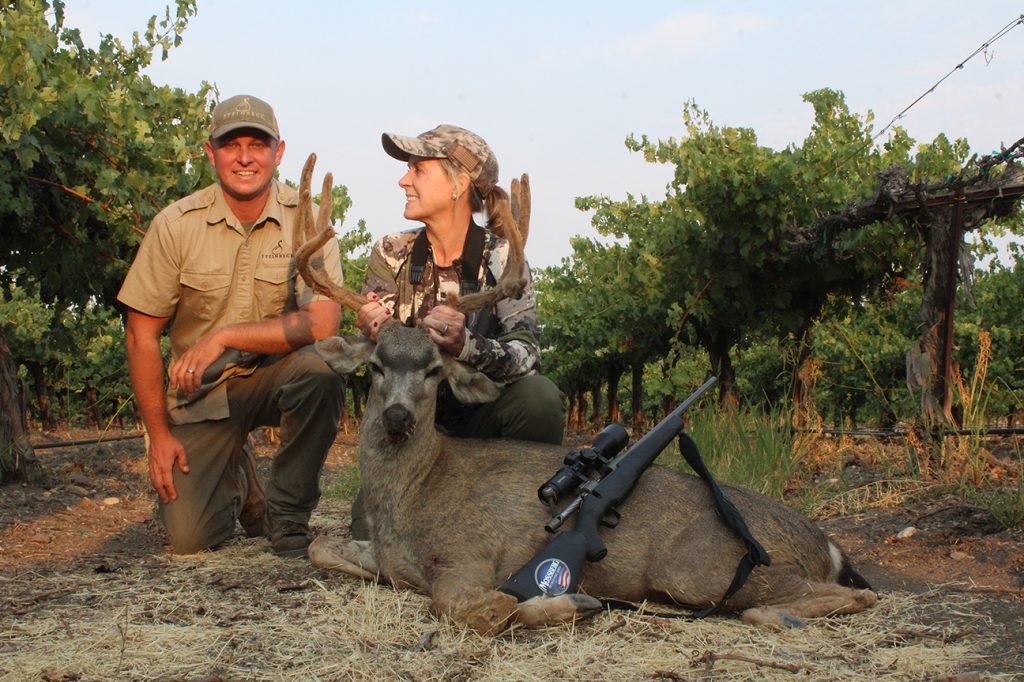
Ryan Newkirk and Donna Boddington with an awesome 4×4 taken on Steinbeck Vineyard with a  Mossberg 6.5 Creedmoor. Even on that special place, clean 4x4s are highly unusual.

Since I moved up here our Central Coast has become a major wine country. The local wine is awesome, the vineyards pretty and green. Sadly, most are game-fenced, blocking movement corridors and access to browse and water, and deer are generally not tolerated. I believe the wine industry has hurt our deer herd terribly. Steinbeck is unusual in that it is low-fenced, accepting crop losses from deer, and offering some deer hunting in return.

Hunting venison among the vines was a marvelous experience. Under careful management, Steinbeck’s well-fed bucks are larger in body than most of our local deer, and grow bigger antlers. They are also pre-marinated from eating grapes. That’s where Donna took her big 4×4.

I really enjoyed that hunt, but it was much different than the average deer hunt on our Central Coast. We have good deer—for what they are—but decent bucks are few and far between. We usually hunt hard to find them, lots of patient glassing. Usually, there’s some sweating as the day heats up, and a whole more if you must pack a buck out of a canyon.

Leave a Comment

The Magnificent Mountain Caribou

Where and when to hunt these big-antlered bulls of the high country.

Photo above by Donald M. Jones/donaldmjones.com

My wife, Wendy, and I were sitting by the fire in the crisp morning air planning our day. We had spent the previous day leading a string of pack horses on the twenty-mile ride from our main camp in to our caribou spike camp, which was located right at timberline next to a high mountain lake. Several caribou hunters were due to arrive in a week’s time, and we had decided to make an advance run with supplies to reduce the amount that would have to be packed in with the hunters.

The plan for the next few days was to check the trails into the alpine. It had been several months since we had last ridden into the area, and there was a good chance that a few rocks had rolled onto the trails, or that blowdowns might need to be cut out of the way. 

We also wanted to see how many caribou were hanging around in the high country. On early season hunts, the temperatures can still get hot enough that the caribou seek out the remaining patches of snow to bed in and cool off. The cool mountain breezes also provide some relief from the various biting insects that make the warm months of the year a bit of living hell for caribou.

After breakfast we saddled a couple of horses. I tied a chainsaw and shovel to the sawbuck on one of our pack horses, and we pointed our ponies up one of our trails, anticipating a great day in the high country of central British Columbia. There is something magical about being above timberline; it produces a sense of well-being that most sheep and goat hunters can identify with.

The trails turned out to be relatively clear of obstructions, and within a few hours we found ourselves up on a ridge, taking in the incredibly beautiful vistas before us. We hobbled the horses and allowed them to graze in a small depression that contained several pools from an underground spring, then sat down and set up the spotting scope to glass distant basins for caribou. It didn’t take long to locate a small herd of cows and calves that had bedded down on a patch of snow about a mile away.

I told Wendy I had found a few “boo” and she quickly said, “I see some caribou, too.” I asked her where they were and she said, “They are about to run over you.” Assuming she was messing with me, I turned to look at her and simultaneously I heard the pounding of hoofs and the unique sound of the tendons clicking in their feet as several young bulls and a handful of cows and calves went thundering by just a few yards away. 

We had a good laugh at this close encounter of a caribou kind, but our horses were less than impressed by the caribou blowing through at close quarters and it took a few minutes to calm them down. Hobbles were designed for a reason, and there are times when they can save cowboys from doing a lot of walking.

This double-shovel mountain caribou bull has exceptionally long top points. 

Talking about mountain caribou can get confusing, as how the various subspecies of caribou are classified depends on what source you use. Over the years, biologists and taxonomists have changed their minds many times. There are those who micro-analyze the differences in caribou from various areas and different habitats, resulting in a large number of subspecies. Then there are those who want to simplify things and only identify a small number of subspecies.

All caribou are native to the cold, harsh landscapes of the Northern Hemisphere. They are found in Greenland, northern Europe, across Russia, Alaska, all of the Canadian territories, and from the province of British Columbia in the west, all the way east to Quebec, Labrador, and Newfoundland. In the Scandinavian countries they are called reindeer, but whether you call them reindeer or caribou they are all the same species, Rangifer tarandus.

The Canadian Wildlife Federation divides the caribou in Alaska and Canada into four subspecies: the Grant’s caribou in Alaska and northern Yukon east to the Mackenzie River; the woodland caribou in the southern Yukon and southwest portion of the Northwest Territories and British Columbia east to Quebec and Newfoundland/Labrador; the barren-ground caribou from the Mackenzie River east through the mainland of the Northwest Territories and Nunavut, as well as the extreme north of Saskatchewan and Manitoba and Nunavut’s Baffin Island eastward to and including the west side of Greenland; and the diminutive Peary caribou on the islands of Canada’s high Arctic in Nunavut.

However, under the Canadian Species at Risk Act there are apparently only three types of caribou in Canada: Peary caribou, barren-ground caribou, and woodland caribou. But a quick check of Canadian Geographic’s list of Canadian subspecies includes woodland caribou, Peary caribou, barren-ground caribou, boreal caribou, Southern mountain caribou, and mountain caribou. Are you confused yet?

As hunters, we have been measuring and recording the antlers of caribou in record books for a long time. There are several different organizations with record books that record the size of big-game animals and they don’t all agree on the boundaries used to identify subspecies or the method used to score the antlers, horns, or skulls.  That said, for the purposes of this article, I am going to rely on the data published by the well-known and respected Boone and Crocket Club. B&C recognize five types of caribou: the barren-ground caribou of Alaska and the northern Yukon; the central Canada barren-ground caribou; the woodland caribou of Newfoundland; the Quebec-Labrador caribou; and the mountain caribou. 

The range B&C has established for mountain caribou includes all of British Columbia and Alberta, the southern half of the Yukon, and the Mackenzie Mountains of the Northwest Territories.

When the average person thinks about caribou, they usually think of the barren-ground caribou and the incredible migratory journeys vast herds of them make every year to their calving grounds and then back to their wintering areas, as depicted on hundreds of nature shows on TV. Mountain caribou, however, do not migrate over vast areas. This does not mean they are completely stationary, as they do migrate in a fashion for breeding season and to their wintering area, but most of their movement involves changing elevation between the open alpine country and the brushy or forested lowlands. This makes them much more reliable in terms of hunting, as they are always in the general neighborhood, unlike barren-ground caribou, which can be here today and miles away by tomorrow.

Mountain caribou are also big-bodied, with mature bulls being significantly larger than mature bulls of other subspecies. It is not uncommon for a big bull to weigh close to 600 pounds, and the mass of their antlers is often quite spectacular. 

Over the years I have guided for mountain caribou in BC, the Yukon, and the NWT. When I first started guiding, BC was the number-one place to go for trophy mountain caribou and not much was in print about the excellent mountain caribou hunting to be had in the Yukon and the NWT. But as the years went by, more and more hunters learned about the mountain caribou hunting in the territories as the number of hunters heading north for Dall sheep and Alaska/Yukon moose increased.

Sadly, the mountain caribou hunting in BC has slowly gone downhill. Many decades of intense timber extraction has taken its toll in BC, with vast areas of old-growth forest being cut. Old-growth forest is exceedingly important for mountain caribou to winter in. Old-growth forest is also less productive for other members of the deer family, such as moose, deer, and elk. Less competition from other ungulates is a plus, but another very important side benefit is less predation by wolves, grizzlies, and cougars due to the lack of their preferred prey species.

In addition, a tremendous amount of access into former wilderness areas has been created by logging, conventional hard rock and placer mining, and in more recent times, the massive oil and gas industry. The population of BC has also increased enormously in the last fifty years, which naturally results in a lot more people enjoying various types of recreation in the backcountry. In addition to more hunters, there are many thousands of people who enjoy hiking, mountain biking, off-road vehicle use, and snowmobiling in the high country, and lots of people and the disturbances they create have had a negative impact on caribou.

Large chunks of BC that previously offered good mountain caribou hunting are now closed or opportunities have been significantly reduced with the advent of a limited entry draw system for residents. First Nations land claims and reconciliation efforts by the provincial and federal governments are also having an impact, and just last year a huge area of northeast BC was abruptly closed to caribou hunting by both licensed BC resident hunters and non-resident hunters via licensed guide/outfitters.

Despite all of the bad news, there is still some excellent, but very limited, hunting for mountain caribou available in BC. Many of the outfitters in both the northern Omineca and Skeena Regions still offer good to excellent mountain caribou hunting, either as a single-species hunt or combined with other species such as Canada moose, elk, Stone sheep, and mountain goat. There are also a handful of non-resident mountain caribou hunts available through a couple of outfitters in the Itcha-Ilgachuz Mountains area of the Cariboo Region in the west-central part of the province.

A mature bull mountain caribou is a very robust animal and can weigh up to 600 pounds. Their antlers also tend to have a lot of mass.

If you are serious about finding a big bull and not just a representative mountain caribou, the areas I would suggest concentrating on in BC are in the Skeena Region. The Kawdy Plateau and Spatsizi Plateau are known for producing big mountain caribou, as are the mountains close to the Yukon border from about Watson Lake west to the Alaska border. When contacting outfitters about their caribou hunts, it would be a good idea to look at operators in game management units 6-20 through 6-29. BC is noted for lots of beautiful country, but those who hunt in this part of the province are usually blown away by the scenery.

The Yukon and the Northwest Territories still offer exceptional mountain caribou hunting, and a quick check of the record book will reveal that there have been many high-scoring bulls entered that were taken in the two territories. The current No. 1 mountain caribou was taken in the Pelly Mountains of the Yukon in 1988 and scored 459 3/8. Outfitters in both territories usually produce a number of bulls that score well over 400 points every year.

While things are changing in the north as well, vast areas of both territories are still only accessible by float plane or chopper. It is also important to remember that the entire population of either the Yukon or the NWT is less than a small suburb of any of the larger cities in BC. The entire population of the Yukon is approximately 44,000, and 25,000 live in the capital city of Whitehorse. The NWT population statistics are not a whole lot different, with a total population of approximately 45,000, with 20,000 in the capital city of Yellowknife.

As with northern BC, the scenery in the Yukon and the Mackenzie Mountains of the NWT is breathtaking. Once you have been in this country you will undoubtedly want to go back, as you will have experienced true wilderness.

Most mountain caribou outfitters in northern BC, the Yukon, and the NWT offer horseback hunts, but some also offer backpack hunts as well. The backpack hunts are obviously designed for those who are in sheep shape and want a more physically demanding hunt, or those who just don’t get along with our equine friends. Not that being in good shape isn’t a good idea on the horseback hunts as well. Horses can go places you wouldn’t believe, but you should still expect that some hiking in steep country is going to be required. 

My wife and I raised horses for thirty years, so I admit I am a little biased toward horseback hunts, but for what it is worth, I believe there are few things in life that can top a horseback hunt in the spectacular mountains of northern Canada for mountain caribou. In my experience, it is every bit as enjoyable and rewarding as a sheep or goat hunt. 

When to Go

As is always the case, hunting seasons can vary from one jurisdiction to another. The mountain caribou season opens as early as July 25th in the NWT and as late as August 15th in northern BC. The seasons close between October 15 and October 31st

Bulls are in velvet during August, but most will be in hard antler and stripped of velvet by the first week of September. The rut occurs during the last part of September and first part of October. It is worth noting that caribou taken on early hunts will not have the nice white mane that many hunters want on their bull, so if that is a concern you are better off to wait until the rut period. The downside to hunting during the rut is that most people consider the bulls to be inedible during the rut, and the later you go the more likely you will run into cold temperatures and the chance of significant snowfall.

One fall, Wendy and I had a few days off between groups of hunters smack-dab in the middle of the rut. I decided we should spend a few days caribou hunting for ourselves, as I wanted to get a big bull with a flowing white mane to mount. As luck would have it, on the first day we spotted a beautiful bull with double shovels and a gorgeous mane, so I put my .338 Winchester Magnum to good use, and we were soon packing the bull down out of the alpine. 

The bull smelled rather rutty, but we decided to try frying up some of the tenderloin for supper anyway. I was outside of the tent tending to the horses when I started to smell something awful. Honestly, it smelled like someone had urinated in a hot frying pan. There was no way we were going to be able to eat it as not even a good dose of garlic powder could disguise the horrid odor. Not wanting to waste it, we tossed it to our red Australian cattle dog. This was a dog that had been known to eat things that he had found in the bush that were hardly recognizable to look at, but he took one whiff of that tenderloin and turned and walked away. Not even the ravens that hung around camp would touch it.

Mountain caribou hunts are getting a lot more attention these days due to the significant decline in numbers of some of the other caribou subspecies. The Central Canada barren ground caribou herds and the Quebec/Labrador caribou herds have suffered a significant drop in numbers, which has resulted in sweeping closures in the barren lands of the NWT, Quebec, and Labrador. There has also been a noticeable decline in the numbers of Newfoundland’s woodland caribou, which resulted in much lower non-resident quotas. Even some of Alaska’s barren-ground caribou herds have seen a drop in numbers.

The result of the increased focus on mountain caribou has been what you would expect with supply and demand: mountain caribou hunts have increased in price. Despite that, mountain caribou hunts are still significantly cheaper than a hunt for sheep or mountain goat, and you get to experience all the same things that make mountain hunts so rewarding and memorable.

Optics and Rifles

Hunts in Canada’s North Country for mountain caribou are not a whole lot different from hunts for Dall sheep or moose. The weather can be extremely variable, with sunshine, rain, and snow all possible, even on the same day. Inclement weather, rocky terrain, brush, and many miles on horseback can all negatively impact your clothing and equipment. This is especially true for firearms and optics.

With the huge variety of protective coatings available these days for wood and metal, you can prep just about any rifle to withstand the abuse of hunting in a wilderness setting. That said, stainless-steel bolt-actions with composite stocks are the perfect choice for harsh environments and inclement weather.

A good variable scope of 2x or 3x low end and 9x to 15x on the high end should handle any situation you encounter, but emphasis should be on quality and reliability. The last thing you need on a hunt out in the middle of nowhere is a budget-priced scope that fails. Even if it has a lifetime replacement warranty, that is of little use to you partway through a hunt on a remote mountain in the Yukon Territory.

Binoculars between 7x and 10x are most common; if you rarely use binoculars and are not used to doing a great deal of glassing, stick with 7×40 or 8×40. If you are used to glassing, I would lean toward 10×40 binos for mountain hunting. Here again, a quality pair that can handle a few bumps and inclement weather is of utmost importance. 

Riflescopes and binoculars should be kept as dry as possible; good lens covers and removable rubberized scope covers can protect your optics and bring peace of mind. In harsh conditions I will often use both flip-up lens covers on my scope and a rubber scope coat on top, unless I am in a situation where close encounters with big bears are likely.

Caribou are not huge animals, but a big bull mountain caribou is easily as heavy as a young bull elk. Anywhere you may hunt mountain caribou is also prime grizzly bear habitat, and you may also want to hunt a bull moose or bull elk as an add-on to the caribou hunt. While a .270 Winchester with a premium bullet will easily handle any caribou that walks, something that is more appropriate to handle the “just in case” situations might be a good idea. 

Shooting distance can be anywhere from 25 yards to as far away as you can accurately place a bullet, but in most instances, you should be able to use the terrain to stalk within reasonable range, and it is rarely necessary to shoot beyond 300 yards.  

For the above reasons, hunters are probably better served with a flat-shooting rifle that provides a little more downrange thump than the previously mentioned, but highly respected, .270 Winchester. A 7mm Magnum of some description would be a better choice, but probably one of the various .30-caliber magnums would be just about ideal.

I tend to pack around a .338 Winchester Magnum loaded with either 210-grain or 225-grain Barnes TTSX most of the time, but I have been carrying it for many decades as a backup rifle while guiding and I am plenty used to it. The recoil does not bother me at all, but it seems to be more than most hunters want to deal with.–K.R.

Leave a Comment

Seventy-five Years of Fine Shotguns

Fausti Arms celebrates three-quarters of a century helping shooters experience the joy of owning a high-quality double gun.

In 1948 in Val Trompia, Italy, the country’s postwar industrial recovery was ramping up. Many new businesses were starting in this region, which would soon become world-famous as the home of some of the world’s leading gun manufacturers. One of these startups was a workshop run by Stefano Fausti that specialized in making double-barrel shotguns. The shop was a small one at first, relying on the handwork of a few skilled craftsmen. It grew quickly, however, partly as a result of Stefano’s love for fine shotguns as well as his tenacity and business sense, and partly because Fausti shotguns quickly developed a passionate following by hunters and shooters worldwide who recognized their quality, practicality, and beauty.

Stefano Fausti passed away in 2019 at the ripe old age of ninety—but he left his thriving company in the capable hands of a second and third generation of Faustis who are equally passionate about fine shotguns. In the 1990s, his daughters Elena, Giovanna, and Barbara took over operations of the company and energized it with their youthful enthusiasm, and in 2018, when a third generation joined the family business, the company reorganized around a Steering Committee that has defined a clear path forward and remains committed to quality and innovation. 

Today, the family-owned company is headquartered in Marcheno, Val Trompia, in the province of Brescia. It employs some forty people and manufactures its shotguns with a fleet of high-precision CNC machines, advanced production processes, and an innovative quality-control system that ensures Fausti guns are top of the line. The company produces between 4,500 and 5,000 over-and-under and side-by-side guns annually in different models and finish levels. In 2009, Fausti expanded its footprint in North America when it opened its Fausti USA headquarters in Fredericksburg, Virginia, with exhibition space, sales offices, and a warehouse. 

Fausti’s philosophy is that owning a fine shotgun should not just be a luxury for the fortunate few—it should be possible for everyone. This is the premise behind its two product lines: Core and Boutique, which ensures that there is a Fausti shotgun that is right for every shooter. The entry-level Core line is characterized by simplicity, but makes no sacrifices when it comes to quality and reliability. The Boutique line features premium finishes, engravings, and high-grade wood to satisfy the most demanding aesthetic tastes. Both lines reflect the company’s commitment to the serious and knowledgeable shooter who wants a technically advanced shotgun that will perform flawlessly in the field, while still incorporating classic style and beauty. Reflecting this focus, Fausti launched a rebranding during the Covid years, updating its logo to a more modern look that still retains a nod to tradition and its hunting-centric customer base in the way it calls to mind the shape of a deer’s antler.

Double shotgun enthusiasts understand that constructing these classic guns is a painstaking process that allows for no uncertainties. Fausti’s side-by-sides are built on a modified Anson & Deeley-style lock mechanism. Dating back to 1875, this system is simple, robust, and reliable. Both side-by-sides and over/unders feature a dedicated gauge receiver that encapsulates the action, which makes each shotgun elegant and balanced and improves ballistic performance.

Fausti’s over/unders feature an exclusive Four Locks system: four lugs that work together to create a rock-solid lock-up, allowing thousands of problem-free shots even with the most potent ammunition. A second pair of lugs inside the receiver’s sides support the usual lugs carved into the monobloc of the barrels, ensuring even lateral closure and a perfect mechanical seal. These shotguns are extremely durable and reliable, even when subjected to intense and prolonged use in shooting competitions or in high-volume hunting situations.

Behind every Fausti product is a thorough design phase: from the choice of materials to the study of shapes, from the internal ballistics of the barrels, drilled with the utmost attention to guarantee the best yield of shot patterns with any cartridge; from the choice of the best wood, to the careful definition of the moving parts for smooth and harmonious–but above all safe and consistent–functioning. Nothing is left to chance; Fausti’s shotgun development derives both from experience and from the continuous search for functional innovation.

Fausti’s advertising tag line is: “I’ll be your gun.” It’s a simple but powerful sentiment that rings true for any upland hunter who views his or her shotgun not just as a tool, but as a trusted and treasured companion worthy of creating a lifetime of memories in the field. It’s an appropriate expression of the connection that can form between a hunter and a shotgun—a connection well understood by a family who has created fine double guns for three generations.

Leave a Comment

New Product Spotlight: CANIS Alps Hooded Down Jacket

The ideal puffy jacket for cold-weather hunting.

My CANIS Alps down jacket arrived in the middle of one of the consistently coldest winters in recent memory here in northern Colorado. The timing couldn’t have been better. On a single-digit day in February, after admiring the very cool camo pattern, I zipped myself into this cozy down puffy, stepped into my cross-country skis, and glided out for a spin around the local park.

Initially, I thought my jacket might be a bit too small. But after just a few minutes, I realized the size (medium) was perfect for me. Yes, this jacket is form-fitting. It’s meant to be. The body-hugging design keeps your core toasty, but the jacket is wonderfully stretchable through the shoulders, so it never binds. It gives you lots of freedom of movement, whether you’re propelling yourself along with ski poles or swinging a shotgun. I know that for a fact because I wore the jacket extensively at my local sporting-clays range, shooting hundreds of rounds over many cold mornings in February and March while getting ready for a spring dove shoot in Argentina.

The Alps jacket features 5.3 ounces of water-repellent goose down, which makes it super warm, but not bulky at all. It features two handwarmer pockets, one handy zippered chest pocket that works great for a phone or keys, and two deep mesh pockets inside. The hood design is by far the best of any puffy jacket I’ve tried—it snugs up to your face without getting in the way of your vision, and it can easily be pulled over a brimmed cap. I also love the fleece-lined collar and the way it easily zips up to completely cover your chin when the air is frigid. The jacket’s overall design is sleek, so there is nothing to interfere or catch when you slide a backpack or rain jacket over it.

The Alps jacket (like all down products from CANIS) packs down amazingly small and comes with a waterproof stuff sack to keep it dry when it’s riding in your backpack. The CANIS developers say the pack sack can also serve as a water bucket if you need one in a pinch.

In short, this is one impressive jacket, one that will definitely accompany me on a tough mountain hunt I have planned for this fall. But I wanted to know more. Truth be told, until a few months before I tested this jacket, I had never even heard of CANIS, so I did some digging to find out the story behind this company.

As it turns out, the CANIS brand is relatively new to the hunting community, but the know-how behind this high-tech clothing was two decades in the making. Co-founders Marcel Geser and Ryan Efurd come from different continents and very different backgrounds. Geser is an award-winning technical apparel designer from Switzerland, and Efurd is an Arkansas-born and bred Air Force veteran, entrepreneur, and hard-core international hunter. They teamed up to create a collection of versatile, practical hunting apparel and introduced their initial collection to the world a little more than three years ago.

A tailor by trade, Geser started a high-end, technical skiwear brand in Switzerland called Mountain Force, and later founded a very well known product development studio in the field of technical sportswear and innovation called Development Never Stops, which works with the largest mountaineering and ski apparel brands in the world. Efurd met Geser when the former began studying who was making and designing the best technical apparel on the market. Although he was looking to create gear for hunters, Efurd investigated the equipment used in the skiing, mountaineering, and Special Forces worlds. “What were the guys who were climbing Mt. Everest wearing?” he wanted to know.

Geser and Efurd teamed up to serve the needs of the modern-day hunter. One of the things they learned was that super-lightweight material can be problematic when a hunter is far from civilization in challenging conditions. Therefore, they started engineering lightweight fabrics with a very high weight to strength ratio. The results are materials that are the strongest in their weight class. The products in their Alps line, like my jacket, are extremely tear and abrasion resistant, resulting in ultra-durable gear. 

In addition to developing innovative fabrics, the CANIS manufacturing process utilizes their BTL (Built To Last) platform. In BTL, there are no exposed quilting lines because they can be one of the weakest areas of a down garment when used in alpine and subalpine environments. BTL also uses Best in Class water-repellent down to protect the insulation from water and moisture.

The CANIS clothing system features several product lines that, when used together, create a complete layering system for the serious hunter. Learn more at Canisathlete.com.—Diana Rupp

Leave a Comment

tablet

Never Miss An Issue!Subscribe Now: 6 Issues for $34.97

More Details
WordPress Video Lightbox Plugin