Scientists call on researchers to better define their terms and metrics in studies involving trophy hunting.
Six well-known wildlife scientists recently published a paper in The Journal of Wildlife Management calling on researchers to provide more details and better context when tacking the subject of trophy hunting. Concerned that many studies are being misunderstood or their conclusions misapplied, the authors of “A Call for More Nuanced Dialogues About Trophy Hunting,” propose that any discussions of trophy hunting include a definition of how the researchers use the term “trophy,” details of variables measured, and explanations of the scales applied.
The paper’s authors, Carl D. Mitchell, Vernon C. Bleich, R. Terry Bowyer, James R. Heffelfinger, Kelly M. Stewart, and Paula A. White, express concern that simplistic portrayals of trophy hunting present an incomplete picture and result in the absence of a balanced, objective approach to trophy hunting in some publications. “A more nuanced treatment of these issues is the first step in resolving some debates surrounding this controversial topic,” the authors note. Read the full text of the paper here:
If you’ve seen “The Revenant,” you might think you know. But there are many versions of the story.
Probably the most famous “true story” from the mountain man period of the American West is the saga of fur trapper Hugh Glass. The generally accepted version goes something like this: Attacked by a grizzly, severely mauled, Glass is considered beyond saving and is left behind to die. Two fellow trappers, one of whom is the young Jim Bridger, are paid to stay with him until the end and provide a proper burial. But Glass hangs on. The men are increasingly worried about nearby hostile Indians, who might discover them at any time. So they abandon the dying man, taking his rifle, knife, and other vital gear. Glass is left on his own, deep in the wilderness. But somehow he manages to survive, drinking stream water, eating berries and whatever else he can find for sustenance. His wounds are terrible–he can’t stand or walk–but he slowly gains enough strength to begin crawling over the prairie, aiming for a fort hundreds of miles away. He is driven by a fierce will to live and a burning desire for vengeance on the scoundrels who robbed him and left him for dead.
It is, of course, the stuff of legends, and a great story, which is why the Glass story has been told and retold, first as ostensibly true accounts, then as blatant fiction in novels and movies, most recently The Revenant. “Everyone knows” about Hugh Glass, but as is often the case with what everyone knows, it turns out that much is doubtful or plainly false. In fact, there isn’t one Hugh Glass story, but several conflicting versions. Some historians even believe the whole chronicle is largely made up, a tall tale first spun by Glass and then embellished by others. Let’s take a closer look at some of the details.
Little is known about Glass’s origins, but it is believed he was born circa 1780, near Philadelphia. At the time of the bear attack he was probably in his mid-forties, which was elderly for a mountain man and explains the frequent reference to him as “Old Hugh,” or “Old Glass.” He spoke of being a sailor in his early years and claimed to have been captured, along with a comrade, by the notorious pirate Jean Lafitte. They were given the option of joining the plunderers or dying; naturally they chose life. After a miserable year with the pirate colony, word came that they were going to be tried as unworthy and executed the next day; so they jumped ship in the middle of the night and swam to the Gulf-coast shore near present-day Galveston. Here they made their way with difficulty, living off the land while avoiding the dangerous Karankawa Indians, who were said to be cannibals.
When they reached the Great Plains they were captured by the Pawnees and slated to be tortured and burned alive. Glass’s companion went first. He was stripped, tied to a stake, and impaled with dozens of pitch-pine slivers, which were then set afire. Glass made himself watch stoically, showing no emotion or fear. When his turn came he bowed slightly and offered the chief a packet of vermilion he’d been (somehow) carrying. The chief found this display of courage and grace impressive. He decided to spare Glass’s life and adopt him into the tribe. By one account Glass lived with the Pawnees for several years before making an escape; another says it was several months. From the Indians he learned survival skills such as how to forage for wild edible plants. Later he entered the western fur trade, eventually enlisting in Major Andrew Henry’s trapping expedition up the Missouri. By late summer or early fall of 1823 he and his group were traveling by foot along the Grand River in present-day South Dakota, heading for the Yellowstone country. It was here he met the grizzly.
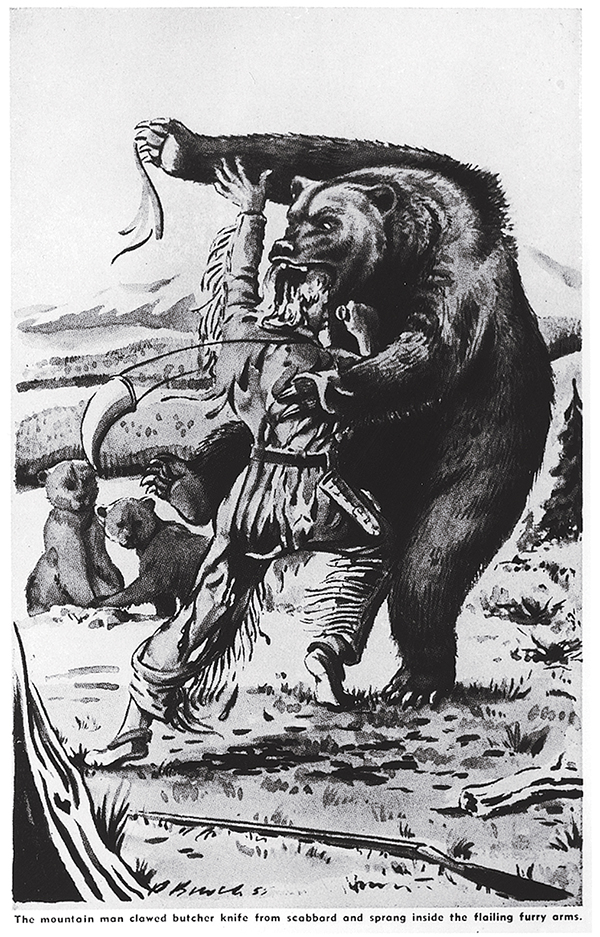
A graphic image of the mauling of Hugh Glass.
According to one account, Glass and another man were sent ahead of the group to hunt for game, when he suddenly encountered a “white bear” (as grizzlies were often called) only three yards away. Before he “could set his triggers or turn to retreat, he was seized by the throat and raised from the ground,” then mauled viciously. But other accounts put Glass at fault. Disobeying orders to stay in close file because of nearby hostile Arikaras, Glass “went off of the line of march….and met with a large grissly Bear which he shot at and wounded,” trapper James Clyman recorded in his journal. Then the bear–a sow with near-adult cubs–attacked. In words attributed to another trapper, Hiram Allen, who was at the scene: “…the monster had seized him, torn the flesh from the lower part of the body, & from the lower limbs–He also had his neck shockingly torn, even to the degree that an aperture appeared to have been made into the windpipe, & his breath to exude at the side of the neck.” Allen noted that Glass’s arms and hands were unhurt, and he suffered no broken bones. (This despite the several versions of the story that say Glass later set his broken leg himself.)
After the bears were killed, the group did what they could for Glass’s wounds, but considered the man a goner. By one account, they then left him to his inevitable death, taking his gun and equipment with them. But in other versions the trappers built a litter and placed the torn man upon it, laboriously carrying him for several days. Glass “retained all his faculties but those of speech & locomotion.” He was “too feeble to walk or help himself at all, his comrads every moment waited his death.” But the tough old mountaineer wouldn’t die. Finally the difficult decision was made to leave him behind. Two men agreed to stay until the end and provide a proper burial–for a fee. (Eighty dollars in one account, $300 in another, or $400–a near fortune for those times.) One man was John Fitzgerald, and the other was a mere boy of 18 or 19. “Bridges,” was the name first reported. Much later–more than 70 years after the event–a prominent historian would use an elderly man’s second-hand recollection to conclude that the boy at the scene was in fact the now-famous mountain man Jim Bridger. This became accepted as part of the story, though some, including Bridger’s main biographer, strongly deny it. (When interviewed in his later years, Bridger recalled the Glass incident but made no mention of playing any part in the drama.)
In any case, after some days (two, three, or five) the care- givers began to worry. Glass kept hanging on. An escalating fear of nearby Arikaras and the increasing distance from the main band were wracking the men’s nerves. Fitzgerald convinced the youth it was time to depart. Just take Old Hugh’s gun and gear and leave him to his inevitable death, which could come any time now. In two accounts, Glass is asleep when the men slip away, and wakes to the horror of being disabled and alone. In another version, Glass hears them planning to abandon him, but cannot speak. He can only plead with his eyes and reaching hands.
Some say the two men took everything–gun, knife, pouch, kettle–leaving Glass on a pallet with just his clothes and a blanket. In a different telling, they left a kettle containing his wallet and an old razor–a precious cutting tool he would later use to survive.
Glass’s reaction varies with the source: 1) “He didn’t despair.” 2) “Oppressed with grief and his hard fate, he soon became delirious.” But then, “visions of benevolent beings appeared…. exhorting him not to despond.” Whichever, he drank water from a nearby stream and ate wild berries to sustain himself. He rested over many days and planned a course of action.
The Crawl
The four original “true accounts” of Glass’s ordeal vary considerably in significant details. In the earliest publication (by James Hall, 1825): “Acquiring, by slow degrees, a little strength, he now set off for Fort Kiowa, a trading establishment on the Missouri River, about three hundred and fifty miles distant.” (Actually, 200 miles.) “It required no ordinary portion of fortitude to crawl…through a hostile country without fire-arms, with scarcely strength to drag one limb after another, and with almost no other subsistence than wild berries.” In Hall’s version as in one other, Glass drags himself the whole way to the fort.
In a perhaps more reliable rendition by trapper George Yount, who claimed to have gotten the story from Old Hugh himself, Glass did build up his strength by drinking creek water, resting and eating berries. But “one morning…he found by his side a huge Rattlesnake–With a small stone he slew the reptile, jambed off its head & cast it from him–Having laid the dead serpent by his side he jambed off small parts from time to time & bruised it thoroughly & moistened it with water….& made of it a grateful food on which he fed from day to day…After a long period his strength began to revive.” He “crawled a few rods” and then rested, building his stamina. Eventually he “found himself upon his feet & began to walk–Soon he could travel nearly a mile a day.” He fed on buffalo carcasses along the way; and once drove a pack of wolves from a fresh kill, gorging on the raw meat. He ate berries and “nourishing roots” dug from the earth, as he had learned from the Pawnee.
Most accounts agree that he drove himself forward with a near-feverish lust for revenge on the two men who had stolen his rifle and gear before leaving him to die.
In two versions, when close to collapsing he came upon a band of friendly Sioux, who gave him much-needed food, tended his wounds, and helped get him to Fort Kiowa.
How long was his arduous journey? Some say several weeks, others several months. He was met at the fort’s gate with shock and disbelief; the return of a man believed to be dead and buried, a revenant. He sought out the youth (“Bridges” or Jim Bridger?) who had abandoned him. As the young man quaked with guilt and remorse, Glass decided not to kill him, allegedly saying: “Go, my boy–I leave you to the punishment of your own conscience & your God….but don’t forget hereafter that truth & fidelity are too valuable to be trifled with.”
The older man, the real culprit, Fitzgerald–who still possessed Hugh’s rifle–had gone to distant Fort Atkinson. Some say Glass spent only a few days at Kiowa before joining a group headed for Atkinson. Others say he spent the winter recuperating and departed in the spring. En route, the men stopped to camp. Glass went off to hunt for food and was barely out of sight when a band of Arikara attacked, killing every white man present. Once again Hugh had defied the odds with an improbable, or spectacularly fortunate, escape from death.
When he finally encountered Fitzgerald, who had enlisted and become a soldier, Glass could not take revenge without Army reprisal, so he only chastised the man for his “shameful perfidy & heartless cruelty–but enough….Settle the matter with your own conscience & your God. Give me my favorite rifle.”
How much of this is actually true? The bear attack and subsequent abandonment seem reasonably well documented, but beyond that, was Old Hugh mainly a spinner of tall tales (like most mountain men of the day), fabricating the many implausible escapes and freely elaborating on his adventures? And how much did the several original “reporters” of the Glass story bend, embellish and fictionalize to make a more dramatic yarn, one ripe with great American values such as courage, grit, self-reliance, prowess, an indomitable spirit–and even, as a capper, forgiveness with a moral lesson? We will probably never know the answer to these questions. But whatever the actual truth, the tale has proved too poignant and arresting to dismiss. Hugh Glass has become a permanent American legend.
And what of the man himself? In the early spring of 1833, nearly ten years after the bear attack and the survival trek that would make him famous, “Old Hugh” ventured out with two companions to trap beaver below Fort Cass, near the junction of the Bighorn and Yellowstone rivers. As the men were crossing the ice they were attacked, killed, and scalped by a large war party of Glass’s longtime enemies, the Arikaras.
Author’s Note: For much more detail about the Glass story and legend, see historian James D. McLaird’s excellent book, Hugh Glass: Grizzly Survivor (South Dakota Historical Society Press; 2016). For maps, informational articles and access to the original accounts of Glass’s ordeal, visit hughglass.org.
The Selous, Africa’s largest hunting reserve, is being destroyed.
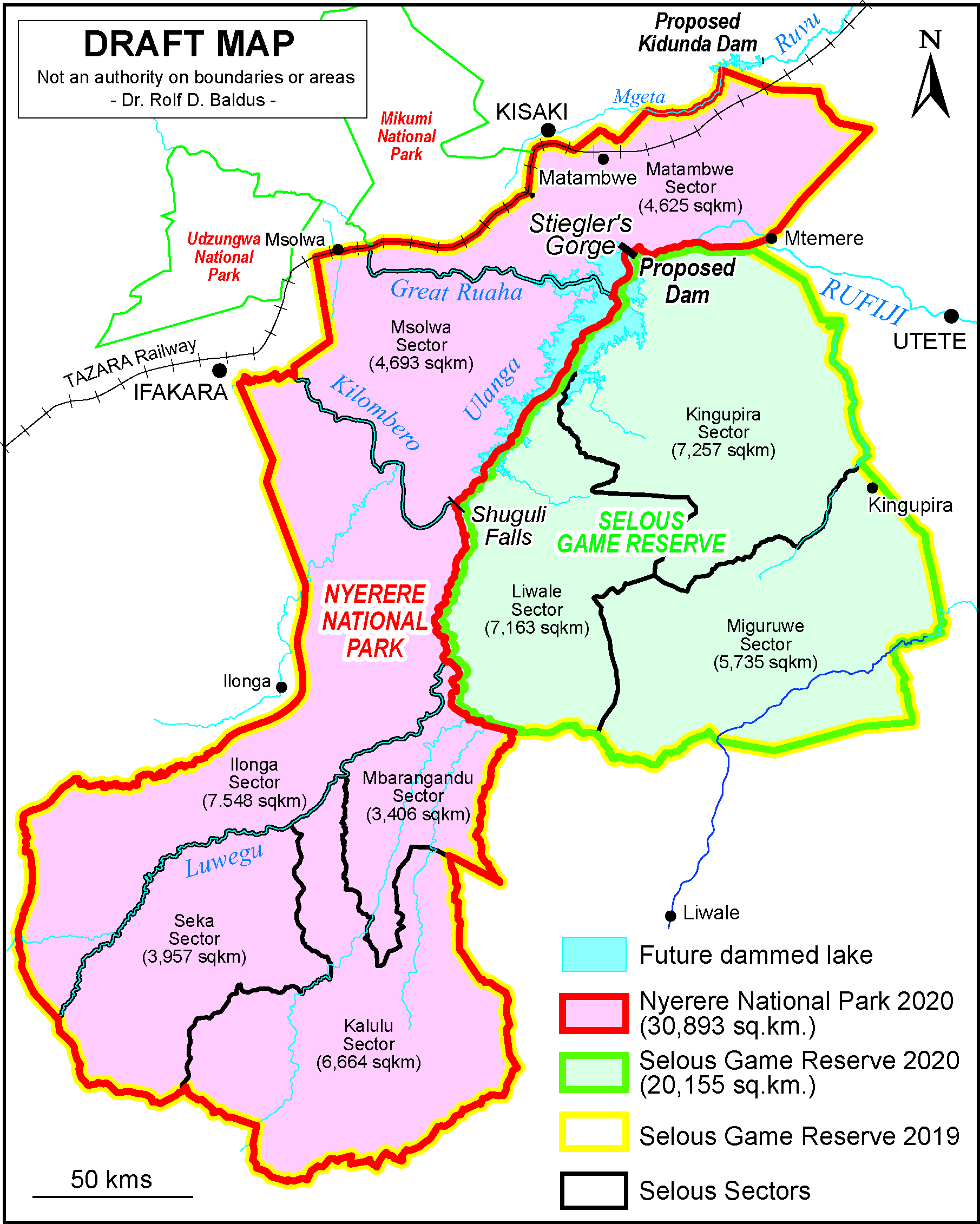
Photo above: The dam construction site at Steigler’s Gorge. Photo: Archive Baldus
The Selous Game Reserve was once Africa’s oldest and largest nature reserve. It was established by Germany in 1896; at more than 31,000 square miles, it was twice the size of Vermont. It was recognized by UNESCO as a World Heritage Site in 1982, one of the most important natural monuments on earth. It was one of the leading hunting grounds in Africa, and hunting proceeds kept the reserve going for many decades. Tanzania’s government has traditionally held the protection of the country’s rich wildlife in high regard, although in practice conservation performance was often lacking. In the Selous, mismanagement, lack of funds, and bad governance has twice led to serious episodes of commercial poaching, which reduced the rhino and elephant populations. This happened in the first half of the 1980s, and again between 2006 and 2013.
Germany, together with Tanzanian partners, rehabilitated the Selous between 1987 and 2003. Elephant numbers rose during this period from 30,000 to over 70,000. One of the most important achievements was the introduction of a system of self-financing. The Selous was allowed to retain half of its income and use it for running costs and investment. In the mid-1990s, this was $3 million dollars, 90 percent of which came from hunting. Thus, international hunters, most of them from the United States, safeguarded one of Africa’s last remaining wildlands and facilitated the conservation of its wildlife, including elephants, lions, leopards, and plains game. After the project ended, however, the Tanzanian government broke all agreements for self-financing of the reserve. Poachers once again targeted the elephant population, with quite a few senior politicians and officials participating. The elephant population fell from more than 70,000 in 2005 to 13,000 in 2013. Value of the looted ivory: over 100 million Euros.
Another disaster befell the reserve in 2012, when a uranium mine in the southwest of the reserve was permitted. This is against the rules for a World Heritage Site. Tanzania promised, however, that this would be the last major violation of the ecological integrity of the Selous. Nolens volens, the UNESCO World Heritage Committee swallowed the toad.
Location of the proposed mega-dam in the Selous Game Reserve. Photo: Archive Baldus
President John Magufuli has been in office since 2015. A former minister for roads and infrastructure, he loves large projects and has no regard for nature, neither for its intrinsic values nor for its ecological and economic significance. In addition, he is increasingly turning into an autocratic ruler. In flawed elections last October, his party got a North Korea-like 98 percent of all seats, and he was re-elected.
As his latest mega-project, Magufuli is having Egyptian and Chinese construction companies build a huge dam with a 2.2 megawatt power plant at Stiegler´s Gorge on the Rufiji River in the heart of the Selous for an estimated 10 billion US dollars. He wants to use the electricity to industrialize Tanzania. Whether that will work is questionable. A serious analysis of the environmental impact, economic efficiency, or financial viability is lacking. What is for sure is large-scale damage to the game reserve. The reservoir alone will flood 500 square miles, including some of the most beautiful and valuable areas of the reserve and one of the last habitats of the black rhino in Tanzania. Another dam is to be built at the northeastern corner of the reserve on the Ruvu River. The president does not think highly of sustainable hunting. In his eyes, it has no economic significance for the country. He spent one night in the Selous in the VIP suite of a lodge. This suite is equipped with air conditioning, satellite TV, and a Jacuzzi; however, it is mostly unoccupied due to the price. When he heard that the suite cost $2,000 per night, he quickly calculated this for 365 days and all tourist accommodation in the Selous. Compared to that sum, he said, hunting is unprofitable.
Hunting blocks throughout the country have been released for agriculture under his rule, and others have been declared national parks. The Selous is now divided. The western and southern part, with about 19,000 square miles, has become the Nyerere National Park. Only the smaller, eastern part (about 12,000 square miles) will be hunted in the future. The division was done without the legally required planning procedures.
Large parts of the new national park could be hunted sustainably, but are unsuitable for phototourism (this region is not attractive for tourists, has a long rainy season, is tsetse- and malaria-infested, and is remote and therefore logistically expensive). The new park has become a financial drain for the Tanzania National Parks Authority (TANAPA), while at the same time the hunting administration is losing millions of dollars in revenue. Only three national parks in the country generate any surpluses at all. All others are lose money and are cross-subsidized. The most money is earned at Kilimanjaro, Africa’s highest mountain. Without the high-priced mountaineering traffic, TANAPA would have had to file for bankruptcy long ago. To make matters worse, the government has decided, in view of empty coffers, that the three previously autonomous nature conservation authorities: TANAPA; the Ngorongoro Crater Administration; and the Tanzania Wildlife Authority, which covers the hunting blocks and all other conservation areas, must submit all of their revenues to the state. Then they will receive state subsidies. Such a system existed decades ago. It resulted in a pronounced underfunding of the nature reserves and massive poaching. In any case, hunting income in Tanzania has fallen by more than half in recent years. There are several reasons for this: Mismanagement of the hunting administration, excessive government taxes and fees, several failed auctions to allocate unused hunting blocks, a trophy import ban by the USA, and now, the coronavirus. In the meantime, dams and mining are not the end of the story. An extensive program for the construction of a road network is on the way. It is becoming obvious that one of the last largely untouched wilderness areas in Africa is gradually being dismembered. Hunting, with its small environmental footprint, has so far preserved nature. The national park, however, will result in infrastructure, hotel buildings, and roads. Experience shows that such roads are not only used by tourists, but also by charcoal trucks, poachers, and through traffic.
The World Heritage Committee declared the Selous a “World Heritage in Danger” some time ago. At the next General Assembly of the Convention, the 194 member states have to decide whether the status will be withdrawn from the Selous altogether. It seems that the “Outstanding Universal Value” of the Selous Ecosystem has been surrendered by the government of Tanzania. Hope dies last, but today there is little hope left. Hunters are losing one of the last wilderness areas in Africa.—Rolf D. Baldus
The idea that sheep hunts require super long-range cartridges is mostly myth.
Photo above: Boddington and Steve Hornady with a good Dagestan tur, taken with Hornady’s .280 Remington. Hornady has done as much mountain hunting as anyone in the industry, mostly with the .280 Remington.
According to Grand Slam Club Ovis (GSCO), an organization that keeps records on such things, just over 2,100 hunters have taken at least one each of the four North American wild sheep. That’s 8,000 North American wild sheep!
In this group were 75 bowhunters, plus half-dozen muzzleloader hunters. The rest have used an eclectic array of calibers. Experienced sheep hunter George Lawrence III recently took one each of our four North American rams with a .30-30. But my Grand Prize for “most unlikely sheep rifle” goes to Charlie Ren, who guided hunters to desert bighorns in 1930s Sonora. Clients included Grancel Fitz, Frank Hibben, Jack O’Connor, and my uncle, Art Popham. Ren relied solely on his open-sighted 1899 Savage .25-35.
It’s a myth that all sheep and goats are taken at long range. So many rams taken with archery tackle and short-range arms shoot holes in the legend. With a scoped centerfire rifle, nobody plans for a short-range shot, but it happens. Now, if you know your range is limited, you plan your stalk accordingly. There will be rams you cannot approach, so you keep glassing, reading the terrain.
So, I don’t buy that hunting sheep and goats requires long-range shooting. Yep, shots average longer than close-cover whitetails, but not farther than elk, mule deer, or caribou. Thanks to Asian hunting, I have taken a lot of sheep and goats. One thing about mountains: They don’t change much from one range to another. The tall Asian mountains are more open, but you can still stalk. If you can’t, you might have to wait, or seek another opportunity.
I figure my average shot is about 250 yards, much the same for elk, mule deer, and caribou. Sure, there have been “take it or leave it” shots at twice that distance. Many more long shots have been passed. And, there have been very close shots!
I go into a mountain hunt prepared for the worst, hoping for the best. I spend time on the range ensuring my rifle, scope, and load are set up to handle shots at least twice as far as I’m likely to actually shoot. In Mongolia in 2018 we shot six sheep and ibex. Those mountains are big and open, and severe wind complicated some opportunities. Even so, the average shot was less than 250 yards.
Although the Asian mountains are often fairly open, this Gobi argali, glassed bedded from a couple of miles away, was stalked to about a hundred yards, not all that unusual in mountain hunting. The rifle is a Blaser R8 with .300 Weatherby barrel.
Being ready for the worst instills confidence, and sometimes you need all the capability you have. You bet, I’ve stretched the barrel now and again. Not often, because a cooler head prevails. You realize you can get closer. If not today, maybe tomorrow. Mountain animals move little at night, so leaving them at last light and trying again at dawn is often sound.
I don’t consider sheep or goats “superior game” in any way, but there are practical and psychological considerations. Hunts for most goats are less expensive than most sheep. But, except for resident hunters, there are no “cheap” mountain hunts. Even for residents, drawing a tag may take decades. There’s a lot of pressure, and when the shot comes, you don’t want to blow it. Sensibly, you try to make the shot as certain as possible.
Sure, misses happen. I’m not a good enough liar to say that I’ve never missed! But, although I’ve had plenty unsuccessful mountain hunts, I’ve never had a failure because I missed. So, I’ve passed “possible” shots as too far, or unreadable wind. It’s always best to pass “possible,” wait for “reasonably certain,” and avoid unnecessary chances. If undisturbed, mountain animals are unlikely to leave a mountain system, so there’s strong rationale for biding your time and waiting until a good stalk is possible, rather than risk blowing them out.
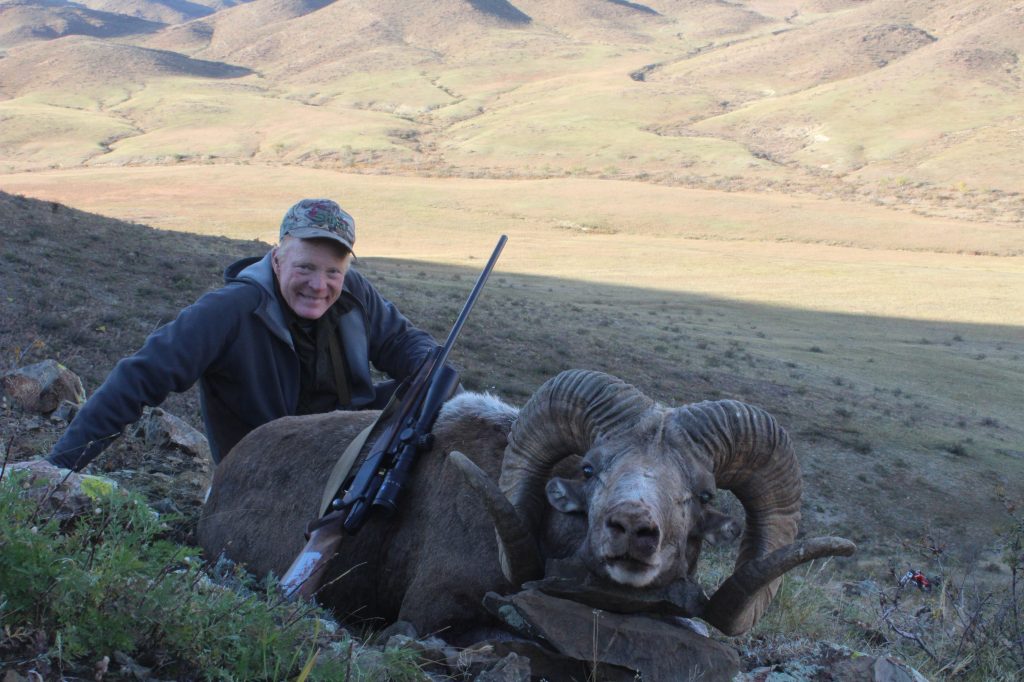
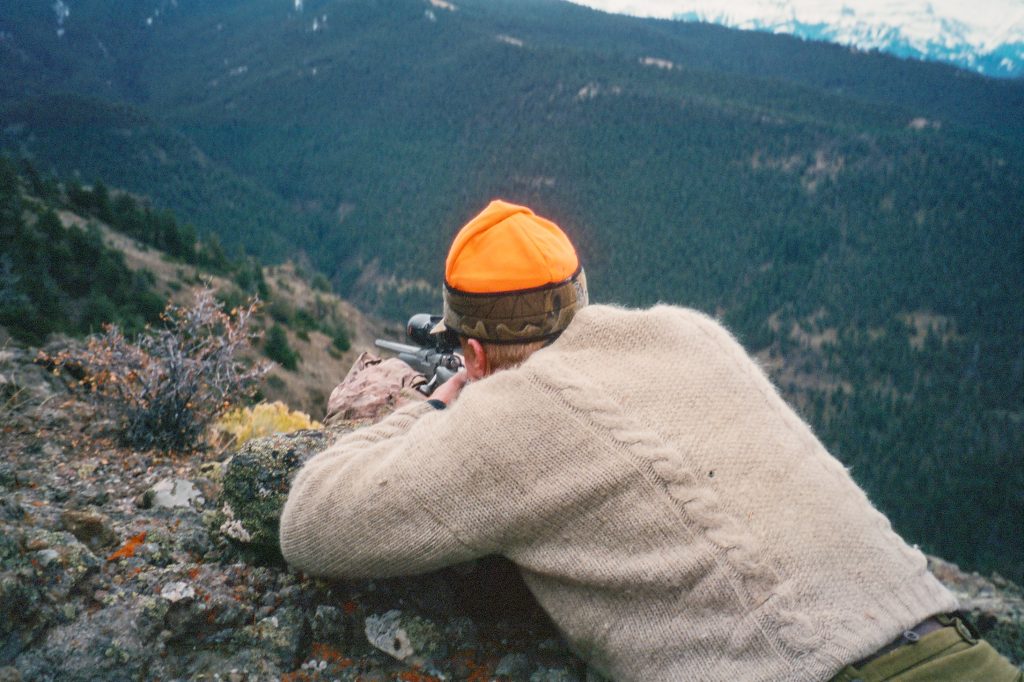
Boddington is ready to shoot his 1998 Wyoming bighorn, using a Rifles, Inc. .300 Weatherby Magnum. Distance is 265 yards, an average shot. This is the eleventh day of a ten-day hunt, first opportunity: Regardless of distance and rifle/cartridge, better make the shot count! The ram was bedded; as soon as it stood up, Boddington dropped it in its tracks.
Although their vision is superb, sheep and goats are not as wary as deer. The real trick: You must first conquer the mountain! So, there is an opposite dynamic. Once you get to the top (and the top after that), and are moving into position, you really want to take the shot. Because: You can’t imagine doing it all over again the next day, and you aren’t sure you can! Many shots at sheep and goats come at the end of a long stalk, when you’ve pushed your limits. Many important hunts culminate at the tail end, after successive long days. Better make it good, because, even if there’s a tomorrow, you’re at your limit and there’s no coming back.
This topsy-turvy psychology dictates that you must have absolute confidence in the cartridge you choose and the rifle that launches your bullet. Not all shots are difficult, but there’ s too much at stake. Most experienced mountain hunters settle on one cartridge and rifle that works. It may not be perfect, if there is such a thing, but it’s a comfortable and familiar combination, like Charlie Ren’s .25-35!
In the recent American Hunter, I noted with pleasure that my old friend John Zent, NRA’s Director of Publications, recently completed his four North American wild sheep with a fine desert bighorn. John and I came into the business about the same time, and have been friends for forty years. Few in our industry have had the determination to create and pursue such opportunity; among living gunwriters and their editors, I think just Jim Carmichel, John Zent, and me. So, Zent’s desert ram is a big deal. Their website carried a synopsis, and I was interested to learn that John’s four rams (plus extra), were all taken with the .300 WSM. Nearly twenty years ago, on his first sheep hunt, Zent found his comfort zone and has stuck with it. I have not been so loyal or steadfast.
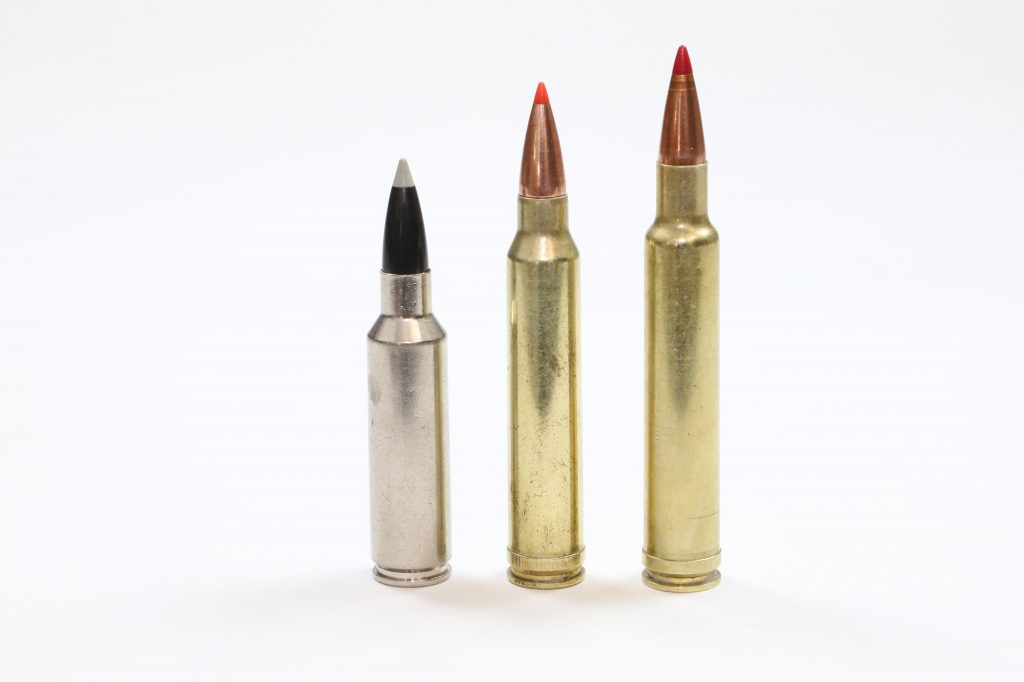
Left to right: .300 WSM, .300 Winchester Magnum, .300 Weatherby Magnum. Any of the fast .30s are always sound choices for mountain hunting. But, although he often relies on various .30-caliber magnums, he concedes that .30-caliber power isn’t essential for any sheep or goat hunting.
The .300 WSM is a good choice; a recent Weatherby winner also prefers it. I’ve never done any mountain hunting with a .300 WSM, but I have used its fast little brother, the .270 WSM. Often, I default to traditional fast .30-calibers, .300 Winchester and .300 Weatherby Magnum. There are more modern and “better” fast .30s, including the .300 RUM, .30 Nosler, and .300 PRC. For many years, the .300 Weatherby Magnum was a perennial favorite among serious mountain hunters. It still is, but in recent years some have shifted to newer case designs like the RUM and Nosler (which is based on the RUM case shortened). I accept the greater efficiency, but since mountain hunting is first about confidence, I haven’t shifted.
Another thing about sheep and goats: They aren’t much different the world over. In the Old World, chamois are small, and the Asian urial sheep are also small (read: smaller targets, more accuracy). The biggest Asian sheep are larger than ours and some of the Asian ibex and turs are big and blocky, but not significantly larger than a big Rocky Mountain billy or Texas aoudad. No sheep or goat anywhere in the world is as big as an elk, or as tough as a bear. So, in the “pure” world of sheep/goat cartridges, and despite my own frequent choices, I’m not certain .30-caliber power, bullet weight, and recoil are needed.
I want velocity, for downrange energy, wind resistance, and confidence that comes with flat trajectory. There are lots of options. I’ve been happy with faster 6.5mms (read: minimum 140-grain bullet at 3,000 fps). I used the .270 WSM on several mountain hunts, and I’ve used the .270 Weatherby Magnum, both awesome. Winchester’s brand-new 6.8 Western has great promise, not as fast as the WSM, but based on extra-heavy bullets that, until now, no .270 cartridge has enjoyed. That said, I have yet to be on a mountain hunt that the old .270 Winchester couldn’t handle, including the largest-bodied Asian sheep and goats.
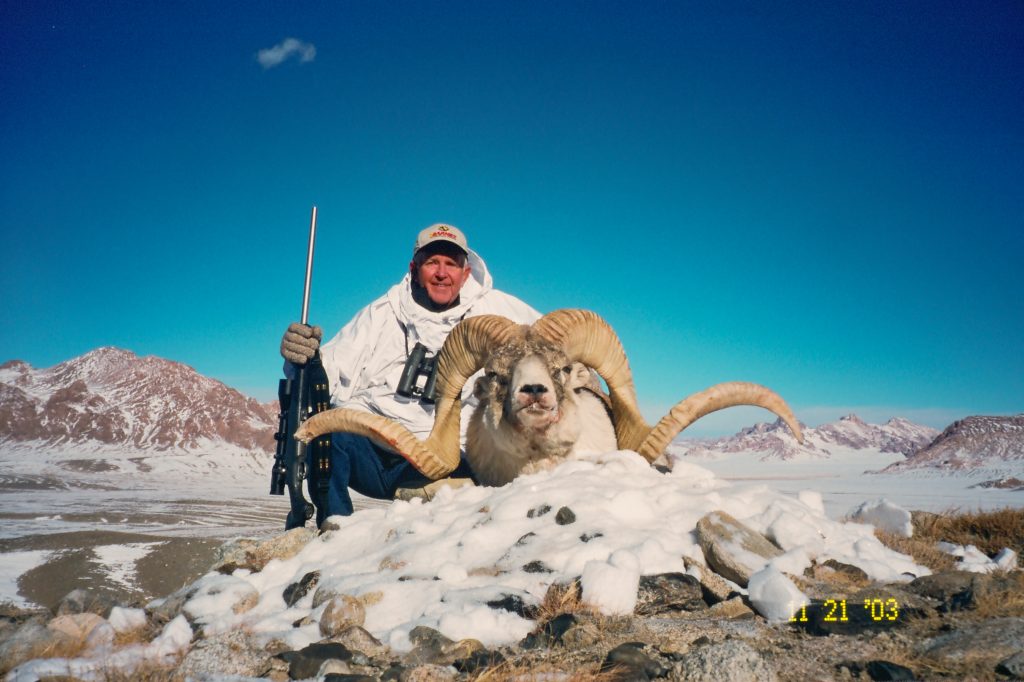
The late Joe Bishop with a wonderful Marco Polo argali, taken in 2003 with a Sako in 7mm Remington Magnum. Bishop used the 7mm Remington Magnum for almost all his mountain game…with confidence and success.
Many serious mountain hunters compromise between the 6.5mms and .270s, settling on fast 7mms. My old friend Joe Bishop used a 7mm Remington Magnum for almost all his mountain game; so did Bert Klineburger, who, together with his brothers, pioneered so much Asian mountain hunting. I’ve used various fast 7mms but, as with .270s, “magnum” 7mms are not essential. Jim Carmichel and Steve Hornady did most of their mountain hunting with the .280 Remington, a great choice. If I were to start over, I’d give serious thought to the suddenly popular .280 Ackley Improved, and for sure I’d have a look at the 6.8 Western.
It’s a bit late to start over so, for the mountains that remain to be climbed, I’ll mostly stick with old favorites, .270s and old-fashioned belted .30s. With cartridges (and rifles), familiarity doesn’t breed contempt; it breeds confidence. When you’re on the last ridge and there’s no coming back, you must know your rifle and cartridge can handle the shot you must make, whether close or far.
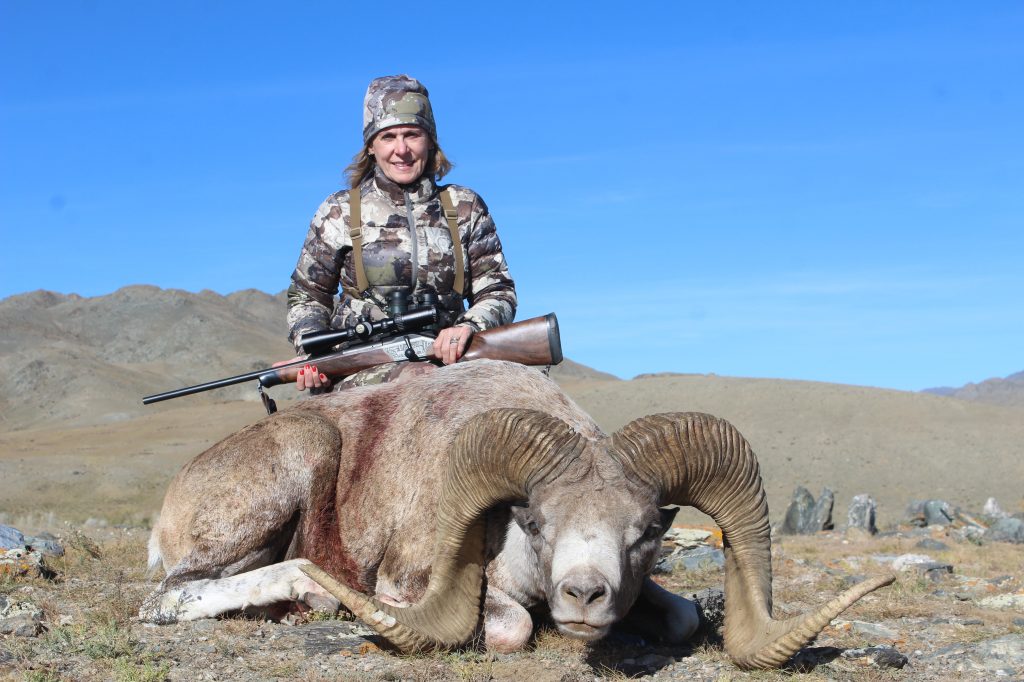
Mongolia’s Altai argali is the world’s largest wild sheep. Boddington used a .300 Weatherby; Donna used a .270 Winchester: Opposite approaches, but both worked just fine!
International hunting travel is different, but still possible, in the era of COVID.
Photo above: Boddington tracking buffalo between palm islands in Botswana’s Okavango Swamp in 1985. Botswana is open, and elephant hunting will resume this year. Unfortunately, there is no longer any hunting in the Okavango.
My rationale (“excuse,” if you prefer) for my first safari was to get Africa out of my system once and for all. It didn’t exactly work out that way. Africa has a way of grabbing you and not letting go. In the forty-four years since that first African experience, I can almost count on the fingers of one hand the years I haven’t hunted somewhere in Africa.
When I was younger, there were a few years when I couldn’t afford it. I also took a couple years off so I could make appearances in the Gulf Wars. Otherwise, I’ve been to Africa almost every year, and enjoyed every minute of it.
One of the years I didn’t get to Africa was our unlucky and unlamented 2020. I had plans, for sure, but they dissipated in the viral-laden mist. But it hasn’t been the end of the world. I’ve had the rare opportunity to reset a bit and reflect on past hunts, even spend time going over old photos. In the era before digital cameras, I spent thousands of dollars annually on film and processing. When I went digital those costs vanished, but I had thirty years of black and white proof sheets and thousands of slides in file cabinets. I’d like to say they were perfectly organized, but why lie?
I hope most of us had “pandemic projects” to keep us occupied as this thing dragged on, stuff we’ve put off (for years). I had some good ones: I built a shop and set up a new reloading bench, with the opposite end for studio photography. Another project: I went through all the old photo files, and I found good images I hadn’t seen in years. At the end, I had several hundred slides scanned at high-res, now added to digital storage. These were from all over, not just Africa, but many were from safaris long past, some in areas no longer available, and with absent friends.
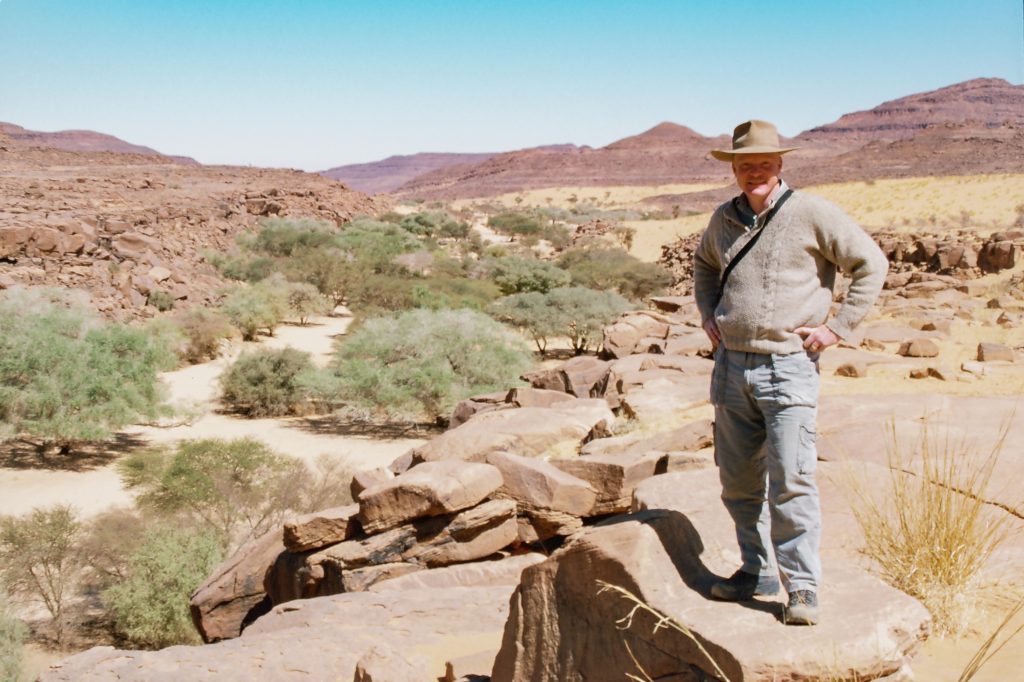
A beautiful wadi in the Ennedi Mountains in Chad. In 2001 it hadn’t rained here for a decade! Southernmost Chad is open, but the Ennedi Mountains, where native aoudad roam, hasn’t been hunted since the early 2000s.
They brought back a lot of fond memories. I’m fortunate to have a lot of great African memories to fall back on. I can’t imagine how I might feel if 2020 was supposed to be the year that I took the Great Plunge and embarked on my first safari, only to have it snatched away. Many were in that boat, and I’m sorry.
Fortunately, Africa and her wildlife are still there, and the life-changing experience of safari still awaits. At this writing, Africa is reopening fast. My crystal ball is no better than anyone else’s, but I expect travel and access to steadily improve. Some countries are fully open (sort of); others with more restrictions.
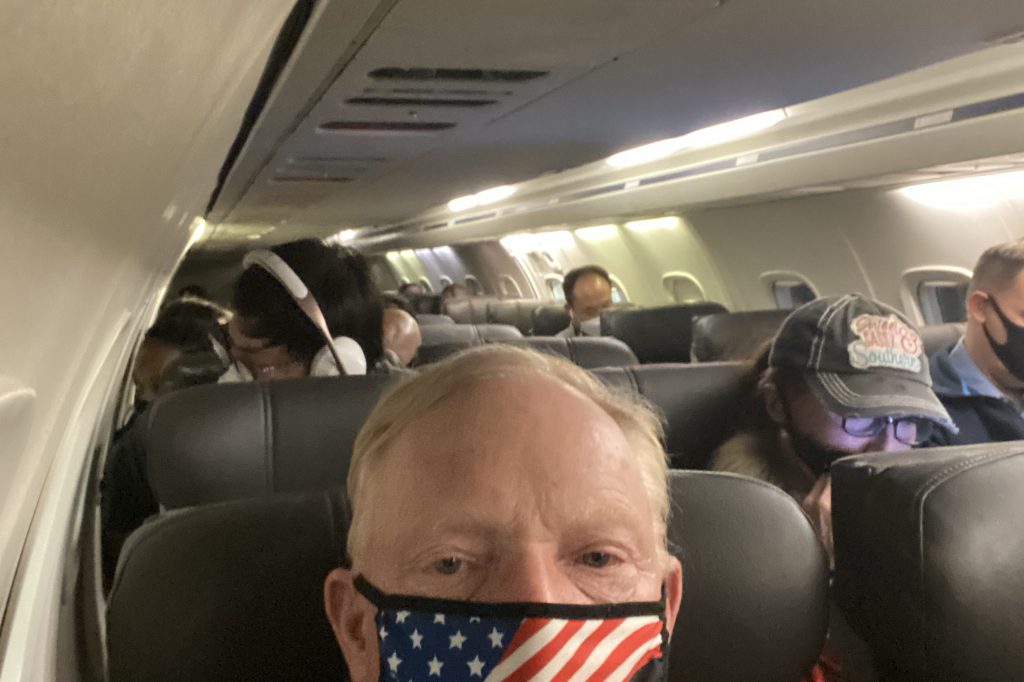
We all have different views of pandemic politics, and COVID-related risk assessment is a personal thing. However, if we wish to get on with our lives (and if our lives include travel), there are real considerations to deal with. I didn’t get on a commercial flight for ten months. When I did, I was required to wear a mask. I took a “selfie” and posted it, and one of the first comments I got went something like “How could you buy into this stuff? I have lost all respect for you.”
When Boddington took his first commercial flight in months, he wasn’t surprised that a mask was required. Special “Covid requirements” will probably be with us for some time!
Well, if you choose to stay home, that’s your decision. Depending on age and health, some of us should stay home for a while longer. But, if you choose to travel, you will wear a mask on common carriers; you won’t board without face covering, and you’ll keep it on. I find the mask claustrophobic, but you get used to it, and in public, in much of world (and on public carriers), masking is now simply a fact of life.
So is testing. In order to fly internationally, at this writing you must have a negative PCR Covid-19 test—within a specified time frame—in order to board. (72 hours before departure seems most common, but this varies and is subject to change.) You must also have another negative test (also with a time limit) to get back into the U.S.
These are things you must think about and plan for, and, although nobody likes to hear this, you must be a bit flexible. In February, Donna and I had a trip planned to Uganda, rescheduled from last year, and we were looking forward to a great buffalo hunt. We watched the Super Bowl at a neighbor’s house, just four people in a large room, no raucous gathering, everybody healthy. Out of the blue, one of them came down with COVID. Suddenly, we weren’t going to Uganda. It’s irresponsible to travel if you know you’ve been exposed. You don’t want to pass it along but, even if you prefer to be completely selfish, do you want to be ill in a foreign country, and have to quarantine there in order to get home?
These are practical concerns. We did get tested, remained negative, and rescheduled our trip for mid-March. So, hopefully, while you’re reading this, we’ll be stalking buffalo on a hot, sunny day in Karamoja. But we have to run the viral gauntlet once more. The airlines are good about rescheduling, but these days one shouldn’t even think about non-refundable or non-changeable tickets. The virus is still out there, and there’s no guarantee a test will come back negative. Also, the time-date-stamped test results are unarguable. Time required to get test results varies with area; it’s essential to do your homework and get tested so that you can get the results back before your flight but, as with the test itself, there’s no guarantee. Be flexible!
Same thing on the other end: You must be sure you can get tested and get results before you head home. This is just one more logistical challenge hard-pressed outfitters must solve, and they are. After a terrible 2020, operators able to resume are fully aware of this requirement and figuring out the best and surest ways. Just ask the questions before you go, and be certain of the answers.
Travel routing has also changed, and will continue to change. I’m writing in late February, still early in the game. South Africa officially opened to travel on October 1, 2020. In southern Africa, Botswana, Mozambique, Namibia, Zambia, and Zimbabwe are also open. This is great news. However, at this writing, U.S. citizens are still not allowed to travel in or through various European countries. Flights and potential routes are thus much more restrictive! In this infancy of reopening, flights through the Middle East have been popular, and our routing to Uganda is Turkish Air through Istanbul (a great airline for travel with firearms).
From a practical business standpoint, airlines must view travel restrictions as opportunities (as well as barriers). They are working aggressively to open new routes, but this takes time. As the year unfolds, there will be more direct flights into Windhoek, and I just learned that Air Ethiopia (another fine carrier) is opening a direct flight from Addis Ababa to Beira in Mozambique. For safari travel, I have always recommended using an experienced gun-savvy travel agent. In these times of COVID, with things evolving quickly, this is even more important.
If you lost a safari last year, don’t give up. Things are improving, and as the vaccine(s) become more widespread, the curve should accelerate. Whether we make it to Uganda this month depends on the vagaries of a tiny little virus, but, for sure, I won’t go through 2021 without getting my “Africa fix.” This will be a great safari season!
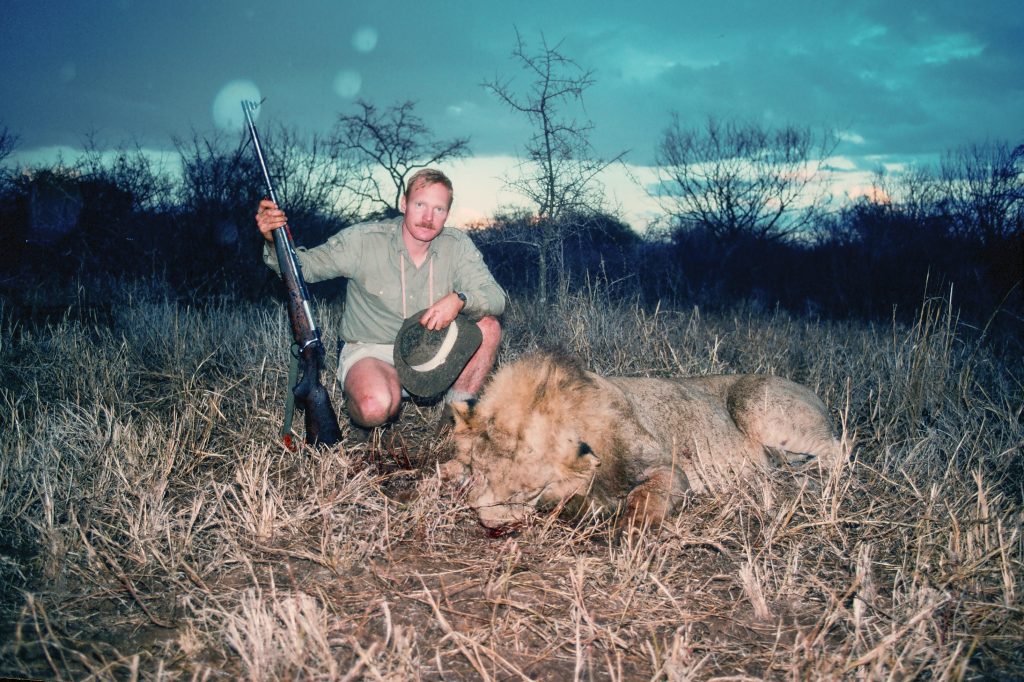
A nice lion, taken in Masailand in 1988 while tracking buffalo. Tanzania is currently open to hunting and tourism.
Thoughts on what works, what’s popular, and what’s trending—based on a small sample of Kansas deer hunters.
Photo above: John Sonne used his .30-06 to take the best buck of the 2020 season on Boddington’s Kansas farm. With a 40-yard shot, you could say he was overgunned, but the buck was moving in thick cover, where it’s a good idea to have plenty of gun and bullet.
I recently wrote about the continuing (and seemingly endless) procession of new cartridges coming out these days. It isn’t anything like the ridiculous flood of new unbelted magnums we saw at the turn of the millennium, but there are still too many, and they come too fast, for any one writer to wring them all out. And, as gunwriters, do we really evaluate cartridges? Especially hunting cartridges?
The late Bob Penfold was a pioneer outfitter who essentially put South Pacific hunting on the map. In his younger days he did a lot of writing for Australian shooting and hunting magazines, and I’ll never forget what he said to me one day: “Mate, you American writers take a new rifle, cartridge, or bullet out and shoot one or two deer, and call it ‘field testing.’” In Australia, which has serious overpopulations of various feral animals, the situation is a lot different. “Over here,” he went on to say, “when we get a crack at something new, we go out and shoot fifty or sixty pigs or feral goats. Now, that’s field testing!”
We can do range testing, either exhaustive or cursory, and we can work up loads and shoot groups or ring steel to our heart’s content. However, with our short seasons and limited bag limits, it’s difficult and expensive to acquire significant field experience with any single cartridge, bullet, or load, whether new or old. I’ve never forgotten Penfold’s words, and I’ve kept them in mind whenever I find myself waxing a bit too eloquent on the near-magical properties of something new, or new to me.
That said, some extrapolation is valid. I first used the .264 Winchester Magnum in about 1965. I have not tried all of the new 6.5mm cartridges, and don’t need to in order to know how a good 140-grain 6.5mm bullet at about 3,000 feet per second performs on game, which, depending on who does the loading, is roughly the speed of the 6.5-.284 Norma, 6.5 PRC, 6.5 SST, the new 6.5 Weatherby RPM, and undoubtedly a bunch of other 6.5mm wildcats and proprietaries I don’t even know about. I can make the same comparison with the several 7mm and .30-caliber cartridges that (more or less) emulate the velocities of the 7mm Remington and .300 Winchester Magnums.
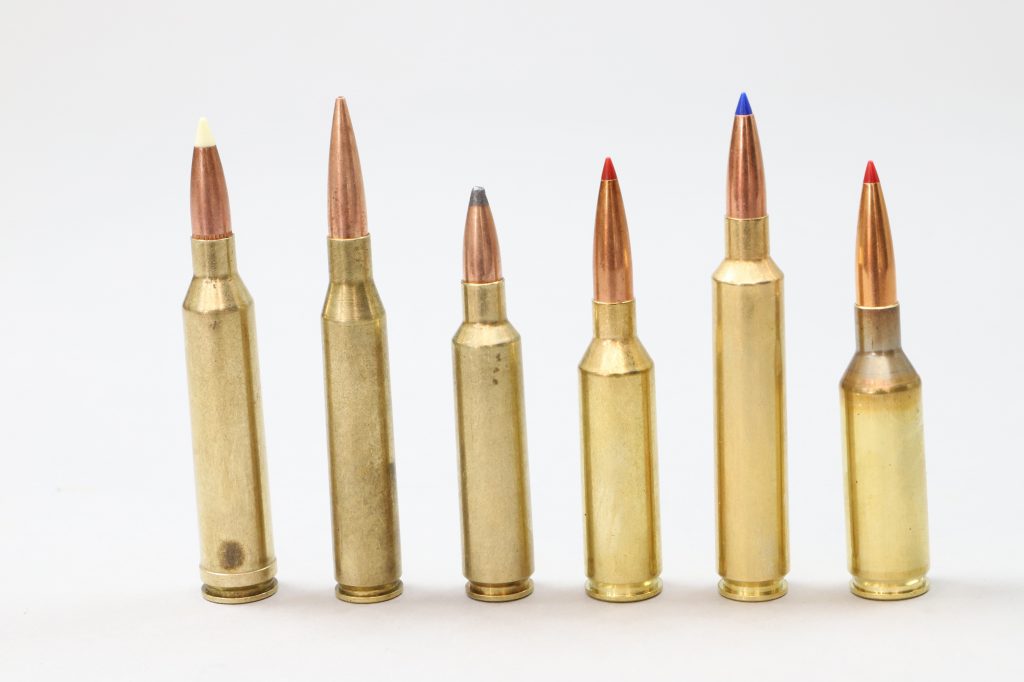
Left to right: .264 Winchester Magnum, 6.5-06 wildcat, 6.5-.284 Norma, 6.5mm PRC, 6.5mm Weatherby RPM, 6.5mm SST proprietary. All of these cartridges propel a 140-grain bullet at about 3000 feet per second. Accuracy will vary with rifles, but performance on game is about the same; it’s not necessary to hunt with all of them to know that.
Benefits of modern case design are real. More efficient cases produce more energy per grain of powder burned because of a smoother burning curve, which is conducive to accuracy. However, I’m probably not going to spend time with a dozen 6.5mm PRC rifles to prove that the group average is better than the average groups I get from my .264. I’m not even sure a dozen rifles would prove it, because that .264 has an exceptional Obermayr barrel, and it shoots, despite archaic belted case and unpopular, near-obsolete cartridge.
This fall I hunted with a Springfield Armory Waypoint in 6.5mm PRC, the first time I’ve messed with that cartridge. The rifle is very accurate, and accounted for several whitetails. On game, the 6.5 PRC performed much like my old .264 (which is not damning with faint praise!). I have not yet squeezed the trigger on a .30 PRC, which should perform about like my .300 Winchester Magnum. Nor have I used a 30 Nosler, which should perform much like my .300 Weatherby Magnum. In time, perhaps I’ll try these or other newer cartridges. Maybe the rifles I try them in will be so spectacularly accurate that I’ll be an instant convert. Maybe not! I concede better case design, which, with barrels and ammo of similar quality, should produce better accuracy. But a blanket statement that new cartridges are “better” is a tough call to make.
These days, I have limited interest in proving the point. If I were a competitive shooter, even the slightest accuracy edge might be worth pursuing. As a hunter, for the handful of game animals we take each year, not a big deal. So many cartridges, and so few days afield! Some hunters are rapidly drawn to the latest cartridges. If they’ve made their choices based on serious study, without blindly accepting all the stuff that’s out there, they may see improved performance. Even if real improvement is illusory, confidence counts for much. However, a lot of hunters continue to rely on the old, reliable combinations. For sure, this isn’t wrong. In terms of the degree of precision required, hunting is neither benchrest nor 1,000-yard competition. If you already know what works for your hunting, why make a radical change?
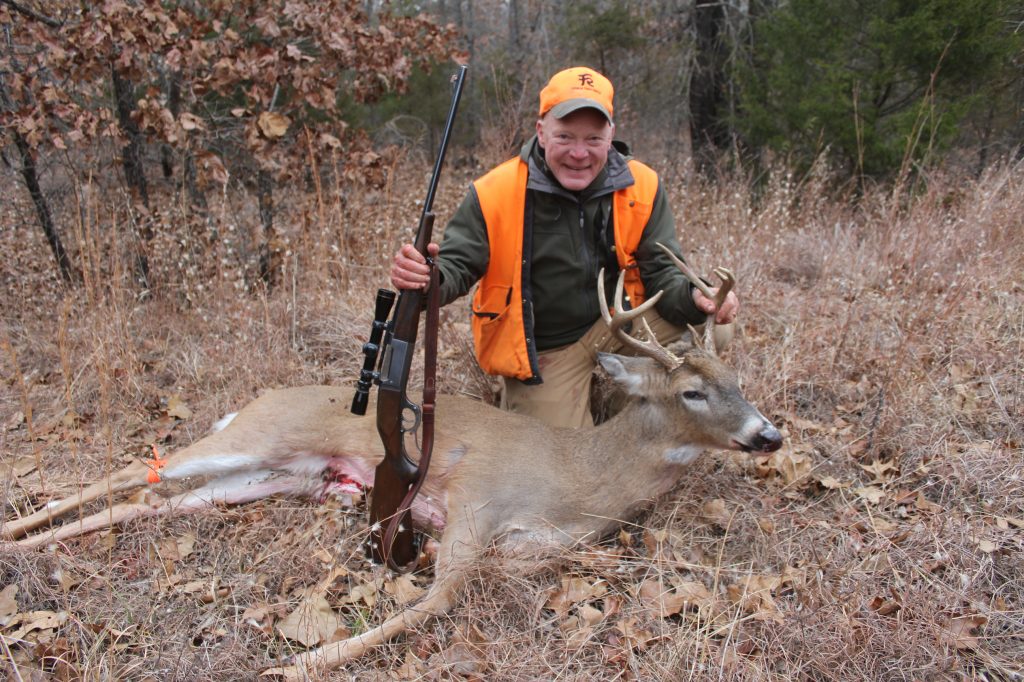
On the next-to-last day of 2020 rifle season, Boddington took a cull eight-pointer with his Savage 99 lever-action in .300 Savage. With the season running down, this buck was a year too old…with antlers too small for its age…and Boddington wanted to take a buck with this old rifle!
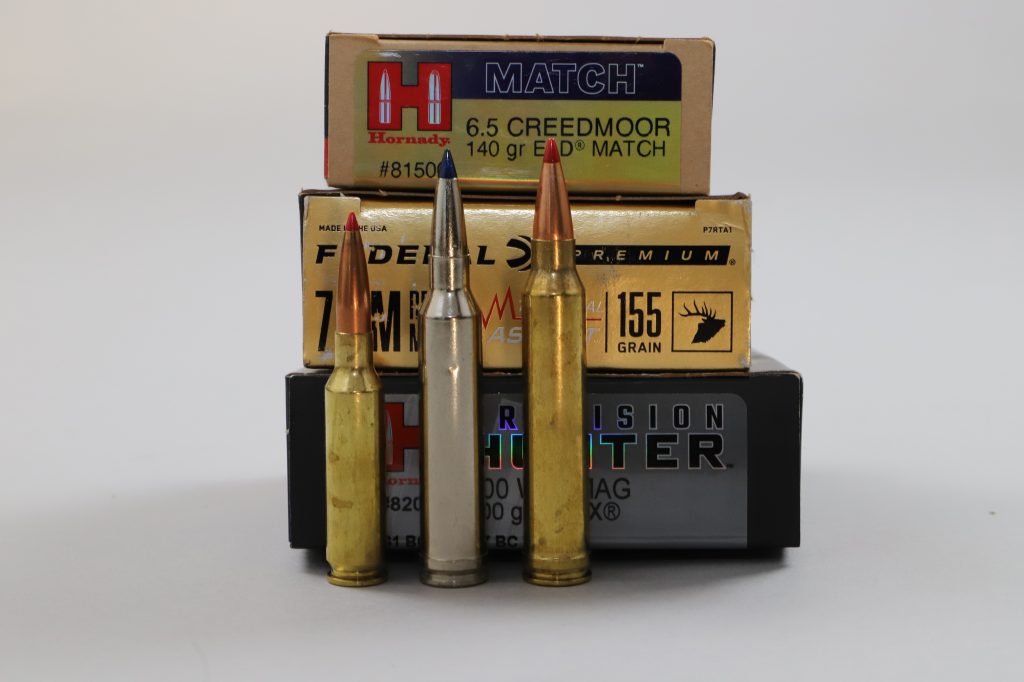
For about a decade, my Kansas neighbor and I have been hosting deer hunters during our short rifle season. They come from all over, ten or a dozen a year, and I look forward to seeing the selection of rifles and cartridges they bring. It’s a small sampling, not meaningful data, but I consider it a minor bellwether of trends. If you believe what we read, you’d think the 6.5mm Creedmoor is the only deer cartridge left in America, but it wasn’t until the 2019 season when young Brad McCarty brought the first Creedmoor we’ve seen. By then I’d joined the Creedmoor Club myself!
Other than advising hunters that our terrain and stands don’t offer long shots, we don’t put anything out there to influence rifle/cartridge decisions. However, literacy is required to negotiate the Kansas permit application, and I suppose my own preferences aren’t altogether unknown. We tend to think of the Creedmoor as appealing to younger shooters, so it was also surprising that, for the 2019 hunt, Lee Murray, over eighty, turned up with another 6.5mm Creedmoor. We were checking zero; Lee quickly added that he’d also brought a .30-06. I wasted no time in saying I was glad he’d also brought a “real gun.” Seriously, the Creedmoor is adequate for any shot (and any buck) we have, but we haven’t seen it much. And, only once ever, has anyone brought a cartridge below .25-caliber. In 2019 that was Erin Tremaine’s .240 Weatherby Magnum, the only time I have ever seen the .240 used in the field.
Left to right: 6.5mm Creedmoor, 7mm Remington Magnum, .300 Winchester Magnum. The cartridges most hunters bring to Boddington’s Kansas deer camp run between these extremes. The little Creedmoor is perfectly adequate for all shots and the fast magnums aren’t needed, but these and the dozens of cartridges in between them all work just fine if the shot is placed well.
Among our two dozen stands, the longest possible shot is less than 300 yards. In 2019, we had a couple of deer taken at about 200 yards. In 2020, no shots exceeded 150 yards. At such distances, with good shot placement, almost anything will work, and most centerfire cartridges shoot plenty flat enough for our conditions. We do see a lot of faster cartridges. Even though this does not apply to the heavy timber in our southeastern corner, Kansas has the reputation for wide open country and longer shots. Thus, it doesn’t surprise me that every year somebody brings a fast .30, usually a .300 WSM or .300 Winchester Magnum. We’ve seen several .270 WSMs and the occasional 7mm Remington Magnum. In both 2019 and 2020, we had 6.5mm PRCs in the field. Considering we’ve seen only two 6.5mm Creedmoors, this is interesting.
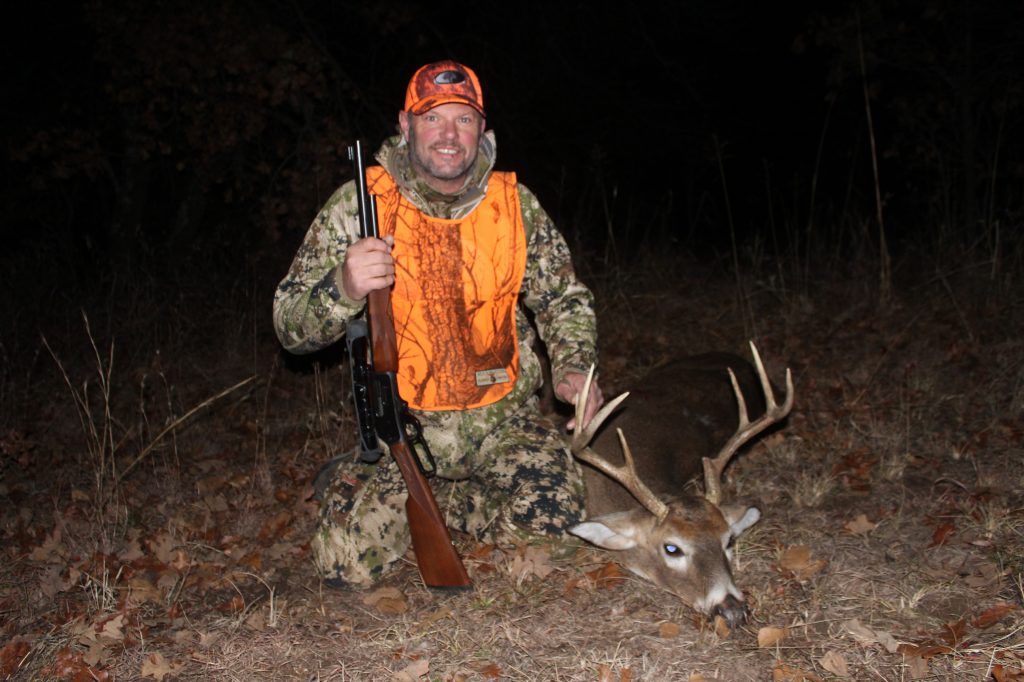
The 2020 “cartridge crop” was, well, sort of normal, and, just perhaps, what you might expect to see in a lot deer camps throughout North America. Three of our hunters carried the .30-06; two had .270 Winchesters, and two more .308 Winchesters. Extra-fast cartridges included a 6.5mm PRC, a .300 WSM, and a .300 Winchester Magnum. Having been here before and knowing our conditions, Larry Tremaine shot his 2020 buck with a Marlin lever-action .45-70.
I’m sort of an extra, taking a leftover stand after I get everybody else out, and looking for a cull buck. As much as I would like to, I rarely risk my buck tag with an iron-sighted rifle. Fine for the distance, but in timber the light comes late and leaves early. So, until my buck tag is filled, I usually carry something with an optical sight. In 2020 I carried a scoped Savage 99 in .300 Savage. By the way, everything worked just fine; under our conditions, it’d difficult to make a bad choice!
One of the .308s was a Browning BLR lever-action. This is the first year we’ve seen more than one lever-action among our buck hunters, and that made three! We hear that the all-American lever-action is selling well and making a comeback, so maybe that is a small bellwether.
Larry Tremaine’s Marlin .45-70 flattened this Kansas eight-point at about 90 yards. Oddly, this is the first time anyone has used a .45-70 at Timber Trails. More unusually, on this hunt there were three lever-actions in the field, definitely a first…possibly a trend?
Bid now on some amazing hunting trips and gear at the live and silent virtual auctions.
Sports Afield has been a proud corporate sponsor of the outstanding conservation and hunting organization DSC for many years. One of the best parts of that partnership is attending the annual DSC convention in Dallas, Texas. The convention is a great place to check out the latest gear, book your next hunting adventure, buy cool stuff you didn’t know you needed, and best of all, catch up with old friends.
All that changed this year, with DSC’s in-person show cancelled because of COVID restrictions. But the show will go on—in the virtual arena. The live and silent auctions that are usually the highlight of each evening of the convention are now being held online, and the lineup of auction items is impressive. Scroll through the auction offerings and you’ll find hunting adventures in just about every part of the world, offshore fishing trips, high-end rifles, stunning paintings and sculptures, and lavish furs and jewelry. The auctions officially run February 10-14, but online bidding is already open. Check it out here: dsc.onlinehuntingauctions.com
If your finances permit, it’s especially important to support conservation organizations like DSC this year. The revenue raised by annual events and auctions is what allows them to continue the important work they do—funding grants that further wildlife conservation, promote education, and advocate for hunting and hunters. So fire up your computer, log in to the auctions, and enjoy DSC’s virtual adventure!
Stukeys Shooting Bench is not only sturdier than most other portable benches, but some permanent benches as well.
In 2004 a self-described cowboy named Royal Stukey contacted me, saying he wanted to send me a test sample of his portable shooting benchrest, then named the Stukeys Sturdy Shooting Bench. I’d already seen the distinctive advertisements in several magazines, including a photo of a full-sized pickup truck with each tire resting on one of the benches.
We talked for quite a while, Royal explaining that his father had been a retail gun dealer, so Royal grew up shooting a lot of different guns. After high school he first worked for a plant owned by the company that makes Crayola Crayons, spending nine years as a production mechanic, learning to machine and weld production tools to keep them running.
He then decided to fulfill a lifelong dream, moving to Montana to become a cowboy—where he could also shoot a lot more. Eventually he became the manager for a big ranch, where the owner turned out to be a worldwide big-game hunter. They decided they needed a portable benchrest in order to shoot on various parts of the ranch. Royal looked and looked, but couldn’t find anything sturdy enough. The ranch manager, having seen Royal fix and make all sorts of stuff, suggested he make one.
That’s where Royal started making the benches, but he eventually moved a few times, including to Worden, Wyoming, where he lived when he contacted me. (Today the company is in Powell, Wyoming.)
At that point I really wanted to try one. I’d used quite a few portable shooting benches over the decades, and while all worked, some worked better than others. The test sample arrived quickly, and the basic design basically followed a common theme among portable benches, including many homemade models: a wood top with three steel legs screwed into the underside.
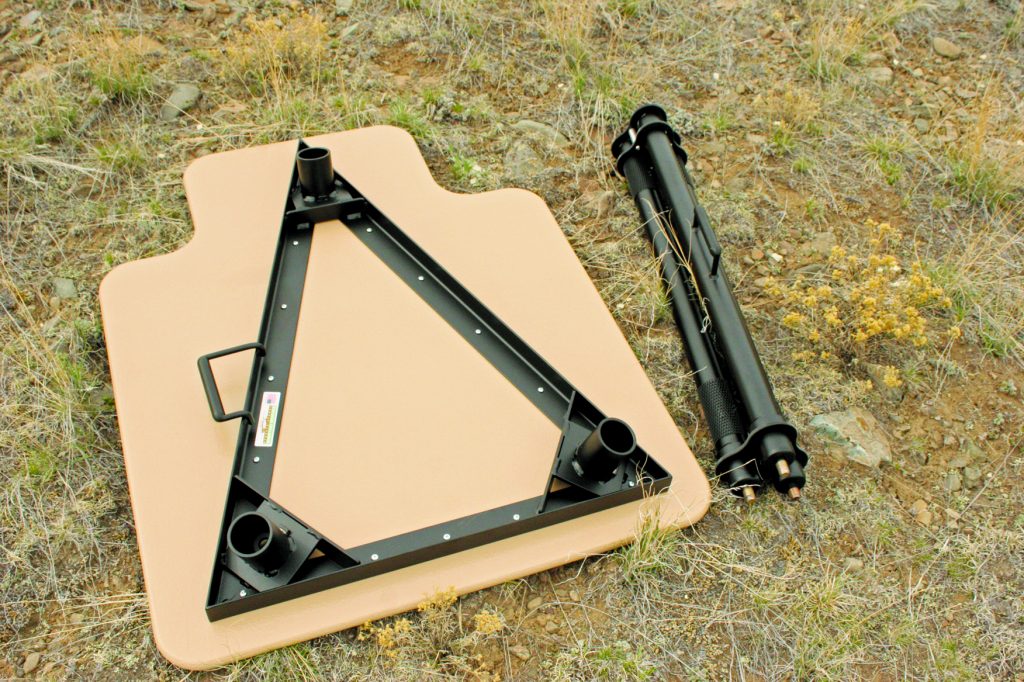
The bench comes apart in two pieces, each of which has a carry handle.
But the quality of the parts was better than any three-legged bench I’d used. The top consisted of a piece of well-varnished 3/4-inch plywood, with a triangular steel bracket made of 2×1 1/2×1/8-inch angle iron, welded together then screwed firmly to the plywood. The legs were made of heavy SCH40 2-inch pipe, and the bolts were 5/8 inch thick, attached to the angle-iron frame by what Royal calls a “nut-plate” system, eliminating the wobble common to similar three-legged benches. For transport, the three legs were held together by what Royal calls a “leg caddy,” two pieces of ultra-high molecular weight polyethylene, each with three holes, connected by a bungee cord—also a nice touch.
The bench turned out to be very sturdy—unlike several others I’d used, which tended to vibrate noticeably even in a moderate wind, like those typically blowing across Montana and Wyoming prairie dog towns in spring. This was partly due to the Stukeys Bench weighing 64 pounds–the top 38 pounds and the legs 26 pounds–although the weight varies a little, due to different batches of wood and steel. Still, putting the parts in a pickup did not require vast effort, thanks to a steel handle on the top’s bracket, and another on one of the legs.
Before using the bench in the field, however, I decided to perform a range-test to see how accurately a rifle would group compared to the permanent bench on the private range where I do most of my shorter-range rifle shooting. The permanent bench is made of redwood lumber varying in size from 6×6 legs to the 2x4s on top. The test consisted of shooting an equal number of groups off the redwood bench and the Stukeys, alternating from one bench to the other between groups.
The rifle was a Remington 700 laminated-stock varmint rifle in .223 Remington, purchased new in 2001. After I applied several “accurizing” techniques from epoxy-bedding the stock to recrowning the muzzle, it turned out to be the most accurate factory rifle I’ve ever owned. Ammo put together using benchrest handloading techniques averages under ¼” for five-shot groups at 100 yards, and most factory ammo will put five in around half an inch, shot when using a 16-pound Caldwell Rock BR Competition front rest on the redwood bench. I also used the Rock when testing the Stukeys Bench, along with accurate Black Hills Ammunition factory ammunition loaded with 50-grain Nosler Ballistic Tips. Result: The groups shot off the Stukeys Bench averaged .15 inch smaller than those shot off the permanent bench.
This convinced me the Stukeys Bench would be more than adequate for testing big-game rifles at longer ranges in the mountain surrounding our valley. The first test involved my wife’s primary rifle at the time, an Ultra Light Arms Model 24 .270 Winchester, which normally grouped three handloads with 130-grain Nosler Partitions into an average of right around half an inch at 100 yards. At 300 yards, with Eileen shooting off the Stukeys Bench, the same load grouped three shots in 1.75 inches—very good for a rifle weighing exactly six pounds with scope, in a slightly varying breeze. (At this point I mailed Royal a check, since he was not getting the bench back.)
It may seem odd for a portable bench to result in such small groups, but Royal mentioned how he’d experimented with dampening vibration. When I mentioned my test, he was pleased but not totally surprised—and a few years later he sent me a new top, also made of 5/8-inch plywood but with 11 laminations, instead of the five in the original, which further helped dampen vibrations, partly because it weighed a little more.
His latest version, new for 2020 and now called simply Stukeys Shooting Bench, uses 13-lamination, ¾-inch all-birch plywood, but along with the varnished plywood version he also offers an option with the top spray-covered by hot polyurea while the primer is still tacky, to cross-link the molecules. (In case you didn’t know—I didn’t—polyurea is a modern elastomer that’s extremely tough and UV light resistant. It’s primarily used for preventing corrosion and impact damage various industrial surfaces, such as tanks, pipes, roofs, concrete garage floors and oil-field containment ponds. It’s also used for coating buoys in the Great Lakes, where they’ve gone 20 years without being recoated.)
Royal sent along a few poly-covered scrap pieces, inviting me to whack them as hard as possible.
I started with a 16-ounce claw hammer, with a piece resting on the concrete apron in front of our garage door. After several whacks, a dent finally appeared, so small it wouldn’t be recognizable if I hadn’t known where the hammer hit. I then switched to a 6-pound firewood splitting maul, whacking the plywood with the blunt end. This left a noticeable dent about an inch long, but the poly coating did not crack, or separate from the wood.
The stouter plywood and poly coating adds a few pounds to the bench, though not enough to make it less portable, this sample weighing a total of 72 pounds. In addition, Royal offers several optional, high-quality accessories, including an adjustable 3-legged seat, and a very steady turret-base for the front rest from Target Shooting Inc. I bought this bench because it works, even though it is not cheap; the basic model is priced at $1,385.00—but that includes Fed Ex ground shipping to U.S. addresses.
The biggest bucks live in the highest, loneliest places.
Photo above by Vic Schendel
After spending about half my autumn hunting time pursuing mule deer from Sonora to Alberta over the past several decades, I started to envision mule deer range as a loose ocean of deer, filling the western portion of the Mississippi River’s huge basin. Their present range, in fact, pretty much covers the same area as the shallow inland sea that rose during the much warmer climate of the Cretaceous Period. The ocean metaphor occurred to me partly because I have found many aquatic fossils in much of Montana’s mule deer country, sandstone squids and snails along high-plains ridges, and shiny trilobites trapped in mountain shale.
Mule deer are sparse along the high western shoreline of the mule deer ocean, the Rocky Mountains—sometimes so scarce hunters may search for days without seeing a buck. But mountain bucks are among the biggest, which is why they keep drawing some of us back, again and again.
Sometimes mountain mule deer hunters end up glassing huge valleys devoid of any other trace of humanity, evoking the pleasant conceit that we’re somehow much closer to Nature. Looking down on flying eagles can do that, and if we look patiently enough, a gray-brown buck may eventually appear, often long after dawn or before dusk, because in high wilderness they’re not as worried about human predators.
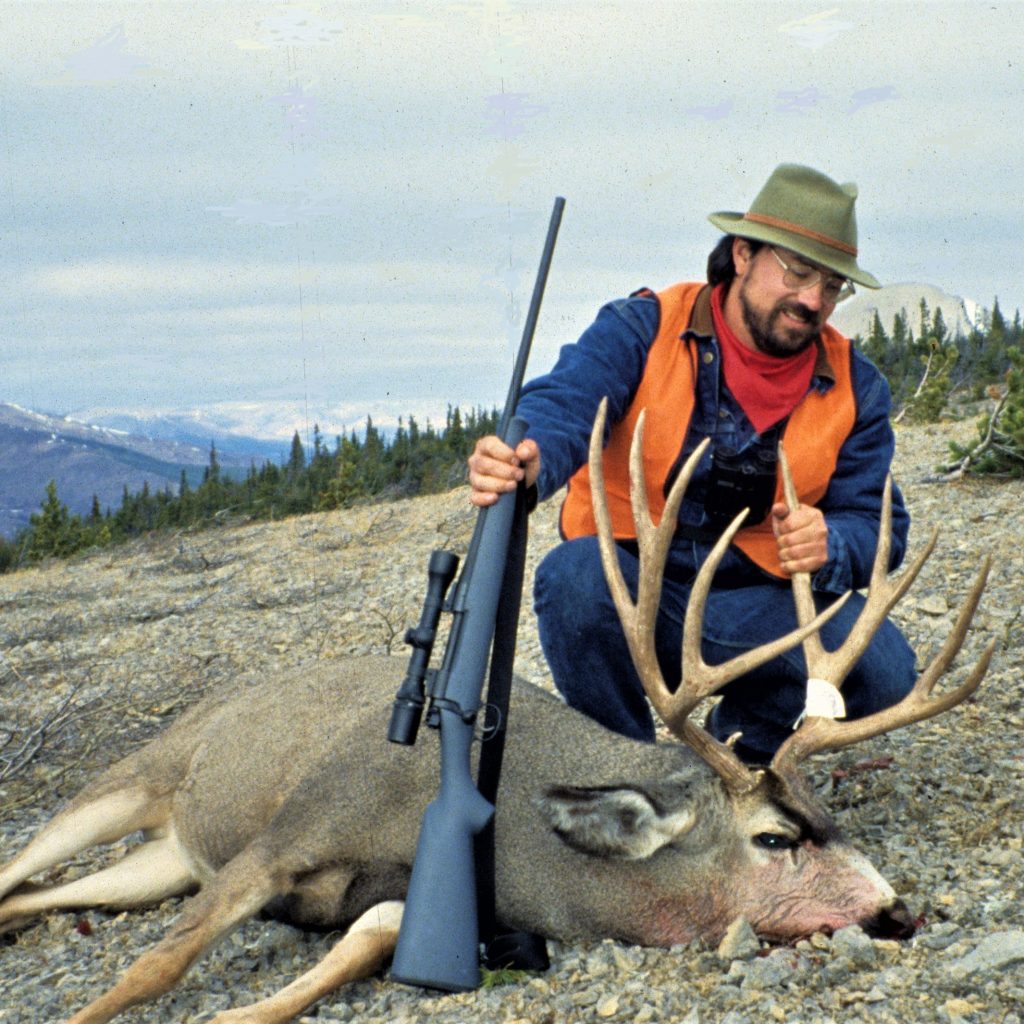
The biggest mountain mule deer I’ve ever killed, both in body and antler, ambled into sight about 10 o’clock in the morning, when wise old bucks should be in bed, on a half-barren limestone ridge partially created by that inland sea. A Forest Service map indicated the ridge was twenty miles from the nearest trailhead, and the buck strolled along as casually as a window-shopper, pausing now and then to bite a stringy tuft of “beard” lichen from a stunted subalpine fir.
I rather noisily dismounted from my horse, pulled my rifle from its scabbard, then rested the fore-end on a fir branch. At the shot, the buck collapsed on a bed of limestone cobbles, and his body turned out to be so big his antlers were even larger than I had first thought.
Exactly what that buck weighed I do not know, but I did measure his body, an odd compulsion learned from field work as a biology major. The buck turned out to be just about as large as a 1 1/2-year-old cow elk my wife got a couple weeks later–and a high-plains mule deer buck I killed in Alberta 15 years later. The boned meat from the Canadian buck weighed a little over 130 pounds, and a general rule for big game is the boned meat weighs about a third as much as the entire animal.
Mountain bucks often have large bodies, making even big antlers look smaller than they really are.
High-country mule deer tend to be bigger than plains bucks, which might be due to the biological rule postulated by German biologist Carl Bergmann in 1847 that warm-blooded animals tend to grow larger in colder environments, due to larger bodies having less relative surface area, thus retaining more heat. But like any general biological rule, there are exceptions—and objections—to Bergmann’s Rule.
Well-known Canadian biologist Valerius Geist believes larger body size is instead related to food availability during the growing season. This would seem to be odd in the high Rockies, but up there vegetation usually remains at least somewhat green (and hence more nutritious) from spring through early fall, due to more summer precipitation and less evaporation than in the warmer valleys below. What I do know is the mountain bucks my hunting partners and I have taken often had very large bodies and, if old enough, antlers to match—although there are exceptions to that as well.
Plus, while mountain mule deer can be found up among bighorn sheep, and sometimes close to mountain goats, they normally don’t winter that high. Instead, they move downhill as snow deepens in late fall—though big bucks will often tolerate even more snow than elk will. In fact, one of my fellow wildlife biology students at the University of Montana specialized in deer predation in the local mountains. He found that male mountain lions took quite a few healthy, mature mule deer bucks, which is contrary to the belief that wild predators primarily kill old, young, or infirm prey. He guessed this was due to mountain bucks spending considerable time alone, at least before the rut.
That is another reason many mountain bucks start downhill later in the fall. Female mule deer tend to live in lower country, perhaps partly because they’re considerably smaller, often weighing less than half as much as really big bucks, so they get colder during high mountain nights. In fact, I have often found a mule deer “gap” in the October mountains. There will be plenty of deer (and medium-sized tracks) along lower, larger creeks, where doe herds feed to put on enough fat to sustain the fawns they’ll soon be carrying into winter. Farther up the mountain, deer sign often fades out—then reappears much higher, especially the larger tracks of high-country bucks. In fact, I killed my first big Montana buck after hiking three miles up an apparently almost deerless ridge near the Idaho Panhandle—and that buck was also up and feeding, all alone, late in the morning.
How high do buck mule deer hang out during the pre-snow “growing season?” The highest I’ve ever seen was taken by my hunting partner Brad Ruddell in the North Park area of Colorado. We were primarily after elk, but also had deer tags, and before the rifle season the outfitter had occasionally seen a big mule deer buck near the end of one ridge.
He suggested that Brad and I start several hundred yards apart on either side of the ridge-end, and slowly hunt toward each other. I had barely started into the ridgetop timber when a shot thumped ahead of me. A couple minutes later I found Brad—and the dead buck. That ridge was a little higher than 10,000 feet above sea level, but that’s Colorado, the highest state in the Lower 48. The limestone ridge in Montana was right around 7,000 feet—about 1,000 feet below the highest peaks in the area.
This Colorado buck was found on a ridge more than 10,000 feet above sea level.
While bow hunting for elk in northern Idaho years ago, I spotted a big mule deer buck bedded far above me on a green avalanche slide, near the top of a peak only 5,500 feet above sea level. I didn’t have a deer tag, but there wasn’t any way to get in bow range anyway, since he lay in the center of the slide, amid tiny springs trickling downhill through the greenery, so didn’t need to move more than a few feet to eat or drink. (The elk were in the shady canyons far below the “high” peaks.)
There’s a limestone mountain on the east side of the valley where my wife and I live, its peak just under 9,500 feet above sea level, and you can occasionally glass mule deer bucks far up its open south slope. After first moving here 30 years ago, I started up that slope a couple times, discovering the steep scree eventually became very difficult to navigate—and would be far more difficult with pieces of mule deer buck on my back.
That was OK, however, because other exploration found a spot below that mountain where bucks often end up in November, as the rut starts and the first substantial snow usually falls. An almost level side-ridge angled southeast from the base of the mountain, around 3,000 feet below the peak, and half a mile above a small but constant creek, paralleled by a Forest Service road.
While hunting grouse along the ridge in early September we found mule deer does, fawns, and young bucks hanging out around recent clear cuts. Later we discovered the ridge was a “staging area” for both mountain bucks and elk as they started downhill after the first snows, and the closed logging road provided an easy path for sliding a plastic toboggan, loaded with big game, down to the creekside road.
On November 4th of our second autumn of hunting the ridge, Eileen and I started up the road through ankle-deep snow, looking for either elk or deer. We didn’t find anything in the first clear cut, but in the second found an older 3×3 buck, bedded toward the top of the cut amid several does. Eileen sat down behind a sawn-off stump, placed her daypack on the stump, and rested her .270 on the pack.
By then the biggest doe had gotten to its feet, then started uphill. The buck rose and followed her–but at edge of the timber paused in the classic mule deer “last mistake.” A couple hours later we tobogganed him easily down the trail. In reality, “high” mule deer country mule deer are not defined by elevation above sea level, but by living on mountains—even after they’ve started downhill to winter in the low country.
There are three primary methods of transportation when hunting high-country mule deer: horses, hiking and motorized vehicles. I have grown less fond of horseback hunting, even though horses have carried me into beautiful high country from Colorado to British Columbia. This is partly due to dislocating my left knee while loading a dead buck, when the horse decided it was time to start downhill despite the deer not being firmly tied down. I turned with the horse while holding onto the buck, but my firmly planted left foot did not. Luckily, the horse stopped and the knee popped back in, and didn’t stiffen up until after my partner and I led the horse down to the nearest road.
Horses can also kill you, though usually not deliberately, like grizzlies or Cape buffalo. My outfitter friend Richard Jackson was among the most competent horsemen—and avid mountain mule deer hunters—I’ve ever known, but died in a horse wreck before turning fifty, on his last pack-trip of the year. Horses can suddenly interrupt a mountain hunt in many other ways between dislocations and dying, especially as we grow older.
I still like to hike for mountain mule deer, but instead of trying to out-hike other hunters, these days I look for pockets they tend to pass by, especially near closed roads—and I also tend to use a game cart instead of a pack frame to bring deer downhill. This past fall I discovered one such place along the base of a narrow sandstone ridge, and am looking forward to November.
The last mountain mule deer buck I got was mostly reached by vehicle, on a hunt with outfitter Colorado Buck in the mountains of northern New Mexico. He’d leased the hunting on a private ranch, with a cabin “lodge” at a little over 8,000 feet above sea level. The deer had been hunted hard for a number of years, and the result was a lack of classic 4-point antlers. My hunting partners and I would only be allowed to take mature bucks with fewer than the normal number of tines.
I ended up hunting with a guide named Dwayne, and my old friend and fellow writer Holt Bodinson. The drill was to drive partway up one of the local 9,000-foot ridges, then hunt the ridge slowly, glassing openings. Holt had to leave early, so he got first shot—which happened on the first morning. We’d hiked to the edge of a canyon, but only found a few does, so were hiking across a near barren flat to the next overlook when Dwayne and I saw a buck walking ahead of us. His face was even grayer than usual, and the right antler a big fork, while the other appeared to be broken off short.
Holt was a little behind us, and by the time he got prone, the buck was a little over 300 yards away. At the shot the deer jumped and kicked its hind legs, then trotted 30 yards and eased to the ground. It turned out the left antler was not broken, but a short, twisted mass of short tines. Aside from the buck’s gray face, his body was also very large.
My chance came late in the afternoon the next day, when one of my friends calls “your basic mule deer buck,” with antlers spreading as wide as its ears, appeared in deer-high Gambel oak brush. But his left antler only had one fork, and luckily an opening in the brush showed the top half of his broadside shoulder. The reticle settled about 1/3 of the way down, and at the shot the buck dropped and never moved.
Even after field-dressing, Dwayne and I had something of a struggle lifting the deer into the vehicle; while not as big as Holt’s, mine still resulted in exactly 100 pounds of boned meat. It was a fine buck for all our purposes, but I was a little jealous of Holt’s ancient buck. I have been lucky enough to take a few big “typical” mule deer, but never such an old buck with ancient antlers to commemorate so many years living along the shoreline of the mule deer ocean.
Don’t miss this online extravaganza scheduled for January 25-February 1.
Like so many hunting organizations this year, Grand Slam Club/OVIS was forced to cancel its in-person convention because of COVID concerns. But this sheep-centric organization is still celebrating convention week with an incredible lineup of online auctions, raffles, and events. GSCO’s virtual extravaganza is slated for January 25 to February 1, and if you haven’t done so yet, you’ll want to sign up now so you’re ready to bid on some of the amazing hunting adventures and gear on offer. (Click here: https://auctions.slamquest.org/auctionlist.aspx.)
Be sure to take a peek at the auction catalog, showcasing a huge array of hunting trips, including hunts for Spanish ibex, African plains game, grizzly, ibex, chamois, and tur; high-end scopes and rifles, taxidermy, fine jewelry, and much more. Several desert sheep hunts as well as a tag for a desert sheep in the Navajo nation and a Wyoming Shiras moose governor’s permit are also on the auction block. Auctions will be held daily from Wednesday, January 27, to Saturday, January 30. On Monday, February 1, the lucky winners of incredible raffle prizes ranging from Dall sheep hunts to elk hunts will be drawn.
The organization will also hold awards presentations Wednesday through Saturday of convention week, with hunters from around the world honored for achieving hunting milestones. Awards include the Super Ten, Super 25, and Super Slam Awards, as well as the Grand Slam, Ovis and Capra World Slams, the Rex Baker Super 40, and many more.
Grand Slam Club/Ovis is a 501(C)(3) organization of hunter/conservationists dedicated to improving and perpetuating wild sheep and goat populations worldwide, as well as North American big game. For full details on GSCO’s 17th annual Hunter & Outfitter Convention Week, visit slamquest.org.