Bid now on some amazing hunting trips and gear at the live and silent virtual auctions.
Sports Afield has been a proud corporate sponsor of the outstanding conservation and hunting organization DSC for many years. One of the best parts of that partnership is attending the annual DSC convention in Dallas, Texas. The convention is a great place to check out the latest gear, book your next hunting adventure, buy cool stuff you didn’t know you needed, and best of all, catch up with old friends.
All that changed this year, with DSC’s in-person show cancelled because of COVID restrictions. But the show will go on—in the virtual arena. The live and silent auctions that are usually the highlight of each evening of the convention are now being held online, and the lineup of auction items is impressive. Scroll through the auction offerings and you’ll find hunting adventures in just about every part of the world, offshore fishing trips, high-end rifles, stunning paintings and sculptures, and lavish furs and jewelry. The auctions officially run February 10-14, but online bidding is already open. Check it out here: dsc.onlinehuntingauctions.com
If your finances permit, it’s especially important to support conservation organizations like DSC this year. The revenue raised by annual events and auctions is what allows them to continue the important work they do—funding grants that further wildlife conservation, promote education, and advocate for hunting and hunters. So fire up your computer, log in to the auctions, and enjoy DSC’s virtual adventure!
Stukeys Shooting Bench is not only sturdier than most other portable benches, but some permanent benches as well.
In 2004 a self-described cowboy named Royal Stukey contacted me, saying he wanted to send me a test sample of his portable shooting benchrest, then named the Stukeys Sturdy Shooting Bench. I’d already seen the distinctive advertisements in several magazines, including a photo of a full-sized pickup truck with each tire resting on one of the benches.
We talked for quite a while, Royal explaining that his father had been a retail gun dealer, so Royal grew up shooting a lot of different guns. After high school he first worked for a plant owned by the company that makes Crayola Crayons, spending nine years as a production mechanic, learning to machine and weld production tools to keep them running.
He then decided to fulfill a lifelong dream, moving to Montana to become a cowboy—where he could also shoot a lot more. Eventually he became the manager for a big ranch, where the owner turned out to be a worldwide big-game hunter. They decided they needed a portable benchrest in order to shoot on various parts of the ranch. Royal looked and looked, but couldn’t find anything sturdy enough. The ranch manager, having seen Royal fix and make all sorts of stuff, suggested he make one.
That’s where Royal started making the benches, but he eventually moved a few times, including to Worden, Wyoming, where he lived when he contacted me. (Today the company is in Powell, Wyoming.)
At that point I really wanted to try one. I’d used quite a few portable shooting benches over the decades, and while all worked, some worked better than others. The test sample arrived quickly, and the basic design basically followed a common theme among portable benches, including many homemade models: a wood top with three steel legs screwed into the underside.
The bench comes apart in two pieces, each of which has a carry handle.
But the quality of the parts was better than any three-legged bench I’d used. The top consisted of a piece of well-varnished 3/4-inch plywood, with a triangular steel bracket made of 2×1 1/2×1/8-inch angle iron, welded together then screwed firmly to the plywood. The legs were made of heavy SCH40 2-inch pipe, and the bolts were 5/8 inch thick, attached to the angle-iron frame by what Royal calls a “nut-plate” system, eliminating the wobble common to similar three-legged benches. For transport, the three legs were held together by what Royal calls a “leg caddy,” two pieces of ultra-high molecular weight polyethylene, each with three holes, connected by a bungee cord—also a nice touch.
The bench turned out to be very sturdy—unlike several others I’d used, which tended to vibrate noticeably even in a moderate wind, like those typically blowing across Montana and Wyoming prairie dog towns in spring. This was partly due to the Stukeys Bench weighing 64 pounds–the top 38 pounds and the legs 26 pounds–although the weight varies a little, due to different batches of wood and steel. Still, putting the parts in a pickup did not require vast effort, thanks to a steel handle on the top’s bracket, and another on one of the legs.
Before using the bench in the field, however, I decided to perform a range-test to see how accurately a rifle would group compared to the permanent bench on the private range where I do most of my shorter-range rifle shooting. The permanent bench is made of redwood lumber varying in size from 6×6 legs to the 2x4s on top. The test consisted of shooting an equal number of groups off the redwood bench and the Stukeys, alternating from one bench to the other between groups.
The rifle was a Remington 700 laminated-stock varmint rifle in .223 Remington, purchased new in 2001. After I applied several “accurizing” techniques from epoxy-bedding the stock to recrowning the muzzle, it turned out to be the most accurate factory rifle I’ve ever owned. Ammo put together using benchrest handloading techniques averages under ¼” for five-shot groups at 100 yards, and most factory ammo will put five in around half an inch, shot when using a 16-pound Caldwell Rock BR Competition front rest on the redwood bench. I also used the Rock when testing the Stukeys Bench, along with accurate Black Hills Ammunition factory ammunition loaded with 50-grain Nosler Ballistic Tips. Result: The groups shot off the Stukeys Bench averaged .15 inch smaller than those shot off the permanent bench.
This convinced me the Stukeys Bench would be more than adequate for testing big-game rifles at longer ranges in the mountain surrounding our valley. The first test involved my wife’s primary rifle at the time, an Ultra Light Arms Model 24 .270 Winchester, which normally grouped three handloads with 130-grain Nosler Partitions into an average of right around half an inch at 100 yards. At 300 yards, with Eileen shooting off the Stukeys Bench, the same load grouped three shots in 1.75 inches—very good for a rifle weighing exactly six pounds with scope, in a slightly varying breeze. (At this point I mailed Royal a check, since he was not getting the bench back.)
It may seem odd for a portable bench to result in such small groups, but Royal mentioned how he’d experimented with dampening vibration. When I mentioned my test, he was pleased but not totally surprised—and a few years later he sent me a new top, also made of 5/8-inch plywood but with 11 laminations, instead of the five in the original, which further helped dampen vibrations, partly because it weighed a little more.
His latest version, new for 2020 and now called simply Stukeys Shooting Bench, uses 13-lamination, ¾-inch all-birch plywood, but along with the varnished plywood version he also offers an option with the top spray-covered by hot polyurea while the primer is still tacky, to cross-link the molecules. (In case you didn’t know—I didn’t—polyurea is a modern elastomer that’s extremely tough and UV light resistant. It’s primarily used for preventing corrosion and impact damage various industrial surfaces, such as tanks, pipes, roofs, concrete garage floors and oil-field containment ponds. It’s also used for coating buoys in the Great Lakes, where they’ve gone 20 years without being recoated.)
Royal sent along a few poly-covered scrap pieces, inviting me to whack them as hard as possible.
I started with a 16-ounce claw hammer, with a piece resting on the concrete apron in front of our garage door. After several whacks, a dent finally appeared, so small it wouldn’t be recognizable if I hadn’t known where the hammer hit. I then switched to a 6-pound firewood splitting maul, whacking the plywood with the blunt end. This left a noticeable dent about an inch long, but the poly coating did not crack, or separate from the wood.
The stouter plywood and poly coating adds a few pounds to the bench, though not enough to make it less portable, this sample weighing a total of 72 pounds. In addition, Royal offers several optional, high-quality accessories, including an adjustable 3-legged seat, and a very steady turret-base for the front rest from Target Shooting Inc. I bought this bench because it works, even though it is not cheap; the basic model is priced at $1,385.00—but that includes Fed Ex ground shipping to U.S. addresses.
The biggest bucks live in the highest, loneliest places.
Photo above by Vic Schendel
After spending about half my autumn hunting time pursuing mule deer from Sonora to Alberta over the past several decades, I started to envision mule deer range as a loose ocean of deer, filling the western portion of the Mississippi River’s huge basin. Their present range, in fact, pretty much covers the same area as the shallow inland sea that rose during the much warmer climate of the Cretaceous Period. The ocean metaphor occurred to me partly because I have found many aquatic fossils in much of Montana’s mule deer country, sandstone squids and snails along high-plains ridges, and shiny trilobites trapped in mountain shale.
Mule deer are sparse along the high western shoreline of the mule deer ocean, the Rocky Mountains—sometimes so scarce hunters may search for days without seeing a buck. But mountain bucks are among the biggest, which is why they keep drawing some of us back, again and again.
Sometimes mountain mule deer hunters end up glassing huge valleys devoid of any other trace of humanity, evoking the pleasant conceit that we’re somehow much closer to Nature. Looking down on flying eagles can do that, and if we look patiently enough, a gray-brown buck may eventually appear, often long after dawn or before dusk, because in high wilderness they’re not as worried about human predators.
The biggest mountain mule deer I’ve ever killed, both in body and antler, ambled into sight about 10 o’clock in the morning, when wise old bucks should be in bed, on a half-barren limestone ridge partially created by that inland sea. A Forest Service map indicated the ridge was twenty miles from the nearest trailhead, and the buck strolled along as casually as a window-shopper, pausing now and then to bite a stringy tuft of “beard” lichen from a stunted subalpine fir.
I rather noisily dismounted from my horse, pulled my rifle from its scabbard, then rested the fore-end on a fir branch. At the shot, the buck collapsed on a bed of limestone cobbles, and his body turned out to be so big his antlers were even larger than I had first thought.
Exactly what that buck weighed I do not know, but I did measure his body, an odd compulsion learned from field work as a biology major. The buck turned out to be just about as large as a 1 1/2-year-old cow elk my wife got a couple weeks later–and a high-plains mule deer buck I killed in Alberta 15 years later. The boned meat from the Canadian buck weighed a little over 130 pounds, and a general rule for big game is the boned meat weighs about a third as much as the entire animal.
Mountain bucks often have large bodies, making even big antlers look smaller than they really are.
High-country mule deer tend to be bigger than plains bucks, which might be due to the biological rule postulated by German biologist Carl Bergmann in 1847 that warm-blooded animals tend to grow larger in colder environments, due to larger bodies having less relative surface area, thus retaining more heat. But like any general biological rule, there are exceptions—and objections—to Bergmann’s Rule.
Well-known Canadian biologist Valerius Geist believes larger body size is instead related to food availability during the growing season. This would seem to be odd in the high Rockies, but up there vegetation usually remains at least somewhat green (and hence more nutritious) from spring through early fall, due to more summer precipitation and less evaporation than in the warmer valleys below. What I do know is the mountain bucks my hunting partners and I have taken often had very large bodies and, if old enough, antlers to match—although there are exceptions to that as well.
Plus, while mountain mule deer can be found up among bighorn sheep, and sometimes close to mountain goats, they normally don’t winter that high. Instead, they move downhill as snow deepens in late fall—though big bucks will often tolerate even more snow than elk will. In fact, one of my fellow wildlife biology students at the University of Montana specialized in deer predation in the local mountains. He found that male mountain lions took quite a few healthy, mature mule deer bucks, which is contrary to the belief that wild predators primarily kill old, young, or infirm prey. He guessed this was due to mountain bucks spending considerable time alone, at least before the rut.
That is another reason many mountain bucks start downhill later in the fall. Female mule deer tend to live in lower country, perhaps partly because they’re considerably smaller, often weighing less than half as much as really big bucks, so they get colder during high mountain nights. In fact, I have often found a mule deer “gap” in the October mountains. There will be plenty of deer (and medium-sized tracks) along lower, larger creeks, where doe herds feed to put on enough fat to sustain the fawns they’ll soon be carrying into winter. Farther up the mountain, deer sign often fades out—then reappears much higher, especially the larger tracks of high-country bucks. In fact, I killed my first big Montana buck after hiking three miles up an apparently almost deerless ridge near the Idaho Panhandle—and that buck was also up and feeding, all alone, late in the morning.
How high do buck mule deer hang out during the pre-snow “growing season?” The highest I’ve ever seen was taken by my hunting partner Brad Ruddell in the North Park area of Colorado. We were primarily after elk, but also had deer tags, and before the rifle season the outfitter had occasionally seen a big mule deer buck near the end of one ridge.
He suggested that Brad and I start several hundred yards apart on either side of the ridge-end, and slowly hunt toward each other. I had barely started into the ridgetop timber when a shot thumped ahead of me. A couple minutes later I found Brad—and the dead buck. That ridge was a little higher than 10,000 feet above sea level, but that’s Colorado, the highest state in the Lower 48. The limestone ridge in Montana was right around 7,000 feet—about 1,000 feet below the highest peaks in the area.
This Colorado buck was found on a ridge more than 10,000 feet above sea level.
While bow hunting for elk in northern Idaho years ago, I spotted a big mule deer buck bedded far above me on a green avalanche slide, near the top of a peak only 5,500 feet above sea level. I didn’t have a deer tag, but there wasn’t any way to get in bow range anyway, since he lay in the center of the slide, amid tiny springs trickling downhill through the greenery, so didn’t need to move more than a few feet to eat or drink. (The elk were in the shady canyons far below the “high” peaks.)
There’s a limestone mountain on the east side of the valley where my wife and I live, its peak just under 9,500 feet above sea level, and you can occasionally glass mule deer bucks far up its open south slope. After first moving here 30 years ago, I started up that slope a couple times, discovering the steep scree eventually became very difficult to navigate—and would be far more difficult with pieces of mule deer buck on my back.
That was OK, however, because other exploration found a spot below that mountain where bucks often end up in November, as the rut starts and the first substantial snow usually falls. An almost level side-ridge angled southeast from the base of the mountain, around 3,000 feet below the peak, and half a mile above a small but constant creek, paralleled by a Forest Service road.
While hunting grouse along the ridge in early September we found mule deer does, fawns, and young bucks hanging out around recent clear cuts. Later we discovered the ridge was a “staging area” for both mountain bucks and elk as they started downhill after the first snows, and the closed logging road provided an easy path for sliding a plastic toboggan, loaded with big game, down to the creekside road.
On November 4th of our second autumn of hunting the ridge, Eileen and I started up the road through ankle-deep snow, looking for either elk or deer. We didn’t find anything in the first clear cut, but in the second found an older 3×3 buck, bedded toward the top of the cut amid several does. Eileen sat down behind a sawn-off stump, placed her daypack on the stump, and rested her .270 on the pack.
By then the biggest doe had gotten to its feet, then started uphill. The buck rose and followed her–but at edge of the timber paused in the classic mule deer “last mistake.” A couple hours later we tobogganed him easily down the trail. In reality, “high” mule deer country mule deer are not defined by elevation above sea level, but by living on mountains—even after they’ve started downhill to winter in the low country.
There are three primary methods of transportation when hunting high-country mule deer: horses, hiking and motorized vehicles. I have grown less fond of horseback hunting, even though horses have carried me into beautiful high country from Colorado to British Columbia. This is partly due to dislocating my left knee while loading a dead buck, when the horse decided it was time to start downhill despite the deer not being firmly tied down. I turned with the horse while holding onto the buck, but my firmly planted left foot did not. Luckily, the horse stopped and the knee popped back in, and didn’t stiffen up until after my partner and I led the horse down to the nearest road.
Horses can also kill you, though usually not deliberately, like grizzlies or Cape buffalo. My outfitter friend Richard Jackson was among the most competent horsemen—and avid mountain mule deer hunters—I’ve ever known, but died in a horse wreck before turning fifty, on his last pack-trip of the year. Horses can suddenly interrupt a mountain hunt in many other ways between dislocations and dying, especially as we grow older.
I still like to hike for mountain mule deer, but instead of trying to out-hike other hunters, these days I look for pockets they tend to pass by, especially near closed roads—and I also tend to use a game cart instead of a pack frame to bring deer downhill. This past fall I discovered one such place along the base of a narrow sandstone ridge, and am looking forward to November.
The last mountain mule deer buck I got was mostly reached by vehicle, on a hunt with outfitter Colorado Buck in the mountains of northern New Mexico. He’d leased the hunting on a private ranch, with a cabin “lodge” at a little over 8,000 feet above sea level. The deer had been hunted hard for a number of years, and the result was a lack of classic 4-point antlers. My hunting partners and I would only be allowed to take mature bucks with fewer than the normal number of tines.
I ended up hunting with a guide named Dwayne, and my old friend and fellow writer Holt Bodinson. The drill was to drive partway up one of the local 9,000-foot ridges, then hunt the ridge slowly, glassing openings. Holt had to leave early, so he got first shot—which happened on the first morning. We’d hiked to the edge of a canyon, but only found a few does, so were hiking across a near barren flat to the next overlook when Dwayne and I saw a buck walking ahead of us. His face was even grayer than usual, and the right antler a big fork, while the other appeared to be broken off short.
Holt was a little behind us, and by the time he got prone, the buck was a little over 300 yards away. At the shot the deer jumped and kicked its hind legs, then trotted 30 yards and eased to the ground. It turned out the left antler was not broken, but a short, twisted mass of short tines. Aside from the buck’s gray face, his body was also very large.
My chance came late in the afternoon the next day, when one of my friends calls “your basic mule deer buck,” with antlers spreading as wide as its ears, appeared in deer-high Gambel oak brush. But his left antler only had one fork, and luckily an opening in the brush showed the top half of his broadside shoulder. The reticle settled about 1/3 of the way down, and at the shot the buck dropped and never moved.
Even after field-dressing, Dwayne and I had something of a struggle lifting the deer into the vehicle; while not as big as Holt’s, mine still resulted in exactly 100 pounds of boned meat. It was a fine buck for all our purposes, but I was a little jealous of Holt’s ancient buck. I have been lucky enough to take a few big “typical” mule deer, but never such an old buck with ancient antlers to commemorate so many years living along the shoreline of the mule deer ocean.
Don’t miss this online extravaganza scheduled for January 25-February 1.
Like so many hunting organizations this year, Grand Slam Club/OVIS was forced to cancel its in-person convention because of COVID concerns. But this sheep-centric organization is still celebrating convention week with an incredible lineup of online auctions, raffles, and events. GSCO’s virtual extravaganza is slated for January 25 to February 1, and if you haven’t done so yet, you’ll want to sign up now so you’re ready to bid on some of the amazing hunting adventures and gear on offer. (Click here: https://auctions.slamquest.org/auctionlist.aspx.)
Be sure to take a peek at the auction catalog, showcasing a huge array of hunting trips, including hunts for Spanish ibex, African plains game, grizzly, ibex, chamois, and tur; high-end scopes and rifles, taxidermy, fine jewelry, and much more. Several desert sheep hunts as well as a tag for a desert sheep in the Navajo nation and a Wyoming Shiras moose governor’s permit are also on the auction block. Auctions will be held daily from Wednesday, January 27, to Saturday, January 30. On Monday, February 1, the lucky winners of incredible raffle prizes ranging from Dall sheep hunts to elk hunts will be drawn.
The organization will also hold awards presentations Wednesday through Saturday of convention week, with hunters from around the world honored for achieving hunting milestones. Awards include the Super Ten, Super 25, and Super Slam Awards, as well as the Grand Slam, Ovis and Capra World Slams, the Rex Baker Super 40, and many more.
Grand Slam Club/Ovis is a 501(C)(3) organization of hunter/conservationists dedicated to improving and perpetuating wild sheep and goat populations worldwide, as well as North American big game. For full details on GSCO’s 17th annual Hunter & Outfitter Convention Week, visit slamquest.org.
A new partnership will help more students learn about hunting and fishing in school.
Above: First-time hunters in the Outdoor Adventures program on a duck hunt at a ranch near Sherman, Texas. All four are students at Southlake Carroll Middle School in Southlake, Texas.Photo courtesy of OTF.
Major donations from the Weatherby Foundation International and Safari Club International Foundation will help the nation’s leading provider of in-school outdoor education – the Outdoors Tomorrow Foundation (OTF) – make its unique Outdoor Adventures (OA) program available to more schools across the nation and get more kids outside.
“This new partnership initiative with the Weatherby Foundation International and Safari Club International Foundation will play a vital role in helping OTF reach its goal of being in 1,000 schools by 2023,” said OTF Executive Director Sean McLelland.
Thanks to the nonprofit OTF, based in Dallas, tens of thousands of kids in big-city schools are getting a full-fledged education in the great outdoors. Students get a physical education credit for taking the class, and in every school where it’s offered, demand to get into the class is high. The Outdoor Adventures education program is offered in more than 620 schools in 39 states nationwide, teaching over 60,000 students each year.
The Weatherby Foundation donated $50,000 to further OTF’s participation in schools. “The Outdoors Tomorrow Foundation is one of the leading organizations working toward expanding youth outdoor education and furthering wildlife conservation efforts worldwide,” said Weatherby Foundation president Ricardo Longoria. “The Weatherby Foundation International is a proud partner and supporter of the organization and its mission.”
Weatherby joins Safari Club International (SCI) Foundation as the latest major donors to OTF. SCI’s mission of ensuring the future of wildlife through conservation, education, and hunting, aligns closely with OTF.
“Both of these outstanding organizations share our passion and commitment for educating the next generation of outdoorsmen and women, so that they will appreciate, respect, and conserve our wildlife, wild spaces and our outdoor heritage,” said OTF Board Chair Ricky Fairchild. “We’re so grateful for their support in furthering our mission.”
The Outdoor Adventures program offered by OTF is a fun, interactive course where students are taught lifelong skills using an integrated curriculum comprised of math, science, writing and critical thinking. Detailed lesson plans cover angler education, archery, hunter education, boater education, orienteering, survival skills, camping, outdoor cooking, challenge course, backpacking, mountain bike camping, paddle sports, rock climbing, shooting sports, CPR/first aid and fauna, flora and wilderness medicine. The curriculum teaches students about the North American Model of Wildlife Conservation, and provides a hunter safety certification.
To find out how to bring the Outdoor Adventure curriculum to a school near you, go to gootf.com.
Students in the Outdoor Adventures program at Ennis Junior High School in Ennis, Texas, practice their new archery skills with 3D targets on school grounds just outside the gym.Photo courtesy of OTF.
Some of the cartridges developed in recent times are great—but many are simply redundant.
Photo above: A very mature Georgia whitetail, taken with the Springfield Waypoint in 6.5mm PRC. The 6.5mm PRC is ballistically similar to the old .264 Winchester Magnum, but in most rifles with equal barrels is likely to be more accurate.
As we grow older, it’s almost axiomatic that we become more like our parents, whether we wish to or not. When I was a young writer, it seemed that the older writers were all curmudgeons (some lovable, some not!), while the younger crew quickly embraced the new whiz-bangs. Jack O’Connor was among the more outspoken in pooh-poohing brave new cartridges–especially the magnums that grew in popularity in his later years. He remained quite happy with his .270s, and the 7×57 and .30-06.
Still, in a 1960s letter to Bob Chatfield-Taylor (of the .416 Taylor), O’Connor listed the rifles he currently owned–including 7mm Remington Magnum and .300 Weatherby Magnum! Younger writers have probably always been more lavish in their praise of new cartridges than old-timers. It’s probably natural that younger people more readily embrace new stuff, while older folks are more skeptical. Also, of course, younger writers are hungrier, and more desperate for something to write about.
In a business with no mandatory retirement, gunwriters continue until infirmity dictates. So, it wasn’t so long ago that I was a younger writer, and I relished a new cartridge that gave me something to write about. In the quarter-century from about 1980 I was involved in most new cartridge introductions. Through the 1980s and most of the 1990s it was a trickle, and many of the introductions were exciting, such as the .35 Whelen (1988); the resurgence of the .416 (both the .416 Remington and .416 Weatherby Magnums in 1989); and the .260 Remington in 1997.
Today, new cartridge introductions are less frequent than at the turn of the millennium. Newer cartridges of particular interest include: 6.5mm Creedmoor; 6.5mm PRC, and .350 Legend.
Then, in just a few years from 1999, came an astounding spate of short, long, extra-short, and fat-cased unbelted magnums. There were full-length Remington Ultra Magnums, Winchester Short Magnums, Short-Action Remington Ultra Magnums, Winchester Super Short Magnums and, a couple years later, the Ruger Compact Magnums. Among them, I make it fifteen fat-cased unbelted factory cartridges of various case lengths, all carrying the “magnum” moniker. Boy, did we have a lot to write about!
Cartridge design today is well advanced; it’s unlikely for engineers to make genuine mistakes in performance characteristics. And, since most serious shooters have access to reliable chronographs, there isn’t much blue sky in published velocities. So, factory cartridges pretty much do what they’re supposed to. In terms of what they were designed to offer, all of these cartridges are “good.”
The .350 Legend was purpose-designed to meet the “straight-wall case” criteria in former shotgun-only deer states. Boddington hasn’t yet used it on deer, but it proved extremely effective on wild hogs.
However, performance and marketing success don’t always go hand in hand. Shooters have preferences in bullet diameters, velocity parameters, and actions (which require cartridges of finite dimensions). And we all have different recoil tolerances. So not all of us were gonna like all fifteen of these new unbelted magnums. Also, the obvious: None of us could possibly have a need for all of them.
In the early 2000s the procession of new cartridges seemed endless. The American hunting and shooting markets are not unlimited. It seemed unlikely that we could absorb all of these brave new cartridges. Some would prevail, others probably not. I’m pretty sure I predicted this. But, at the time, my job was to write about them, and tell folks whether they did what they were supposed to do (they all did). It was not my job to predict which would be winners and which would be losers. Inevitably, there were both, and several of those unbelted magnums are already gone, with some of the shortest production runs in American cartridge history.
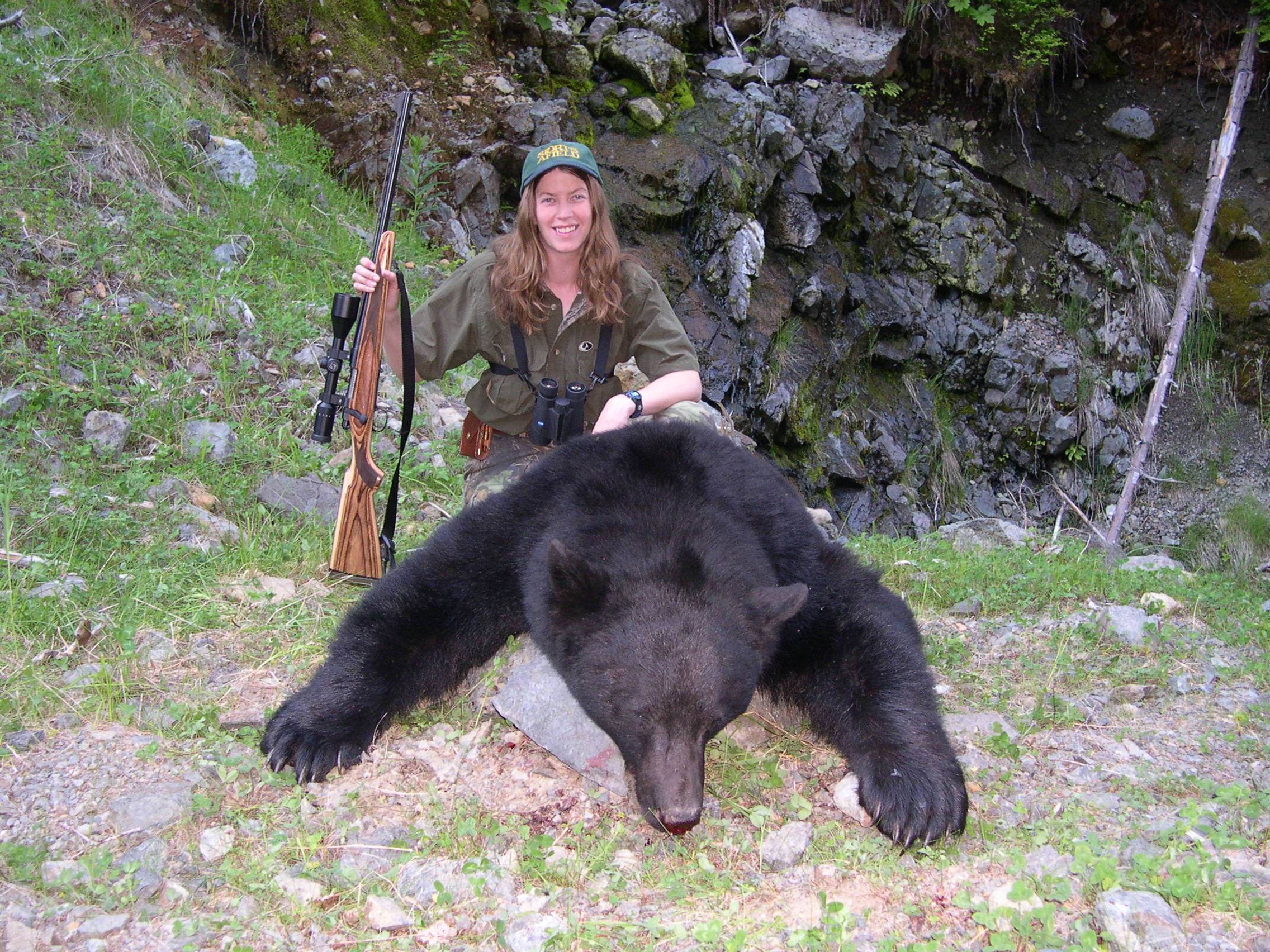
The .300 WSM was the first of the factory short magnums, used to take this big black bear on Vancouver Island in 2001.
Since then, the flood of new factory cartridges has slowed to a trickle. Except for the occasional flurry, that’s the way it has been for a century, with very sporadic new cartridge introductions. That’s probably the way it should be. Between design, tooling, production, and marketing, bringing out a new cartridge is frightfully expensive. Although there were some home runs in that unbelted magnum blizzard at the turn of the millennium, I can’t imagine the cost.
These days, without a constant flood of new cartridges to write about, guys like me must try to be a bit more creative (or retrospective). I don’t want to be curmudgeonly (like the older gunwriters I grew up with!), but I tend to think we have about all the centerfire cartridges we really need, and there’s a lot of redundancy in performance. Hmm, maybe I am becoming a curmudgeon! Unlike my younger days, in recent years I’ve been slower to embrace new cartridges among today’s slow trickle. And, as a writer, I no longer bombard manufacturers with “me first!” pleas.
In this past year, most uncharacteristically, I have spent a bit of time hunting with several fairly new cartridges, including the 6.5mm Creedmoor, 6.5mm PRC, and .350 Legend. The 6.5mm Creedmoor is certainly not “new,” but its rise to stardom has been recent.
I have been publicly (and curmudgeonly) outspoken in my lack of enthusiasm for the 6.5mm Creedmoor. I will not reverse myself. It’s a wonderful example of performance redundancy: Ballistically, it is almost identical to the .260 Remington, and similar to the old 6.5x55mm Swedish Mauser. That is not damning with faint praise: Both the .260 and 6.5×55 are great little cartridges. However, especially in these days of pandemic shortages and political uncertainty, there is much to be said for popular cartridges (which translates to widespread availability).
A .338 RUM accounted for this Lichtenstein’s hartebeest. The 7mm, .338, and .375 Remington Ultra Magnum cartridges were all first used on safari in Tanzania in 2000. All are excellent…but not all have become popular.
I do own a 6.5mm Creedmoor. Great little cartridge, and it offers the advantage of a short, efficient case so, in short actions, it does well with longer, heavier bullets. Because of this, and with the inherent burning efficiency of shorter (and thus relatively fatter) cases, it is probably a better long-range target cartridge than the .260 Remington or the older European 6.5mms. At medium range it is not a better hunting cartridge, and (at least in my opinion) none of these milder 6.5mms carry enough energy to reliably take big game at long ranges.
Depending on size of game and one’s personal definition of “long range,” the faster 6.5mms definitely do. As we know, there is now a spate of them. In part, this is because the Creedmoor’s popularity awakened new interest in the 6.5mm, and bullet selection has greatly expanded. I haven’t used all the new 6.5mms and I probably won’t. But I’ve used several, including the fastest, the 6.5mm Weatherby Magnum and 26 Nosler. This fall, I’ve used both the 6.5mm PRC and the proprietary 6.5mm SST (Sherman Short Tactical). Both (if I can be forgiven a curmudgeonly comment), are ballistically similar to the old .264 Winchester Magnum, introduced in 1958 and hovering on obsolescence. Honest, I had a passing thought that I should rechamber my .264 to a newer case design. Fortunately, the impulse passed! My .264, with a great barrel, is very accurate. And, built on a rare left-hand Santa Barbara Mauser action, it feeds perfectly. It would probably shoot as well with a modern case design, but feeding could be an issue, and not worth the risk.
Unless you’re a serious rifle crank, non-standard (wildcat or proprietary) cartridges are problematic, but the 6.5mm PRC is interesting, with a short, efficient unbelted case, intended for use with today’s long, aerodynamic 6.5mm bullets. This fall, I’m using it in a Springfield Waypoint, a super-modern “tactically inspired” rifle that shoots great. Performance is, well, no different from what I get from the archaic .264, roundabout 3,000 fps with a more-or-less 140-grain bullet. I figure this to be the 6.5mm “sweet spot,” much better downrange performance than is possible with the Creedmoor and its ilk, but not as much muzzle blast and recoil, and not as finicky as the fastest 6.5mms.
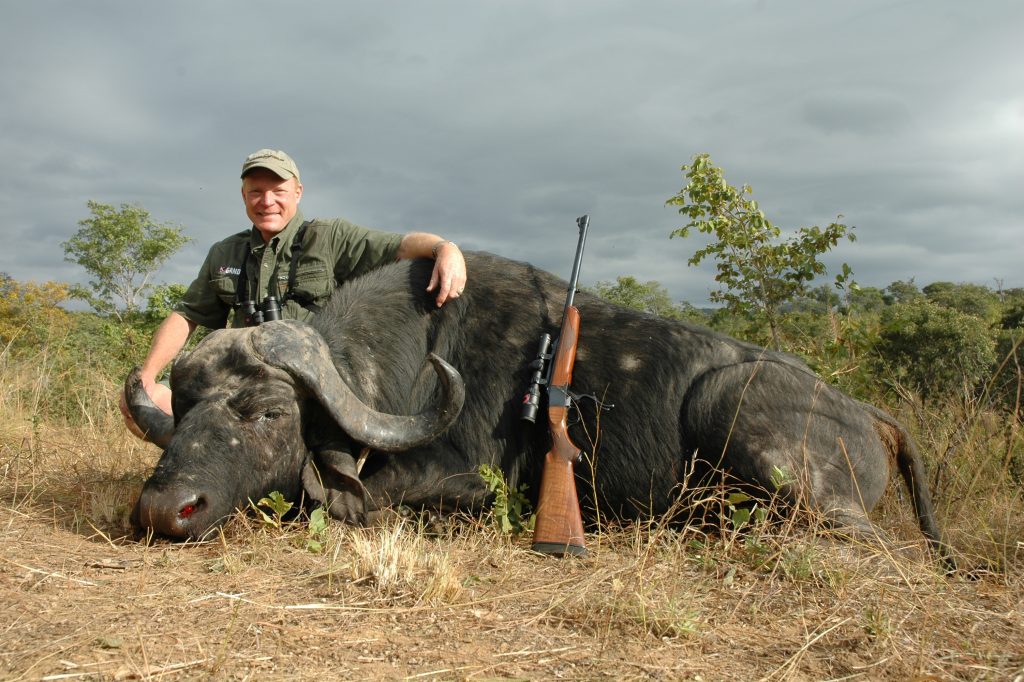
Steve Hornady with a fine Cape buffalo, perhaps the first animal taken with the .375 Ruger, introduced in 2006. Although not as popular as the .375 H&H, it is somewhat faster. Perhaps it has survived on merit…or perhaps because its name doesn’t carry the over-used “magnum” term.
Winchester’s .350 Legend is a classic “purpose-driven” cartridge, intended for use in the (now five) important whitetail states that allow “straight-wall” (and thus relatively short-range) centerfire rifle cartridges in lieu of traditional shotguns with slugs (and muzzleloaders). It is sized to be adaptable to AR platforms, and also other actions. The many American .35-caliber rifle cartridges have traditionally used .358-inch bullets. The Legend uses slightly smaller 9mm bullets (which were standard in European rifle as well as handgun cartridges). This allows manufacturing efficiency, and also lower cost practice ammunition using 9mm pistol bullets.
Larry and Erin Tremaine brought a .350 Legend AR to our Kansas farm last year and took multiple does with it. I haven’t personally used the Legend for deer, but I’m applying in Iowa (which now allows straight-wall cartridges), so I have a Mossberg Patriot in .350 Legend. Although not as fast as the .358 Winchester, it’s faster than the famous old .35 Remington, neither of which would be allowed under straight-wall-cartridge rules. So, I have a Mossberg Patriot in .350 Legend, and I’ve used it to take several wild hogs, very effective.
There are many brave new cartridges I haven’t used, and I certainly won’t get around to all of them. But I’m still willing to try new stuff–provided it makes sense.
Getting caught out in an unexpected snowstorm, whether you’re on foot or in a vehicle, is no joke.
Photo above: Winter is a beautiful time of year, but getting stuck in a white-out can be deadly. Photo by Vic Schendel
Snowstorms can blow in fast and hard. In the mountains, thick, wind-driven snowfalls can quickly cut visibility to a few yards or less. Travel–whether on foot, horseback, or even in a vehicle–can be slow, dangerous, or completely halted. Trails and roads become impassable. It’s very easy to get lost, even in familiar country, and if not lost, then simply stranded and forced to survive the harsh elements.
On the plains, screaming winds can blow snow more sideways than down. There are fresh-snowfall blizzards and blizzards of whipped-up ground snow, and often there is a mixture of both. “Pouderies,” they called these terrible white-outs in the Old West fur-trapper days. There are also “northers,” sudden wind-blasts that seem to appear out of nowhere and turn snow crystals into blinding pellets. Steep temperature drops, severe windchill factors, and a lack of protective cover add to both the misery and danger of being “caught out” in open country.
From autumn into winter, in the mountains and on the plains, snowstorms are responsible for a high percentage of search-and-rescue efforts involving lost or stranded hunters. Most of these hunters end up enduring some pretty grueling ordeals before they are rescued. And of course, some don’t make it. A few hunters survive the experience in pretty good shape. These are the comparative minority who started out well-prepared for a possible snowstorm emergency, and who knew what to do when it occurred.
Although anyone can be surprised and overtaken by a sudden storm, it’s worth noting that often, dangerous snowfall blasts announce their approach well ahead of arrival. Not only does the sky show signs of an incomer, but the storm itself might appear in subtle or obviously progressive stages. Smart hunters maintain an alert weather eye and read environmental clues–such as thickening or darkening clouds (especially those showing increased vertical height and blackened, roiling bottoms), changes in the direction or force of the wind, signs of a falling barometer, and of course the first, possibly light appearance of snowflakes. By accurately reading the weather you can sometimes get a jump on storm arrival and either head immediately for safety or at least locate the best possible place to hunker down and withstand the storm’s brunt and duration.
But let’s say for one reason or another you are caught out, and suddenly realize a bad storm is roaring in, or perhaps has already hit. The initial and vitally important decision is: Should you try to push on anyway, braving the elements while staggering toward ostensible safety, or should you shelter up and ride it out? The best choice depends entirely on the specific situation, but more often than not it’s a mistake to flounder on in low-visibility, high-danger conditions. Too many bad things can happen, and your chances of getting lost, exhausted, frostbitten, hypothermic, or outright killed rise substantially. The exception would be when you know for certain that safety can be reached with a comparatively short, physically plausible effort. Otherwise, at the first sign that you’re caught in a serious storm, it’s generally best to shift into survival mode.
Step one is to survey the surroundings. Where and how can you escape, or at least minimize the brunt of the elements? In a snowstorm this means getting out of the wind and staying or becoming dry. Wind chills can be deadly, and even an imperfect windbreak makes a difference. With any increase in wind exposure, the rate of personal heat loss is exponential. For example, an 8 mph wind whisks away four times more body heat than a 4 mph wind. As for the effect of moisture, you can lose body heat as much as 30 times faster if your skin and clothing are wet. So the need to avoid wind and stay dry is paramount.
Natural windbreaks include thick copses of trees, hollows beneath large conifers, large boulders or rock formations, caves, ravines and (in open country) any kind of trench-like “cut,” coulee, or arroyo. The very best sites are also close to a source of firewood or other easily gathered fuel.
In some circumstances, once you find a good natural windbreak, there will be time and materials to fashion an emergency shelter. In other cases the best you can do is get out of the wind and wrap up in whatever air-and-moisture barrier you have on hand. This could be a tarp, space blanket, hooded parka, rainsuit, heavy-plastic trash bag, and so on. Insulation of various kinds (dry dead leaves, grasses, man-made materials) can be stuffed inside the wrap and also inside your clothing to help retain warmth.
In very open country, such as the northern plains, the only way out of the wind might be by digging a deep, narrow trench in the snow, lining its bottom with whatever insulating or water-resistant materials are on hand, and lying down inside, literally beneath the blowing storm, while you wait for it to pass over. This is hardly pleasant, but many people, including plains Indians and frontiersmen, used the tactic to survive when other, less savvy individuals stayed above ground and perished.
In any type of terrain, if you locate a good wind-and-snow-break and have ample fire fuel on hand, you can survive a storm simply by building a large fire (making it longer, not taller, to warm more of your body) and positioning yourself between the fire and a heat-reflecting surface such as a boulder, rock wall, or the metallic side of a space blanket.
When time and materials allow, the optimal strategy is to fashion an emergency shelter, especially one combined with a warming fire. Shelter-making is a huge subject, but a few basic tips can be helpful. First, unless you’ve trained in shelter building, go for the simplest possible construction. One example is the basic lean-to. Start with two sturdy 3- to 4-foot sticks sharpened and driven into the ground on an angle so that they cross at the top, forming a V. Then use a 6- to 8-foot stick/branch for a ridgepole, resting one end inside the V, angling the remaining length down to the ground. Lash these tight if possible. A tarp or space blanket can be draped over this frame and pegged down to make an open-faced shelter (facing away from the wind). Seal the base area, where the tarp meets the ground, with packed snow. Additional snow can be packed up the walls to aid insulation. (Lacking a tarp, layer in branches, conifer boughs, and other natural materials to form the sides and top of the shelter, then seal everything off with a tight packing of snow.) The ground inside the shelter should be insulated with whatever dry material is available. If a fire can be built near the mouth of the lean-to, all the better.
For modern hunters, the dangers of a snowstorm or blizzard exist not only in the field, but also inside our motorized vehicles. Getting storm-stranded on a highway or back road can be its own kind of life-or-death survival situation. The most important thing to remember if you have to shelter in a vehicle during a snowstorm is that carbon monoxide (CO) poisoning is a real danger. About 1,500 people in America die in their cars each winter from CO poisoning, usually while stranded and running their engines and heaters to stay warm. When drifting snow (or packing from a slide-off) clogs the exhaust pipe, fumes back up and leak into the interior. Odorless CO kills people before they even realize they are being poisoned. So rule number one: check periodically to be sure your exhaust pipe is cleared of all snow.
Next, when a storm is raging, stay with your car unless help is clearly reachable. Bundle up to stay warm, and run the engine and heater in ten or fifteen minute intervals to preserve fuel. If fuel runs out, the vehicle might not remain your best shelter, but it can still be a source of lifesaving resources. A hubcap can be used to dig a snow cave or trench, or it can serve as a dry fire-base. Dipstick oil soaked into a rag or paper makes a good firestarter. Maps can be rolled tight to serve as kindling. Slash open seats and use the foam for insulation to be stuffed inside coats or boots. Floor mats can be wrapped around your torso, legs or feet; or they can be used as insulating, waterproof ground pads for an outdoor shelter. When cold-storm strandings are a possibility, it’s smart to prep your vehicle with a shovel, a winter-rated sleeping bag, and a pair of lightweight snowshoes for each person aboard. Add an axe and some pre-split logs in case you need to rely on an emergency outdoor fire.
When dangerous snowstorms hit, those who have the good sense to “be prepared” generally fare best, with the least misery and injury. Where I live in the Rockies, even mid-September can be snow time in the high country, and from October on, both the mountains and the plains are fair targets for northers, snow dumps, and even white-out “pouderies.”
For me, essential equipment (in addition to a standard survival kit) includes: an overkill of firestarters (matches, lighters, candle stubs, home-made tinder, commercial fire cubes, metal-match “sparking” device); a lightweight shelter tarp; at least one metallic-sided space blanket; four heavyweight yard-size plastic trash bags (for extra wind and moisture protection, vapor barriers, etc.); a large metal cup and spoon (for snow-melting water and emergency cooking); a lightweight, plastic digging tool (to aid emergency shelter-building); a 25-foot roll of parachute cord; commercial hand and foot warming packets and insoles; spare wool socks; a balaclava or similar head and neck covering; gloves and/or mittens, and a “food sack” containing high-energy protein bars, packets of dried soup and a wide-mouthed plastic bottle of energy-enhanced, extra-crunchy peanut butter. If I’m going to suffer a night or two out in a snowstorm, I’m going to suffer as comfortably as possible.
International travel may be out of the question this year, but you can still put together an interesting late-season hunting adventure.
Covid-era travel restrictions continue to be devastating to the hunting industry worldwide. Outfitters, guides, PHs, travel agents, taxidermists, shippers, camp staff, and wildlife are all suffering. With international travel mostly prohibited, we are left to innovate. Many are rebooking to 2021 and beyond, but that leaves the remaining fall and winter hanging like a fat plum. How should we pluck it?
By all accounts, U.S. outfitters have been swamped with clients looking to replace canceled hunts. Still, it’s worth a try: call your favorite outfitters or hunting consultants, and you may find an opening for a late-season hunt. Last-minute cancellations are always a possibility. Otherwise, get ready to return to those thrilling days of yesteryear when a hunting adventure meant a road trip, a do-it-yourself camp, and self-guided hunting.
Hundreds of thousands of hunters plan and execute their own trips each year. It seems that right now the public land/backcountry hunt is “in.” On TV shows and YouTube, celebrity hunters are challenging each other and themselves to see who can carry the most, hike the farthest, climb the highest, and cook the finest venison. This is a marked improvement over the “drive and shoot from the truck” ethos of too many hunters decades ago. Bravo to those dedicated, tough young hunters, but if you’re an old-timer, don’t feel as if DIY hunts have passed you by. Not too many years ago I had the pleasure of sharing an elk hunt with a guide who was in his early seventies. I couldn’t quite keep up with him! He’s now in his eighties–and still climbing the mountains.
The biggest stumbling block to any DIY deer, elk, or black bear hunt these days is limited tags. Very few western states still sell over-the-counter non-resident tags. Some states, however, hold late-season depredation hunts to alleviate deer and elk pillage on private farms and ranches. There are also Midwestern and eastern whitetail hunts, and a few bear hunts, as late-season DIY options.
One destination to consider: Texas. Texas has almost no public land hunting, but its private ranches offer the widest variety of big game in North America. Much of it is behind fences, but some of those fences are so far apart that the game itself probably hasn’t seen them. New Mexico allows landowners to sell big-game tags, so you might try there. Hawaii is a good bet for axis deer, mouflon sheep, and Spanish goats. (At this writing, travelers to most islands in Hawaii may bypass the state’s mandatory quarantine with proof of a negative Covid test, but be sure to check for the most recent requirements.)
Another overlooked big-game hunting option: Alligators. Check out our southern states from Texas to Florida. And as long as you’re looking south, don’t forget feral hogs. They can be hunted year-round in many states, with no limit. Do Mother Nature a favor and help trim the hogs.
Feral hogs are widespread in many southern states and in California, with never-ending seasons and unlimited tags available.
Should you fail to put together a late-season big-game hunt, set your sights on birds, waterfowl, and small game. South Dakota, Nebraska, and Kansas pheasants are always a good bet. Southwest desert quail are hit or miss depending on recent rains. Check with fish and game agencies. If bird numbers are up, go. In addition to enjoying good hiking and shooting, you might discover a new pronghorn, Coues deer, mule deer, or elk destination.
Ducks Unlimited reported good nesting conditions across much of Canada this spring, so waterfowl numbers should be good to excellent. By November 10th, the northern mallards are pouring into South Dakota. Snow geese usually precede them by a week. Canada geese? They’ve gone from rare trophies to darn near vermin in my lifetime. If you can’t put together a Canada goose hunt, you aren’t trying—and seasons in many places extend through winter into early spring.
Finally, there are squirrels and rabbits. Don’t laugh. During the first half of the twentieth century, these were the two most commonly hunted species in the U.S. Much of the reason was because big game hadn’t yet recovered from the overharvest of the previous century. But plenty of the reason was because stalking squirrels and cottontails is quintessential hunting. These days it’s lonely, too, because so few indulge. Slip a handful of .22 Long Rifle shells in your pocket, tuck a sub-MOA rimfire rifle under your arm, and stroll into the hardwoods, watching, listening, and calling for gray and fox squirrels. I’ll bet you’ll forget all about your missed kudu and buffalo hunt–for a few hours, at least.
Small game hunts have the advantage of no tags to draw, large bag limits, and delectable dining. Who knows? Without the worry and hassles of travel, you may rediscover the simple joys of uncomplicated hunting the way it was done back when sportsmen and women merely walked out the back door, loaded up, and started hunting.
North America is home to some of the finest public land bird hunting in the world. Pheasant hunting in the Plains states is open and productive through December and even January.
Rowland Ward joins other conservation groups in taking a stand against the shooting of captive-bred lions.
Rowland Ward Ltd. has united with several highly regarded international conservation groups to take a firm stand against the practice of captive-bred lion shooting.The shooting of lions bred in captivity not only has no conservation benefit, but also it is extremely damaging to the reputation of hunters and to sustainable hunting around the world.
Last month, the International Council for Game and Wildlife Conservation (CIC) and Dallas Safari Club’s (DSC) published a joint statement on captive bred lion shooting. Today Rowland Ward Ltd., the International Professional Hunters’ Association (IPHA), the African Operators’ and Professional Hunters’ Associations of Africa (OPHAA), and the African Professional Hunters Association (APHA) have joined as co-signatories to the statement, which you can read below.
This new optic is Leica’s first long-range riflescope with 6x zoom.
When it comes to accuracy at a distance, long-range shooters can rely on the uncompromising technology of the new Leica PRS 5-30x56i riflescope. Its generous magnification range of 5x to 30x offers many uses for both competitive settings and long-range sport shooting and hunting – at extended distances and under the most difficult conditions. Maximum optical performance gives a shooter high light transmission (>90%), and high contrast images while maintaining increased eye relief and color fidelity, giving the shooter the ability to concentrate fully on the target in any conditions. The reticle’s large adjustment range in the first focal plane also gives the shooter the ability to shoot at extended ranges.
Both the elevation and windage turrets exhibit well-defined tactile clicks that are accurate and precise throughout its entire range. Thanks to tool-free zeroing of the turret, precision sport shooters can react quickly and flexibly to different conditions. What’s more, the shooter can either activate the “zero stop” function or configure it individually, adapting the riflescope to custom requirements without the need for additional tools.
The functional design of the PRS 5-30x56i is also geared to the needs of long-range shooters: Made exclusively of robust metal components, it is extremely rugged while maintaining mechanical precision.
Features include:
6x zoom for flexible use during long-range sport shooting and competitions
• 32 mrad (>100 MoA) adjustment range of the reticle in the first focal plane
• tool-free zeroing of the turret scales, onboard tool for “zero stop”
• extremely rugged, high-quality workmanship maintain mechanical and optical precision